
Study Guides
IGCSE Accounting: Other payables, other receivables and irrecoverable debts (Cambridge 0452)
Cambridge IGCSE Accounting 0452 study guide to accruals, prepayments, irrecoverable debts, debts recovered and the allowance, with journals and ledgers.
- Subject
- Accounting
- Level
- IGCSE, O LEVELS
- Topic
- Accounting procedures
- Author
- Marlbridge Academic Team
- Updated
- Reviewed by
- Javaid Iqbal Sabri (what this means)
Aligned to Cambridge IGCSE O Level Accounting (0452, 7707), 2027-2029. Official specification (IGCSE) ; Official specification (O Level) .
Syllabus page (what it covers and how it is assessed): Cambridge IGCSE Accounting; Cambridge O Level Accounting.
Syllabus points this page covers
0452
- 4.3 Other payables and other receivables
- 4.4 Irrecoverable debts and allowance for irrecoverable debts
7707
- 4.3 Other payables and other receivables
- 4.4 Irrecoverable debts and allowance for irrecoverable debts
Found an error? Report a correction.
Want a teacher for this? Marlbridge teaches Accounting online. Request a free trial class.
Syllabus edition note. This resource follows the Cambridge IGCSE Accounting 0452 syllabus (and Cambridge O Level Accounting 7707, which has the same subject content for the same series) for exams in 2027, 2028 and 2029 (version 1), first examined in the March 2027 series in India and the June 2027 series elsewhere. If you sit 0452 in November 2026, you sit the 2026 syllabus (version 2), which differs: Paper 1 has 35 multiple-choice marks in 1 hour 15 minutes, not 40 marks in 1 hour 30 minutes; Topic 7 is “Accounting principles and policies”, without 7.2 Ethical considerations or 7.3 Technology and sustainability; 4.4 is “Irrecoverable debts and provision for doubtful debts”; income statements are named instead of statements of profit or loss; three-column running balance accounts are not required; Clubs and societies is 5.4 and Manufacturing accounts 5.5; and 6.3 is “Inter-firm comparison”. For this topic, the 2026 syllabus says “recovery of debts written off” where the 2027-2029 syllabus says “irrecoverable debts recovered”, asks for simple inventory valuation statements, and does not separately list choosing a depreciation method for each type of non-current asset, journal entries for purchasing a non-current asset, or calculating the profit or loss on disposal. If you sit in November 2026, work from the 2026 syllabus on the Cambridge International website.
This study guide covers sections 4.3 (Other payables and other receivables) and 4.4 (Irrecoverable debts and allowance for irrecoverable debts) of the Cambridge IGCSE Accounting 0452 syllabus for exams in 2027, 2028 and 2029 (version 1). The subject is not tiered, and according to the syllabus both papers draw on all of its content. This page goes further into these two sections than the wider Accounting Procedures study guide, so use the two together. Then test yourself with the revision notes and the practice questions. Also see the Cambridge IGCSE Accounting hub, the printable checklist and the free diagnostics.
What the syllabus asks you to do
| Section | Outcome |
|---|---|
| 4.3 | Importance of matching costs and revenues |
| 4.3 | Apply matching / accruals using accruals and pre-payments |
| 4.3 | Journals and ledgers: accrued and prepaid expenses |
| 4.3 | Journals and ledgers: accrued and prepaid incomes |
| 4.4 | Meaning of irrecoverable debts and debts recovered |
| 4.4 | Journals and ledgers: irrecoverable debts, and debts recovered |
| 4.4 | Need for an allowance for irrecoverable debts |
| 4.4 | Journals and ledgers: creation of, and adjustments to, the allowance |
Matching and why it matters
Under the matching / accruals concept, a period carries the expenses it incurred and the incomes it earned, whether or not cash moved in it. Use cash instead and a year in which two insurance premiums happened to be paid looks worse than it was, which misleads owners and lenders.
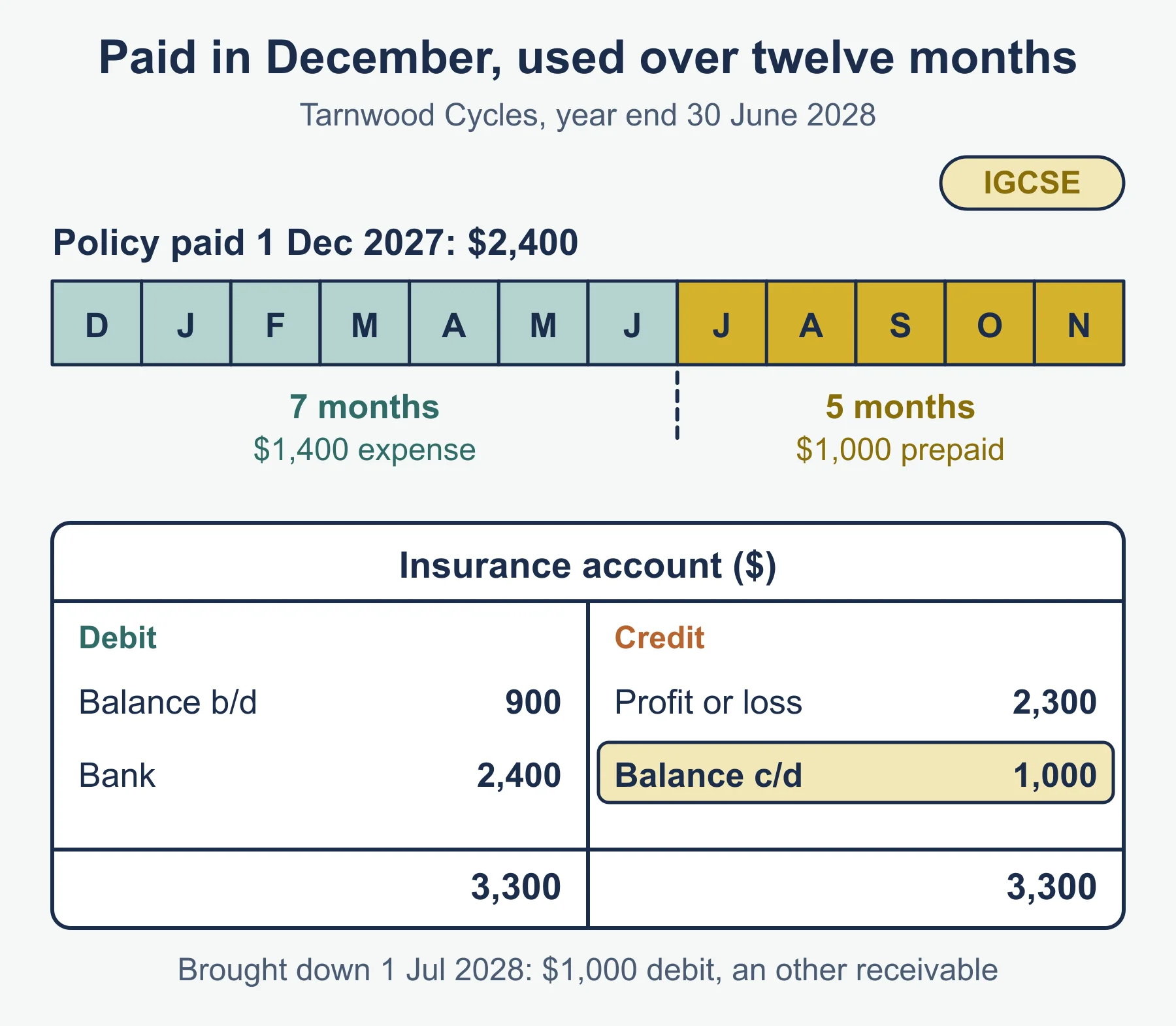
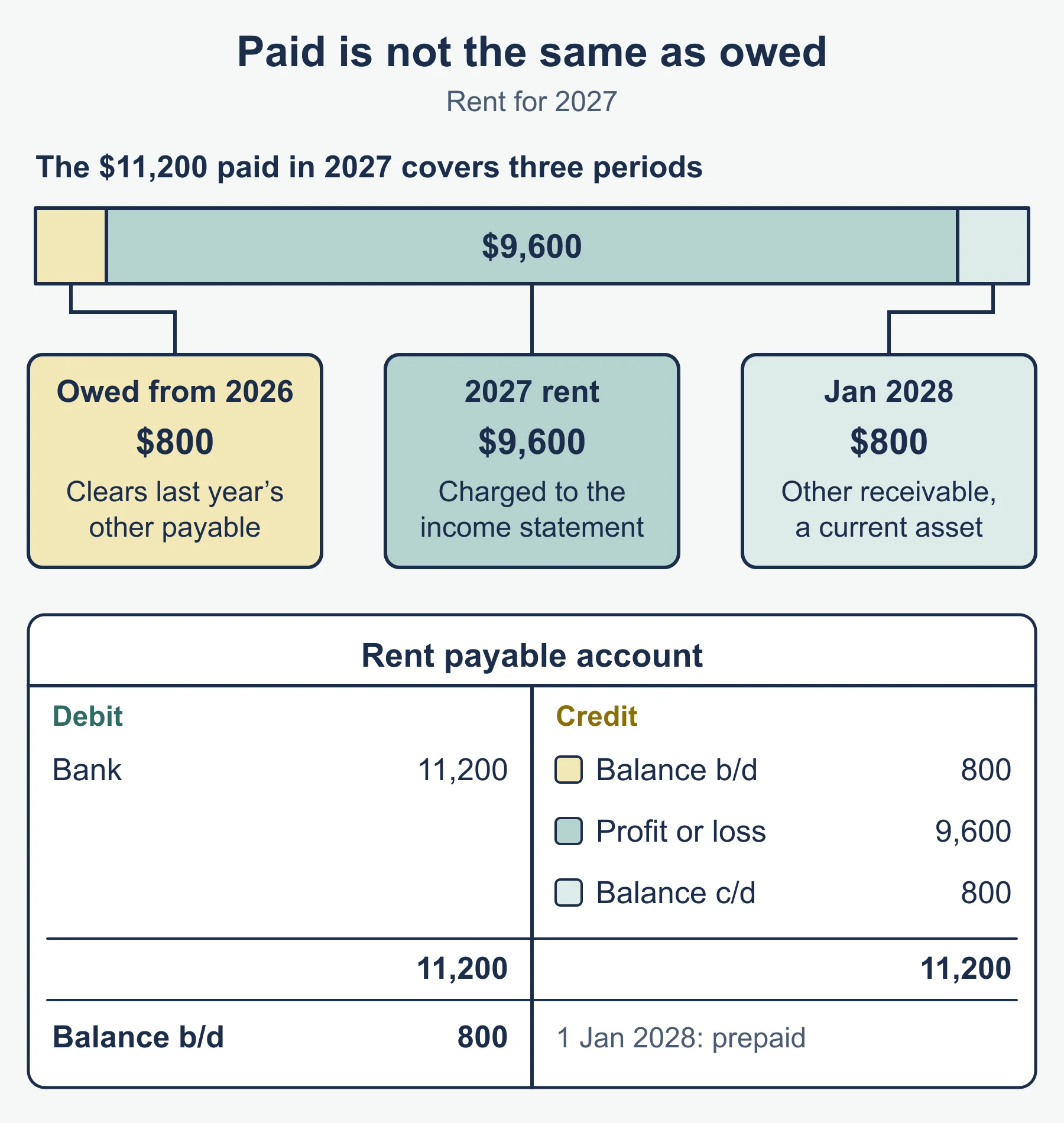
Tarnwood Cycles, a sole trader with a 30 June year end, paid $2,400 on 1 December 2027 for twelve months of insurance. Only seven months (December to June) fall in the year to 30 June 2028, which is $1,400. The other five months, $1,000, serve next year, so at the year end they are an asset: a prepaid expense.
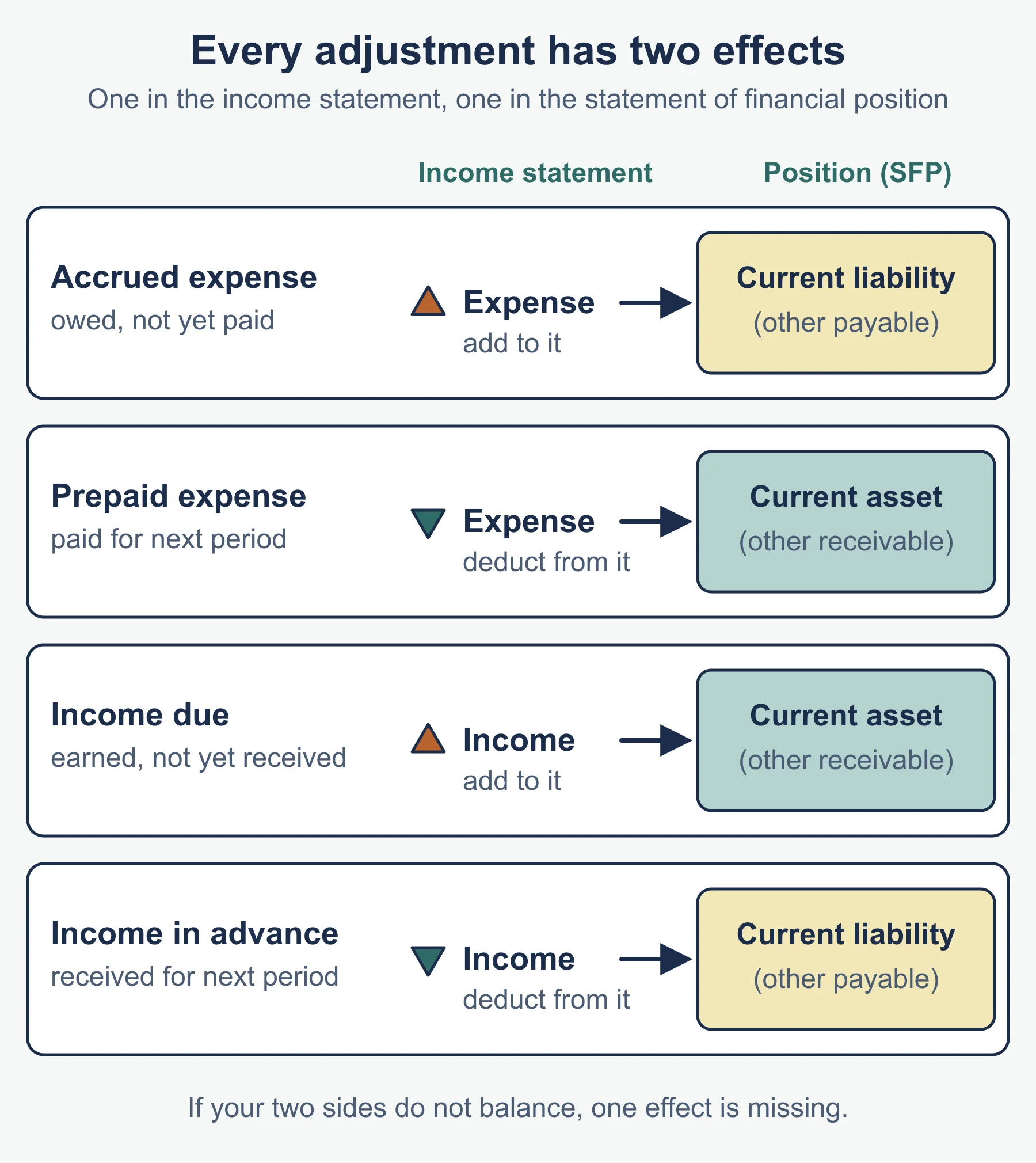
In this guide, other payables are amounts the business owes that are not trade purchases, and other receivables are amounts due to the business, or paid ahead, that are not from trade customers. Both are current items in the statement of financial position.
| Adjustment | Meaning | Year-end journal | Balance b/d |
|---|---|---|---|
| Accrued expense | Used, not yet paid | Dr Expense, Cr Other payables | Credit |
| Prepaid expense | Paid, benefits next year | Dr Other receivables, Cr Expense | Debit |
| Accrued income | Earned, not yet received | Dr Other receivables, Cr Income | Debit |
| Income received in advance | Received, earned next year | Dr Income, Cr Other payables | Credit |
Ledger method for any expense or income account:
- Enter the opening balance. An expense account opens with a debit if prepaid and a credit if accrued. An income account opens with a credit if received in advance and a debit if accrued.
- Enter the cash paid or received.
- Work out the closing balance by time-apportioning: months in the year divided by months paid for, times the amount.
- Carry that balance down on the side that lets the account balance, and bring it down on the opposite side.
- Whatever makes the account balance is moved to the statement of profit or loss.
Worked example: Tarnwood Cycles, year ended 30 June 2028
Insurance (prepaid expense). The previous policy ran to 30 November 2027, so $900 was prepaid on 1 July 2027. The new policy leaves $1,000 prepaid.
Insurance account ($)
Date      Details                Amount  Date      Details                Amount
1 Jul 27  Balance b/d               900  30 Jun 28 Profit or loss          2,300
1 Dec 27  Bank                    2,400  30 Jun 28 Balance c/d             1,000
                                 ------                                   ------
                                  3,300                                    3,300
                                 ======                                   ======
1 Jul 28  Balance b/d             1,000
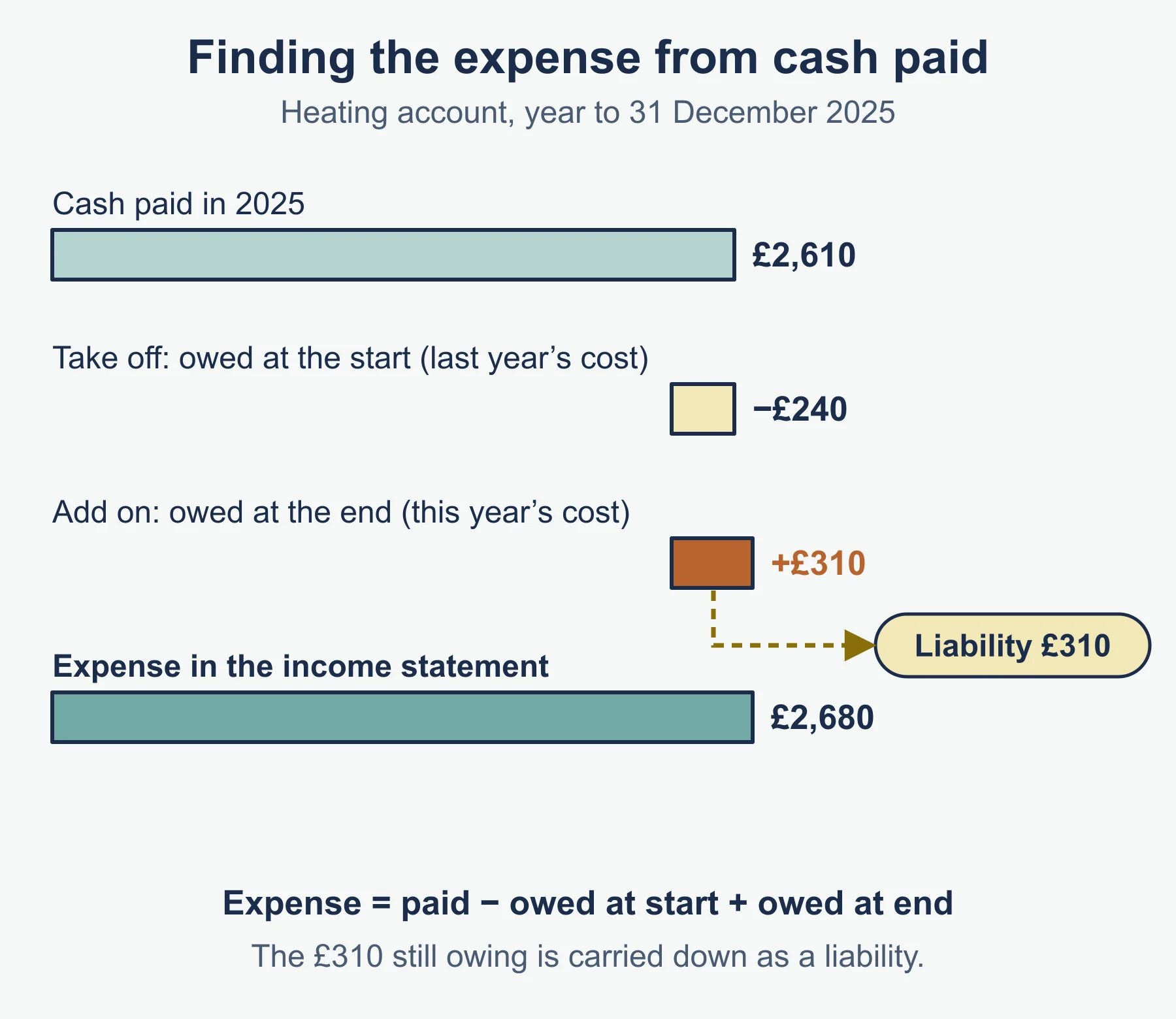
Wages (accrued expense). The amounts in dollars: 380 owing on 1 July 2027, 14,260 paid in the year and 440 owing at 30 June 2028.
Wages account ($)
Date      Details                Amount  Date      Details                Amount
Various   Bank                   14,260  1 Jul 27  Balance b/d               380
30 Jun 28 Balance c/d               440  30 Jun 28 Profit or loss         14,320
                                 ------                                   ------
                                 14,700                                   14,700
                                 ======                                   ======
                                         1 Jul 28  Balance b/d               440
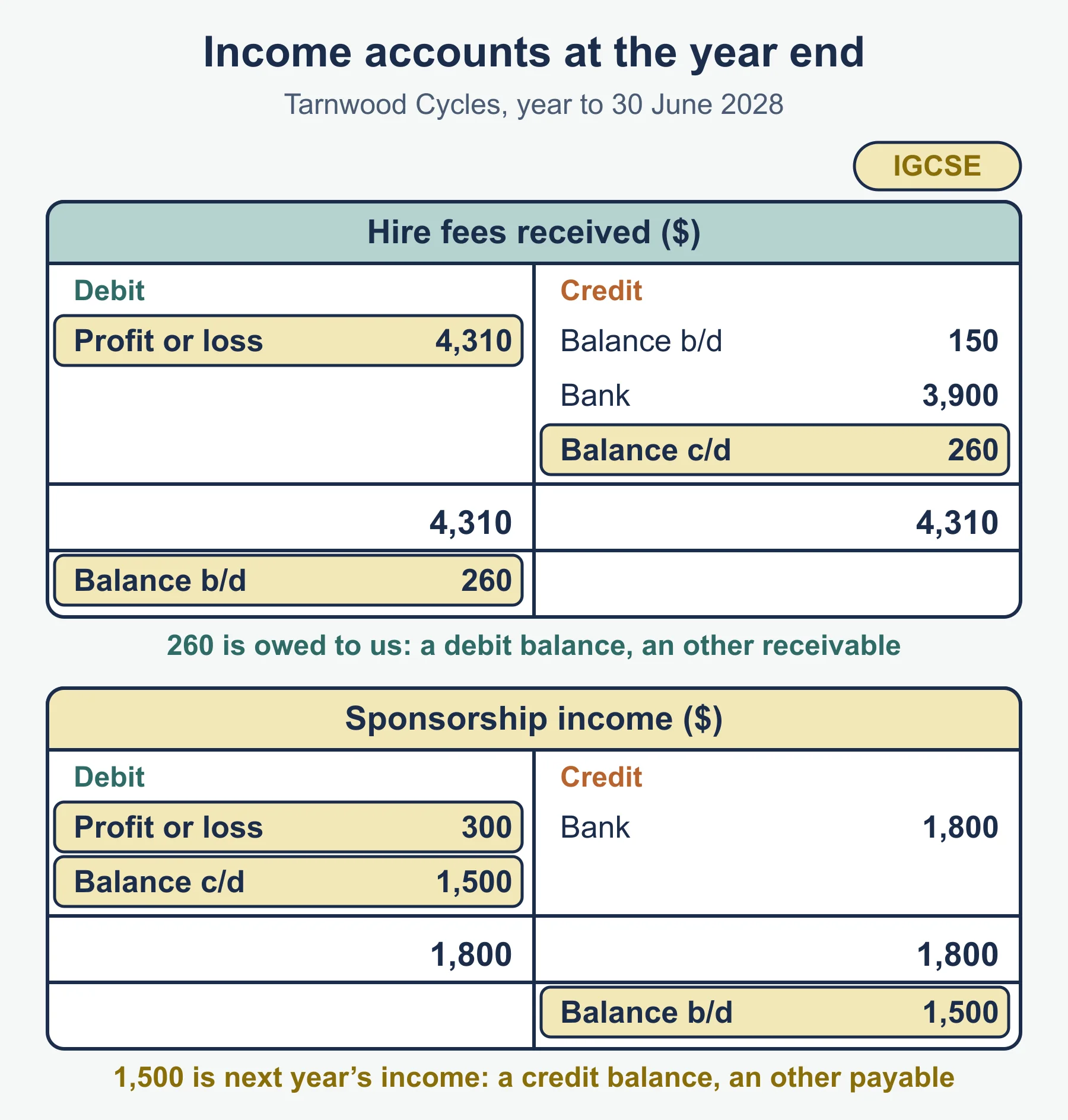
Hire fees received (accrued income). The business lets out a workshop bay. A customer had paid 150 in advance on 1 July 2027. During the year 3,900 was received. At 30 June 2028 a customer owes 260 for June.
Hire fees received account ($)
Date      Details                Amount  Date      Details                Amount
30 Jun 28 Profit or loss          4,310  1 Jul 27  Balance b/d               150
                                         Various   Bank                    3,900
                                         30 Jun 28 Balance c/d               260
                                 ------                                   ------
                                  4,310                                    4,310
                                 ======                                   ======
1 Jul 28  Balance b/d               260
The opening credit balance is earned this year, so it adds to income. The closing figure is entered on the credit side as balance c/d and appears as a debit when brought down, because the money is owed to the business.
Sponsorship (income received in advance). On 1 May 2028 a club paid $1,800 for twelve months. Two months, $300, are earned by 30 June; $1,500 is for next year.
Sponsorship income account ($)
Date      Details                Amount  Date      Details                Amount
30 Jun 28 Profit or loss            300  1 May 28  Bank                    1,800
30 Jun 28 Balance c/d             1,500
                                 ------                                   ------
                                  1,800                                    1,800
                                 ======                                   ======
                                         1 Jul 28  Balance b/d             1,500
Journal, 30 Jun 28 ($) Dr Cr
Other receivables (prepaid insurance) 1,000
Insurance 1,000
Wages 440
Other payables (accrued wages) 440
Other receivables (accrued hire fees) 260
Hire fees received 260
Sponsorship income 1,500
Other payables (income in advance) 1,500Statement of financial position extract, 30 Jun 28 ($)
Current assets
Other receivables (1,000 + 260) 1,260
Current liabilities
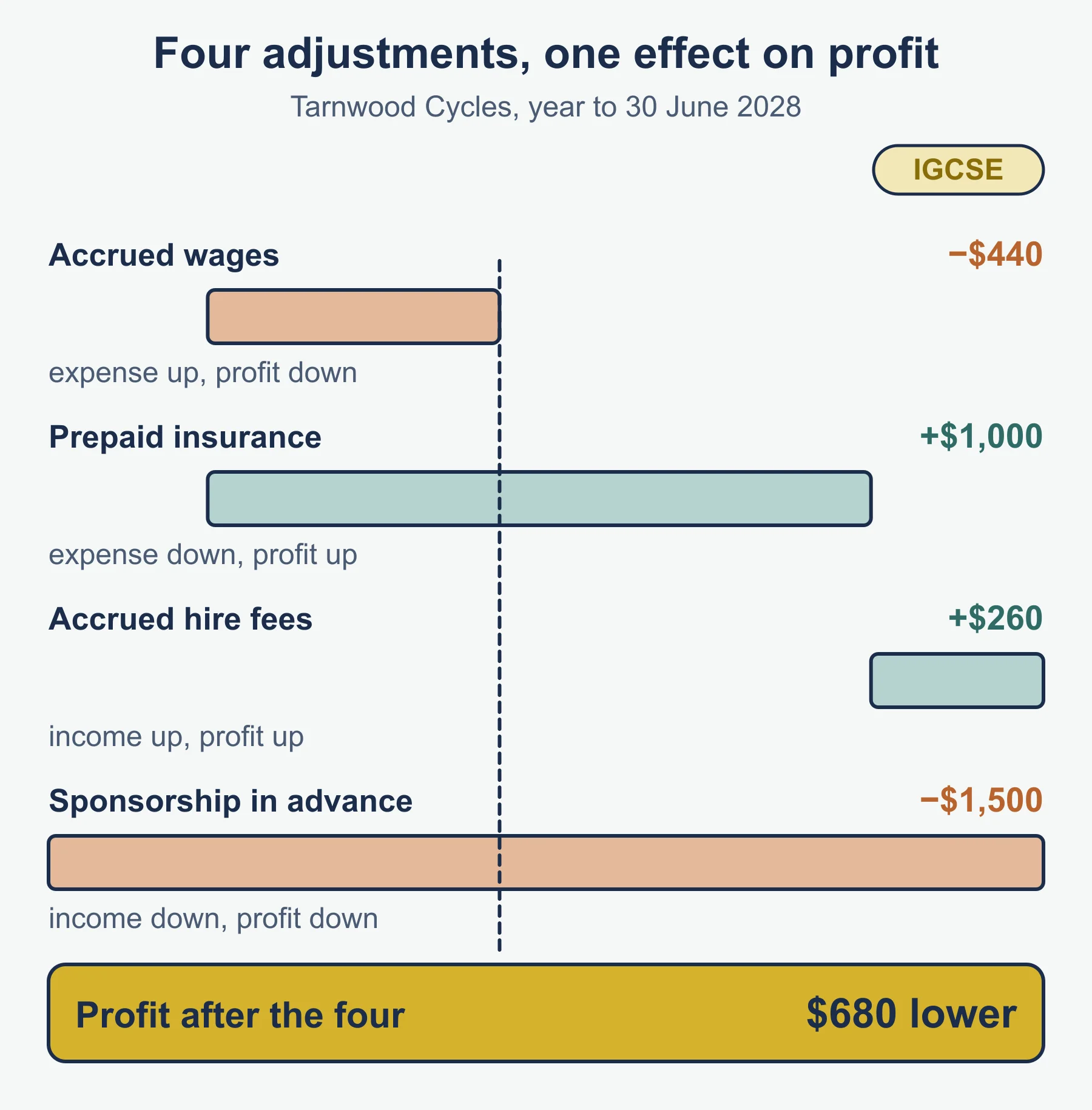
Other payables (440 + 1,500) 1,940Taken together, these four year-end adjustments leave profit $680 lower than if all four were left out. The table shows the effect of leaving each adjustment out:
| If you leave out | Profit | Statement of financial position |
|---|---|---|
| Accrued wages | Overstated by $440 | Liabilities understated |
| Prepaid insurance | Understated by $1,000 | Assets understated |
| Accrued hire fees | Understated by $260 | Assets understated |
| Sponsorship in advance | Overstated by $1,500 | Liabilities understated |
Irrecoverable debts
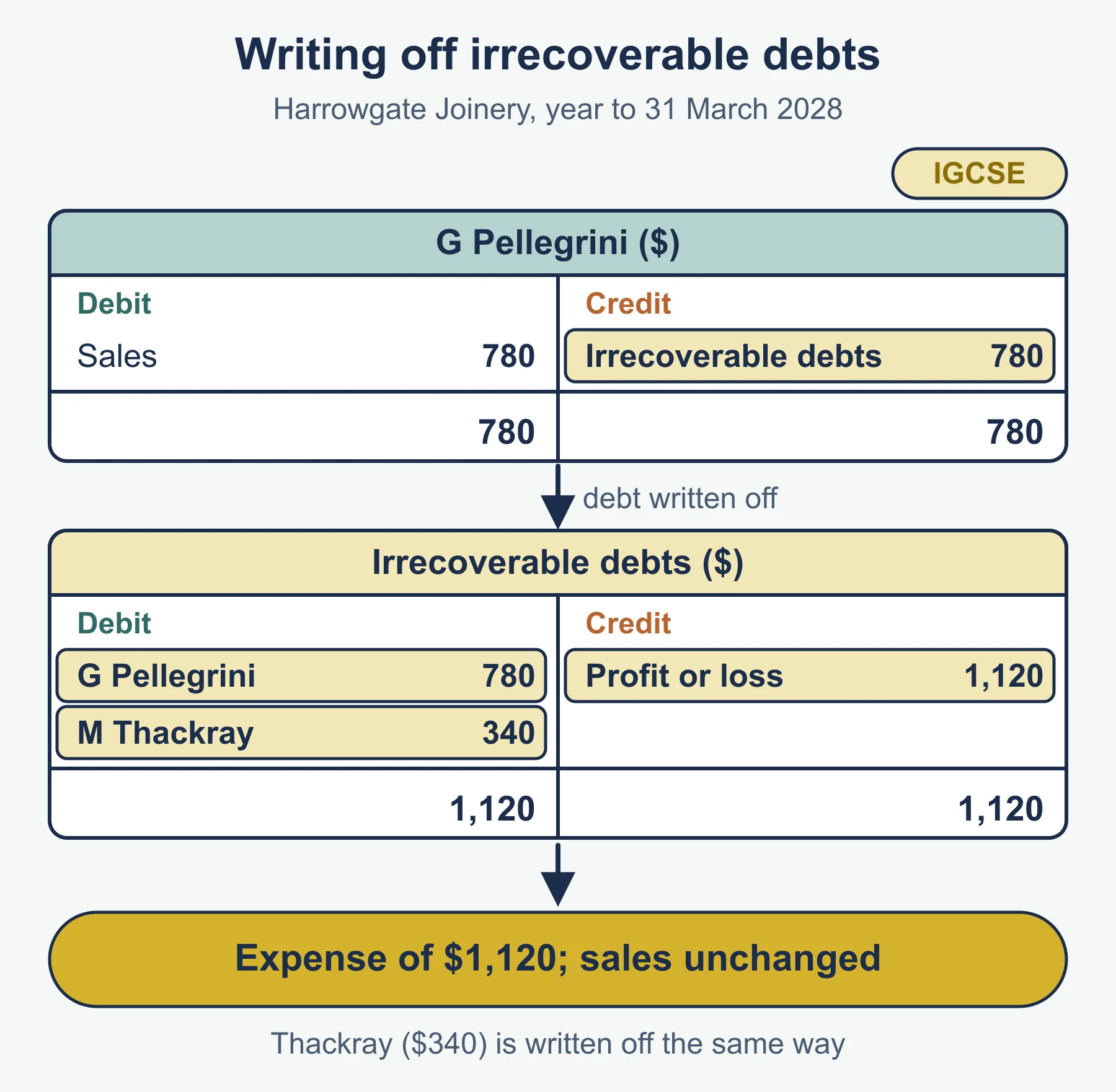
An irrecoverable debt is money due from a credit customer that the business has given up expecting, for example because the customer is bankrupt or cannot be traced. The sale was already recorded as revenue, so the loss is an expense and sales are left unchanged. Journal: Dr Irrecoverable debts, Cr the customer.
Harrowgate Joinery has a 31 March year end. G Pellegrini owed $780 from a sale on 14 October 2027 and was declared bankrupt on 12 February 2028. On 20 March 2028 the business learned that M Thackray’s company, which owed $340, had closed.
G Pellegrini account ($)
Date      Details                Amount  Date      Details                Amount
14 Oct 27 Sales                     780  12 Feb 28 Irrecoverable debts       780
                                 ------                                   ------
                                    780                                      780
                                 ======                                   ======
Irrecoverable debts account ($)
Date Details Amount Date Details Amount
12 Feb 28 G Pellegrini 780 31 Mar 28 Profit or loss 1,120
20 Mar 28 M Thackray 340
------ ------
1,120 1,120
====== ======Trade receivables fall by 1,120 dollars, and the whole amount is treated as a cost of the year in the statement of profit or loss.
Irrecoverable debts recovered
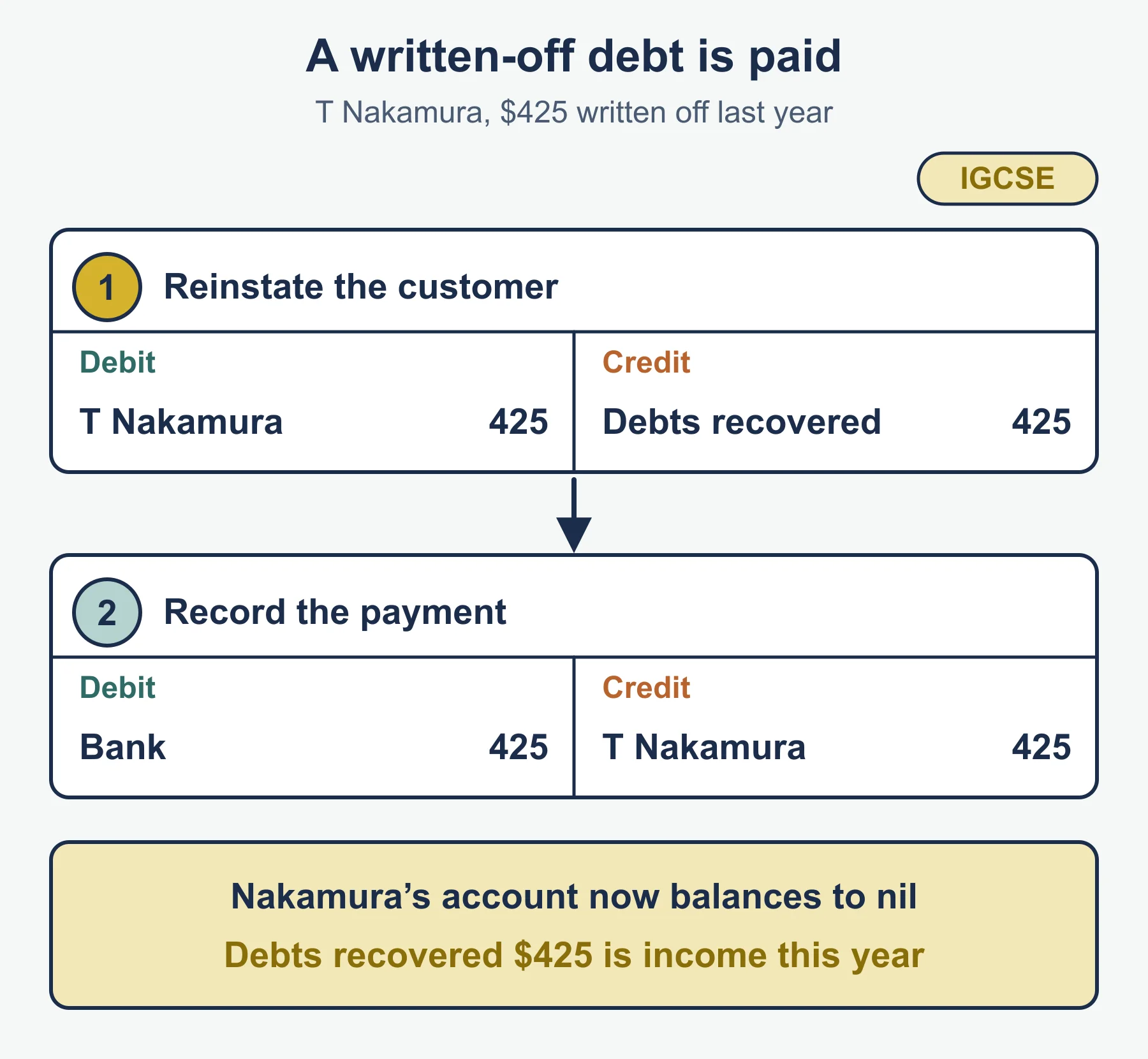
A debt written off in an earlier year may later be paid. T Nakamura’s $425 was written off in the year to 31 March 2027, and on 9 February 2028 he paid in full by cheque. Reinstate the debt first, so his account shows the whole history, then record the money.
Journal, 9 Feb 28 ($)                          Dr      Cr
T Nakamura                                    425
   Irrecoverable debts recovered                      425
Bank                                          425
   T Nakamura                                         425
T Nakamura account ($)
Date Details Amount Date Details Amount
9 Feb 28 Debts recovered 425 9 Feb 28 Bank 425
------ ------
425 425
====== ======Irrecoverable debts recovered account ($)
Date Details Amount Date Details Amount
31 Mar 28 Profit or loss 425 9 Feb 28 T Nakamura 425
------ ------
425 425
====== ======(The details column says Debts recovered to save space.) The recovery is income of the year in which it is received.
Why keep an allowance
The business cannot tell which customers will fail to pay, but some year-end trade receivables will probably not be collected. Without an allowance, trade receivables are shown at more than the business expects to receive, and the cost of the loss falls in a later year than the sale. The allowance is an estimate that applies matching / accruals and prudence. It is usually given as a percentage.
- Write off the known irrecoverable debts first.
- Allowance required = percentage × remaining trade receivables.
- Compare it with the existing allowance balance.
- An increase is an expense: Dr Statement of profit or loss, Cr Allowance. A decrease is income: Dr Allowance, Cr Statement of profit or loss.
- In the statement of financial position, deduct the full allowance from trade receivables.
Harrowgate’s policy is 5%. In the first year the allowance is created. In the second year receivables are 41,400 before the 1,120 of write-offs. In the third year collections have improved, so the rate falls to 4%. Figures are in dollars.
| Year end | Remaining trade receivables | Rate | Allowance required | Change |
|---|---|---|---|---|
| 31 Mar 2027 | 29,600 | 5% | 1,480 | Created: expense 1,480 |
| 31 Mar 2028 | 40,280 | 5% | 2,014 | Increase: expense 534 |
| 31 Mar 2029 | 34,000 | 4% | 1,360 | Decrease: income 654 |
Year one: Dr Statement of profit or loss 1,480, Cr Allowance 1,480. Year three: Dr Allowance 654, Cr Statement of profit or loss 654.
Allowance for irrecoverable debts account ($)
Date      Details                Amount  Date      Details                Amount
31 Mar 27 Balance c/d             1,480  31 Mar 27 Profit or loss          1,480
                                 ------                                   ------
                                  1,480                                    1,480
                                 ======                                   ======
31 Mar 28 Balance c/d             2,014  1 Apr 27  Balance b/d             1,480
                                         31 Mar 28 Profit or loss            534
                                 ------                                   ------
                                  2,014                                    2,014
                                 ======                                   ======
31 Mar 29 Profit or loss            654  1 Apr 28  Balance b/d             2,014
31 Mar 29 Balance c/d             1,360
                                 ------                                   ------
                                  2,014                                    2,014
                                 ======                                   ======
                                         1 Apr 29  Balance b/d             1,360
Statement of financial position extract, 31 Mar 28 ($)
Trade receivables 40,280
Less allowance for irrecoverable debts 2,014
------
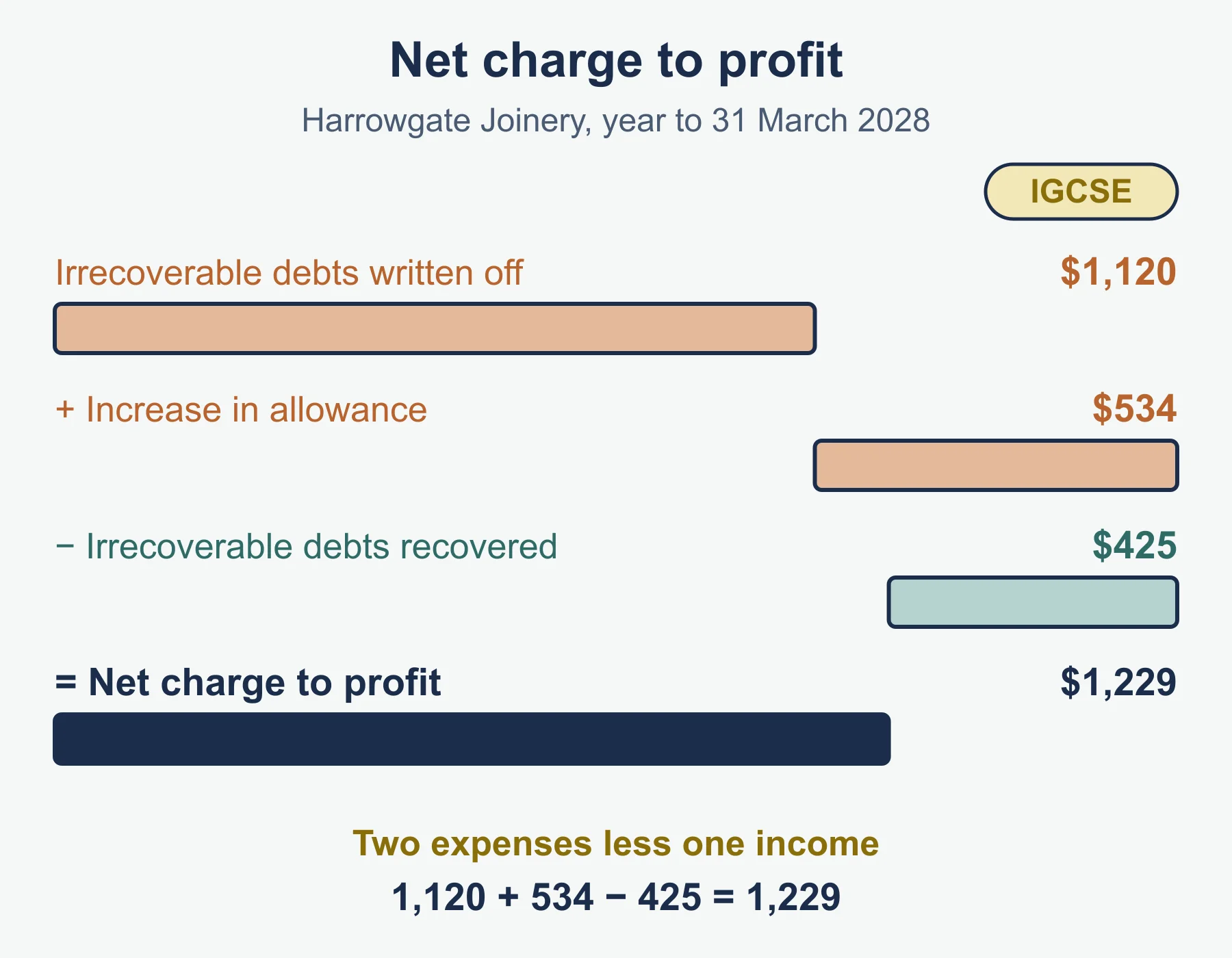
38,266Statement of profit or loss effects, year to 31 Mar 28 ($)
Expense: irrecoverable debts 1,120
Expense: increase in allowance 534
Income: irrecoverable debts recovered 425
Net charge to profit 1,229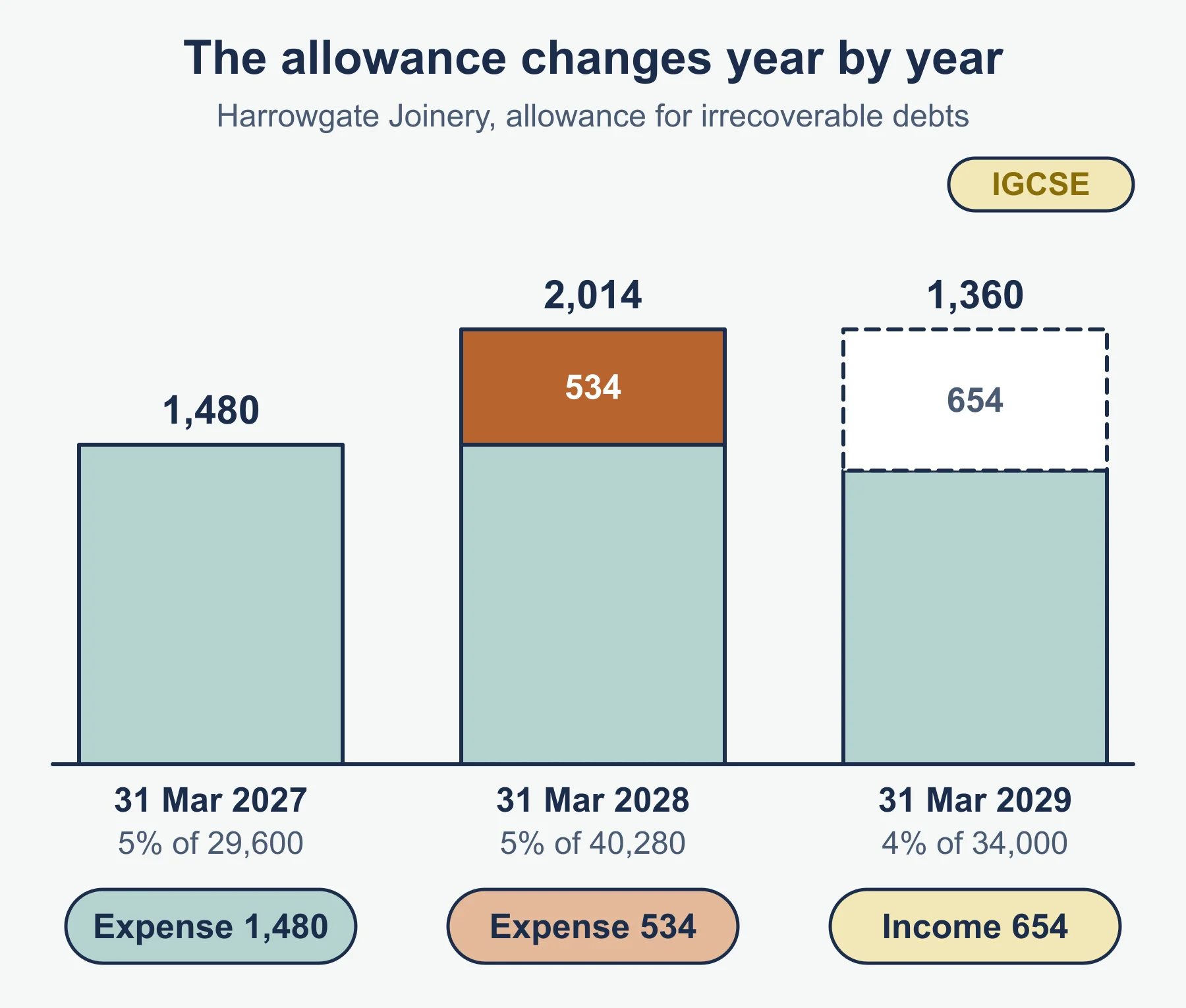
Common mistakes
- Using the cash paid as the expense, instead of adjusting it for opening and closing balances.
- Showing a prepayment as a credit balance. Prepaid expenses and accrued incomes are debit balances.
- Recording a write-off as a reduction in sales rather than as an expense.
- Recording a recovered debt in the bank account only. Reinstate the customer first.
- Charging the entire allowance as an expense every year instead of just the change.
- Calculating the percentage before the irrecoverable debts are written off.
- Treating a decrease in the allowance as an expense. It is income.
Frequently asked questions
What is the difference between an accrued expense and a prepaid expense? An accrued expense has been used but not yet paid at the year end, so it is added to the expense and shown as an other payable (a current liability with a credit balance). A prepaid expense has been paid but benefits the next year, so it is deducted from the expense and shown as an other receivable (a current asset with a debit balance).
How do you work out the expense for the year when amounts are owing? Take the cash paid, subtract the amount owing at the start of the year (last year’s cost) and add the amount owing at the end of the year. The figure that makes the ledger account balance is the amount transferred to the statement of profit or loss.
How do you record an irrecoverable debt in Cambridge IGCSE Accounting 0452? Debit the irrecoverable debts account and credit the customer’s account, then transfer the irrecoverable debts to the statement of profit or loss as an expense. Sales are not reduced, because the sale was already recorded as revenue.
How do you record a debt that was written off and is later paid? First reinstate the debt (debit the customer, credit irrecoverable debts recovered), then record the money received (debit bank, credit the customer). The recovery is income of the year in which it is received.
How much of the allowance for irrecoverable debts goes to the statement of profit or loss? Only the change in the allowance: an increase is an expense and a decrease is income. The full allowance, calculated as a percentage of trade receivables after known irrecoverable debts are written off, is deducted from trade receivables in the statement of financial position.
Official syllabus
Cambridge IGCSE Accounting 0452 syllabus for exams in 2027, 2028 and 2029 (version 1), published by Cambridge University Press and Assessment (Cambridge International), sections 4.3 and 4.4.
Get free revision emails (optional)
Occasional emails with practice questions, worked explanations and links to free resources for the qualification and subjects you choose. No spam, and you can unsubscribe from any email. The free tools on this site never need an email.
Related resources
-
Revision notes
IGCSE Accounting: Analysis and Interpretation — Revision Notes
Quick recall for Cambridge IGCSE Accounting 0452 Topic 6: ten ratios, reading them, profit versus cash, comparing businesses, users and statement limits.
Accounting · Cambridge · IGCSE, O Level
Revise topic -
Practice questions
IGCSE Accounting: Other payables and receivables, irrecoverable debts (Cambridge 0452) – Practice Questions
Original practice questions with worked answers on accruals, prepayments, irrecoverable debts and the allowance for IGCSE Accounting 0452 (2027-2029).
Accounting · Cambridge · IGCSE, O Level
Try questions -
Revision notes
IGCSE Accounting: Other payables, other receivables and irrecoverable debts (Cambridge 0452) – Revision Notes
Condensed revision notes for IGCSE Accounting 0452 sections 4.3 and 4.4: accruals, prepayments, irrecoverable debts and the allowance, with a self-test.
Accounting · Cambridge · IGCSE, O Level
Revise topic
Related articles
-
teaching
A Level tuition in Dubai: Cambridge or Pearson Edexcel International A Level?
Schools in Dubai and Abu Dhabi teach either Cambridge International AS & A Level or Pearson Edexcel International A Level. How the two are structured, why it matters for tuition, and how online classes from Lahore work.
9 October 2026
-
curriculum guides
Choosing subjects at IGCSE and A Level
How subject choices at 14 and 16 affect university options later, and how to keep pathways open without overloading a timetable.
28 July 2026
Studying this with a teacher
Working through Accounting IGCSE, O LEVELS?
This page is free and stays free. If you would rather be taught it, Marlbridge runs Accounting classes one-to-one and in small groups of up to 15, online in your own time zone. The first trial class is free. WhatsApp replies within an hour (8am–11pm Pakistan time, every day); email the same day.
Cambridge Accounting teachers at Marlbridge

