
Revision Notes
IGCSE Accounting: Other payables, other receivables and irrecoverable debts (Cambridge 0452) – Revision Notes
Condensed revision notes for IGCSE Accounting 0452 sections 4.3 and 4.4: accruals, prepayments, irrecoverable debts and the allowance, with a self-test.
- Subject
- Accounting
- Level
- IGCSE, O LEVELS
- Topic
- Accounting procedures
- Author
- Marlbridge Academic Team
- Updated
- Reviewed by
- Javaid Iqbal Sabri (what this means)
Aligned to Cambridge IGCSE O Level Accounting (0452, 7707), 2027-2029. Official specification (IGCSE) ; Official specification (O Level) .
Syllabus page (what it covers and how it is assessed): Cambridge IGCSE Accounting; Cambridge O Level Accounting.
Syllabus points this page covers
0452
- 4.3 Other payables and other receivables
- 4.4 Irrecoverable debts and allowance for irrecoverable debts
7707
- 4.3 Other payables and other receivables
- 4.4 Irrecoverable debts and allowance for irrecoverable debts
Found an error? Report a correction.
Want a teacher for this? Marlbridge teaches Accounting online. Request a free trial class.
Syllabus edition note. This resource follows the Cambridge IGCSE Accounting 0452 syllabus (and Cambridge O Level Accounting 7707, which has the same subject content for the same series) for exams in 2027, 2028 and 2029 (version 1), first examined in the March 2027 series in India and the June 2027 series elsewhere. If you sit 0452 in November 2026, you sit the 2026 syllabus (version 2), which differs: Paper 1 has 35 multiple-choice marks in 1 hour 15 minutes, not 40 marks in 1 hour 30 minutes; Topic 7 is “Accounting principles and policies”, without 7.2 Ethical considerations or 7.3 Technology and sustainability; 4.4 is “Irrecoverable debts and provision for doubtful debts”; income statements are named instead of statements of profit or loss; three-column running balance accounts are not required; Clubs and societies is 5.4 and Manufacturing accounts 5.5; and 6.3 is “Inter-firm comparison”. For this topic, the 2026 syllabus says “recovery of debts written off” where the 2027-2029 syllabus says “irrecoverable debts recovered”, asks for simple inventory valuation statements, and does not separately list choosing a depreciation method for each type of non-current asset, journal entries for purchasing a non-current asset, or calculating the profit or loss on disposal. If you sit in November 2026, work from the 2026 syllabus on the Cambridge International website.
These revision notes cover sections 4.3 (Other payables and other receivables) and 4.4 (Irrecoverable debts and allowance for irrecoverable debts) of the Cambridge IGCSE Accounting 0452 syllabus for exams in 2027, 2028 and 2029 (version 1). For full explanations and ledger layouts, read the study guide. When you are ready, try the practice questions. The wider Topic 4 revision notes cover depreciation and inventory. Other links: the Cambridge IGCSE Accounting hub, the printable checklist and the free diagnostics. Figures below are in dollars unless stated.
4.3 Other payables and other receivables
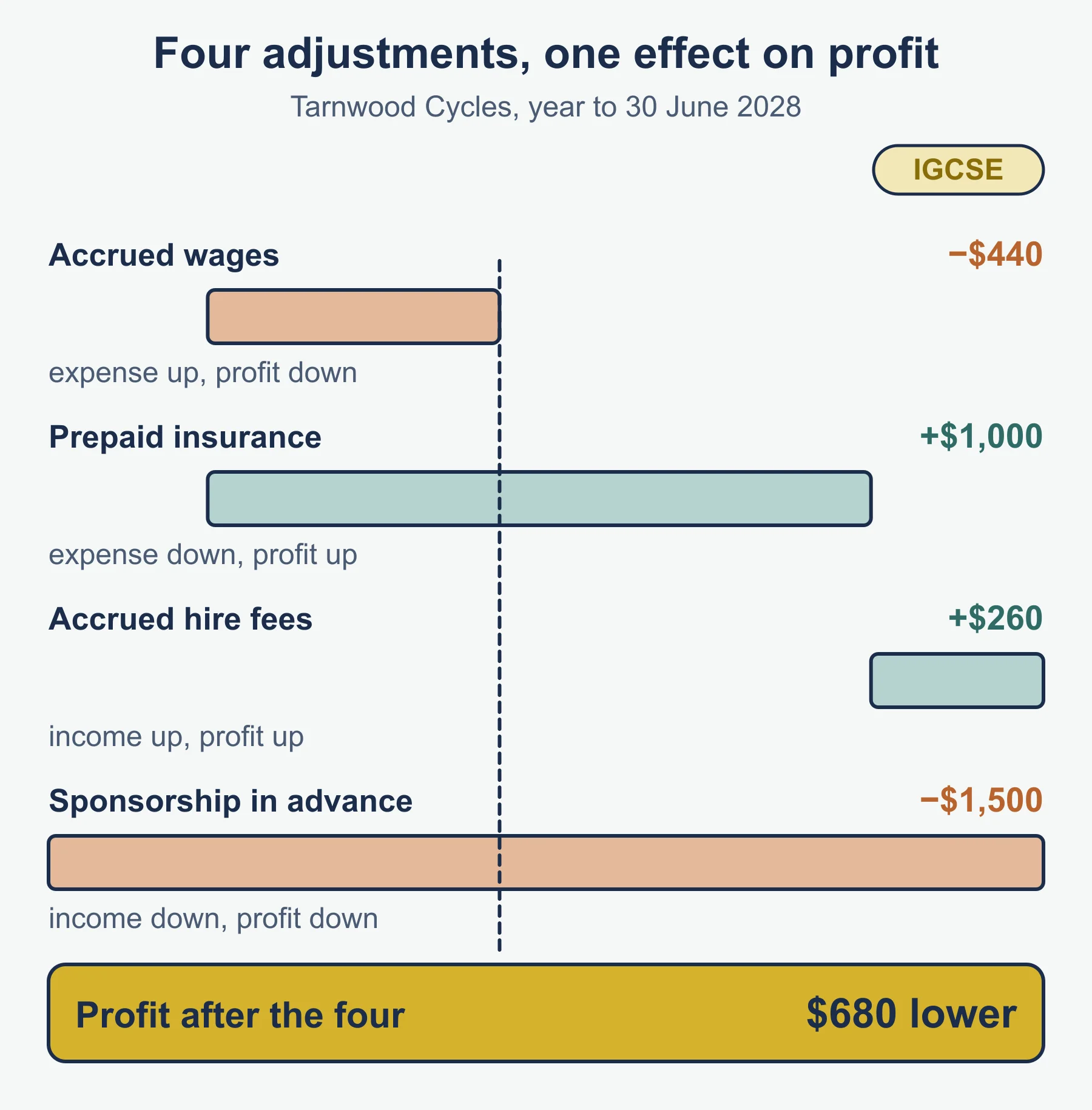
Why: matching / accruals means each year carries the costs and incomes that belong to it, not the cash that happened to move. Cash-based figures would give a wrong profit.
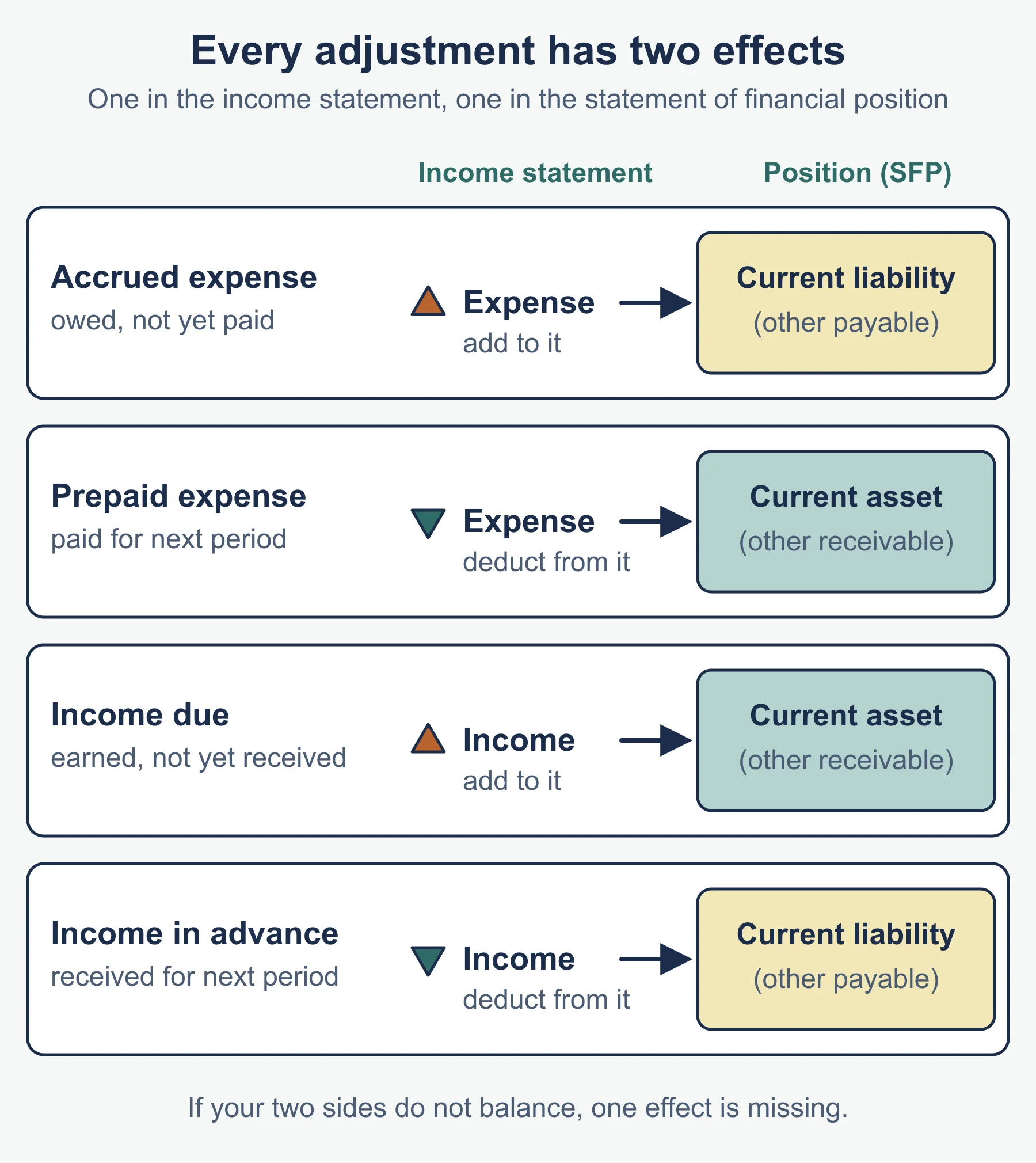
| Type | Plain meaning | Journal at year end | Closing balance is | Shown as |
|---|---|---|---|---|
| Accrued expense | Cost used, bill unpaid | Dr Expense, Cr Other payables | Credit | Current liability |
| Prepaid expense | Cost paid for later use | Dr Other receivables, Cr Expense | Debit | Current asset |
| Accrued income | Income earned, unpaid | Dr Other receivables, Cr Income | Debit | Current asset |
| Income in advance | Cash in, not yet earned | Dr Income, Cr Other payables | Credit | Current liability |
Formulas (paid or received means cash in the year):
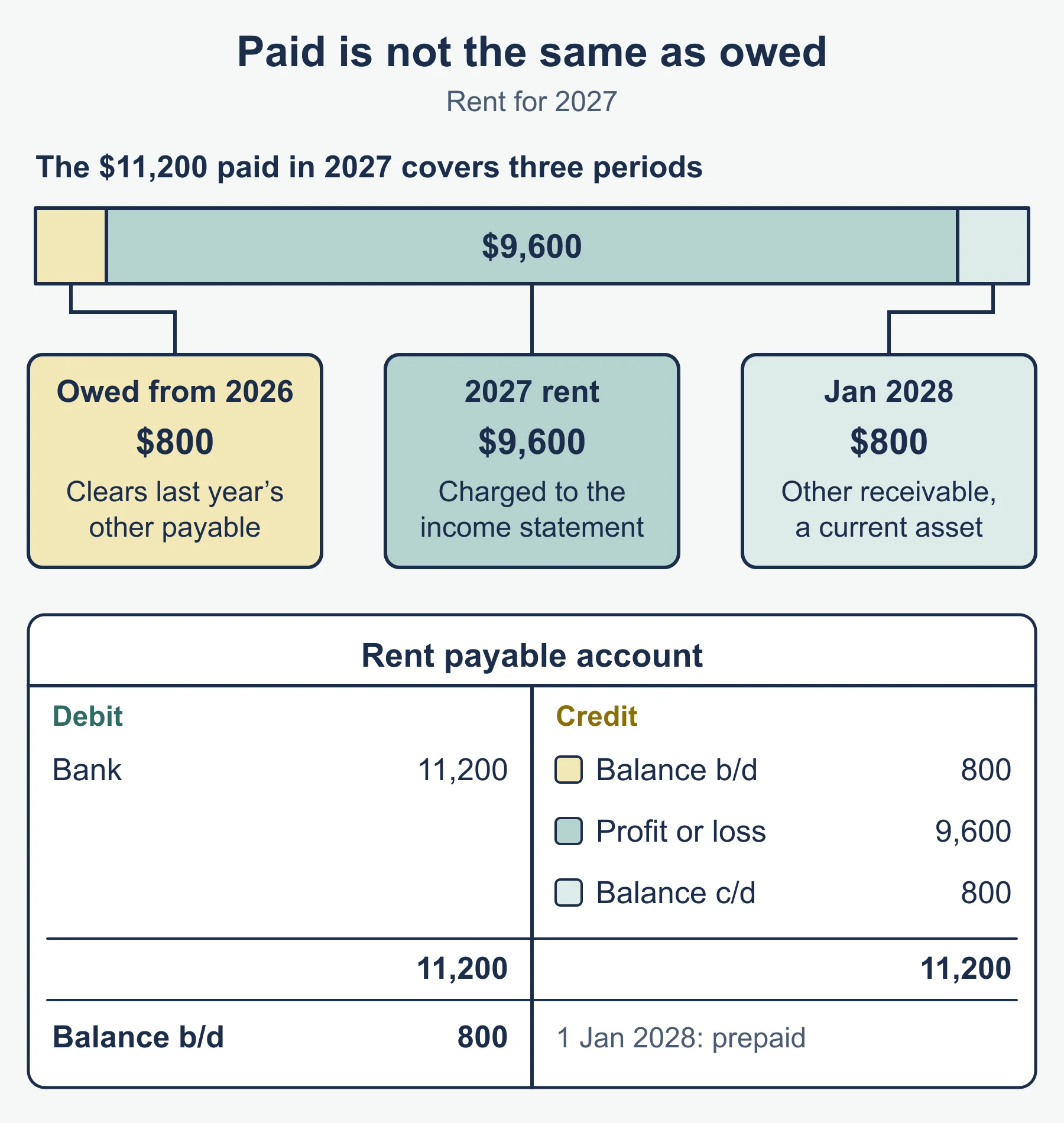
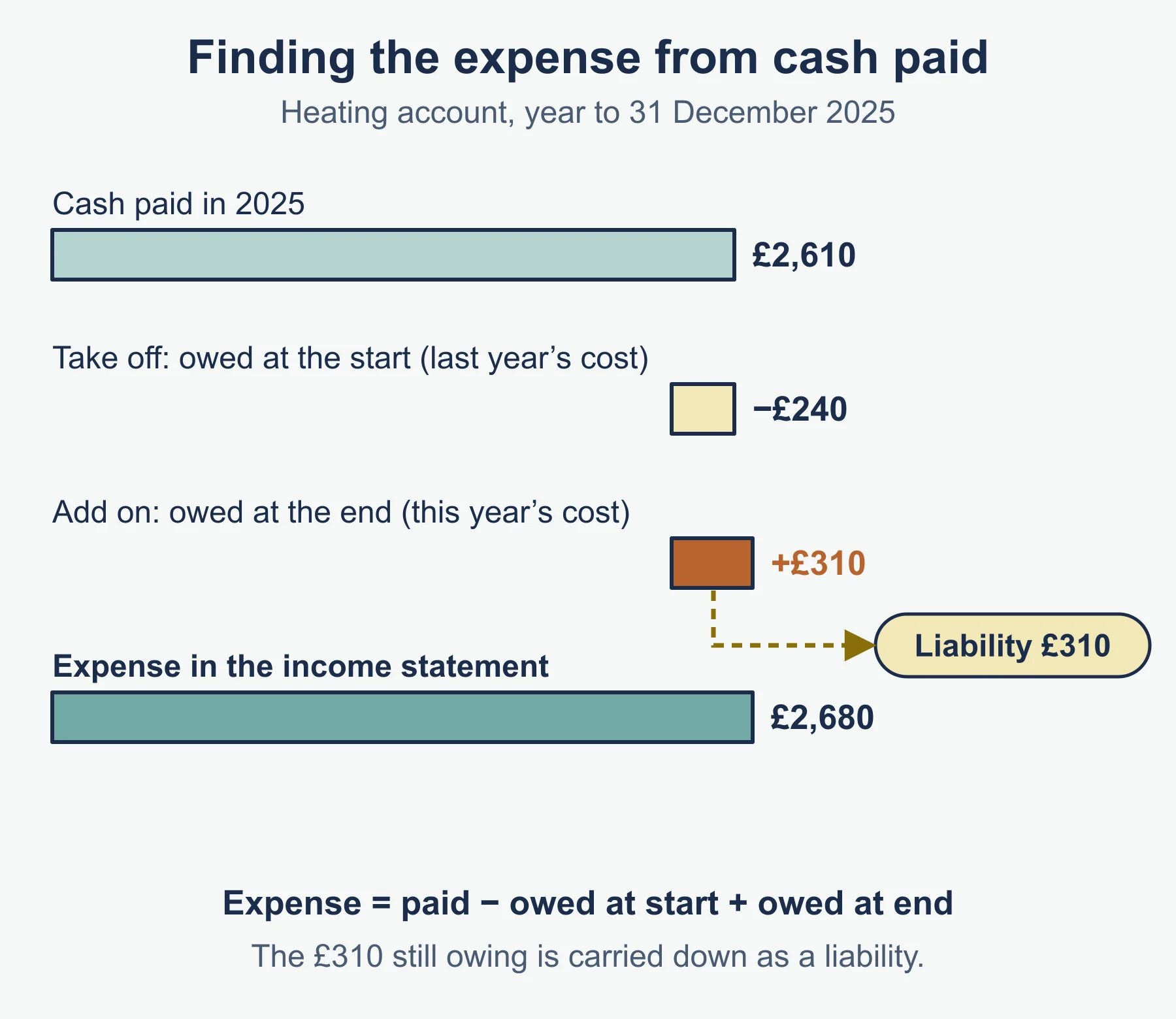
- Expense for the year = paid - opening accrued + closing accrued + opening prepaid - closing prepaid
- Income for the year = received - opening accrued + closing accrued + opening in advance - closing in advance
- Time apportionment = months in the year / months paid for x amount
Ledger method in steps
- Post the opening balance on the side its type needs.
- Post the cash for the year.
- Calculate the closing balance and post it as balance c/d.
- The figure that balances the account is the transfer to the statement of profit or loss.
- Bring the closing balance down on the opposite side, then total the account.
Small reminders: Aldercott Bakery, year ended 31 October 2028
| Account | Working | Result |
|---|---|---|
| Telephone, 1,090 paid, 160 owing at the start, 210 owing at the end | 1,090 - 160 + 210 | Expense 1,140 |
| Rates, 6,300 paid, 900 prepaid at the start, 1,050 prepaid at the end | 6,300 + 900 - 1,050 | Expense 6,150 |
| Bank interest, 372 received, 48 owed at the start, 60 owed at the end | 372 - 48 + 60 | Income 384 |
| Stall rental, 2,160 received including 540 for next year, nothing opening | 2,160 - 540 | Income 1,620 |
Closing balances: telephone credit 210 and bank interest debit 60 (accrued); rates debit 1,050 (prepaid); stall rental credit 540 (in advance). The two debits are other receivables of 1,110. The two credits are other payables of 750.
Effect of an omitted adjustment
| Omitted item | Profit | Statement of financial position |
|---|---|---|
| Accrued expense | Too high | Liabilities too low |
| Prepaid expense | Too low | Assets too low |
| Accrued income | Too low | Assets too low |
| Income in advance | Too high | Liabilities too low |
4.4 Irrecoverable debts and the allowance
| Event | Journal | Profit effect |
|---|---|---|
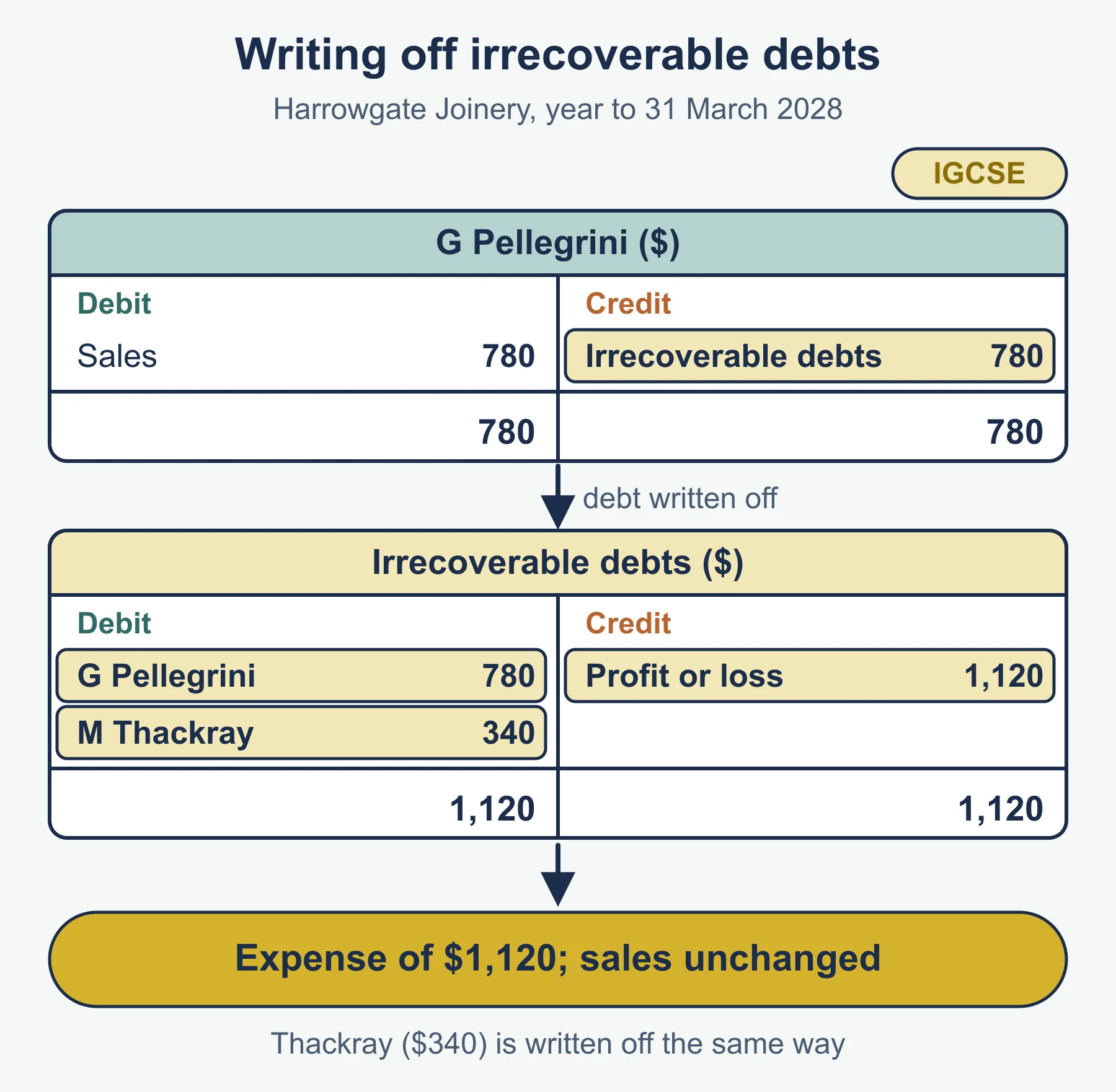
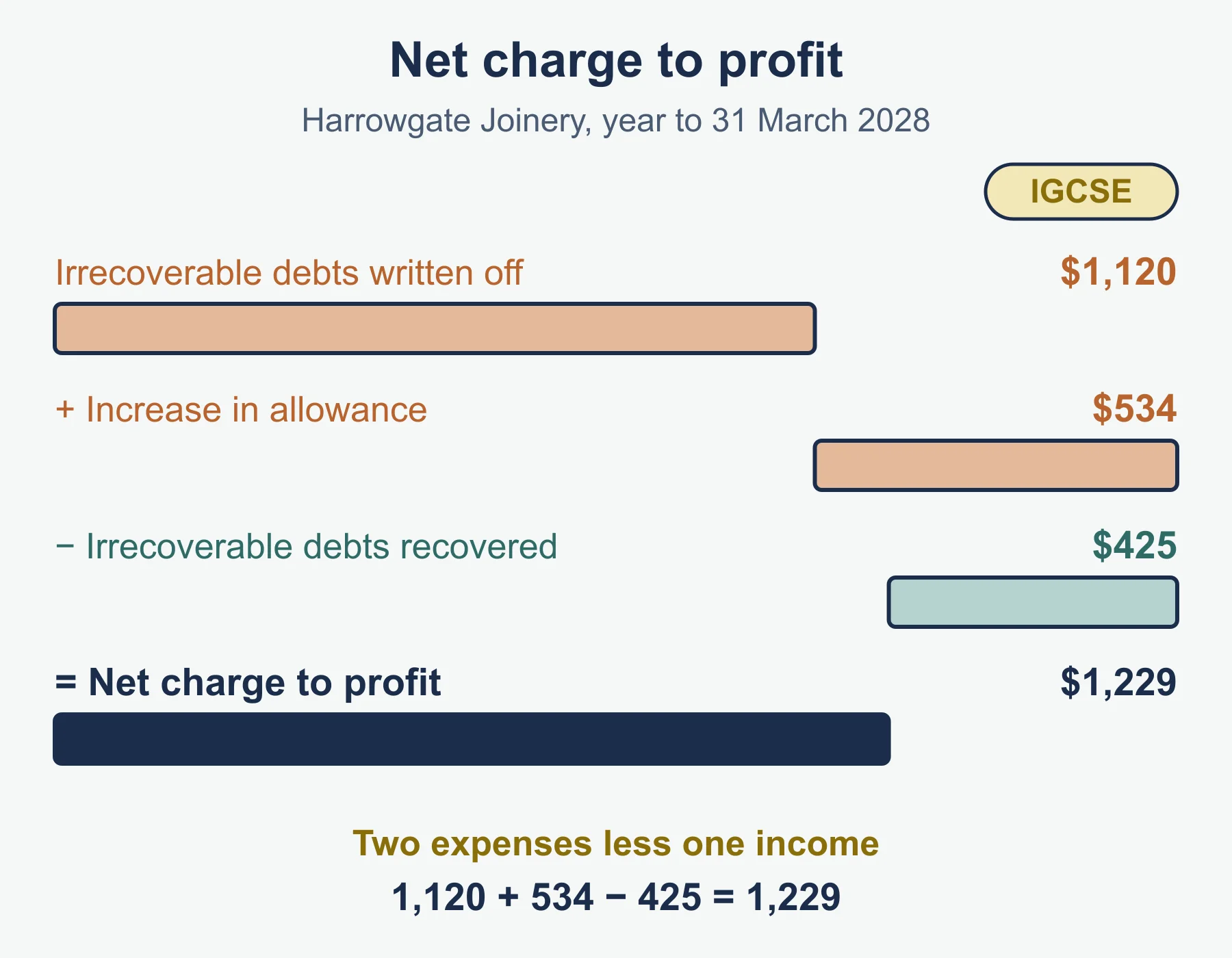
| Debt written off | Dr Irrecoverable debts, Cr Customer | Expense when moved to the statement of profit or loss |
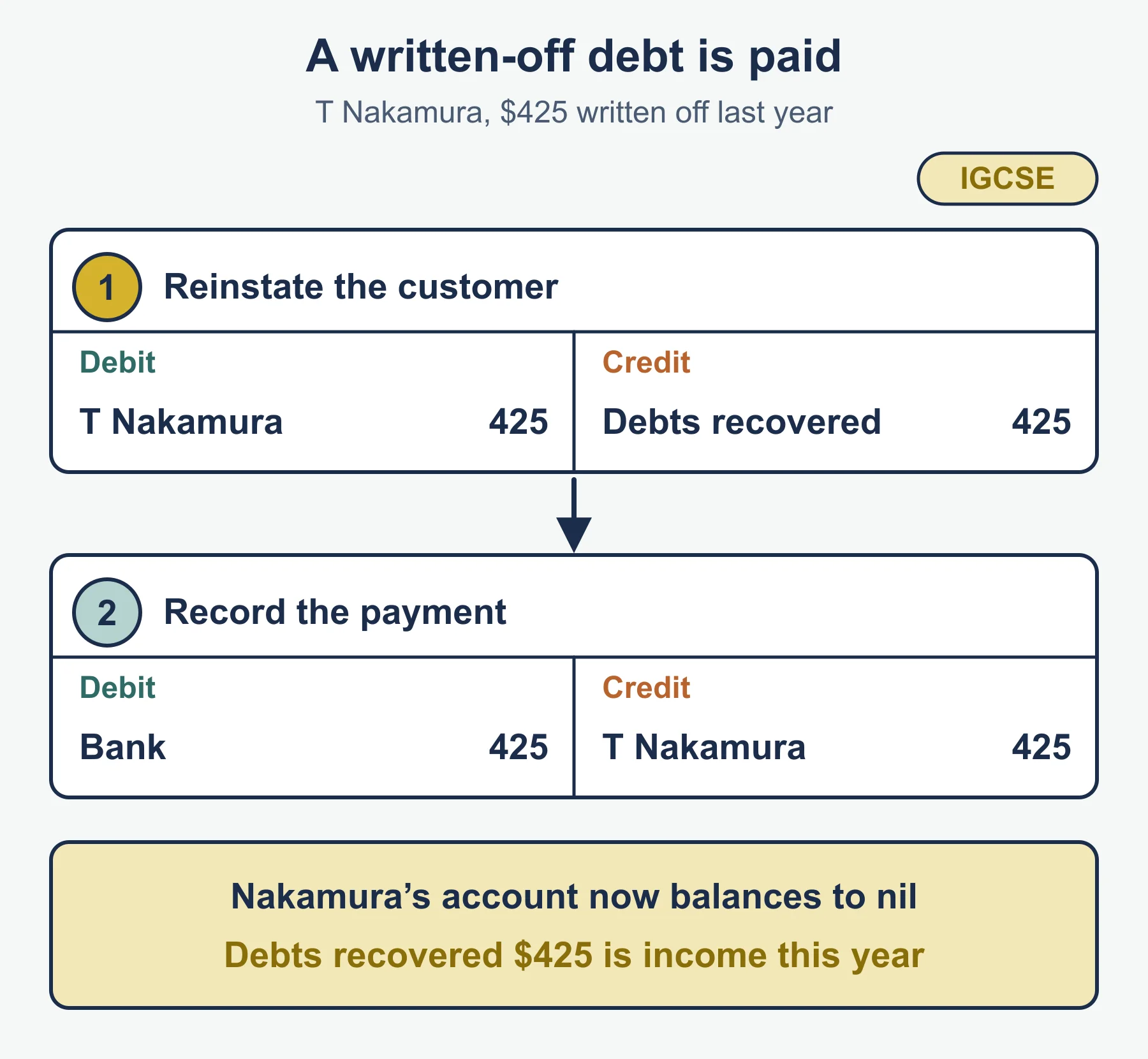
| Debt recovered, step 1 | Dr Customer, Cr Irrecoverable debts recovered | Income of the year of receipt |
| Debt recovered, step 2 | Dr Bank, Cr Customer | None |
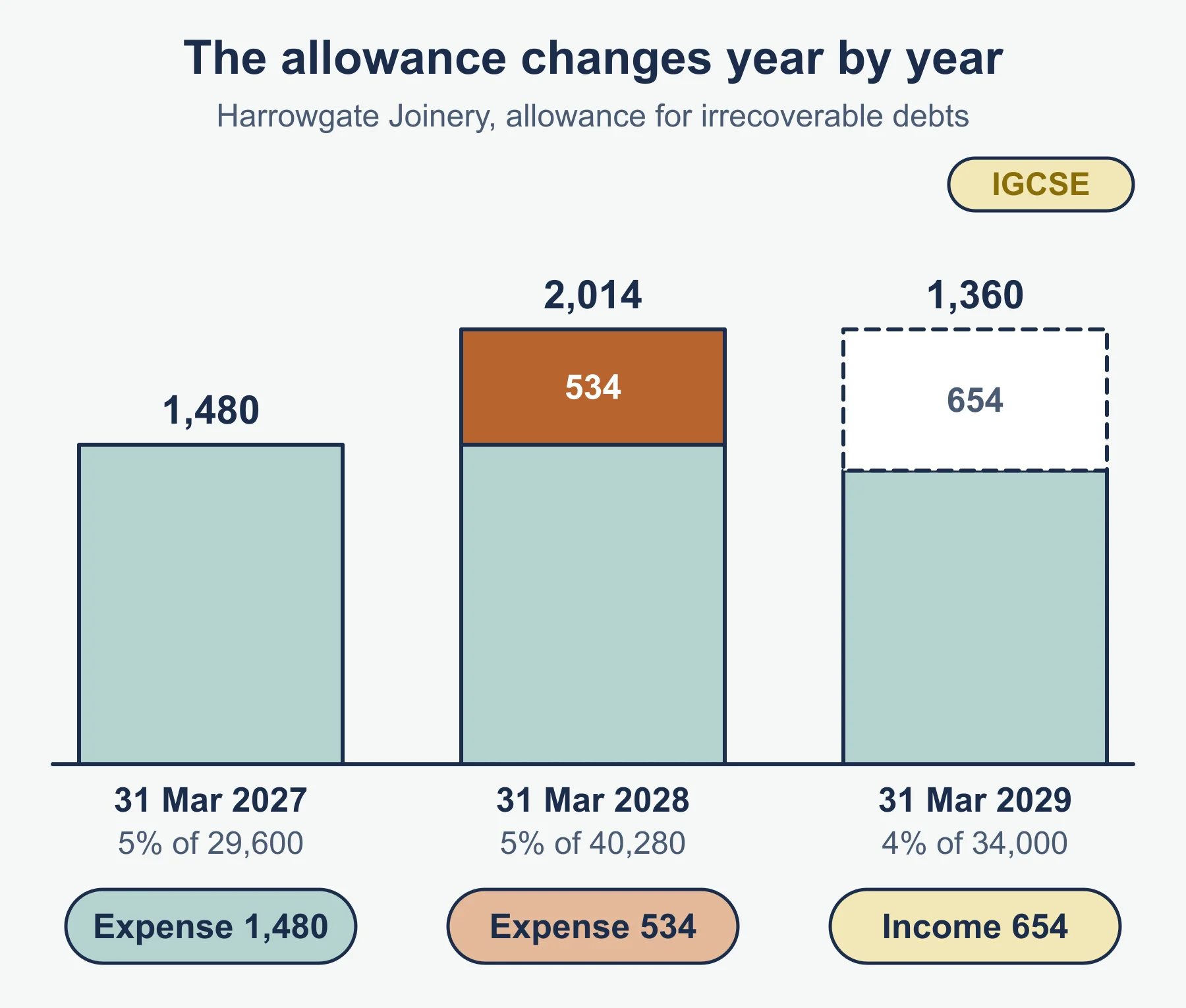
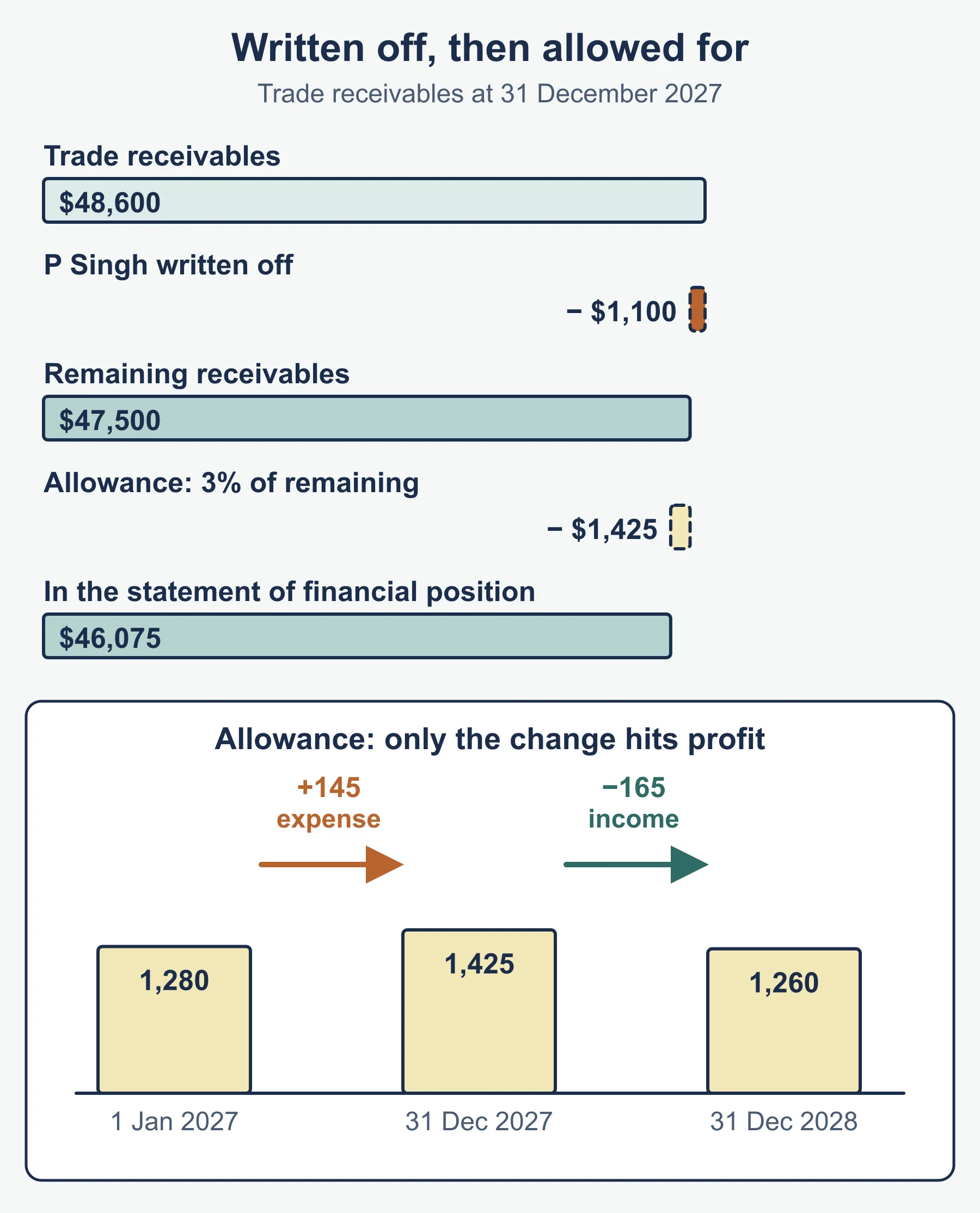
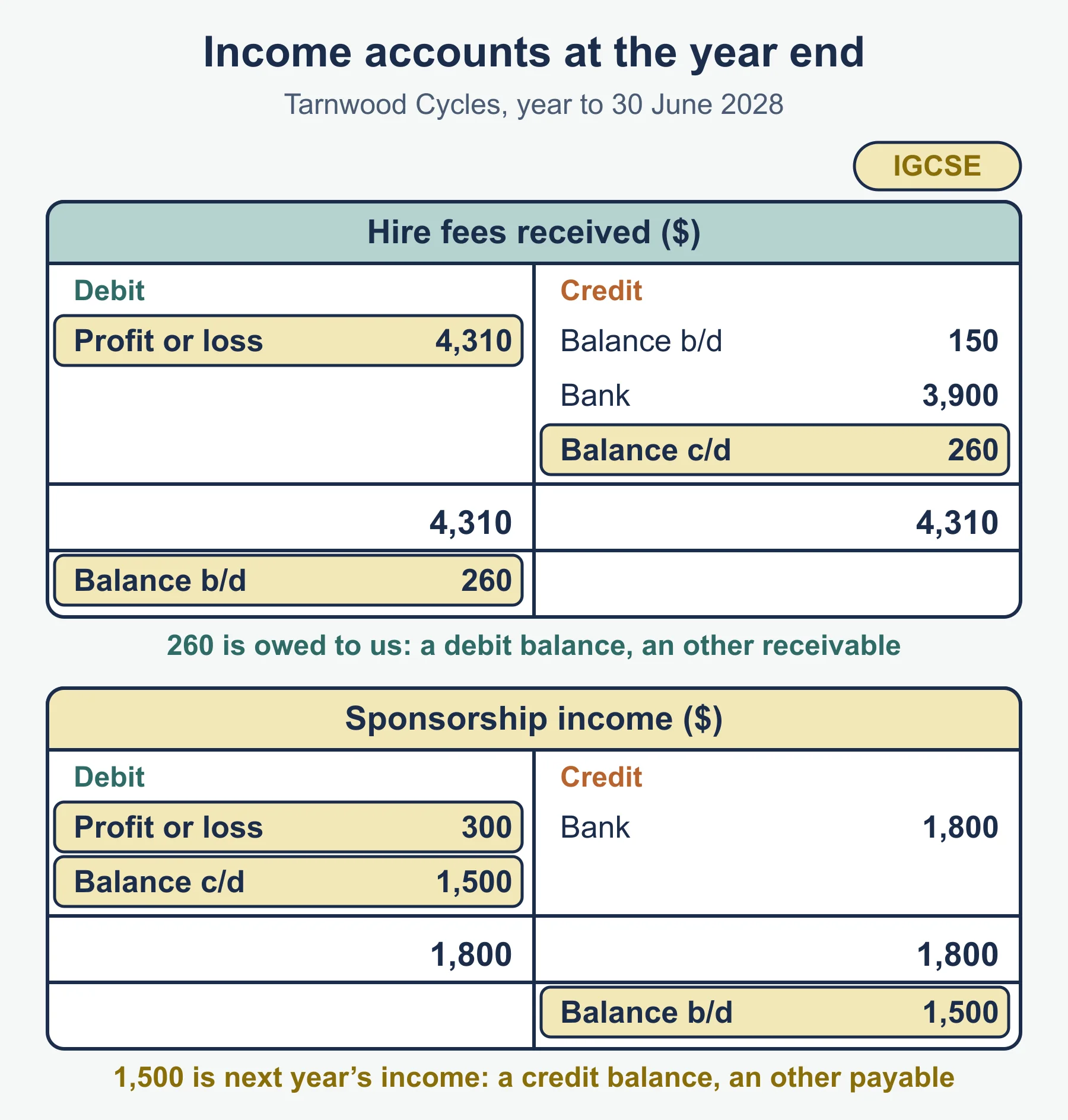
| Allowance created or increased | Dr Statement of profit or loss, Cr Allowance | Expense of the increase only |
| Allowance reduced | Dr Allowance, Cr Statement of profit or loss | Income of the decrease only |
Definitions to learn
- Irrecoverable debt: money due from a credit customer that the business concludes will never be paid.
- Irrecoverable debt recovered: a debt written off earlier that the customer later pays.
- Allowance for irrecoverable debts: an estimate of the part of year-end trade receivables that will probably not be collected. It is kept because trade receivables should not be overstated and each year should bear its share of the loss (prudence and matching / accruals).
Allowance method in steps
- Write off the known irrecoverable debts.
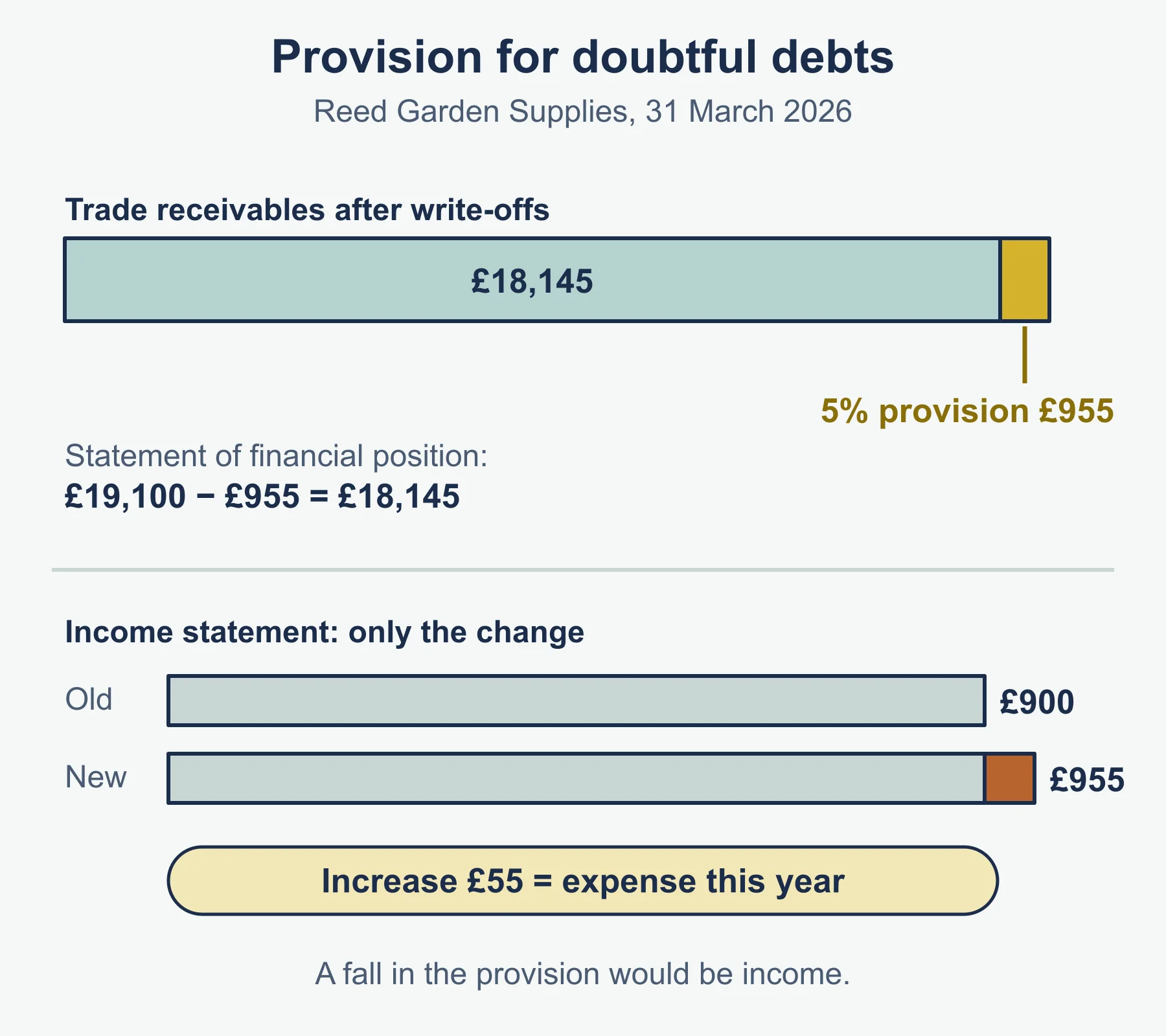
- Remaining trade receivables x percentage = allowance required.
- Required allowance - opening allowance = increase (expense) or decrease (income).
- Post the change, balance the allowance account and bring the balance down.
- Present trade receivables less the full allowance.
Small reminder. Trade receivables are 18,500 before a 500 write-off. The allowance is 6% and the opening allowance is 900.
- Remaining trade receivables: 18,500 - 500 = 18,000
- Allowance required: 6% x 18,000 = 1,080; increase 1,080 - 900 = 180 (expense)
- Statement of financial position: 18,000 - 1,080 = 16,920
- Next year trade receivables are 14,000 after write-offs, so the allowance is 840 and falls by 240, which is income.
Turning question wording into entries
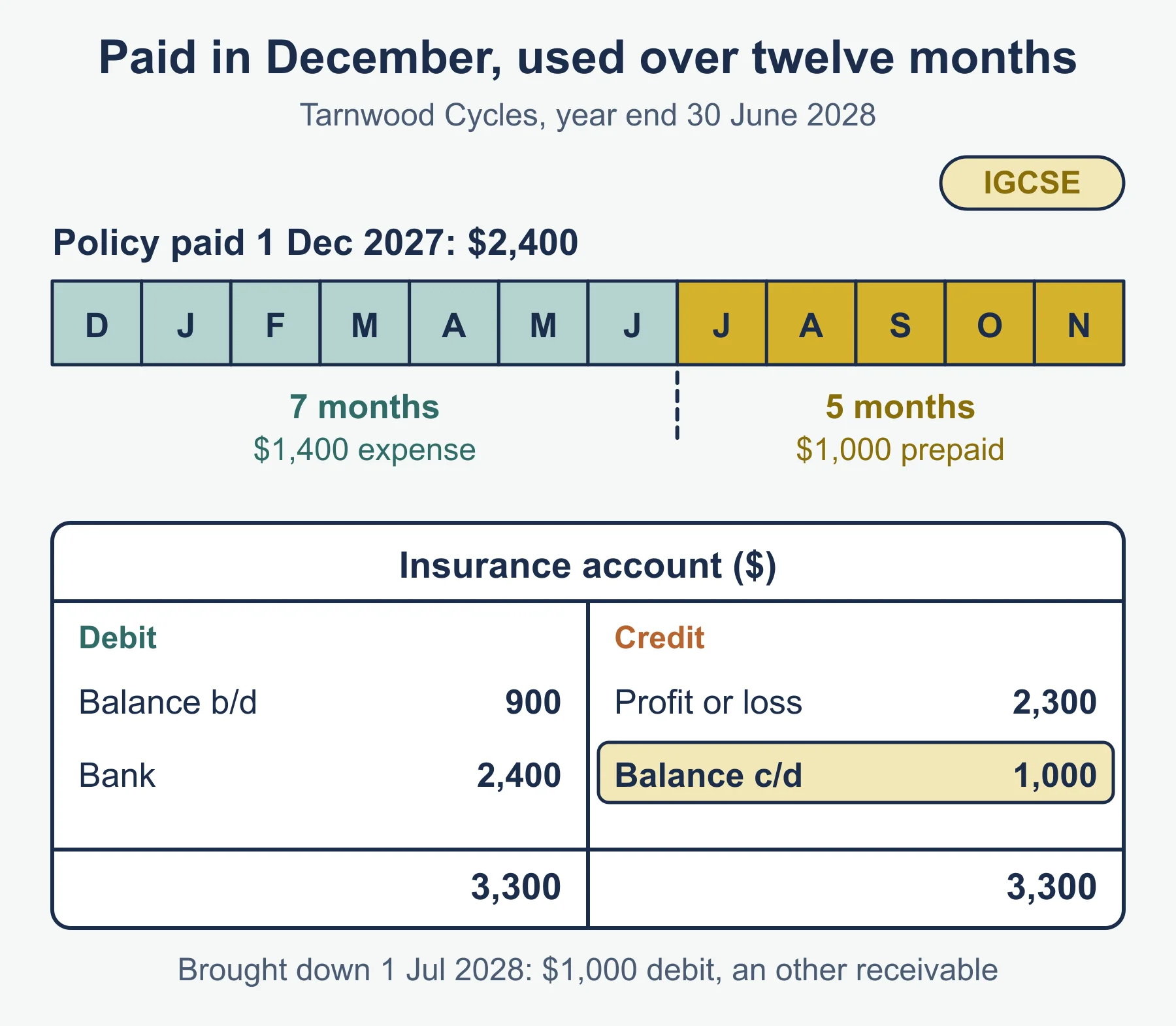
- “Paid in advance for twelve months from 1 March” with a 31 December year end: ten months fall in the year, so two months are prepaid (2/12 of the amount).
- “Owing at the year end” or “not yet received”: an accrual, so post the closing balance and let the transfer balance the account.
- “Declared bankrupt” or “cannot be traced”: write the debt off as irrecoverable, before any allowance calculation.
- “Paid in full” for a debt written off in a past year: reinstate it, then record the money.
- “Allowance of 4% of trade receivables”: use the figure left after the write-offs, then compare with the opening allowance.
Must-know distinctions
| Pair | Difference |
|---|---|
| Irrecoverable debt and allowance | One is a known loss on a named customer. The other is an estimate across the remaining receivables. |
| Written off and recovered | Writing off removes the receivable. Recovery reinstates it, then clears it with cash. |
| Accrued expense and prepaid expense | Owed at the year end (credit) and paid ahead at the year end (debit). |
| Accrued income and income in advance | Owed to the business (debit) and received early (credit). |
| Other receivables and trade receivables | Trade receivables are credit customers. Other receivables are prepayments and accrued income. |
| Charge in the year and allowance balance | The statement of profit or loss gets the change. The statement of financial position gets the whole balance. |
Quick self-test
- On which side is the closing balance of a prepaid expense brought down?
- Rent paid in the year was 7,800. There was 650 owing at the start and 400 prepaid at the end. Calculate the rent expense.
- Interest of 90 has been earned but not received. Give the journal.
- State the effect on profit of leaving out an accrued expense.
- A customer who owes 640 is declared bankrupt. Give the journal.
- A debt written off last year is now paid. What is the first journal entry?
- Trade receivables are 24,000, with 1,000 to write off. The allowance is 5%. Calculate the allowance.
- The opening allowance is 1,400 and 1,150 is required. State the effect on profit.
- Calculate the trade receivables figure shown net in the statement of financial position for question 7.
- Name two concepts that support keeping an allowance.
Answers
- Debit (it is an other receivable).
- 7,800 - 650 - 400 = 6,750.
- Dr Other receivables 90, Cr Interest received 90.
- Expenses are too low, so profit is too high.
- Dr Irrecoverable debts 640, Cr the customer 640.
- Dr the customer, Cr Irrecoverable debts recovered, for the amount recovered.
- (24,000 - 1,000) x 5% = 1,150.
- The allowance falls by 250. That 250 is income, so profit rises by 250.
- 23,000 - 1,150 = 21,850.
- Prudence and matching / accruals.
Where marks are usually lost
- Using the amount paid or received as the income or expense without adjusting it.
- Putting a prepayment or accrued income on the credit side.
- Forgetting to bring the closing balance down, or bringing it down on the same side as it was carried.
- Mixing up the sign of the opening balance: an opening accrual reduces this year’s expense.
- Calculating the allowance on trade receivables before writing off the irrecoverable debts.
- Charging the whole allowance rather than the change, or treating a decrease as an expense.
- Recording a recovery as a bank receipt only, with no entry in the customer’s account.
- Writing a vague account name such as bad debts where the syllabus term is irrecoverable debts.
Frequently asked questions
What is the formula for an expense with accruals and prepayments in Cambridge IGCSE Accounting 0452? Expense for the year equals cash paid minus opening accrued plus closing accrued plus opening prepaid minus closing prepaid. Income works the same way, using amounts accrued and received in advance.
What is the difference between accrued income and income received in advance? Accrued income has been earned but not yet received, so it is a debit balance and an other receivable. Income received in advance is cash received before it is earned, so it is a credit balance and an other payable.
What happens to profit if an accrued expense is left out? If an accrued expense is omitted, the expense is too low, so profit is too high and liabilities in the statement of financial position are too low.
What is an irrecoverable debt recovered? It is a debt written off earlier that the customer later pays. First debit the customer and credit irrecoverable debts recovered, then debit bank and credit the customer, so the recovery is income of the year it is received.
What is the correct syllabus term for bad debts? The 0452 syllabus uses the term irrecoverable debts, and the allowance for irrecoverable debts for the estimate of debts that will probably not be collected. Using vague names such as bad debts can cost marks.
Official syllabus
Cambridge IGCSE Accounting 0452 syllabus for exams in 2027, 2028 and 2029 (version 1), published by Cambridge University Press and Assessment (Cambridge International), sections 4.3 and 4.4.
Get free revision emails (optional)
Occasional emails with practice questions, worked explanations and links to free resources for the qualification and subjects you choose. No spam, and you can unsubscribe from any email. The free tools on this site never need an email.
Related resources
-
Revision notes
IGCSE Accounting: Analysis and Interpretation — Revision Notes
Quick recall for Cambridge IGCSE Accounting 0452 Topic 6: ten ratios, reading them, profit versus cash, comparing businesses, users and statement limits.
Accounting · Cambridge · IGCSE, O Level
Revise topic -
Practice questions
IGCSE Accounting: Accounting Procedures — Practice Questions
Exam-style Cambridge IGCSE Accounting 0452 Topic 4 questions with marked answers on depreciation, disposals, accruals, irrecoverable debts and inventory.
Accounting · Cambridge · IGCSE, O Level
Try questions -
Revision notes
IGCSE Accounting: Accounting Procedures — Revision Notes
Quick-recall Cambridge IGCSE Accounting 0452 Topic 4 notes: capital and revenue items, depreciation, disposals, accruals, irrecoverable debts and inventory.
Accounting · Cambridge · IGCSE, O Level
Revise topic
Related articles
-
teaching
A Level tuition in Dubai: Cambridge or Pearson Edexcel International A Level?
Schools in Dubai and Abu Dhabi teach either Cambridge International AS & A Level or Pearson Edexcel International A Level. How the two are structured, why it matters for tuition, and how online classes from Lahore work.
9 October 2026
-
curriculum guides
Choosing subjects at IGCSE and A Level
How subject choices at 14 and 16 affect university options later, and how to keep pathways open without overloading a timetable.
28 July 2026
Studying this with a teacher
Working through Accounting IGCSE, O LEVELS?
This page is free and stays free. If you would rather be taught it, Marlbridge runs Accounting classes one-to-one and in small groups of up to 15, online in your own time zone. The first trial class is free. WhatsApp replies within an hour (8am–11pm Pakistan time, every day); email the same day.
Cambridge Accounting teachers at Marlbridge

