
Study Guides
IGCSE Accounting: Valuation of inventory (Cambridge 0452)
Study guide to Cambridge IGCSE Accounting 0452 section 4.5: lower of cost and net realisable value, count adjustments and inventory errors.
- Subject
- Accounting
- Level
- IGCSE, O LEVELS
- Topic
- Accounting procedures
- Author
- Marlbridge Academic Team
- Updated
- Reviewed by
- Javaid Iqbal Sabri (what this means)
Aligned to Cambridge IGCSE O Level Accounting (0452, 7707), 2027-2029. Official specification (IGCSE) ; Official specification (O Level) .
Syllabus page (what it covers and how it is assessed): Cambridge IGCSE Accounting; Cambridge O Level Accounting.
Syllabus points this page covers
0452
- 4.5 Valuation of inventory
7707
- 4.5 Valuation of inventory
Found an error? Report a correction.
Want a teacher for this? Marlbridge teaches Accounting online. Request a free trial class.
Syllabus edition note. This resource follows the Cambridge IGCSE Accounting 0452 syllabus (and Cambridge O Level Accounting 7707, which has the same subject content for the same series) for exams in 2027, 2028 and 2029 (version 1), first examined in the March 2027 series in India and the June 2027 series elsewhere. If you sit 0452 in November 2026, you sit the 2026 syllabus (version 2), which differs: Paper 1 has 35 multiple-choice marks in 1 hour 15 minutes, not 40 marks in 1 hour 30 minutes; Topic 7 is “Accounting principles and policies”, without 7.2 Ethical considerations or 7.3 Technology and sustainability; 4.4 is “Irrecoverable debts and provision for doubtful debts”; income statements are named instead of statements of profit or loss; three-column running balance accounts are not required; Clubs and societies is 5.4 and Manufacturing accounts 5.5; and 6.3 is “Inter-firm comparison”. For this topic, the 2026 syllabus says “recovery of debts written off” where the 2027-2029 syllabus says “irrecoverable debts recovered”, asks for simple inventory valuation statements, and does not separately list choosing a depreciation method for each type of non-current asset, journal entries for purchasing a non-current asset, or calculating the profit or loss on disposal. If you sit in November 2026, work from the 2026 syllabus on the Cambridge International website.
This study guide covers section 4.5 Valuation of inventory of the Cambridge IGCSE Accounting 0452 syllabus for exams in 2027, 2028 and 2029 (version 1). The official text lists three points, and the syllabus says that questions on both papers can draw on any of the subject content, so inventory valuation can be tested in either. Amounts are in dollars ($). The wider topic is in Accounting Procedures, which has its own worked inventory example; the examples here use different businesses and figures. Condensed notes are in the revision notes and exam-style questions are in the practice set. See also the Cambridge IGCSE Accounting hub, the printable checklist and the free diagnostics.
What 4.5 asks for
| Official point | Where it is covered |
|---|---|
| the valuation of inventory at the lower of cost and net realisable value | sections 1 and 2 |
| how to calculate the value of inventory | sections 2 and 3 |
| the effect of an incorrect valuation of inventory on gross profit, profit for the year, equity and asset valuation | sections 4 and 5 |
1. The rule: lower of cost and net realisable value
Cost is what the business paid for the units. In a question it is given as a cost per unit.
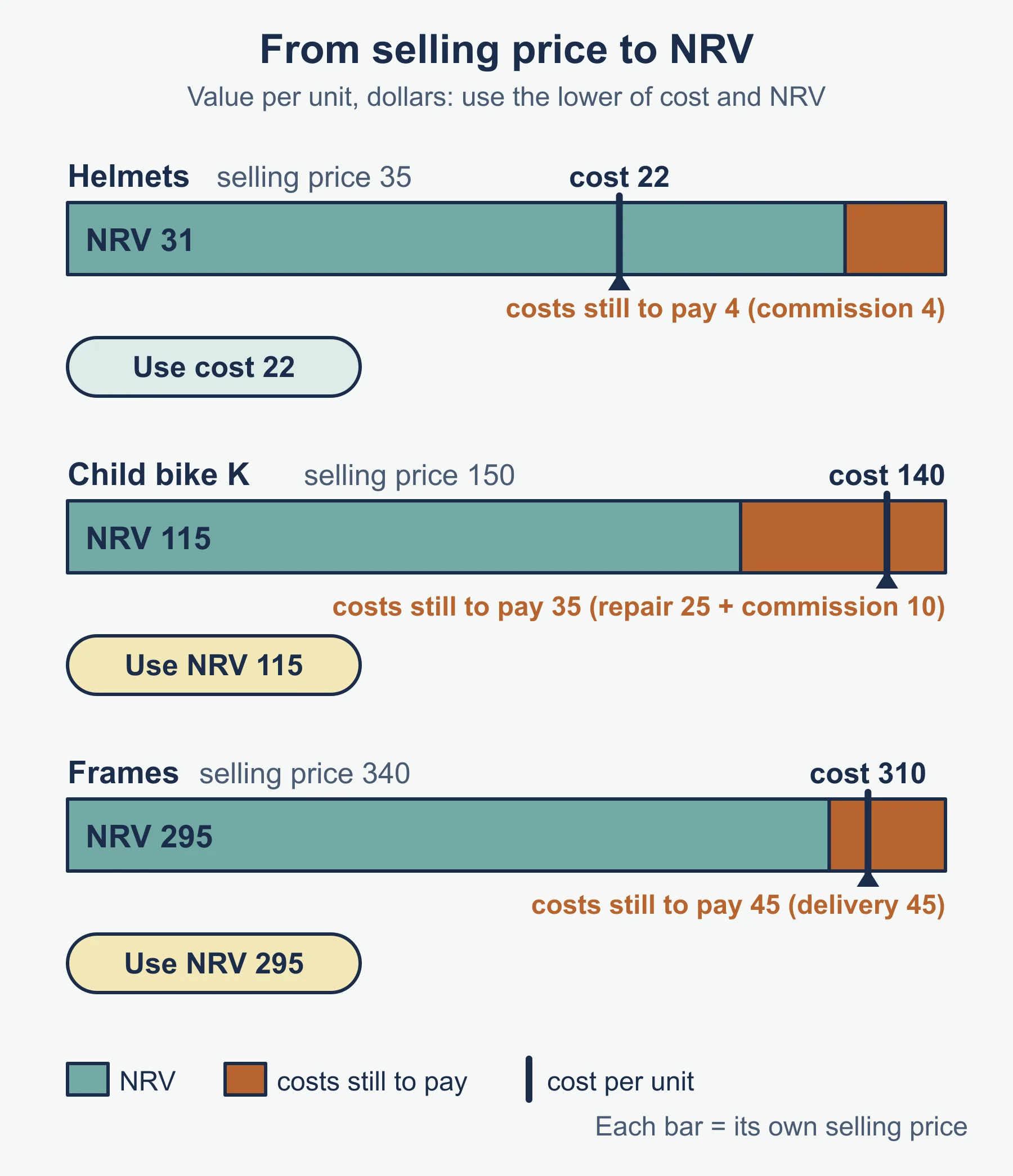
Net realisable value (NRV) is the amount the business expects to receive when it sells the goods, less any costs still to be paid before the sale is complete. Typical deductions are repairs, repackaging, commission to a sales agent and delivery to the customer.
Net realisable value per unit = expected selling price
                                − costs still to be paid
The value of each item of inventory is whichever is lower, cost or NRV. There are two reasons.
- Prudence (section 7.1): a loss that is expected is recognised as soon as it is foreseen, so the cost of unsellable goods is charged to the year in which they lose value.
- Realisation and historic cost (section 7.1): a profit is recognised only when the goods are sold, so inventory is never shown above what it cost, even when it could be sold for more.
If NRV is higher than cost, cost is used. If NRV is lower, NRV is used and the difference is a reduction in the closing inventory figure.
2. Calculating the value of inventory, item by item
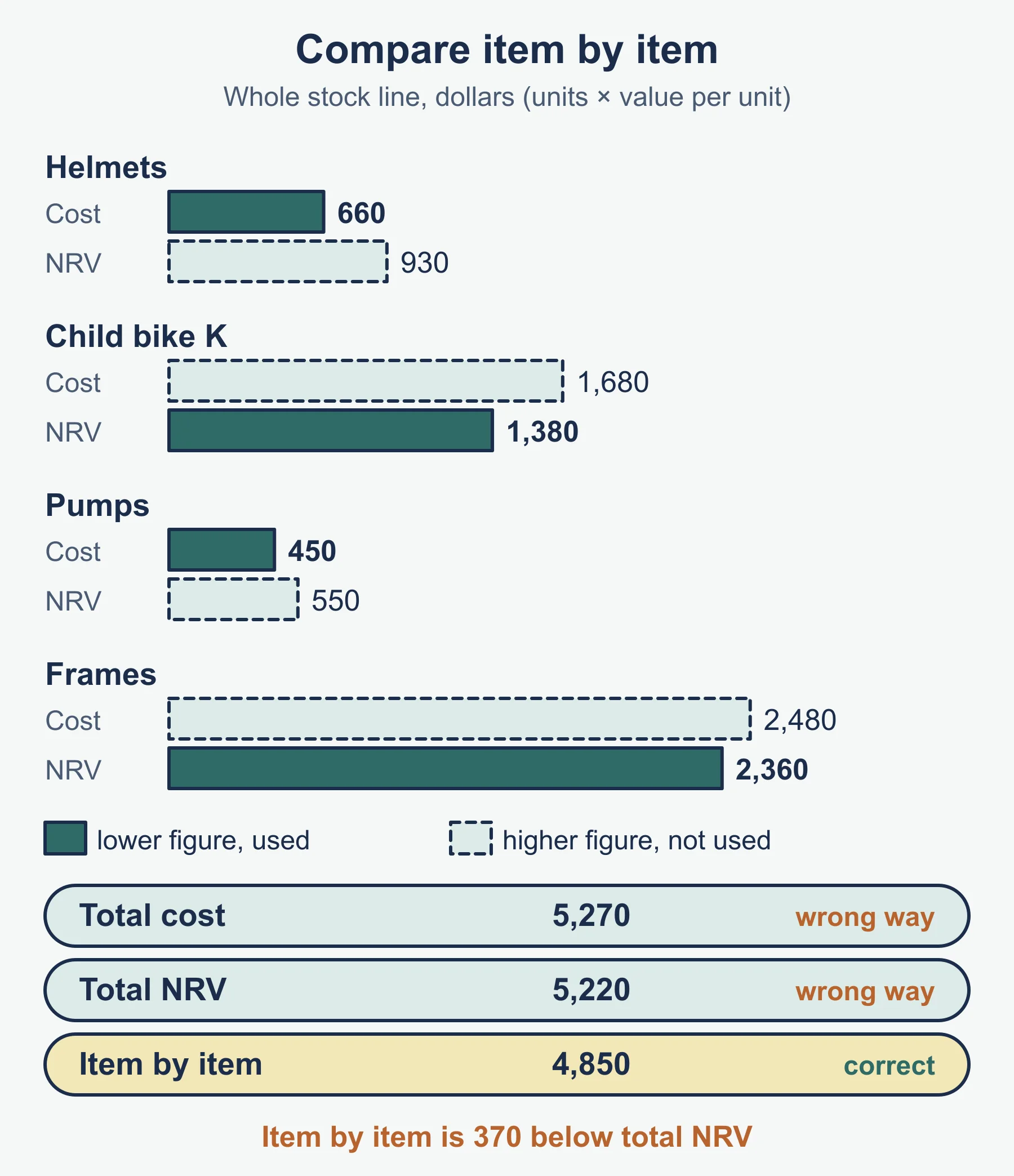
Compare cost and NRV for each item (or each group of identical items) and multiply the lower figure by the number of units.
Worked example 1. Marisol Pendleton owns Beresford Cycles. At 31 December 2028 the inventory count gave these figures (dollars):
| Item | Units | Cost per unit | Selling price | Costs still to pay | NRV per unit | Lower | Value |
|---|---|---|---|---|---|---|---|
| Helmets | 30 | 22 | 35 | 4 commission | 31 | 22 (cost) | 660 |
| Child bike K | 12 | 140 | 150 after repair | 25 repair + 10 commission | 115 | 115 (NRV) | 1,380 |
| Pumps | 50 | 9 | 12 | 1 commission | 11 | 9 (cost) | 450 |
| Frames | 8 | 310 | 340 | 45 delivery | 295 | 295 (NRV) | 2,360 |
| Closing inventory | 4,850 |
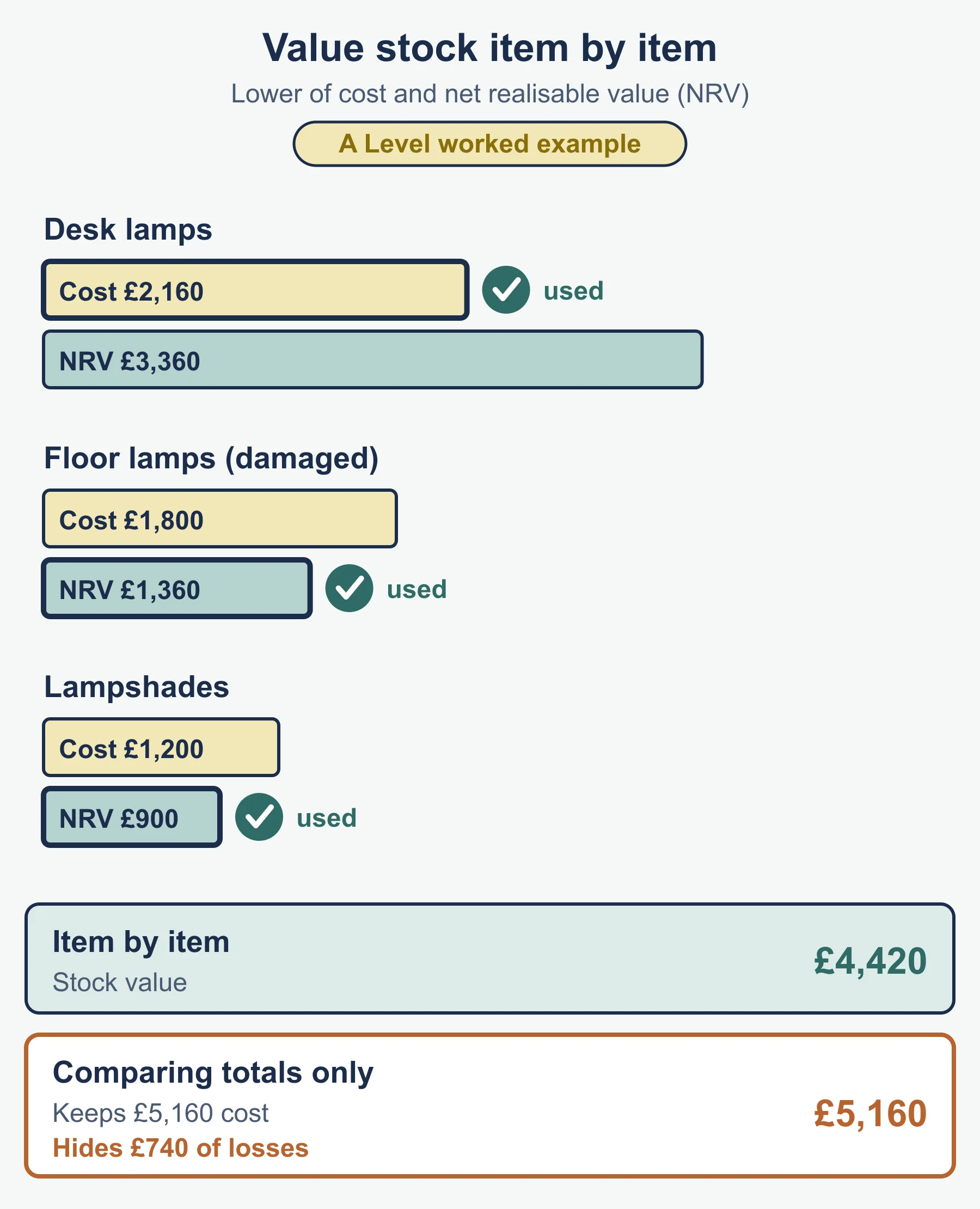
Total cost is 5,270 and total NRV is 5,220. Comparing the two totals would give 5,220, but that lets the extra value in the helmets and pumps hide the losses on child bike K and the frames. Item by item, closing inventory is 4,850, which is 370 lower. Section 4.5 does not list methods such as FIFO or average cost for choosing a unit cost, so a question will give you the cost per unit.
3. Adjusting a count taken on another date
A business does not always count its inventory on the last day of the year. If the count is on another date, start from the counted value at cost and move it to the year-end date using the transactions in between. Sales are recorded at selling price, so convert them to cost first (using the mark-up or margin the question gives). Mark-up is profit expressed as a percentage of cost. Margin is profit expressed as a percentage of selling price.
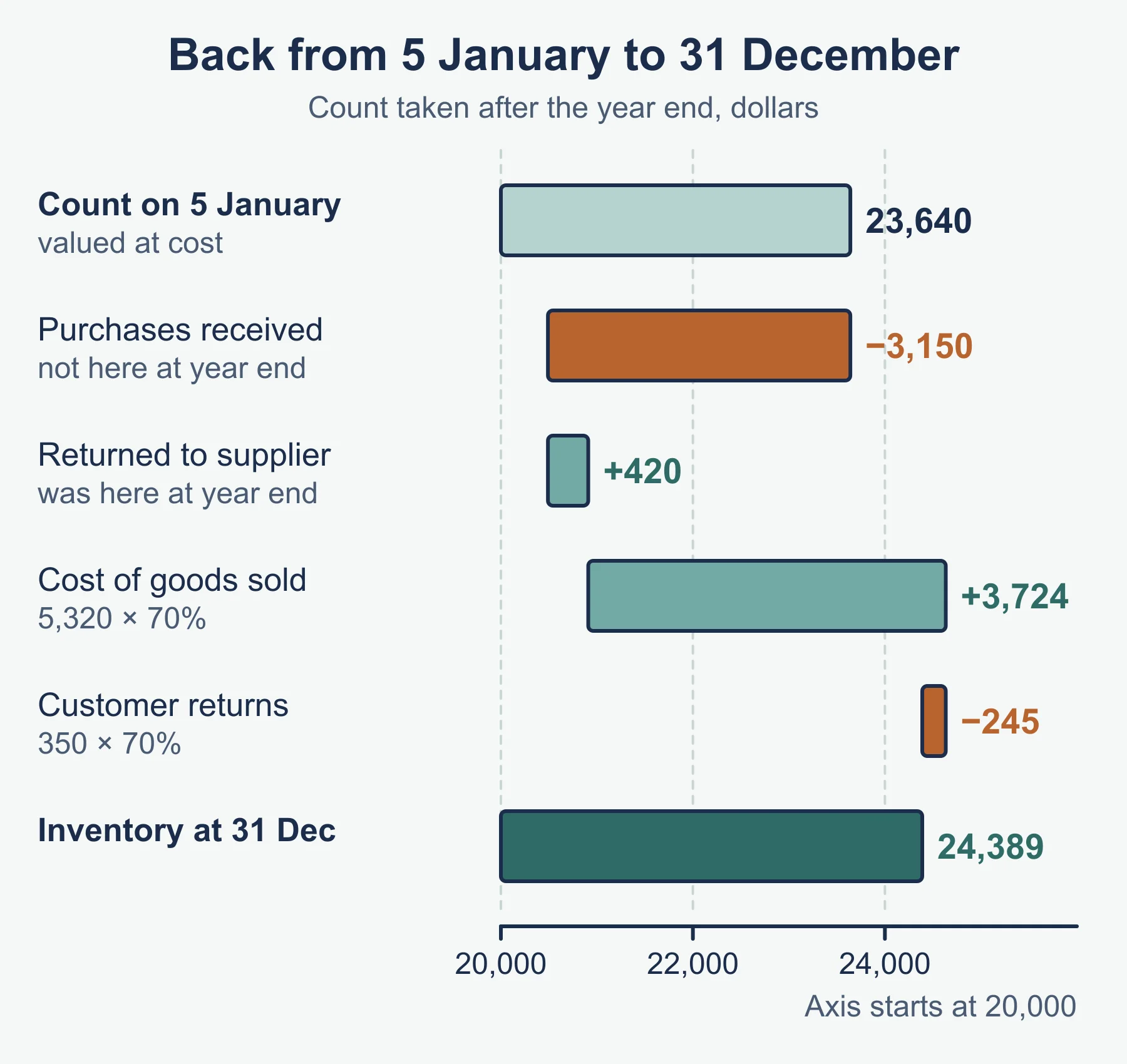
Count after the year end: take off purchases made since year end, add back the cost of goods sold since year end, and adjust for returns.
Worked example 2. Imara Sandrine’s year end at Ravenscroft Kitchenware is 31 December 2028. She counted inventory on 5 January 2029 and valued it at cost at 23,640. Between 1 and 5 January:
- purchases of 3,150 were received into inventory
- goods costing 420 were returned to a supplier
- sales were 5,320 at selling price, and the gross profit margin is 30%
- customers returned goods with a selling price of 350
Cost of goods sold      5,320 × 70%                = 3,724
Cost of goods returned    350 × 70%                =   245
Count on 5 January                                   23,640
Less purchases received                              (3,150)
Add goods returned to supplier (left before count)      420
Add cost of goods sold                                3,724
Less goods returned by customers (back in the count)   (245)
Inventory at 31 December 2028                        24,389
Count before the year end: do the reverse. Add purchases made after the count, and subtract the cost of goods sold after the count.
Correcting a draft inventory figure. Questions often list problems with the first count. Work through them one at a time.
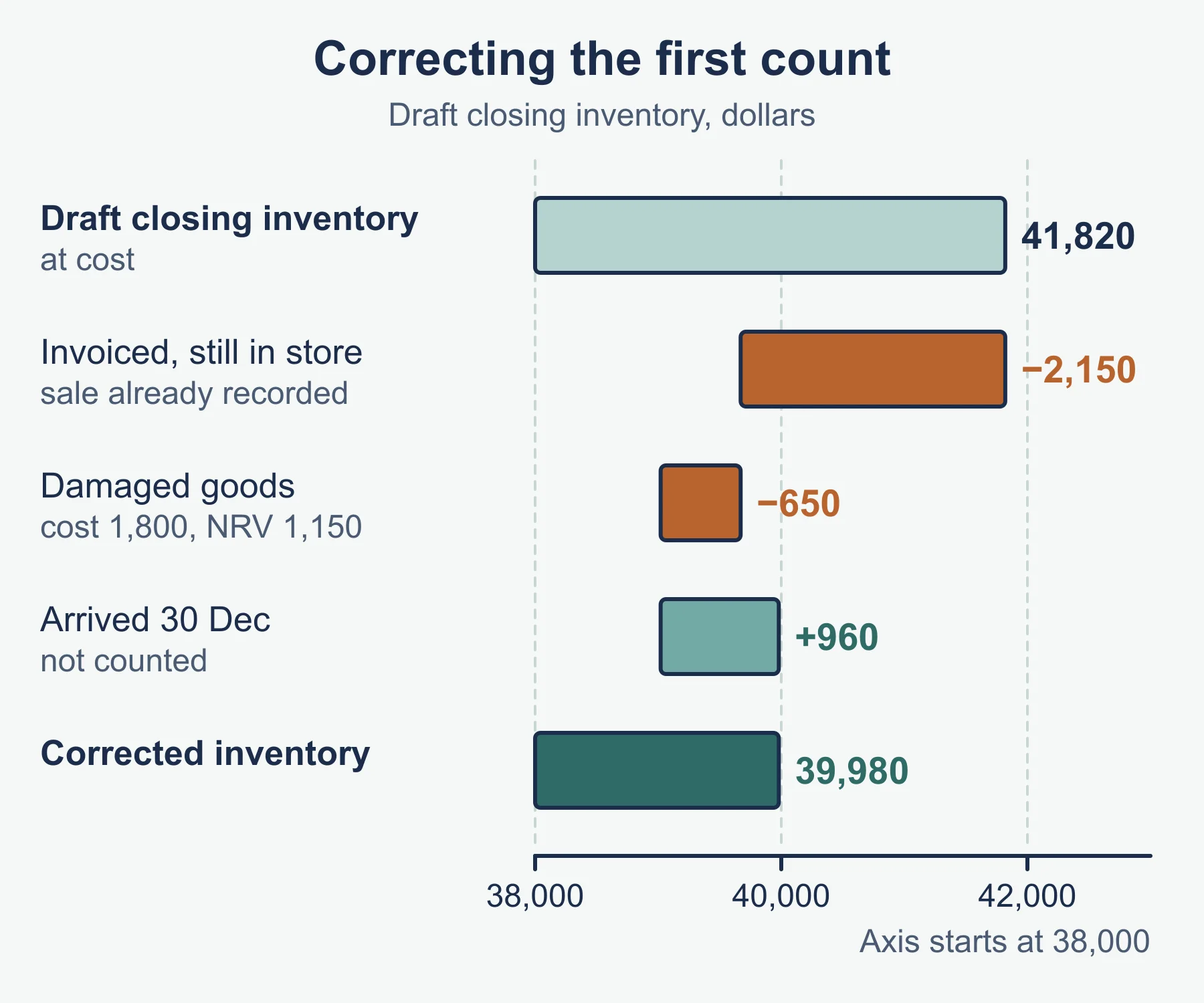
Worked example 3. Soraya Danforth’s draft closing inventory at Danforth Garden Supplies was 41,820 at cost.
- Goods costing 2,150 were invoiced to a customer on 30 December but were still in the warehouse at the count. The sale is recorded, so the goods are deducted.
- Damaged goods costing 1,800 were counted at cost. They can be sold for 1,300 with selling costs of 150, so NRV is 1,150 and the reduction is 650.
- Goods costing 960 arrived on 30 December and were not counted. They are added.
Corrected closing inventory is 41,820 − 2,150 − 650 + 960 = 39,980.
4. The effect of an incorrect valuation
Closing inventory is subtracted in the calculation of cost of sales and is shown as a current asset:
Cost of sales = opening inventory + purchases − closing inventoryIf closing inventory is understated, cost of sales is overstated, so gross profit and profit for the year are understated by the same amount. Equity (capital) rises by the profit for the year, so equity is understated, and the inventory figure in current assets is understated. An overstatement has the opposite effect on every figure.
The error does not stay in one year. Closing inventory becomes the next year’s opening inventory, so in the next year the effects on cost of sales, on gross profit and on profit for the year are reversed.
5. Worked example: an understatement over two years
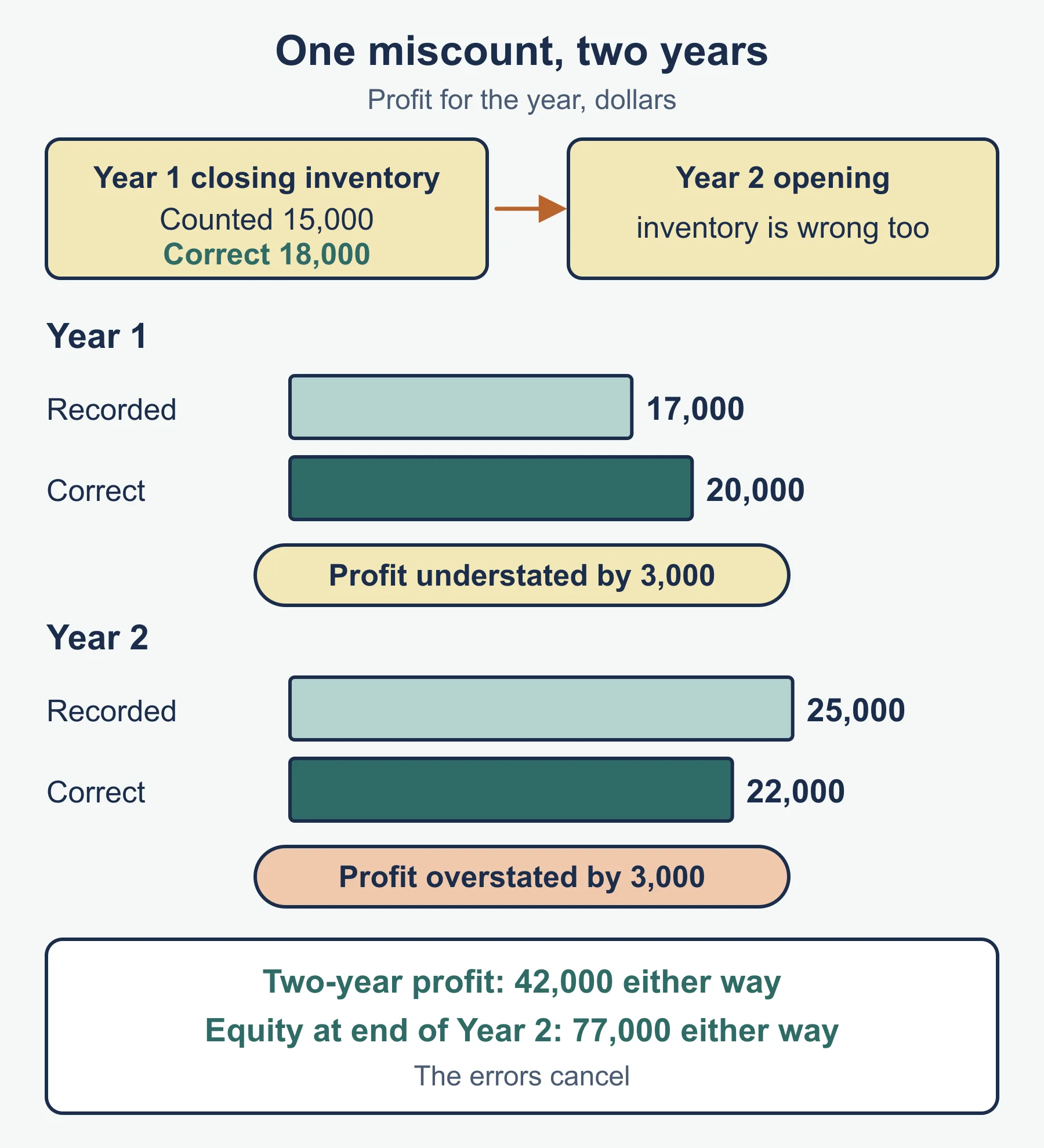
Yusra Ellsworth sells audio equipment. At the end of Year 1 a batch of goods costing 3,000 in a storeroom was not counted, so closing inventory was recorded as 15,000 instead of 18,000. Year 2 closing inventory (20,000) was correct. Opening capital was 60,000 and drawings were 12,000 in Year 1 and 13,000 in Year 2.
| ($) | Year 1 recorded | Year 1 correct | Year 2 recorded | Year 2 correct |
|---|---|---|---|---|
| Revenue | 150,000 | 150,000 | 165,000 | 165,000 |
| Opening inventory | 14,000 | 14,000 | 15,000 | 18,000 |
| Purchases | 96,000 | 96,000 | 104,000 | 104,000 |
| Closing inventory | (15,000) | (18,000) | (20,000) | (20,000) |
| Cost of sales | 95,000 | 92,000 | 99,000 | 102,000 |
| Gross profit | 55,000 | 58,000 | 66,000 | 63,000 |
| Expenses | 38,000 | 38,000 | 41,000 | 41,000 |
| Profit for the year | 17,000 | 20,000 | 25,000 | 22,000 |
| Equity at year end | 65,000 | 68,000 | 77,000 | 77,000 |
In Year 1, gross profit, profit for the year, equity and the inventory asset were each understated by 3,000. In Year 2, gross profit and profit for the year were overstated by 3,000. Equity at the end of Year 2 is correct, because the two profit errors cancel, and so is the Year 2 inventory asset. Total profit over the two years is 42,000 either way. The error moves profit between years and gives a misleading comparison of results (see Analysis and Interpretation).
The same logic applies if inventory was overstated: for example, goods still valued at cost when their NRV was lower. Gross profit, profit for the year, equity and the inventory asset are all too high, and the next year’s profit is too low.
Common errors
- Comparing total cost with total NRV instead of working item by item.
- Deducting selling costs from cost instead of from the selling price.
- Using NRV when it is higher than cost.
- Forgetting that a repair cost is deducted in finding NRV when the selling price quoted is the price after repair.
- Using the selling price of goods sold in a count-date adjustment without converting to cost.
- Confusing a mark-up, which is based on cost, with a margin, which is based on selling price.
- Stating the effect on the first year only and leaving out the opposite effect in the second year.
- Saying equity is affected in the second year: it is corrected, because the two years’ profit errors cancel.
Next steps
Use the revision notes, then the practice questions. The Accounting Procedures practice set mixes inventory with the other Topic 4 procedures, and Preparation of Financial Statements shows where closing inventory sits in full statements.
Frequently asked questions
Why must cost and net realisable value be compared item by item? Comparing the totals lets the extra value in some items hide the loss on others. Comparing each item, or group of identical items, and taking the lower figure means every expected loss is recognised.
How do you adjust an inventory count taken after the year end? Start from the counted value at cost, take off purchases received since the year end, add back the cost of goods sold since the year end, and adjust for returns. For a count before the year end, do the reverse.
What happens to profit if closing inventory is understated? Cost of sales is overstated, so gross profit and profit for the year are understated by the same amount, and the inventory asset and equity are understated too. In the next year the effects reverse, because the understated figure becomes opening inventory.
Which accounting concepts explain the inventory valuation rule in Cambridge IGCSE Accounting 0452? Prudence, because an expected loss is recognised as soon as it is foreseen, and realisation, because profit is not recognised until goods are sold. Together they give the rule of the lower of cost and net realisable value.
Official syllabus
Cambridge IGCSE Accounting 0452 syllabus for 2027, 2028 and 2029 (version 1), section 4.5 Valuation of inventory, published by Cambridge International Education (September 2024).
Get free revision emails (optional)
Occasional emails with practice questions, worked explanations and links to free resources for the qualification and subjects you choose. No spam, and you can unsubscribe from any email. The free tools on this site never need an email.
Related resources
-
Revision notes
IGCSE Accounting: Analysis and Interpretation — Revision Notes
Quick recall for Cambridge IGCSE Accounting 0452 Topic 6: ten ratios, reading them, profit versus cash, comparing businesses, users and statement limits.
Accounting · Cambridge · IGCSE, O Level
Revise topic -
Practice questions
IGCSE Accounting: Valuation of inventory (Cambridge 0452) – Practice Questions
Original practice questions with worked answers on Cambridge IGCSE Accounting 0452 section 4.5: lower of cost and NRV, count dates and inventory errors.
Accounting · Cambridge · IGCSE, O Level
Try questions -
Revision notes
IGCSE Accounting: Valuation of inventory (Cambridge 0452) – Revision Notes
Condensed revision notes for Cambridge IGCSE Accounting 0452 section 4.5: NRV rule, count-date adjustments, effects of inventory errors, and a self-test.
Accounting · Cambridge · IGCSE, O Level
Revise topic
Related articles
-
teaching
A Level tuition in Dubai: Cambridge or Pearson Edexcel International A Level?
Schools in Dubai and Abu Dhabi teach either Cambridge International AS & A Level or Pearson Edexcel International A Level. How the two are structured, why it matters for tuition, and how online classes from Lahore work.
9 October 2026
-
curriculum guides
Choosing subjects at IGCSE and A Level
How subject choices at 14 and 16 affect university options later, and how to keep pathways open without overloading a timetable.
28 July 2026
Studying this with a teacher
Working through Accounting IGCSE, O LEVELS?
This page is free and stays free. If you would rather be taught it, Marlbridge runs Accounting classes one-to-one and in small groups of up to 15, online in your own time zone. The first trial class is free. WhatsApp replies within an hour (8am–11pm Pakistan time, every day); email the same day.
Cambridge Accounting teachers at Marlbridge

