
Revision Notes
IGCSE Accounting: The purpose of accounting and the accounting equation (Cambridge 0452) – Revision Notes
Condensed notes on book-keeping versus accounting, profit and loss and the accounting equation for Cambridge IGCSE Accounting 0452, with a self-test.
- Subject
- Accounting
- Level
- IGCSE, O LEVELS
- Topic
- The fundamentals of accounting
- Author
- Marlbridge Academic Team
- Updated
- Reviewed by
- Javaid Iqbal Sabri (what this means)
Aligned to Cambridge IGCSE O Level Accounting (0452, 7707), 2027-2029. Official specification (IGCSE) ; Official specification (O Level) .
Syllabus page (what it covers and how it is assessed): Cambridge IGCSE Accounting; Cambridge O Level Accounting.
Syllabus points this page covers
0452
- 1.1 The purpose of accounting
- 1.2 The accounting equation
7707
- 1.1 The purpose of accounting
- 1.2 The accounting equation
Found an error? Report a correction.
Want a teacher for this? Marlbridge teaches Accounting online. Request a free trial class.
Syllabus edition note. This resource follows the Cambridge IGCSE Accounting 0452 syllabus (and Cambridge O Level Accounting 7707, which has the same subject content for the same series) for exams in 2027, 2028 and 2029 (version 1), first examined in the March 2027 series in India and the June 2027 series elsewhere. If you sit 0452 in November 2026, you sit the 2026 syllabus (version 2), which differs: Paper 1 has 35 multiple-choice marks in 1 hour 15 minutes, not 40 marks in 1 hour 30 minutes; Topic 7 is “Accounting principles and policies”, without 7.2 Ethical considerations or 7.3 Technology and sustainability; 4.4 is “Irrecoverable debts and provision for doubtful debts”; income statements are named instead of statements of profit or loss; three-column running balance accounts are not required; Clubs and societies is 5.4 and Manufacturing accounts 5.5; and 6.3 is “Inter-firm comparison”. If you sit in November 2026, work from the 2026 syllabus on the Cambridge International website.
Condensed recall for sections 1.1 The purpose of accounting and 1.2 The accounting equation of the Cambridge IGCSE Accounting 0452 syllabus for exams in 2027, 2028 and 2029 (version 1). Full explanations are in the study guide; questions are in the practice set. Earlier overviews are the Topic 1 study guide and fundamentals revision notes. Use the course hub, the checklist and the free diagnostics to see what is left.
Paper 1 is 40 multiple-choice questions and calculators may be used. Paper 2 has five compulsory structured questions of 20 marks each. Both papers are based on all the subject content, so treat this topic as background to everything else.
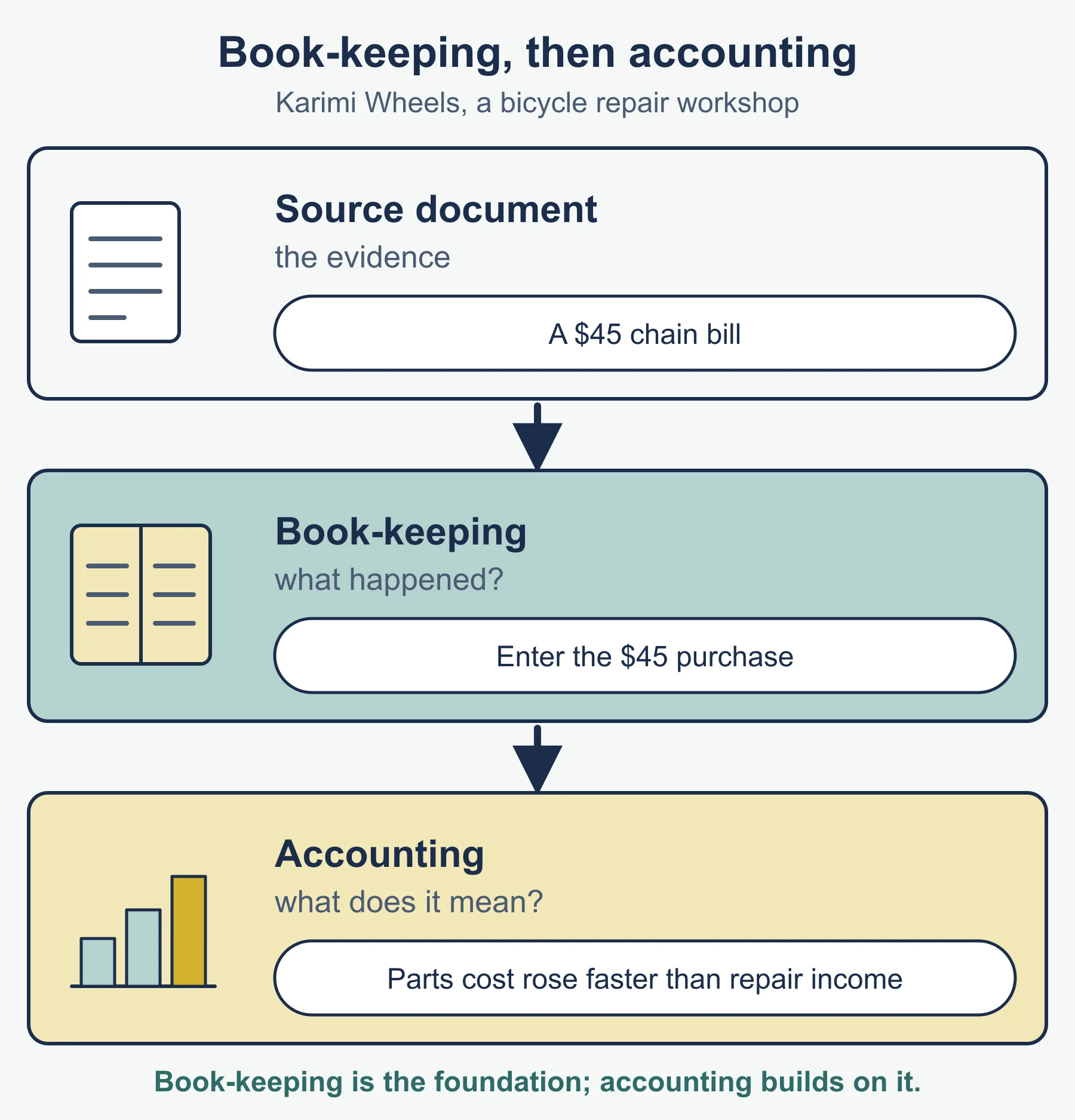
1.1 Book-keeping versus accounting
| Book-keeping | Accounting | |
|---|---|---|
| What it is | Recording transactions | Using the records to summarise, analyse and communicate |
| Question it answers | What happened? | What does it mean and what should we do? |
| Typical outputs | Entries in the books, ledger accounts | Statement of profit or loss, statement of financial position, comments, recommendations |
| Judgement needed | Little: follow set rules | A lot: interpret, compare, advise |
One-line test: if the task is writing an entry down, it is book-keeping; if it is summarising, interpreting or advising, it is accounting.
1.1 Measuring profit and loss
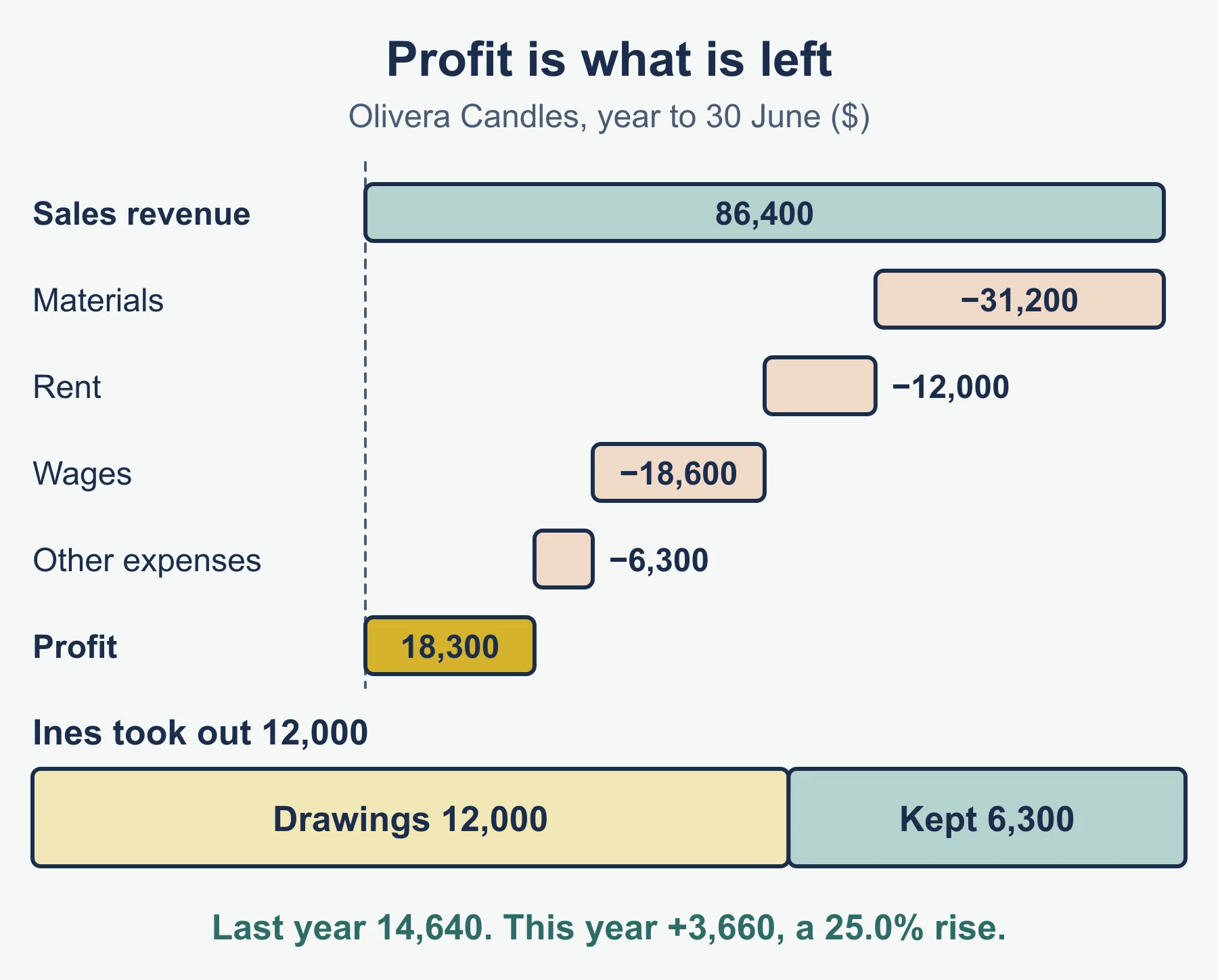
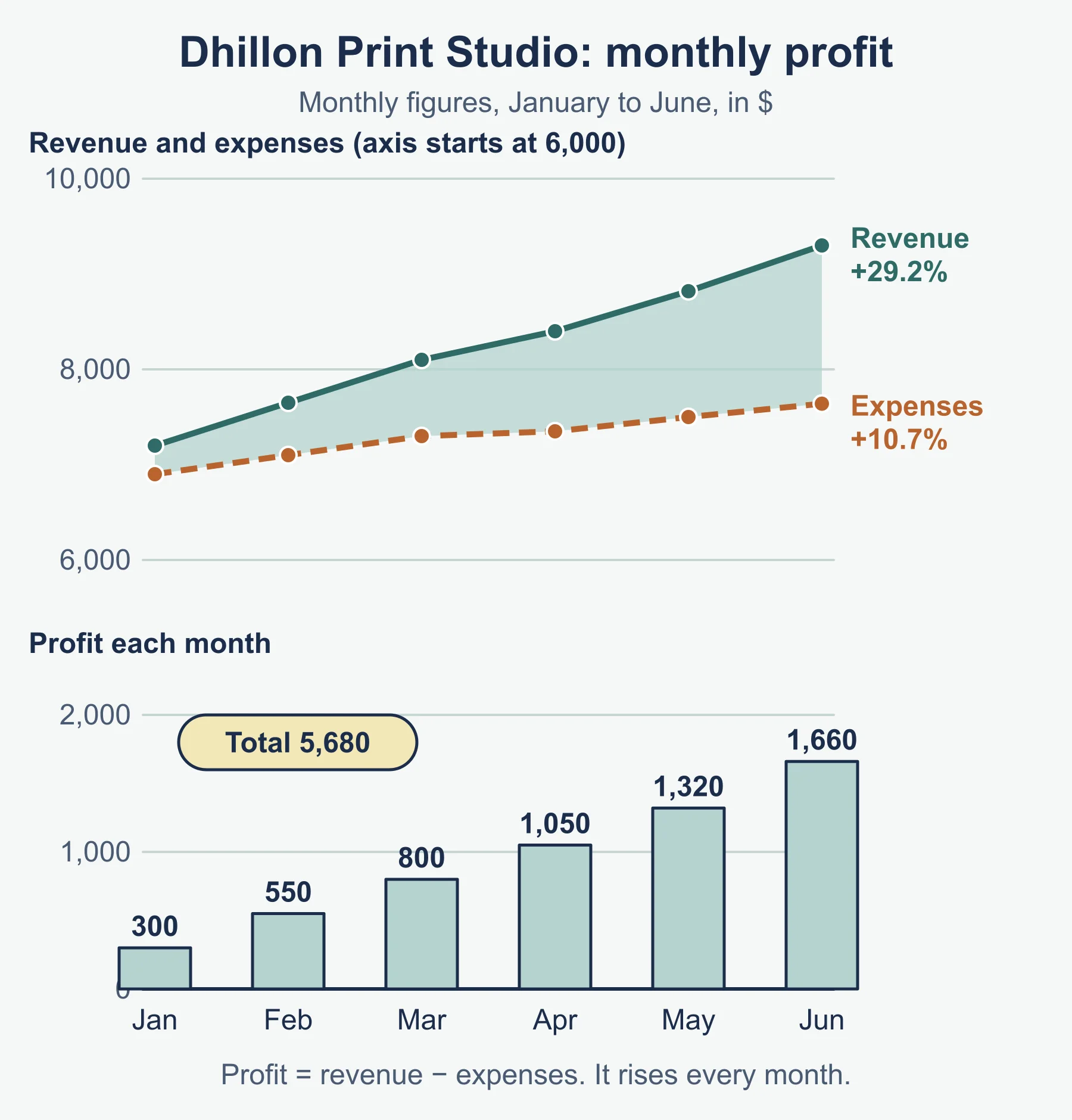
Profit = income earned in the period − expenses of earning it. A negative result is a loss. The figure belongs to a stated period and appears in the statement of profit or loss.
Purposes to be able to name and apply:
- Judge whether the business is succeeding and whether the owner’s effort is rewarded.
- Decide how much the owner can take as drawings without weakening the business.
- Compare with earlier periods, with plans, or with similar businesses.
- Give lenders and tax authorities a recognised measure.
- Support decisions: pricing, cost control, expansion, closure.
Percentage change = change ÷ original × 100. Profit falling from 9,000 to 6,750 is a fall of 2,250, which is 2,250 ÷ 9,000 = 25.0% down.
1.1 Information for monitoring and decisions
| Role | Meaning | Example |
|---|---|---|
| Monitoring progress | Comparing results with a past period or a target | Revenue up 12% but profit flat, so expenses are rising |
| Decision-making | Choosing between options using the facts | Do not buy a second vehicle while the bank loan is still large and profit is falling |
Accounting information supports the decision. It does not make the decision, and it cannot show things that are not measured in money.
1.2 The three elements
| Element | Meaning | Examples | Memory hook |
|---|---|---|---|
| Asset | Resource the business owns | Premises, equipment, inventory, trade receivables, bank, cash | Owned or owed to us |
| Liability | Amount the business owes outsiders | Trade payables, loan, bank overdraft | We owe it |
| Owner’s equity | Owner’s claim = assets − liabilities | Capital paid in + profit − drawings | What is left for the owner |
Owner’s equity goes up with: capital introduced, profit. Owner’s equity goes down with: loss, drawings.
1.2 The accounting equation
Assets = Liabilities + Owner’s equity
| To find | Rearrange to |
|---|---|
| Owner’s equity | Assets − Liabilities |
| Liabilities | Assets − Owner’s equity |
| Assets | Liabilities + Owner’s equity |
Method for a missing figure: write the equation, put in the two known figures, solve for the third, then check by substituting back.
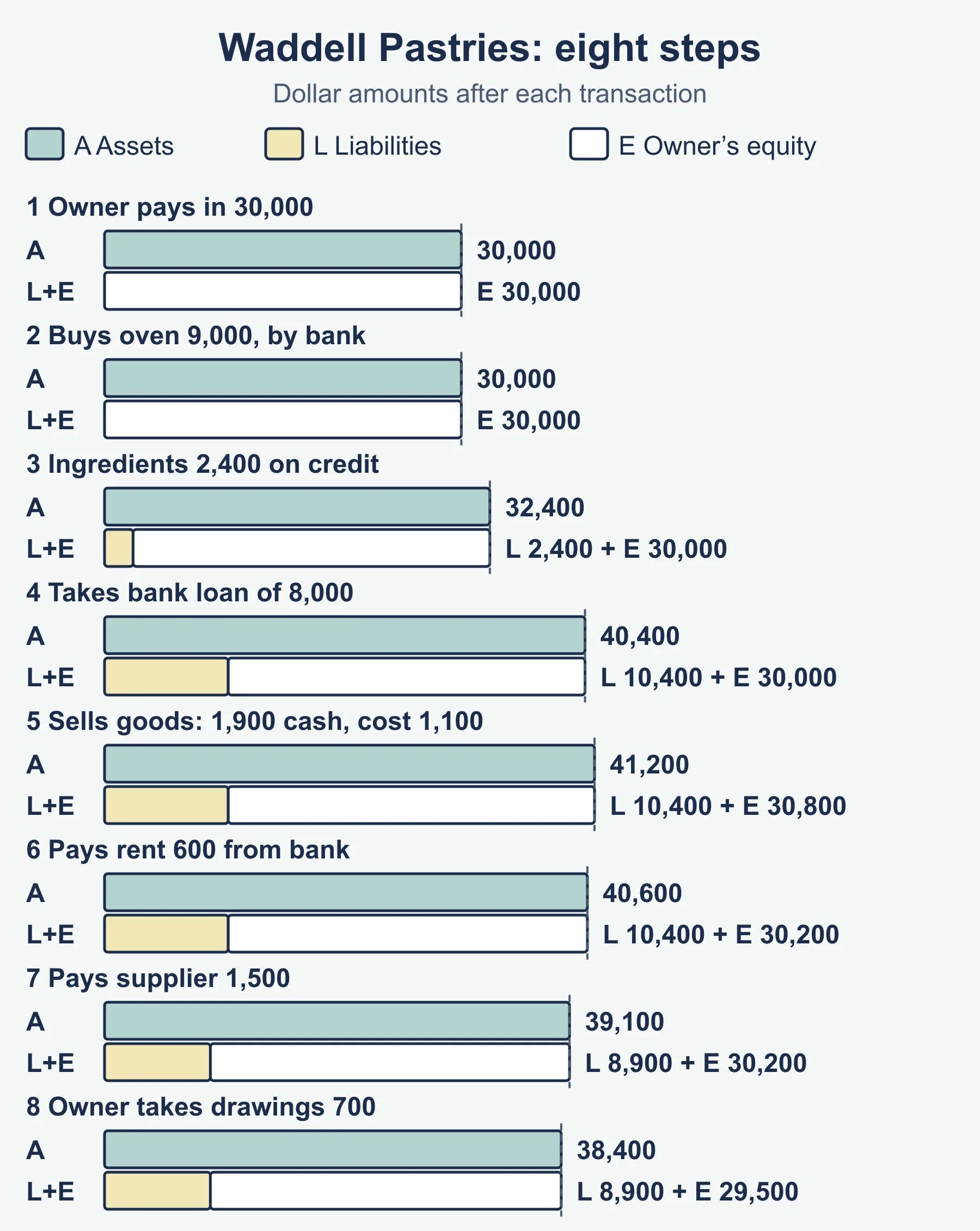
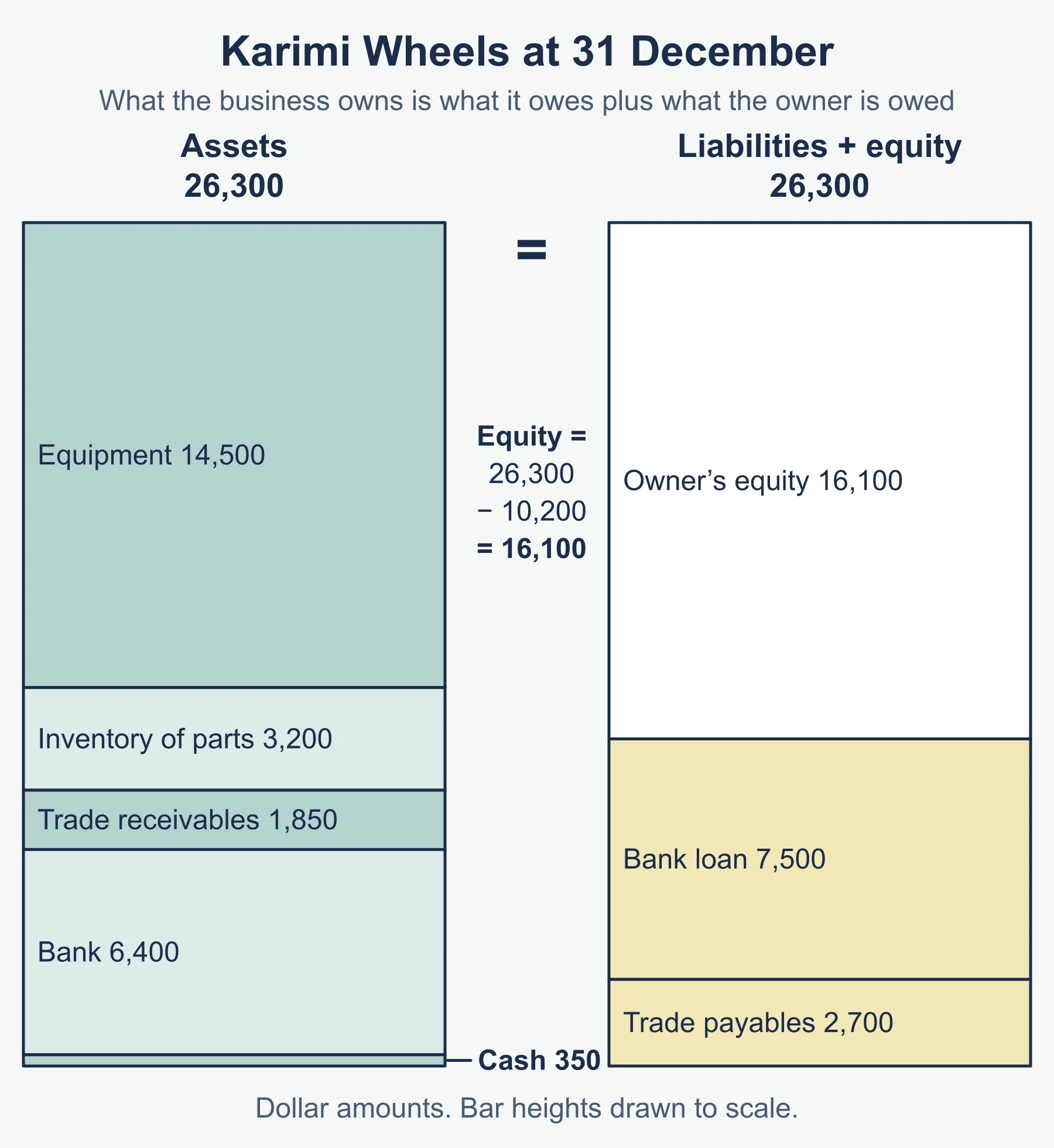
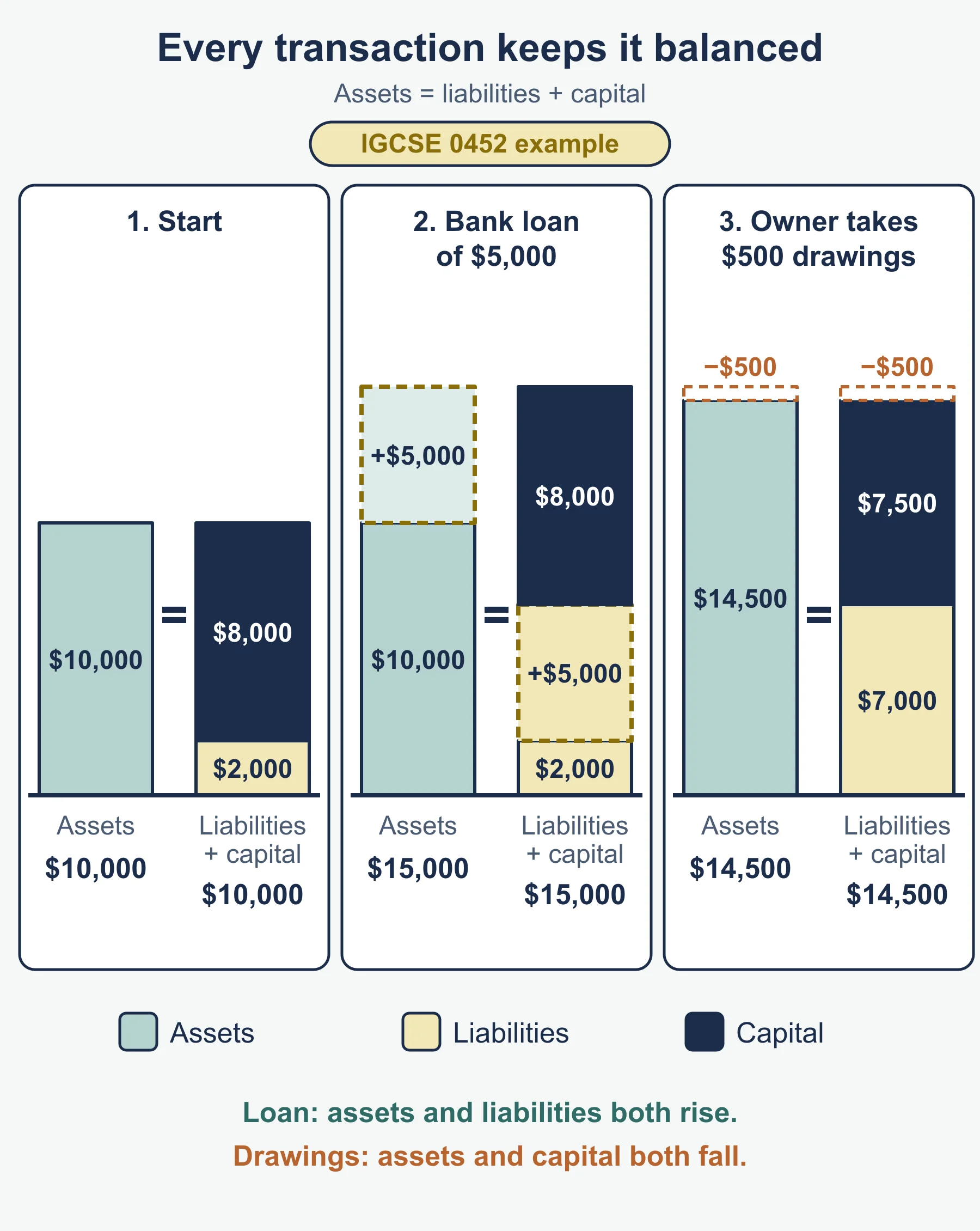
1.2 Effect of common transactions
| Transaction | Assets | Liabilities | Owner’s equity |
|---|---|---|---|
| Owner pays in capital | Up | No change | Up |
| Buy equipment for cash or bank | One up, one down (total same) | No change | No change |
| Buy equipment on credit | Up | Up | No change |
| Take out a loan (cash received) | Up | Up | No change |
| Repay part of a loan | Down | Down | No change |
| Sell goods above cost, cash or credit | Up by the profit | No change | Up by the profit |
| Pay an expense | Down | No change | Down |
| Owner takes drawings | Down | No change | Down |
| Customer pays what is owed | One up, one down (total same) | No change | No change |
| Pay a supplier | Down | Down | No change |
Only profit or loss, capital introduced and drawings move owner’s equity. Everything else leaves it alone.
Worked reminder: following the equation
Fernandez Tile Supplies starts with assets of 60,000, liabilities of 22,000 and so owner’s equity of 38,000 (all in dollars).
| Step | Assets | Liabilities | Owner’s equity |
|---|---|---|---|
| Opening position | 60,000 | 22,000 | 38,000 |
| Buys a van for 12,000 on credit | 72,000 | 34,000 | 38,000 |
| Owner takes 1,500 cash as drawings | 70,500 | 34,000 | 36,500 |
| Repays 5,000 of a loan from the bank | 65,500 | 29,000 | 36,500 |
| Sells goods that cost 800 for 1,250 on credit | 65,950 | 29,000 | 36,950 |
| Owner pays 6,000 into the bank | 71,950 | 29,000 | 42,950 |
Check the last line: 29,000 + 42,950 = 71,950, so the equation balances. The sale adds 450 to both assets and owner’s equity, because 1,250 − 800 = 450.
Profit from the movement in owner’s equity
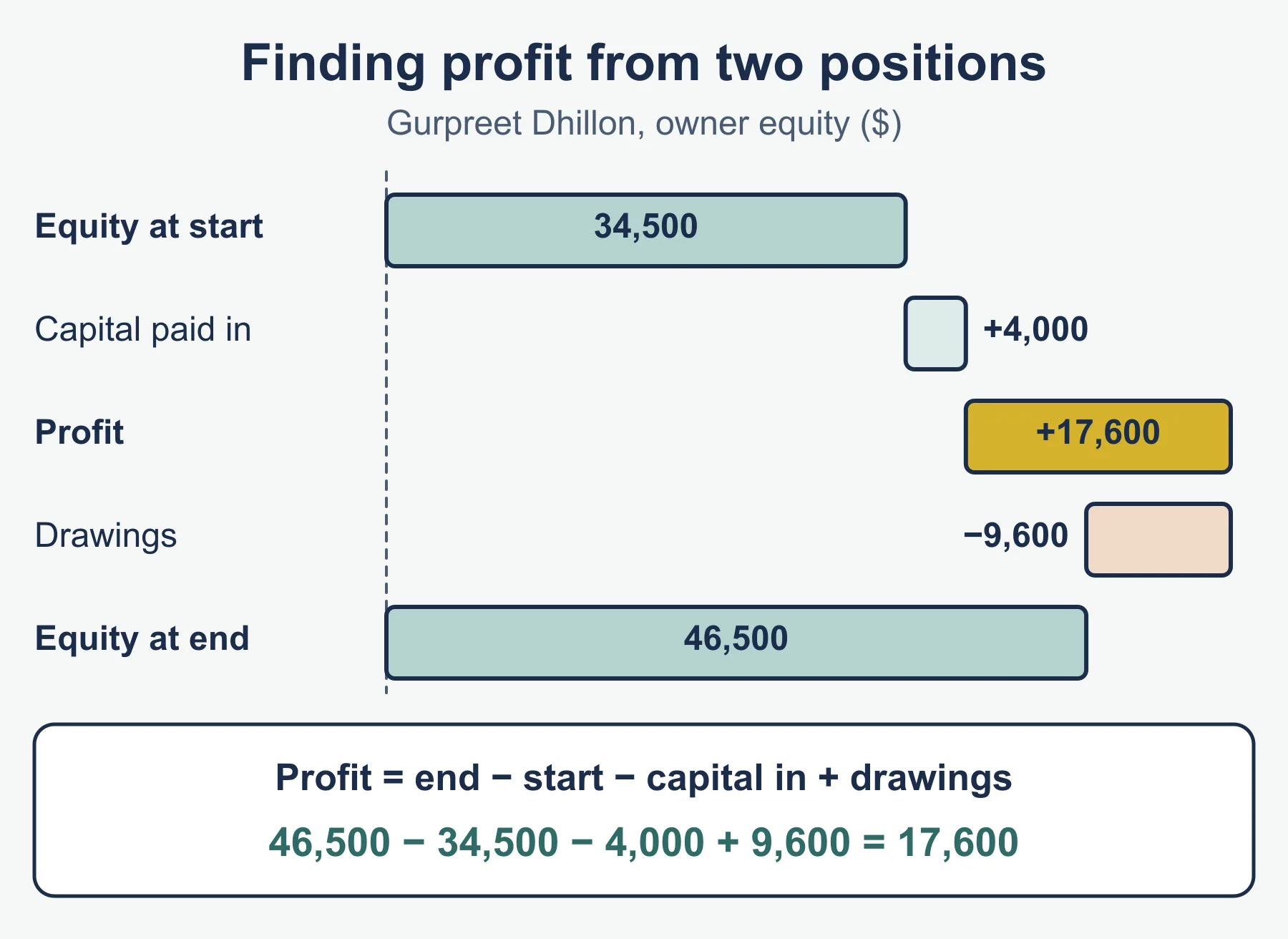
Profit = closing equity − opening equity − capital introduced + drawings
Opening equity 31,200, closing equity 38,650, capital introduced 2,500, drawings 7,200: profit = 38,650 − 31,200 − 2,500 + 7,200 = 12,150.
Distinctions to keep clear
- Profit versus cash. Profit is a measure of performance over a period. Cash is one of the assets.
- Drawings versus expenses. An expense is a cost of running the business. Drawings are the owner taking value out.
- Receivables versus payables. Receivables are owed to the business (asset). Payables are owed by it (liability).
- Loan versus capital. A loan is owed to an outsider. Capital belongs to the owner.
- Overdraft versus bank balance. An overdrawn account is a liability.
Quick self-test
- State the accounting equation.
- Assets are 83,600 and liabilities are 29,400. Find owner’s equity.
- Liabilities are 15,250 and owner’s equity is 40,750. Find assets.
- Assets are 27,800 and owner’s equity is 18,300. Find liabilities.
- Classify each as asset, liability or owner’s equity: trade receivables, bank overdraft, capital paid in by the owner.
- A machine costing 7,400 is bought on credit. State the effect on assets, liabilities and owner’s equity.
- The owner takes 1,500 from the bank for personal use. State the effect on each element.
- Goods that cost 650 are sold on credit for 940. By how much do assets and owner’s equity change?
- Opening equity 31,200, closing equity 38,650, capital introduced 2,500, drawings 7,200. Find profit.
- Give two purposes of measuring profit.
- Distinguish book-keeping from accounting in one sentence each.
- Profit falls from 9,000 to 6,750. State the percentage change.
Answers
- Assets = Liabilities + Owner’s equity.
- 83,600 − 29,400 = 54,200.
- 15,250 + 40,750 = 56,000.
- 27,800 − 18,300 = 9,500.
- Trade receivables: asset. Bank overdraft: liability. Capital paid in: owner’s equity.
- Assets up 7,400, liabilities up 7,400, owner’s equity no change.
- Assets down 1,500, owner’s equity down 1,500, liabilities no change.
- Both increase by 290, because 940 − 650 = 290.
- 38,650 − 31,200 − 2,500 + 7,200 = 12,150.
- Any two from: judge performance, guide drawings, compare over time, inform lenders or tax calculations, support decisions.
- Book-keeping records transactions. Accounting summarises, analyses and communicates what the records show.
- A fall of 25.0% (2,250 ÷ 9,000 × 100).
Where marks are usually lost
- Defining accounting as “keeping the books” with no mention of analysis or communication.
- Giving a purpose of profit that is only a definition, such as “to find the profit”.
- Answers that say “to see if the business is doing well” without saying how it is then used.
- Putting drawings in the expenses when finding profit.
- Treating a bank overdraft or trade payables as assets.
- Saying a loan raises owner’s equity.
- Showing only one side of a transaction and forgetting the second change.
- Working out a percentage change against the new figure instead of the original.
- Writing figures without units or a stated period where the question asks for them.
Frequently asked questions
How is the Cambridge IGCSE Accounting 0452 exam structured? Paper 1 is 40 multiple-choice questions and calculators may be used. Paper 2 has five compulsory structured questions of 20 marks each, and both papers are based on all the subject content.
How do you calculate profit from the movement in owner’s equity? Profit = closing equity minus opening equity minus capital introduced plus drawings. For example, with opening equity of 31,200, closing equity of 38,650, capital introduced of 2,500 and drawings of 7,200, profit is 12,150.
What changes owner’s equity? Only four things: capital introduced and profit increase it, while a loss and drawings decrease it. Other transactions, such as buying an asset on credit or repaying a loan, leave owner’s equity unchanged.
What is the difference between drawings and expenses? An expense is a cost of earning income and is deducted when finding profit. Drawings are amounts the owner takes out for private use, which reduce owner’s equity directly and are not an expense.
Official syllabus
Cambridge IGCSE Accounting 0452 syllabus for exams in 2027, 2028 and 2029 (version 1), published by Cambridge University Press & Assessment (Cambridge International Education). Sections 1.1 and 1.2.
Get free revision emails (optional)
Occasional emails with practice questions, worked explanations and links to free resources for the qualification and subjects you choose. No spam, and you can unsubscribe from any email. The free tools on this site never need an email.
Related resources
-
Revision notes
IGCSE Accounting: Analysis and Interpretation — Revision Notes
Quick recall for Cambridge IGCSE Accounting 0452 Topic 6: ten ratios, reading them, profit versus cash, comparing businesses, users and statement limits.
Accounting · Cambridge · IGCSE, O Level
Revise topic -
Practice questions
The Fundamentals of Accounting: Practice Questions
Original exam-style practice questions with full worked answers on the accounting equation, double entry, trial balance and financial statements.
Accounting · Cambridge · IGCSE, O Level
Try questions -
Revision notes
IGCSE Accounting: The Fundamentals of Accounting — Revision Notes
Condensed recall notes on the accounting equation, double entry, books of prime entry and the trial balance for Cambridge IGCSE Accounting 0452.
Accounting · Cambridge · IGCSE, O Level
Revise topic
Related articles
-
teaching
A Level tuition in Dubai: Cambridge or Pearson Edexcel International A Level?
Schools in Dubai and Abu Dhabi teach either Cambridge International AS & A Level or Pearson Edexcel International A Level. How the two are structured, why it matters for tuition, and how online classes from Lahore work.
9 October 2026
-
curriculum guides
Choosing subjects at IGCSE and A Level
How subject choices at 14 and 16 affect university options later, and how to keep pathways open without overloading a timetable.
28 July 2026
Studying this with a teacher
Working through Accounting IGCSE, O LEVELS?
This page is free and stays free. If you would rather be taught it, Marlbridge runs Accounting classes one-to-one and in small groups of up to 15, online in your own time zone. The first trial class is free. WhatsApp replies within an hour (8am–11pm Pakistan time, every day); email the same day.
Cambridge Accounting teachers at Marlbridge

