
Study Guides
IGCSE Accounting: The trial balance and correction of errors (Cambridge 0452)
Study guide to the trial balance, the six error types, correcting journals, suspense accounts and corrected profit for Cambridge IGCSE Accounting 0452.
- Subject
- Accounting
- Level
- IGCSE, O LEVELS
- Topic
- Verification of accounting records
- Author
- Marlbridge Academic Team
- Updated
- Reviewed by
- Javaid Iqbal Sabri (what this means)
Aligned to Cambridge IGCSE O Level Accounting (0452, 7707), 2027-2029. Official specification (IGCSE) ; Official specification (O Level) .
Syllabus page (what it covers and how it is assessed): Cambridge IGCSE Accounting; Cambridge O Level Accounting.
Syllabus points this page covers
0452
- 3.1 The trial balance
- 3.2 Corrections of errors
7707
- 3.1 The trial balance
- 3.2 Corrections of errors
Found an error? Report a correction.
Want a teacher for this? Marlbridge teaches Accounting online. Request a free trial class.
Syllabus edition note. This resource follows the Cambridge IGCSE Accounting 0452 syllabus (and Cambridge O Level Accounting 7707, which has the same subject content for the same series) for exams in 2027, 2028 and 2029 (version 1), first examined in the March 2027 series in India and the June 2027 series elsewhere. If you sit 0452 in November 2026, you sit the 2026 syllabus (version 2), which differs: Paper 1 has 35 multiple-choice marks in 1 hour 15 minutes, not 40 marks in 1 hour 30 minutes; Topic 7 is “Accounting principles and policies”, without 7.2 Ethical considerations or 7.3 Technology and sustainability; 4.4 is “Irrecoverable debts and provision for doubtful debts”; income statements are named instead of statements of profit or loss; three-column running balance accounts are not required; Clubs and societies is 5.4 and Manufacturing accounts 5.5; and 6.3 is “Inter-firm comparison”. For this topic, the 2026 syllabus also lists dividends among the cash book updates, and it does not include the impact of digital transactions on bank reconciliation or on control accounts. If you sit in November 2026, work from the 2026 syllabus on the Cambridge International website.
This guide teaches sections 3.1 (The trial balance) and 3.2 (Corrections of errors) of the Cambridge IGCSE Accounting syllabus for exams in 2027, 2028 and 2029 (version 1). All candidates take the same two papers, so nothing here is limited to a tier. Amounts are in dollars ($) and tables show bare figures. It builds on double entry from Sources and Recording of Data and sits inside the wider Verification of Accounting Records guide, which also covers bank reconciliation and control accounts.
Next: the revision notes and the practice questions. More practice on the whole topic is in the earlier practice set and earlier revision notes. Course pages: Cambridge IGCSE Accounting hub, printable checklist and free 10-minute diagnostics.
What the syllabus asks for
| Section | Official point | Where it is taught |
|---|---|---|
| 3.1 | Purposes and limitations of a trial balance | Section 1 |
| 3.1 | Prepare a trial balance from a list of balances; amend one containing errors | Sections 2 and 3 |
| 3.1 | Errors that do not affect the trial balance: commission, compensating, complete reversal, omission, original entry, principle | Section 4 |
| 3.2 | Correct errors using journal entries | Section 5 |
| 3.2 | Suspense account as a temporary measure; correcting errors through it | Section 6 |
| 3.2 | Adjust a profit or loss after correcting errors | Section 7 |
| 3.2 | Effect of corrections on the statement of financial position | Section 8 |
Paper 2 may ask you to prepare suspense accounts and journal entries, and calculators may be used.
1. Purposes and limitations of a trial balance
A trial balance is a list of the balances on all the ledger accounts at a stated date, with debit balances in one column and credit balances in the other.
Purposes
- It checks that the total of debit balances equals the total of credit balances, which is what double entry should produce.
- If the totals differ, at least one error exists.
- It is a convenient list of balances from which the statement of profit or loss and the statement of financial position are prepared.
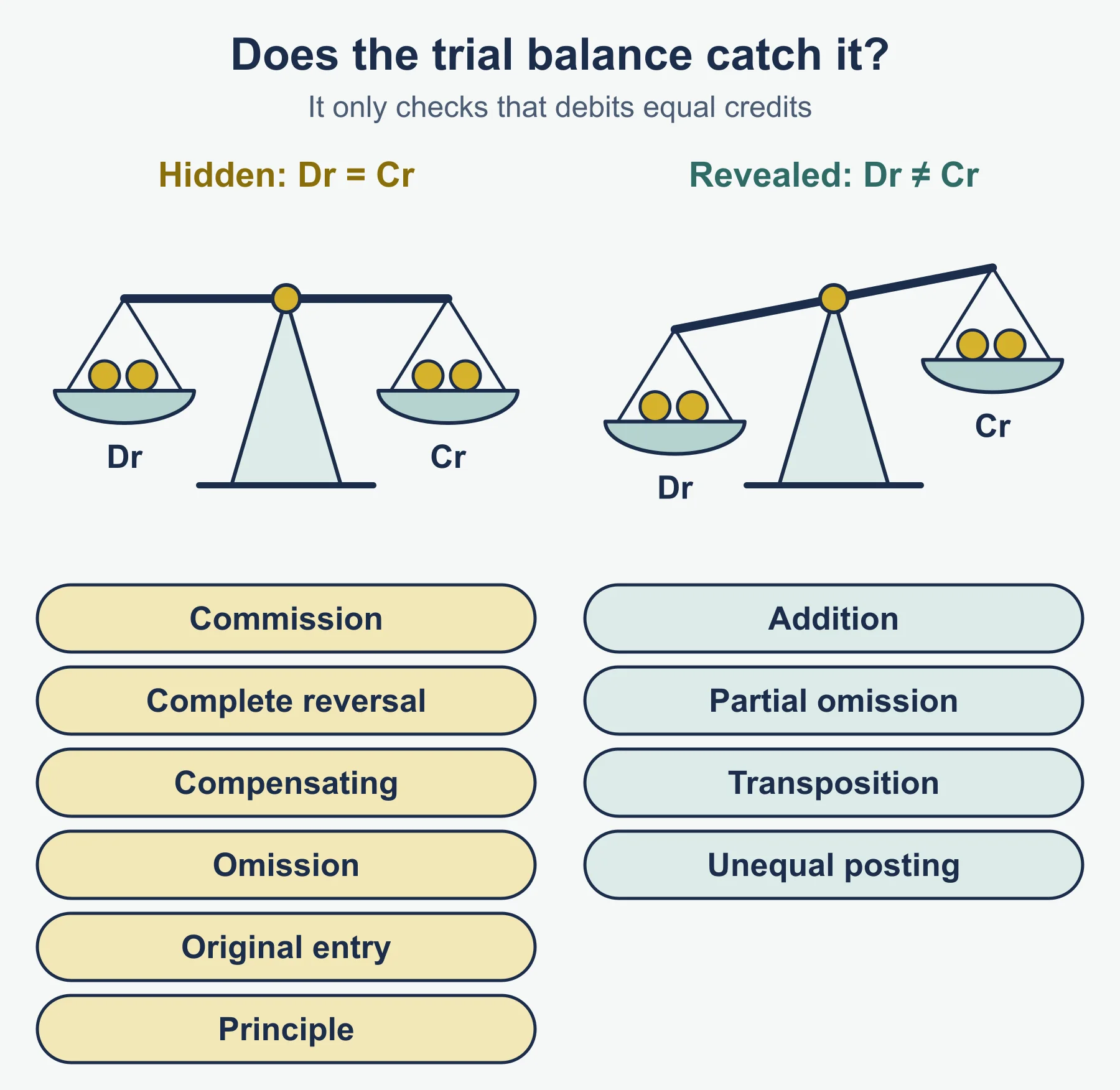
Limitations. Equal totals do not prove the books are right. Six kinds of error leave the totals equal (section 4), so they are invisible to it. It cannot say which account holds an error.
2. Preparing a trial balance
Put each balance in the column where it normally sits.
| Debit balances | Credit balances |
|---|---|
| Assets: non-current assets, inventory, trade receivables, bank (if positive) | Liabilities: trade payables, loans, bank overdraft |
| Expenses, purchases, carriage inwards | Revenue, sales, other income |
| Sales returns | Purchases returns |
| Drawings | Capital |
Worked example. Torridge Cycles lists these balances at 31 March.
| Account | Debit | Credit |
|---|---|---|
| Inventory at 1 April | 6,300 | |
| Purchases | 41,700 | |
| Sales | 73,900 | |
| Sales returns | 1,540 | |
| Purchases returns | 1,260 | |
| Carriage inwards | 380 | |
| Wages | 12,180 | |
| Rent | 4,800 | |
| Insurance | 1,150 | |
| Motor vehicles | 14,500 | |
| Equipment | 9,200 | |
| Trade receivables | 6,870 | |
| Trade payables | 5,210 | |
| Bank | 4,150 | |
| Loan from bank | 8,000 | |
| Drawings | 5,600 | |
| Capital | 20,000 | |
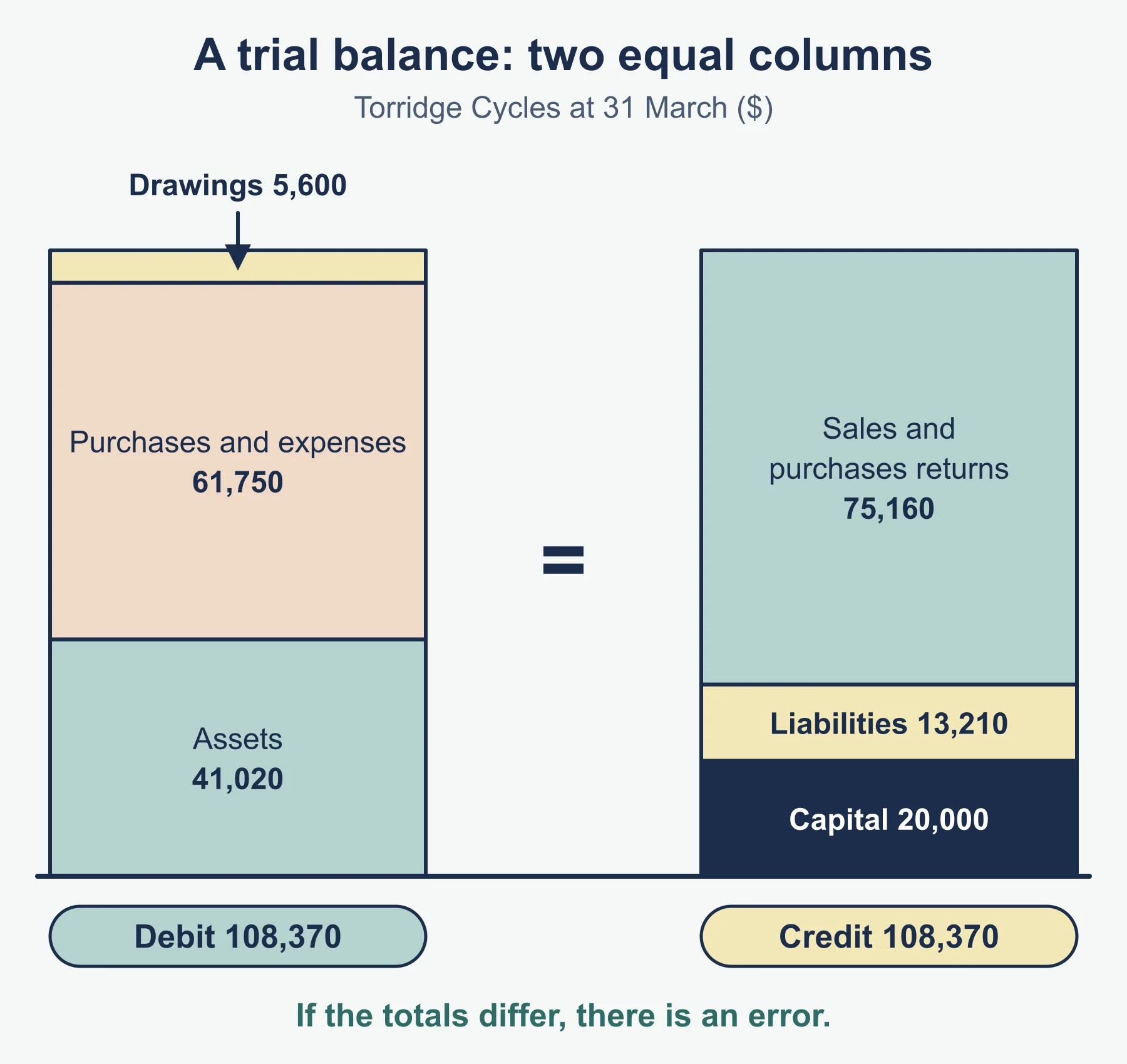
| Totals | 108,370 | 108,370 |
The debits add to 108,370 and the credits add to 108,370, so the trial balance agrees. If capital had not been given, it would be the figure that balances the columns.
3. Amending a trial balance that contains errors
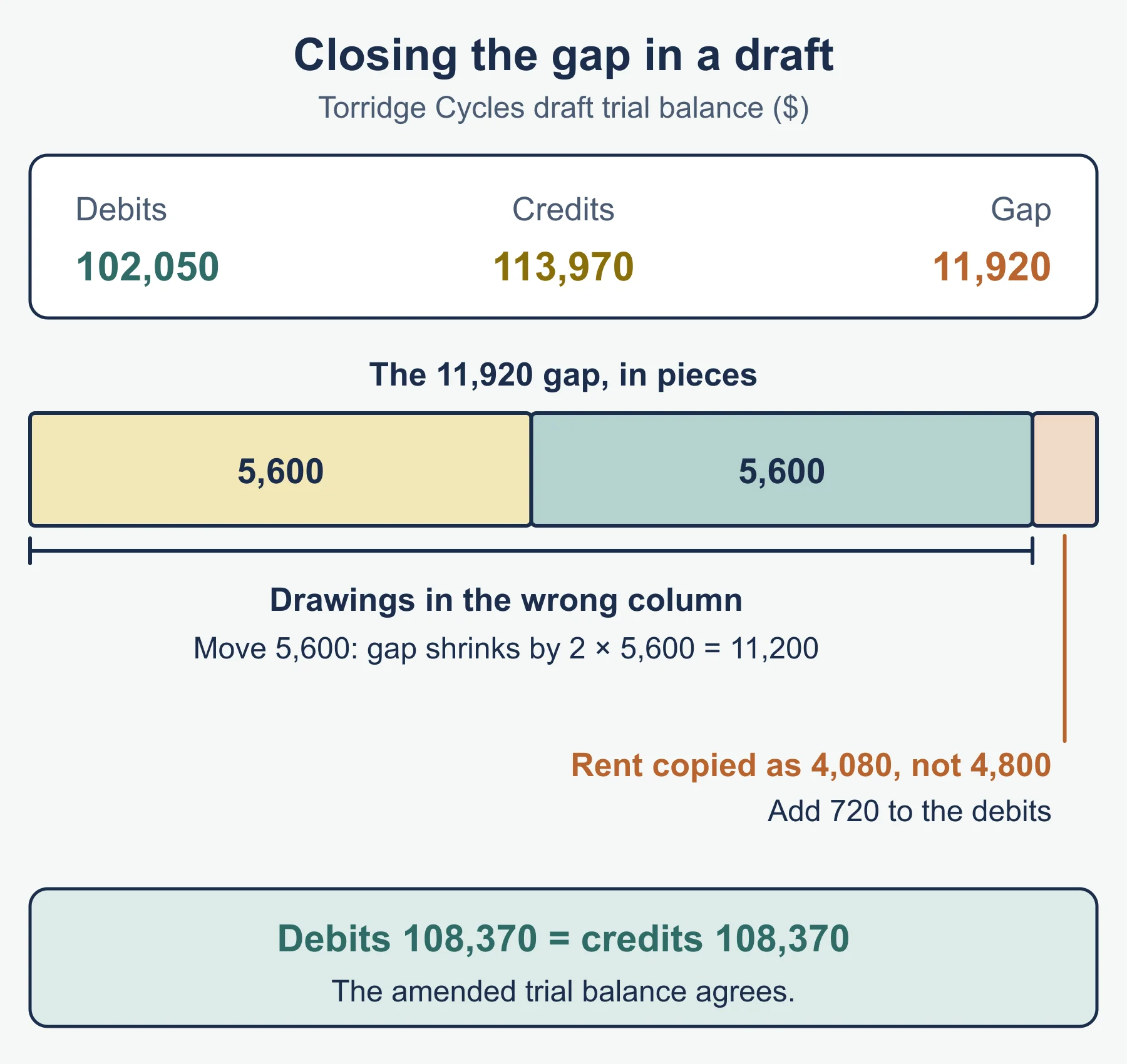
A draft trial balance was first prepared for Torridge Cycles with two mistakes in listing: drawings (5,600) was put in the credit column, and rent was copied as 4,080 instead of 4,800.
| Step | Debit total | Credit total |
|---|---|---|
| Draft totals | 102,050 | 113,970 |
| Move drawings to the debit column | +5,600 | −5,600 |
| Correct rent to 4,800 | +720 | |
| Amended totals | 108,370 | 108,370 |
The draft gap was 11,920. Moving drawings accounts for 11,200 of it (5,600 comes off one side and goes onto the other, so the gap changes by twice that) and the rent slip accounts for the other 720. When you amend, name each error, state its effect on each column and finish with equal totals.
4. Errors that do not affect the trial balance
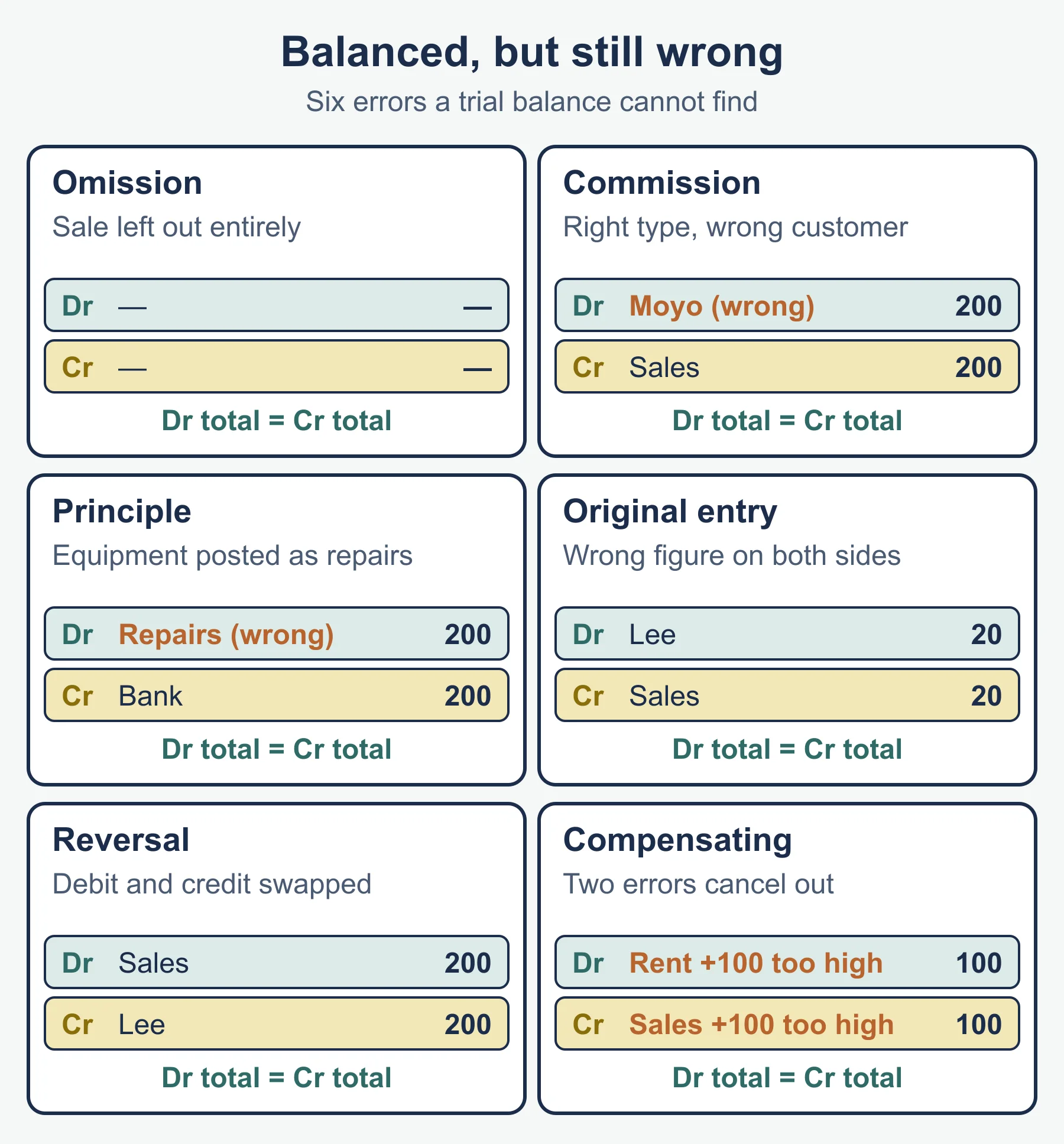
In each error below the debits and credits stay equal, so the trial balance still agrees.
| Error | What goes wrong | Example (Torridge Cycles) |
|---|---|---|
| Omission | A transaction is never recorded in any account | A credit sale of 640 to R Adeyemi is never recorded |
| Commission | Correct type of account, wrong specific account | Electricity of 275 is debited to the water account |
| Principle | Wrong class of account (for example an expense instead of an asset) | A computer costing 1,200 is debited to office expenses |
| Original entry | Wrong amount entered, the same wrong amount on both sides | A sale of 2,730 is recorded as 2,370 in both accounts |
| Complete reversal | Correct accounts, but debit and credit swapped | A 900 payment to a supplier is debited to bank and credited to the supplier |
| Compensating | Two separate errors, equal and opposite, cancel out | Sales is overcast by 500 and purchases is overcast by 500 |
To name the type, ask whether the transaction was recorded at all, then whether the right class of account, the right account, the right sides and the right amount were used.
5. Correcting errors with journal entries
Correct each error with a journal entry, not by crossing out. Work out what was done, what should have been done and the entries that bridge the gap.
| Error | Journal: debit | Journal: credit | Amount |
|---|---|---|---|
| Omission of the credit sale | R Adeyemi | Sales | 640 |
| Commission (electricity) | Electricity | Water | 275 |
| Principle (computer) | Office equipment | Office expenses | 1,200 |
| Original entry | Customer | Sales | 360 |
| Complete reversal | Supplier | Bank | 1,800 |
| Compensating | Sales | Purchases | 500 |
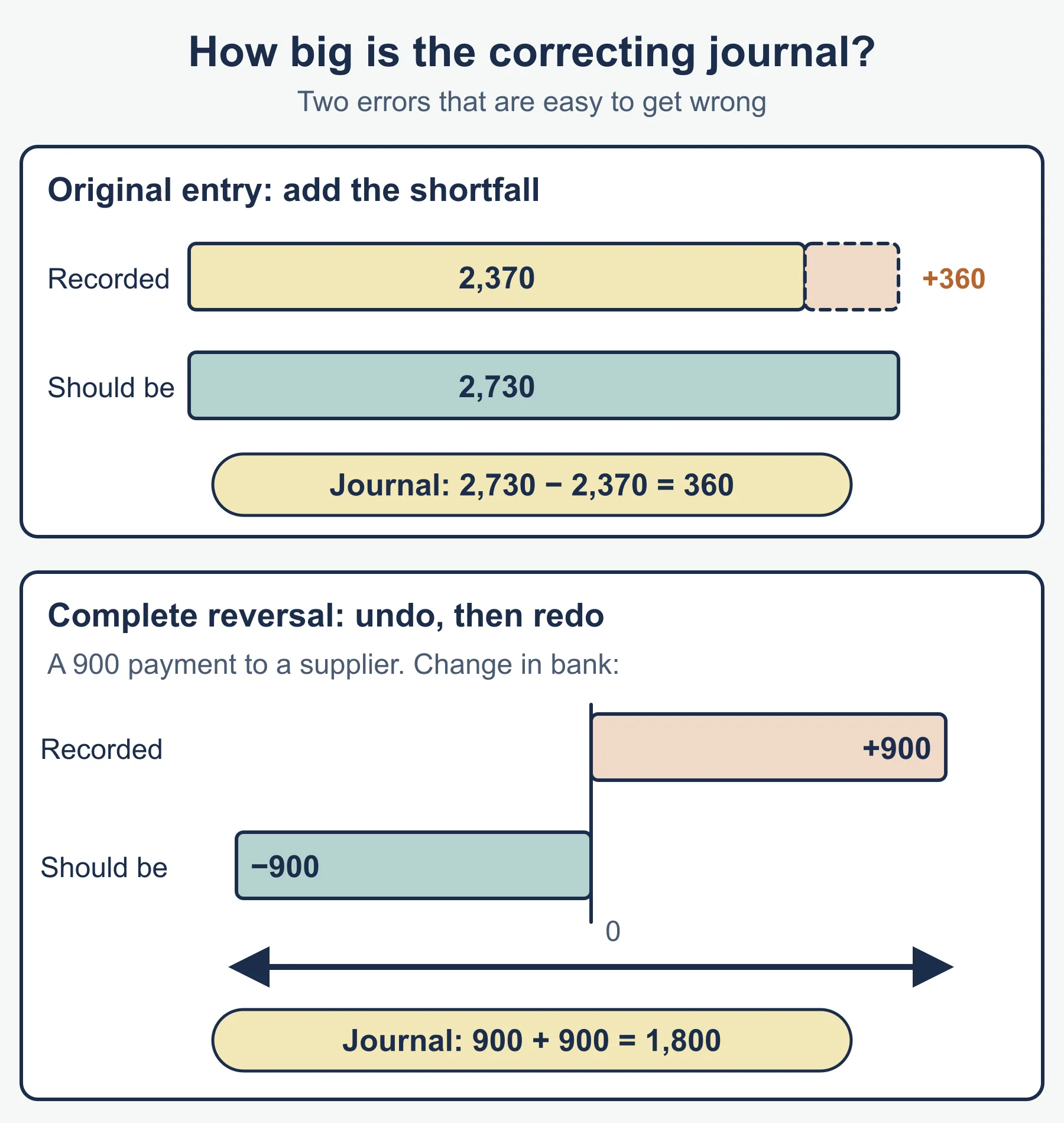
Two that are often mishandled:
- Original entry. Both accounts show 2,370 but should show 2,730. Only the shortfall is added: 2,730 − 2,370 = 360.
- Complete reversal. The 900 was debited to bank and credited to the supplier. The right entry is credit bank and debit supplier. To reach it you must undo the wrong entry (900) and then make the right one (900), so the correcting journal is for 1,800.
Each journal needs a narrative, for example “Correction of omitted credit sale”.
6. The suspense account
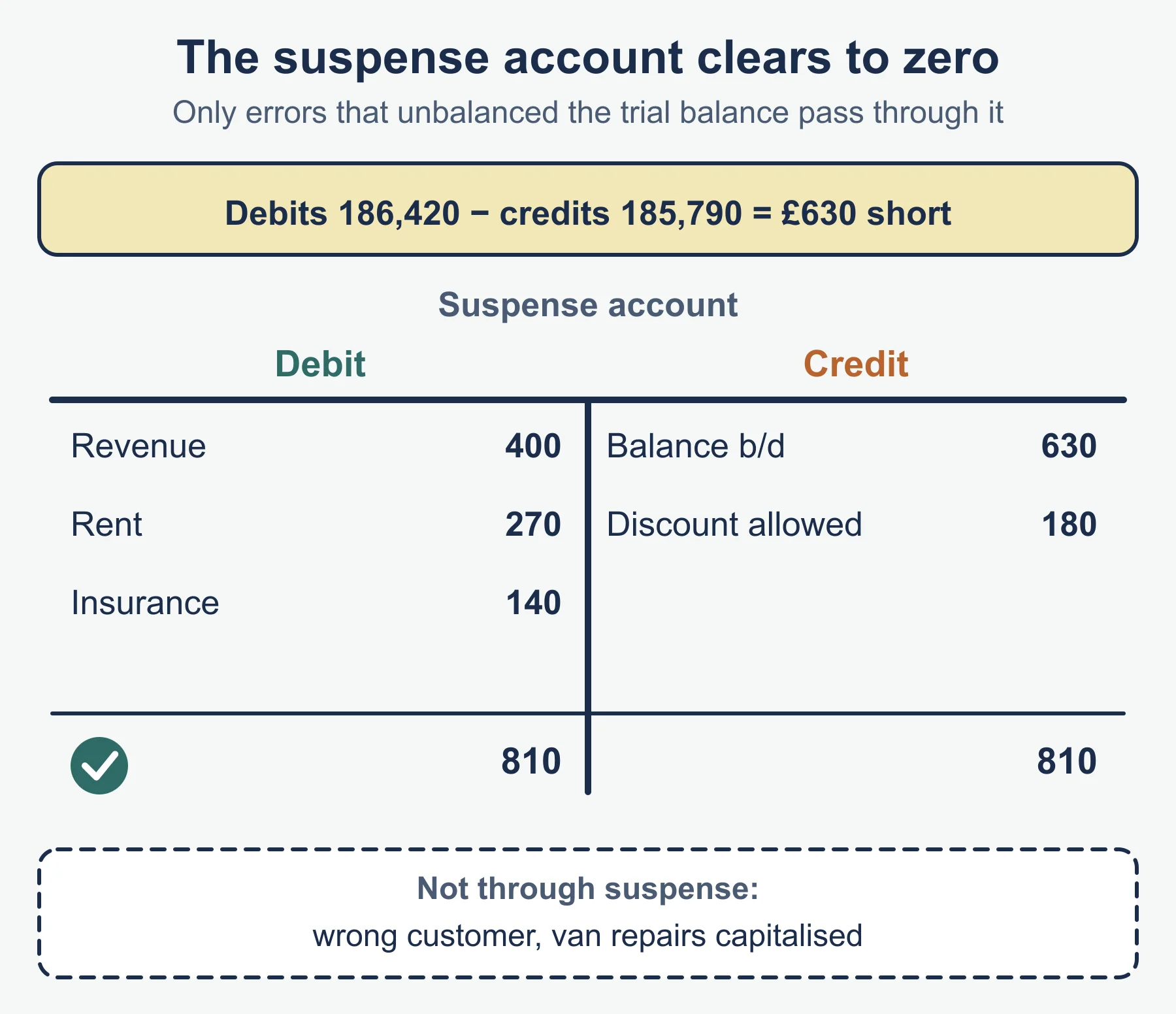
Some errors do break the equality of the two totals: a one-sided entry, different amounts on the two sides, two entries on the same side, or an addition mistake in an account. When the books cannot be put right before the accounts are needed, the difference is parked in a suspense account to make the trial balance agree. This is a temporary measure.
- If the debit total is larger than the credit total, the suspense account is shown as a credit balance, and the reverse.
- It is cleared by correcting journals once the errors are found, and it must end with a nil balance.
- Errors of the six types in section 4 never need a suspense account.
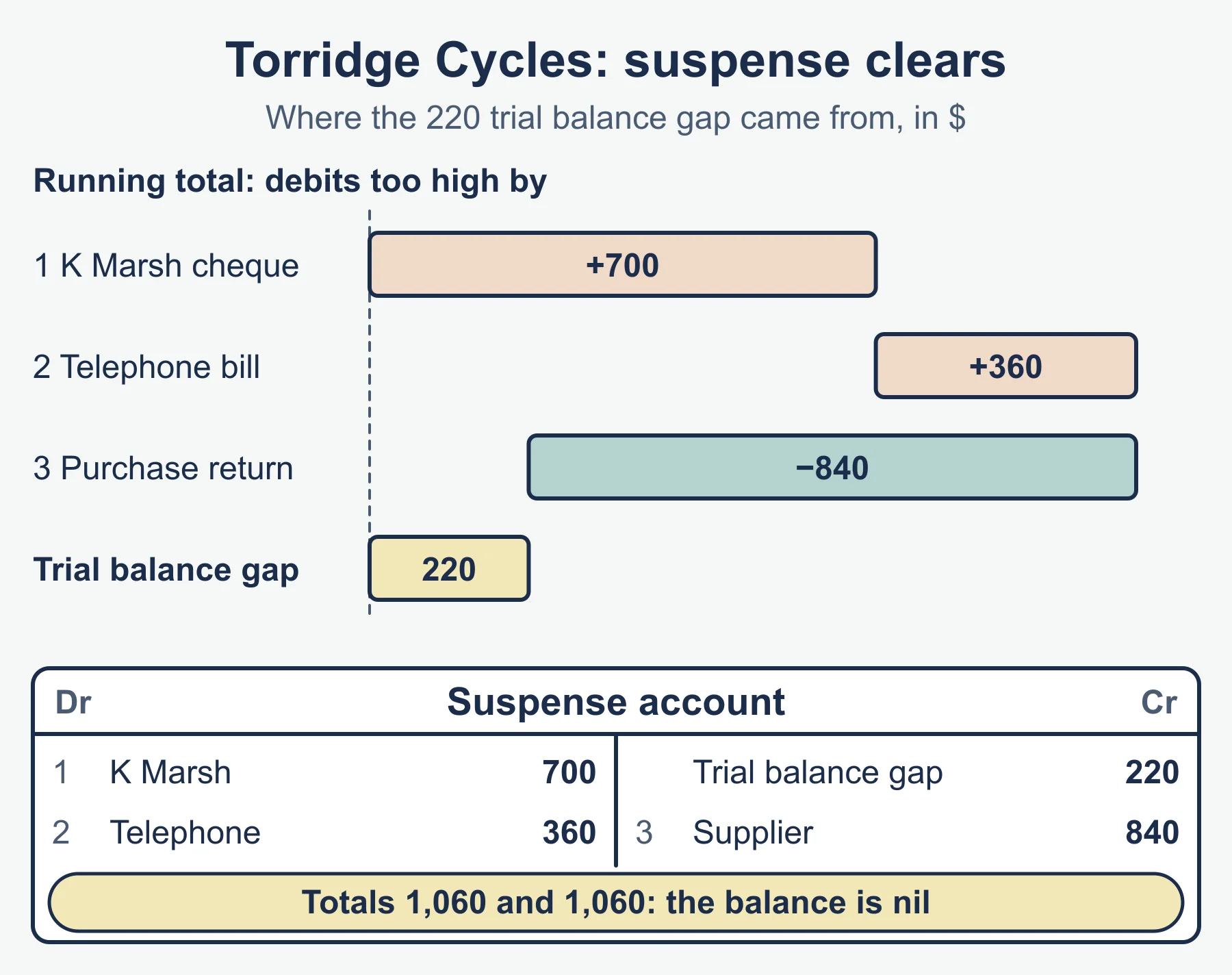
Worked example. Torridge Cycles’ trial balance showed debits 220 greater than credits, so a credit balance of 220 was opened in suspense. Three errors are then found.
- A 700 cheque from K Marsh was debited to bank, but not credited to K Marsh. Debits were too high by 700.
- A telephone bill of 840 was paid by bank, but entered in the telephone account as 1,200. Debits were too high by 360.
- A 420 purchase return was credited to purchases returns and also credited to the supplier’s account, which should have been debited. Credits were too high by 840.
Check: 700 + 360 − 840 = 220. The correcting journals:
| Item | Debit | Credit | Amount |
|---|---|---|---|
| 1 | Suspense | K Marsh | 700 |
| 2 | Suspense | Telephone | 360 |
| 3 | Supplier | Suspense | 840 |
| Suspense account | |||
|---|---|---|---|
| Debit side | Amount | Credit side | Amount |
| K Marsh | 700 | Balance (trial balance difference) | 220 |
| Telephone | 360 | Supplier | 840 |
| 1,060 | 1,060 |
The account clears, so the difference is fully explained. If it did not, an error would still be undiscovered.
A payment posted to the wrong supplier is commission and needs no suspense; a payment debited to the supplier with no credit entry in bank would need it.
7. Adjusting profit after correcting errors
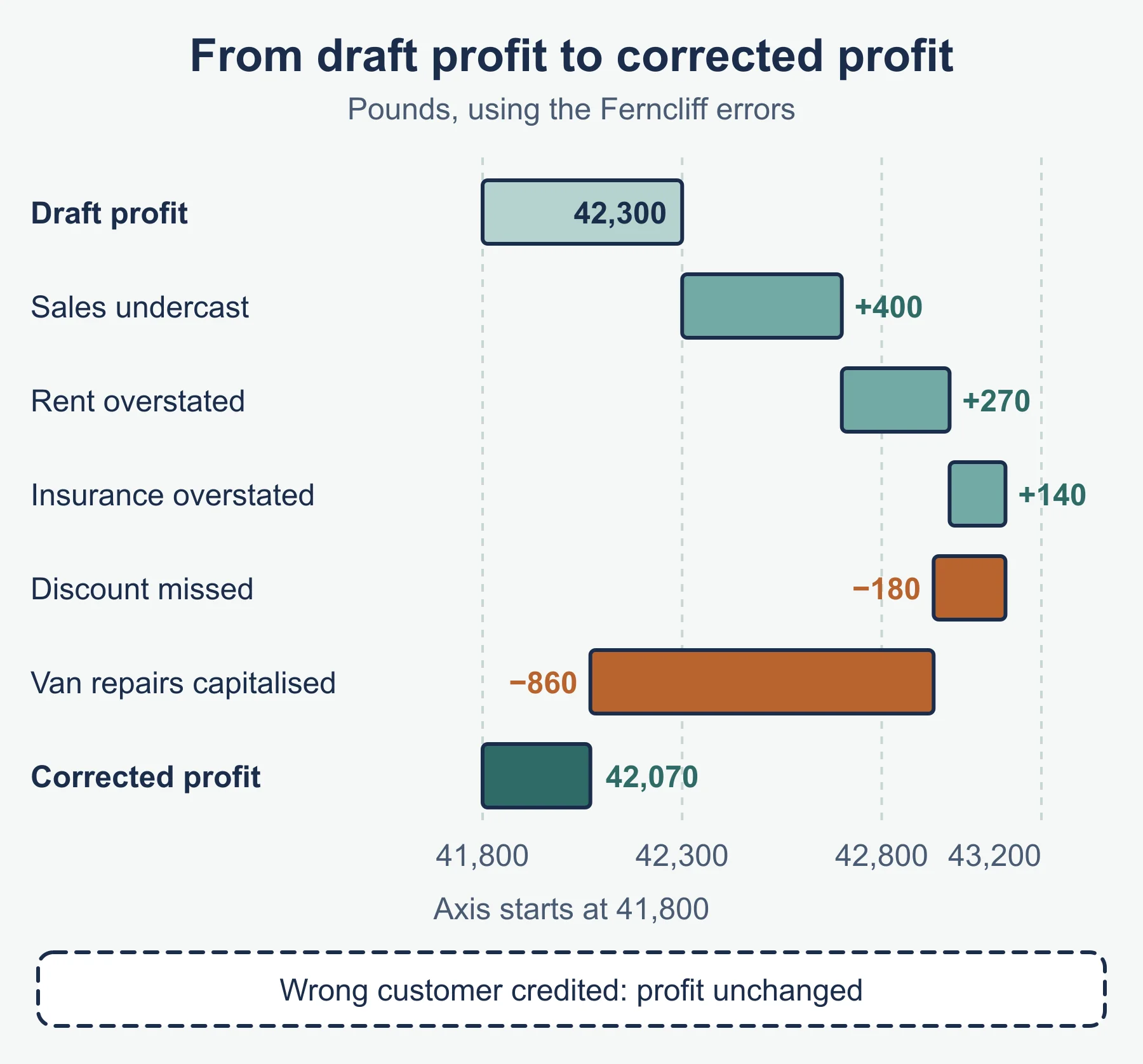
Only errors that touch revenue or expense accounts change profit. Ask for each correction: does it increase profit, reduce profit or leave it unchanged?
Worked example. Kelsterton Stationers’ draft statement of profit or loss gave a profit for the year of 36,850. Errors found: (1) shelving of 1,800 debited to repairs; (2) a credit sale of 950 omitted; (3) rent of 2,400 debited to the rates account; (4) insurance of 780 recorded as 870 in both accounts; (5) delivery costs of 340 paid by bank omitted; (6) the owner’s cash payment of 700 into the business debited to capital and credited to bank.
| Item | Effect | Change in profit |
|---|---|---|
| Draft profit | 36,850 | |
| 1 Expense wrongly charged; asset understated | Expenses fall | +1,800 |
| 2 Revenue omitted | Revenue rises | +950 |
| 3 Wrong expense account | Total expenses unchanged | 0 |
| 4 Expense overstated by 90 | Expenses fall | +90 |
| 5 Expense omitted | Expenses rise | −340 |
| 6 Capital and bank only | No profit effect | 0 |
| Corrected profit | 39,350 |
The net change is +2,500. A loss is adjusted the same way: a correction that raises profit reduces the loss.
8. Effect on the statement of financial position
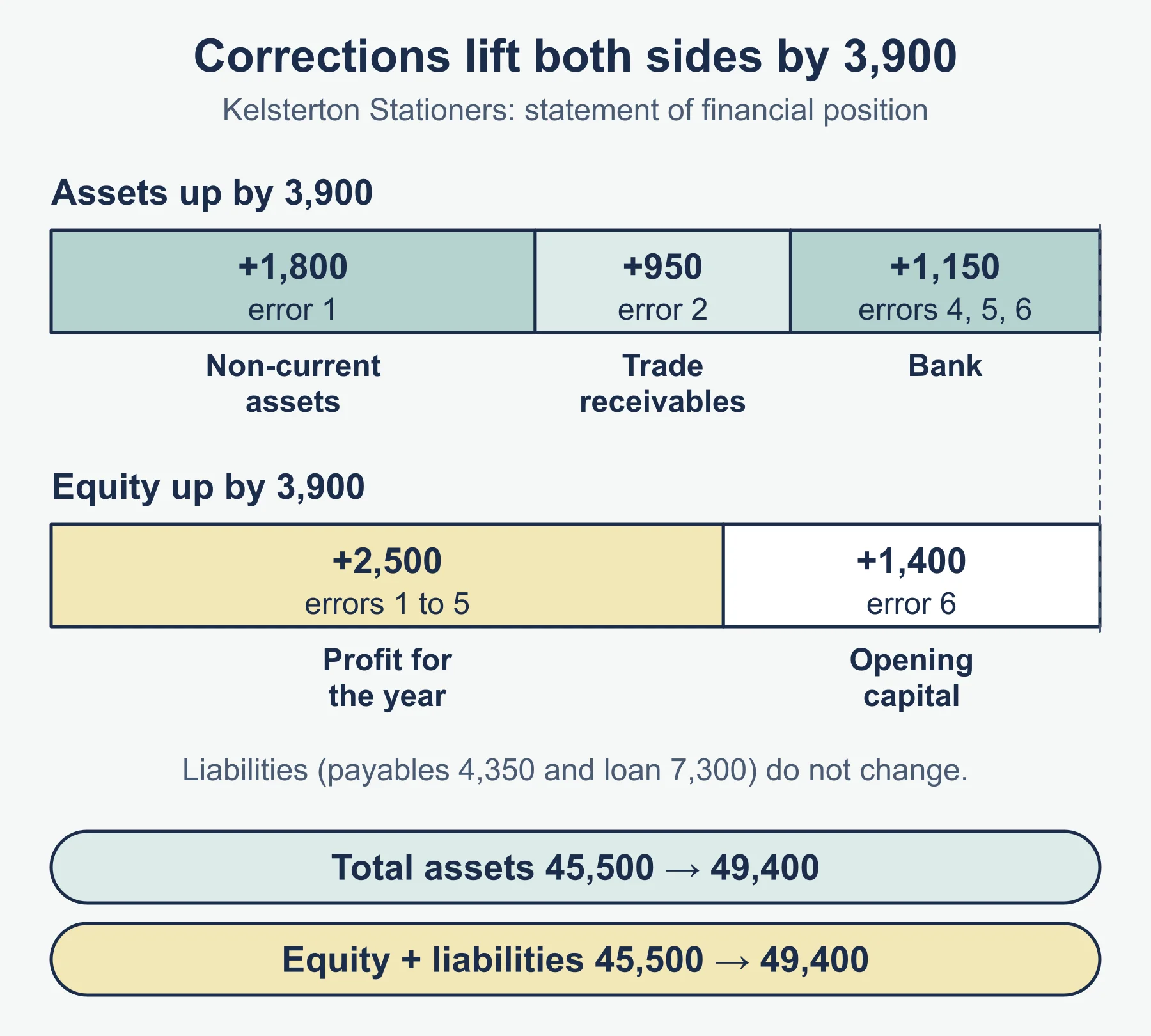
Corrections to asset, liability and capital accounts change the statement of financial position, and corrected profit changes capital because profit is added to it. Using the same Kelsterton errors:
| Item | Draft | Change | Corrected |
|---|---|---|---|
| Non-current assets | 28,000 | +1,800 | 29,800 |
| Inventory | 9,400 | 9,400 | |
| Trade receivables | 6,200 | +950 | 7,150 |
| Bank | 1,900 | +90 −340 +1,400 | 3,050 |
| Total assets | 45,500 | +3,900 | 49,400 |
| Capital, opening | 21,000 | +1,400 | 22,400 |
| Profit for the year | 36,850 | +2,500 | 39,350 |
| Drawings | (24,000) | (24,000) | |
| Equity | 33,850 | +3,900 | 37,750 |
| Trade payables | 4,350 | 4,350 | |
| Loan | 7,300 | 7,300 | |
| Equity and liabilities | 45,500 | +3,900 | 49,400 |
Error 6 is a complete reversal, so bank rises by 1,400: remove the wrong credit of 700 and add the correct debit of 700. Assets rise by 3,900 and equity rises by the same amount, so the statement still balances.
Common errors to avoid
- Saying a balancing trial balance proves the accounts are correct.
- Opening a suspense account for an error that leaves the totals equal.
- Correcting a complete reversal with the original amount instead of double, or an original entry with the full right amount instead of the difference.
- Changing profit for a commission error (it leaves profit unchanged), or leaving profit alone when an asset was wrongly charged to an expense (profit rises).
- Putting the suspense balance on the wrong side of the draft trial balance.
Frequently asked questions
What is a trial balance? A trial balance is a list of the balances on all the ledger accounts at a stated date, with debit balances in one column and credit balances in the other. It checks that total debits equal total credits, as double entry should produce.
When is a suspense account opened? When the trial balance totals do not agree, for example because of a one-sided entry, different amounts on the two sides, two entries on the same side, or an addition error. It is cleared by correcting the errors, and it is not opened for errors that leave the totals equal.
How do you correct an error of original entry? Only the difference is corrected. If both accounts show 2,370 but should show 2,730, the correcting journal adds the shortfall of 360 to each account, not the full 2,730.
Is a payment posted to the wrong supplier’s account a suspense account error? No. Posting to the wrong account of the right type is an error of commission, which leaves the trial balance totals equal and needs no suspense entry. A payment debited to the supplier with no credit entry in bank would need suspense.
Can Cambridge IGCSE Accounting 0452 Paper 2 ask for suspense accounts? Yes. The syllabus says candidates may be asked to prepare suspense accounts and journal entries, so practise both in full.
Official syllabus
Cambridge IGCSE Accounting syllabus for exams in 2027, 2028 and 2029 (version 1), published by Cambridge International Education: sections 3.1 The trial balance and 3.2 Corrections of errors.
Get free revision emails (optional)
Occasional emails with practice questions, worked explanations and links to free resources for the qualification and subjects you choose. No spam, and you can unsubscribe from any email. The free tools on this site never need an email.
Related resources
-
Revision notes
IGCSE Accounting: Analysis and Interpretation — Revision Notes
Quick recall for Cambridge IGCSE Accounting 0452 Topic 6: ten ratios, reading them, profit versus cash, comparing businesses, users and statement limits.
Accounting · Cambridge · IGCSE, O Level
Revise topic -
Practice questions
IGCSE Accounting: The trial balance and correction of errors (Cambridge 0452) – Practice Questions
Original practice questions with worked answers on trial balances, error types, correcting journals and suspense accounts for Cambridge IGCSE Accounting.
Accounting · Cambridge · IGCSE, O Level
Try questions -
Revision notes
IGCSE Accounting: The trial balance and correction of errors (Cambridge 0452) – Revision Notes
Condensed notes on trial balance purposes, the six error types, correcting journals, suspense accounts and corrected profit for Cambridge IGCSE Accounting.
Accounting · Cambridge · IGCSE, O Level
Revise topic
Related articles
-
teaching
A Level tuition in Dubai: Cambridge or Pearson Edexcel International A Level?
Schools in Dubai and Abu Dhabi teach either Cambridge International AS & A Level or Pearson Edexcel International A Level. How the two are structured, why it matters for tuition, and how online classes from Lahore work.
9 October 2026
-
curriculum guides
Choosing subjects at IGCSE and A Level
How subject choices at 14 and 16 affect university options later, and how to keep pathways open without overloading a timetable.
28 July 2026
Studying this with a teacher
Working through Accounting IGCSE, O LEVELS?
This page is free and stays free. If you would rather be taught it, Marlbridge runs Accounting classes one-to-one and in small groups of up to 15, online in your own time zone. The first trial class is free. WhatsApp replies within an hour (8am–11pm Pakistan time, every day); email the same day.
Cambridge Accounting teachers at Marlbridge

