
Study Guides
IGCSE Business: Business activity and Economic sectors (Cambridge 0264)
Study guide to factors of production, added value, opportunity cost and the economic sectors for Cambridge IGCSE Business 0264, with worked examples.
- Subject
- Business
- Level
- IGCSE
- Topic
- Understanding business activity
- Author
- Marlbridge Academic Team
- Updated
- Reviewed by
- Salman Ahmad (what this means)
Aligned to Cambridge IGCSE Business (0264), For examination in 2027, 2028 and 2029. Official specification .
Syllabus page (what it covers and how it is assessed): Cambridge IGCSE Business.
Syllabus points this page covers
0264
- 1.1 Business activity
- 1.2 Economic sectors
Found an error? Report a correction.
Need help with this topic? Request a free trial class for IGCSE Business (0450 / 0264).
This guide covers sections 1.1 (Business activity) and 1.2 (Economic sectors) of the Cambridge IGCSE Business 0264 syllabus for examination in 2027, 2028 and 2029. These are the first two subtopics of topic 1, Understanding business activity. The syllabus does not split the content into tiers, so everything here is for every candidate. For quick recall use the revision notes, then test yourself with the practice questions. The course home is the Cambridge IGCSE Business hub, and you can tick off what you have covered on the printable checklist. If you are not sure where to start, the free diagnostics show which topics need work.
What the syllabus asks for
| Section | Content point | What you must be able to do |
|---|---|---|
| 1.1.1 | Factors of production: land, labour, capital and enterprise | Name each factor, describe it and recognise it in a business |
| 1.1.1 | The concept of adding value and how added value can be increased | Explain and calculate added value, and suggest ways to raise it |
| 1.1.1 | The concept of opportunity cost | Define it, find it in a choice and use it to judge a decision |
| 1.2.1 | Primary, secondary and tertiary sectors | Classify businesses and explain the difference |
| 1.2.1 | Private and public sectors | Distinguish them and classify organisations |
The syllabus says candidates must apply their understanding to a variety of business situations and make simple decisions from the information given. The assessment has two papers: Paper 1 (short answer and data response) and Paper 2 (a case study supplied as an insert), each 1 hour 30 minutes and 80 marks. Both test knowledge, application, analysis and evaluation. Definitions on their own earn little: you need to tie each idea to the business in the question.
1.1.1 The nature of business activity
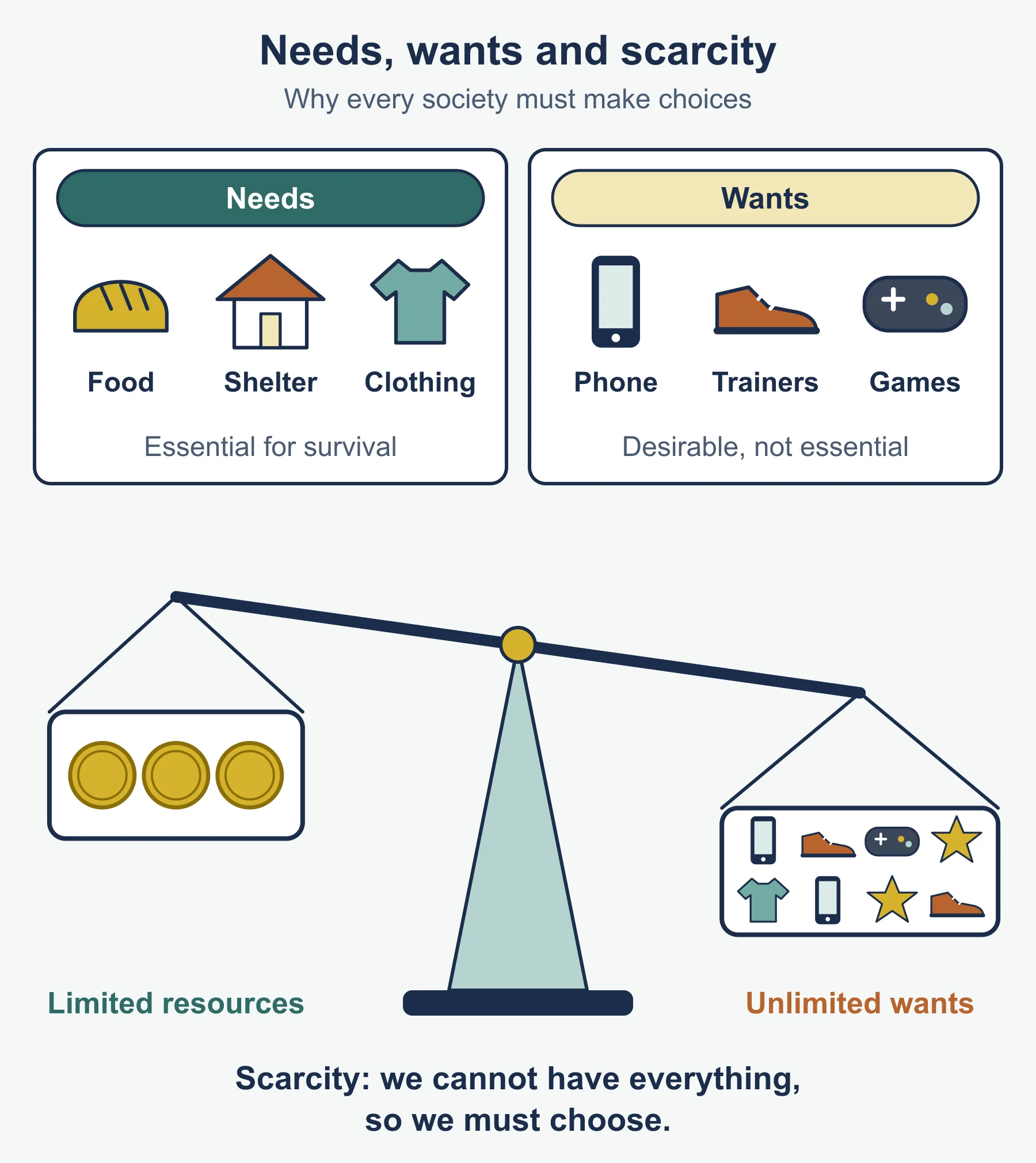
A business activity uses resources to produce goods or services that people want to buy. The resources are limited, so a business has to decide how to use them. Everything in this section follows from that.
Factors of production
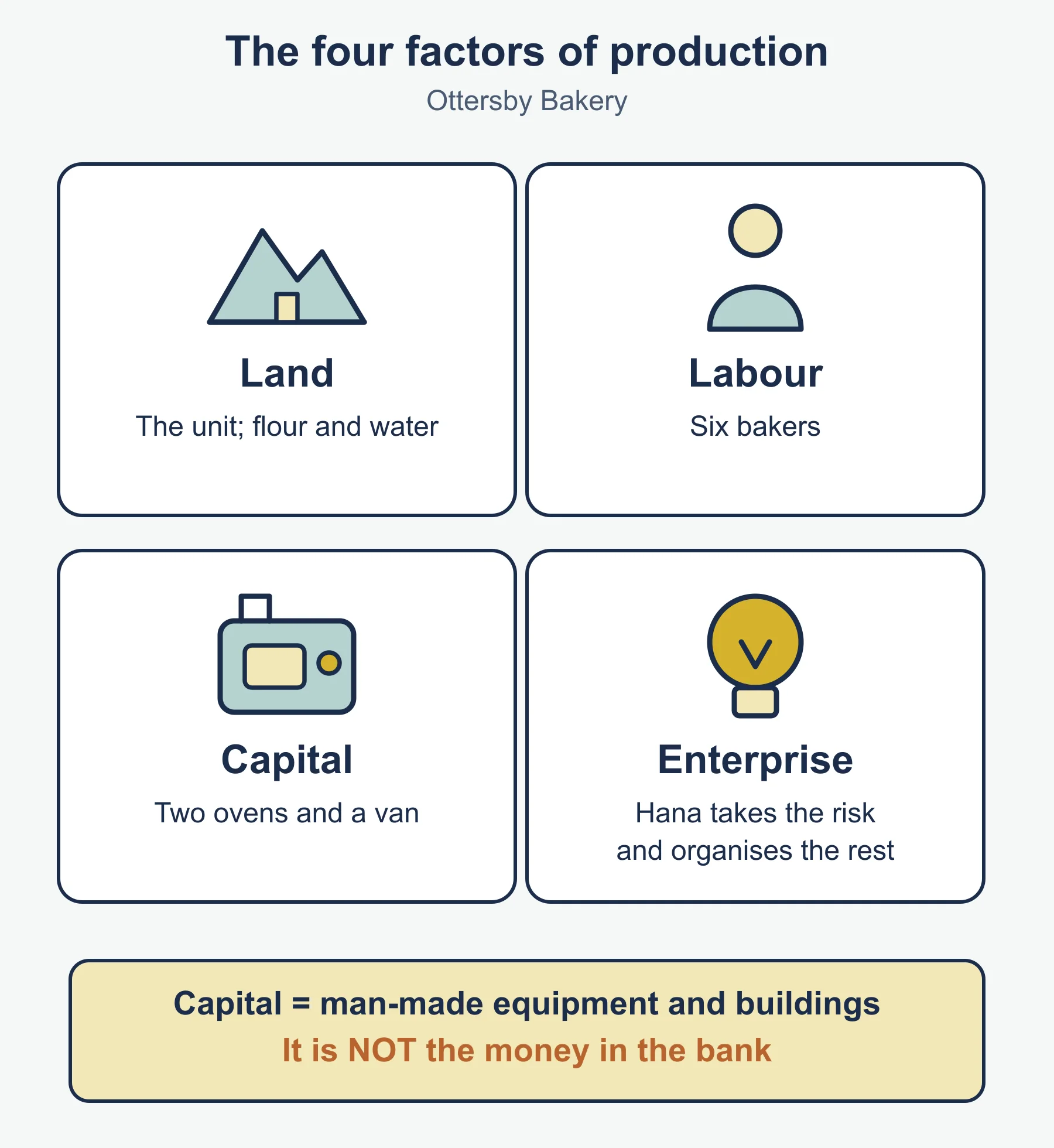
The syllabus lists four factors of production. These are the resources needed to produce any good or service.
| Factor | What it means | Examples in a small bakery |
|---|---|---|
| Land | Natural resources and the space used for production | The plot the bakery stands on; the wheat and water it uses |
| Labour | The human effort, physical or mental, used to produce | Bakers, delivery drivers, the person at the till |
| Capital | Man-made resources used to produce other goods and services | Ovens, mixers, delivery van, shop fittings |
| Enterprise | The willingness to take risks and organise the other factors in order to produce | The owner who finds the money, hires the team and bears the risk of failure |
Three points matter in answers.
- Capital here means the man-made equipment and buildings used in production. It is not the same as money. Writing that capital is “money” confuses the two meanings.
- Land includes natural resources, not just ground. A fishing business uses the sea, a mining business uses mineral deposits.
- Enterprise is the factor that brings the others together. Without someone to take the risk and make the decisions, the land, labour and capital would not become a business.
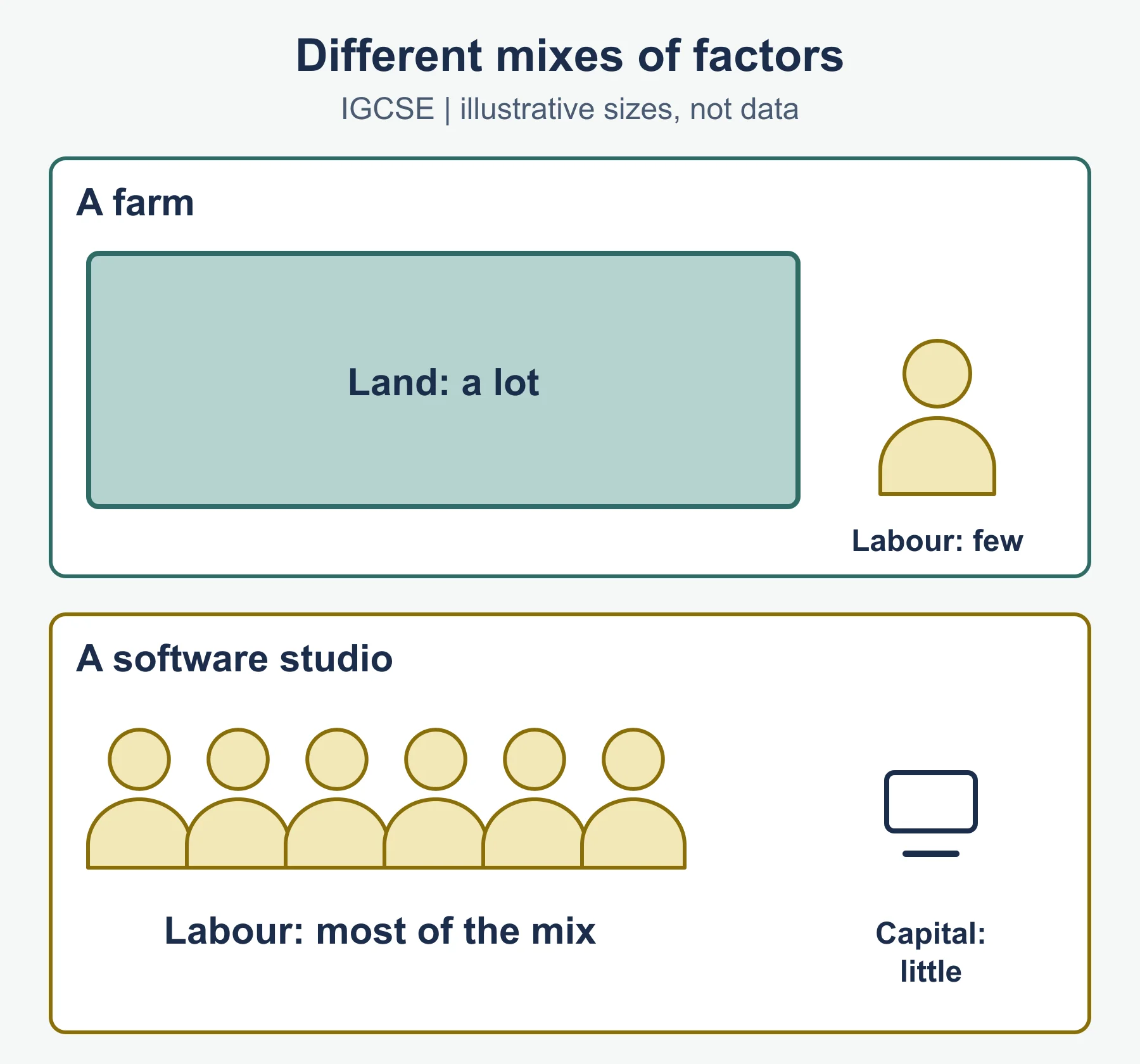
Businesses mix the factors in different proportions. A farm may use a lot of land and few workers. A software studio may use mostly labour and little capital. These contrasts help when a question asks how two businesses differ.
Worked example: identifying the factors
Ottersby Bakery rents a unit on an industrial estate, employs six bakers, owns two industrial ovens and a refrigerated van, and was started by Hana Ottersby, who put in her savings and runs the business.
- Land: the rented unit and the natural ingredients (flour from grain, for example).
- Labour: the six bakers.
- Capital: the two ovens and the van.
- Enterprise: Hana, who takes the risk and organises the rest.
Adding value
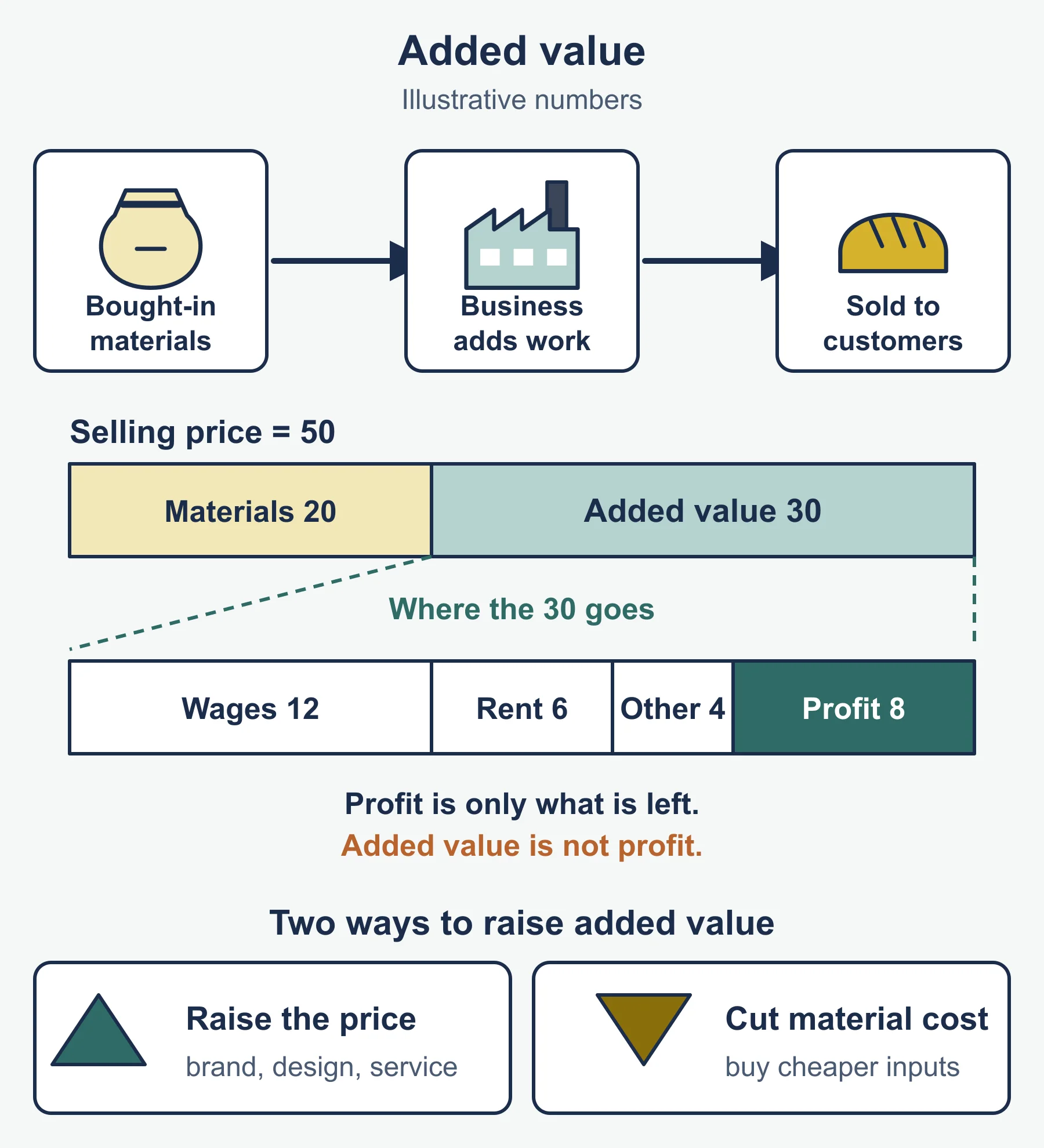
Added value is the difference between the selling price of a product and the cost of the bought-in materials or inputs used to make it. This is the standard form:
added value per unit = selling price per unit - cost of bought-in inputs per unit
For a number of units, multiply by the quantity. Added value is not profit. Wages, rent, advertising and other costs still have to be paid out of it.
Added value also explains why businesses exist. A customer will pay more for a finished product than the inputs would cost separately, because the business has turned them into something more useful or desirable.
Worked example: calculating added value
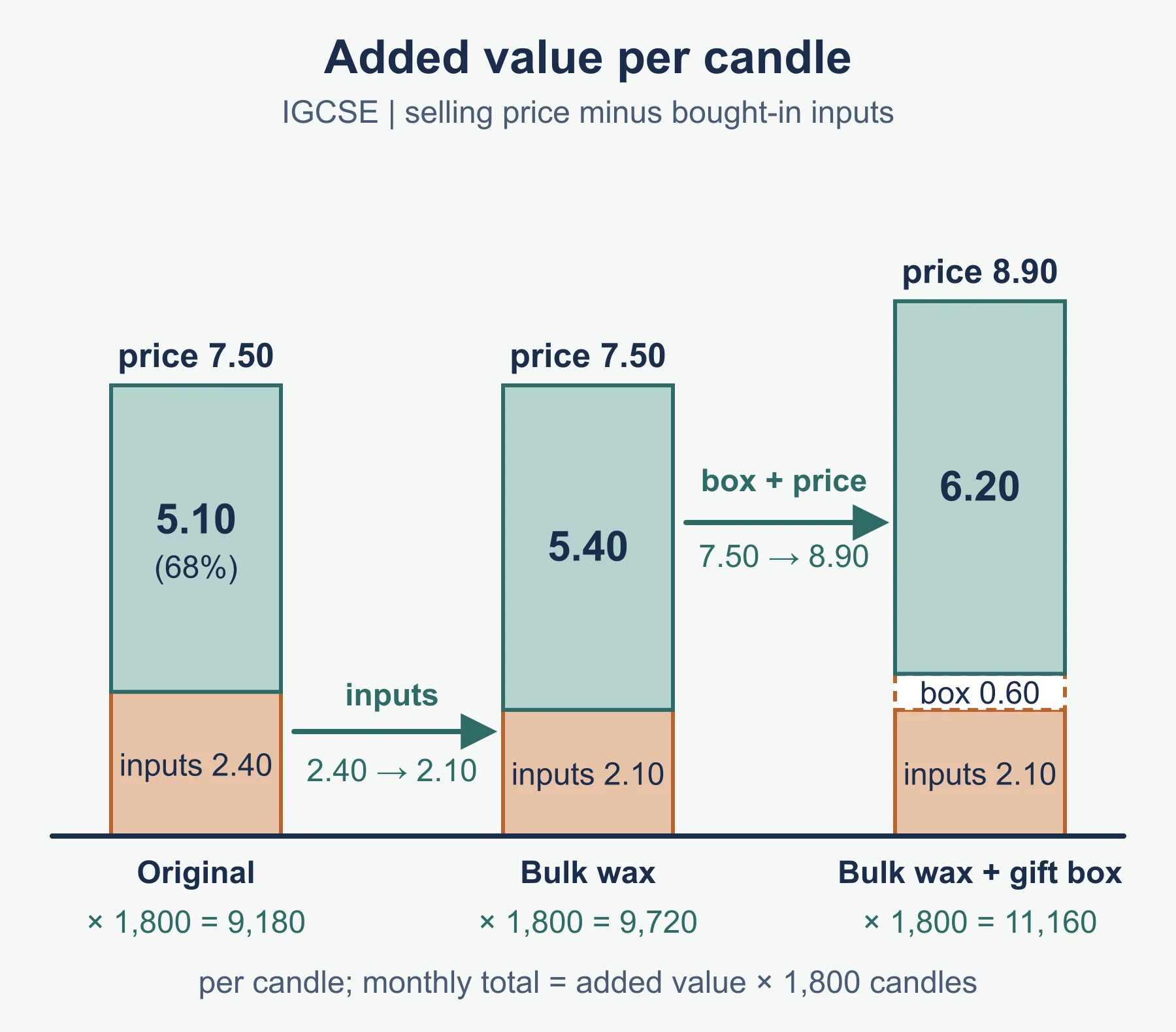
Kelvarne Candles sells a candle for 7.50. The wax, wick and jar bought in cost 2.40 per candle. It sells 1,800 candles a month.
Added value per candle = 7.50 - 2.40 = 5.10
Monthly added value    = 5.10 x 1,800 = 9,180
As a percentage of the selling price, 5.10 / 7.50 = 68.0 per cent. Expressing added value as a percentage of price is a standard way to compare products. The syllabus does not give a formula for it, so only use it if a question asks for it or it helps your argument.
How added value can be increased
There are two routes: raise the selling price, or cut the cost of the bought-in inputs. The first is realistic when the product becomes worth more to customers.
| Method | How it raises added value | Possible drawback |
|---|---|---|
| Improve the brand or design | Customers accept a higher price | Costs money to build, and customers may not follow |
| Improve quality or add features | Justifies a higher price | Better inputs can raise cost |
| Provide a better service (delivery, personalisation) | Customers pay for convenience | The extra service has its own costs |
| Find cheaper suppliers or buy in bulk | Lowers cost of inputs | Quality may fall, or supply may be less reliable |
| Reduce waste of materials | Fewer inputs bought for each unit sold | May need new machinery or training |
| Move into finishing or packaging | Turns a basic item into a premium one | Needs extra skills and equipment |
Kelvarne tries two changes. First, bulk wax lowers the input cost to 2.10 per candle:
New added value = 7.50 - 2.10 = 5.40 per candle; 5.40 x 1,800 = 9,720Second, it adds a gift box costing 0.60 per candle, and sells the boxed candle at 8.90 with the bulk wax:
Input cost = 2.10 + 0.60 = 2.70
Added value = 8.90 - 2.70 = 6.20 per candle; 6.20 x 1,800 = 11,160
Together the two changes raise added value per candle from 5.10 to 6.20, a rise of 1.10. This assumes it still sells 1,800 candles. If the higher price makes sales fall, the monthly total could be lower, so a full answer notes this assumption.
Opportunity cost
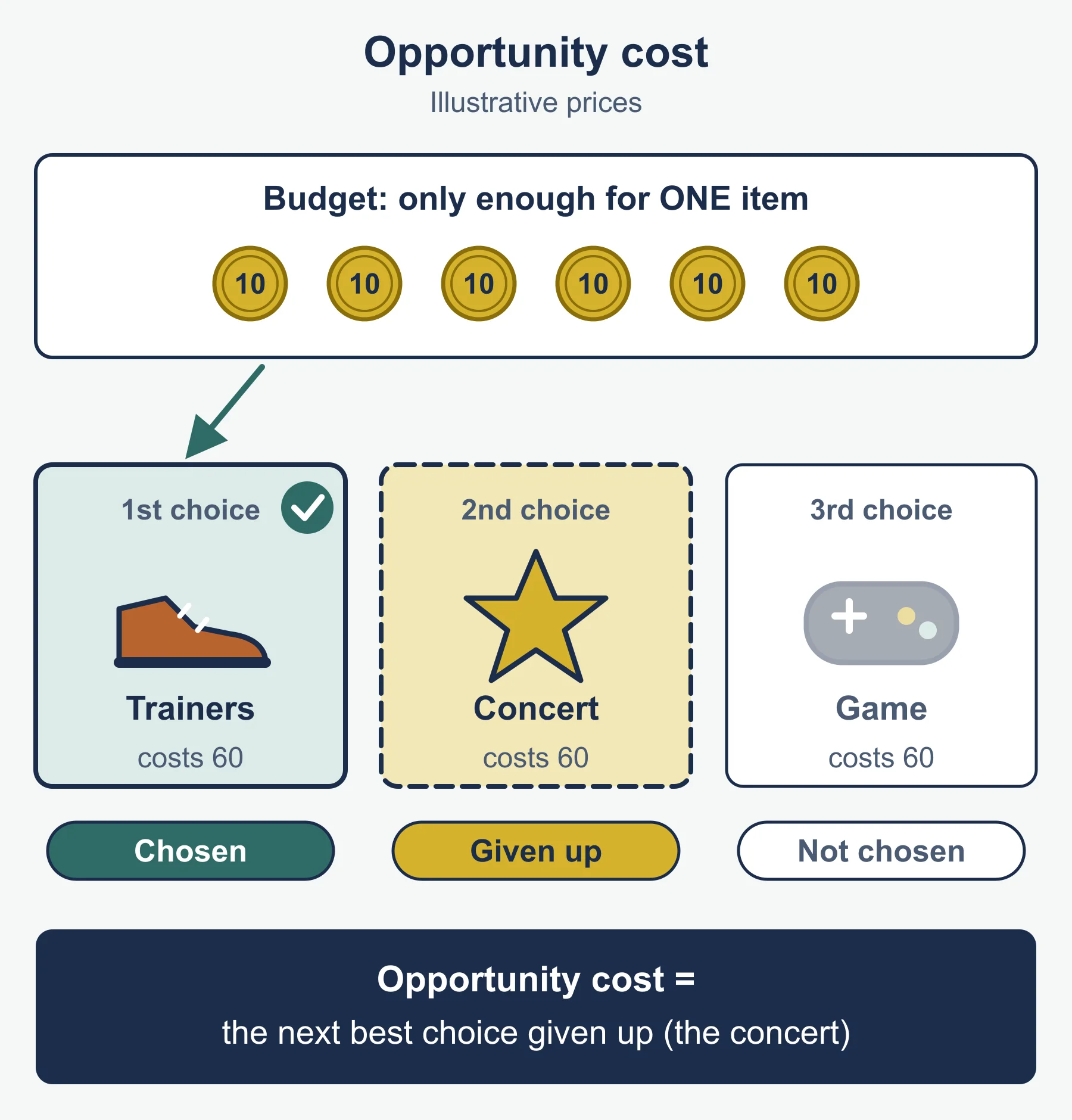
Resources are limited, so choosing one use for them means giving up another. Opportunity cost is the benefit of the next best alternative that is given up when a choice is made. Two points matter:
- It is the next best alternative only, not the total of everything you gave up.
- It is measured in benefit forgone, which may be money, time or output, not simply the price paid.
Worked example: finding the opportunity cost
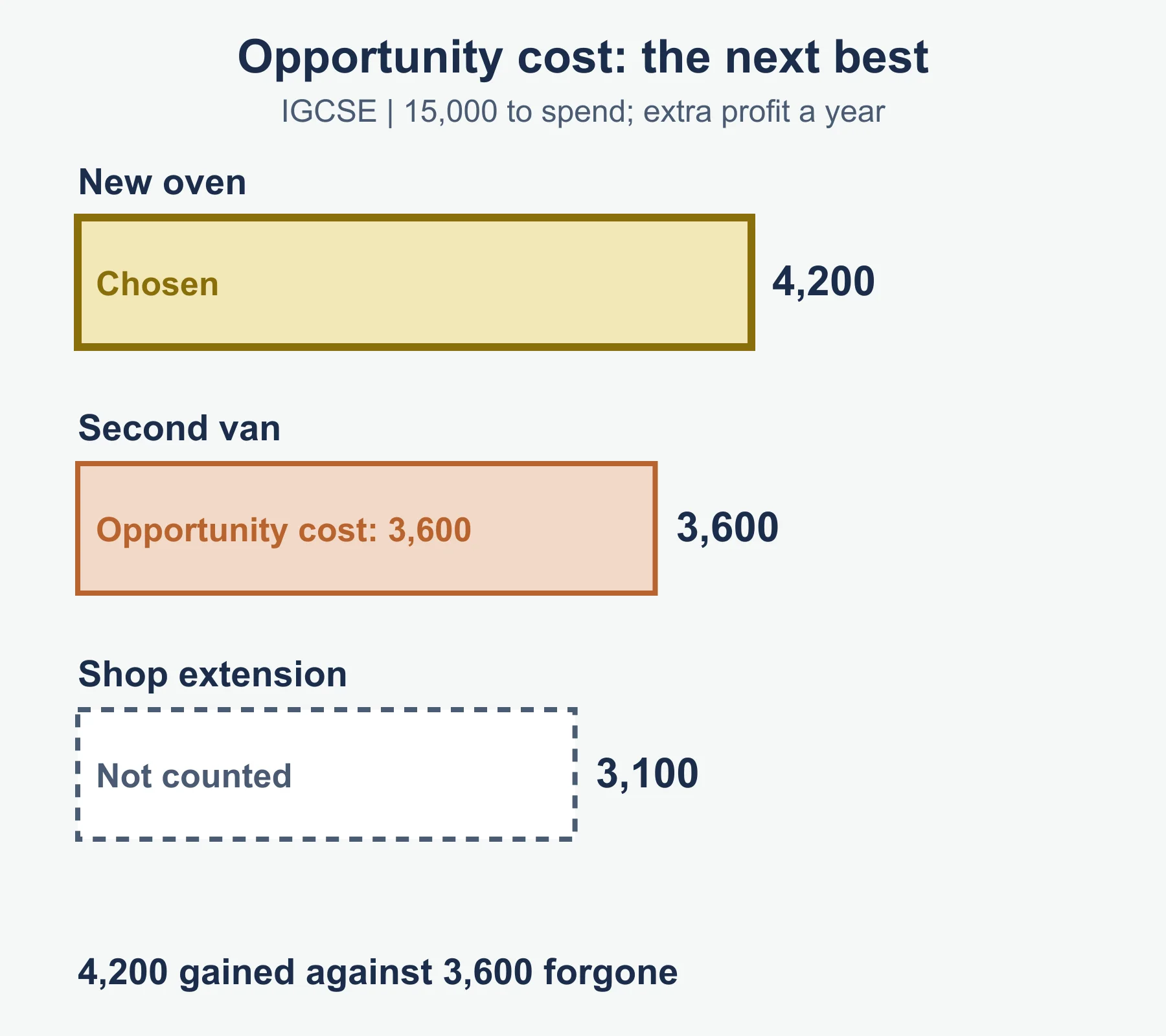
Ottersby Bakery has 15,000 to spend. Three options are open, with the extra annual profit each is expected to bring:
| Option | Expected extra profit a year |
|---|---|
| New oven | 4,200 |
| Second van | 3,600 |
| Shop extension | 3,100 |
The business buys the oven, which has the highest return. The next best alternative is the second van, so the opportunity cost of buying the oven is 3,600 a year of extra profit given up. The extension (3,100) is not counted. The decision still looks sensible: 4,200 gained against 3,600 forgone.
Opportunity cost is not only about big purchases. An owner who spends Saturday on paperwork gives up what she could have earned serving customers. A government that builds a road gives up what the same money would have provided as health care.
Opportunity cost is useful for evaluation. If the benefit chosen is bigger than the benefit forgone, the decision is supported. If the forgone alternative carried less risk, a justified answer may still prefer it. Link the point to the business in the question and the objectives in the case.
1.2.1 Types of economic sector
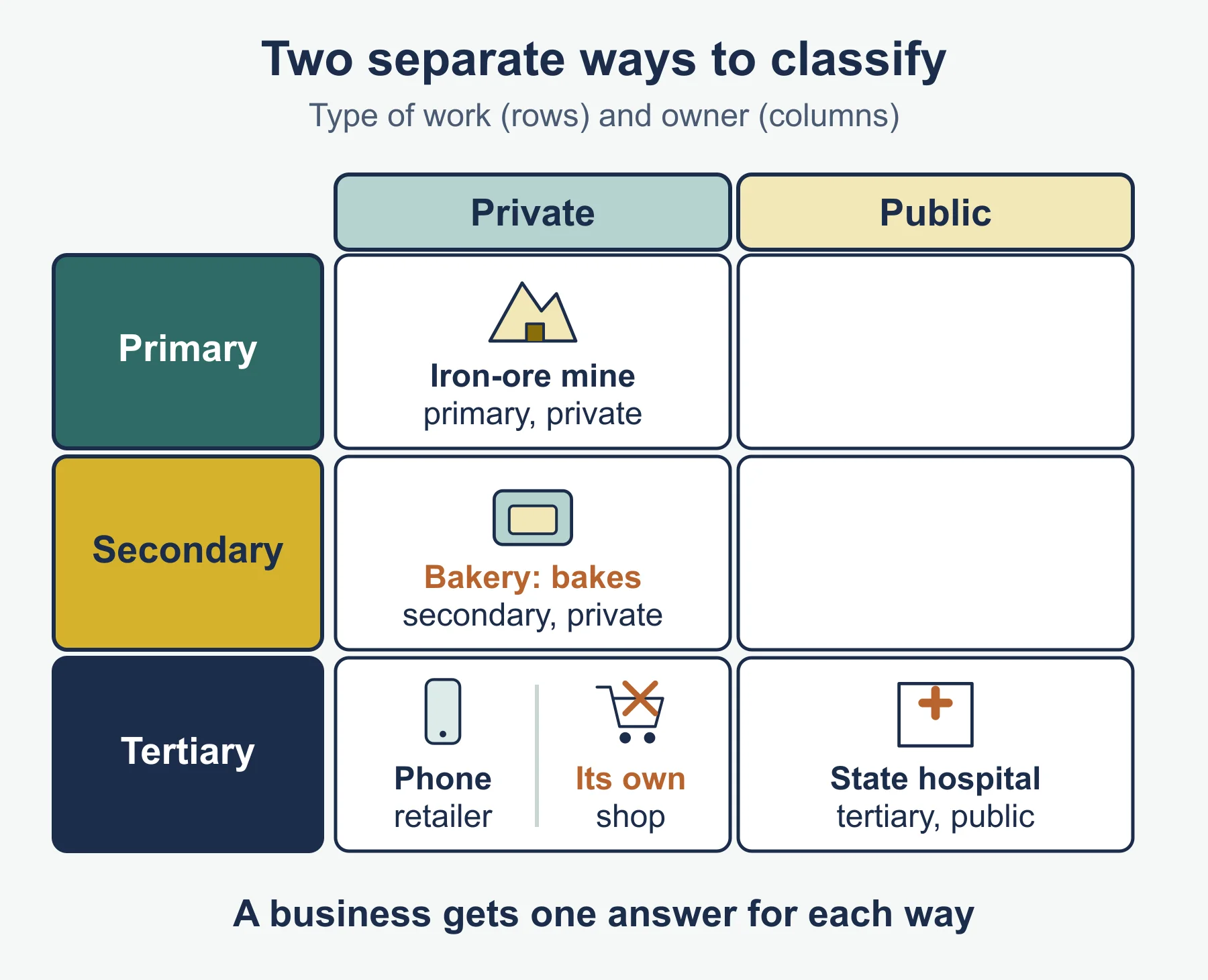
Economic activity can be grouped by the kind of work done, and by who owns and controls the organisation. These are two separate ways of classifying, so a business has one answer for each.
Primary, secondary and tertiary sectors
| Sector | What it does | Examples |
|---|---|---|
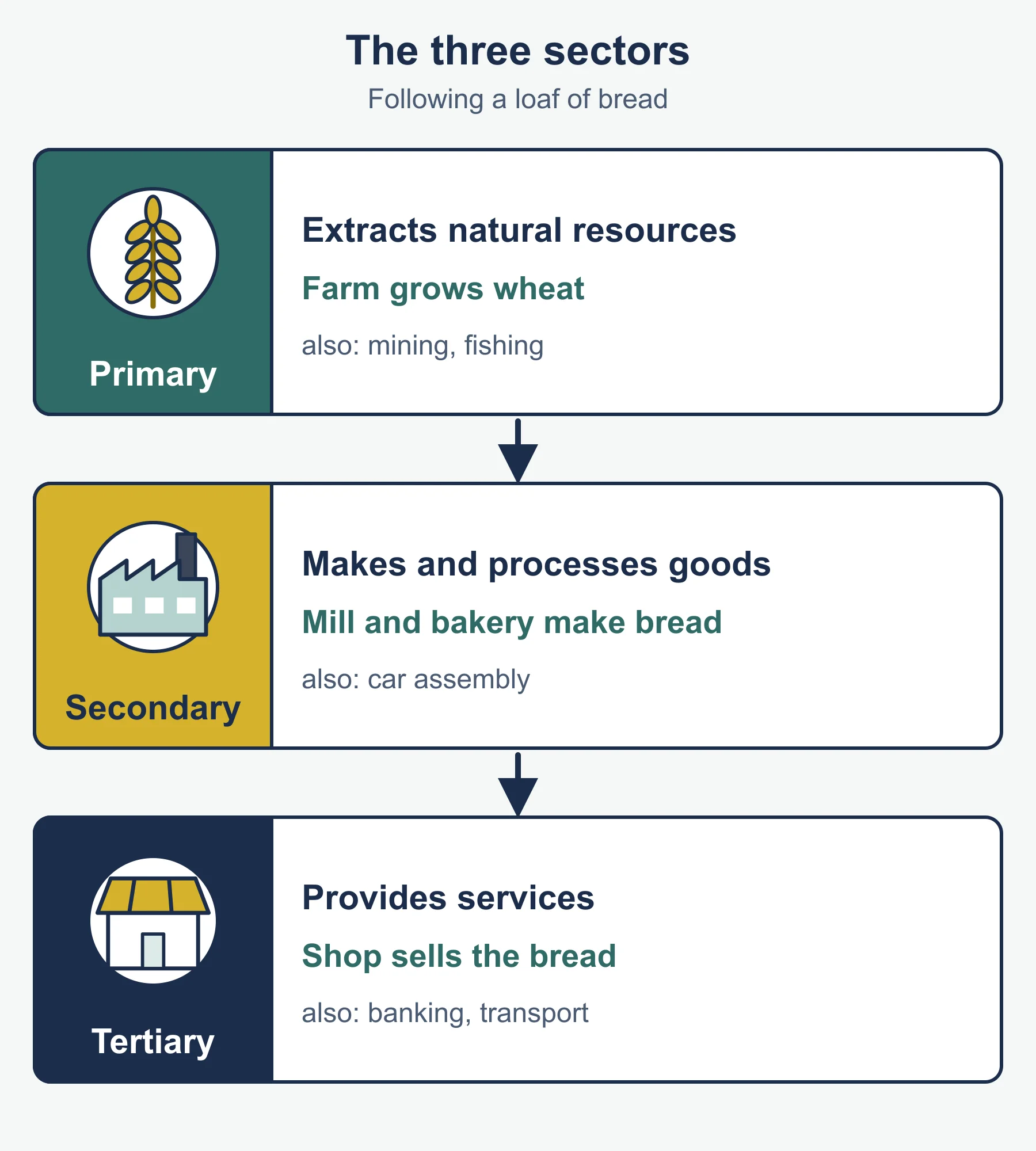
| Primary | Extracts or grows natural resources | Farming, fishing, forestry, mining, quarrying |
| Secondary | Manufactures, processes or builds, turning materials into goods | Food processing, car assembly, furniture making, construction |
| Tertiary | Provides services | Retail, banking, transport, teaching, health care, hotels |
The sectors link in a chain of production. Windermoor Rice is a fictional example. A grower harvests the crop (primary), a mill polishes and packs it (secondary), and a supermarket sells it (tertiary). Each stage adds value. The raw crop is worth little on its own, the packed rice is worth more, and the rice on a shop shelf, ready to buy, is worth more again.
Some businesses work in more than one sector. A farm that grows tomatoes and also runs a plant making sauce and a roadside shop is primary, secondary and tertiary. When classifying, look at the main activity described, and say if there is more than one.
Private and public sectors
| Sector | Who owns and controls it | Typical aim |
|---|---|---|
| Private sector | Individuals or groups of individuals, such as owners and shareholders | Mainly to make a profit, though other aims are possible |
| Public sector | The government (national or local) | Mainly to provide a service for the public, often without aiming for profit |
Examples: a family restaurant and a mobile phone retailer are private sector. A state school, a government-run water supplier and a state hospital are public sector. The “typical aim” column states general tendencies, not rules. A private business can have social aims, and a public organisation may still need to control its costs.
The two classifications combine. A state hospital is tertiary and public. A privately owned iron-ore mine is primary and private. A privately owned bakery that bakes and sells in its own shop is secondary and tertiary, and private.
Case-study skills for this topic
The command words the syllabus uses match the four assessment objectives. Here is how to use them on these ideas.
- State, identify, define (knowledge): one clear fact, such as the four factors or what opportunity cost means.
- Calculate (application and analysis): show the formula and the working. Added value per unit uses selling price and bought-in input cost, so pick those numbers from the data and not others.
- Explain, analyse (analysis): give a point, then say why it matters in this business. “Cheaper wax raises added value because the cost of inputs per candle falls from 2.40 to 2.10” beats “it saves money”.
- Evaluate, justify, recommend (evaluation): weigh both sides, then make a decision and give the reason. For an opportunity cost question, compare what is gained with what is given up and consider risk, time and the objectives.
Common errors
- Writing “capital” for the money a business has. As a factor, capital is the man-made equipment and buildings.
- Calling the rent, wages or machine cost “the factor”. Name the factor (land, labour, capital) the cost pays for.
- Treating added value as profit. Overheads and wages have not been taken off.
- Using the wrong figures: total costs instead of bought-in input cost.
- Stating opportunity cost as the cost of the chosen option, or adding up every alternative, when it is the next best alternative given up.
- Putting a business in the tertiary sector because it “sells”, when it makes goods. Look at what it mainly does.
Frequently asked questions
How do you calculate added value? Added value per unit is the selling price per unit minus the cost of bought-in inputs per unit. For a total, multiply by the number of units sold.
What is opportunity cost? Opportunity cost is the benefit of the next best alternative given up when a choice is made. It can be measured in money, time or output and exists because resources are limited.
What is the difference between the primary, secondary and tertiary sectors? The primary sector extracts or grows natural resources, such as farming and mining. The secondary sector manufactures, processes or builds, and the tertiary sector provides services.
What is the difference between the private and public sectors? The private sector is owned and controlled by individuals or groups of individuals and mainly aims for profit. The public sector is owned and controlled by government, national or local, and mainly aims to provide a service to the public.
Official syllabus
Cambridge IGCSE Business 0264 syllabus for examination in 2027, 2028 and 2029, published by Cambridge University Press & Assessment (Cambridge International Education), sections 1.1 Business activity and 1.2 Economic sectors.
Get free revision emails (optional)
Occasional emails with practice questions, worked explanations and links to free resources for the qualification and subjects you choose. No spam, and you can unsubscribe from any email. The free tools on this site never need an email.
Related resources
-
Practice questions
IGCSE Business: Business activity and Economic sectors (Cambridge 0264) – Practice Questions
Eleven original practice questions with worked answers on factors of production, added value, opportunity cost and sectors, Cambridge IGCSE Business 0264.
Business · Cambridge · IGCSE
Try questions -
Revision notes
IGCSE Business: Business activity and Economic sectors (Cambridge 0264) – Revision Notes
Condensed revision notes on factors of production, added value, opportunity cost and economic sectors for Cambridge IGCSE Business 0264.
Business · Cambridge · IGCSE
Revise topic -
Study guides
IGCSE Business: Business objectives and stakeholder objectives (Cambridge 0264)
Study guide to business objectives, stakeholder groups, their aims and how those aims conflict, for Cambridge IGCSE Business 0264, with worked examples.
Business · Cambridge · IGCSE
Read guide
Related articles
-
teaching
A Level tuition in Dubai: Cambridge or Pearson Edexcel International A Level?
Schools in Dubai and Abu Dhabi teach either Cambridge International AS & A Level or Pearson Edexcel International A Level. How the two are structured, why it matters for tuition, and how online classes from Lahore work.
9 October 2026
-
curriculum guides
Choosing subjects at IGCSE and A Level
How subject choices at 14 and 16 affect university options later, and how to keep pathways open without overloading a timetable.
28 July 2026
Studying this with a teacher
Working through Business IGCSE?
This page is free and stays free. If you would rather be taught it, Marlbridge runs Business classes one-to-one and in small groups of up to 15, online in your own time zone. The first trial class is free. WhatsApp replies within an hour (8am–11pm Pakistan time, every day); email the same day.
Cambridge Business teachers at Marlbridge

