
Revision Notes
IGCSE Business: Business activity and Economic sectors (Cambridge 0264) – Revision Notes
Condensed revision notes on factors of production, added value, opportunity cost and economic sectors for Cambridge IGCSE Business 0264.
- Subject
- Business
- Level
- IGCSE
- Topic
- Understanding business activity
- Author
- Marlbridge Academic Team
- Updated
- Reviewed by
- Salman Ahmad (what this means)
Aligned to Cambridge IGCSE Business (0264), For examination in 2027, 2028 and 2029. Official specification .
Syllabus page (what it covers and how it is assessed): Cambridge IGCSE Business.
Syllabus points this page covers
0264
- 1.1 Business activity
- 1.2 Economic sectors
Found an error? Report a correction.
Need help with this topic? Request a free trial class for IGCSE Business (0450 / 0264).
These are condensed notes for sections 1.1 (Business activity) and 1.2 (Economic sectors) of the Cambridge IGCSE Business 0264 syllabus for examination in 2027, 2028 and 2029. For full explanations and worked examples, read the study guide. When you are ready to test yourself, use the practice questions. Course pages: the Cambridge IGCSE Business hub and the printable checklist. The free diagnostics show which topics need most work.
Syllabus map
| Ref | Content point |
|---|---|
| 1.1.1 | Factors of production: land, labour, capital and enterprise |
| 1.1.1 | Concept of adding value and how added value can be increased |
| 1.1.1 | Concept of opportunity cost |
| 1.2.1 | Primary, secondary and tertiary sectors |
| 1.2.1 | Private and public sectors |
Factors of production
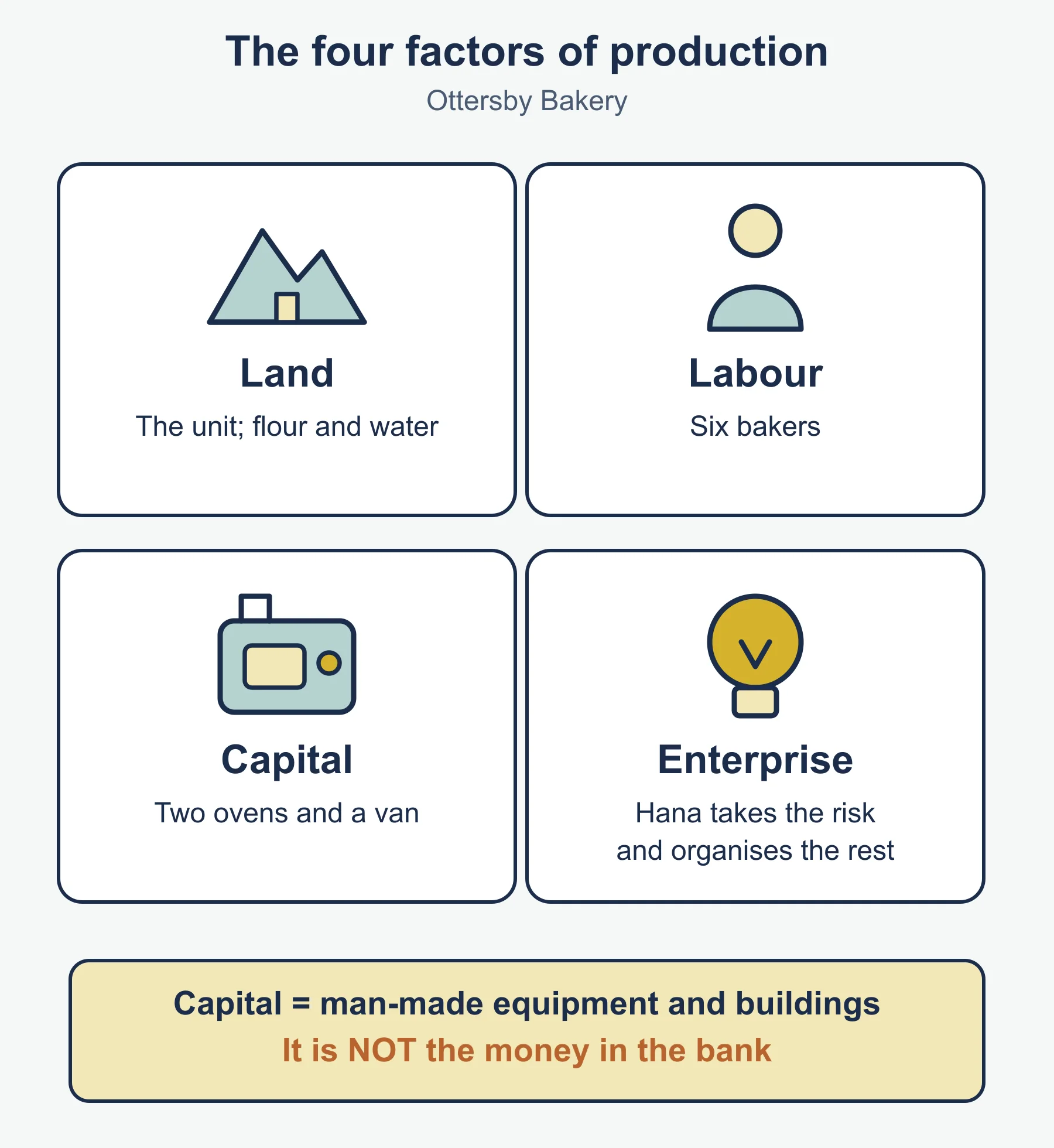
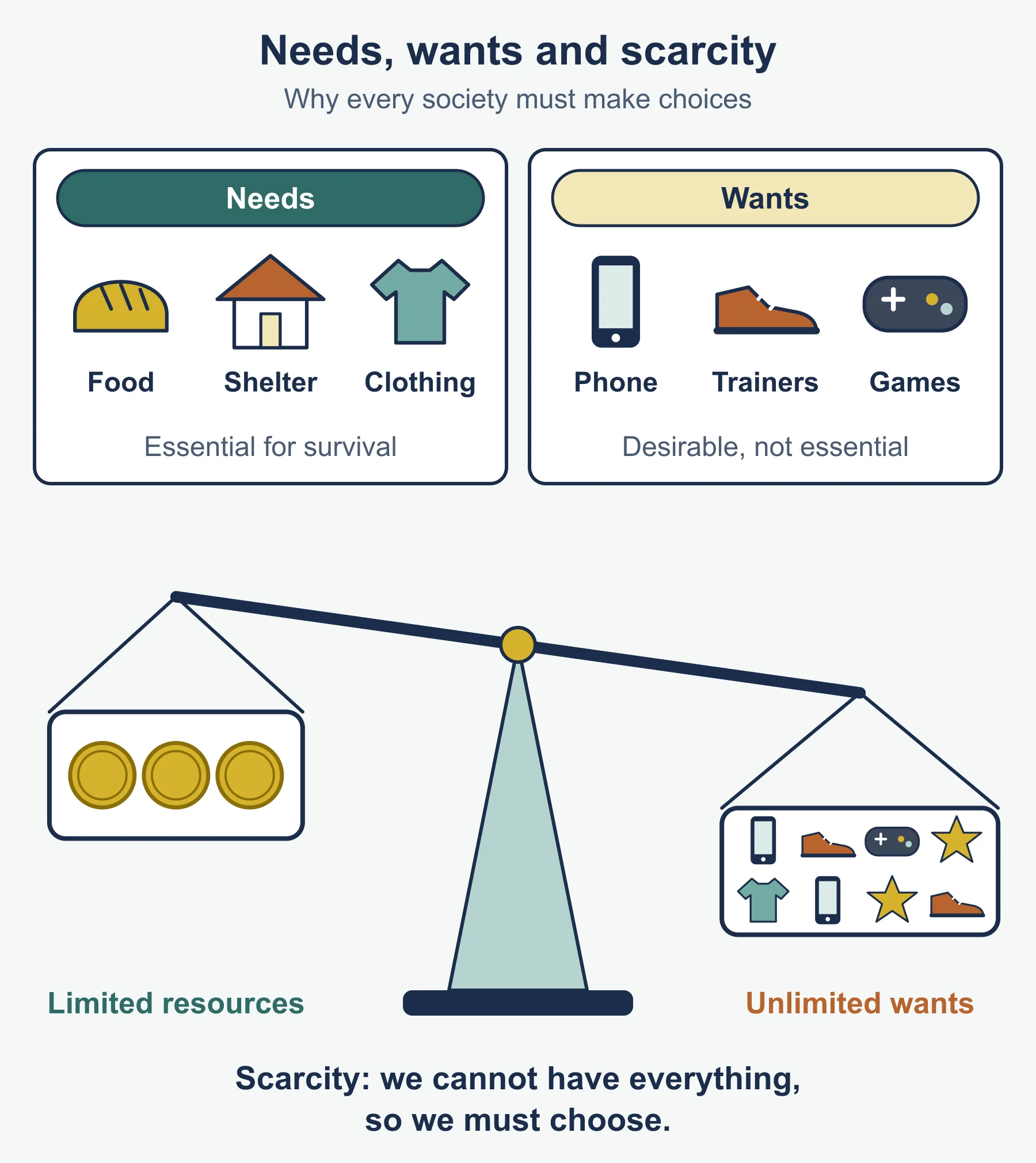
Resources needed to produce goods and services. There are four.
| Factor | Definition to learn | Quick example |
|---|---|---|
| Land | Natural resources and space used in production | Farmland, a mine, a fishing ground, a factory site |
| Labour | Human effort, physical or mental, used in production | Machine operators, accountants, drivers |
| Capital | Man-made resources used to produce other goods and services | Machinery, vehicles, tools, buildings |
| Enterprise | Willingness to take risks and organise the other factors to produce | The owner who starts and runs the business |
Remember:
- Capital as a factor is equipment and buildings, not cash.
- A cost (rent, wages, interest) is not itself a factor. Link it to the factor it pays for.
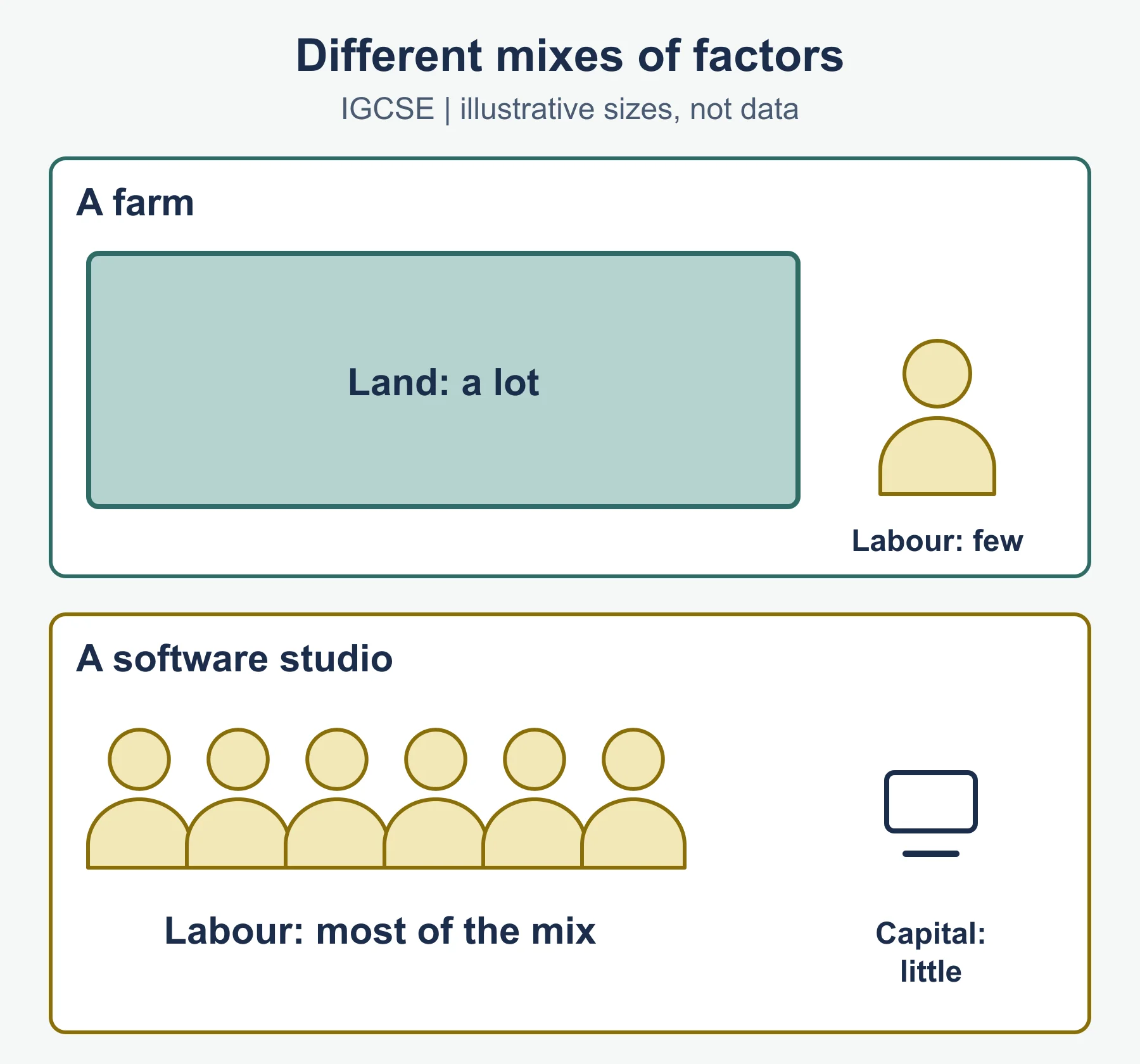
- Businesses use different mixes. Compare them in answers, such as “more labour than machinery”.
Adding value
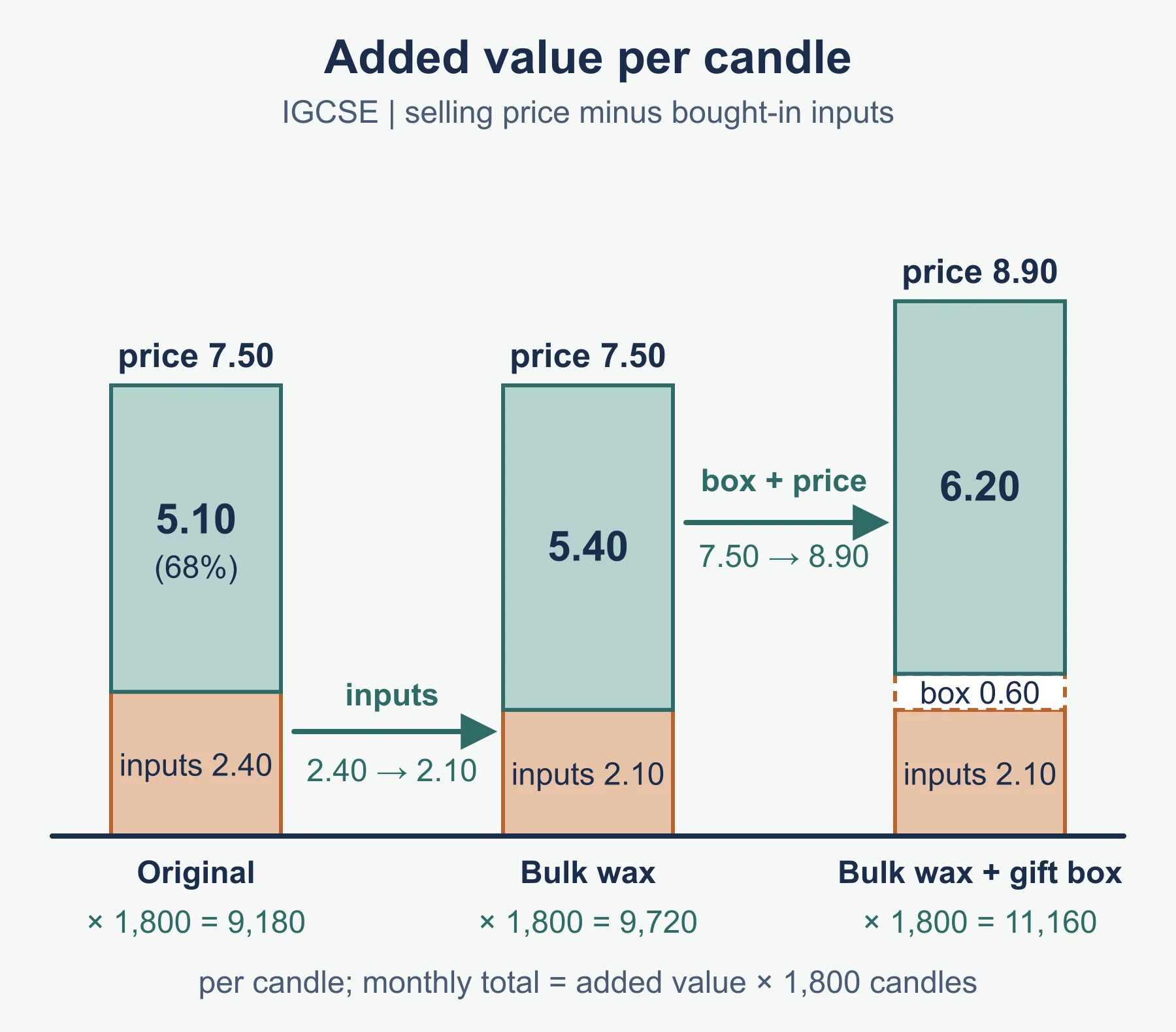
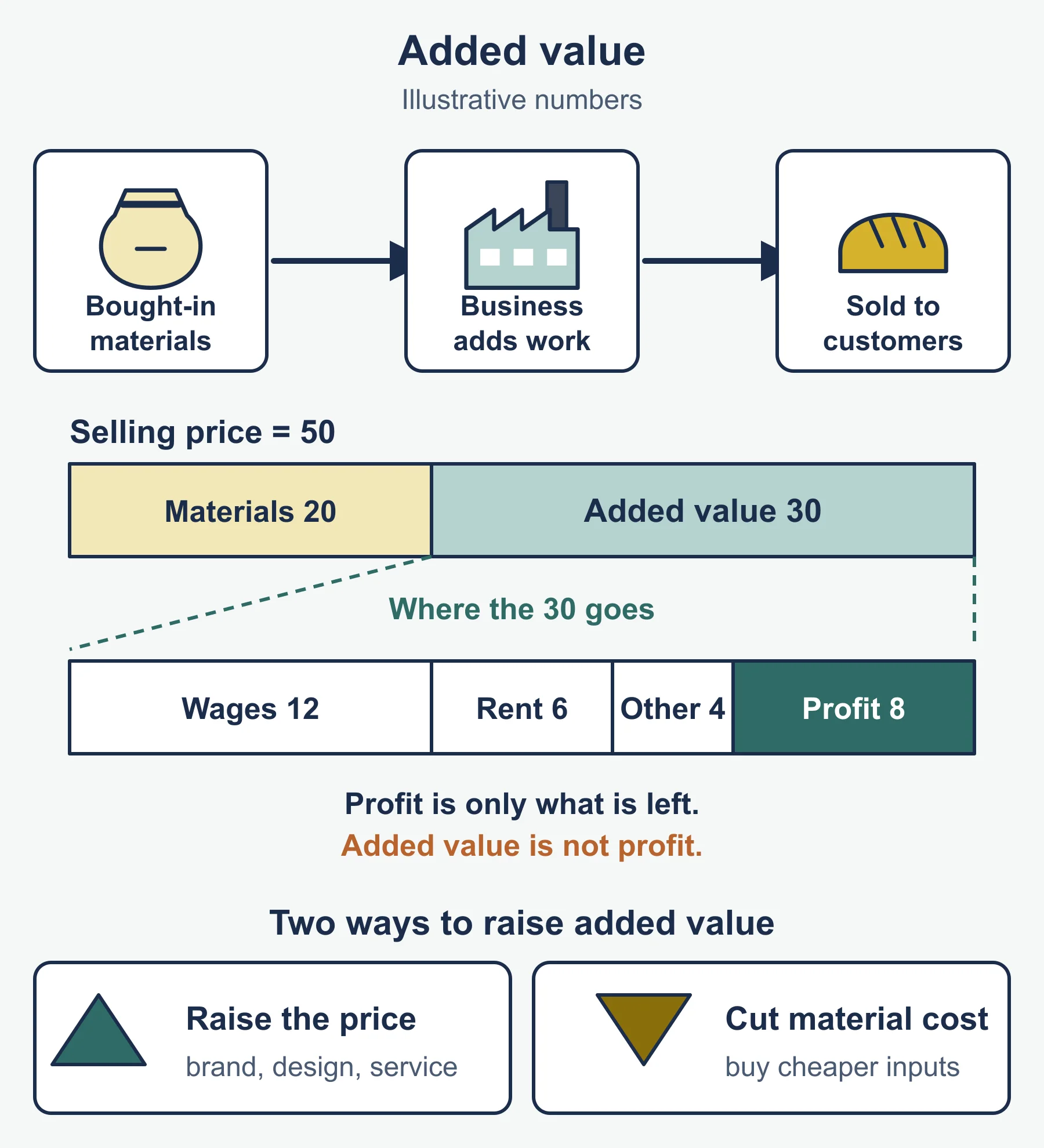
Definition: added value is the difference between the selling price of a product and the cost of the bought-in materials or inputs used to make it.
Standard form: added value per unit = selling price per unit - cost of bought-in inputs per unit. Multiply by the number of units for a total.
Added value is not profit, because wages, rent and other costs are still to be paid from it.
Method in steps
- Find the selling price per unit.
- Find the cost of bought-in inputs per unit (materials, components, packaging). Leave out wages and rent unless the data says they are part of the bought-in cost.
- Subtract.
- Multiply by units sold if a total is asked for.
- State the unit (per item, per month) and the currency.
Worked reminder
Fordhurst Joinery sells a chopping board for 12.00. Wood, oil and packaging bought in cost 7.50 per board. It sells 250 a month.
Added value per board = 12.00 - 7.50 = 4.50
Monthly added value   = 4.50 x 250 = 1,125
As a percentage of price = 4.50 / 12.00 = 37.5%
The percentage is a standard comparison and the syllabus gives no formula for it, so use it only when useful.
Ways to increase added value
| Raise the selling price | Lower bought-in input costs |
|---|---|
| Stronger brand or better design | Cheaper or bulk suppliers |
| Higher quality or extra features | Less waste of material |
| Better service or personalisation | Cheaper but suitable materials |
| Better packaging or finishing | Better planning of orders |
If Fordhurst raises its price to 13.50 with the same inputs, added value becomes 13.50 - 7.50 = 6.00. If instead it cuts input costs to 6.80 at the old price of 12.00, added value becomes 12.00 - 6.80 = 5.20.
Always add the risk: higher prices may cut sales, and cheaper inputs may cut quality. A balanced answer mentions it.
Opportunity cost
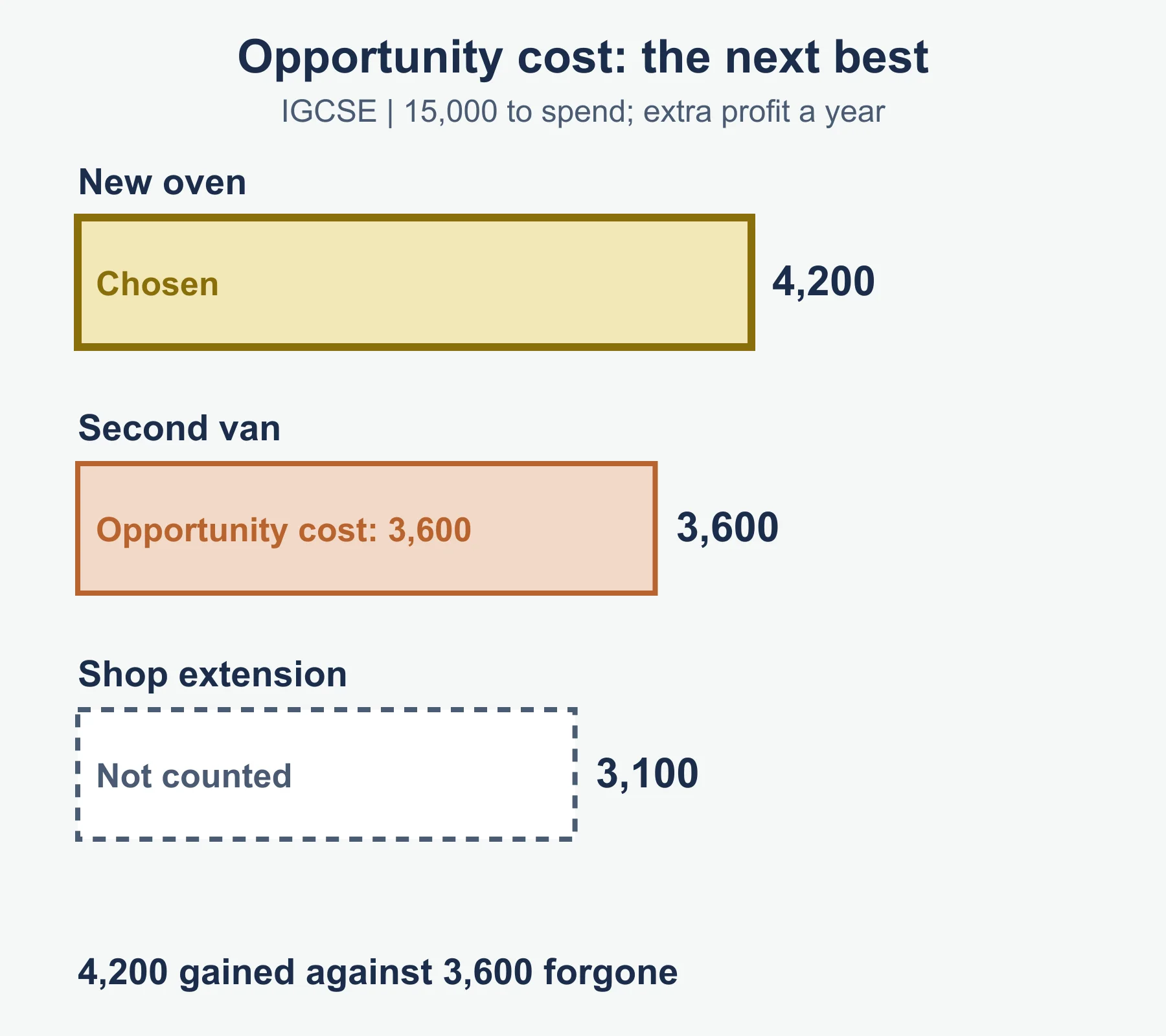
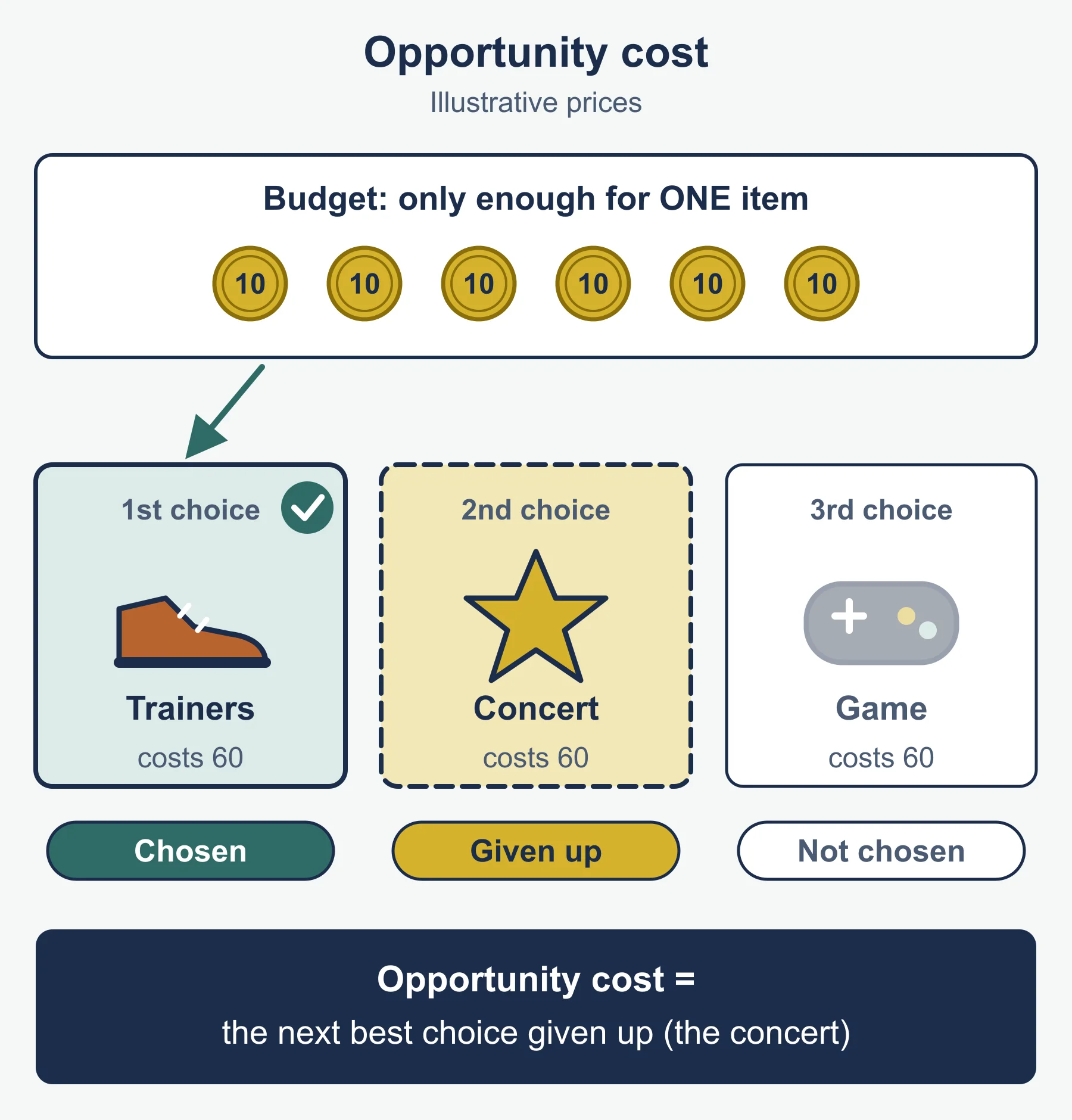
Definition: the benefit of the next best alternative that is given up when a choice is made.
Key points:
- Only the next best alternative counts, not every option rejected.
- It can be measured in money, time or output.
- It exists because resources are limited, so choosing one use means not choosing another.
Method in steps
- List the options and the benefit of each.
- Identify the option chosen.
- Rank the rest and take the highest one that is left. That is the opportunity cost.
- Compare it with the benefit gained and with other factors (risk, time, objectives).
Worked reminder
Fordhurst can spend 9,000 on a new saw (extra profit 2,800 a year), a delivery bike (2,300) or a website upgrade (1,900). If it buys the saw, the opportunity cost is the delivery bike, at 2,300 a year of extra profit.
Economic sectors
By type of activity
| Sector | Activity | Examples |
|---|---|---|
| Primary | Extracting or growing natural resources | Farming, fishing, forestry, mining |
| Secondary | Making, processing or building | Manufacturing, food processing, construction |
| Tertiary | Providing services | Retail, banking, transport, education, tourism |
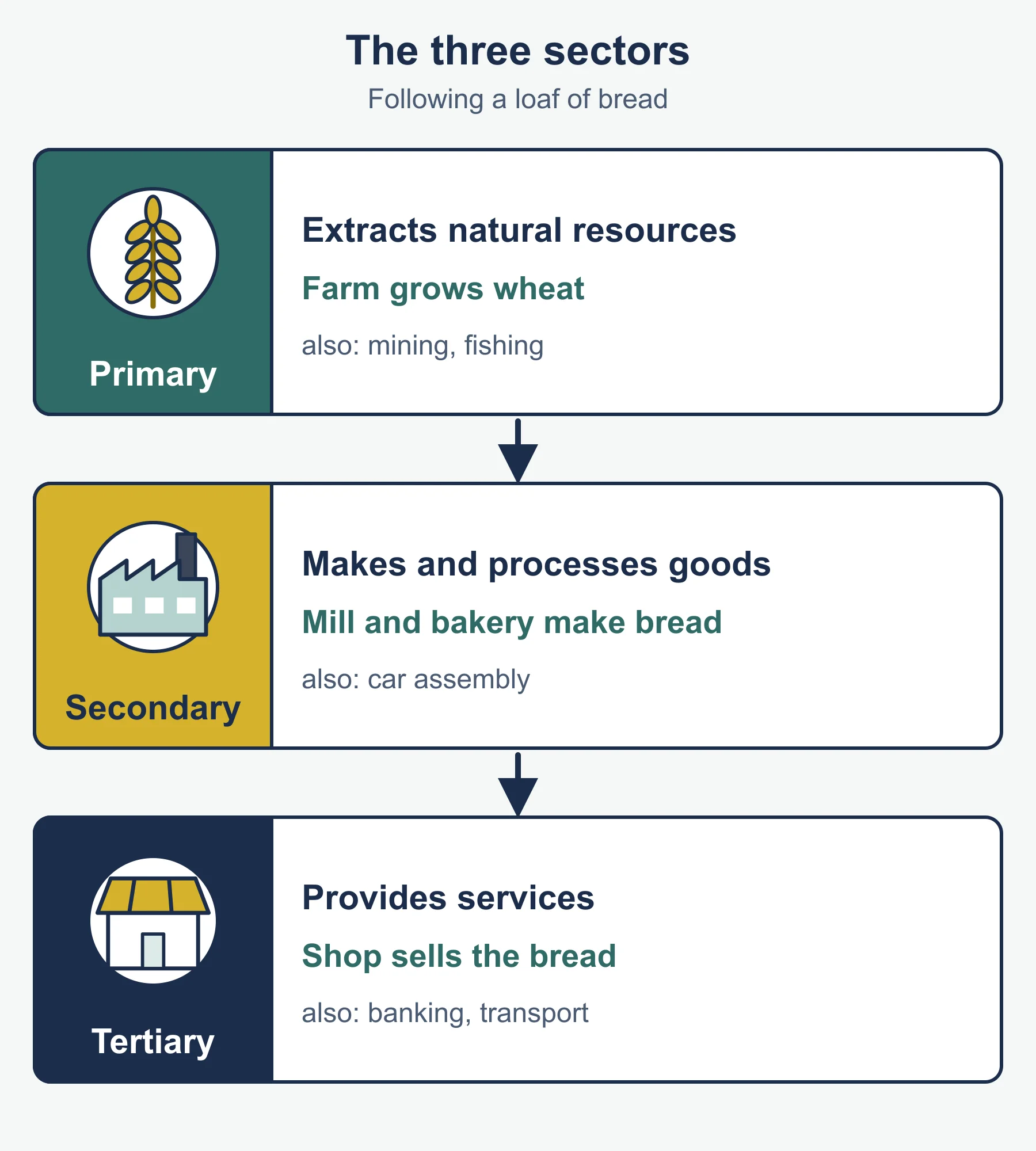
Chain of production example: wheat grown on a farm (primary), flour milled and bread baked (secondary), bread sold in a shop (tertiary). Value is added at each stage.
A business may work in more than one sector. Classify by its main activity, and mention the others if the data shows them.
By ownership and control
| Sector | Owned and controlled by | Usual aim |
|---|---|---|
| Private sector | Individuals or groups of individuals | Mainly profit |
| Public sector | Government (national or local) | Mainly providing a service to the public |
The aims are general tendencies. Private firms can have social aims, and public organisations still need to manage costs.
Must-know distinctions
| Idea A | Idea B | The difference |
|---|---|---|
| Capital (factor) | Money | Capital is man-made equipment and buildings, money is not a factor |
| Added value | Profit | Added value is before wages, rent and other costs |
| Opportunity cost | Cost paid | It is the benefit lost from the next best alternative |
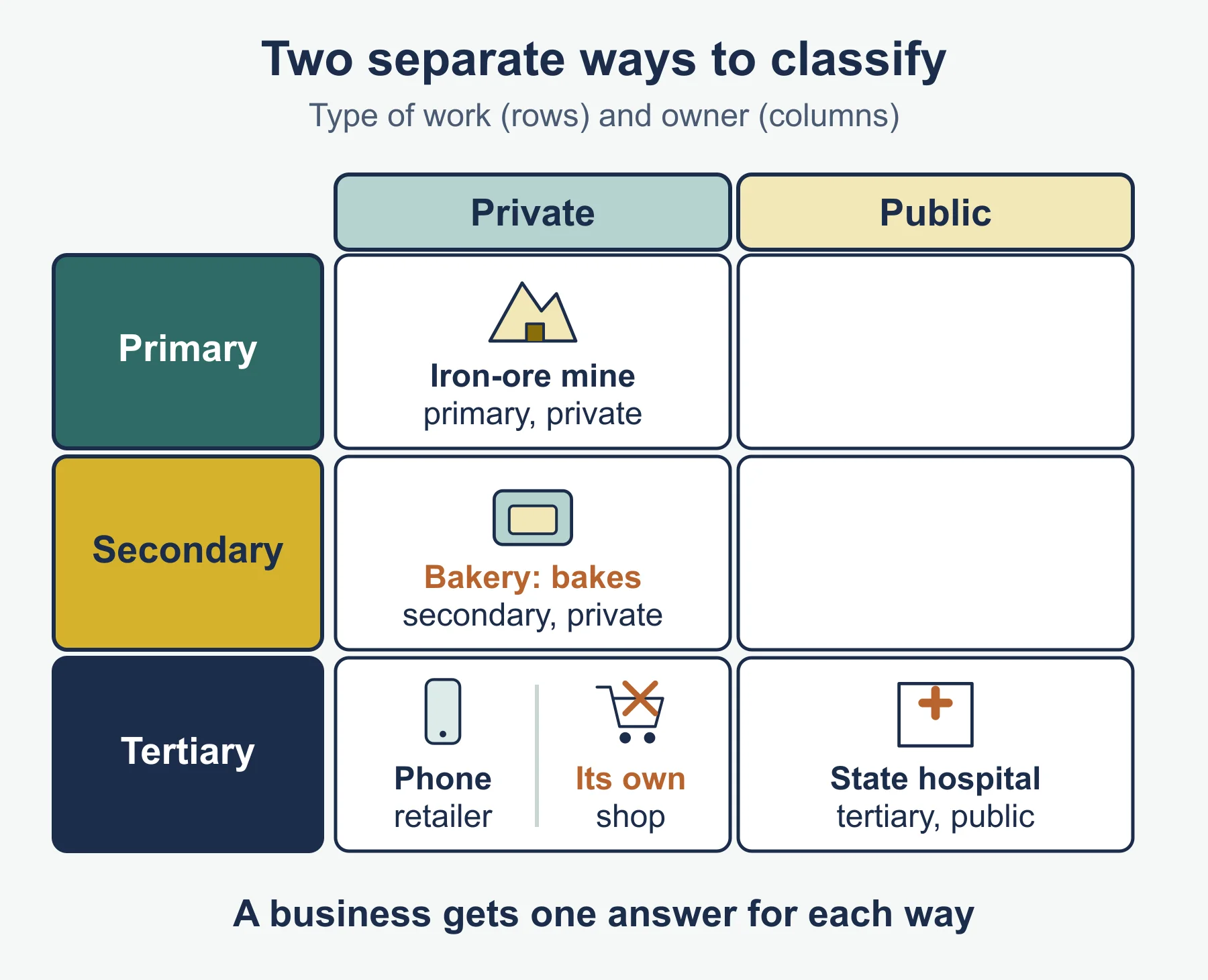
| Primary/secondary/tertiary | Private/public | One groups by activity, the other by ownership |
| Secondary | Tertiary | Making goods versus providing services |
Combining the two: a state-run railway is tertiary and public. A privately owned quarry is primary and private.
Applying it to a business
The syllabus says candidates apply their understanding to a variety of business situations, so practise turning each idea into a sentence about a named business. Examples of the pattern:
- Factor: “The two ovens are capital because they are man-made equipment used to produce bread.”
- Added value: “Added value per board is 4.50, which is what is left after the wood and packaging bought in.”
- Opportunity cost: “Choosing the saw means giving up the delivery bike, worth 2,300 a year.”
- Sector: “The bakery is secondary because it makes bread, and private because individuals own it.”
How to write answers
- State, identify, define: short and exact. Use the wording above.
- Calculate: show the formula, the numbers and the units.
- Explain, analyse: make a point, then link it to the business in the data. Use “because” and “which means”.
- Evaluate, justify, recommend: give both sides, reach a decision and give the reason that decided it.
Quick self-test
- List the four factors of production.
- Which factor is a delivery van?
- Define added value.
- A scarf sells at 30.00 and bought-in inputs cost 19.50 per scarf. Calculate added value per scarf.
- Using Question 4, how much is the added value for 120 scarves?
- State two ways to increase added value.
- Define opportunity cost.
- A business chooses a 5,000 project from options worth 5,000, 4,200 and 3,700. What is the opportunity cost?
- Classify a coal mine and a hotel by sector.
- Give one difference between private and public sector organisations.
Answers
- Land, labour, capital and enterprise.
- Capital.
- The difference between the selling price of a product and the cost of the bought-in materials or inputs used to make it.
- 30.00 - 19.50 = 10.50 per scarf.
- 10.50 x 120 = 1,260.
- Any two, for example raise the selling price through a stronger brand or better quality, or lower input costs through cheaper suppliers or less waste.
- The benefit of the next best alternative that is given up when a choice is made.
- 4,200, the next best alternative.
- A coal mine is primary. A hotel is tertiary.
- Private sector organisations are owned by individuals or groups of individuals and mainly aim to make a profit. Public sector organisations are owned by the government and mainly aim to provide a service.
Where marks are usually lost
- Defining capital as money instead of equipment and buildings.
- Naming a cost, such as wages, when the question asks for a factor.
- Using total cost, not the cost of bought-in inputs, in an added value sum.
- Treating added value as profit.
- Forgetting to multiply by the number of units when a total is asked for.
- Giving the cost of the chosen option, or all alternatives, as the opportunity cost.
- Listing sector names with no link to what the business actually does.
- Describing a way to increase added value without saying what happens to price or input cost.
- Evaluating with one side only. Say what could go wrong with the change, then decide.
- Leaving out units or currency on a calculation.
Frequently asked questions
What are the four factors of production? The four factors are land (natural resources and space), labour (human effort), capital (man-made equipment and buildings) and enterprise (the risk-taking and organizing that brings the others together).
Is capital the same as money in IGCSE Business? No. As a factor of production, capital means man-made equipment and buildings used in production. Money is not a factor, and defining capital as money is a common error.
Is added value the same as profit? No. Added value is the selling price minus the cost of bought-in inputs, before wages, rent and other costs are paid. Profit is what remains after all those costs.
How can a business increase added value? It can raise the selling price, for example through a stronger brand, better design or higher quality, or lower the cost of bought-in inputs, for example through cheaper or bulk suppliers and less waste. Each route has a risk, such as lost sales or lower quality.
Official syllabus
Cambridge IGCSE Business 0264 syllabus for examination in 2027, 2028 and 2029, published by Cambridge University Press & Assessment (Cambridge International Education), sections 1.1 Business activity and 1.2 Economic sectors.
Get free revision emails (optional)
Occasional emails with practice questions, worked explanations and links to free resources for the qualification and subjects you choose. No spam, and you can unsubscribe from any email. The free tools on this site never need an email.
Related resources
-
Study guides
IGCSE Business: Business objectives and stakeholder objectives (Cambridge 0264)
Study guide to business objectives, stakeholder groups, their aims and how those aims conflict, for Cambridge IGCSE Business 0264, with worked examples.
Business · Cambridge · IGCSE
Read guide -
Practice questions
IGCSE Business: Business objectives and stakeholder objectives (Cambridge 0264) – Practice Questions
Original practice questions with worked answers on business objectives and stakeholder objectives for Cambridge IGCSE Business 0264, with case items.
Business · Cambridge · IGCSE
Try questions -
Revision notes
IGCSE Business: Business objectives and stakeholder objectives (Cambridge 0264) – Revision Notes
Condensed revision notes on business objectives, internal and external stakeholders and stakeholder conflict for Cambridge IGCSE Business 0264.
Business · Cambridge · IGCSE
Revise topic
Related articles
-
teaching
A Level tuition in Dubai: Cambridge or Pearson Edexcel International A Level?
Schools in Dubai and Abu Dhabi teach either Cambridge International AS & A Level or Pearson Edexcel International A Level. How the two are structured, why it matters for tuition, and how online classes from Lahore work.
9 October 2026
-
curriculum guides
Choosing subjects at IGCSE and A Level
How subject choices at 14 and 16 affect university options later, and how to keep pathways open without overloading a timetable.
28 July 2026
Studying this with a teacher
Working through Business IGCSE?
This page is free and stays free. If you would rather be taught it, Marlbridge runs Business classes one-to-one and in small groups of up to 15, online in your own time zone. The first trial class is free. WhatsApp replies within an hour (8am–11pm Pakistan time, every day); email the same day.
Cambridge Business teachers at Marlbridge

