
Study Guides
IGCSE Business: Enterprise, business growth and size (Cambridge 0264)
A full study guide to Cambridge IGCSE Business 0264 section 1.3: entrepreneurs, business plans, measuring size, growth, small firms, success and failure.
- Subject
- Business
- Level
- IGCSE
- Topic
- Understanding business activity
- Author
- Marlbridge Academic Team
- Updated
- Reviewed by
- Salman Ahmad (what this means)
Aligned to Cambridge IGCSE Business (0264), For examination in 2027, 2028 and 2029. Official specification .
Syllabus page (what it covers and how it is assessed): Cambridge IGCSE Business.
Syllabus points this page covers
0264
- 1.3 Enterprise, business growth and size
Found an error? Report a correction.
Need help with this topic? Request a free trial class for IGCSE Business (0450 / 0264).
This guide covers section 1.3, Enterprise, business growth and size, of the Cambridge IGCSE Business 0264 syllabus for examination in 2027, 2028 and 2029. It follows the syllabus order: 1.3.1 to 1.3.4. All candidates study the same content. For quick recall use the revision notes, then test yourself with the practice questions. The course hub and the printable checklist track what you have covered, and the free diagnostics show where to start.
All businesses in this guide are invented.
What this section covers
| Syllabus point | What you must be able to do |
|---|---|
| 1.3.1 Enterprise and entrepreneurship | Describe the characteristics of successful entrepreneurs; know the purpose and key elements of a business plan and why it matters; explain why and how governments support start-ups |
| 1.3.2 Measuring business size | Use and compare methods of measuring size; explain the problems of measuring it |
| 1.3.3 Growth and staying small | Explain why owners want growth; internal and external growth; advantages, disadvantages and problems; why some firms stay small |
| 1.3.4 Success and failure | Explain why businesses succeed or fail |
The command words used in this syllabus include state, identify, define, outline, explain, calculate, justify and consider. Questions test knowledge (AO1), application to a given business (AO2), analysis (AO3) and evaluation (AO4). Application (AO2) carries a large share of the marks, so always tie a point back to the business in front of you.
1.3.1 Enterprise and entrepreneurship
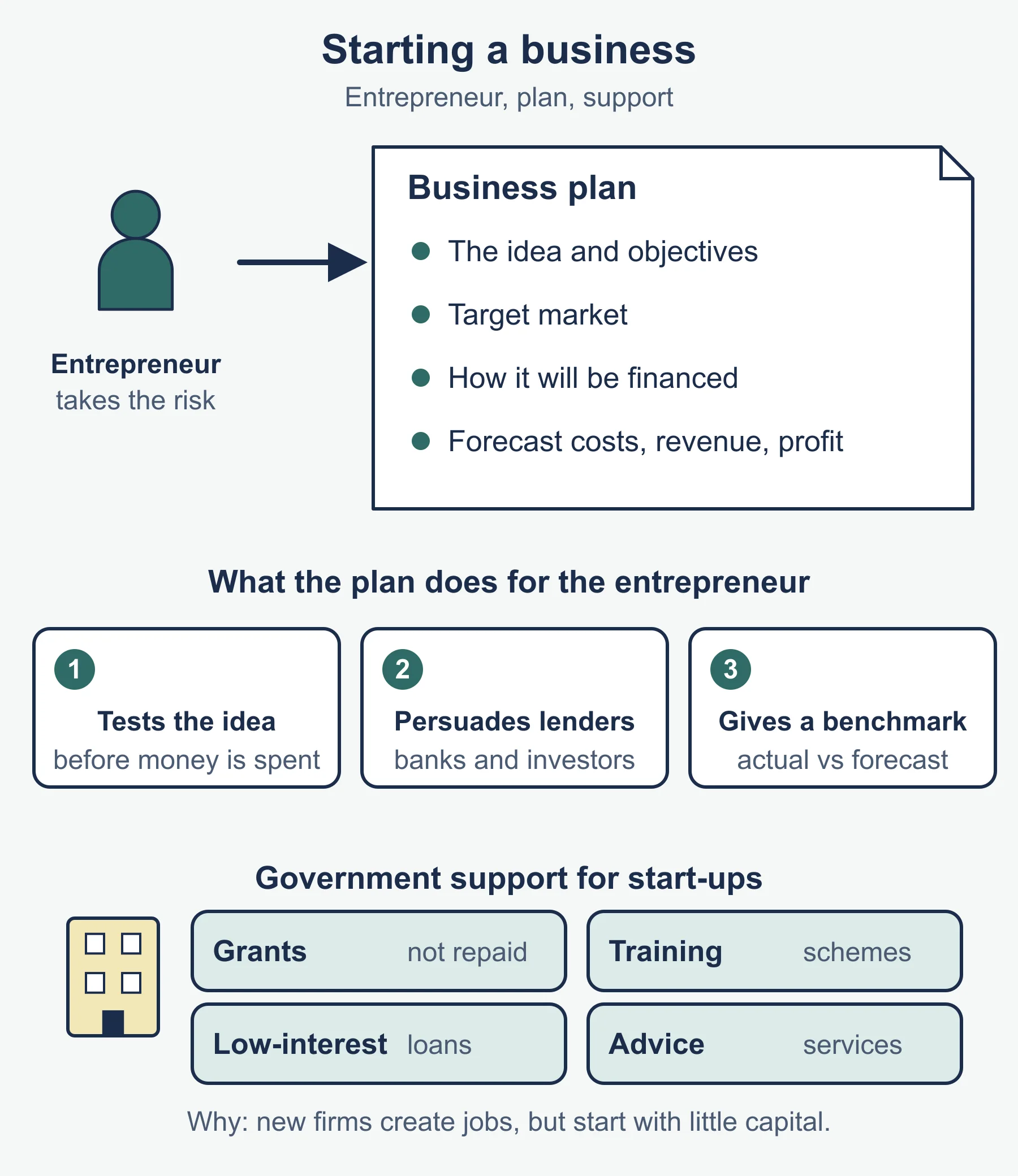
An entrepreneur is a person who takes the risk of starting and running a business. Enterprise is the activity of doing this.
Characteristics of successful entrepreneurs
The syllabus asks for the characteristics of successful entrepreneurs, without fixing a list. The ones you can use confidently are:
- Risk-taking. They put their own money and time in with no guarantee of a return.
- Innovation. They spot a gap or a better way to do something and act on it.
- Determination and resilience. They keep going after setbacks such as a lost customer or a rejected loan.
- Hard work and commitment. Early on, the owner often does several jobs.
- Self-confidence and leadership. They persuade staff, suppliers and lenders to back them.
- Good decision-making and organisation. They plan money, time and people sensibly.
In an exam, name the trait, then show it in the case. “Dara left a secure job and used her savings, so she is a risk-taker” earns more than the bare word.
The business plan
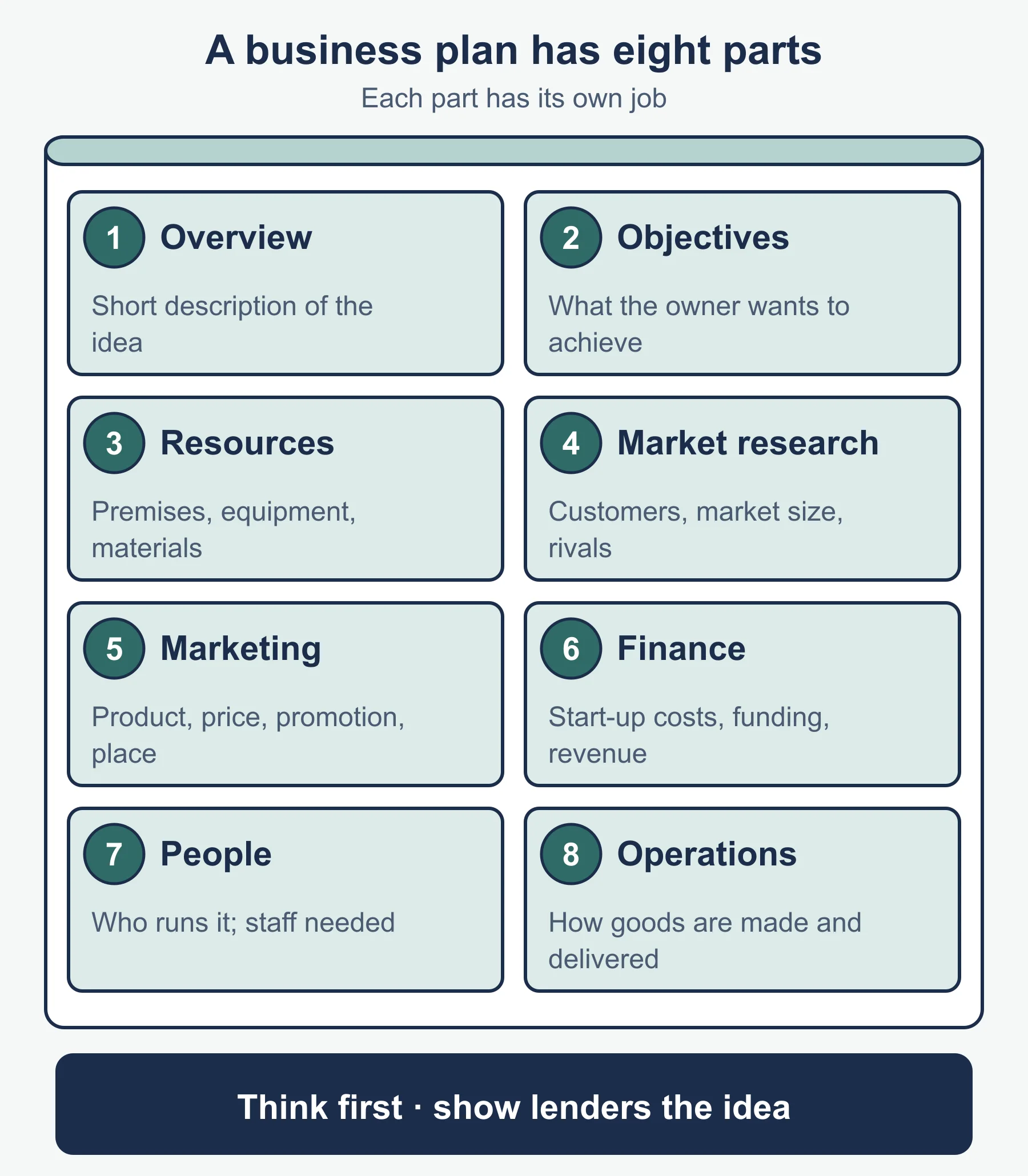
A business plan is a document that sets out what a new or growing business intends to do and how. The syllabus lists these key elements:
| Element | What it contains |
|---|---|
| Overview/summary | A short description of the business and its idea |
| Objectives | What the owner wants to achieve, for example a sales target |
| Resources | Premises, equipment and materials needed |
| Market research | Who the customers are, how big the market is, who the competitors are |
| Marketing | Product, price, promotion and place decisions |
| Finance | Start-up costs, sources of finance, expected revenue and costs |
| People | Who will run the business and how many staff are needed |
| Operations | How goods or services will be produced and delivered |
Why a plan is important. It forces the owner to think through problems before spending money. It gives a bank or investor evidence that the idea is sound, which helps in raising finance. Its objectives give everyone a target to measure progress against. A plan does not guarantee success: it rests on forecasts, and forecasts can be wrong.
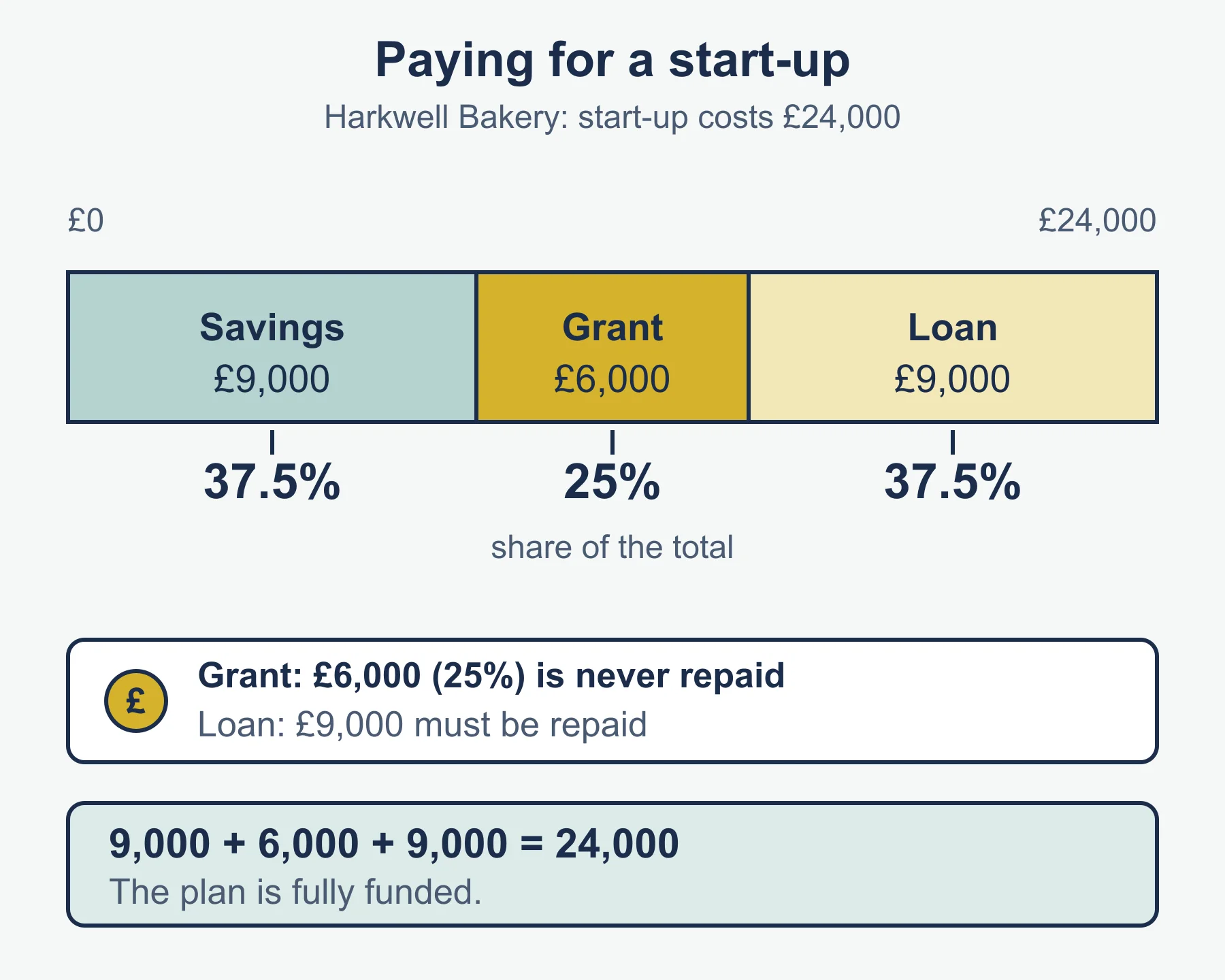
Worked example 1: using the plan. Dara Okoye wants to open Harkwell Bakery, a small shop selling bread to commuters. Her plan’s finance section shows start-up costs of £24,000 for an oven, a counter and the first stock. She will put in £9,000 of savings, receive a £6,000 grant and take a £9,000 low-cost loan.
- Check the sources add up: 9,000 + 6,000 + 9,000 = £24,000. The plan is fully funded.
- Share from her own savings: 9,000 ÷ 24,000 × 100 = 37.5%.
- Share that does not need to be repaid (the grant): 6,000 ÷ 24,000 × 100 = 25%.
The market research section would back up her sales forecast, and the marketing section would explain why commuters will choose her shop. A lender reading the plan can see how the loan is covered.
Why governments support business start-ups
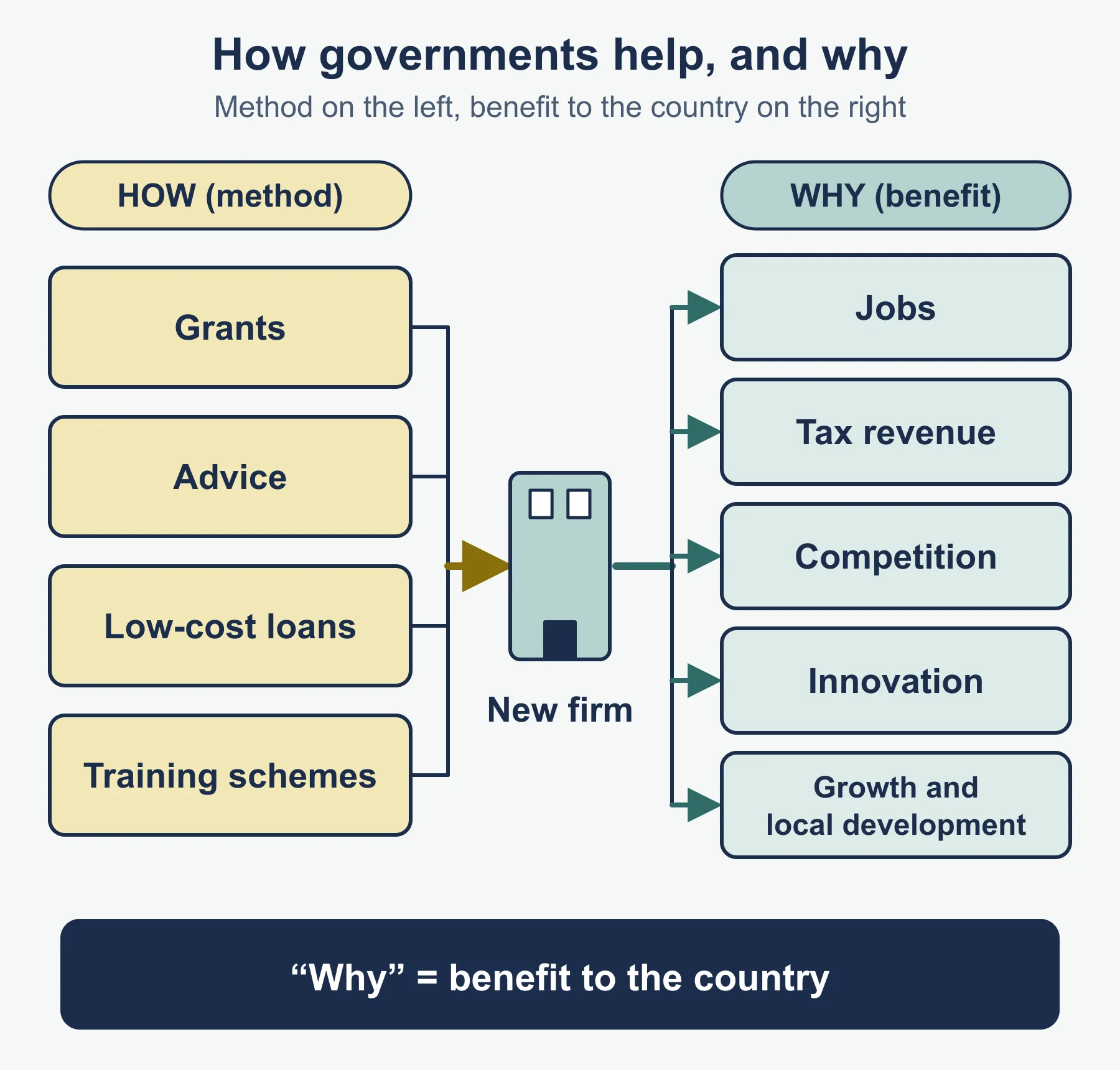
New businesses matter to a country’s economy. Governments may want to:
- create jobs and so reduce unemployment;
- raise tax revenue, because new firms and their staff pay taxes once established;
- increase competition, which can lead to better quality and lower prices for consumers;
- encourage innovation and new products;
- support economic growth and local development.
How governments support start-ups
| Method | How it helps the new firm |
|---|---|
| Grants | Money that does not have to be repaid |
| Advice | Free or cheap guidance on planning, law and finance |
| Low-cost loans | Borrowing at a lower interest rate than a bank would offer |
| Training schemes | Skills for the owner and workers |
When asked “how”, name the method and say what it does. When asked “why”, give the benefit to the country, not to the business.
1.3.2 The methods and problems of measuring business size
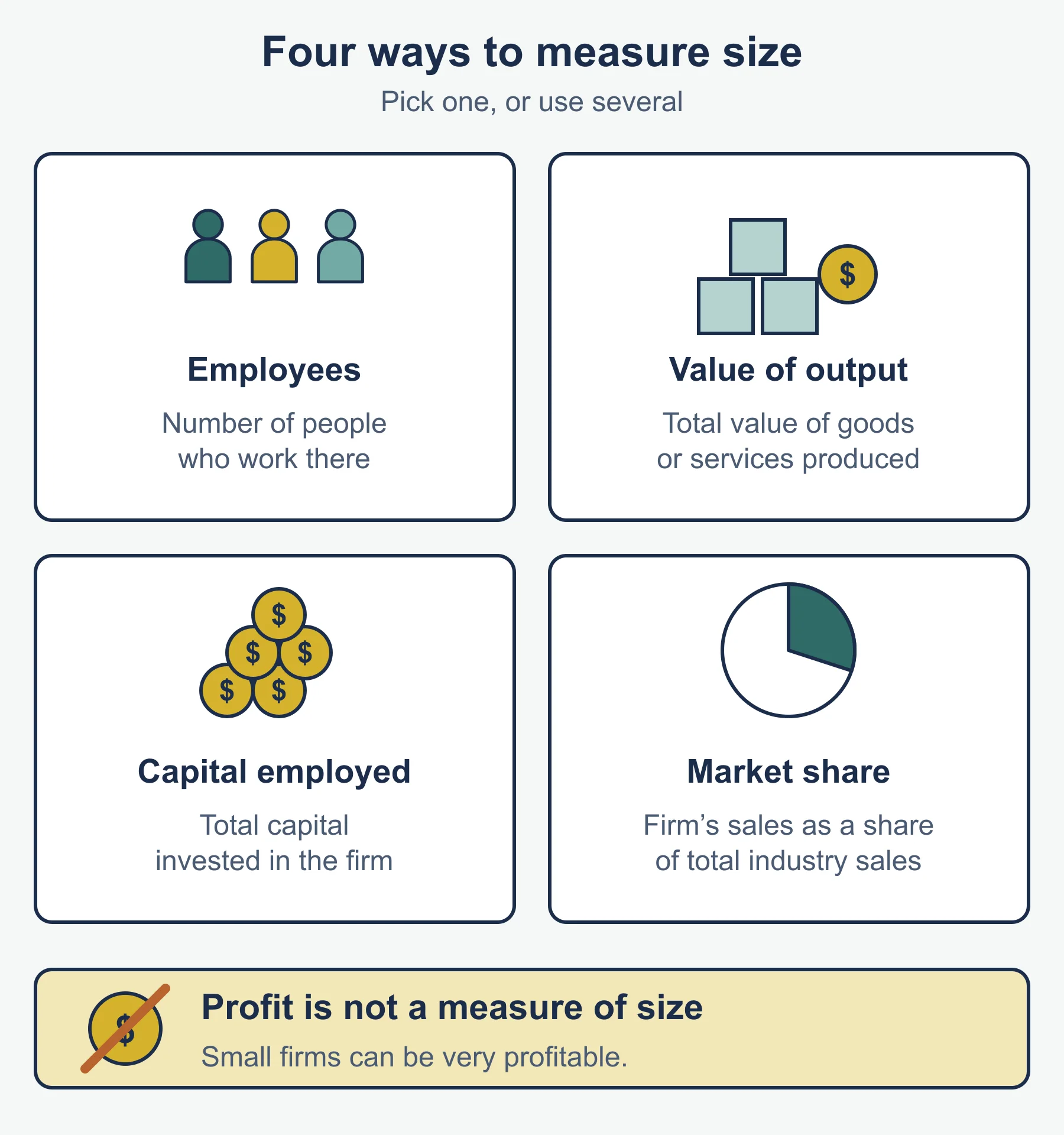
Size matters because it affects how a business is run, how it is financed and how it compares with rivals. The syllabus gives these methods:
| Method | What it measures | Typical limitation |
|---|---|---|
| Number of people employed | How many workers | Ignores machines; part-time and full-time are not equal |
| Value of output/sales | Revenue from sales in money terms | Prices and inflation change the figure |
| Volume of output/sales | Number of units made or sold | Hard to compare different products |
| Capital employed | The money invested in the business | Asset values can be hard to judge |
A standard form of capital employed is total assets less current liabilities, so it shows the long-term finance in the business. This is the usual textbook form rather than a wording given in the syllabus.
Profit is not a method of measuring business size. A small firm can earn a high profit and a very large one can make a loss. Do not offer profit as an answer.
Problems when measuring size
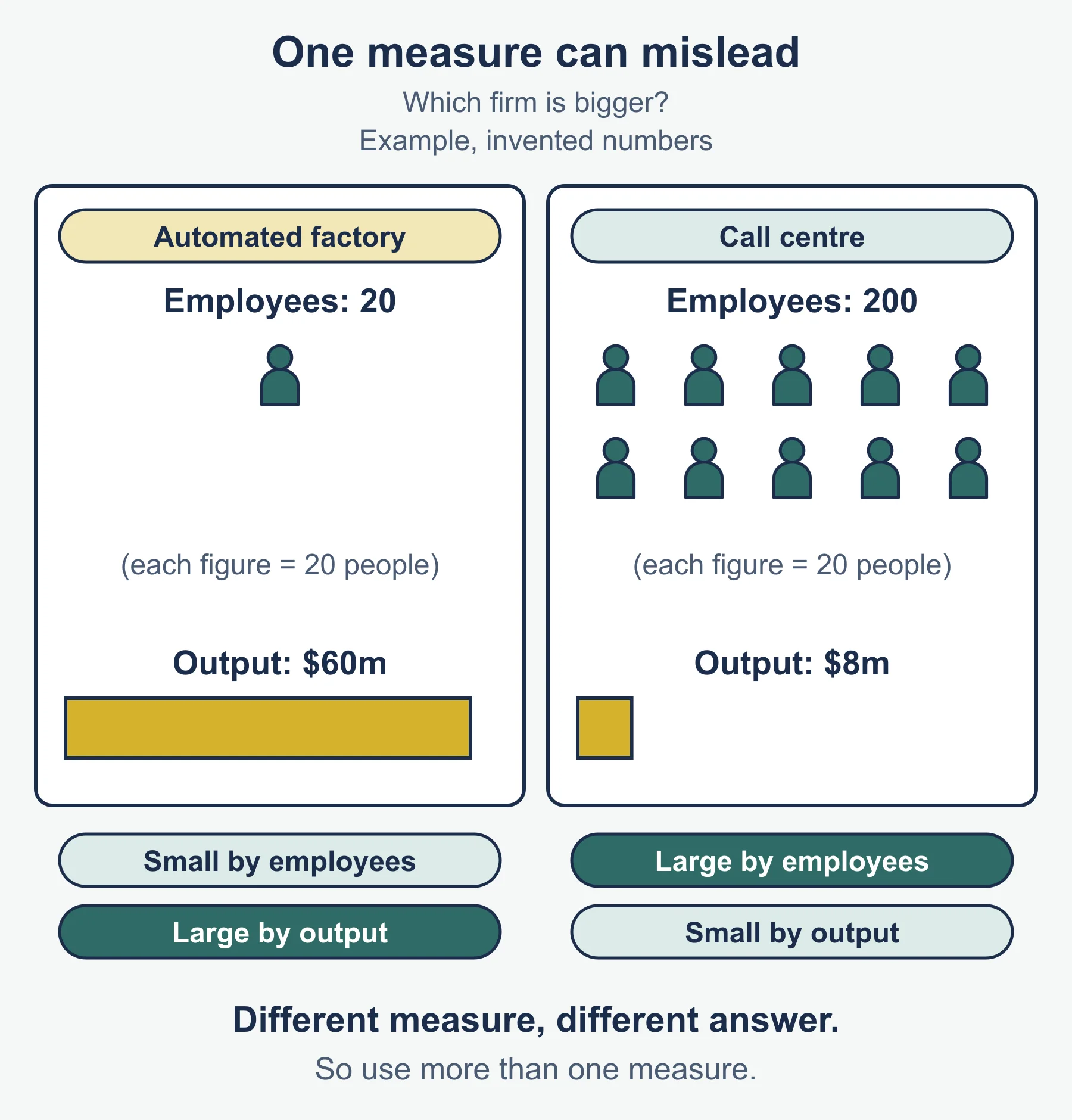
- Different industries. A software firm can have few staff and large sales. A farm can have many workers and low sales. One method may make one firm look big and another small.
- Capital-intensive and labour-intensive firms. A factory with many machines may employ few people.
- Value versus volume. A jeweller sells few items of high value; a bread maker sells thousands of cheap ones.
- Changing prices and exchange rates. Sales value can rise only because of price increases.
- Part-time, seasonal and outsourced workers. Headcount may not reflect work done.
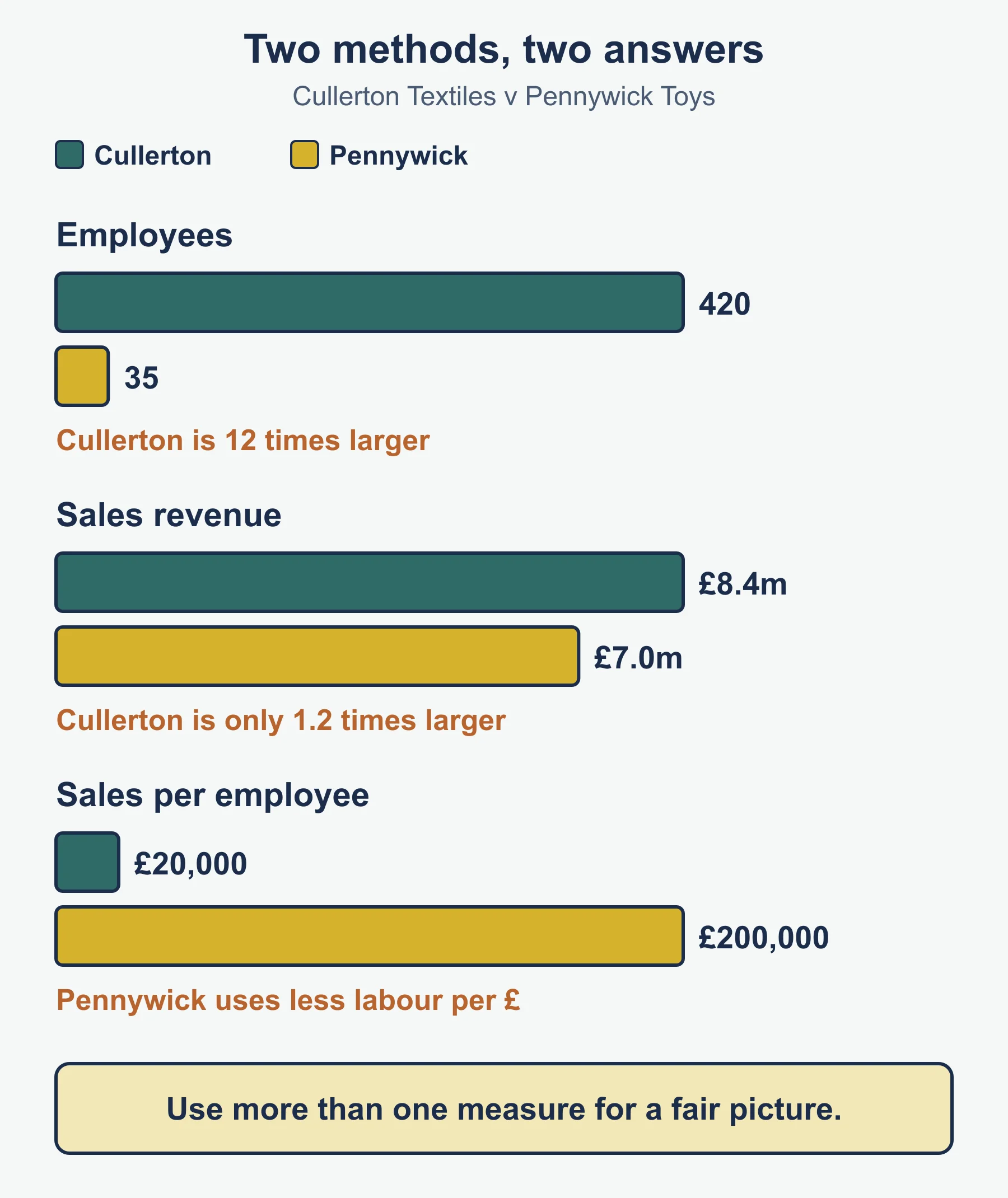
Worked example 2: two methods give two answers. Cullerton Textiles employs 420 people and had sales revenue of £8.4 million. Pennywick Toys employs 35 people and had sales revenue of £7.0 million.
- By employees, Cullerton is 420 ÷ 35 = 12 times larger.
- By sales revenue, Cullerton is 8.4 ÷ 7.0 = 1.2 times larger.
- Sales per employee (the standard form is sales revenue ÷ employees): Cullerton £8,400,000 ÷ 420 = £20,000; Pennywick £7,000,000 ÷ 35 = £200,000.
Conclusion: Cullerton is much bigger by number employed but only slightly bigger by sales revenue. Pennywick uses far less labour for each pound of sales. The best answer says which method suits the purpose, and that using more than one gives a fairer picture.
1.3.3 Why some businesses grow and others remain small
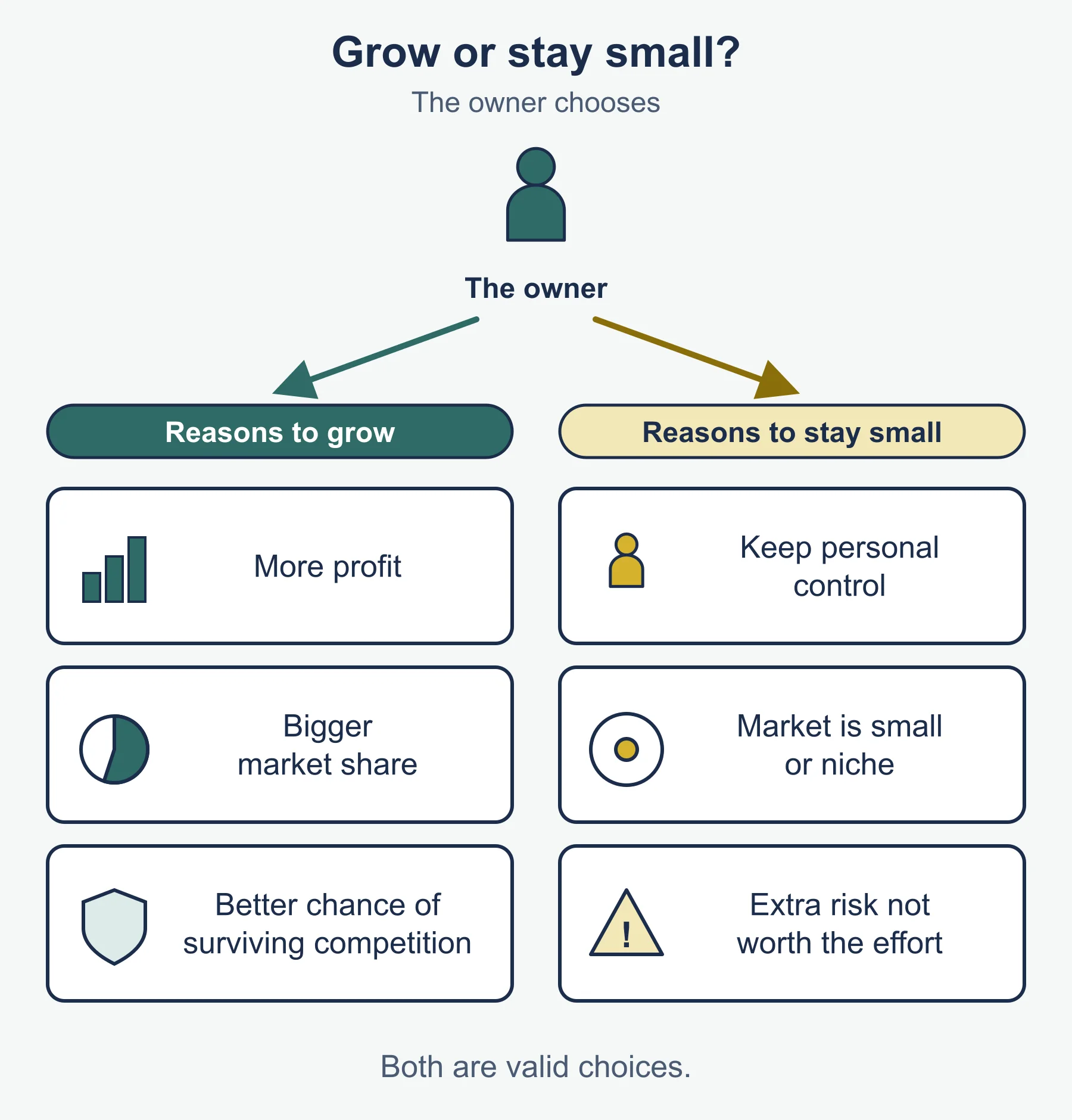
Why owners may want to grow
- Higher profit from greater sales.
- Larger market share, which gives more influence over prices and suppliers.
- Lower average costs per unit, because buying and producing in larger amounts is often cheaper.
- Spreading risk by selling more products or in more places, so one failure does less harm.
- Status and personal ambition, and greater security against being taken over.
Internal growth
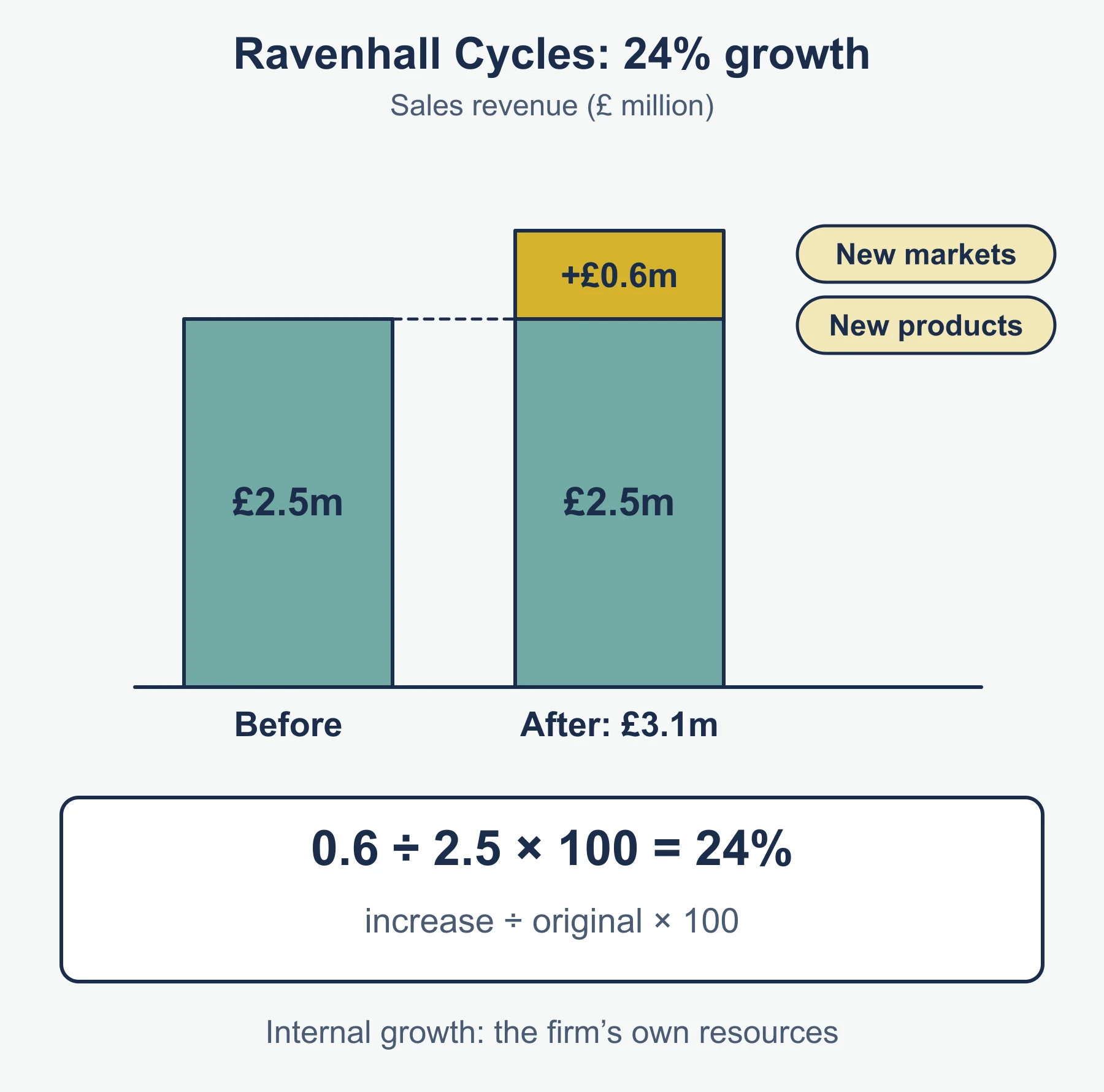
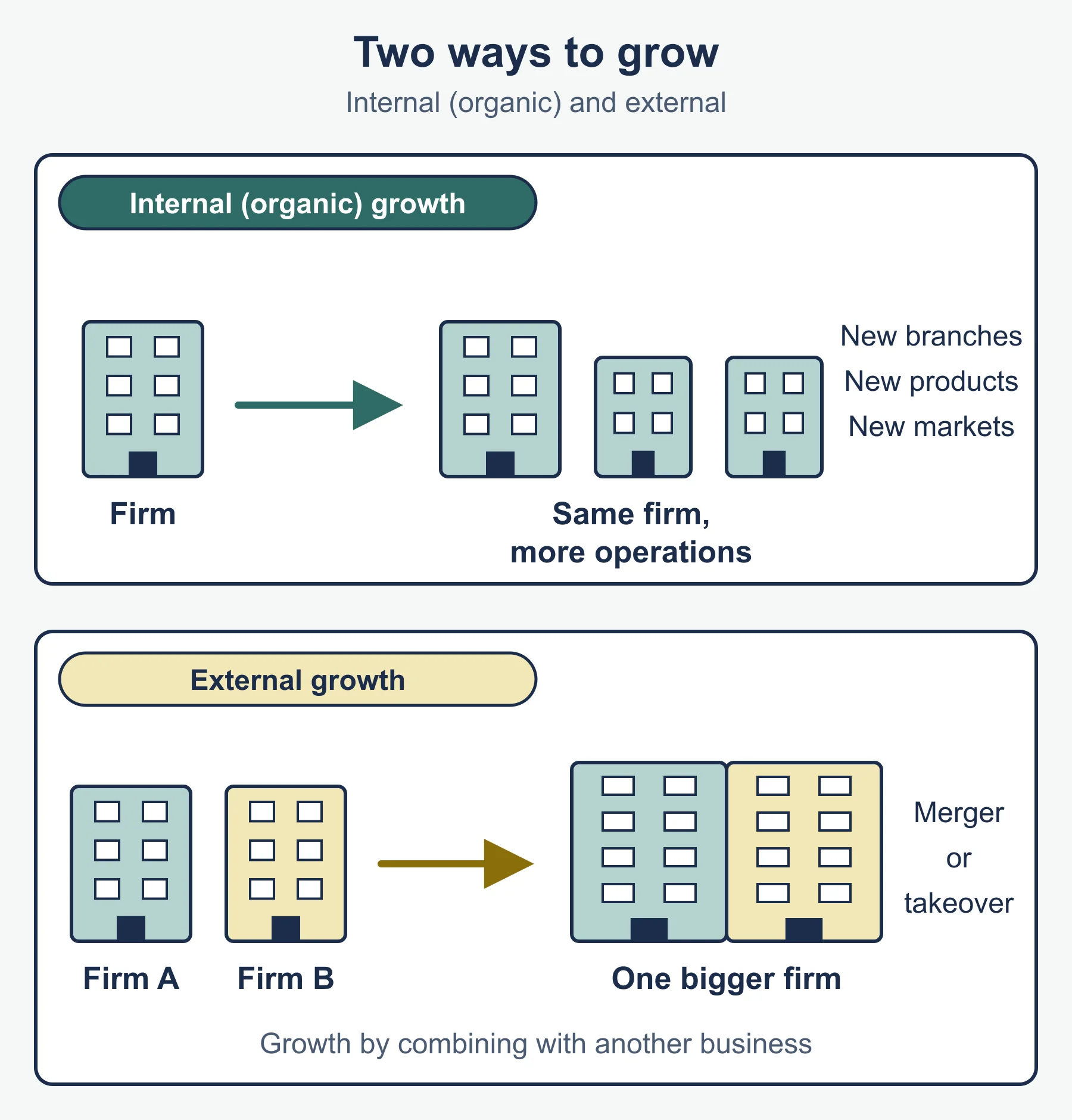
Internal (organic) growth comes from the business’s own resources, not from joining with another firm. The syllabus examples are developing new products and developing new markets. A business can also open more outlets or raise output with its own money.
Worked example 3. Ravenhall Cycles raised sales revenue from £2.5 million to £3.1 million by launching a children’s range (a new product) and selling online in a neighbouring country (a new market).
- Increase = 3.1 − 2.5 = £0.6 million.
- Percentage growth = 0.6 ÷ 2.5 × 100 = 24%.
Advantages: the owner keeps control and growth is steady. Disadvantages: it is slow, it needs finance from profits or loans, and new products can fail.
External growth
External growth means joining with another business.
- A merger happens when two firms agree to combine as a single business.
- A takeover is when one firm buys enough of another to control it. It may be agreed or opposed by the target’s owners.
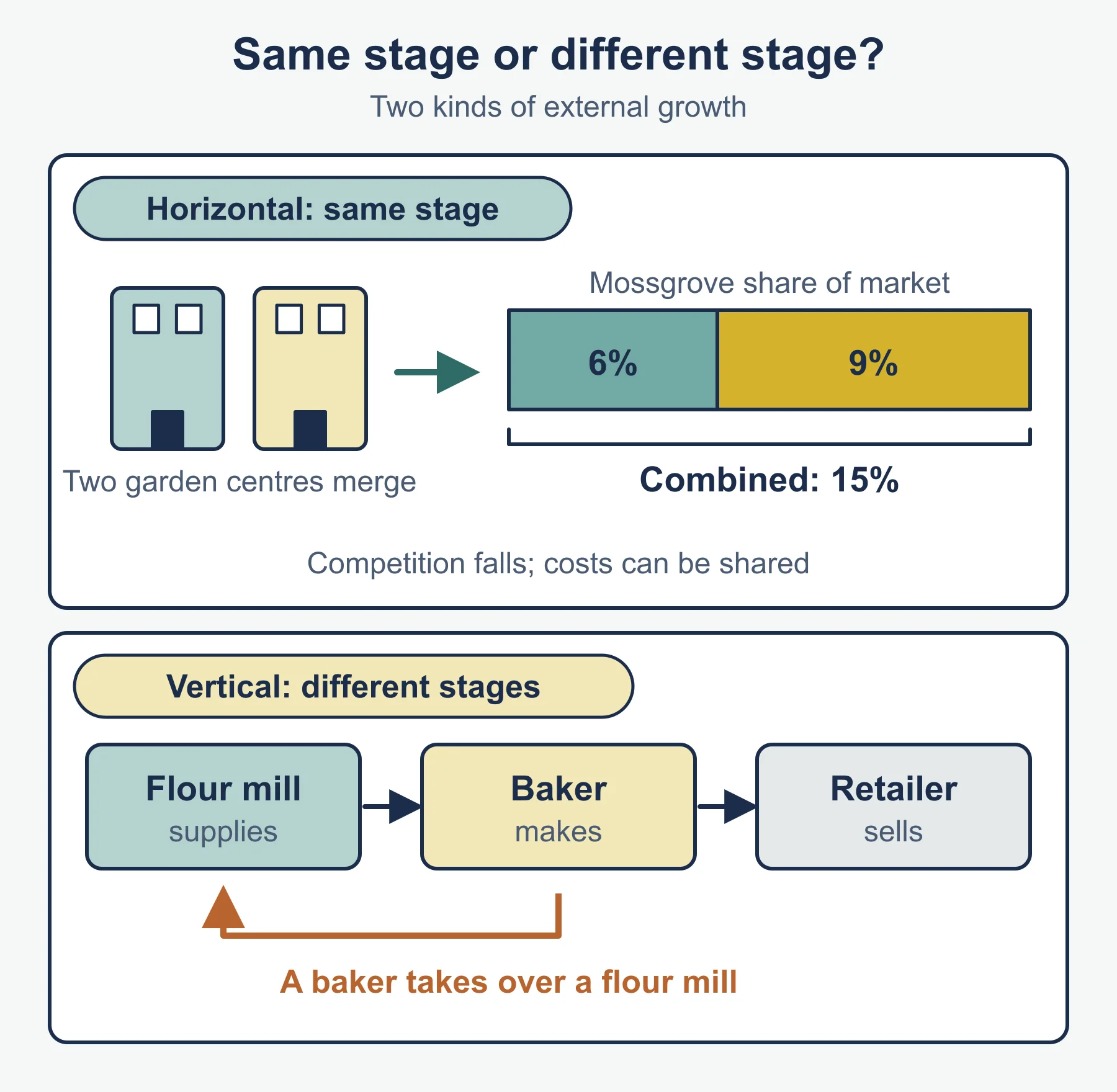
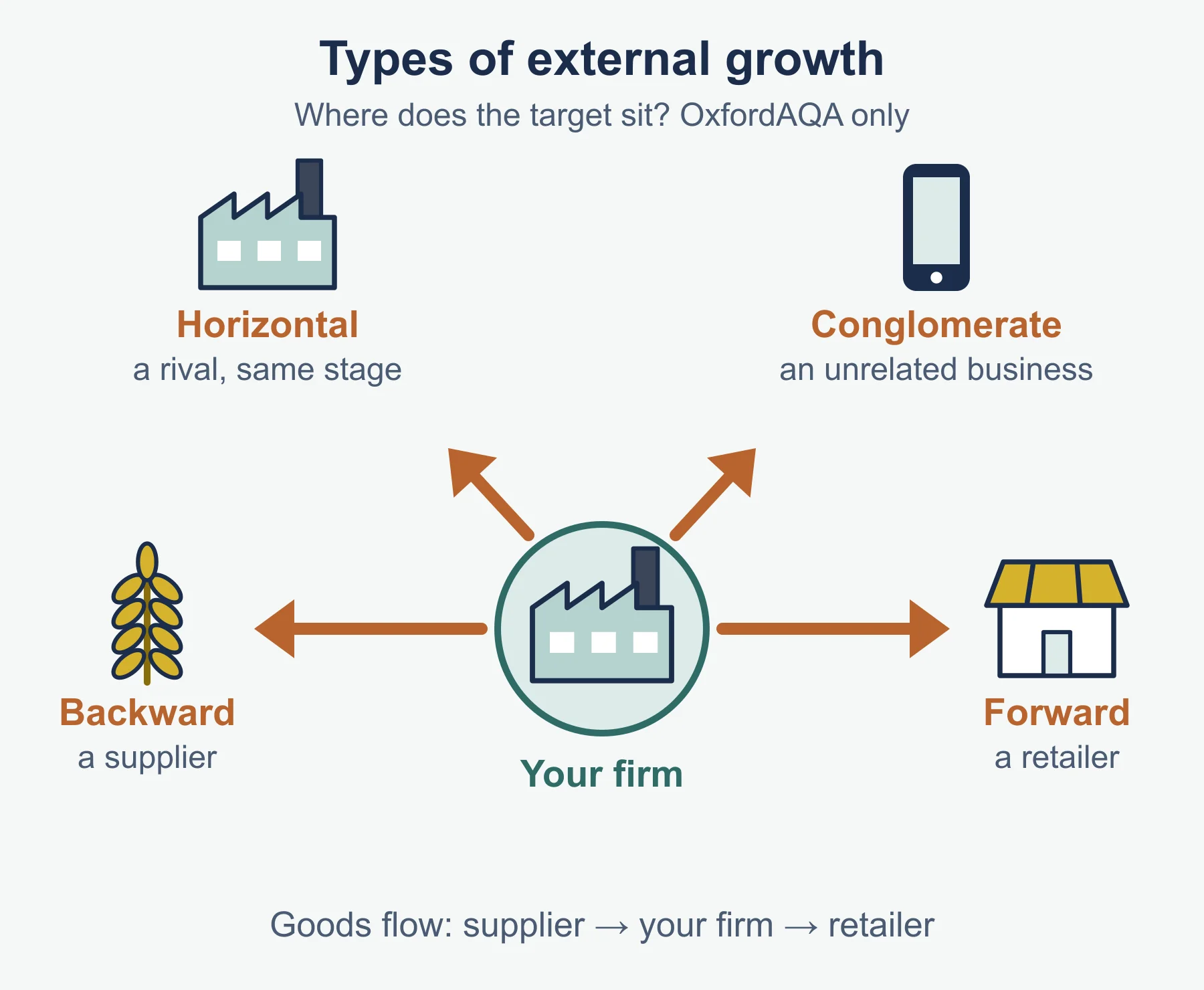
| Type | Meaning | Example |
|---|---|---|
| Horizontal integration | Joining firms at the same stage of the same industry | Mossgrove Garden Centre merges with another garden centre |
| Vertical integration | Joining firms at different stages of the supply chain | A baker takes over a flour mill |
The standard sub-types are backward (towards suppliers) and forward (towards retailers or customers).
Worked example 4. Mossgrove Garden Centre has 6% of its local market. It merges with a rival that has 9%. Combined share = 6 + 9 = 15%, assuming no customers are lost. This is horizontal integration. Competition falls and costs can be shared, but staff may be made redundant and cultures may clash.
| Advantages of external growth | Disadvantages of external growth |
|---|---|
| Fast increase in size and market share | Often expensive; may need large loans |
| Gains the other firm’s customers, skills and brands | Managers may struggle to run the larger firm |
| Vertical integration can secure supplies or outlets | Conflicts and job losses can lower morale |
| Horizontal integration removes a competitor | Customers may dislike the change |
Problems linked to growth
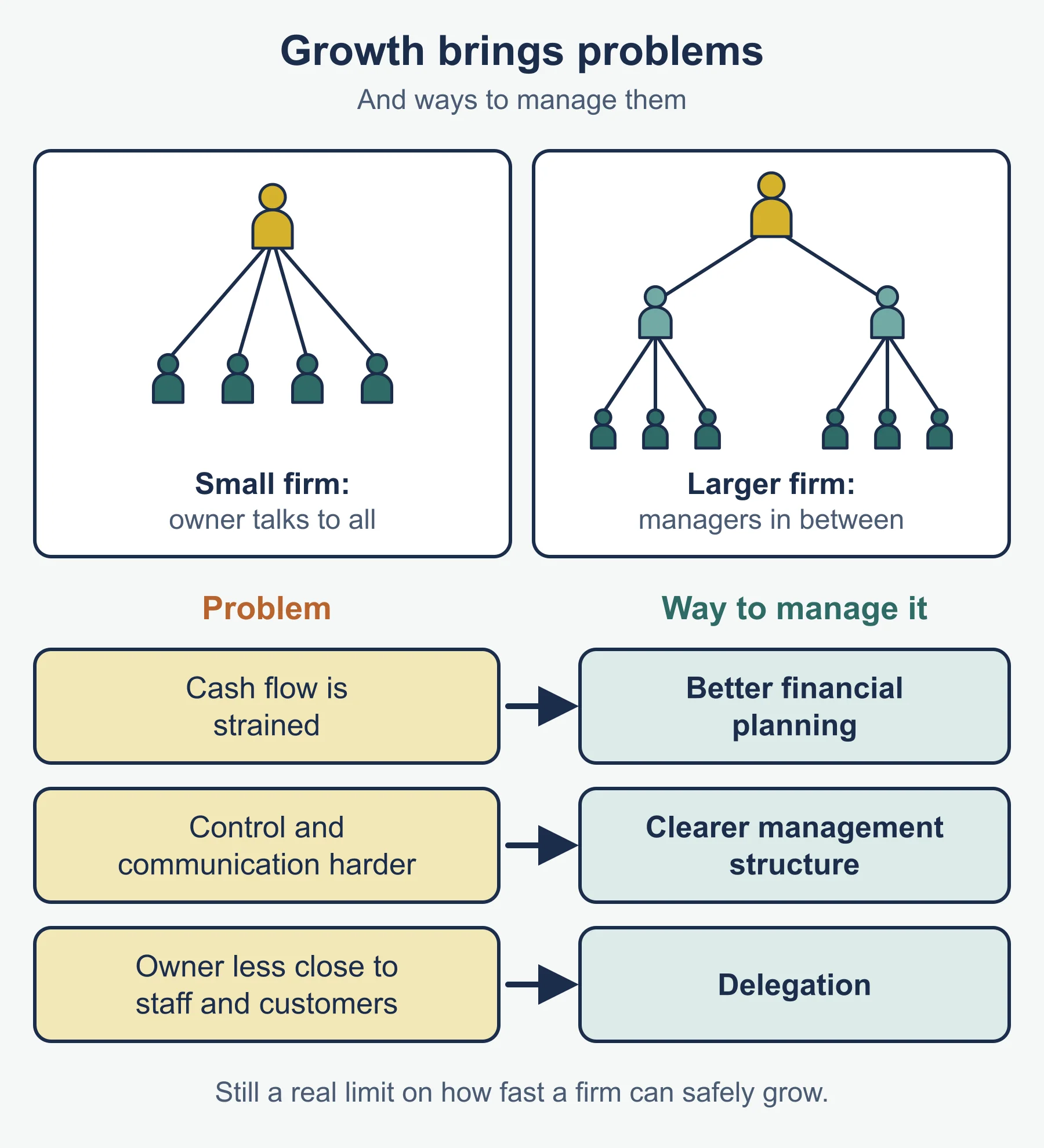
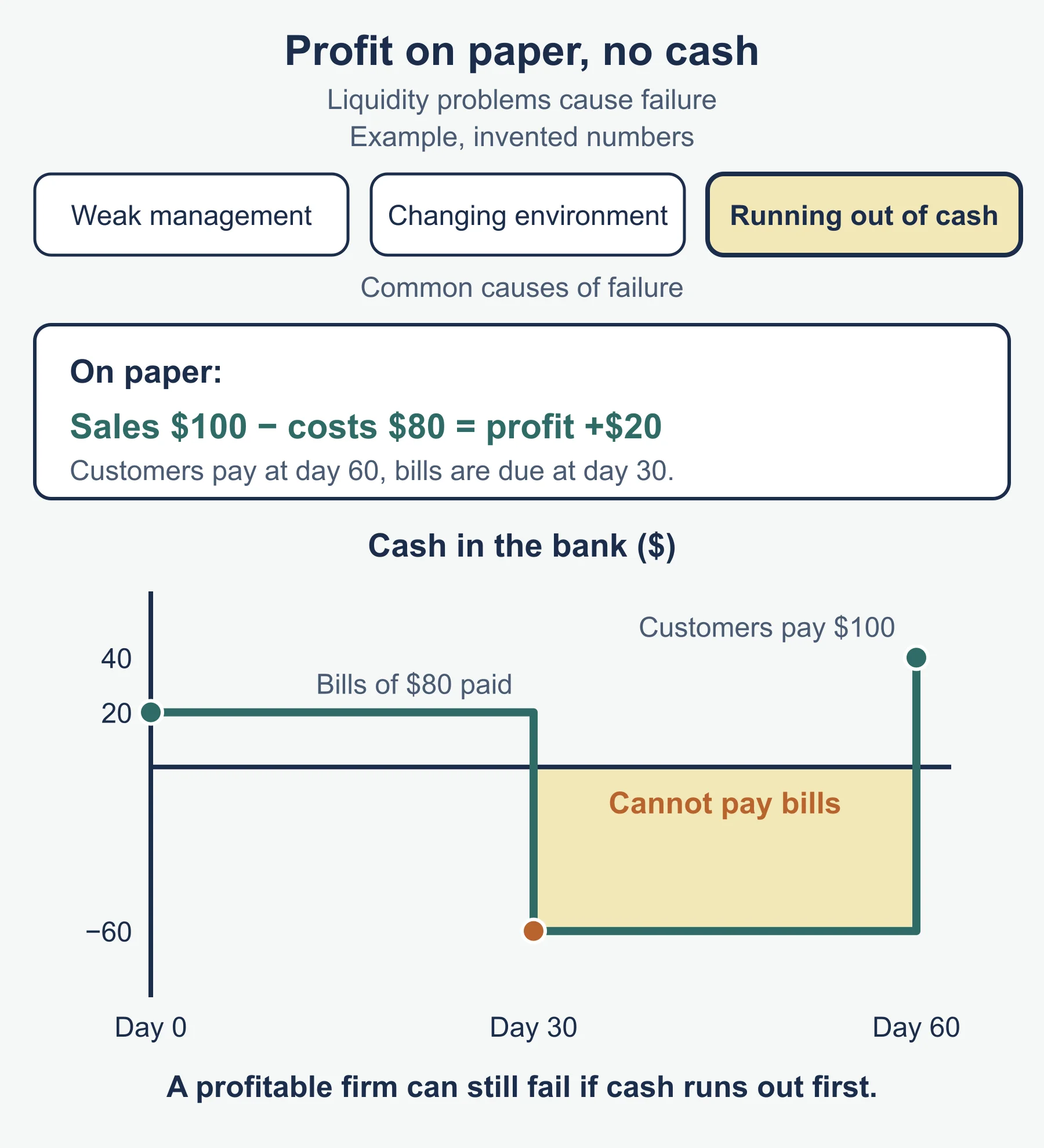
- Cash flow strain, because growth costs money before it brings money in.
- Management difficulty. Owners find it harder to supervise and keep control.
- Communication problems in larger organisations.
- Higher average costs if the firm becomes too big to manage well.
- Lower quality or service as the business stretches.
- Finance risk if growth is paid for by borrowing.
Why some businesses remain small
- The market is small or specialised, for example a niche craft product.
- The owner prefers control and a manageable workload.
- Lack of finance or reluctance to take risks.
- Personal service is the selling point and cannot be copied at scale.
- The owner is content with the income and lifestyle.
1.3.4 Why some businesses succeed and others fail
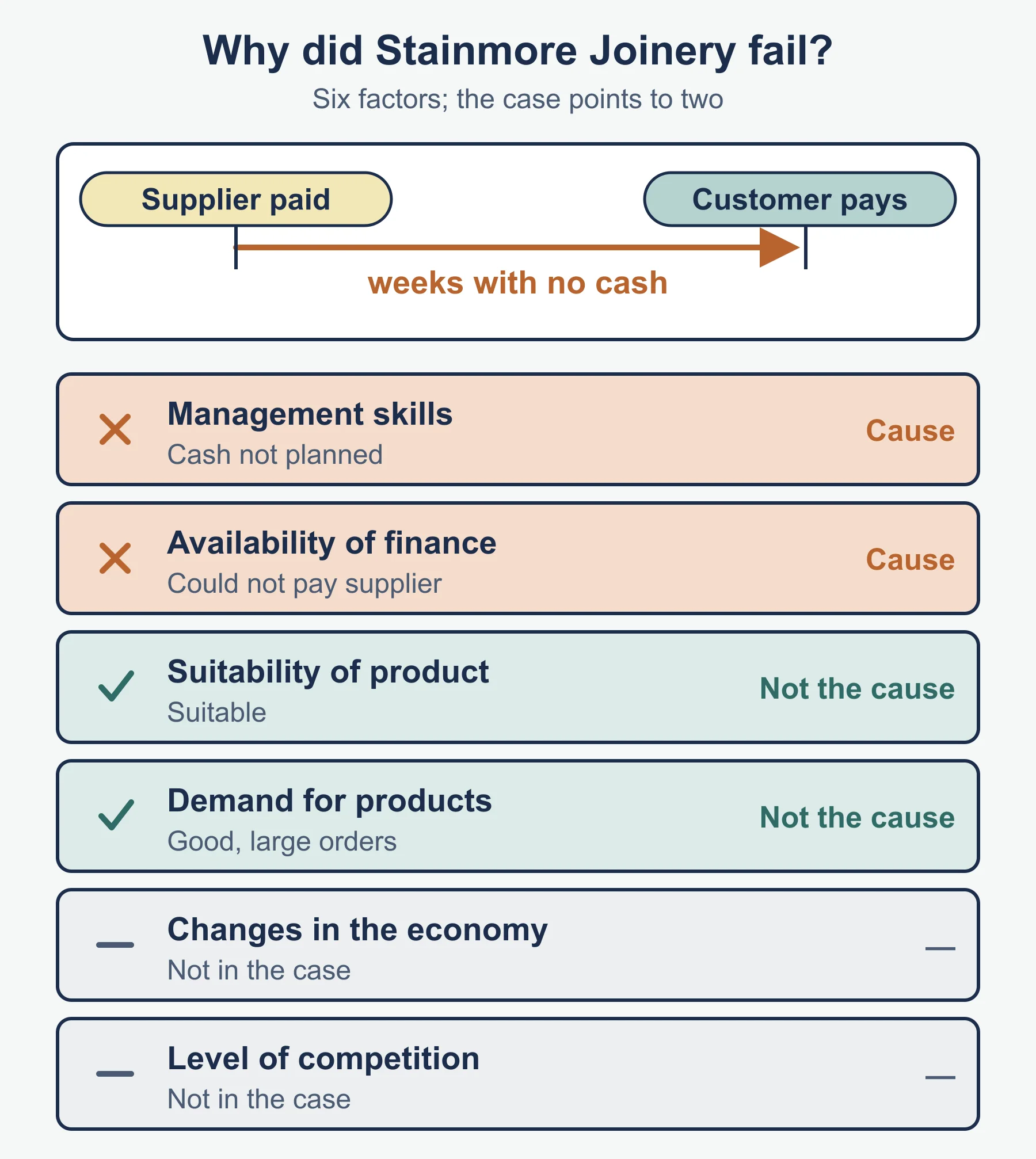
| Factor | Helps success when | Leads to failure when |
|---|---|---|
| Management skills | Managers plan, lead and control costs | Poor decisions or weak control |
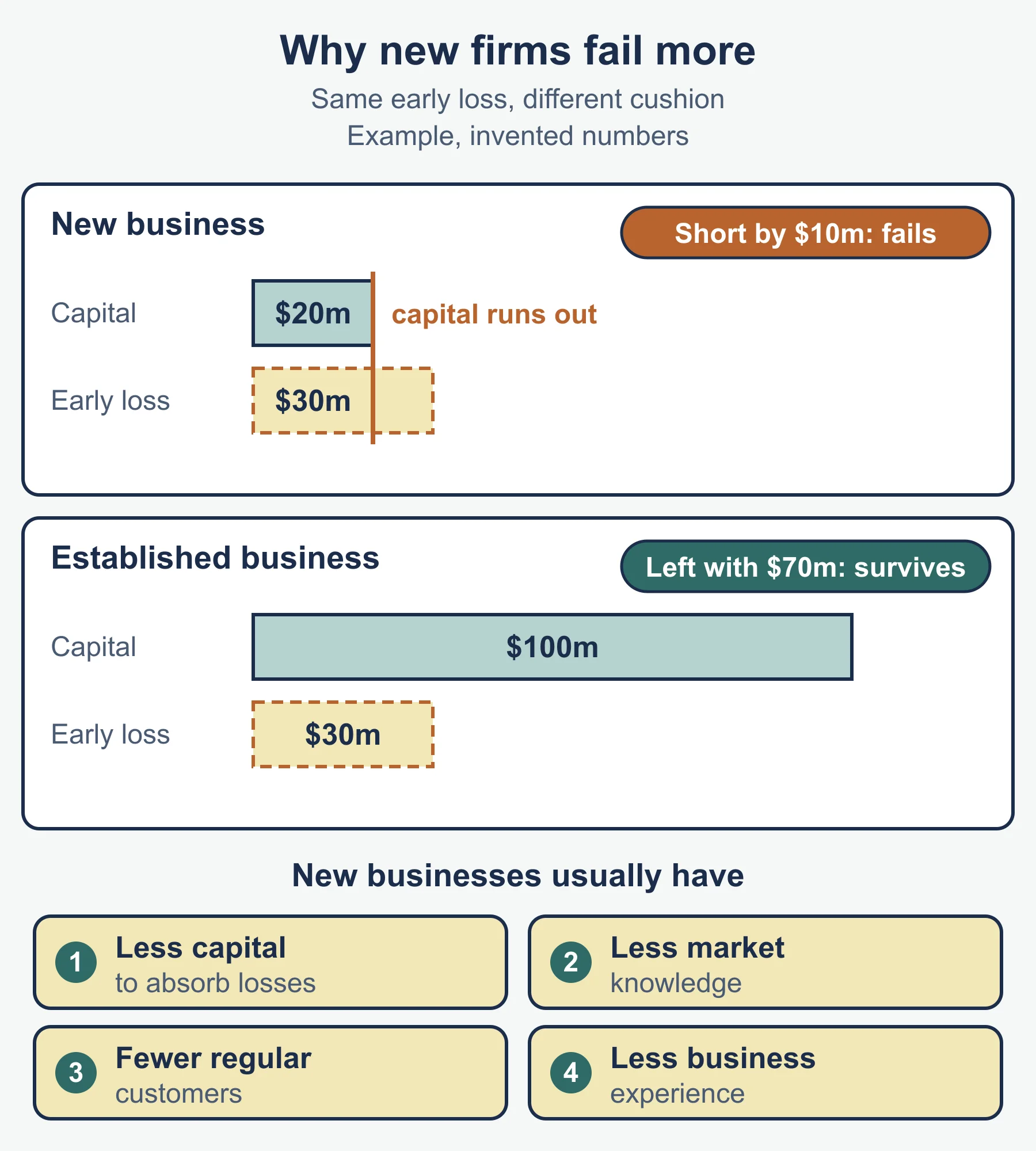
| Availability of finance | Funds cover start-up and early losses | Cash runs out |
| Suitability of product | Product fits customer needs | Customers do not want it |
| Demand for products | Demand is strong and steady | Demand falls |
| Changes in the economy | Incomes rise; costs are stable | Recession cuts spending |
| Level of competition | Few close rivals | Strong rivals cut prices or copy the product |
Worked example 5. Stainmore Joinery makes bespoke kitchens. Its owner won large orders but did not plan cash. Materials were paid for weeks before customers paid, so the firm could not pay a supplier and stopped trading. The factors are management skills (poor cash planning) and availability of finance. The product was suitable and demand was good, so failure was not caused by those.
Common errors
- Giving profit as a way to measure size.
- Listing business plan headings without saying what each one contains.
- Describing government support from the firm’s point of view when the question asks why the government wants it.
- Confusing a merger with a takeover, or horizontal with vertical integration.
- Giving only advantages when the question asks you to justify or consider.
Frequently asked questions
What are the characteristics of a successful entrepreneur? Common characteristics are risk-taking, innovation, determination and resilience, hard work, self-confidence and leadership, and good decision-making and organization. In an exam, name the trait and show it in the case.
How can business size be measured? Methods include the number of people employed, the value of output or sales, the volume of output or sales, and capital employed. Each has a limitation, so different methods can give different answers.
What is internal growth? Internal (organic) growth comes from the business’s own resources, such as new products, new markets or new outlets. The owner keeps control and growth is steady, but it is slow and needs finance.
Why do some businesses fail? Failure is linked to poor management skills, finance running out, a product customers do not want, falling demand, changes in the economy such as recession, and strong competition.
Official syllabus
Cambridge IGCSE Business 0264 syllabus for examination in 2027, 2028 and 2029, published by Cambridge University Press & Assessment (Cambridge International), section 1.3.
Get free revision emails (optional)
Occasional emails with practice questions, worked explanations and links to free resources for the qualification and subjects you choose. No spam, and you can unsubscribe from any email. The free tools on this site never need an email.
Related resources
-
Practice questions
IGCSE Business: Enterprise, business growth and size (Cambridge 0264) – Practice Questions
Twelve original practice questions with worked answers on Cambridge IGCSE Business 0264 section 1.3: enterprise, business plans, size and growth.
Business · Cambridge · IGCSE
Try questions -
Revision notes
IGCSE Business: Enterprise, business growth and size (Cambridge 0264) – Revision Notes
Revision notes for Cambridge IGCSE Business 0264 section 1.3: entrepreneurs, plans, business size, growth, small firms and failure, plus a self-test.
Business · Cambridge · IGCSE
Revise topic -
Study guides
IGCSE Business: Types of business organisation (Cambridge 0264)
Study guide to types of business organisation for Cambridge IGCSE Business 0264: ownership, liability, franchises, joint ventures and recommending a type.
Business · Cambridge · IGCSE
Read guide
Related articles
-
teaching
A Level tuition in Dubai: Cambridge or Pearson Edexcel International A Level?
Schools in Dubai and Abu Dhabi teach either Cambridge International AS & A Level or Pearson Edexcel International A Level. How the two are structured, why it matters for tuition, and how online classes from Lahore work.
9 October 2026
-
curriculum guides
Choosing subjects at IGCSE and A Level
How subject choices at 14 and 16 affect university options later, and how to keep pathways open without overloading a timetable.
28 July 2026
Studying this with a teacher
Working through Business IGCSE?
This page is free and stays free. If you would rather be taught it, Marlbridge runs Business classes one-to-one and in small groups of up to 15, online in your own time zone. The first trial class is free. WhatsApp replies within an hour (8am–11pm Pakistan time, every day); email the same day.
Cambridge Business teachers at Marlbridge

