
Study Guides
IGCSE Business: Types of business organisation (Cambridge 0264)
Study guide to types of business organisation for Cambridge IGCSE Business 0264: ownership, liability, franchises, joint ventures and recommending a type.
- Subject
- Business
- Level
- IGCSE
- Topic
- Understanding business activity
- Author
- Marlbridge Academic Team
- Updated
- Reviewed by
- Salman Ahmad (what this means)
Aligned to Cambridge IGCSE Business (0264), For examination in 2027, 2028 and 2029. Official specification .
Syllabus page (what it covers and how it is assessed): Cambridge IGCSE Business.
Syllabus points this page covers
0264
- 1.4 Types of business organisation
Found an error? Report a correction.
Need help with this topic? Request a free trial class for IGCSE Business (0450 / 0264).
This guide covers section 1.4 (Types of business organisation, 1.4.1) of the Cambridge IGCSE Business 0264 syllabus for examination in 2027, 2028 and 2029. All candidates take the same two papers, Paper 1 (Short Answer and Data Response) and Paper 2 (Case Study), and both papers are based on all the subject content. So expect this topic in stimulus material and case studies, not only as recall. Use the course hub and the printable checklist to track progress, then use the revision notes and the practice questions to test yourself. To find weak spots first, try the free diagnostics.
Money figures are in dollars ($). All businesses and people are invented.
What you must be able to do
| Syllabus point (1.4.1) | What it means for you |
|---|---|
| Sole traders, partnerships, private limited companies and public limited companies | Describe each type, who owns it and who is liable for its debts |
| Advantages and disadvantages of different types | Weigh up each type, with reasons that fit the business in the question |
| Recommend and justify a suitable type for a given situation | Choose a type, support the choice with evidence from the case and say why you rejected the others |
| Franchises, joint ventures, social enterprises | Define each and explain how it differs from the four main types |
| Advantages and disadvantages of franchises for the franchisor and franchisee | Give both sides, from each party’s point of view |
| Advantages and disadvantages of joint ventures | Give benefits and drawbacks for the businesses involved |
Ownership and liability: the key ideas
Each type of organisation answers three questions. Who owns it? Who is responsible for its debts? How can it raise money?
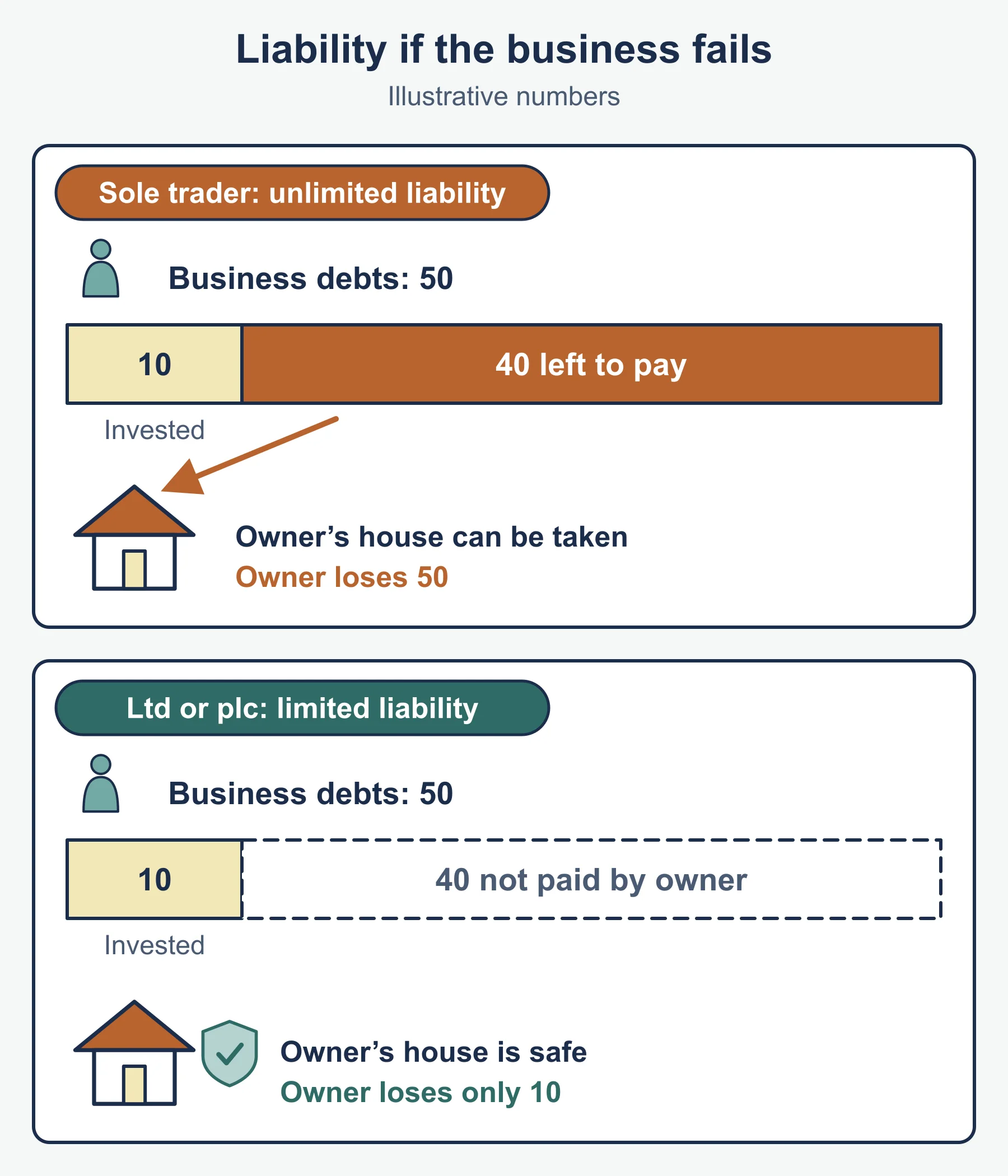
Liability means legal responsibility for the debts of the business. With unlimited liability the owner can be forced to pay business debts from personal assets such as savings or a house. With limited liability an owner can lose only the money they put into the business. Creditors cannot claim the owner’s other property.
A company is treated in law as separate from its owners. A sole trader or partnership is not.
Sole traders
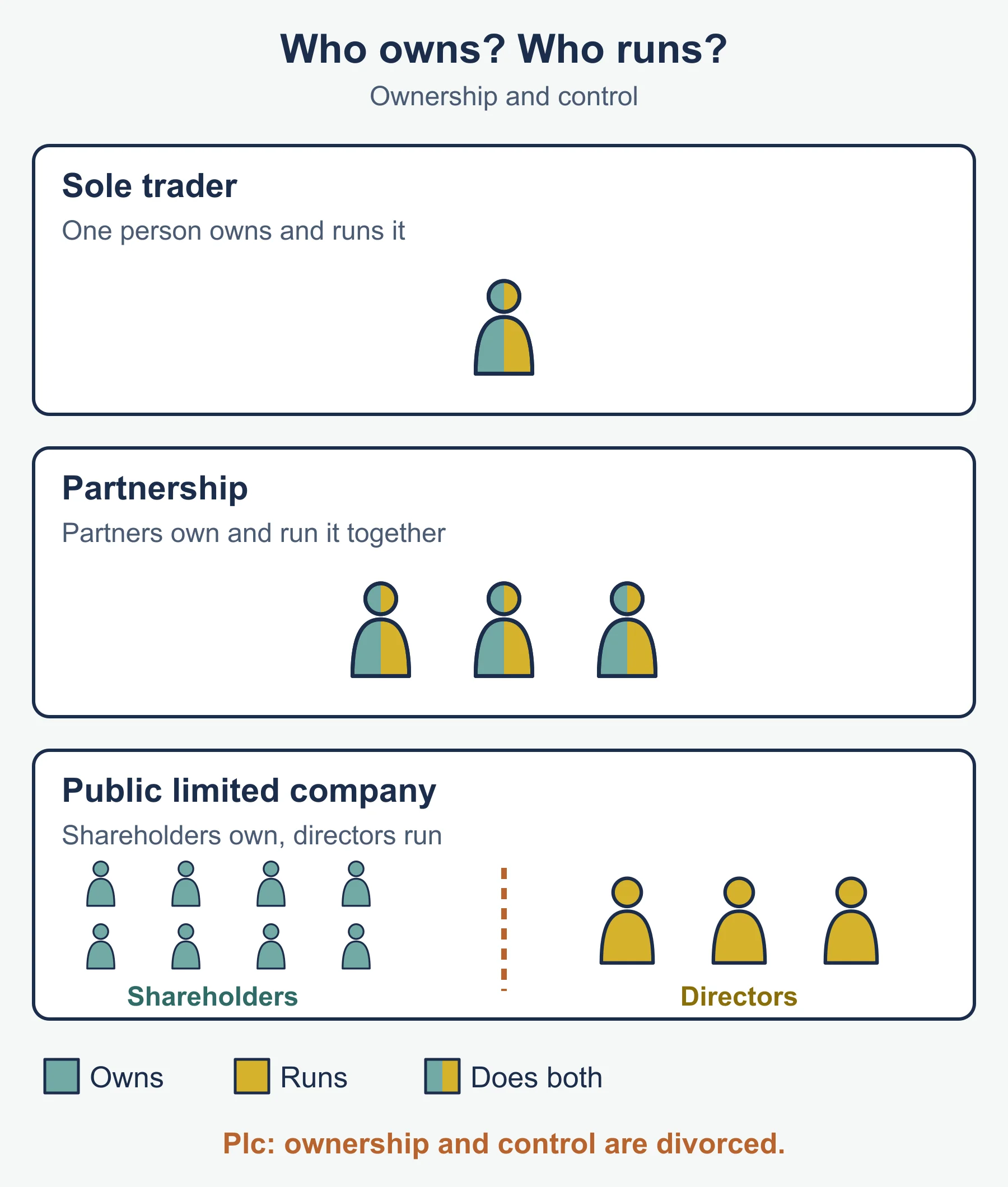
A sole trader is a business owned and usually controlled by one person. The owner may employ staff.
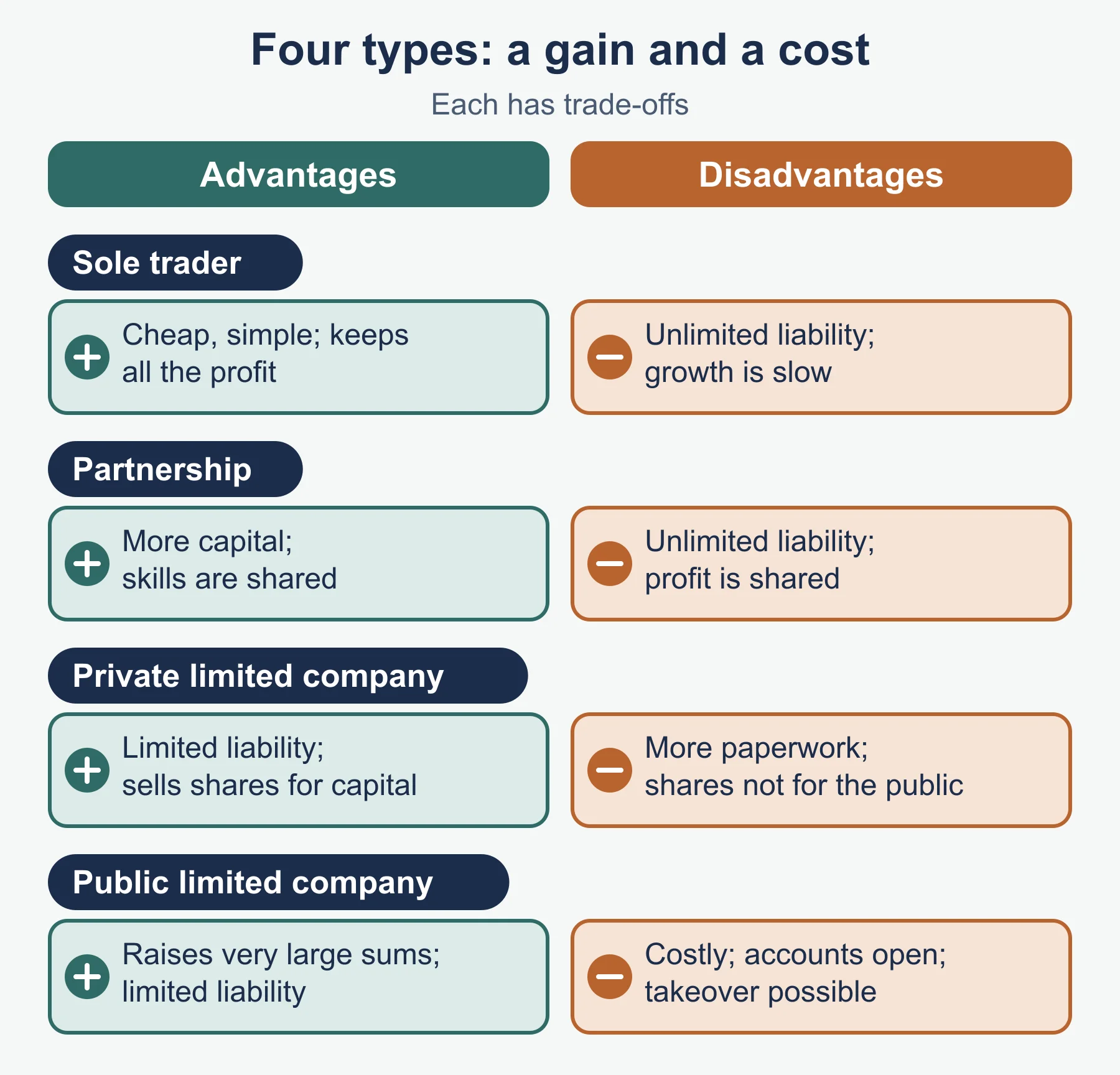
Advantages
- Easy and cheap to set up, with few legal formalities.
- The owner keeps all the profit, takes decisions quickly and has complete control.
Disadvantages
- Unlimited liability.
- Finance is limited to personal savings, profit kept in the business and loans, so growth is slow.
- The owner may work long hours, and illness can stop the business.
Worked example: unlimited versus limited liability
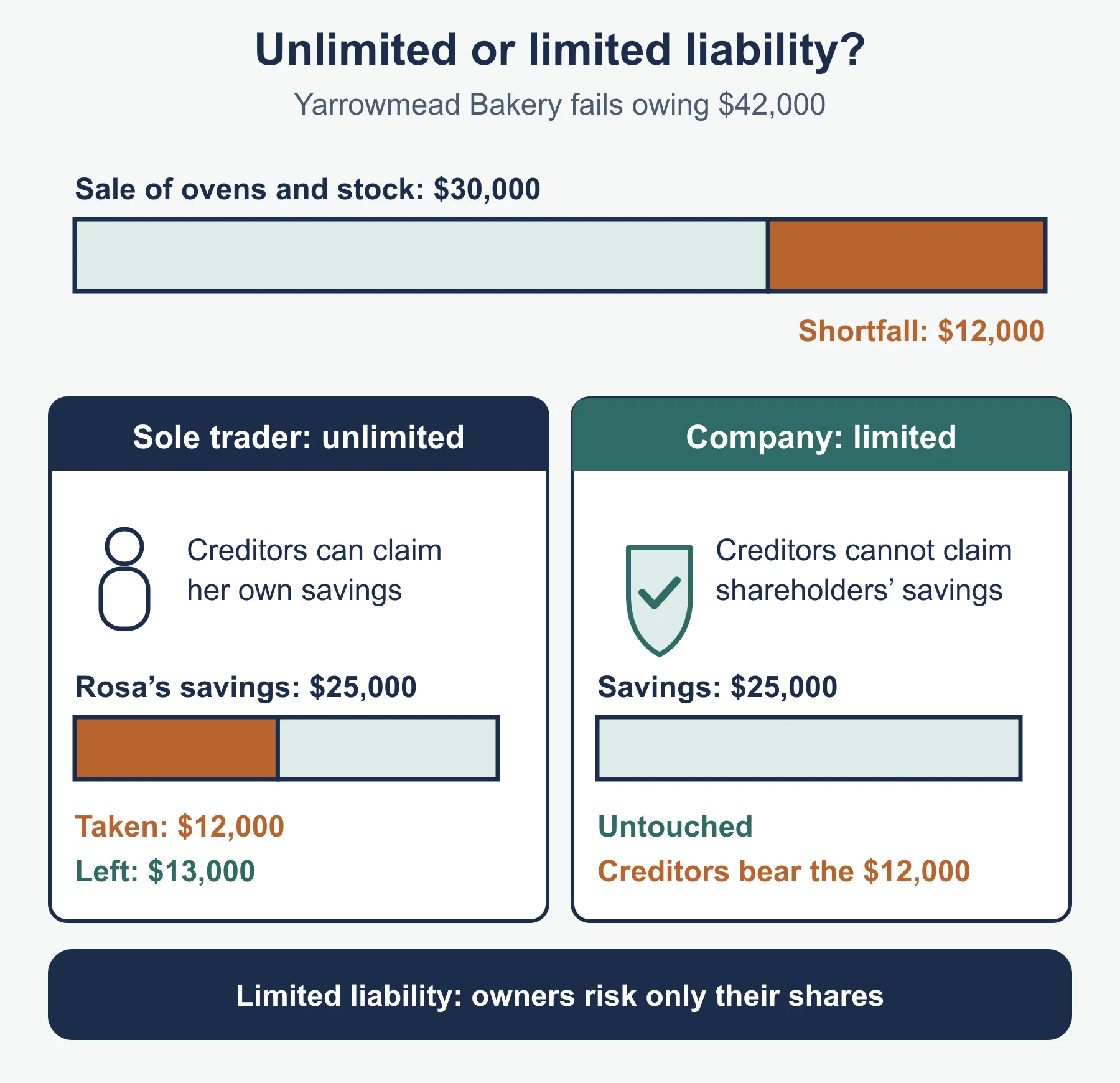
Yarrowmead Bakery is run by Rosa Danvers as a sole trader. The business fails owing 42,000 to suppliers and the bank. Selling its ovens and stock raises 30,000.
- Shortfall = 42,000 - 30,000 = 12,000.
- Rosa has unlimited liability, so creditors can claim 12,000 from her personal assets. If she has 25,000 of savings, she is left with 13,000.
- If Yarrowmead had been a limited company with the same figures, the shareholders would lose the value of their shares, but creditors could not claim the shareholders’ personal savings. The creditors would bear the unpaid 12,000.
The comparison shows why limited liability encourages people to invest, and why lenders may be cautious about lending to a limited company.
Partnerships
A partnership is a business owned by two or more people who agree to share the risks, work and profit. Partners normally sign a written partnership agreement covering the sharing of profit, the money each puts in, and how decisions and disputes are handled. Treat partners as having unlimited liability unless the question says otherwise.
Advantages
- More capital than a sole trader, because each partner contributes.
- Skills and workload are shared.
- More than one person to take decisions and cover absence.
Disadvantages
- Unlimited liability, and each partner can be affected by decisions made by the others.
- Profits must be shared.
- Disagreements can slow decisions or end the partnership.
Worked example: sharing profit
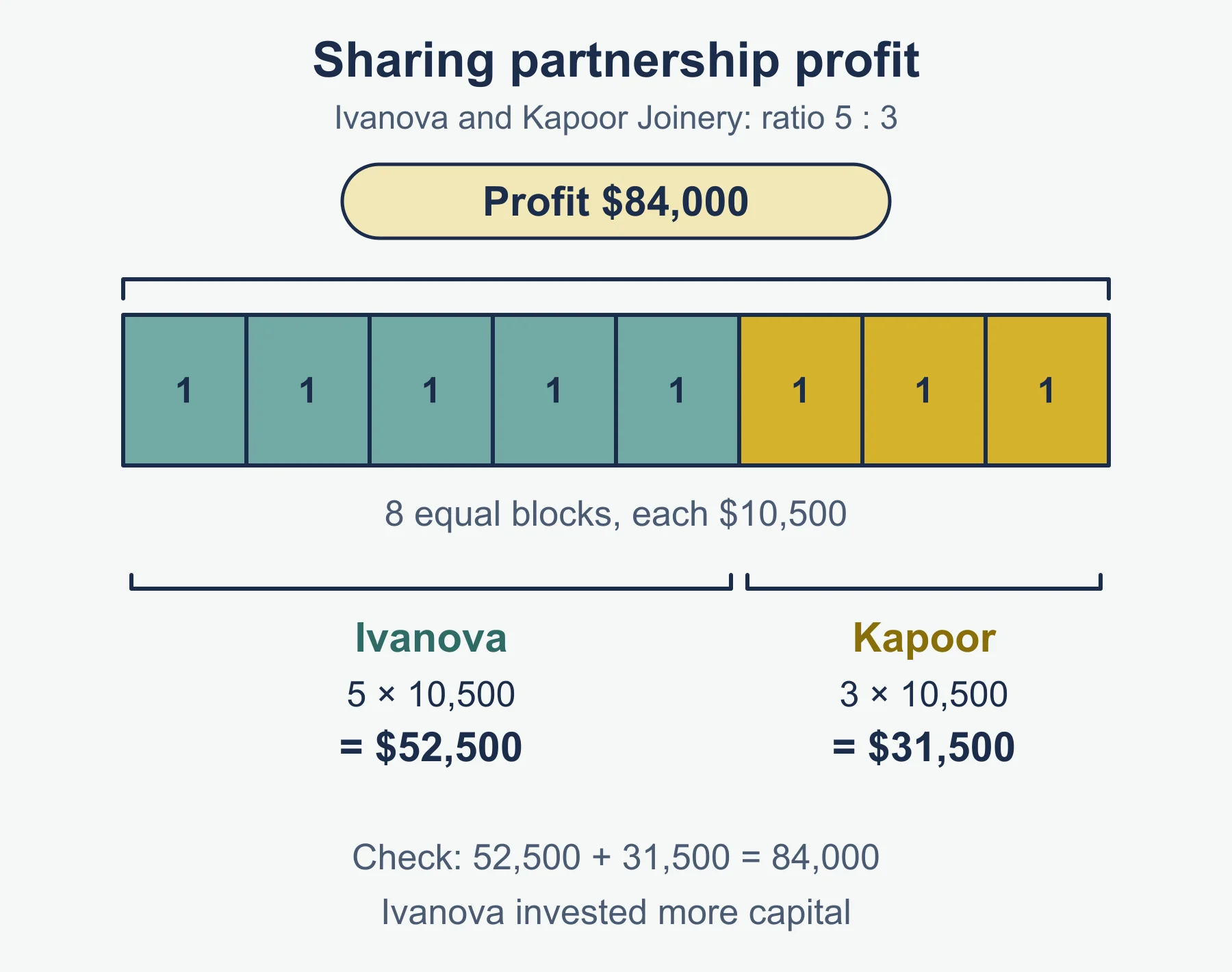
Ivanova and Kapoor Joinery made a profit of 84,000. The agreement shares profit in the ratio 5:3, because Ivanova invested more capital.
- Total shares = 5 + 3 = 8.
- Ivanova = 5/8 x 84,000 = 52,500.
- Kapoor = 3/8 x 84,000 = 31,500.
- Check: 52,500 + 31,500 = 84,000.
Private limited companies
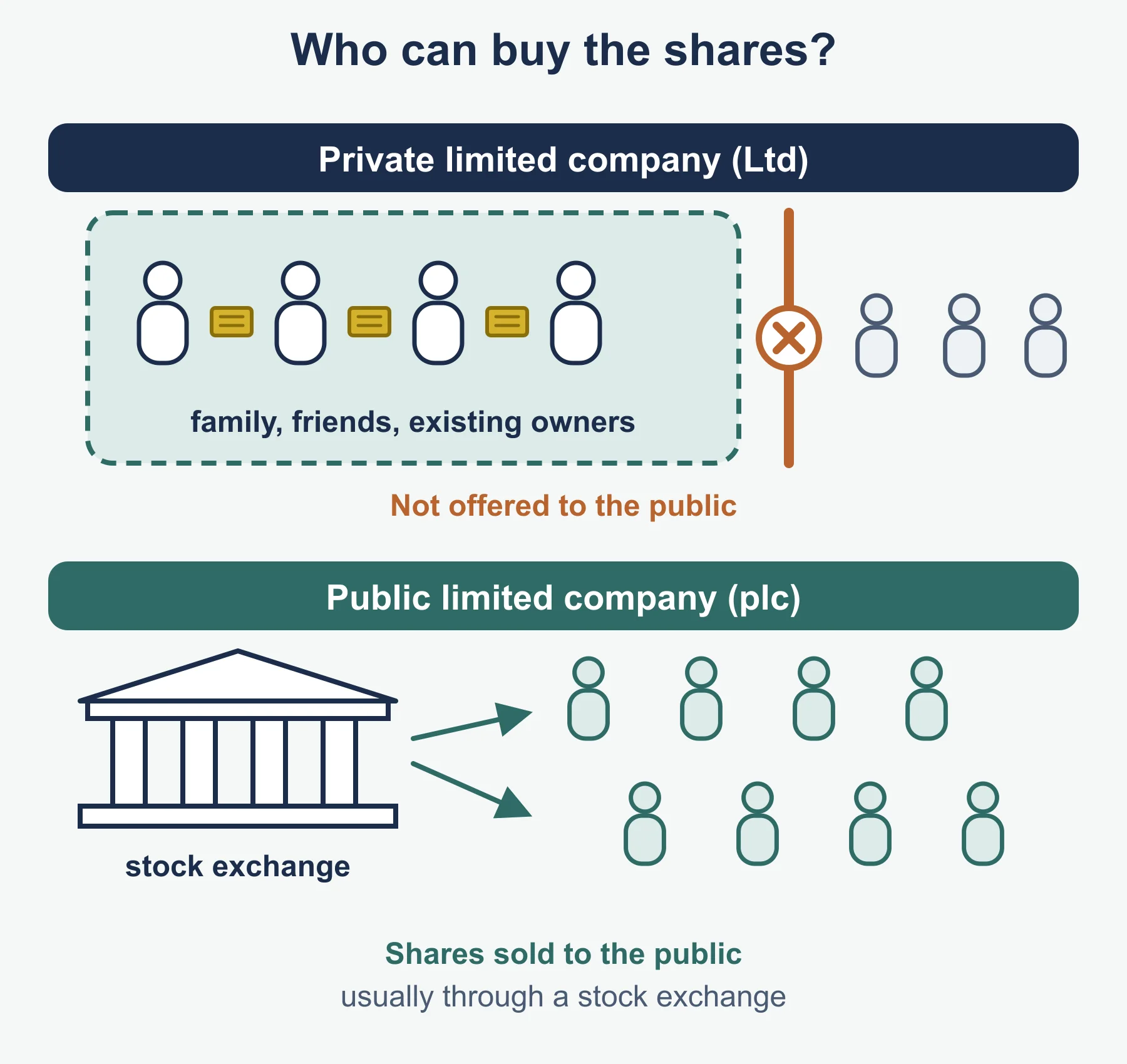
A private limited company (Ltd) is owned by shareholders, who hold shares in it. Its shares cannot be offered to the general public. They are normally sold privately, often to family, friends or existing owners, and usually only with the agreement of the other shareholders. Shareholders have limited liability. Profit paid out to shareholders is called a dividend.
Advantages
- Limited liability.
- Can raise more capital than a partnership by selling shares.
- The company continues when a shareholder leaves.
Disadvantages
- More legal paperwork and cost to set up and run.
- Shares cannot be sold to the public, so there is a ceiling on funds raised.
- Selling shares to new investors can reduce the founders’ share of control.
- Some financial information usually has to be made available, so there is less privacy than for a sole trader.
Worked example: control and new shares
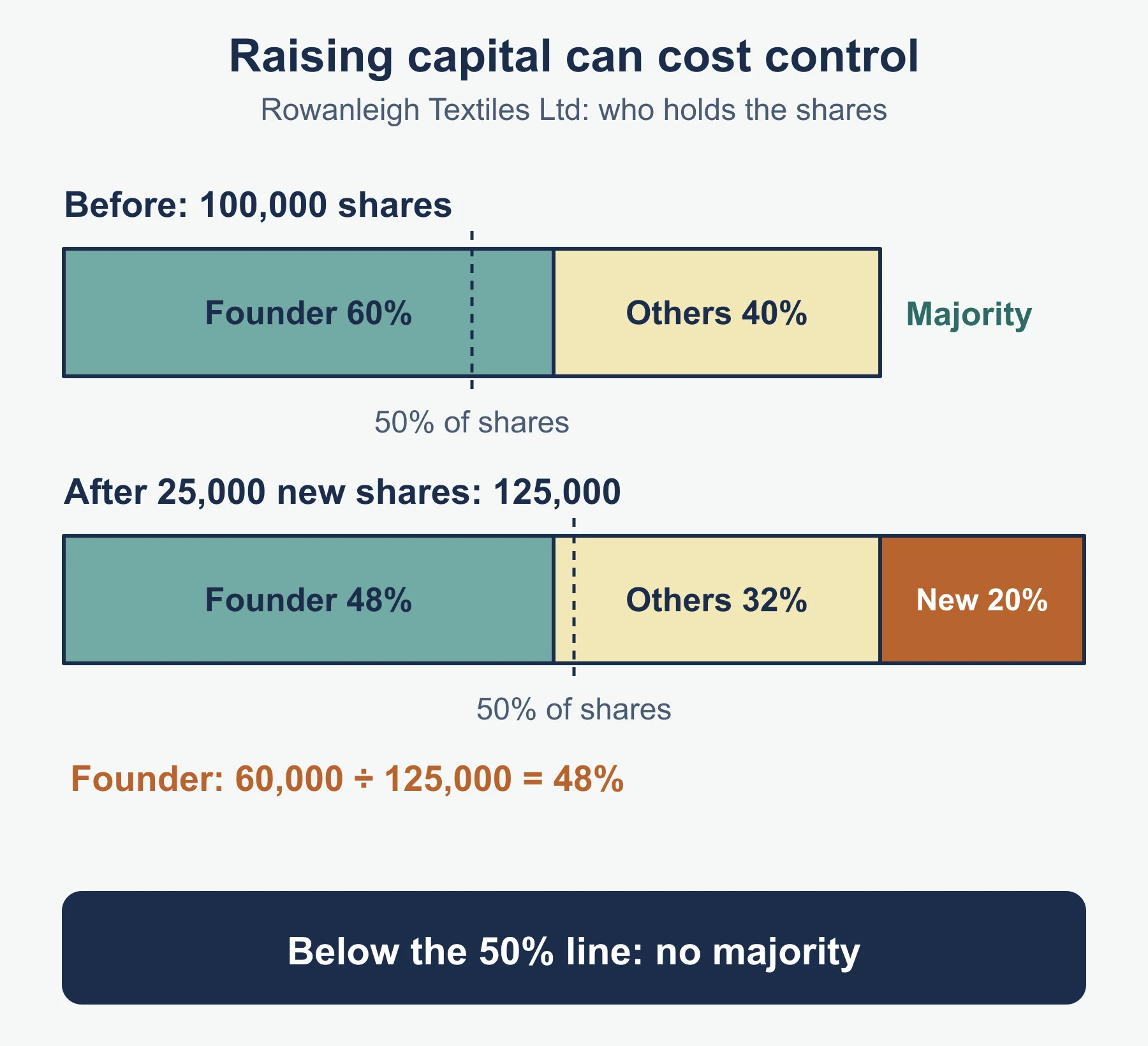
Rowanleigh Textiles Ltd has 100,000 shares. The founder holds 60,000.
- Founder’s share = 60,000/100,000 = 60%, so she has a majority.
- The company sells 25,000 new shares to an outside investor to raise capital.
- Total shares = 125,000. Founder’s share = 60,000/125,000 = 48%.
- She no longer holds a majority. Raising capital has cost her some control.
Public limited companies
A public limited company (plc) can sell shares to the general public, usually through a stock exchange. Shareholders have limited liability, and a plc is often large, though size alone does not define it.
Advantages
- Can raise very large sums by selling shares to many investors, and has limited liability.
- Easier to borrow from banks.
- Shares can be bought and sold freely, which attracts investors.
Disadvantages
- Setting up and running costs are high, and accounts are widely available to competitors.
- Ownership is spread out, which can make a takeover possible.
- Managers may focus on short-term results to please shareholders.
Worked example: dividends and control
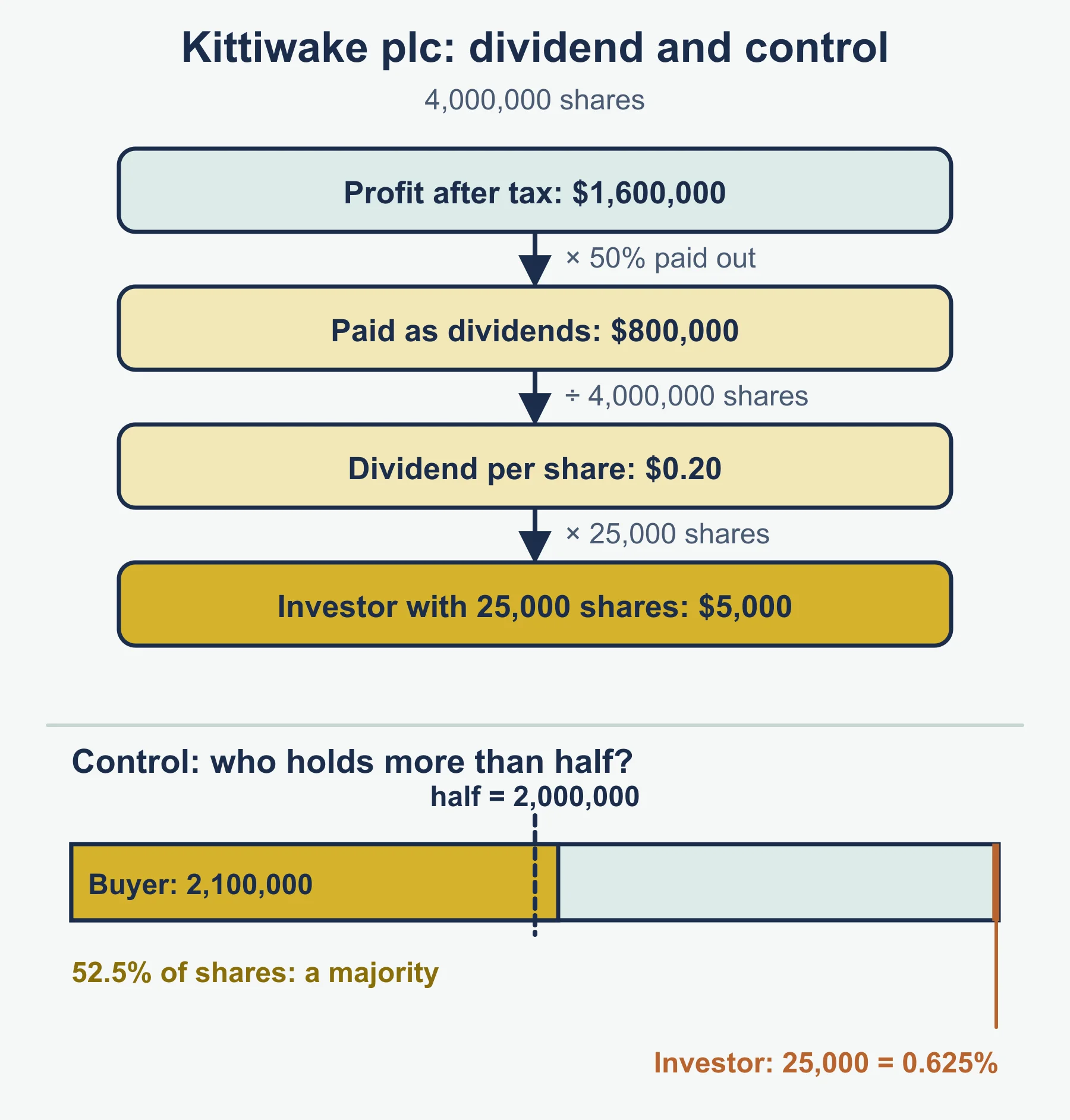
Kittiwake Freight plc has 4,000,000 shares. Profit after tax is 1,600,000 and the directors decide to pay out half as dividends.
- Total dividend = 50% x 1,600,000 = 800,000.
- Dividend per share = 800,000/4,000,000 = 0.20 (20 cents).
- An investor with 25,000 shares receives 25,000 x 0.20 = 5,000, and owns 25,000/4,000,000 = 0.625% of the company.
- A buyer needs more than 2,000,000 shares to hold a majority. Holding 2,100,000 shares would give 52.5%.
Comparing the four main types
| Feature | Sole trader | Partnership | Private limited company | Public limited company |
|---|---|---|---|---|
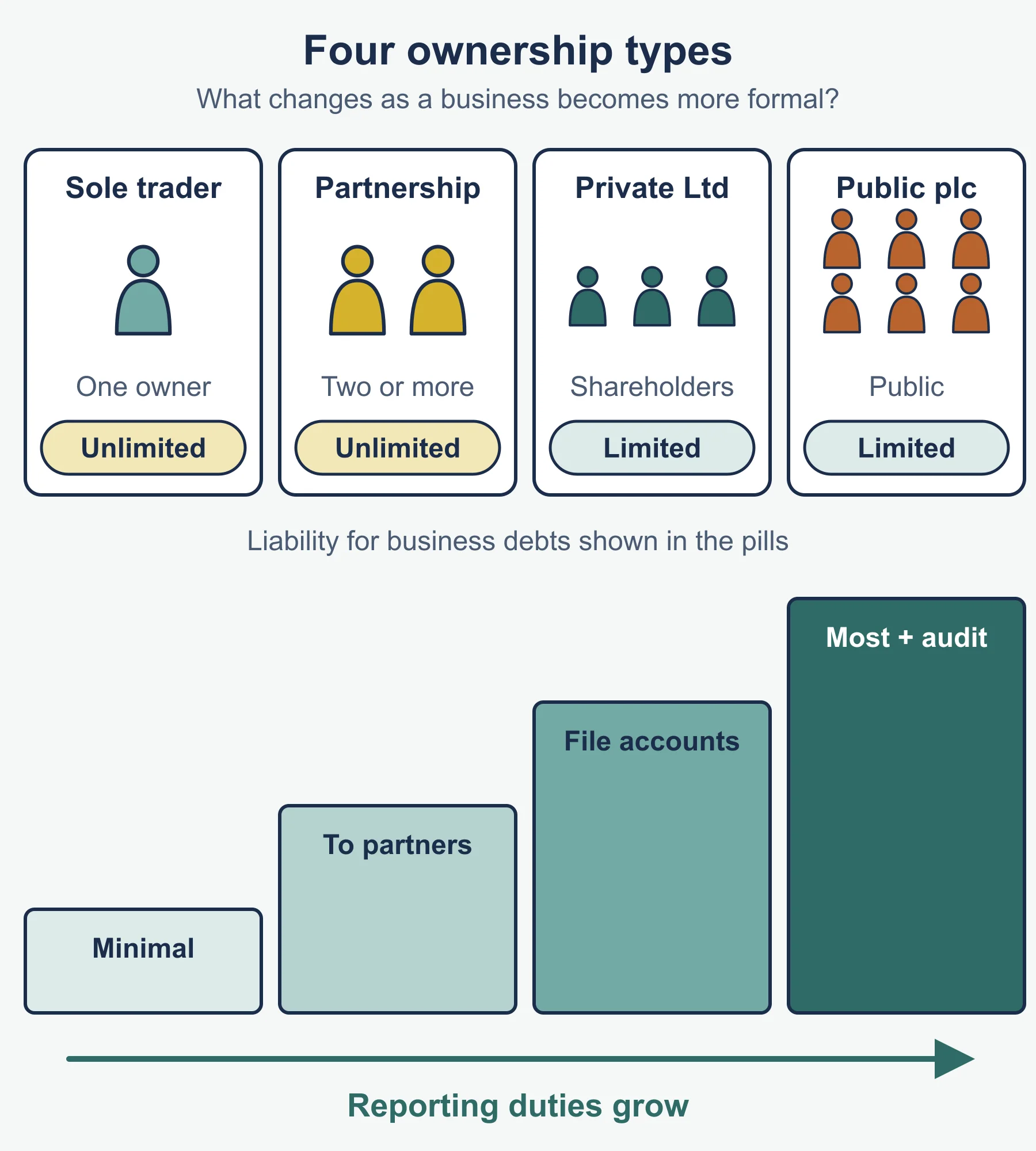
| Owners | One person | Two or more | Shareholders | Shareholders |
| Liability | Unlimited | Unlimited (usual position) | Limited | Limited |
| Share sale | Not applicable | Not applicable | Not to the public | To the public |
| Ability to raise capital | Low | Low to medium | Medium | High |
| Control | One person | Shared | Shareholders, often founders | Shareholders, often widely spread |
| Setup and running | Simple | Fairly simple | More formal | Most formal |
Franchises
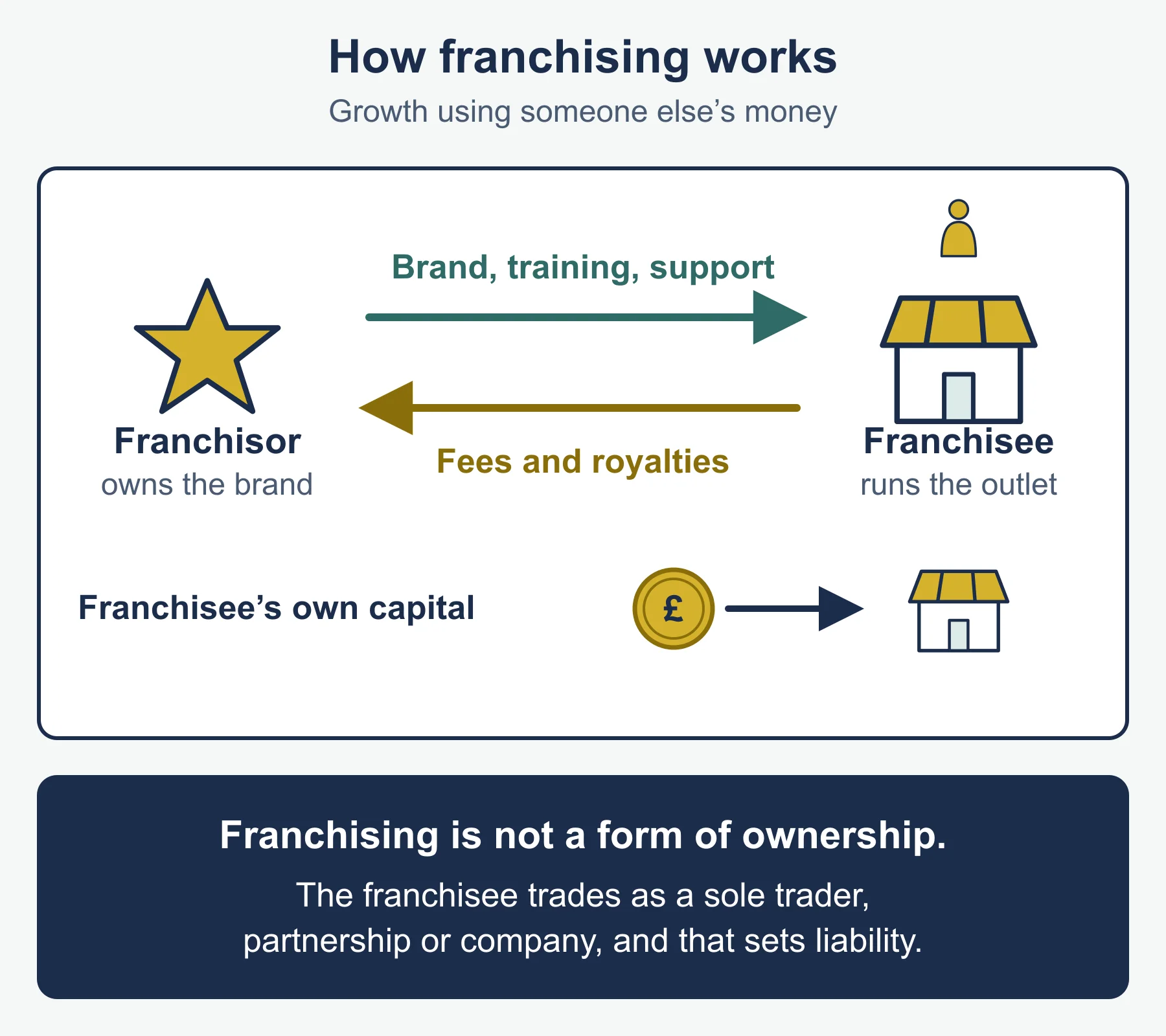
A franchise is an agreement where a business with a successful brand and product (the franchisor) gives another business or person (the franchisee) the right to use its name, products and methods in return for payment. Payment is usually an initial fee plus a regular royalty, often a percentage of sales. The franchisee runs the outlet as a separate business.
For the franchisor
- Advantages: expansion without investing its own capital, since the franchisee supplies most of the money; a motivated local owner-manager; income from fees and royalties.
- Disadvantages: it gives up some of the profit to the franchisee; the brand can be damaged if one franchisee offers poor quality; it has less direct control than with its own outlets.
For the franchisee
- Advantages: an established brand and product with proven demand; training and support; lower risk of failure than a new brand.
- Disadvantages: the franchisee pays the initial fee and continuing royalties; must follow the franchisor’s rules and cannot easily change products; poor performance by other franchisees may harm the brand.
Worked example: a franchise
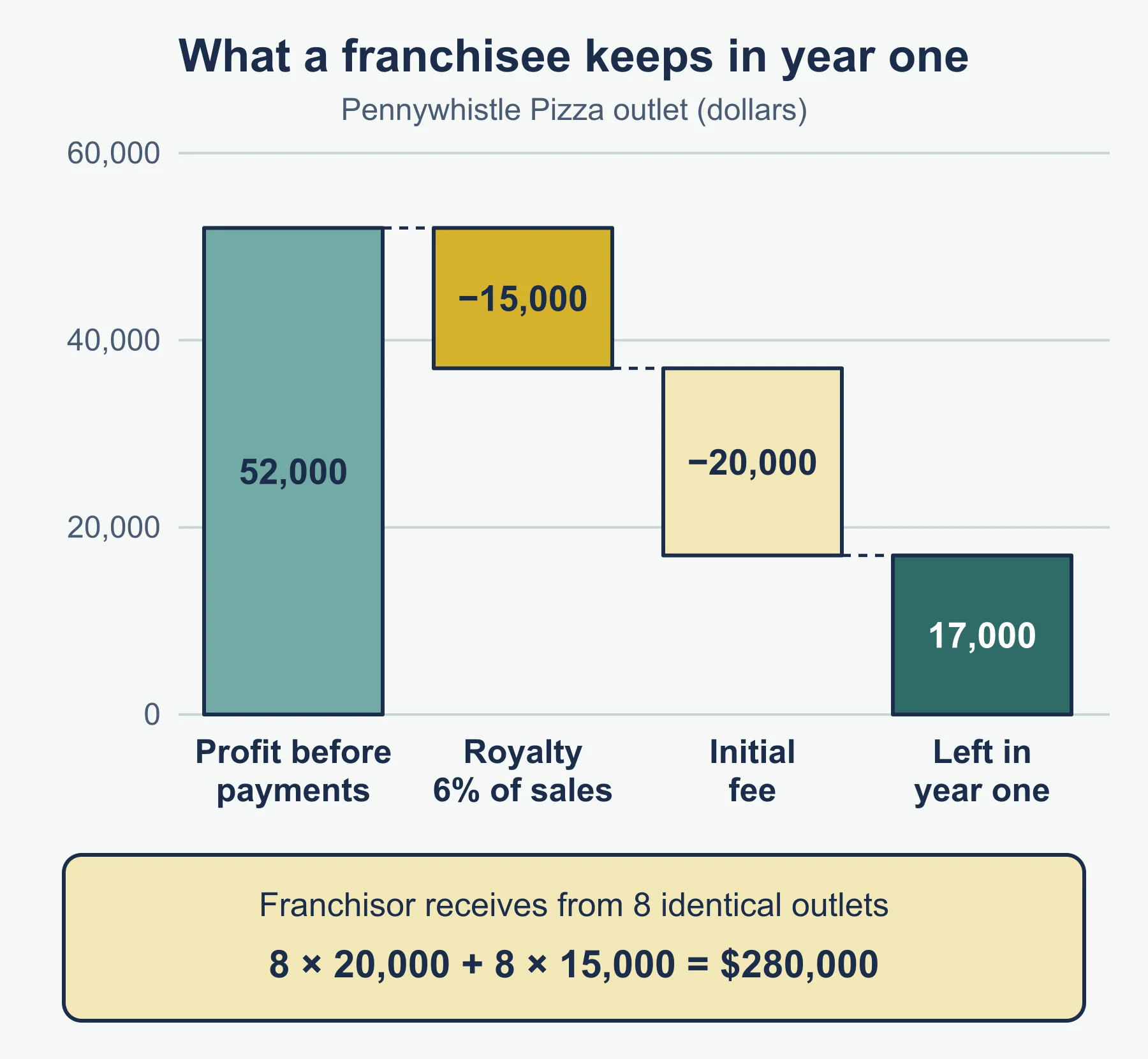
Pennywhistle Pizza charges an initial fee of 20,000 and a royalty of 6% of sales. One outlet sells 250,000 in its first year and earns 52,000 operating profit before paying the franchisor.
- Royalty = 6% x 250,000 = 15,000.
- Profit after royalty = 52,000 - 15,000 = 37,000.
- After also paying the initial fee, the franchisee is left with 37,000 - 20,000 = 17,000 in year one.
- If eight franchisees are identical, the franchisor receives 8 x 20,000 + 8 x 15,000 = 160,000 + 120,000 = 280,000 in year one.
Joint ventures
A joint venture is when two or more businesses cooperate on a project or in a market, sharing costs, risks and rewards, while staying separate businesses.
Advantages
- Costs and risks are shared.
- Each partner brings skills, contacts or local knowledge.
- Can open a new market, especially abroad, faster than going alone.
Disadvantages
- Profits must be shared.
- The businesses may disagree on aims, management or how to divide work.
- Decisions may be slower because both sides must agree.
Worked example: sharing a joint venture
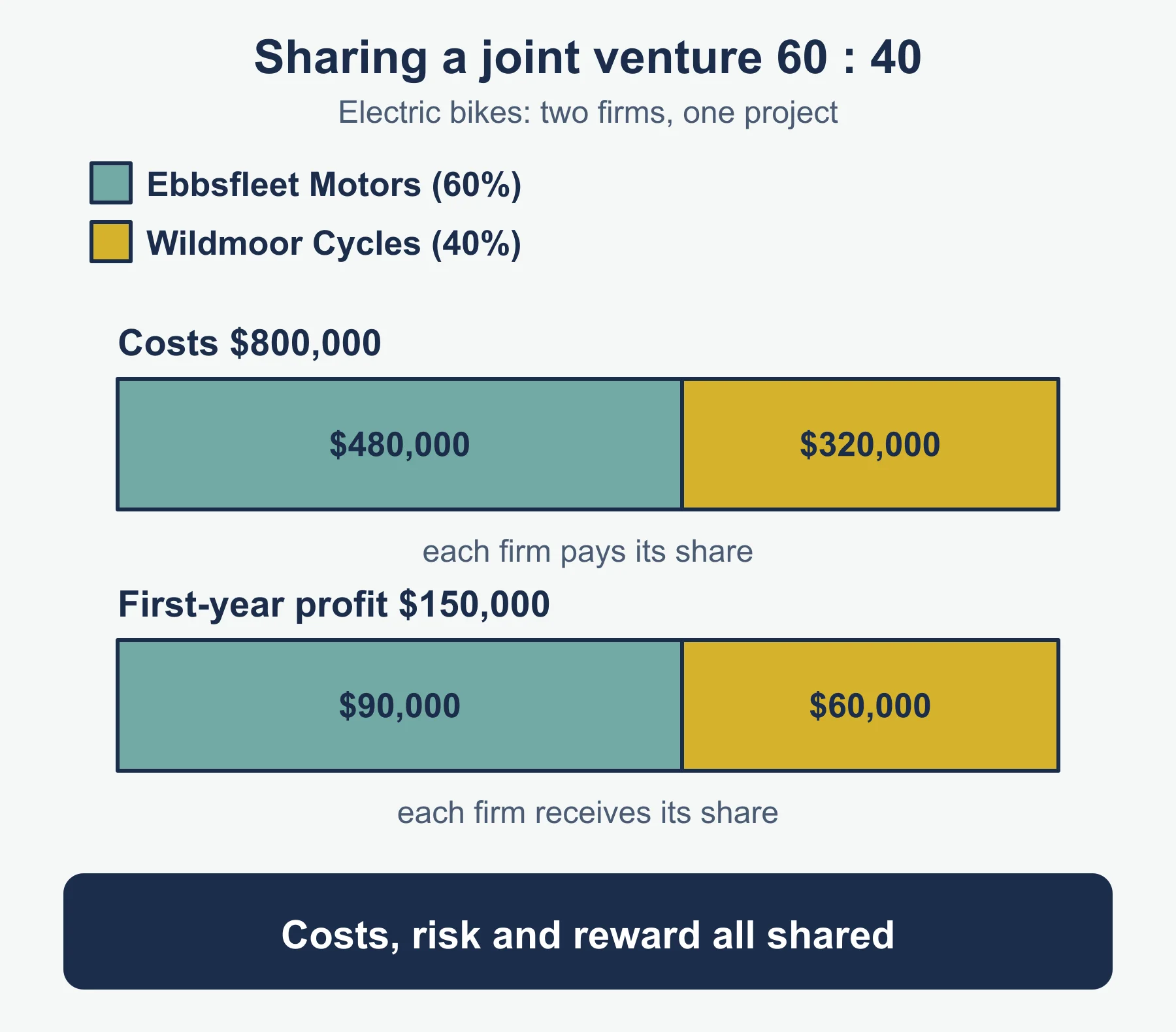
Ebbsfleet Motors and Wildmoor Cycles set up a joint venture to make electric bikes. Costs are 800,000, shared 60:40, and the first-year profit is 150,000, shared in the same ratio.
- Ebbsfleet pays 60% x 800,000 = 480,000 and receives 60% x 150,000 = 90,000.
- Wildmoor pays 40% x 800,000 = 320,000 and receives 40% x 150,000 = 60,000.
Social enterprises
A social enterprise is a business that trades to achieve social or environmental aims. Any profit is mainly reinvested in those aims rather than paid out to owners. It still has to cover its costs, so it needs sales revenue.
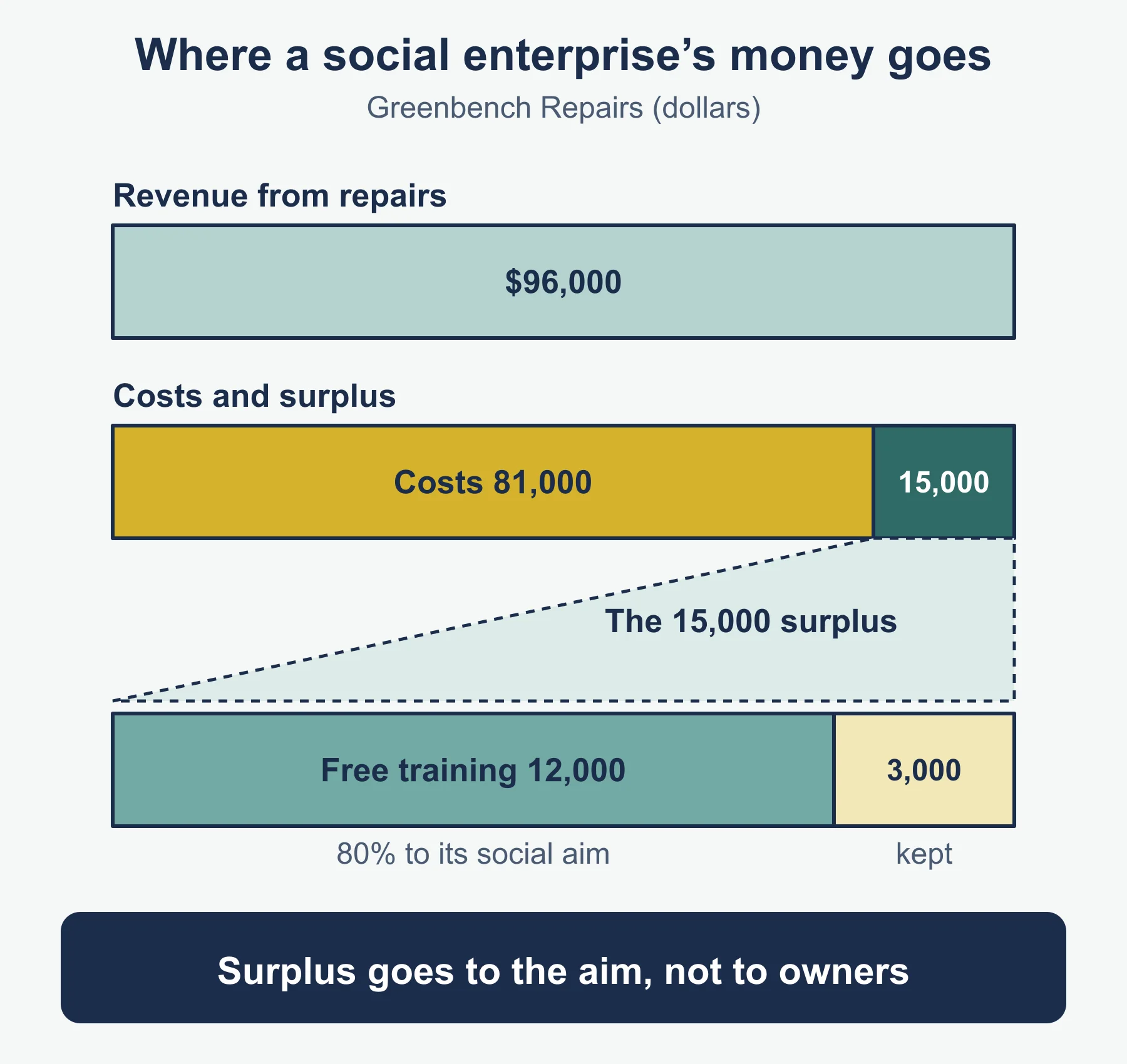
Greenbench Repairs earns 96,000 from repair services, has costs of 81,000, and uses 80% of the surplus to fund free training for unemployed people.
- Surplus = 96,000 - 81,000 = 15,000.
- Training fund = 80% x 15,000 = 12,000.
- Retained = 15,000 - 12,000 = 3,000.
Benefits include customer goodwill and a purpose that can motivate staff. Drawbacks include less money for growth, and difficulty raising finance from investors who want a return.
Recommend and justify a suitable type
Use these steps on case-study questions.
- Pull out the facts: size, finance needed, risk, who wants control, growth plans.
- Match each fact to a type. A need for large capital points toward a company. A wish to keep full control and keep things simple points to a sole trader.
- Make your recommendation clear.
- Justify it with two or three reasons from the case.
- Say why another type is less suitable, then give a short judgement.
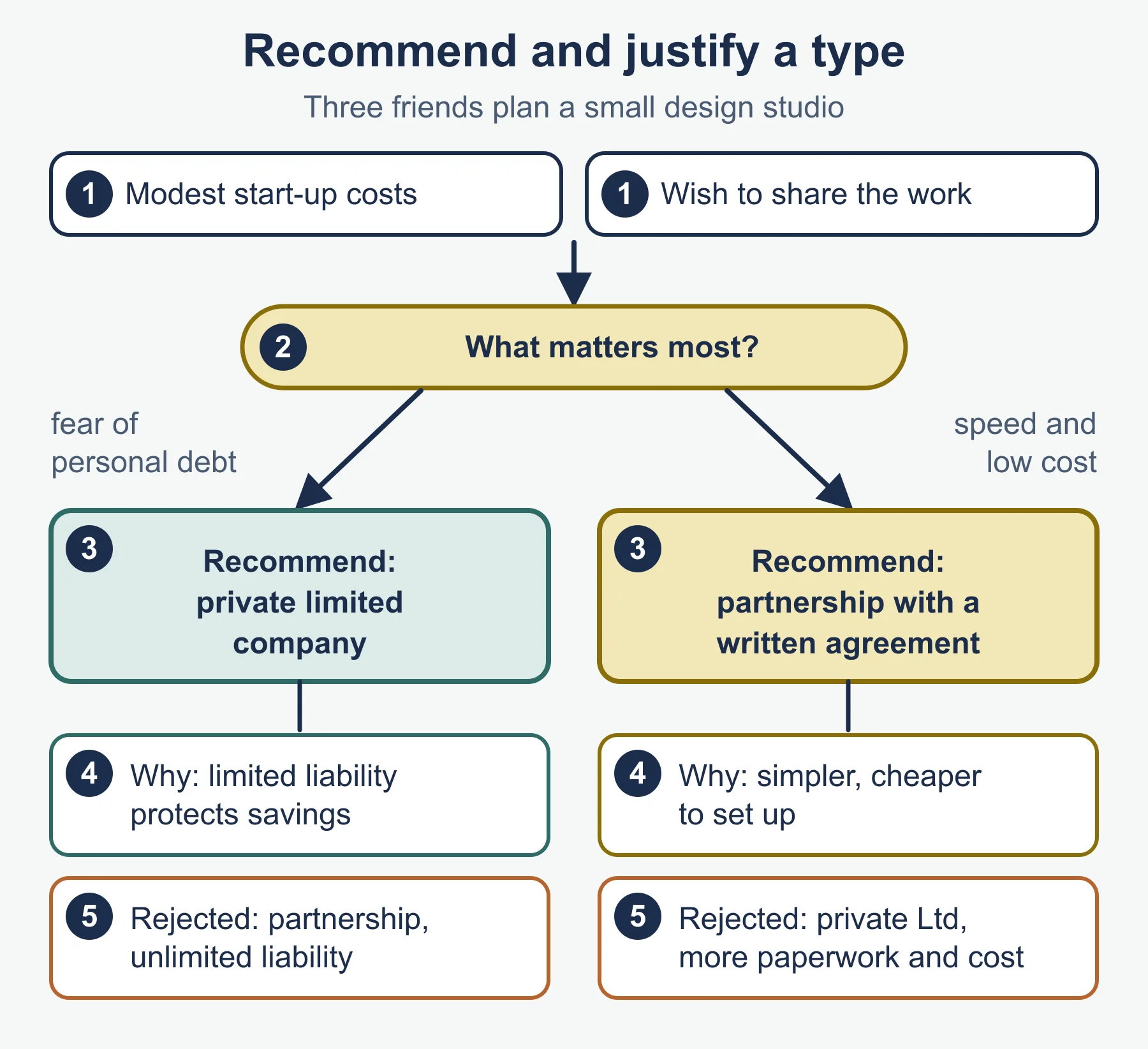
Example: three friends plan a small design studio with modest start-up costs and a wish to share the work. A partnership or private limited company fits. If they fear personal debt, the private limited company is better. If speed and low cost matter most, a partnership with a written agreement may be preferable.
Common errors
- Writing that a limited company “cannot fail”. It can; the owners lose only their investment.
- Confusing private and public limited companies by saying private companies are owned by the government.
- Listing generic points with no reference to the business in the case.
- Treating a franchisee as an employee of the franchisor, when it owns its outlet.
- Giving only one party’s view when the question asks about both franchisor and franchisee.
Frequently asked questions
What is the difference between limited and unlimited liability? With unlimited liability the owner can be forced to pay business debts from personal assets such as savings or a house. With limited liability an owner can lose only the money they put into the business.
Which types of business organisation have unlimited liability? Sole traders and partners in an ordinary partnership have unlimited liability. Shareholders in private and public limited companies have limited liability, because a company is separate from its owners in law.
How is partnership profit shared? Profit is shared according to the partnership agreement, often in a ratio linked to the capital each partner put in. Add the ratio parts, divide the profit by that total and multiply by each partner’s share.
Why can selling shares reduce the founder’s control of a company? New shares increase the total number of shares, so the founder’s holding becomes a smaller percentage. A founder who held a majority can lose it once enough new shares are sold to outside investors.
What must a Cambridge IGCSE Business 0264 answer on business types include? Section 1.4 asks you to recommend and justify a suitable type for a given situation, so support your choice with evidence from the case and say why you rejected the other types.
Official syllabus
This page is aligned to the Cambridge IGCSE Business 0264 syllabus for examination in 2027, 2028 and 2029, published by Cambridge University Press & Assessment (Cambridge International Education), section 1.4 Types of business organisation.
Get free revision emails (optional)
Occasional emails with practice questions, worked explanations and links to free resources for the qualification and subjects you choose. No spam, and you can unsubscribe from any email. The free tools on this site never need an email.
Related resources
-
Practice questions
IGCSE Business: Types of business organisation (Cambridge 0264) – Practice Questions
Original practice questions with worked answers on types of business organisation for Cambridge IGCSE Business 0264, with short-answer and case items.
Business · Cambridge · IGCSE
Try questions -
Revision notes
IGCSE Business: Types of business organisation (Cambridge 0264) – Revision Notes
Revision notes on types of business organisation for Cambridge IGCSE Business 0264: definitions, comparison tables, a self-test and common mistakes.
Business · Cambridge · IGCSE
Revise topic -
Study guides
IGCSE Business: Business activity and Economic sectors (Cambridge 0264)
Study guide to factors of production, added value, opportunity cost and the economic sectors for Cambridge IGCSE Business 0264, with worked examples.
Business · Cambridge · IGCSE
Read guide
Related articles
-
teaching
A Level tuition in Dubai: Cambridge or Pearson Edexcel International A Level?
Schools in Dubai and Abu Dhabi teach either Cambridge International AS & A Level or Pearson Edexcel International A Level. How the two are structured, why it matters for tuition, and how online classes from Lahore work.
9 October 2026
-
curriculum guides
Choosing subjects at IGCSE and A Level
How subject choices at 14 and 16 affect university options later, and how to keep pathways open without overloading a timetable.
28 July 2026
Studying this with a teacher
Working through Business IGCSE?
This page is free and stays free. If you would rather be taught it, Marlbridge runs Business classes one-to-one and in small groups of up to 15, online in your own time zone. The first trial class is free. WhatsApp replies within an hour (8am–11pm Pakistan time, every day); email the same day.
Cambridge Business teachers at Marlbridge

