
Revision Notes
IGCSE Business: Types of business organisation (Cambridge 0264) – Revision Notes
Revision notes on types of business organisation for Cambridge IGCSE Business 0264: definitions, comparison tables, a self-test and common mistakes.
- Subject
- Business
- Level
- IGCSE
- Topic
- Understanding business activity
- Author
- Marlbridge Academic Team
- Updated
- Reviewed by
- Salman Ahmad (what this means)
Aligned to Cambridge IGCSE Business (0264), For examination in 2027, 2028 and 2029. Official specification .
Syllabus page (what it covers and how it is assessed): Cambridge IGCSE Business.
Syllabus points this page covers
0264
- 1.4 Types of business organisation
Found an error? Report a correction.
Need help with this topic? Request a free trial class for IGCSE Business (0450 / 0264).
These notes condense section 1.4 (Types of business organisation) of the Cambridge IGCSE Business 0264 syllabus for examination in 2027, 2028 and 2029. For full explanations and worked examples, read the study guide. Test yourself with the practice questions, tick off topics on the printable checklist, and see the course hub for the rest of the syllabus. If you are unsure where you stand, take a free diagnostic first.
All candidates take Paper 1 (Short Answer and Data Response) and Paper 2 (Case Study). Both are based on all the subject content, so this topic can appear in either. Money figures are in dollars ($) and all businesses are invented.
Key definitions
| Term | Meaning |
|---|---|
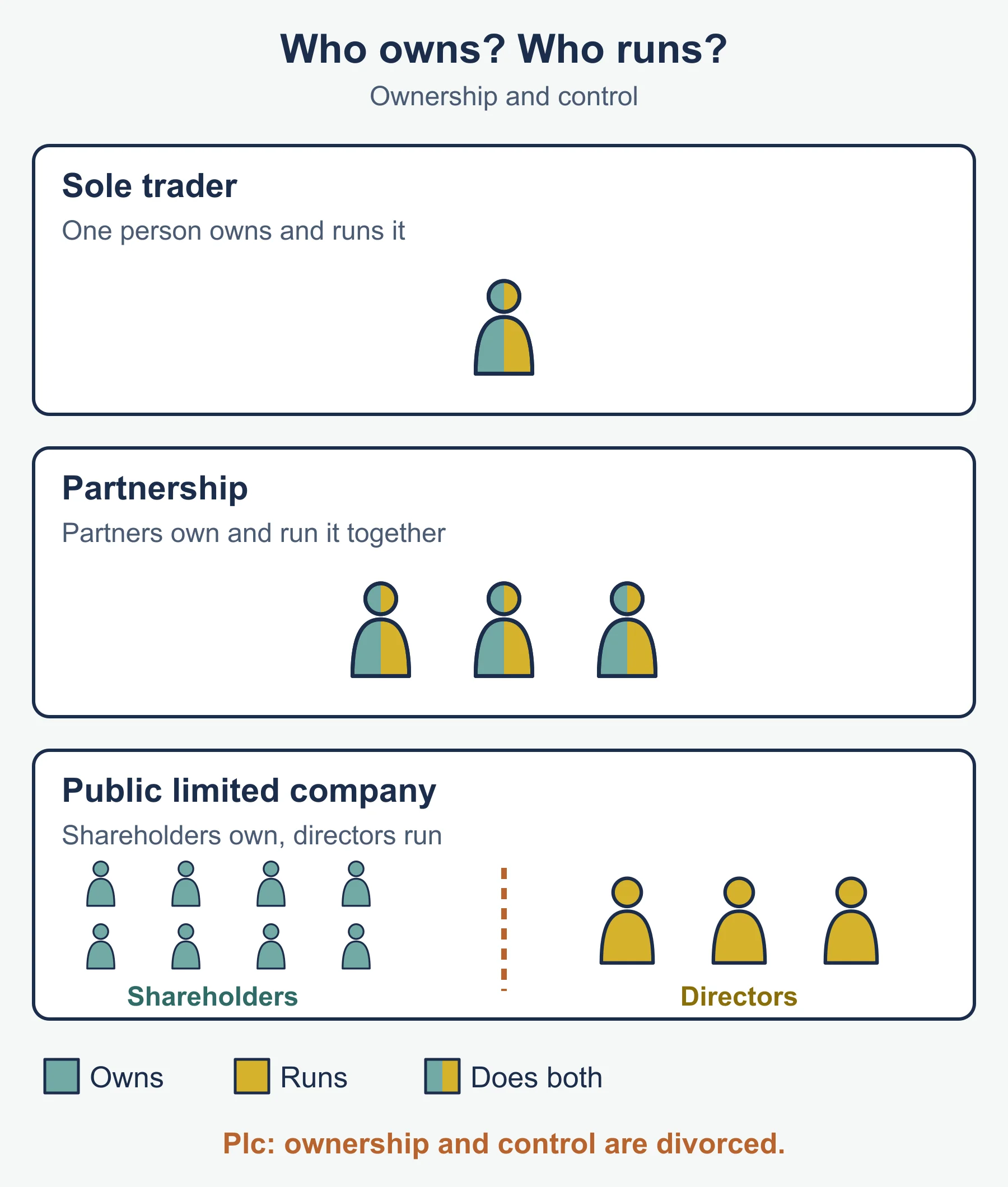
| Sole trader | A business owned (and usually run) by one person |
| Partnership | A firm with two or more owners who agree to share profit, work and risk |
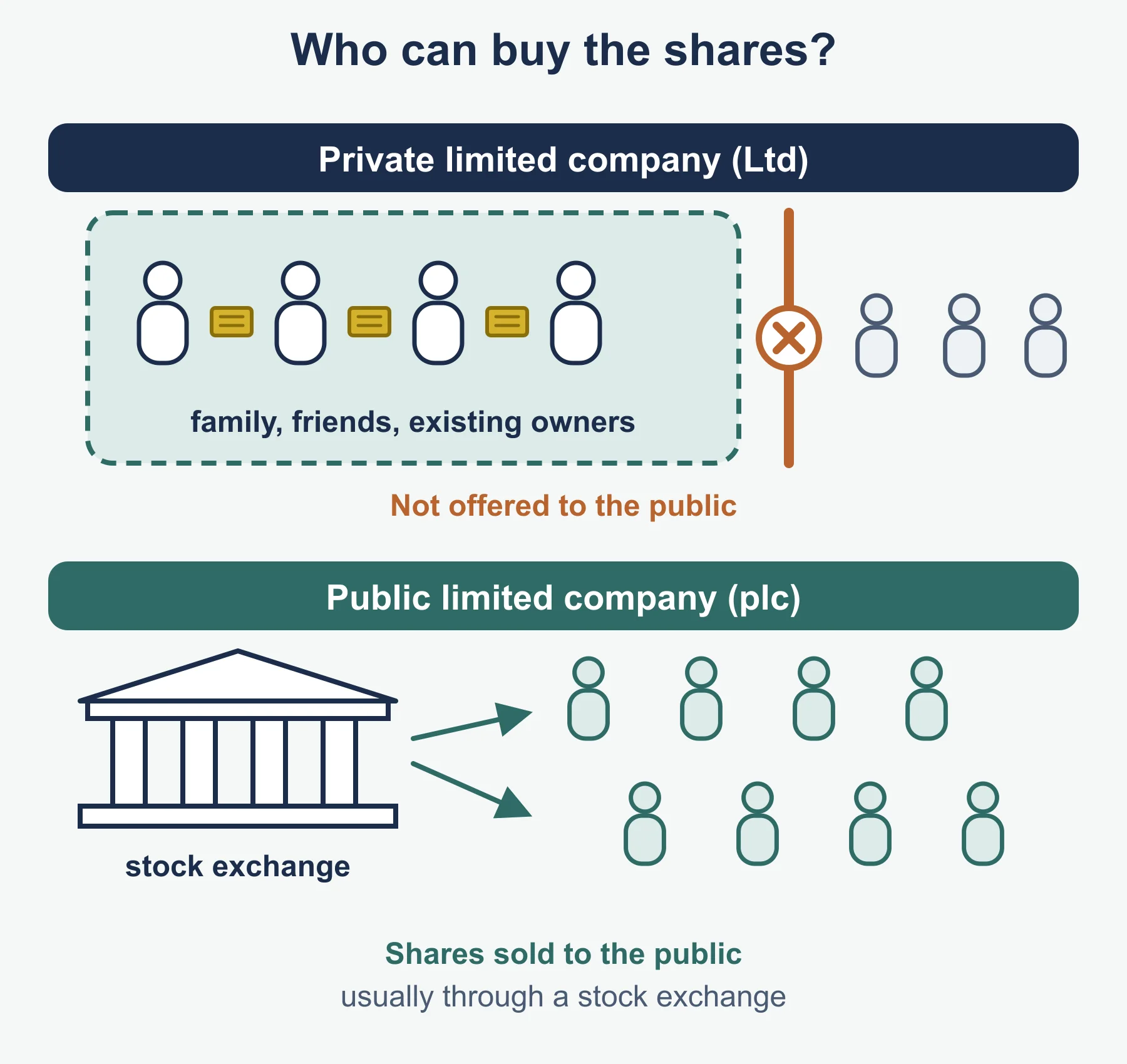
| Private limited company (Ltd) | A company owned by shareholders; the public cannot buy its shares directly |
| Public limited company (plc) | A company owned by shareholders; it may offer its shares to the general public |
| Shareholder | An owner of a company, holding shares |
| Dividend | Part of a company’s profit paid to shareholders |
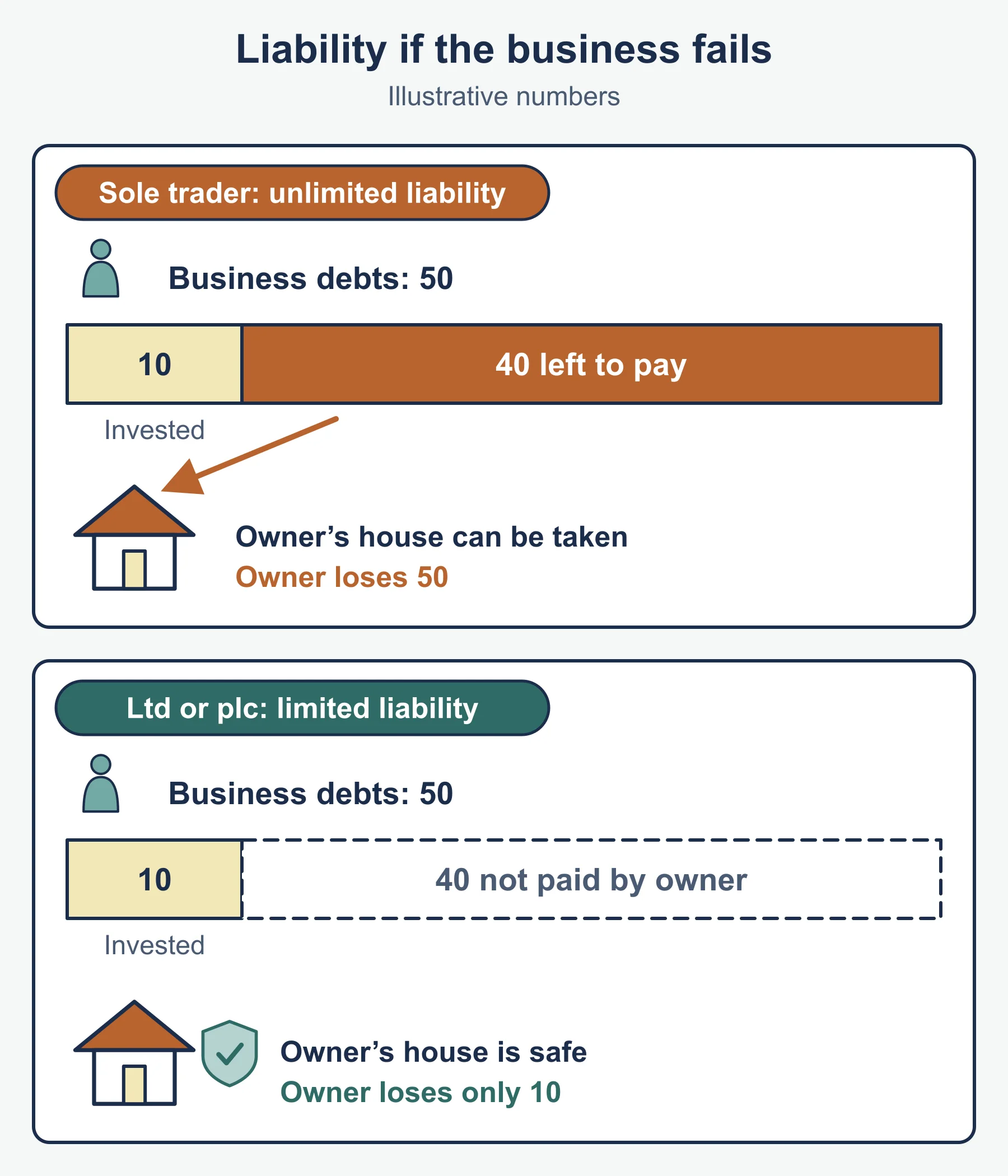
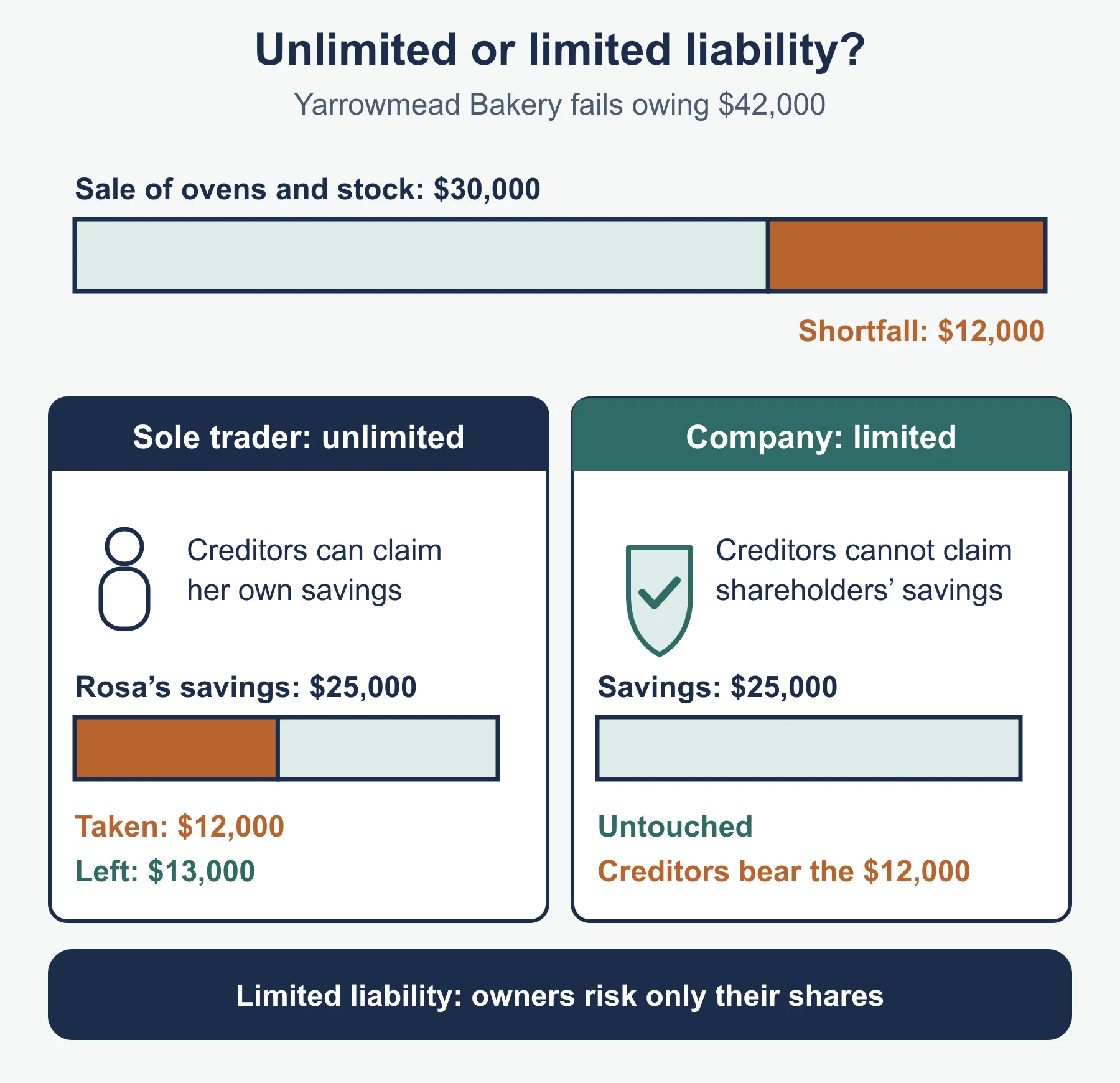
| Unlimited liability | Owners can be made to pay business debts from personal assets |
| Limited liability | Owners can lose only the money they invested |
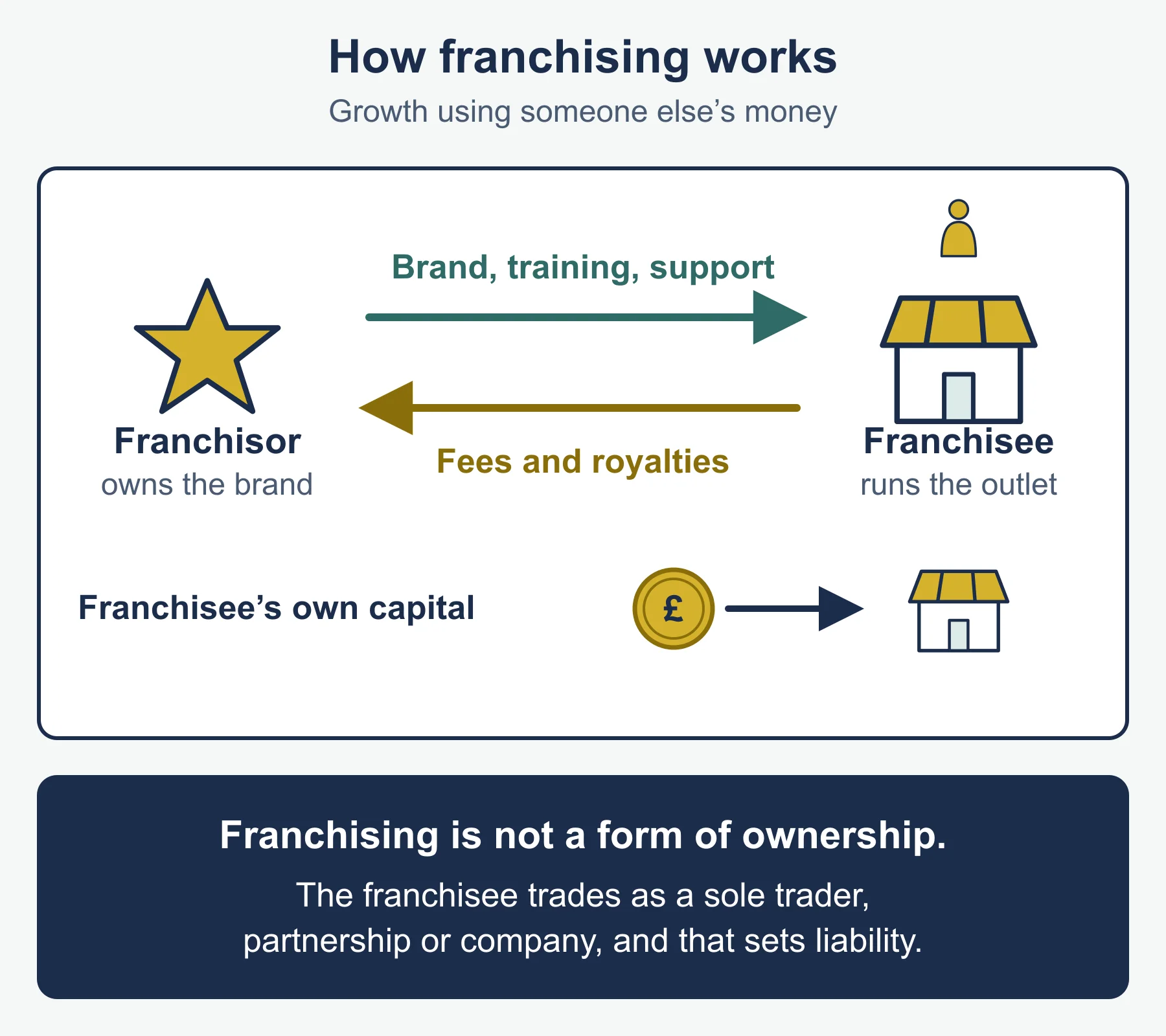
| Franchise | A right to use another business’s brand, products and methods in return for payment |
| Franchisor | The business that grants the franchise |
| Franchisee | The business or person that buys the franchise |
| Royalty | A regular payment by the franchisee, often a percentage of sales |
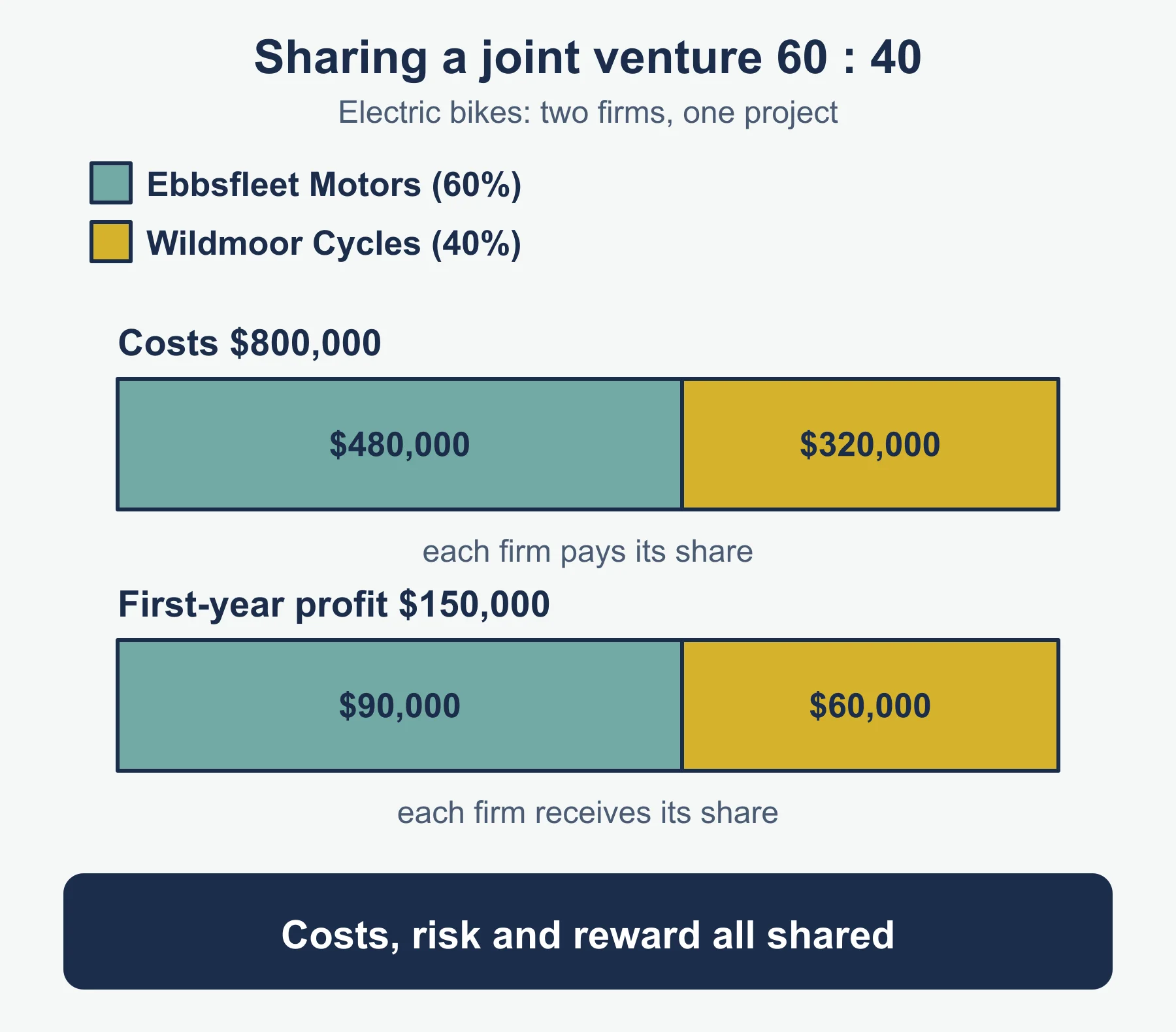
| Joint venture | Two or more businesses cooperating on a project or in a market, sharing costs, risks and rewards |
| Social enterprise | A business that trades mainly to achieve social or environmental aims |
The four main types at a glance
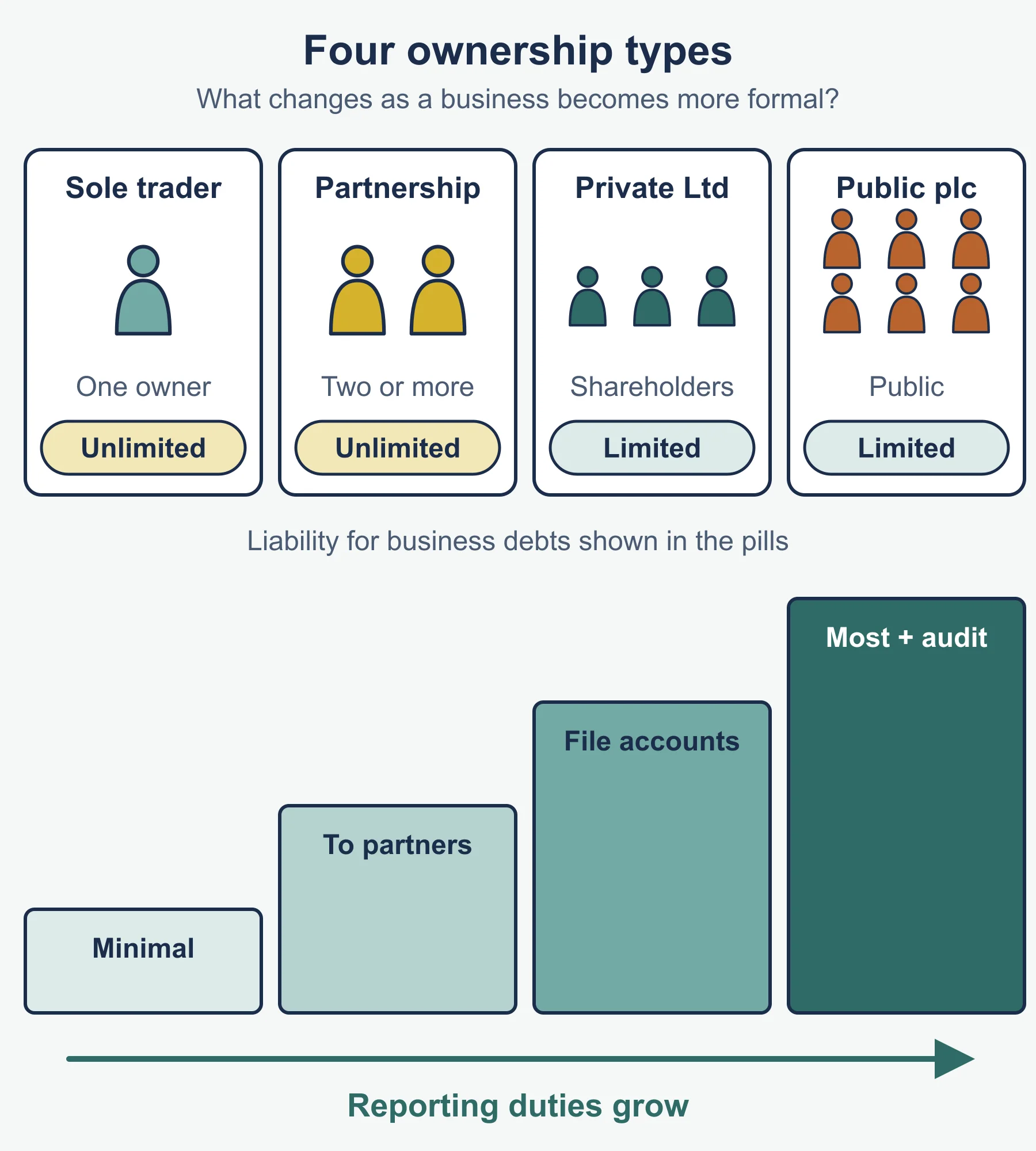
| Sole trader | Partnership | Private limited | Public limited | |
|---|---|---|---|---|
| Owners | 1 | 2 or more | Shareholders | Shareholders |
| Liability | Unlimited | Unlimited (usual position) | Limited | Limited |
| Share sale to the public | No | No | No | Yes |
| Capital | Smallest | Small to medium | Medium | Largest |
| Control | Owner alone | Shared | Founders or shareholders | Spread widely |
| Set-up | Easiest | Easy | More formal | Most formal |
Advantages and disadvantages: quick recall
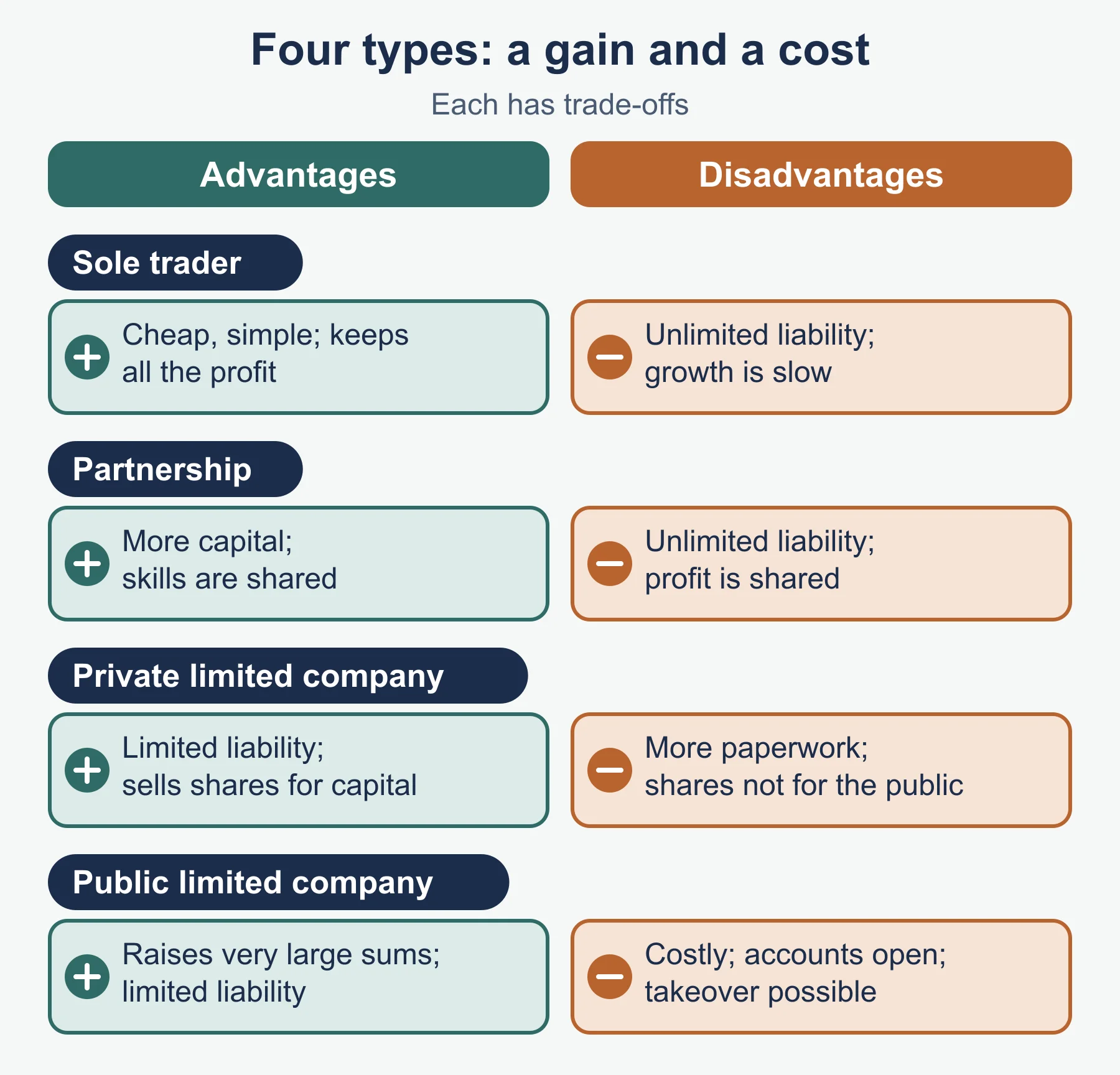
Sole trader
- For: simple, cheap, full control, keeps all profit.
- Against: unlimited liability, little capital, owner carries all work and risk.
Partnership
- For: shared capital, skills and workload; more than one decision-maker.
- Against: unlimited liability, shared profit, possible disputes.
Private limited company
- For: limited liability, more capital through share sales, founders choose who joins.
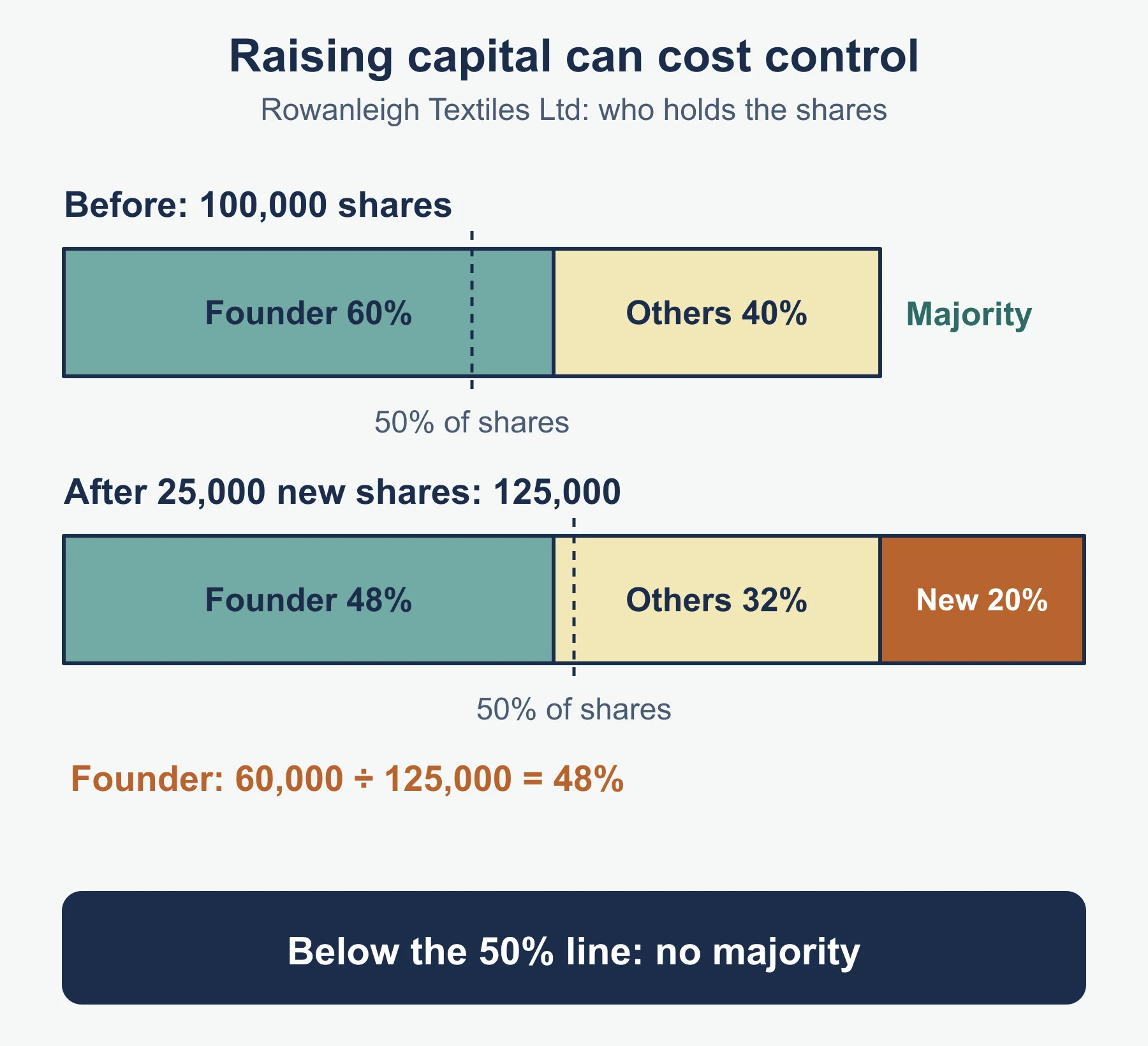
- Against: more paperwork and cost, cannot sell shares to the public, control can dilute.
Public limited company
- For: large capital, limited liability, easy to trade shares, easier borrowing.
- Against: high costs, strict regulation, accounts widely available, risk of takeover, pressure for short-term results.
Franchise: both sides
| Advantages | Disadvantages | |
|---|---|---|
| Franchisor | Expands with the franchisee’s money; motivated local owner; fee and royalty income | Shares profit; brand harmed by weak franchisees; less control than owned outlets |
| Franchisee | Known brand; support and training; lower risk than starting alone | Pays fee and royalty; must follow rules; limited freedom; shares brand reputation |
Joint venture
- For: shared costs and risk; combined skills and knowledge; faster entry to a new market.
- Against: shared profit; possible disagreement; slower decisions; unclear responsibility.
Social enterprise
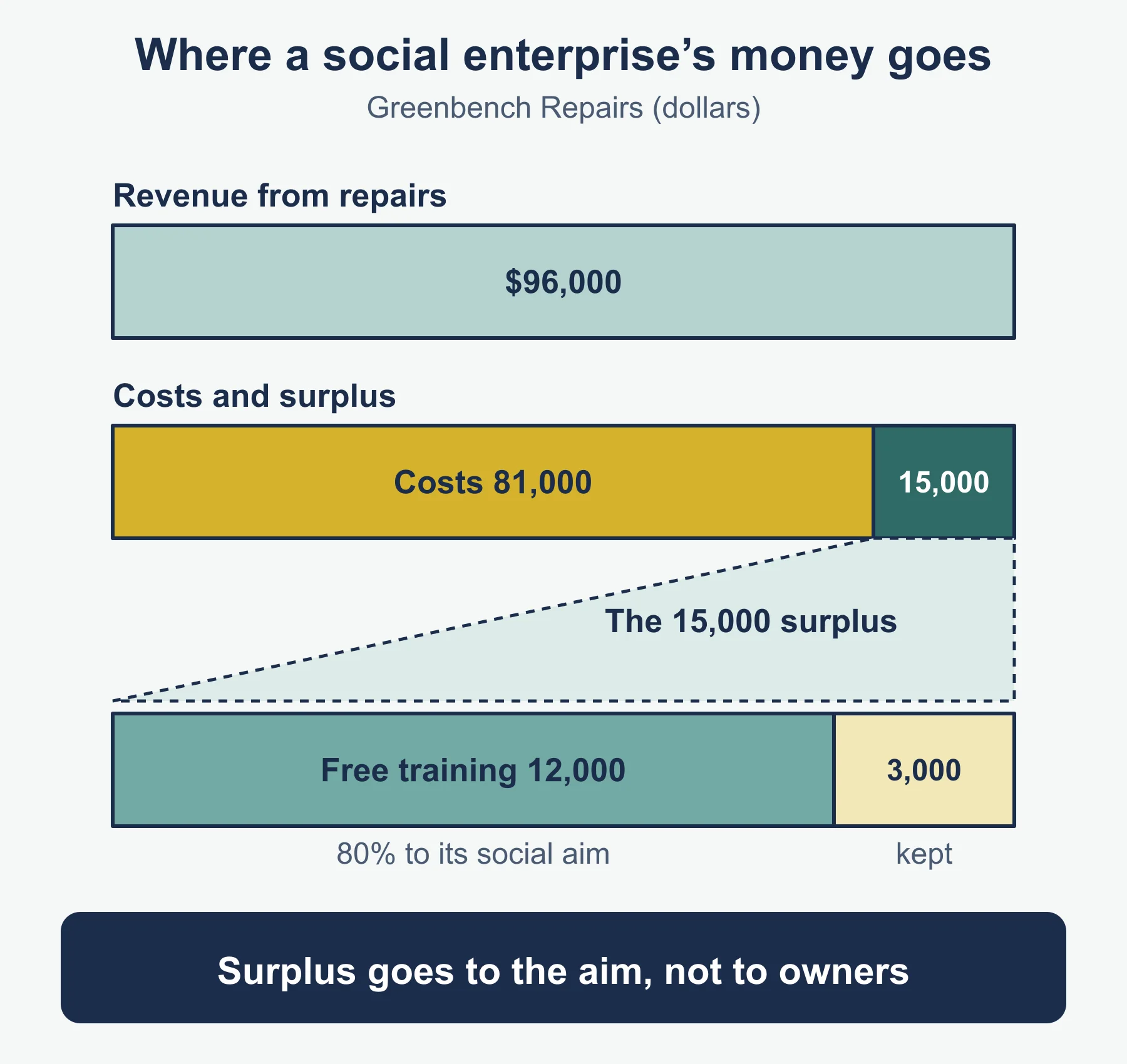
- Sells goods or services like any business, but social or environmental aims come first.
- Profit is mainly reinvested in the aims.
- For: goodwill, committed staff, a clear purpose.
- Against: less money for growth, harder to attract investors who want returns.
Method boxes
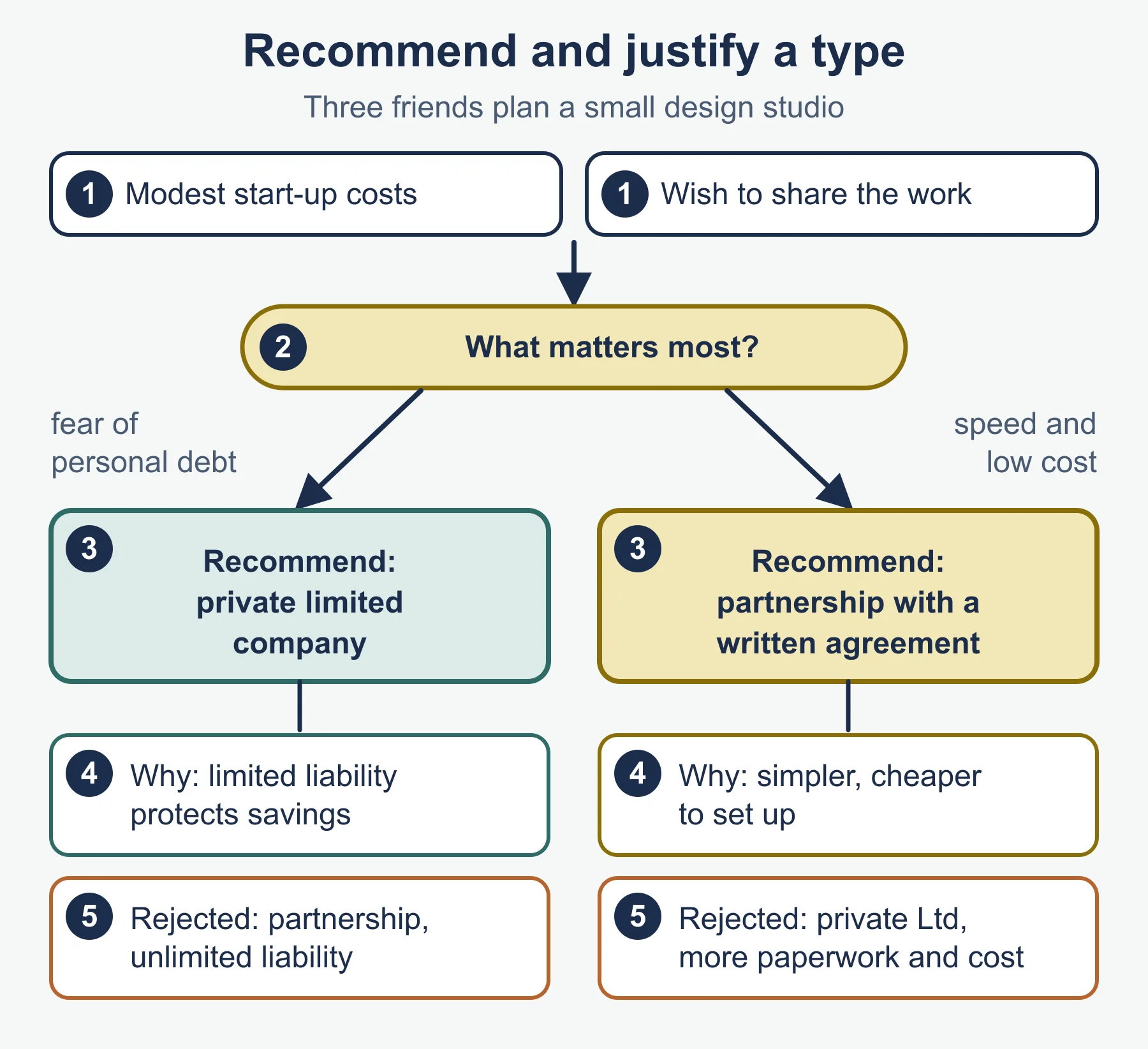
Method: recommend and justify a type (case study)
- Underline the facts: capital needed, risk, control wanted, growth plans, number of owners.
- Match facts to features in the table above.
- State your recommendation in one sentence.
- Give two or three reasons, each linked to a fact from the case.
- Explain why one other type is weaker for this business.
- End with a short judgement that mentions any drawback of your choice.
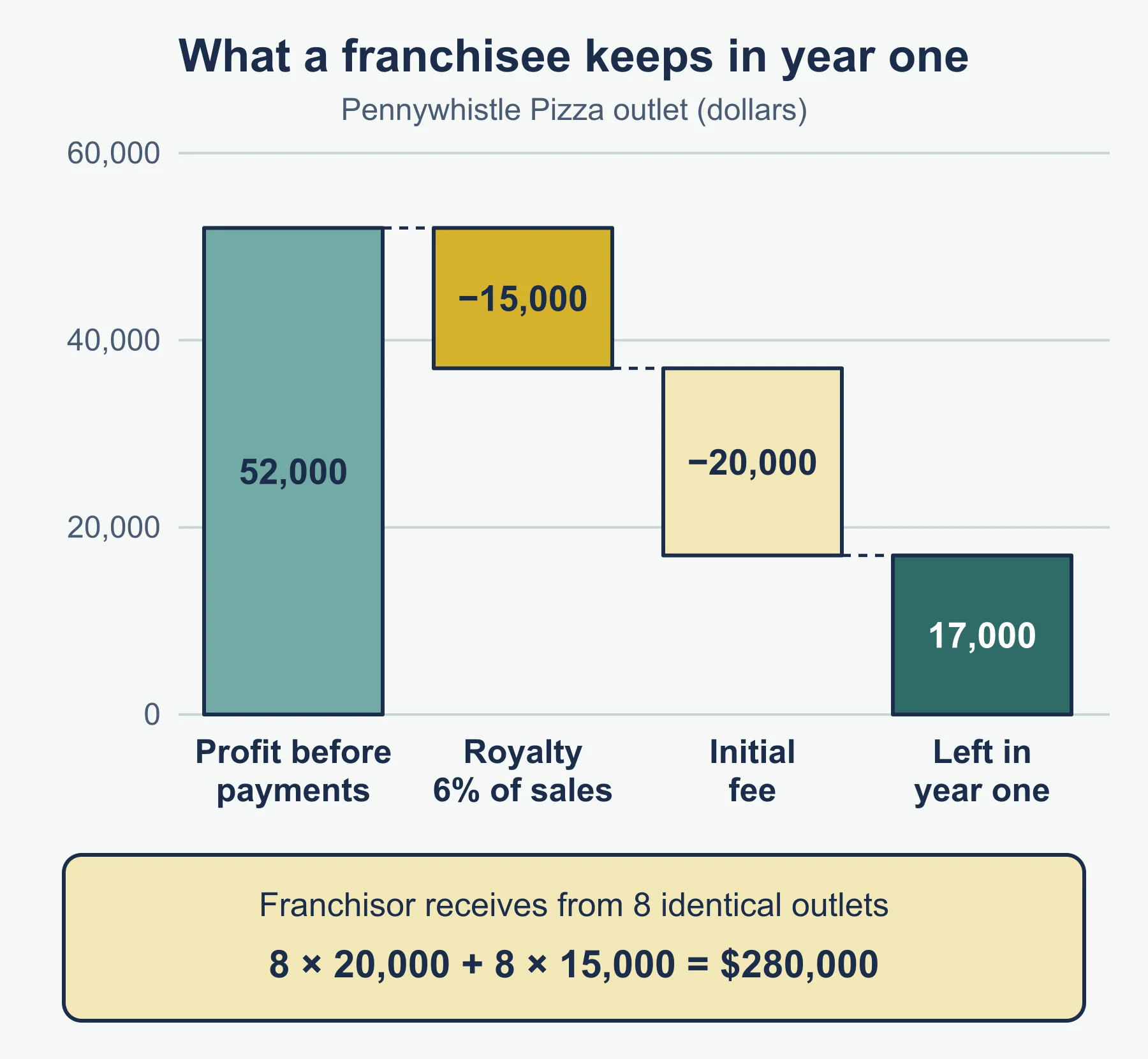
Method: franchise payments
- Royalty = percentage x sales.
- Franchisee profit after royalty = profit before royalty - royalty.
- If asked about year one, also take off the initial fee.
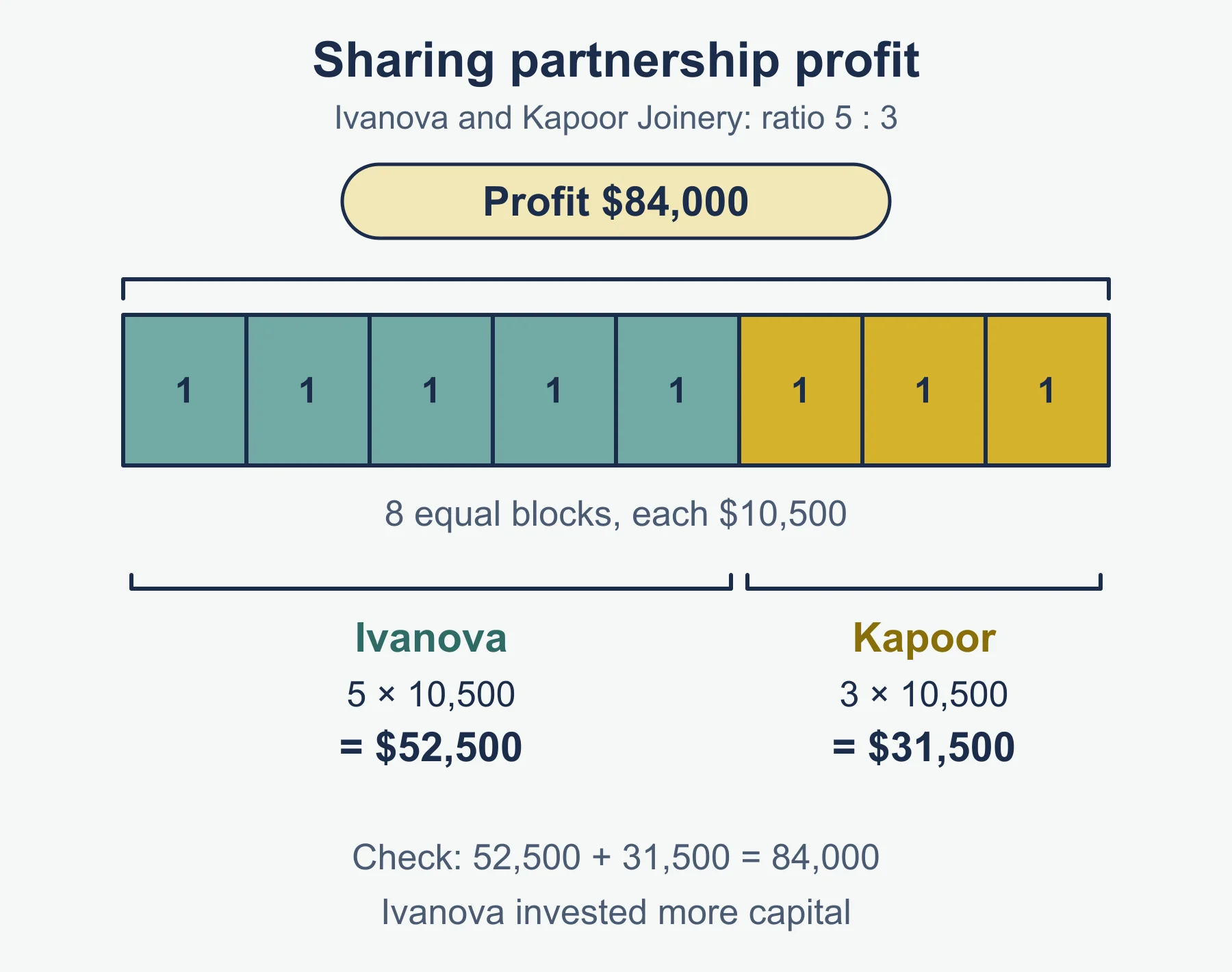
Method: profit shares
- Add the ratio parts to find the total.
- Share = own part divided by total, multiplied by profit.
- Check the shares add back to total profit.
Small worked reminders
Partnership profit of 45,000 shared 2:1. Total parts = 3. One partner gets 2/3 x 45,000 = 30,000 and the other gets 15,000.
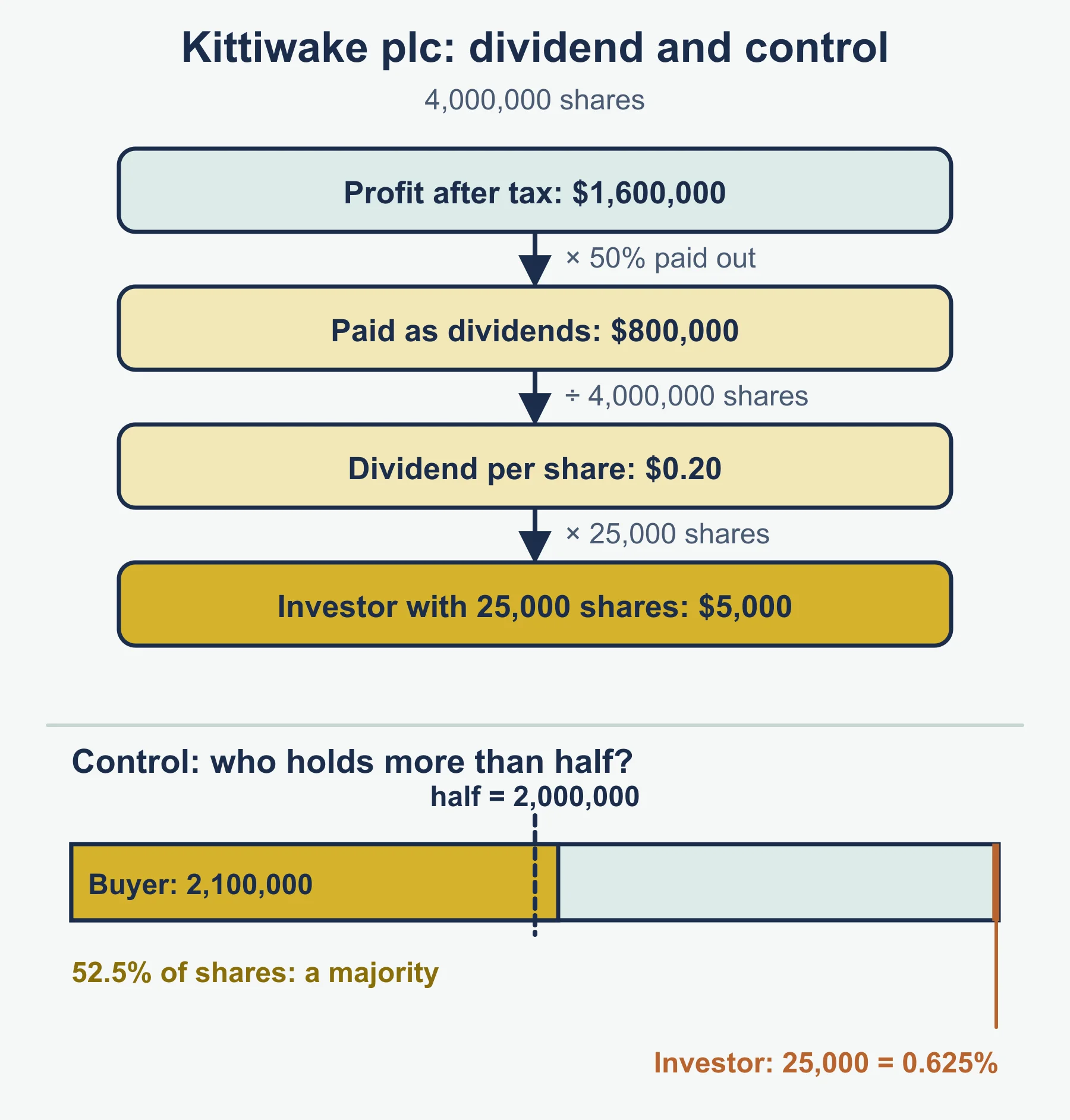
A plc pays a dividend of 0.25 per share. An investor holding 8,000 shares receives 8,000 x 0.25 = 2,000. If the company has 500,000 shares, the investor owns 8,000/500,000 = 1.6%.
A franchisee has sales of 150,000 and pays an 8% royalty: 0.08 x 150,000 = 12,000 a year, or 60,000 over five years.
A joint venture costing 500,000 is shared 3:2. The first partner pays 3/5 x 500,000 = 300,000 and the second pays 200,000.
A sole trader owes 20,000 and the business assets raise 14,000. The shortfall is 6,000. With unlimited liability, the owner pays it. With limited liability, the creditors lose it.
Must-know distinctions
| Pair | Key difference |
|---|---|
| Private v public limited company | Public can offer shares to the general public; private cannot |
| Sole trader v private limited company | Sole trader has unlimited liability and one owner; Ltd has limited liability and shareholders |
| Franchise v joint venture | Franchise is brand-use for a fee; joint venture is two businesses sharing a project and its results |
| Franchisor v franchisee | Franchisor owns the brand; franchisee runs the outlet |
| Social enterprise v ordinary business | Social aims come first, with profit mainly reinvested |
| Limited liability v no risk | Owners can still lose all they invested |
Applying the content
Cambridge assesses application, analysis and evaluation as well as knowledge, so a list of textbook points is rarely enough. Name the business, use its figures, and say what a feature means for that business. A sentence such as “limited liability protects the owner’s house” is knowledge. Adding “so Ms Okoro can borrow to open a second shop without risking her home” is application.
Command words for this topic
Cambridge lists these command words with the meanings below.
| Command word | What it means | Typical use here |
|---|---|---|
| State | Express in clear terms | State one feature of a partnership |
| Identify | Name, select or recognise | Identify the type of organisation in the stem |
| Define | Give precise meaning | Define limited liability |
| Outline | Set out the main points | Outline two features of a franchise |
| Explain | Make the relationships clear, say why and how, and support with evidence | Explain one advantage of a joint venture |
| Calculate | Work out from given figures | Calculate each partner’s share |
| Justify | Support a case with evidence or argument | Justify a recommended type |
| Consider | Review and respond to given information | Consider whether a franchise is suitable |
Quick self-test
- Define the term limited liability.
- State two types of business with unlimited liability.
- What is the main difference between a private and a public limited company?
- A partnership makes a profit of 60,000 shared 3:1. How much does the larger partner get?
- A company with 200,000 shares pays out 30,000 as dividends. What is the dividend per share?
- A franchisee pays a royalty of 5% on sales of 180,000. Calculate the royalty.
- Give one advantage of a franchise to the franchisor.
- Give one disadvantage of a franchise to the franchisee.
- State one reason two businesses might form a joint venture.
- What is a social enterprise?
Answers
- Owners can lose only the money they invested in the business; their personal assets cannot be claimed for business debts.
- Sole trader and partnership.
- A plc can sell shares to the general public; a private limited company cannot.
- 3/4 x 60,000 = 45,000. The other partner gets 15,000.
- 30,000/200,000 = 0.15 per share.
- 0.05 x 180,000 = 9,000.
- It can expand using the franchisee’s capital, or it receives fees and royalties.
- It must pay an initial fee and royalties, or it must follow the franchisor’s rules.
- To share costs and risks, or to gain skills or access to a market.
- A business that trades mainly to achieve social or environmental aims, reinvesting most profit in them.
Where marks are usually lost
- Using general points that could apply to any business, with no link to the case.
- Stating an advantage or disadvantage without explaining the reason or effect.
- Mixing up limited liability and limited risk.
- Saying private companies “sell shares privately to anyone” rather than that they cannot offer them to the public.
- Treating the franchisee as part of the franchisor’s business.
- Forgetting to calculate the royalty before the franchisee’s profit.
- Giving a recommendation with no reasons or no comparison with another type.
- Making a one-sided judgement that ignores the drawbacks of the type chosen.
- Writing “profit” when the question asks for revenue or dividends.
Frequently asked questions
What is the difference between a private and a public limited company? A private limited company (Ltd) cannot offer its shares to the general public, so they are sold privately. A public limited company (plc) can sell shares to the public, usually through a stock exchange, so it can raise much larger sums.
Does limited liability mean a company cannot fail? No. A limited company can still fail; limited liability means the owners lose only the money they put into the business, while their personal assets are protected from its debts.
Is a franchisee an employee of the franchisor? No. The franchisee owns its outlet and pays the franchisor for the right to use the brand, products and methods, usually through an initial fee plus a regular royalty.
What is a social enterprise? A social enterprise is a business that trades to achieve social or environmental aims, mainly reinvesting any profit in those aims rather than paying it to owners. It still needs sales revenue to cover its costs.
Official syllabus
Aligned to section 1.4 of the Cambridge IGCSE Business 0264 syllabus for examination in 2027, 2028 and 2029, published by Cambridge University Press & Assessment (Cambridge International Education).
Get free revision emails (optional)
Occasional emails with practice questions, worked explanations and links to free resources for the qualification and subjects you choose. No spam, and you can unsubscribe from any email. The free tools on this site never need an email.
Related resources
-
Study guides
IGCSE Business: Business activity and Economic sectors (Cambridge 0264)
Study guide to factors of production, added value, opportunity cost and the economic sectors for Cambridge IGCSE Business 0264, with worked examples.
Business · Cambridge · IGCSE
Read guide -
Practice questions
IGCSE Business: Business activity and Economic sectors (Cambridge 0264) – Practice Questions
Eleven original practice questions with worked answers on factors of production, added value, opportunity cost and sectors, Cambridge IGCSE Business 0264.
Business · Cambridge · IGCSE
Try questions -
Revision notes
IGCSE Business: Business activity and Economic sectors (Cambridge 0264) – Revision Notes
Condensed revision notes on factors of production, added value, opportunity cost and economic sectors for Cambridge IGCSE Business 0264.
Business · Cambridge · IGCSE
Revise topic
Related articles
-
teaching
A Level tuition in Dubai: Cambridge or Pearson Edexcel International A Level?
Schools in Dubai and Abu Dhabi teach either Cambridge International AS & A Level or Pearson Edexcel International A Level. How the two are structured, why it matters for tuition, and how online classes from Lahore work.
9 October 2026
-
curriculum guides
Choosing subjects at IGCSE and A Level
How subject choices at 14 and 16 affect university options later, and how to keep pathways open without overloading a timetable.
28 July 2026
Studying this with a teacher
Working through Business IGCSE?
This page is free and stays free. If you would rather be taught it, Marlbridge runs Business classes one-to-one and in small groups of up to 15, online in your own time zone. The first trial class is free. WhatsApp replies within an hour (8am–11pm Pakistan time, every day); email the same day.
Cambridge Business teachers at Marlbridge

