
Study Guides
IGCSE Business: Business objectives and stakeholder objectives (Cambridge 0264)
Study guide to business objectives, stakeholder groups, their aims and how those aims conflict, for Cambridge IGCSE Business 0264, with worked examples.
- Subject
- Business
- Level
- IGCSE
- Topic
- Understanding business activity
- Author
- Marlbridge Academic Team
- Updated
- Reviewed by
- Salman Ahmad (what this means)
Aligned to Cambridge IGCSE Business (0264), For examination in 2027, 2028 and 2029. Official specification .
Syllabus page (what it covers and how it is assessed): Cambridge IGCSE Business.
Syllabus points this page covers
0264
- 1.5 Business objectives and stakeholder objectives
Found an error? Report a correction.
Need help with this topic? Request a free trial class for IGCSE Business (0450 / 0264).
This guide covers section 1.5 (Business objectives and stakeholder objectives, 1.5.1 and 1.5.2) of the Cambridge IGCSE Business 0264 syllabus for examination in 2027, 2028 and 2029. All candidates take Paper 1 (Short Answer and Data Response) and Paper 2 (Case Study), and both papers are based on all the subject content. So expect this topic inside stimulus material and case studies as well as in recall questions. Track your progress with the course hub and the printable checklist. When you finish, use the revision notes and the practice questions. To find weak spots first, try the free diagnostics.
Money figures are in dollars. All businesses and people are invented.
What this unit covers
| Syllabus point | What you must be able to do |
|---|---|
| 1.5.1 | Say that businesses can have several objectives, for example survival, growth, profit and market share |
| 1.5.1 | Explain the importance of business objectives |
| 1.5.2 | Name the internal stakeholder groups: owners (sole traders, partnerships, shareholders), managers and employees |
| 1.5.2 | Name the external stakeholder groups: customers, suppliers, lenders/banks, government and the local community |
| 1.5.2 | Describe the objectives of each stakeholder group |
| 1.5.2 | Explain how these objectives may conflict with each other |
The syllabus gives a formula for market share in its list of formulas and ratios, and the topic on market changes (3.1.2) asks you to calculate it. It is the one calculation that fits naturally here, so it appears below.
Related pages on the site: types of business organisation (owners and their liability) and enterprise, business growth and size (how growth happens).
Business objectives (1.5.1)
An objective is a target that a business sets itself and tries to reach. A business is not limited to one. The syllabus lists survival, growth, profit and market share as examples, and the word “e.g.” tells you other objectives are possible too. Treat the four as a starting set and be ready to apply others if a case study mentions them.
Survival
Survival means staying in business and keeping the doors open. It matters most to new businesses, to firms facing strong competition and to firms in a weak economy. A business that is fighting to survive may cut its prices to keep customers or accept a very small profit. Its owners judge success by whether the business is still trading at the end of the year.
Growth
Growth means the business gets bigger. It can be measured by sales revenue, number of employees or number of outlets. Owners may want growth for more profit, more power in the market, or the lower cost per unit that a larger scale can bring. Growth takes money and management time, so it can put pressure on cash. You can read about methods of growth in the linked page above.
Profit
Profit is what is left from sales revenue after all costs are paid. Some businesses aim for the highest profit they can make. Others aim for a satisfactory profit, enough to reward owners and keep the business going. Profit has two uses: it is paid to the owners and it can be reinvested in the business to pay for future growth.
Market share
Market share is the part of the total market that one business wins. The syllabus gives the formula as:
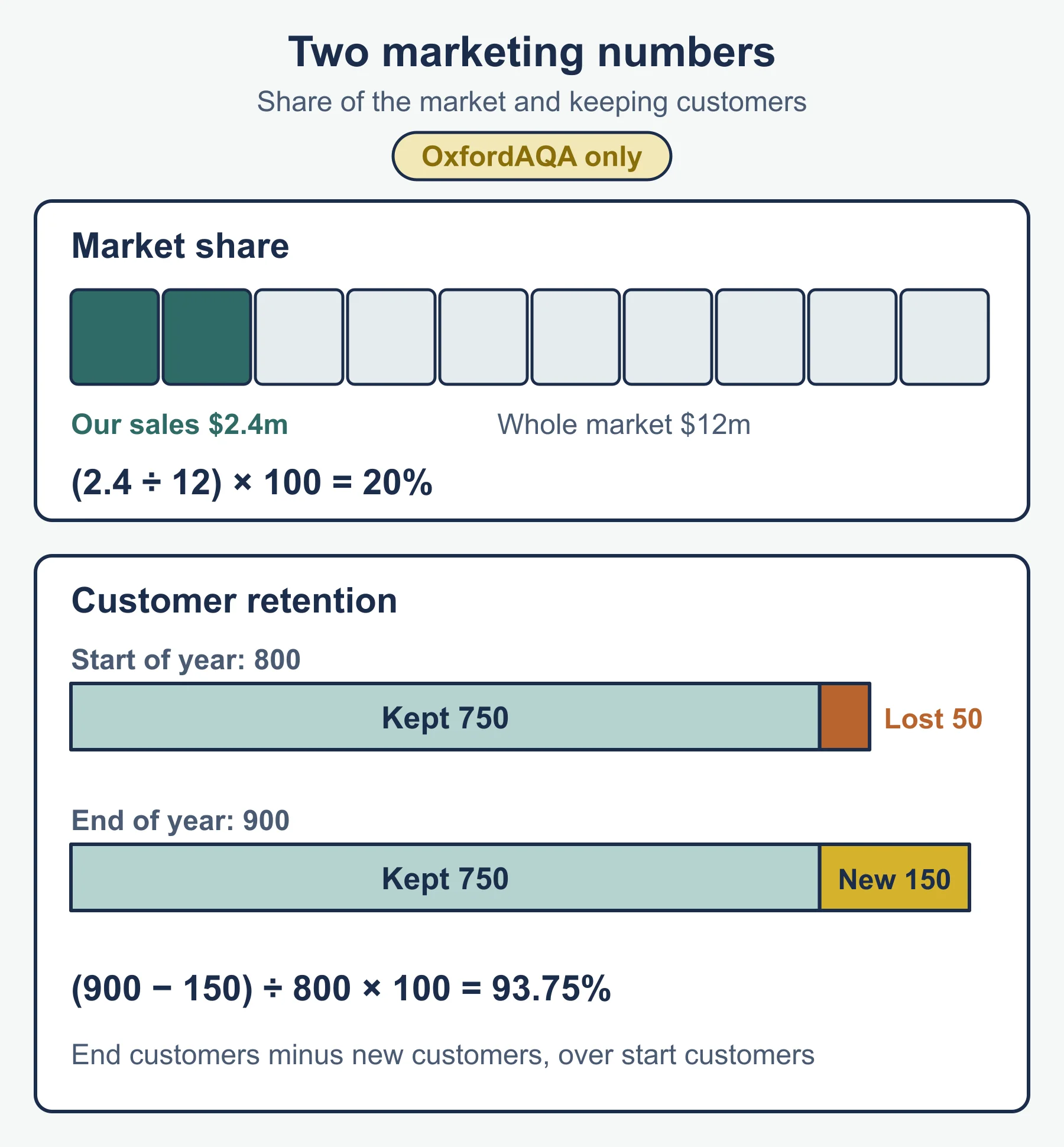
market share (%) = (sales revenue of a business / total sales revenue for the whole market) × 100
A business aiming to raise its market share is trying to win customers from rivals. A rising share means the business is doing better than the market as a whole.
Worked example: market share
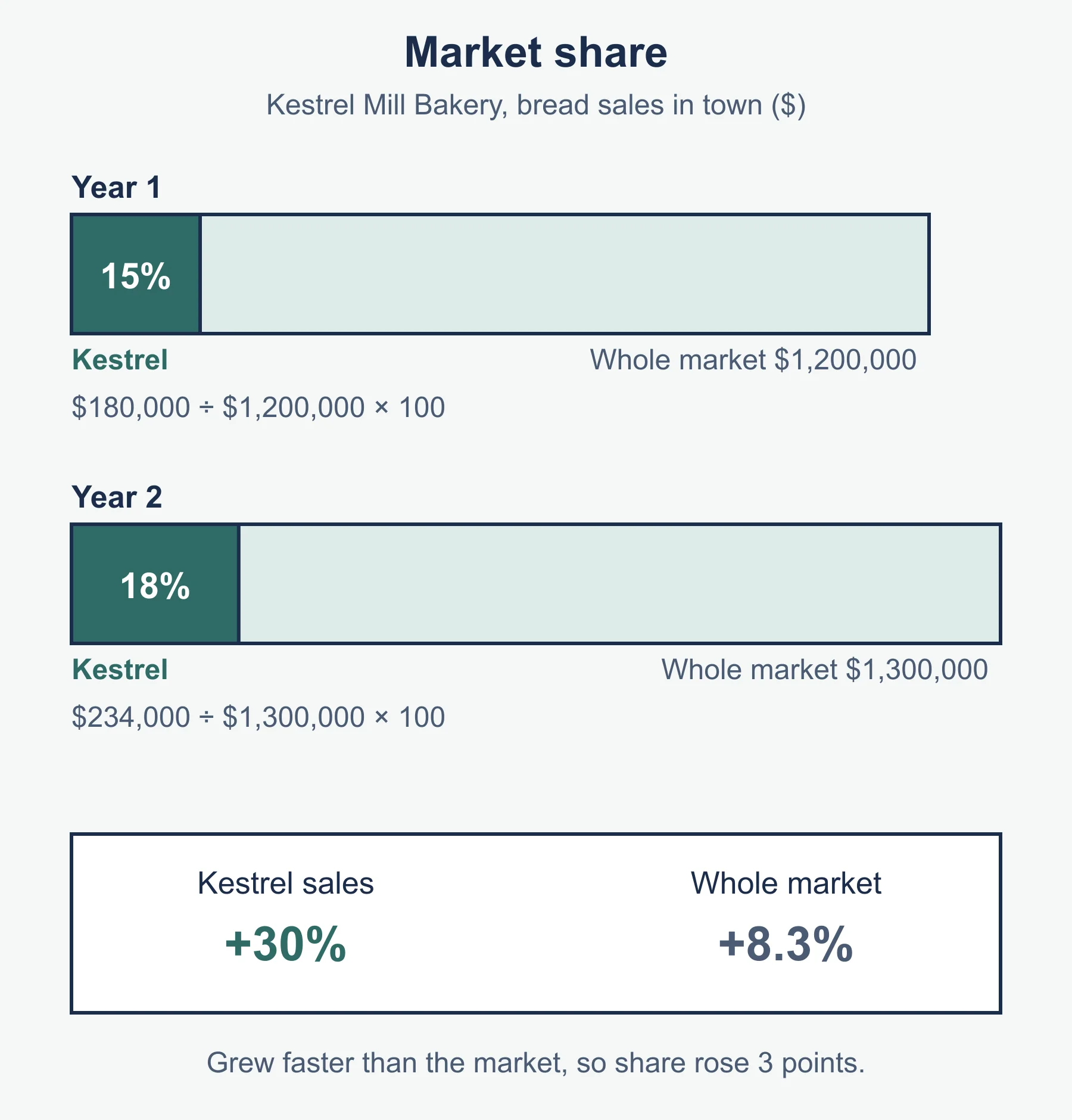
Kestrel Mill Bakery sold 180,000 dollars of bread in a town where the whole bread market was worth 1,200,000 dollars. The next year its sales were 234,000 dollars in a market worth 1,300,000 dollars.
- Year 1 share = 180,000 / 1,200,000 × 100 = 15%.
- Year 2 share = 234,000 / 1,300,000 × 100 = 18%.
- Kestrel’s sales grew by (234,000 − 180,000) / 180,000 × 100 = 30%. The market grew by only (1,300,000 − 1,200,000) / 1,200,000 × 100 = 8.3% (to one decimal place).
- Judgement: the bakery grew much faster than the market, which is why its share rose by three percentage points. Notice that sales growth alone would not tell you this. If the market had grown by 30% as well, the share would not have moved.
Why objectives are important
Objectives matter for several reasons. Each is a point you can develop in an explanation.
- Direction. Everyone in the business knows what it is trying to achieve.
- Decision making. Managers can test choices against the objective. If the aim is growth, opening a second shop fits. If the aim is survival, it may not.
- Measuring success. A target such as an 18% share can be compared with the result. Without a target, nobody can say whether the year went well.
- Motivation and co-ordination. Employees and departments pull the same way when they share a target.
- Communication. Lenders, owners and other stakeholders can see what the business is aiming for.
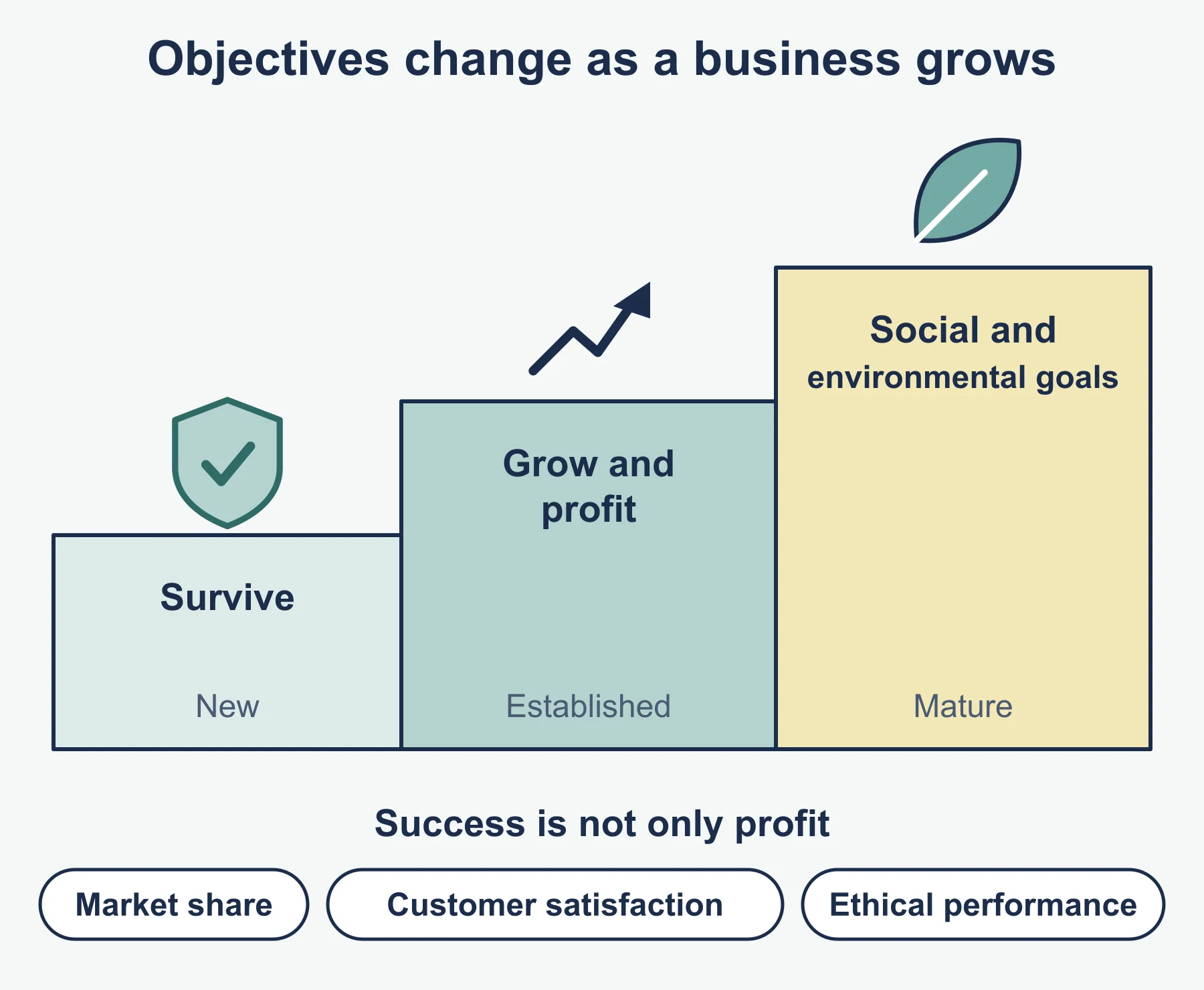
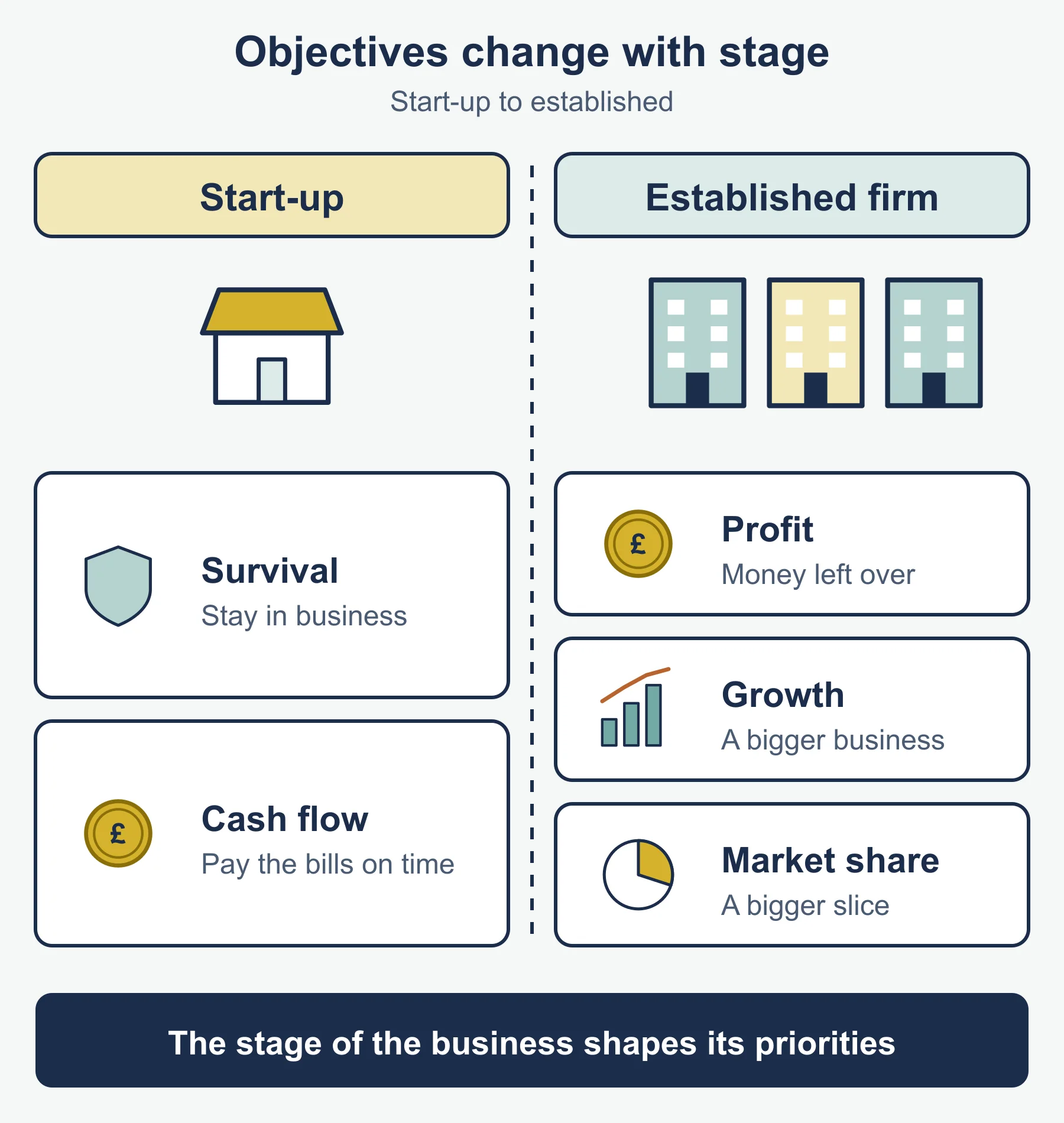
Objectives also change. A new business often starts with survival. Once it is secure, it may move to growth and a larger market share. In a recession an established firm may go back to survival. When you read a case study, ask what stage the business is at.
The role of stakeholder groups (1.5.2)
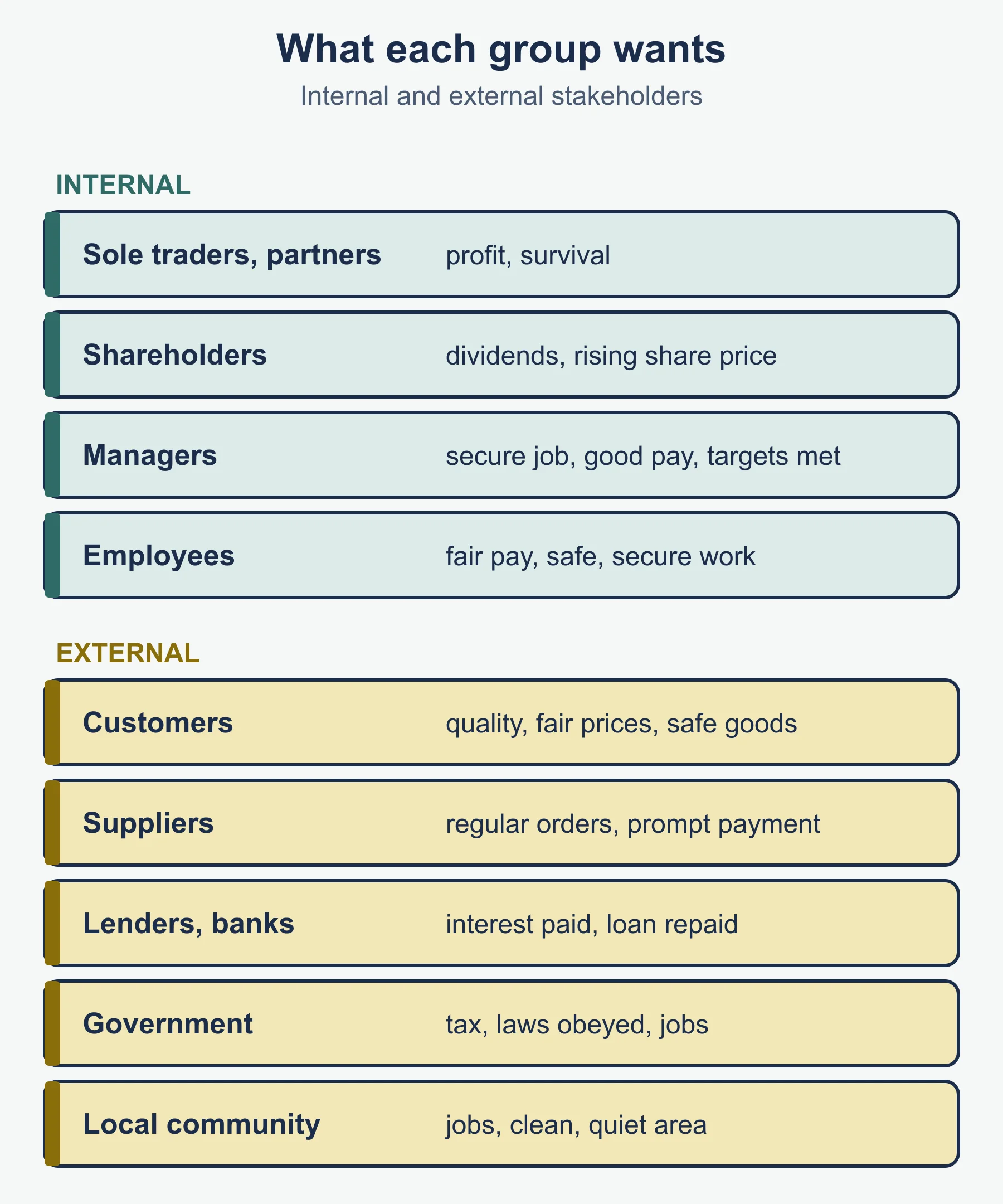
A stakeholder is a person or group with an interest in a business and its activities. They may affect the business or be affected by it. The syllabus splits them into internal and external groups.
| Type | Group | What they typically want |
|---|---|---|
| Internal | Owners: sole traders and partners | Profit for themselves, a business that survives, sometimes growth |
| Internal | Owners: shareholders | A return on their investment (dividends), a rising share value, growth |
| Internal | Managers | Job security, good pay, a business that meets its targets, status |
| Internal | Employees | Fair pay, secure work, good working conditions, chances to train and progress |
| External | Customers | Good quality, fair prices, reliable service, safe products |
| External | Suppliers | Regular orders, prompt payment, fair prices, a long-term relationship |
| External | Lenders/banks | Interest paid on time and the loan repaid, so they want a business that is safe and survives |
| External | Government | Tax collected, laws obeyed, jobs created, a healthy economy |
| External | Local community | Jobs, a clean and safe area, low noise and traffic, support for local causes |
Internal stakeholders
Owners. A sole trader or partner takes the profit personally, so profit and survival are close to personal income. Partners also share decisions and may disagree about how much to take out. Shareholders own part of a company. They are paid a share of profit called a dividend and they hope the share price rises. Many shareholders do not run the business, so they depend on managers.
Managers. Managers run the business day to day. They want secure jobs and good pay. They may want growth because a bigger business often means more responsibility and more reward. They are usually judged on whether targets are met.
Employees. Employees want wages that are fair, work that is safe and enjoyable, and job security. Many also want training and promotion.
External stakeholders
Customers want products that are good value, safe and available. Suppliers want to sell more, be paid on time and keep the customer for years. A late-paying business can lose its suppliers. Lenders and banks have lent money and want it back with interest, so they care about whether the business can pay. The government collects taxes and sets laws, and wants jobs and a stable economy. The local community lives near the business. It gains from jobs but may suffer from noise, pollution or traffic.
Some people belong to more than one group. An employee who lives nearby is also part of the local community. An employee who buys shares is also an owner. Mention this only if the case study gives you the evidence.
How stakeholder objectives may conflict (1.5.2)
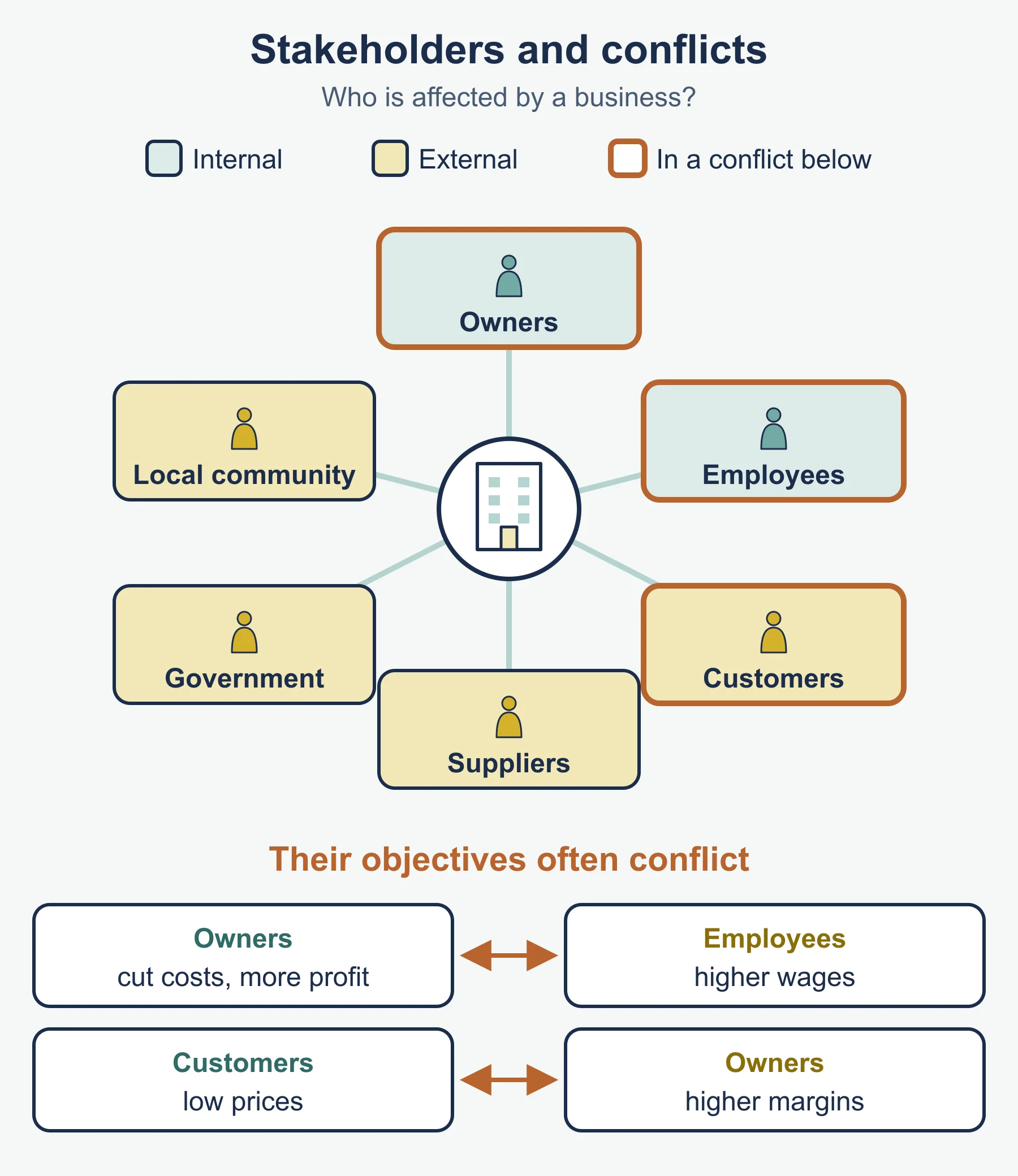
Different stakeholders want different things from the same pot of money, so some of their objectives pull against each other. Usually a gain for one group is a loss for another.
| Stakeholders | The conflict |
|---|---|
| Owners and employees | Owners want low costs and high profit. Employees want higher wages and more staff. |
| Owners and customers | Owners want higher prices. Customers want lower prices or better quality. |
| Shareholders and managers | Shareholders want profit paid out as dividends. Managers may want it kept to fund growth. |
| Owners and suppliers | Owners want to pay less for materials. Suppliers want higher prices. |
| Local community and owners | The community wants quiet and clean surroundings. The owners may want a bigger, busier site. |
| Government and owners | The government wants more tax and rule following. Owners want to keep more profit and avoid costs. |
| Lenders and owners | Lenders want a safe business that can repay. Owners may want to take risks to grow. |
Worked example: a conflict with numbers
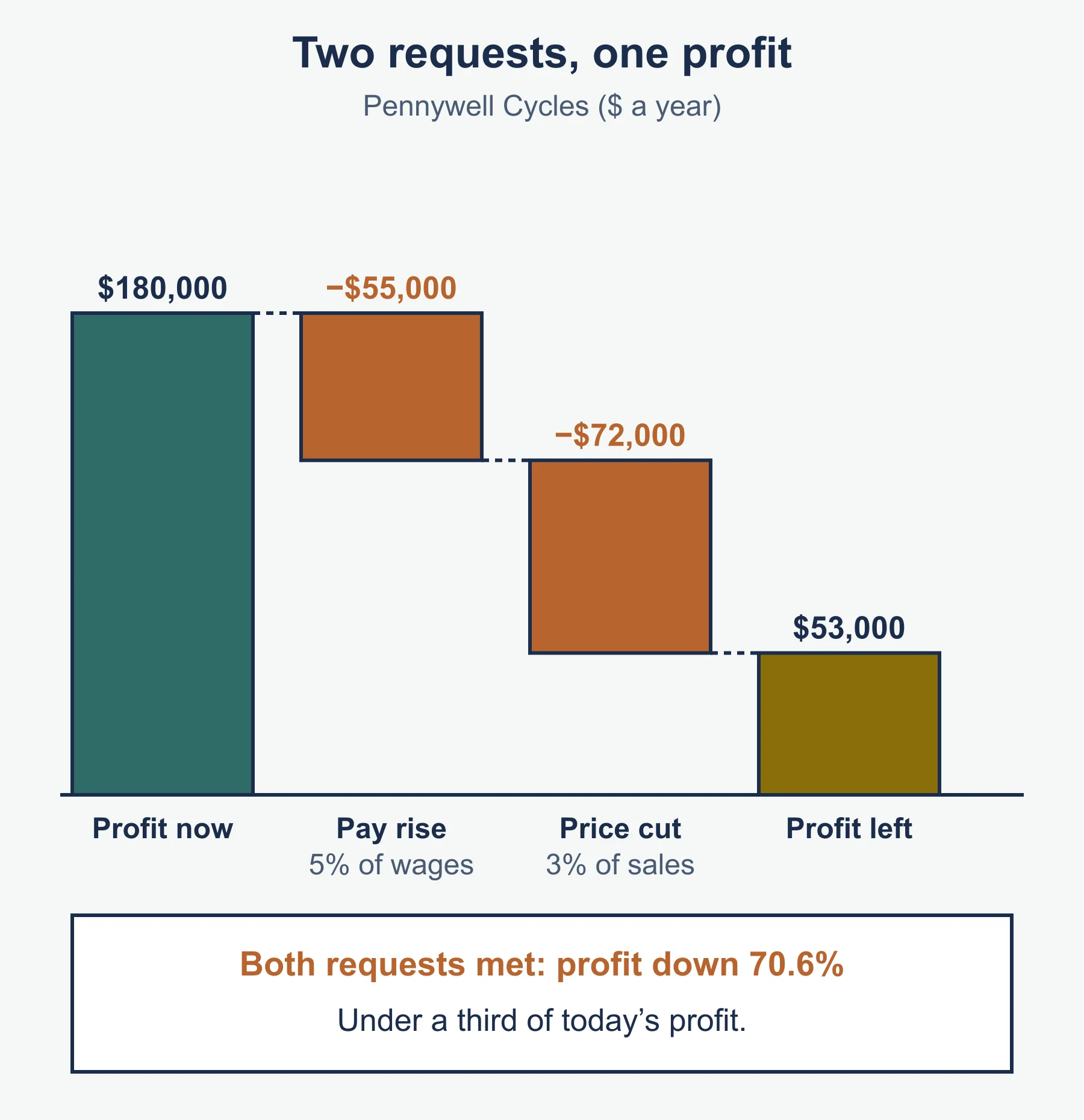
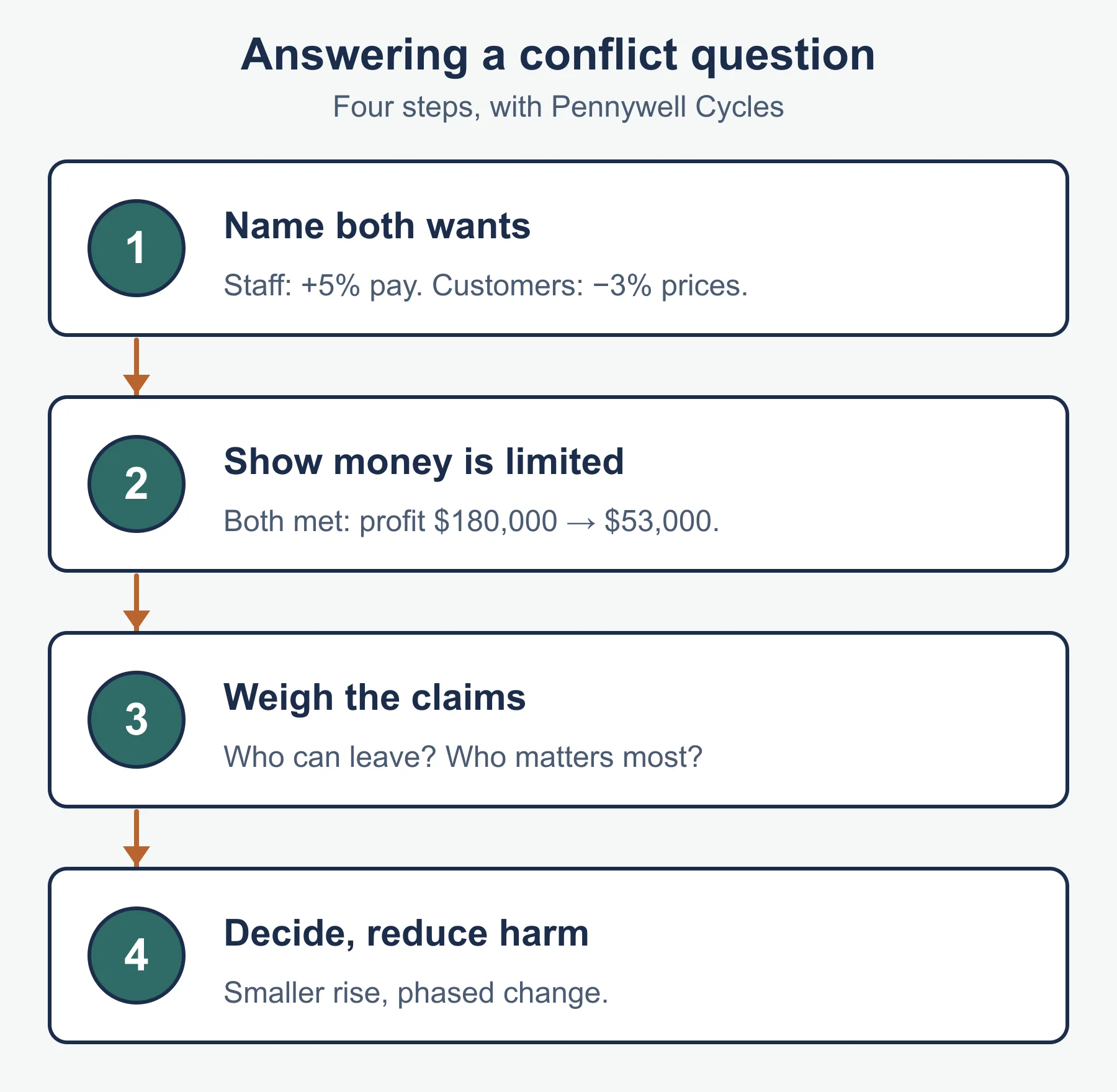
Pennywell Cycles earned a profit of 180,000 dollars last year from sales revenue of 2,400,000 dollars. Its wage bill was 1,100,000 dollars. The employees ask for a 5% pay rise. Customers ask for a 3% cut in prices. Assume nothing else changes, including the number of bikes sold.
- Cost of the pay rise = 5% × 1,100,000 = 55,000 dollars.
- Profit after the pay rise = 180,000 − 55,000 = 125,000 dollars, a fall of 55,000 / 180,000 × 100 = 30.6%.
- Revenue lost from the price cut = 3% × 2,400,000 = 72,000 dollars.
- Profit if both requests are met = 180,000 − 55,000 − 72,000 = 53,000 dollars, a fall of 127,000 / 180,000 × 100 = 70.6%.
- Judgement: the owners cannot meet both requests without profit falling to less than a third of its present level. A lender would then worry about the loan, and the owners may think about survival rather than growth. The business has to weigh the groups against each other.
Dealing with a conflict in an answer
For a question that asks you to justify a decision, work through four steps.
- Name the two stakeholders and state what each wants, using the case facts.
- Explain why both wants cannot be met in full.
- Weigh them. Ask which group has the stronger claim, which can leave, and which matters most to the business objective.
- Reach a decision and give the reason, and say what the business might do to reduce the harm, such as a smaller pay rise or a phased change.
Common errors
- Writing “profit” as the only objective. The syllabus says businesses can have several.
- Confusing market share with sales. Market share is a percentage of the whole market and needs both figures.
- Listing stakeholder groups without objectives. Always say what the group wants.
- Calling customers or suppliers internal. They are external. Owners, managers and employees are internal.
- Treating a lender as an owner. A lender is repaid with interest. A shareholder owns part of the company.
- Describing a conflict without saying why it cannot be solved. Say that the money is limited.
- Giving one-sided answers when asked to justify. A better answer shows the other side before deciding.
Next, test yourself with the practice questions.
Frequently asked questions
What is a business objective? A business objective is a target that a business sets itself and tries to reach, such as survival, growth, profit or market share.
Why are objectives important to a business? Objectives give direction, guide decision making, set a target to measure success against, help motivate and co-ordinate staff, and tell stakeholders such as lenders what the business is trying to achieve.
Who are the internal and external stakeholders of a business? Internal stakeholders are owners, managers and employees. External stakeholders include customers, suppliers, lenders, the government and the local community.
What are typical stakeholder conflicts? Owners want low costs and high profit while employees want higher wages, and owners want higher prices while customers want lower prices or better quality. Conflicts arise because stakeholders want different things from the same limited money.
Official syllabus
Cambridge IGCSE Business 0264 syllabus for examination in 2027, 2028 and 2029, published by Cambridge University Press and Assessment (Cambridge International Education). This guide follows section 1.5, including the formula for market share in the syllabus list of formulas and ratios.
Get free revision emails (optional)
Occasional emails with practice questions, worked explanations and links to free resources for the qualification and subjects you choose. No spam, and you can unsubscribe from any email. The free tools on this site never need an email.
Related resources
-
Practice questions
IGCSE Business: Business objectives and stakeholder objectives (Cambridge 0264) – Practice Questions
Original practice questions with worked answers on business objectives and stakeholder objectives for Cambridge IGCSE Business 0264, with case items.
Business · Cambridge · IGCSE
Try questions -
Revision notes
IGCSE Business: Business objectives and stakeholder objectives (Cambridge 0264) – Revision Notes
Condensed revision notes on business objectives, internal and external stakeholders and stakeholder conflict for Cambridge IGCSE Business 0264.
Business · Cambridge · IGCSE
Revise topic -
Study guides
IGCSE Business: Enterprise, business growth and size (Cambridge 0264)
A full study guide to Cambridge IGCSE Business 0264 section 1.3: entrepreneurs, business plans, measuring size, growth, small firms, success and failure.
Business · Cambridge · IGCSE
Read guide
Related articles
-
teaching
A Level tuition in Dubai: Cambridge or Pearson Edexcel International A Level?
Schools in Dubai and Abu Dhabi teach either Cambridge International AS & A Level or Pearson Edexcel International A Level. How the two are structured, why it matters for tuition, and how online classes from Lahore work.
9 October 2026
-
curriculum guides
Choosing subjects at IGCSE and A Level
How subject choices at 14 and 16 affect university options later, and how to keep pathways open without overloading a timetable.
28 July 2026
Studying this with a teacher
Working through Business IGCSE?
This page is free and stays free. If you would rather be taught it, Marlbridge runs Business classes one-to-one and in small groups of up to 15, online in your own time zone. The first trial class is free. WhatsApp replies within an hour (8am–11pm Pakistan time, every day); email the same day.
Cambridge Business teachers at Marlbridge

