
Revision Notes
IGCSE Business: Business objectives and stakeholder objectives (Cambridge 0264) – Revision Notes
Condensed revision notes on business objectives, internal and external stakeholders and stakeholder conflict for Cambridge IGCSE Business 0264.
- Subject
- Business
- Level
- IGCSE
- Topic
- Understanding business activity
- Author
- Marlbridge Academic Team
- Updated
- Reviewed by
- Salman Ahmad (what this means)
Aligned to Cambridge IGCSE Business (0264), For examination in 2027, 2028 and 2029. Official specification .
Syllabus page (what it covers and how it is assessed): Cambridge IGCSE Business.
Syllabus points this page covers
0264
- 1.5 Business objectives and stakeholder objectives
Found an error? Report a correction.
Need help with this topic? Request a free trial class for IGCSE Business (0450 / 0264).
These notes condense section 1.5 (Business objectives and stakeholder objectives) of the Cambridge IGCSE Business 0264 syllabus for examination in 2027, 2028 and 2029. For full explanations and worked examples, read the study guide. Both Paper 1 and Paper 2 are based on all the subject content, so this topic can turn up in any case study. Then try the practice questions, tick off the printable checklist, visit the course hub and take a free diagnostic to check your recall.
1.5.1 Business objectives
| Term | Meaning | Key point to remember |
|---|---|---|
| Objective | A target the business aims to reach | A business can have several at once |
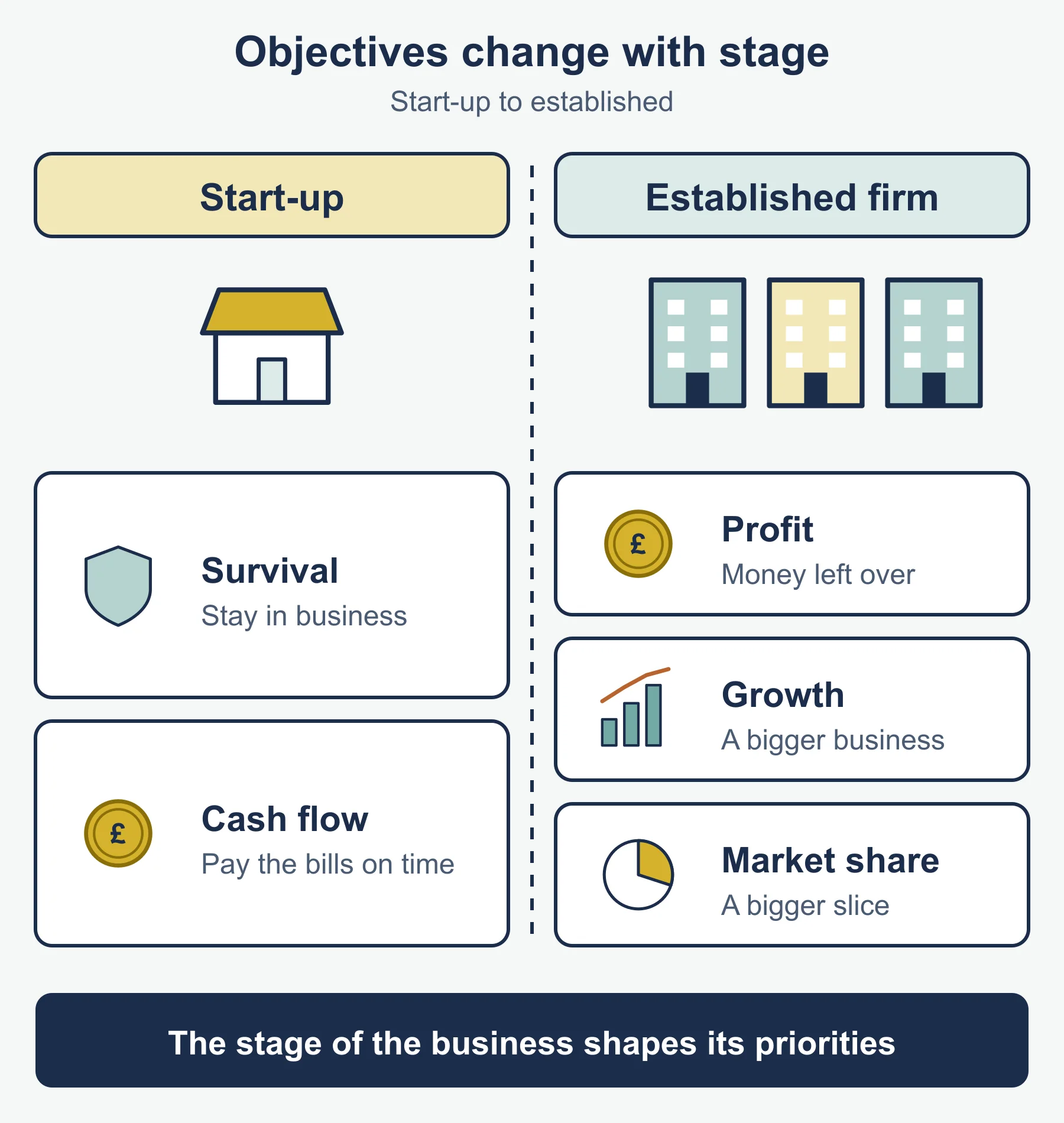
| Survival | Staying in business | Typical for new firms, tough markets and recessions |
| Growth | Becoming bigger | Measured by sales revenue, employees or outlets |
| Profit | Sales revenue minus total costs | Paid to owners or reinvested in the business |
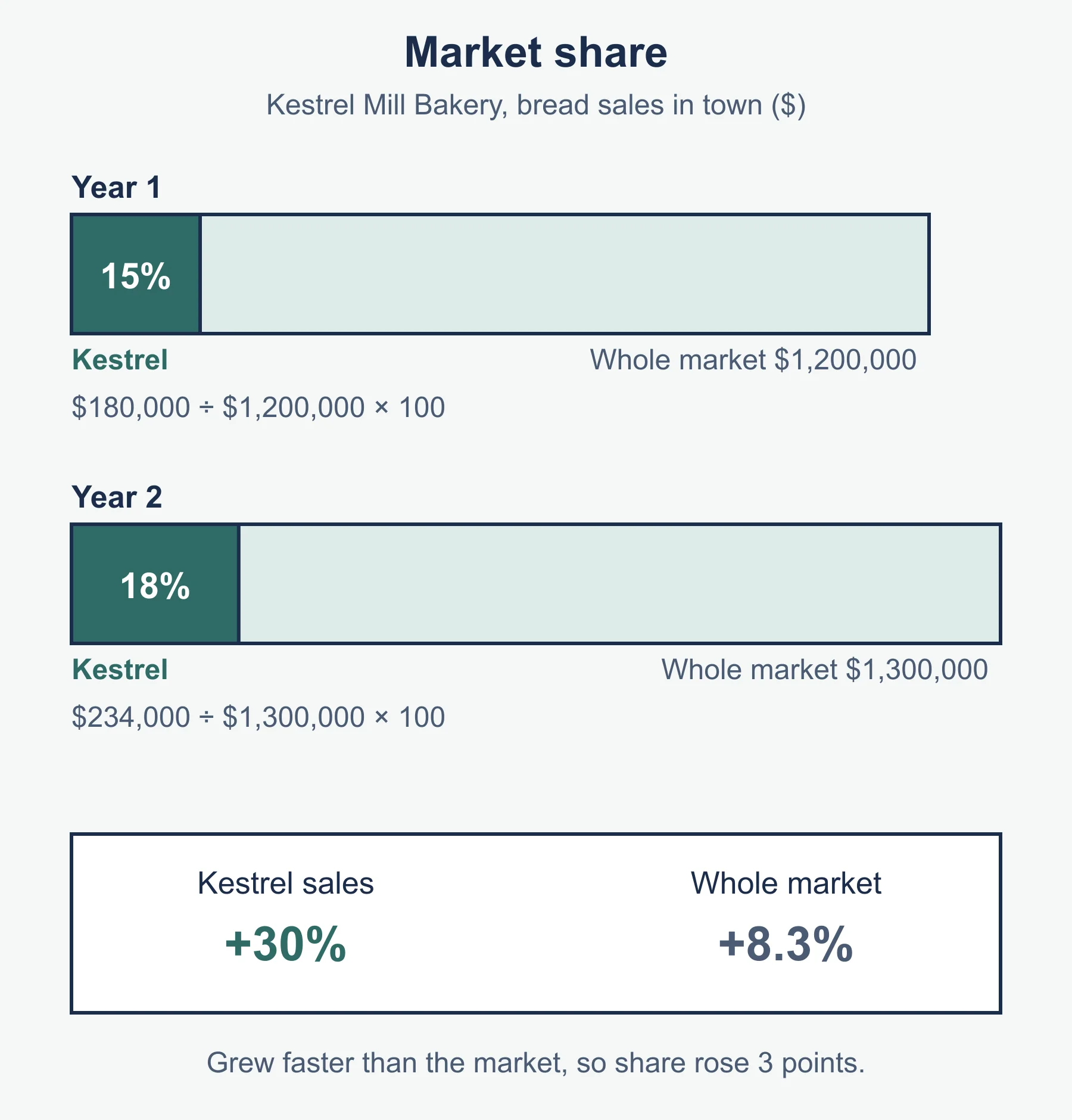
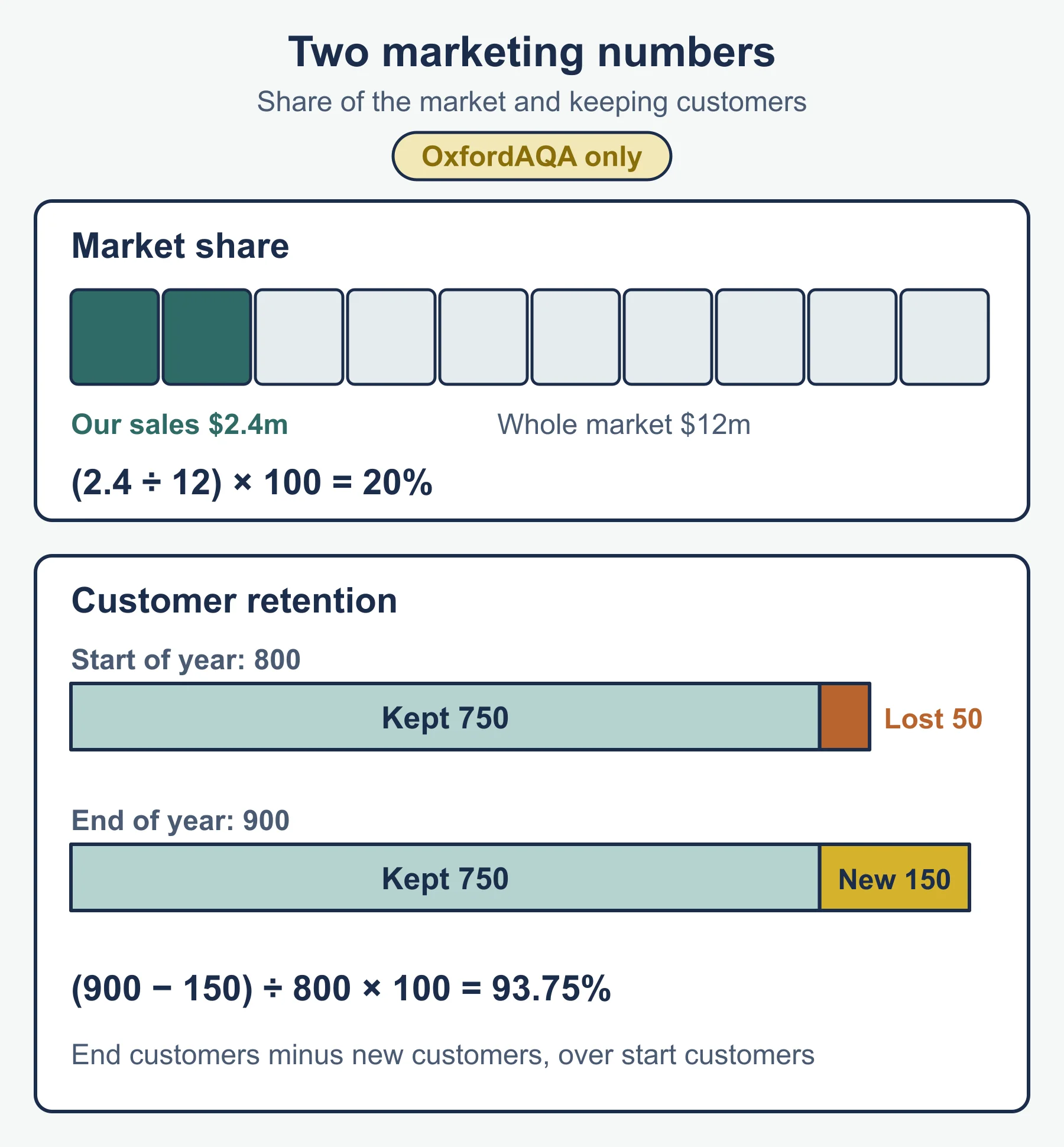
| Market share | Part of the whole market held by one business | A percentage, so it needs the market total |
The syllabus gives the examples survival, growth, profit and market share, with “e.g.” in front. Other objectives can appear in a case study, so apply the same method to any objective you are given.
Market share formula
market share (%) = (sales revenue of a business / total sales revenue for the whole market) × 100
Method in steps:
- Find the business’s sales revenue for the period.
- Find the sales revenue of the whole market for the same period.
- Divide the first by the second.
- Multiply by 100 and write the % sign.
Quick reminder: sales of 60,000 dollars in a market of 400,000 dollars gives 60,000 / 400,000 × 100 = 15%.
Why objectives are important
- They give direction, so everyone works towards the same aim.
- They guide decisions, because choices are tested against the aim.
- They set a target to measure success against.
- They help to motivate and co-ordinate staff and departments.
- They tell stakeholders, such as lenders, what the business is trying to do.
How objectives change
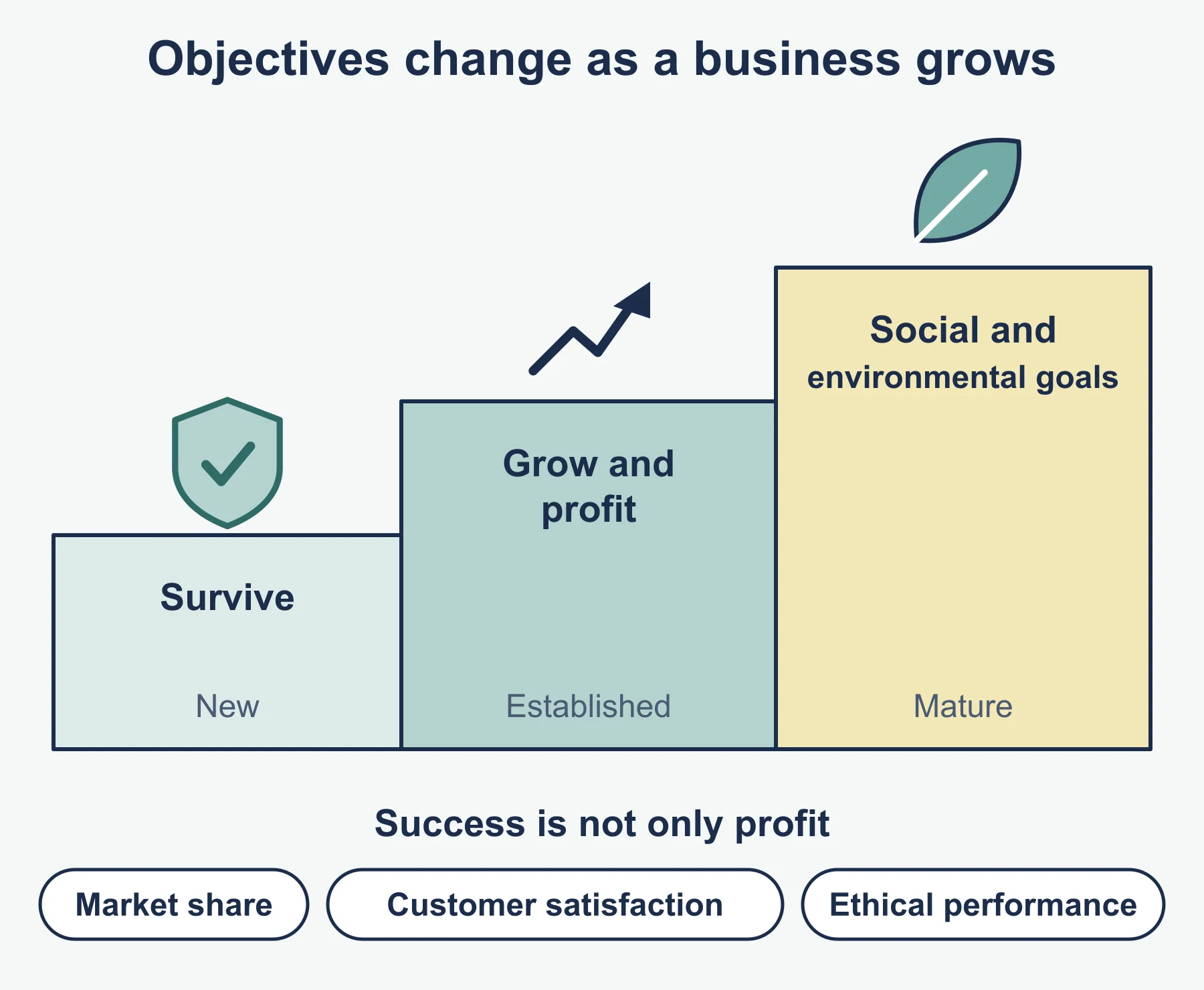
- A new business: survival comes first.
- A secure business: growth, profit and market share become more likely targets.
- A hard economy or new rival: a business may return to survival.
- A rise in the size of the business can move the objective from “enough profit” to “more growth”.
1.5.2 Stakeholder groups
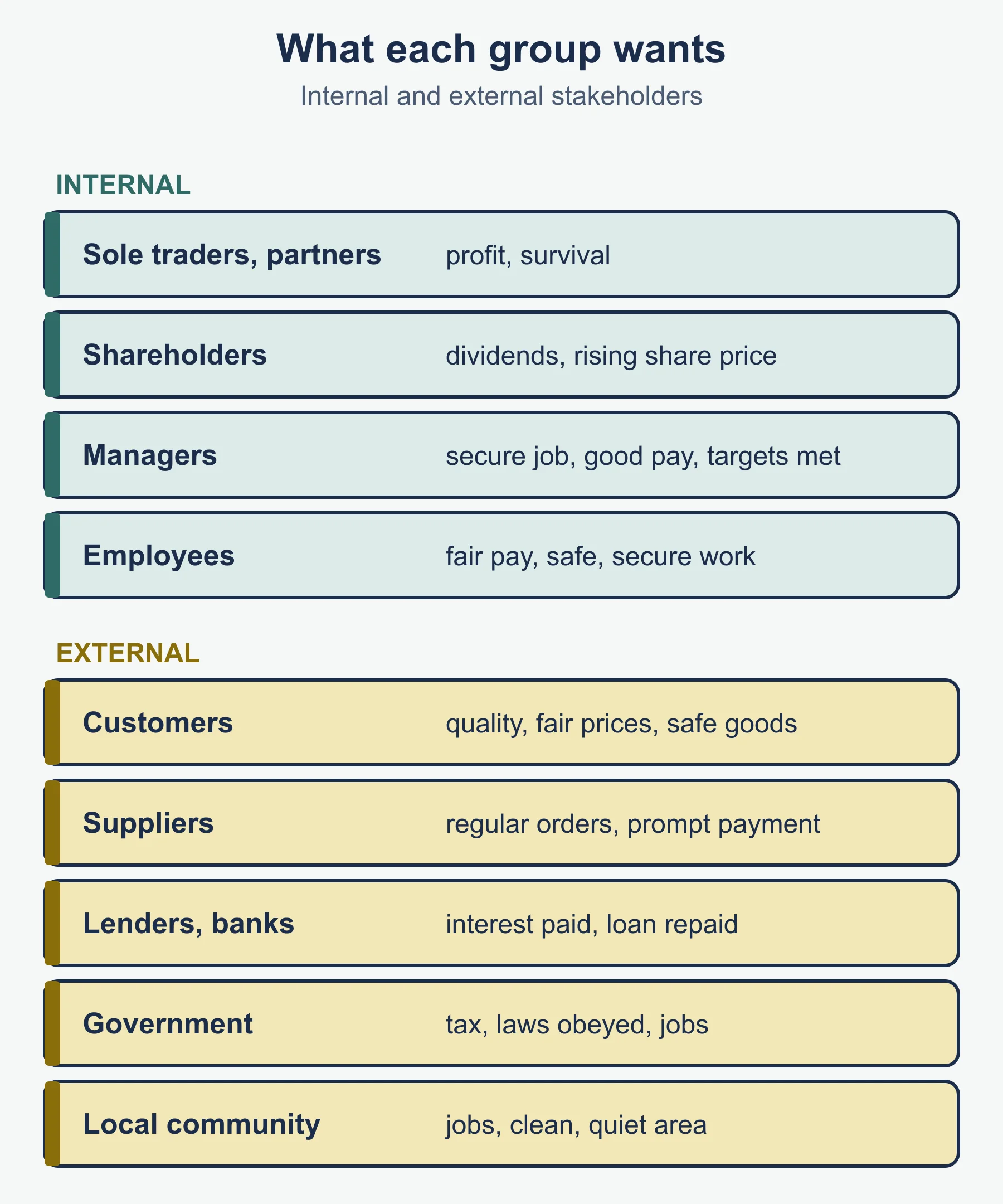
| Group | Internal or external | Main objectives |
|---|---|---|
| Owners (sole traders, partners) | Internal | Profit, survival, personal income |
| Owners (shareholders) | Internal | Dividends, rising share price, growth |
| Managers | Internal | Secure job, pay, targets met, status |
| Employees | Internal | Fair pay, job security, good conditions, training |
| Customers | External | Quality, fair price, reliability, safety |
| Suppliers | External | Regular orders, prompt payment, fair prices |
| Lenders/banks | External | Interest paid and loan repaid; a safe, surviving business |
| Government | External | Tax paid, laws followed, jobs, a healthy economy |
| Local community | External | Jobs, a clean and safe area, low noise and traffic |
Must-know distinctions
- Internal and external. Internal groups work in or own the business. External groups deal with it from outside.
- Shareholder and lender. A shareholder owns part of a company and gets dividends. A lender gets interest and the loan back, and has no ownership.
- Owner and manager. In a sole trader or partnership they are often the same people. In a company they are often different, which is a source of conflict.
- Dividend and retained profit. A dividend is profit paid to shareholders. Retained profit stays in the business for reinvestment.
- Sales and market share. Sales grow when the business sells more. Market share grows only if it sells faster than the market grows.
Conflicts between stakeholders
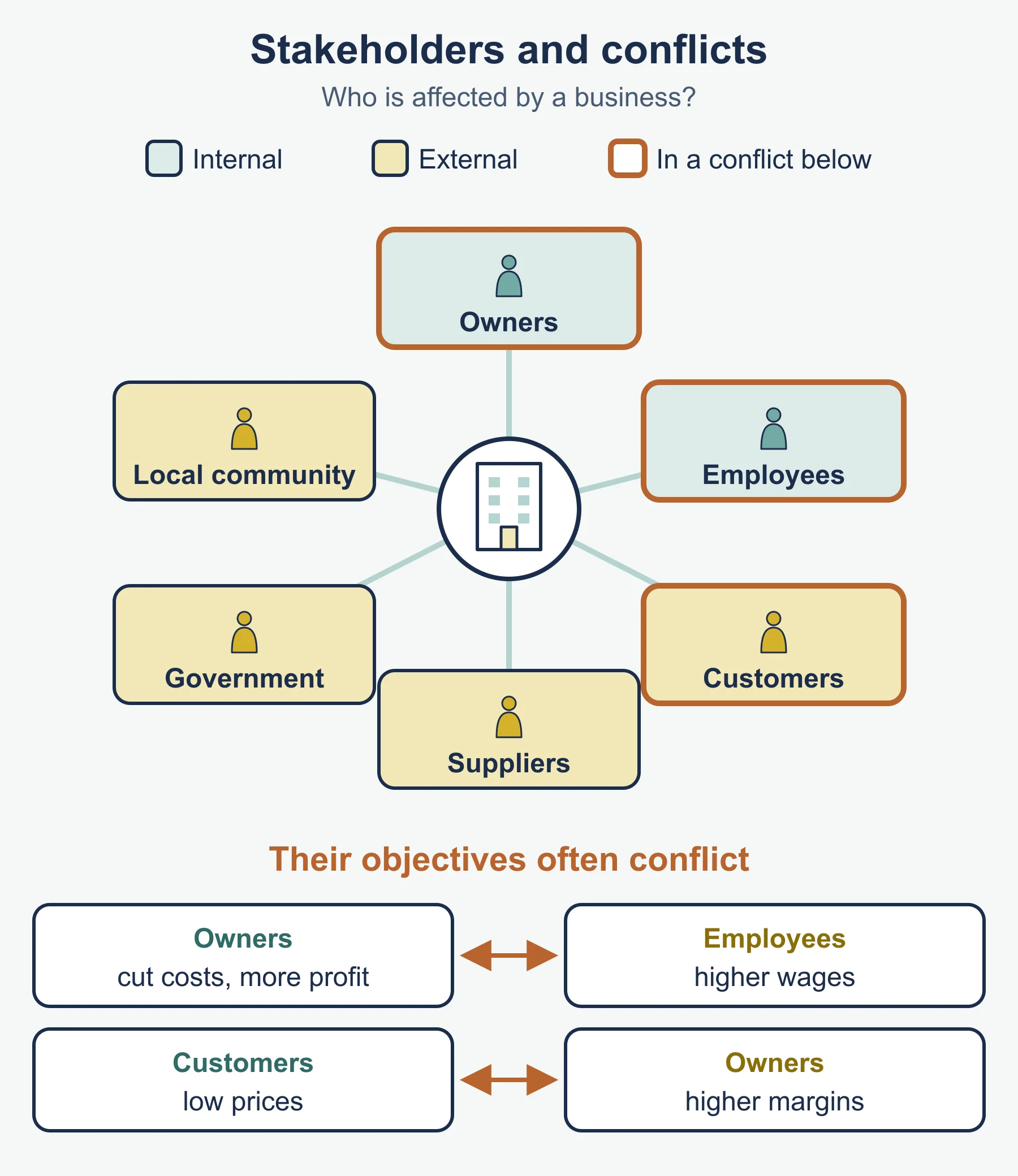
| Pair | Why they conflict |
|---|---|
| Owners and employees | Profit against wages and staff numbers |
| Owners and customers | Higher prices against lower prices or higher quality |
| Shareholders and managers | Dividends against profit kept for growth |
| Owners and suppliers | Low input prices against higher selling prices |
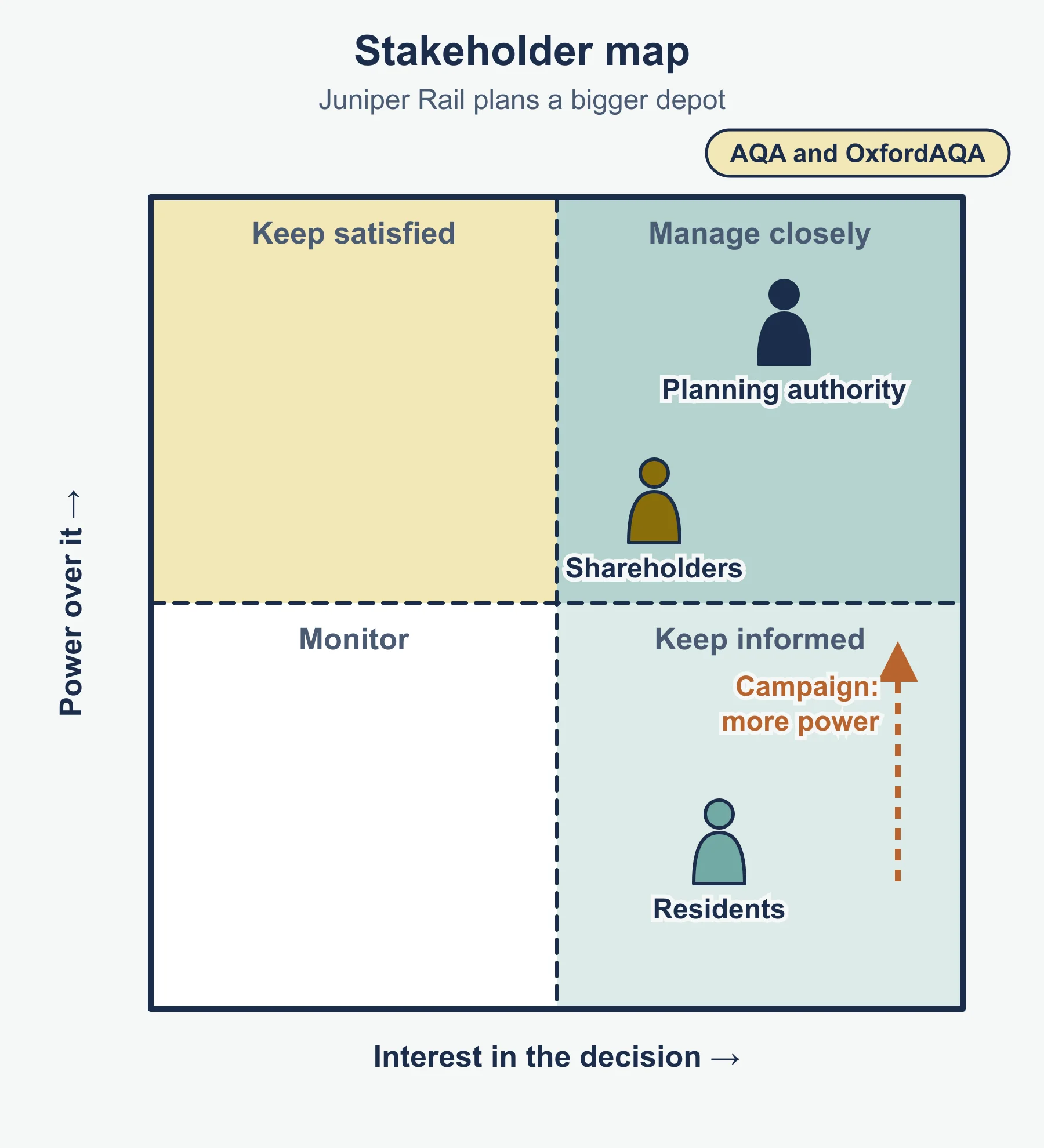
| Local community and owners | Quiet and clean surroundings against expansion |
| Government and owners | Tax and rules against keeping profit and cutting costs |
| Lenders and owners | Safety and repayment against risk taking |
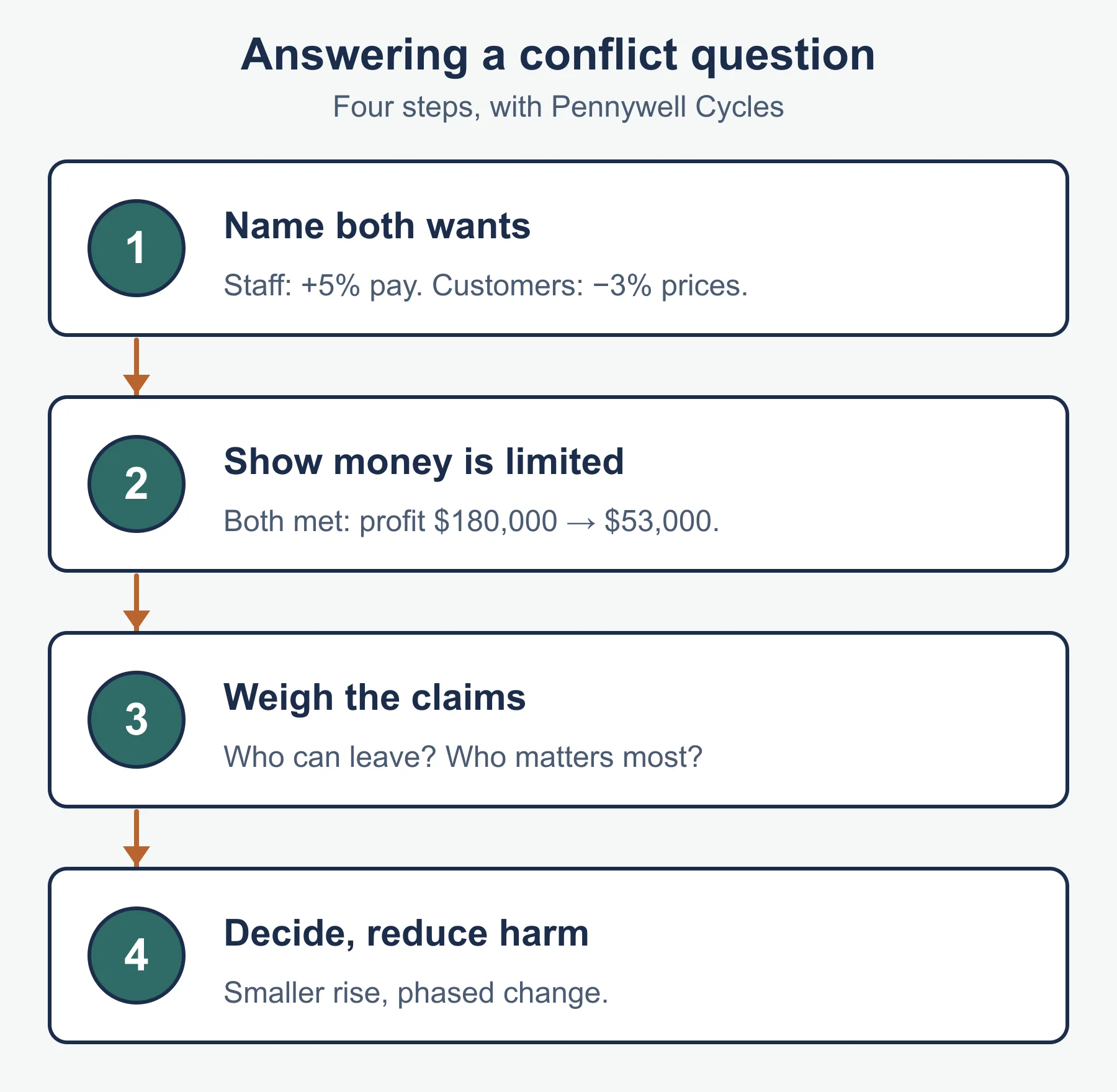
Method in steps for a conflict question:
- State what each of the two stakeholders wants, using details from the case.
- Explain why both cannot be fully satisfied, usually because money, space or time is limited.
- Weigh the claims.
- Give a reasoned decision, and one way to soften the effect on the losing group.
Using the ideas in answers
Command words
These are the command words from the syllabus that matter most here.
| Command word | What it means | How to answer on this topic |
|---|---|---|
| Define | Give precise meaning | One clear sentence, for example what an objective or a stakeholder is |
| State / Identify | Express in clear terms / name or select | Name the objective or group. No explanation needed |
| Outline | Set out the main points | Two or three short points, such as a brief description of a conflict |
| Calculate | Work out from given facts or figures | Show the formula, the numbers and the unit, for example market share as a % |
| Explain | Say why or how, supported by evidence | Make a point, add a “because”, and use the case details |
| Justify | Support a case with evidence or argument | Give a decision, back it with evidence, and show you have weighed the other side |
| Consider | Review and respond to given information | Look at the stakeholders in the case and judge their claims |
Applying objectives to a case study
- Find the stage of the business: new, growing, established or in difficulty.
- Link that stage to the likely objective. A struggling business points to survival. A strong one points to growth or market share.
- Find the stakeholders named in the text and the facts that show what each wants.
- Decide which objective should come first and why.
Worked reminder: a conflict with numbers
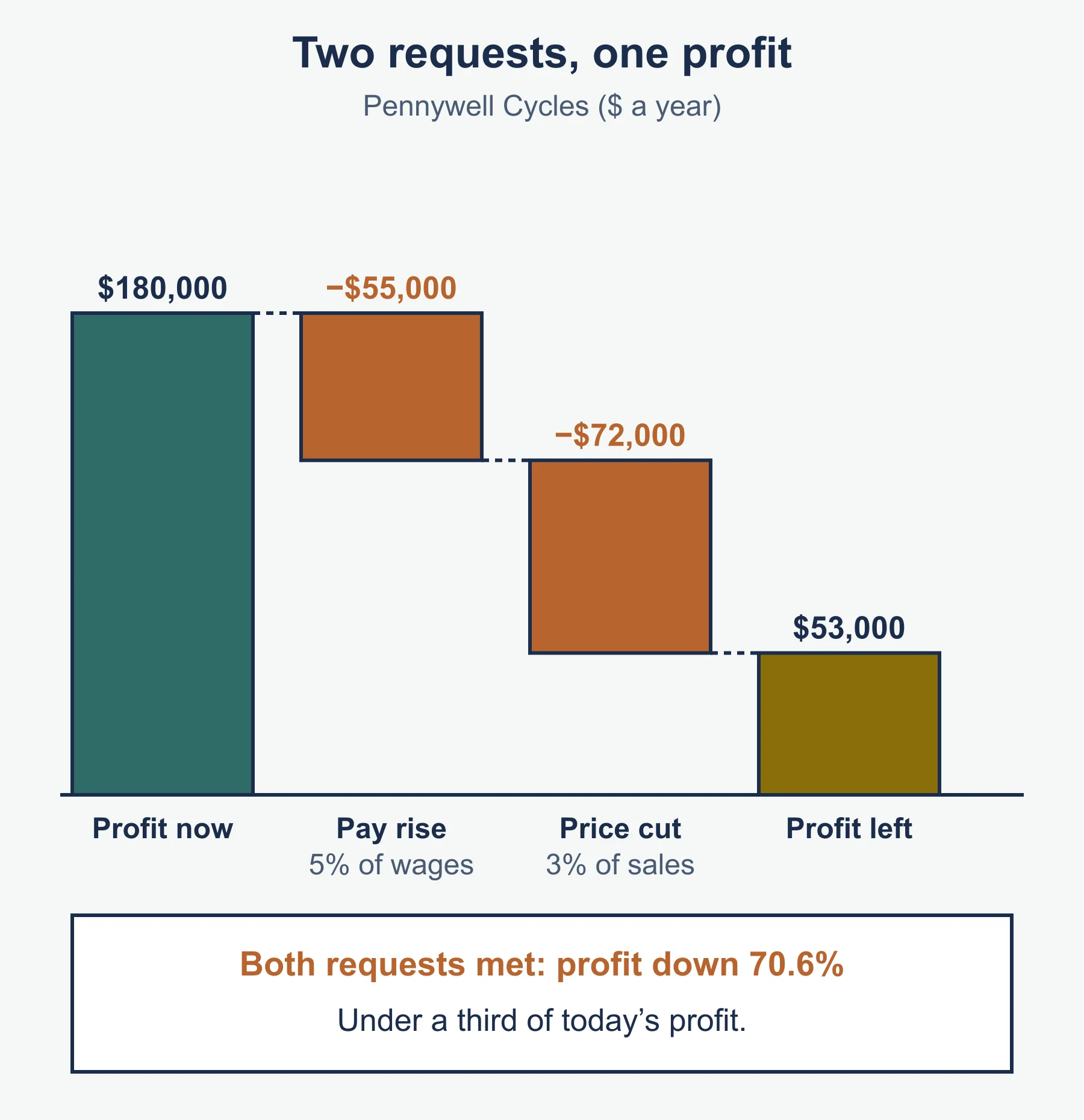
A business has profit of 80,000 dollars and sales revenue of 1,000,000 dollars. Customers ask for a 5% price cut. Assume the number of items sold stays the same.
- Revenue lost = 5% × 1,000,000 = 50,000 dollars.
- New profit = 80,000 − 50,000 = 30,000 dollars.
- Fall in profit = 50,000 / 80,000 × 100 = 62.5%.
- Conclusion: customers gain, but the owners lose most of their profit, so the two groups conflict. Lenders would also take more care, because less profit means less margin to repay a loan.
Stakeholder objectives by owner type
- Sole trader. The owner and the manager are the same person, so personal income and survival are close together.
- Partnership. Each partner wants profit, but partners can disagree about how much to take out and how much to reinvest.
- Shareholders in a company. They are owners but may not run the business. They want dividends and a rising share value, and they rely on managers to deliver both.
Quick self-test
- Define the term business objective.
- State two examples of business objectives.
- Norcastle Printers has sales revenue of 90,000 dollars in a market worth 750,000 dollars. Calculate its market share.
- A year later Norcastle’s sales revenue is 105,000 dollars and the market is worth 700,000 dollars. Calculate the new market share and state whether it has risen or fallen.
- Identify the three internal stakeholder groups named in the syllabus.
- Identify the five external stakeholder groups named in the syllabus.
- State one objective of a local community.
- Explain why a lender is more interested in survival than in rapid growth.
- A company makes a profit of 50,000 dollars and pays 40% of it as dividends. Calculate the dividend total.
- Outline one conflict between shareholders and managers.
Answers
- A target a business sets itself and aims to achieve.
- Any two of: survival, growth, profit, market share.
- 90,000 / 750,000 × 100 = 12%.
- 105,000 / 700,000 × 100 = 15%. It has risen by three percentage points.
- Owners (sole traders, partnerships, shareholders), managers and employees.
- Customers, suppliers, lenders/banks, government and the local community.
- Any one of: jobs, a clean and safe area, low noise and traffic.
- A lender wants its interest paid and its loan repaid. A business that survives can keep paying. Fast growth often needs more spending and can add risk of non-payment.
- 40% × 50,000 = 20,000 dollars.
- Shareholders may want profit paid out as dividends while managers may want it kept to fund growth, so the money cannot be used both ways.
Where marks are usually lost
- Naming a stakeholder group but not giving its objective.
- Writing that “profit” is the only objective.
- Giving a market share answer without the % sign, or dividing by the wrong total.
- Mixing up internal and external groups, especially putting customers or suppliers in the internal list.
- Describing what a stakeholder wants in general terms instead of using the details in the case.
- Stating a conflict without showing why both sides cannot win.
- Writing a one-sided answer when the question asks you to justify a decision.
- Treating shareholders as lenders or lenders as owners.
- Repeating the same point in different words when two separate points are needed.
Frequently asked questions
What objectives can a business have? The syllabus gives survival, growth, profit and market share as examples, and a business can have several objectives at once.
Why do business objectives change over time? A new business usually puts survival first; once it is secure, growth, profit and market share become more likely targets. A hard economy or a new rival can push a business back towards survival.
What is the difference between a shareholder and a lender? A shareholder owns part of a company and may receive dividends. A lender, such as a bank, does not own the business and wants its money repaid with interest.
What is the difference between growth in sales and growth in market share? Sales grow when the business sells more. Market share grows only when the business’s sales rise faster than the whole market’s sales.
Official syllabus
Cambridge IGCSE Business 0264 syllabus for examination in 2027, 2028 and 2029, published by Cambridge University Press and Assessment (Cambridge International Education). Section 1.5 lists business objectives and the role of stakeholder groups; the market share formula appears in the syllabus list of formulas and ratios.
Get free revision emails (optional)
Occasional emails with practice questions, worked explanations and links to free resources for the qualification and subjects you choose. No spam, and you can unsubscribe from any email. The free tools on this site never need an email.
Related resources
-
Study guides
IGCSE Business: Enterprise, business growth and size (Cambridge 0264)
A full study guide to Cambridge IGCSE Business 0264 section 1.3: entrepreneurs, business plans, measuring size, growth, small firms, success and failure.
Business · Cambridge · IGCSE
Read guide -
Practice questions
IGCSE Business: Enterprise, business growth and size (Cambridge 0264) – Practice Questions
Twelve original practice questions with worked answers on Cambridge IGCSE Business 0264 section 1.3: enterprise, business plans, size and growth.
Business · Cambridge · IGCSE
Try questions -
Revision notes
IGCSE Business: Enterprise, business growth and size (Cambridge 0264) – Revision Notes
Revision notes for Cambridge IGCSE Business 0264 section 1.3: entrepreneurs, plans, business size, growth, small firms and failure, plus a self-test.
Business · Cambridge · IGCSE
Revise topic
Related articles
-
teaching
A Level tuition in Dubai: Cambridge or Pearson Edexcel International A Level?
Schools in Dubai and Abu Dhabi teach either Cambridge International AS & A Level or Pearson Edexcel International A Level. How the two are structured, why it matters for tuition, and how online classes from Lahore work.
9 October 2026
-
curriculum guides
Choosing subjects at IGCSE and A Level
How subject choices at 14 and 16 affect university options later, and how to keep pathways open without overloading a timetable.
28 July 2026
Studying this with a teacher
Working through Business IGCSE?
This page is free and stays free. If you would rather be taught it, Marlbridge runs Business classes one-to-one and in small groups of up to 15, online in your own time zone. The first trial class is free. WhatsApp replies within an hour (8am–11pm Pakistan time, every day); email the same day.
Cambridge Business teachers at Marlbridge

