
Study Guides
IGCSE Business: Economic issues (Cambridge 0264)
Study guide to the business cycle, taxes, government spending and interest rates for Cambridge IGCSE Business 0264, with worked examples.
- Subject
- Business
- Level
- IGCSE
- Topic
- External influences on business activity
- Author
- Marlbridge Academic Team
- Updated
- Reviewed by
- Salman Ahmad (what this means)
Aligned to Cambridge IGCSE Business (0264), For examination in 2027, 2028 and 2029. Official specification .
Syllabus page (what it covers and how it is assessed): Cambridge IGCSE Business.
Syllabus points this page covers
0264
- 6.1 Economic issues
Found an error? Report a correction.
Need help with this topic? Request a free trial class for IGCSE Business (0450 / 0264).
This guide covers section 6.1, Economic issues, of the Cambridge IGCSE Business 0264 syllabus for examination in 2027, 2028 and 2029. It follows syllabus points 6.1.1 (Business cycle) and 6.1.2 (Effects of government policy). All candidates study the same content. The syllabus says both papers are based on all the subject content, so this topic can appear in short answers, data responses and case studies. For quick recall use the revision notes, then test yourself with the practice questions. The course hub, the printable checklist and the free diagnostics help you plan your revision.
All businesses and figures here are invented. Money is in dollars, and tax rates are made up to keep the arithmetic clean. Real tax systems differ between countries, so this guide describes taxes in general terms.
What this section covers
| Syllabus point | What you must be able to do |
|---|---|
| 6.1.1 main stages of the business cycle | Name growth, boom, recession and slump and describe each |
| 6.1.1 how each stage may affect a business | Explain the effect of each stage on demand, sales, costs and decisions |
| 6.1.1 employment, inflation and economic growth | Explain how changes in each affect a business |
| 6.1.2 changes in taxes on business profit | Explain and calculate the effect on profit kept |
| 6.1.2 changes in taxes on people’s income | Explain the effect on spending and on demand |
| 6.1.2 changes in government spending | Explain the effect on different businesses |
| 6.1.2 changes in interest rates | Explain the effect on borrowing, customers and costs |
| 6.1.2 business responses to taxes and interest rates | Suggest and judge sensible responses |
The business cycle
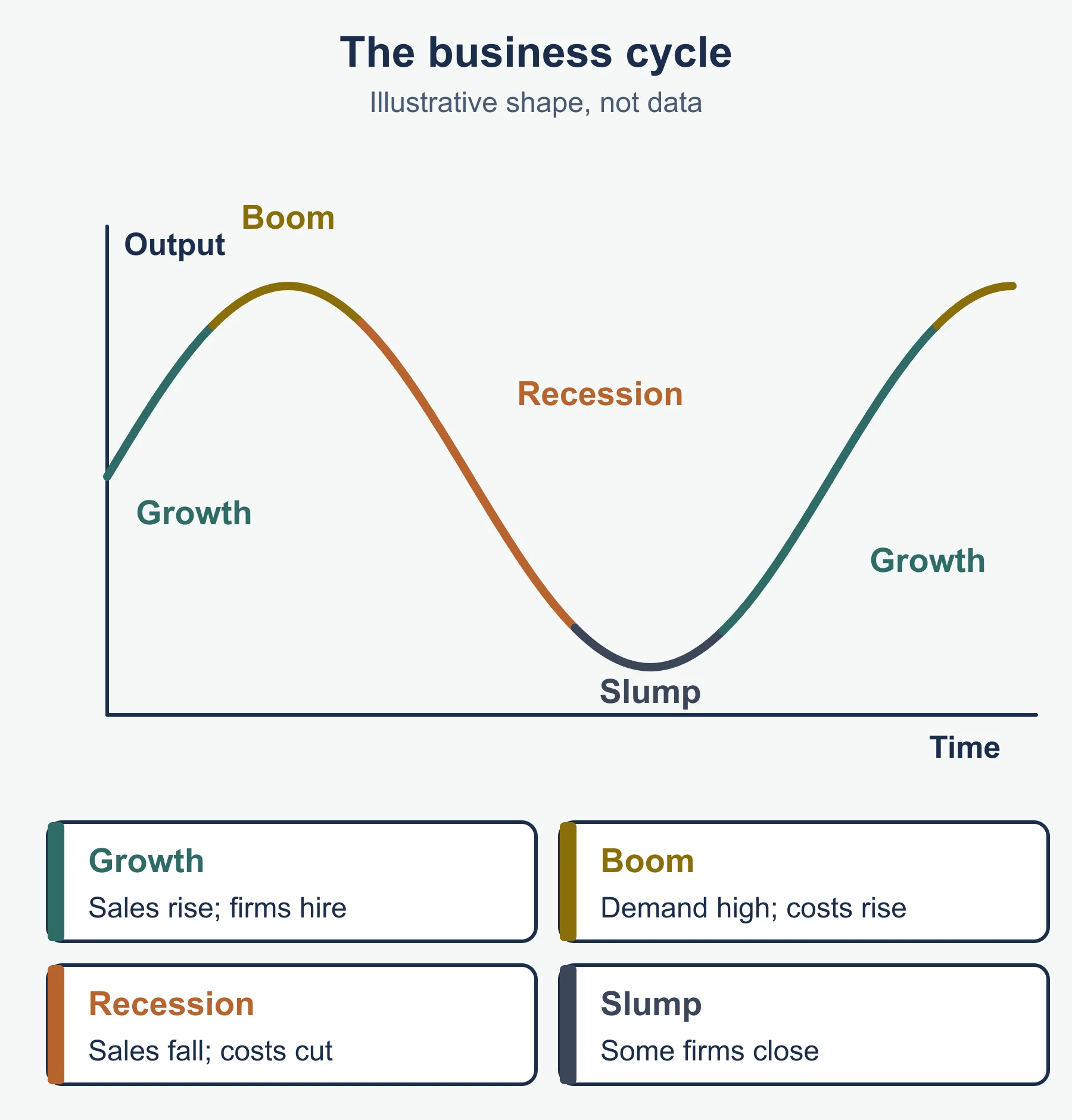
The economy does not grow at a steady pace. Total output and spending rise for a while, then slow or fall, then recover. This repeating pattern is the business cycle. The syllabus names four main stages.
  output
    |        boom
    |       /     \
    |  growth      \          growth
    |  /             recession  /
    | /                  \    /
    |/                    slump
+---------------------------------- time| Stage | What is happening in the economy | Typical effect on a business |
|---|---|---|
| Growth | Output and incomes rise at a healthy pace; unemployment falls | Sales rise; firms invest and hire |
| Boom | Output and spending are at their highest; jobs are easy to find; prices tend to rise faster | Very high demand; capacity is stretched; costs and prices rise |
| Recession | Output falls; unemployment rises; people spend less | Sales fall; firms cut costs, hiring and investment |
| Slump | Output stays low for a long time; unemployment is high; confidence is weak | Many sales are lost; some firms close; survival is the aim |
Use these descriptions as the standard picture. Real economies are untidy, and a question may give you data instead of a label. Your job is then to match the data to the stage and explain what it means for the business in the case.
How each stage may affect a business
The effect depends on what the business sells.
- Growth. Incomes rise, so customers buy more. A business can raise output, take on staff and invest. The risk is expanding too fast and being left with spare capacity when growth ends.
- Boom. Demand is strong and a business may raise prices without losing many customers. Problems appear on the cost side: wages, materials and rents tend to rise, and skilled staff are hard to find. A firm may struggle to meet orders.
- Recession. Demand falls, especially for goods people can delay buying, such as furniture or holidays. Stocks build up, cash flow weakens and some customers pay late. Businesses often cut prices, run promotions, cut costs or delay investment.
- Slump. The same pressures last longer and are harder to fight. Firms that cannot cover their costs may close. Those that survive often focus on cash flow, cheaper product ranges and loyal customers.
Not every business suffers equally. Demand for goods bought only when people feel well off (luxury goods) tends to fall faster in a recession than demand for basic goods. A discount supplier may even gain customers when others struggle.
Employment, inflation and economic growth
The syllabus also asks about changes in three measures of the economy.
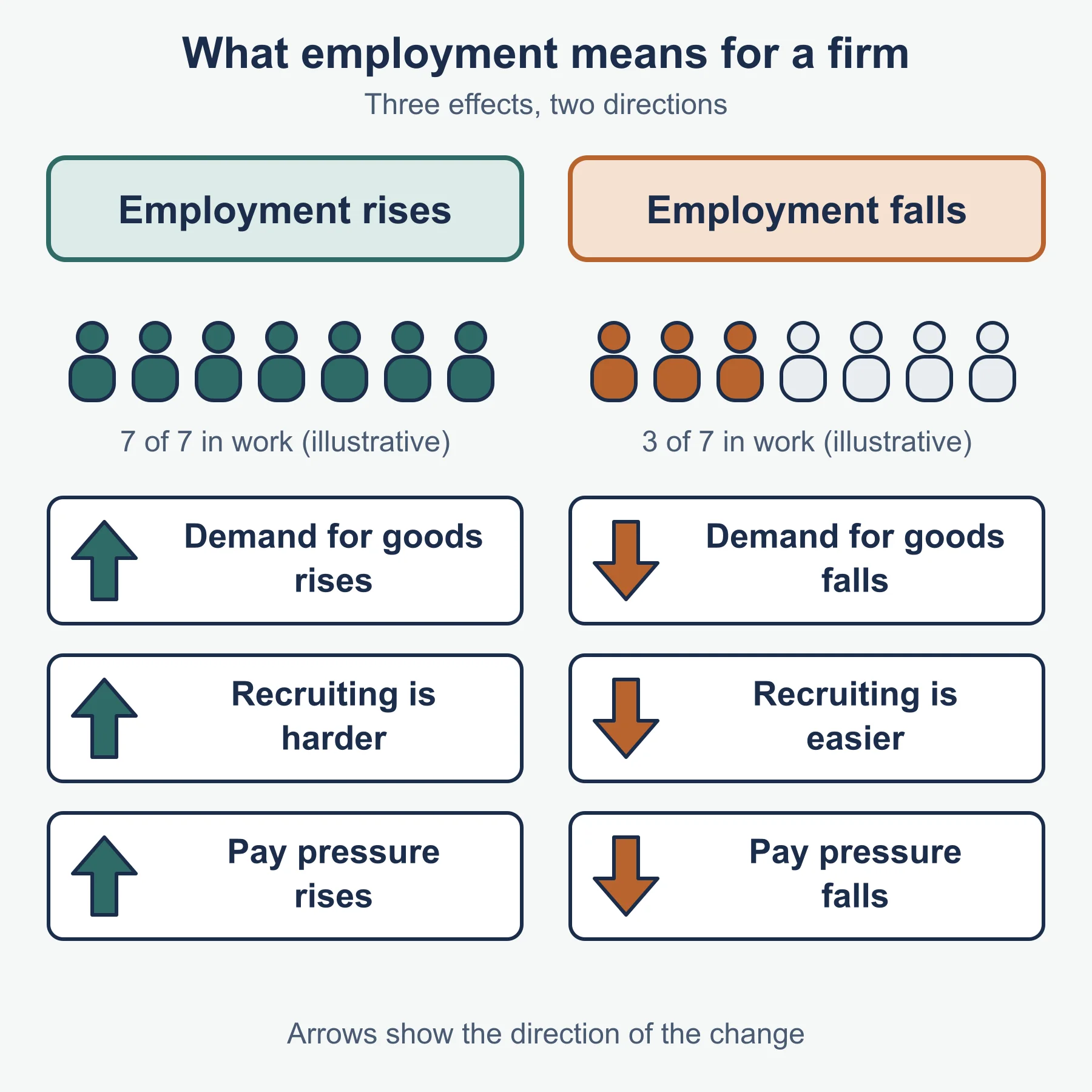
Employment. When more people are in work, they have more income to spend, so demand rises. The business also finds it harder to recruit and may have to raise wages. When unemployment rises, demand falls but recruitment is easy and wage pressure is lower.
Inflation. Inflation is a general rise in prices over time, usually shown as a percentage a year. Its effects on a business include:
- costs rise (materials, energy, wages), so profit margins fall unless prices rise too
- customers’ money buys less, so they may cut back or switch to cheaper brands
- the business has to change prices more often and plan with less certainty
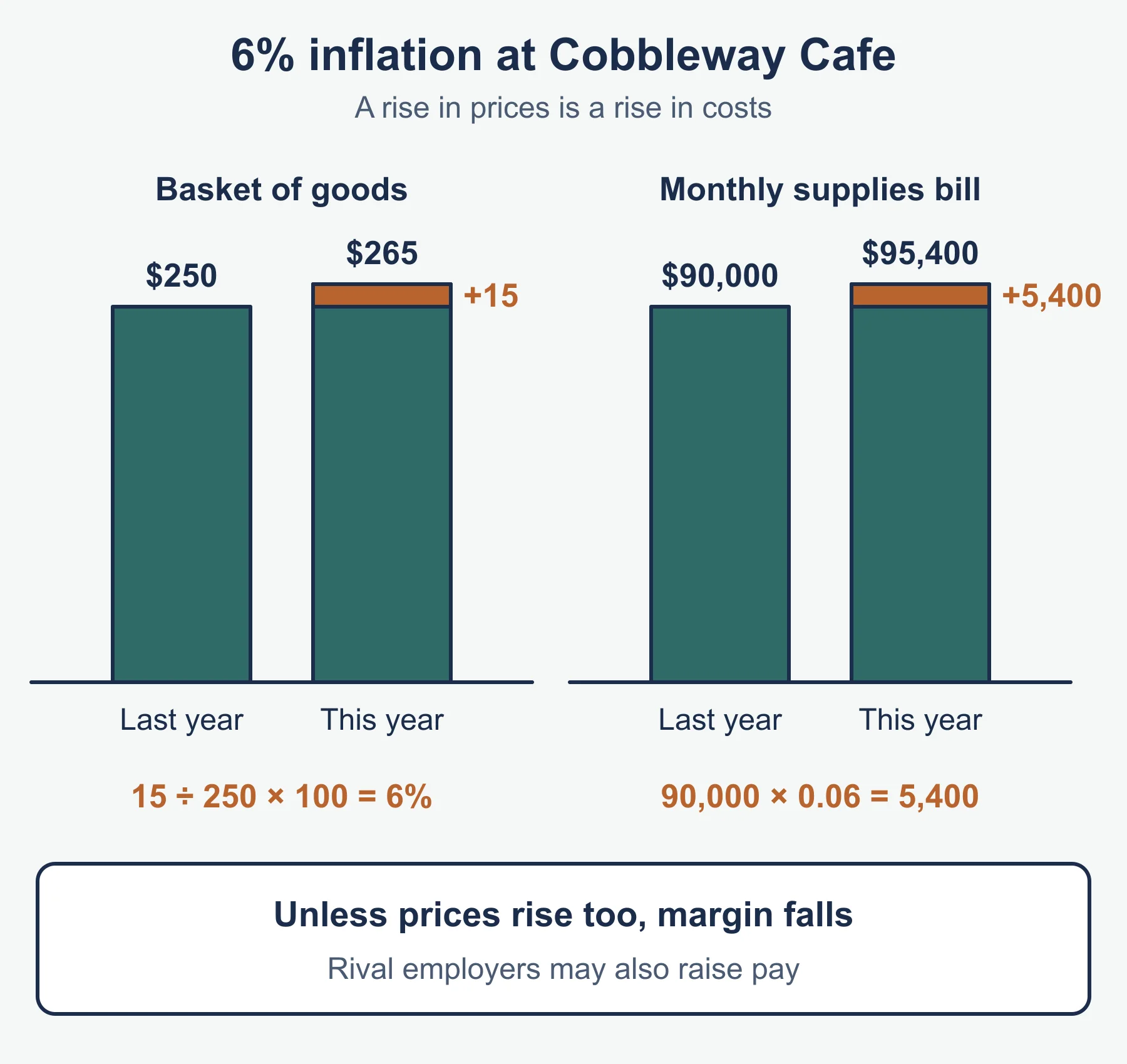
A simple measure: a basket of goods costs 250 dollars last year and 265 this year. The rise is 15, so inflation is 15 / 250 × 100 = 6%.
Economic growth. Economic growth is an increase in the output of the whole economy over time. Rising incomes mean more demand, especially for non-essentials, so a business can expand. Slow or negative growth means weaker sales and a greater chance of price cutting.
Worked example: reading the cycle
Cobbleway Cafe sells coffee and light meals in a city centre. Newspaper reports say the economy is growing, unemployment is falling and prices are rising at 6% a year. Its monthly supplies bill is 90,000 dollars.
- The economy is growing and unemployment is falling, so the stage is growth, perhaps moving towards a boom.
- More people have jobs and incomes, so footfall and spending should rise. The cafe can plan extra opening hours.
- Inflation at 6% raises the supplies bill by 90,000 × 0.06 = 5,400 dollars, to 95,400. If the cafe does not raise prices, its profit margin falls by that amount.
- Falling unemployment means other employers are hiring, so the cafe may need to raise pay to keep its staff.
A good conclusion: demand is helpful, but the cafe should raise prices carefully to cover the higher costs without losing customers.
Effects of government policy
Governments use taxes, spending and interest rates to influence the economy. The syllabus asks for the effects of changes in each on businesses.
Taxes on business profit
A tax on profit is paid by a business on the profit it makes. The profit left after tax is what the owners can take out or reinvest. A rise in the rate reduces profit after tax; a fall increases it.
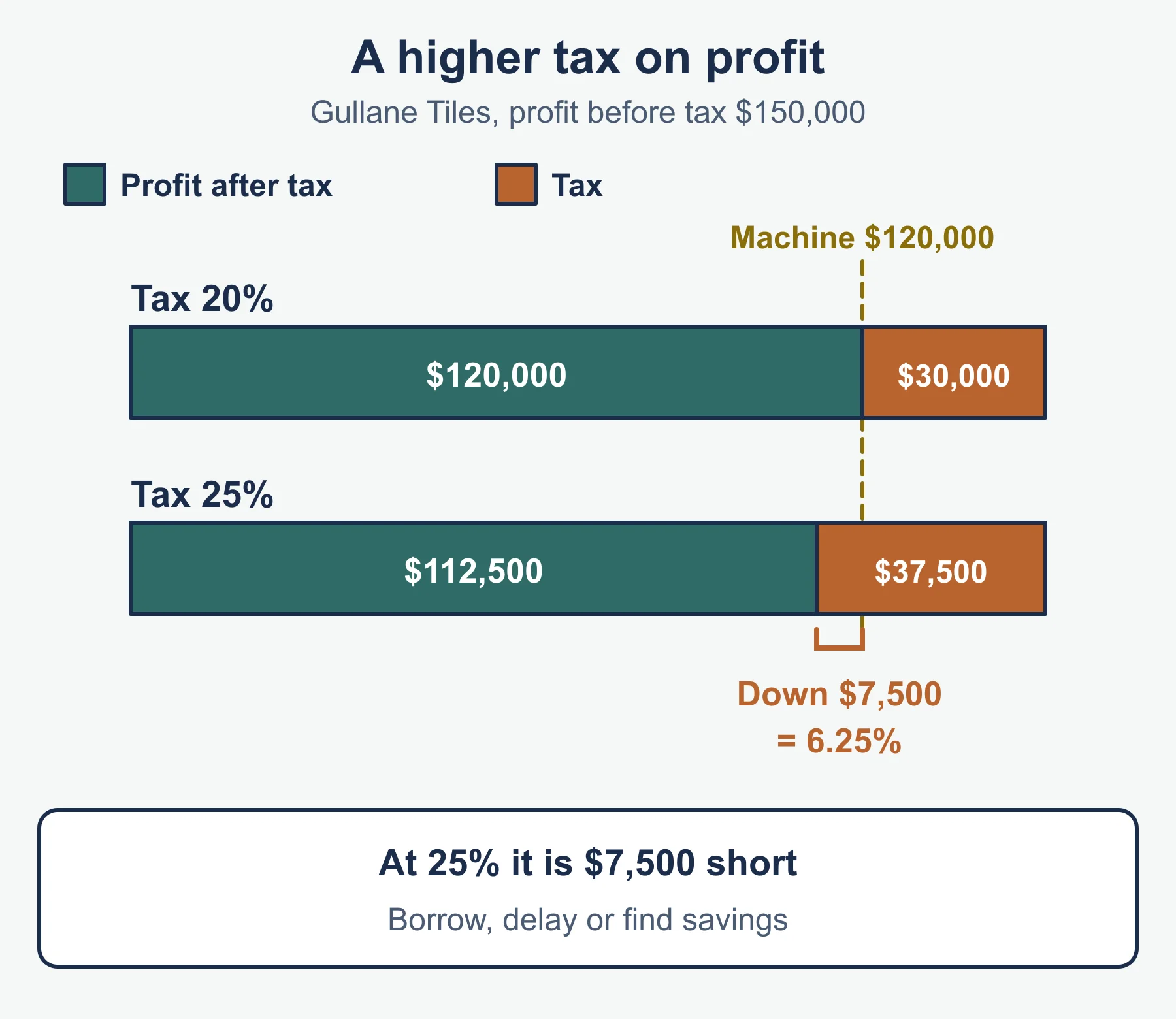
Worked example. Gullane Tiles makes a profit before tax of 150,000 dollars. The tax rate is 20%.
Tax at 20%        = 150,000 x 0.20 = 30,000
Profit after tax  = 150,000 - 30,000 = 120,000

Tax at 25%        = 150,000 x 0.25 = 37,500
Profit after tax  = 150,000 - 37,500 = 112,500

Fall in profit after tax = 120,000 - 112,500 = 7,500
As a percentage          = 7,500 / 120,000 x 100 = 6.25%
Gullane planned to buy a machine for 120,000 dollars from profit after tax. At 20% it can just afford it. At 25% it is 7,500 short, so it must borrow, delay the purchase or find savings. A higher tax on profit therefore reduces funds for investment, lowers returns to owners and may make a firm less willing to expand. A lower rate does the opposite.
Taxes on people’s income
A tax on income is taken from what people earn. Income after tax is their disposable income, the money they can spend or save.
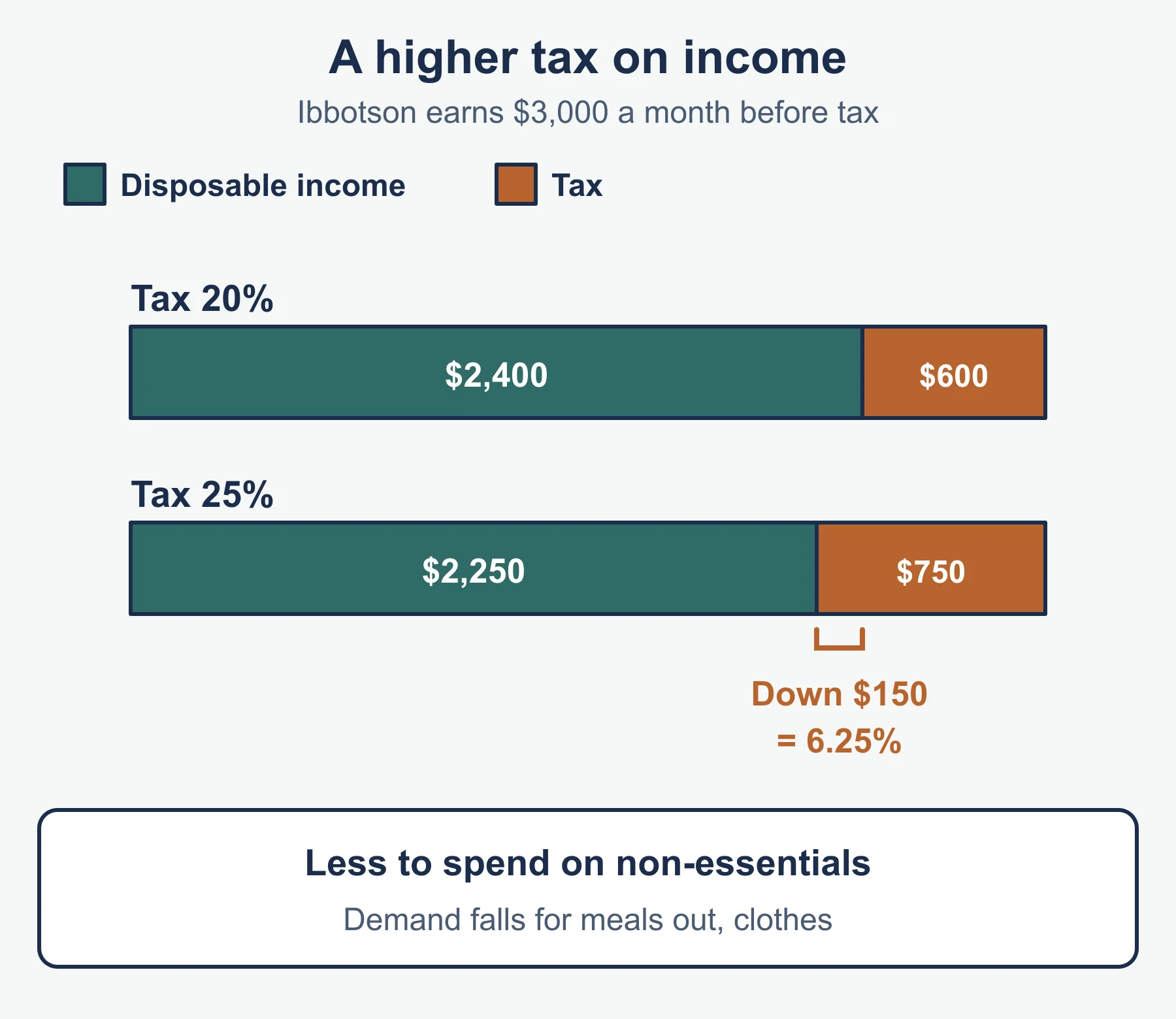
Take an employee, Ibbotson, who earns 3,000 dollars a month before tax.
Tax at 20%  -> keeps 3,000 x 0.80 = 2,400
Tax at 25%  -> keeps 3,000 x 0.75 = 2,250
Fall        = 150, which is 150 / 2,400 x 100 = 6.25%
When income tax rises, disposable income falls and people buy less. Demand falls most for non-essentials such as meals out, new clothes or holidays. When income tax falls, spending tends to rise and businesses selling these goods gain. The effect depends on the business: a bakery selling bread may notice little change, while a firm selling garden furniture may notice a lot.
Government spending
The government spends on services, roads, schools, hospitals and support for people and firms. Changes in this spending reach businesses in several ways.
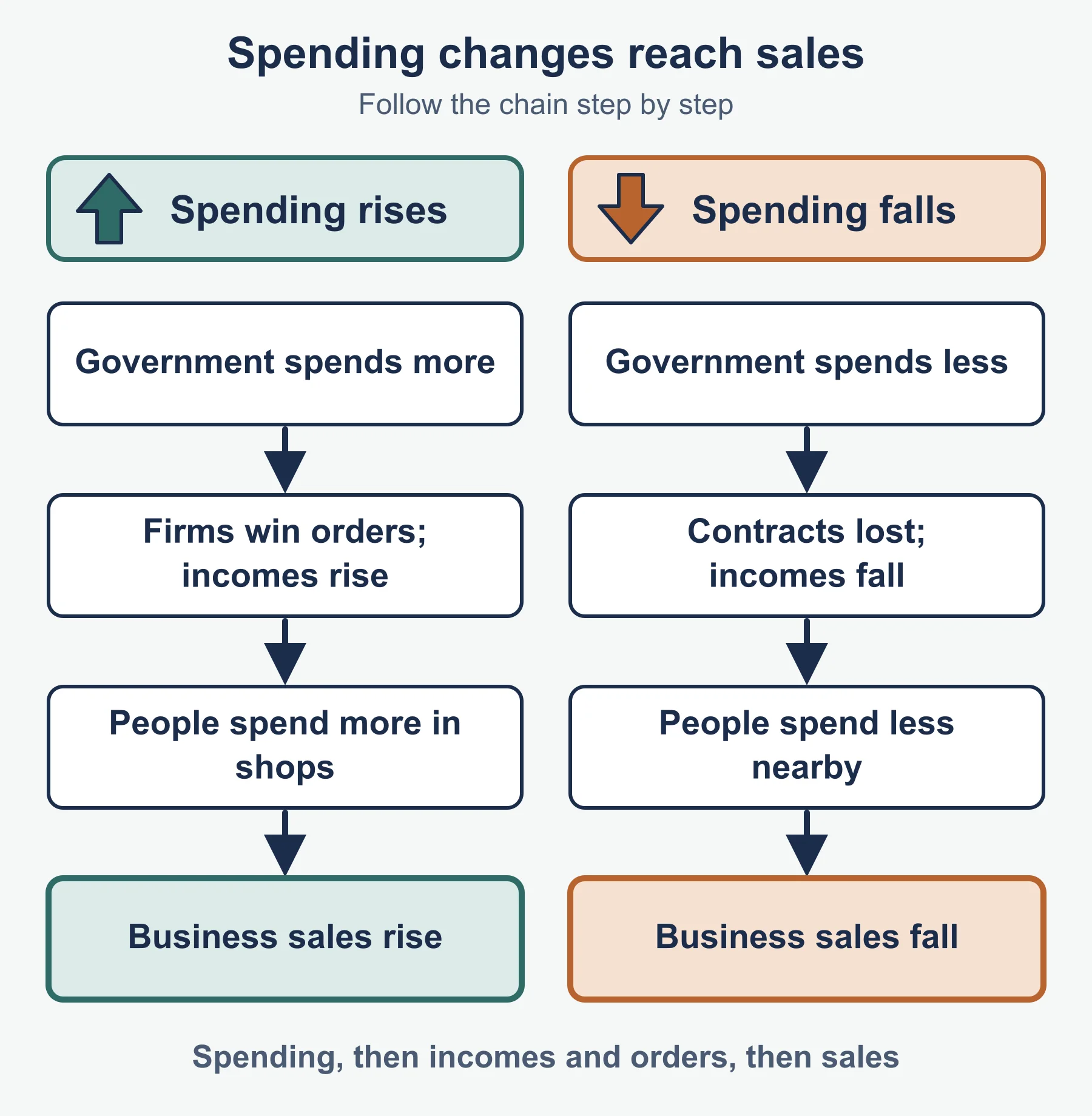
- Higher spending. Construction firms win contracts for roads and buildings. Their suppliers and workers gain, and the workers’ extra income raises demand elsewhere. Spending on benefits or support for people raises their spending power.
- Lower spending. Firms that depend on government contracts lose sales and may cut jobs. Fewer public-sector jobs and lower benefits reduce incomes, so demand can fall in shops and other businesses nearby.
In each case, explain the chain: spending changes, then incomes and orders change, then the business’s sales and decisions change.
Interest rates
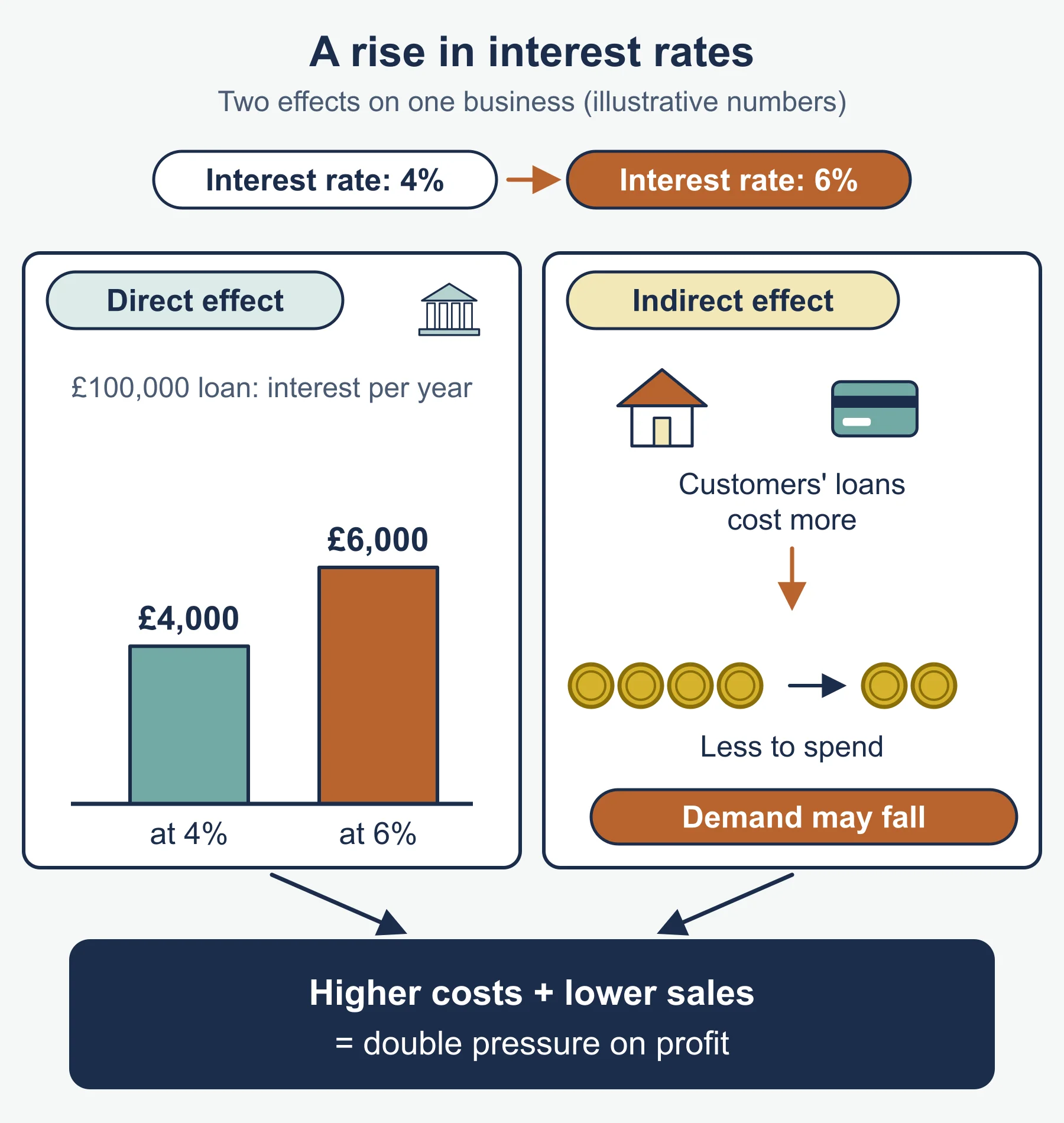
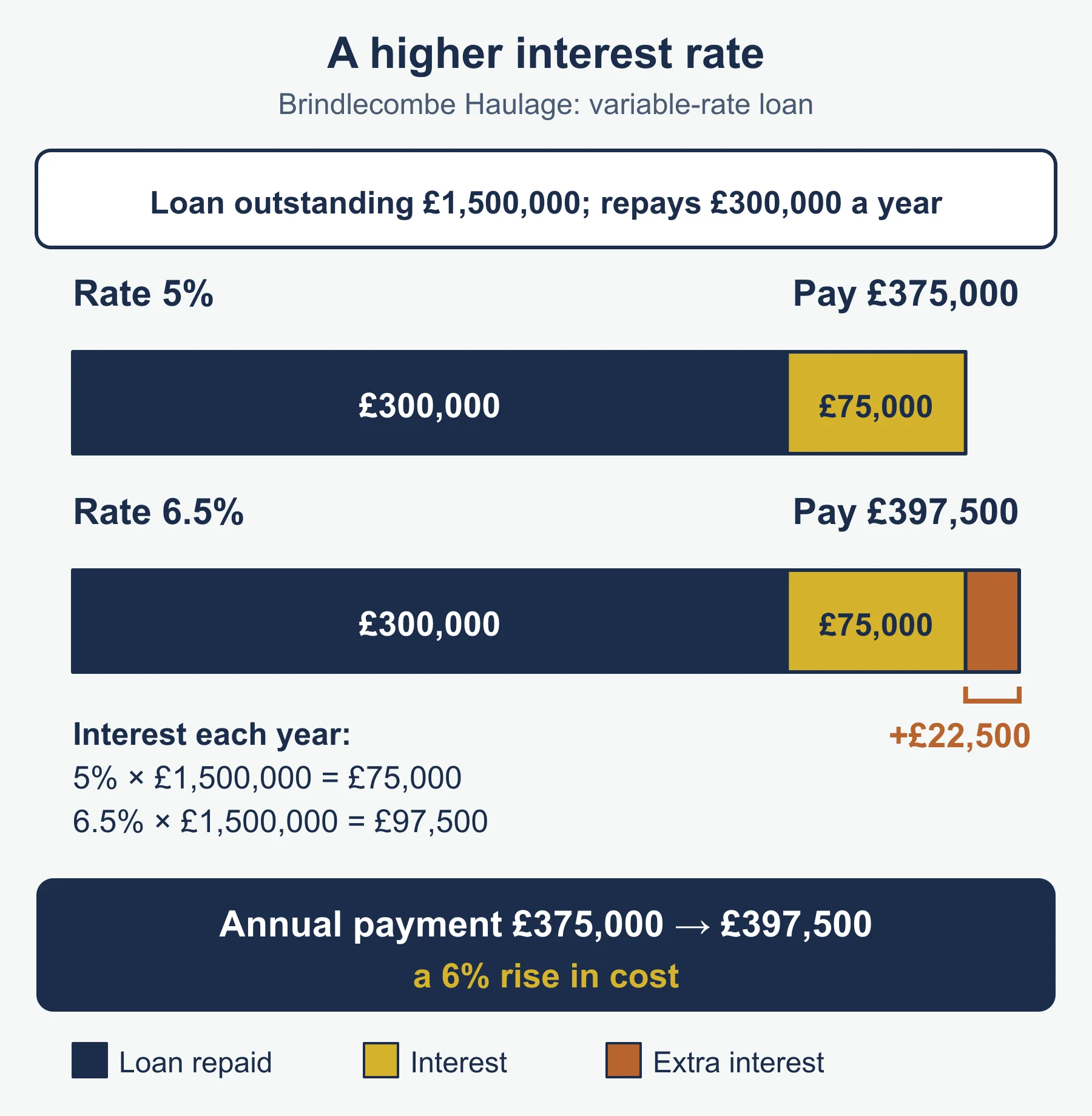
The interest rate is the price paid each year for borrowing money, shown as a percentage of the sum borrowed; savers receive it as a return. A change in the rate affects a business in two ways.
- Its own costs. A business with a loan pays more interest when rates rise. New borrowing becomes more expensive, so fewer investment projects look worthwhile.
- Its customers. Higher rates make loans, credit cards and mortgages dearer, and make saving more attractive. Customers spend less, especially on big purchases bought on credit.
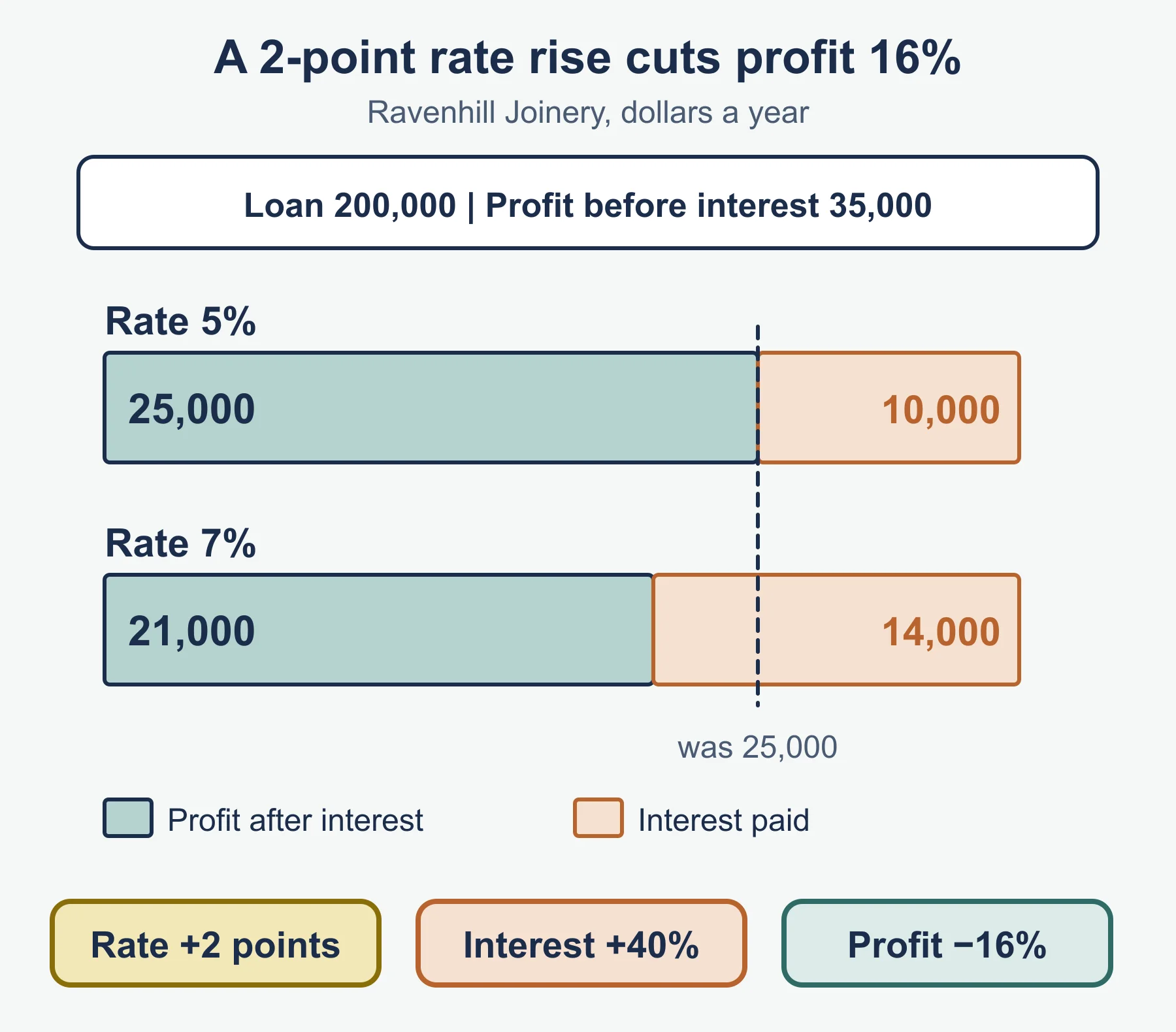
Worked example. Ravenhill Joinery has a loan of 200,000 dollars. Its profit before interest is 35,000 dollars a year.
Interest at 5%   = 200,000 x 0.05 = 10,000   Profit after interest = 25,000
Interest at 7%   = 200,000 x 0.07 = 14,000   Profit after interest = 21,000
Rise in interest = 4,000, which is 40% more
Fall in profit   = 4,000 / 25,000 x 100 = 16%
A 2 percentage point rise in the rate raises the interest bill by 40% and cuts profit by 16%. Ravenhill’s customers also face dearer loans, so demand for new kitchens may fall at the same time. A fall in interest rates works the other way: lower costs, cheaper borrowing for growth, and more customer spending.
How businesses may respond
The syllabus asks how businesses may respond to changes in taxes and interest rates.
| Change | Possible responses |
|---|---|
| Higher tax on profit | Cut costs; raise prices; delay or scale back investment; seek more efficient methods |
| Lower tax on profit | Invest more in equipment and staff; pay owners more; reduce prices to win sales |
| Higher tax on income | Promote lower-priced products; offer discounts; target customers less affected by the change |
| Lower tax on income | Promote higher-value products; increase stock for expected demand |
| Higher interest rates | Repay loans early; use retained profit instead of loans; delay expansion; cut prices to hold sales |
| Lower interest rates | Borrow to expand or replace equipment; refinance existing loans |
A response is only good if it suits the business. Raising prices to pass on a tax cost works if demand is not very sensitive to price. If customers can easily switch, the business may need to cut its own costs instead. Always test your answer against the facts in the case.
Common errors
- Describing the cycle in general terms without saying what it means for the business in the question.
- Treating every business the same. A luxury seller and a basic-goods seller react differently.
- Mixing up tax on profit (paid by the business) with tax on income (paid by individuals).
- Saying that higher interest rates only hurt borrowers. Customers’ spending falls too.
- Listing effects but not saying whether they are large or small for this business. Evaluation needs a judgement.
Frequently asked questions
How does a recession affect a business? In a recession demand falls, especially for goods people can delay buying, such as furniture or holidays. Stocks build up, cash flow weakens and some customers pay late, so businesses often cut prices, run promotions, cut costs or delay investment.
How do higher interest rates affect a business? Higher interest rates raise the cost of the business’s own loans, which cuts profit. They also reduce customer spending, especially on goods bought with loans or credit.
How does government spending affect businesses? Higher government spending can win contracts for firms such as construction businesses and their suppliers, raising incomes and demand. Lower spending means firms that depend on government contracts lose sales and may cut jobs.
What is economic growth? Economic growth is an increase in the output of the whole economy over time. It usually brings rising incomes and more demand, especially for non-essentials.
Official syllabus
This guide follows the Cambridge IGCSE Business 0264 syllabus for examination in 2027, 2028 and 2029, published by Cambridge University Press & Assessment, section 6.1 (Economic issues).
Get free revision emails (optional)
Occasional emails with practice questions, worked explanations and links to free resources for the qualification and subjects you choose. No spam, and you can unsubscribe from any email. The free tools on this site never need an email.
Related resources
-
Practice questions
IGCSE Business: Economic issues (Cambridge 0264) – Practice Questions
Original practice questions with worked answers on the business cycle, taxes, government spending and interest rates for Cambridge IGCSE Business 0264.
Business · Cambridge · IGCSE
Try questions -
Revision notes
IGCSE Business: Economic issues (Cambridge 0264) – Revision Notes
Condensed revision notes on the business cycle, tax, government spending and interest rates for Cambridge IGCSE Business 0264, with a self-test.
Business · Cambridge · IGCSE
Revise topic -
Study guides
IGCSE Business: Business and ethical issues and Pressure groups (Cambridge 0264)
Study guide to ethical issues, how businesses respond, the pros and cons of being ethical and pressure groups, for Cambridge IGCSE Business 0264.
Business · Cambridge · IGCSE
Read guide
Related articles
-
teaching
A Level tuition in Dubai: Cambridge or Pearson Edexcel International A Level?
Schools in Dubai and Abu Dhabi teach either Cambridge International AS & A Level or Pearson Edexcel International A Level. How the two are structured, why it matters for tuition, and how online classes from Lahore work.
9 October 2026
-
curriculum guides
Choosing subjects at IGCSE and A Level
How subject choices at 14 and 16 affect university options later, and how to keep pathways open without overloading a timetable.
28 July 2026
Studying this with a teacher
Working through Business IGCSE?
This page is free and stays free. If you would rather be taught it, Marlbridge runs Business classes one-to-one and in small groups of up to 15, online in your own time zone. The first trial class is free. WhatsApp replies within an hour (8am–11pm Pakistan time, every day); email the same day.
Cambridge Business teachers at Marlbridge

