
Study Guides
IGCSE Business: Legal controls (Cambridge 0264)
A full study guide to Cambridge IGCSE Business 0264 section 3.4: why legal controls protect customers and how they affect marketing decisions.
- Subject
- Business
- Level
- IGCSE
- Topic
- Marketing
- Author
- Marlbridge Academic Team
- Updated
- Reviewed by
- Salman Ahmad (what this means)
Aligned to Cambridge IGCSE Business (0264), For examination in 2027, 2028 and 2029. Official specification .
Syllabus page (what it covers and how it is assessed): Cambridge IGCSE Business.
Syllabus points this page covers
0264
- 3.4 Legal controls
Found an error? Report a correction.
Need help with this topic? Request a free trial class for IGCSE Business (0450 / 0264).
This guide covers section 3.4, Legal controls, of the Cambridge IGCSE Business 0264 syllabus for examination in 2027, 2028 and 2029. It follows the syllabus point 3.4.1, Legal controls related to marketing. All candidates study the same content, and both papers can test it: the syllabus describes Paper 1 as short answer and data response and Paper 2 as a case study. For quick recall use the revision notes, then test yourself with the practice questions. The course hub and the printable checklist track what you have covered, and the free diagnostics show where to start.
All businesses and figures in this guide are invented. Laws differ from country to country, so this guide describes legal controls in general terms. It does not name or quote any particular law, and you do not need to.
What this section covers
| Syllabus point | What you must be able to do |
|---|---|
| 3.4.1 the purpose of legal controls to protect customers: misleading promotion | Explain why laws control promotion and give examples of misleading promotion |
| 3.4.1 the purpose of legal controls to protect customers: faulty goods | Explain why laws control the quality of goods and what a customer can expect when goods are faulty |
| 3.4.1 the effects of legal controls on marketing | Analyse how legal controls change what a business can do, and what they cost or give it |
The section is short, so exam questions on it are often short too. They can also appear inside a longer case study about a marketing mix, a new product or entry into another country. That is why this guide spends time on application and on balanced judgements.
Why legal controls exist
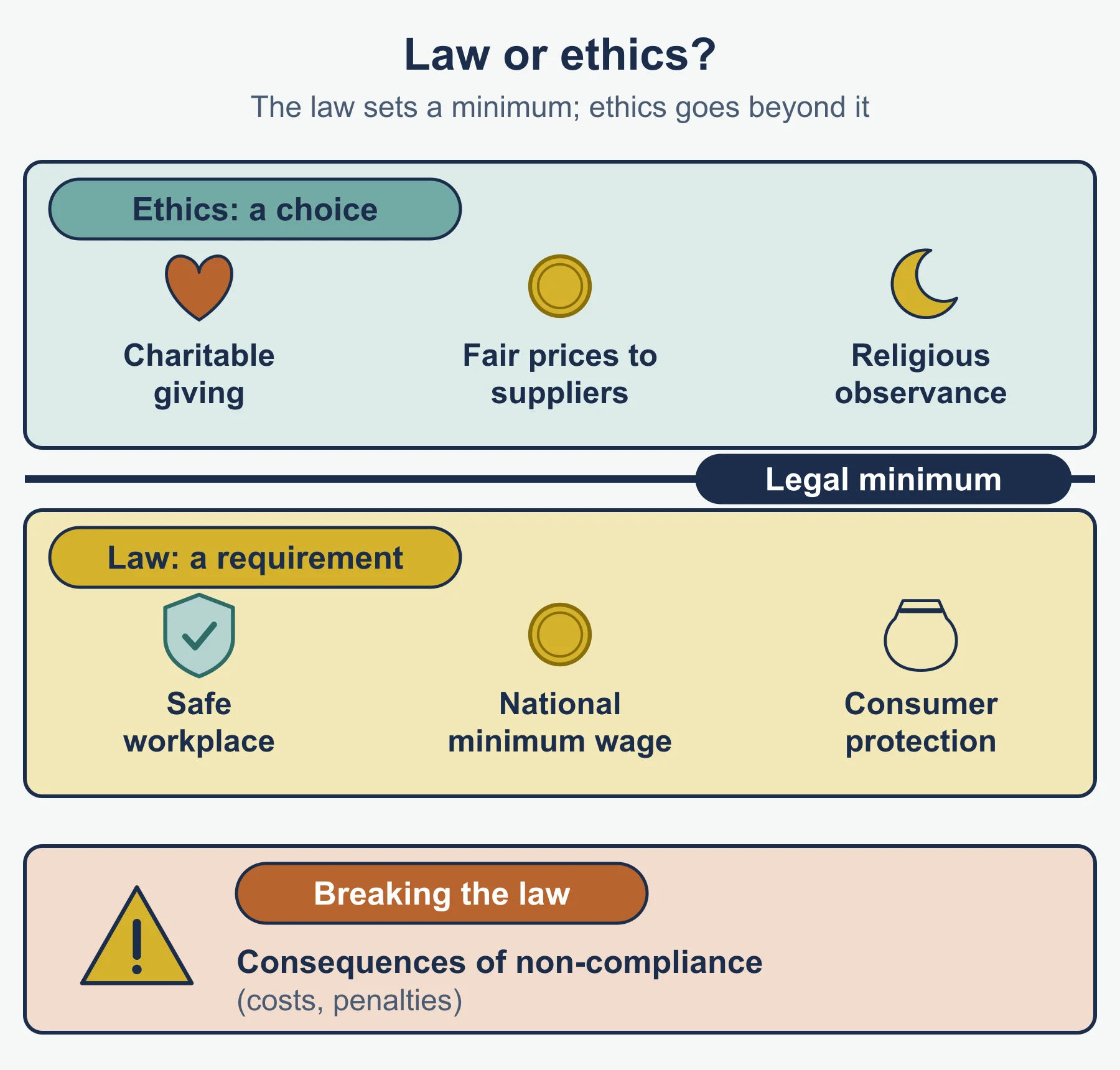
A legal control is a rule set by the government that a business must follow, with penalties if it does not. In marketing, these rules exist because the business and the customer do not start with the same information. The business knows how a product was made, how long it lasts and what the small print says. The customer usually knows only what the business chooses to show.
This imbalance is the reason for the purpose of legal controls: to protect customers. The rules aim to make sure that:
- customers can trust what businesses say about products, prices and offers
- customers are not pushed into paying for goods that do not do what they were sold to do
- customers have a way to put things right when something goes wrong
- honest businesses are not undercut by dishonest rivals who make bigger claims
The last point matters for the business side. A firm that tells the truth about a product competes more fairly when everyone has to tell the truth.
Misleading promotion
Promotion is the part of the marketing mix used to inform and persuade customers (see section 3.3 on the marketing mix). Persuading is allowed. Misleading promotion is promotion that gives customers a false or unclear picture, so that they decide to buy because of it.
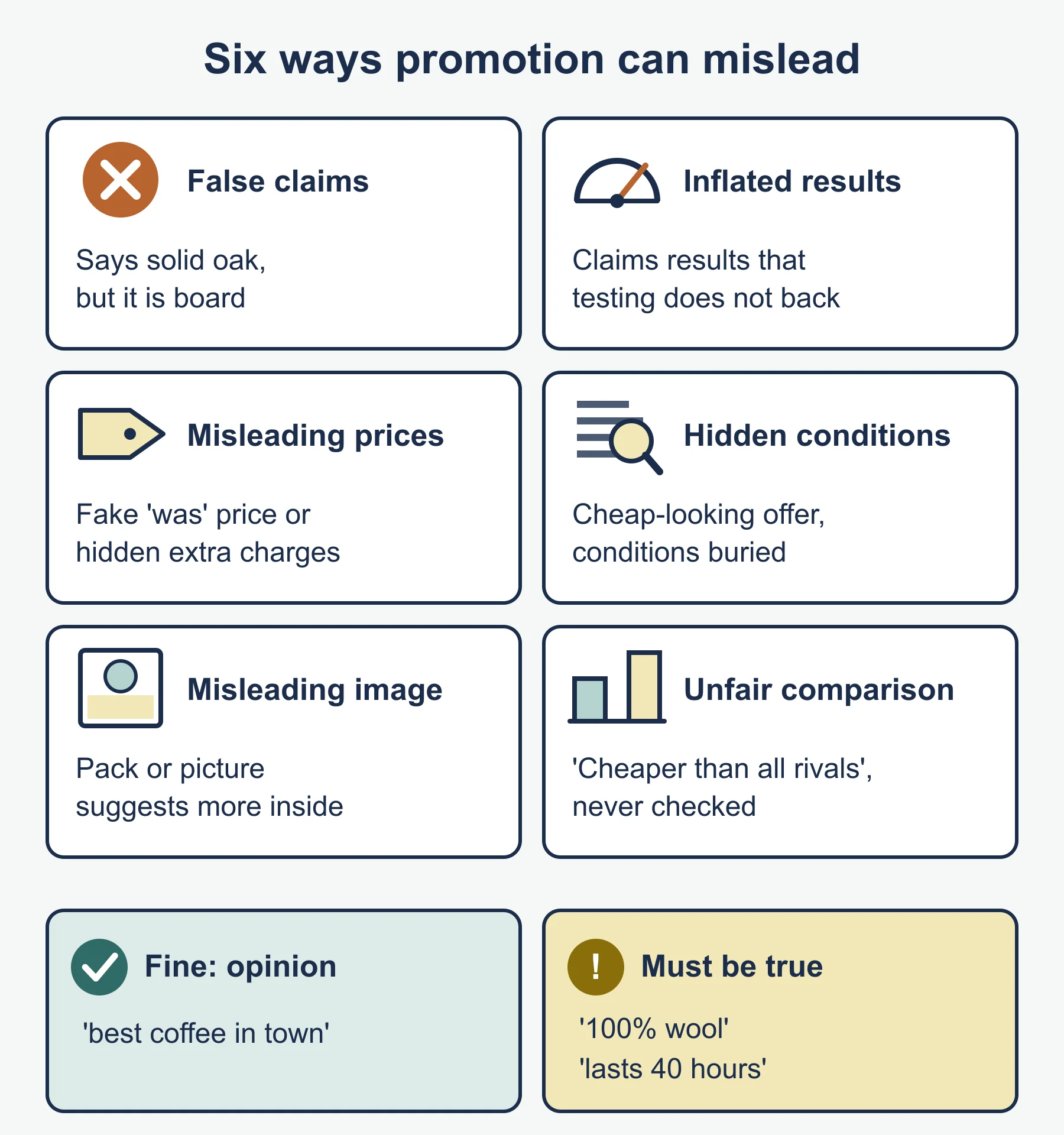
Promotion can mislead in several ways.
- False claims about the product. Saying a product is made of a material it is not made of, or that it can do something it cannot.
- Exaggerated performance. Claiming results that testing does not support.
- Misleading prices. Showing a “reduced” price when the higher price was never really charged, or leaving out compulsory extra charges.
- Hidden conditions. An offer that looks free or cheap, but the conditions are buried or unclear.
- Misleading images or packaging. A picture or pack size that suggests more than the customer gets.
- Unfair comparisons. Claiming to be “cheaper than every rival” when this has not been checked.
Not every strong statement is misleading. A shop that says “the best coffee in town” is using opinion that most customers understand as enthusiasm. A claim that can be checked, such as “lasts 40 hours” or “100% wool”, must be true.
Worked example: a misleading material claim
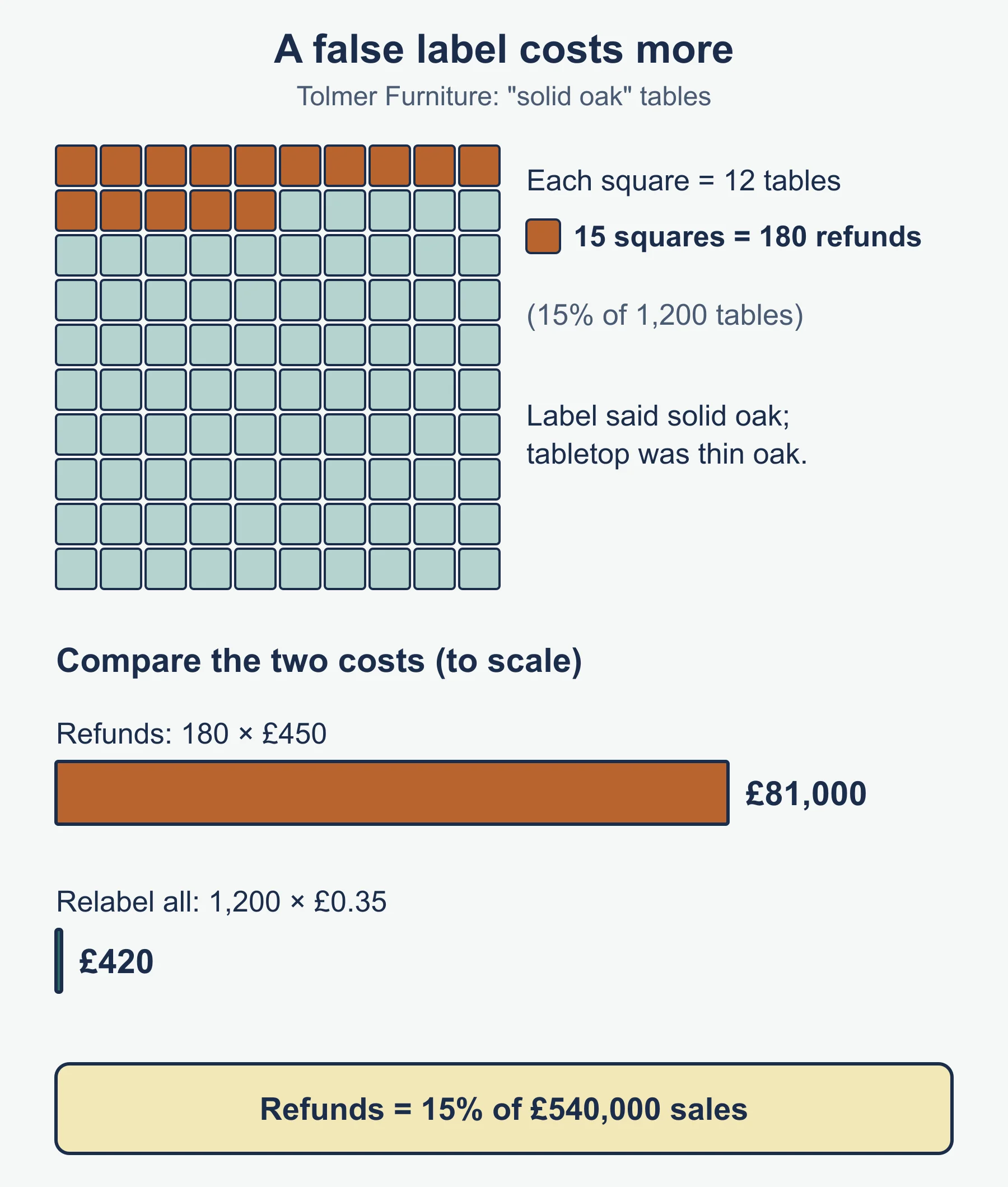
Tolmer Furniture sells dining tables labelled “solid oak”. In fact the tabletop is a thin layer of oak over manufactured board. The business sold 1,200 tables at £450 each.
Sales revenue = 1,200 × £450 = £540,000.
After a customer complaint, 15% of buyers ask for a refund.
Number of refunds = 1,200 × 0.15 = 180 tables. Refund cost = 180 × £450 = £81,000.
That is 15% of the sales revenue, taken back from the business, before counting legal costs or the cost of correcting the labels. To relabel all 1,200 tables at £0.35 each would cost 1,200 × £0.35 = £420. Telling the truth from the start would have cost far less than the refunds.
Faulty goods
Faulty goods are goods that do not work properly, are damaged, or are not as described. Legal controls on faulty goods protect customers in two ways. First, they set an expectation that goods sold should be of reasonable quality, should do what they are sold to do and should match their description. Second, they give a customer a remedy if the goods fail that test, such as a repair, a replacement or a refund.
You should be able to explain the idea in your own words without relying on any legal wording. A useful way to think about it:
- The business has taken the customer’s money.
- In return the customer expects a product that works and is as described.
- If it does not, the business is responsible for putting it right, not the customer.
Responsibility for faulty goods affects the whole business. Production and quality control must catch faults. Suppliers must be reliable. Customer service must deal with complaints quickly. A marketing manager who ignores these links will find that a promotion which brings in many buyers also brings in many returns.
Worked example: the cost of faulty goods
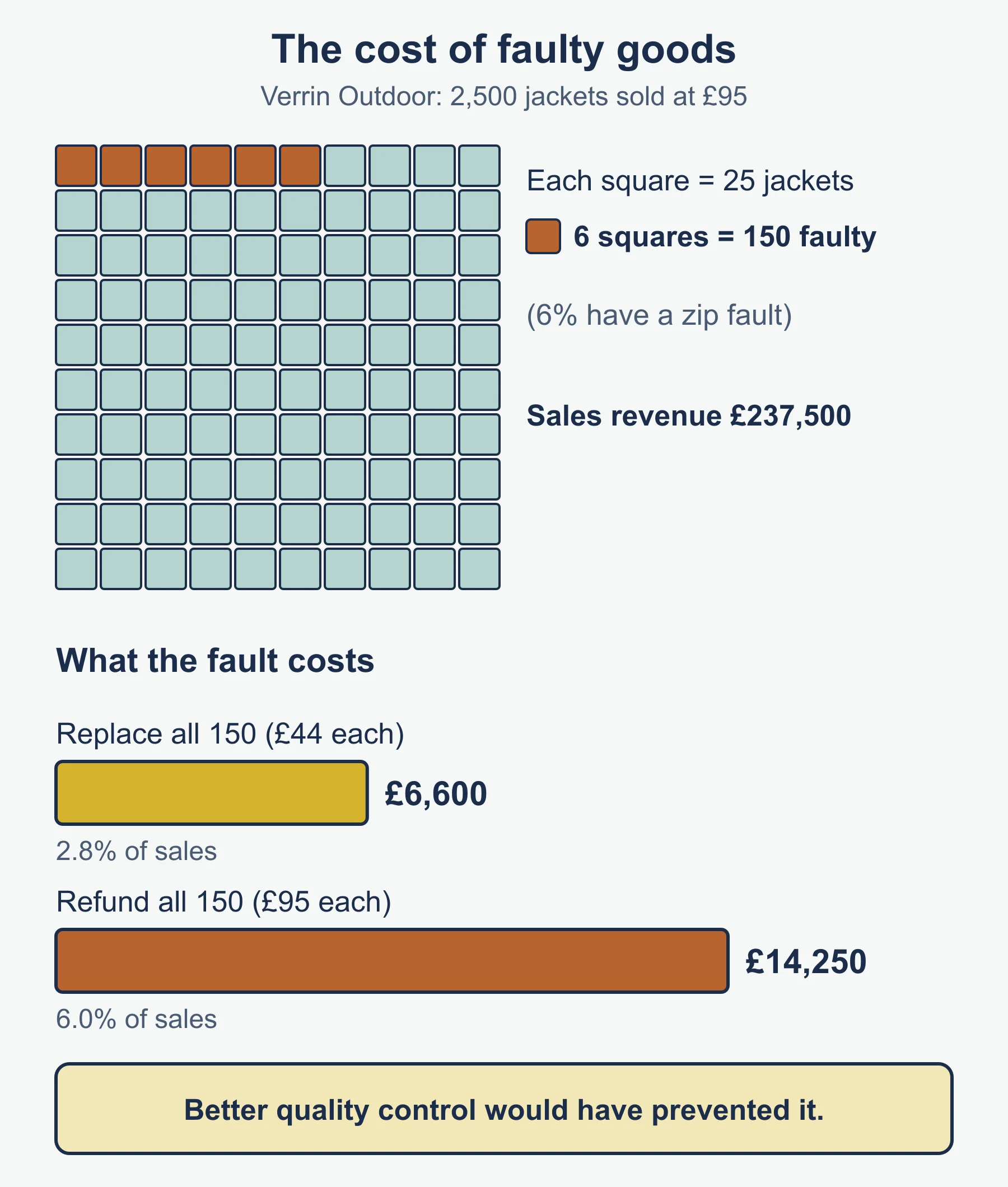
Verrin Outdoor makes waterproof jackets. In one season it sells 2,500 jackets at £95 each. A fault in the zip affects 6% of the jackets.
Faulty jackets = 2,500 × 0.06 = 150 jackets.
Verrin Outdoor offers replacements. Each replacement costs £38 to make and £6 to post. Cost of one replacement = £38 + £6 = £44. Total cost = 150 × £44 = £6,600.
If Verrin Outdoor had to refund every faulty jacket instead, the cost would be 150 × £95 = £14,250.
Sales revenue for the season = 2,500 × £95 = £237,500. The refund cost is about 6.0% of it (14,250 ÷ 237,500 × 100 = 6.0%). The replacement cost is about 2.8% of it.
A replacement policy can cost much less than refunds, but either way the business pays for a fault that better quality control would have caught earlier.
The effects of legal controls on marketing
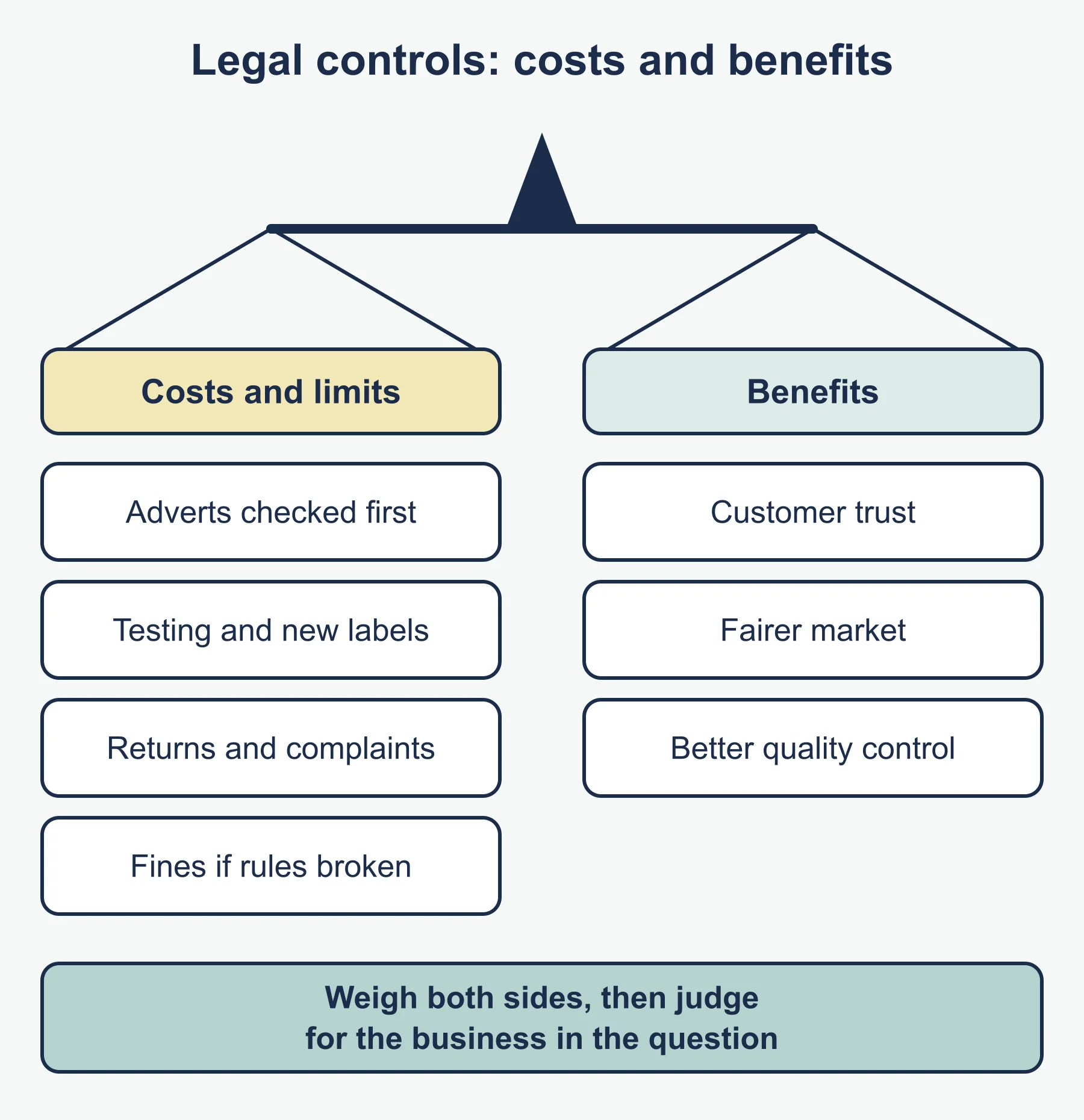
The syllabus asks for the effects of legal controls on marketing. A good answer looks at both sides, and links the effect to a part of the marketing mix.
Effects that can limit or cost the business
- Promotion becomes more careful. Advertising must be checked before it is used. Claims need evidence. This takes staff time and may involve a legal adviser.
- Strong claims are given up. A business may drop a headline that would attract attention, because it cannot be proved.
- Product testing and labelling cost money. Packaging may need to be redesigned and printed again.
- Price promotions are planned more carefully. A “was/now” price has to be honest, so the business cannot invent a high “was” price.
- Dealing with returns and complaints costs money. The business needs a system, trained staff and stock for replacements.
- New markets add rules. When a business sells abroad it has to learn the rules there, which links to the “legal requirements” disadvantage in section 3.3.7.
- Breaking the rules is expensive. Possible results include fines, court action, forced withdrawal of an advert or product, refunds and bad publicity.
Effects that can help the business
- Customer trust. A business known for honest promotion and fair treatment of faulty goods is more likely to win repeat sales and recommendations.
- A fairer market. Rivals cannot win customers with false claims.
- Better products. The need to avoid faults pushes a business to improve quality control.
Worked example: a promotion decision
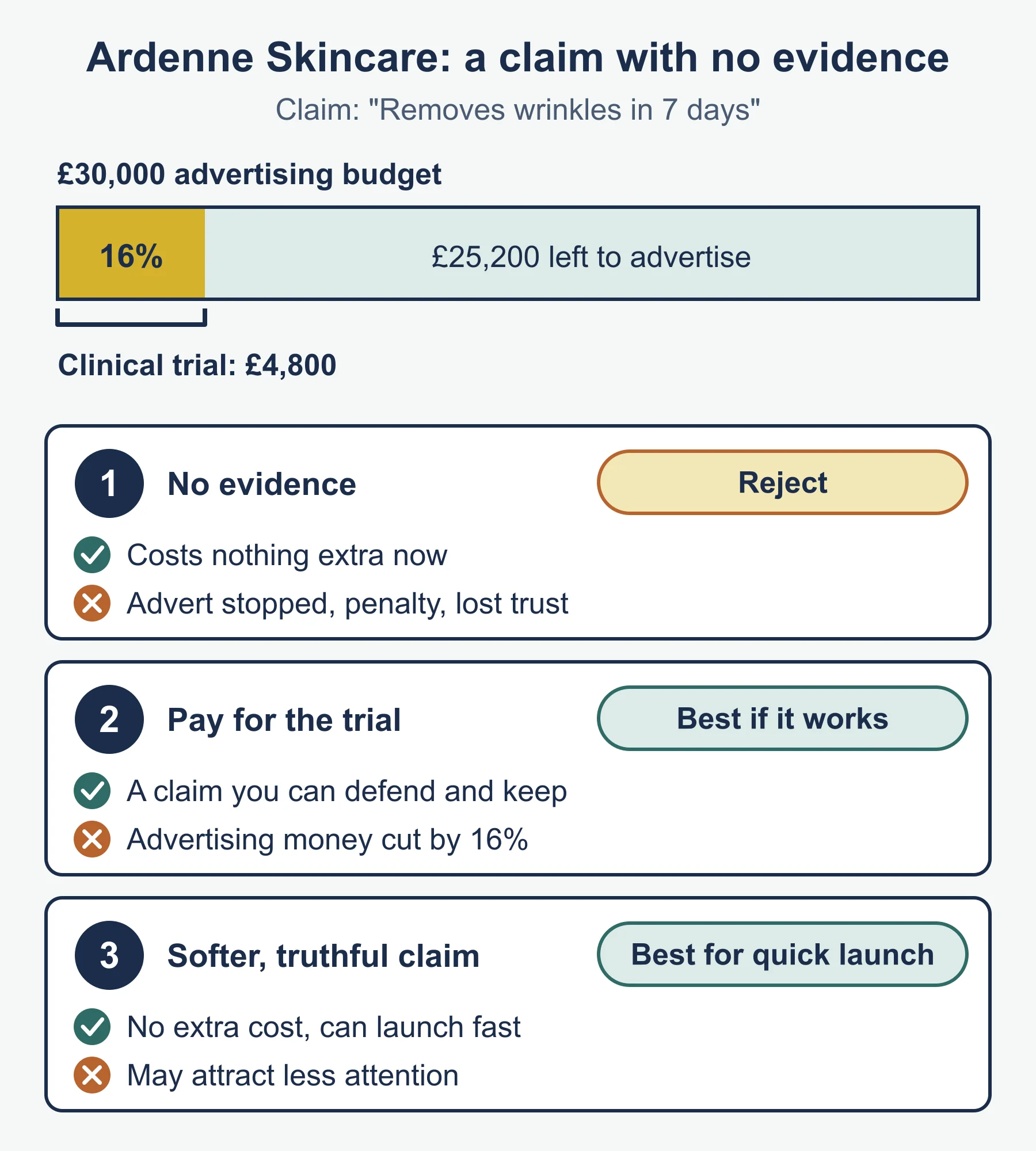
Ardenne Skincare plans a £30,000 advertising budget for a new face cream. The marketing manager wants the headline “Removes wrinkles in 7 days”. The firm has no evidence for this. A clinical trial to test the claim would cost £4,800.
Trial cost as a share of budget = 4,800 ÷ 30,000 × 100 = 16%. Budget left for advertising = £30,000 − £4,800 = £25,200.
Three options exist.
- Run the claim without evidence. Cheap now, but if customers or an authority challenge it, the business may have to stop the advert, pay a penalty and lose trust.
- Pay for the trial. This reduces advertising money by 16%, but gives a claim the business can defend and use for a longer time.
- Use a softer, truthful claim such as “a smoother-feeling skin after regular use”. It costs nothing extra, but may attract less attention.
A sound recommendation is option 2 if the product genuinely works, or option 3 if the firm wants to launch quickly. Option 1 should be rejected because the potential loss is much larger than the £4,800 saved. In a real answer, link the choice to the objective: if the aim is a long-term reputation, honest and evidence-based promotion is the better fit.
Worked example: an honest price claim
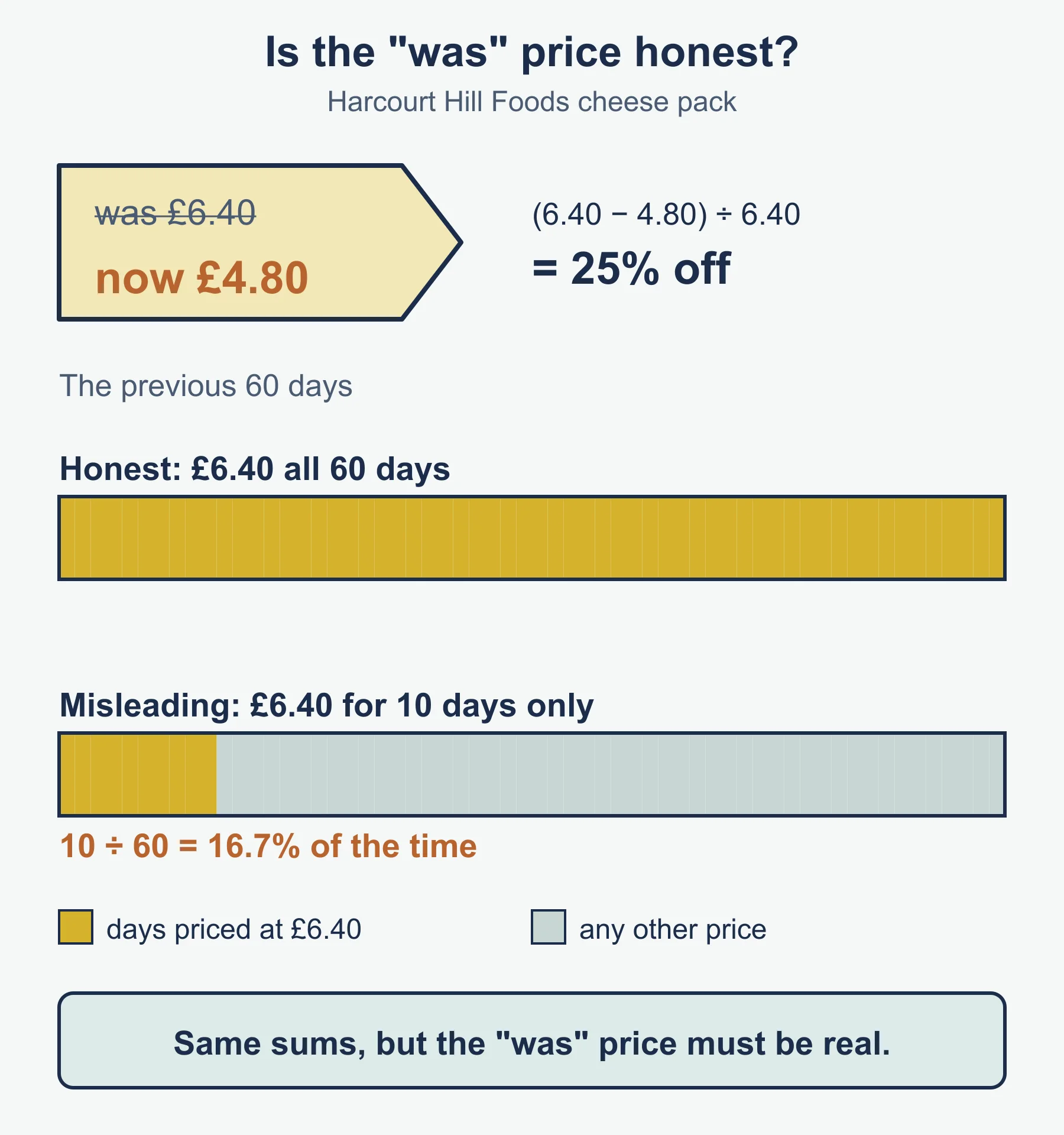
Harcourt Hill Foods puts a pack of cheese on sale at “£4.80, was £6.40”.
Discount = (6.40 − 4.80) ÷ 6.40 × 100 = 25%.
If the pack really sold at £6.40 for a normal period before the sale, the claim is fair and “25% off” is accurate. If the pack was priced at £6.40 for only 10 days out of the previous 60 (10 ÷ 60 × 100 = 16.7% of the time), customers could be misled about the saving. The arithmetic of the discount is the same, but the honesty of the “was” price is what matters.
Linking to the marketing mix
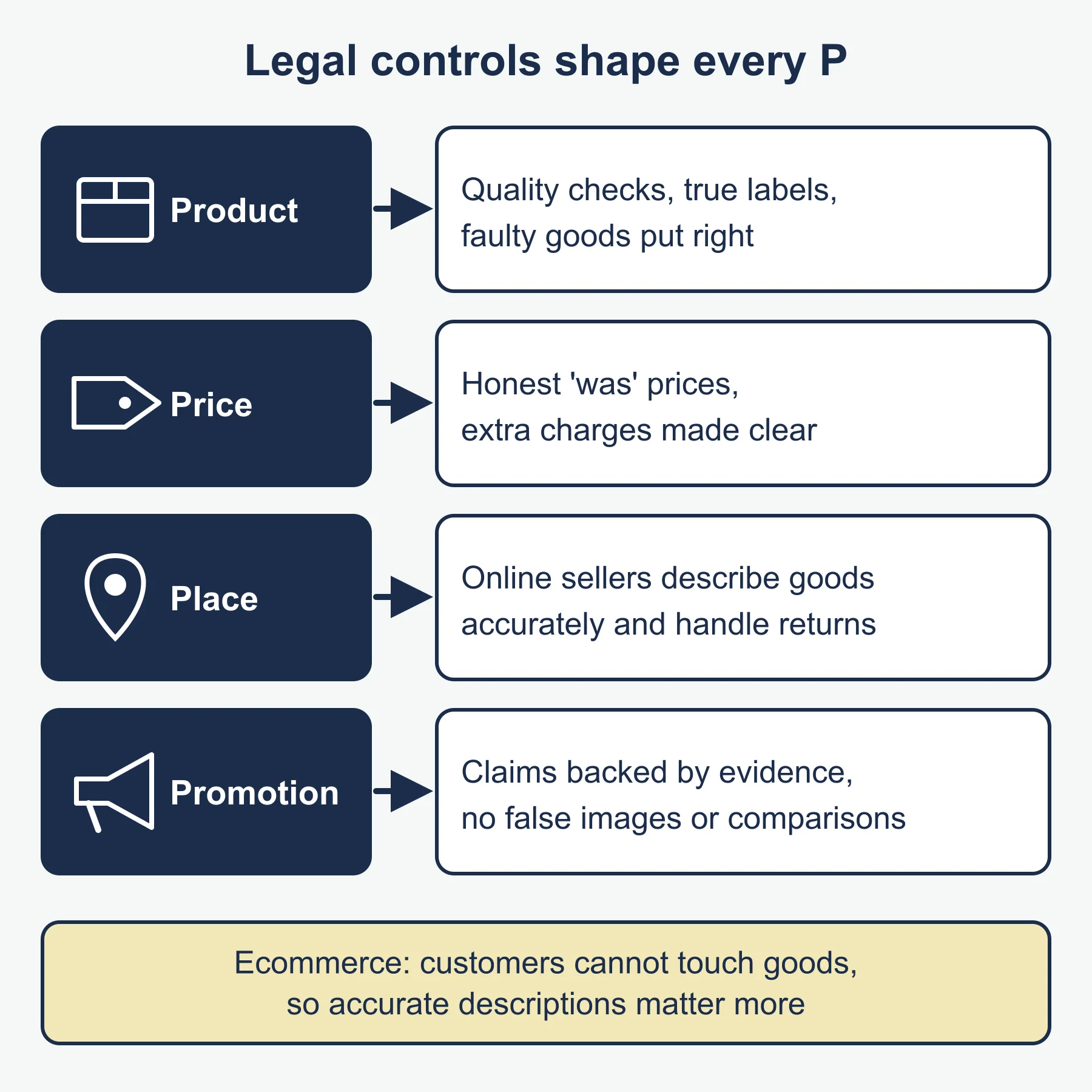
Legal controls are not a separate subject from the marketing mix. They shape each element.
| Element | Example of a legal effect |
|---|---|
| Product | Quality checks, accurate labels, handling faulty goods |
| Price | Honest price claims, clear extra charges |
| Promotion | Evidence for claims, no false images or comparisons |
| Place | Retailers and online sellers need to describe goods accurately and deal with returns |
For ecommerce (section 3.3.5), customers cannot touch the product before buying, so accurate descriptions and photographs matter even more.
Writing good exam answers
- Define briefly, then apply. If the question says “explain”, give a point, a reason and a link to the business in the question.
- Use the context. If the case study is about a food business, talk about labels and ingredients, not jackets.
- For “evaluate” or “justify” questions, weigh both sides. Costs of following the rules against benefits of trust, then reach a judgement that depends on the business’s situation.
- Show your working. For a percentage or cost, write the formula and units.
Common errors
- Saying legal controls only protect customers. They also affect the business, positively and negatively.
- Treating every exaggeration as illegal. Clear opinion differs from a false factual claim.
- Naming laws from memory. The syllabus does not ask for this, and a wrong name earns nothing.
- Writing that a business “never” has to refund. Say what a customer can generally expect: repair, replacement or refund, depending on the situation.
- Forgetting cost-benefit. A one-sided “rules are bad for business” answer is incomplete.
- Mixing up faulty goods with a change of mind. A faulty product has something wrong with it.
Frequently asked questions
What is misleading promotion? Misleading promotion is promotion that gives customers a false or unclear picture, so that they decide to buy because of it. Examples include false claims about a product, exaggerated performance, misleading prices, hidden conditions, misleading images or packaging, or unfair comparisons.
What are faulty goods? Faulty goods are goods that do not work properly, are damaged, or are not as described. The business that sold them is responsible for putting things right, not the customer.
How do legal controls affect a business’s marketing? They can make promotion more careful, mean strong claims are given up, add testing, labelling and returns costs, and make price promotions harder to plan. They can also help, by building customer trust, creating a fairer market and pushing quality improvements.
How do legal controls link to the marketing mix? Legal controls shape each element of the marketing mix, such as what can be claimed in promotion, how “was/now” prices are shown, and how accurately a product must be described, especially when selling online.
Official syllabus
This page follows the Cambridge IGCSE Business 0264 syllabus for examination in 2027, 2028 and 2029, published by Cambridge University Press & Assessment (Cambridge International), section 3.4 Legal controls.
Get free revision emails (optional)
Occasional emails with practice questions, worked explanations and links to free resources for the qualification and subjects you choose. No spam, and you can unsubscribe from any email. The free tools on this site never need an email.
Related resources
-
Practice questions
IGCSE Business: Legal controls (Cambridge 0264) – Practice Questions
Twelve original practice questions with worked answers on Cambridge IGCSE Business 0264 section 3.4: legal controls on marketing.
Business · Cambridge · IGCSE
Try questions -
Revision notes
IGCSE Business: Legal controls (Cambridge 0264) – Revision Notes
Condensed revision notes for Cambridge IGCSE Business 0264 section 3.4: legal controls, misleading promotion, faulty goods and their effects on marketing.
Business · Cambridge · IGCSE
Revise topic -
Study guides
IGCSE Business: Marketing and the market and Market research (Cambridge 0264)
Study guide to marketing, markets, segmentation and market research for Cambridge IGCSE Business 0264, with worked market share and survey examples.
Business · Cambridge · IGCSE
Read guide
Related articles
-
teaching
A Level tuition in Dubai: Cambridge or Pearson Edexcel International A Level?
Schools in Dubai and Abu Dhabi teach either Cambridge International AS & A Level or Pearson Edexcel International A Level. How the two are structured, why it matters for tuition, and how online classes from Lahore work.
9 October 2026
-
curriculum guides
Choosing subjects at IGCSE and A Level
How subject choices at 14 and 16 affect university options later, and how to keep pathways open without overloading a timetable.
28 July 2026
Studying this with a teacher
Working through Business IGCSE?
This page is free and stays free. If you would rather be taught it, Marlbridge runs Business classes one-to-one and in small groups of up to 15, online in your own time zone. The first trial class is free. WhatsApp replies within an hour (8am–11pm Pakistan time, every day); email the same day.
Cambridge Business teachers at Marlbridge

