
Study Guides
IGCSE Business: Marketing and the market and Market research (Cambridge 0264)
Study guide to marketing, markets, segmentation and market research for Cambridge IGCSE Business 0264, with worked market share and survey examples.
- Subject
- Business
- Level
- IGCSE
- Topic
- Marketing
- Author
- Marlbridge Academic Team
- Updated
- Reviewed by
- Salman Ahmad (what this means)
Aligned to Cambridge IGCSE Business (0264), For examination in 2027, 2028 and 2029. Official specification .
Syllabus page (what it covers and how it is assessed): Cambridge IGCSE Business.
Syllabus points this page covers
0264
- 3.1 Marketing and the market
- 3.2 Market research
Found an error? Report a correction.
Need help with this topic? Request a free trial class for IGCSE Business (0450 / 0264).
This guide covers sections 3.1 (Marketing and the market) and 3.2 (Market research) of the Cambridge IGCSE Business 0264 syllabus for examination in 2027, 2028 and 2029. It teaches every content point the syllabus lists for those two sections, including the market share calculation and the analysis of simple market research data. Revise from the revision notes and test yourself with the practice questions. Course pages: the Cambridge IGCSE Business hub and the printable checklist. The free diagnostics show which topics need most work.
What this guide covers
| Ref | What you must be able to do |
|---|---|
| 3.1.1 | Explain the role of marketing: identifying, satisfying and anticipating customer needs, keeping customers loyal and building relationships |
| 3.1.2 | Explain why spending patterns change, why some markets are becoming more competitive, and how businesses respond; calculate market share |
| 3.1.3 | Explain mass markets and niche markets, with advantages and disadvantages of each |
| 3.1.4 | Segment a market by age, income, location, gender and lifestyle; weigh the advantages and disadvantages of segmentation |
| 3.2.1 | Explain why businesses use market research; describe and assess primary and secondary methods; explain sampling; judge accuracy; analyse simple data |
In the syllabus, “calculate” means work out from given facts, figures or information, “explain” means give reasons supported with evidence, and “justify” means support a case with evidence or argument. Answer in the language of the command word.
3.1.1 The role of marketing
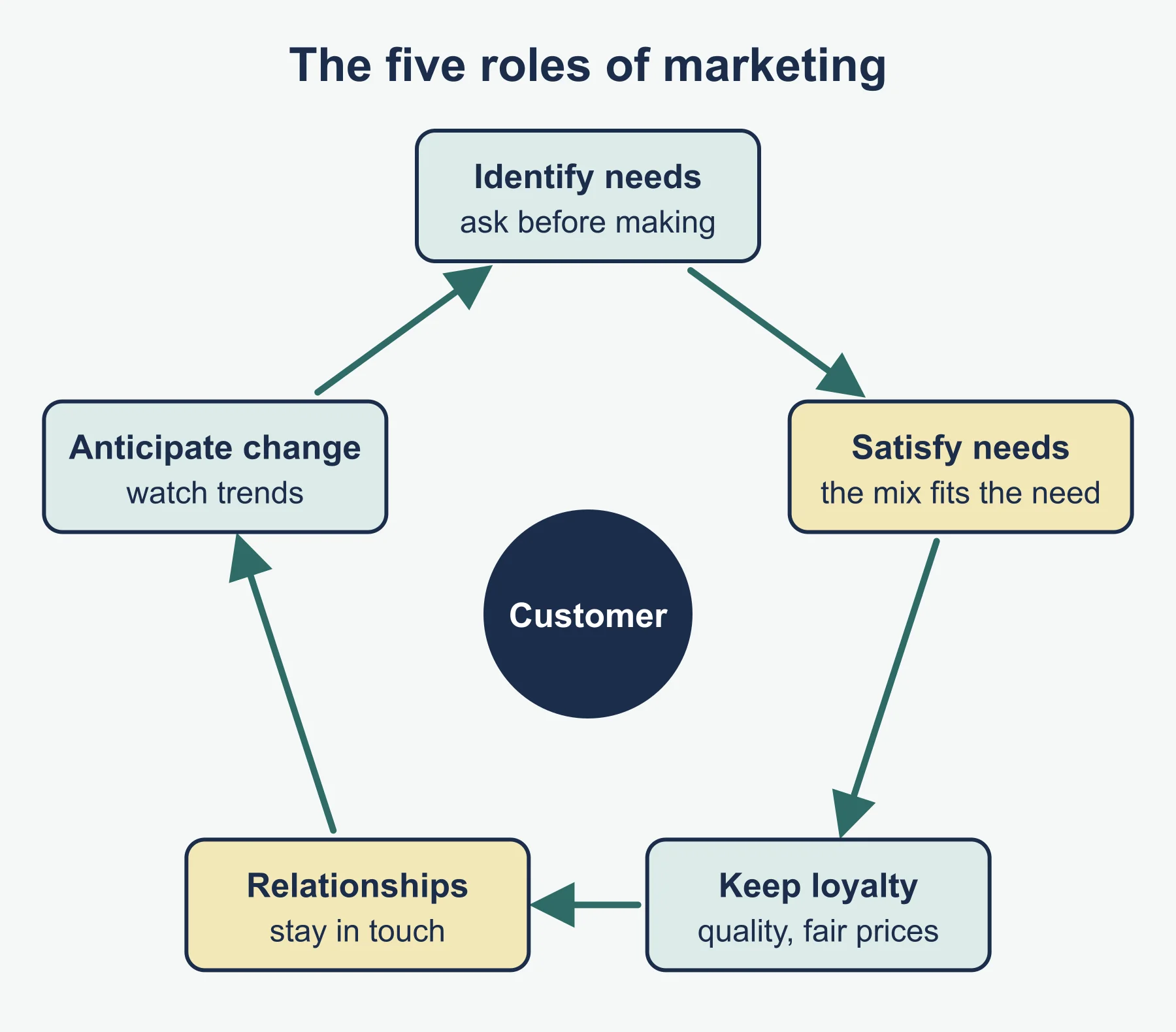
Marketing links a business to the people who buy from it. The role has five parts.
- Identifying customer needs. A business has to find out what people want before it makes anything. A bakery might discover that local workers want a hot breakfast they can carry.
- Satisfying customer needs. Once a need is known, the product, price, promotion and place must meet it. A product that is right but too expensive, or right but impossible to find, does not satisfy the customer.
- Maintaining customer loyalty. Keeping a customer is usually cheaper than winning a new one. Loyalty is helped by reliable quality, fair prices and good service after the sale.
- Building customer relationships. Businesses keep in touch through email, social media, feedback forms and friendly service. A customer who feels known is more likely to return and to recommend the business.
- Anticipating changes in customer needs. Tastes, incomes and technology move on. A business that watches trends can adjust its range before sales fall.
3.1.2 Understanding market changes
A market is where buyers and sellers meet to trade a product. Markets are never still.
Why consumer spending patterns may change
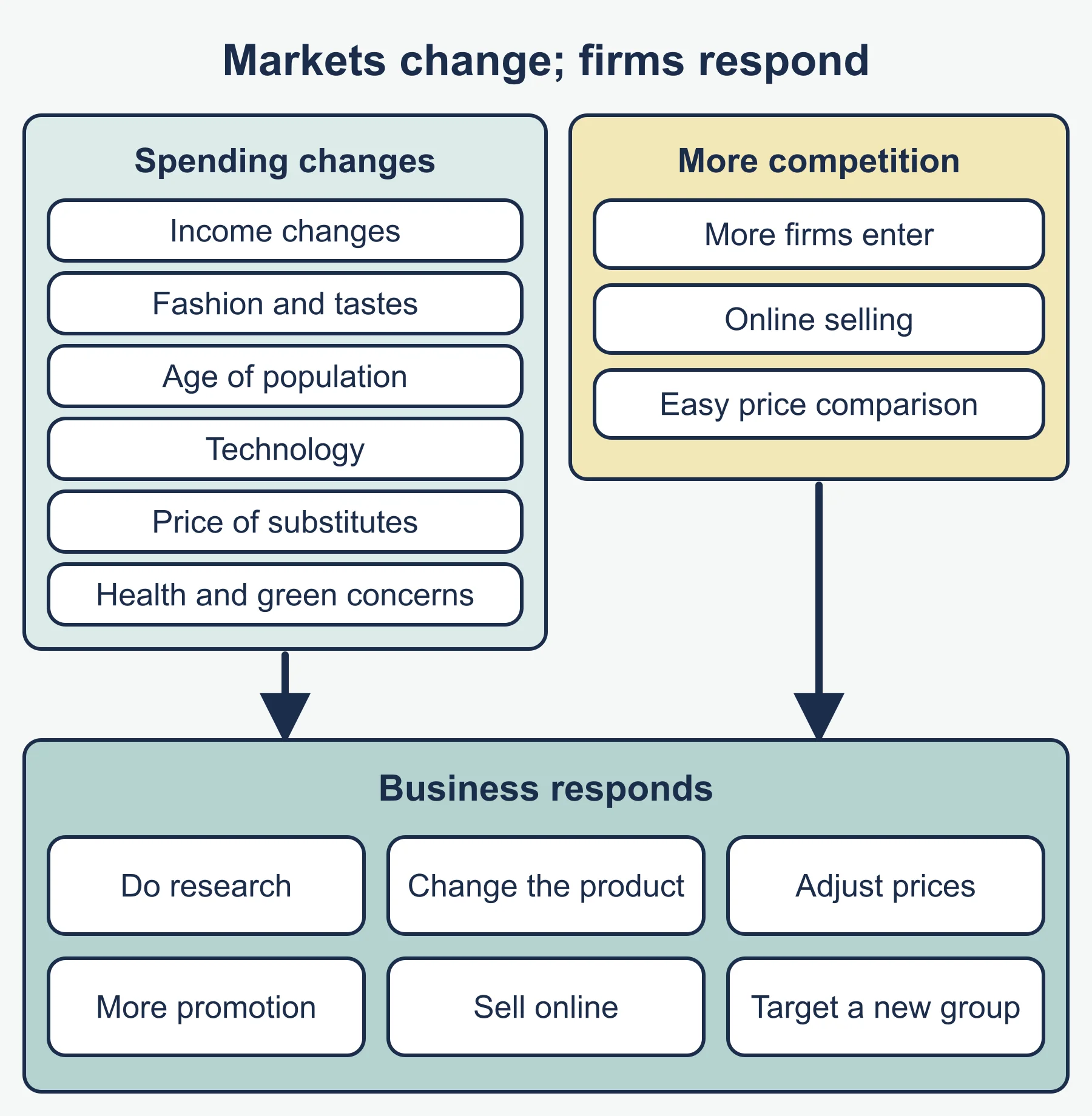
- Income changes. When incomes rise, people buy more normal goods and trade up to higher quality. When incomes fall, they cut back and switch to cheaper brands.
- Fashion and tastes. What is popular this year may be ignored next year.
- Age and population. An ageing population spends more on health care and less on school items.
- Technology. New devices create new spending and make older products less wanted.
- Price changes of other goods. If a substitute becomes cheaper, buyers may switch.
- Awareness and attitudes. Concern about health or the environment changes what people choose to buy.
Why some markets are becoming more competitive
- More firms enter, often because the market looks profitable and barriers to entry are low.
- Online selling lets small and overseas firms reach the same customers.
- Customers compare prices easily, so firms cannot hide high prices.
How businesses can respond
A business facing changing spending or tougher competition can:
- carry out market research to understand the change;
- change the product, for example a new flavour, size or design;
- adjust prices or run offers;
- increase promotion or improve customer service;
- find new ways to sell, such as an online store;
- target a different group of customers.
Calculating market share
Market share shows how large a business is compared with the whole market. The syllabus formula reads:
market share = (sales revenue of a business / total sales revenue for the whole market) × 100, giving a percentage.
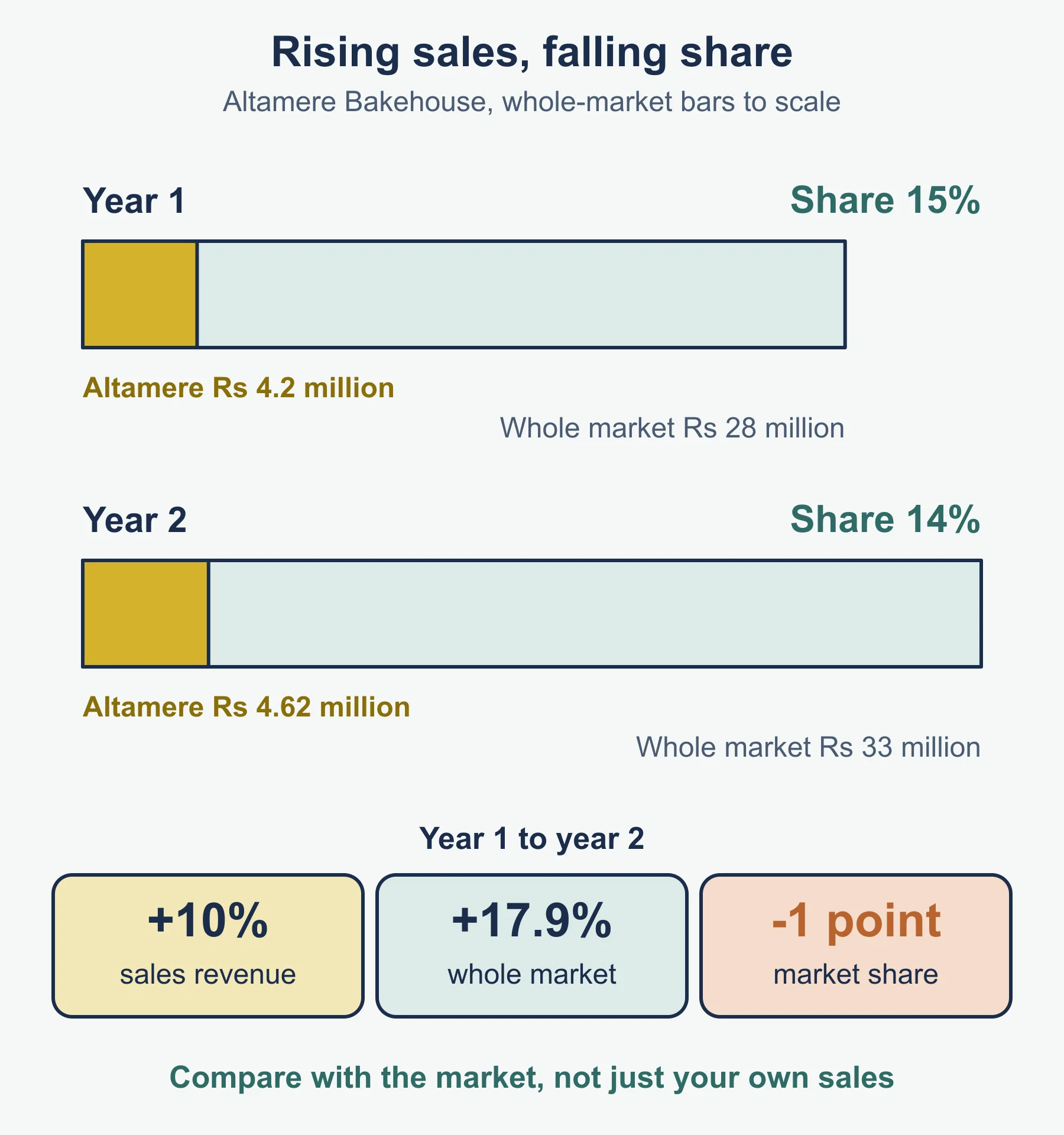
Worked example 1. Altamere Bakehouse sells bread and cakes in a town. In year 1 its sales revenue was Rs 4,200,000. Total sales revenue for all bakeries in the town was Rs 28,000,000.
Year 1 market share = 4,200,000 / 28,000,000 × 100 = 15%.
In year 2, Altamere’s sales revenue rose to Rs 4,620,000 and the whole market grew to Rs 33,000,000.
Year 2 market share = 4,620,000 / 33,000,000 × 100 = 14%.
Altamere’s sales revenue grew by 10%, yet the market grew by about 17.9%. Its share fell by one percentage point. The lesson: rising sales revenue does not always mean a stronger position. Compare with the market.
You may also be given the share and one other figure and asked to find the missing one. Rearrange: total market sales revenue = business sales revenue / market share × 100. If a firm has a 12% share on sales revenue of Rs 600,000, the market is 600,000 / 12 × 100 = Rs 5,000,000.
3.1.3 Mass markets and niche markets
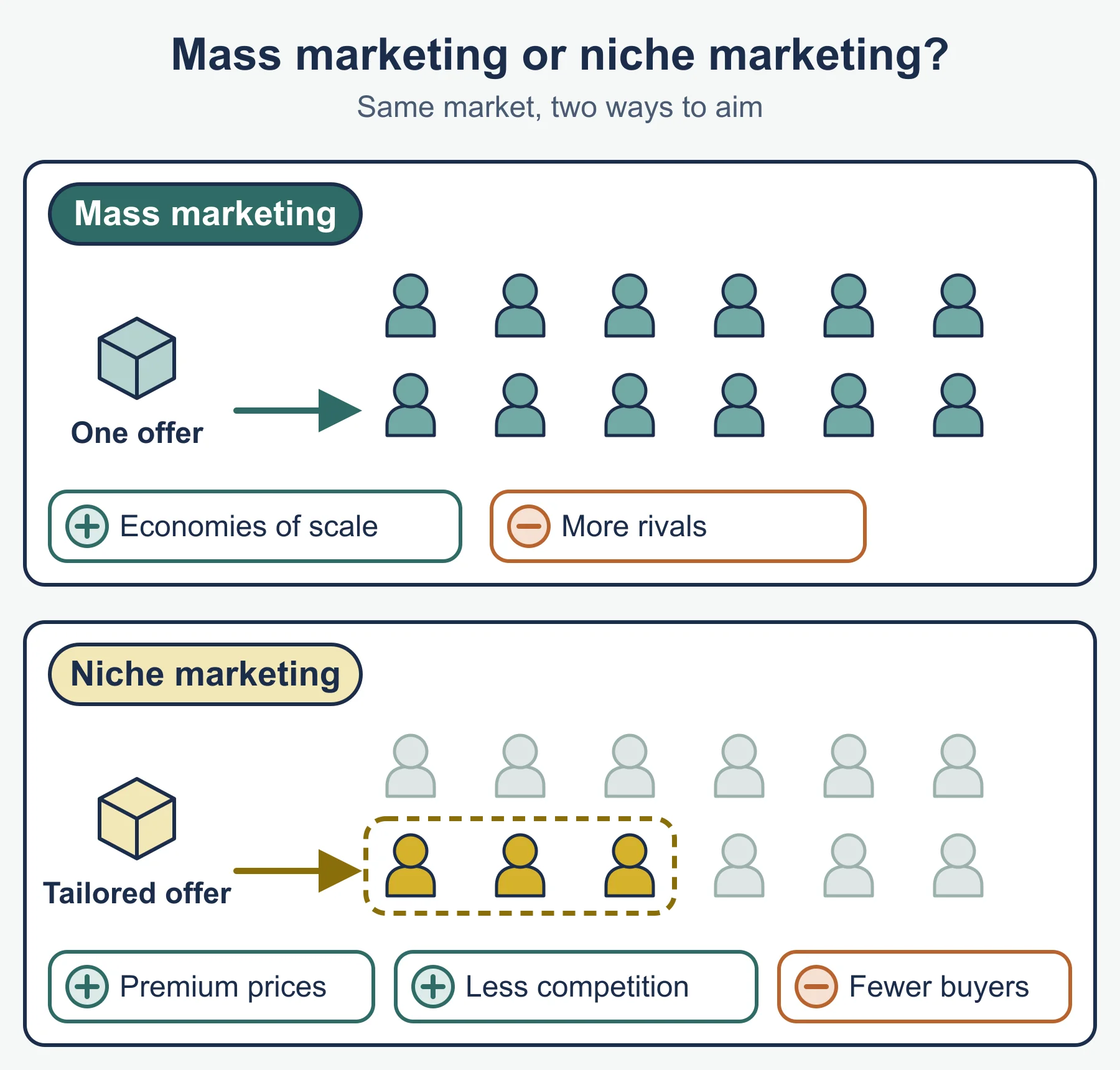
A mass market is a very large market where a product is sold to many customers. Examples are basic foods, mobile phone plans and everyday clothing. A niche market is a small part of a larger market with specific needs. An example is bicycles built for very tall riders, within the wider cycle market.
| Advantages | Disadvantages | |
|---|---|---|
| Mass market | Large sales and high potential sales revenue; economies of scale lower unit costs; wide choice of places to sell | Many competitors; low prices may be needed to win sales; heavy promotion costs; harder to stand out |
| Niche market | Fewer competitors; customers may accept higher prices; loyal customers; specialist reputation | Small number of customers and limited growth; risk if the niche shrinks; larger firms may move in; higher unit costs from small output |
Worked example 2. Norwenna Cycles makes frames for riders over 195 cm tall. There are few rivals, so it charges well above the price of standard frames and customers return because few others fit them. But total demand is small. If a large manufacturer began making tall frames, Norwenna could lose its main advantage.
3.1.4 Market segmentation
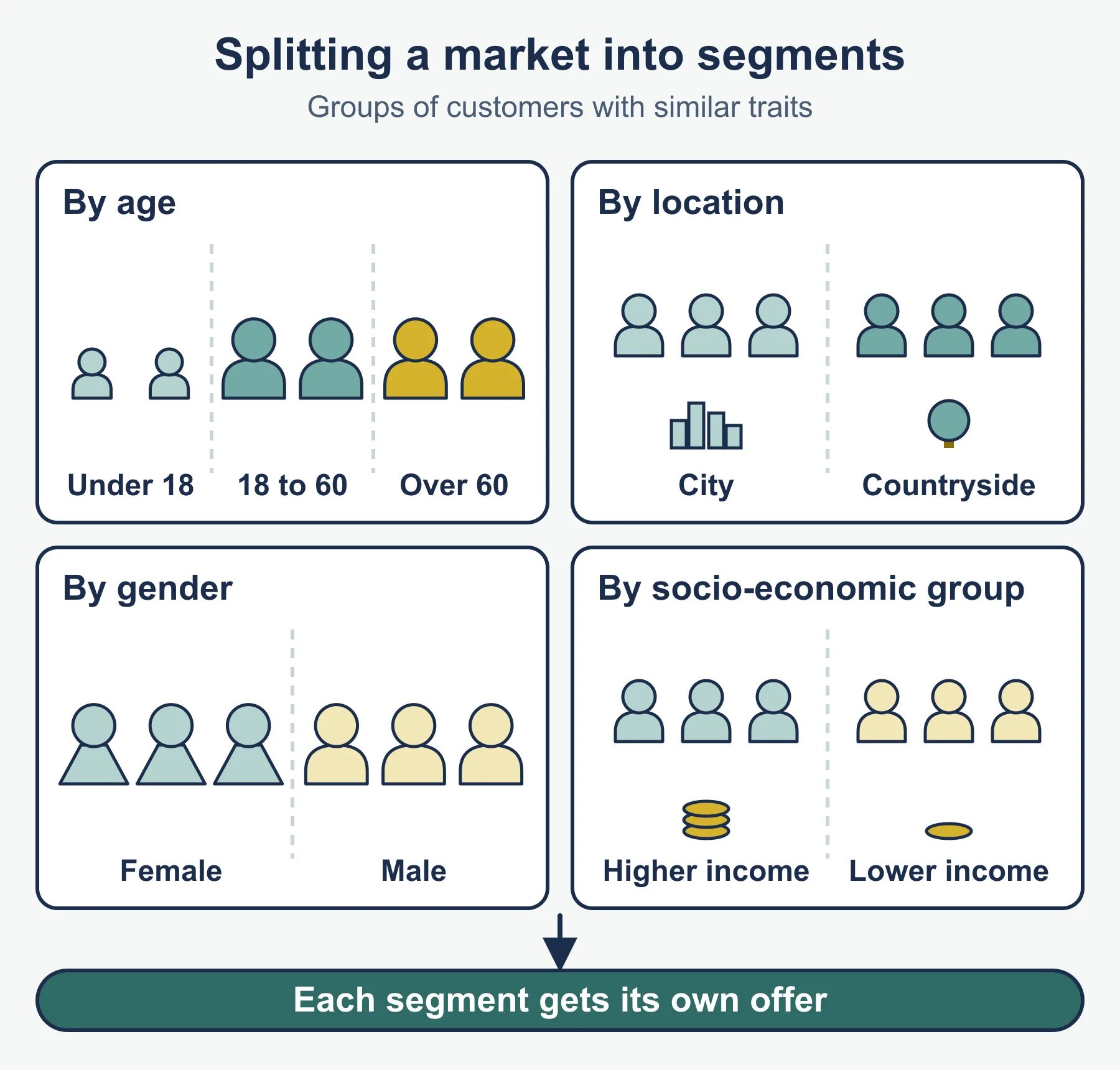
Segmentation splits a market into groups whose members have something in common, so a business can direct its products and promotion at each group. The syllabus lists five ways of segmenting.
| Basis | What it means | Example |
|---|---|---|
| Age | Customers grouped by age band | Children’s, teen and adult versions of a snack |
| Income | Customers grouped by what they can afford | Budget, standard and premium ranges |
| Location | Customers grouped by where they live | Warm-weather clothing in one region, heavy coats in another; urban or rural |
| Gender | Customers grouped as female or male | Different razors or sports clothing |
| Lifestyle | Customers grouped by how they live and what they value | Busy professionals, fitness fans, eco-conscious shoppers |
Advantages of segmentation: products and messages match each group, so customers feel understood; promotion is better targeted, which can reduce wasted spending; the business may find gaps its competitors ignore; sales revenue may rise as more groups are served.
Disadvantages: research into each segment costs money; producing several versions can raise costs and reduce economies of scale; the business may focus on small segments and miss the bigger picture; groups overlap, so the segments are not always clear.
Worked example 3. Pimlow Fitness runs a gym in a city. It offers low-price off-peak membership for students (age and income), a lunchtime express class for office workers (lifestyle) and a women-only morning session (gender). Each offer has its own advertising. This helps Pimlow fill quiet hours, but it must pay for extra instructors and separate advertising.
3.2 Market research
Market research is the process of collecting and analysing information about customers, competitors and the market.
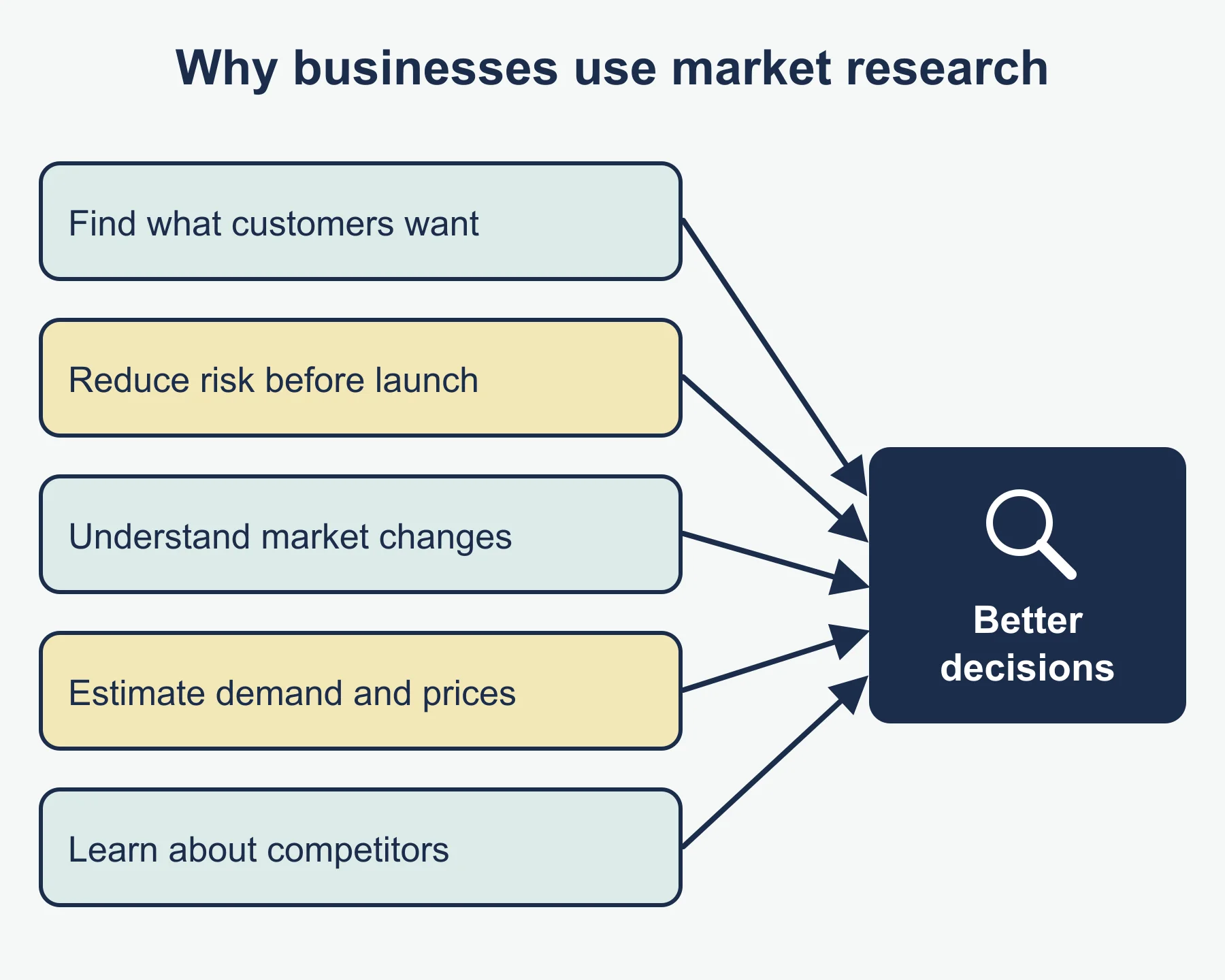
Why businesses use market research
- To find out what customers want and what they think of existing products.
- To reduce risk before launching a product.
- To understand changes in the market and respond to them.
- To estimate demand and judge prices.
- To learn about competitors.
Primary research (field research)
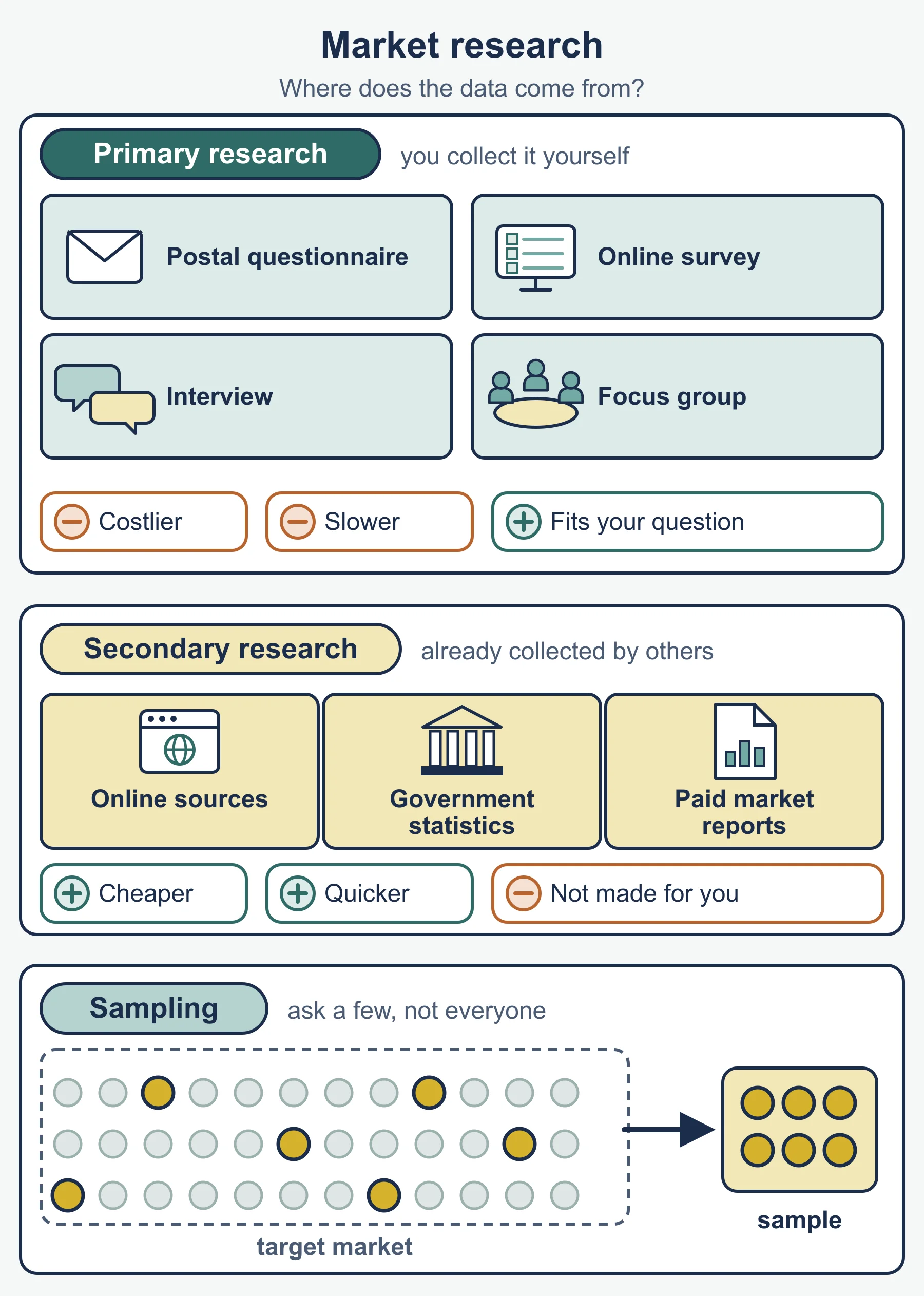
Primary research is collecting new information for the first time for a specific purpose.
| Method | How it works | Advantages | Disadvantages |
|---|---|---|---|
| Questionnaires or surveys | Written or online questions answered by a group | Cheap per response, can reach many people, easy to count results | Low response rates; answers may be untruthful or rushed; poor questions give poor data |
| Interviews | One person asks another questions face to face or by phone | Detailed answers; questions can be explained and followed up | Slow, costly per person; interviewer can influence answers |
| Focus groups | A few people talk about a product, guided by a leader | Rich opinions; shows why people think as they do | Small group may not represent the market; strong voices can dominate; costs of running sessions |
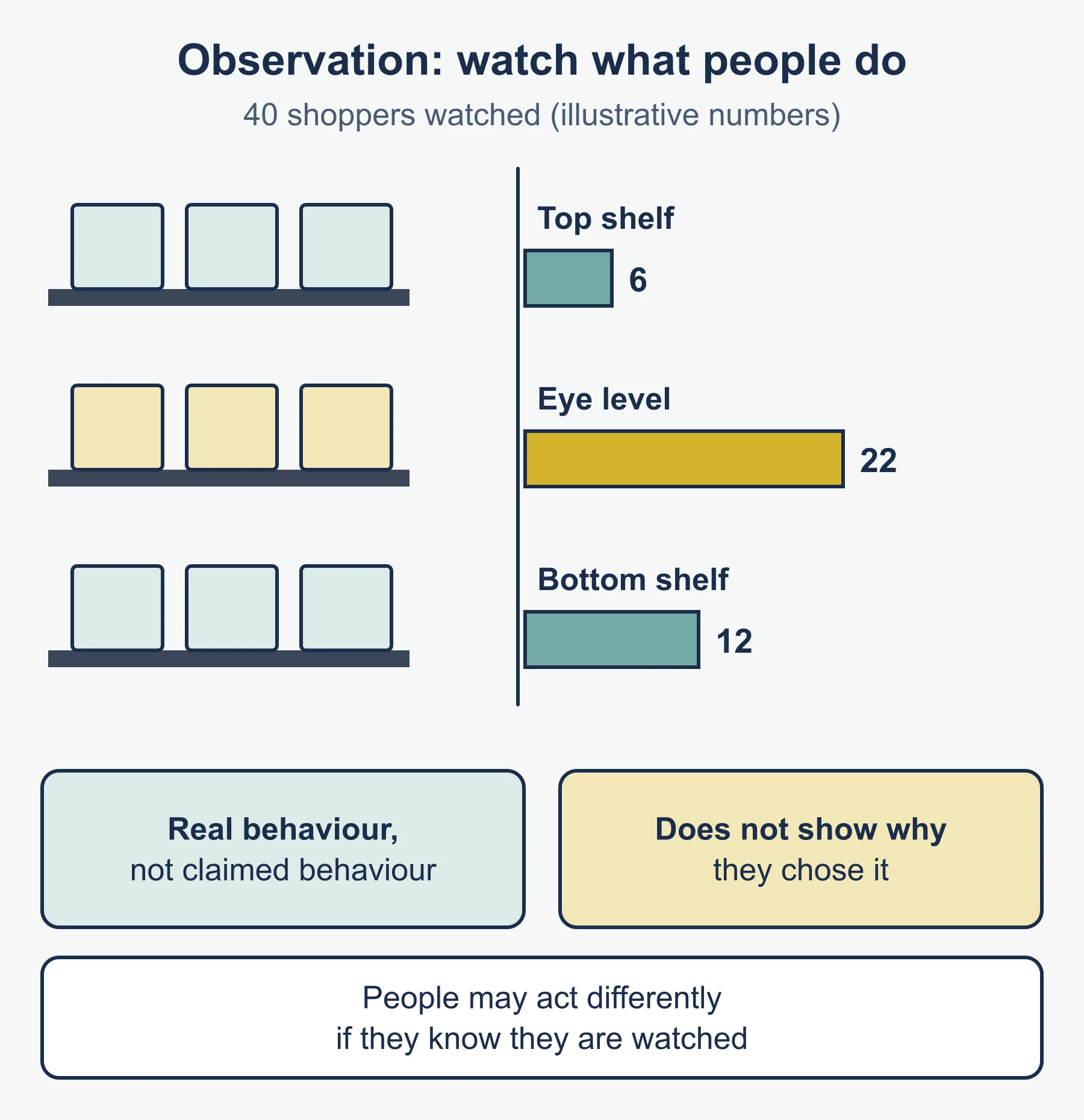
| Observation | Watching what people actually do, such as which shelf they choose | Records real behaviour, not claimed behaviour | Does not explain why; time-consuming; people may act differently if they know they are watched |
General points on primary research: it is up to date and fits the exact question, but it costs more and takes longer than secondary research.
Secondary research (desk research)
Secondary research uses information that already exists and was collected for another purpose. Sources named in the syllabus are competitor websites, government sources, market reports and trade magazines.
Advantages: usually cheaper and quicker; a wide view of the market, often covering the whole country. Disadvantages: may be old; may not answer the question the business is asking; may be costly if bought as a market report; competitors can see the same data; the user cannot check how it was gathered.
Sampling
A sample is a smaller group chosen from the whole population of customers to represent it. Asking everyone would take too long and cost too much, so a business asks a sample and uses the results to estimate what all customers think. Sampling is useful because it saves time and money and still gives a guide to the market. It works only if the sample is large enough and representative of the people the business wants to learn about.
Factors influencing accuracy
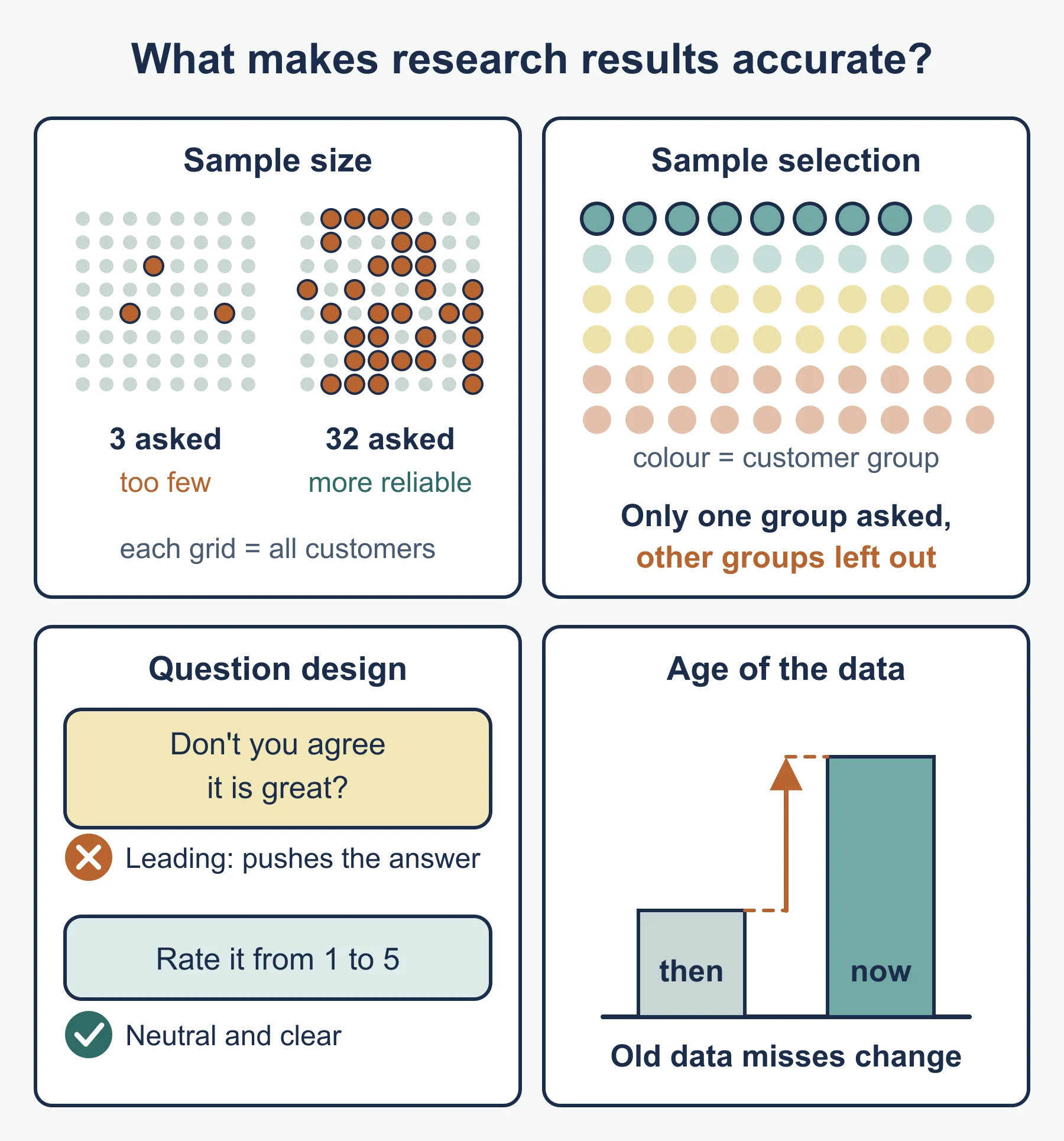
- Sample size: very small samples give unreliable results.
- Sample selection (bias): if the sample leaves out important groups, or is picked in a way that favours one group, results mislead.
- Question design: leading, confusing or vague questions distort answers.
- Honesty and recall: people may give the answer they think is expected.
- Age of the data: old data may no longer describe the market.
- Source reliability: a competitor’s claims or a company with something to sell may not be neutral.
- Interviewer or observer influence.
Analysing simple market research data
You may be given a table, a chart or a set of percentages and asked to read it, calculate from it and draw a conclusion.
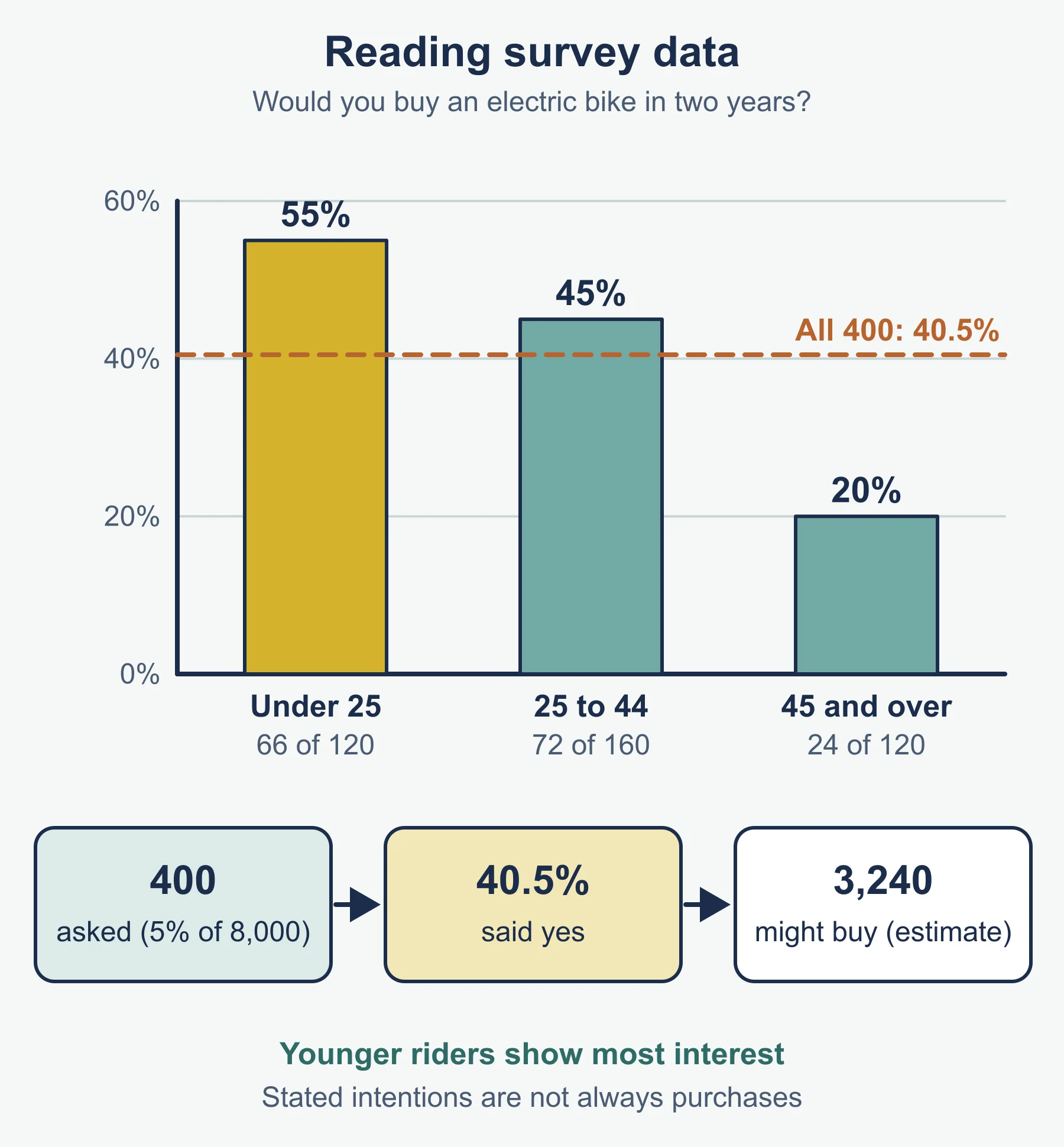
Worked example 4. Norwenna Cycles has 8,000 customers on its email list. It surveys a sample of 400, which is 5% of the list. It asks whether they would buy an electric bike in the next two years.
| Age group | Number in sample | Would buy | Percentage |
|---|---|---|---|
| Under 25 | 120 | 66 | 55% |
| 25 to 44 | 160 | 72 | 45% |
| 45 and over | 120 | 24 | 20% |
| Total | 400 | 162 | 40.5% |
Steps: percentage = number who would buy / number in group × 100. Overall: 162 / 400 × 100 = 40.5%. Reading the table, interest falls with age. Interest is strongest in the under 25 group. A sensible conclusion is that Norwenna should aim early promotion at younger riders. If the sample is representative, about 40.5% of 8,000, or 3,240 customers, might be interested. Treat that as an estimate: stated intentions do not always become purchases, and email customers may differ from the wider market.
Common errors
- Giving a market share as a number of units instead of a percentage.
- Treating rising sales revenue as proof of rising market share.
- Listing segmentation bases without applying them to the business in the question.
- Claiming a sample result is certain for the whole market.
Frequently asked questions
How do you calculate market share in IGCSE Business? Market share is the sales revenue of a business divided by the total sales revenue for the whole market, multiplied by 100. The answer is a percentage.
What is the difference between a mass market and a niche market? A mass market is a very large market where a product is sold to many customers. A niche market is a small part of a larger market with specific needs, such as bicycles built for very tall riders.
Why do consumer spending patterns change? Spending patterns change with incomes, fashion and tastes, age and population, technology, the prices of other goods, and attitudes such as concern about health or the environment.
What is the difference between primary and secondary research? Primary (field) research collects new information for the first time for a specific purpose; it is up to date and specific but can be expensive and slow. Secondary (desk) research uses information that already exists and was collected for another purpose.
Official syllabus
Cambridge IGCSE Business 0264 syllabus for examination in 2027, 2028 and 2029, published by Cambridge University Press & Assessment (Cambridge International Education): sections 3.1 and 3.2.
Get free revision emails (optional)
Occasional emails with practice questions, worked explanations and links to free resources for the qualification and subjects you choose. No spam, and you can unsubscribe from any email. The free tools on this site never need an email.
Related resources
-
Practice questions
IGCSE Business: Marketing and the market and Market research (Cambridge 0264) – Practice Questions
Ten original questions with worked answers on market share, segmentation, niche markets and market research for Cambridge IGCSE Business 0264.
Business · Cambridge · IGCSE
Try questions -
Revision notes
IGCSE Business: Marketing and the market and Market research (Cambridge 0264) – Revision Notes
Condensed revision notes on marketing, market share, niche and mass markets, segmentation and market research for Cambridge IGCSE Business 0264.
Business · Cambridge · IGCSE
Revise topic -
Study guides
IGCSE Business: Marketing mix (Cambridge 0264)
Study guide to product, price, place, promotion, ecommerce, marketing strategy and entering new markets for Cambridge IGCSE Business 0264.
Business · Cambridge · IGCSE
Read guide
Related articles
-
teaching
A Level tuition in Dubai: Cambridge or Pearson Edexcel International A Level?
Schools in Dubai and Abu Dhabi teach either Cambridge International AS & A Level or Pearson Edexcel International A Level. How the two are structured, why it matters for tuition, and how online classes from Lahore work.
9 October 2026
-
curriculum guides
Choosing subjects at IGCSE and A Level
How subject choices at 14 and 16 affect university options later, and how to keep pathways open without overloading a timetable.
28 July 2026
Studying this with a teacher
Working through Business IGCSE?
This page is free and stays free. If you would rather be taught it, Marlbridge runs Business classes one-to-one and in small groups of up to 15, online in your own time zone. The first trial class is free. WhatsApp replies within an hour (8am–11pm Pakistan time, every day); email the same day.
Cambridge Business teachers at Marlbridge

