
Study Guides
IGCSE Business: Marketing mix (Cambridge 0264)
Study guide to product, price, place, promotion, ecommerce, marketing strategy and entering new markets for Cambridge IGCSE Business 0264.
- Subject
- Business
- Level
- IGCSE
- Topic
- Marketing
- Author
- Marlbridge Academic Team
- Updated
- Reviewed by
- Salman Ahmad (what this means)
Aligned to Cambridge IGCSE Business (0264), For examination in 2027, 2028 and 2029. Official specification .
Syllabus page (what it covers and how it is assessed): Cambridge IGCSE Business.
Syllabus points this page covers
0264
- 3.3 Marketing mix
Found an error? Report a correction.
Need help with this topic? Request a free trial class for IGCSE Business (0450 / 0264).
This guide covers section 3.3 Marketing mix of the Cambridge IGCSE Business 0264 syllabus for examination in 2027, 2028 and 2029. It follows the syllabus order: product, price, place, promotion, ecommerce, marketing strategy and entering new markets in other countries. The syllabus content for this section is not split into tiers. Use it with the revision notes and the practice questions. The course hub is IGCSE Business, the printable list is the checklist, and the free diagnostics show where to start.
What you must be able to do
| Syllabus section | You must be able to |
|---|---|
| 3.3.1 Product | Explain brand image and packaging; weigh up new products; label and interpret a product life cycle diagram; compare extension strategies; recommend and justify one |
| 3.3.2 Price | Describe cost-plus, competitive, penetration, skimming and dynamic pricing; weigh them up; recommend and justify one |
| 3.3.3 Place | Compare direct, retailer, wholesaler and agent channels; recommend and justify one |
| 3.3.4 Promotion | Give reasons for promotion; describe sales promotion and advertising methods; recommend and justify a method of each |
| 3.3.5 Ecommerce | Give examples; weigh up advantages and disadvantages for businesses and for customers |
| 3.3.6 Marketing strategy | Explain the importance of each element of the mix; recommend and justify a mix |
| 3.3.7 Entering new markets abroad | Give advantages and disadvantages of growing into other countries |
The syllabus says candidates must apply their knowledge to business situations and make simple decisions from the information given. So every section below ends with the same habit: use the facts in the question.
3.3.1 Product
Brand image and packaging
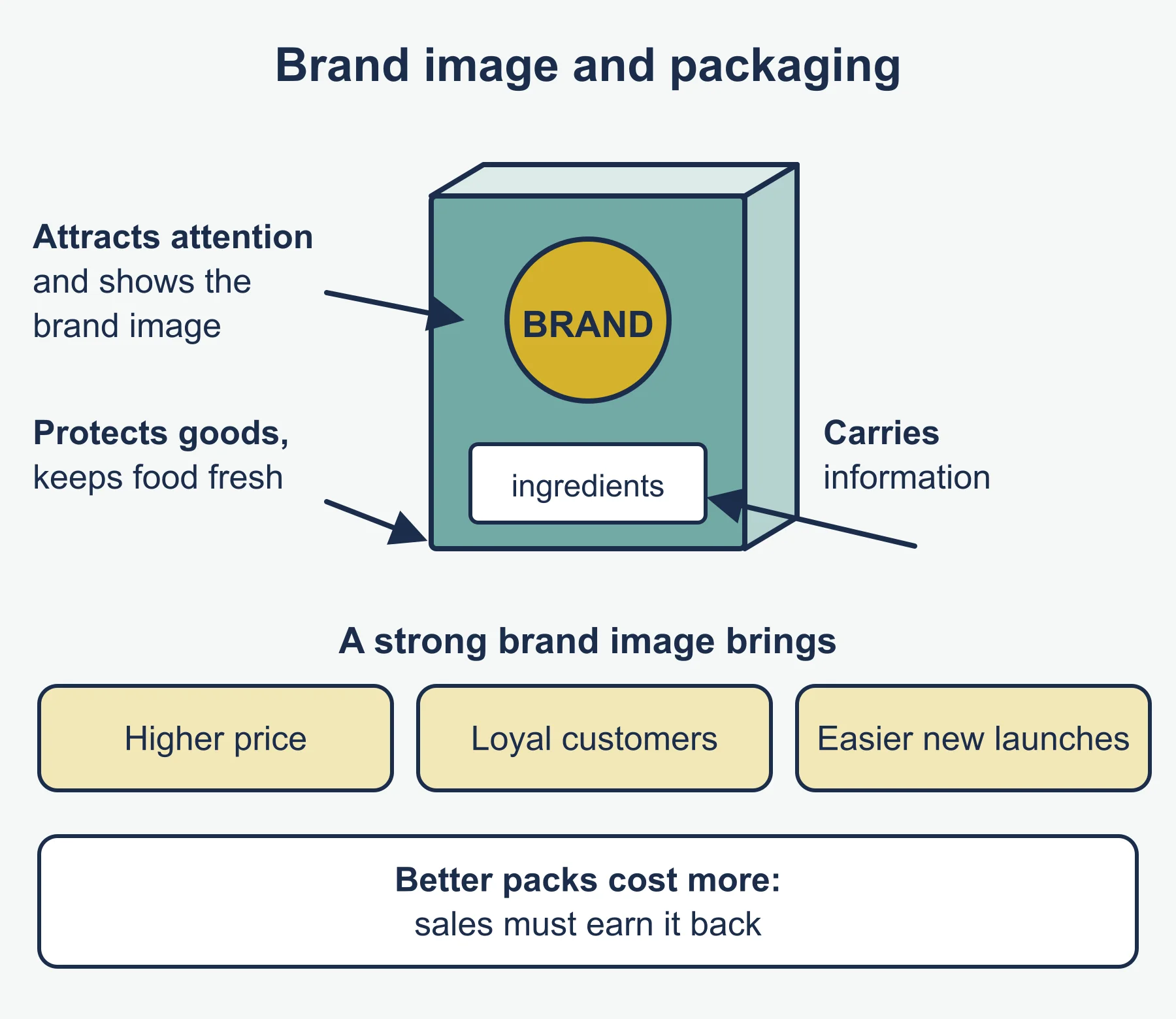
A brand is the name, logo and reputation that make a product recognisable. Brand image is what customers think and feel when they see it. A strong, positive image lets a business charge more, keeps customers loyal and makes new products easier to launch under the same name. A damaged image does the reverse.
Packaging has several roles. It protects goods in transit and on the shelf, and it keeps food fresh. It carries information such as ingredients and instructions. It attracts attention and shows the brand image, for example plain recycled card for a natural product. Better packaging adds cost, so it must earn that cost back through sales.
Developing new products
Advantages: new sales when existing products mature, a lead over competitors, and a chance to reach new customers. Disadvantages: research and development cost, the risk that customers do not buy it, and the time before it makes a profit. It can also take sales from the business’s own existing products.
The product life cycle
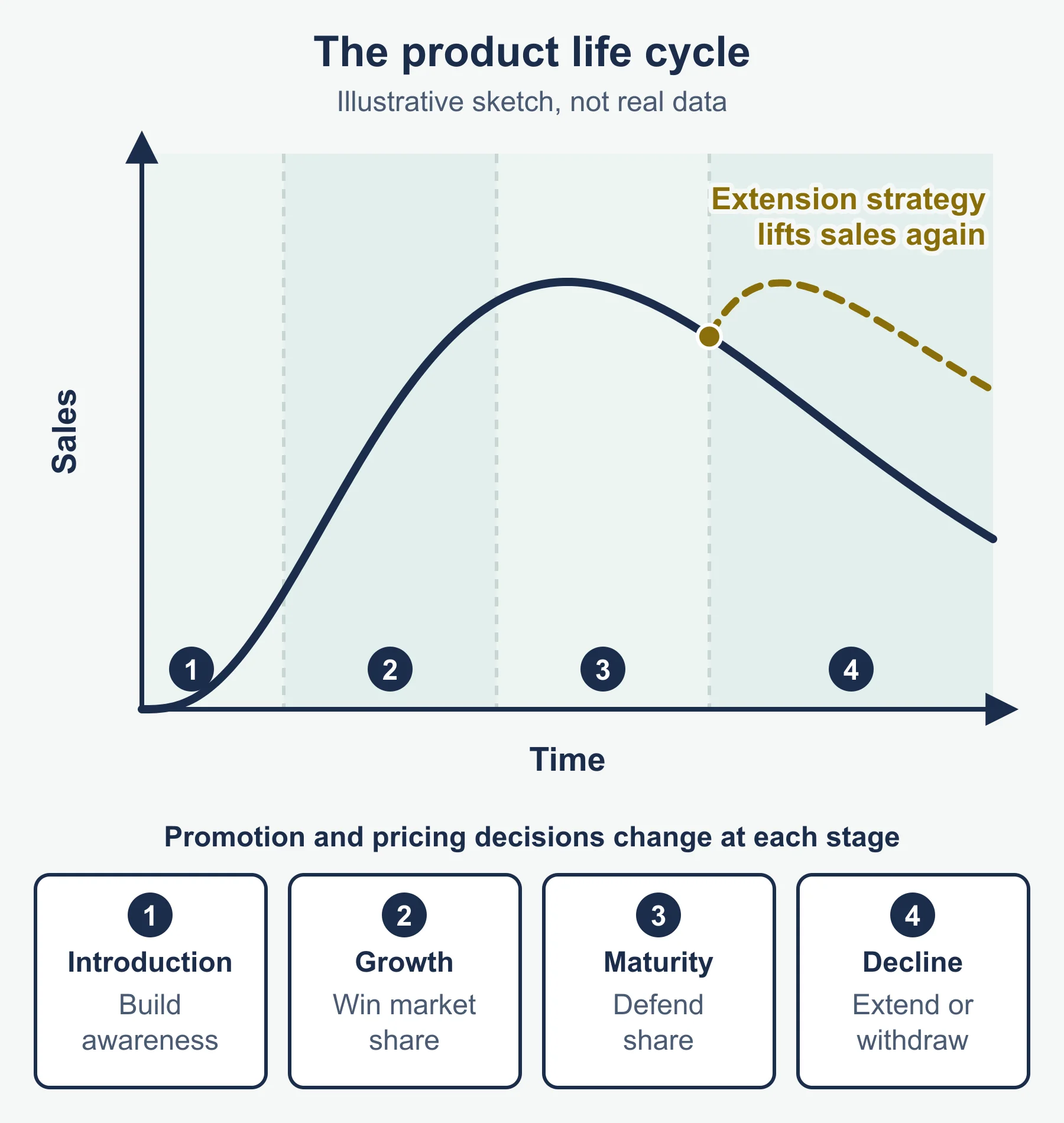
The product life cycle has four stages: introduction, growth, maturity and decline. A diagram plots sales (vertical axis) against time (horizontal axis).
| Stage | Sales | Typical features |
|---|---|---|
| Introduction | Low, rising slowly | High promotion cost, little or no profit |
| Growth | Rising fast | Rising profit, competitors may enter |
| Maturity | Levelling off at the peak | Highest sales, strong competition |
| Decline | Falling | Customers move to newer products |
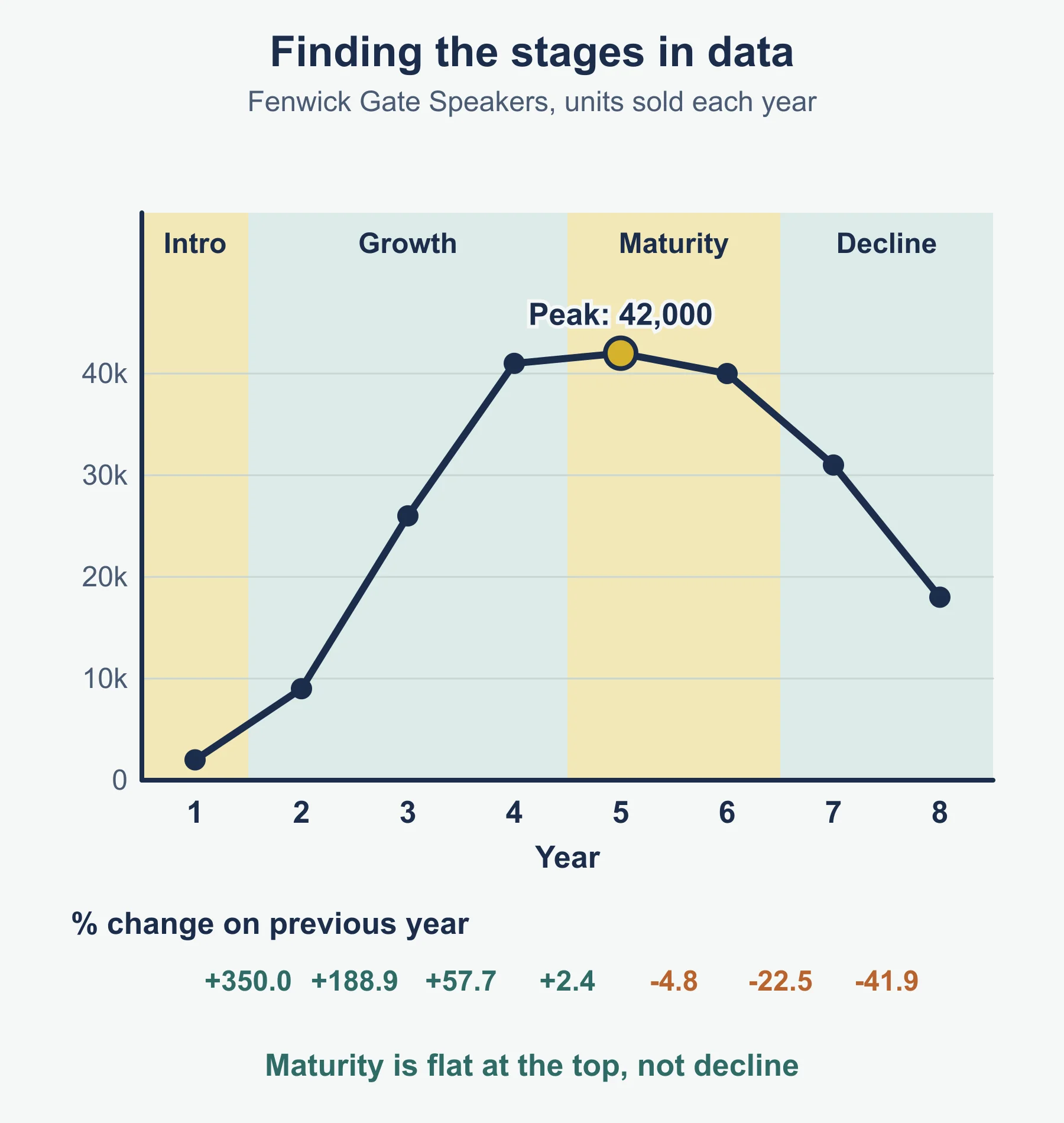
Worked example: interpreting a diagram. Fenwick Gate Speakers records yearly sales of one speaker model.
| Year | 1 | 2 | 3 | 4 | 5 | 6 | 7 | 8 |
|---|---|---|---|---|---|---|---|---|
| Sales (units) | 2,000 | 9,000 | 26,000 | 41,000 | 42,000 | 40,000 | 31,000 | 18,000 |
Year 1 is introduction. Years 2 to 4 are growth, because sales rise by 350%, then 188.9%, then 57.7%, though the rises are slowing. Years 5 and 6 are maturity: the curve is nearly flat, with a rise of 2.4% to year 5 and a fall of 4.8% to year 6. Years 7 and 8 are decline: sales fall 22.5% then 41.9%. The percentage change is (new - old) / old × 100. Year 5 is the peak, the highest point on the diagram.
Extension strategies
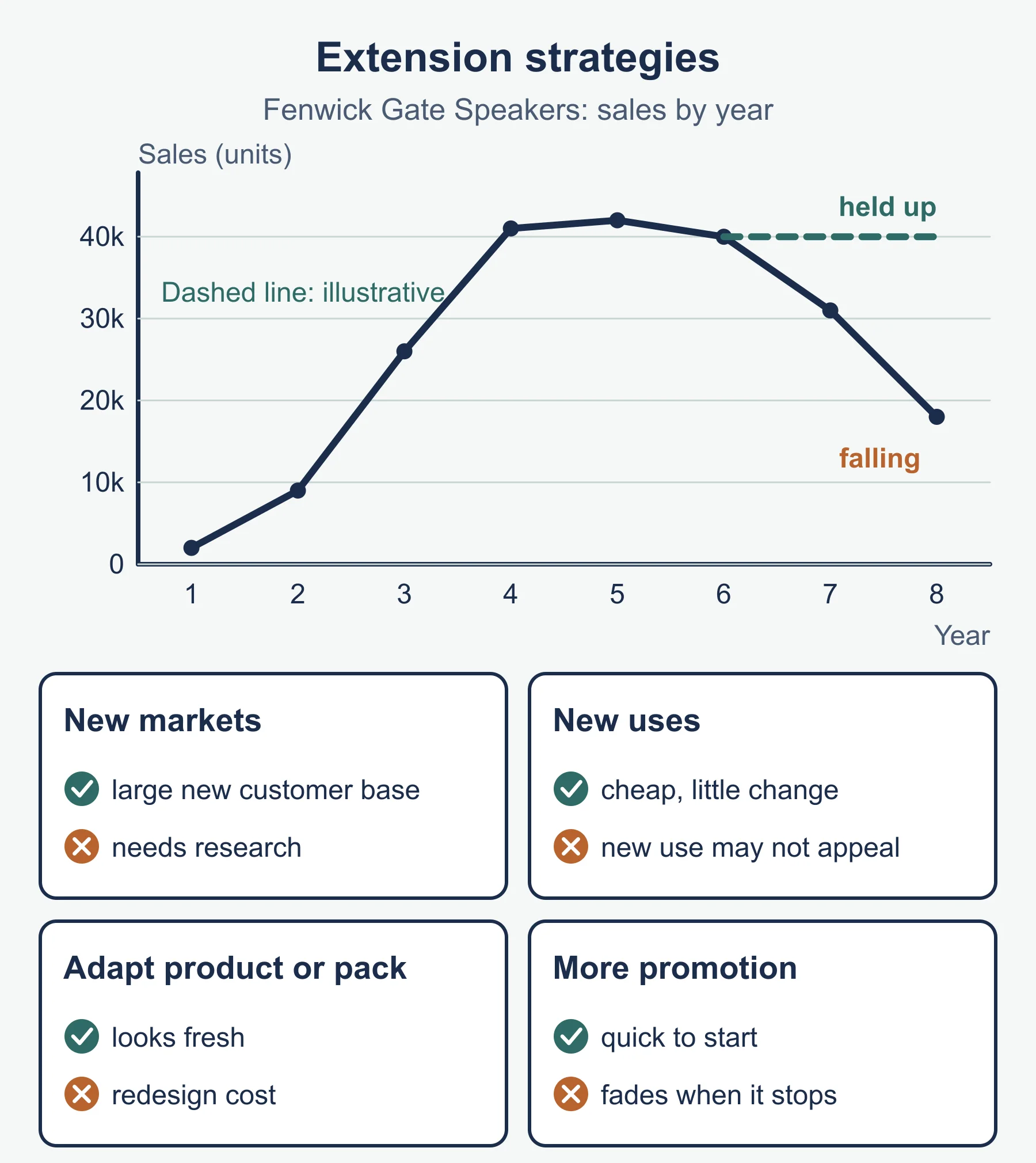
An extension strategy tries to stop sales falling when a product is mature or in decline. The syllabus lists these.
| Strategy | Meaning | Advantage | Disadvantage |
|---|---|---|---|
| New markets | Sell the same product to a new region or customer group | Large new customer base | Needs research and distribution set-up |
| New uses | Find another purpose for the product | Cheap, little change needed | The new use may not appeal |
| Adapt the product or packaging | Change features, flavours, design or pack | Looks fresh, keeps loyal customers | Redesign cost; may not be enough |
| Increased advertising or sales promotion | Spend more on promotion | Quick to start, easy to stop | Sales may fall again when it stops |
Recommending and justifying. Pick one strategy, link it to a fact in the case, and say why a rival option is weaker. Fenwick Gate Speakers, for example, could adapt the product by adding a voice assistant: the question says customers in years 6 to 8 are moving to smart devices, so the change answers the cause of the decline. A cheaper option such as extra advertising would not fix a product customers see as out of date.
3.3.2 Price
| Method | How it works | Advantage | Disadvantage |
|---|---|---|---|
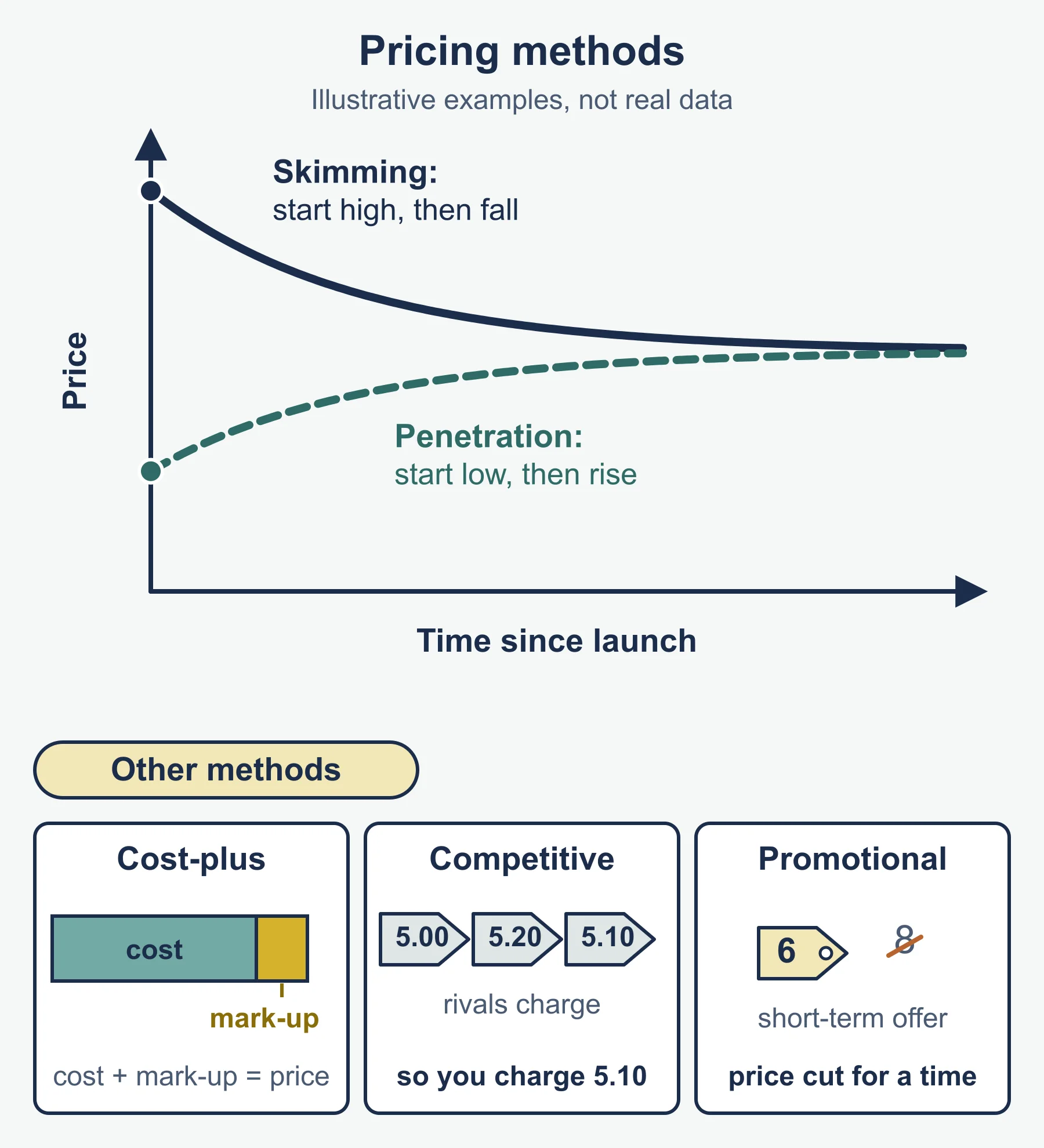
| Cost-plus | Add a mark-up to the unit cost | Simple; every sale covers cost | Ignores what customers will pay and what rivals charge |
| Competitive | Set price close to rivals | Avoids a price war; suits crowded markets | Little room to stand out; margin may be thin |
| Penetration | Low price at launch to win customers fast | Quick market share | Low early profit; hard to raise the price later |
| Skimming | High price at launch, often lowered later | High early profit from keen buyers | Few customers; attracts rivals |
| Dynamic | Price changes with demand, time or customer | Captures more revenue at peak demand | Customers may feel it is unfair |
Cost-plus in its standard form: selling price = unit cost + (unit cost × mark-up percentage). The syllabus does not give this formula, so treat it as the standard form.
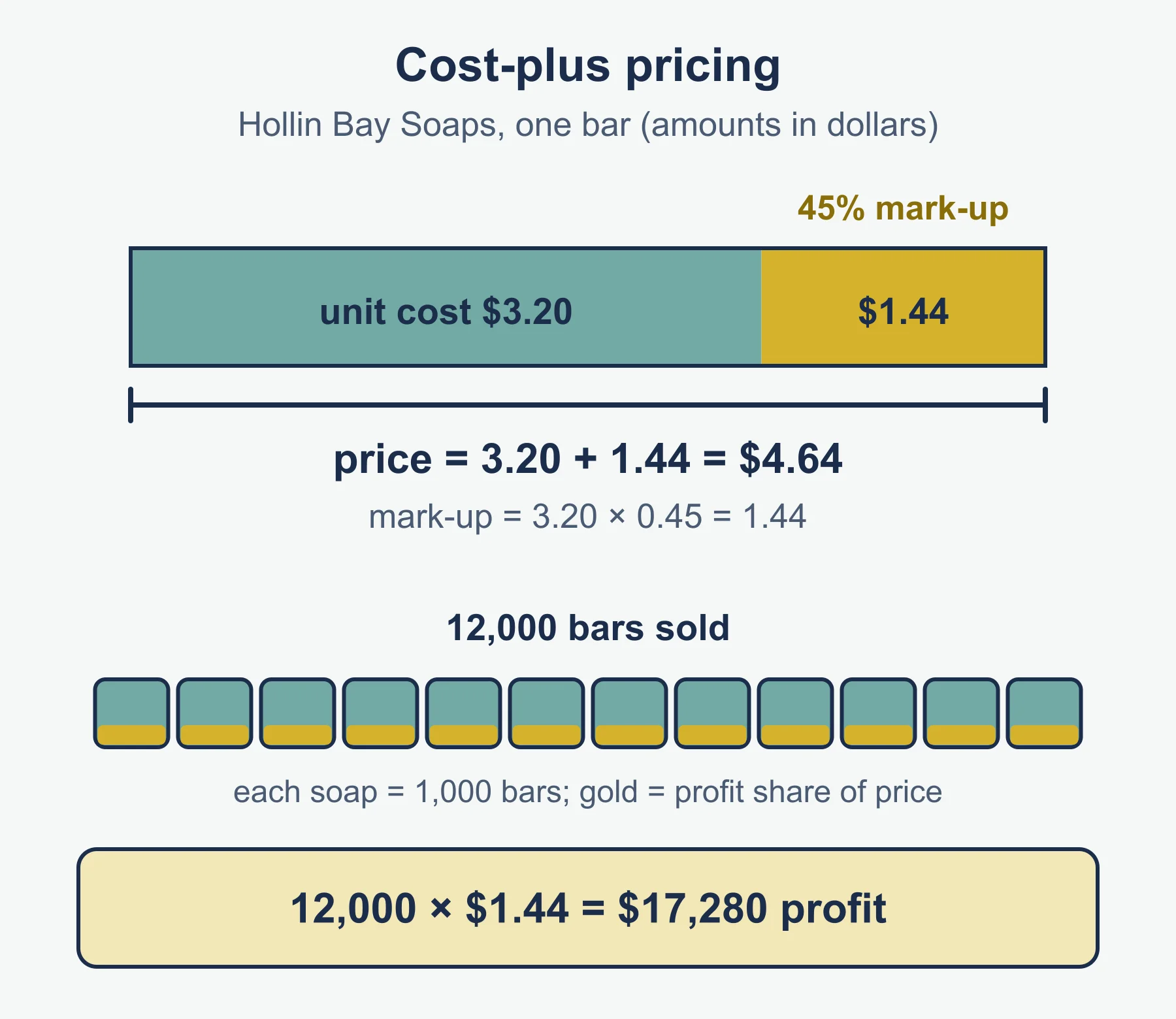
Worked example. Hollin Bay Soaps makes a bar of soap at a unit cost of 3.20 and adds a 45% mark-up. Mark-up = 3.20 × 0.45 = 1.44. Price = 3.20 + 1.44 = 4.64. Profit per bar is 1.44, so 12,000 bars give 12,000 × 1.44 = 17,280 profit (amounts in dollars).
To recommend a method, match it to the situation. Penetration suits a product that is easy to copy and needs volume. Skimming suits a new technology with few rivals. Competitive pricing suits a market of near-identical products. Dynamic pricing suits services with changing demand, such as tickets or travel.
3.3.3 Place
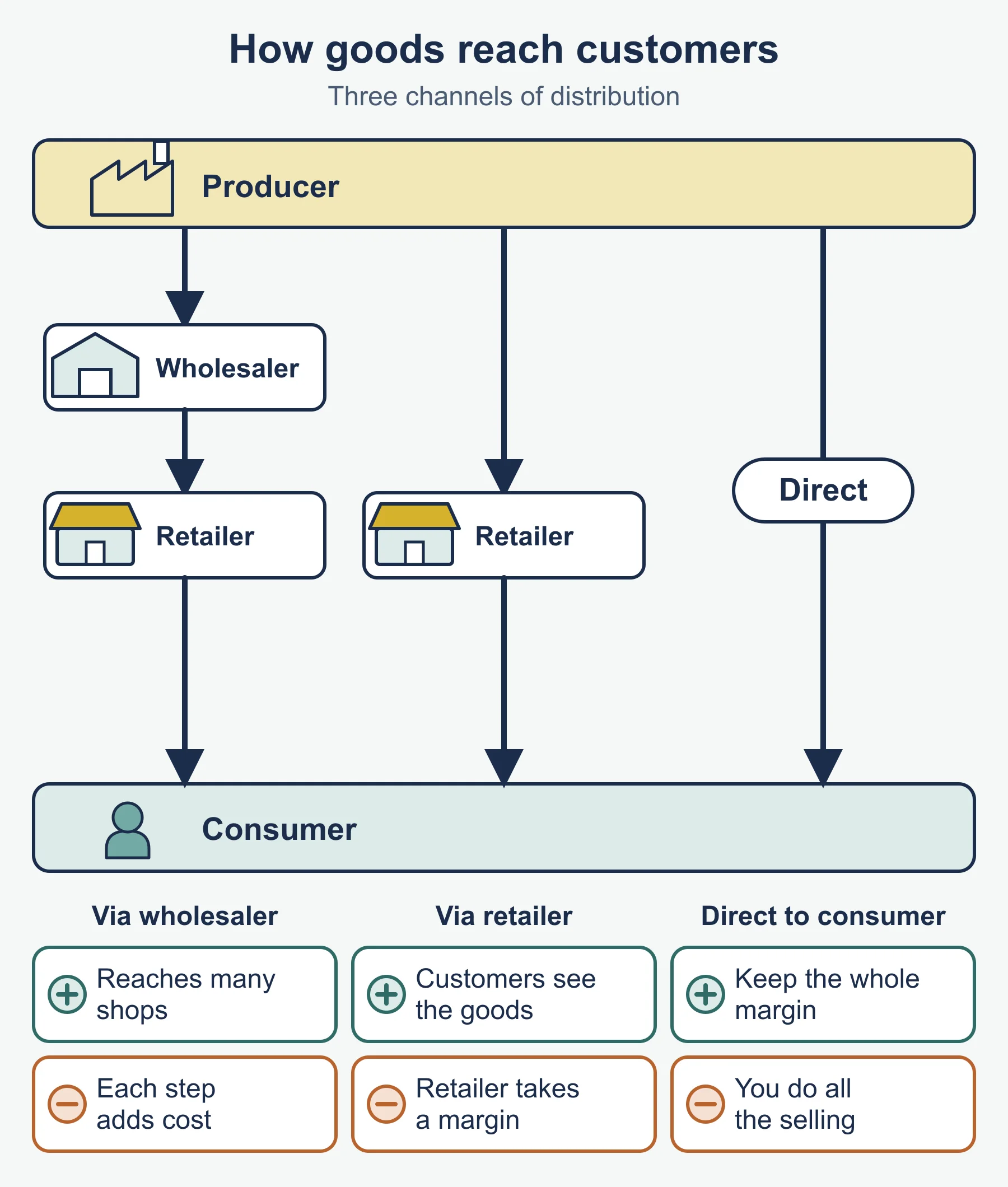
A distribution channel is the route goods take from producer to customer.
| Channel | Advantages | Disadvantages |
|---|---|---|
| Direct to customers | Keeps the whole profit; direct contact and data | The business pays for storage, delivery and selling |
| Through retailers | Wide reach; shops display goods | Retailer takes a margin; less control of how goods are presented |
| Through wholesalers | Buy in bulk, break bulk to small retailers; saves the producer time | Another margin; producer is further from customers |
| Through agents | Local knowledge; paid by commission, so few fixed costs | Commission cost; agent may sell rival goods |
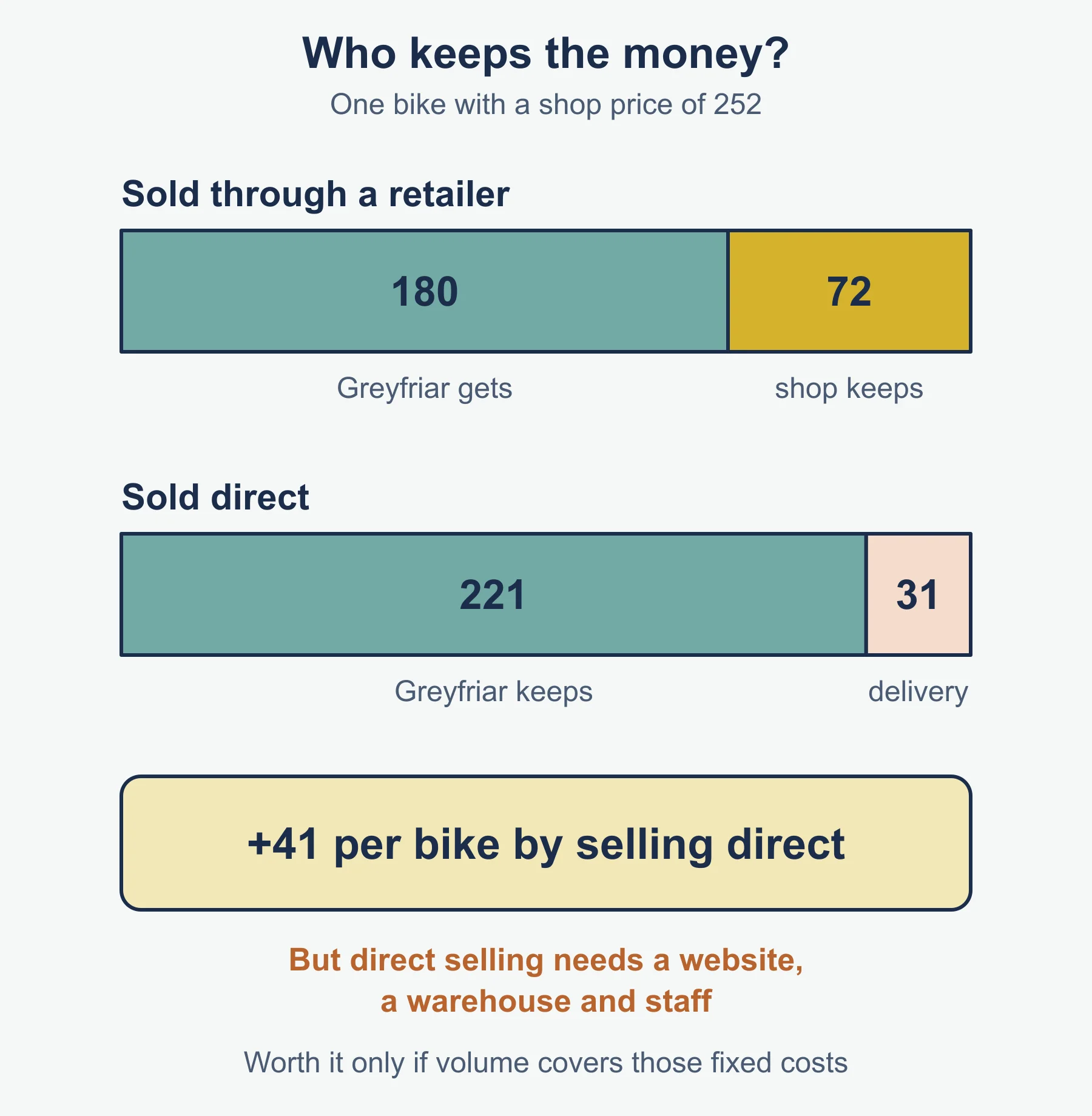
Worked example. Greyfriar Cycles sells a bike to a retailer for 180. The retailer adds 40%, so the shop price is 180 × 1.40 = 252 and the retailer keeps 72. If Greyfriar sold the same bike direct at 252 and paid 31 per bike for packing and delivery, it would keep 252 - 31 = 221, which is 41 more than 180. But direct selling would need a website, a warehouse and staff, so the extra 41 is only worth having if volume is high enough to cover those fixed costs.
To recommend a channel, use the product and customer: perishable or custom goods point to direct; mass-market goods point to retailers; a small producer with many small shops to supply may need a wholesaler; entering a distant country may need an agent.
3.3.4 Promotion
Reasons for promotion: to inform customers about a product, to persuade them to buy, to increase sales, to build or keep the brand image, and to remind customers about the business or to compete with rivals.
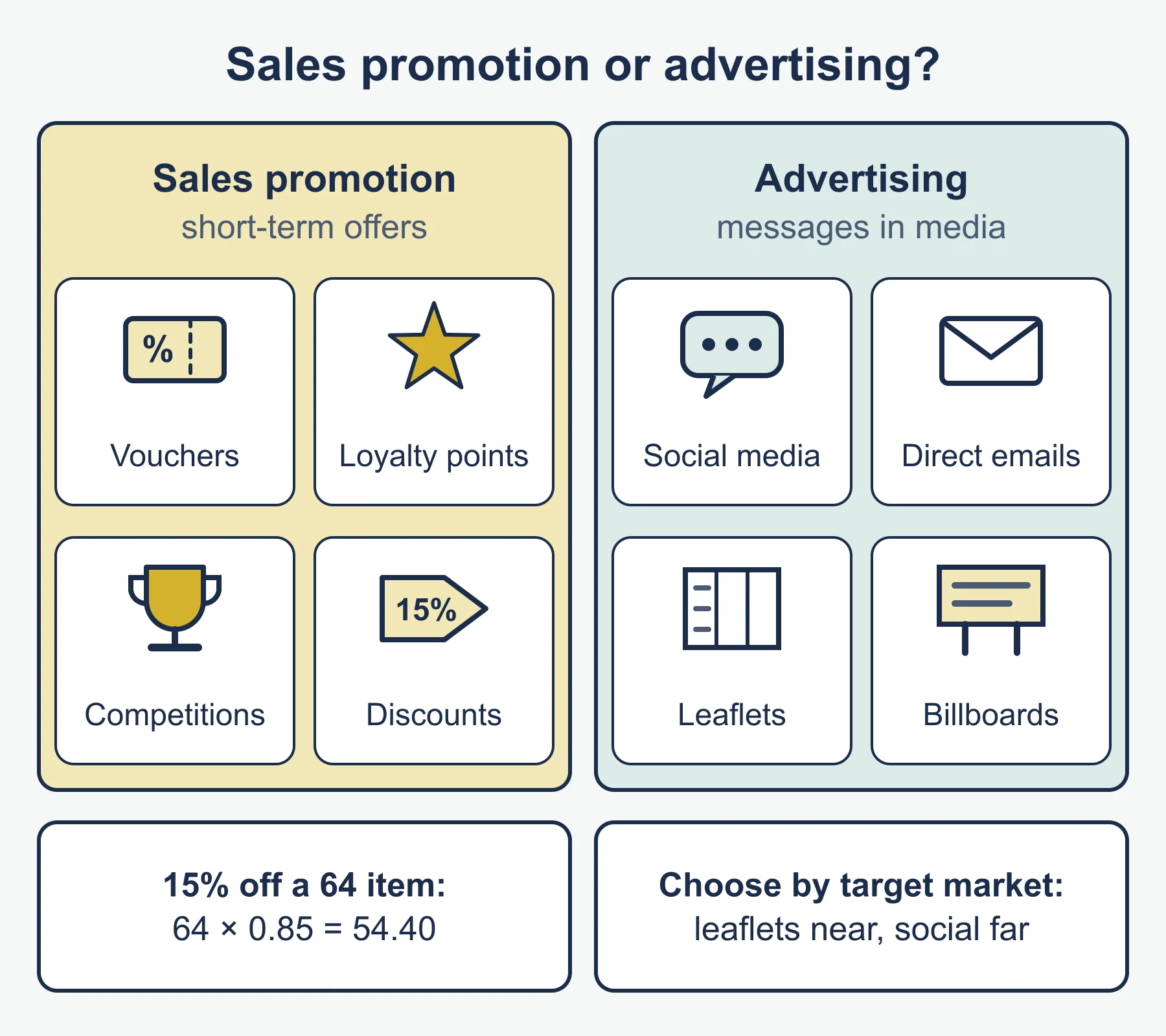
Methods of sales promotion are short-term offers: vouchers, reward schemes (loyalty points), competitions and special offers or discounts. A 15% discount on a 64 item gives 64 × 0.85 = 54.40.
| Method | Strength | Weakness |
|---|---|---|
| Vouchers | Target customers; trackable | Cost of discount; customers may only buy with a voucher |
| Reward schemes | Encourage repeat purchases | Cost of rewards and administration |
| Competitions | Create interest and data | Few win; prize cost |
| Special offers or discounts | Quick sales boost | Cut profit per unit; may harm brand image |
Methods of advertising include social media, direct or targeted emails, leaflets and billboards.
| Method | Strength | Weakness |
|---|---|---|
| Social media | Cheap, targeted by age and interest, shared by users | Needs constant content; negative comments are public |
| Direct or targeted emails | Low cost; reaches known customers | May be ignored as junk |
| Leaflets | Cheap local coverage | Often thrown away; hard to target |
| Billboards | Seen by many people daily | Message must be short; cost; cannot be targeted |
Choose by link to the target market. A school stationery shop wanting parents nearby should consider leaflets or targeted emails; a brand for teenagers across a country should consider social media.
3.3.5 Ecommerce
Ecommerce is buying and selling using the internet. The syllabus examples are mobile phone or internet banking, online shopping and online ticketing.
| Advantages | Disadvantages | |
|---|---|---|
| Businesses | Wider market, lower premises costs, open at all hours | Website and security cost, delivery problems, strong competition, fraud risk |
| Customers | Convenient, easy price comparison, wider choice | Cannot touch or try goods, delivery wait, fears about security and privacy, no internet means no access |
3.3.6 Marketing strategy
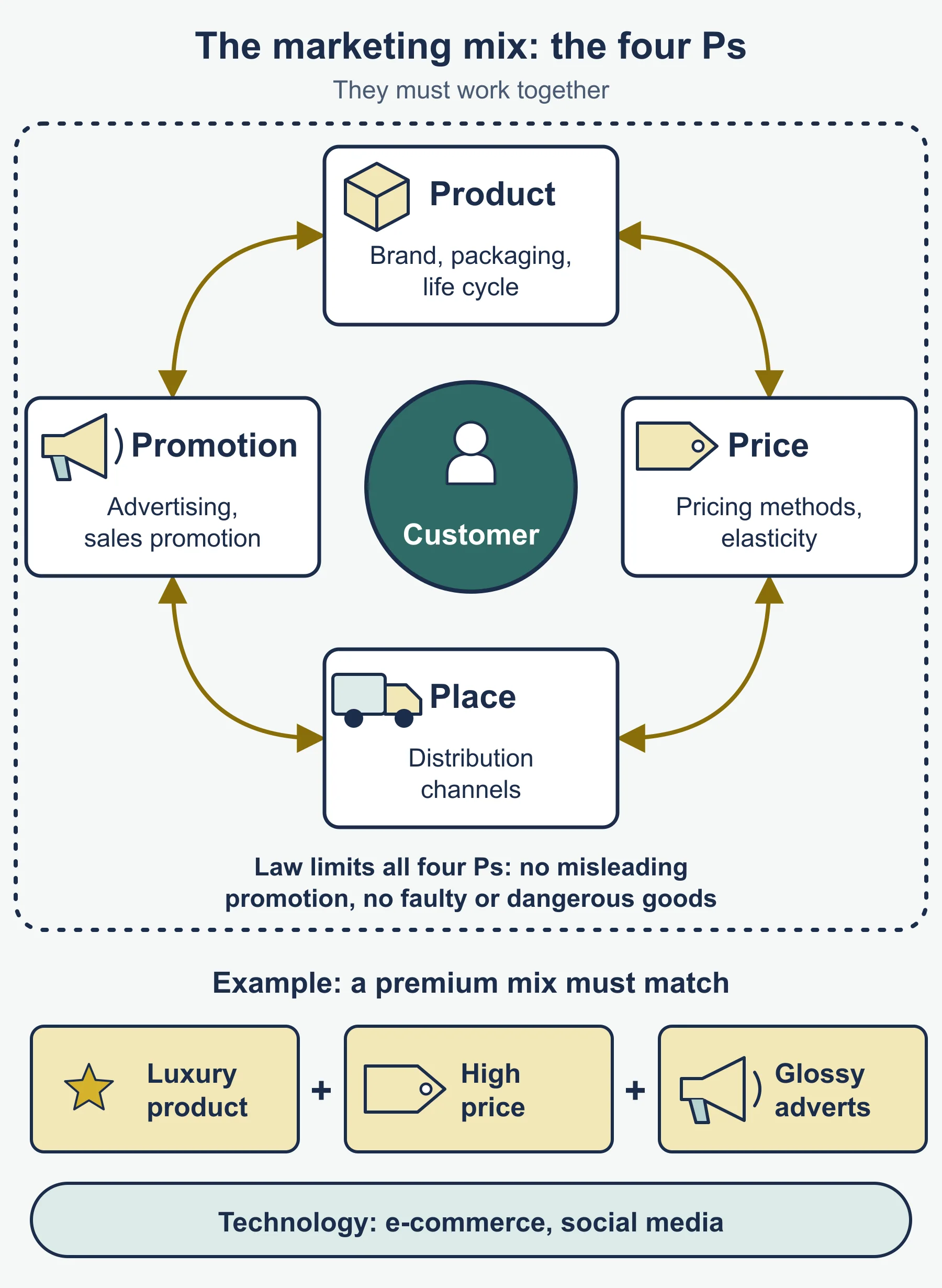
The four elements of the marketing mix are product, price, place and promotion. They must fit together: a luxury product needs a high price, upmarket outlets and an image-based promotion. A mismatch confuses customers. The importance of each element depends on the market. Price matters most for basic goods with many substitutes; product and brand matter most where customers see goods as different; place matters when convenience decides the purchase; promotion matters for new products or when customers do not know the business.
Worked example. Alder & Finch Stationery plans a range of recycled notebooks for university students, who are price-aware and online. A justified mix: a competitive price just under main rivals; plain recycled packaging that supports the image; sales through its own website plus campus shops (place); and social media with student discount vouchers. Each choice is tied to the target group, and together they match.
3.3.7 Entering new markets in other countries
Advantages: more sales, spreading risk (a fall at home is offset by sales abroad), a longer product life and possible lower costs from bigger production. Disadvantages: cultural differences (language, tastes, symbols), lack of knowledge of the market, legal requirements, transport and exchange costs, and competition from local firms.
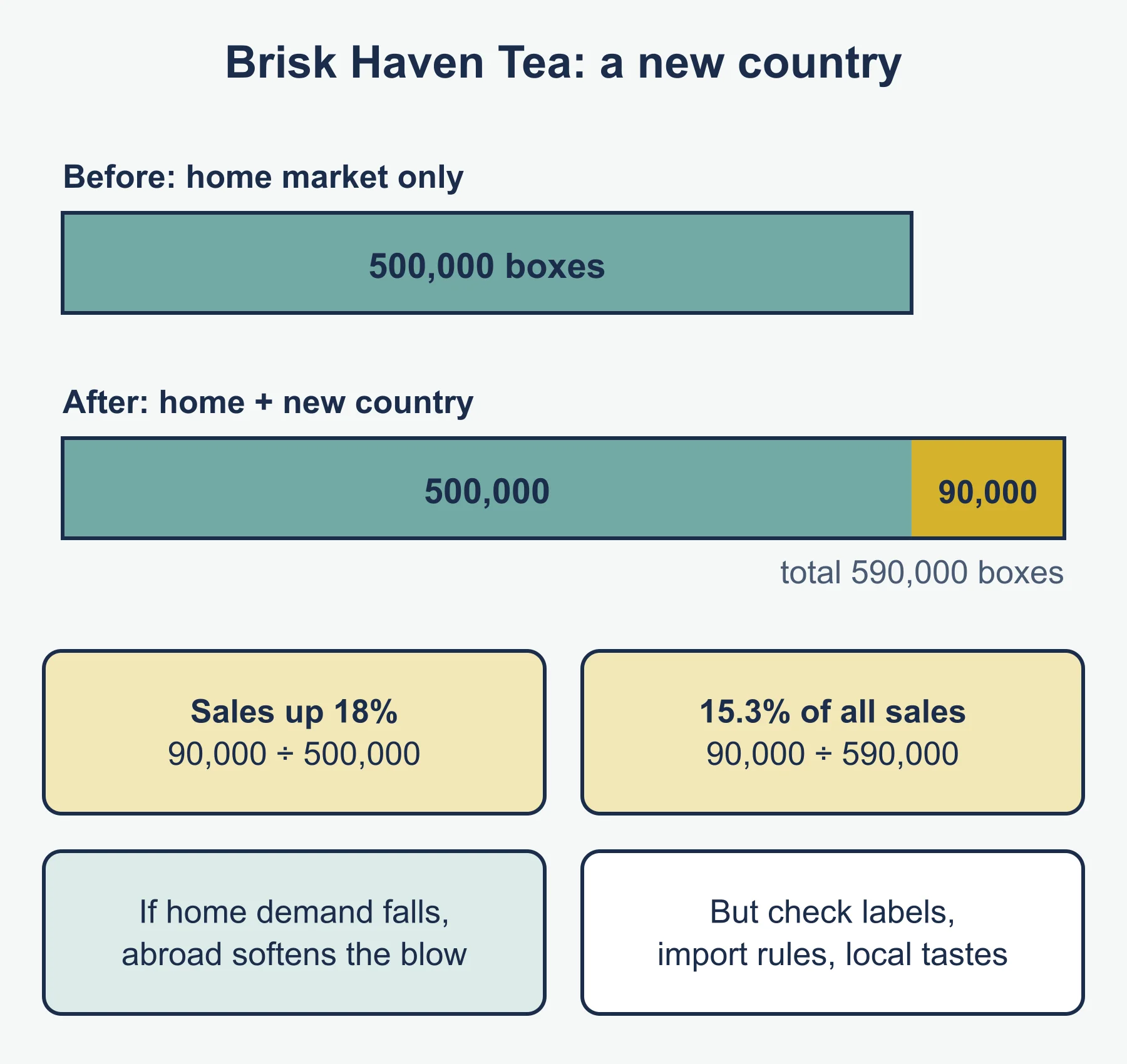
Worked example. Brisk Haven Tea sells 500,000 boxes at home. A new country adds 90,000 boxes. Sales rise by 90,000 / 500,000 × 100 = 18%, and the new country provides 90,000 / 590,000 = 15.3% of total sales. If home demand fell, those sales would soften the blow, which is the risk-spreading benefit. But the firm must check labelling and import rules, and may need local taste research first.
Common errors
- Listing the four Ps without applying them to the business named in the question.
- Describing a pricing method but not saying why it suits this product.
- Confusing sales promotion (short-term offers) with advertising (messages in media).
- Treating maturity as decline: in maturity sales are at their peak and flat.
- Recommending an extension strategy without saying why the product needs one.
- Forgetting a disadvantage: every method has a cost.
Frequently asked questions
What are the four stages of the product life cycle? The four stages are introduction, growth, maturity and decline.
What is an extension strategy? An extension strategy tries to stop sales falling when a product is mature or in decline. When recommending one, link it to a fact in the case and say why the product needs it.
How do you calculate a cost-plus price? The cost-plus selling price is the unit cost plus the unit cost multiplied by the mark-up percentage. For example, a unit cost of 3.20 with a 45% mark-up gives a price of 4.64.
What are the advantages of entering new markets abroad? Entering markets in other countries can bring more sales, spread risk because a fall at home may be offset by sales abroad, and extend a product’s life.
What is ecommerce? Ecommerce is buying and selling using the internet. Syllabus examples include mobile or internet banking, online shopping and online ticketing.
Official syllabus
Cambridge IGCSE Business 0264 syllabus for examination in 2027, 2028 and 2029, published by Cambridge University Press & Assessment, section 3.3 Marketing mix.
Get free revision emails (optional)
Occasional emails with practice questions, worked explanations and links to free resources for the qualification and subjects you choose. No spam, and you can unsubscribe from any email. The free tools on this site never need an email.
Related resources
-
Practice questions
IGCSE Business: Marketing mix (Cambridge 0264) – Practice Questions
Eleven original practice questions with worked answers on product, price, place, promotion, ecommerce and new markets, Cambridge IGCSE Business 0264.
Business · Cambridge · IGCSE
Try questions -
Revision notes
IGCSE Business: Marketing mix (Cambridge 0264) – Revision Notes
Condensed revision notes on the marketing mix, life cycle, pricing, channels, promotion and ecommerce for Cambridge IGCSE Business 0264.
Business · Cambridge · IGCSE
Revise topic -
Study guides
IGCSE Business: Legal controls (Cambridge 0264)
A full study guide to Cambridge IGCSE Business 0264 section 3.4: why legal controls protect customers and how they affect marketing decisions.
Business · Cambridge · IGCSE
Read guide
Related articles
-
teaching
A Level tuition in Dubai: Cambridge or Pearson Edexcel International A Level?
Schools in Dubai and Abu Dhabi teach either Cambridge International AS & A Level or Pearson Edexcel International A Level. How the two are structured, why it matters for tuition, and how online classes from Lahore work.
9 October 2026
-
curriculum guides
Choosing subjects at IGCSE and A Level
How subject choices at 14 and 16 affect university options later, and how to keep pathways open without overloading a timetable.
28 July 2026
Studying this with a teacher
Working through Business IGCSE?
This page is free and stays free. If you would rather be taught it, Marlbridge runs Business classes one-to-one and in small groups of up to 15, online in your own time zone. The first trial class is free. WhatsApp replies within an hour (8am–11pm Pakistan time, every day); email the same day.
Cambridge Business teachers at Marlbridge

