
Study Guides
IGCSE Business: Production of goods and services (Cambridge 0264)
Study guide to Cambridge IGCSE Business 0264 section 4.1: labour productivity, efficiency, lean production, inventory and job, batch and flow production.
- Subject
- Business
- Level
- IGCSE
- Topic
- Operations management
- Author
- Marlbridge Academic Team
- Updated
- Reviewed by
- Salman Ahmad (what this means)
Aligned to Cambridge IGCSE Business (0264), For examination in 2027, 2028 and 2029. Official specification .
Syllabus page (what it covers and how it is assessed): Cambridge IGCSE Business.
Syllabus points this page covers
0264
- 4.1 Production of goods and services
Found an error? Report a correction.
Need help with this topic? Request a free trial class for IGCSE Business (0450 / 0264).
This guide covers section 4.1, Production of goods and services, of the Cambridge IGCSE Business 0264 syllabus for examination in 2027, 2028 and 2029. It teaches production processes (4.1.1) and the main methods of production (4.1.2). Every business below is invented. Revise from the revision notes, then test yourself with the practice questions. The course hub and the printable checklist track your progress, and the free diagnostics show where to start.
What this section covers
| Syllabus point | What you must be able to do |
|---|---|
| 4.1.1 | Calculate labour productivity |
| 4.1.1 | Explain why efficiency is important to a business |
| 4.1.1 | Explain how to increase efficiency, for example more automation and technology, or better labour skills |
| 4.1.1 | Explain lean production and how to achieve it through just-in-time (JIT) inventory control and Kaizen |
| 4.1.1 | Give advantages and disadvantages of lean production methods |
| 4.1.1 | Explain why businesses hold inventory and what affects how much they hold |
| 4.1.2 | Describe job, batch and flow production |
| 4.1.2 | Give advantages and disadvantages of each method |
| 4.1.2 | Recommend and justify a production method for a given situation |
The syllabus says this topic covers goods and services, so keep both in mind. A hairdresser, a bank and a bus company all have production processes too.
Labour productivity
Labour productivity measures how much output each worker produces in a given period. The syllabus asks you to calculate it and lists the formula in its formulas and ratios section, as output per period (units) divided by number of employees, giving units per employee:
Labour productivity = output in a period / number of employees in that period
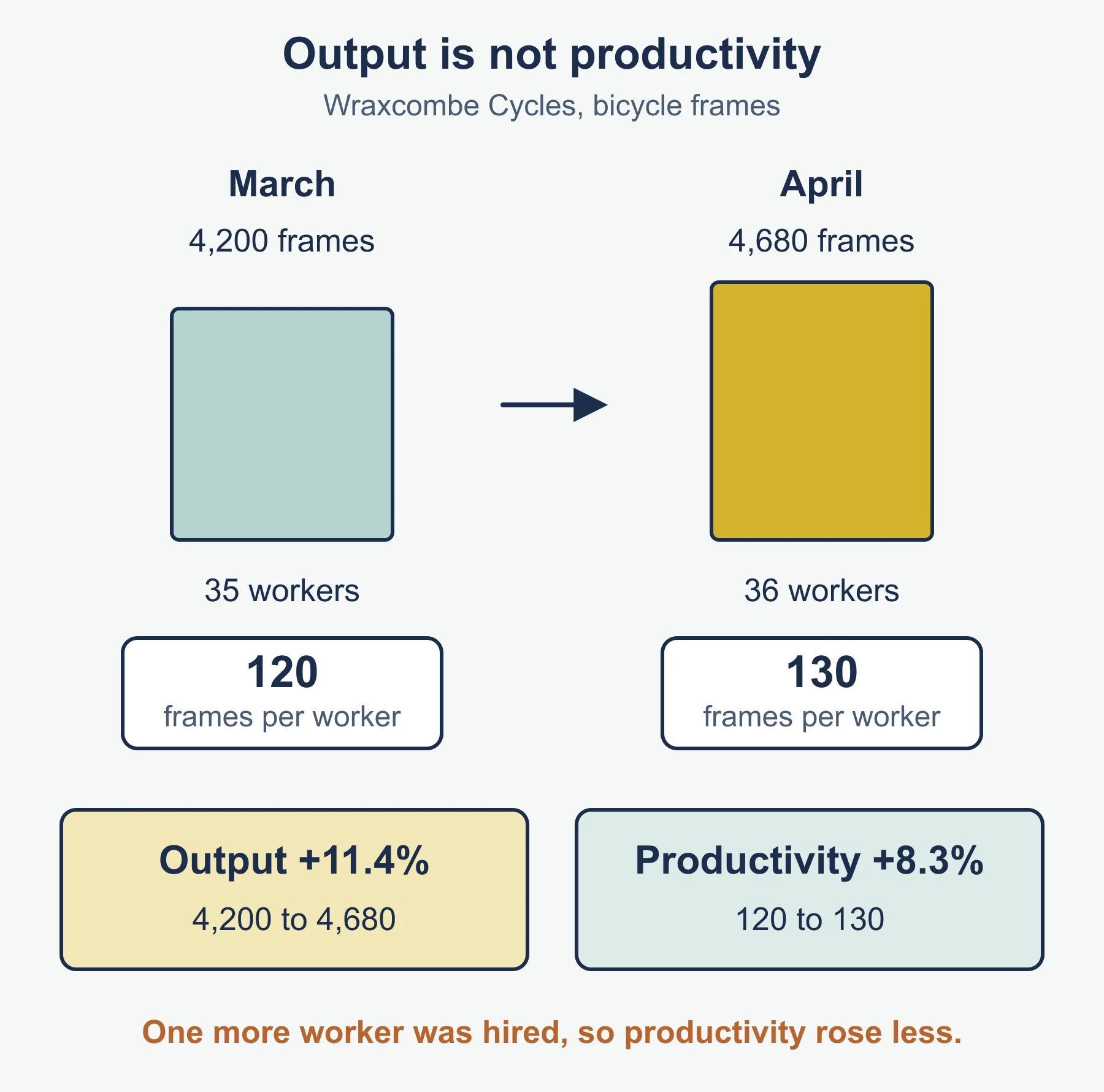
Worked example 1. Wraxcombe Cycles makes bicycle frames. In March 35 workers made 4,200 frames. In April 36 workers made 4,680 frames.
- March: 4,200 / 35 = 120 frames per worker.
- April: 4,680 / 36 = 130 frames per worker.
- Change: 130 - 120 = 10 more frames per worker, which is 10 / 120 = 8.3% (1 decimal place).
Output rose by 11.4%, but productivity rose by only 8.3%, because the workforce also grew. That is why productivity is a better measure of performance than output alone. Always state the unit (frames per worker) and the time period.
Productivity can be measured per hour instead of per employee. The method is the same: divide output by the labour input you are given.
Why efficiency is important
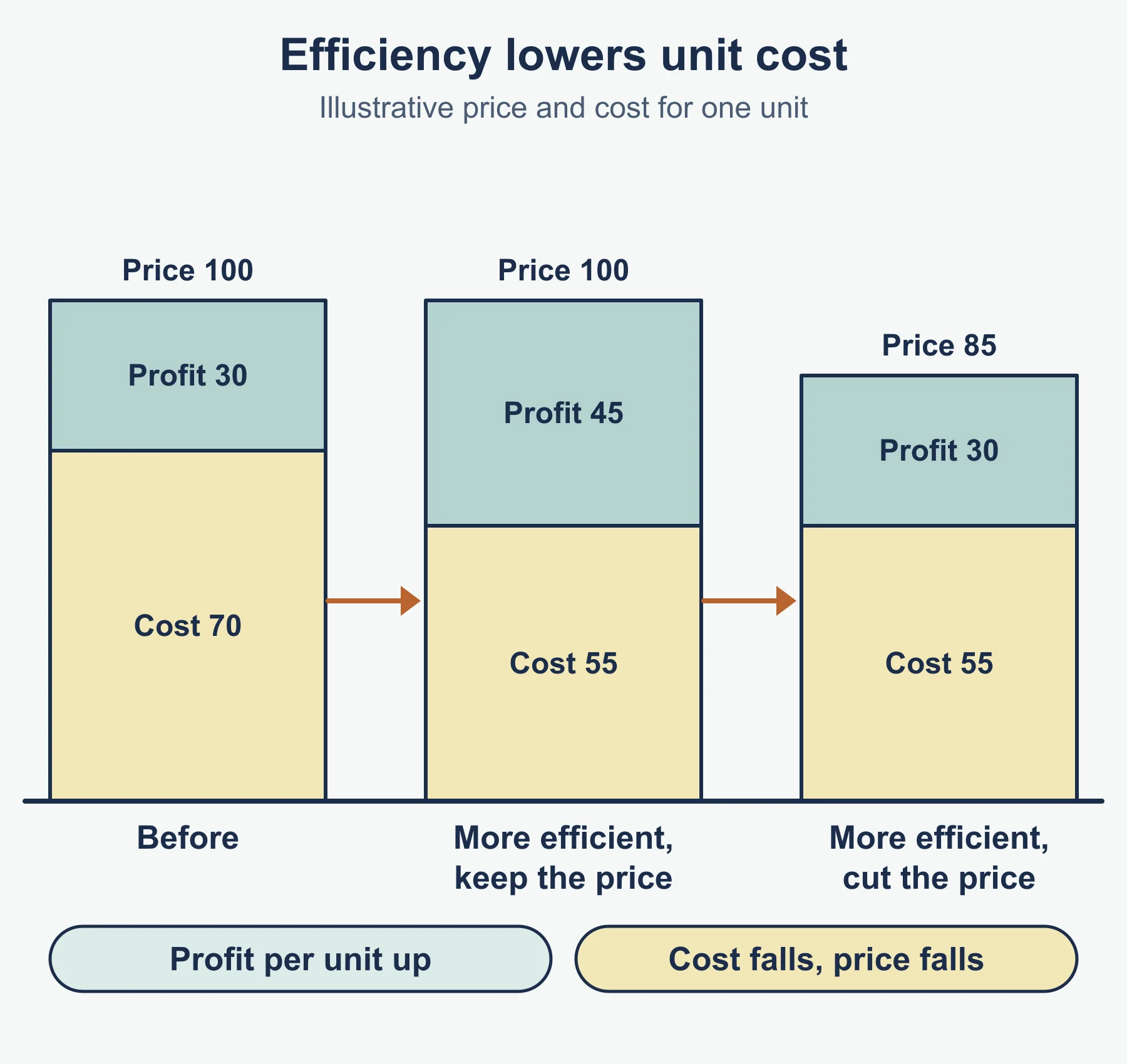
Efficiency means using resources, such as labour, materials and energy, so that little is wasted and each unit of output costs less. In answers, link it to the business’s results:
- Lower unit costs. The same money produces more, so the business can make more profit at its current price or cut the price to compete.
- Better competitiveness. A business that produces at lower cost can price below rivals or spend more on quality and marketing.
- Less waste. Fewer materials and less energy are thrown away, which also helps the business’s environmental image.
- Faster delivery. Smoother processes mean customers get products sooner, which supports customer satisfaction.
A strong explanation has a chain: efficiency rises, so unit costs fall, so the business can lower its price or raise its profit. Do not stop at “it saves money”.
How to increase efficiency
The syllabus names two routes by example: automation and technology, and improving labour skills.
Automation and technology. Machines and computer-controlled equipment do repetitive tasks faster, more consistently and for longer hours than people. The gain is higher output per worker and fewer errors. The costs are the purchase price, maintenance, possible redundancies and the risk of breakdowns halting production.
Improving labour skills. Training lets workers do tasks faster, make fewer mistakes and use equipment properly. A better-trained worker may also be more motivated. The costs are the fees, the lost production while people train, and the risk that trained staff leave for a better-paid job.
Worked example 2. Tarnbury Bakehouse has 20 packers. A training course costs £6,000 in total. Afterwards each packer handles 4 more trays per week. Each extra tray adds £9 to revenue after costs.
- Extra trays per week: 20 x 4 = 80.
- Extra weekly benefit: 80 x £9 = £720.
- Time to recover the training cost: £6,000 / £720 = 8.3 weeks (1 decimal place).
The course pays for itself in about eight to nine weeks, if the gains last. A good evaluation points out that last condition: the benefit depends on workers staying and keeping the new habits.

Lean production
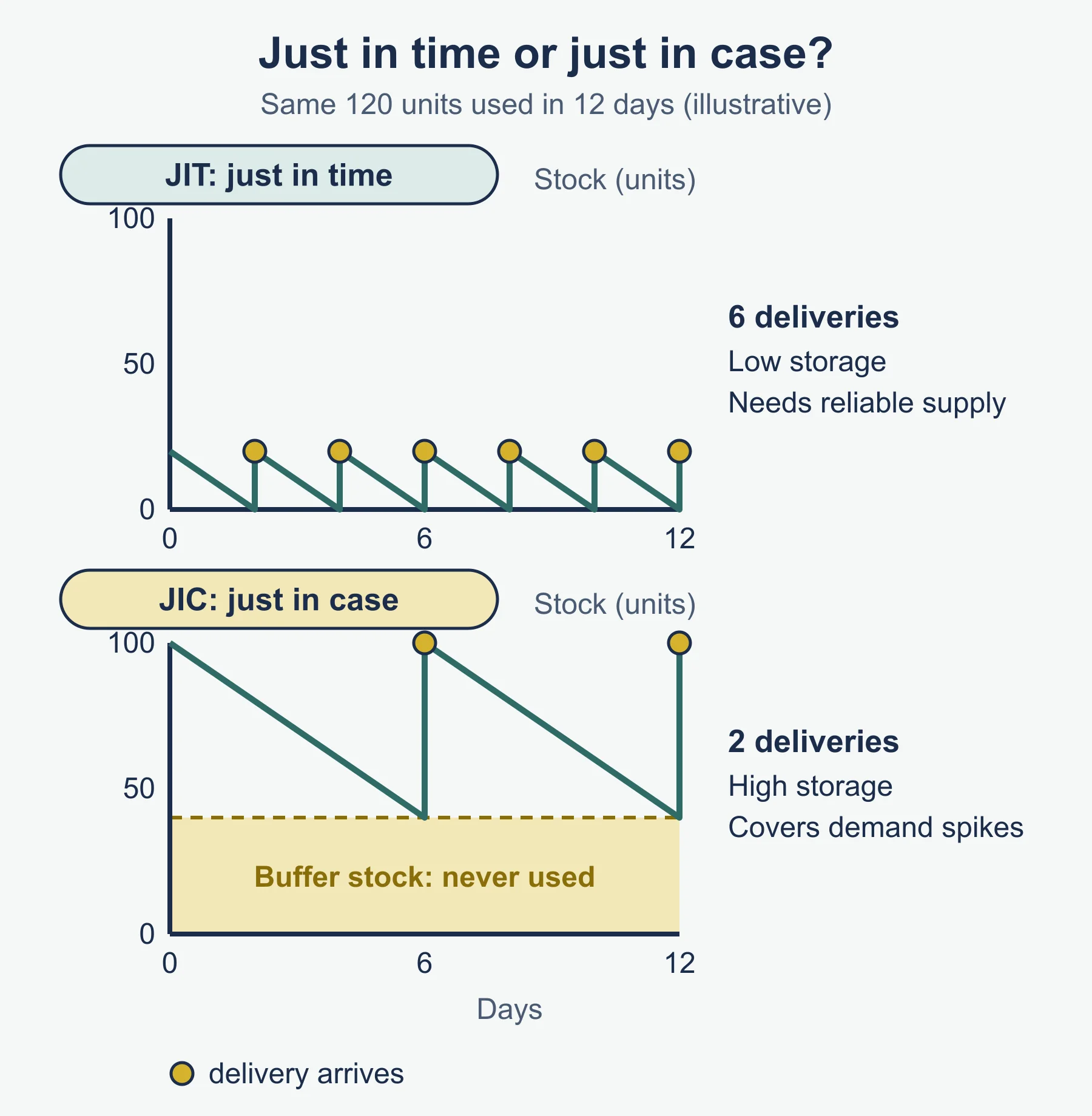
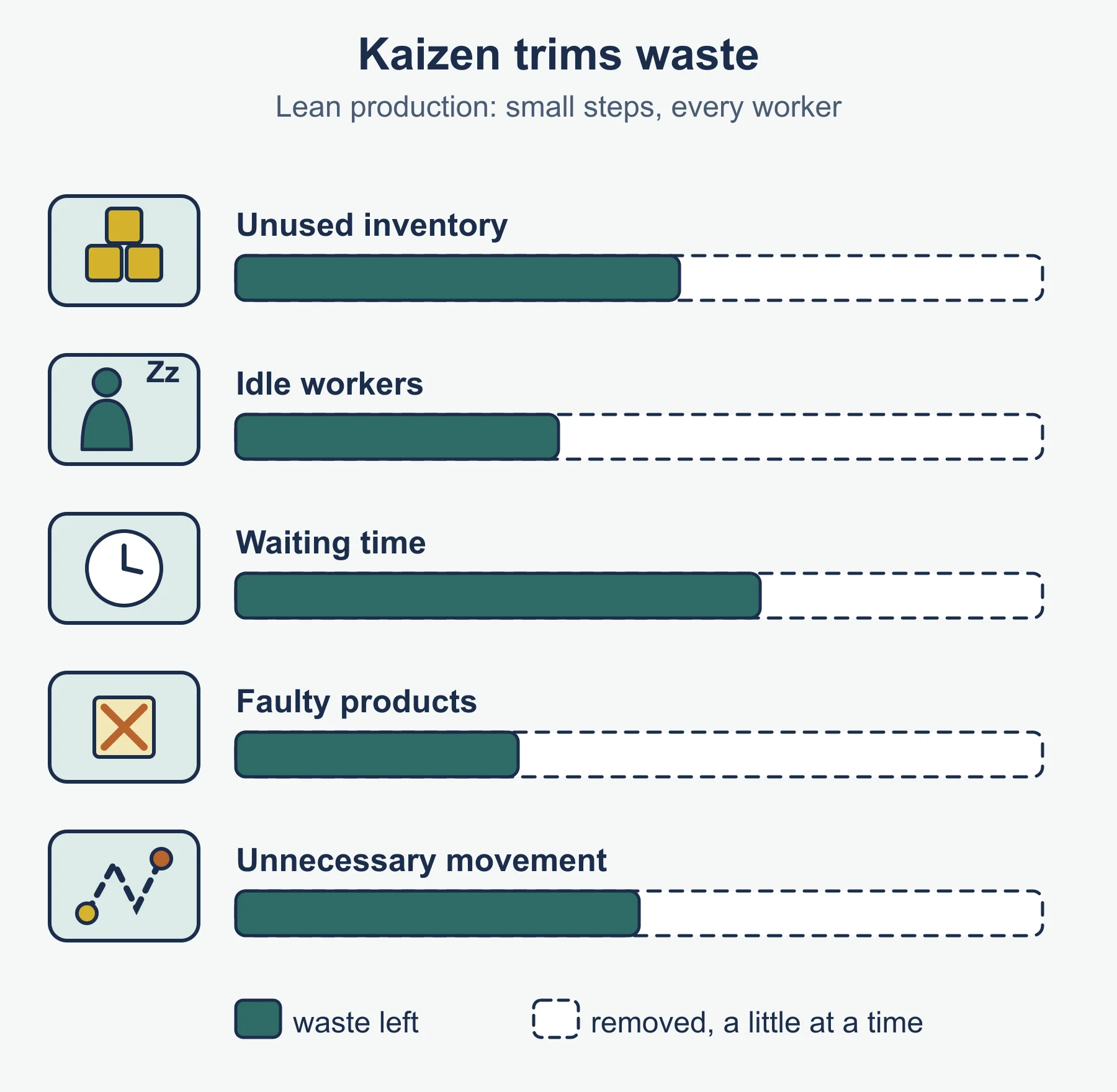
Lean production means producing goods or services with as little waste as possible, while keeping quality high. Waste includes unused inventory, idle workers, waiting time, faulty products and unnecessary movement. The syllabus names two ways to achieve it.
Just-in-time (JIT) inventory control
With JIT, a business keeps very little inventory. Materials arrive from suppliers just as they are needed, and finished products go to customers soon after they are made.
| Advantages | Disadvantages |
|---|---|
| Less money tied up in inventory | Production stops if a delivery is late |
| Less storage space needed | Suppliers must be reliable, so the business depends on them |
| Less risk of stock going out of date or being damaged | Orders may be smaller and dearer, with fewer bulk discounts |
| Cash can be used elsewhere | Hard to meet a sudden rise in demand from stock |
Kaizen
Kaizen means continuous improvement. Every worker, not just managers, is expected to suggest small changes all the time, often through teams that meet to solve problems. Many small improvements add up to lower costs and higher quality.
| Advantages | Disadvantages |
|---|---|
| Staff feel involved, which can raise motivation | Gains are small and slow, not dramatic |
| Ideas come from people who do the work | Meetings and training take time and money |
| Costs and waste fall steadily | Some workers resist change or feel under pressure |
| Quality improves | Needs commitment from all levels to keep going |
Advantages of lean production overall: lower costs, less waste, higher quality and more flexible production. Disadvantages overall: heavy reliance on suppliers, risk of lost sales if stock runs out, and the effort of changing how people work.
Why businesses hold inventory
Inventory (also called stock) means raw materials, work in progress and finished goods. Businesses hold it to:
- keep production running if a supplier is late;
- meet sudden rises in demand without disappointing customers;
- buy materials in bulk at a discount;
- deal with seasonal demand, such as building up stock before a busy period.
Factors affecting how much inventory a business holds
- Type of product. Fresh or perishable items such as bread must be held in small amounts. Durable items such as screws can be stored for years.
- Demand. Steady, predictable demand needs less spare inventory. Uncertain or seasonal demand needs more.
- Supplier reliability and delivery time. Slow or unreliable suppliers mean a larger buffer.
- Storage space and cost. Little space or high storage costs push a business to hold less.
- Cash available. Inventory ties up money, so a business short of cash holds less.
- Production method. A business using JIT holds very little inventory. One using batch production may hold more.
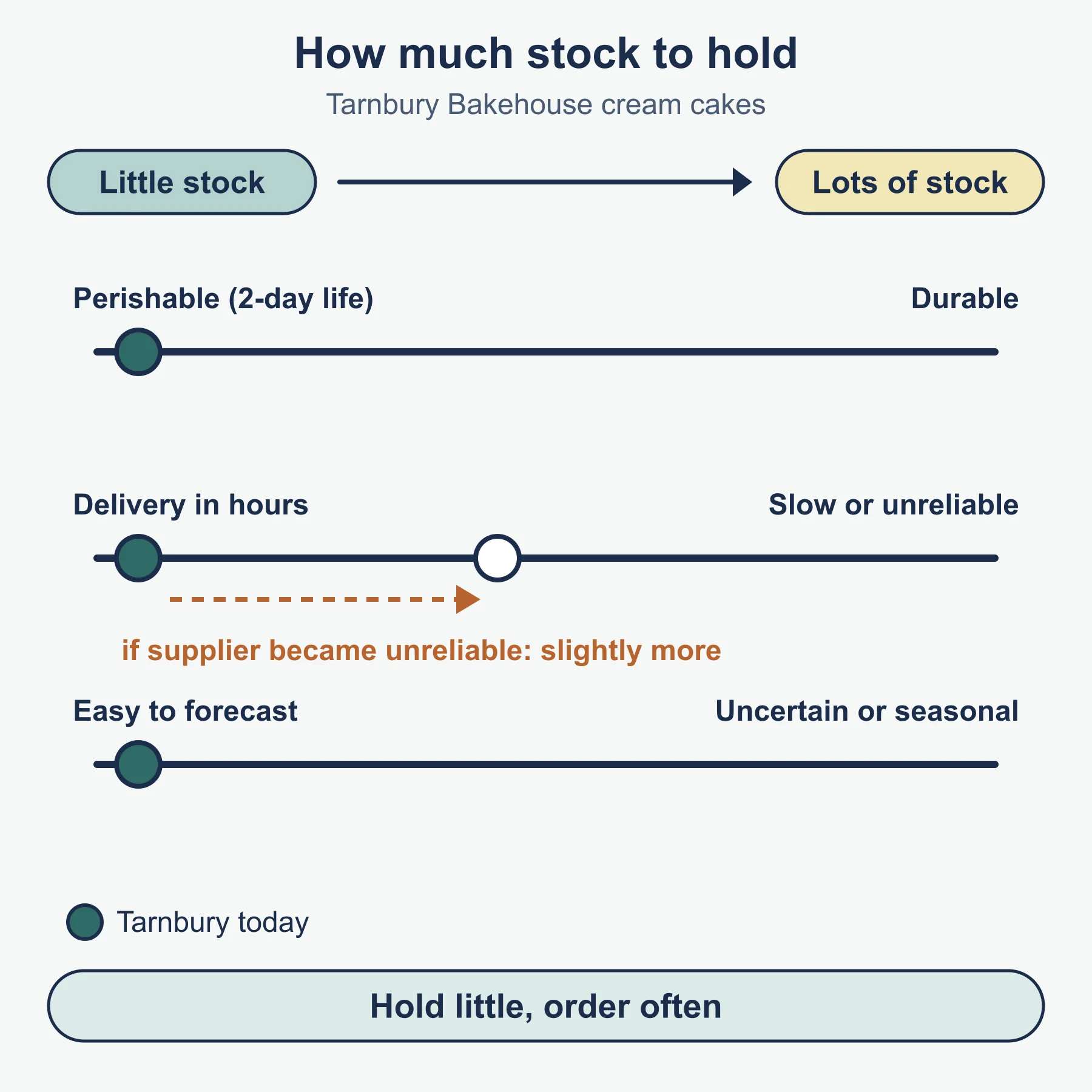
Worked example 3. Tarnbury Bakehouse bakes cream cakes with a two-day shelf life, and its supplier of cream delivers within hours. Applying the factors: the product is perishable, delivery is quick and reliable, and demand is easy to forecast from daily sales. The bakehouse should hold small amounts of inventory and order often. If its supplier became unreliable, it might hold slightly more cream but must still avoid waste.
The main methods of production
Job production
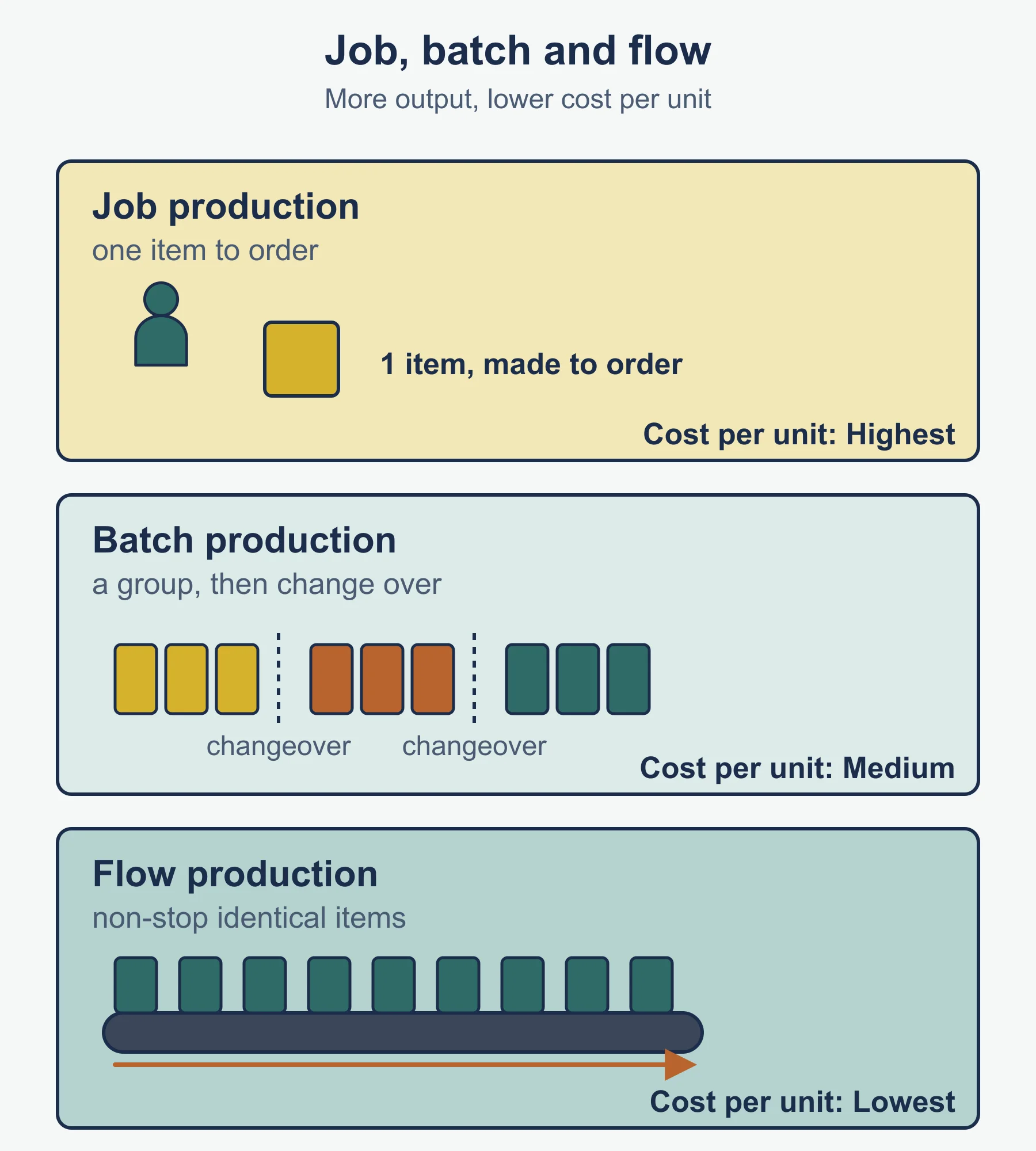
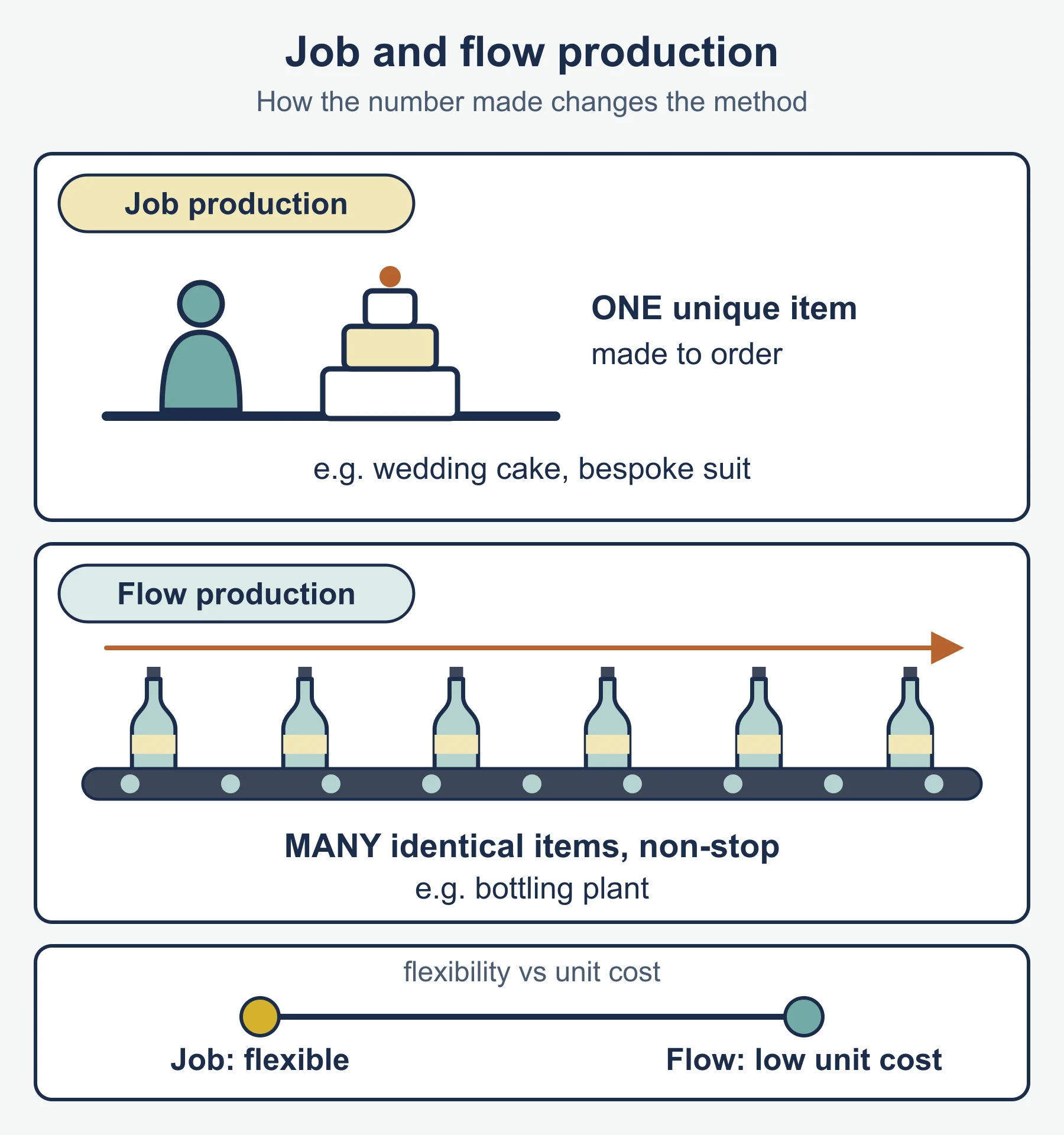
One product is made at a time, to a customer’s own specification. Examples: a bespoke wedding dress, a custom yacht, a one-off bridge.
- Advantages: the customer gets exactly what they want, quality is often high, a premium price can be charged, and workers may enjoy varied, skilled work.
- Disadvantages: high cost per unit, slow, needs skilled and so expensive labour, and little benefit from machines or bulk buying.
Batch production
A group (batch) of identical products is made together, then the equipment is changed to make the next batch. Examples: a bakery making a set of loaves of one type, a clothing maker producing 200 shirts in one size and colour.
- Advantages: more variety than flow production, can switch products as demand changes, lower unit costs than job production, and some specialisation is possible.
- Disadvantages: equipment is idle during changeovers, batches can lead to storing finished goods, and each switch needs time and set-up cost.
Flow production
Products are made continuously on a production line, and each stage is done in sequence. The products are identical and made in very large quantities. Examples: bottling drinks, assembling cars, making tins of beans.
- Advantages: very low unit cost, high output, heavy use of machinery, and consistent quality.
- Disadvantages: high set-up cost for machines and the line, little flexibility, boring work for employees, and the whole line stops if one stage breaks down.
| Job | Batch | Flow | |
|---|---|---|---|
| Quantity | One | A group at a time | Very large, continuous |
| Variety | Unique | Some | Little or none |
| Unit cost | Highest | Medium | Lowest |
| Flexibility | Very high | Medium | Low |
| Capital needed | Low | Medium | High |
Services. Methods apply to services as well: a tailor works to individual order (job), a cleaning firm treats offices in a scheduled round (batch-like), and an automated car wash processes cars in sequence (flow-like).
Recommend and justify a production method
When a question gives you a business and asks for a recommendation, use this approach:
- Pick the method you recommend, stated clearly.
- Use the data: quantity demanded, how standard or customised the product is, price, capital available, the skills of the workforce.
- Justify with at least two reasons that link to the case.
- Weigh the other options: say why a rejected method suits the case less well.
- Conclude with one line that returns to the business’s situation.
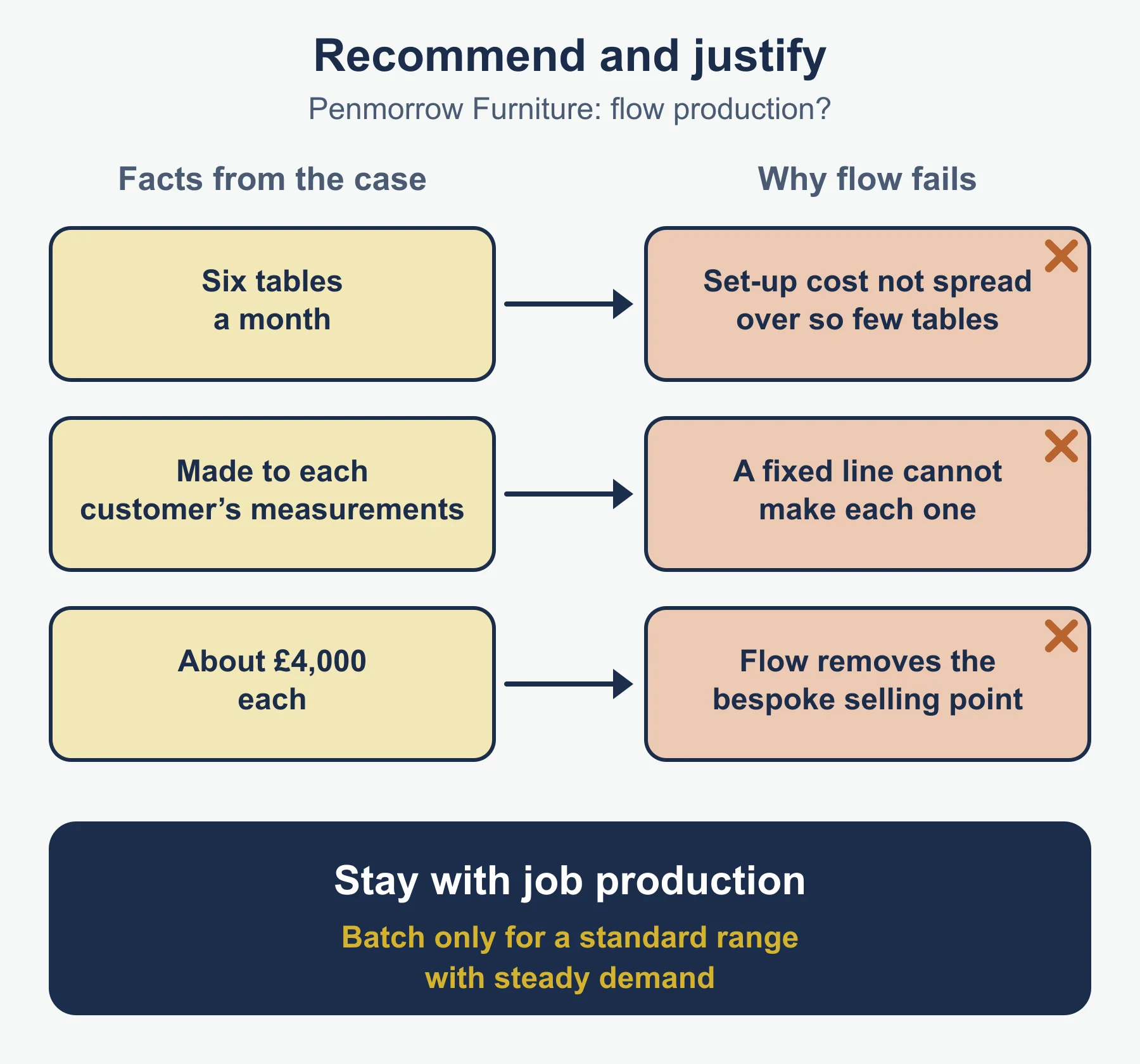
Worked example 4. Penmorrow Furniture makes six dining tables a month, each to a customer’s measurements, and sells each for about £4,000. A manager suggests moving to flow production to cut costs.
Recommendation: stay with job production. Each table differs, so a fixed production line could not produce them. With only six a month the cost of setting up a line could not be spread over enough output. Customers pay a premium for a bespoke piece, and flow production would remove that selling point. Batch production would suit only if Penmorrow introduced a standard range with steady demand. On the data given, job production is the better fit.
Notice that the answer uses three facts from the case (six a month, customer measurements, £4,000 price). An answer without them is generic and scores poorly on application.
Common errors
- Writing “productivity” when you mean output. Productivity is output per worker (or per hour).
- Dividing by the wrong period or the wrong number of workers.
- Saying JIT means “no inventory”. It means very little, with deliveries timed to need.
- Describing Kaizen as a single large change. It is continuous, small and involves everyone.
- Recommending a method with no reference to the case. Name the quantity, the product and the budget.
- Listing advantages only. Questions that ask you to justify need a reason why the rejected options are weaker.
Frequently asked questions
Is labour productivity the same as output? No. Output is the total amount produced, while labour productivity is output per worker or per hour. Output can rise while productivity rises more slowly, or even falls, if the workforce grows.
Does just-in-time mean a business holds no inventory? No. Just-in-time means holding very little inventory, with materials delivered just as they are needed and finished products sent to customers soon after they are made.
What is the difference between batch and flow production? Batch production makes a group of identical products, then changes the equipment for the next batch, so it offers some variety. Flow production makes identical products continuously on a line in very large quantities, giving the lowest unit cost but little flexibility.
Do production methods apply to services as well as goods? Yes. The Cambridge IGCSE Business 0264 syllabus covers goods and services, so a tailor working to individual order resembles job production, and an automated car wash processing cars in sequence resembles flow production.
Why is flow production unsuitable for a small number of customised products? A fixed production line cannot make products that each differ, and its high set-up cost cannot be spread over a small output. Customers paying a premium for a bespoke product would also lose what they are paying for.
Next steps
Condense this into the revision notes, then try the twelve questions in the practice set.
Official syllabus
Cambridge IGCSE Business 0264 syllabus for examination in 2027, 2028 and 2029, published by Cambridge International Education, section 4.1.
Get free revision emails (optional)
Occasional emails with practice questions, worked explanations and links to free resources for the qualification and subjects you choose. No spam, and you can unsubscribe from any email. The free tools on this site never need an email.
Related resources
-
Practice questions
IGCSE Business: Production of goods and services (Cambridge 0264) – Practice Questions
Twelve original practice questions with worked answers on Cambridge IGCSE Business 0264 section 4.1: productivity, lean production and production methods.
Business · Cambridge · IGCSE
Try questions -
Revision notes
IGCSE Business: Production of goods and services (Cambridge 0264) – Revision Notes
Condensed revision notes for Cambridge IGCSE Business 0264 section 4.1: productivity, efficiency, lean production, inventory and production methods.
Business · Cambridge · IGCSE
Revise topic -
Study guides
IGCSE Business: Quality of goods and services and Location decisions (Cambridge 0264)
Study guide to quality control, quality assurance and location decisions for Cambridge IGCSE Business 0264, with worked examples and common errors.
Business · Cambridge · IGCSE
Read guide
Related articles
-
teaching
A Level tuition in Dubai: Cambridge or Pearson Edexcel International A Level?
Schools in Dubai and Abu Dhabi teach either Cambridge International AS & A Level or Pearson Edexcel International A Level. How the two are structured, why it matters for tuition, and how online classes from Lahore work.
9 October 2026
-
curriculum guides
Choosing subjects at IGCSE and A Level
How subject choices at 14 and 16 affect university options later, and how to keep pathways open without overloading a timetable.
28 July 2026
Studying this with a teacher
Working through Business IGCSE?
This page is free and stays free. If you would rather be taught it, Marlbridge runs Business classes one-to-one and in small groups of up to 15, online in your own time zone. The first trial class is free. WhatsApp replies within an hour (8am–11pm Pakistan time, every day); email the same day.
Cambridge Business teachers at Marlbridge

