
Revision Notes
IGCSE Business: Production of goods and services (Cambridge 0264) – Revision Notes
Condensed revision notes for Cambridge IGCSE Business 0264 section 4.1: productivity, efficiency, lean production, inventory and production methods.
- Subject
- Business
- Level
- IGCSE
- Topic
- Operations management
- Author
- Marlbridge Academic Team
- Updated
- Reviewed by
- Salman Ahmad (what this means)
Aligned to Cambridge IGCSE Business (0264), For examination in 2027, 2028 and 2029. Official specification .
Syllabus page (what it covers and how it is assessed): Cambridge IGCSE Business.
Syllabus points this page covers
0264
- 4.1 Production of goods and services
Found an error? Report a correction.
Need help with this topic? Request a free trial class for IGCSE Business (0450 / 0264).
These notes condense section 4.1, Production of goods and services, of the Cambridge IGCSE Business 0264 syllabus for examination in 2027, 2028 and 2029. For full explanations and worked examples, read the study guide first. Test yourself afterwards with the practice questions. The course hub, the checklist is printable, and the free diagnostics find weak spots. All businesses below are invented.
Key terms
| Term | Meaning |
|---|---|
| Labour productivity | Output per worker in a given period |
| Efficiency | Using resources with little waste so each unit costs less to produce |
| Automation | Machines and computer-controlled equipment carrying out tasks |
| Lean production | Making products with as little waste as possible while keeping quality high |
| Just-in-time (JIT) | Holding very little inventory, with materials delivered as they are needed |
| Kaizen | Continuous improvement through many small changes suggested by all staff |
| Inventory | Raw materials, work in progress and finished goods held by a business |
| Job production | One product made at a time to a customer’s order |
| Batch production | A group of identical products made together, then equipment changed |
| Flow production | Continuous production of identical products on a line |
Labour productivity (4.1.1)
Formula (listed in the syllabus formulas and ratios section):
Labour productivity = output in a period / number of employees in that period
Method in steps:
- Pick the output figure and the number of workers for the same period.
- Divide output by workers.
- Write the unit and period, for example “units per worker per week”.
- For a change, use (new - old) / old x 100.
Reminder example. Dovenby Printers makes 9,600 leaflets a day with 24 operators. Productivity is 9,600 / 24 = 400 leaflets per operator per day. With 25 operators making 10,500 leaflets, productivity is 420. The rise is 20, which is 5.0% on 400.
Efficiency
Why it matters
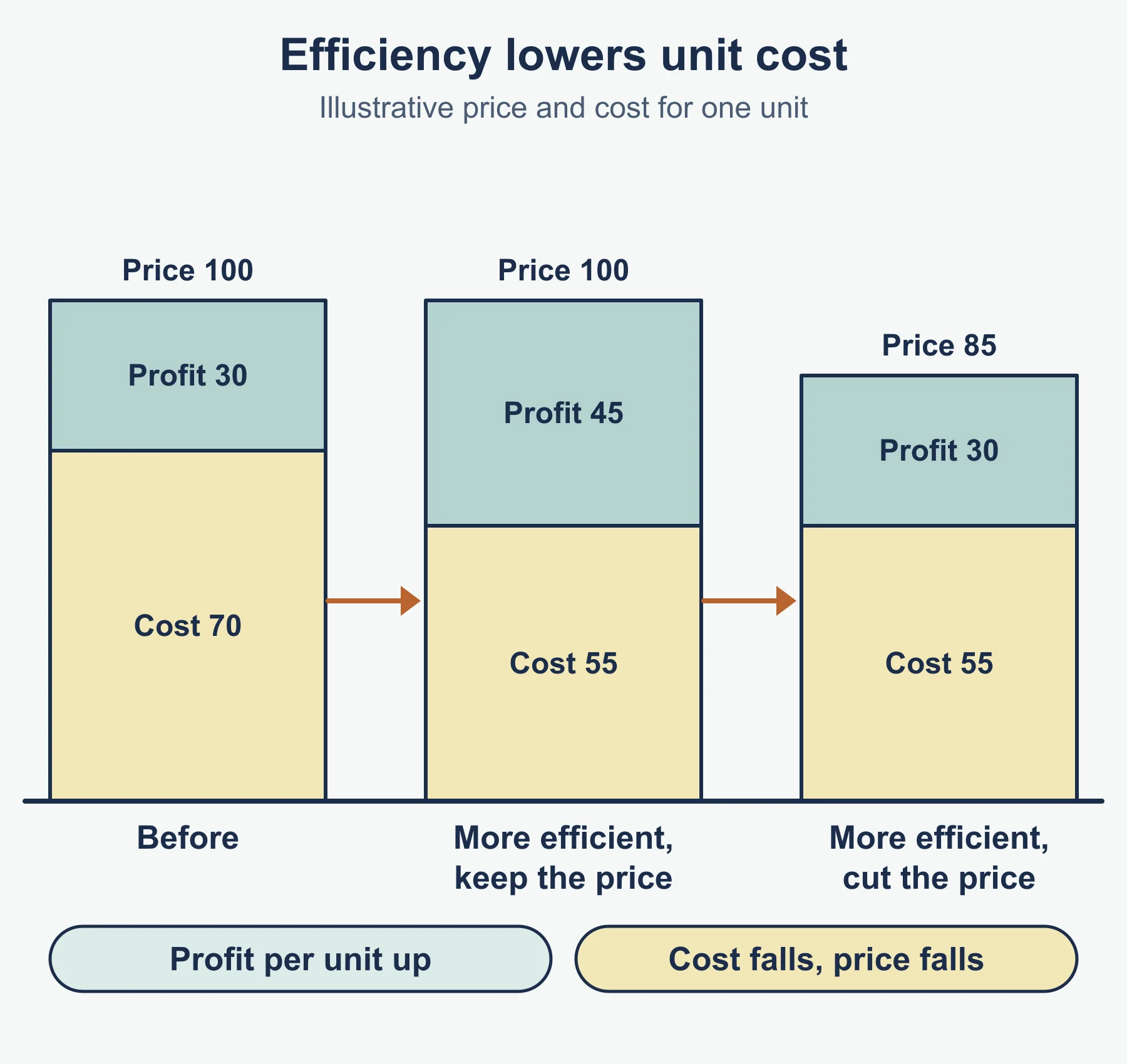
- Lower unit costs, so higher profit or a lower price.
- Better competitiveness against rivals.
- Less waste of materials, time and energy.
- Faster delivery and happier customers.
How to increase it
| Method | Gain | Drawback |
|---|---|---|
| Automation and technology | More output per worker, consistent quality | High purchase and maintenance cost, job losses, breakdown risk |
| Improving labour skills (training) | Faster work, fewer errors, possibly more motivation | Course cost, lost production time, staff may leave afterwards |
Write the chain: efficiency rises, unit cost falls, price can fall or profit can rise.

Lean production
Definition: minimising waste while keeping quality. Two ways to achieve it are named in the syllabus.
JIT inventory control
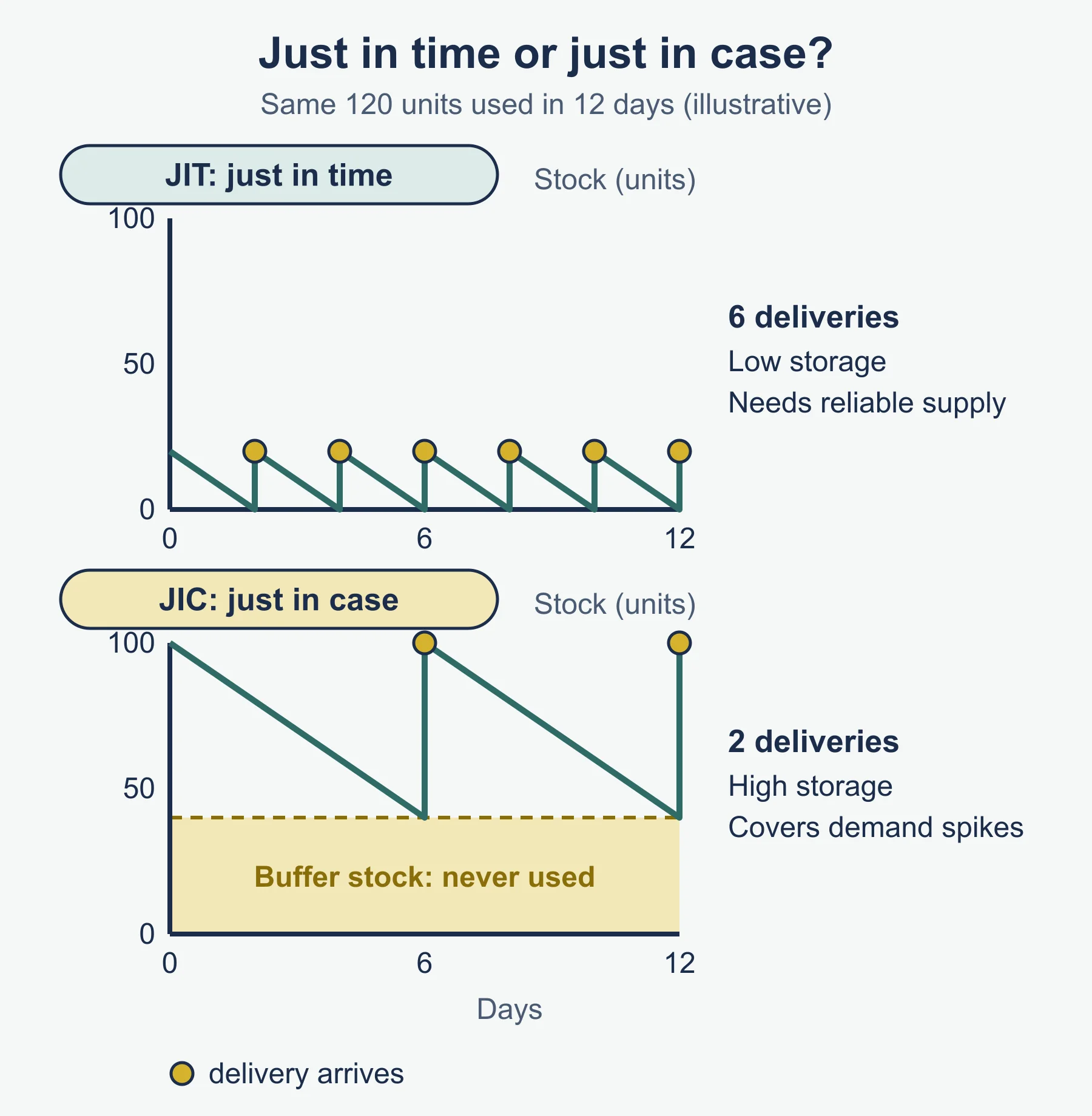
- Deliveries arrive when needed; finished goods go out quickly.
- Pros: less money tied up in stock, less storage space, less waste from damaged or outdated stock.
- Cons: one late delivery can stop production, dependence on reliable suppliers, fewer bulk discounts, and difficulty meeting a sudden jump in demand.
Kaizen
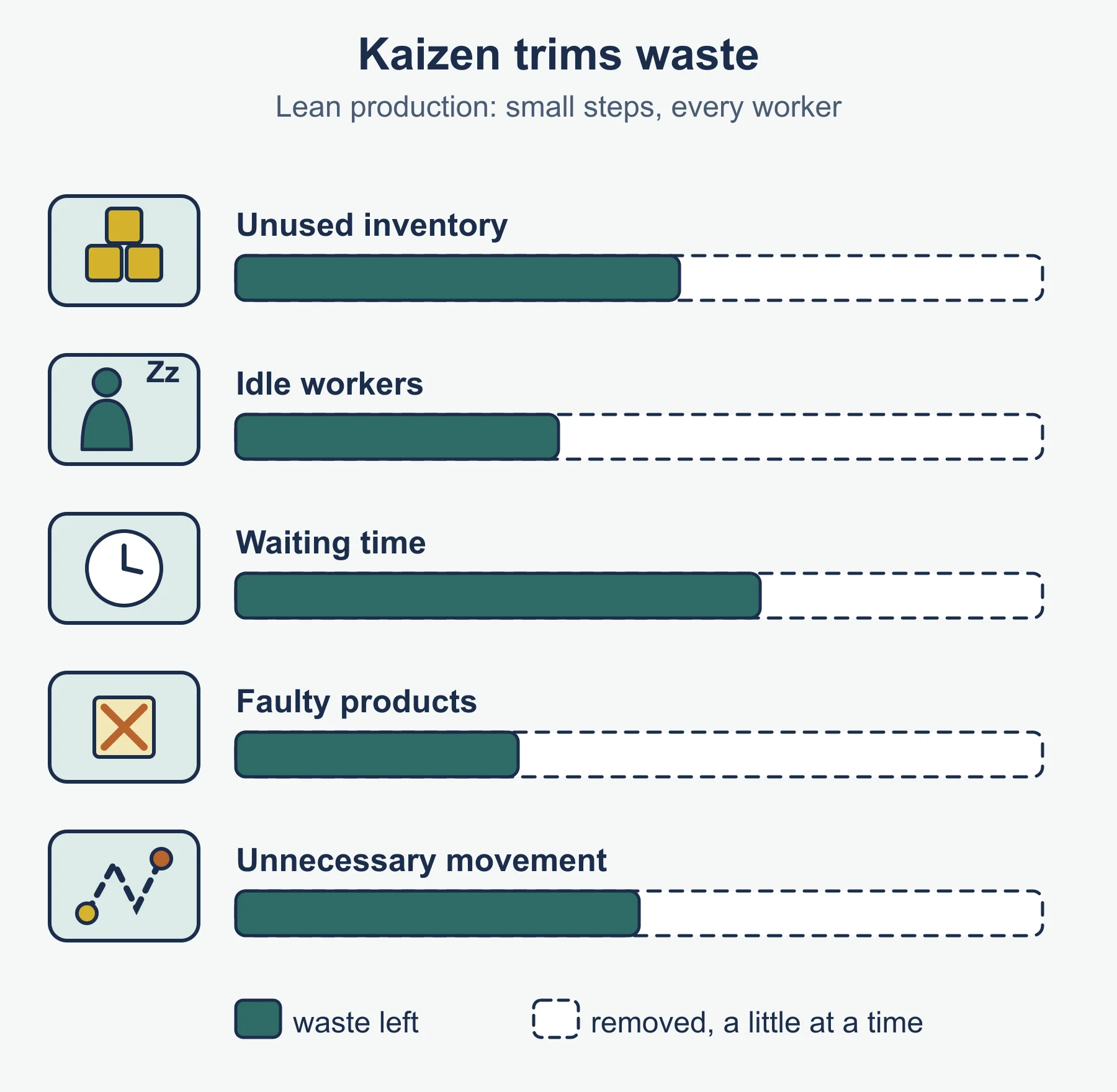
- Continuous small improvements, suggested by all workers, often in problem-solving teams.
- Pros: staff involved and motivated, costs and waste fall steadily, quality rises.
- Cons: slow gains, training and meetings take time, some staff resist change.
Lean production overall. Advantages: lower costs, less waste, higher quality, flexibility. Disadvantages: supplier dependence, risk of running out, cost and effort of changing working methods.
Inventory
Why hold it
- Keep production going if a supplier is late.
- Meet a sudden rise in demand.
- Buy in bulk at a discount.
- Prepare for seasonal demand.
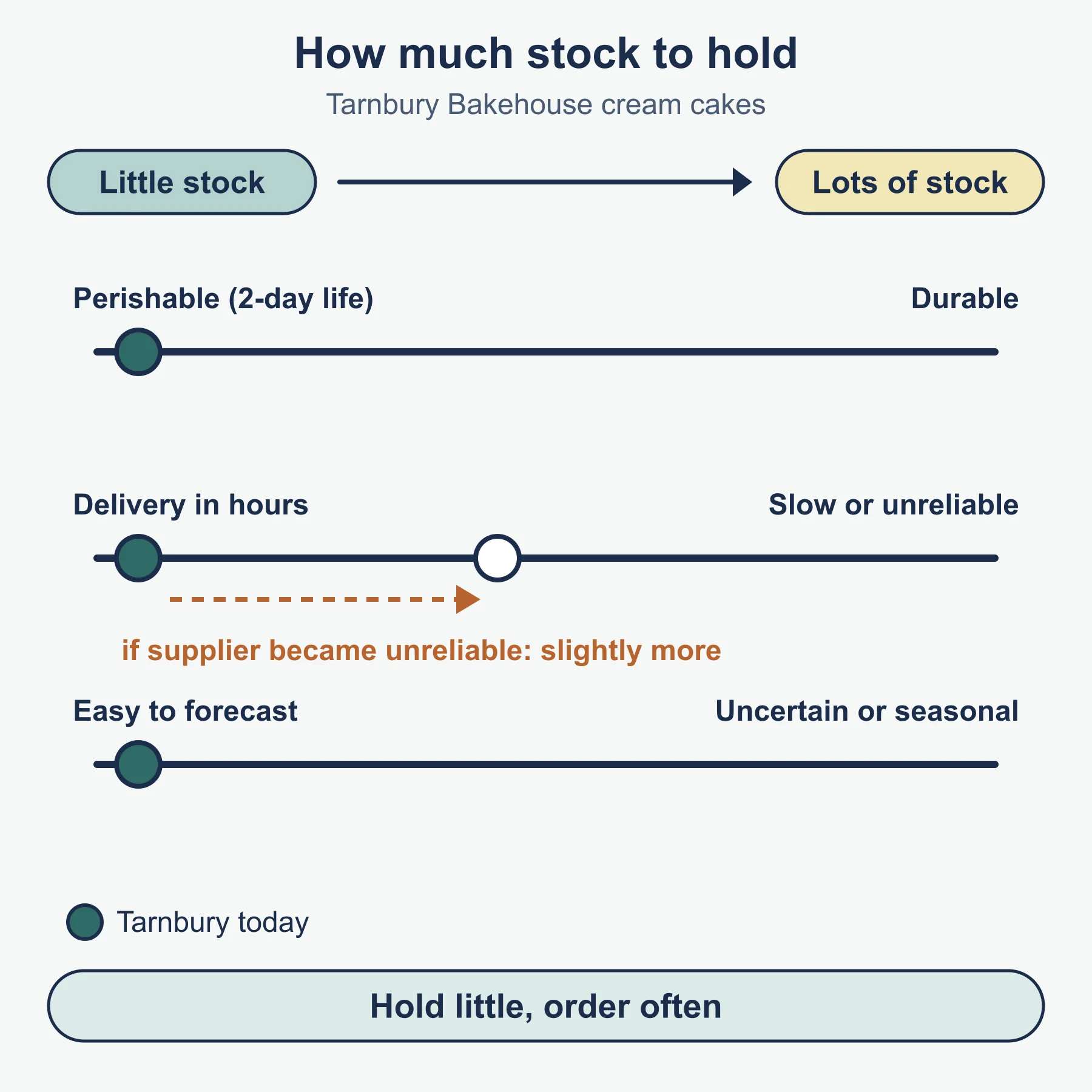
Factors affecting how much is held
| Factor | Effect |
|---|---|
| Perishable product | Hold less, order often |
| Unpredictable or seasonal demand | Hold more |
| Unreliable or slow supplier | Hold more |
| Limited storage space or high storage cost | Hold less |
| Limited cash | Hold less |
| JIT system | Hold very little |
Production methods (4.1.2)
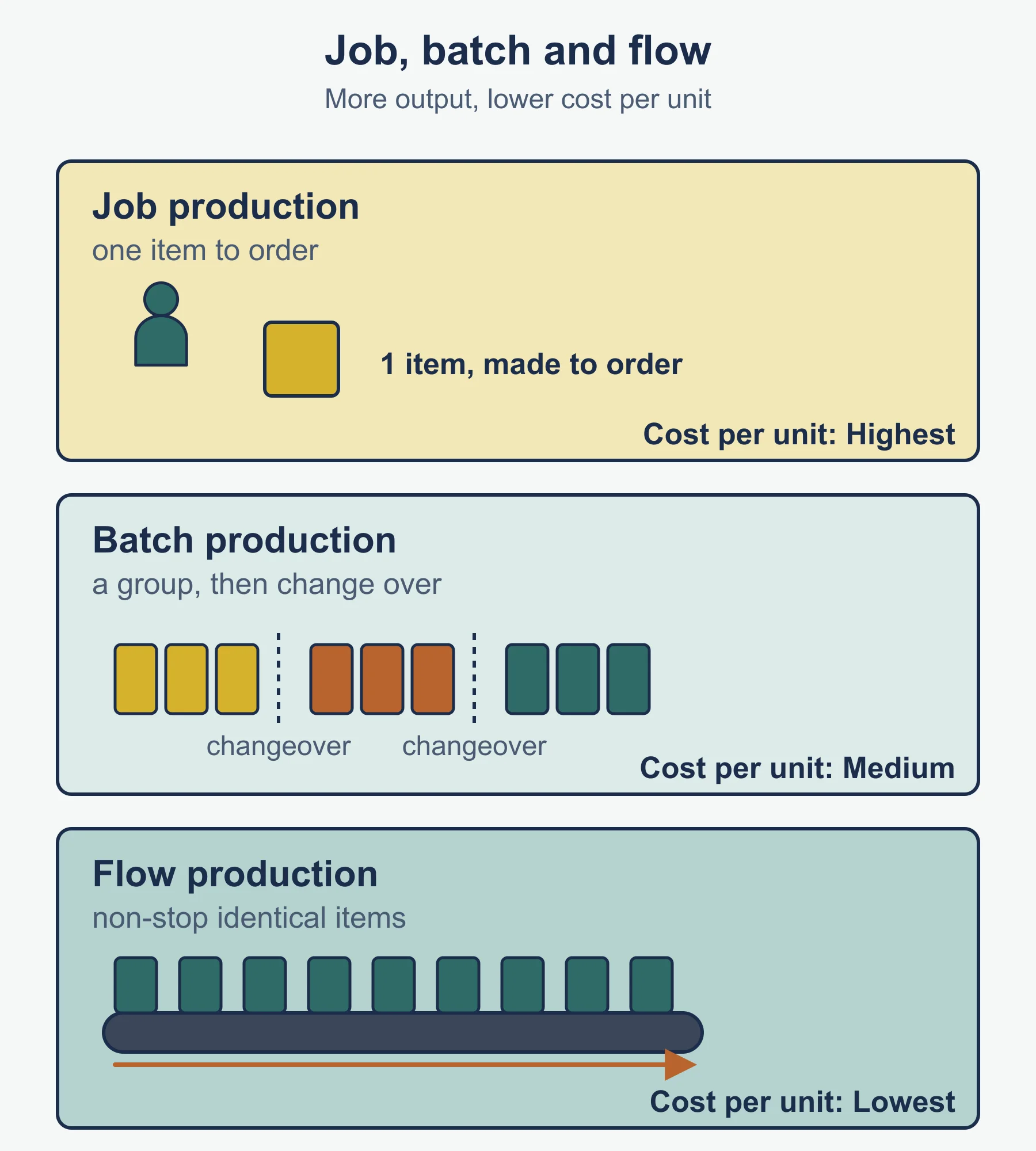
| Job | Batch | Flow | |
|---|---|---|---|
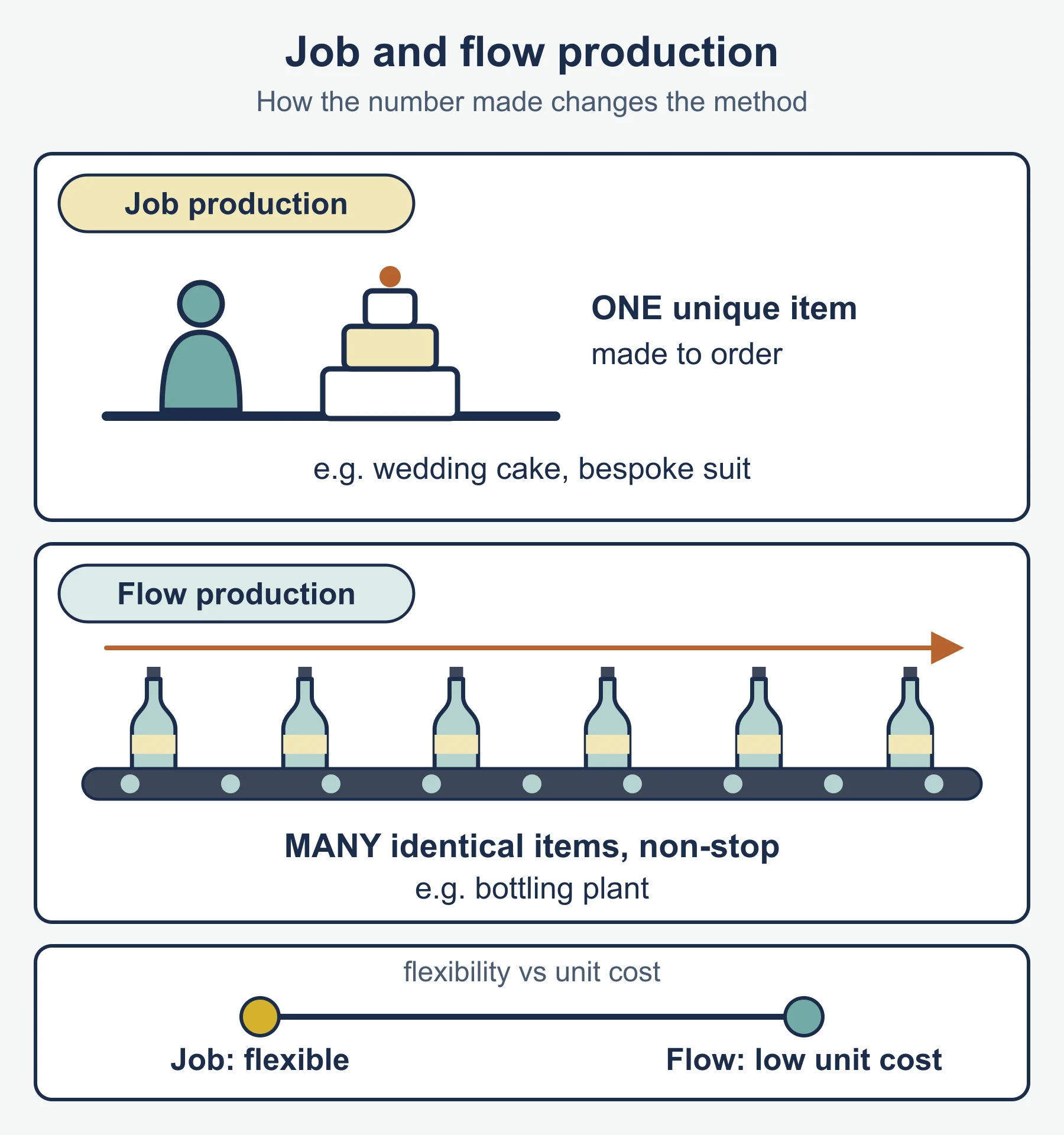
| What is made | One-off, to order | Groups of identical items | Identical items, continuously |
| Examples | Wedding dress, bespoke furniture | Bread of one type, a run of one clothing size | Bottled drinks, tinned food |
| Unit cost | Highest | Middle | Lowest |
| Flexibility | Very high | Medium | Low |
| Capital needed | Low | Medium | High |
| Main advantage | Exactly what the customer wants, premium price | Variety with lower unit cost | Very low unit cost, high output |
| Main disadvantage | Slow, costly, skilled labour | Changeover time, possible storage | High set-up cost, little flexibility, repetitive work |
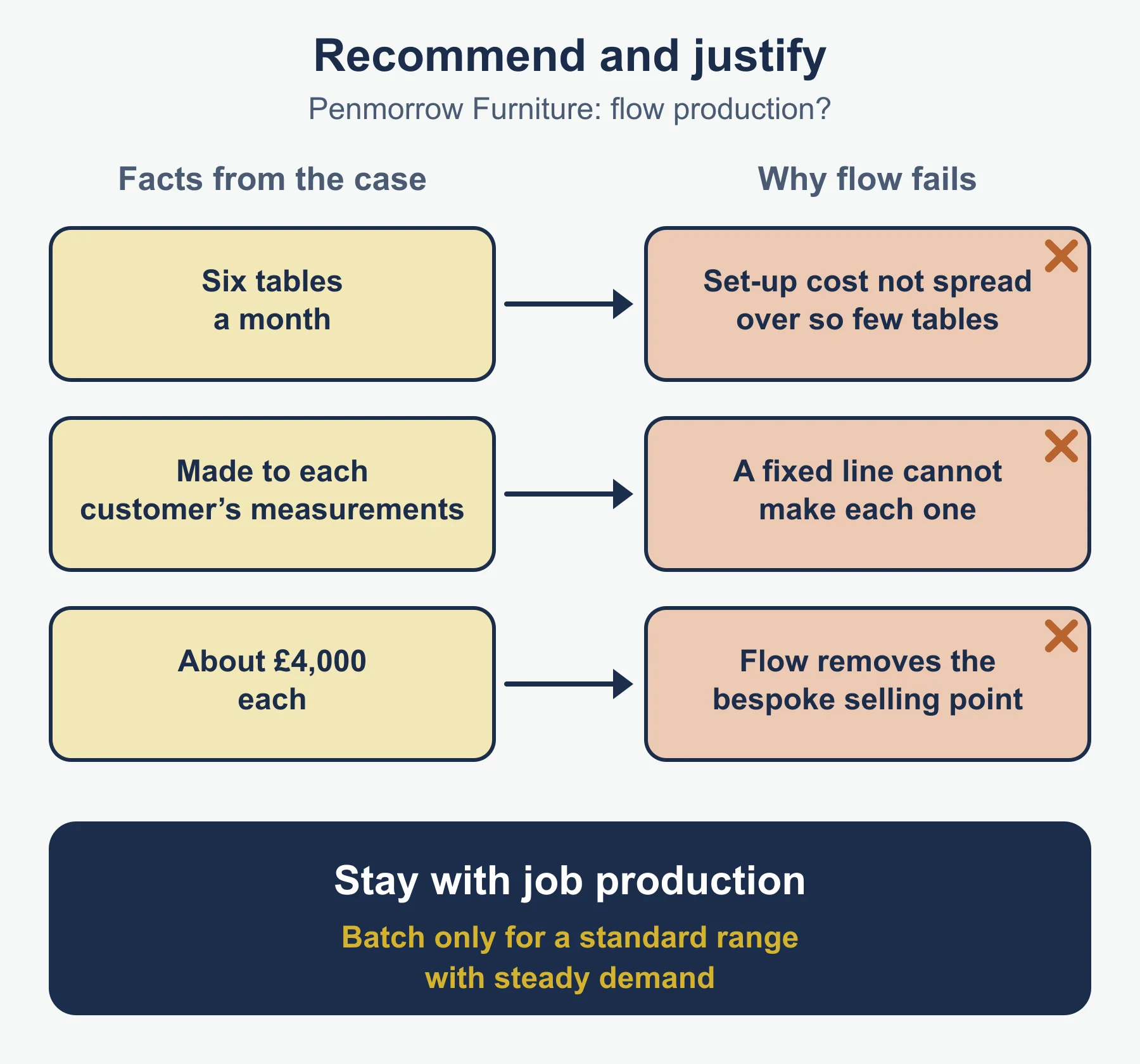
Recommend and justify: method in steps
- State the method you recommend.
- Use the case data: quantity, how standard the product is, price, capital available, worker skills.
- Give at least two reasons linked to the case.
- Say why a rejected method suits less well.
- Finish with one sentence that returns to the business.
Reminder example. Kettlewell Pottery sells 30,000 identical mugs a year to supermarkets at a low price. Flow production fits, because the product is standard, volume is large, and a low unit cost is needed to win the contract. Job production would be too costly. Batch production could work if the design changed every few months.
Applying the ideas to services
Goods and services both have production processes. A dentist treats one patient at a time to individual need, which is like job production. A coach company running a timetabled route for many passengers behaves more like a flow process. Productivity in a service can be patients seen per dentist per day or orders handled per clerk per hour. Technology can raise it: a clinic that lets patients book online frees reception staff for other work.
Building a developed answer
Use a three-link chain for any “explain” question: point, reason, effect on this business.
- Point: “Automation raises output per worker.”
- Reason: “Machines work faster and for longer than people.”
- Effect: “So the cost of each unit falls and the firm can cut its price.”
Use the same chain for an advantage, a disadvantage or a factor affecting inventory. For “evaluate” or “justify”, add the other side and end with a judgement that returns to the data in the case.
Quick recall: pros and cons at a glance
- JIT: saves cash and space, but any late delivery stops production.
- Kaizen: steady gains and involved staff, but slow progress and resistance to change.
- Automation: higher output per worker, but high cost and fewer jobs.
- Training: cheaper than machines, but staff can leave afterwards.
- Job production: unique and premium priced, but slow and costly per unit.
- Batch production: variety at medium cost, but changeovers waste time.
- Flow production: lowest unit cost, but expensive to set up and inflexible.
Must-know distinctions
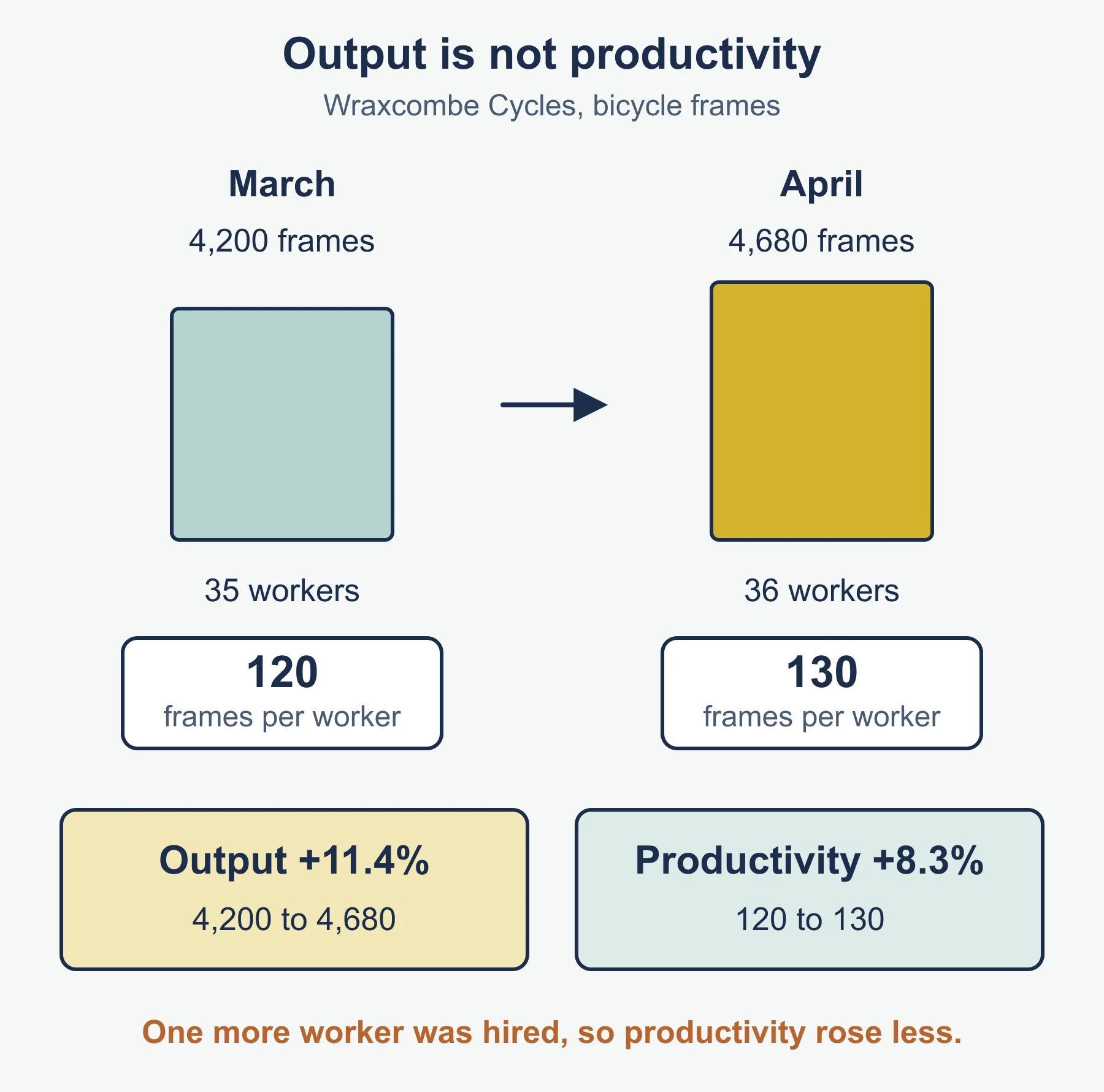
- Output and productivity. Output is the total made. Productivity is output per worker. Output can rise while productivity falls.
- JIT and Kaizen. JIT is about inventory timing. Kaizen is about continuous improvement of how work is done. Both are routes to lean production.
- Batch and flow. Batch stops and switches equipment between groups. Flow does not stop and every item is identical.
- Cheaper and better. Cheaper is not always better. A job-production firm gets paid for being different.
Quick self-test
- A bakery makes 3,300 rolls with 11 workers in a day. Calculate labour productivity.
- The next day 12 workers make 3,720 rolls. Calculate the percentage change in productivity.
- State two reasons why a business might hold inventory.
- Define the term Kaizen.
- Give two disadvantages of JIT.
- Identify the production method used to make a single bespoke guitar.
- State two advantages of flow production.
- Explain one way automation could improve efficiency.
- Give two factors that affect how much inventory a business holds.
- A firm makes 800 identical chairs, then switches to 800 of a different design. Name the production method.
Answers
- 3,300 / 11 = 300 rolls per worker per day.
- Day two: 3,720 / 12 = 310. Change: (310 - 300) / 300 x 100 = 3.3% (1 decimal place).
- Any two: keep production going if deliveries are late; meet sudden demand; buy in bulk for a discount; cover seasonal demand.
- Continuous improvement, through many small changes suggested by all employees.
- Any two: late delivery stops production; reliance on suppliers; no bulk discounts; difficulty meeting sudden demand.
- Job production.
- Any two: low unit cost; high output; consistent quality; makes full use of machinery.
- For example: machines work faster and for longer than people, so output per worker rises and the cost per unit falls.
- Any two: type of product (perishable or not); demand pattern; supplier reliability; storage space and cost; cash available.
- Batch production.
Where marks are usually lost
- Quoting productivity without a unit, or leaving out the period.
- Dividing output by the wrong figure, for example total workers across two months.
- Rounding a percentage change too early.
- Calling Kaizen a one-off project rather than continuous improvement.
- Saying JIT removes all inventory, rather than keeping it to a minimum.
- Describing advantages and disadvantages of lean production in general terms with no link to the business in the case.
- Recommending a production method without using quantities, prices or product details from the stem.
- Writing only one side when asked to justify, with no reason why the other methods are weaker.
- Treating a rise in output as a rise in productivity when the workforce also grew.
Frequently asked questions
How do you calculate labour productivity for Cambridge IGCSE Business 0264? Labour productivity = output in a period ÷ number of employees in that period, giving units per employee. Always state the unit and the time period, and productivity can also be measured per hour worked.
What is the difference between job and batch production? Job production makes one product at a time to a customer’s own specification. Batch production makes a group of identical products together before the equipment is changed for the next batch, giving lower unit costs than job production but less individuality.
What are the disadvantages of just-in-time inventory control? Production stops if a delivery is late, so the business depends on reliable suppliers. Orders may be smaller and dearer with fewer bulk discounts, and a sudden rise in demand is hard to meet from stock.
What factors affect how much inventory a business holds? The main factors are the type of product (perishable or durable), how steady demand is, supplier reliability and delivery time, storage space and cost, the cash available and the production method used.
Official syllabus
Cambridge IGCSE Business 0264 syllabus for examination in 2027, 2028 and 2029, published by Cambridge International Education, section 4.1.
Get free revision emails (optional)
Occasional emails with practice questions, worked explanations and links to free resources for the qualification and subjects you choose. No spam, and you can unsubscribe from any email. The free tools on this site never need an email.
Related resources
-
Study guides
IGCSE Business: Quality of goods and services and Location decisions (Cambridge 0264)
Study guide to quality control, quality assurance and location decisions for Cambridge IGCSE Business 0264, with worked examples and common errors.
Business · Cambridge · IGCSE
Read guide -
Practice questions
IGCSE Business: Quality of goods and services and Location decisions (Cambridge 0264) – Practice Questions
Original practice questions with worked answers on quality control, quality assurance and location decisions for Cambridge IGCSE Business 0264.
Business · Cambridge · IGCSE
Try questions -
Revision notes
IGCSE Business: Quality of goods and services and Location decisions (Cambridge 0264) – Revision Notes
Condensed revision notes on quality control, quality assurance and location decisions for Cambridge IGCSE Business 0264, with a self-test.
Business · Cambridge · IGCSE
Revise topic
Related articles
-
teaching
A Level tuition in Dubai: Cambridge or Pearson Edexcel International A Level?
Schools in Dubai and Abu Dhabi teach either Cambridge International AS & A Level or Pearson Edexcel International A Level. How the two are structured, why it matters for tuition, and how online classes from Lahore work.
9 October 2026
-
curriculum guides
Choosing subjects at IGCSE and A Level
How subject choices at 14 and 16 affect university options later, and how to keep pathways open without overloading a timetable.
28 July 2026
Studying this with a teacher
Working through Business IGCSE?
This page is free and stays free. If you would rather be taught it, Marlbridge runs Business classes one-to-one and in small groups of up to 15, online in your own time zone. The first trial class is free. WhatsApp replies within an hour (8am–11pm Pakistan time, every day); email the same day.
Cambridge Business teachers at Marlbridge

