
Study Guides
IGCSE Business: Quality of goods and services and Location decisions (Cambridge 0264)
Study guide to quality control, quality assurance and location decisions for Cambridge IGCSE Business 0264, with worked examples and common errors.
- Subject
- Business
- Level
- IGCSE
- Topic
- Operations management
- Author
- Marlbridge Academic Team
- Updated
- Reviewed by
- Salman Ahmad (what this means)
Aligned to Cambridge IGCSE Business (0264), For examination in 2027, 2028 and 2029. Official specification .
Syllabus page (what it covers and how it is assessed): Cambridge IGCSE Business.
Syllabus points this page covers
0264
- 4.5 Quality of goods and services
- 4.6 Location decisions
Found an error? Report a correction.
Need help with this topic? Request a free trial class for IGCSE Business (0450 / 0264).
This guide covers sections 4.5 (Quality of goods and services) and 4.6 (Location decisions) of the Cambridge IGCSE Business 0264 syllabus for examination in 2027, 2028 and 2029. Both papers are based on all the subject content, so these ideas can appear in short answers, data responses and the case study.
Use it with the revision notes and the practice questions. The course hub and the printable checklist show where this fits in the course. If you want a quick check of what you already know, try the free diagnostics.
What you must be able to do
| Section | What the syllabus asks for |
|---|---|
| 4.5.1 | What quality means and why it matters to businesses |
| 4.5.1 | The concept of quality control |
| 4.5.1 | The concept of quality assurance |
| 4.5.1 | Advantages and disadvantages of quality control and of quality assurance |
| 4.5.1 | Recommend and justify quality control or quality assurance in a given situation |
| 4.6.1 | Factors which influence the location of a manufacturing business |
| 4.6.1 | Factors which influence the location of a service business |
| 4.6.1 | Factors to consider when choosing which country to locate operations in |
| 4.6.1 | Recommend and justify an appropriate location in a given situation |
The syllabus does not name the location factors one by one, so the lists below are the standard ones used in teaching. Learn them as a toolkit, then choose the few that matter for the business in front of you.
4.5 What quality means and why it matters
Quality means how well a good or service meets what the customer expects and needs. A good is high quality if it works as promised, lasts, and looks and feels right for its price. A service is high quality if it is carried out reliably, politely and on time. Quality is always judged against the price and the market: a budget bus ticket and a luxury hotel stay can both be good quality if each delivers what its customers expect.
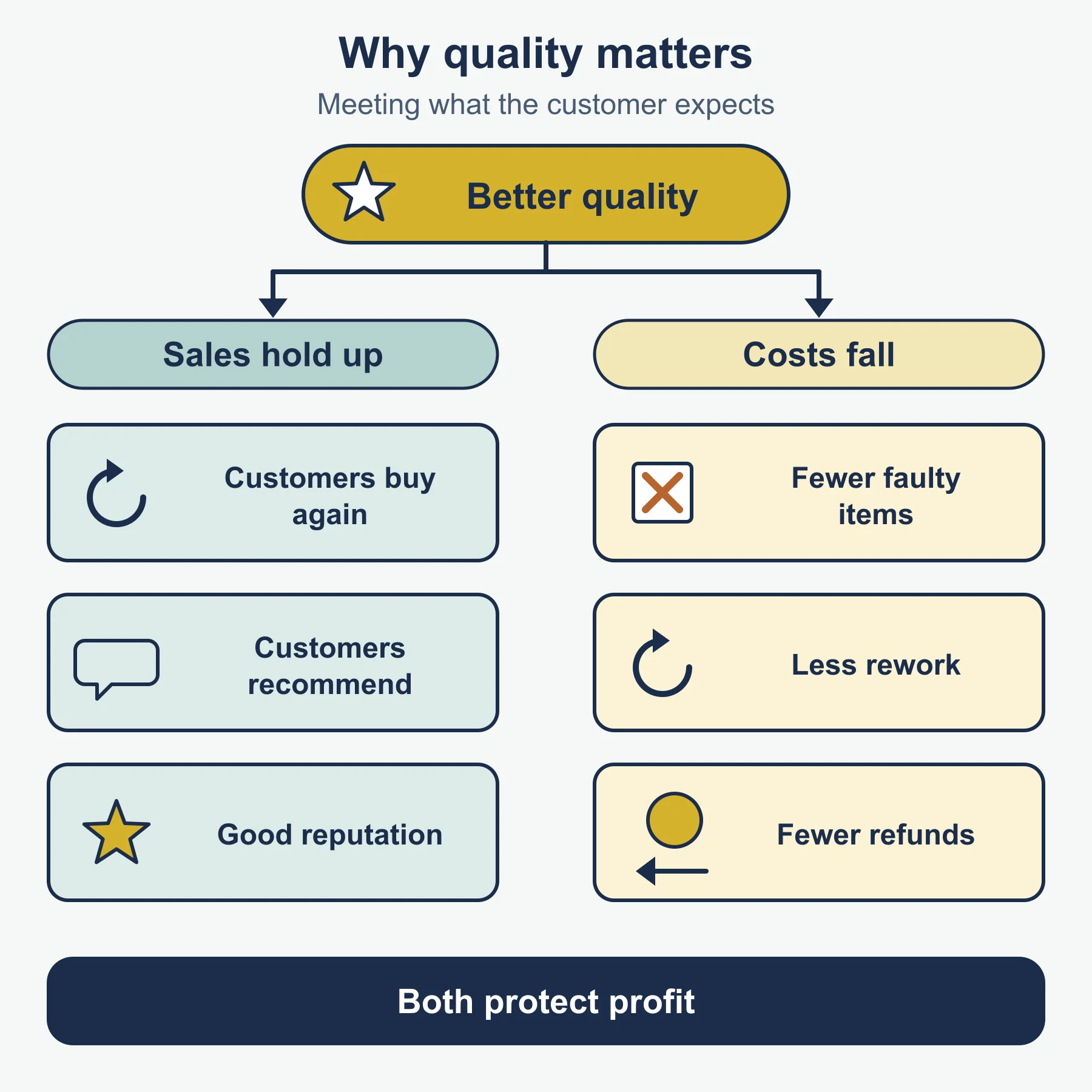
Quality matters because:
- Satisfied customers buy again and recommend the business, which protects sales revenue.
- A good reputation supports the brand and can allow a higher price.
- Fewer faulty items means less waste, less rework and fewer refunds, so costs fall.
- Complaints, returns and replacements take up staff time and damage trust.
- Competitors are always offering alternatives, so poor quality loses customers quickly.
Quality has to be built into operations. The syllabus names two approaches.
Quality control
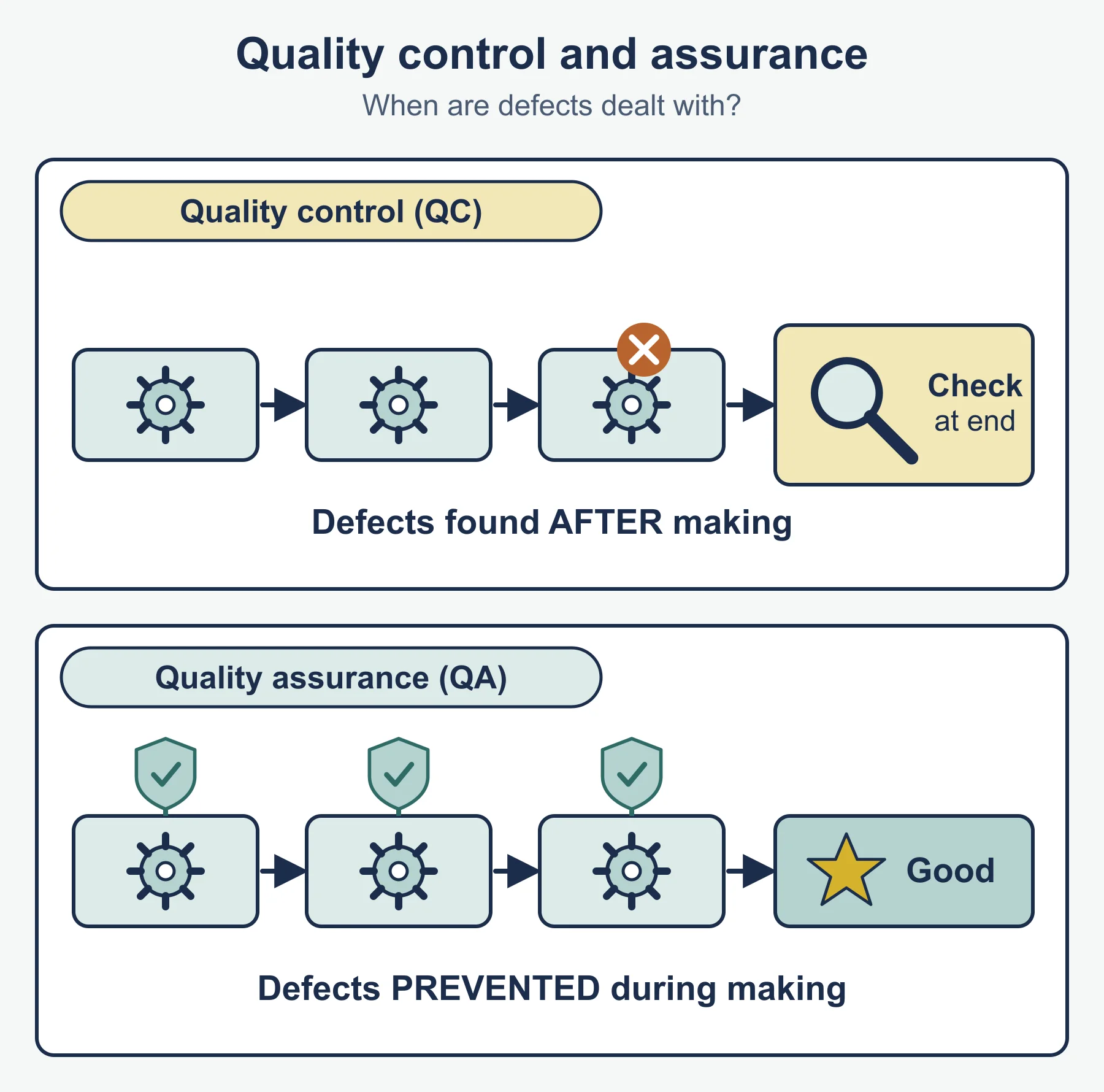
Quality control means checking goods or services, usually after they are made or provided, to find and remove faults. It is a checking approach. Inspectors, supervisors or machines examine products at one or more points, often at the end of the process. Where output is large, a business may inspect a sample and use the result to judge the whole batch.
Items that fail are rejected, repaired (reworked) or scrapped. In a service, the equivalent is a manager observing a call, reviewing a finished report or checking a room after cleaning.
Advantages
- It is easy to understand and can be introduced quickly.
- It stops faulty goods reaching customers, protecting the reputation.
- It gives data on how often faults occur.
- It does not need every employee to change how they work.
Disadvantages
- It finds faults after the money, materials and time have been spent, so waste can be high.
- Inspectors add a labour cost without adding to the product.
- Sampling can miss faulty items.
- Workers may leave quality to the inspectors and take less care.
Quality assurance
Quality assurance means organising the whole business so that faults are prevented at every stage, from buying materials to delivering to the customer. It is a prevention approach. Standards are set for each stage, suppliers are chosen and checked, staff are trained, and every employee is responsible for the quality of their own work.
Advantages
- Fewer faults are made, so less waste, rework and scrapping.
- Quality improves at every stage, not only at the end, which strengthens the brand.
- Employees take responsibility and can feel more involved.
- Customers receive more consistent products and services.
Disadvantages
- It needs training, planning and changes to systems, so it costs time and money to set up.
- It depends on all employees cooperating, which takes time to build.
- Results may be slow to appear, so owners may doubt the benefit.
- It does not remove the chance of an occasional fault, so some checking may still be needed.
Quality control compared with quality assurance
| Quality control | Quality assurance | |
|---|---|---|
| Aim | Find and remove faulty items | Prevent faults happening |
| When | Mostly at the end, or at set checkpoints | Throughout the whole process |
| Who | Inspectors or supervisors | All employees |
| Cost pattern | Ongoing inspection cost and high waste | Higher set-up cost, lower waste later |
Worked example: the cost of faults
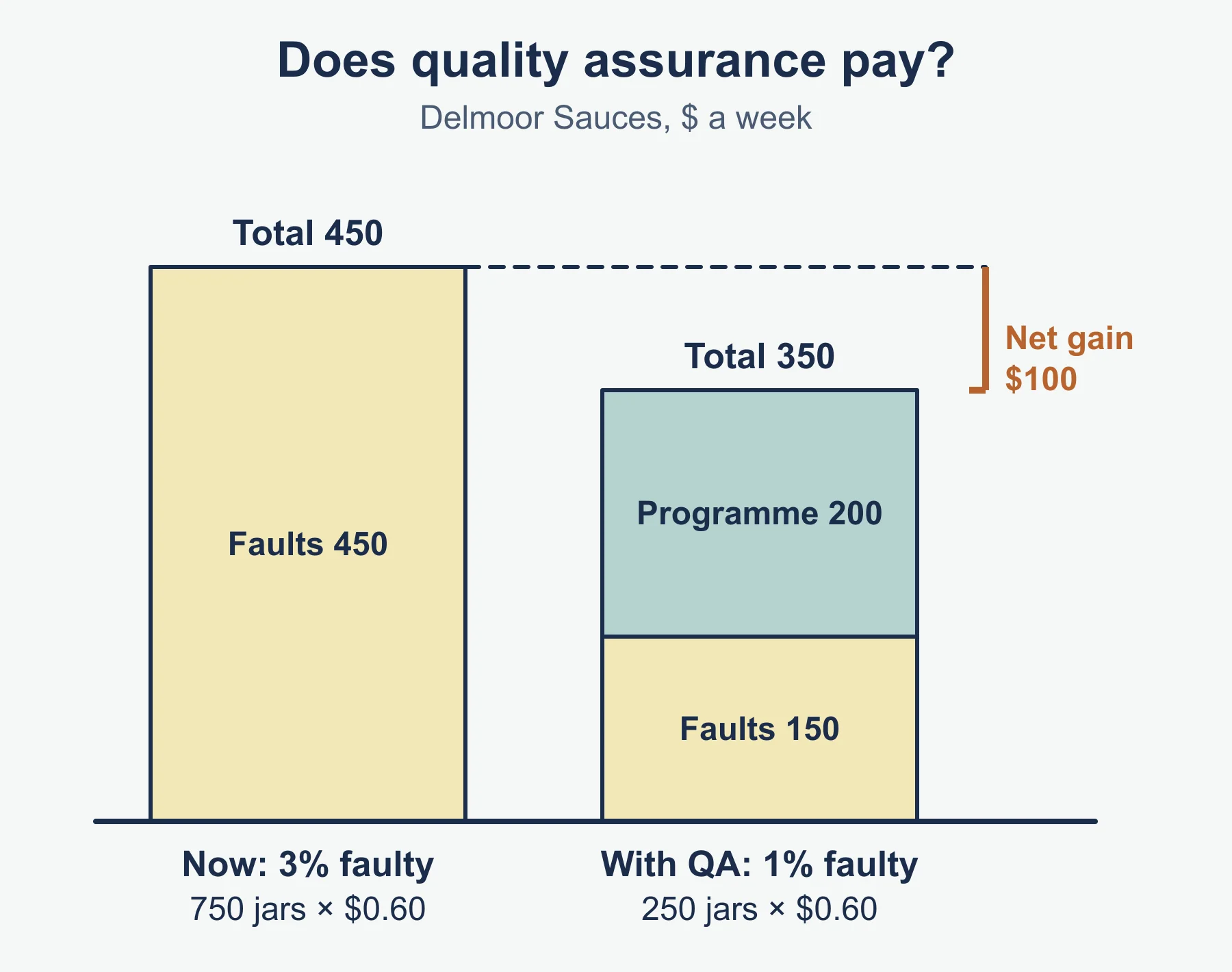
Delmoor Sauces fills 25,000 jars a week. An inspector tests a sample of 400 jars and finds 12 faulty.
Defect rate = 12 / 400 x 100 = 3%. Estimated faulty jars each week = 3% x 25,000 = 750. Each faulty jar costs 0.60 dollars in wasted materials and labour, so the weekly cost = 750 x 0.60 = 450 dollars.
The owner introduces a quality assurance programme (supplier checks and staff training) costing 200 dollars a week. It is expected to cut the defect rate to 1%.
Faulty jars = 1% x 25,000 = 250, costing 250 x 0.60 = 150 dollars. Saving on faults = 450 - 150 = 300 dollars. After paying 200 dollars for the programme, the net gain is 100 dollars a week.
The estimate comes from a sample, so the true figure may differ. The money figure also leaves out complaints and brand damage.
Recommend and justify: control or assurance?
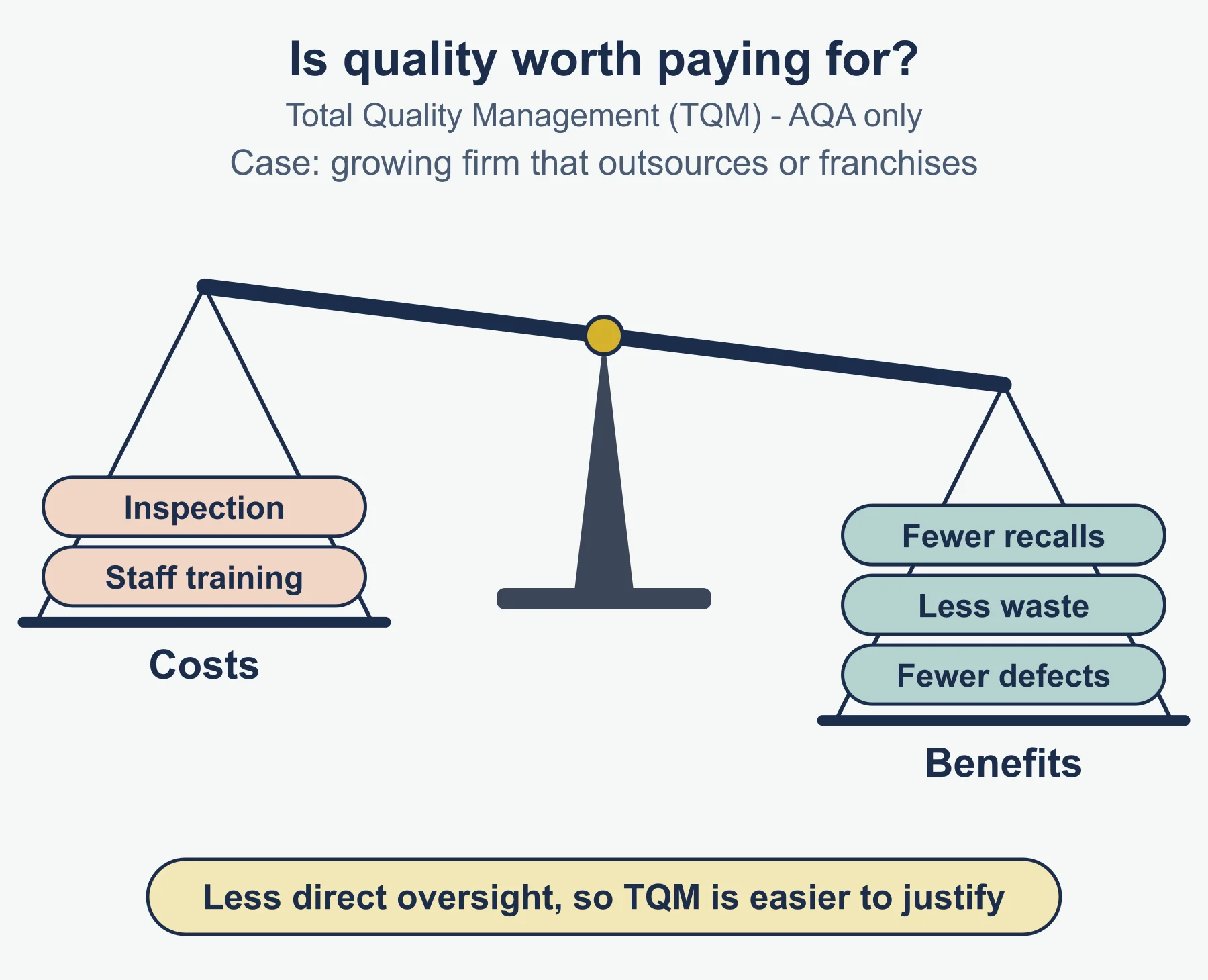
Pick the approach that suits the situation and say why, using the facts given. Quality control may suit a small business with few products, a limited budget, or goods where a fault is easy to spot and low in cost. Quality assurance may suit a business where faults are costly or dangerous (food, medicine, safety equipment, healthcare), where reputation is the main selling point, or where output is large enough that waste is expensive.
A strong answer names the approach, gives a reason linked to the stem, and weighs a drawback. Many businesses use both, but the question usually wants you to choose one and defend it.
4.6 Location decisions: manufacturing
A manufacturing business makes physical goods, so its location is driven by cost and by moving materials and products. Standard factors:
- Cost of land and premises: rent or purchase prices differ widely between regions.
- Labour: availability, skills and wage rates. A skilled trade needs a nearby pool of trained workers.
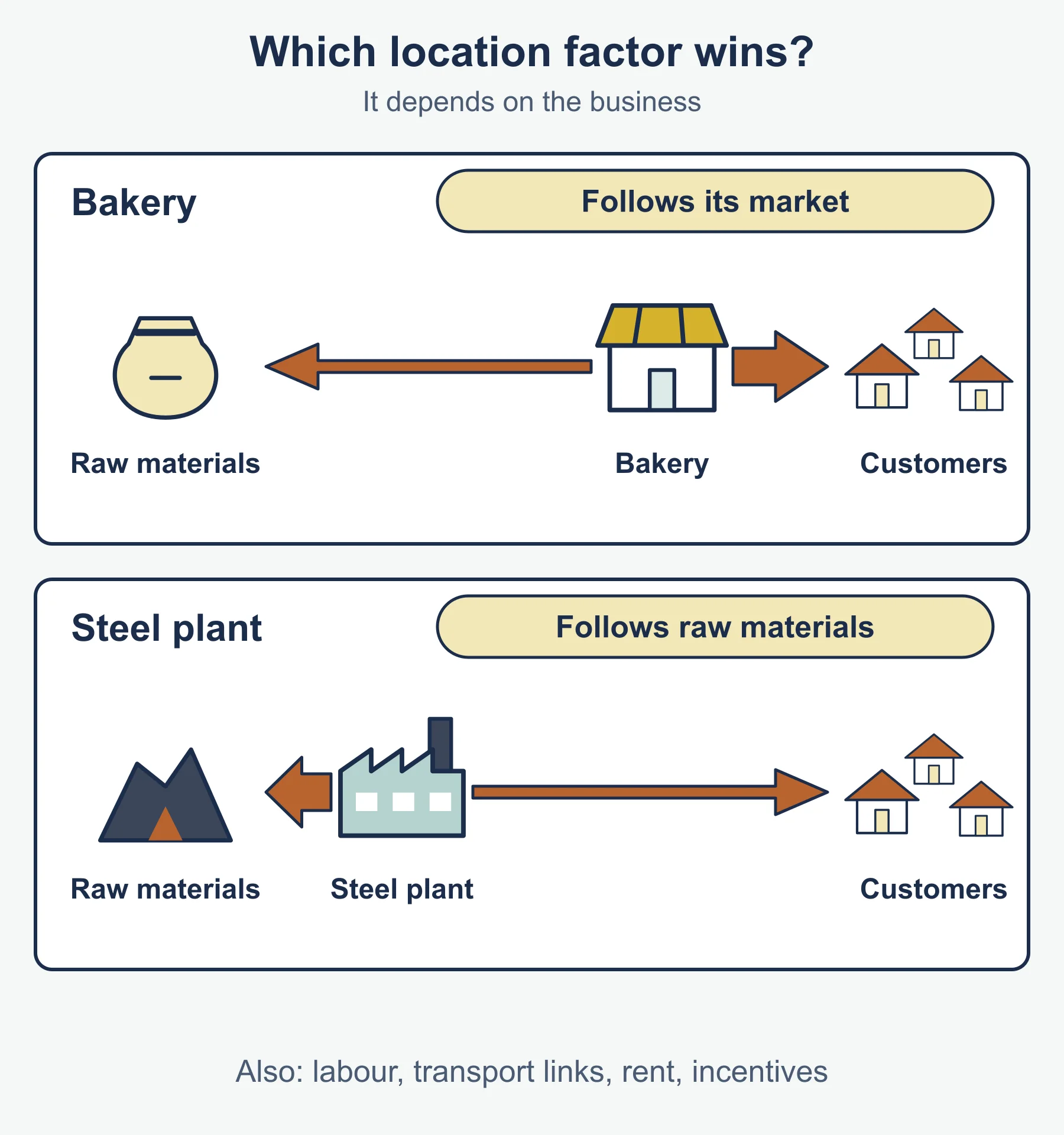
- Raw materials: if materials are heavy or bulky, locating near the source can cut transport cost.
- Market: if finished goods are fragile or costly to move, being near customers helps.
- Transport and infrastructure: roads, ports, rail, electricity and communications.
- Government help: grants, tax breaks or planning support in certain areas.
- Room to expand: space for a bigger factory if demand grows.
Worked example: three sites for a workshop
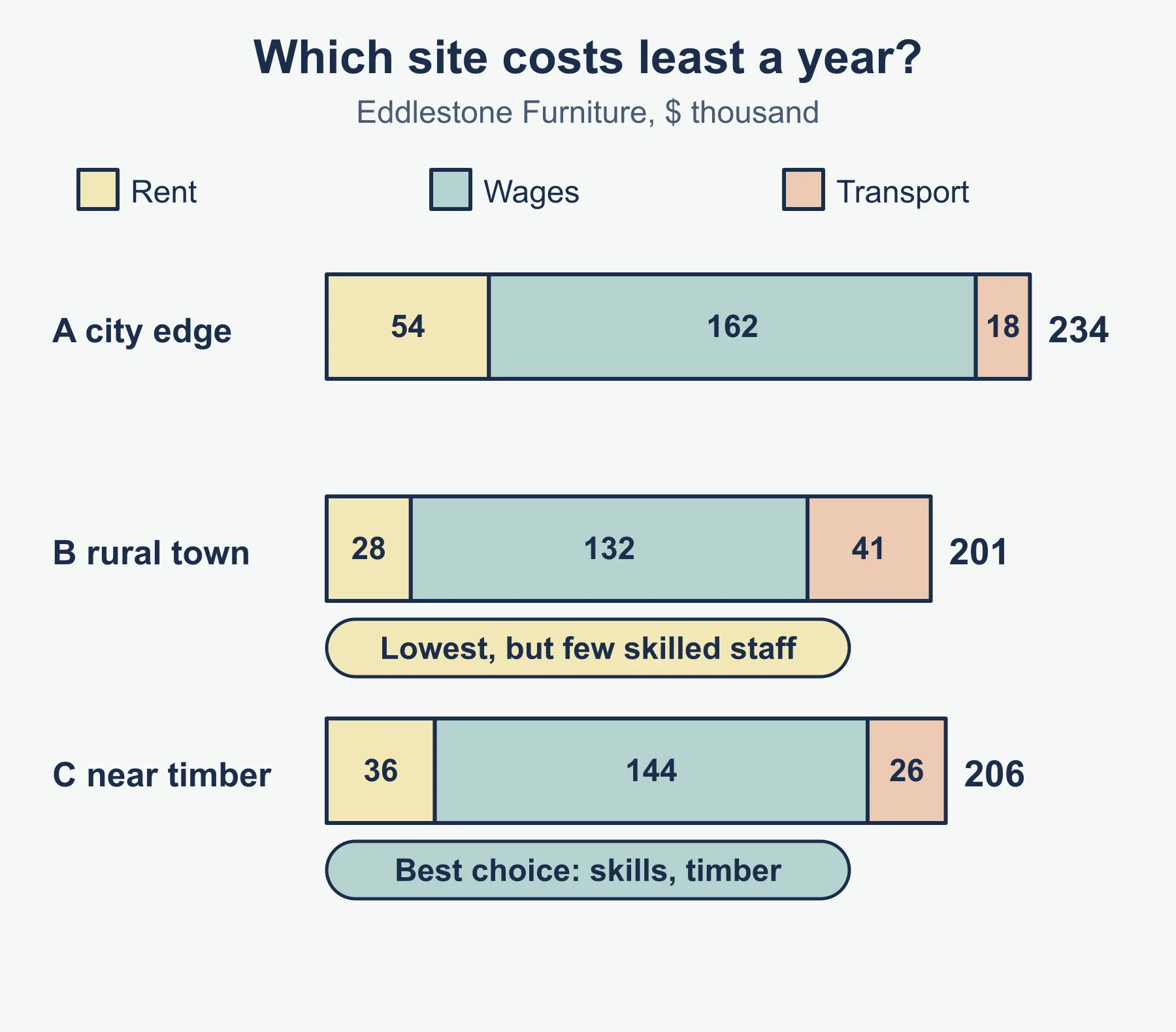
Eddlestone Furniture needs six workers. Annual costs at three possible sites are below (in dollars).
| Site | Rent | Wages (6 workers) | Transport | Total |
|---|---|---|---|---|
| A: city edge | 54,000 | 162,000 | 18,000 | 234,000 |
| B: rural town | 28,000 | 132,000 | 41,000 | 201,000 |
| C: near timber supplier | 36,000 | 144,000 | 26,000 | 206,000 |
Site B is cheapest, but only 5,000 below Site C. Site B has few trained furniture makers, and staff would need training, which the table does not include. Site C is close to its wood supply, offers a skilled labour force and costs 28,000 less than Site A.
Judgement: Site C is the better choice. Site B saves 5,000 a year on paper, but the risk of skill shortages and the long delivery distances could cost more than that. Site A is the most expensive on every cost except transport.
4.6 Location decisions: services
A service business sells an activity rather than a product, and the customer often has to come to the service or the service goes to the customer. Standard factors:
- Closeness to customers: shops, cafes, clinics and salons depend on people nearby.
- Footfall and visibility: passing trade, a main street, public transport links.
- Rent and local business costs: busy locations cost more.
- Competition: a crowded area can split sales, though it can also show demand.
- Parking, access and safety: customers need an easy and safe visit.
- Skilled staff: the quality of the service depends on the people who deliver it.
- Communications and technology: an online or phone service needs reliable internet and power more than a high street.
Worked example: choosing a clinic site
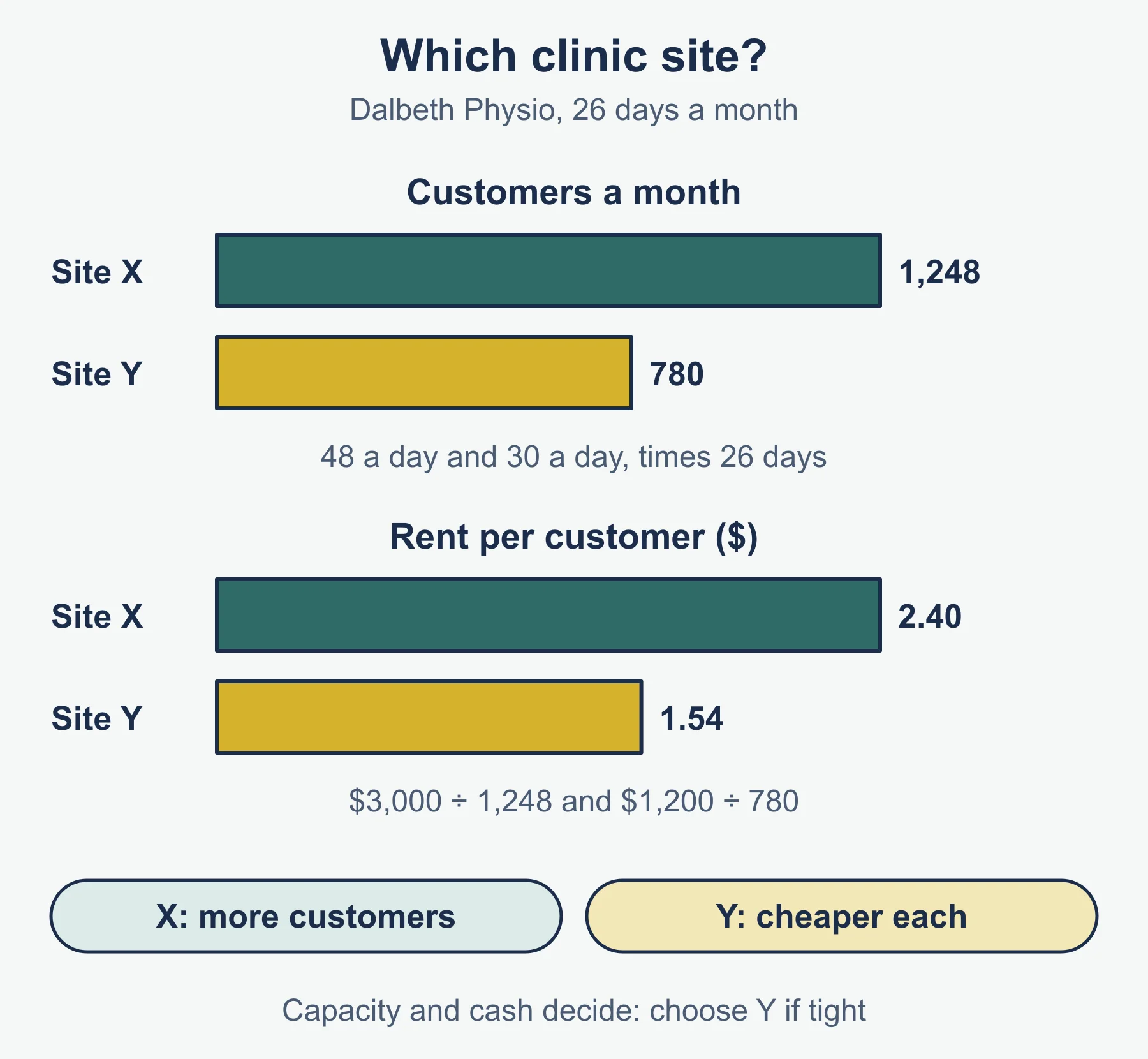
Dalbeth Physio compares two premises. Site X has 1,200 people passing each day and rent of 3,000 dollars a month. Site Y has 500 people passing and rent of 1,200 dollars a month. The owner expects 4% of passers-by to visit at X and 6% at Y, because Y is next to a sports centre. The clinic opens 26 days a month.
Customers per day: X = 1,200 x 4% = 48; Y = 500 x 6% = 30. Customers per month: X = 48 x 26 = 1,248; Y = 30 x 26 = 780. Rent per customer: X = 3,000 / 1,248 = 2.40 dollars; Y = 1,200 / 780 = 1.54 dollars.
X brings more customers, but Y has a lower rent for each one. Whether it can serve 48 people a day also depends on staff and treatment rooms, which the figures leave out. A balanced recommendation: choose Y if capacity is limited or cash is tight, X if the clinic can handle more customers and wants growth.
4.6 Locating in another country
Factors a business could consider when choosing a country:
- Labour: cost, skills and willingness to work.
- Costs of land, energy and materials.
- Market access: being near customers, and any taxes or limits on trade.
- Transport and communications links.
- Government attitude: grants, tax rates and stability of policy.
- Political stability and safety.
- Exchange rate: a falling or unpredictable currency changes costs and revenue.
- Language and culture: can affect dealing with staff and customers.
- Legal requirements: rules on employing staff, safety and environment.
Worked example: two countries
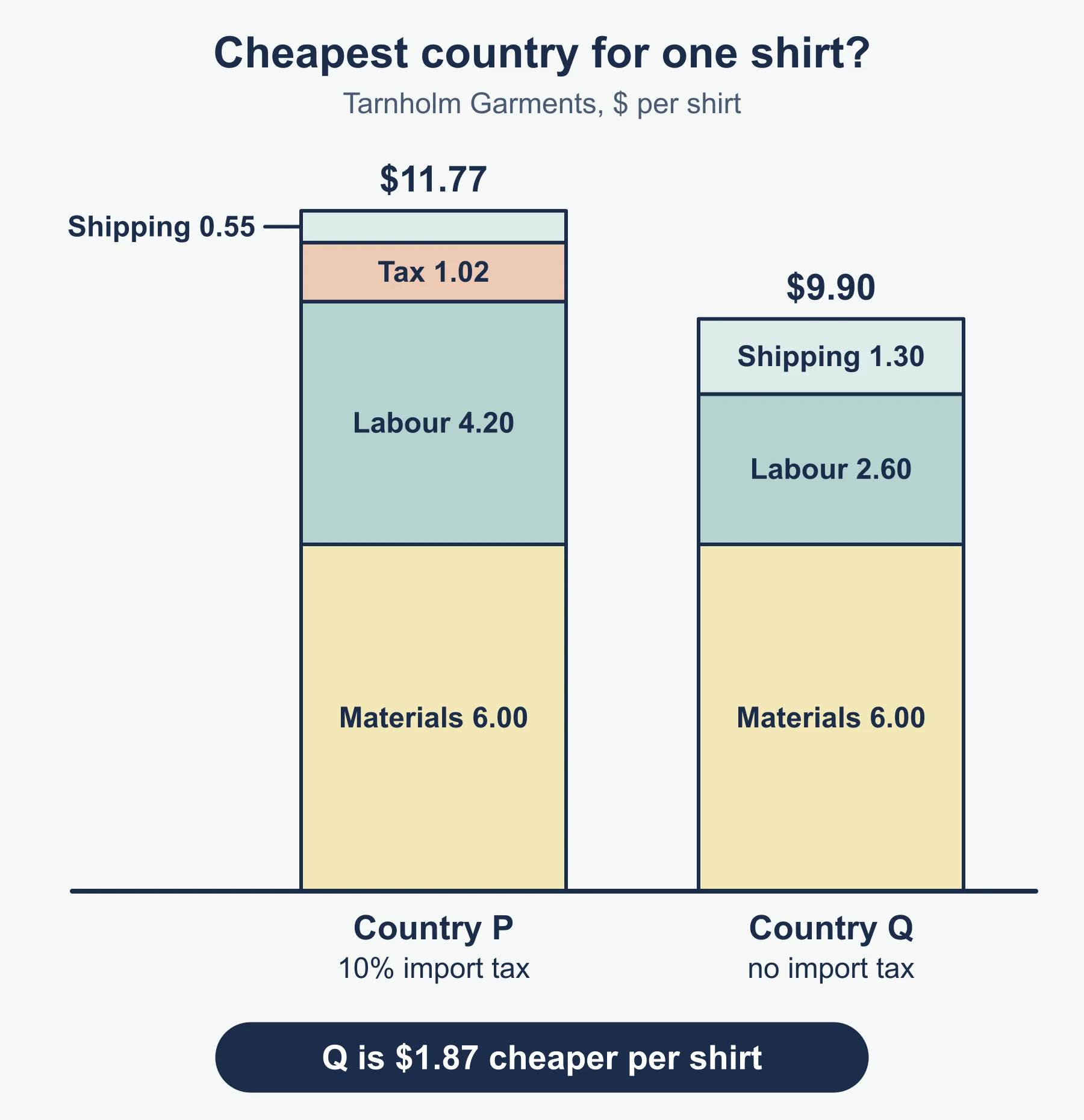
Tarnholm Garments can make a shirt in Country P or Country Q. Materials cost 6.00 dollars in both.
| Country P | Country Q | |
|---|---|---|
| Labour per shirt | 4.20 | 2.60 |
| Shipping per shirt | 0.55 | 1.30 |
| Import tax on labour plus materials | 10% | 0% |
Country P: (4.20 + 6.00) = 10.20; tax = 1.02; plus shipping 0.55 gives 11.77. Country Q: (2.60 + 6.00) = 8.60; no tax; plus shipping 1.30 gives 9.90.
Q is 1.87 dollars cheaper per shirt. Before recommending Q, consider whether its workforce has the skills, whether its government is stable and whether exchange rates could erase the gap.
Recommend and justify a location
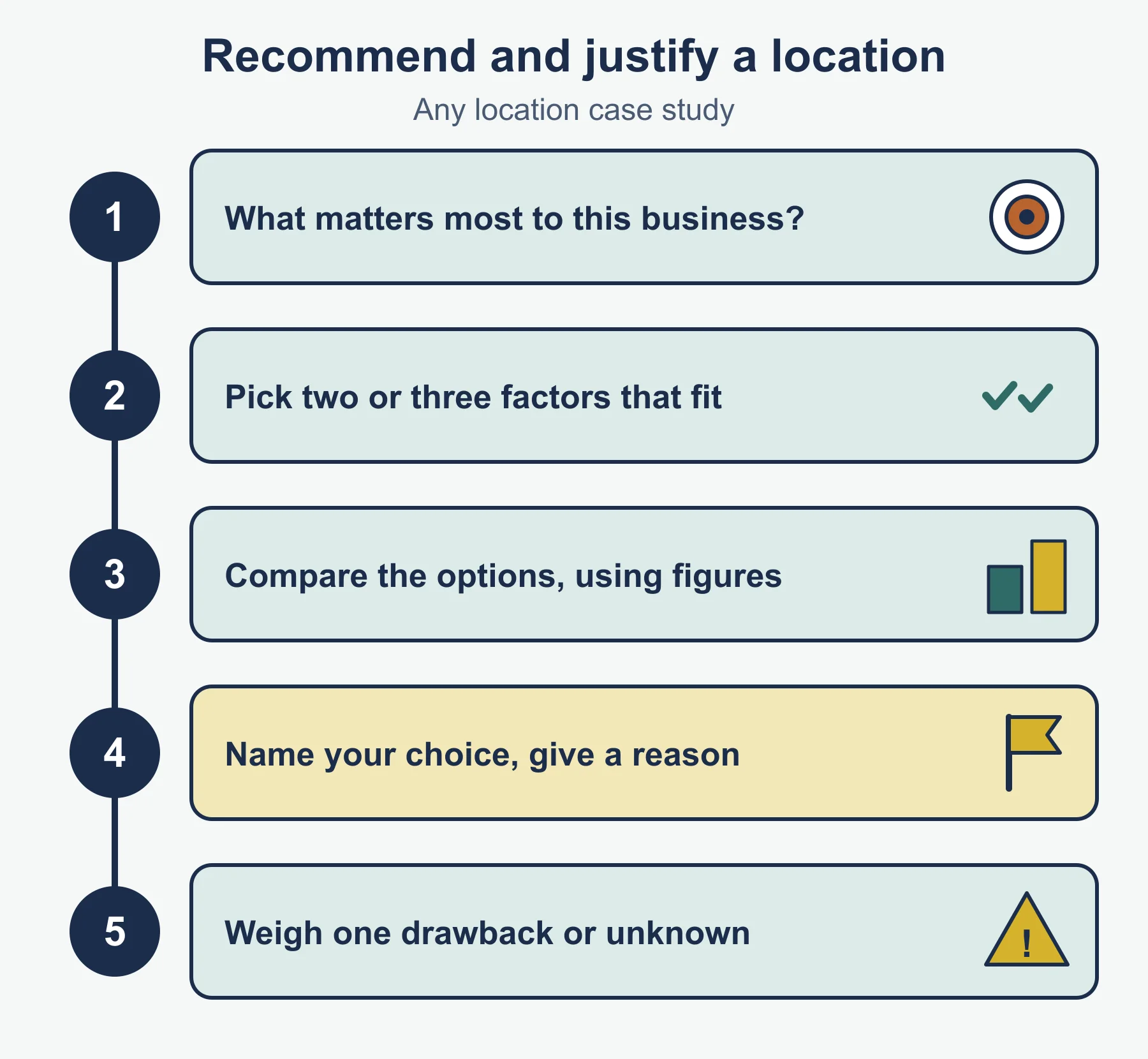
Use this order for any location case study:
- Identify what the business sells and what matters most to it (low cost, skills, customers, speed).
- Pick the two or three factors that fit the stem.
- Compare the options on those factors, using figures.
- Name your choice and give a reason.
- Weigh one drawback or what you cannot tell from the data.
Common errors
- Writing “good quality” without saying what the customer expects.
- Mixing up the two approaches: control checks, assurance prevents.
- Saying quality assurance has no disadvantages, or that quality control is always cheaper.
- Listing location factors without linking them to the business.
- Choosing the cheapest site without considering skills, customers or growth.
- Using manufacturing factors for a service business (or the reverse).
- Giving a recommendation with no justification or no drawback.
Frequently asked questions
How do you calculate a defect rate from a sample? Defect rate = faulty items in the sample ÷ items in the sample × 100. Applying that rate to total output estimates the number of faulty items, though the true figure may differ because it comes from a sample.
Does the Cambridge IGCSE Business 0264 syllabus list the location factors? No. The syllabus does not name the location factors one by one, so the lists taught are the standard ones. Learn them as a toolkit and choose the few that matter for the business in the question.
What factors should a business consider when choosing a country to locate in? Standard factors include labour cost and skills, land and energy costs, market access and trade taxes, transport links, government attitude, political stability, exchange rates, language and culture, and legal requirements.
What are the disadvantages of quality control? Faults are found after money, materials and time have been spent, inspectors add cost without adding to the product, sampling can miss faulty items, and workers may leave quality to the inspectors.
Is quality assurance free of disadvantages? No. It needs training, planning and changes to systems, depends on every employee cooperating, can be slow to show results and still may not remove every fault.
Official syllabus
Aligned to sections 4.5 and 4.6 of the Cambridge IGCSE Business 0264 syllabus for examination in 2027, 2028 and 2029, published by Cambridge University Press & Assessment (Cambridge International Education).
Get free revision emails (optional)
Occasional emails with practice questions, worked explanations and links to free resources for the qualification and subjects you choose. No spam, and you can unsubscribe from any email. The free tools on this site never need an email.
Related resources
-
Practice questions
IGCSE Business: Quality of goods and services and Location decisions (Cambridge 0264) – Practice Questions
Original practice questions with worked answers on quality control, quality assurance and location decisions for Cambridge IGCSE Business 0264.
Business · Cambridge · IGCSE
Try questions -
Revision notes
IGCSE Business: Quality of goods and services and Location decisions (Cambridge 0264) – Revision Notes
Condensed revision notes on quality control, quality assurance and location decisions for Cambridge IGCSE Business 0264, with a self-test.
Business · Cambridge · IGCSE
Revise topic -
Study guides
IGCSE Business: Technology and production of goods and services and related topics (Cambridge 0264)
Study guide to Cambridge IGCSE Business 0264 sections 4.2 and 4.3: technology in production, service-sector productivity and sustainable production.
Business · Cambridge · IGCSE
Read guide
Related articles
-
teaching
A Level tuition in Dubai: Cambridge or Pearson Edexcel International A Level?
Schools in Dubai and Abu Dhabi teach either Cambridge International AS & A Level or Pearson Edexcel International A Level. How the two are structured, why it matters for tuition, and how online classes from Lahore work.
9 October 2026
-
curriculum guides
Choosing subjects at IGCSE and A Level
How subject choices at 14 and 16 affect university options later, and how to keep pathways open without overloading a timetable.
28 July 2026
Studying this with a teacher
Working through Business IGCSE?
This page is free and stays free. If you would rather be taught it, Marlbridge runs Business classes one-to-one and in small groups of up to 15, online in your own time zone. The first trial class is free. WhatsApp replies within an hour (8am–11pm Pakistan time, every day); email the same day.
Cambridge Business teachers at Marlbridge

