
Revision Notes
IGCSE Business: Quality of goods and services and Location decisions (Cambridge 0264) – Revision Notes
Condensed revision notes on quality control, quality assurance and location decisions for Cambridge IGCSE Business 0264, with a self-test.
- Subject
- Business
- Level
- IGCSE
- Topic
- Operations management
- Author
- Marlbridge Academic Team
- Updated
- Reviewed by
- Salman Ahmad (what this means)
Aligned to Cambridge IGCSE Business (0264), For examination in 2027, 2028 and 2029. Official specification .
Syllabus page (what it covers and how it is assessed): Cambridge IGCSE Business.
Syllabus points this page covers
0264
- 4.5 Quality of goods and services
- 4.6 Location decisions
Found an error? Report a correction.
Need help with this topic? Request a free trial class for IGCSE Business (0450 / 0264).
These notes condense sections 4.5 (Quality of goods and services) and 4.6 (Location decisions) of the Cambridge IGCSE Business 0264 syllabus for examination in 2027, 2028 and 2029. For full explanations and worked examples, read the study guide. When you are ready to test yourself, use the practice questions, the course hub, the printable checklist and the free diagnostics.
Both papers are based on all the subject content, so expect these topics to appear in short answers, data responses and the case study.
Key definitions
| Term | Meaning |
|---|---|
| Quality | How well a good or service meets what customers expect and need, judged against its price |
| Quality control | Checking goods or services, usually after they are made or provided, to find and remove faults |
| Quality assurance | Organising the whole business, with standards, training and checks at every stage, so faults are prevented |
| Defect rate | Faulty items as a percentage of items checked (standard form, not given in the syllabus) |
| Footfall | Number of people passing or entering a location |
| Infrastructure | Roads, ports, rail, power and communications that support a business |
Why quality matters (learn four)
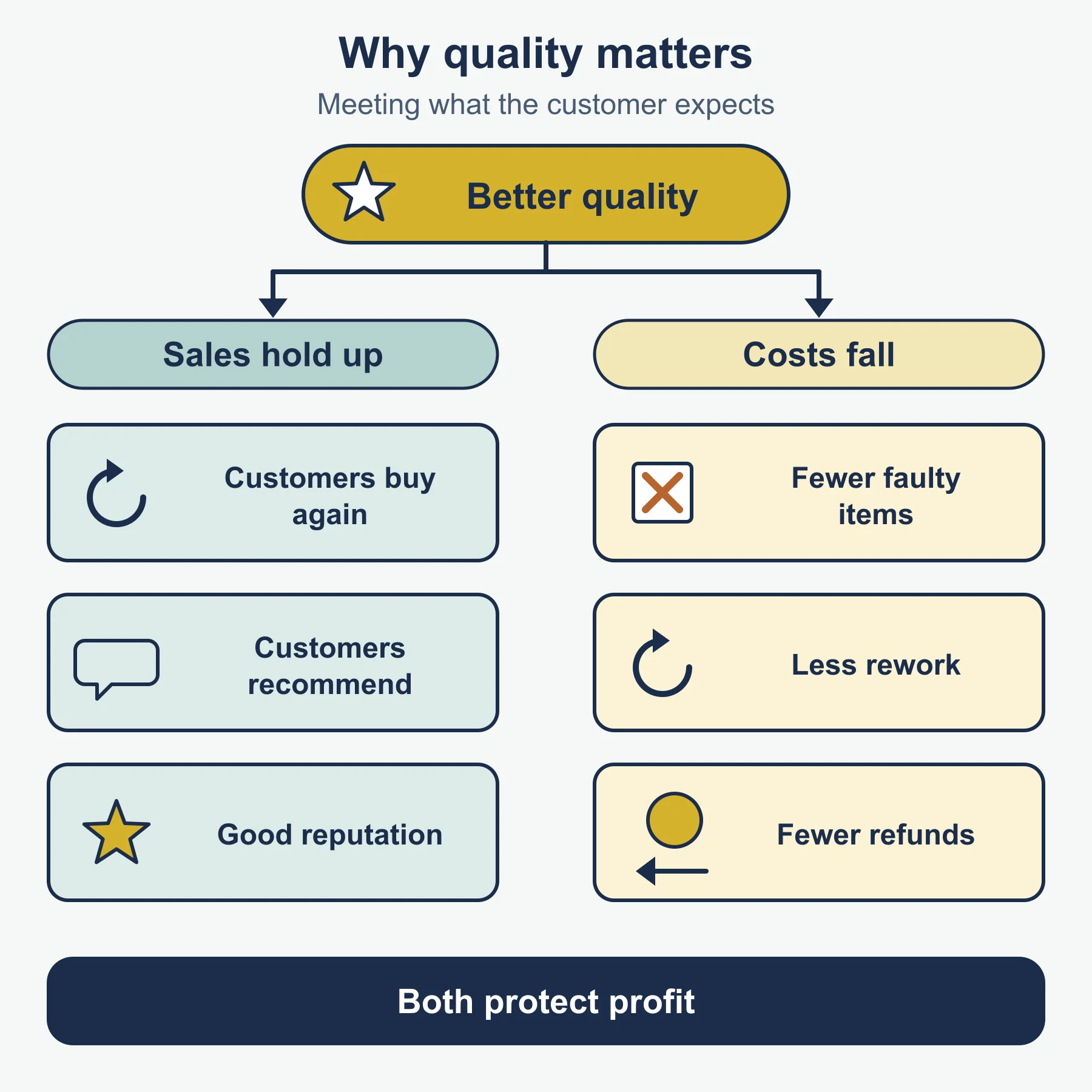
- Repeat purchases and recommendations keep sales revenue up.
- Reputation and brand image support a higher price.
- Less waste, rework and refunds lowers costs.
- Fewer complaints and returns saves staff time.
- It helps the business stand out from competitors.
Quality control versus quality assurance
| Quality control | Quality assurance | |
|---|---|---|
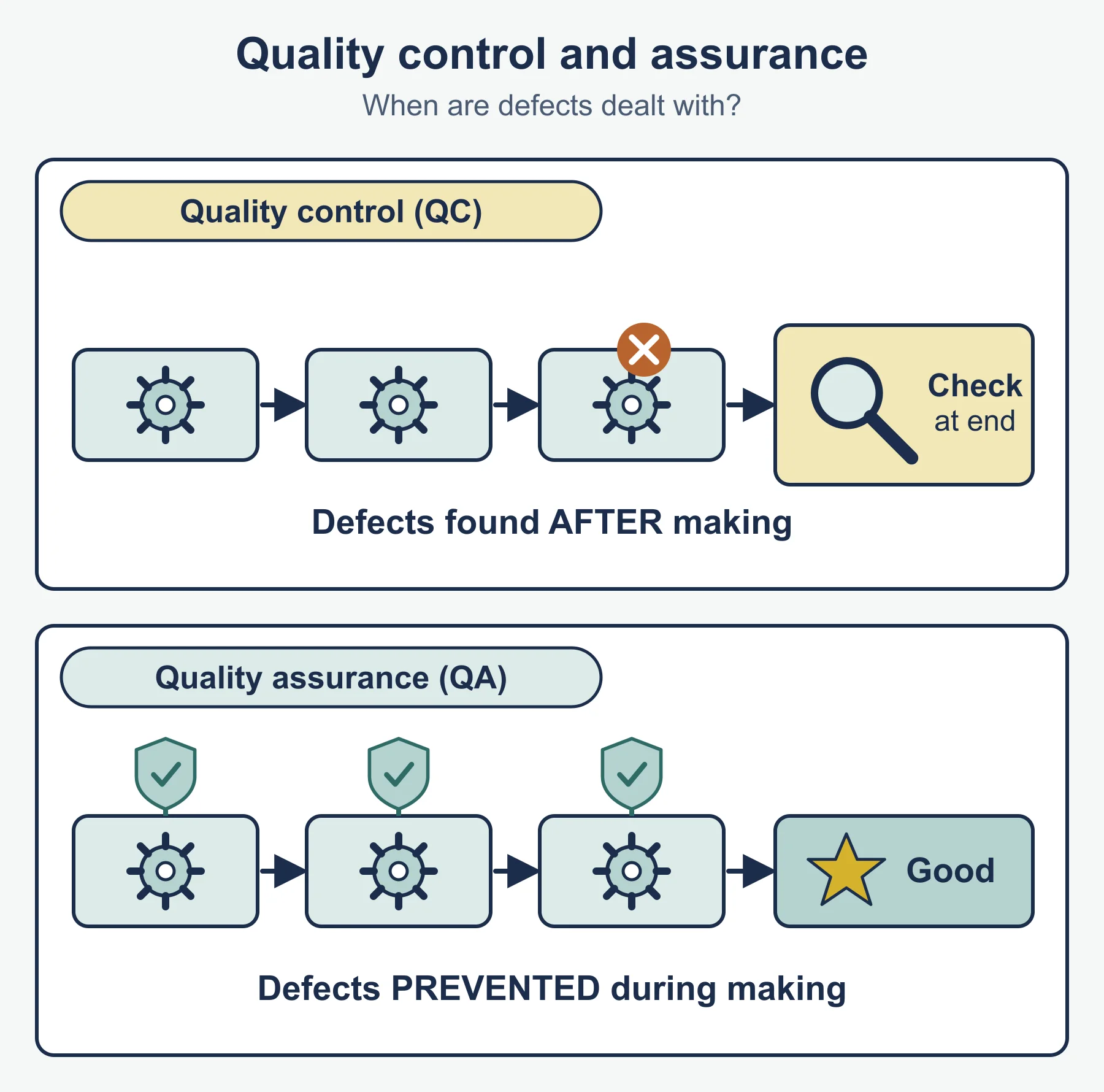
| Idea | Check and remove faults | Prevent faults |
| Timing | Mostly at the end or at checkpoints | Every stage, from supplier to delivery |
| Who | Inspectors, supervisors | All employees |
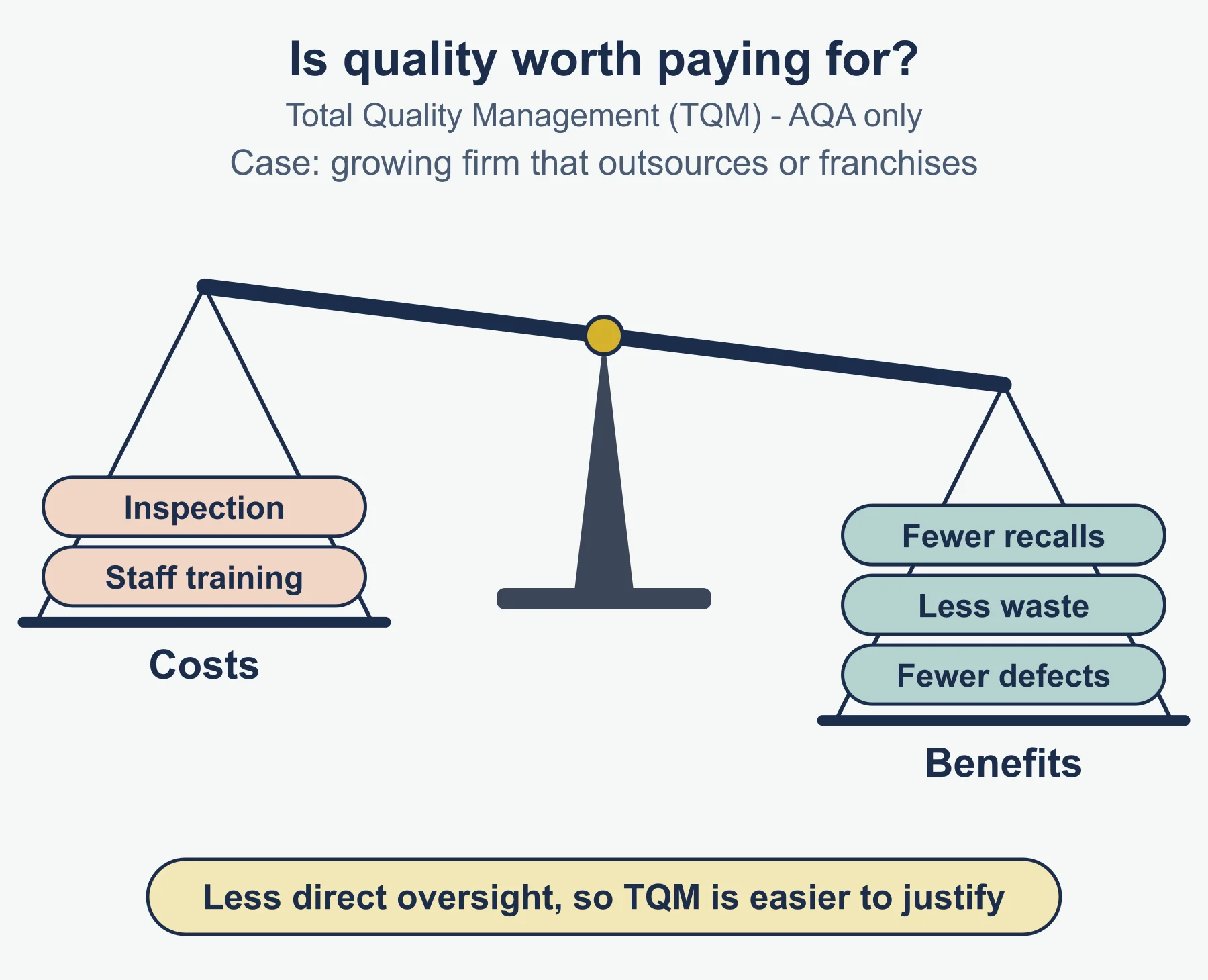
| Strength | Simple, quick, protects customers from faulty items | Less waste, consistent quality, employees involved |
| Weakness | Waste already incurred, inspection cost, sampling can miss faults | Set-up cost, needs training and cooperation, slower results |
| Suits | Small firms, low-cost goods, limited budget | Costly or risky faults, brand built on quality, large output |
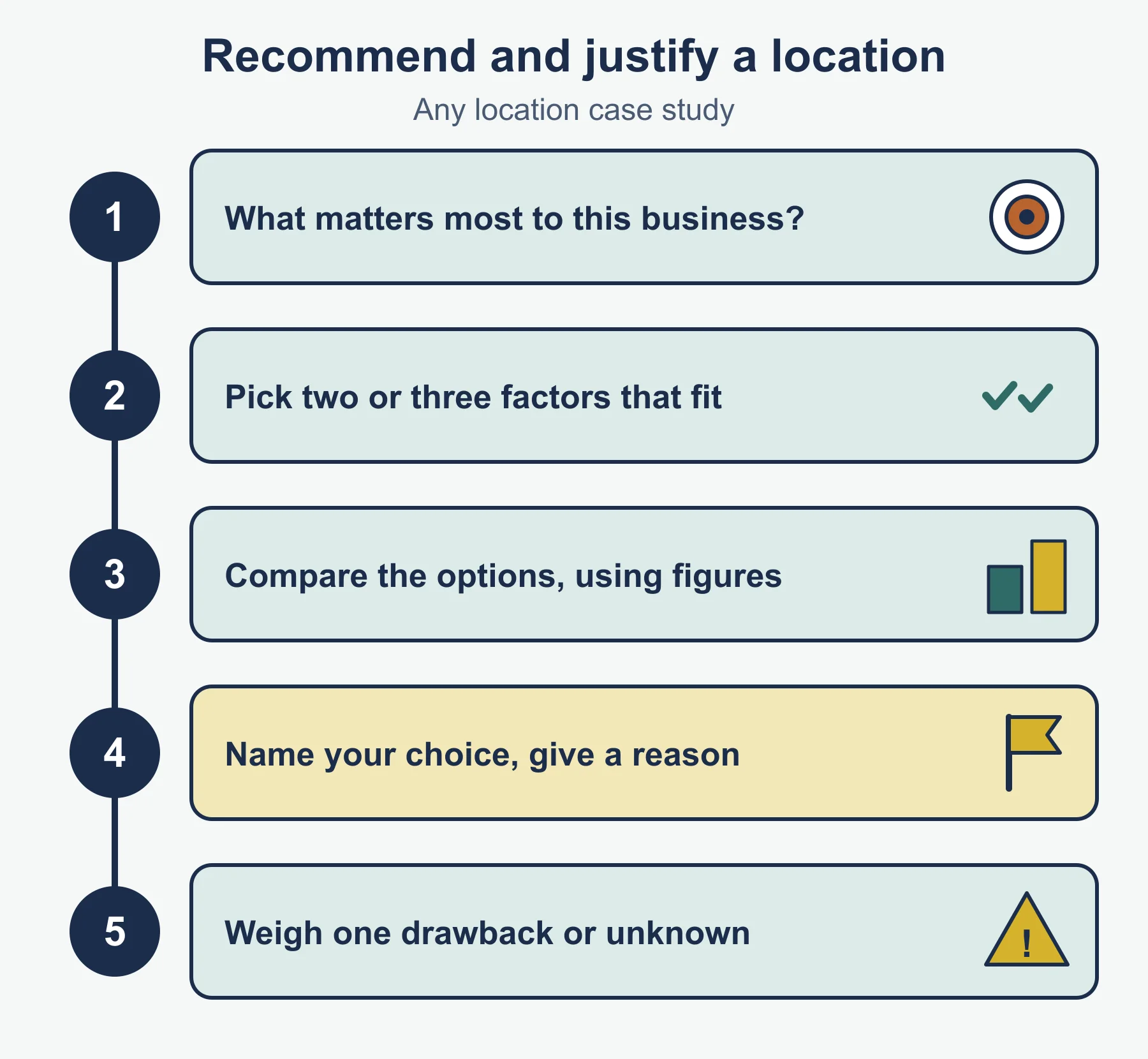
Method: recommend and justify control or assurance
- Name your choice clearly (control or assurance).
- Link it to a fact in the stem: product, size, budget, risk or reputation.
- Give a reason it helps, with an effect on cost, customers or brand.
- Weigh a drawback or a condition (for example, set-up cost or needing staff cooperation).
- Finish with one sentence that answers the question asked.
Small worked reminders
Defect rate and estimate. A sample of 250 items has 5 faulty. Defect rate = 5 / 250 x 100 = 2%. In a batch of 3,000 the estimate is 2% x 3,000 = 60 faulty items. If each costs 1.20 dollars to fix, the cost is 60 x 1.20 = 72 dollars.
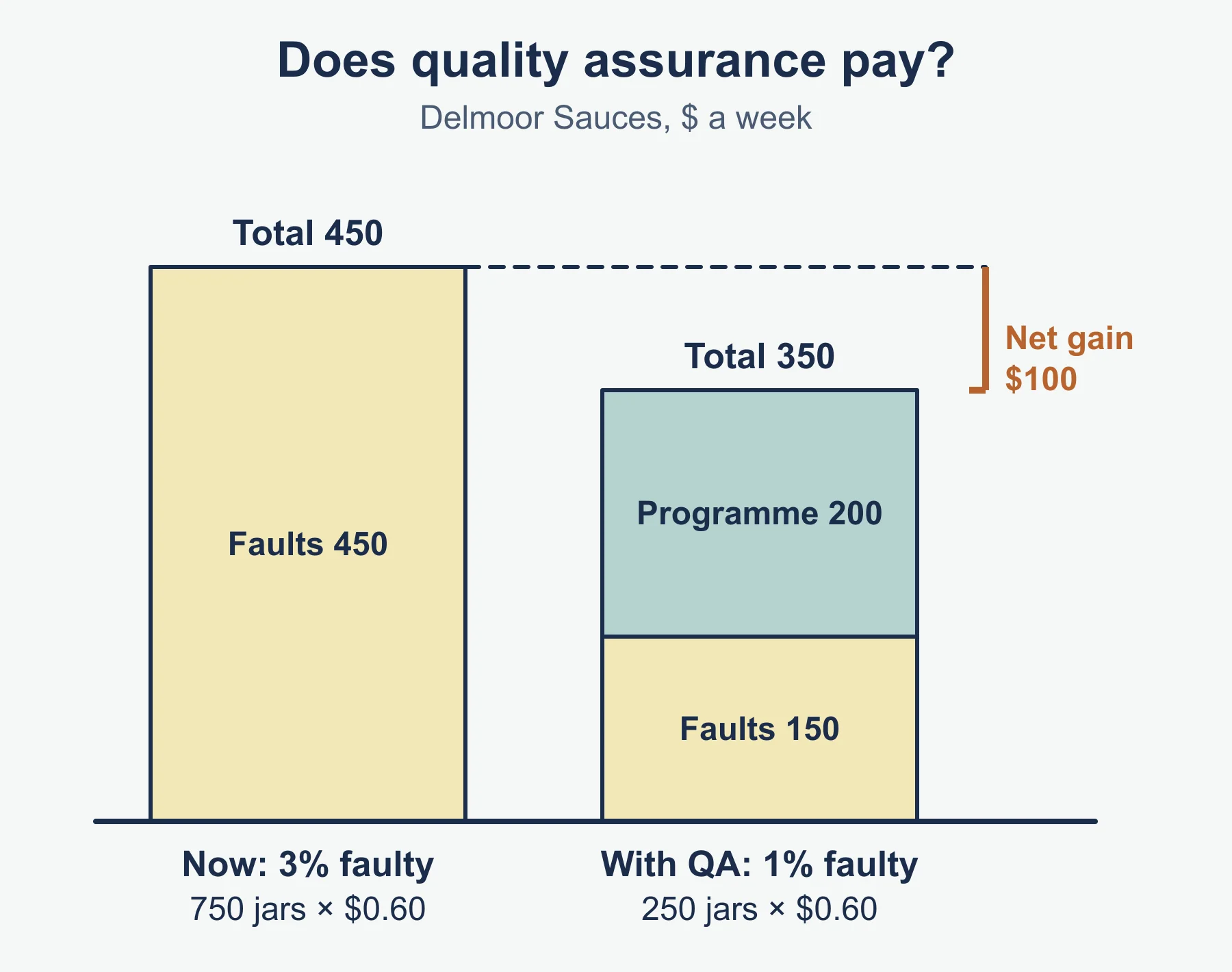
Is prevention worth it? A firm makes 2,000 items a week. At 4% faulty and 2.50 dollars each, faults cost 200 dollars. If a prevention programme cuts faults to 1%, faults cost 50 dollars. The gap is 150 dollars a week, so the programme is worth it if it costs less than 150 dollars a week.
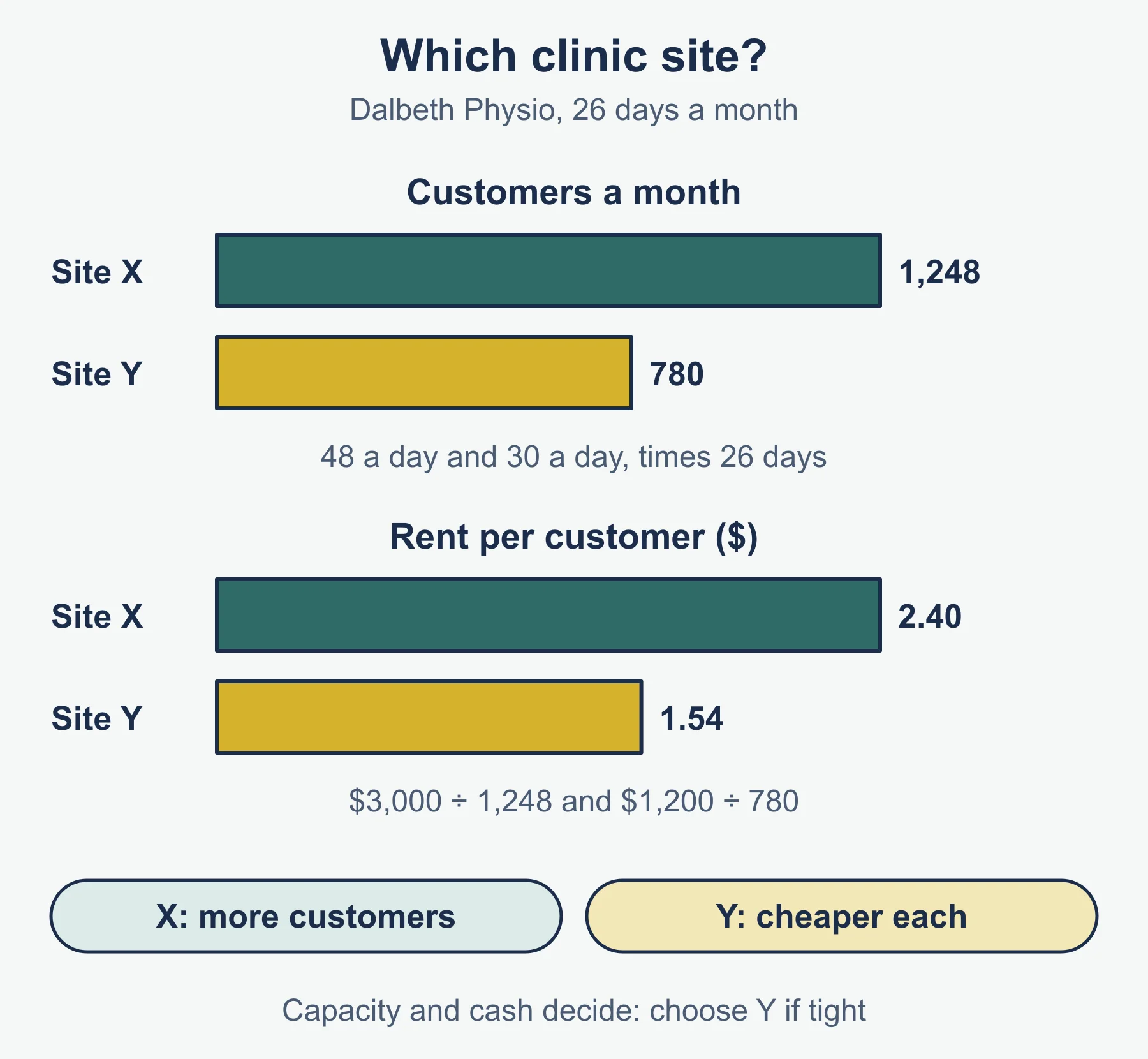
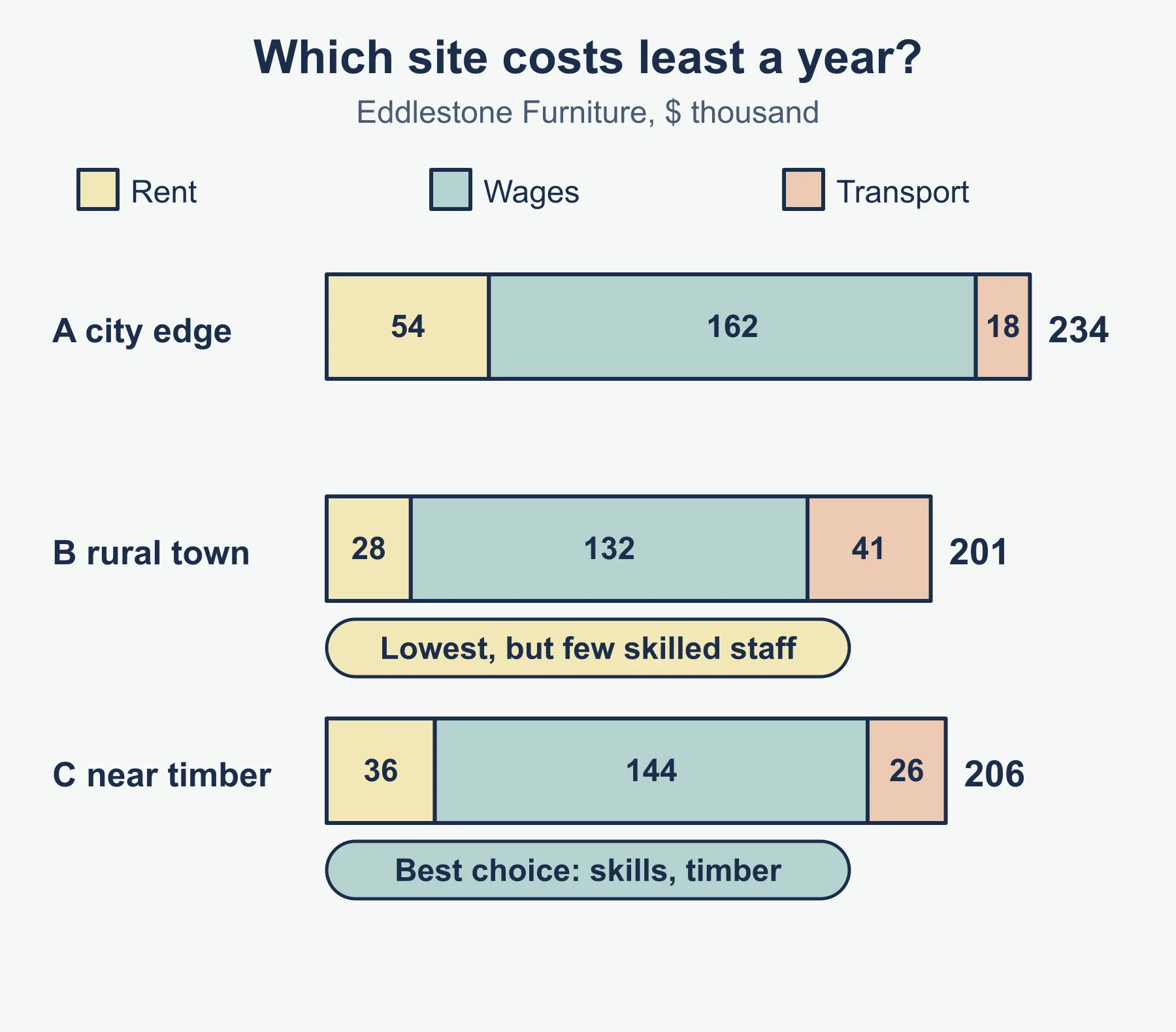
Comparing sites by total cost. Add rent, wages and transport for each site. Site 1: 70,000 + 205,000 + 15,000 = 290,000. Site 2: 52,000 + 226,000 + 9,000 = 287,000. The gap is 3,000 a year, so cost alone is close and other factors (skills, customers, growth) decide.
Location: manufacturing
| Factor | Typical effect |
|---|---|
| Land and premises cost | Lower rent in some regions cuts fixed costs |
| Labour | Skills, availability and wage rates affect output and cost |
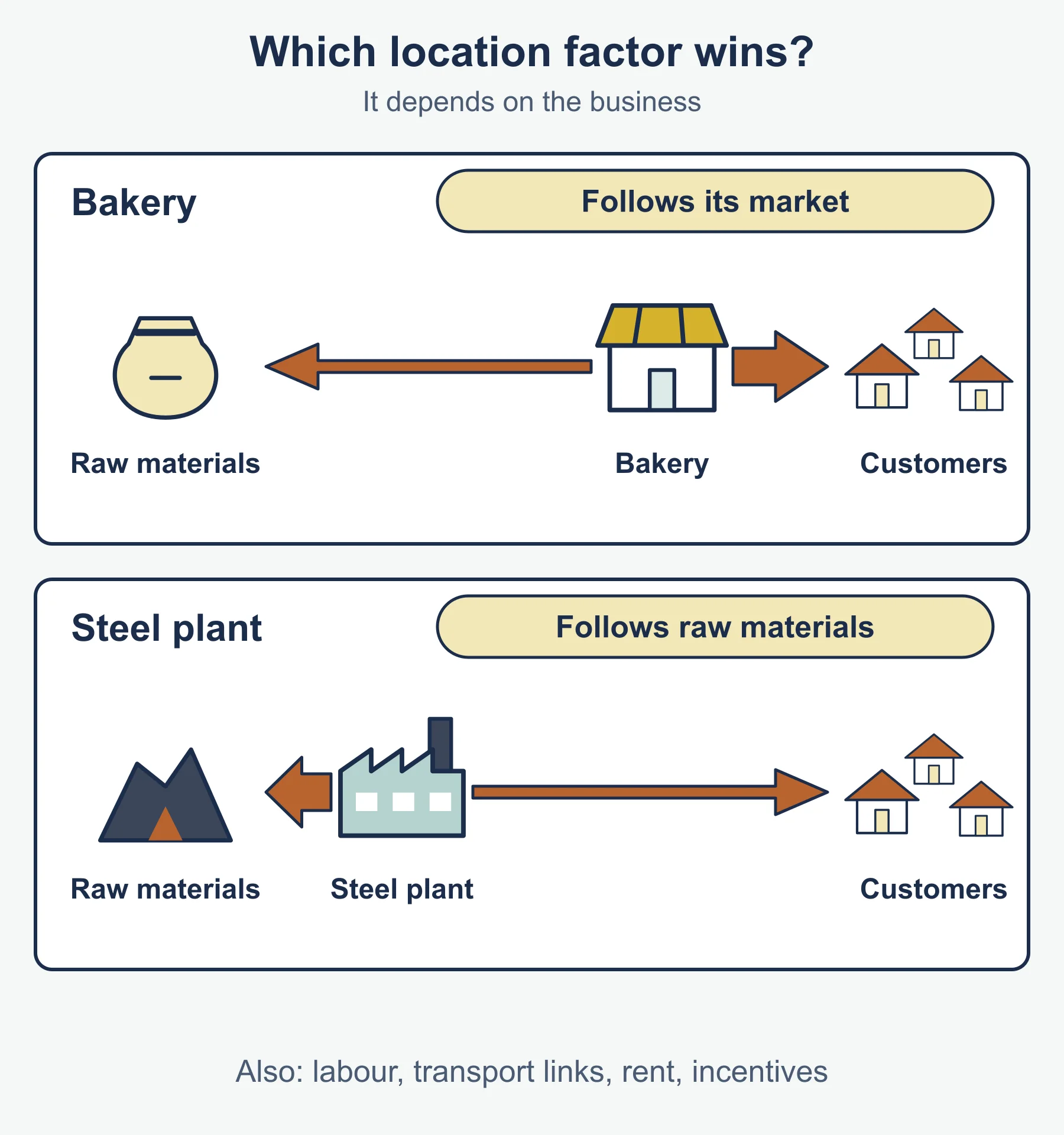
| Raw materials | Heavy or bulky inputs favour a site near the source |
| Market | Fragile or costly-to-move goods favour a site near customers |
| Transport and infrastructure | Good links cut delivery time and cost |
| Government help | Grants or tax breaks may favour an area |
| Room to expand | Space for growth avoids a costly move later |
Location: services
| Factor | Typical effect |
|---|---|
| Closeness to customers | Shops, cafes and clinics need people nearby |
| Footfall and visibility | Passing trade brings sales without advertising |
| Rent and local costs | Busy sites cost more |
| Competition | Can reduce sales, or signal strong demand |
| Parking, access, safety | Affect whether customers will visit |
| Skilled staff | The quality of the service depends on them |
| Communications | Online and phone services need reliable internet and power |
Location: choosing a country
| Factor | Typical effect |
|---|---|
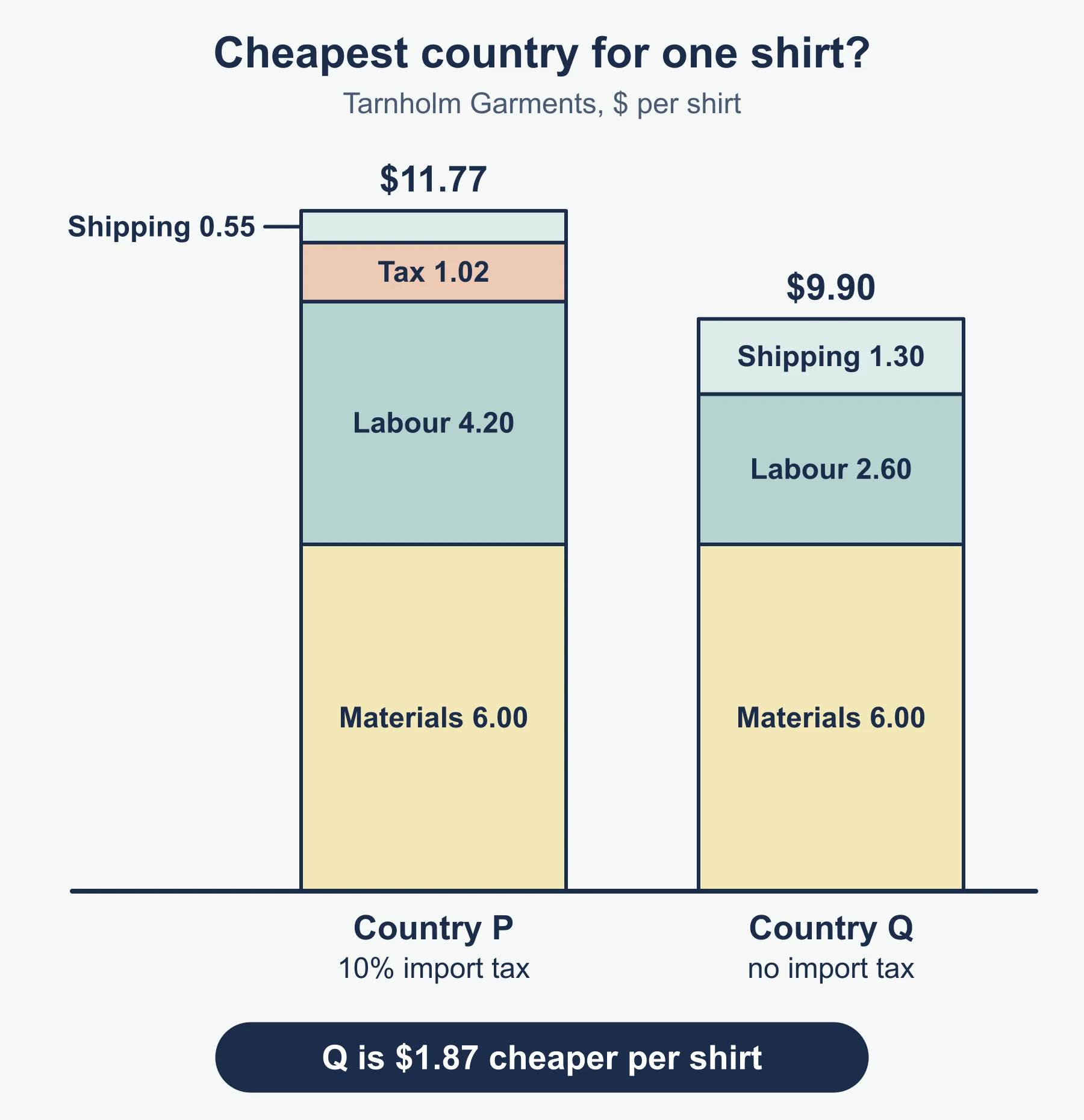
| Labour cost and skills | Lower wages may save money; skills affect quality |
| Costs of land, energy, materials | Change total production cost |
| Market access | Nearness to customers; taxes or limits on trade |
| Transport and communications | Affect delivery time and cost |
| Government attitude | Grants, tax rates, stable policy |
| Political stability | Unrest or sudden policy changes raise risk |
| Exchange rate | A changing currency alters costs and revenue |
| Language and culture | Affect working with staff and customers |
| Legal requirements | Rules differ between countries |
Must-know distinctions
- Control versus assurance: control finds faults, assurance stops them being made.
- Manufacturing versus service location: manufacturers focus on materials, labour and transport; service firms focus on customers, footfall and access.
- Cheapest versus best: the lowest-cost site is not always the right answer if it lacks skills, customers or room to grow.
- Home versus abroad: moving to another country adds risks (exchange rates, stability, culture) as well as possible savings.
- Describe versus justify: listing factors is not enough; justify means support your choice with evidence from the stem.
Applying the content to a case study
Read the stem for clues before you write. A food or care business points towards assurance because a fault can harm customers. A tiny workshop with a small budget points towards control. For location, underline what the business sells, who its customers are and which costs the data gives. Then use two or three matching factors, quote at least one figure or fact, and say what you cannot tell from the information given. This last step is what turns a list into a justified recommendation.
Command words
Use the meanings in the syllabus. Define means give a precise meaning. Identify and state ask for a name or a clear statement. Outline means set out the main points. Explain means say why or how, with evidence. Justify means support a case with evidence or argument. Calculate means work out from the figures given.
Quick self-test
- Define quality.
- State two benefits to a business of good quality.
- Distinguish between quality control and quality assurance.
- A sample of 300 items has 9 faulty. Calculate the defect rate, then estimate the faulty items in 6,000.
- State one advantage and one disadvantage of quality control.
- State one advantage and one disadvantage of quality assurance.
- A business sells perishable cakes and has a reputation for freshness. Which approach would you recommend, and why?
- Identify two factors that affect the location of a manufacturer.
- Identify two factors that affect the location of a hairdresser.
- Explain one reason a business might choose a country with lower wages, and one risk.
- A site has high rent but heavy footfall. Explain why a cafe might still choose it.
- Why can the cheapest site be the wrong choice?
Answers
- How well a good or service meets what customers expect and need.
- Any two: repeat purchases, better reputation, a higher price, fewer returns or less waste.
- Control checks output to find and remove faults, mostly after production. Assurance sets standards and trains staff at every stage so faults are not made.
- 9 / 300 x 100 = 3%. Estimated faulty items = 3% x 6,000 = 180.
- Advantage: simple to use and stops faulty items reaching customers. Disadvantage: faults are found after the cost has been spent, so waste remains.
- Advantage: fewer faults and less waste. Disadvantage: training and set-up cost, and it needs all staff to cooperate.
- Quality assurance: spoilage is costly and freshness is the selling point, so prevention at every stage (supplier checks, storage, training) protects the reputation. Drawback: set-up cost.
- Any two: cost of premises, labour skills and wages, nearness to raw materials, nearness to market, transport links, government grants.
- Any two: footfall, nearness to customers, rent, competition, parking and access.
- Reason: lower labour cost reduces production cost per unit. Risk: lower skills or an unstable government or exchange rate could raise costs or damage quality.
- Many passers-by become customers, so higher sales could outweigh the extra rent. This depends on the cafe converting enough passers-by into buyers.
- It may have too few skilled workers, poor transport or few customers, and these could add costs or lose sales that exceed the saving.
Where marks are usually lost
- Defining quality as “very good” instead of meeting customer expectations.
- Treating inspection at the end as assurance.
- Giving the same advantage for control and assurance without a contrast.
- Naming location factors with no link to the business in the stem.
- Recommending the lowest-cost site without comparing skills, customers or growth.
- Forgetting to add every cost (rent, wages and transport) before comparing sites.
- Using a defect rate from a sample as if it were certain.
- Writing a recommendation with no drawback or no reason.
Frequently asked questions
What is the difference between quality control and quality assurance? Quality control checks goods or services, mostly at the end or at set checkpoints, to find and remove faults. Quality assurance organises the whole business so that faults are prevented at every stage, with every employee responsible for quality.
Which businesses are best suited to quality assurance? Quality assurance suits businesses where faults are costly or dangerous, such as food, medicine, safety equipment and healthcare, or where reputation matters greatly. It costs more to set up but cuts waste later.
Should a business always choose the cheapest location? No. The cheapest site or country may lack skilled workers, be far from customers or carry political and exchange-rate risk, so weigh those factors against the cost saving.
Can manufacturing location factors be used for a service business? Not without care. A manufacturer is driven by costs and moving materials, while a service business depends more on closeness to customers, footfall and visibility, so using the wrong set of factors is a common error.
Official syllabus
Aligned to sections 4.5 and 4.6 of the Cambridge IGCSE Business 0264 syllabus for examination in 2027, 2028 and 2029, published by Cambridge University Press & Assessment (Cambridge International Education).
Get free revision emails (optional)
Occasional emails with practice questions, worked explanations and links to free resources for the qualification and subjects you choose. No spam, and you can unsubscribe from any email. The free tools on this site never need an email.
Related resources
-
Study guides
IGCSE Business: Technology and production of goods and services and related topics (Cambridge 0264)
Study guide to Cambridge IGCSE Business 0264 sections 4.2 and 4.3: technology in production, service-sector productivity and sustainable production.
Business · Cambridge · IGCSE
Read guide -
Practice questions
IGCSE Business: Technology and production of goods and services and related topics (Cambridge 0264) – Practice Questions
Eleven original practice questions with worked answers on Cambridge IGCSE Business 0264 sections 4.2 and 4.3: technology and sustainable production.
Business · Cambridge · IGCSE
Try questions -
Revision notes
IGCSE Business: Technology and production of goods and services and related topics (Cambridge 0264) – Revision Notes
Condensed revision notes for Cambridge IGCSE Business 0264 sections 4.2 and 4.3: technology, service-sector productivity and sustainable production.
Business · Cambridge · IGCSE
Revise topic
Related articles
-
teaching
A Level tuition in Dubai: Cambridge or Pearson Edexcel International A Level?
Schools in Dubai and Abu Dhabi teach either Cambridge International AS & A Level or Pearson Edexcel International A Level. How the two are structured, why it matters for tuition, and how online classes from Lahore work.
9 October 2026
-
curriculum guides
Choosing subjects at IGCSE and A Level
How subject choices at 14 and 16 affect university options later, and how to keep pathways open without overloading a timetable.
28 July 2026
Studying this with a teacher
Working through Business IGCSE?
This page is free and stays free. If you would rather be taught it, Marlbridge runs Business classes one-to-one and in small groups of up to 15, online in your own time zone. The first trial class is free. WhatsApp replies within an hour (8am–11pm Pakistan time, every day); email the same day.
Cambridge Business teachers at Marlbridge

