
Revision Notes
Cambridge IGCSE Geography (0460): Settlements (Rural and Urban) and Service Provision – Revision Notes
Condensed IGCSE Geography 0460 notes on 1.5: site and situation, settlement patterns, hierarchy, range, threshold and a self-test.
- Subject
- Geography
- Level
- IGCSE
- Topic
- Theme 1 – Population and Settlement
- Author
- Marlbridge Academic Team
- Updated
- Reviewed by
- Azam Siddique (what this means)
Aligned to Cambridge IGCSE Geography (0460), 2025-2026. Official specification .
Syllabus page (what it covers and how it is assessed): Cambridge IGCSE Geography.
Syllabus points this page covers
0460
- 1.5 Settlements (Rural and Urban) and Service Provision
Condensed recall for 1.5 Settlements (Rural and Urban) and Service Provision (Cambridge IGCSE Geography 0460, Theme 1). For the full explanation, read the Population and Settlement study guide.
Key terms
| Term | Meaning |
|---|---|
| Settlement | A place where people live, from a single farm to a city |
| Service | Something provided for people, such as a shop, school, doctor or bank |
| Low-order service | An everyday, cheap service bought often (newsagent, bakery, primary school) |
| High-order service | A specialised, expensive service used rarely (department store, hospital, university) |
| Sphere of influence | The area served by a settlement or service, from which people travel to it |
| Function | The main economic activity or purpose of a settlement, such as market town, port or resort |
Site and situation
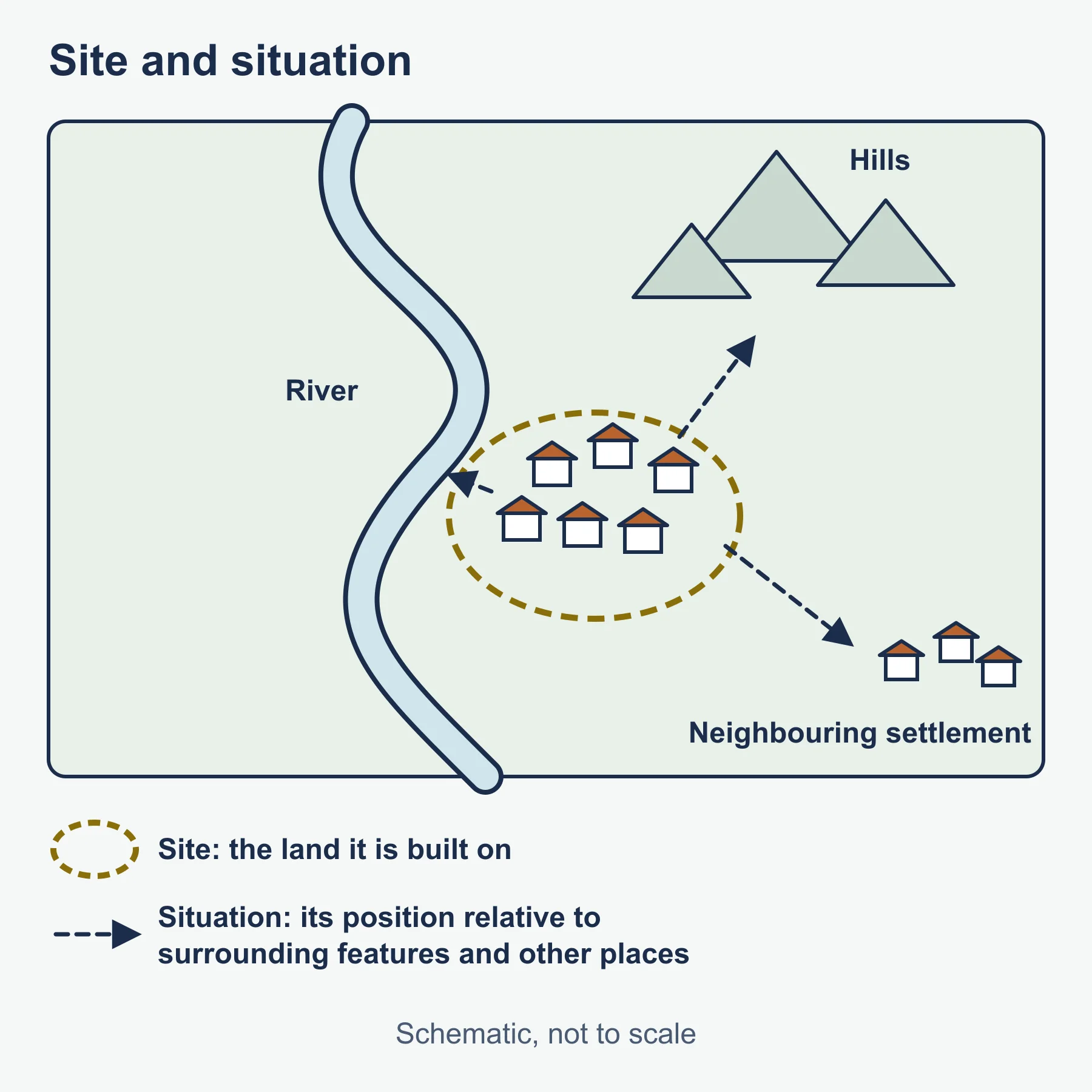
- Site – the actual land a settlement is built on.
- Situation – its position in relation to the surrounding area, routes and other settlements.
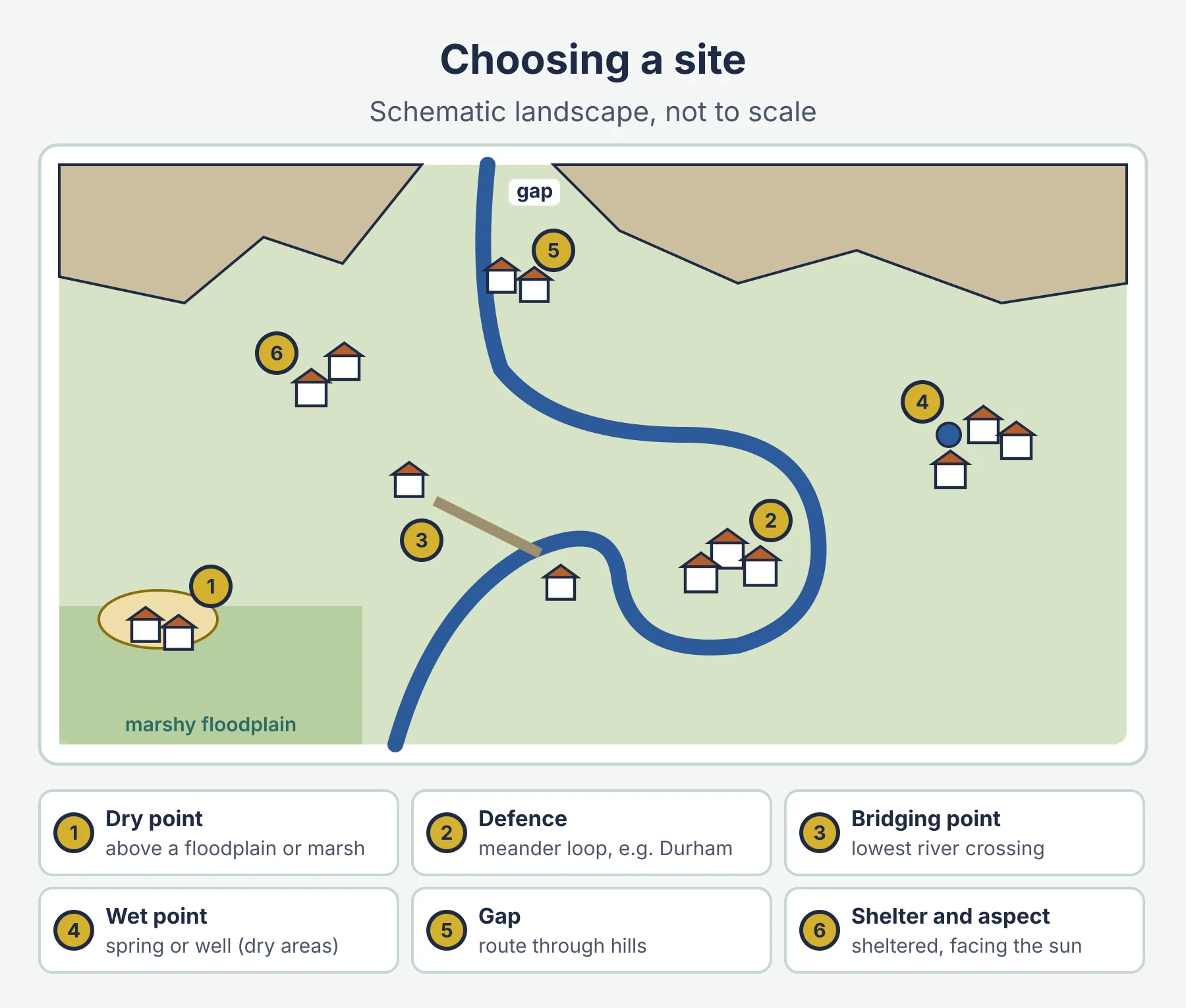
Site factors for early settlements: water supply, a dry point above flood level, defence (a hill or river bend), flat or well-drained land, building materials, fuel and fertile land. A settlement grows where site and situation combine well, for example at a route crossing.
Why each site factor mattered
| Factor | Why it helped |
|---|---|
| Wet point (spring, river) | Water was needed every day for drinking, cooking and animals, and was heavy to carry far |
| Dry point | A slight rise above a marsh or floodplain kept homes safe from floods |
| Defence | A hilltop or a river meander made attack harder |
| Bridging or fording point | Routes met to cross the river, bringing trade and travellers |
| Gap town | A valley through hills funnels routes, so traffic passes through |
| Sheltered harbour | Calm water allowed ships to load safely, leading to port functions |
| Resources | Wood for fuel and building, stone, fertile soil for crops |
Situation explains why a few settlements grew large. A village on a good site but in a remote situation stays small; a site at a route centre, river mouth or gap can grow into a town or city because people and goods pass through it.
Patterns
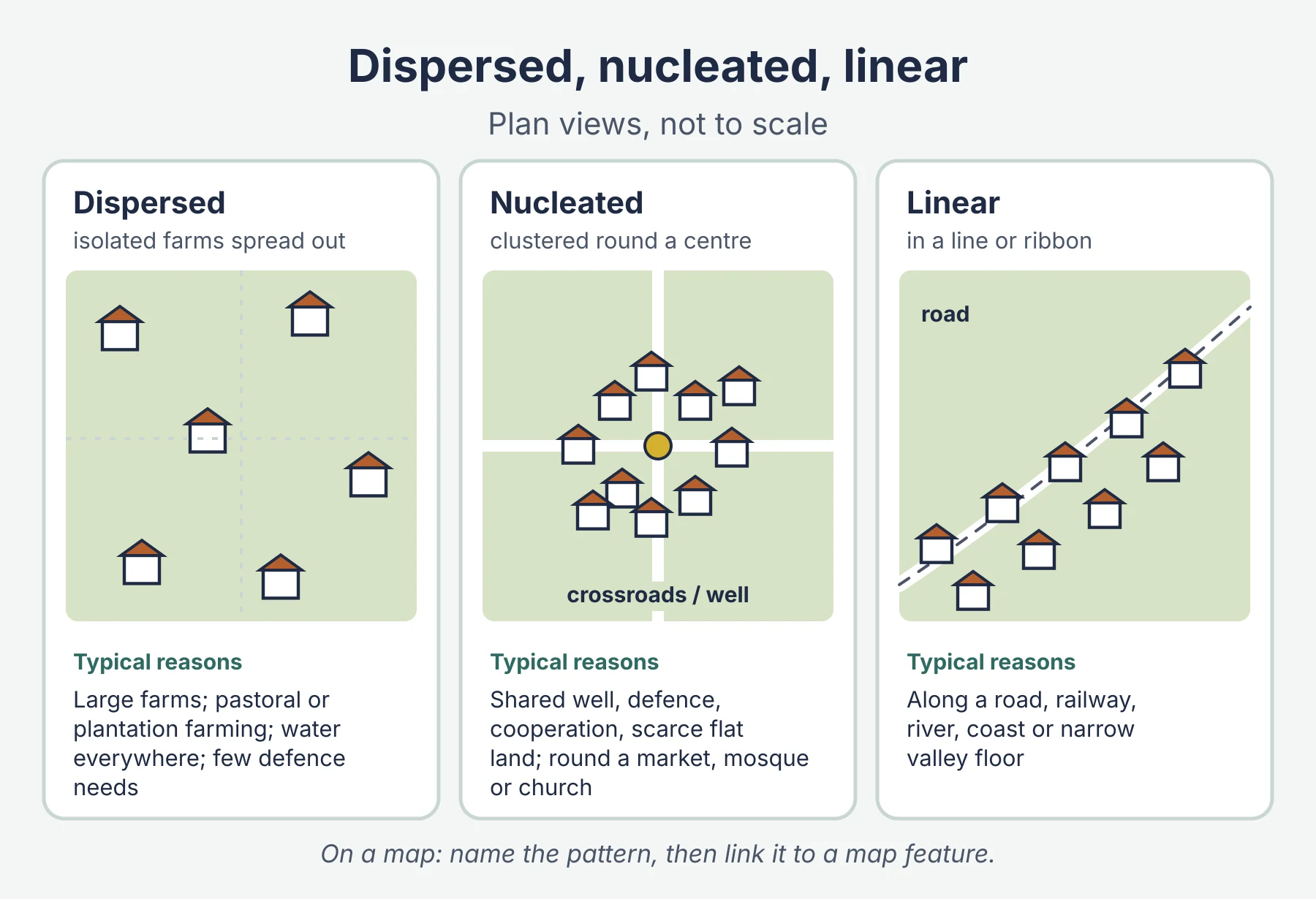
| Pattern | Shape |
|---|---|
| Dispersed | Scattered buildings with large gaps |
| Linear | Buildings in a line along a road, river or coast |
| Nucleated | Buildings clustered around a central point |
Relief, water supply and routes help explain which pattern forms.
- Dispersed: found where farms are large or land is poor, so each family needs a wide area; common in upland grazing areas and newly settled farmland.
- Linear: follows a feature that gives access or limits space – a road, a canal, a narrow valley floor or a raised river bank above a floodplain.
- Nucleated: grows around a crossroads, a spring, a defensive hill or a market, where people benefited from living close together for safety and trade.
Hierarchy of settlements
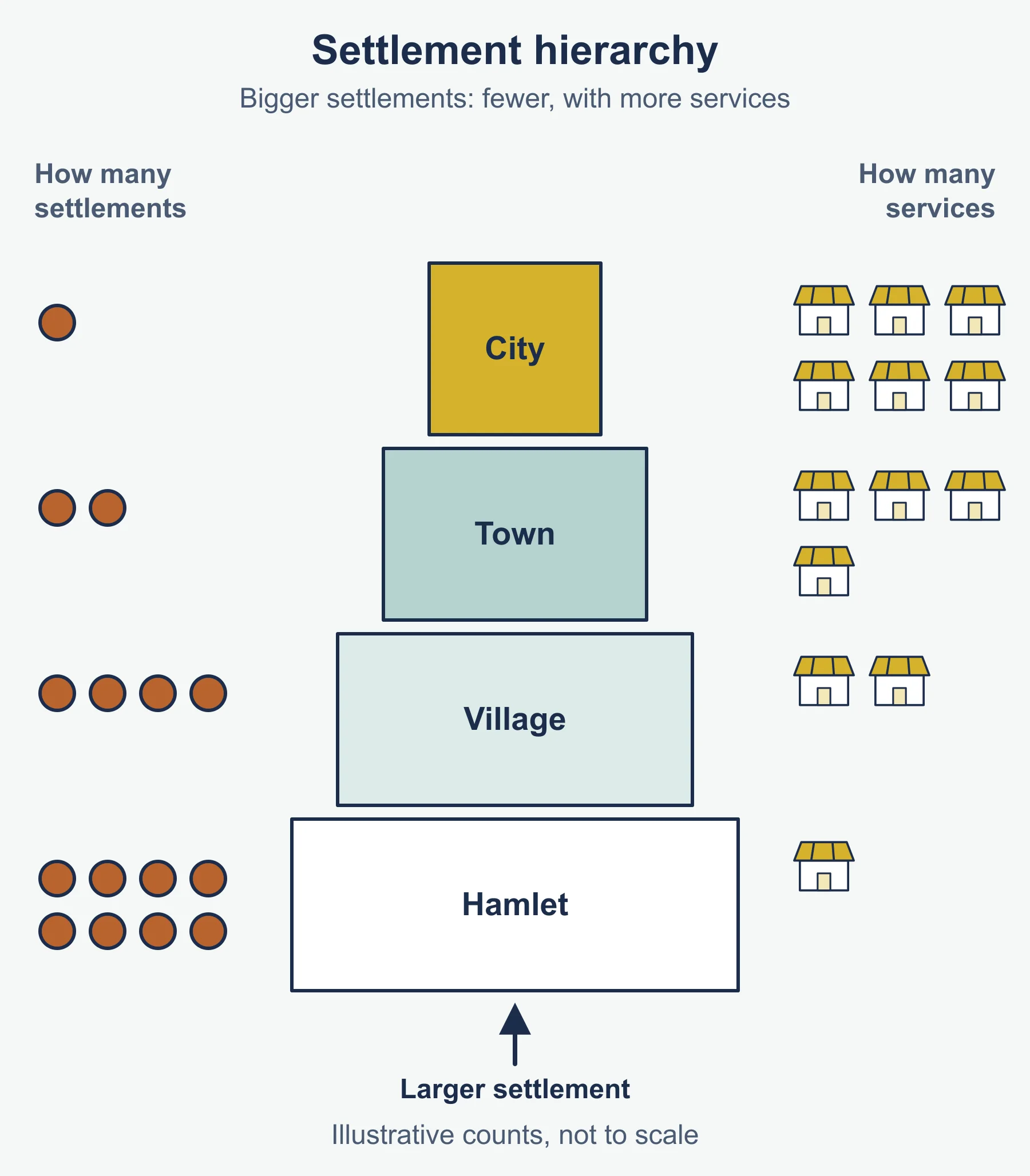
Settlements are ranked by size and importance: hamlet, village, town, city.
- As size increases, the number of settlements falls.
- As size increases, the number and range of services rises.
- Many small villages with few services; few large cities with many.
A hierarchy can be shown by a pyramid diagram (cities at the narrow top, hamlets at the wide base) or measured by counting services in each settlement.
Range and threshold
| Term | Meaning | Newsagent | Department store |
|---|---|---|---|
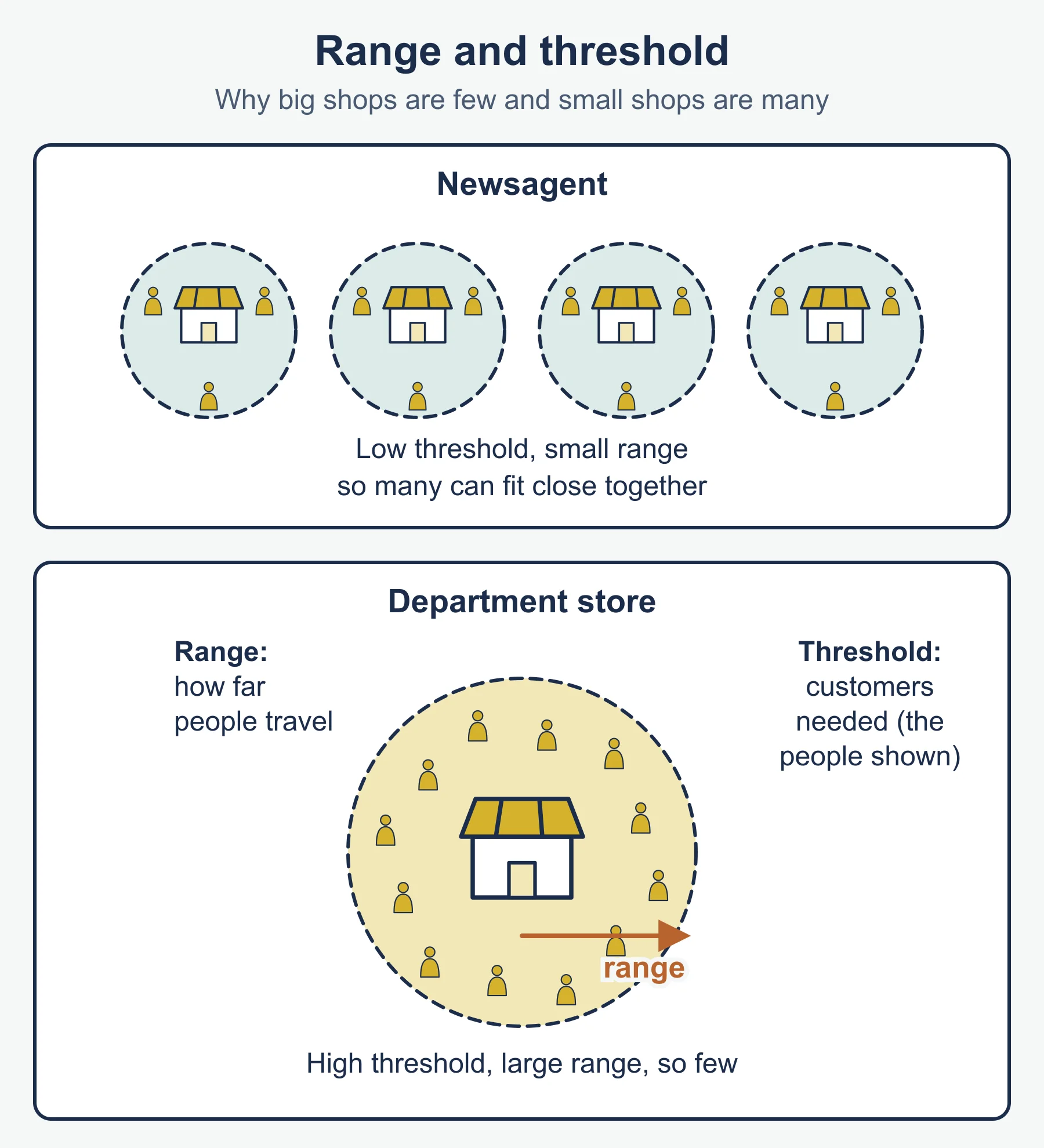
| Threshold population | Minimum number of people needed to support a service | Low | High |
| Range | How far people will travel to use it | Small | Large |
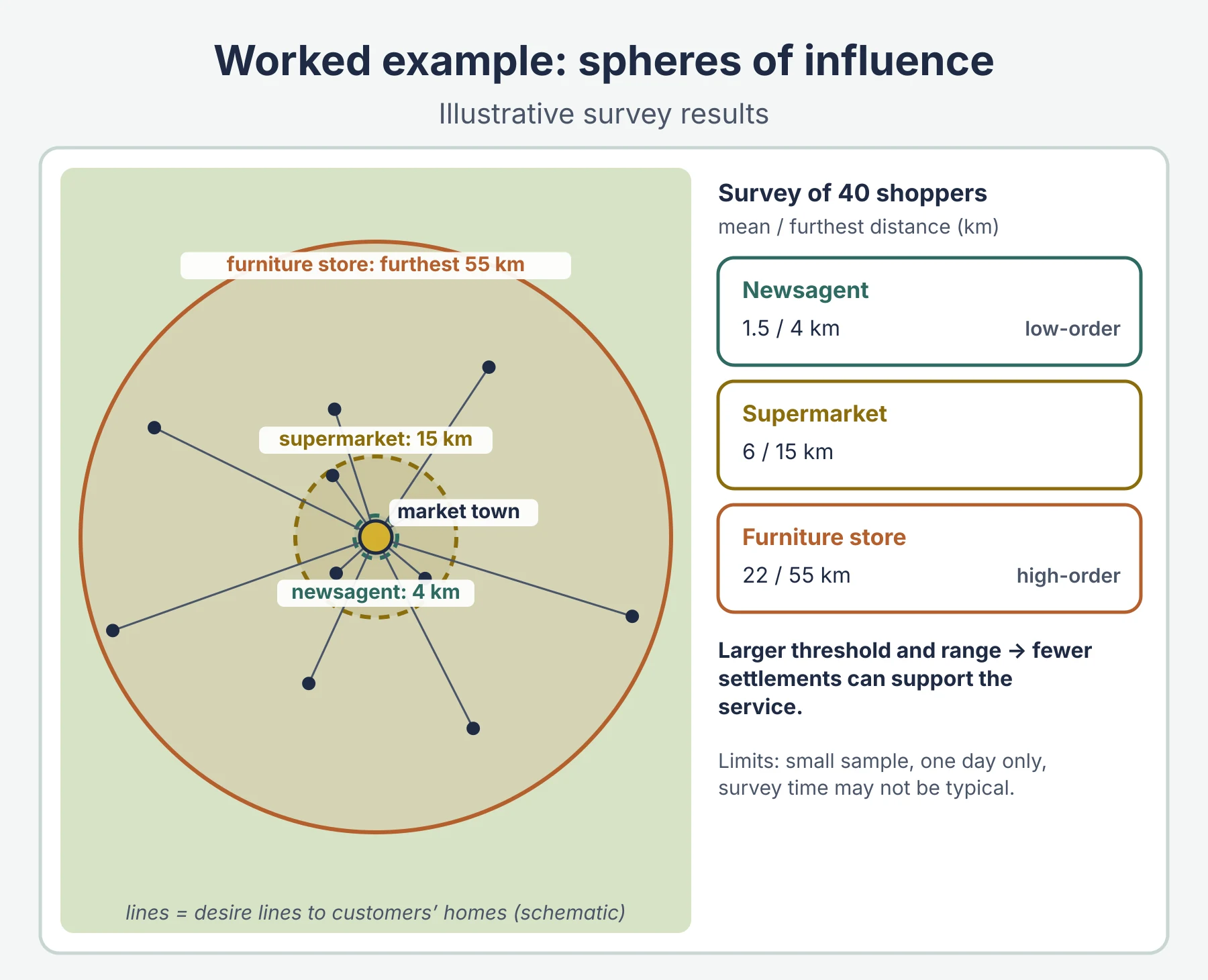
So there are many newsagents close together, and few department stores, each with a wide catchment. Everyday (low-order) services are found in settlements of all sizes; specialised (high-order) services only in larger ones. A city’s sphere of influence is larger than a village’s.
Why range differs: people will not travel far for a cheap item they buy every day, because the cost of the journey would be large compared with the price of the item. For a rare, expensive purchase such as furniture or a specialist hospital appointment, a long journey is worth it.
How a sphere of influence is measured
Survey shoppers or service users and ask where they have travelled from, then plot their homes on a map and draw a line round the outermost points. A desire-line map shows the pattern. A large town draws people from a wider area because it offers high-order services nearby villages lack.
Rural and urban settlements
Rural settlements are small and mostly serve farming areas, with limited services, so people travel to larger settlements for specialised ones. Urban settlements are larger, with more services and jobs, and draw people from a wide area.
Changing rural service provision
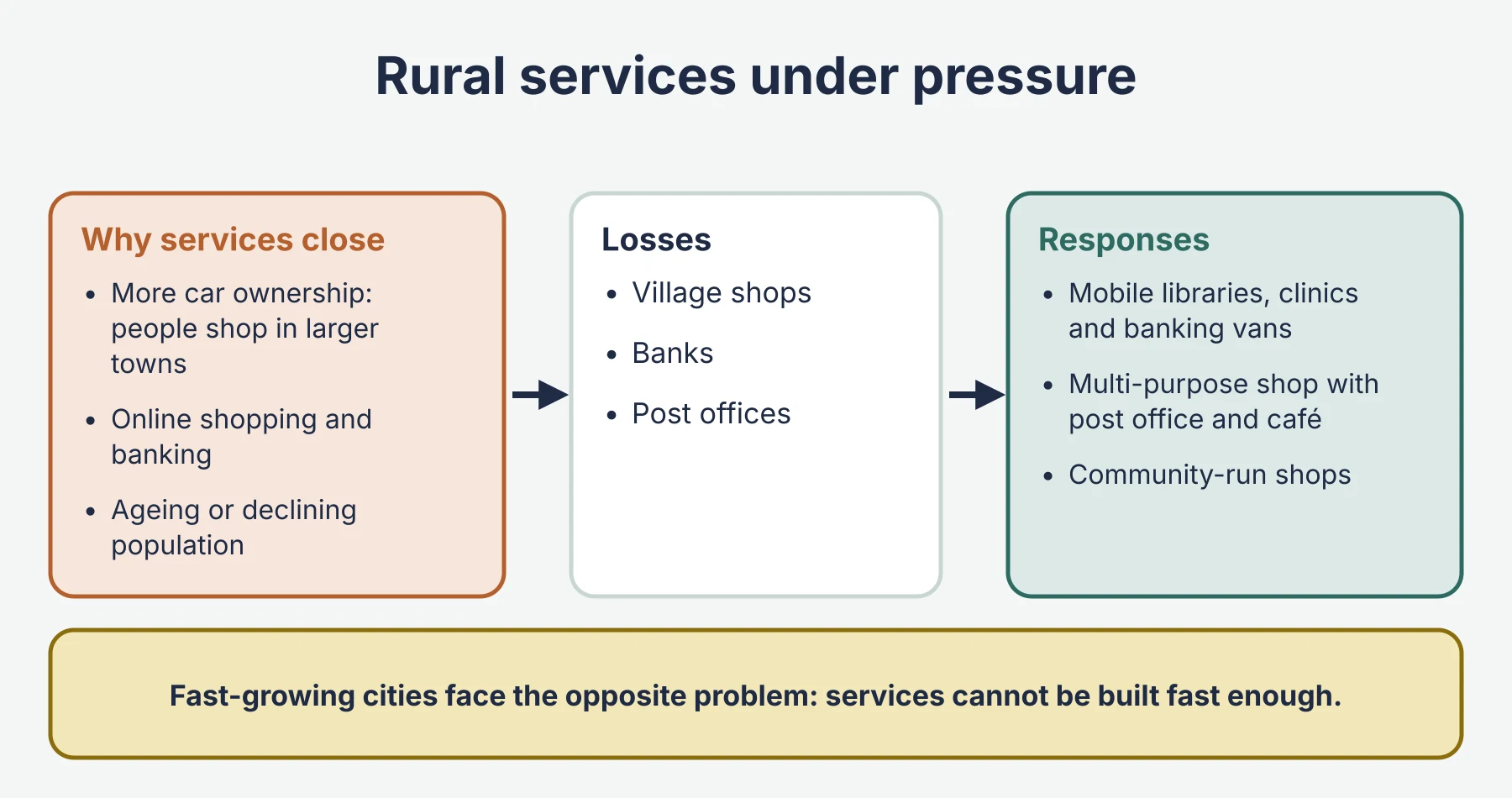
In many rural areas of high-income countries, village shops, post offices, banks, pubs, bus routes and small schools have closed. Reasons include:
- Falling local population as young people leave, so services fall below their threshold.
- Car ownership lets people drive to larger supermarkets in nearby towns.
- Online shopping and banking reduce the need for local branches.
Consequences fall hardest on people without cars, such as the elderly and the young. Responses include mobile services (libraries, shops, banks and health clinics in vans), community-run shops, combined services in one building, and subsidised or demand-responsive buses.
Commuter villages near cities can grow, however: new housing brings wealthier residents, but they often shop and work in the town, so local services may still decline while house prices rise.
Case study card
The syllabus asks for a case study of settlement and service provision in an area. Build it from an area you know or one your teacher has covered:
- Name the area and its main settlements, ranked as a hierarchy.
- Give the site and situation of one settlement, with reasons for its growth.
- List the services found at each level, with one low-order and one high-order example.
- Describe how service provision has changed and why.
- Give one response and say whether it has worked.
Exam traps
- Confusing site (the land itself) with situation (where it is relative to other places).
- Mixing up range and threshold: range is distance, threshold is number of people.
- Describing the hierarchy but forgetting that settlement numbers fall as size rises.
- Naming site factors without explaining why each helped (for example why a dry point matters).
- Using only abstract examples when a named settlement is asked for.
- Describing a pattern on a map without using map evidence such as roads, rivers or contours.
Self-test
- Distinguish site from situation.
- Give three site factors for an early settlement.
- Define threshold population.
- Why are there fewer department stores than newsagents?
- Describe a linear settlement pattern.
- Why might a nucleated settlement grow at a crossroads?
- Give one low-order and one high-order service.
- Why do people travel further for high-order services?
- Give two reasons why village services have closed in many high-income countries.
- How could you find the sphere of influence of a town?
- Name one response to the loss of rural services and one group who benefits from it.
Answers: 1. Site is the land the settlement stands on; situation is its position relative to surrounding places. 2. For example water supply, a dry point and defence. 3. The minimum number of people needed to support a service. 4. A department store needs a high threshold population and draws customers from a large range, so only a few can survive. 5. Buildings in a line along a road, river or coast. 6. Routes meet there, so traders and travellers pass through, giving a market and access in several directions. 7. For example a newsagent (low order) and a hospital (high order). 8. They are used rarely and are expensive, so the journey is worth the cost. 9. For example falling local population and car ownership that lets people shop in towns. 10. Survey users about where they live, plot their home locations and draw a boundary round the outermost points. 11. For example a mobile library or shop, which helps elderly people without cars.
More resources on this topic
Related resources
-
Revision notes
Cambridge IGCSE Geography (0460): Urban Settlements – Revision Notes
Condensed IGCSE Geography 0460 notes on 1.6: urban land-use zones, land values, inner-city and fringe problems, squatter settlements and a self-test.
Geography · Cambridge · IGCSE
Revise topic -
Revision notes
Cambridge IGCSE Geography (0460): Urbanisation – Revision Notes
Condensed IGCSE Geography 0460 notes on 1.7: causes of urbanisation, rural push and urban pull factors, consequences, management strategies and a self-test.
Geography · Cambridge · IGCSE
Revise topic -
Study guides
IGCSE Geography: Population and Settlement (Cambridge 0460)
Cambridge IGCSE Geography 0460 (2025-2026 series), Theme 1: population dynamics, migration, population structure, density and distribution, rural and urban settlement, and urbanisation.
Geography · Cambridge · IGCSE
Read guide
Studying Geography?
This page is free and stays free. Marlbridge is not offering Geography classes at the moment, so there is no tuition to book for it. The free study resources stay open to everyone.
Get free revision emails (optional)
Occasional emails with practice questions, worked explanations and links to free resources for the qualification and subjects you choose. No spam, and you can unsubscribe from any email. The free tools on this site never need an email.