
Study Guides
O Level Business: Business finance: needs and sources (Cambridge 7115)
Why businesses need finance and where it comes from: internal, external, short-term and long-term sources, for Cambridge O Level Business.
- Subject
- Business
- Level
- O LEVELS
- Topic
- Financial information and decisions
- Author
- Marlbridge Academic Team
- Updated
- Reviewed by
- Salman Ahmad (what this means)
Aligned to Cambridge O Level Business (7115), For examination in 2026. Official specification .
Syllabus page (what it covers and how it is assessed): Cambridge O Level Business.
Syllabus points this page covers
7115
- 5.1 Business finance: needs and sources
Found an error? Report a correction.
Need help with this topic? Request a free trial class for O Level Business (7115).
This guide covers section 5.1, Business finance: needs and sources, of the Cambridge O Level Business Studies 7115 syllabus for examination in 2026. It teaches every point the syllabus lists under 5.1.1 and 5.1.2. The syllabus does not split the content into tiers, so all of it can be examined. Section 5.1 sits inside Topic 5, Financial information and decisions. Test yourself afterwards with the practice questions, and use the revision notes in the last weeks. For the wider topic, see the Financial information and decisions practice set, the Cambridge O Level Business hub and the printable checklist. If you are not sure where you stand, try the free diagnostics.
What 5.1 asks you to do
| Syllabus point | What you must be able to do |
|---|---|
| 5.1.1 The need for business finance | Give the main reasons a business needs finance, for example start-up capital, capital for expansion and additional working capital. Understand the difference between short-term and long-term finance needs. |
| 5.1.2 Internal and external sources | Give internal and external sources, with examples. |
| 5.1.2 Short-term and long-term sources | Give short-term and long-term sources with examples, for example an overdraft for short-term finance and debt or equity for long-term finance. |
| 5.1.2 Alternative sources | Explain the importance of alternative sources of capital, for example micro-finance and crowd-funding. |
| 5.1.2 Choosing a source | Explain the main factors in the financial choice: size and legal form of business, amount required, length of time, existing loans. |
| 5.1.2 Recommend and justify | Recommend and justify appropriate source or sources of finance in given circumstances. |
1. Why businesses need finance (5.1.1)
Finance (also called capital) is money a business uses to pay for what it needs to operate and grow. The syllabus names three main reasons.
Start-up capital. A new business must pay for things before it earns any sales revenue. These include premises or a deposit, equipment, an opening stock of goods, licences and early advertising. The owner may also need money to live on while sales build up.
Capital for expansion. An existing business may want to open a second site, buy larger machines, launch a new product or sell in a new country. These plans cost money before they bring in extra revenue.
Additional working capital. Working capital is the money available for the day-to-day running of the business. A business needs it to buy materials, pay wages and pay bills while it waits for customers to pay. Growth in sales often raises the need for working capital, because the business has to buy more stock and wait longer in total for payment.
The syllabus gives these three as examples. Others, such as replacing worn-out equipment, can appear in a case study.
Short-term and long-term needs
The syllabus asks you to understand the difference between short-term and long-term finance needs.
| Short-term need | Long-term need | |
|---|---|---|
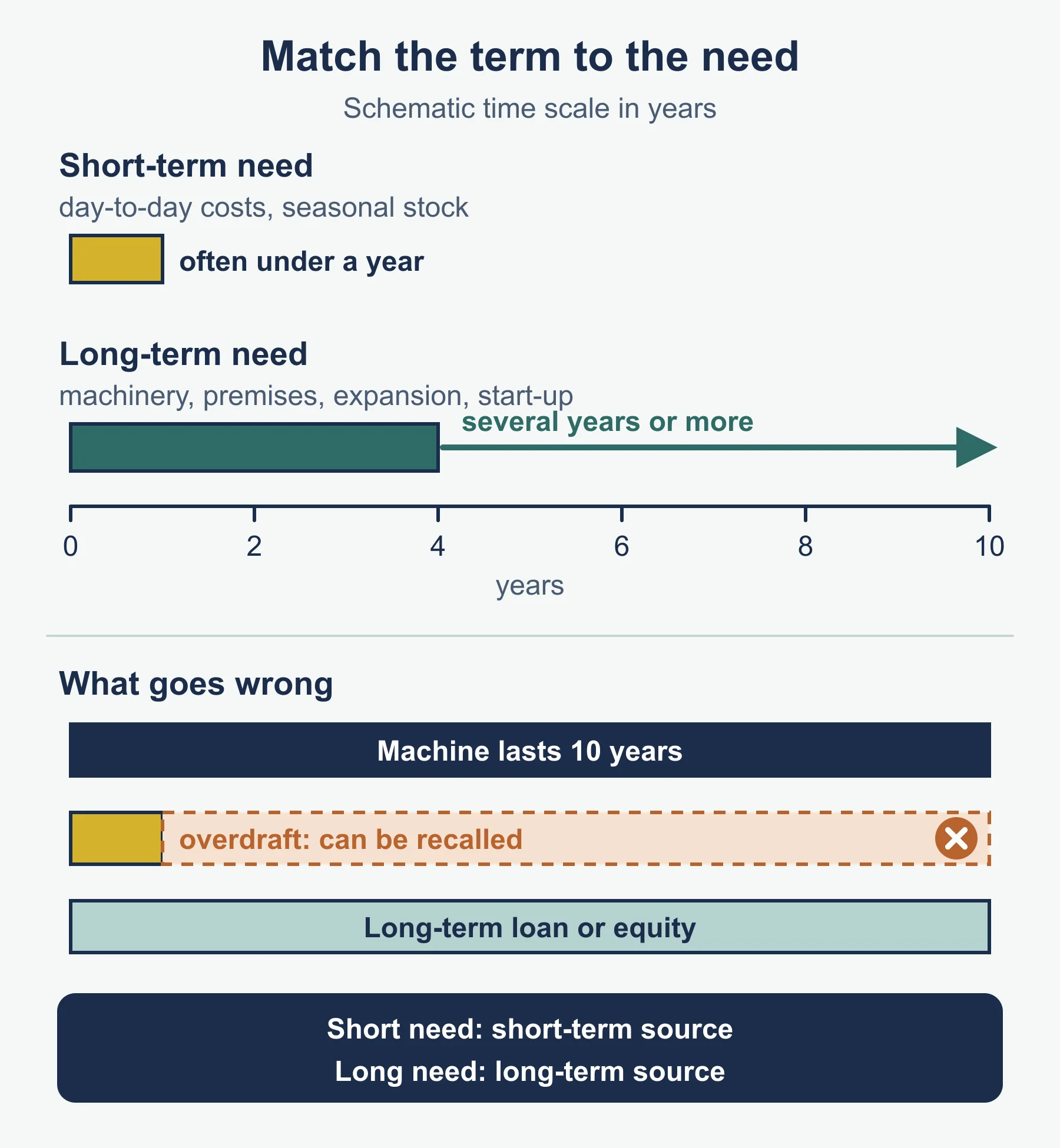
| Typical period | A short time, often under a year | Several years or more |
| Typical purpose | Day-to-day costs, a temporary cash shortage, seasonal stock, paying suppliers on time | Buying premises or machinery, expansion, start-up |
| Repaid from | Cash coming in from sales in the coming weeks or months | Profits earned over many years from the assets bought |
The rule of matching: use short-term finance for short-term needs and long-term finance for long-term needs. If a business buys a machine that will last ten years using an overdraft that the bank can ask to be repaid at short notice, it takes an unnecessary risk.
2. Internal and external sources (5.1.2)
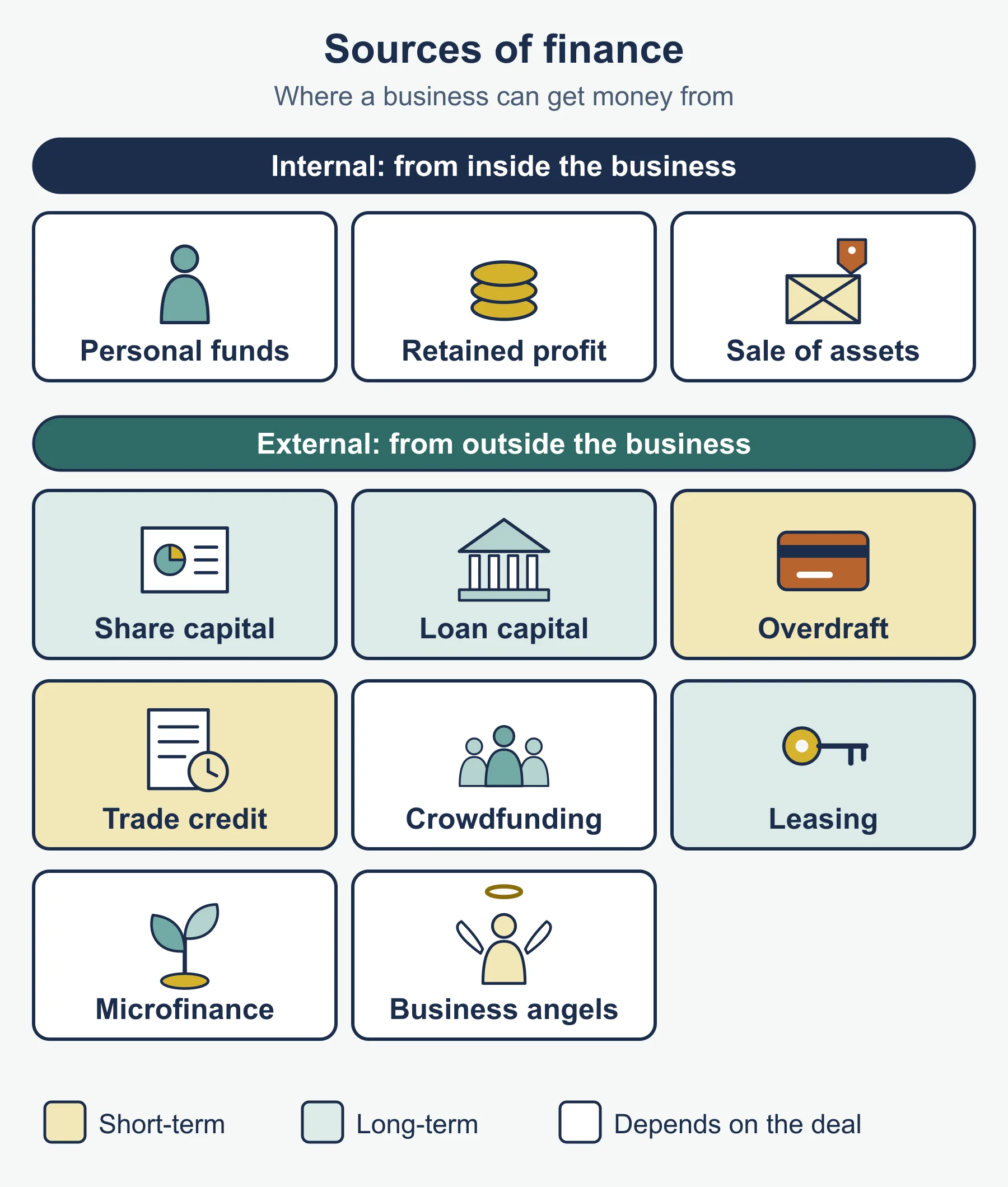
Internal sources come from inside the business or from its owners’ own resources. External sources come from outside the business, from other people or organisations.
Internal sources, with examples
- Retained profit. Profit kept in the business rather than paid out to the owners. It costs no interest and needs no one’s permission, but it only exists if the business has made profit and it may be too small for a large project.
- Owner’s savings or capital. Money the owner puts in. This is the usual first source for a sole trader. It is limited and puts personal wealth at risk.
- Sale of assets. Selling land, vehicles or machinery the business no longer needs. It brings in cash quickly without borrowing, but the business loses the asset and can only do it once.
- Reducing stock or collecting debts sooner. This turns stock and money owed by customers into cash. It helps short-term needs but may upset customers.
External sources, with examples
- Bank loan. A fixed sum, repaid with interest over an agreed period. It gives a large amount for a long time, but interest must be paid whether or not the business is profitable, and the bank may ask for security.
- Overdraft. Permission to spend more than is in the bank account, up to an agreed limit. It is flexible and interest is charged only on the amount used, but interest rates can be high and the bank can withdraw the facility.
- Trade credit. Buying goods now and paying the supplier later. It is a form of short-term finance with no interest in many cases, but delaying payment too long can harm supplier relationships.
- Share issue. A company sells shares to new investors in exchange for money. This is equity finance, covered below.
- Grants and investors who take a share in the business. These are standard examples; the syllabus does not name them.
The syllabus itself names overdraft, debt, equity, micro-finance and crowd-funding. The other items are standard examples that fit its categories.
3. Short-term and long-term sources (5.1.2)
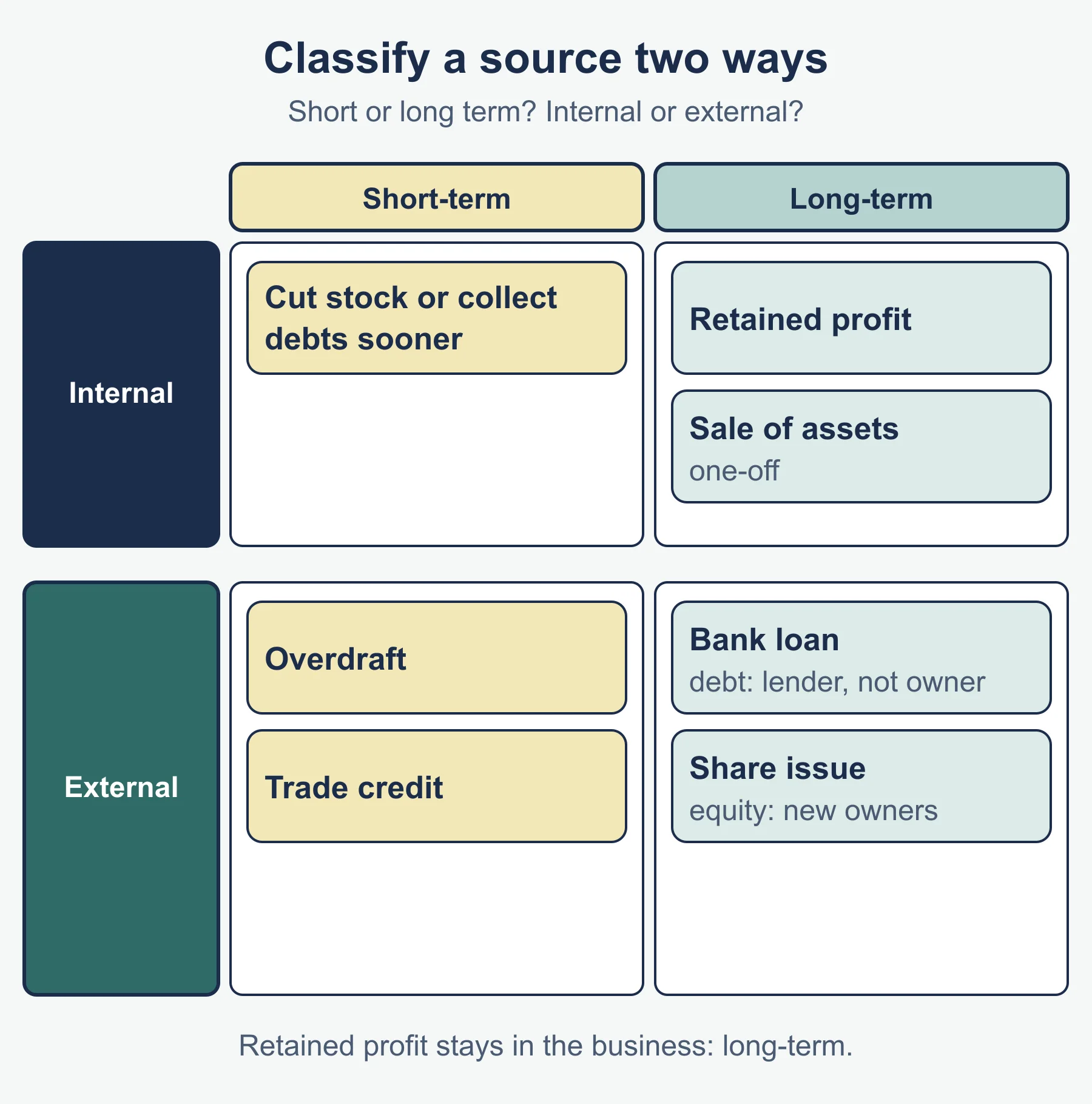
Sources are also classed by how long the business has the money.
| Source | Short-term or long-term | Internal or external |
|---|---|---|
| Overdraft | Short-term | External |
| Trade credit | Short-term | External |
| Reducing stock or collecting debts sooner | Short-term | Internal |
| Bank loan (several years) | Long-term | External |
| Share issue (equity) | Long-term | External |
| Retained profit | Long-term (stays in the business) | Internal |
| Sale of assets | One-off, usually long-term | Internal |
Be ready to classify the same source both ways.
Debt and equity
The syllabus names debt and equity as long-term sources.
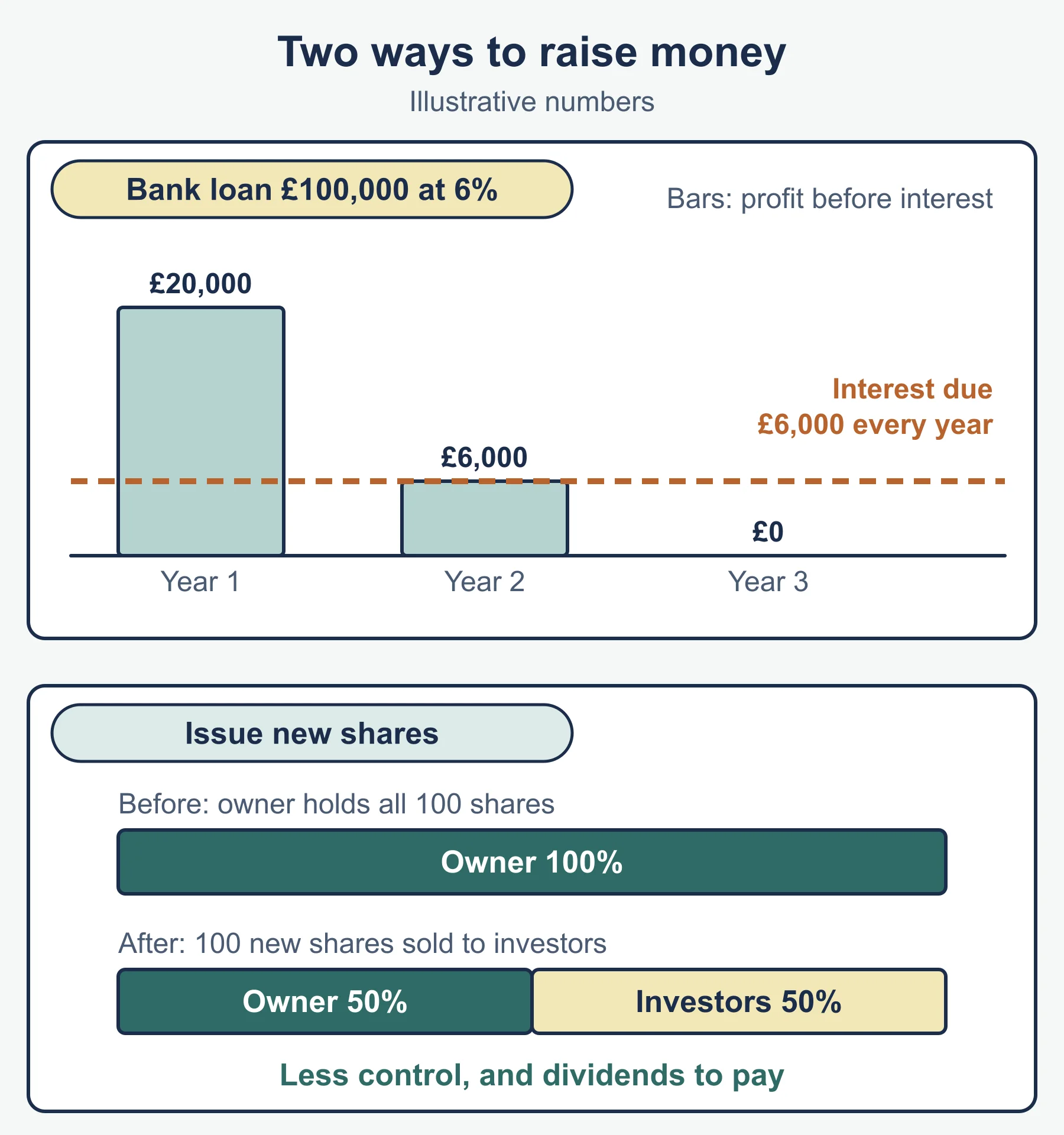
- Debt is money borrowed from a lender that has to be paid back, usually with interest added. An example is a long-term bank loan. The lender does not become an owner and does not share in the profit. The interest cost continues even in a bad year.
- Equity is money put in by owners, either as share capital from shareholders or as an owner’s own capital. Nothing has to be repaid on a set date. Shareholders expect a reward as dividends when the company makes profit, and new shareholders share ownership, which can reduce the original owners’ control.
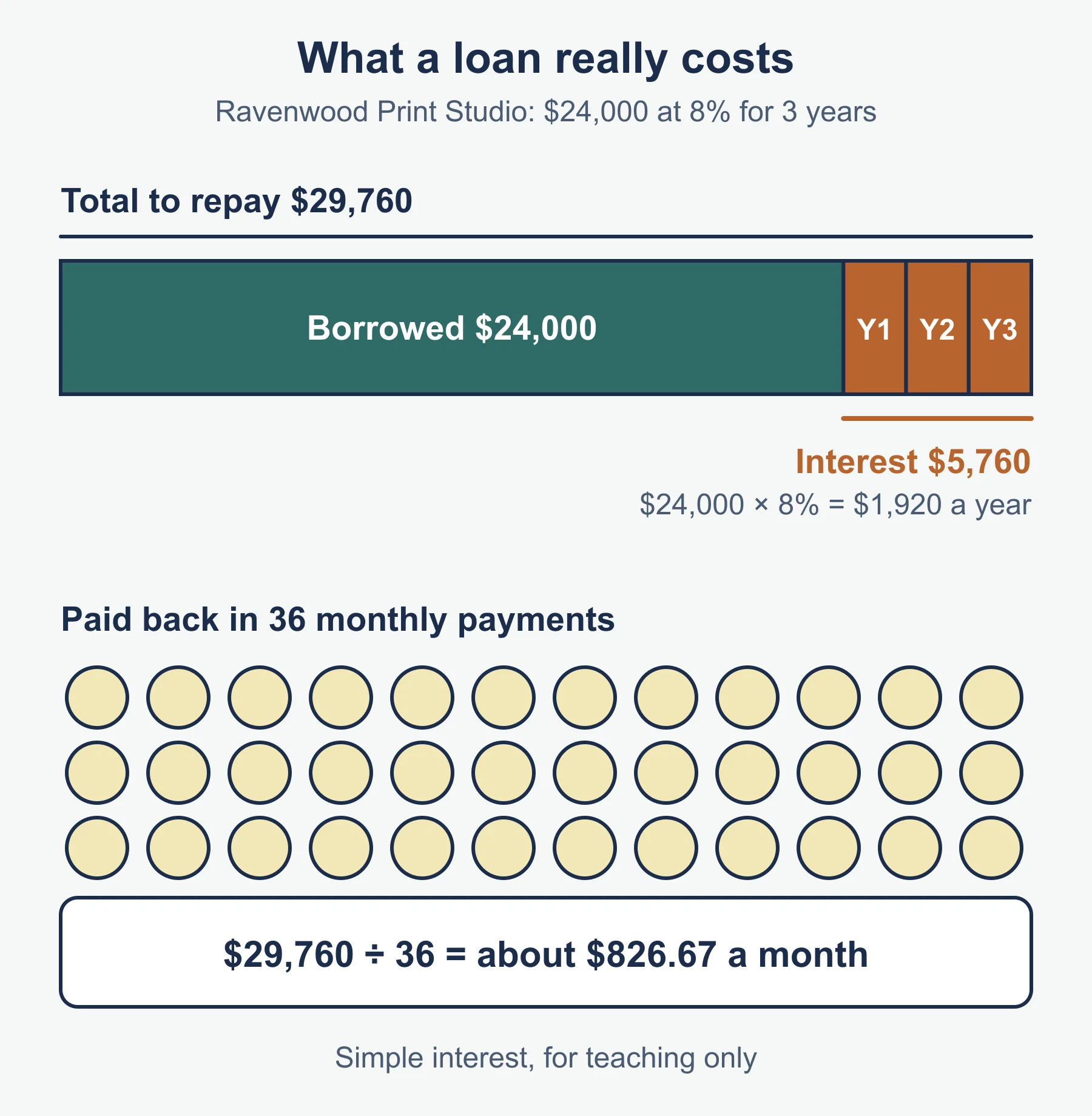
A simple loan illustration (simple interest, for teaching only; real loans may calculate interest differently). Ravenwood Print Studio borrows $24 000 at 8% a year for 3 years.
- Interest per year = 24 000 × 8% = $1 920.
- Interest over 3 years = $5 760.
- Total to repay = 24 000 + 5 760 = $29 760.
- Spread over 36 months this is about $826.67 a month.
The business must find this from its cash flow each month.
4. Alternative sources of capital (5.1.2)
Banks do not lend to every business. A small or new one may have no security or track record. The syllabus names two alternative sources.
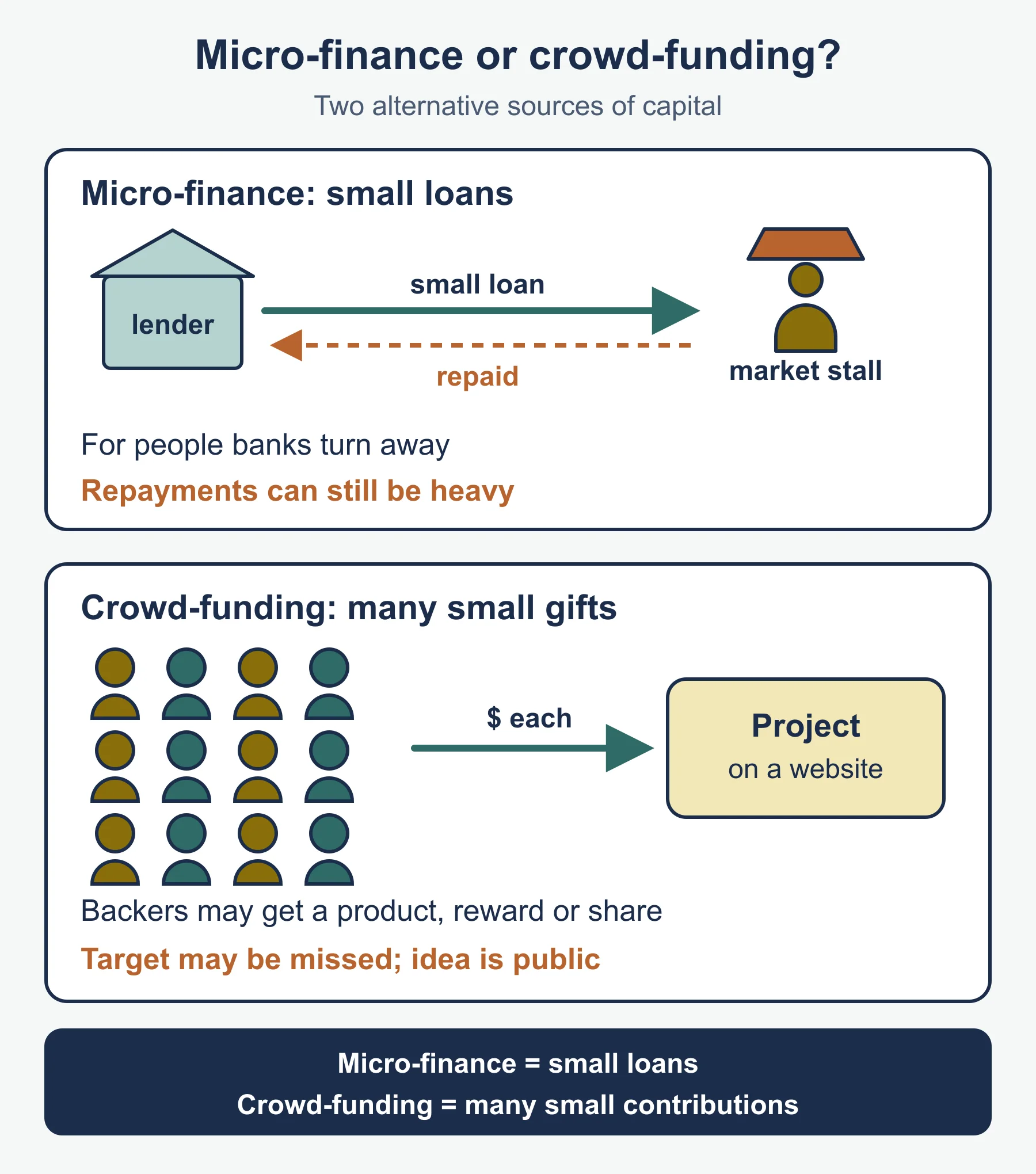
Micro-finance means very small loans, often made to people who cannot get ordinary bank loans, usually for small businesses such as a market stall, a sewing workshop or a small farm. It lets people start or expand a business who would otherwise be shut out. The amounts are small, and repayments can still be heavy for a tiny business.
Crowd-funding means raising small amounts of money from a large number of people, usually through a website. The supporters may receive a product, a reward or a share in the business in return. It matters because it needs no bank, it lets the business test demand for a product before producing it, and it spreads the risk. Drawbacks: the target may not be met, and the idea becomes public.
They matter most to small, new or risky businesses and to those that cannot meet a bank’s conditions.
5. Factors in choosing a source (5.1.2)
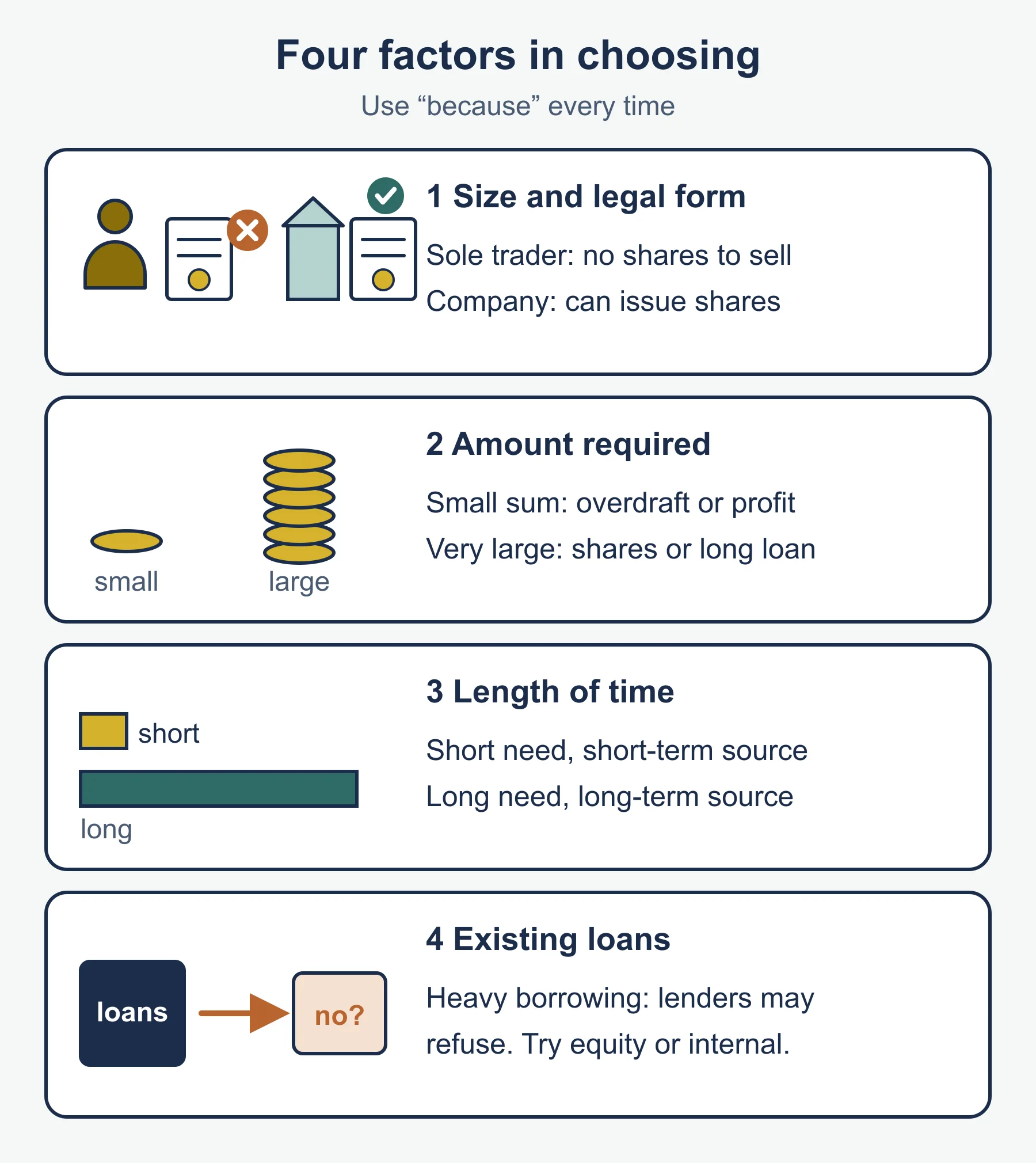
The syllabus lists four main factors. Use the word “because” every time you apply one.
- Size and legal form of business. A sole trader cannot issue shares, so relies on savings, loans and retained profit. A company can raise equity by selling shares; a public company can offer them to the general public, whereas a private company’s shares cannot be sold to the public in the same way. Small businesses often have fewer choices.
- Amount required. A small sum may be met by an overdraft or retained profit. A very large sum for expansion may need a share issue or a large long-term loan.
- Length of time. Match the period of the source to the period of the need. Short need, short-term source; long need, long-term source.
- Existing loans. If a business already has large borrowings, lenders may refuse more or charge more, and repayments may already strain cash flow. In that case, equity or internal sources may be better.
Cost, speed and loss of control can add support, but do not replace these four.
6. Recommend and justify (5.1.2)
Commands such as “recommend” and “justify” test AO4 evaluation. A strong answer has four parts.
- State the amount, purpose and period from the case.
- Name the source and say whether it is internal or external, short-term or long-term.
- Link it to at least one factor from section 5, using the case facts.
- Show you have weighed it: give a drawback or an alternative you rejected, and say why yours is better here.
Worked example
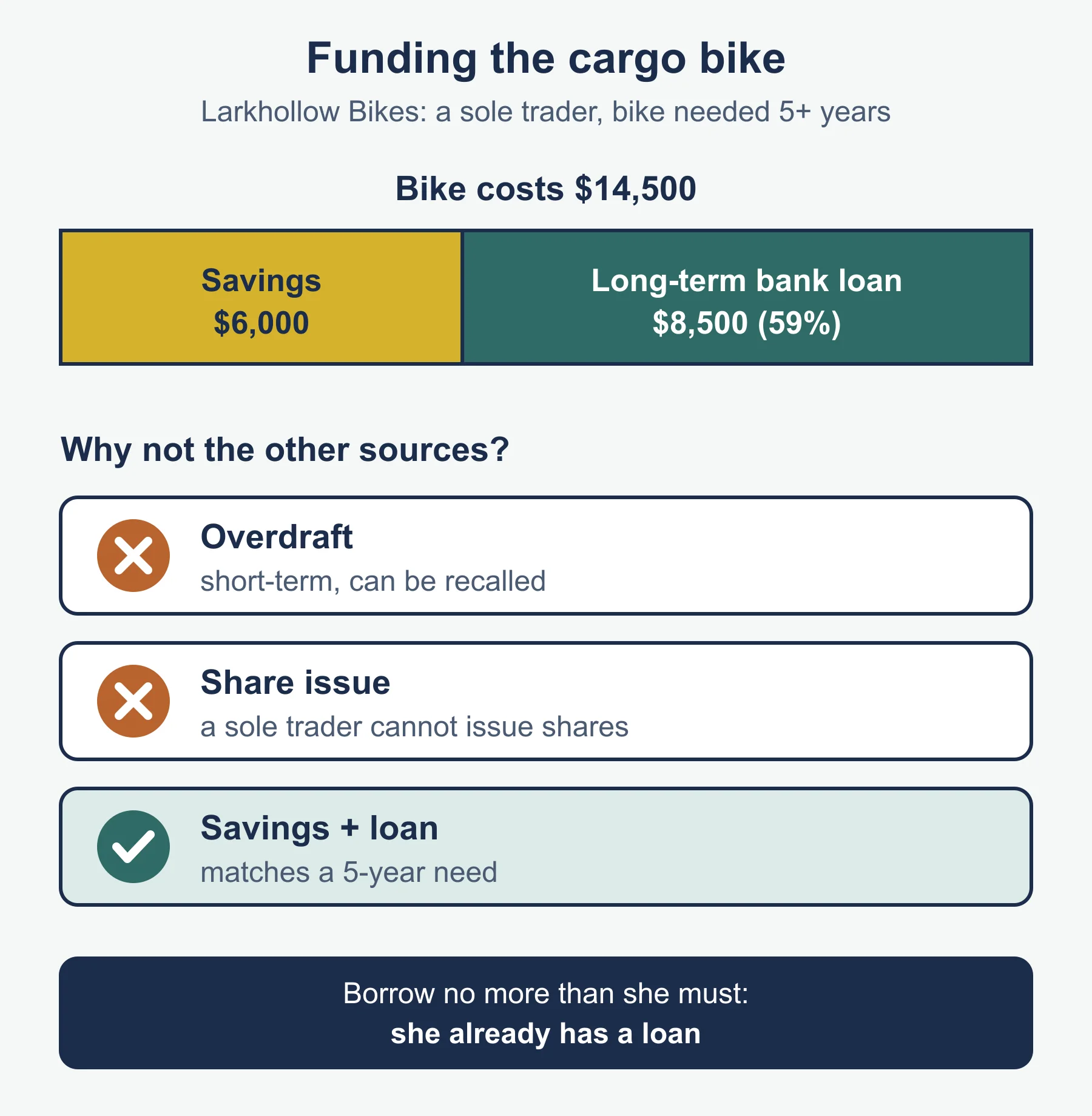
Larkhollow Bikes is a sole trader’s workshop. The owner, Mirela, wants a cargo bike for deliveries costing 14 500 dollars. She can spare 6 000 dollars of savings and already has a loan whose repayments take most of her profit. The bike will be used for at least five years.
Recommendation: use her own savings plus a bank loan repaid over several years.
- The amount needed from outside is 14 500 − 6 000 = 8 500 dollars, about 59% of the total.
- The need is long-term (five years or more), so a long-term source fits. An overdraft would be wrong because it is short-term and can be recalled.
- As a sole trader she cannot issue shares, so equity from new shareholders is not available.
- Her existing loan is a risk: more debt would raise her repayments. This is why she should put in her own savings first and borrow no more than she must. If the bank refuses, crowd-funding could be an alternative, because the delivery service is popular locally, but it is uncertain.
Judgement: a smaller long-term loan plus her own money is best, because it matches the length of the need, keeps borrowing as low as possible given the existing loan, and is available to a sole trader.
Common errors
- Calling an overdraft long-term finance, or a bank loan always short-term. Match each to its usual use.
- Saying internal sources are free. Retained profit could have been paid to the owners.
- Listing sources without linking them to the case facts.
- Mixing up debt and equity: shareholders are owners; lenders are not.
- Saying crowd-funding and micro-finance are the same. Micro-finance is small loans; crowd-funding is many small contributions.
- Recommending a source that the legal form rules out, such as a share issue for a sole trader.
Frequently asked questions
Can a sole trader raise finance by issuing shares? No. A sole trader cannot issue shares, so relies on savings, loans and retained profit. Recommending a share issue for a sole trader is a common error.
Is an overdraft short-term or long-term finance? An overdraft is short-term external finance. It is flexible and interest is charged only on the amount used, but rates can be high and the bank can withdraw it.
What is trade credit? Trade credit means buying goods now and paying the supplier later. It is short-term finance, often with no interest, but delaying payment too long can harm the relationship with the supplier.
Which sources of finance does the Cambridge O Level Business 7115 syllabus name? The syllabus itself names overdraft, debt, equity, micro-finance and crowd-funding. Other sources, such as retained profit, bank loans and trade credit, are standard examples that fit its categories.
Official syllabus
Cambridge O Level Business Studies 7115 syllabus for examination in 2026, published by Cambridge University Press & Assessment (Cambridge International Education), section 5.1 Business finance: needs and sources.
Get free revision emails (optional)
Occasional emails with practice questions, worked explanations and links to free resources for the qualification and subjects you choose. No spam, and you can unsubscribe from any email. The free tools on this site never need an email.
Related resources
-
Practice questions
O Level Business: Business finance: needs and sources (Cambridge 7115) – Practice Questions
Original questions with worked answers on why businesses need finance and how to choose between sources of finance, for Cambridge O Level Business.
Business · Cambridge · O Level
Try questions -
Revision notes
O Level Business: Business finance: needs and sources (Cambridge 7115) – Revision Notes
Condensed revision notes on why businesses need finance and the main sources of finance, with a self-test, for Cambridge O Level Business.
Business · Cambridge · O Level
Revise topic -
Study guides
O Level Business: Cash-flow forecasting and working capital (Cambridge 7115)
Why cash matters, how to build, complete and interpret a simple cash-flow forecast, fixes for short-term shortfalls, and working capital.
Business · Cambridge · O Level
Read guide
Related articles
-
teaching
A Level tuition in Dubai: Cambridge or Pearson Edexcel International A Level?
Schools in Dubai and Abu Dhabi teach either Cambridge International AS & A Level or Pearson Edexcel International A Level. How the two are structured, why it matters for tuition, and how online classes from Lahore work.
9 October 2026
-
curriculum guides
Choosing subjects at IGCSE and A Level
How subject choices at 14 and 16 affect university options later, and how to keep pathways open without overloading a timetable.
28 July 2026
Studying this with a teacher
Working through Business O LEVELS?
This page is free and stays free. If you would rather be taught it, Marlbridge runs Business classes one-to-one and in small groups of up to 15, online in your own time zone. The first trial class is free. WhatsApp replies within an hour (8am–11pm Pakistan time, every day); email the same day.
Cambridge Business teachers at Marlbridge

