
Study Guides
O Level Business: Cash-flow forecasting and working capital (Cambridge 7115)
Why cash matters, how to build, complete and interpret a simple cash-flow forecast, fixes for short-term shortfalls, and working capital.
- Subject
- Business
- Level
- O LEVELS
- Topic
- Financial information and decisions
- Author
- Marlbridge Academic Team
- Updated
- Reviewed by
- Salman Ahmad (what this means)
Aligned to Cambridge O Level Business (7115), For examination in 2026. Official specification .
Syllabus page (what it covers and how it is assessed): Cambridge O Level Business.
Syllabus points this page covers
7115
- 5.2 Cash-flow forecasting and working capital
Found an error? Report a correction.
Need help with this topic? Request a free trial class for O Level Business (7115).
This guide teaches section 5.2 (Cash-flow forecasting and working capital) of the Cambridge O Level Business Studies 7115 syllabus for examination in 2026. It covers 5.2.1 (the importance of cash and of cash-flow forecasting) and 5.2.2 (working capital). Everything is explained from scratch, with worked examples built on invented businesses. All amounts are in dollars, and tables show plain numbers.
Use it with the revision notes and the practice questions. The wider topic has a mixed practice set, and the Cambridge O Level Business hub and checklist show where this section fits. To find your weak spots first, try the free diagnostics.
What the syllabus asks you to do
| Ref | Content point | Where it is covered |
|---|---|---|
| 5.2.1 | Why cash is important to a business | Section 1 |
| 5.2.1 | What a cash-flow forecast is, how a simple one is constructed, and its importance | Sections 2 and 5 |
| 5.2.1 | Amend or complete a simple cash-flow forecast | Sections 3 and 4 |
| 5.2.1 | Interpret a simple cash-flow forecast | Section 4 |
| 5.2.1 | How a short-term cash-flow problem might be overcome (overdraft, delaying supplier payments, asking debtors to pay more quickly) | Section 6 |
| 5.2.2 | The concept and importance of working capital | Section 7 |
1. Why cash is important
Cash means money the business can spend now: notes and coins in the till plus money in the bank account that can be used straight away. A business needs cash to:
- pay wages and salaries on the due date
- pay suppliers for materials, stock and services
- pay regular bills such as rent, electricity and insurance
- pay loan repayments and interest
- buy equipment when needed, or take up a chance such as a bulk discount
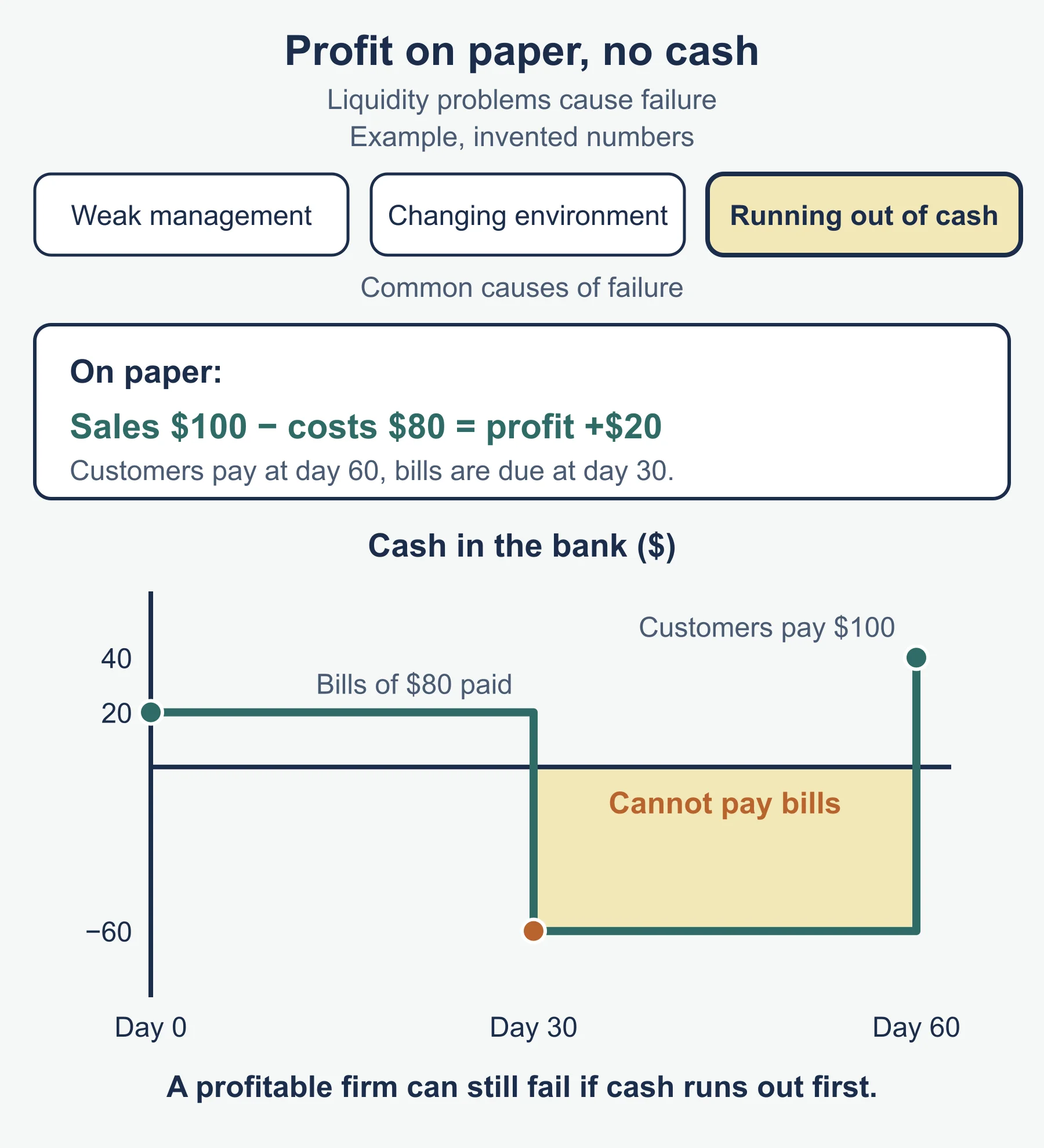
A business that cannot pay these on time may lose staff, lose its supplier’s goodwill or be forced to stop trading. Syllabus section 1.3.4 lists liquidity problems as a cause of business failure, and cash shortage is the everyday form that problem takes.
Cash is not the same as profit. Profit is revenue minus costs over a period. A business can make a profit on paper while customers have not yet paid, so there is no cash to pay the bills. Section 5.3.1 treats this difference in full. For this section, remember one idea: profit does not pay the wages, cash does.
2. What a cash-flow forecast is
A cash-flow forecast is a prediction of the money expected to come into and go out of a business over a future period, usually month by month, showing the expected cash balance at the end of each month.
The headings vary between textbooks, so here are the names used on this page.
| Term | Meaning |
|---|---|
| Cash inflows (receipts) | Money coming in, for example cash sales and payments from customers who bought on credit |
| Cash outflows (payments) | Money going out, for example materials, wages, rent, equipment |
| Net cash flow | Total inflows minus total outflows for the month |
| Opening balance | Cash at the start of the month |
| Closing balance | Cash at the end of the month: opening balance plus net cash flow |
The closing balance of one month is the opening balance of the next. That link is the single most-tested idea in these tables.
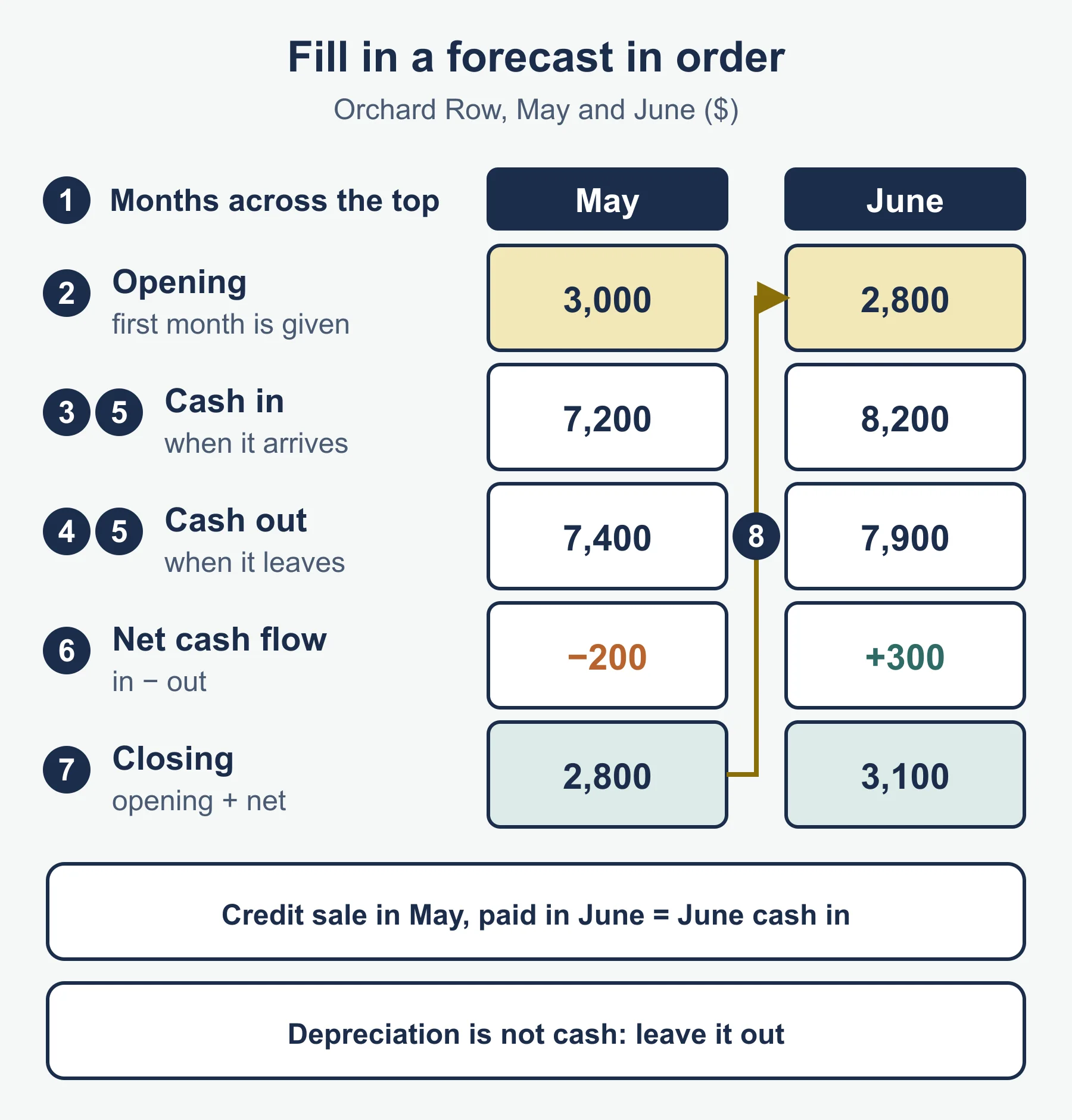
Method for building a simple forecast
- List the months across the top.
- Enter the opening balance for the first month.
- Enter each inflow in the month the cash actually arrives, not the month of the sale. A credit sale in May paid in June is a June inflow.
- Enter each outflow in the month the cash leaves.
- Add up total inflows and total outflows.
- Net cash flow = total inflows minus total outflows.
- Closing balance = opening balance + net cash flow.
- Copy the closing balance into the next month’s opening balance and repeat.
Only cash movements belong in the forecast. Depreciation of equipment, for example, is not a cash payment, so it would not appear.
3. Worked example: completing a forecast
Orchard Row Preserves makes jam and chutney and sells to shops and at markets. Its owner has drawn up a forecast for May to July. The July payments include 4,000 for a new jar-filling machine.
| May | June | July | |
|---|---|---|---|
| Opening balance | 3,000 | ? | ? |
| Cash sales | 5,200 | 5,800 | 6,400 |
| Payments from credit customers | 2,000 | 2,400 | 2,600 |
| Total inflows | ? | ? | ? |
| Materials | 3,100 | 3,500 | 3,900 |
| Wages | 2,800 | 2,800 | 2,800 |
| Rent | 900 | 900 | 900 |
| Other costs | 600 | 700 | 800 |
| Machine | 0 | 0 | 4,000 |
| Total outflows | ? | ? | ? |
| Net cash flow | ? | ? | ? |
| Closing balance | ? | ? | ? |
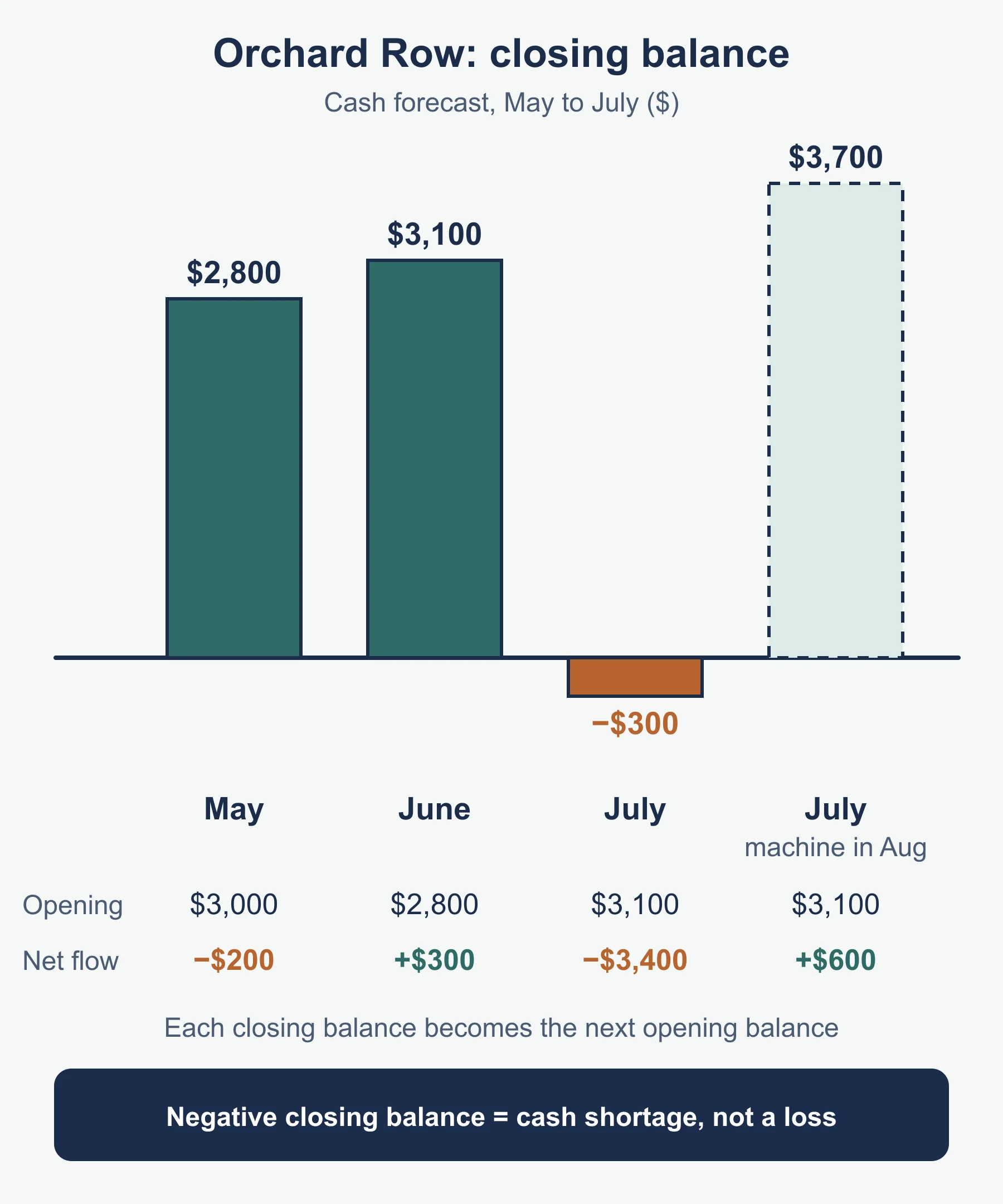
May: inflows 5,200 + 2,000 = 7,200. Outflows 3,100 + 2,800 + 900 + 600 = 7,400. Net cash flow = 7,200 - 7,400 = -200. Closing balance = 3,000 + (-200) = 2,800.
June: opening balance 2,800. Inflows 5,800 + 2,400 = 8,200. Outflows 3,500 + 2,800 + 900 + 700 = 7,900. Net cash flow = +300. Closing balance = 2,800 + 300 = 3,100.
July: opening balance 3,100. Inflows 6,400 + 2,600 = 9,000. Outflows 3,900 + 2,800 + 900 + 800 + 4,000 = 12,400. Net cash flow = -3,400. Closing balance = 3,100 - 3,400 = -300.
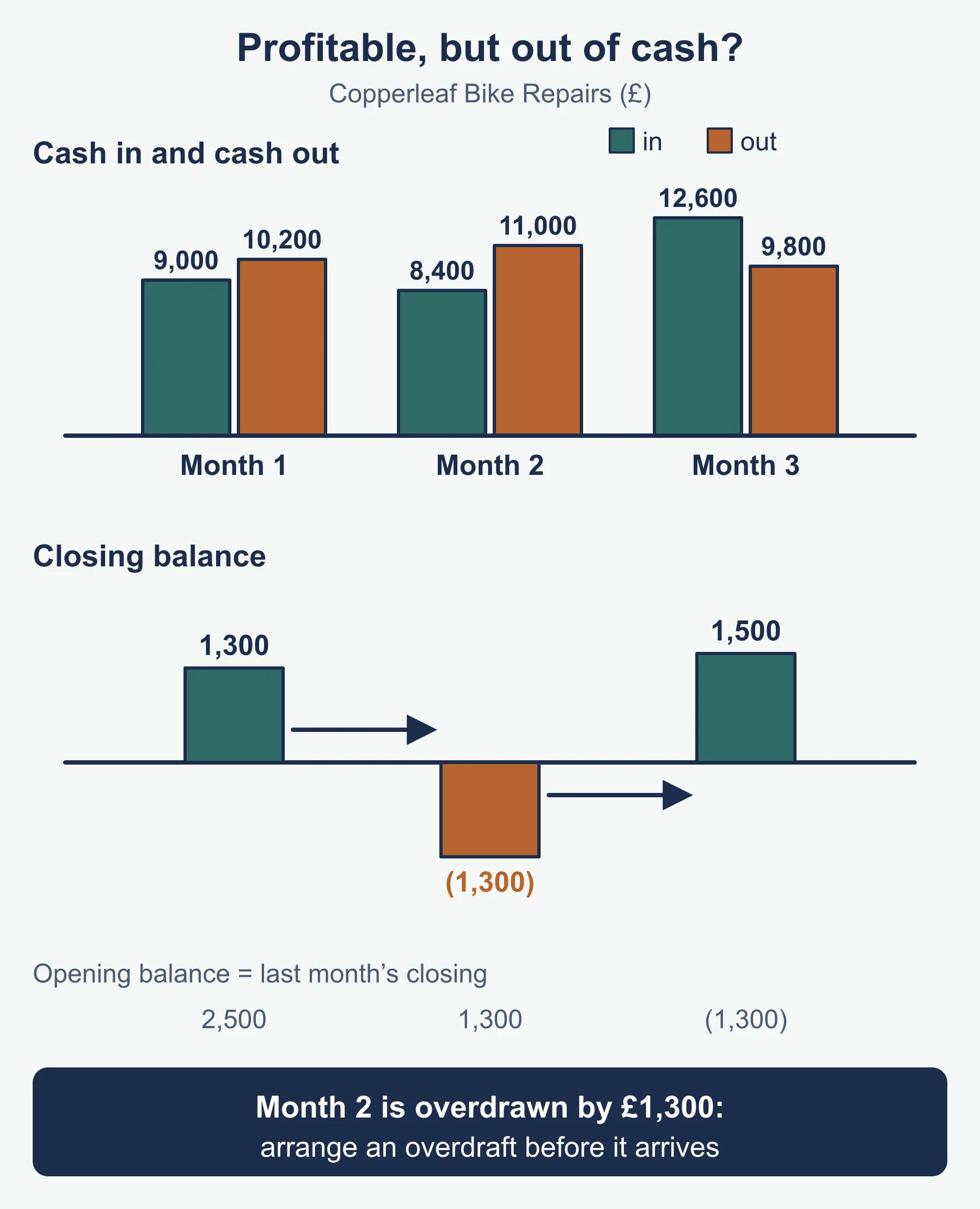
A negative closing balance means the business would be short of cash by that amount.
4. Interpreting and amending a forecast
Interpreting means reading the numbers and saying what they mean for the business. Ask these questions:
- Is the closing balance positive or negative in each month?
- Which month is the lowest, and what causes it? Here July falls because of the machine, a one-off payment.
- Is the balance trending up or down over the period?
- Are inflows large enough to cover outflows in a normal month?
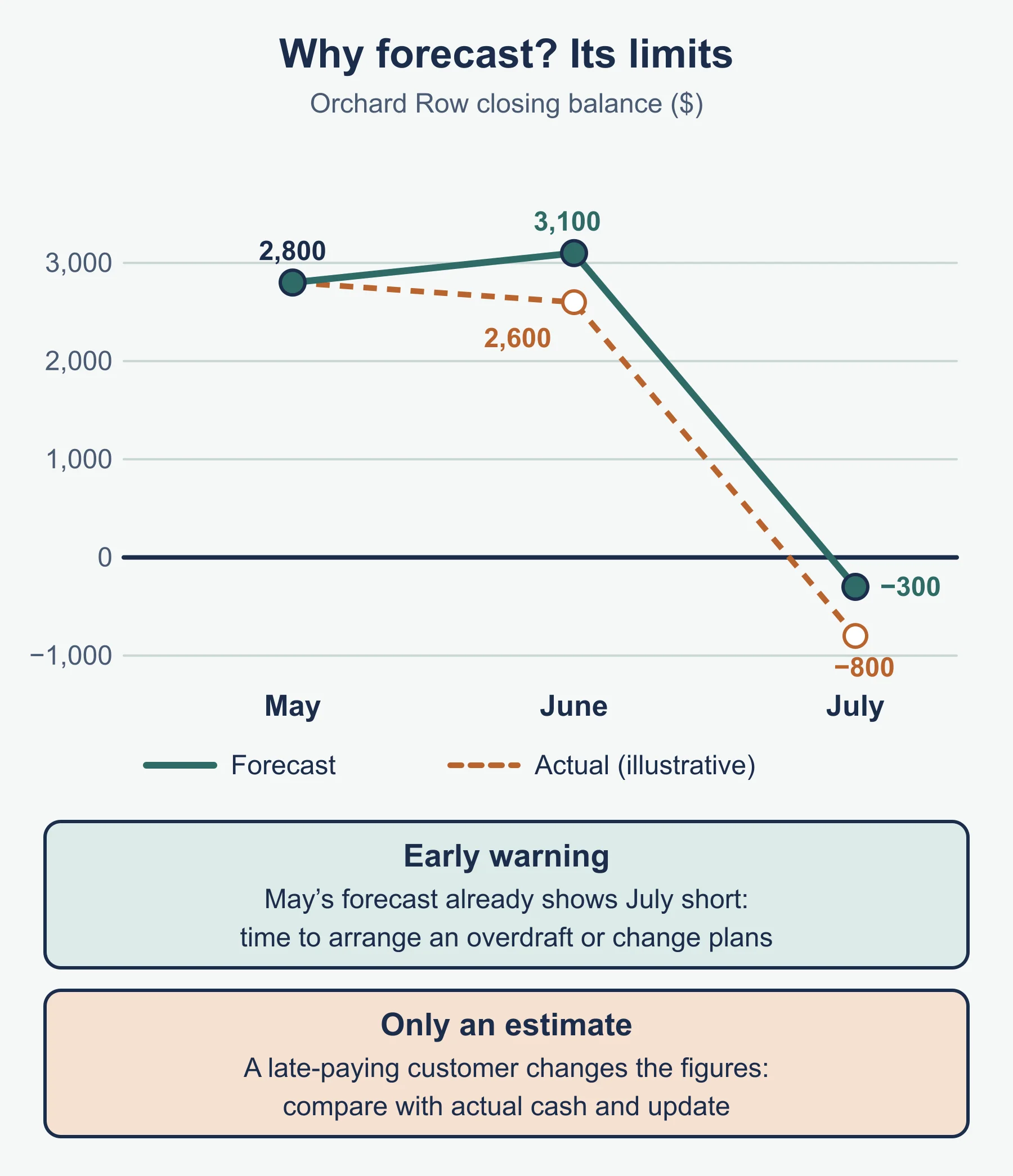
For Orchard Row: May and June are fine, but July ends 300 short. The business is not failing, since normal months are close to break-even on cash, but it needs a plan for July.
Amending means changing figures when plans or conditions change, then recalculating every month after the change, because each closing balance feeds the next opening balance.
Suppose Orchard Row moves the machine purchase to August, outside the forecast. July outflows fall to 3,900 + 2,800 + 900 + 800 = 8,400. Net cash flow = 9,000 - 8,400 = +600, so the July closing balance becomes 3,100 + 600 = 3,700. Delaying the purchase solves the forecast shortfall, at the cost of delaying the faster production the machine would bring.
In an exam, a changed figure in an early month changes all later closing balances. Re-work them; do not just alter one cell.
5. Why forecasting is important
A forecast helps a business to:
- spot a shortage months ahead, so it can arrange an overdraft or change plans in time
- decide when it can afford large payments, such as equipment
- support a request for a loan, since lenders want evidence the business can repay
- set a standard to check against later, by comparing actual cash with the forecast
- plan the timing of purchases and credit offered to customers
It also has limits. Forecasts rest on estimates, such as expected sales. A new competitor, bad weather or a late-paying customer can make the real figures differ. A forecast is a planning guide, not a promise, and it must be updated.
6. Overcoming a short-term cash-flow problem
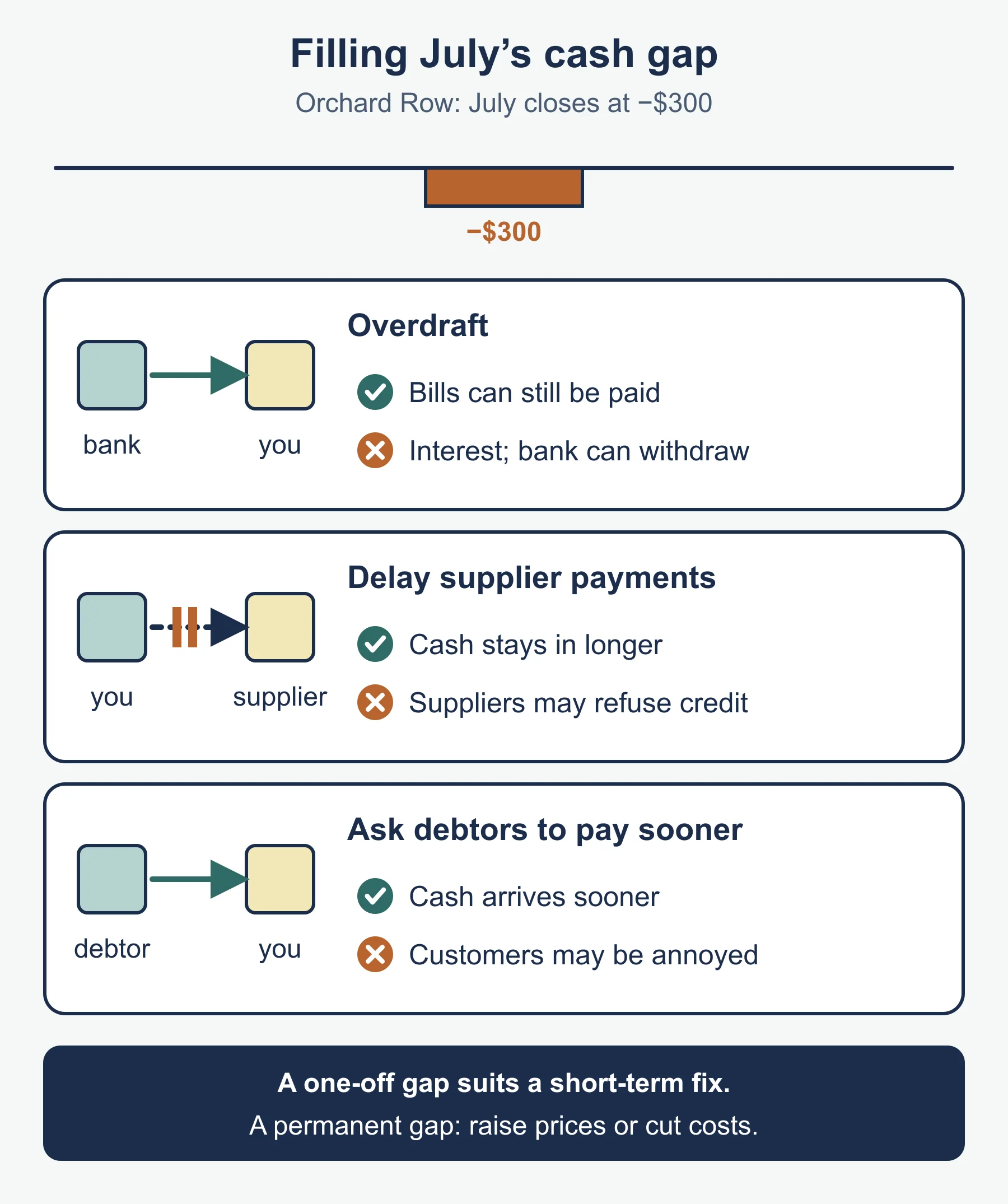
A short-term cash-flow problem is a temporary shortage, such as Orchard Row’s July gap. The syllabus names three methods as examples.
| Method | How it helps | Possible drawback |
|---|---|---|
| Overdraft | The bank lets the account go below zero up to an agreed limit, so bills can still be paid | Interest is charged, the bank can reduce or withdraw it, and it suits short periods only |
| Delaying payments to suppliers | Cash stays in the business longer | Suppliers may refuse future credit, charge more or stop supplying; prompt-payment discounts may be lost |
| Asking debtors (customers who owe money) to pay more quickly | Cash arrives sooner from sales already made | Customers may be annoyed or buy elsewhere; offering a discount for quick payment reduces revenue |
Other ways exist, such as delaying a planned purchase (as in section 4), selling an unused asset, or the owner putting in more money. Whatever you choose, link it to the business in the question and consider how long the problem lasts. A one-off gap suits an overdraft. A permanent gap between inflows and outflows needs a deeper fix, such as higher prices or lower costs, because borrowing only postpones the problem.
For the full range of finance options see section 5.1; this guide stays with short-term fixes.
7. Working capital
Working capital is the money a business has available to fund its day-to-day operations. The syllabus lists the concept and its importance. The standard form of the calculation is:
Working capital = current assets - current liabilities
Current assets are things the business expects to turn into cash within a year, such as inventories (stock), money owed by customers (trade receivables) and cash. Current liabilities are debts due within a year, such as money owed to suppliers (trade payables) and a bank overdraft. Section 5.4 covers these classifications.
Worked example
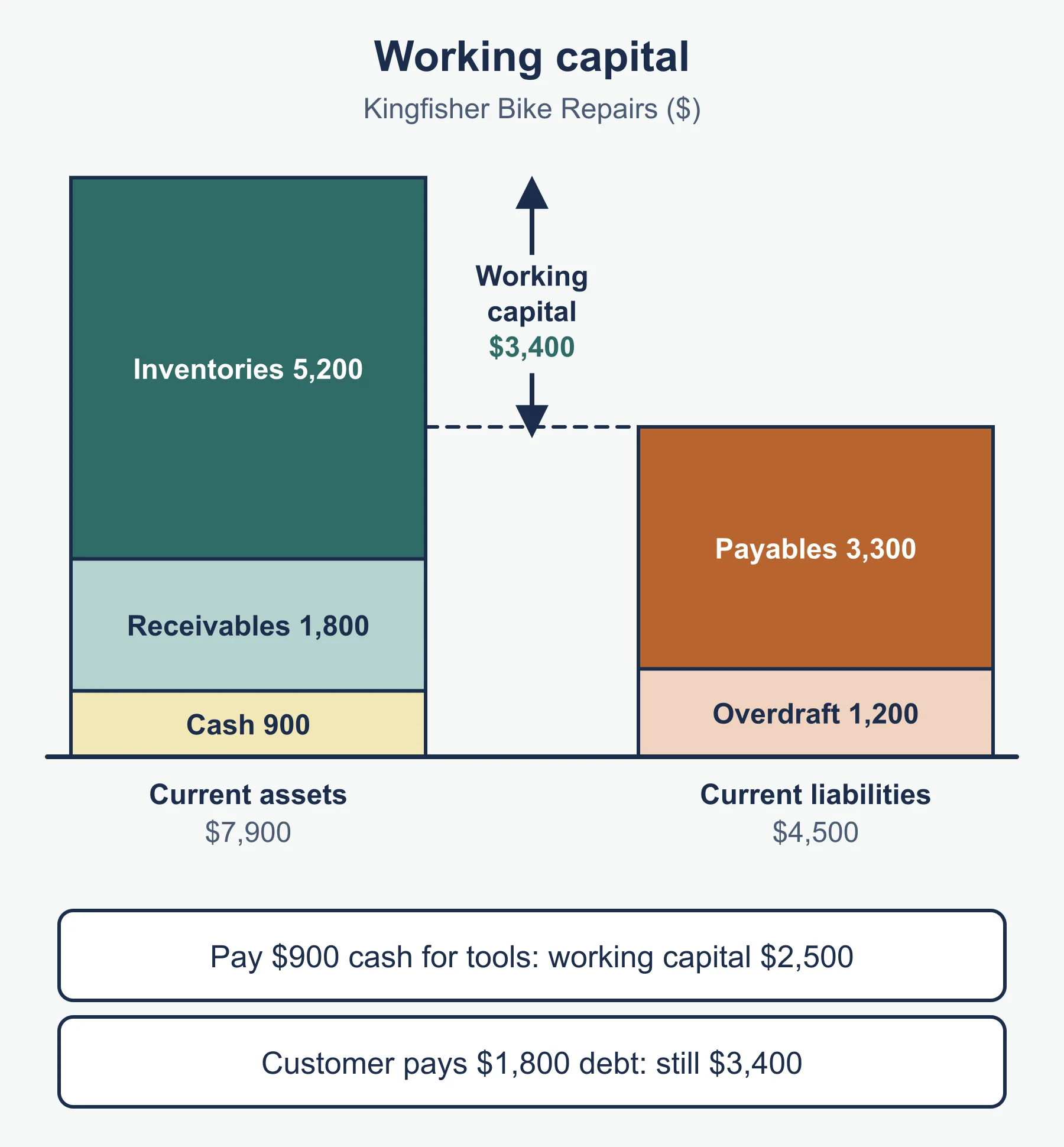
Kingfisher Bike Repairs has inventories of spare parts 5,200, trade receivables 1,800 and cash 900. It owes suppliers 3,300 and has an overdraft of 1,200.
- Current assets = 5,200 + 1,800 + 900 = 7,900
- Current liabilities = 3,300 + 1,200 = 4,500
- Working capital = 7,900 - 4,500 = 3,400
Now see how events change it. If Kingfisher pays 900 cash for new tools (a non-current asset), current assets fall to 7,000 and working capital falls to 2,500. If a customer pays a 1,800 debt, receivables fall by 1,800 and cash rises by 1,800, so working capital is unchanged: one current asset has simply turned into another.
Why working capital is important
- It pays the day-to-day costs: wages, suppliers and bills.
- Enough working capital means the business can buy stock and fill orders without borrowing at short notice.
- It lets the business handle a slow month or a late-paying customer.
- Too little can force a business to stop trading even though it has orders, which is a liquidity problem (see section 5.5).
- Too much is also a concern: money tied up in unsold stock or idle cash earns nothing, and could have been used to grow the business.
The current ratio, which compares current assets with current liabilities, is covered under section 5.5, and the topic practice set includes it.
Common errors
- Putting a credit sale in the month of the sale instead of the month the customer pays.
- Forgetting to carry the closing balance forward as the next opening balance.
- Adding a closing balance into the outflows, or counting non-cash items such as depreciation.
- Calling a negative closing balance a loss. It is a cash shortage, not a loss.
- Writing “get a loan” with no link to the business, its size or how long the shortage lasts.
- Treating working capital as a profit figure or as only cash in the bank.
- Saying an overdraft or faster debt collection has no drawback.
Finish with the practice questions.
Frequently asked questions
How do you calculate the closing balance in a cash-flow forecast? Closing balance = opening balance + net cash flow, where net cash flow is total inflows minus total outflows. The closing balance of one month is then carried forward as the next month’s opening balance.
How do you calculate working capital in O Level Business 7115? Working capital = current assets − current liabilities. Current assets include inventories, trade receivables and cash; current liabilities include money owed to suppliers and an overdraft.
What are the limits of a cash-flow forecast? A forecast rests on estimates, such as expected sales, so a new competitor, bad weather or a late-paying customer can make the real figures differ. It is a planning guide that must be updated, not a promise.
What is the difference between cash and profit? Profit is revenue minus costs over a period, while cash is money the business can spend now. A business can make a profit on paper while customers have not yet paid, leaving no cash to pay the bills.
Official syllabus
Cambridge O Level Business Studies 7115, syllabus for examination in 2026, from Cambridge International, section 5.2.
Get free revision emails (optional)
Occasional emails with practice questions, worked explanations and links to free resources for the qualification and subjects you choose. No spam, and you can unsubscribe from any email. The free tools on this site never need an email.
Related resources
-
Practice questions
O Level Business: Cash-flow forecasting and working capital (Cambridge 7115) – Practice Questions
Eleven original questions with worked answers on completing and interpreting cash-flow forecasts, fixing cash shortages and working capital.
Business · Cambridge · O Level
Try questions -
Revision notes
O Level Business: Cash-flow forecasting and working capital (Cambridge 7115) – Revision Notes
Condensed revision notes on cash-flow forecasts, fixing short-term cash problems and working capital, with a self-test and common mistakes.
Business · Cambridge · O Level
Revise topic -
Practice questions
O Level Business: Financial information and decisions — Practice Questions (Cambridge 7115)
Original practice questions with worked answers on ROCE, profit margins, the current ratio, cash-flow forecasts and users of accounts for O Level Business 7115.
Business · Cambridge · O Level
Try questions
Related articles
-
teaching
A Level tuition in Dubai: Cambridge or Pearson Edexcel International A Level?
Schools in Dubai and Abu Dhabi teach either Cambridge International AS & A Level or Pearson Edexcel International A Level. How the two are structured, why it matters for tuition, and how online classes from Lahore work.
9 October 2026
-
curriculum guides
Choosing subjects at IGCSE and A Level
How subject choices at 14 and 16 affect university options later, and how to keep pathways open without overloading a timetable.
28 July 2026
Studying this with a teacher
Working through Business O LEVELS?
This page is free and stays free. If you would rather be taught it, Marlbridge runs Business classes one-to-one and in small groups of up to 15, online in your own time zone. The first trial class is free. WhatsApp replies within an hour (8am–11pm Pakistan time, every day); email the same day.
Cambridge Business teachers at Marlbridge

