
Revision Notes
O Level Business: Business finance: needs and sources (Cambridge 7115) – Revision Notes
Condensed revision notes on why businesses need finance and the main sources of finance, with a self-test, for Cambridge O Level Business.
- Subject
- Business
- Level
- O LEVELS
- Topic
- Financial information and decisions
- Author
- Marlbridge Academic Team
- Updated
- Reviewed by
- Salman Ahmad (what this means)
Aligned to Cambridge O Level Business (7115), For examination in 2026. Official specification .
Syllabus page (what it covers and how it is assessed): Cambridge O Level Business.
Syllabus points this page covers
7115
- 5.1 Business finance: needs and sources
Found an error? Report a correction.
Need help with this topic? Request a free trial class for O Level Business (7115).
These notes condense section 5.1, Business finance: needs and sources, of the Cambridge O Level Business Studies 7115 syllabus for examination in 2026. For full explanations and a worked recommendation, read the study guide. Then practise with the practice questions. Related pages: the Financial information and decisions practice set, the Cambridge O Level Business hub and the printable checklist. To find weak spots first, use the free diagnostics.
Key definitions
| Term | Meaning |
|---|---|
| Business finance (capital) | Money a business uses to start, run and grow |
| Start-up capital | Money needed to set a business up before it earns revenue |
| Capital for expansion | Money to grow an existing business |
| Working capital | Money for day-to-day running costs |
| Internal source | Finance from inside the business or its owners |
| External source | Finance from outside the business |
| Short-term finance | Money needed or borrowed for a short period |
| Long-term finance | Money needed or borrowed for several years or more |
| Overdraft | Spending beyond the bank balance, up to an agreed limit |
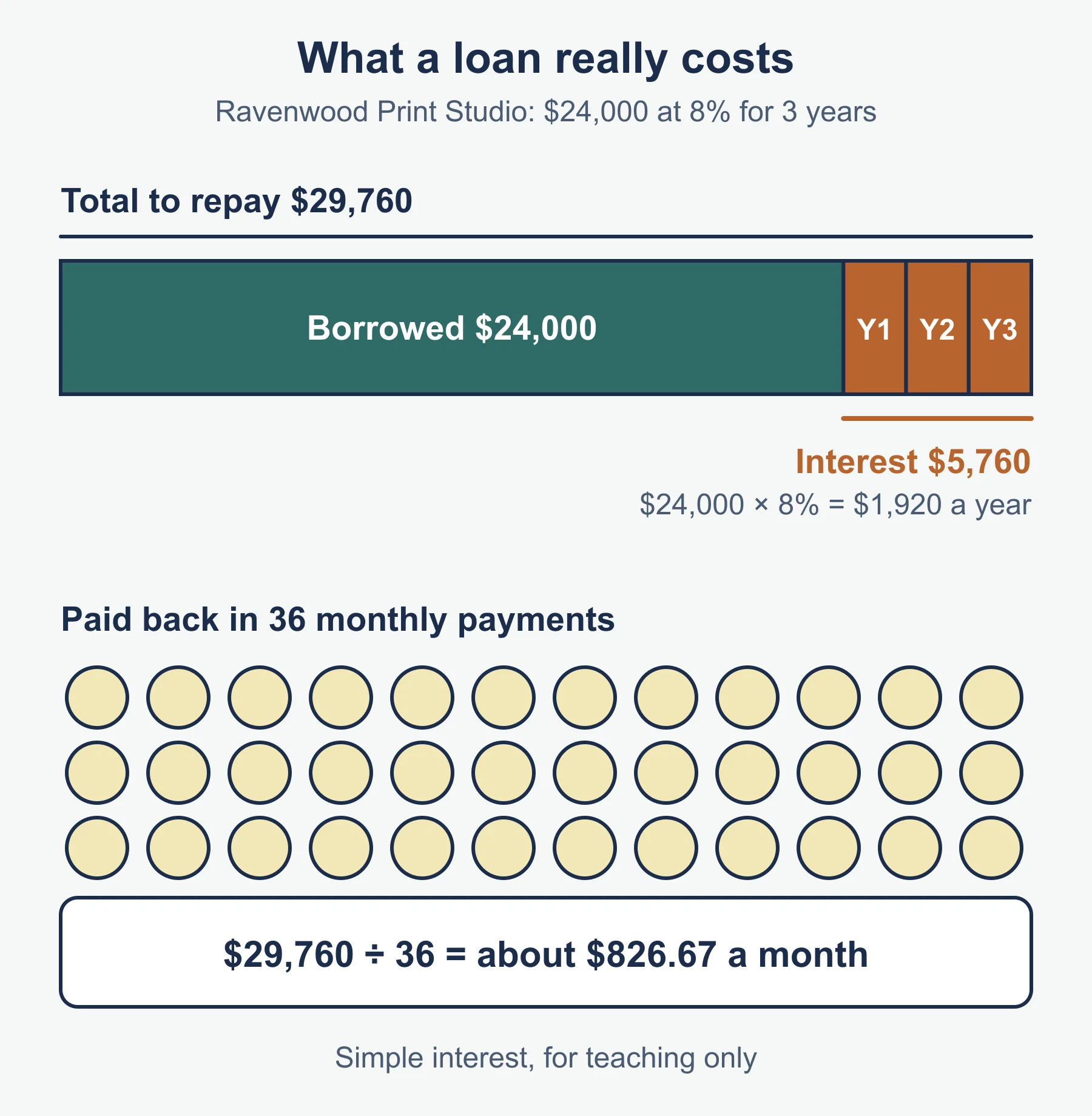
| Debt | Borrowed money repaid, normally with interest |
| Equity | Money put in by owners or shareholders; not repaid on a set date |
| Micro-finance | Very small loans, often to people who cannot get bank loans |
| Crowd-funding | Many people each giving a small amount, usually online |
5.1.1 The need for finance
Three main reasons (named in the syllabus):
- Start-up capital.
- Capital for expansion.
- Additional working capital.
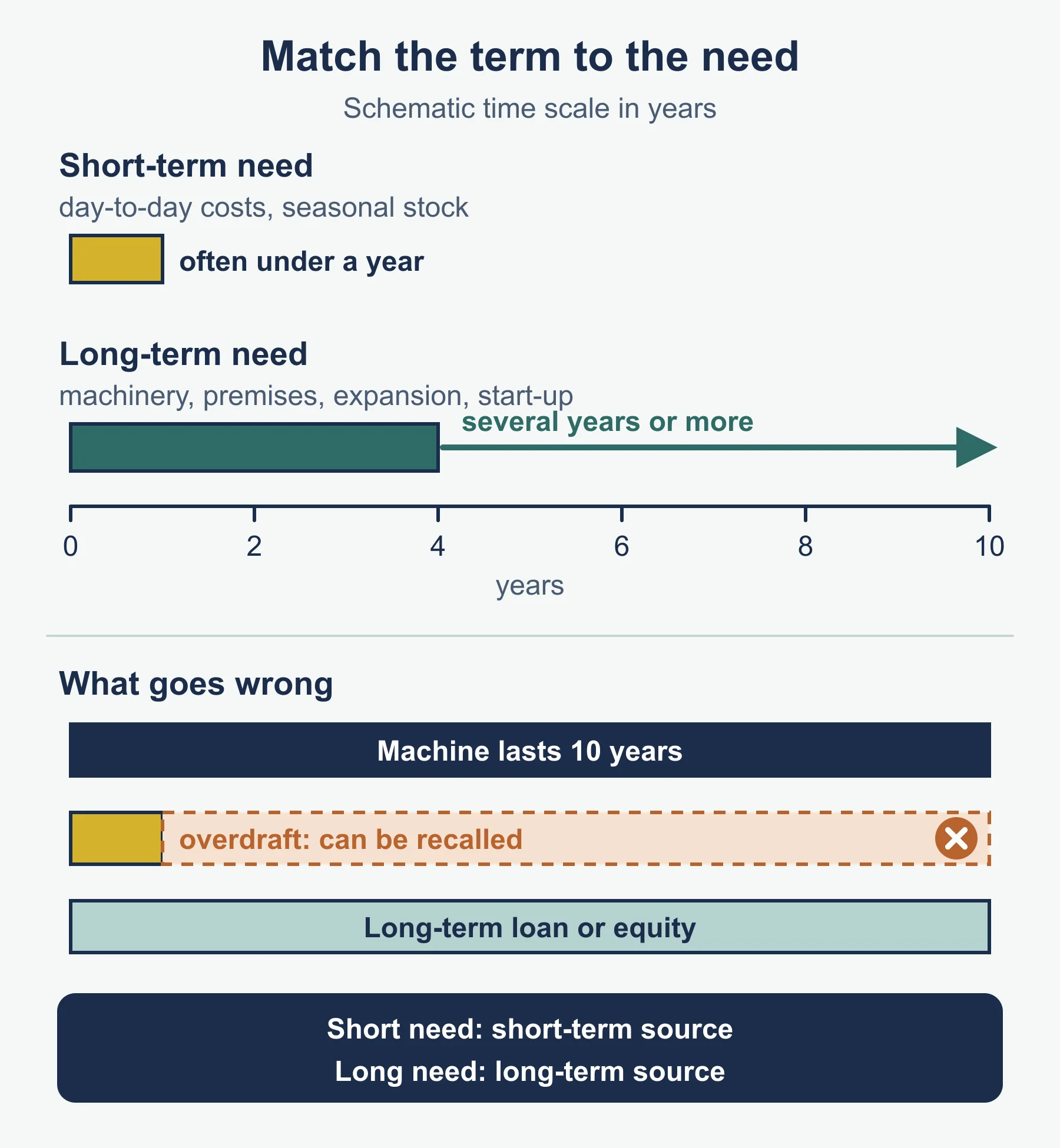
Short-term needs are for day-to-day costs and temporary shortages. Long-term needs are for assets and projects that pay back over years. Rule: match the source to the need.
5.1.2 Sources of finance
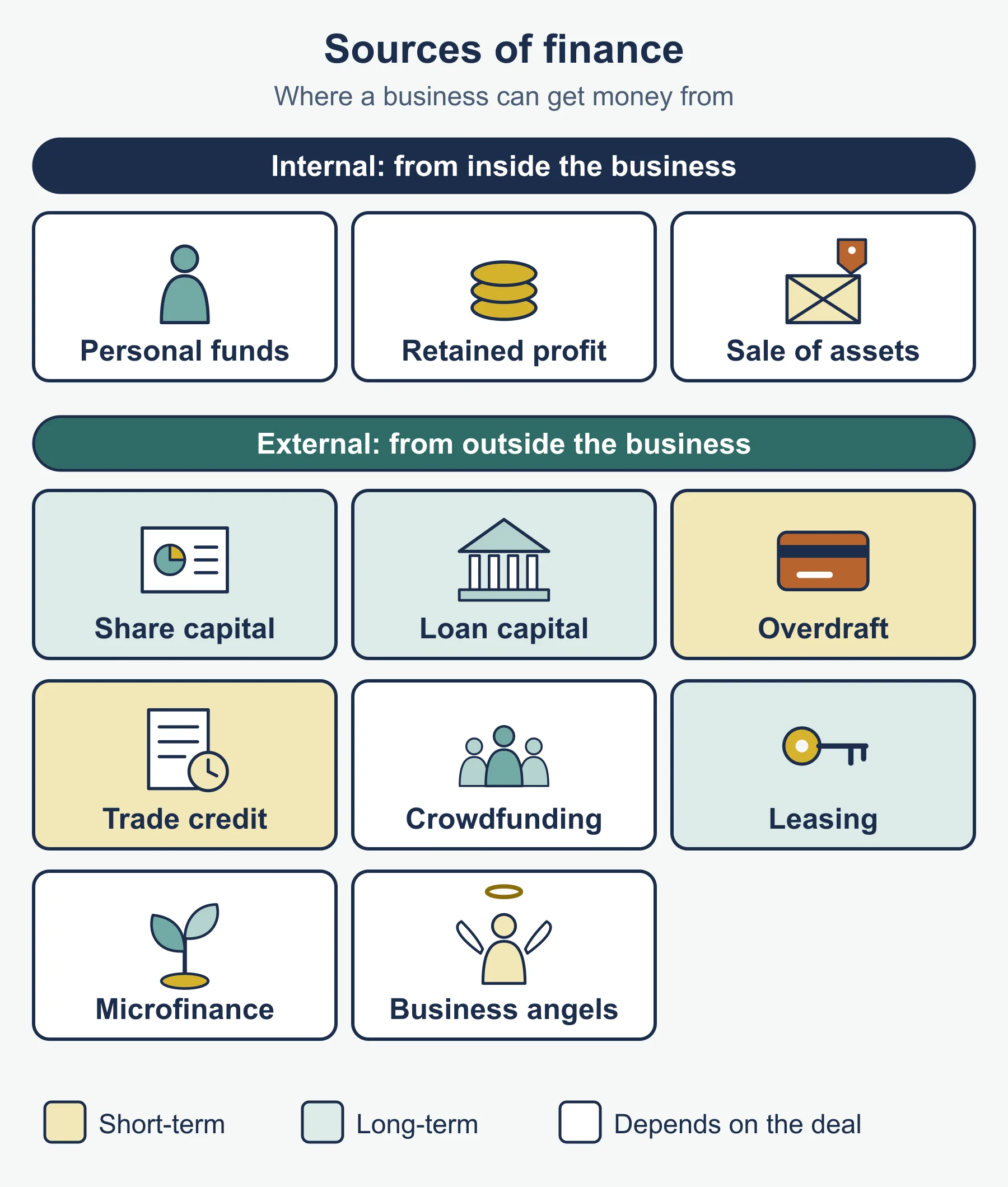
Internal and external
| Internal | External |
|---|---|
| Retained profit | Bank loan |
| Owner’s savings or capital | Overdraft |
| Sale of assets | Trade credit |
| Reducing stock, collecting debts sooner | Share issue |
| Grants, outside investors | |
| Micro-finance, crowd-funding |
Short-term and long-term
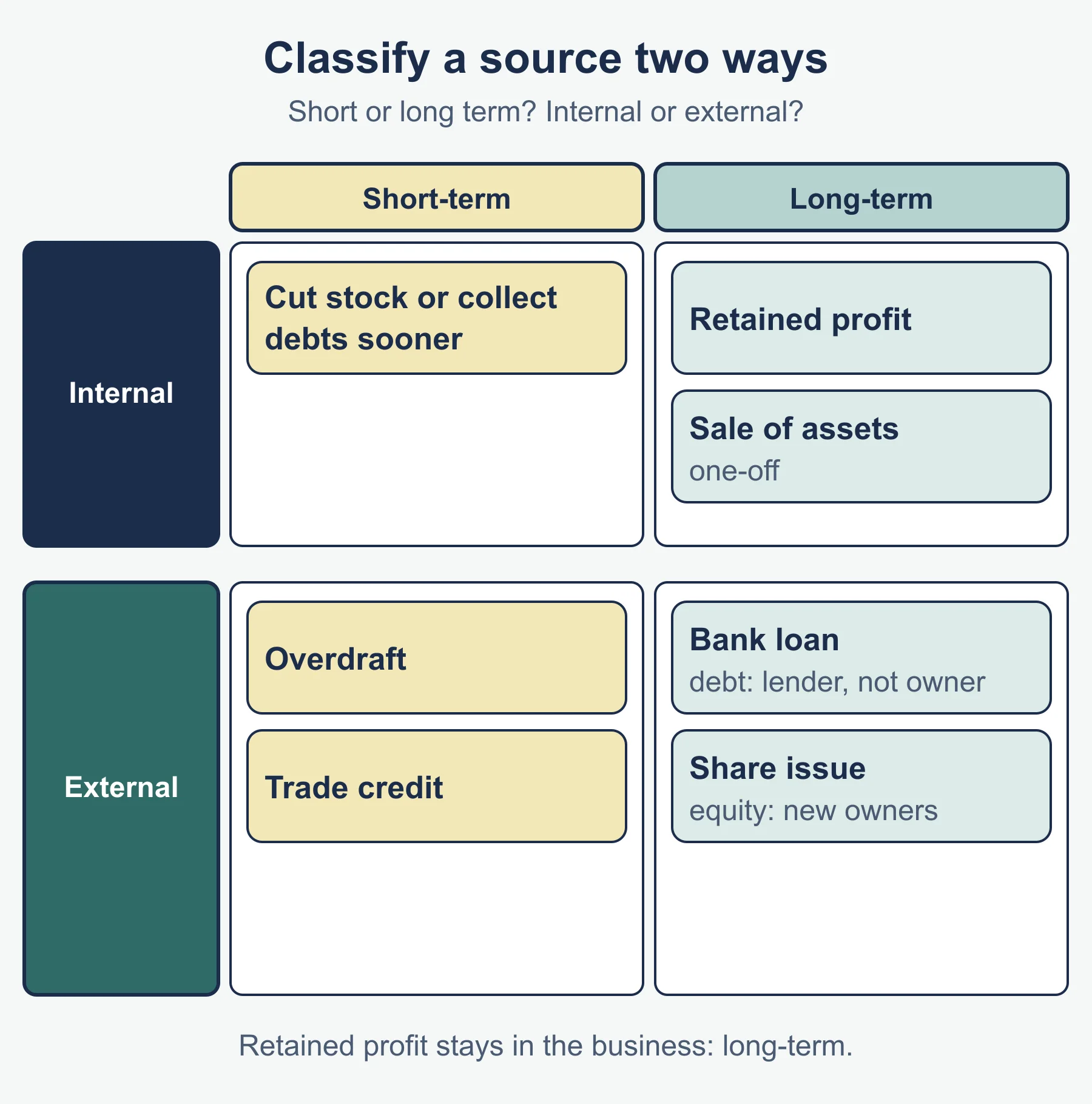
| Short-term | Long-term |
|---|---|
| Overdraft | Bank loan (debt) |
| Trade credit | Share issue (equity) |
| Collecting debts sooner | Retained profit |
Overdraft, debt and equity are the examples the syllabus itself uses. The other items are standard examples.
Quick advantages and disadvantages
| Source | Advantage | Disadvantage |
|---|---|---|
| Retained profit | No interest; no outsider involved | Only available if profit was made; may be too small |
| Owner’s savings | Quick; keeps control | Limited amount; personal risk |
| Sale of assets | Fast cash with no borrowing | Asset lost; one-off |
| Overdraft | Flexible; interest only on amount used | Often costly; can be withdrawn |
| Trade credit | Delays payment | Harms supplier relations if overused |
| Bank loan | Large sum; planned repayments | Interest and security needed |
| Share issue | No repayment; raises large sums | Owners share control and profit |
| Micro-finance | Reaches those refused by banks | Small amounts |
| Crowd-funding | No bank; tests demand | Target may not be met; idea made public |
Must-know distinction: debt versus equity
| Debt | Equity | |
|---|---|---|
| Who provides it | Lender | Owner or shareholder |
| Repayment | Yes, with interest | No set repayment |
| Reward | Interest | Dividend, share of profit |
| Control | Unchanged | May be shared more widely |
| Effect in a bad year | Interest still due | Dividend can be cut |
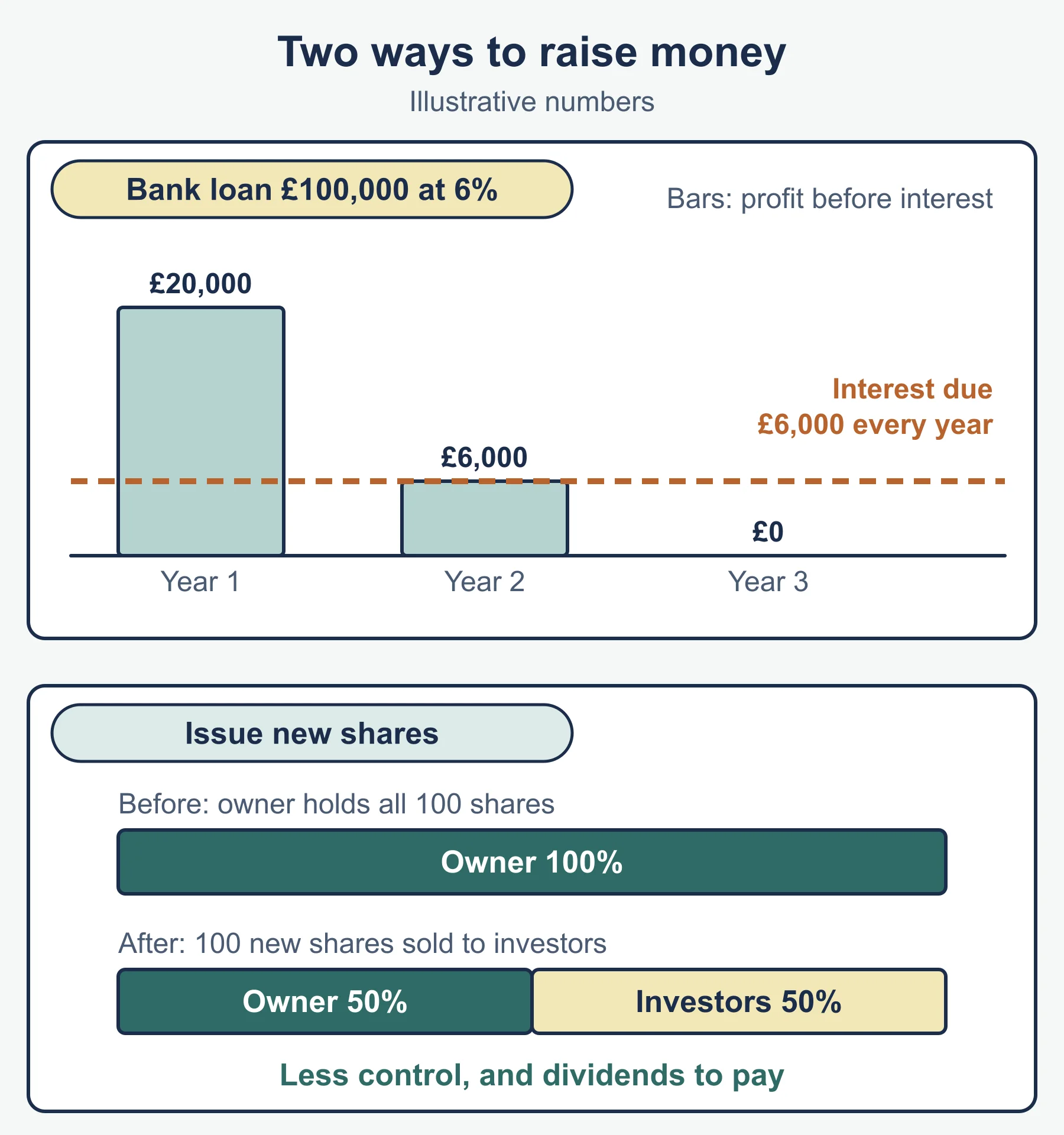
Why alternative sources matter
- Banks may refuse small, new or risky businesses.
- Micro-finance opens small loans to those without security.
- Crowd-funding raises money from many people and shows whether people want the product.
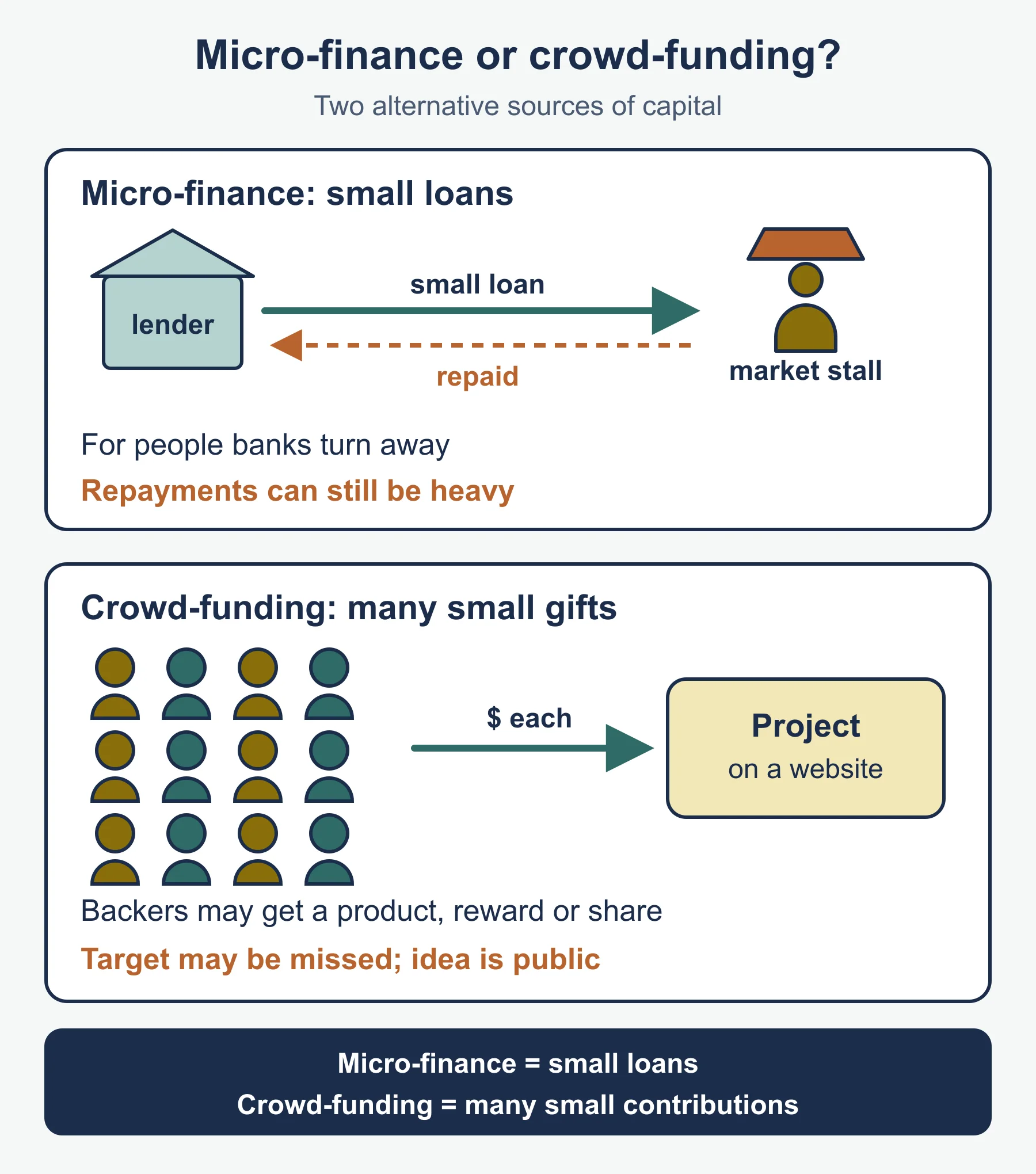
Short-term versus long-term needs: how to tell
- Ask what the money is for. Paying wages, buying materials or covering a gap before customers pay is a short-term need.
- Ask how long the benefit lasts. A van, oven or new shop earns money for years, so the need is long-term.
- Ask when the money comes back. If the project repays itself within weeks, short-term finance can work. If it repays over years, use long-term finance.
- Remember that one business can have both needs at once. It might use an overdraft for stock and a loan for a new site.
Internal or external: how to tell
- Internal: the money already belongs to the business or its owner, or is released from within, such as profit kept back or an unused asset sold.
- External: someone else provides it and expects something back, such as interest, repayment, a dividend or a reward.
- Careful: an owner’s savings are the owner’s own money, so they are usually treated as internal. A new shareholder’s money is external, because it comes from outside the existing owners.
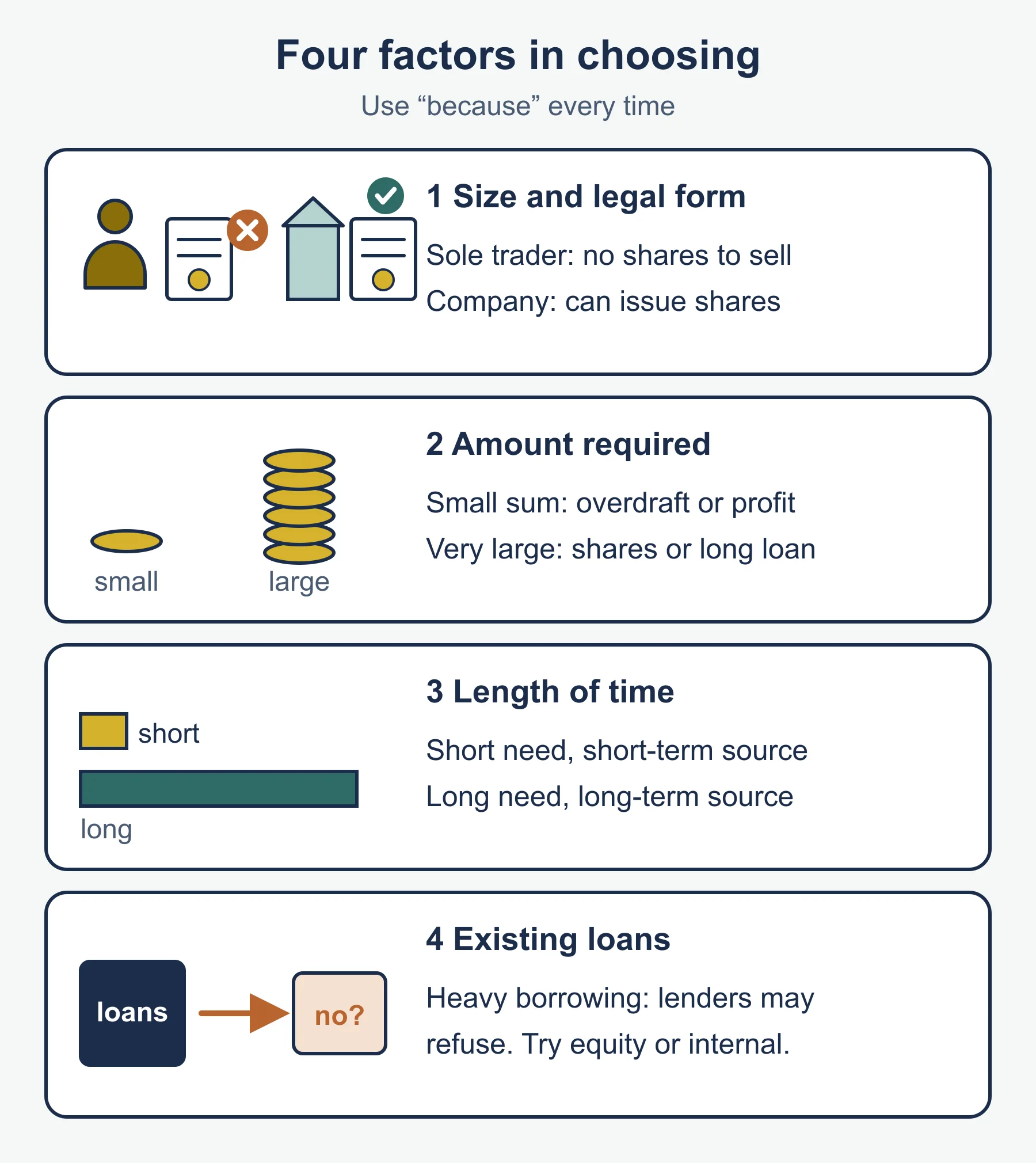
Choosing a source: the four factors
- Size and legal form of business: a sole trader cannot issue shares; a company can.
- Amount required: small sums, overdraft or savings; large sums, loan or shares.
- Length of time: short need, short-term source; long need, long-term source.
- Existing loans: heavy borrowing makes more debt harder to get and riskier.
Method in steps: recommend and justify
- Pull out the amount, purpose, time period and legal form from the case.
- Name your source (and call it internal or external, short-term or long-term).
- Give a reason that uses a number or fact from the case.
- Reject one alternative and say why.
- Close with a one-line judgement.
Worked reminder
Dalmere Foods, a private company, needs 120 000 dollars to buy ovens that last about ten years. A bank loan over ten years matches the length of the need. An overdraft does not, because it is short-term and can be withdrawn. Selling shares would avoid interest but would share ownership. Judgement: a long-term bank loan, unless existing loans already make repayments hard.
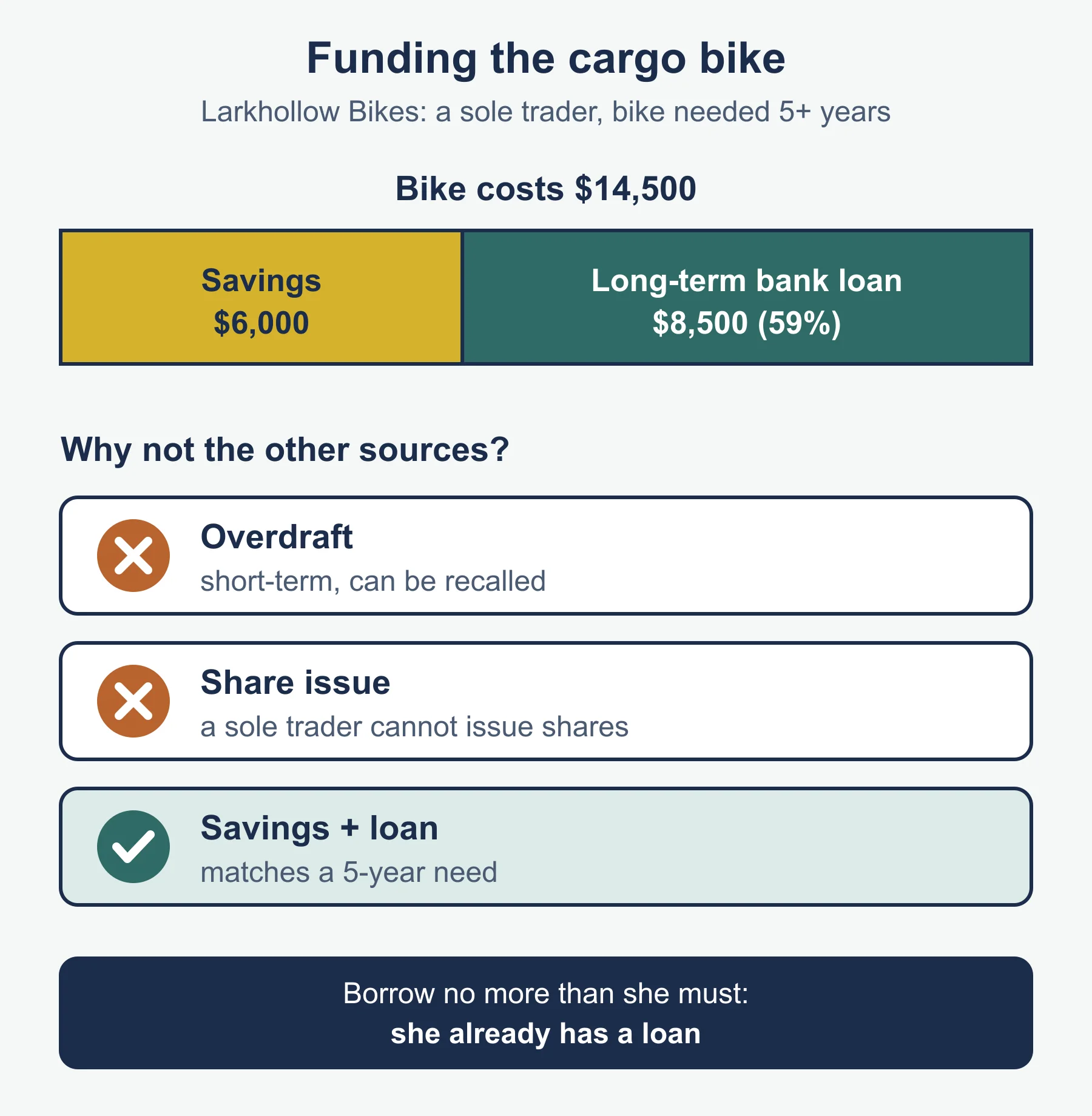
Matching sources to situations
| Situation | Sensible choice | Why |
|---|---|---|
| New sole trader, small sum, no assets to offer | Owner’s savings, then micro-finance or crowd-funding | Banks may refuse; shares are not available |
| Seasonal shortage of cash for a few weeks | Overdraft or trade credit | Short need, short-term source |
| Large company buying a factory | Long-term loan or share issue | Large sum, long period |
| Business with spare unused vehicle | Sale of assets | Quick cash, no interest |
| Profitable business with a modest project | Retained profit | Cheap and no outsider involved |
| Business already heavily in debt | Equity or internal sources | More debt raises repayments and risk |
Treat the table as a starting point only. A case study often gives a fact that changes the answer, so always check the amount, time, legal form and existing loans before choosing.
Command words for this topic
- State, identify: a short answer with no explanation.
- Calculate: work out from the figures given, showing each step.
- Outline: set out the main points briefly.
- Define: give a precise meaning, for example an overdraft lets a business spend beyond its bank balance up to an agreed limit.
- Explain: a point, then a reason or consequence, linked with “because” or “so”.
- Consider: review the information given and respond to it, weighing more than one side.
- Justify (with recommend): choose a source and support the choice with evidence from the case, ideally weighing it against an alternative.
Quick self-test
- Name the three main reasons for needing finance given in the syllabus.
- Give one internal source and one external source.
- Is an overdraft short-term or long-term finance?
- What is the difference between debt and equity?
- State one advantage of crowd-funding.
- Why can a sole trader not use a share issue?
- A business needs 50 000 dollars. It has 20 000 dollars of retained profit available. How much must it find from other sources?
- In question 7, retained profit supplies what percentage of the 50 000 dollars?
- Give one reason an existing loan affects the choice of a new source.
- A business borrows 12 000 dollars at 5% simple interest per year for 2 years. What is the total interest?
- Give one reason why a business should not use an overdraft to buy a machine that will last ten years.
- State one disadvantage of using retained profit to fund expansion.
Answers
- Start-up capital, capital for expansion and additional working capital.
- For example retained profit (internal) and a bank loan (external).
- Short-term.
- Debt is borrowed and repaid with interest; equity is owners’ money with no set repayment.
- For example it needs no bank, or it shows whether people want the product.
- A sole trader does not have shares to sell; shares belong to companies.
- 30 000 dollars.
- 40%.
- For example lenders may refuse more, or extra repayments could strain cash flow.
- 1 200 dollars.
- An overdraft is short-term and can be withdrawn by the bank, so the repayment period does not match the machine’s life.
- For example it may be too small, or it may reduce what can be paid to the owners.
Where marks are usually lost
- Calling an overdraft or a trade credit arrangement a long-term source.
- Writing “loan” without saying whether it is short-term or long-term, when asked for a source for a specific need.
- Describing sources with no link to the case, when the command word is recommend or justify.
- Recommending shares for a sole trader.
- Mixing up debt and equity, or calling shareholders lenders.
- Giving a list of advantages with no drawback, so no judgement.
- Forgetting the percentage sign, or working out the wrong base, in a finance calculation.
- Confusing micro-finance with crowd-funding.
Frequently asked questions
What is the difference between debt and equity finance? Debt is borrowed money that must be repaid, usually with interest, and the lender does not become an owner. Equity is money put in by owners, such as share capital, with no set repayment date, and shareholders expect dividends when there is profit.
Are internal sources of finance free? No. Retained profit costs no interest, but it could have been paid to the owners instead, and selling assets means the business loses them.
What is the difference between micro-finance and crowd-funding? Micro-finance is very small loans, often to people who cannot get ordinary bank loans. Crowd-funding raises small amounts from a large number of people, usually through a website, who may receive a product, a reward or a share in return.
Why should an overdraft not be used to buy long-lasting equipment? An overdraft is short-term finance that the bank can ask to be repaid at short notice. A long-term need, such as a machine lasting many years, should be matched with long-term finance.
Official syllabus
Cambridge O Level Business Studies 7115 syllabus for examination in 2026, published by Cambridge University Press & Assessment (Cambridge International Education), section 5.1 Business finance: needs and sources.
Get free revision emails (optional)
Occasional emails with practice questions, worked explanations and links to free resources for the qualification and subjects you choose. No spam, and you can unsubscribe from any email. The free tools on this site never need an email.
Related resources
-
Study guides
O Level Business: Cash-flow forecasting and working capital (Cambridge 7115)
Why cash matters, how to build, complete and interpret a simple cash-flow forecast, fixes for short-term shortfalls, and working capital.
Business · Cambridge · O Level
Read guide -
Practice questions
O Level Business: Cash-flow forecasting and working capital (Cambridge 7115) – Practice Questions
Eleven original questions with worked answers on completing and interpreting cash-flow forecasts, fixing cash shortages and working capital.
Business · Cambridge · O Level
Try questions -
Revision notes
O Level Business: Cash-flow forecasting and working capital (Cambridge 7115) – Revision Notes
Condensed revision notes on cash-flow forecasts, fixing short-term cash problems and working capital, with a self-test and common mistakes.
Business · Cambridge · O Level
Revise topic
Related articles
-
teaching
A Level tuition in Dubai: Cambridge or Pearson Edexcel International A Level?
Schools in Dubai and Abu Dhabi teach either Cambridge International AS & A Level or Pearson Edexcel International A Level. How the two are structured, why it matters for tuition, and how online classes from Lahore work.
9 October 2026
-
curriculum guides
Choosing subjects at IGCSE and A Level
How subject choices at 14 and 16 affect university options later, and how to keep pathways open without overloading a timetable.
28 July 2026
Studying this with a teacher
Working through Business O LEVELS?
This page is free and stays free. If you would rather be taught it, Marlbridge runs Business classes one-to-one and in small groups of up to 15, online in your own time zone. The first trial class is free. WhatsApp replies within an hour (8am–11pm Pakistan time, every day); email the same day.
Cambridge Business teachers at Marlbridge

