
Revision Notes
O Level Business: Cash-flow forecasting and working capital (Cambridge 7115) – Revision Notes
Condensed revision notes on cash-flow forecasts, fixing short-term cash problems and working capital, with a self-test and common mistakes.
- Subject
- Business
- Level
- O LEVELS
- Topic
- Financial information and decisions
- Author
- Marlbridge Academic Team
- Updated
- Reviewed by
- Salman Ahmad (what this means)
Aligned to Cambridge O Level Business (7115), For examination in 2026. Official specification .
Syllabus page (what it covers and how it is assessed): Cambridge O Level Business.
Syllabus points this page covers
7115
- 5.2 Cash-flow forecasting and working capital
Found an error? Report a correction.
Need help with this topic? Request a free trial class for O Level Business (7115).
These notes condense section 5.2 (Cash-flow forecasting and working capital) of the Cambridge O Level Business Studies 7115 syllabus for examination in 2026: 5.2.1 (cash and cash-flow forecasting) and 5.2.2 (working capital). For full explanations and longer worked examples, read the study guide first. When you are ready to test yourself, use the practice questions, the wider topic practice set and the free diagnostics. Course pages: Cambridge O Level Business hub and checklist. Amounts are in dollars.
Key definitions
| Term | Meaning |
|---|---|
| Cash | Money the business can use now: till cash plus usable bank balance |
| Cash-flow forecast | A prediction of cash expected to come in and go out over future months, with the expected balance each month |
| Cash inflows | Money coming in, such as cash sales and payments from credit customers |
| Cash outflows | Money going out, such as materials, wages, rent, equipment |
| Net cash flow | Inflows minus outflows for the month |
| Opening balance | Cash at the start of the month |
| Closing balance | Opening balance plus net cash flow |
| Debtors | People or businesses that owe the business money |
| Overdraft | Bank permission to spend more than is in the account, up to a limit |
| Working capital | Current assets minus current liabilities (the standard form) |
Why cash is important
- Pays wages, suppliers, bills, loan repayments and tax on time.
- Lets the business buy equipment or take up a bulk-buying chance.
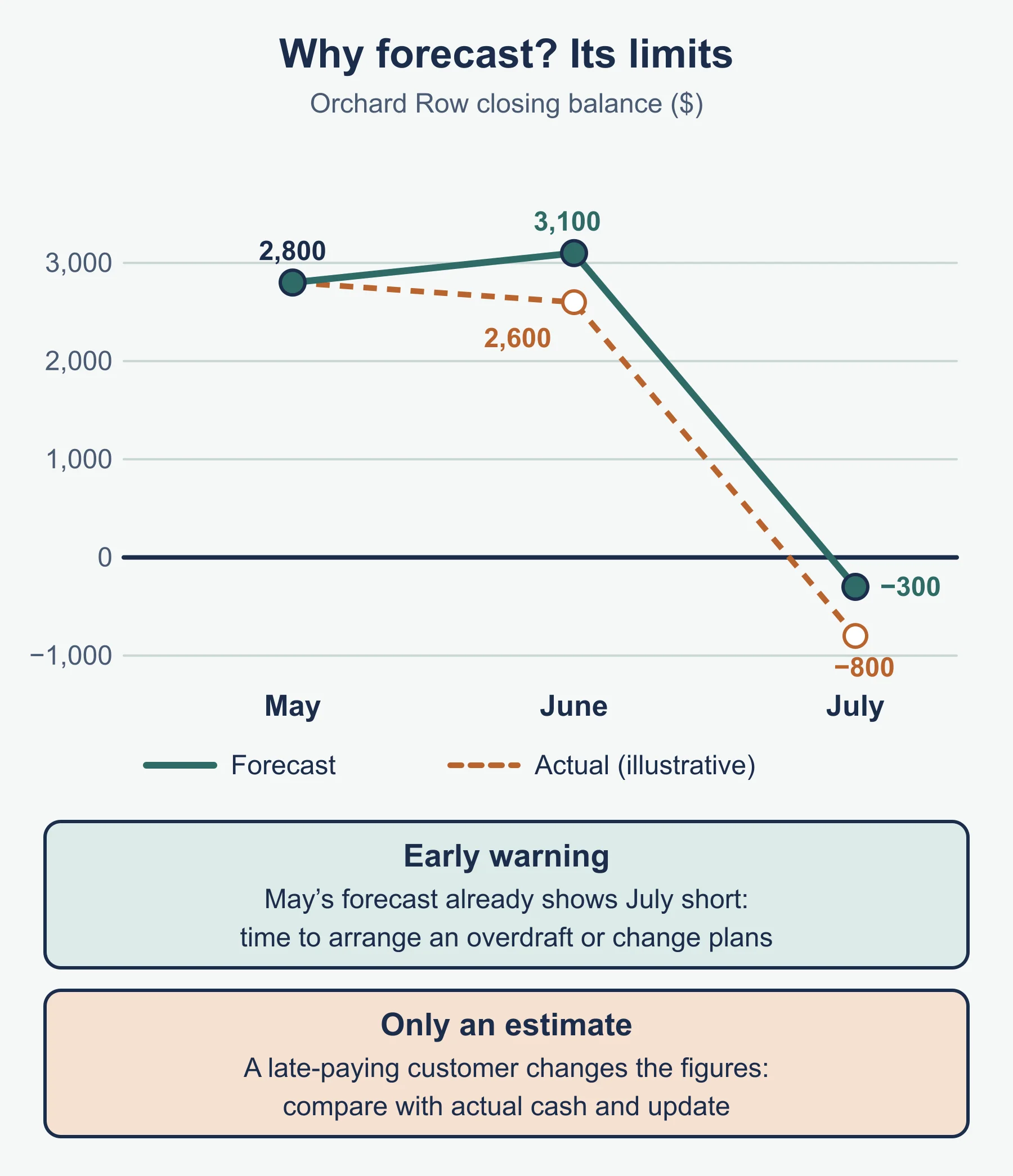
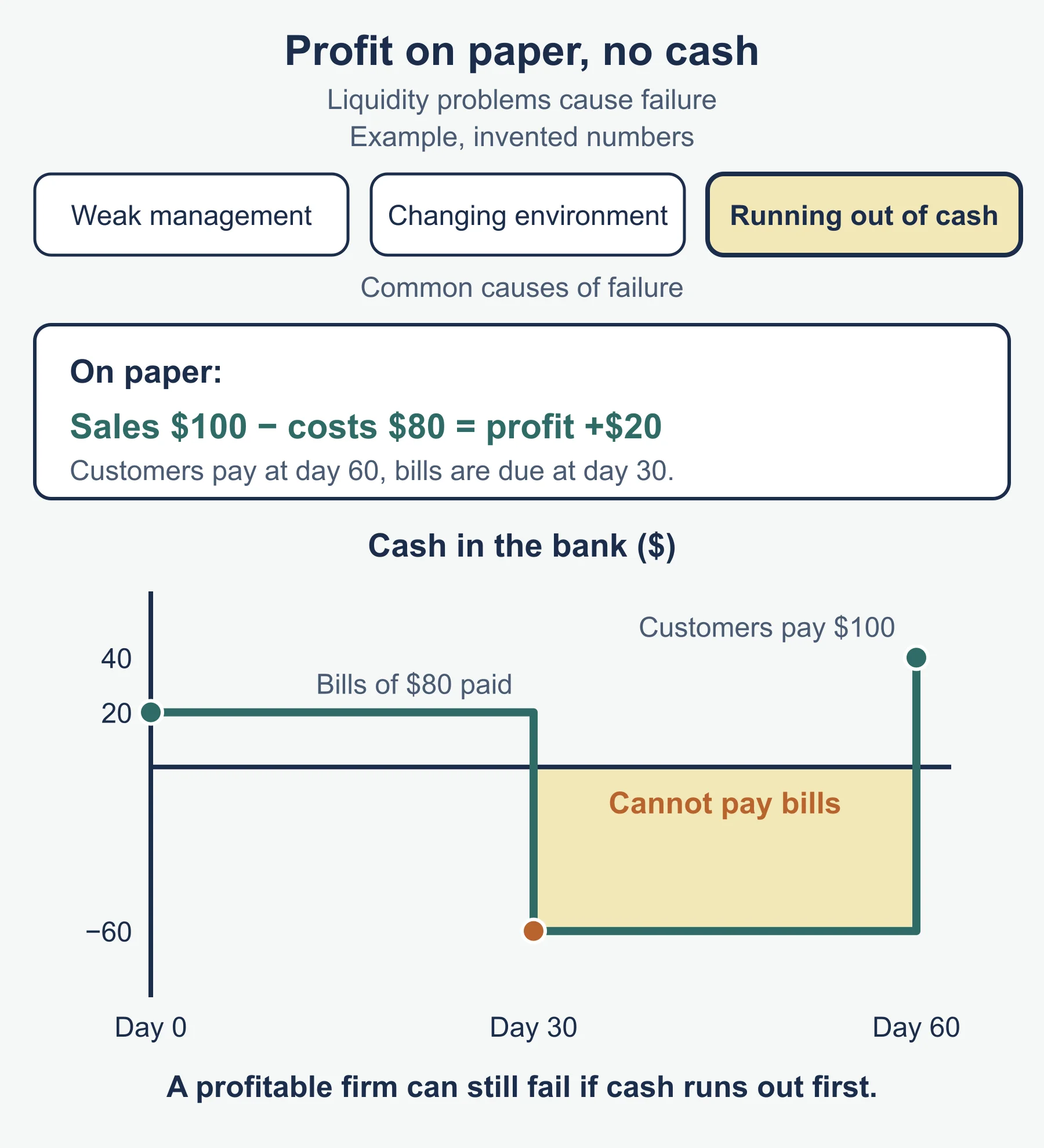
- Running out of cash can end a business, even one with orders. Cash shortage is the everyday form of the liquidity problems named in section 1.3.4.
- Profit and cash differ: a credit sale adds to profit now but brings in cash later.
Building a forecast: method in steps
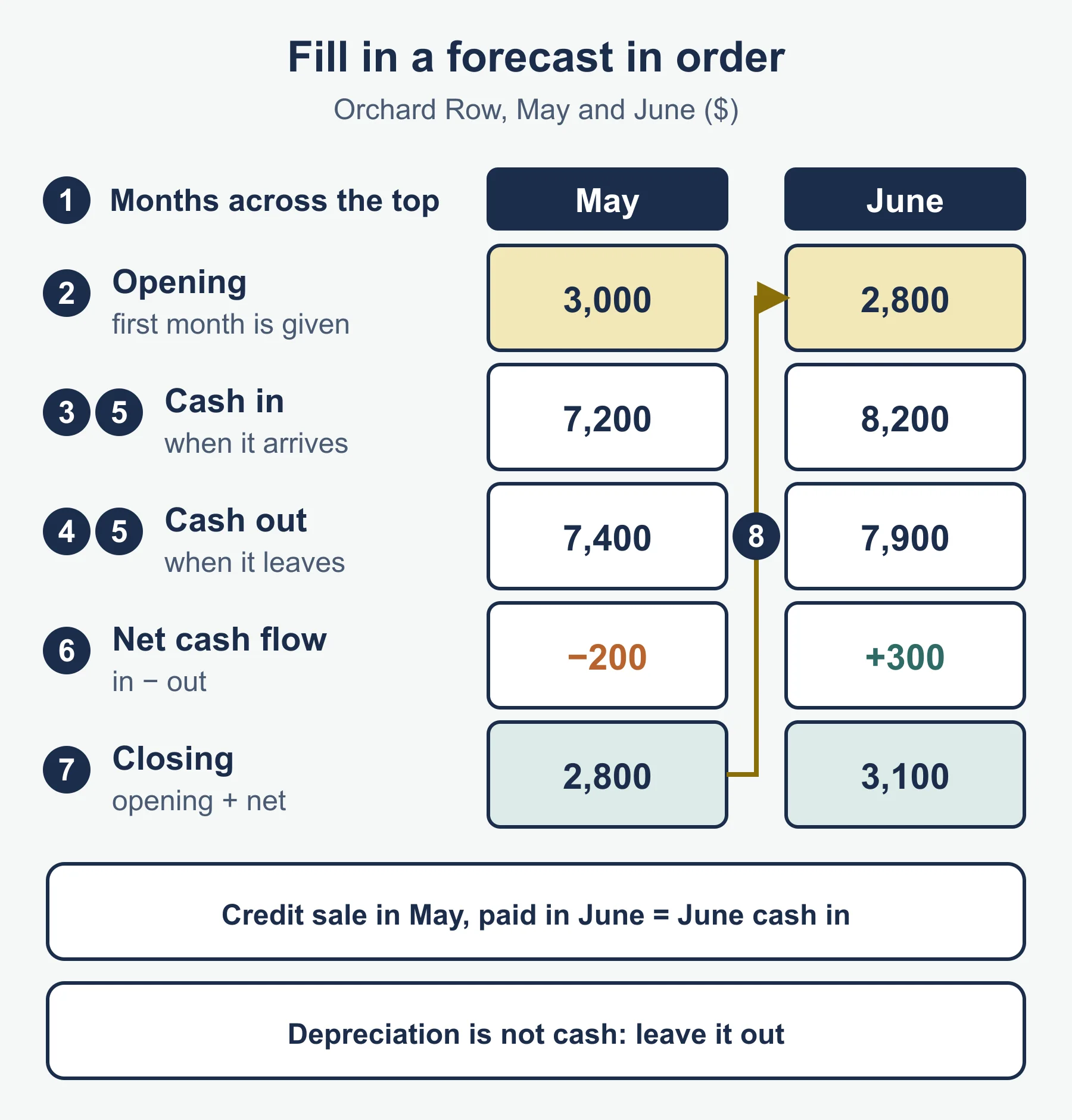
- Months across the top; opening balance for month one.
- Inflows go in the month the cash arrives.
- Outflows go in the month the cash leaves.
- Total inflows minus total outflows gives net cash flow.
- Closing balance = opening balance + net cash flow.
- Closing balance becomes next month’s opening balance.
- Leave out non-cash items such as depreciation.
Small worked reminder
Wickham Pottery starts April with 1,500.
| April | May | June | |
|---|---|---|---|
| Opening balance | 1,500 | 1,200 | 700 |
| Total inflows | 4,200 | 3,800 | 4,600 |
| Total outflows | 4,500 | 4,300 | 3,900 |
| Net cash flow | -300 | -500 | +700 |
| Closing balance | 1,200 | 700 | 1,400 |
Reading it: the balance stays positive but falls for two months, so the owner should watch spending in April and May.
Amendment reminder
Suppose Wickham Pottery’s May outflows rise by 600 because it buys a second kiln shelf set. May net cash flow becomes -500 - 600 = -1,100, so the May closing balance is 1,200 - 1,100 = 100. June opens with 100, not 700. June net cash flow is still +700, so June closes at 800, not 1,400. Every later month moves by the same 600.
Command words for this topic
| Command word | What to do here |
|---|---|
| Define | Give the precise meaning, for example of cash-flow forecast or working capital |
| State | Give the answer in clear terms, with no explanation |
| Identify | Name or select, for example a month with a negative balance |
| Calculate | Work out from the figures given; show the working |
| Outline | Set out the main points briefly |
| Explain | Give a reason and say why or how, using evidence from the case |
| Justify | Support a case with evidence and argument, weighing the alternative |
For a recommendation or justification, give your choice, give a reason tied to the figures, name a drawback of the choice and say why it is still the better option.
Completing, amending and interpreting
Complete: fill the blanks in order, left to right. A missing total is a sum; a missing opening balance is the previous closing balance.
Amend: change the figure the question gives, then recalculate that month and every later month.
Interpret: for each month say whether the closing balance is positive or negative, find the lowest point and its cause, describe the trend, and suggest what the business should do. Use the figures from the table in your answer.
Why forecasts are important
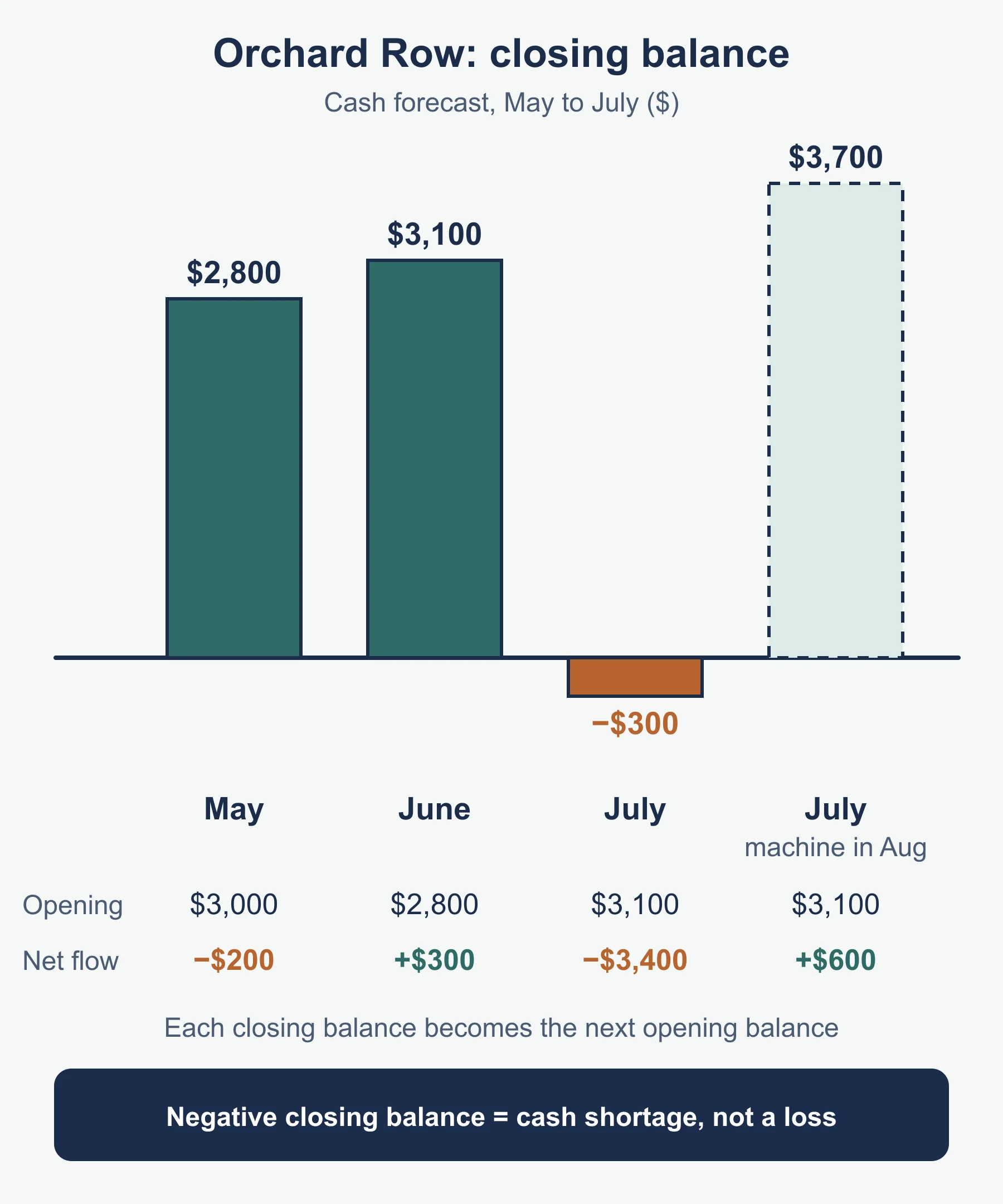
- Show future shortages in time to arrange a fix.
- Help decide when large purchases are affordable.
- Support loan applications, since lenders want evidence of repayment ability.
- Give a standard to compare actual cash against.
Limits: based on estimates (sales may be lower than forecast); unexpected events; needs regular updating.
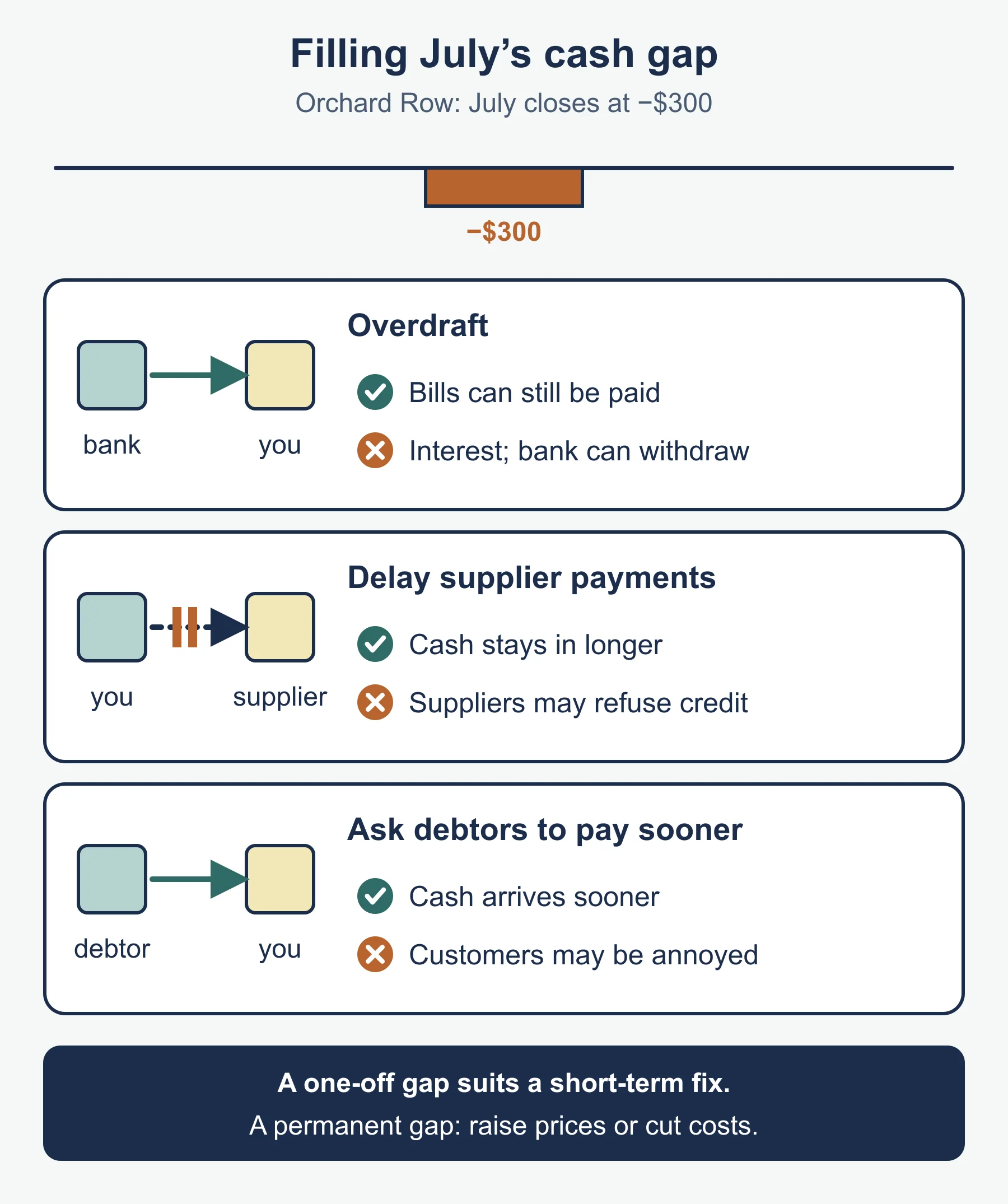
Overcoming a short-term cash problem
| Method | Benefit | Drawback |
|---|---|---|
| Overdraft | Quick; bills still paid | Interest; the bank can withdraw it; short-term use only |
| Delay supplier payments | Keeps cash longer | May lose credit terms or discounts; supplier goodwill suffers |
| Ask debtors to pay sooner | Cash from sales already made | May upset or lose customers; discounts cut revenue |
Others: delay a planned purchase, sell an unused asset, owner adds money. Match the fix to the business and to how long the gap lasts. A one-off gap suits a short-term fix; a lasting gap needs higher prices or lower costs.
Working capital
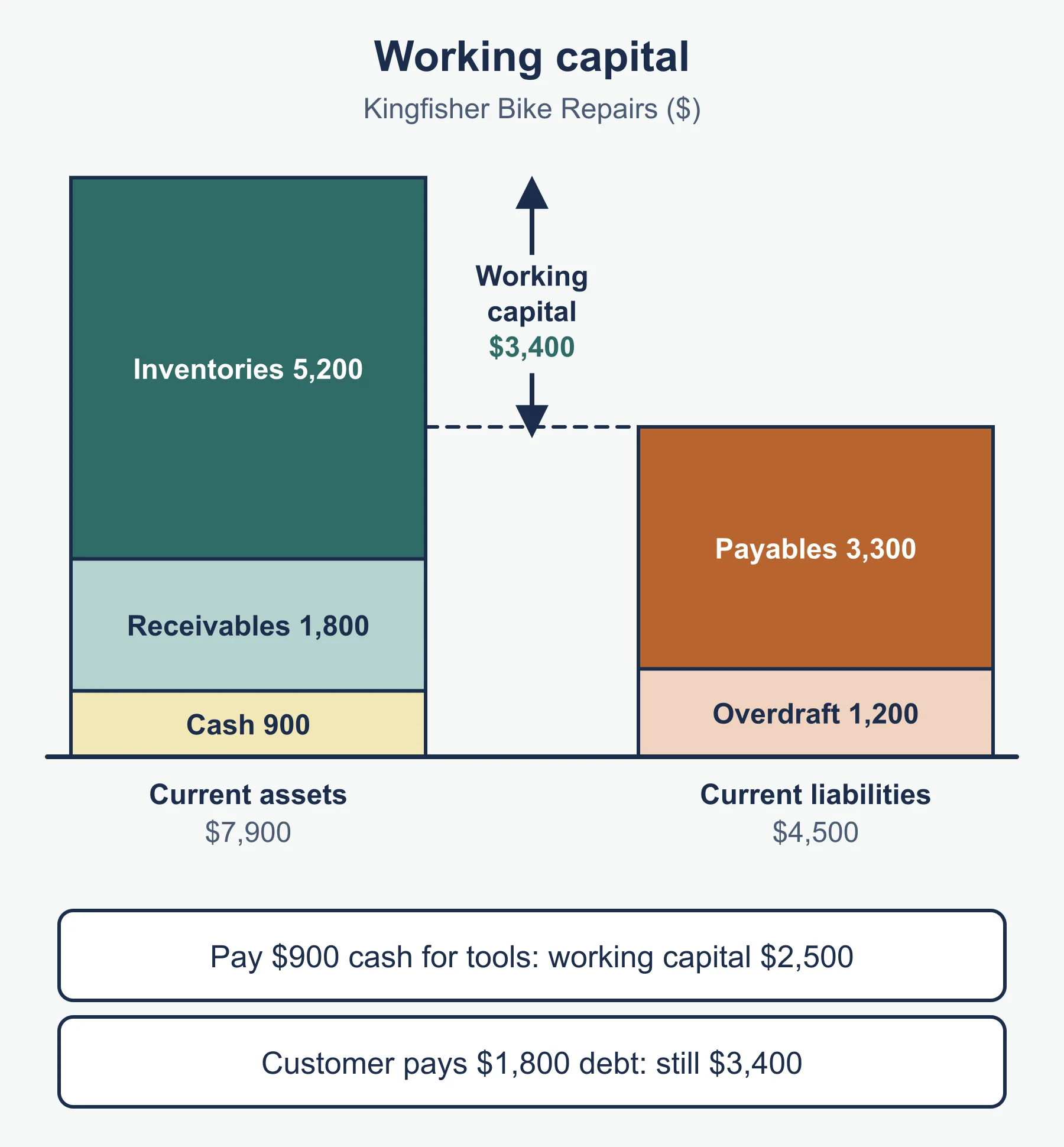
Working capital = current assets - current liabilities (standard form).
| Current assets | Current liabilities |
|---|---|
| Inventories (stock) | Trade payables (owed to suppliers) |
| Trade receivables (owed by customers) | Bank overdraft |
| Cash | Other debts due within a year |
Quick check: inventories 9,000, receivables 3,000, cash 500; payables 4,000, overdraft 1,000. Current assets 12,500, current liabilities 5,000, working capital 7,500.
Importance: pays day-to-day costs; lets the business buy stock and meet orders; absorbs a slow month; too little risks a liquidity problem; too much leaves money idle.
Effects: a customer paying a debt changes receivables into cash, so working capital is unchanged. Buying equipment with cash lowers working capital.
Must-know distinctions
- Cash vs profit: cash is money available now; profit is revenue minus costs.
- Net cash flow vs closing balance: net cash flow is one month’s change; closing balance is the running total.
- Cash-flow problem vs loss: a negative balance is a shortage, not a loss.
- Cash vs working capital: cash is one current asset; working capital is all current assets minus all current liabilities.
- Short-term fix vs long-term fix: an overdraft covers a gap; it does not remove its cause.
Quick self-test
- Define “cash-flow forecast”.
- A business has an opening balance of 2,400, inflows of 6,000 and outflows of 6,800. Find the closing balance.
- A business opens a month with -700, then has inflows of 3,100 and outflows of 2,500. Find the net cash flow and the closing balance.
- A shop makes a credit sale in March; the customer pays in May. In which month does the inflow appear?
- Name the three methods of easing a short-term cash problem that the syllabus gives as examples.
- Give one drawback of an overdraft.
- Give one drawback of asking debtors to pay sooner.
- State the standard formula for working capital.
- Inventories 9,000, receivables 3,000, cash 500; payables 4,000, overdraft 1,000. Find working capital.
- A customer pays a debt of 1,000. What happens to working capital?
- Give one reason a forecast may turn out wrong.
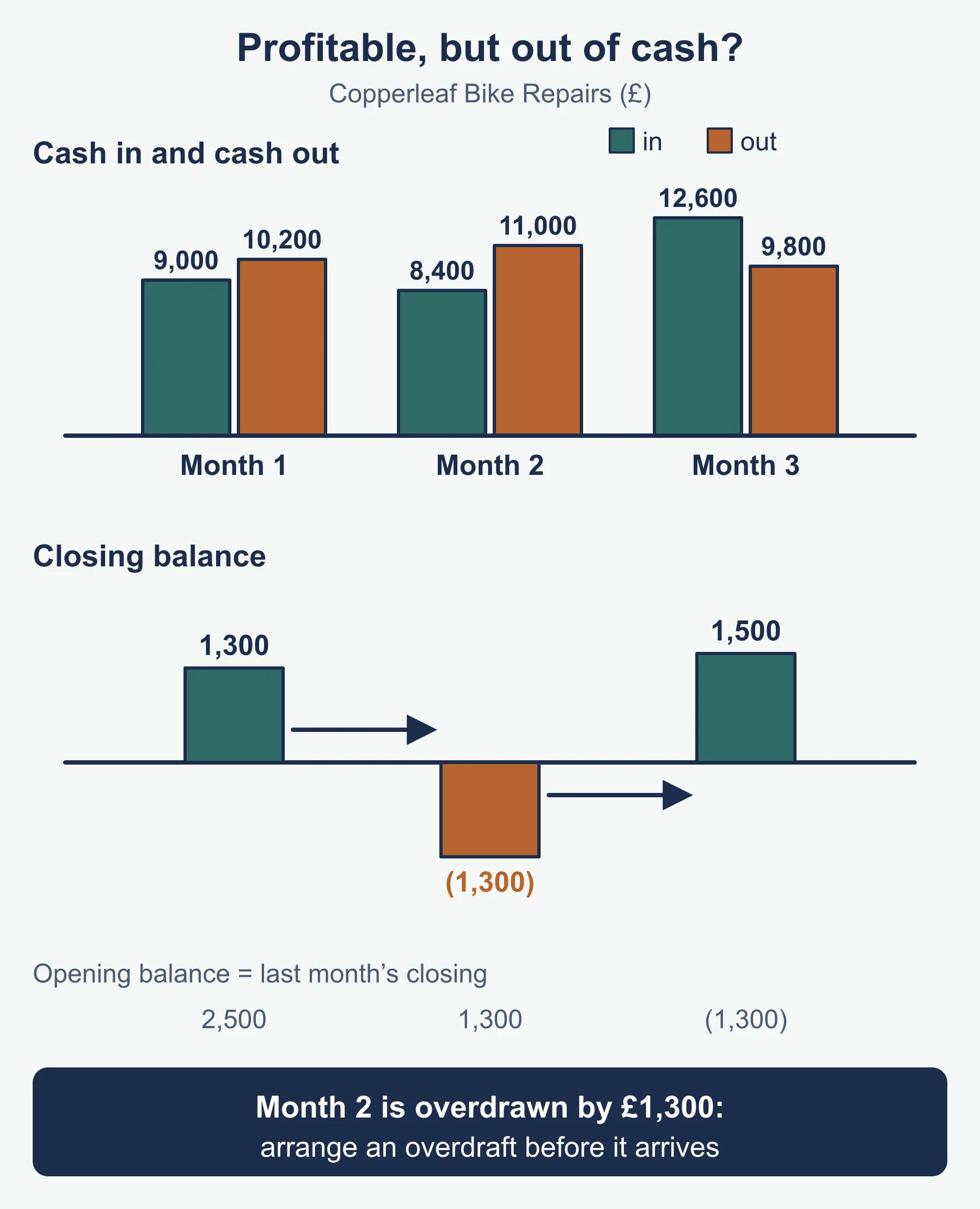
- Why might a profitable business still run out of cash?
Answers
- A prediction of the cash expected to come into and go out of a business over future months, showing the expected balance each month.
- 2,400 + 6,000 - 6,800 = 1,600.
- Net cash flow = 3,100 - 2,500 = +600; closing balance = -700 + 600 = -100.
- May, when the cash arrives.
- Overdraft, delaying payments to suppliers, asking debtors to pay more quickly.
- Interest is charged; the bank may withdraw or limit it.
- Customers may be annoyed and buy elsewhere; or a discount reduces revenue.
- Current assets minus current liabilities.
- 12,500 - 5,000 = 7,500.
- No change: receivables fall by 1,000 and cash rises by 1,000.
- Sales or costs were estimated wrongly; or an unexpected event, such as a late-paying customer.
- Customers have not yet paid for credit sales, or cash has been spent on stock or equipment, so there is not enough cash for bills even though profit is shown.
Where marks are usually lost
- Putting a credit sale in the month of the sale rather than the month of payment.
- Not carrying the closing balance forward as the next opening balance.
- Changing one month after an amendment but not the months that follow.
- Calling a negative closing balance a loss.
- Listing an overdraft or early debt collection with no drawback, or no link to the business.
- Giving a long-term solution (such as a ten-year loan) for a short-term gap.
- Describing a forecast figure without saying what it means for the business.
- Treating working capital as cash only, or reversing the formula.
Frequently asked questions
Is a negative closing balance a loss? No. A negative closing balance in a cash-flow forecast is a cash shortage, not a loss, because cash and profit are different measures.
When should a credit sale appear in a cash-flow forecast? In the month the customer actually pays, not the month of the sale. A credit sale made in May and paid in June is a June inflow.
Does depreciation appear in a cash-flow forecast? No. Only cash movements belong in the forecast, and depreciation of equipment is not a cash payment.
Can a business have too much working capital? Yes. Money tied up in unsold stock or idle cash earns nothing and could have been used to grow the business, while too little can force a business to stop trading.
Official syllabus
Cambridge O Level Business Studies 7115, syllabus for examination in 2026, from Cambridge International, section 5.2.
Get free revision emails (optional)
Occasional emails with practice questions, worked explanations and links to free resources for the qualification and subjects you choose. No spam, and you can unsubscribe from any email. The free tools on this site never need an email.
Related resources
-
Practice questions
O Level Business: Financial information and decisions — Practice Questions (Cambridge 7115)
Original practice questions with worked answers on ROCE, profit margins, the current ratio, cash-flow forecasts and users of accounts for O Level Business 7115.
Business · Cambridge · O Level
Try questions -
Study guides
O Level Business: Income statements and Statement of financial position (Cambridge 7115)
Study guide to profit, income statements and the statement of financial position for Cambridge O Level Business 7115, with worked examples.
Business · Cambridge · O Level
Read guide -
Practice questions
O Level Business: Income statements and Statement of financial position (Cambridge 7115) – Practice Questions
Original practice questions with worked answers on profit, income statements and the statement of financial position for Cambridge O Level Business 7115.
Business · Cambridge · O Level
Try questions
Related articles
-
teaching
A Level tuition in Dubai: Cambridge or Pearson Edexcel International A Level?
Schools in Dubai and Abu Dhabi teach either Cambridge International AS & A Level or Pearson Edexcel International A Level. How the two are structured, why it matters for tuition, and how online classes from Lahore work.
9 October 2026
-
curriculum guides
Choosing subjects at IGCSE and A Level
How subject choices at 14 and 16 affect university options later, and how to keep pathways open without overloading a timetable.
28 July 2026
Studying this with a teacher
Working through Business O LEVELS?
This page is free and stays free. If you would rather be taught it, Marlbridge runs Business classes one-to-one and in small groups of up to 15, online in your own time zone. The first trial class is free. WhatsApp replies within an hour (8am–11pm Pakistan time, every day); email the same day.
Cambridge Business teachers at Marlbridge

