
Revision Notes
O Level Business: Economic issues (Cambridge 7115) – Revision Notes
Condensed revision notes for Cambridge O Level Business 7115 section 6.1: business cycle, inflation, taxes, spending, interest rates and a self-test.
- Subject
- Business
- Level
- O LEVELS
- Topic
- External influences on business activity
- Author
- Marlbridge Academic Team
- Updated
- Reviewed by
- Salman Ahmad (what this means)
Aligned to Cambridge O Level Business (7115), For examination in 2026. Official specification .
Syllabus page (what it covers and how it is assessed): Cambridge O Level Business.
Syllabus points this page covers
7115
- 6.1 Economic issues
Found an error? Report a correction.
Need help with this topic? Request a free trial class for O Level Business (7115).
These notes condense section 6.1, Economic issues, of the Cambridge O Level Business Studies 7115 syllabus for examination in 2026 (points 6.1.1 and 6.1.2). For full explanations and worked examples, read the study guide. When you have revised, try the practice questions, tick off the printable checklist and look at the course hub. If you are unsure where to start, use a free diagnostic. The wider unit also has a topic-level practice set.
Key terms
| Term | Meaning |
|---|---|
| Business cycle | The repeating pattern of rising and falling economic activity over time |
| Gross Domestic Product (GDP) | Value of all output of goods and services made within a country over a set time |
| Economic growth | A rise in GDP over time |
| Employment level | Number of people in work; unemployment rate = unemployed / labour force × 100 (standard form) |
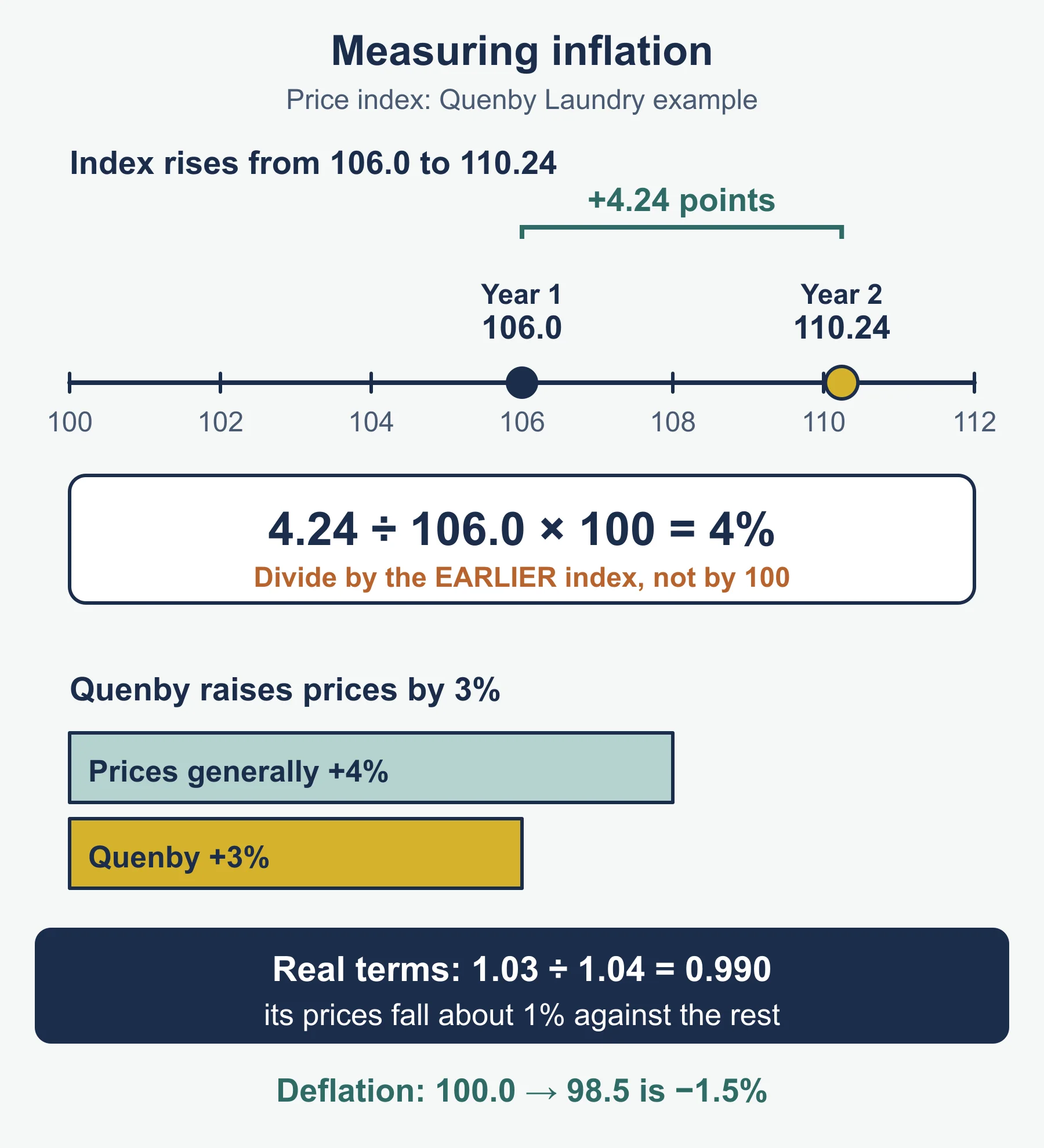
| Inflation | Prices in general rising over a sustained time |
| Tax | Compulsory payment to the government |
| Government spending | What the state spends on services, infrastructure, support and contracts |
| Interest rate | Cost of borrowing and reward for saving, as a percentage |
| Variable-rate loan | Rate moves with market rates (standard term) |
| Fixed-rate loan | Rate stays the same for an agreed period (standard term) |
The business cycle (6.1.1)
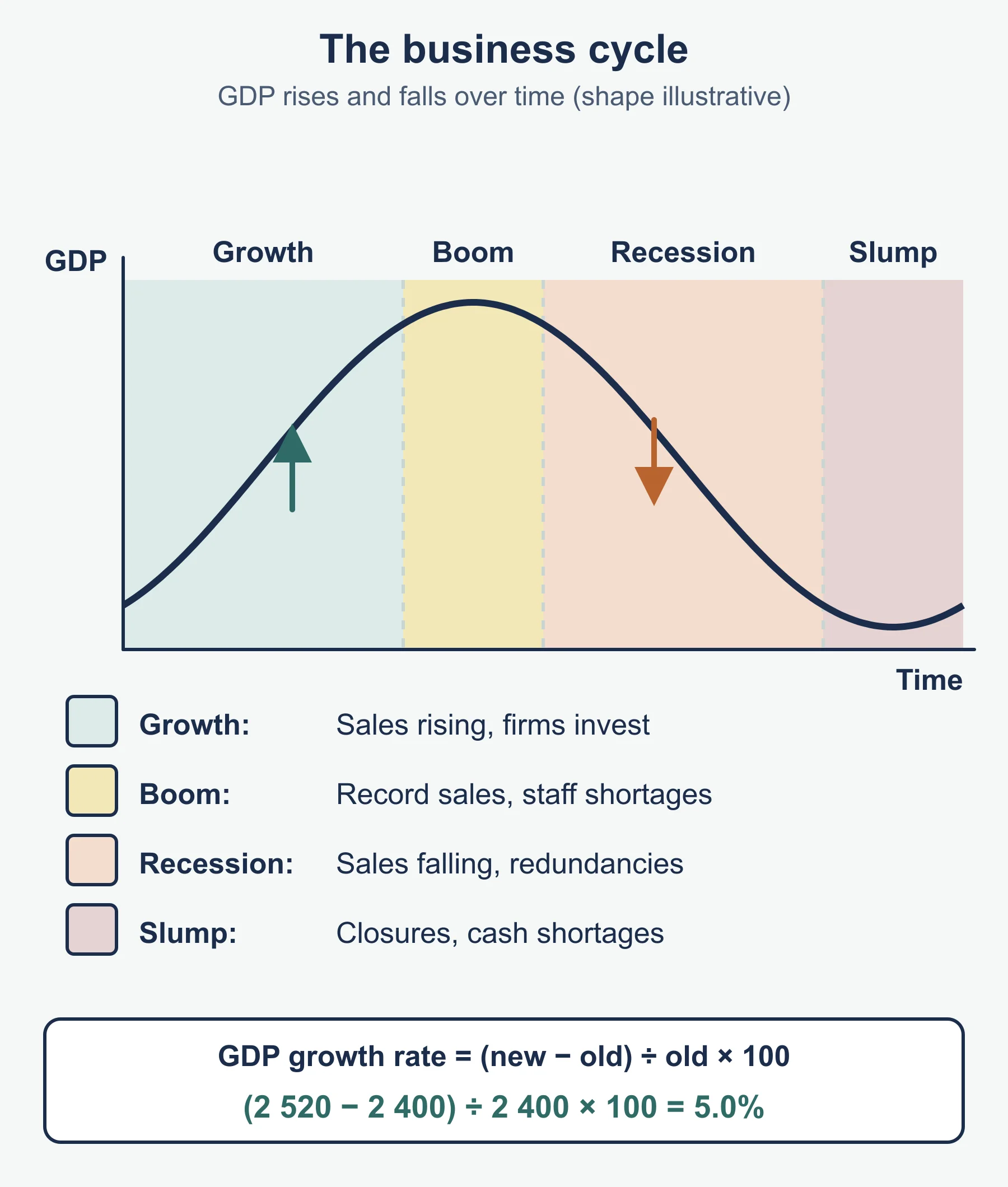
Learn the four stages the syllabus gives as examples, in order of a typical cycle.
| Stage | One-line memory | Business effect |
|---|---|---|
| Growth | GDP rising steadily | Sales up, firms invest |
| Boom | GDP rising fast, very low unemployment | Peak sales, but staff shortages and rising costs |
| Recession | GDP falling | Sales down, redundancies, spare capacity |
| Slump | GDP very low, weak demand | Closures, discounting, cash problems |
Some books add “recovery” after a slump. It acts like growth.
Formulas (standard forms):
| Measure | Formula |
|---|---|
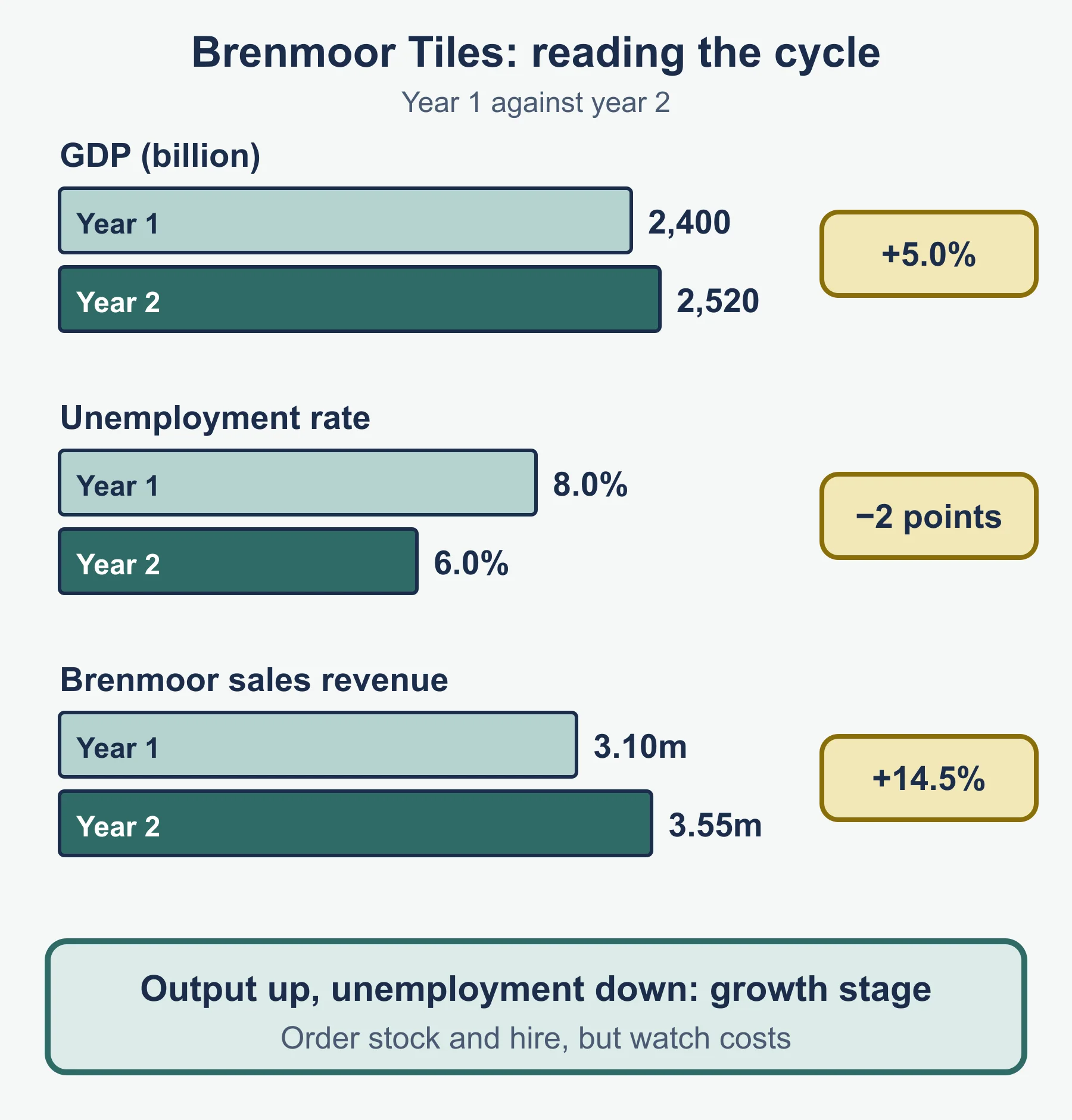
| GDP growth rate | (new GDP - old GDP) / old GDP × 100 |
| Inflation rate | (new index - old index) ÷ old index × 100 |
| Unemployment rate | unemployed / labour force × 100 |
| Profit margin | profit / sales revenue × 100 |
| After-tax profit | profit before tax × (1 - tax rate) |
Effects of employment, inflation and GDP
| Change | Likely effect on a business |
|---|---|
| Employment up | More spending power, higher demand, harder to recruit, pressure on pay |
| Employment down | Weaker demand, easier recruitment, redundancy costs may arise |
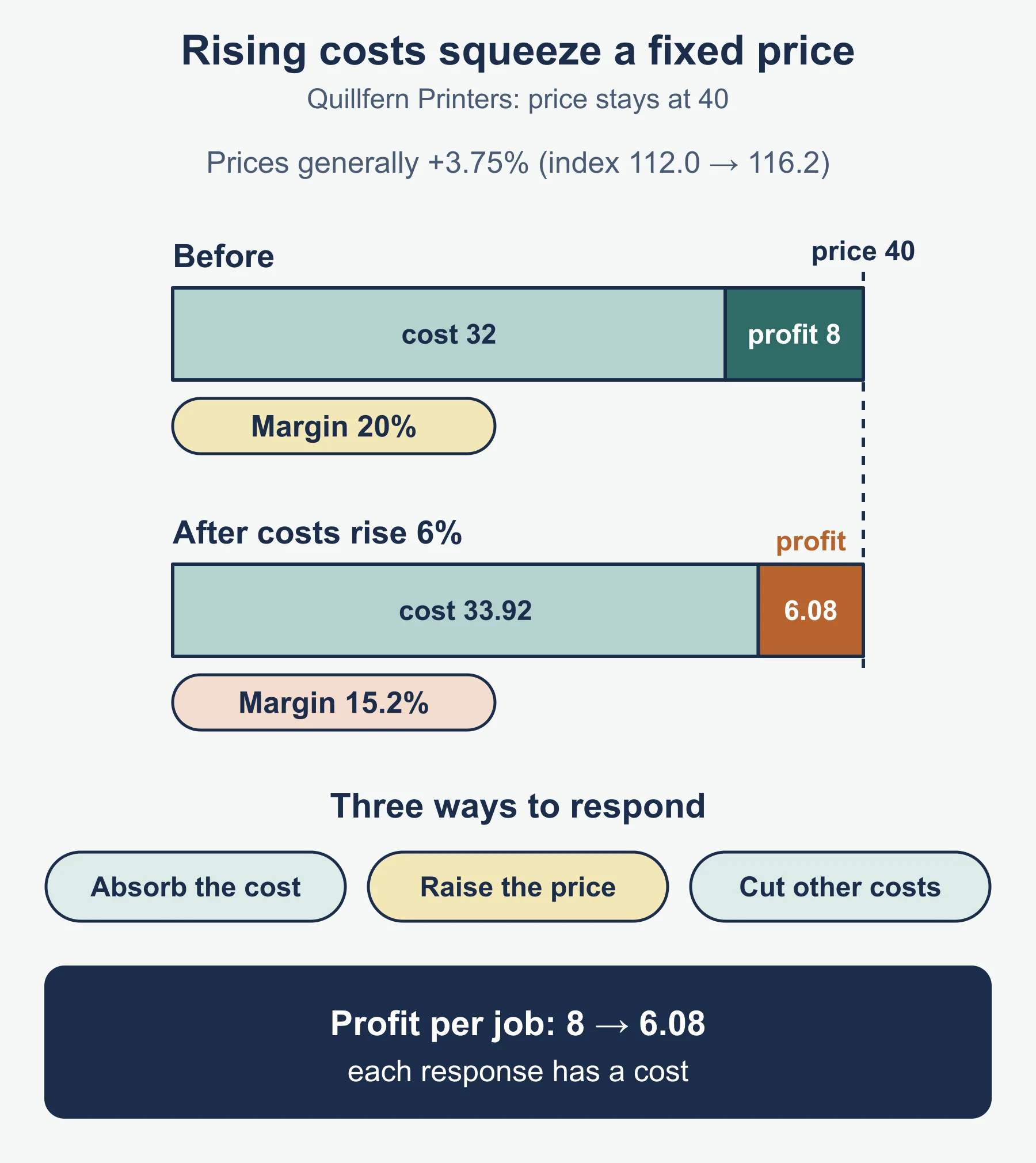
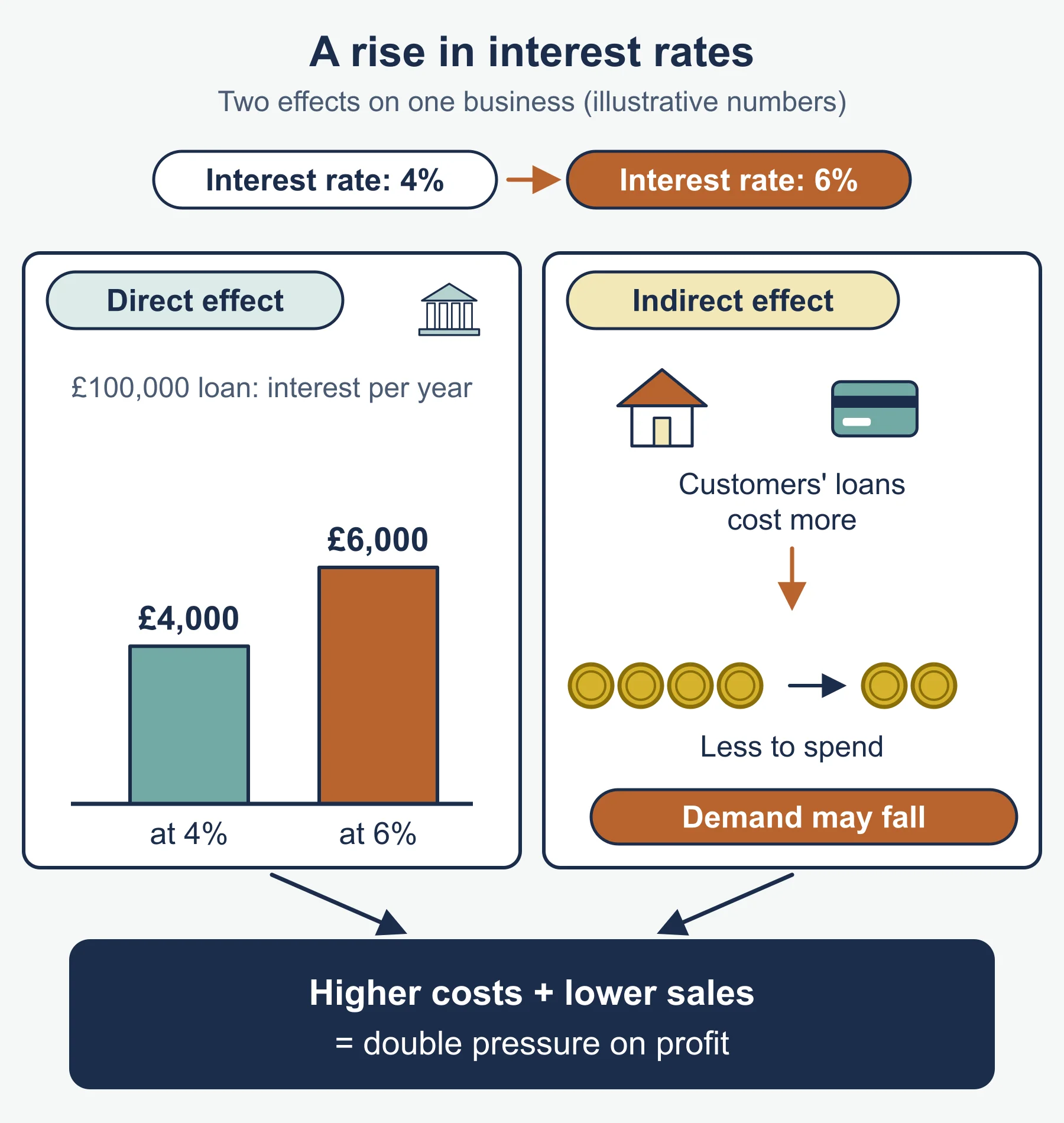
| Inflation up | Costs rise; margin squeezed unless prices rise; customers may cut back |
| Inflation down or stable | Easier to plan, cost and price |
| GDP up | Higher incomes, more sales, expansion |
| GDP down | Lower sales, cuts in output, jobs and investment |
Government objectives and tools (6.1.2)
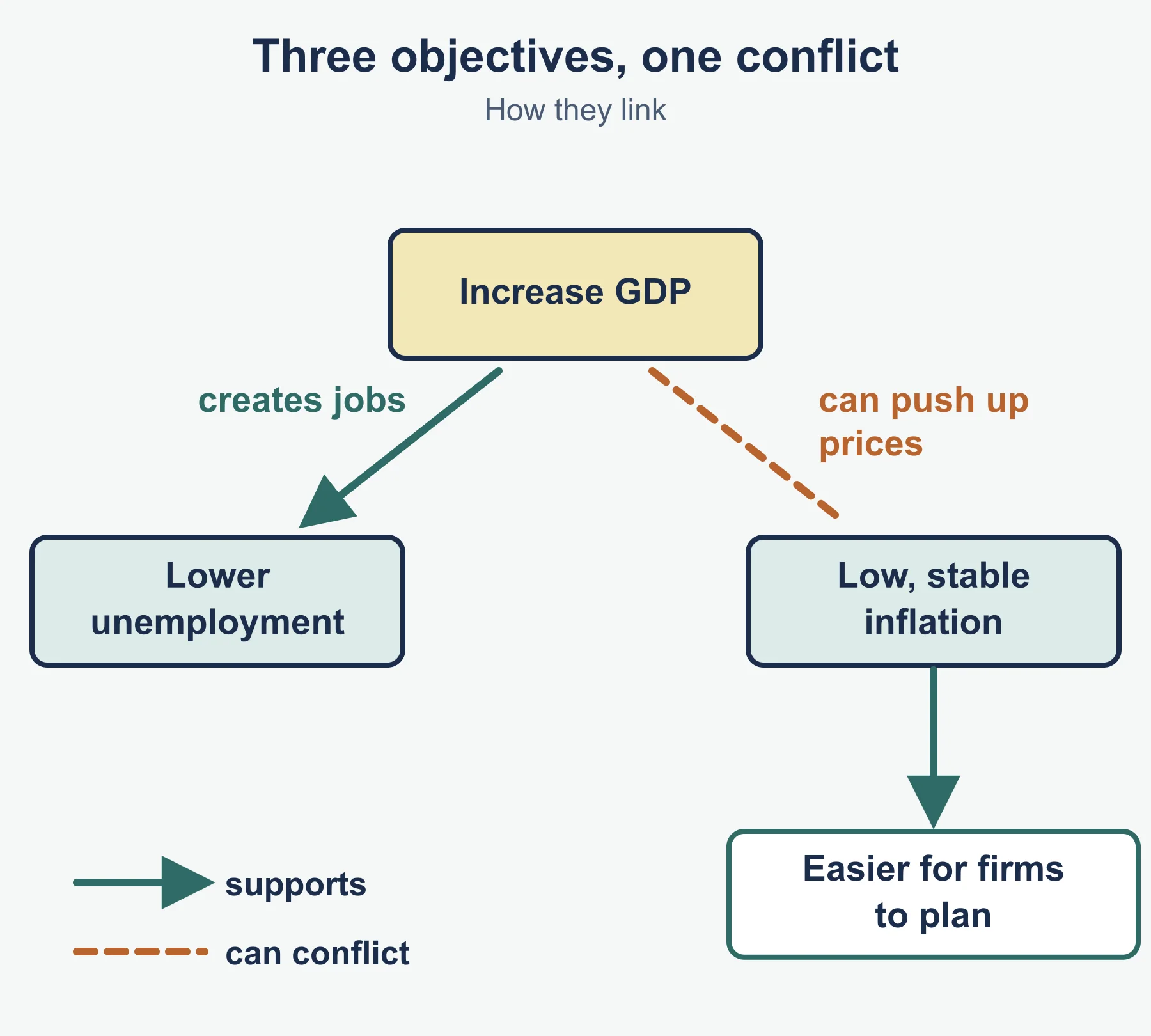
Objectives: increasing GDP (the syllabus example); other common ones are lower unemployment and low, stable inflation. Tools: taxes, government spending and interest rates (often set through the central bank).
| Tool | Cut or lower | Raise or increase |
|---|---|---|
| Profit tax | Firms keep more profit, can invest | Less profit retained, less investment |
| Income tax | Households have more to spend | Households have less to spend, wage demands may rise |
| Sales tax | Prices fall, demand may rise | Prices rise, demand may fall |
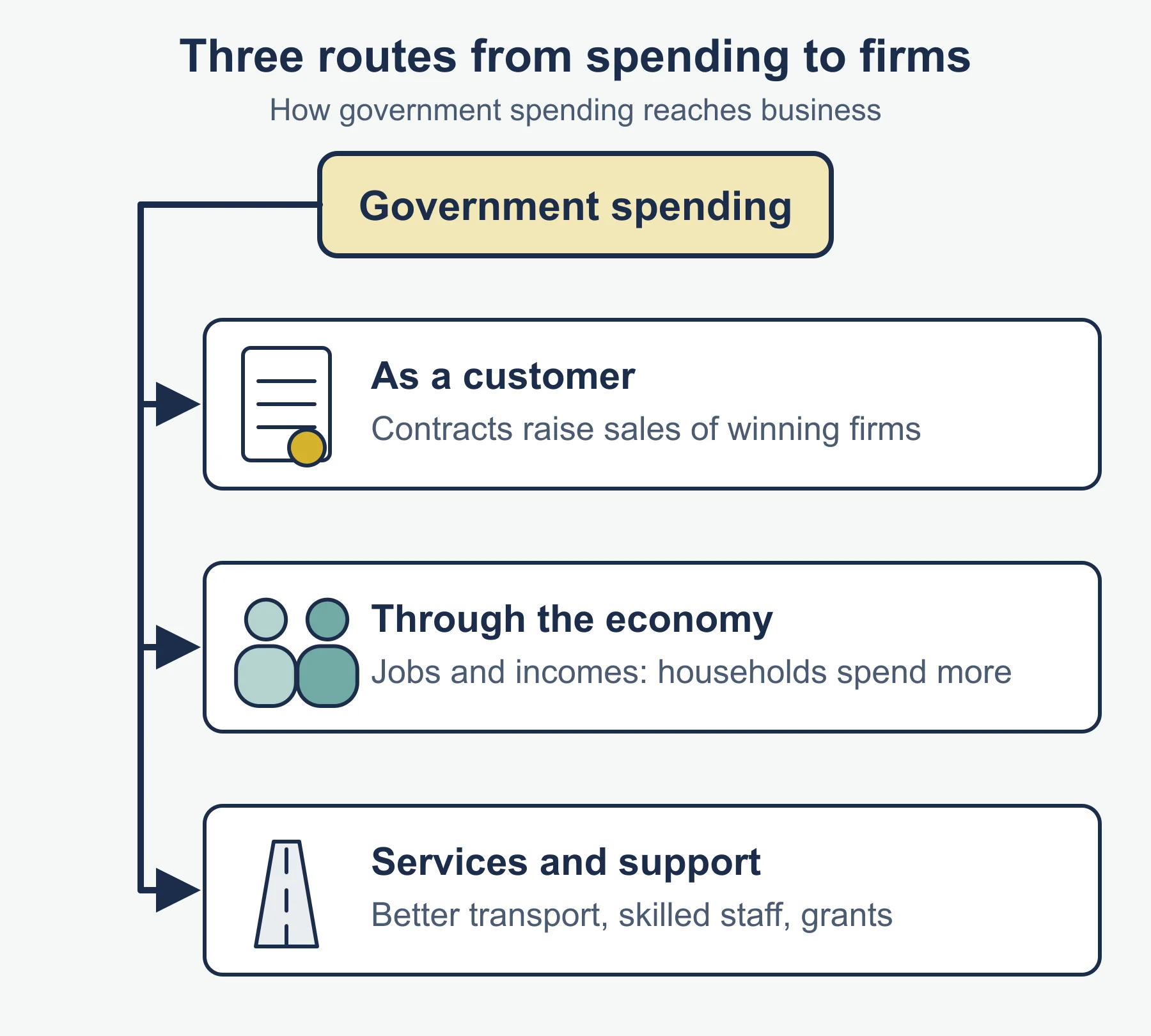
| Government spending | Fewer contracts, less demand | More contracts, more jobs and incomes |
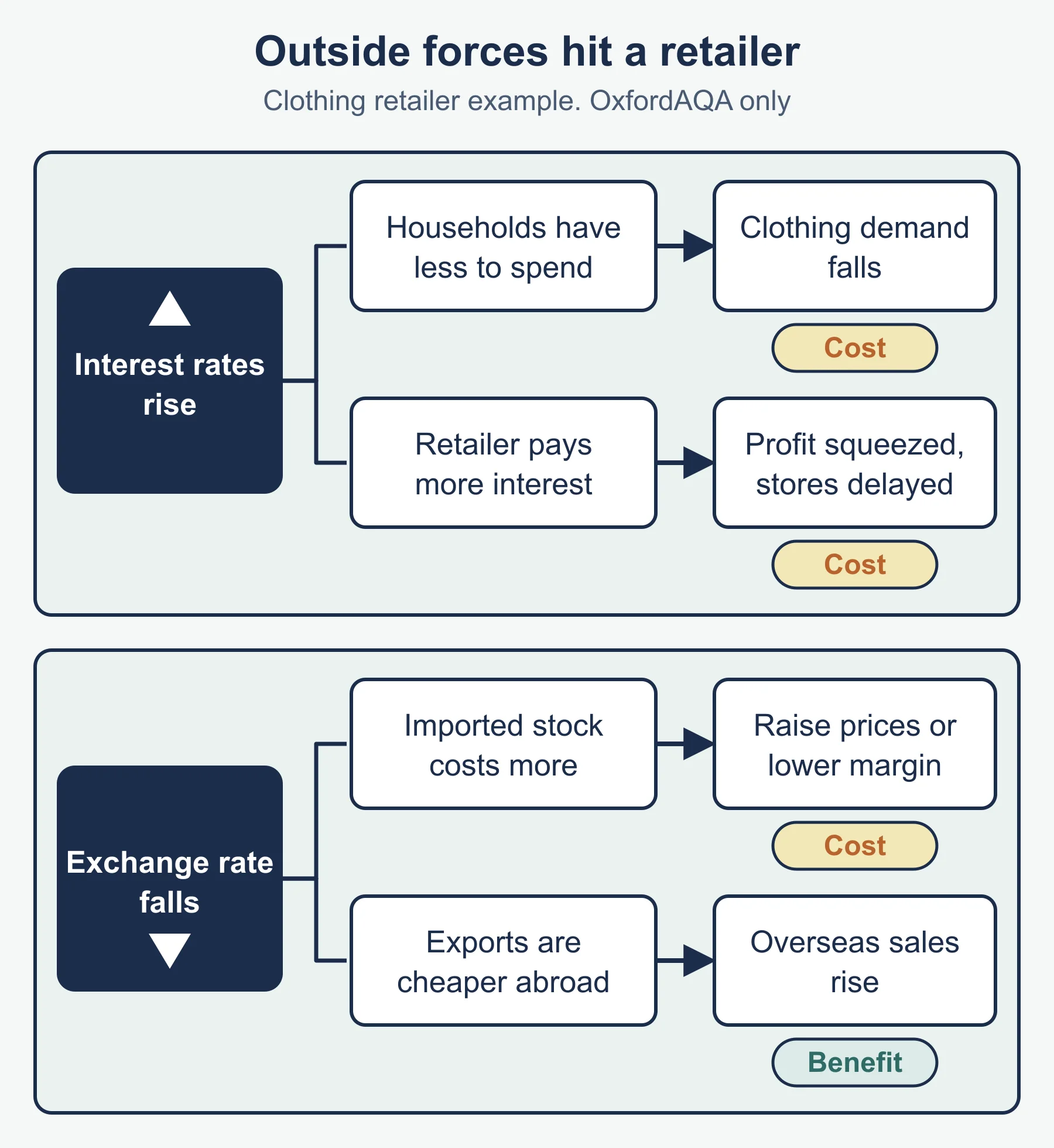
| Interest rates | Cheaper loans, more borrowing and spending | Dearer loans, less borrowing and spending |
Method: explaining an effect
- State the change.
- Say who it affects (business, customers, workers).
- Say what changes in the business: price, demand, cost, profit or cash.
- Use the numbers or the context in the stem.
- Add a response or a judgement if the command word asks for one.
Method: justify a decision
- Pick one option and say why, using the data.
- State the main risk of that option.
- Say why the other option is weaker in this case.
- Add a condition (“this holds if the recession lasts more than a year”).
Business responses at a glance
| Condition | Typical responses |
|---|---|
| Recession or slump | Cut costs, promotions, cheaper lines, new markets, less stock, delay investment |
| Growth or boom | Increase output, recruit, invest, control costs |
| High inflation | Find cheaper suppliers, raise prices, improve efficiency |
| Higher taxes | Cut costs, raise prices, delay investment |
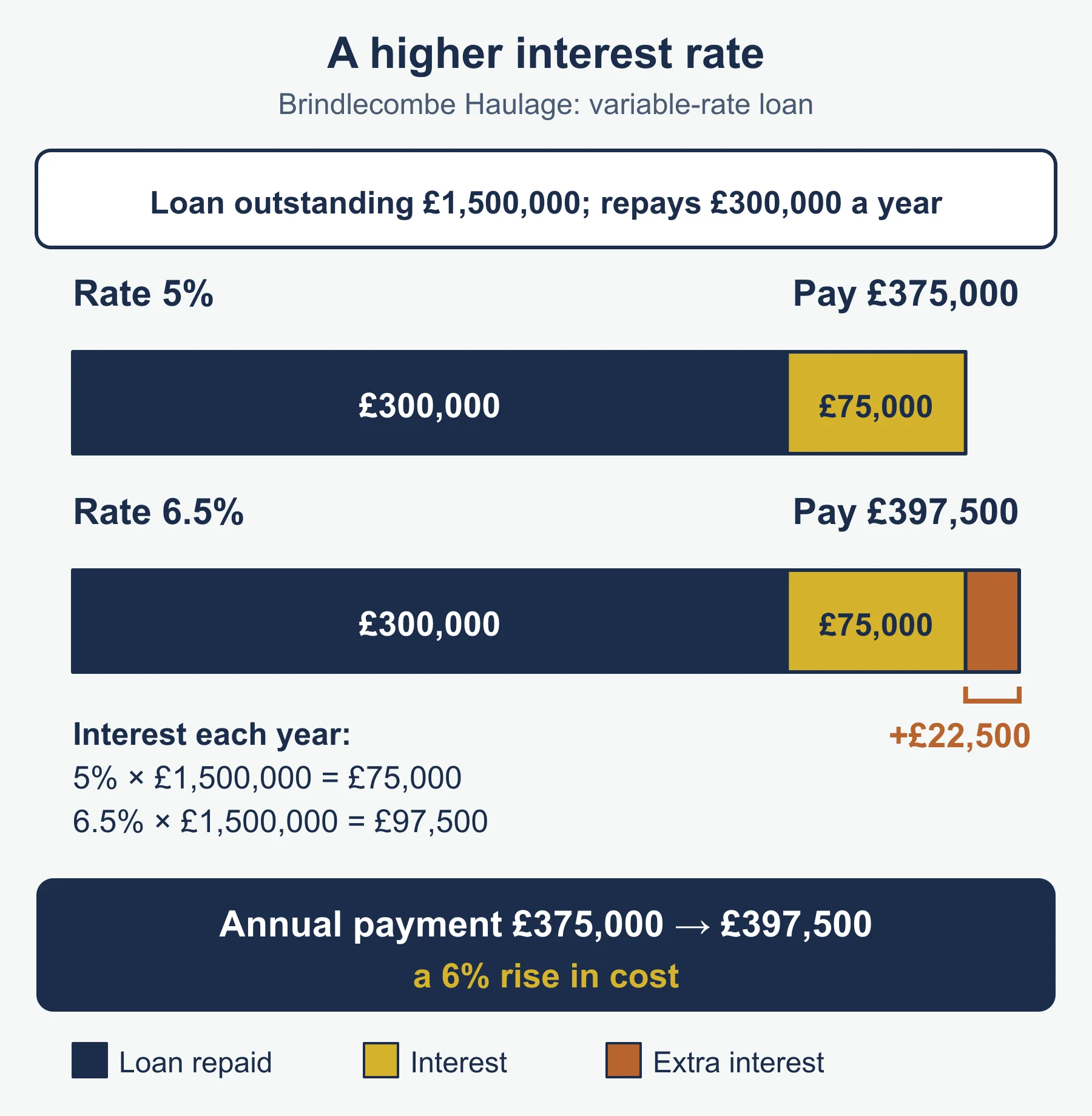
| Higher interest rates | Repay debt, delay borrowing, fixed-rate finance |
| Lower interest rates | Borrow to expand, refinance, target credit-funded purchases |
Every response has a cost. A discount can lower the margin. Delaying investment can leave a firm behind its rivals. Say so.
Command words for this topic
The syllabus lists these command words, with the meanings below.
| Command word | Meaning | In this topic |
|---|---|---|
| State | Express in clear terms | Name a stage of the cycle or a government objective |
| Identify | Name, select, recognise | Pick the stage from a description or table |
| Define | Give precise meaning | GDP, inflation, interest rate |
| Calculate | Work out from given figures | Growth rate, inflation rate, tax, interest |
| Outline | Set out the main points | Several effects of a spending cut, briefly |
| Explain | Say why or how, with evidence | Link a change to a result for the business |
| Justify | Support a case with evidence or argument | Back a recommended response |
| Consider | Review and respond to given information | Use the data in the stem |
Why the same change hits firms differently
The effect depends on the business, so check the stem for these clues.
| Clue in the stem | What it changes |
|---|---|
| Sells big purchases bought on credit (cars, furniture) | More exposed to interest rates and to recession |
| Sells basic goods such as bread | Less exposed to recession; costs still rise with inflation |
| Has a large variable-rate loan | Interest rise hits profit directly |
| Sells to the government | Spending cuts matter most |
| Exports or imports | Pay attention to cost changes and demand in other countries |
| Labour-intensive | Wage pressure matters in a boom |
Use at least one such clue in each answer. It turns a general point into application.
Small worked reminders
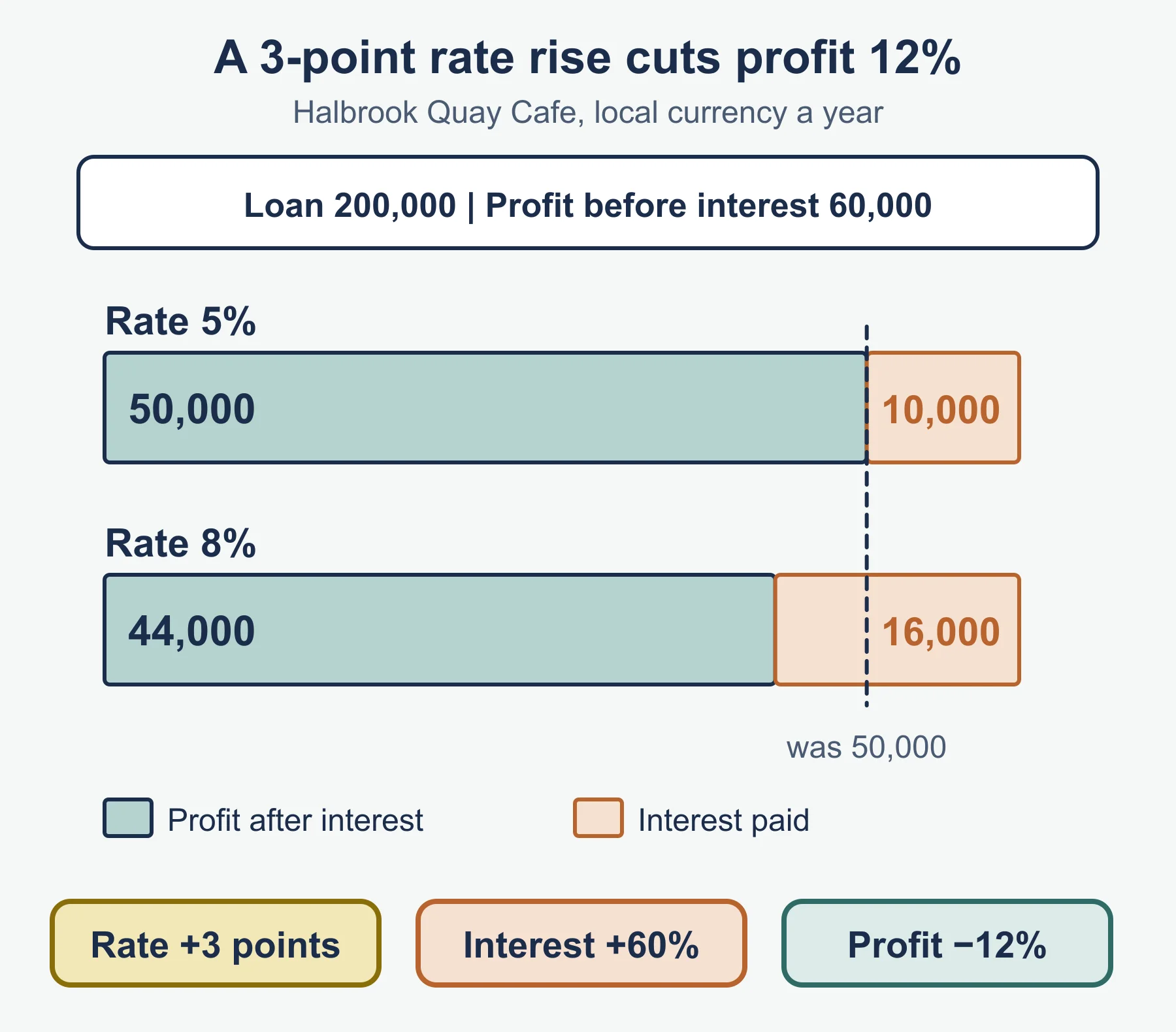
Varnley Bakery has a 100,000 loan at 6%. Interest is 100,000 × 0.06 = 6,000 a year. At 9% it is 9,000. The bill is up 3,000, or 50%. The rate rose by 3 percentage points, not 50%.
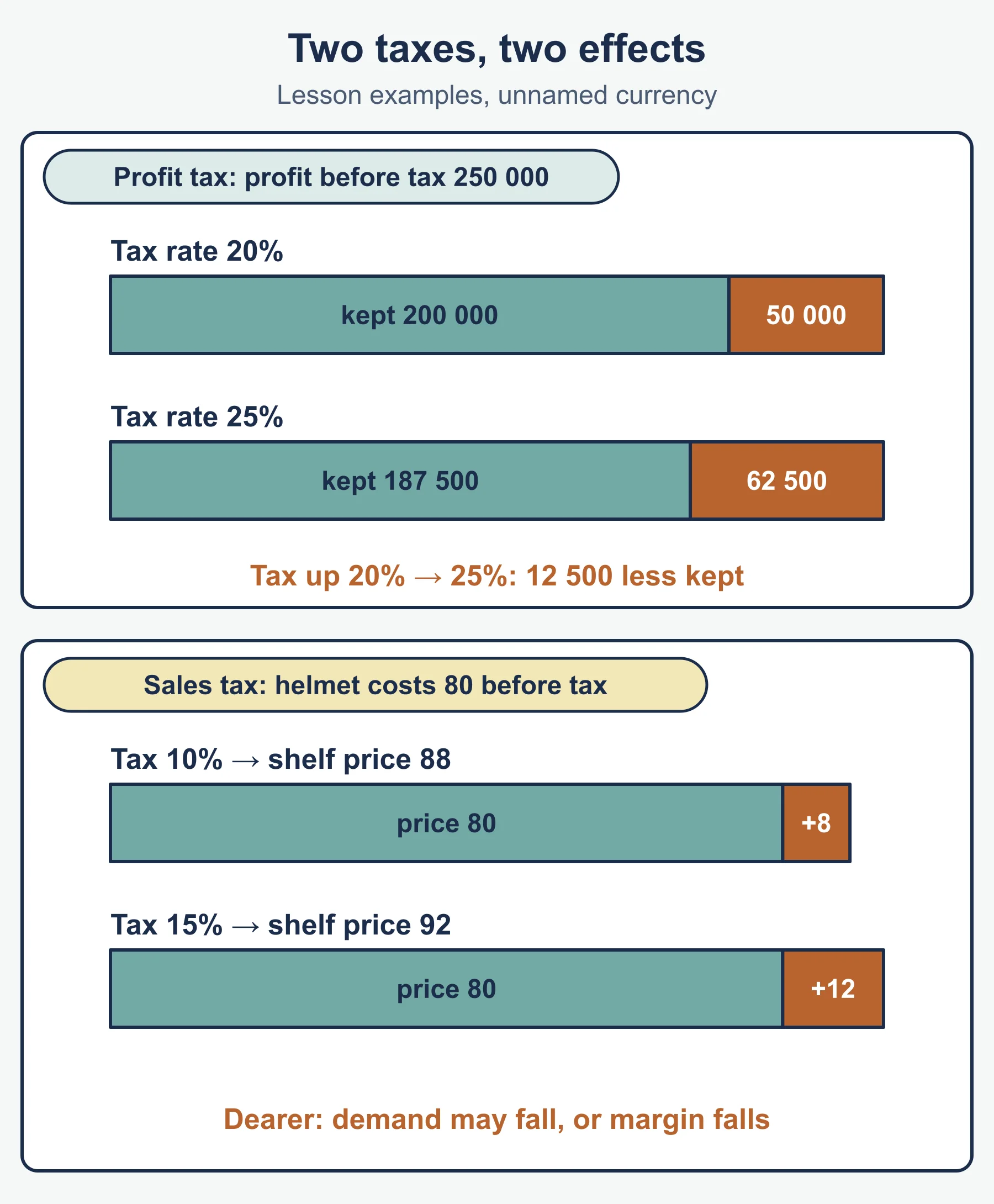
A firm earns 80,000 profit before tax. At a 20% rate, tax is 16,000 and profit after tax is 64,000. If the rate falls to 15%, profit after tax is 80,000 × 0.85 = 68,000, an extra 4,000.
A magazine costs 50 before sales tax. A 12% sales tax makes the shelf price 50 × 1.12 = 56.
Must-know distinctions
- GDP (output) versus inflation (prices): GDP can rise while prices are stable.
- Recession (GDP falling) versus slump (low and staying low).
- Percentage versus percentage point.
- Tax on profit (paid by the business) versus tax on sales (added to the price).
- Fixed-rate versus variable-rate loan: only the variable-rate loan moves with a rise in market rates.
- Government spending as a customer (contracts) versus spending that changes the whole economy.
Quick self-test
- Name the four stages of the business cycle given as examples in the syllabus.
- Define Gross Domestic Product.
- GDP rises from 1,800 billion to 1,890 billion. Calculate the growth rate.
- A price index rises from 100.0 to 106.2. Calculate the inflation rate.
- State one effect of a boom on a firm’s costs.
- A business has profit before tax of 80,000. Tax falls from 20% to 15%. Calculate the change in profit after tax.
- A magazine costs 50 before sales tax. Calculate the price with a 12% sales tax.
- Explain one way a rise in interest rates could reduce sales for a furniture shop.
- There are 40m people in the labour force and 2.4m are unemployed. Calculate the unemployment rate.
- State one way a firm could respond to a recession, and one cost of that response.
Answers
- Growth, boom, recession, slump.
- Everything a country produces, goods and services, added up in money terms for a set time.
- (1,890 - 1,800) / 1,800 × 100 = 5.0%.
- (106.2 - 100.0) / 100.0 × 100 = 6.2%.
- Any one: wages rise as staff are scarce; materials cost more; suppliers raise prices; overtime is needed.
- Old after-tax profit 64,000; new 68,000; the change is an increase of 4,000.
- 50 × 1.12 = 56.
- Customers often buy furniture with loans, so higher interest makes the purchase dearer and some delay it; fewer sales follow.
- 2.4 / 40 × 100 = 6%.
- For example, cut prices to hold sales, which lowers the margin on every item. Other valid pairs: cut costs (staff morale suffers), delay investment (may fall behind rivals).
Where marks are usually lost
- Describing a stage of the cycle without any effect on a business.
- Giving the direction of a change but not the link (“tax rises so profit falls” with no reason).
- Mixing up a rise in the tax rate on profit with a rise in sales tax.
- Writing about a firm with no loan as if it paid interest.
- Forgetting percentage points when comparing rates.
- Listing responses with no reason they suit this firm.
- Recommending without weighing the alternative.
- Ignoring figures provided in the stem.
Frequently asked questions
What is the difference between a percentage point and a percentage? A rate moving from 5% to 8% has risen by 3 percentage points, but the interest bill on a loan at that rate rises by 60%. Treating the two as the same is a common error.
Why does the same economic change affect businesses differently? Each firm’s position differs: a firm with no loan is not hurt by a rise in interest rates on loans, while one with a large variable-rate loan is. Apply the change to the type of business in the question.
What is the difference between a fixed-rate and a variable-rate loan? A variable-rate loan changes when market interest rates change. A fixed-rate loan stays the same for an agreed period, so the business is protected from a rise during that time.
What is GDP? Gross Domestic Product is the value of goods and services produced within a country over a period, usually a year. It is not money held by the government.
Official syllabus
Cambridge O Level Business Studies 7115 syllabus for 2026, Cambridge University Press & Assessment (Cambridge Assessment International Education), section 6.1 Economic issues.
Get free revision emails (optional)
Occasional emails with practice questions, worked explanations and links to free resources for the qualification and subjects you choose. No spam, and you can unsubscribe from any email. The free tools on this site never need an email.
Related resources
-
Study guides
O Level Business: Environmental and ethical issues and Business and the international economy (Cambridge 7115)
Study guide to environmental and ethical issues, globalisation, multinationals and exchange rates for Cambridge O Level Business 7115, with examples.
Business · Cambridge · O Level
Read guide -
Practice questions
O Level Business: Environmental and ethical issues and Business and the international economy (Cambridge 7115) – Practice Questions
Original practice questions with worked answers on externalities, ethics, tariffs, multinationals and exchange rates for Cambridge O Level Business 7115.
Business · Cambridge · O Level
Try questions -
Revision notes
O Level Business: Environmental and ethical issues and Business and the international economy (Cambridge 7115) – Revision Notes
Condensed revision notes on externalities, sustainability, ethics, globalisation, tariffs, MNCs and exchange rates for Cambridge O Level Business 7115.
Business · Cambridge · O Level
Revise topic
Related articles
-
teaching
A Level tuition in Dubai: Cambridge or Pearson Edexcel International A Level?
Schools in Dubai and Abu Dhabi teach either Cambridge International AS & A Level or Pearson Edexcel International A Level. How the two are structured, why it matters for tuition, and how online classes from Lahore work.
9 October 2026
-
curriculum guides
Choosing subjects at IGCSE and A Level
How subject choices at 14 and 16 affect university options later, and how to keep pathways open without overloading a timetable.
28 July 2026
Studying this with a teacher
Working through Business O LEVELS?
This page is free and stays free. If you would rather be taught it, Marlbridge runs Business classes one-to-one and in small groups of up to 15, online in your own time zone. The first trial class is free. WhatsApp replies within an hour (8am–11pm Pakistan time, every day); email the same day.
Cambridge Business teachers at Marlbridge

