
Revision Notes
O Level Business: Marketing mix (Cambridge 7115) – Revision Notes
Condensed revision notes on the marketing mix for Cambridge O Level Business 7115: product, price, place, promotion and e-commerce, plus a quick self-test.
- Subject
- Business
- Level
- O LEVELS
- Topic
- Marketing
- Author
- Marlbridge Academic Team
- Updated
- Reviewed by
- Salman Ahmad (what this means)
Aligned to Cambridge O Level Business (7115), For examination in 2026. Official specification .
Syllabus page (what it covers and how it is assessed): Cambridge O Level Business.
Syllabus points this page covers
7115
- 3.3 Marketing mix
Found an error? Report a correction.
Need help with this topic? Request a free trial class for O Level Business (7115).
These revision notes condense section 3.3 Marketing mix of the Cambridge O Level Business Studies 7115 syllabus for examination in 2026 (3.3.1 to 3.3.5). For explanations and worked examples, read the full study guide first. When you are ready, test yourself with the practice questions. Earlier marketing content is in the Marketing practice set. Course pages: Cambridge O Level Business hub and printable checklist. Not sure where to start? Use the free diagnostics.
Key definitions
| Term | Meaning |
|---|---|
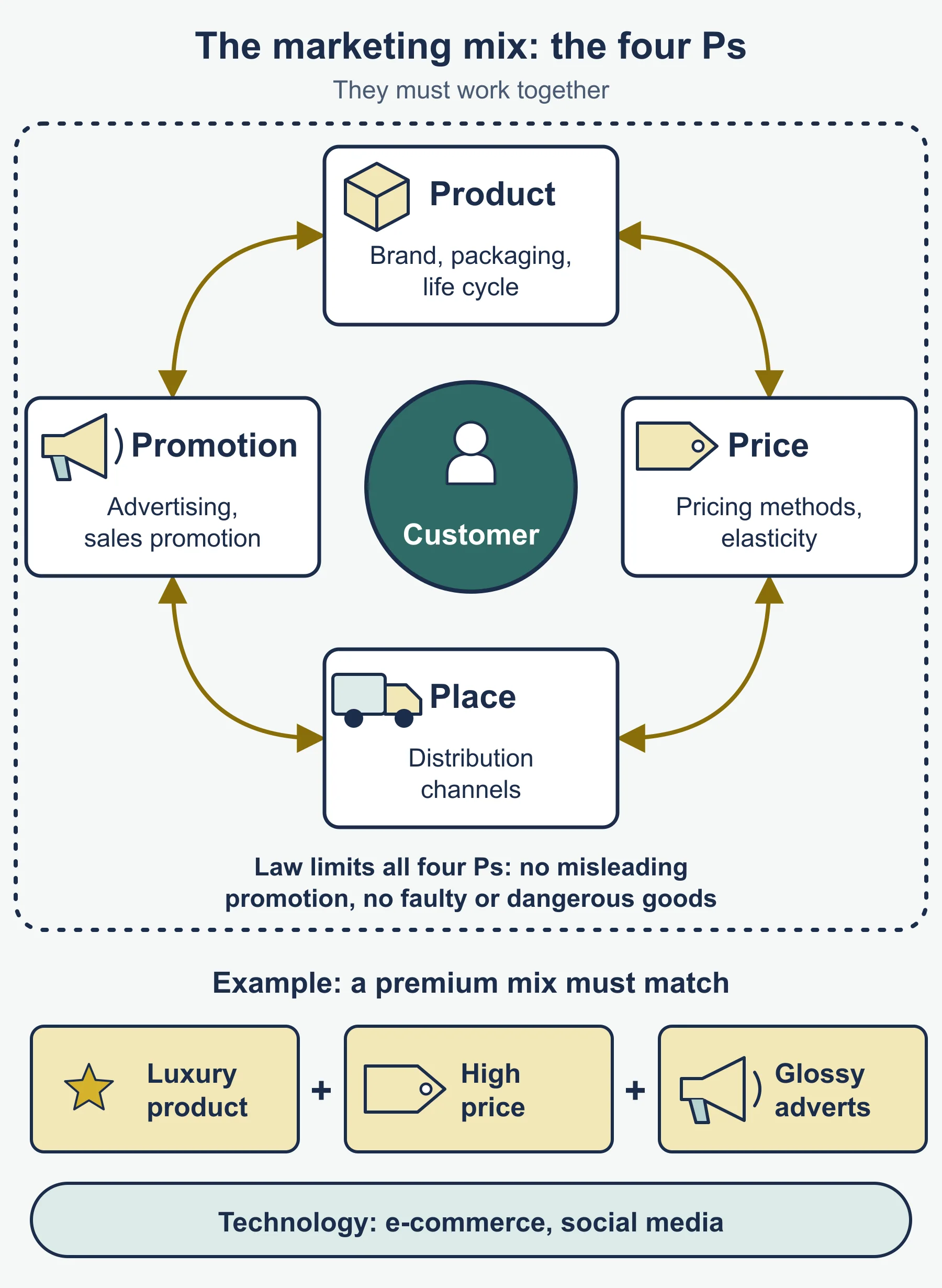
| Marketing mix | The set of choices a business makes about its product, its price, where it sells and how it promotes (the four Ps) |
| Brand image | What customers think and feel about a brand |
| Packaging | The container or wrapping of a product; it protects, informs and promotes |
| Product life cycle | The pattern of a product’s sales over time, from launch to withdrawal |
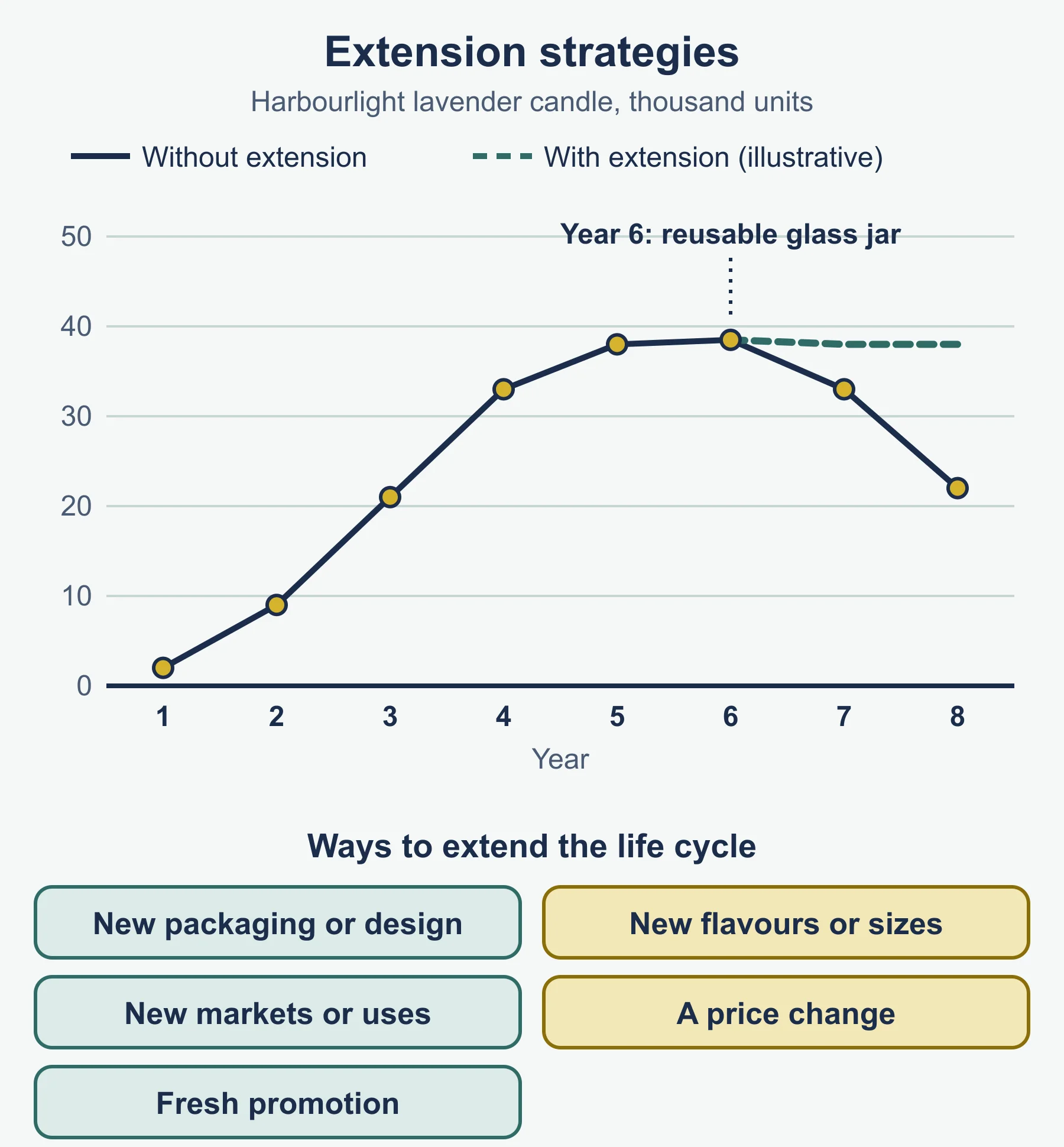
| Extension strategy | An action to lengthen the life of a product before it declines |
| Cost plus pricing | Unit cost plus a percentage mark-up (this is the standard form) |
| Penetration pricing | Low price at launch to gain market share fast |
| Skimming | High price at launch, usually lowered later |
| Price elastic | Quantity demanded changes proportionately more than price |
| Price inelastic | Quantity demanded changes proportionately less than price |
| Distribution channel | The route a product takes from producer to consumer |
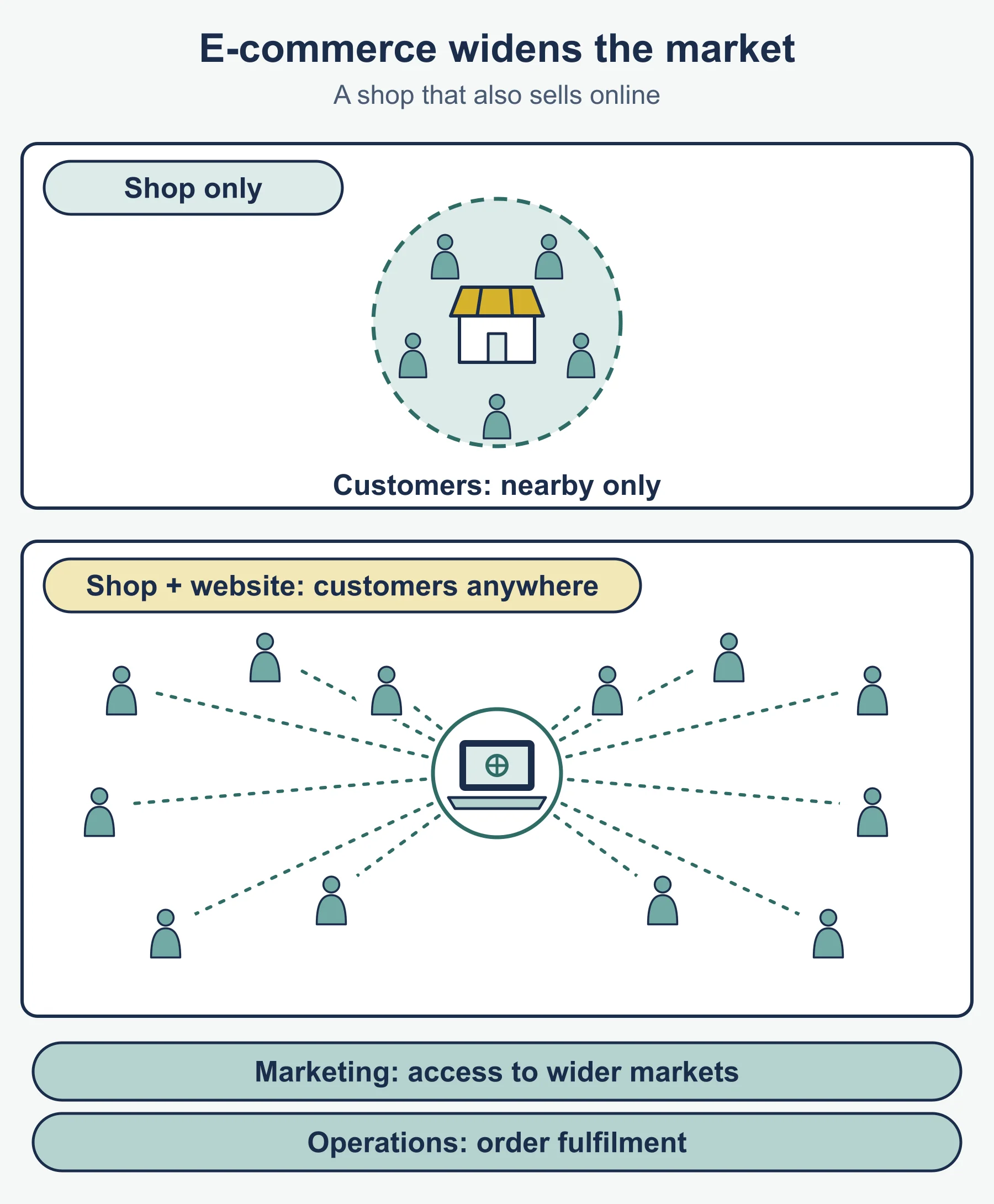
| E-commerce | Buying and selling of goods and services over the internet |
3.3.1 Product
New products: benefits are new markets, replacing declining lines and a stronger position against rivals. Limitations are high cost, risk of failure and sales taken from existing products.
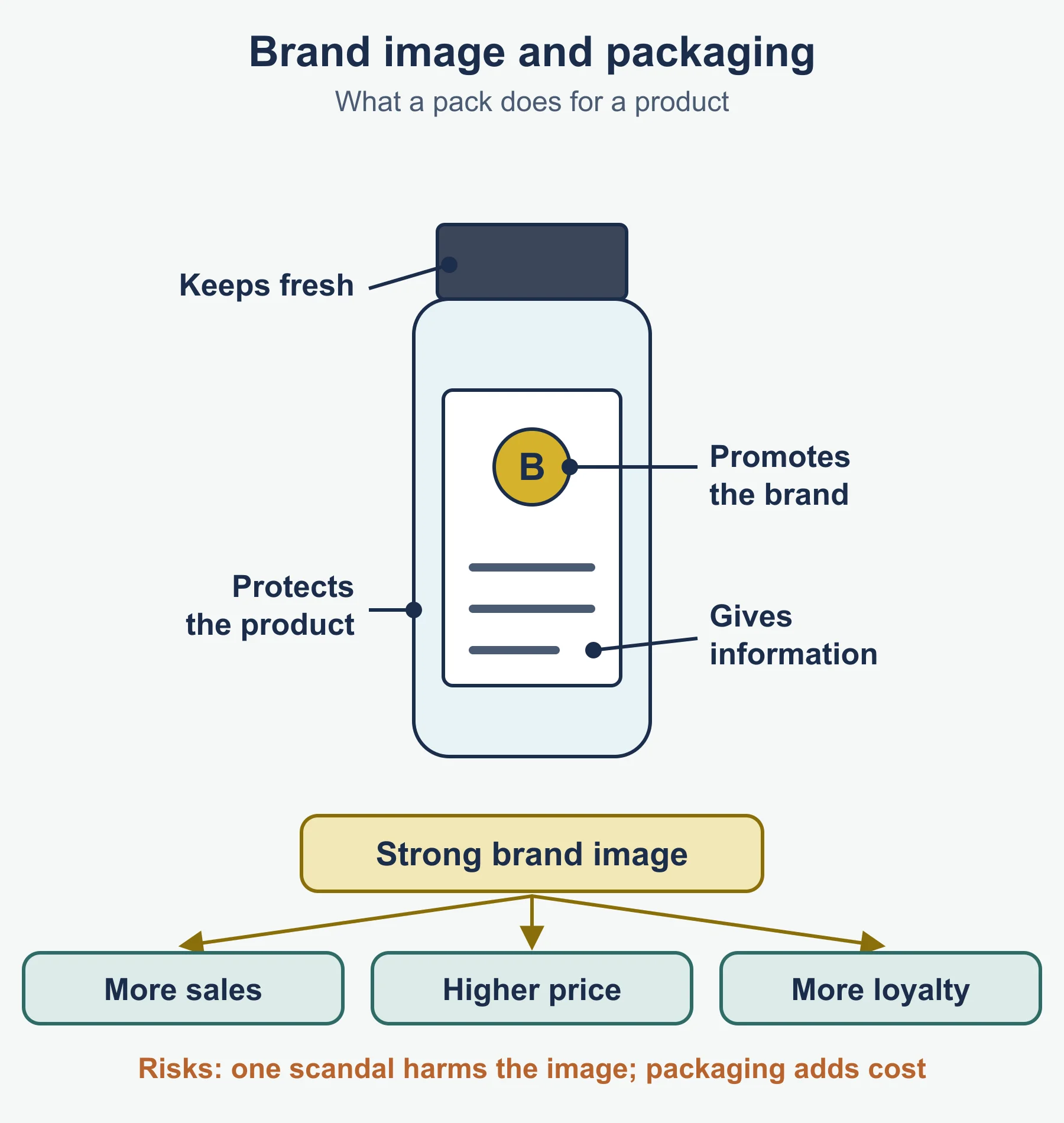
Brand image: positive image supports sales, can allow higher prices and builds loyalty. A damaged image can cut sales fast.
Packaging roles:
- protects the product
- keeps it fresh
- gives information
- promotes the brand
- adds cost
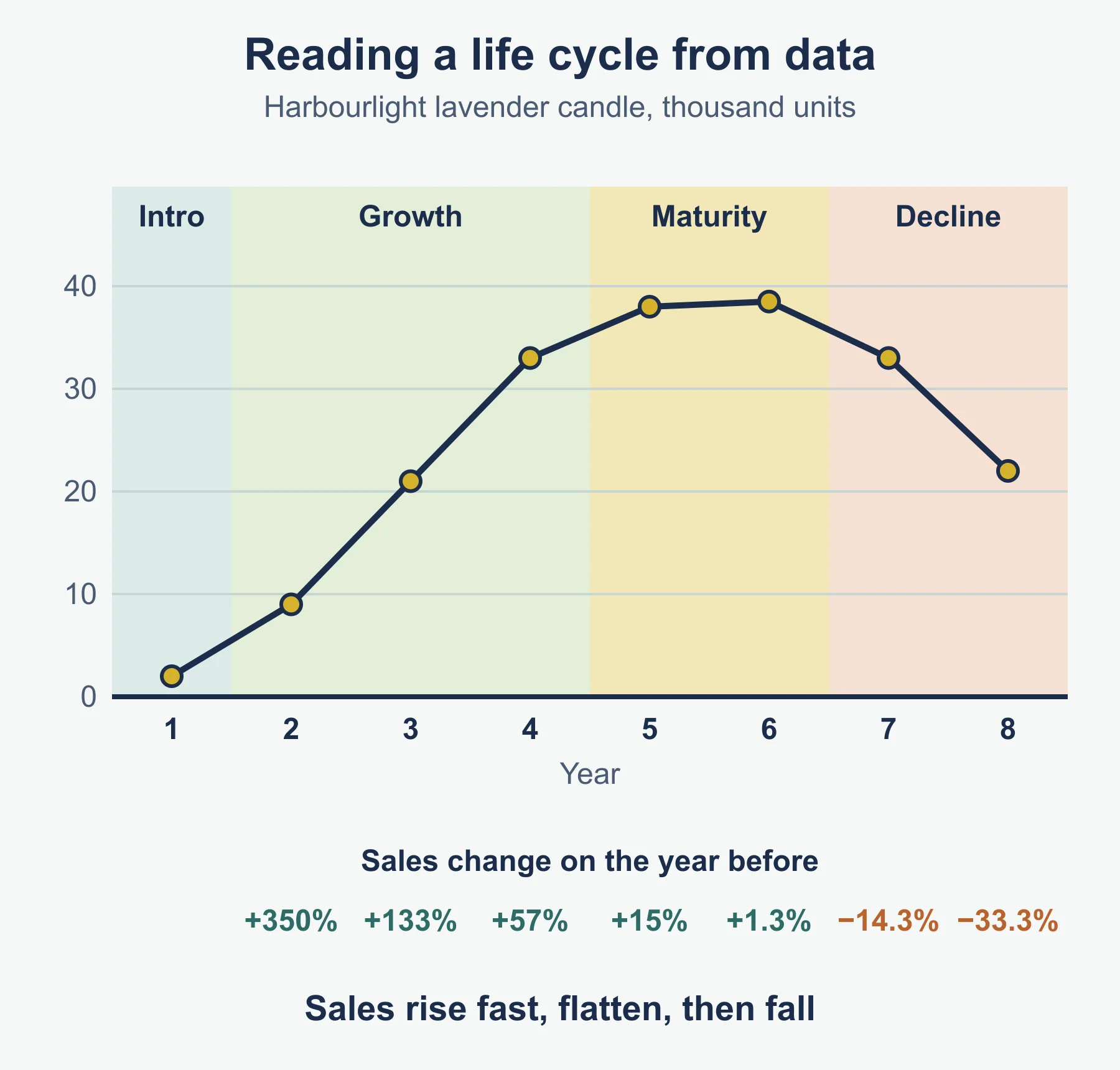
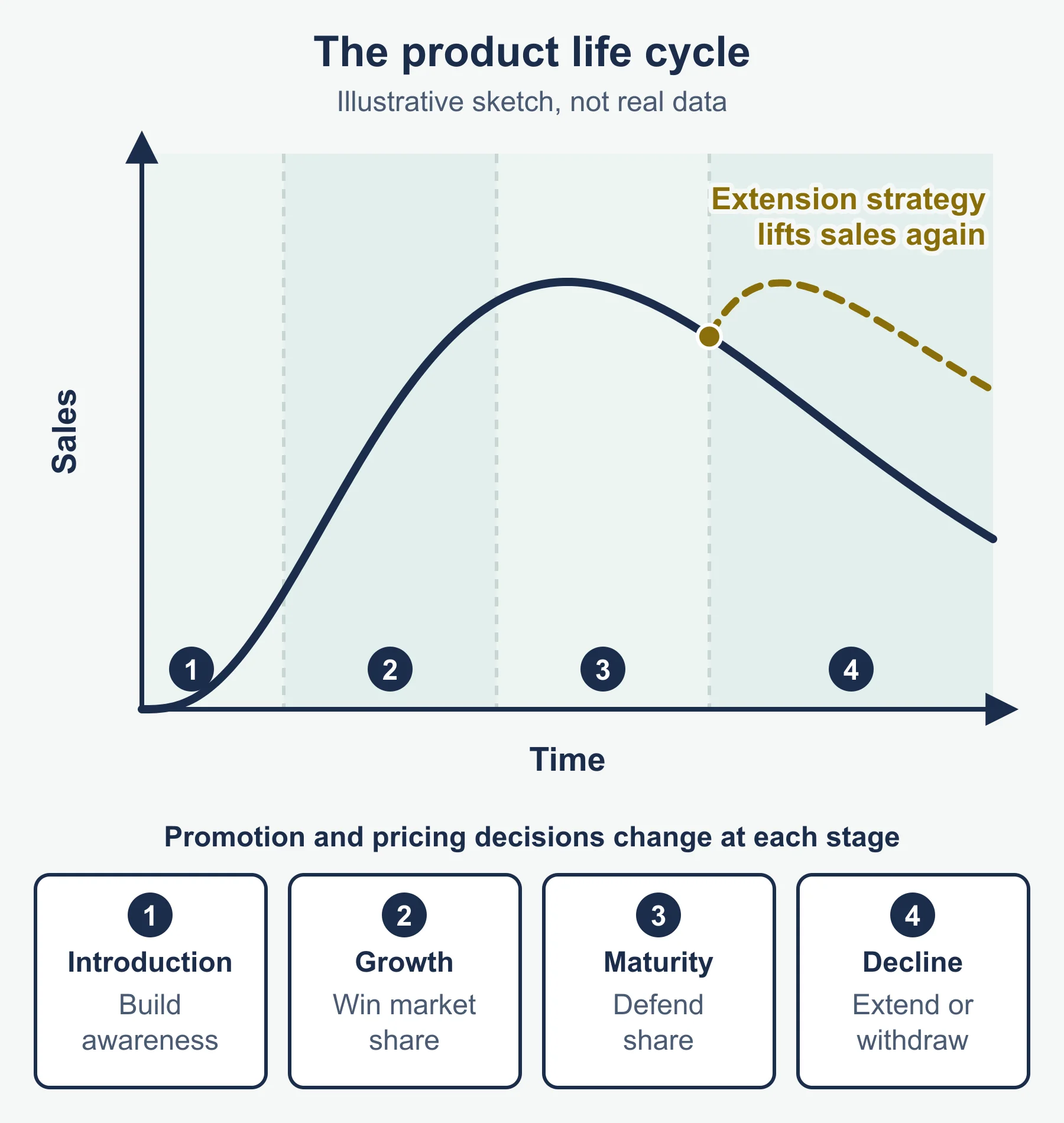
Product life cycle method in steps:
- Look at the direction of sales.
- Rising fast from a low base: introduction or early growth.
- Rising but slowing: late growth.
- Flat: maturity.
- Falling: decline.
- Quote figures from the data to support your choice.
| Stage | Sales | Promotion | Pricing |
|---|---|---|---|
| Development | None; costs only | None yet | Price being planned |
| Introduction | Low | Inform | Penetration or skimming |
| Growth | Rising fast | Persuade; build brand | Hold or adjust as rivals enter |
| Maturity | Peak, flat | Remind; defend share | Competitive or promotional |
| Decline | Falling | Cut, or extend life | Clear stock or withdraw |
Extension strategies: new packaging or design, new variants, new markets, new uses, price change, fresh promotion.
3.3.2 Price
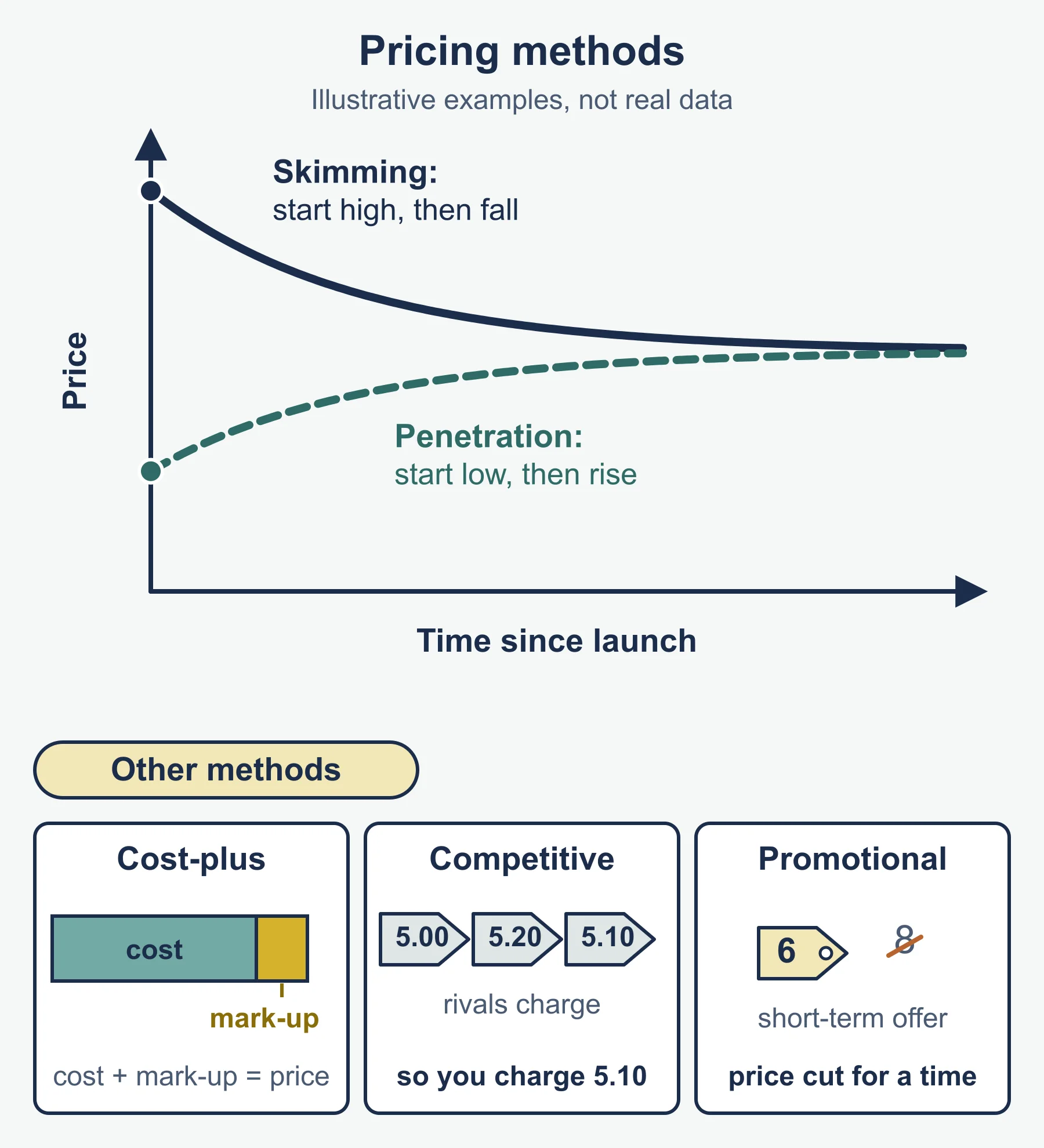
| Method | Use when | Main limitation |
|---|---|---|
| Cost plus | Costs are known and there are few rivals | Ignores competitors and customers |
| Competitive | Many similar rivals | Limited freedom on price |
| Penetration | New entrant needs share quickly | Low profit per unit at first |
| Skimming | Unique or novel product | Small sales; attracts rivals |
| Promotional | Clearing stock or short-term boost | Cuts profit; customers may wait for offers |
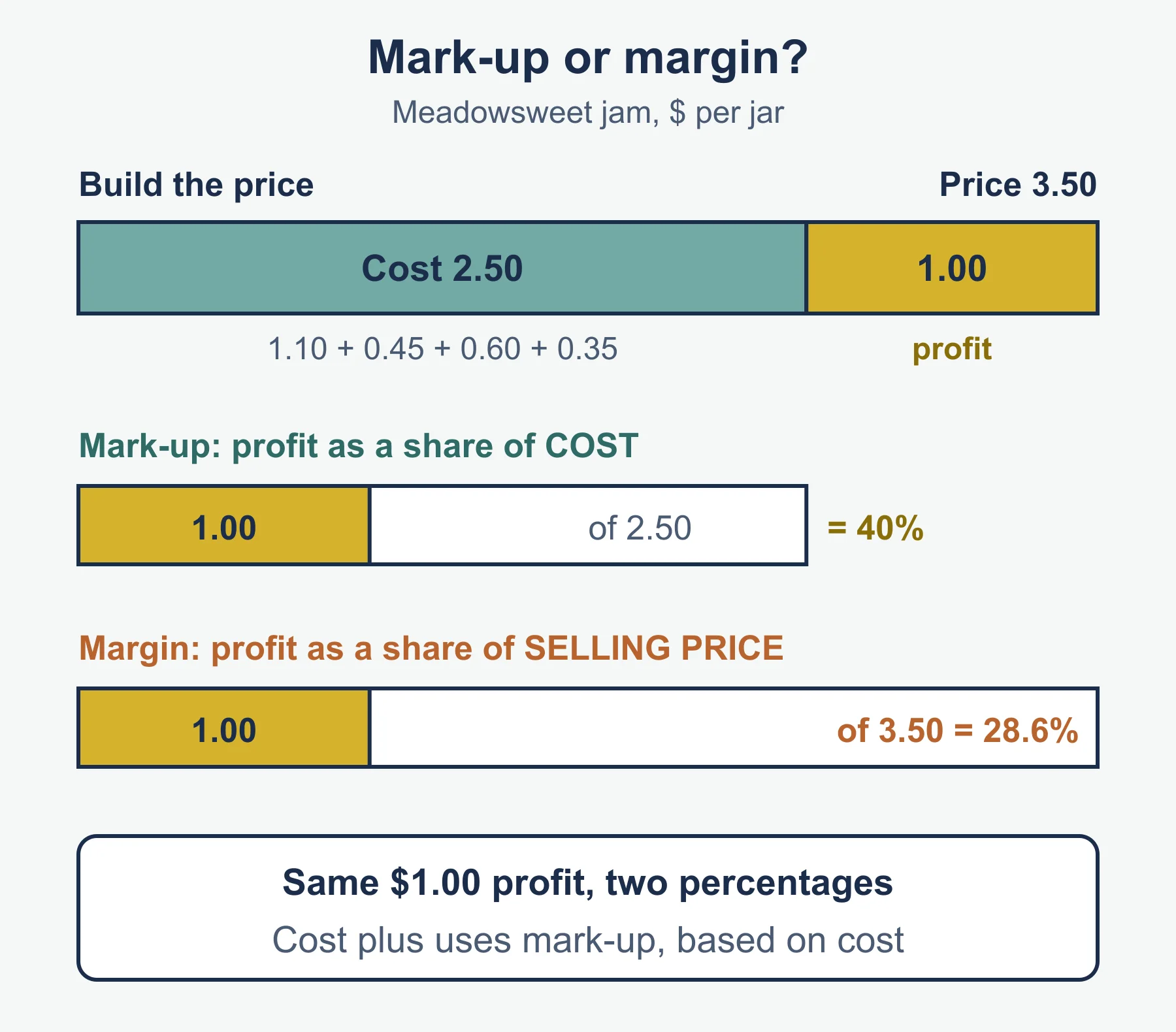
Cost plus reminder. Mark-up is a percentage of cost. A unit costing 12 sold at 15 has a 25% mark-up on cost, but profit is 20% of the selling price. Do not swap the two.
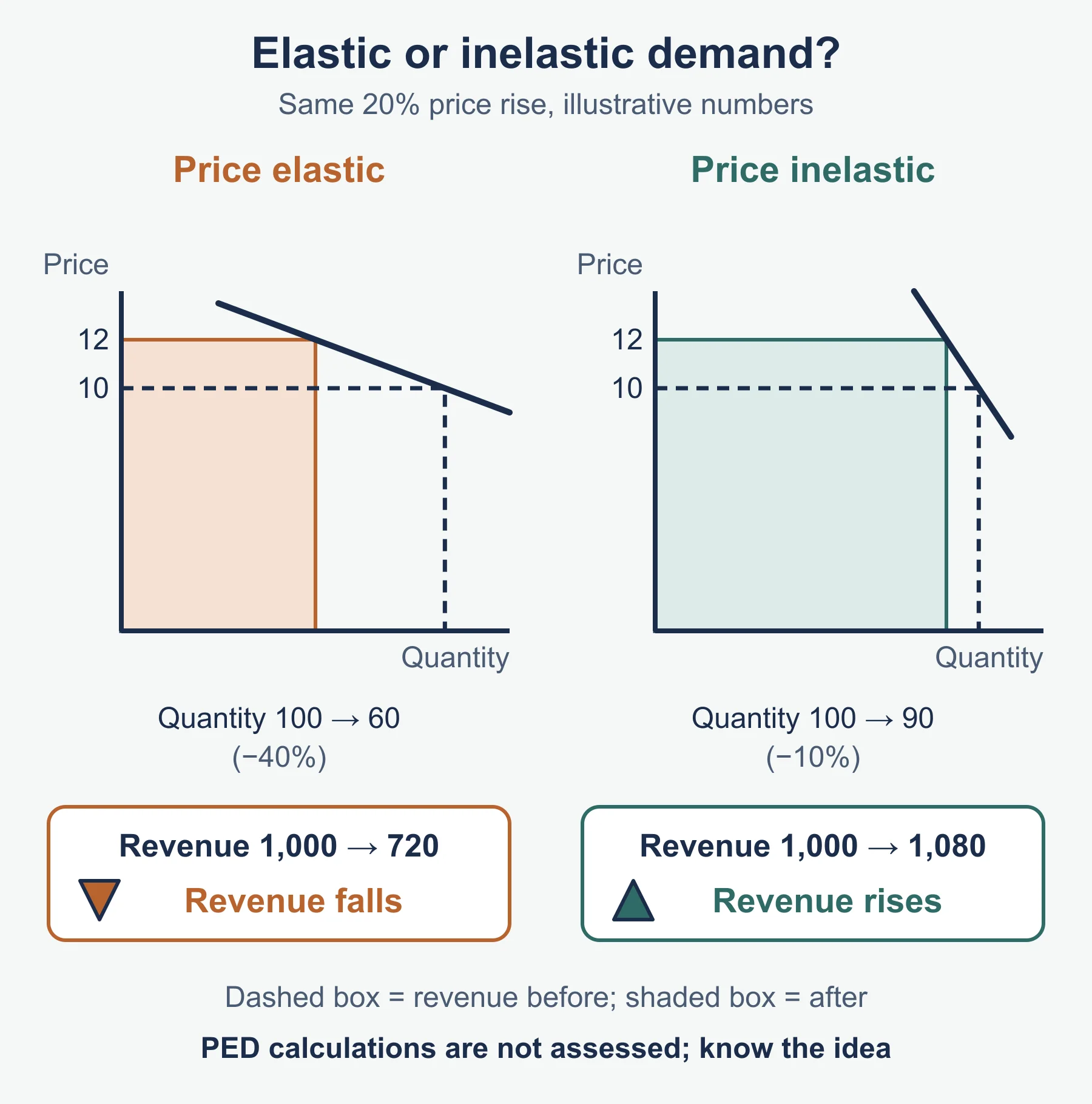
Elasticity:
- Elastic: price cut can raise revenue; price rise can lose many customers.
- Inelastic: price rise can raise revenue; price cut gives away revenue.
- Many substitutes tends toward elastic; necessity or strong brand tends toward inelastic.
- The syllabus says PED formula and calculations are not assessed.
Recommend and justify method: name the method, say why it fits the business described, state one limitation.
3.3.3 Place
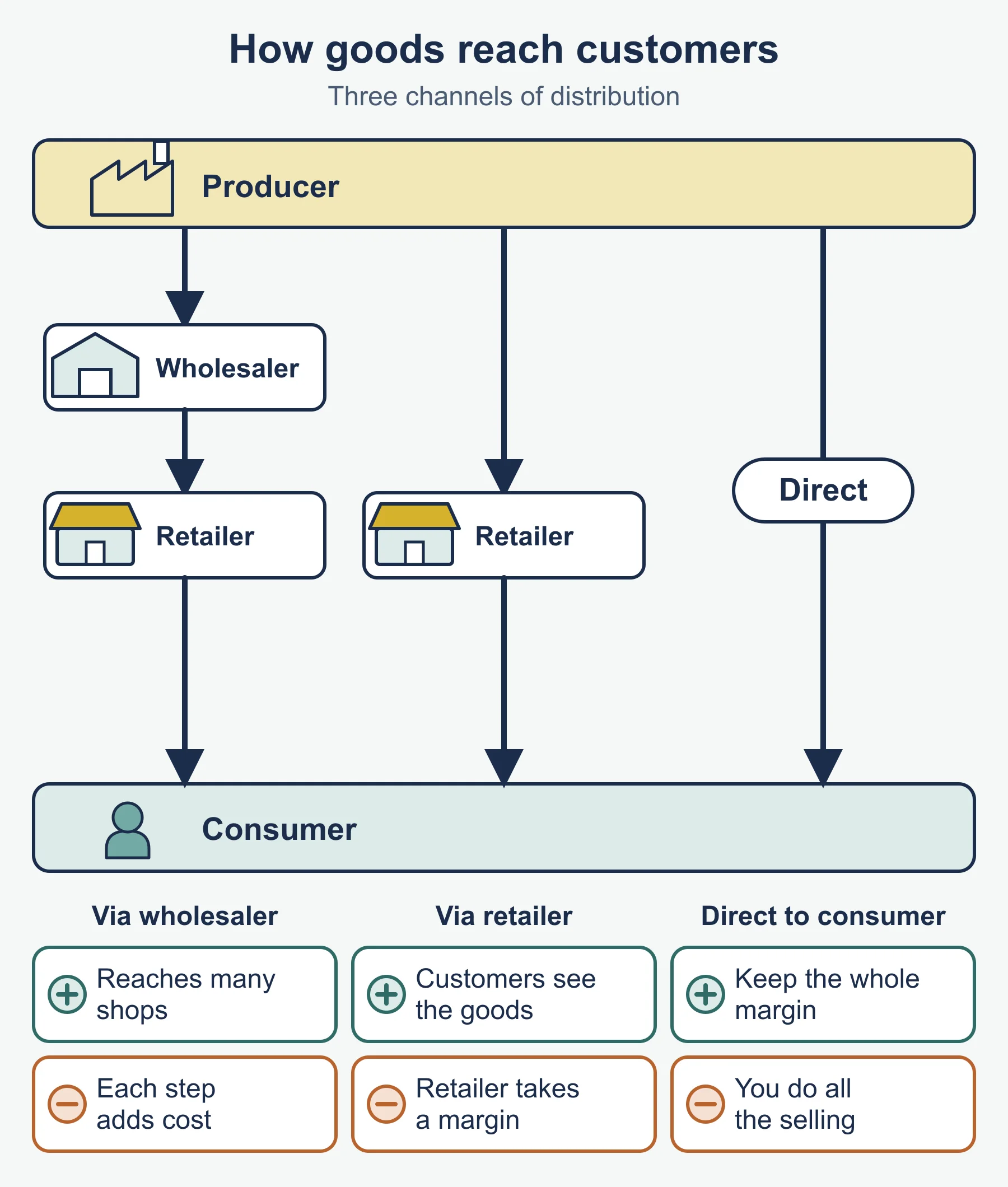
| Channel | Advantage | Disadvantage |
|---|---|---|
| Via wholesaler | Wide reach; wholesaler holds stock | Several margins; less control |
| Via retailer | Shops reach customers; fewer margins | Retailer takes a margin |
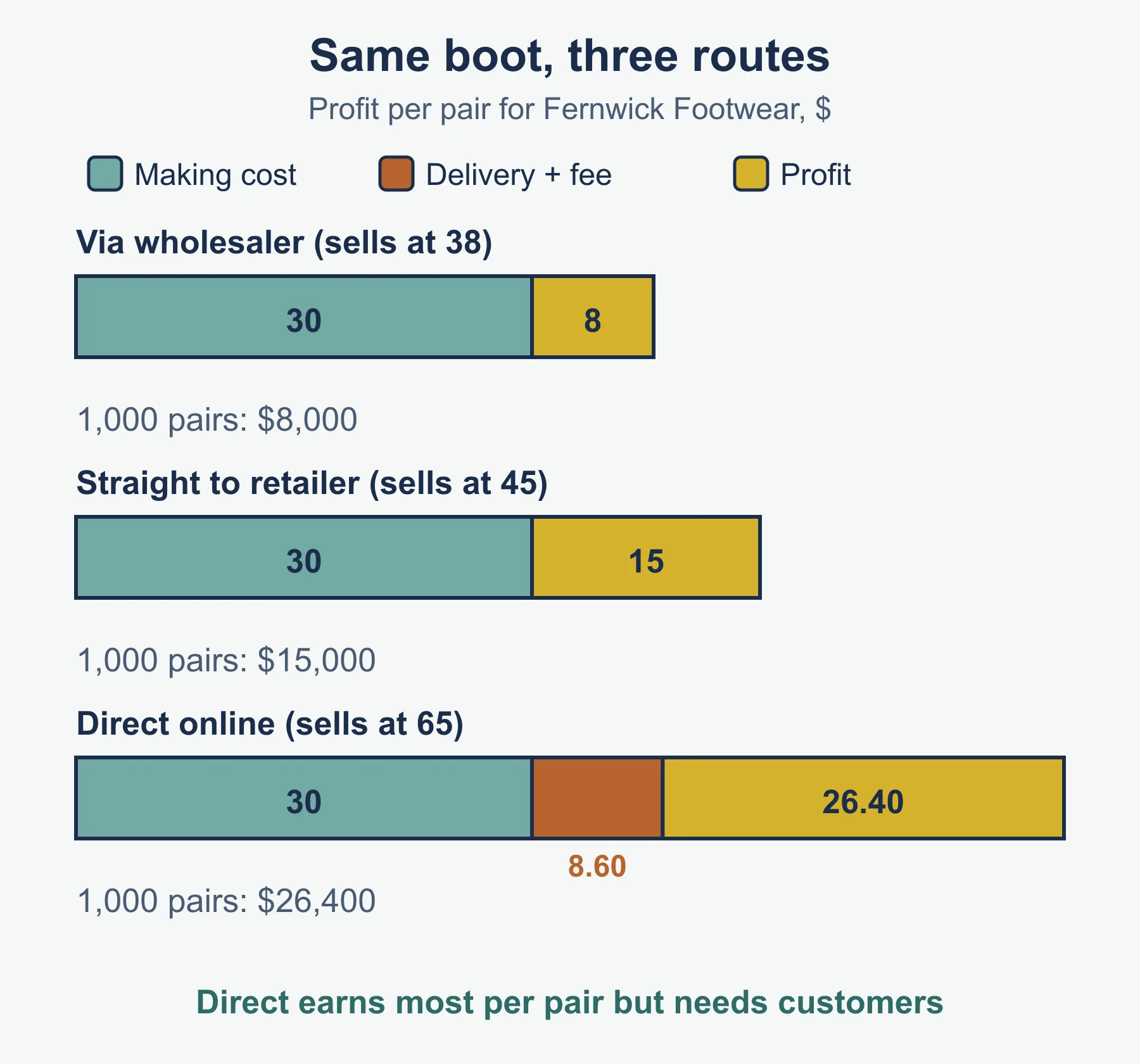
| Direct to consumer | Producer keeps whole margin; customer data | Producer pays delivery and handling; smaller reach |
Method for a recommendation:
- Check what the business sells and to whom.
- Check how many customers it needs to reach.
- Compare profit per unit by channel.
- Choose, justify, and note one drawback.
3.3.4 Promotion
Aims: inform, persuade, remind, build image, increase sales and market share, support a launch.
Forms:
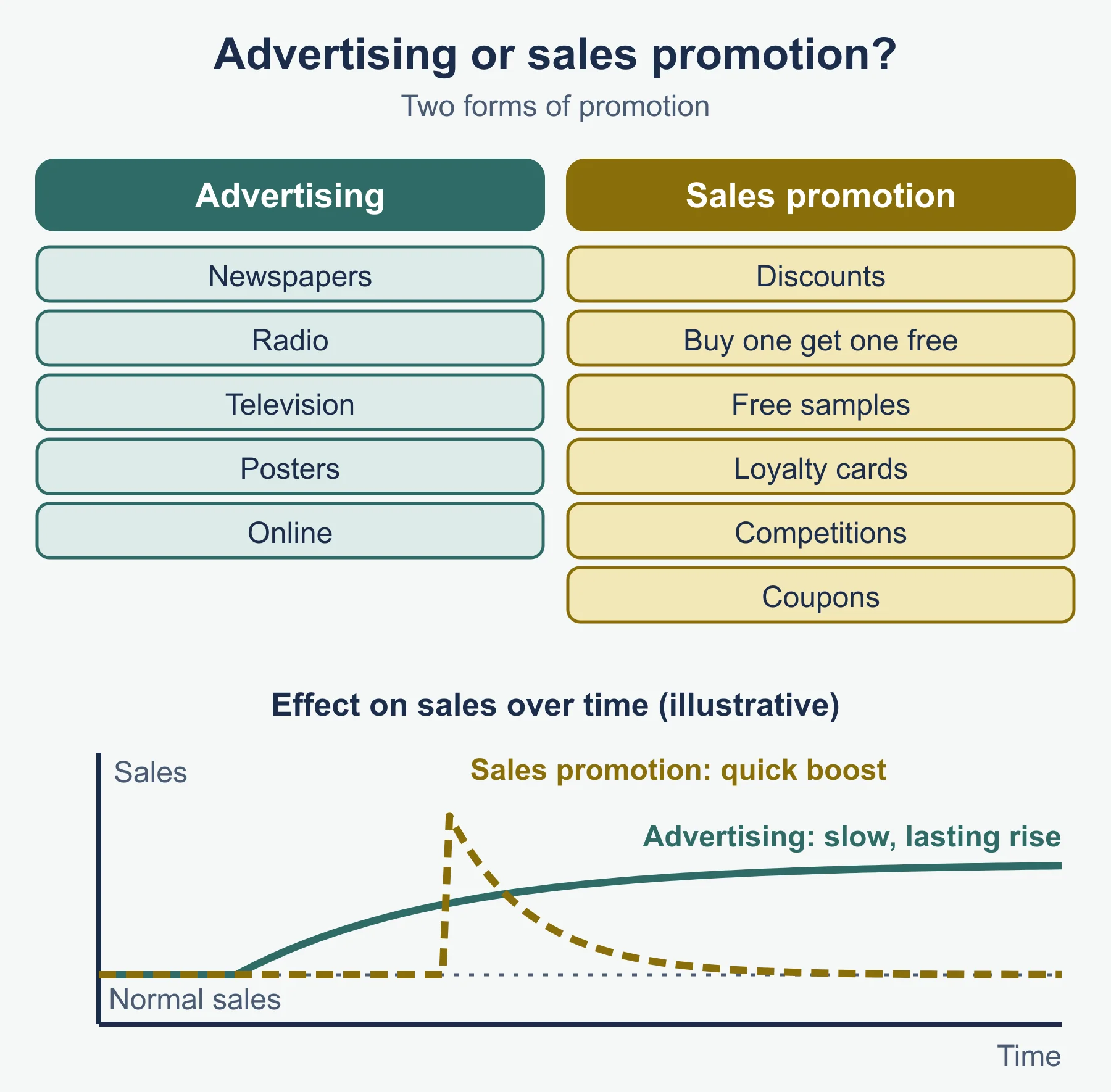
- Advertising: builds awareness and image over time.
- Sales promotion: discounts, samples, loyalty cards, competitions; boosts sales in the short term.
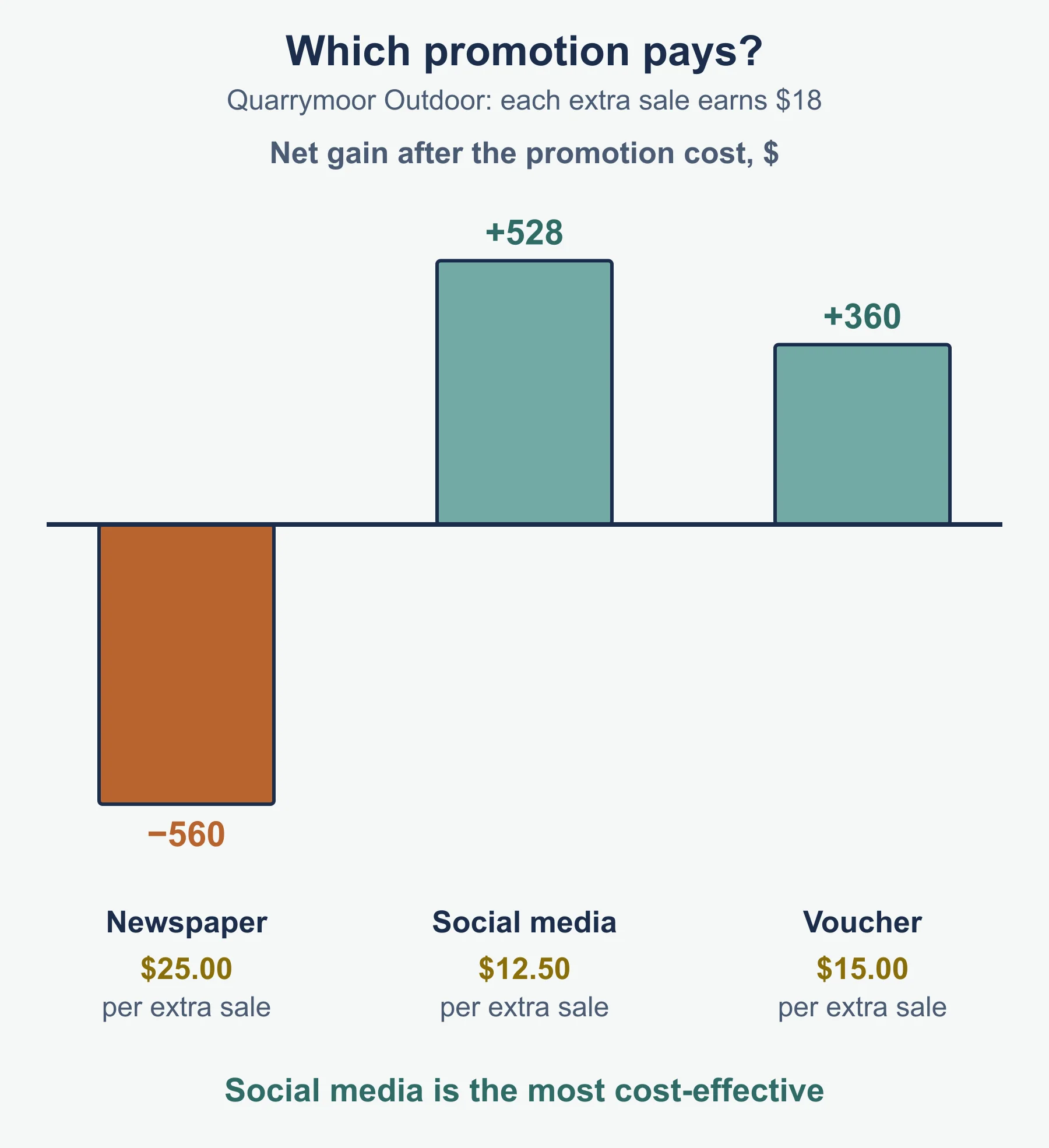
Cost-effectiveness: compare cost per extra sale and the profit earned per sale. If an extra sale earns less profit than the cost per sale, the method makes a loss.
3.3.5 Technology and the marketing mix
| Opportunities | Threats | |
|---|---|---|
| Business | Wide reach; open all hours; lower costs; customer data | Heavy competition; security and website failures; delivery costs |
| Consumer | Choice; price comparison; convenience | Fraud risk; cannot inspect; delivery and returns problems |
Social media promotion: low cost, targeted, measurable, two-way. Limits: bad comments spread fast, takes staff time, followers may not buy.
Small worked reminders
Life cycle reading. A board game sells 5, 14, 26, 31, 31.5 and 28 thousand over six years. Year-on-year changes are +180%, +85.7%, +19.2%, +1.6% and -11.1%. Growth is strong at first, slows sharply by year 4, is almost flat in year 5, and falls in year 6. So: introduction and growth, maturity around years 4 and 5, early decline in year 6. A sensible next step is an extension strategy such as a new edition.
Channel comparison. A craft kit costs 20 to make. Sold direct online at 50 with 10 delivery and packing, profit is 50 - 20 - 10 = 20 a kit. Sold to a retailer at 35, profit is 15 a kit. On 100 kits, direct selling earns 500 more. The answer to a “recommend” question is not automatically direct: weigh reach, fulfilment effort and risk before choosing.
Promotion choice. Compare cost per extra sale, then compare it with the profit each extra sale earns. A method with the lowest cost per sale is not always the best if another brings far more sales, so state which aim you are using in your judgement.
Command words for this topic
The syllabus lists these command words and meanings, which apply to marketing mix questions as to the rest of the course.
| Command word | What it means |
|---|---|
| State | Express in clear terms |
| Identify | Name, select or recognise |
| Define | Give precise meaning |
| Calculate | Work out from given facts, figures or information |
| Outline | Set out the main points |
| Explain | Set out purposes or reasons, make relationships clear, say why or how and support with evidence |
| Justify | Support a case with evidence or argument |
| Consider | Review and respond to given information |
For “recommend and justify” questions, name your choice, give a reason tied to the business in the stem, and add a limitation or alternative.
Must-know distinctions
- Penetration (low launch price) versus skimming (high launch price).
- Advertising (paid message) versus sales promotion (short-term incentive).
- Mark-up (on cost) versus profit margin (on selling price).
- Price elastic (big response) versus price inelastic (small response).
- Wholesaler (sells to retailers) versus retailer (sells to consumers).
- Benefits to the business versus benefits to the consumer.
Quick self-test
- Define the marketing mix.
- Name the stages of the product life cycle in order.
- Rookery Books has a unit cost of 8.00 and uses a 25% mark-up. What is the selling price?
- A product’s sales are 40, 38 and 39 thousand over three years. Which stage is it likely to be in?
- Explain one way packaging helps a business.
- State the main difference between penetration and skimming.
- Why might a firm with price inelastic demand raise its price?
- Identify the channel that gives the producer the whole margin.
- State two aims of promotion.
- A social media campaign costs 900 and brings 60 extra sales. What is the cost per extra sale?
- Define e-commerce.
- Give one threat of e-commerce to consumers.
Answers
- The set of choices about product, price, place and promotion.
- Development, introduction, growth, maturity, decline.
- 8.00 × 1.25 = 10.00.
- Maturity (sales are flat).
- Any one: protects goods from damage, keeps them fresh, gives information or promotes the brand with its design.
- Penetration uses a low price at launch to gain share; skimming uses a high price at launch.
- Few customers will leave, so revenue is likely to rise.
- Direct to consumer.
- Any two: inform, persuade, remind, increase sales, build brand image.
- 900 ÷ 60 = 15.
- Buying and selling of goods and services over the internet.
- Any one: fraud or security risk, cannot inspect the product, delivery delays, awkward returns.
Where marks are usually lost
- Describing a product life cycle stage without quoting figures from the data.
- Confusing penetration and skimming.
- Giving a price recommendation with no link to the business in the question.
- Mixing up mark-up and profit margin.
- Treating advertising as the only form of promotion.
- Listing benefits of e-commerce only for the business when the question asks about consumers.
- Saying a method is “cheap” or “quick” without explaining why it helps the business.
- Giving a one-sided answer to a recommend or justify question and never weighing a limitation.
Frequently asked questions
What is the difference between penetration and skimming pricing? Penetration pricing sets a low price at launch to win sales, while skimming sets a high price at launch, often for a new product with no close rival. Mixing them up is a common error.
Is promotion the same as advertising? No. Advertising pays for messages in media such as newspapers, radio, posters and online, while sales promotion uses short-term incentives such as discounts, free samples and buy-one-get-one-free offers.
What is an extension strategy? An extension strategy tries to lengthen the life of a product before it declines, for example through new packaging, new variants, new markets or uses, or a price change.
Why does price elasticity matter for pricing decisions? With elastic demand, a price cut can raise sales enough to increase revenue, while a rise can lose many customers. With inelastic demand, a price rise can increase revenue because few customers stop buying.
Official syllabus
Aligned to the Cambridge O Level Business Studies 7115 syllabus for examination in 2026, published by Cambridge International, section 3.3 Marketing mix.
Get free revision emails (optional)
Occasional emails with practice questions, worked explanations and links to free resources for the qualification and subjects you choose. No spam, and you can unsubscribe from any email. The free tools on this site never need an email.
Related resources
-
Practice questions
O Level Business: Marketing — Practice Questions (Cambridge 7115)
Original practice questions with worked answers on customer relationships, niche markets, market share, social media and pricing for O Level Business 7115.
Business · Cambridge · O Level
Try questions -
Study guides
O Level Business: Marketing strategy (Cambridge 7115)
Study guide to marketing strategy for Cambridge O Level Business 7115: choosing the mix, legal controls and foreign markets, with worked examples.
Business · Cambridge · O Level
Read guide -
Practice questions
O Level Business: Marketing strategy (Cambridge 7115) – Practice Questions
Original practice questions with worked answers on marketing strategy, legal controls and foreign markets for Cambridge O Level Business 7115.
Business · Cambridge · O Level
Try questions
Related articles
-
teaching
A Level tuition in Dubai: Cambridge or Pearson Edexcel International A Level?
Schools in Dubai and Abu Dhabi teach either Cambridge International AS & A Level or Pearson Edexcel International A Level. How the two are structured, why it matters for tuition, and how online classes from Lahore work.
9 October 2026
-
curriculum guides
Choosing subjects at IGCSE and A Level
How subject choices at 14 and 16 affect university options later, and how to keep pathways open without overloading a timetable.
28 July 2026
Studying this with a teacher
Working through Business O LEVELS?
This page is free and stays free. If you would rather be taught it, Marlbridge runs Business classes one-to-one and in small groups of up to 15, online in your own time zone. The first trial class is free. WhatsApp replies within an hour (8am–11pm Pakistan time, every day); email the same day.
Cambridge Business teachers at Marlbridge

