
Study Guides
O Level Business: Marketing strategy (Cambridge 7115)
Study guide to marketing strategy for Cambridge O Level Business 7115: choosing the mix, legal controls and foreign markets, with worked examples.
- Subject
- Business
- Level
- O LEVELS
- Topic
- Marketing
- Author
- Marlbridge Academic Team
- Updated
- Reviewed by
- Salman Ahmad (what this means)
Aligned to Cambridge O Level Business (7115), For examination in 2026. Official specification .
Syllabus page (what it covers and how it is assessed): Cambridge O Level Business.
Syllabus points this page covers
7115
- 3.4 Marketing strategy
Found an error? Report a correction.
Need help with this topic? Request a free trial class for O Level Business (7115).
This guide covers section 3.4 (Marketing strategy) of the Cambridge O Level Business Studies 7115 syllabus for examination in 2026. It teaches every content point the syllabus lists for 3.4.1, 3.4.2 and 3.4.3. The syllabus says that each written paper (Paper 1, Short Answer and Data Response, and Paper 2, Case Study) assesses content from the entire syllabus, so strategy questions can appear on either paper.
Related pages: revision notes, practice questions, the topic-level Marketing practice set, the Cambridge O Level Business hub, the printable checklist and the free 10-minute diagnostics.
What this section covers
| Syllabus point | What you must be able to do |
|---|---|
| 3.4.1 Justify marketing strategies appropriate to a given situation | Explain the importance of different elements of the marketing mix in influencing consumer decisions in given circumstances. Recommend and justify an appropriate marketing strategy in given circumstances. |
| 3.4.2 The nature and impact of legal controls related to marketing | Explain the impact of legal controls on marketing strategy, for example misleading promotion, and faulty and dangerous goods. |
| 3.4.3 The opportunities and problems of entering new foreign markets | Explain the growth potential of new markets in other countries; the problems of entering them (for example cultural differences and lack of knowledge); and the benefits and limitations of methods to overcome those problems (for example joint ventures and licensing). |
The syllabus gives “for example” lists in each point. Other relevant examples are acceptable in an answer if they are accurate and linked to the business.
3.4.1 Choosing a marketing strategy
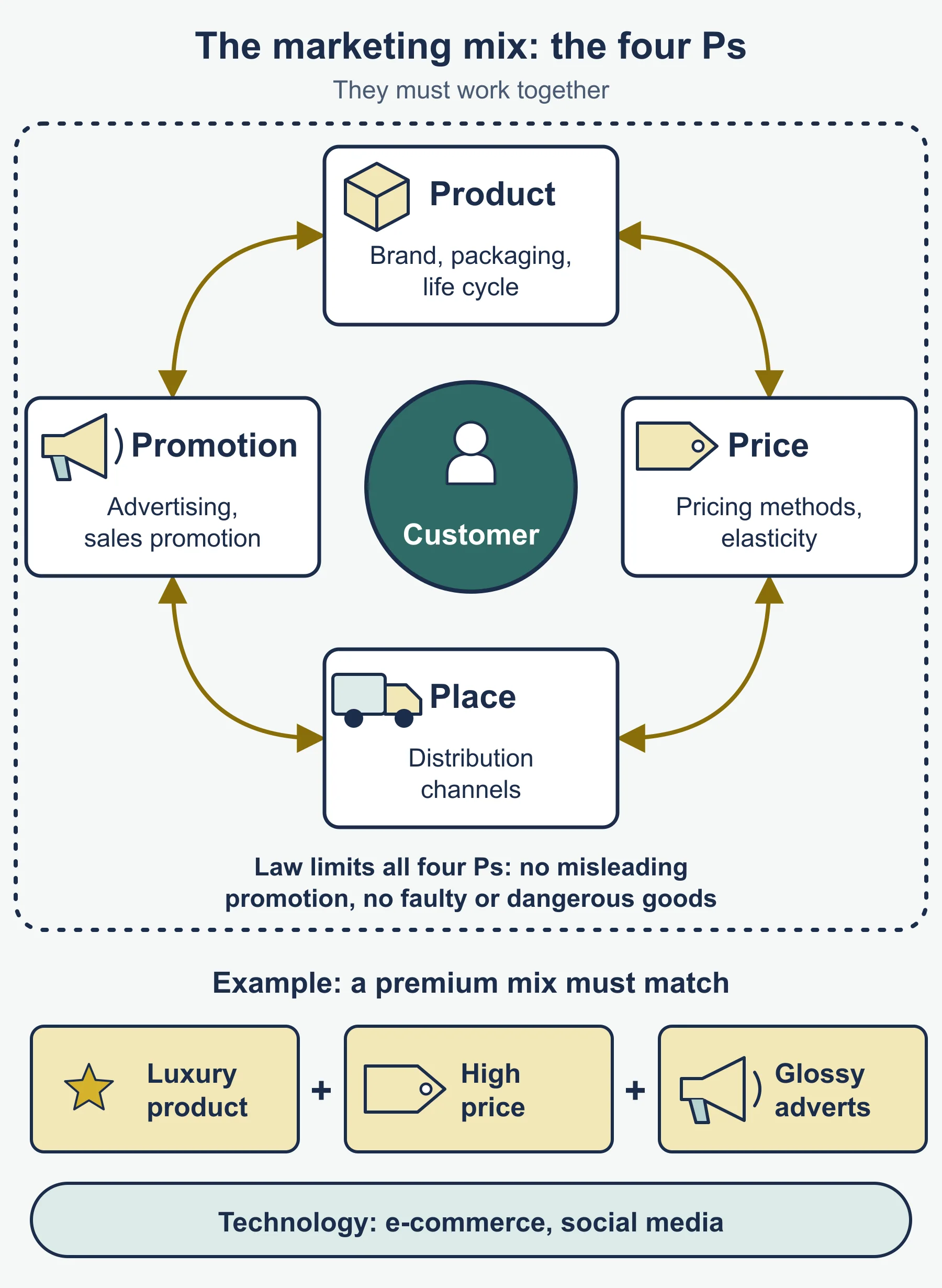
A marketing strategy is the plan a business follows to reach its marketing objectives. In practice it is a decision about how to use the four parts of the marketing mix together:
- Product: what is sold, its brand image, packaging and stage in its life cycle.
- Price: the price level and the pricing method (for example penetration, skimming, competitive).
- Place: the distribution channel (direct to consumers, retailers, wholesalers).
- Promotion: advertising, sales promotion, and use of the internet and social media.
The four parts must fit each other. A luxury product with a low price, sold in a discount store and promoted with coupons gives customers mixed messages. Each part should support the same target customers.
Which element matters most depends on the circumstances
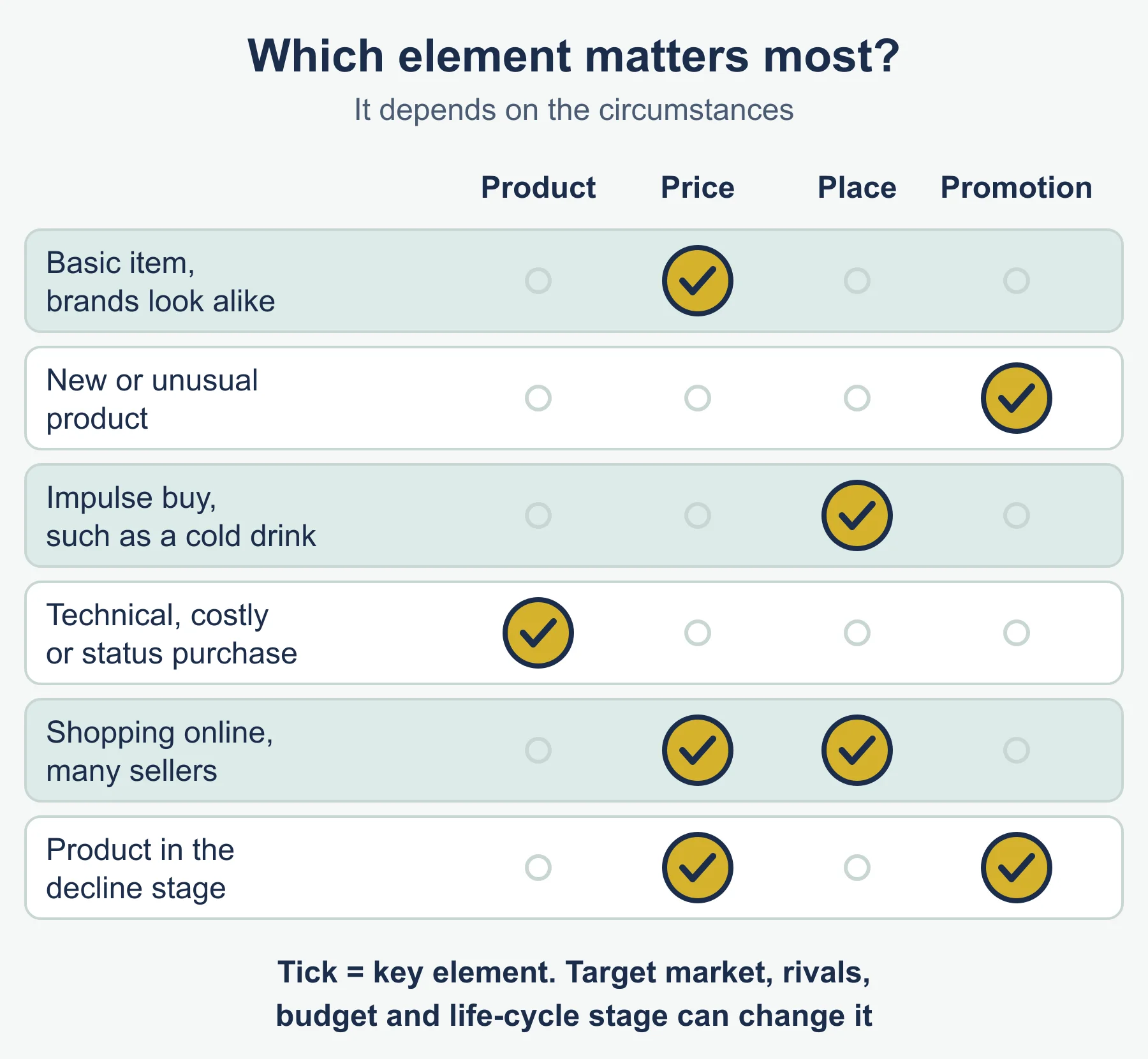
No element is always most important. The syllabus asks for “the importance of different elements of the marketing mix in influencing consumer decisions in given circumstances”. Ask what the customer cares about when buying.
| Circumstance | Element likely to matter most | Why |
|---|---|---|
| Customers buy a basic, frequently bought item and see little difference between brands | Price | They choose the cheapest option. |
| The product is new or unusual | Promotion | People must hear about it before they can buy it. |
| The product is bought on impulse, such as a cold drink | Place | It must be where and when the customer wants it. |
| The product is technical, costly or a status purchase | Product (quality, brand image) | Customers pay for performance and reputation. |
| Customers shop online and compare many sellers | Price and place (delivery, website) | Comparison is easy and switching costs nothing. |
| Product in the decline stage of its life cycle | Price and promotion | A discount or sales promotion may be needed to clear stock. |
Other circumstances that change the answer include the target market (for example age or income), competitors’ actions, the marketing budget and the stage of the product life cycle.
Steps for recommending and justifying a strategy
“Justify” means to support a case with evidence or argument. The same method works for “recommend and justify”.
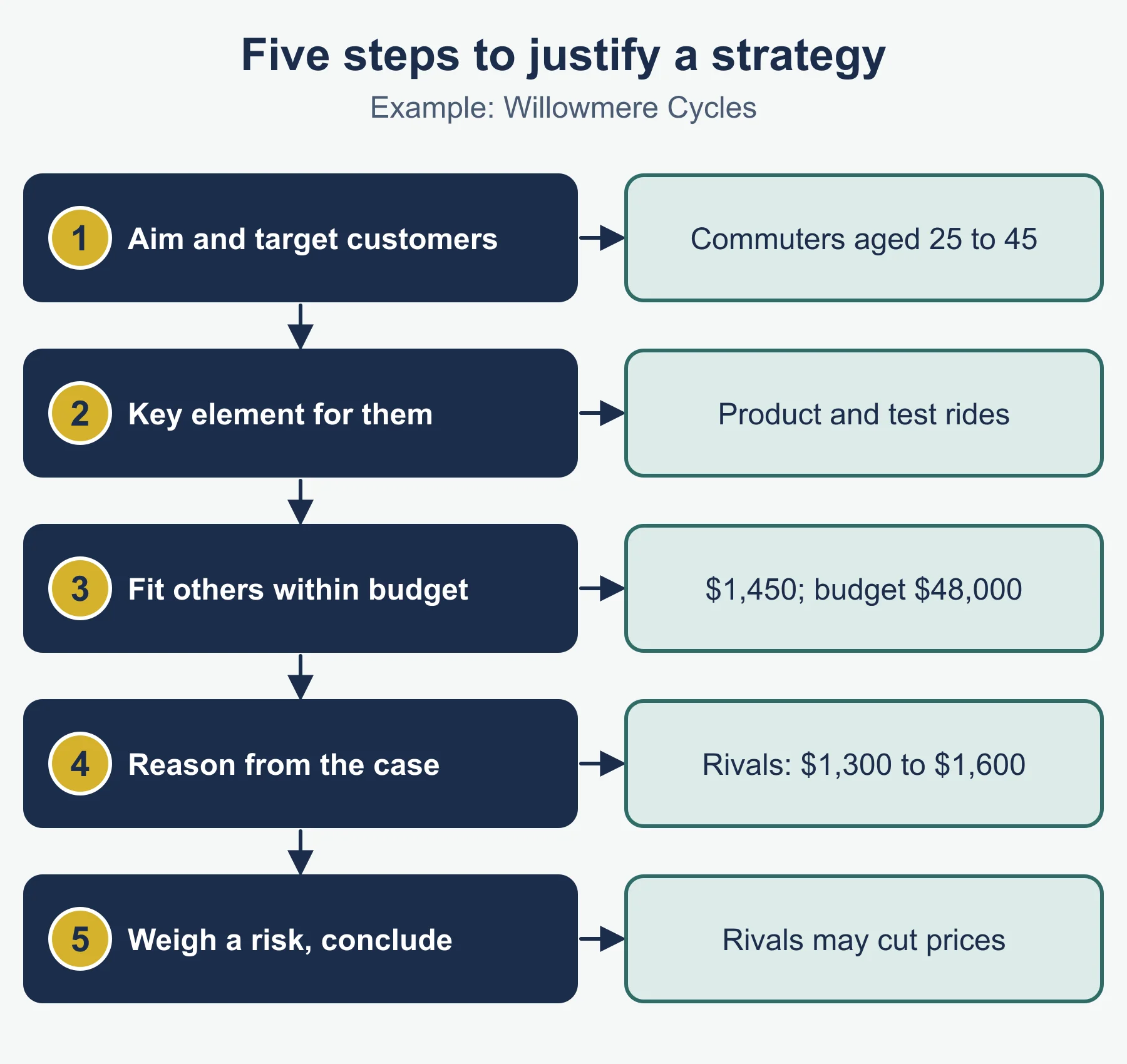
- Identify the objective and the target customers in the case.
- Decide which element of the mix influences those customers most, using evidence from the case.
- Fit the other elements around it, within the budget.
- Give a reason for each choice that refers to the case.
- Weigh a risk or an alternative, then reach a reasoned conclusion.
Worked example: Willowmere Cycles
Willowmere Cycles is a new business that will launch a folding electric bicycle in a large city. Target customers are commuters aged 25 to 45. The bike costs 900 dollars to make. Rival folding bikes sell for between 1 300 and 1 600 dollars. The owner has a marketing budget of 48 000 dollars and expects to sell 320 bikes in the first year.
Plan:
| Element | Decision | Reason |
|---|---|---|
| Product | Lightweight, quick to fold, with a bag | Commuters take it on trains and into offices. |
| Price | 1 450 dollars, a competitive price inside the rival range | Mark-up is 550 dollars on cost, which is 61.1% of cost; the price signals quality without being above rivals. |
| Place | Own website plus three city bike shops | Buyers can try before buying; the website gives a direct sale at the full price. |
| Promotion | See the budget split below | Commuters are online and need to see the bike working. |
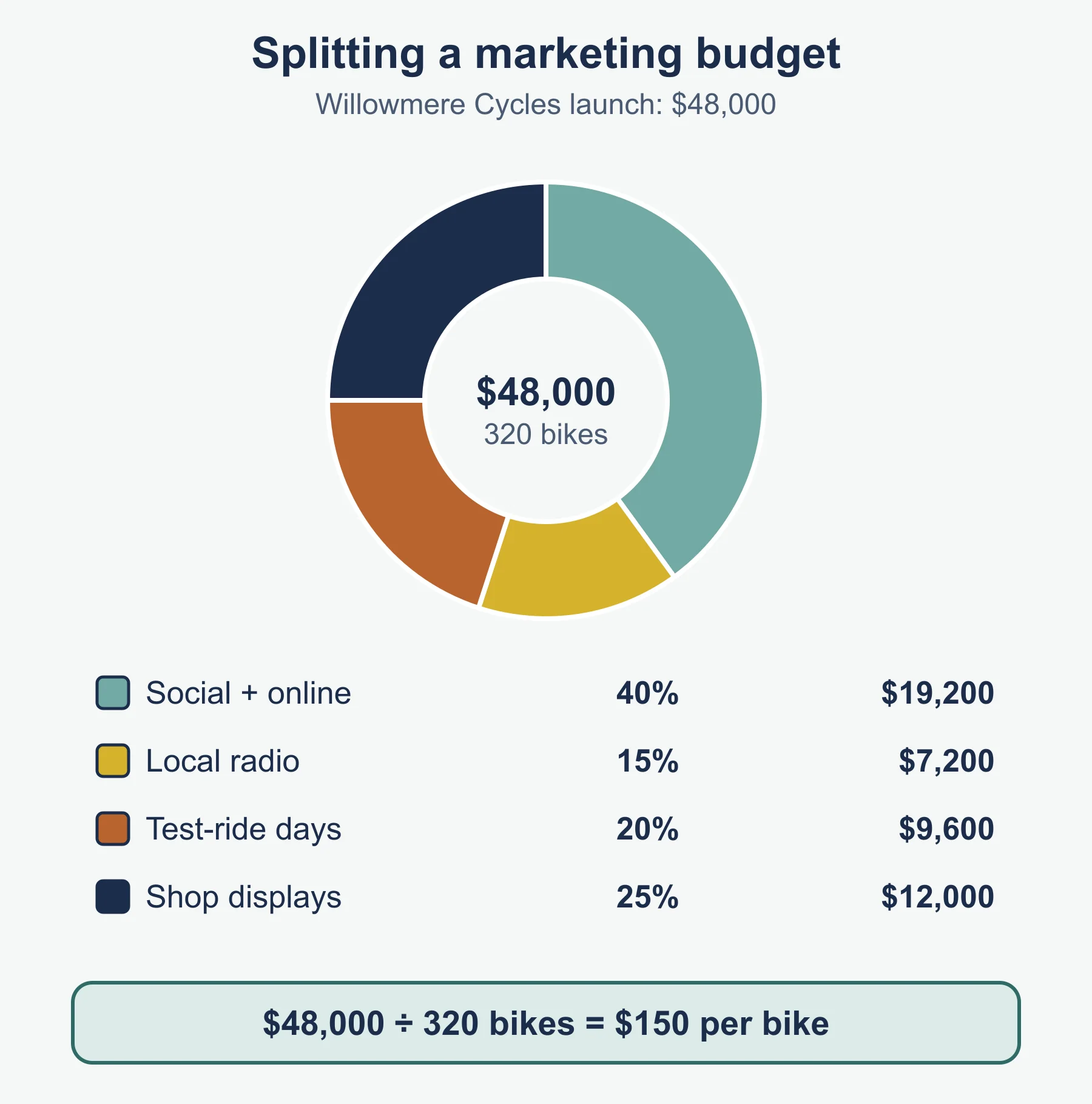
Budget split: social media and online adverts 40% = 19 200 dollars; local radio 15% = 7 200 dollars; test-ride days (sales promotion) 20% = 9 600 dollars; shop display material 25% = 12 000 dollars. These total 48 000 dollars.
Cost-effectiveness check: 48 000 divided by 320 bikes is 150 dollars of marketing per bike. Each bike gives 550 dollars (1 450 minus 900) towards other costs and profit. So 320 bikes give 176 000 dollars, and 128 000 dollars after marketing, before other expenses are deducted.
Justification: the strategy puts most money into the elements that matter most to this buyer, which are a product that suits commuting and a chance to test it. The risk is that the rivals cut their prices, which would force Willowmere to reduce its own mark-up. A sensible judgement is that the strategy is appropriate if sales reach about 320, but the owner should watch rivals’ prices and sales after the first months.
3.4.2 Legal controls related to marketing
Governments make laws to protect consumers from unfair treatment. The syllabus names two areas: misleading promotion, and faulty and dangerous goods. Laws differ between countries, so describe them in general terms rather than quoting a particular law.
Misleading promotion
A promotion is misleading if it gives customers a false or unclear impression, for example by exaggerating what a product does, hiding a condition, or advertising a price that is not really available.
Impact on marketing strategy:
- Claims must be accurate and supported by evidence, so the business may need tests before it advertises.
- Wording of adverts and packaging is checked more carefully, which adds time and cost.
- Promotion may rely more on facts (ingredients, size, price) and less on exaggeration.
- Breaking the rules can lead to penalties, withdrawal of the advert, damaged brand image and lost customer loyalty.
- Honest businesses gain, because competitors cannot win sales with false claims.
Faulty and dangerous goods
Businesses must sell goods that are safe and fit for their purpose. Faulty goods do not work as described. Dangerous goods may harm users.
Impact on marketing strategy:
- The product stage needs more design, testing and quality checks, which raises costs and may delay launch.
- Packaging must carry accurate warnings and instructions.
- If a fault is found, the business may have to recall goods and refund customers. This costs money, and bad publicity can reduce sales of the whole brand.
- Customers can trust products more, which makes buying less risky for them.
Worked example: Juniper Bay Skincare
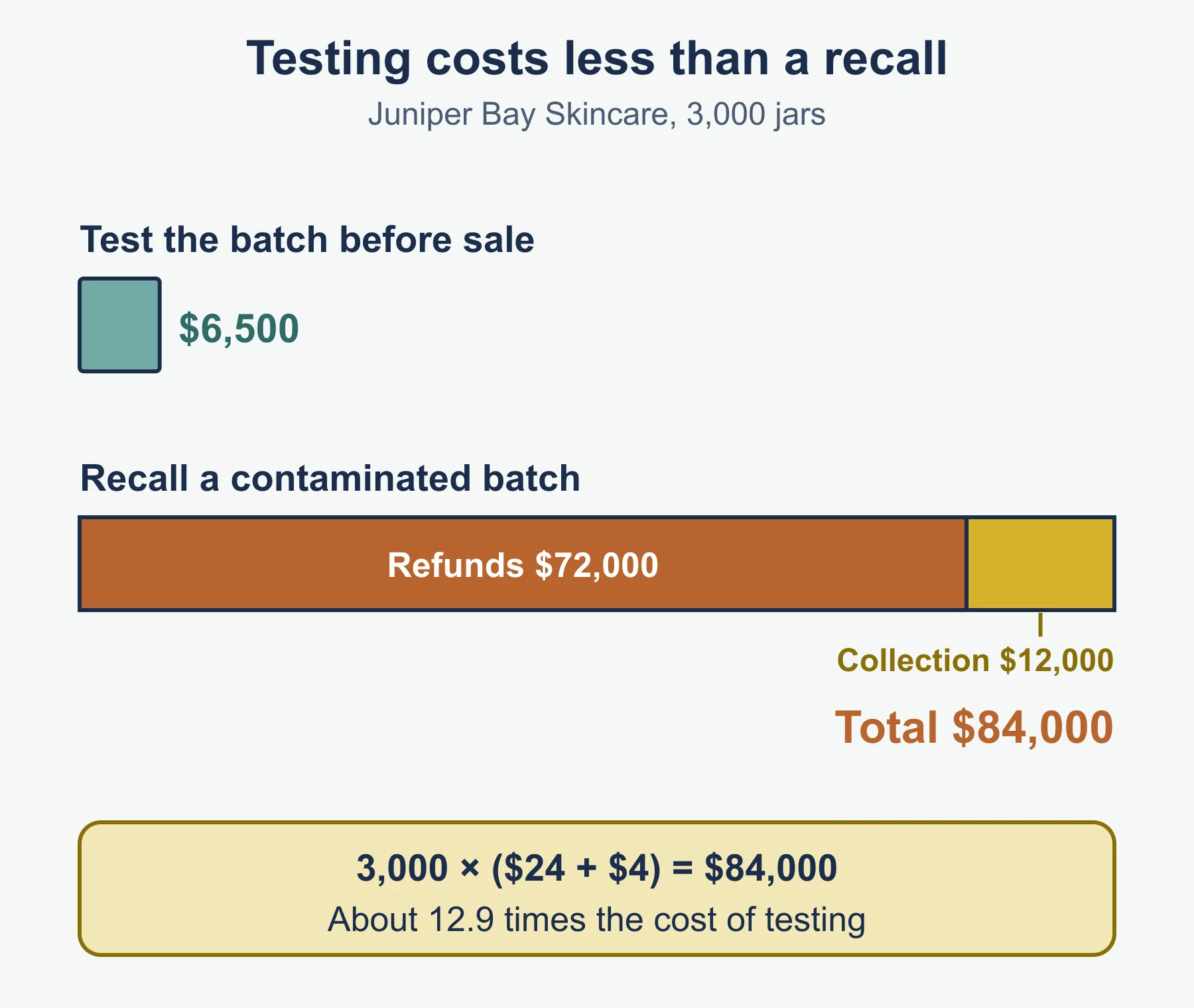
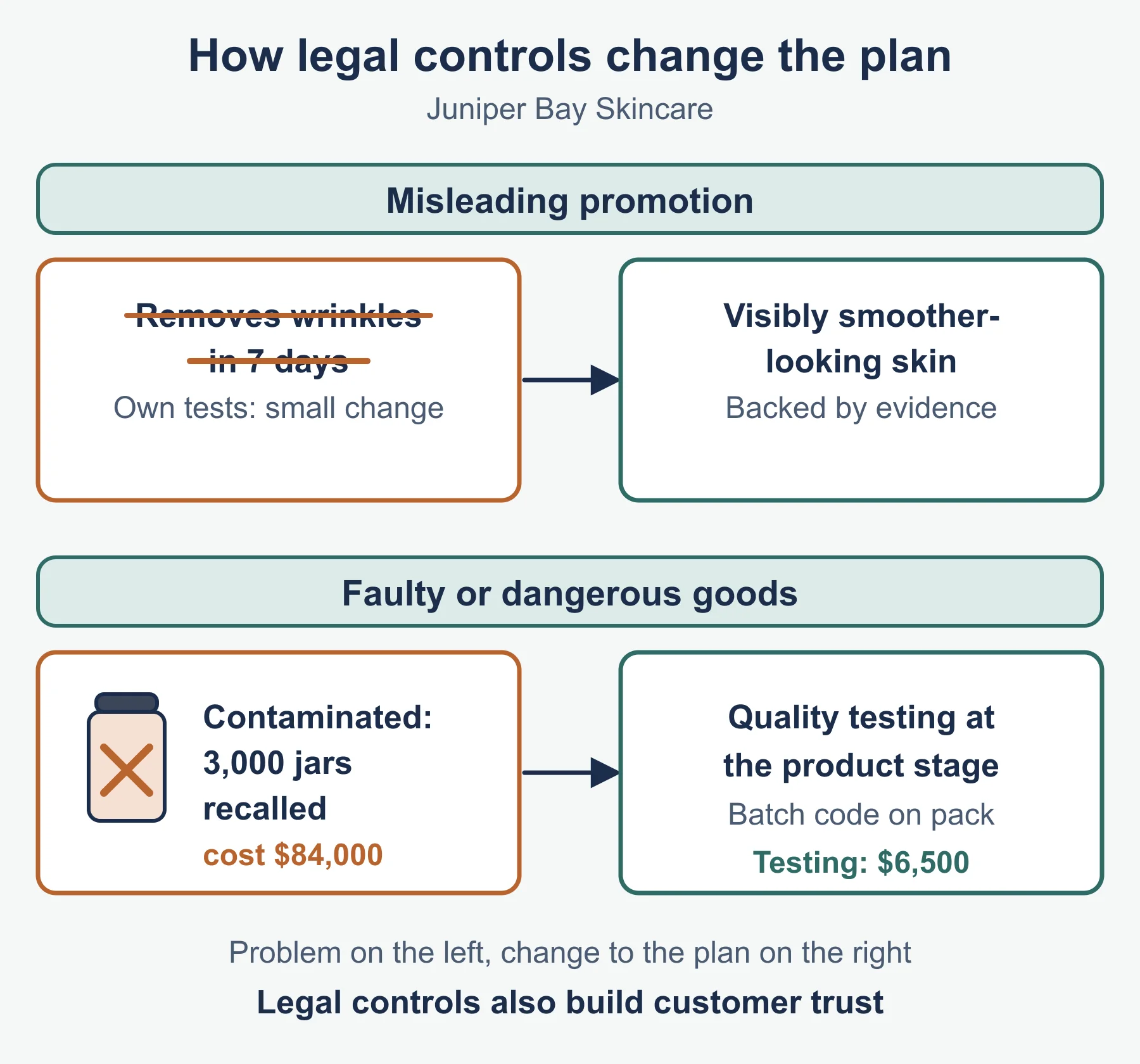
Juniper Bay Skincare sells a face cream for 24 dollars a jar. Its adverts say “removes wrinkles in 7 days”, but its own tests show only a small change in appearance after 7 days. A different batch of 3 000 jars is found to be contaminated and must be recalled. The company refunds the 24 dollars and pays 4 dollars per jar to collect it.
- Cost of the recall: 3 000 × (24 + 4) = 84 000 dollars.
- Testing the batch before sale would have cost 6 500 dollars. The recall is about 12.9 times as much.
Strategy changes: the advert is changed to say “visibly smoother-looking skin”, which the company can support with evidence. Quality testing becomes part of the product stage, and packaging gains a batch code to help any future recall. A good answer links each change to the legal control: the advert change answers misleading promotion; the extra testing answers faulty and dangerous goods.
3.4.3 Entering new foreign markets
Growth potential
Selling in other countries can offer:
- Larger or faster-growing markets than the home market, for example a bigger population or a rising number of households.
- Rising incomes, which means customers can afford more of the product.
- Less competition, or a market not yet filled with similar products.
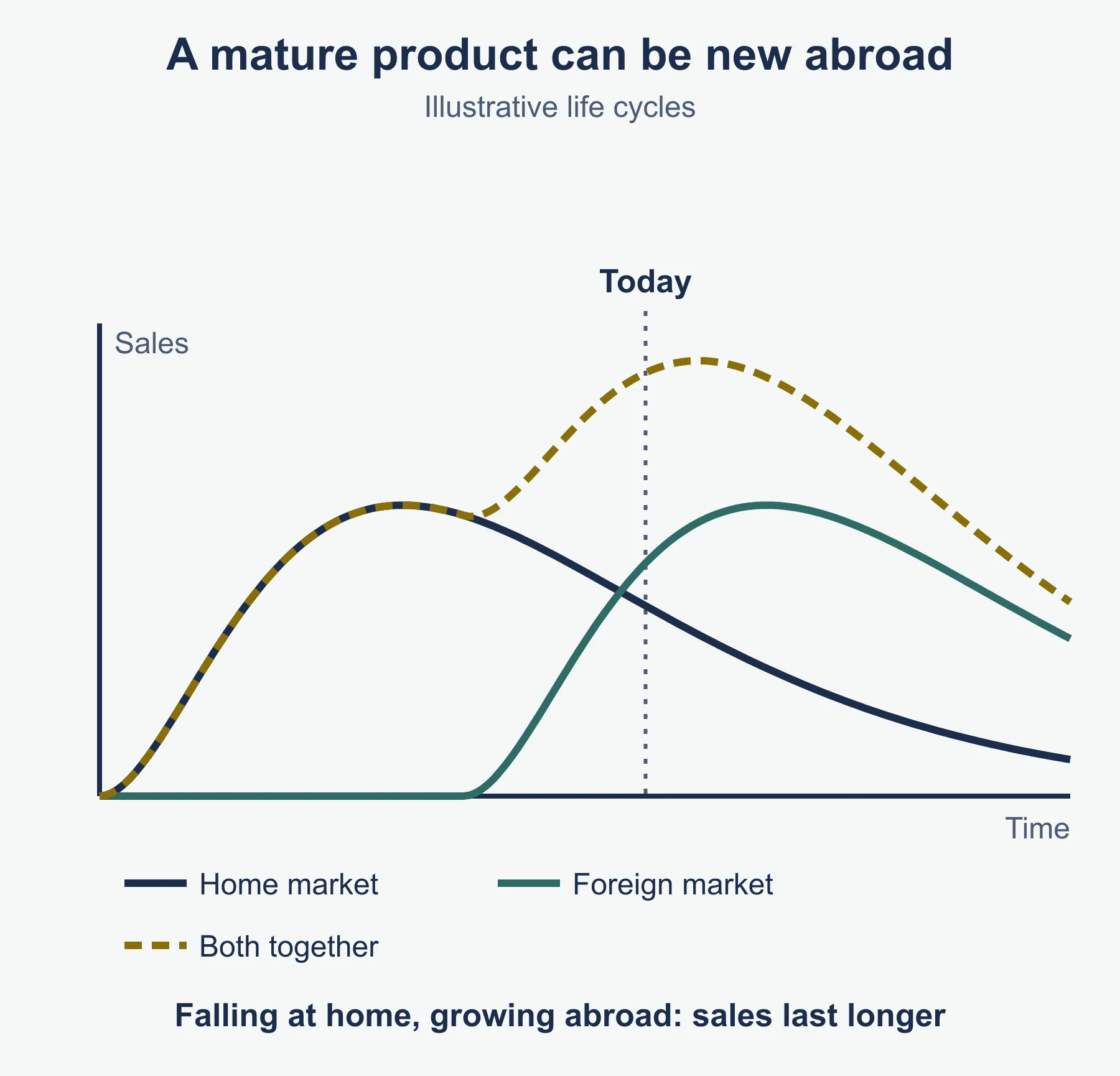
- Spreading risk, because a fall in sales at home is less damaging if sales abroad continue.
- A longer product life cycle, because a product that is mature at home may still be new abroad.
- Economies of scale from producing more units.
Problems of entering foreign markets
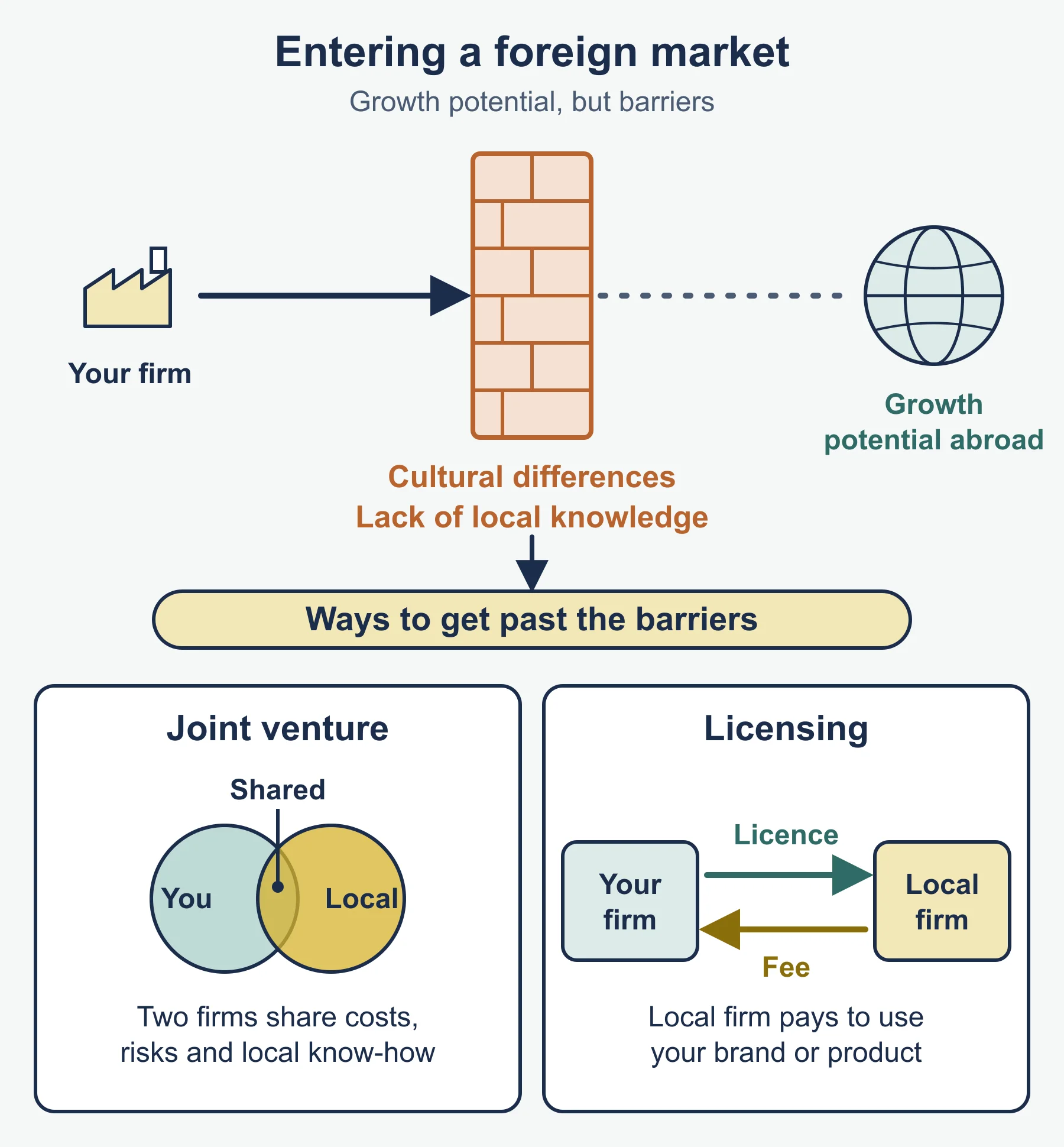
- Cultural differences: language, tastes, religion, customs, colours and symbols may change what customers accept. A product name, advert or package design may have an unintended meaning, and a product may need to be adapted.
- Lack of knowledge: the business may not know customers’ habits, local competitors, distribution routes, or the rules about selling and advertising.
- Distance and costs: delivery takes longer and costs more.
- Competition from established local brands that customers already trust.
Methods to overcome the problems
The syllabus names joint ventures and licensing as examples.
| Method | What it is | Benefits | Limitations |
|---|---|---|---|
| Joint venture | Two businesses, often one local and one foreign, set up a shared project and share costs, risks and profit. | Local partner brings knowledge of customers, rules and distribution; costs and risk are shared; quicker entry. | Profit is shared; partners may disagree; the local partner may learn the secrets and become a rival. |
| Licensing | The owner of a brand or product (licensor) lets a foreign business (licensee) make or sell it in return for fees or royalties. | Low cost and low risk for the licensor; licensee knows the market; quick. | The licensor earns less than if it sold the goods itself; control of quality and brand image is weaker; the licensee may become a competitor later. |
Market research (section 3.2) is another sensible way to reduce lack of knowledge before choosing a method.
Worked example: Greystone Tea
Greystone Tea makes premium tea and wants to enter a country whose income per household is rising quickly. Two offers are available.
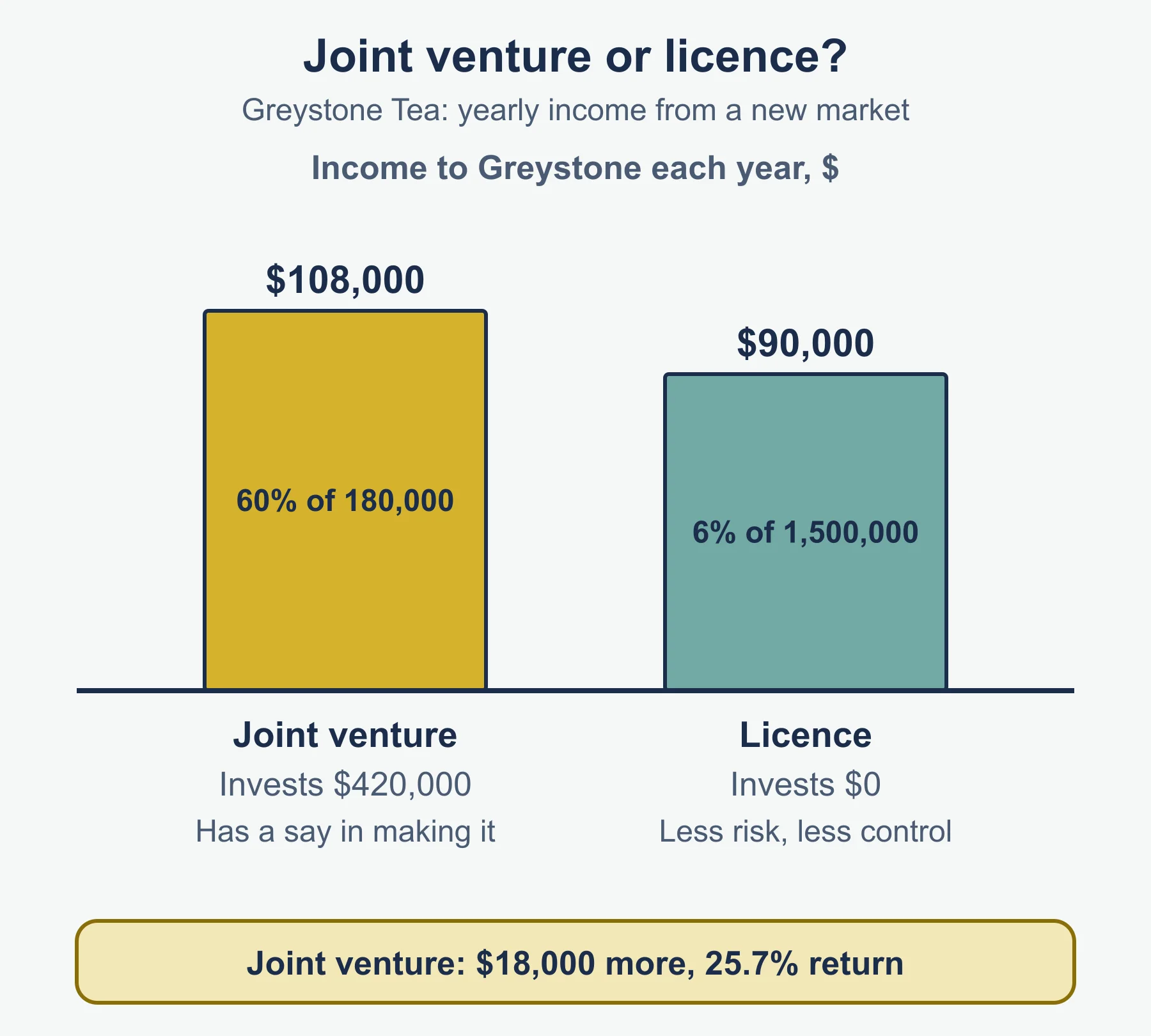
Joint venture: Greystone invests 420 000 dollars for a 60% share. The venture’s expected profit is 180 000 dollars a year, so Greystone’s share is 0.60 × 180 000 = 108 000 dollars. That is a return of 25.7% on its investment.
Licence: a local firm would make and sell Greystone tea. It expects sales of 1 500 000 dollars and pays a royalty of 6%, so Greystone receives 0.06 × 1 500 000 = 90 000 dollars. Greystone invests nothing.
Judgement: the joint venture earns 18 000 dollars more a year, and Greystone has a say in how the product is made. The licence needs no investment and carries less risk, but Greystone has less control over quality, and its brand could suffer if the licensee is careless. If Greystone has limited cash or no knowledge of the country, licensing is more suitable. If its brand image matters most, the joint venture is better. State the choice, then justify it from the facts you are given.
Common errors
- Listing the four Ps without saying which matters most to these customers.
- Making a recommendation without a reason from the case, or without weighing a risk.
- Describing laws in detail rather than their impact on strategy.
- Saying legal controls only harm businesses. They also build customer trust.
- Treating “cultural differences” as only language. Tastes, customs and symbols matter too.
- Confusing joint ventures (shared ownership and profit) with licensing (permission to use a brand for a fee).
- Forgetting that costs and revenues in an example need units and a clear calculation.
Frequently asked questions
What is a marketing strategy? A marketing strategy is the plan a business follows to reach its marketing objectives, deciding how to use product, price, place and promotion together. All four parts should support the same target customers.
What is misleading promotion? Misleading promotion gives customers a false or unclear impression, for example by exaggerating what a product does, hiding a condition or advertising a price that is not really available.
Which methods of entering foreign markets does the 7115 syllabus name? The Cambridge O Level Business Studies 7115 syllabus names joint ventures and licensing as examples. Market research is another sensible way to reduce lack of knowledge before choosing a method.
Why might a business sell in foreign markets? Foreign markets can be larger or faster-growing, have rising incomes or less competition, spread risk, extend a product’s life cycle and allow economies of scale.
Official syllabus
Cambridge International, Cambridge O Level Business Studies 7115 syllabus for 2026, section 3.4 Marketing strategy (3.4.1 to 3.4.3).
Get free revision emails (optional)
Occasional emails with practice questions, worked explanations and links to free resources for the qualification and subjects you choose. No spam, and you can unsubscribe from any email. The free tools on this site never need an email.
Related resources
-
Practice questions
O Level Business: Marketing strategy (Cambridge 7115) – Practice Questions
Original practice questions with worked answers on marketing strategy, legal controls and foreign markets for Cambridge O Level Business 7115.
Business · Cambridge · O Level
Try questions -
Revision notes
O Level Business: Marketing strategy (Cambridge 7115) – Revision Notes
Condensed revision notes on marketing strategy for Cambridge O Level Business 7115: mix choices, legal controls, foreign markets, plus a self-test.
Business · Cambridge · O Level
Revise topic -
Study guides
O Level Business: Marketing, competition and the customer and Market research (Cambridge 7115)
Study guide to the customer, competition, niche and mass marketing, segmentation and market research for Cambridge O Level Business Studies 7115.
Business · Cambridge · O Level
Read guide
Related articles
-
teaching
A Level tuition in Dubai: Cambridge or Pearson Edexcel International A Level?
Schools in Dubai and Abu Dhabi teach either Cambridge International AS & A Level or Pearson Edexcel International A Level. How the two are structured, why it matters for tuition, and how online classes from Lahore work.
9 October 2026
-
curriculum guides
Choosing subjects at IGCSE and A Level
How subject choices at 14 and 16 affect university options later, and how to keep pathways open without overloading a timetable.
28 July 2026
Studying this with a teacher
Working through Business O LEVELS?
This page is free and stays free. If you would rather be taught it, Marlbridge runs Business classes one-to-one and in small groups of up to 15, online in your own time zone. The first trial class is free. WhatsApp replies within an hour (8am–11pm Pakistan time, every day); email the same day.
Cambridge Business teachers at Marlbridge

