
Study Guides
O Level Business: Marketing mix (Cambridge 7115)
Study guide to the marketing mix for Cambridge O Level Business 7115: product, price, place, promotion and technology, with worked examples.
- Subject
- Business
- Level
- O LEVELS
- Topic
- Marketing
- Author
- Marlbridge Academic Team
- Updated
- Reviewed by
- Salman Ahmad (what this means)
Aligned to Cambridge O Level Business (7115), For examination in 2026. Official specification .
Syllabus page (what it covers and how it is assessed): Cambridge O Level Business.
Syllabus points this page covers
7115
- 3.3 Marketing mix
Found an error? Report a correction.
Need help with this topic? Request a free trial class for O Level Business (7115).
This guide covers section 3.3 Marketing mix of the Cambridge O Level Business Studies 7115 syllabus for examination in 2026. That means product (3.3.1), price (3.3.2), place and distribution channels (3.3.3), promotion (3.3.4) and technology and the marketing mix (3.3.5). Both papers draw on the whole syllabus, so expect these ideas in short-answer questions and in case-study questions. Revision notes and a practice set follow the same sections: revision notes and practice questions. Earlier marketing topics (customers, segmentation, market research) are in the Marketing practice set. Course pages: Cambridge O Level Business hub and the printable checklist. To find weak spots first, try the free diagnostics.
All money amounts below are in dollars. Every business is invented.
What you must be able to do
| Section | Content you must cover |
|---|---|
| 3.3.1 Product | Limitations and benefits of developing new products; brand image, its impact on sales and customer loyalty; the role of packaging; product life cycle stages and extension strategies, drawing and interpreting a diagram; how stages influence promotion and pricing |
| 3.3.2 Price | Pricing methods (cost plus, competitive, penetration, skimming, promotional) with benefits and limitations; recommend and justify a method; price elastic and price inelastic demand and why the idea matters in pricing |
| 3.3.3 Place | Advantages and disadvantages of wholesalers, retailers and direct to consumers; recommend and justify a channel |
| 3.3.4 Promotion | Aims of promotion; forms such as advertising and sales promotion and how they influence sales; cost-effectiveness of the marketing budget |
| 3.3.5 Technology | Define and explain e-commerce; opportunities and threats to business and consumers; internet and social media for promotion |
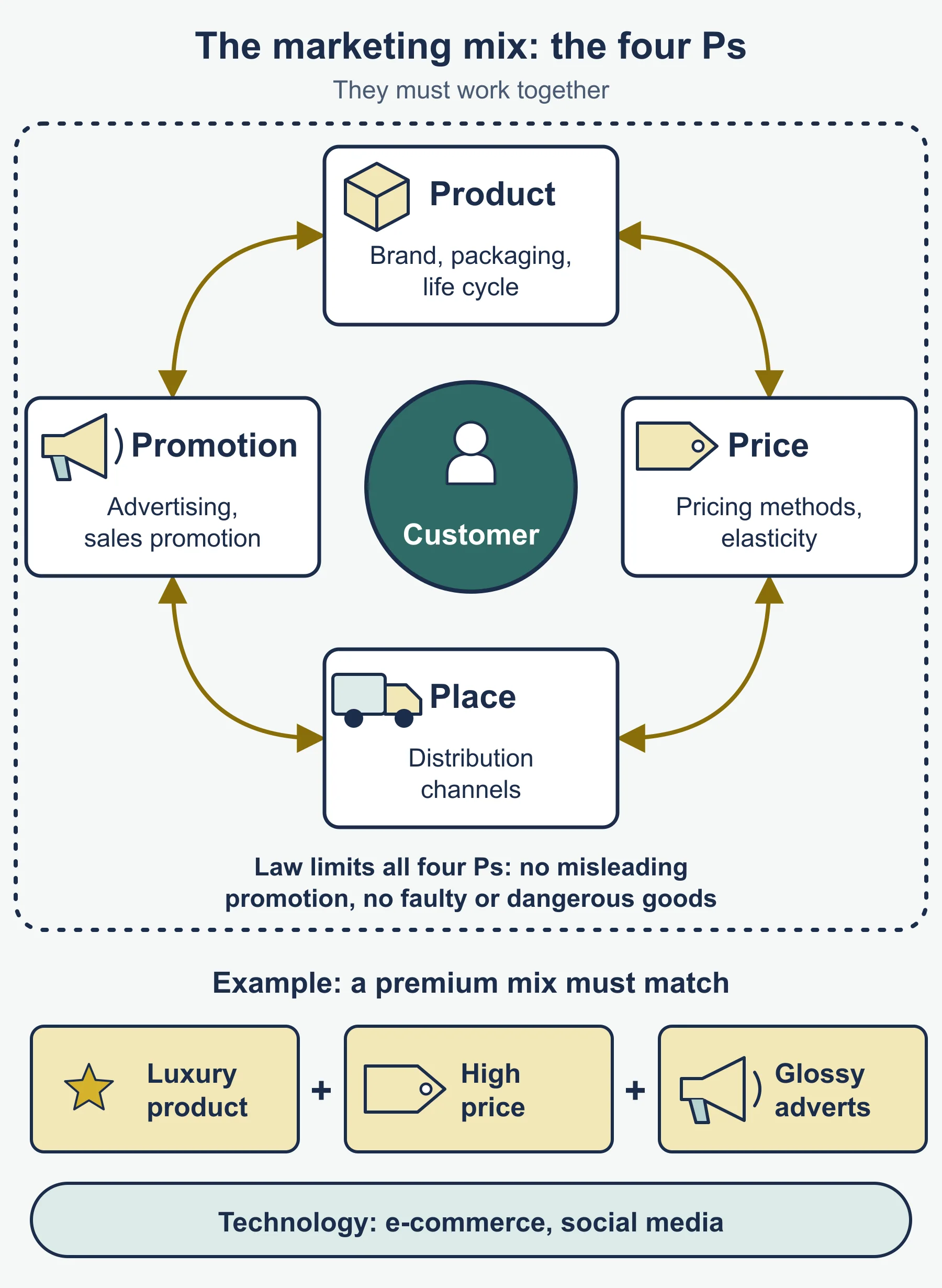
The marketing mix is the combination of decisions a business makes about its product, price, place and promotion. The syllabus calls these the four Ps, but in answers it is safest to name the elements in full: product, price, place and promotion.
3.3.1 Product
New products
Developing a new product gives a business a chance to open a new market, replace products that are declining and stand out from competitors. The limitations are cost and risk: research and development, testing and launch spending all happen before any sales, and many new products fail. A business may also take sales from its own existing products.
Brand image
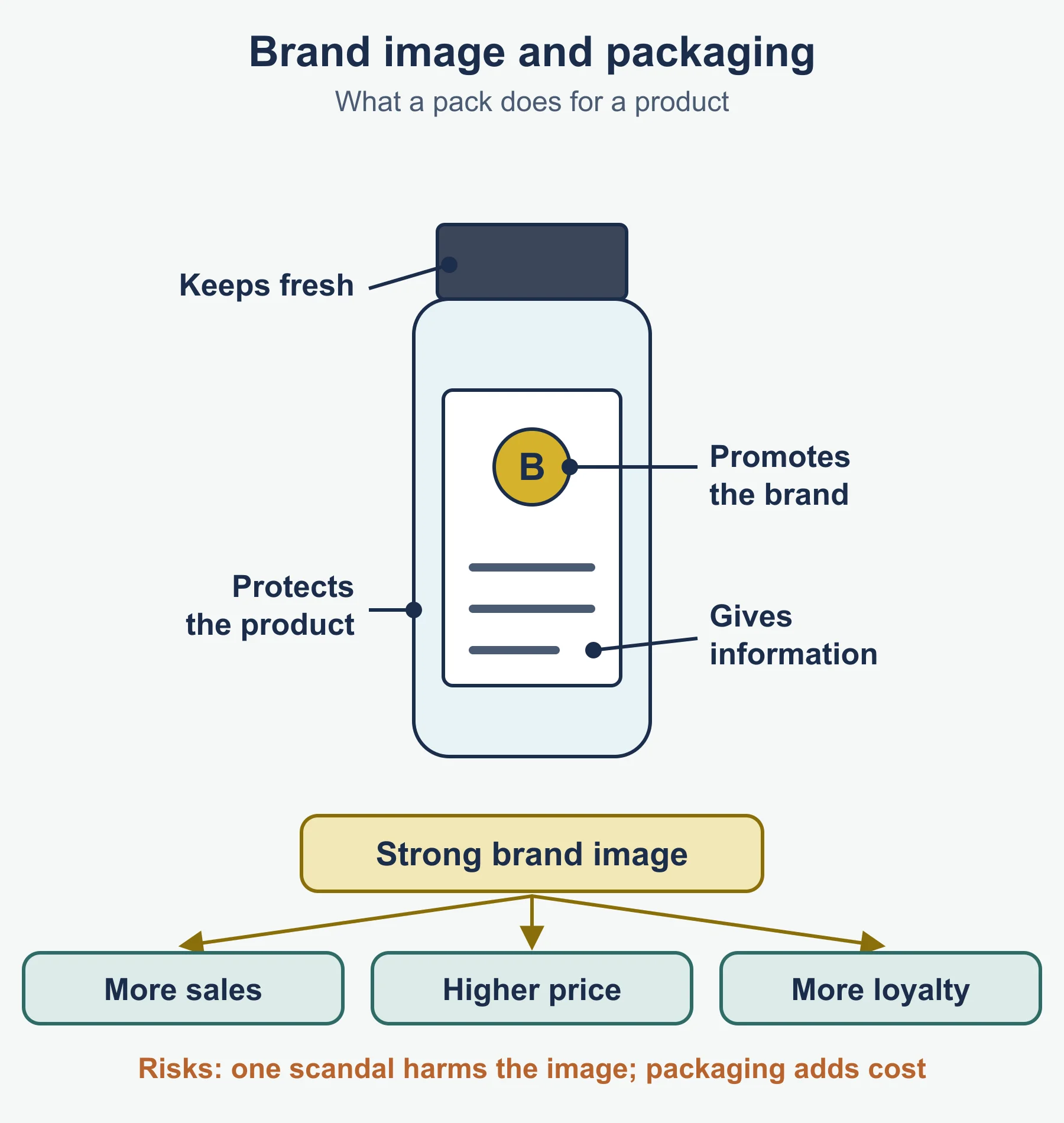
A brand is a name, symbol or design that identifies a product and sets it apart. Brand image is what customers think and feel about it. A strong, positive image can support sales because customers trust the quality before they buy, and it can allow a higher price. It also builds customer loyalty: people who like the brand return and recommend it. The risk is that a single scandal or faulty batch can damage the image quickly.
Packaging
Packaging has several roles: it protects the product in transport and storage, keeps it fresh, gives information (ingredients, instructions), and helps promote the brand through colours and design. Packaging also adds cost, and wasteful packaging can harm the image of a business with environmentally aware customers.
The product life cycle
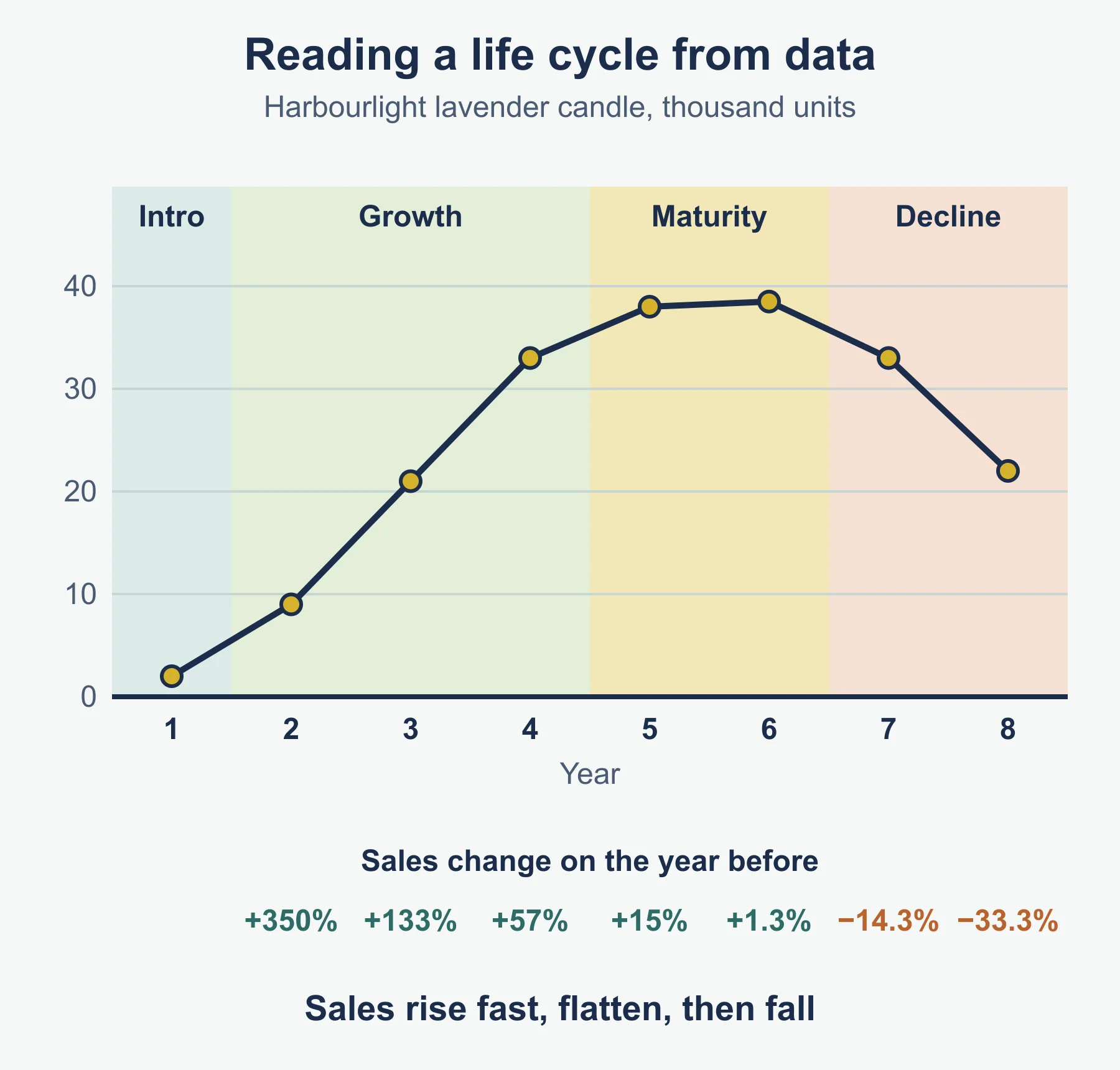
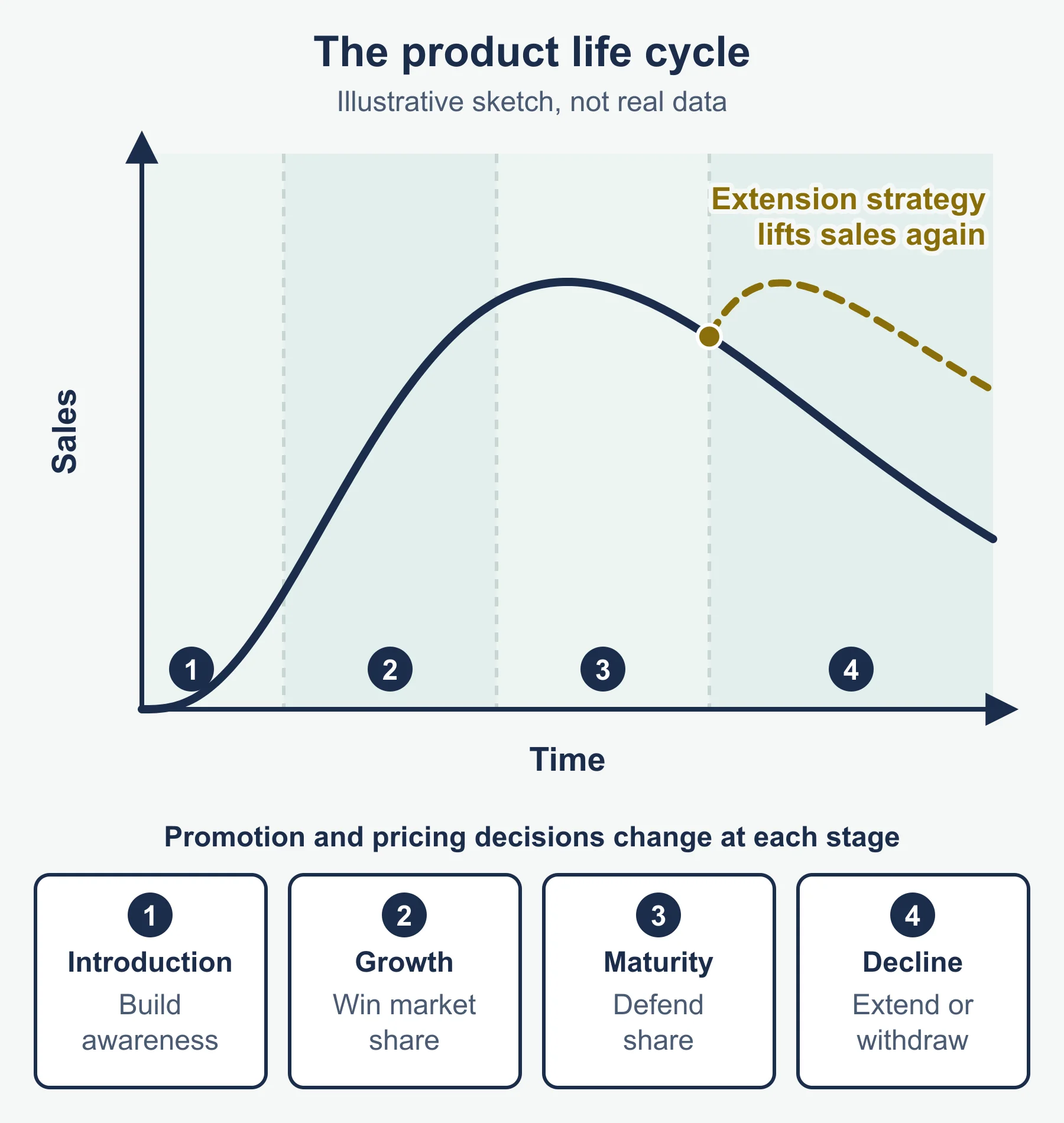
The product life cycle shows how the sales of a product change over time. The main stages are development (before launch, no sales and spending), introduction, growth, maturity and decline. A diagram has time on the horizontal axis and sales on the vertical axis.
Sales
  |              ____
  |           /      \
  |          /        \
  |        /           \
  |      /               \
  |   __/                  \___
  +---------------------------------> Time
    Intro   Growth  Maturity  Decline
Worked example. Harbourlight Candles launches a lavender candle. Sales (thousands of units) over eight years are in the table.
| Year | 1 | 2 | 3 | 4 | 5 | 6 | 7 | 8 |
|---|---|---|---|---|---|---|---|---|
| Sales | 2 | 9 | 21 | 33 | 38 | 38.5 | 33 | 22 |
Interpret it in steps.
- Year 1 sales are small: introduction.
- Sales rise by 350% in year 2, then 133% and 57% in years 3 and 4: growth.
- Growth slows to about 15% in year 5 and 1.3% in year 6, with sales flat near 38 thousand: maturity.
- Sales fall 14.3% in year 7 and 33.3% in year 8: decline.
Extension strategies
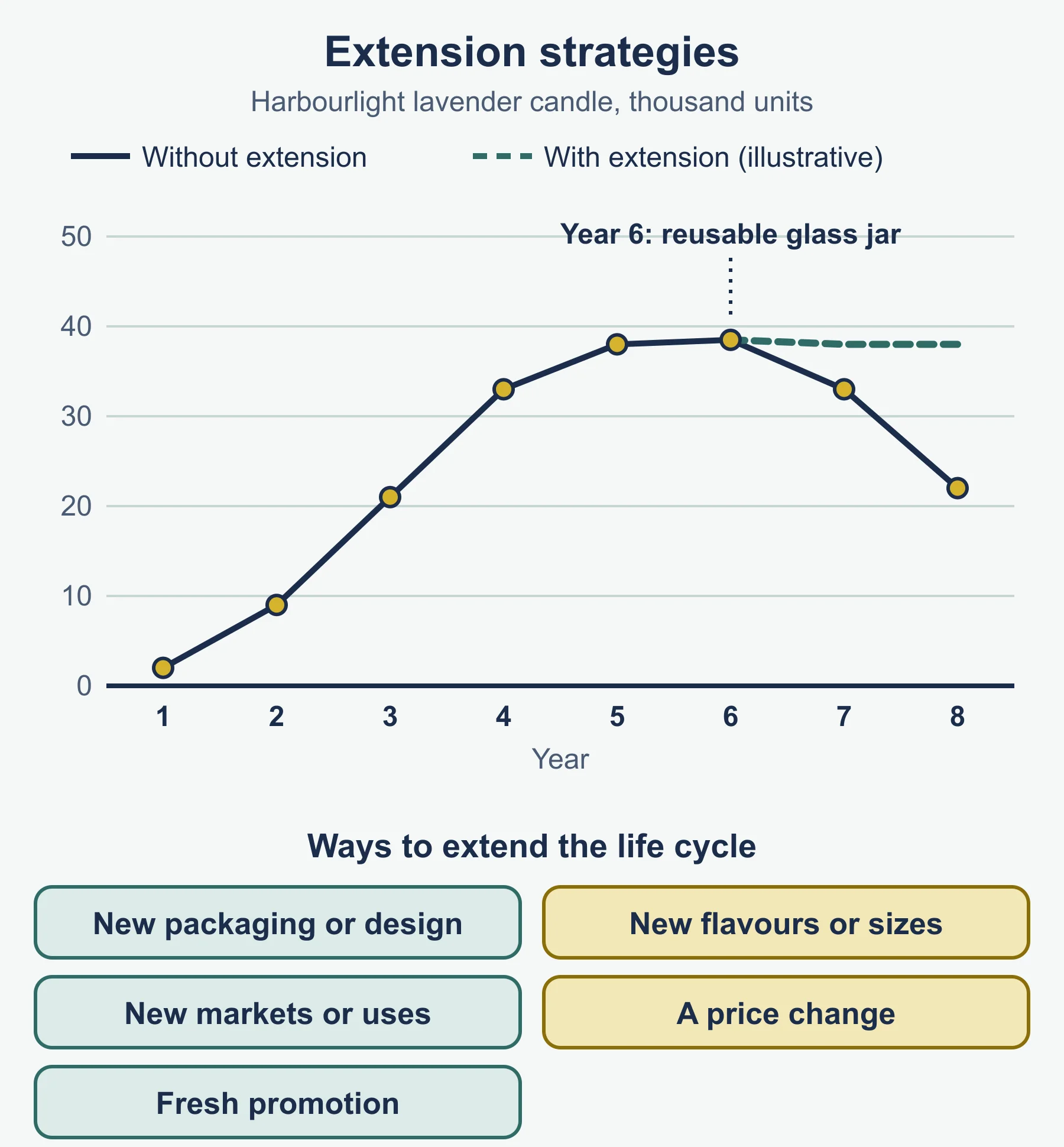
An extension strategy tries to lengthen the life of a product before it declines. Examples: new packaging or a design update, new variants (flavours, sizes), finding new markets or new uses, a price change, or fresh promotion. If Harbourlight launched a candle in a reusable glass jar in year 6, the aim would be to hold sales near maturity instead of letting them fall.
Life cycle and marketing decisions
The stage affects the other parts of the mix.
| Stage | Promotion | Pricing |
|---|---|---|
| Introduction | Informative: make people aware of the product | Penetration or skimming, depending on aims |
| Growth | Persuasive: build the brand as rivals enter | Prices may be held or adjusted as competitors arrive |
| Maturity | Remind and defend market share; promotion often more competitive | Competitive pricing or promotional offers |
| Decline | Spending cut, or an extension strategy tried | Prices cut to clear stock, or the product withdrawn |
3.3.2 Price
Pricing methods
Fill the table with a benefit and limitation for each method the syllabus lists.
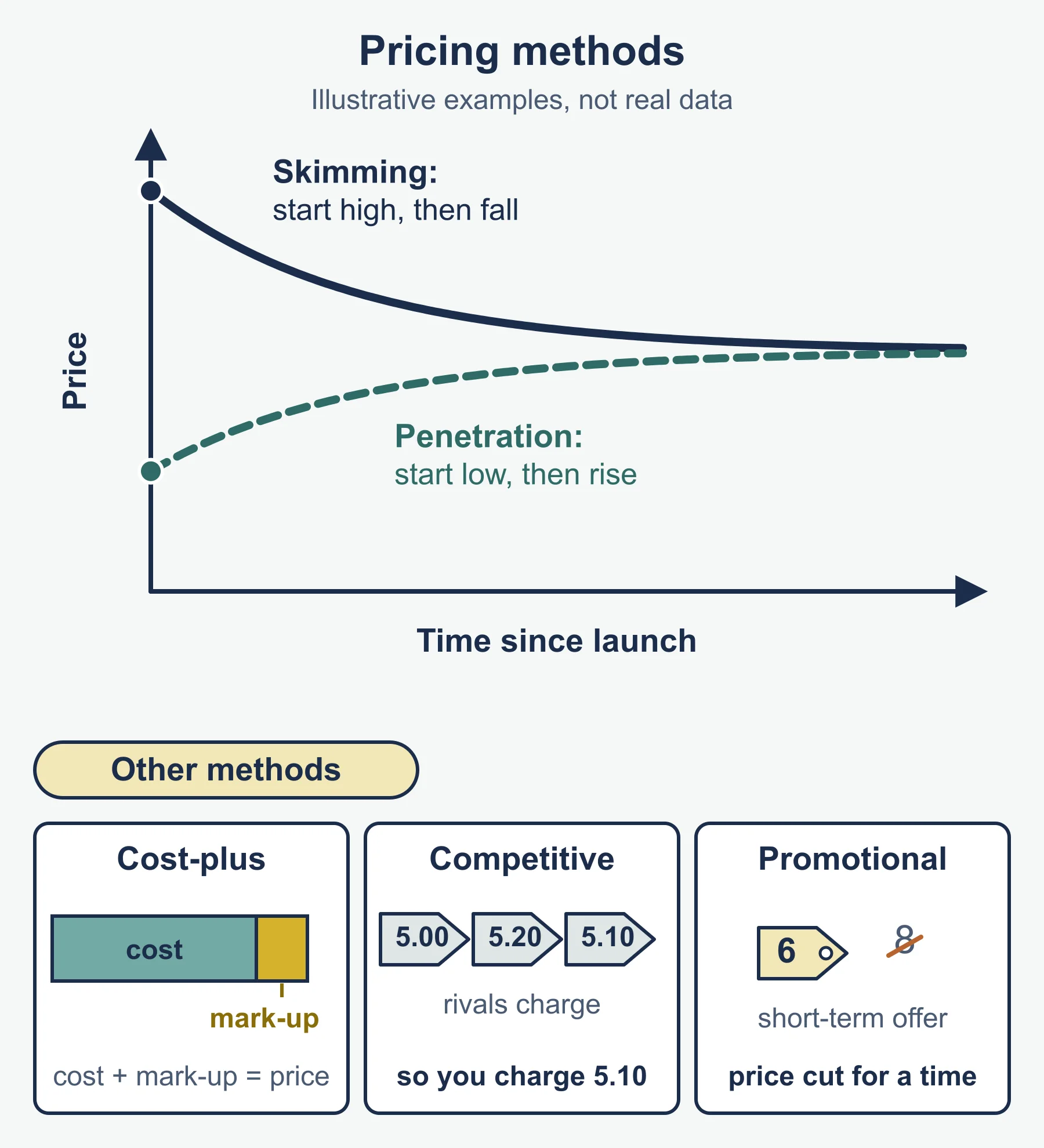
| Method | How it works | Benefit | Limitation |
|---|---|---|---|
| Cost plus | Add a mark-up (a percentage of unit cost) to the cost of making the product | Simple; covers costs and gives a known profit per item | Ignores competitors and what customers will pay |
| Competitive | Set prices close to rivals’ prices | Avoids losing sales to cheaper rivals; avoids price wars | Little freedom; costs may not be covered if rivals are efficient |
| Penetration | Low price at launch to win market share quickly | Attracts customers to a new brand; builds sales fast | Low profit per unit at first; customers may dislike a later rise |
| Skimming | High price at launch for a new or unusual product, lowered later | High profit per unit from customers who pay for novelty; recovers development cost | Few buyers; high prices attract rivals |
| Promotional | Temporary price cuts, bundles or special offers | Boosts short-term sales and clears stock | Reduces profit per item; customers may wait for the next offer |
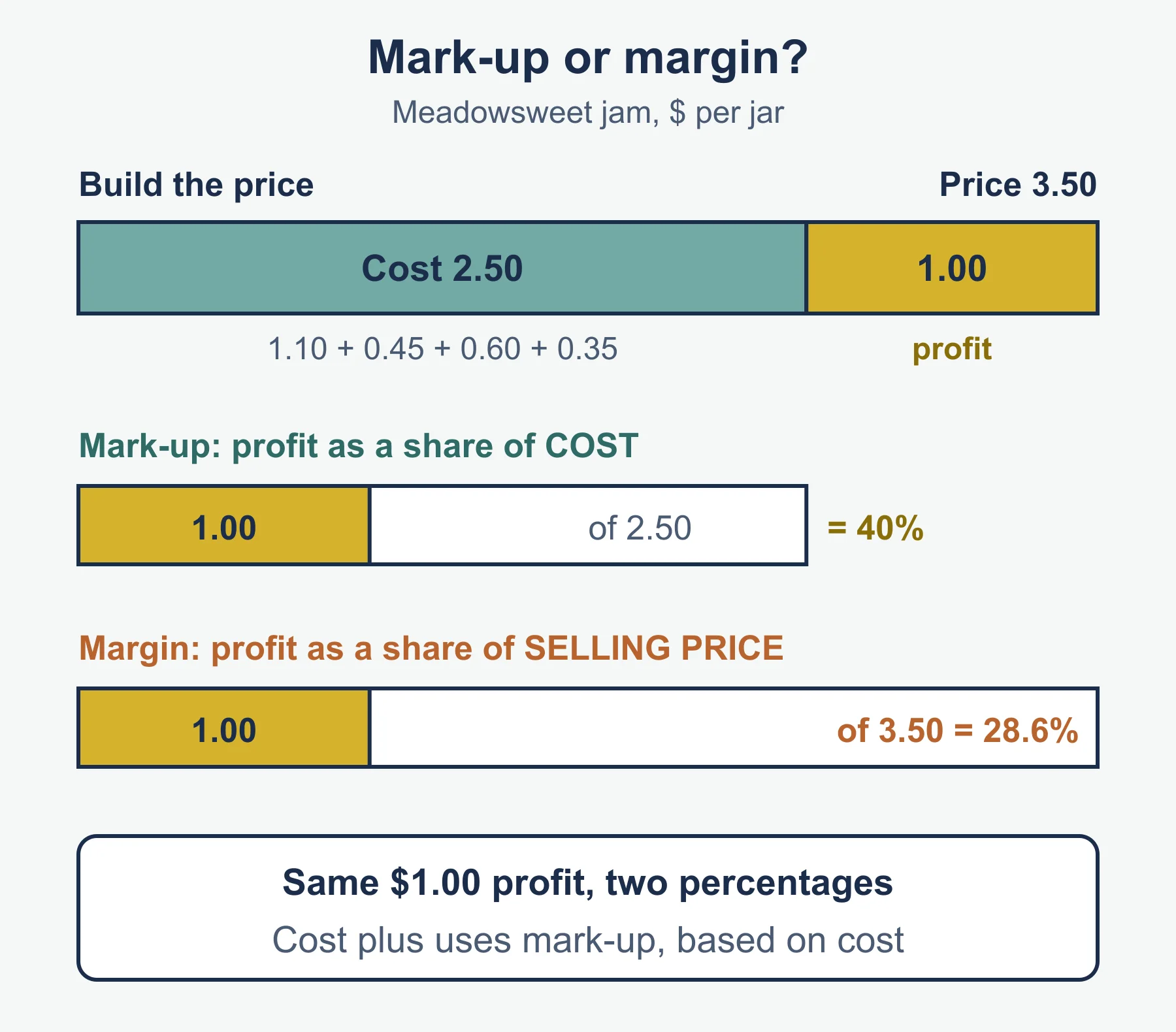
Worked example. Meadowsweet Preserves makes a jar of jam. Costs per jar: ingredients 1.10, jar and label 0.45, labour 0.60, overheads 0.35.
- Total cost = 1.10 + 0.45 + 0.60 + 0.35 = 2.50.
- Cost plus with a 40% mark-up: 2.50 × 1.40 = 3.50, so profit per jar is 1.00.
- A new competitor sells similar jam at 3.30 to 3.60, so 3.50 also fits a competitive approach.
- Penetration at 20% below normal price: 3.50 × 0.80 = 2.80. Profit per jar falls to 0.30, so the owner must expect volume to rise enough to make up for it.
- A promotional offer of two jars for 6.00 gives 3.00 a jar, a discount of 14.3% on 3.50.
Mark-up is based on cost, not on selling price. The profit of 1.00 is 40% of cost but only 28.6% of the selling price. Do not mix the two.
Recommending and justifying a pricing method
Link the method to the situation. A new product with no close rival and customers who want novelty suggests skimming. A new entrant in a crowded market suggests penetration or competitive pricing. A product in decline suggests promotional pricing to clear stock. A product with a stable, easily measured cost and few rivals suggests cost plus. A justified answer says why, then gives one limitation.
Price elasticity
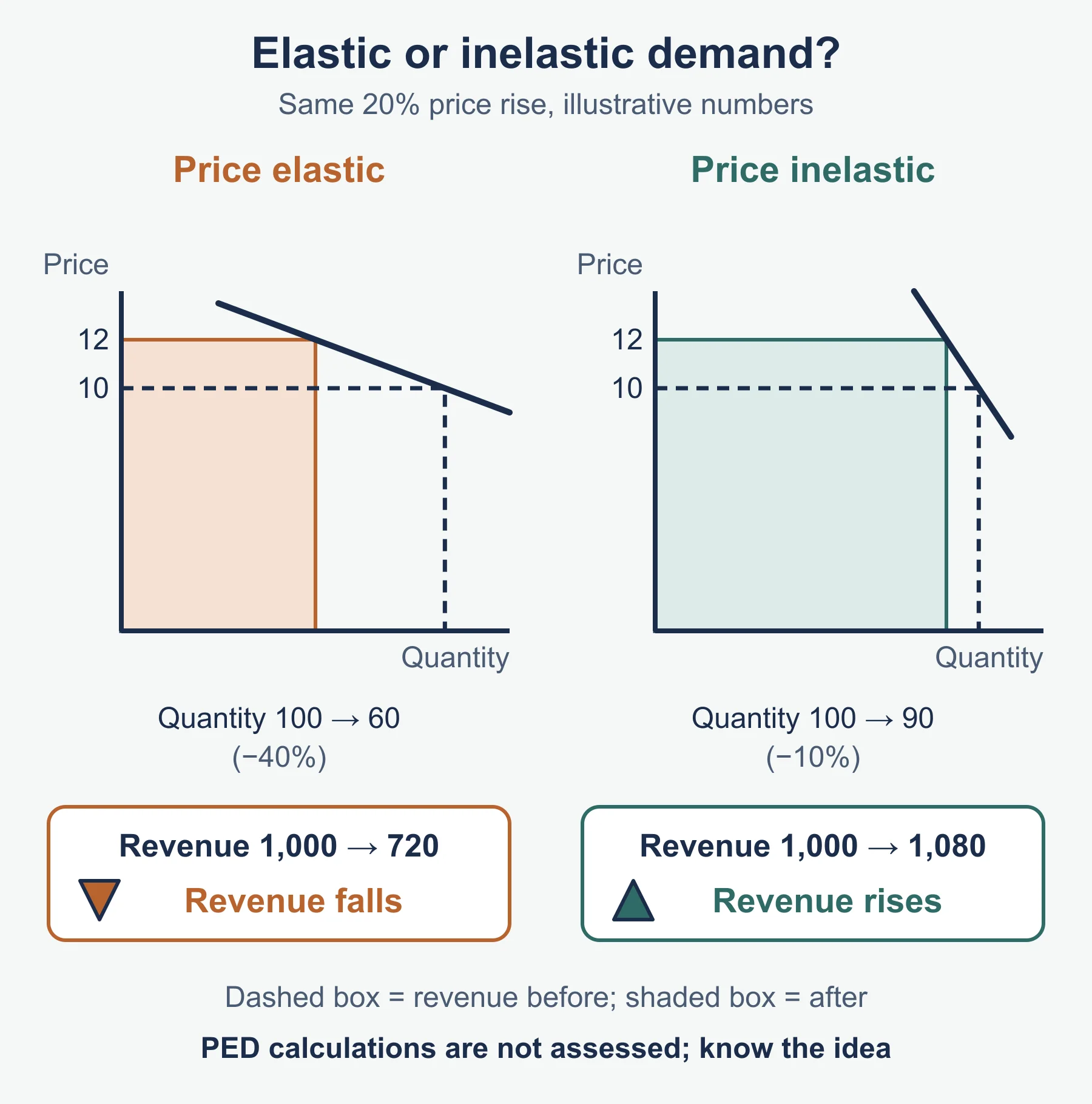
Demand is price elastic when a change in price causes a larger proportionate change in the quantity demanded. It is price inelastic when the quantity changes by proportionately less. The syllabus says the PED formula and calculations are not assessed, so you need the idea, not the number.
Why it matters: for elastic demand, a price cut can raise sales enough to increase revenue, and a rise can lose many customers. For inelastic demand, a price rise can increase revenue because few customers leave, but a cut gives away revenue. Products with many substitutes tend to be elastic, while necessities and strongly branded goods tend to be inelastic.
3.3.3 Place: distribution channels
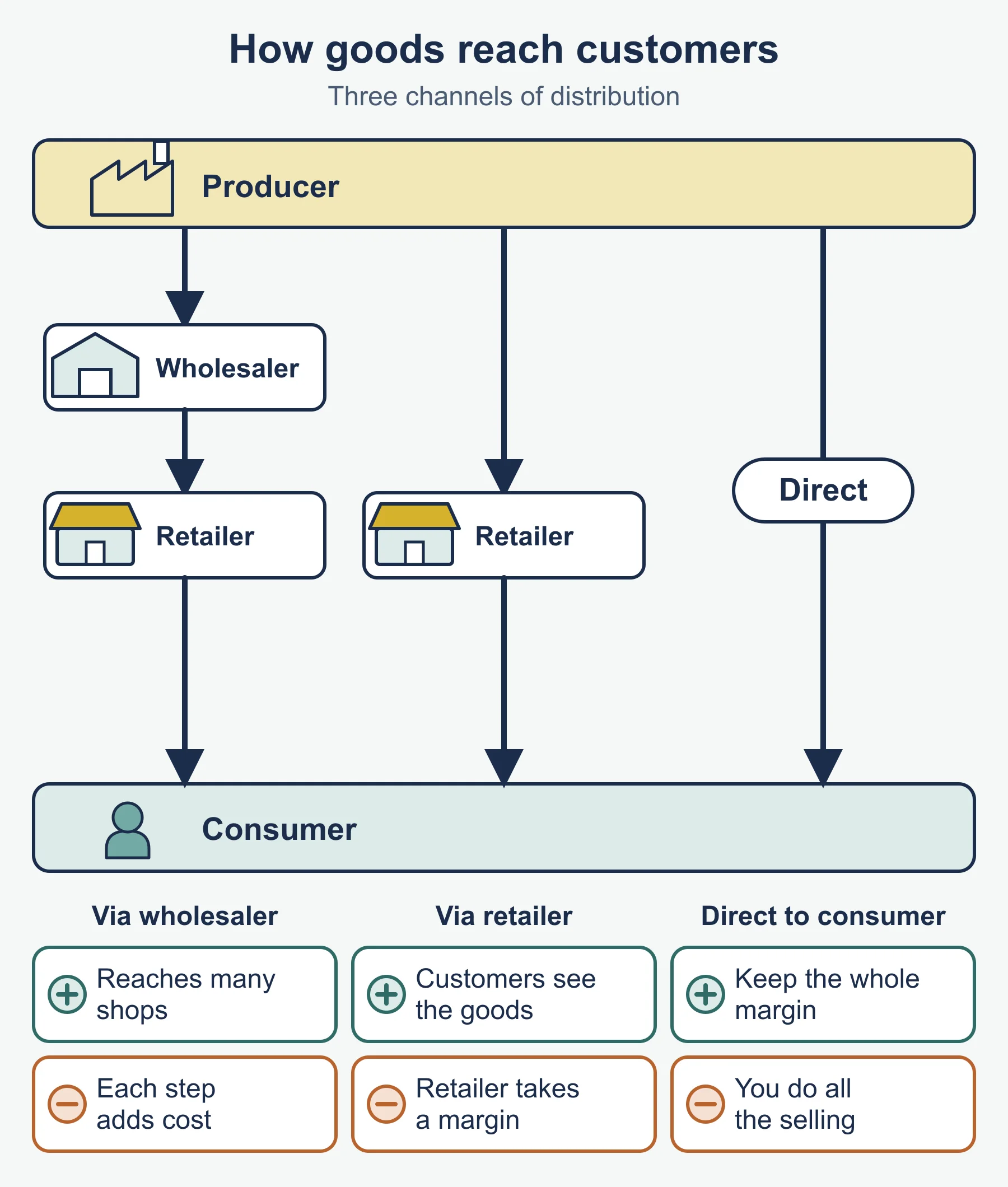
A distribution channel is the route a product takes from producer to consumer. The syllabus mentions wholesalers, retailers and direct to consumers.
| Channel | Advantages | Disadvantages |
|---|---|---|
| Wholesaler then retailer | Reaches many shops; wholesaler holds stock and breaks bulk | Each step takes a margin, so producer earns less per item; less control of image |
| Direct to retailer | Fewer margins; closer relations with the shop | Producer deals with many small orders and delivery |
| Direct to consumer | Producer keeps the whole margin; direct customer contact and control of image | Producer pays for storage, delivery and handling; reaches fewer customers |
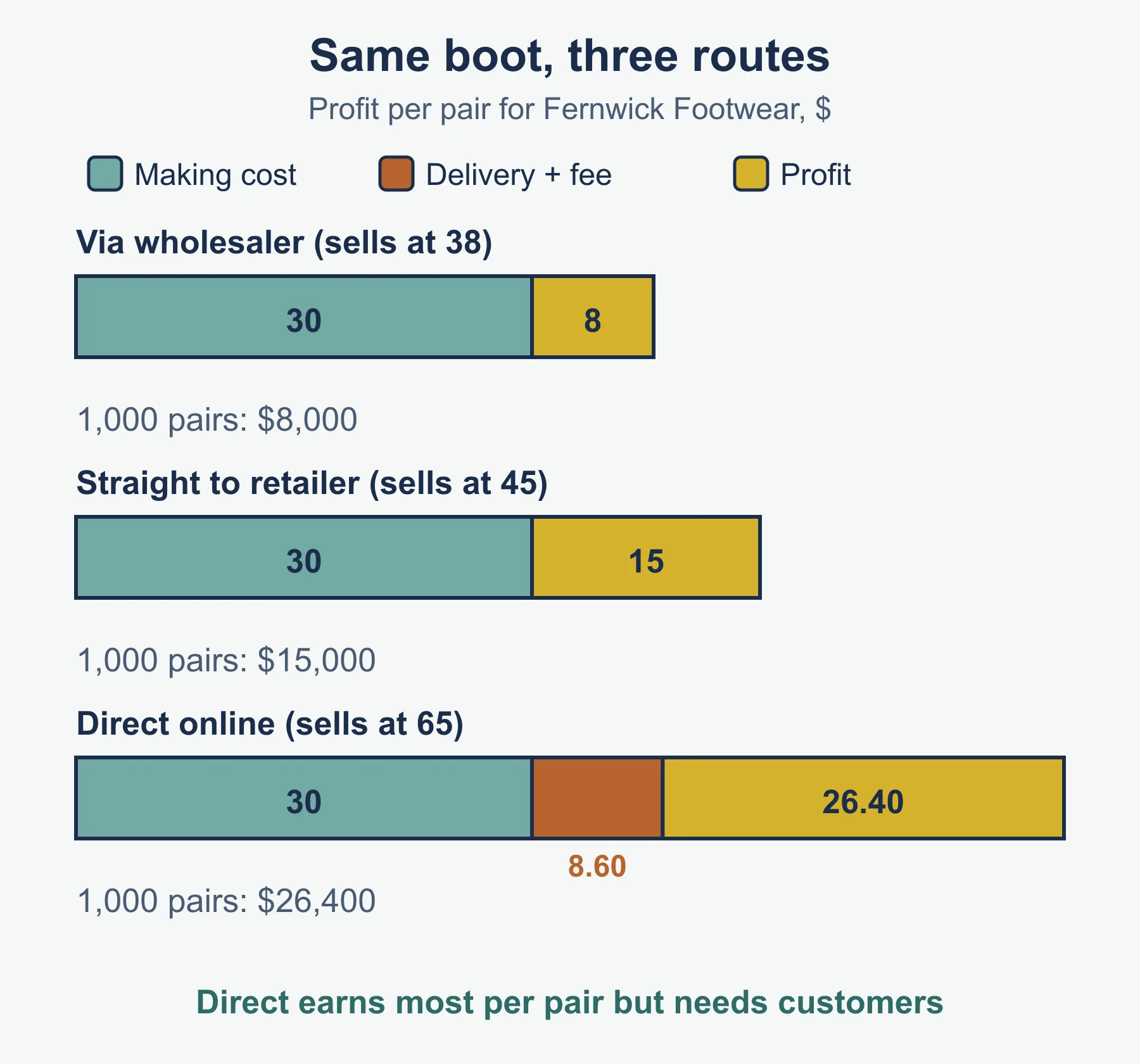
Worked example. Fernwick Footwear makes a boot at a cost of 30 a pair.
- Via a wholesaler: sells to the wholesaler at 38, who sells to a retailer at 48, who sells to the consumer at 70. Fernwick earns 8 a pair.
- Via a retailer only: Fernwick sells at 45. Profit is 15 a pair.
- Direct online at 65, with delivery and packing of 6 and a payment platform fee of 4% (2.60): profit = 65 − 30 − 6 − 2.60 = 26.40 a pair.
On 1,000 pairs, that is 8,000, 15,000 and 26,400. Direct selling earns most per pair, but it only works if the website can attract customers and fulfil orders. Recommend based on the situation: a start-up with no buyers may start with a retailer for reach and add a direct channel as it learns.
3.3.4 Promotion
Aims
Promotion aims to inform customers, persuade them to buy, remind them of the product, build or protect brand image, increase sales and market share, and launch a new product.
Forms
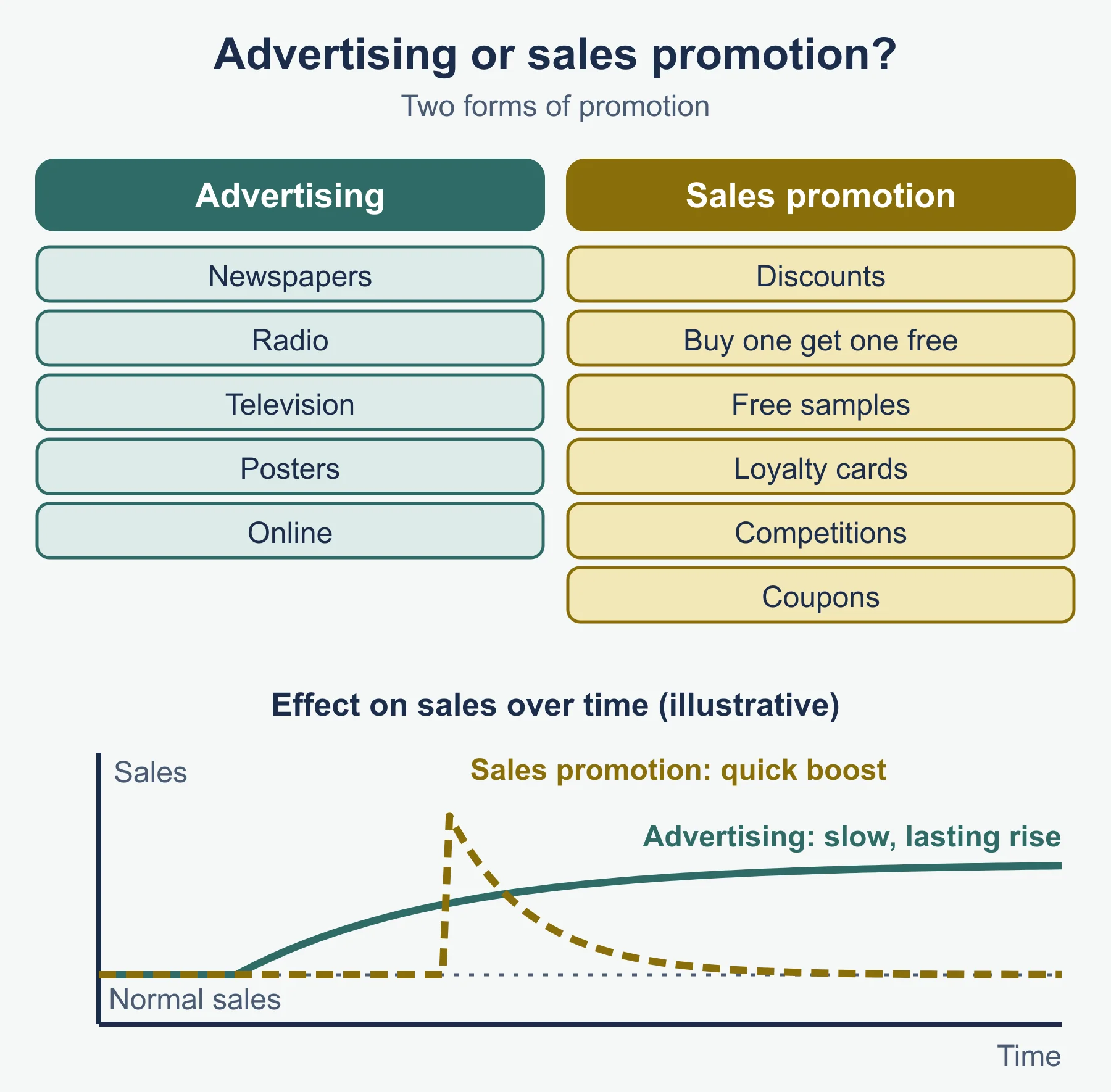
Advertising pays for messages in media such as newspapers, radio, television, posters and online. Sales promotion uses short-term incentives: discounts, buy-one-get-one-free, free samples, loyalty cards, competitions and coupons. Sales promotion tends to boost sales quickly, while advertising builds awareness and image over time. The syllabus names advertising and sales promotion as examples.
Cost-effectiveness
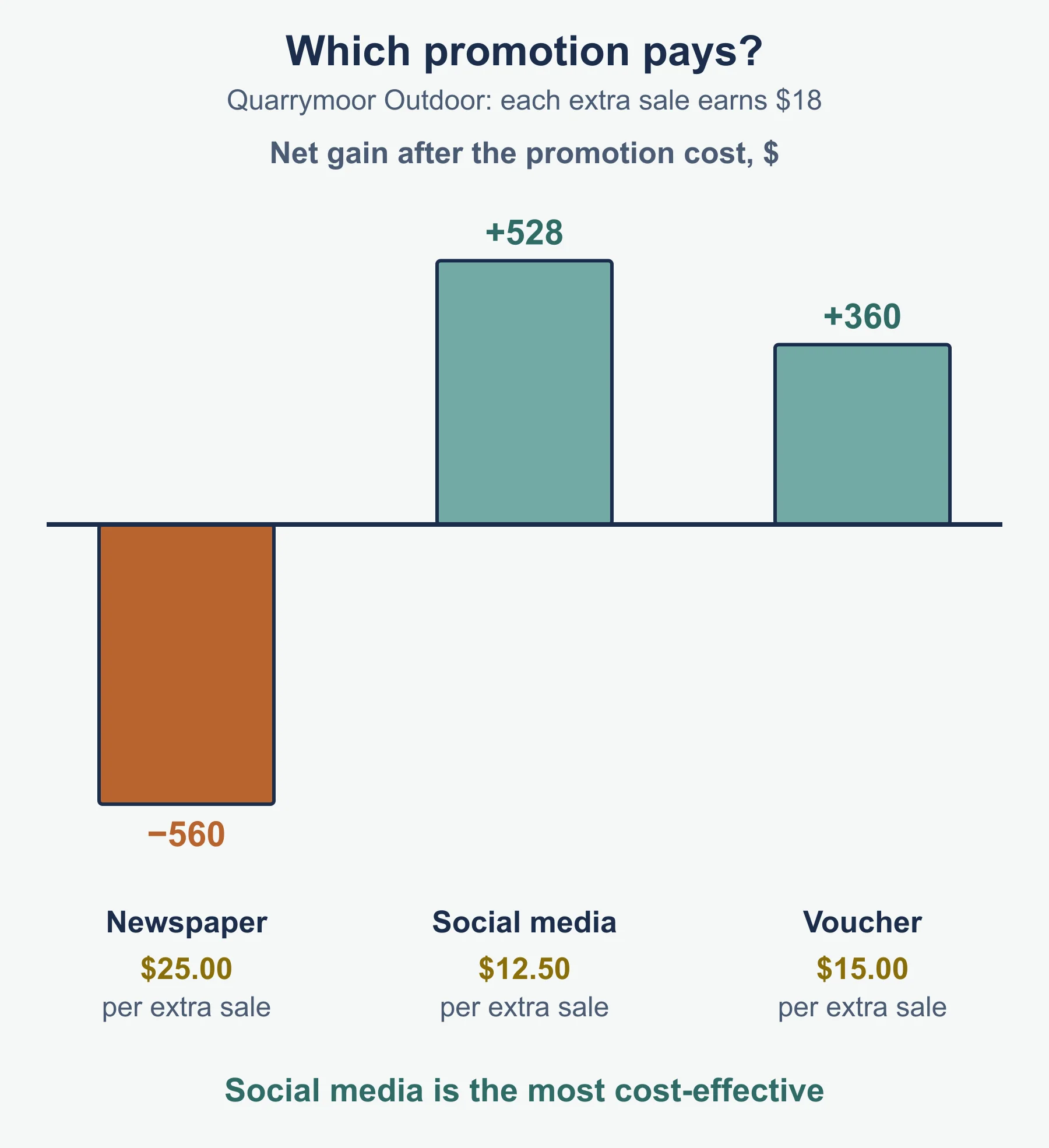
A marketing budget is limited, so a business must ask how much extra sales each method brings per dollar spent. Quarrymoor Outdoor can spend on three options. Each extra sale earns the business 18 profit before promotion costs.
| Method | Cost | Extra sales | Cost per extra sale | Net gain after cost |
|---|---|---|---|---|
| Local newspaper advert | 2,000 | 80 | 25.00 | −560 |
| Social media campaign | 1,200 | 96 | 12.50 | 528 |
| Discount voucher | 1,800 | 120 | 15.00 | 360 |
The newspaper advert costs more per sale than each sale earns, so it loses money. Social media is most cost-effective on these figures. Voucher gives the most extra sales but a lower net gain. Say what the business cares about: cost per sale, or total sales.
3.3.5 Technology and the marketing mix
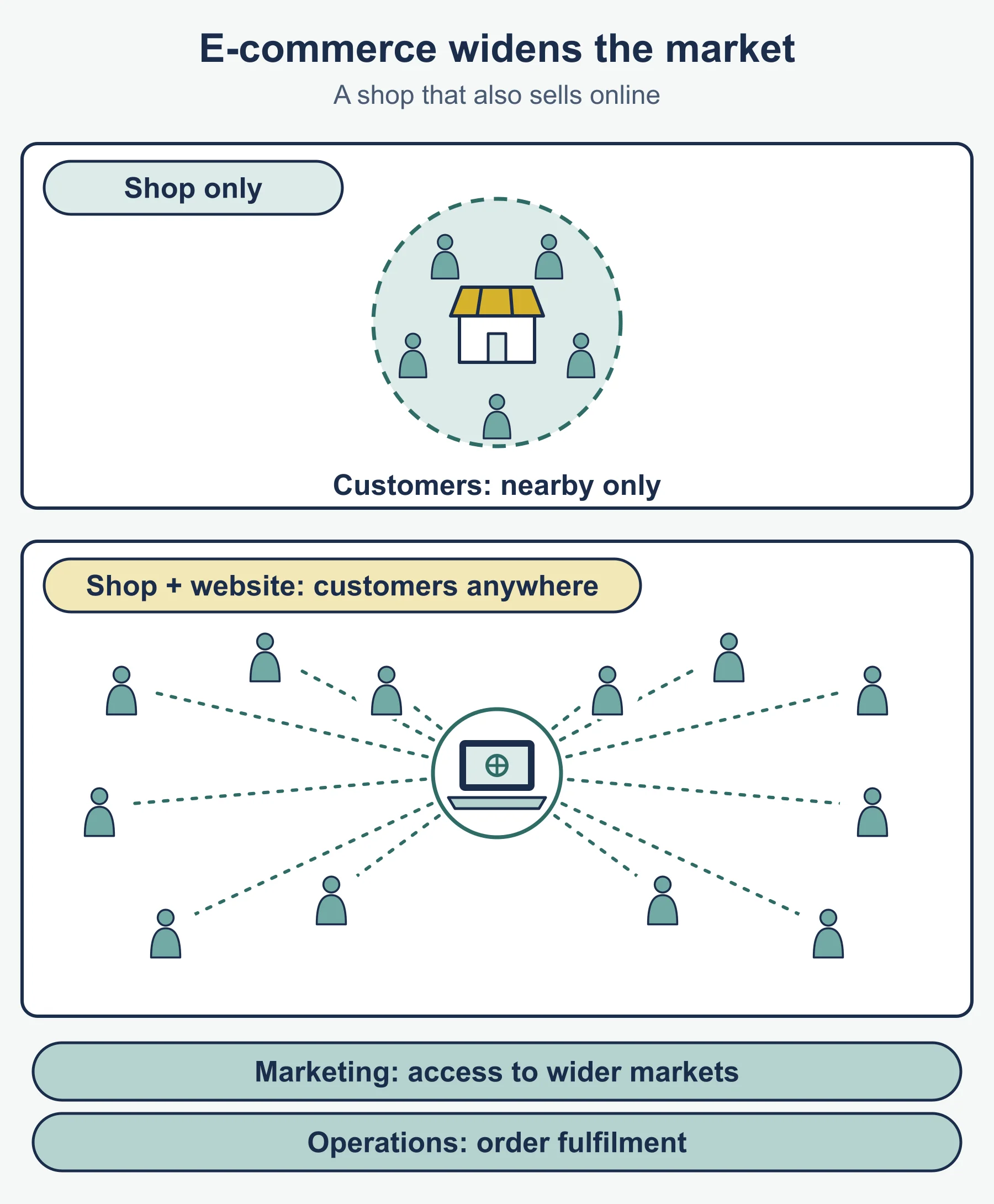
E-commerce is buying and selling goods and services over the internet. Online shops, delivery apps and digital downloads are examples.
| Opportunities | Threats | |
|---|---|---|
| Business | Reach customers anywhere; open all hours; lower costs (fewer shops); data on customers; easy to target promotion | Heavy competition from many sellers; website failures; security and data risks; delivery costs; customers cannot see the product |
| Consumer | Wider choice; easy price comparison; convenience; delivery to home | Fraud and security concerns; cannot inspect products; delivery delays; returns can be awkward; those without internet are left out |
Internet and social media promotion: businesses can post offers, share customer reviews and respond to questions. They can also target adverts by age or location, measure responses and spend less than on television. Limitations include negative comments spreading fast, the time needed to manage accounts and customers who ignore online advertising.
Common errors
- Mixing up penetration (low price at launch) and skimming (high price at launch).
- Calling promotion only “advertising”; sales promotion is a separate form.
- Describing the life cycle stages without using the data given in a question.
- Writing PED calculations; the syllabus says they are not assessed.
- Recommending a method without giving a reason linked to the business described.
- Listing e-commerce benefits only for the business when the question asks about consumers.
Frequently asked questions
What are the stages of the product life cycle? The main stages are development, introduction, growth, maturity and decline. During development, before launch, there are no sales but money is spent.
Is mark-up the same as profit margin on the selling price? No. Mark-up is based on cost: a 40% mark-up on a cost of 2.50 gives a price of 3.50 and a profit of 1.00, which is 40% of cost but only 28.6% of the selling price.
When is skimming the best pricing method? Skimming suits a new product with no close rival and customers who want novelty. A new entrant in a crowded market is more likely to suit penetration or competitive pricing.
What does cost-effective promotion mean? It means comparing how much extra sales each promotion method brings per dollar spent. A method can bring many extra sales yet still give a lower net gain than a cheaper one.
What are the roles of packaging? Packaging protects the product in transport and storage, keeps it fresh, gives information such as ingredients and instructions, and helps promote the brand through its colours and design.
Official syllabus
This guide is aligned to the Cambridge O Level Business Studies 7115 syllabus for examination in 2026, published by Cambridge International, section 3.3.
Get free revision emails (optional)
Occasional emails with practice questions, worked explanations and links to free resources for the qualification and subjects you choose. No spam, and you can unsubscribe from any email. The free tools on this site never need an email.
Related resources
-
Practice questions
O Level Business: Marketing mix (Cambridge 7115) – Practice Questions
Original practice questions with worked answers on the marketing mix for Cambridge O Level Business 7115: product, price, place, promotion and e-commerce.
Business · Cambridge · O Level
Try questions -
Revision notes
O Level Business: Marketing mix (Cambridge 7115) – Revision Notes
Condensed revision notes on the marketing mix for Cambridge O Level Business 7115: product, price, place, promotion and e-commerce, plus a quick self-test.
Business · Cambridge · O Level
Revise topic -
Practice questions
O Level Business: Marketing — Practice Questions (Cambridge 7115)
Original practice questions with worked answers on customer relationships, niche markets, market share, social media and pricing for O Level Business 7115.
Business · Cambridge · O Level
Try questions
Related articles
-
teaching
A Level tuition in Dubai: Cambridge or Pearson Edexcel International A Level?
Schools in Dubai and Abu Dhabi teach either Cambridge International AS & A Level or Pearson Edexcel International A Level. How the two are structured, why it matters for tuition, and how online classes from Lahore work.
9 October 2026
-
curriculum guides
Choosing subjects at IGCSE and A Level
How subject choices at 14 and 16 affect university options later, and how to keep pathways open without overloading a timetable.
28 July 2026
Studying this with a teacher
Working through Business O LEVELS?
This page is free and stays free. If you would rather be taught it, Marlbridge runs Business classes one-to-one and in small groups of up to 15, online in your own time zone. The first trial class is free. WhatsApp replies within an hour (8am–11pm Pakistan time, every day); email the same day.
Cambridge Business teachers at Marlbridge

