
Revision Notes
O Level Business: Marketing, competition and the customer and Market research (Cambridge 7115) – Revision Notes
Condensed revision notes on customer needs, market changes, niche and mass marketing, segmentation and research for Cambridge O Level Business 7115.
- Subject
- Business
- Level
- O LEVELS
- Topic
- Marketing
- Author
- Marlbridge Academic Team
- Updated
- Reviewed by
- Salman Ahmad (what this means)
Aligned to Cambridge O Level Business (7115), For examination in 2026. Official specification .
Syllabus page (what it covers and how it is assessed): Cambridge O Level Business.
Syllabus points this page covers
7115
- 3.1 Marketing, competition and the customer
- 3.2 Market research
Found an error? Report a correction.
Need help with this topic? Request a free trial class for O Level Business (7115).
These notes condense sections 3.1 (Marketing, competition and the customer) and 3.2 (Market research) of the Cambridge O Level Business Studies (7115) syllabus for examination in 2026. For full explanations and worked examples, read the study guide. Then try the practice set and the topic-level Marketing practice questions. Tick off topics on the printable checklist, see the course hub and take a free diagnostic to find weak spots.
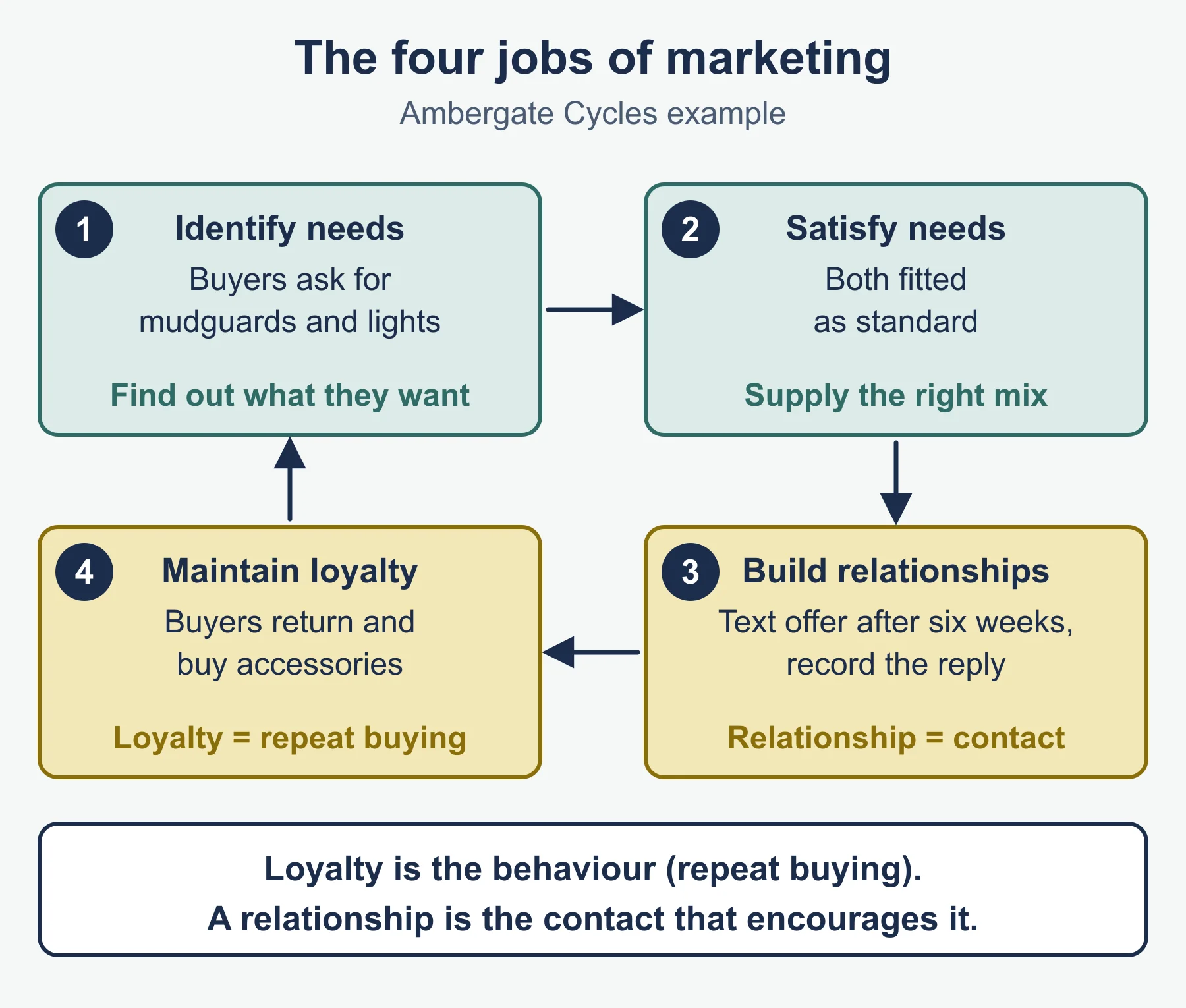
3.1.1 Role of marketing
| Job | One-line meaning | Typical action |
|---|---|---|
| Identify customer needs | Find out what customers want | Surveys, studying sales records |
| Satisfy customer needs | Supply the right product, price, place, promotion | Adjusting features and service |
| Maintain customer loyalty | Keep customers buying again | Points schemes, consistent quality |
| Build customer relationships | Two-way contact over time | Feedback requests, personal offers |
Distinction: loyalty is the repeat buying; a relationship is the contact that encourages it.
3.1.2 Market changes
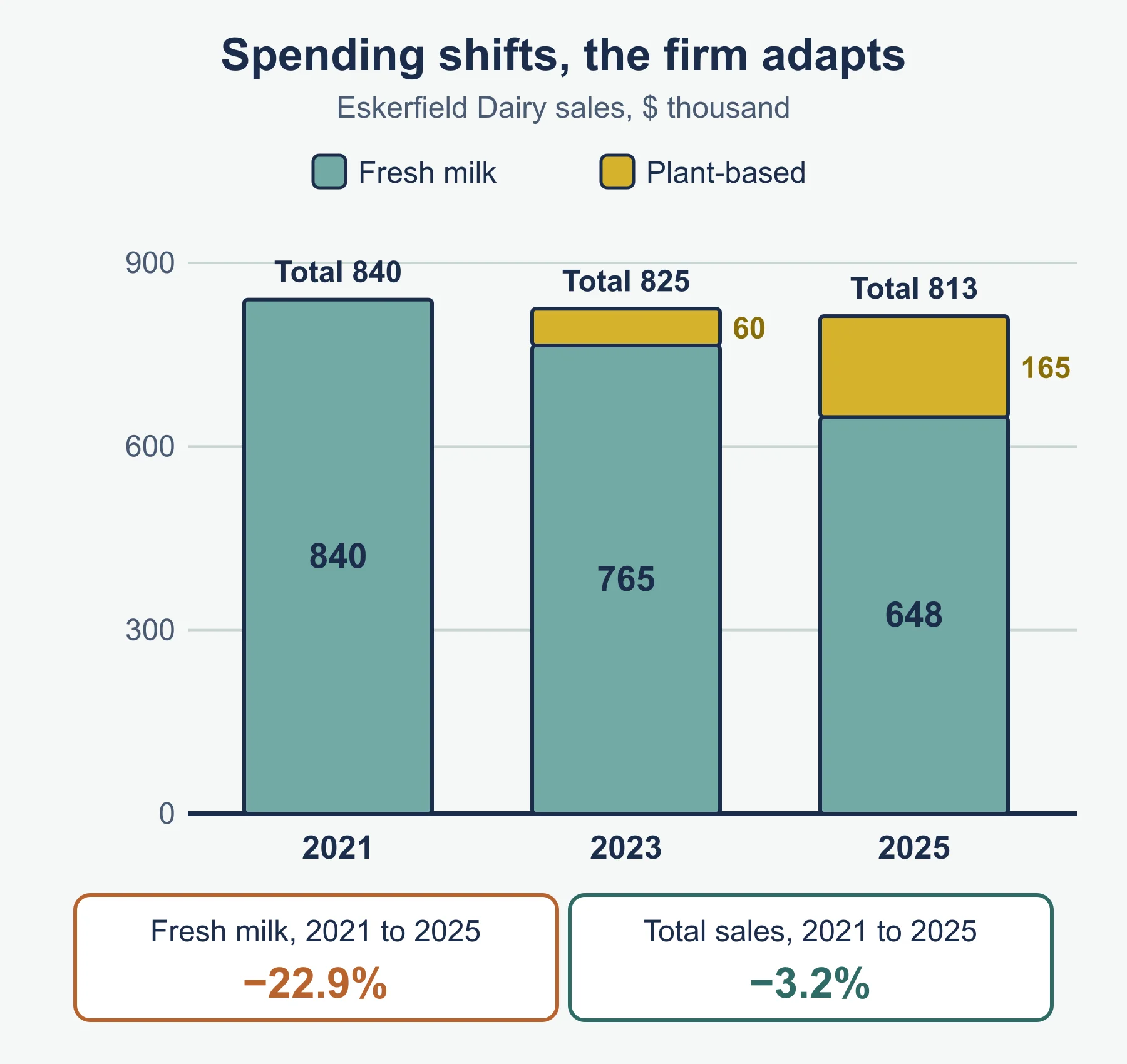
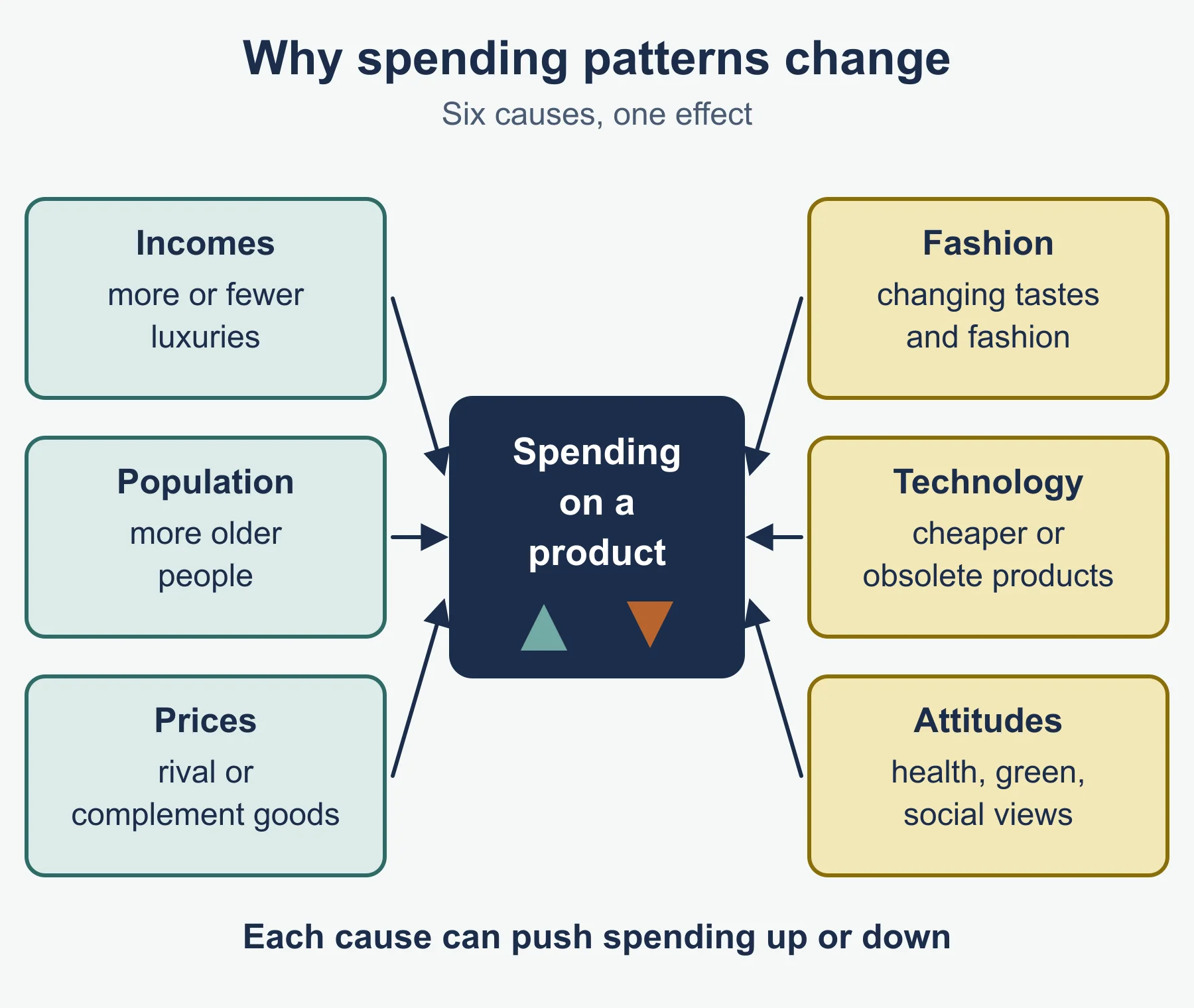
- Why spending patterns change: incomes, tastes and fashion, population, technology, prices of related goods, health and environmental attitudes.
- Why changing needs matter: products that no longer match needs lose sales, leave unsold stock and hand customers to rivals.
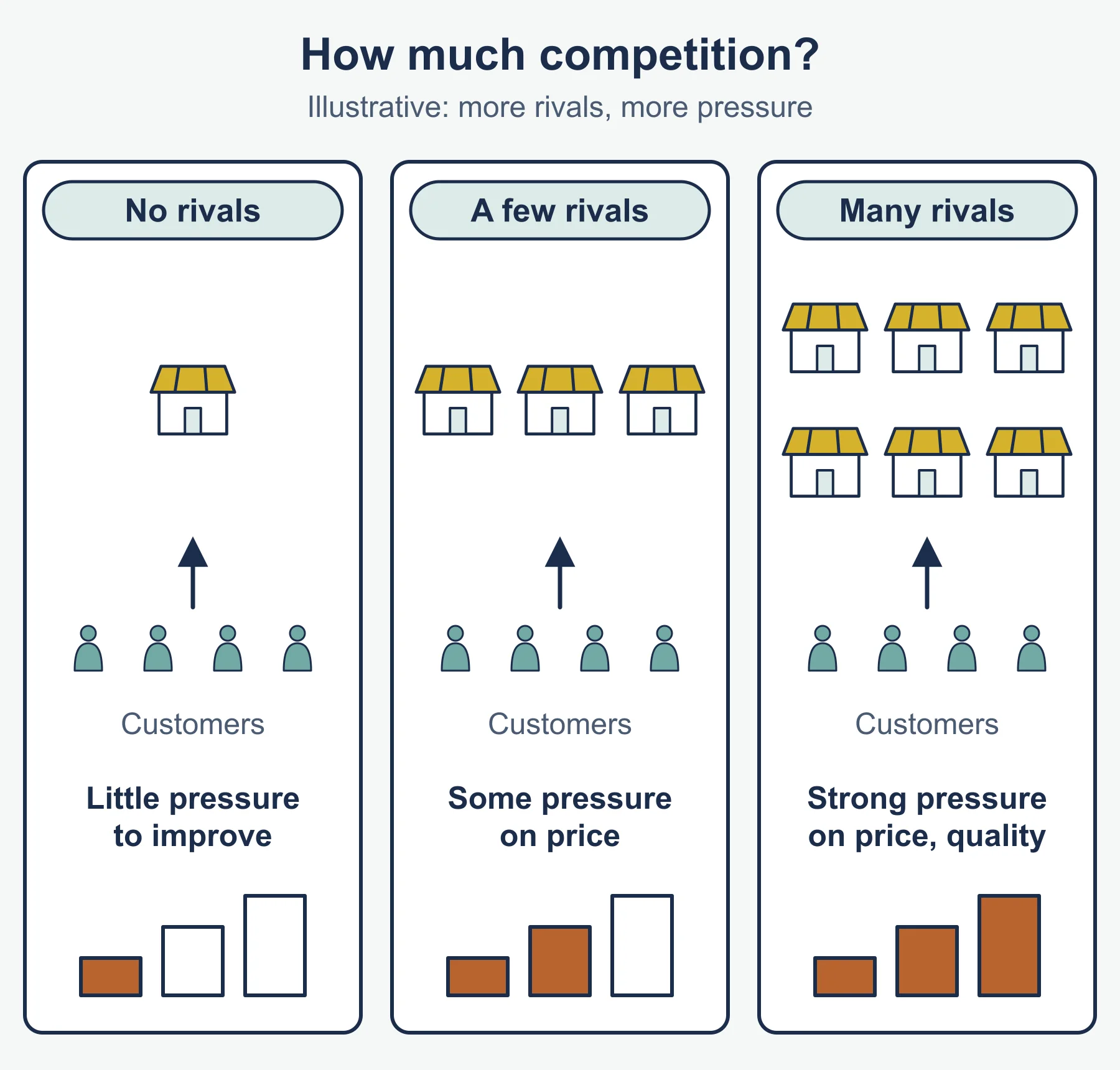
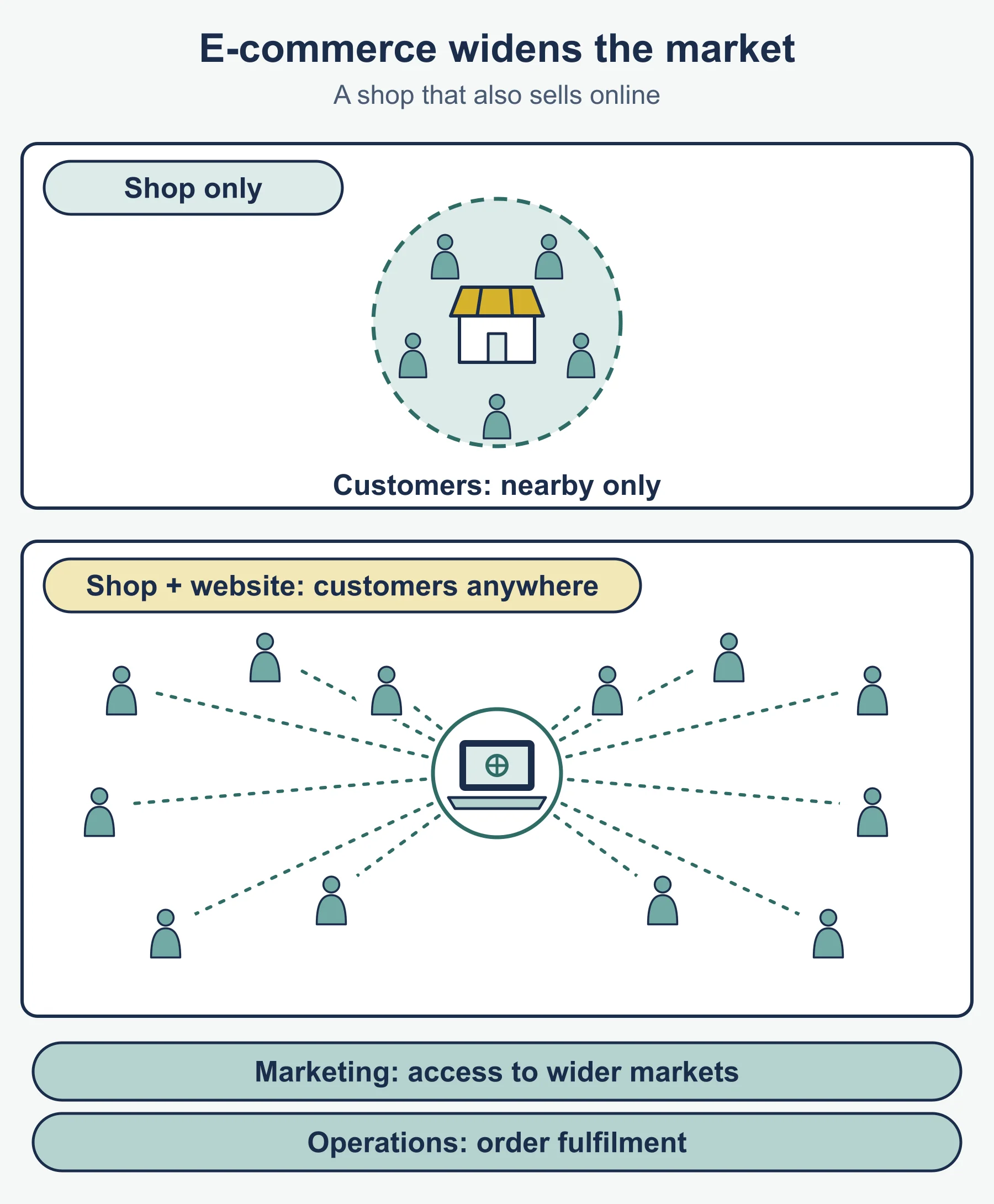
- Why markets become more competitive: easier entry for new firms, online selling, global rivals, price comparison websites, better-informed customers.
- Responses: more research, new or adapted products, price changes, better service or quality, stronger promotion, new customer groups, lower costs.
Method in steps for a “respond to change” question
- Name the change in the case.
- Say what it does to the business (sales, costs, share of customers).
- Choose a response that fits that business.
- Explain why it helps, and note a drawback or cost.
3.1.3 Niche and mass marketing
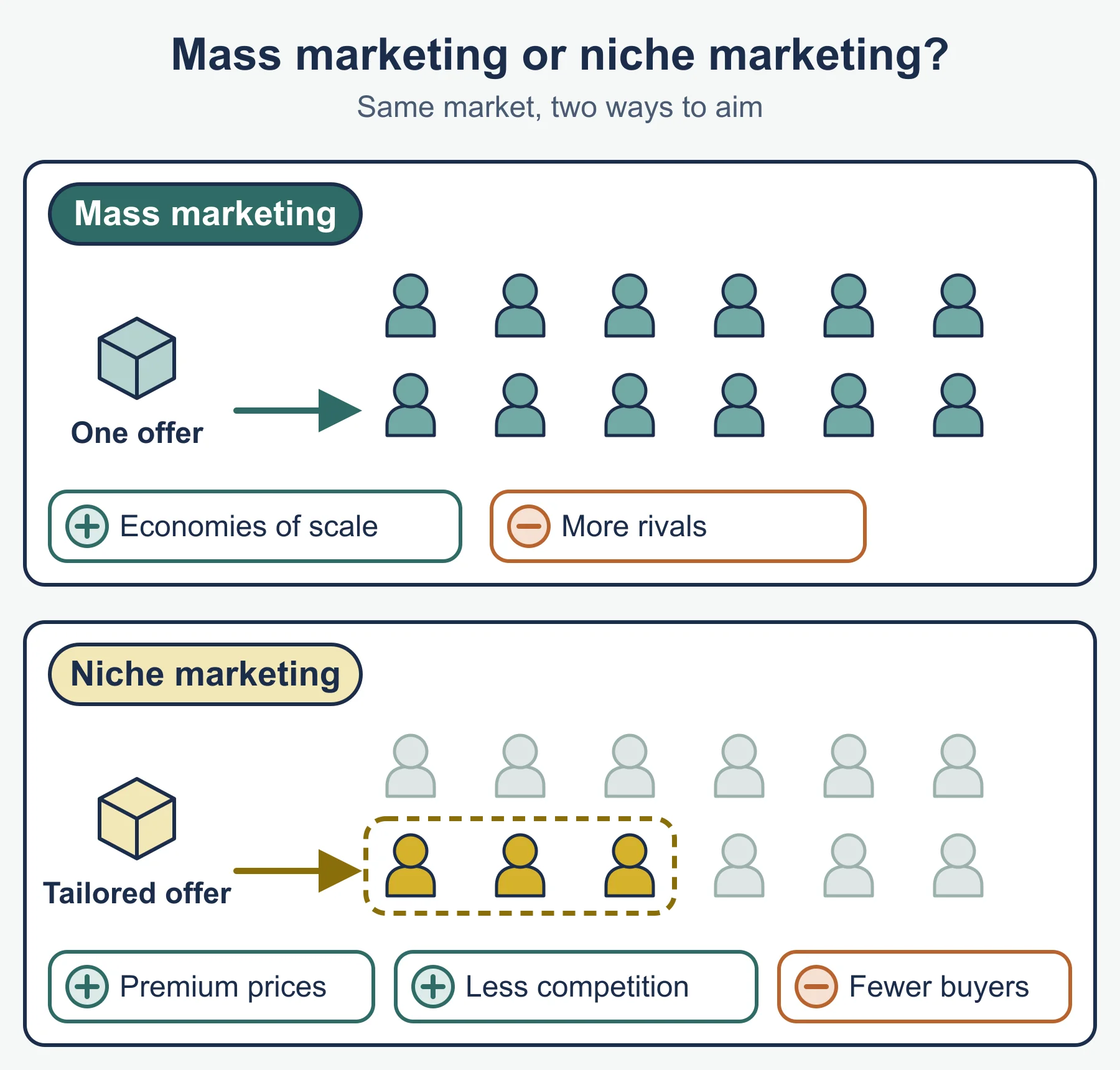
| Niche | Mass | |
|---|---|---|
| Market | Small, specific | Large, general |
| Benefits | Fewer rivals; higher price possible; loyal customers | High volumes; lower unit costs; spread of risk |
| Limitations | Small sales; risk if tastes change; larger rivals may enter | More rivals; price competition; promotion is costly; does not suit everyone exactly |
Distinction: the question is never “which is best” but “which suits this business”.
3.1.4 Market segmentation
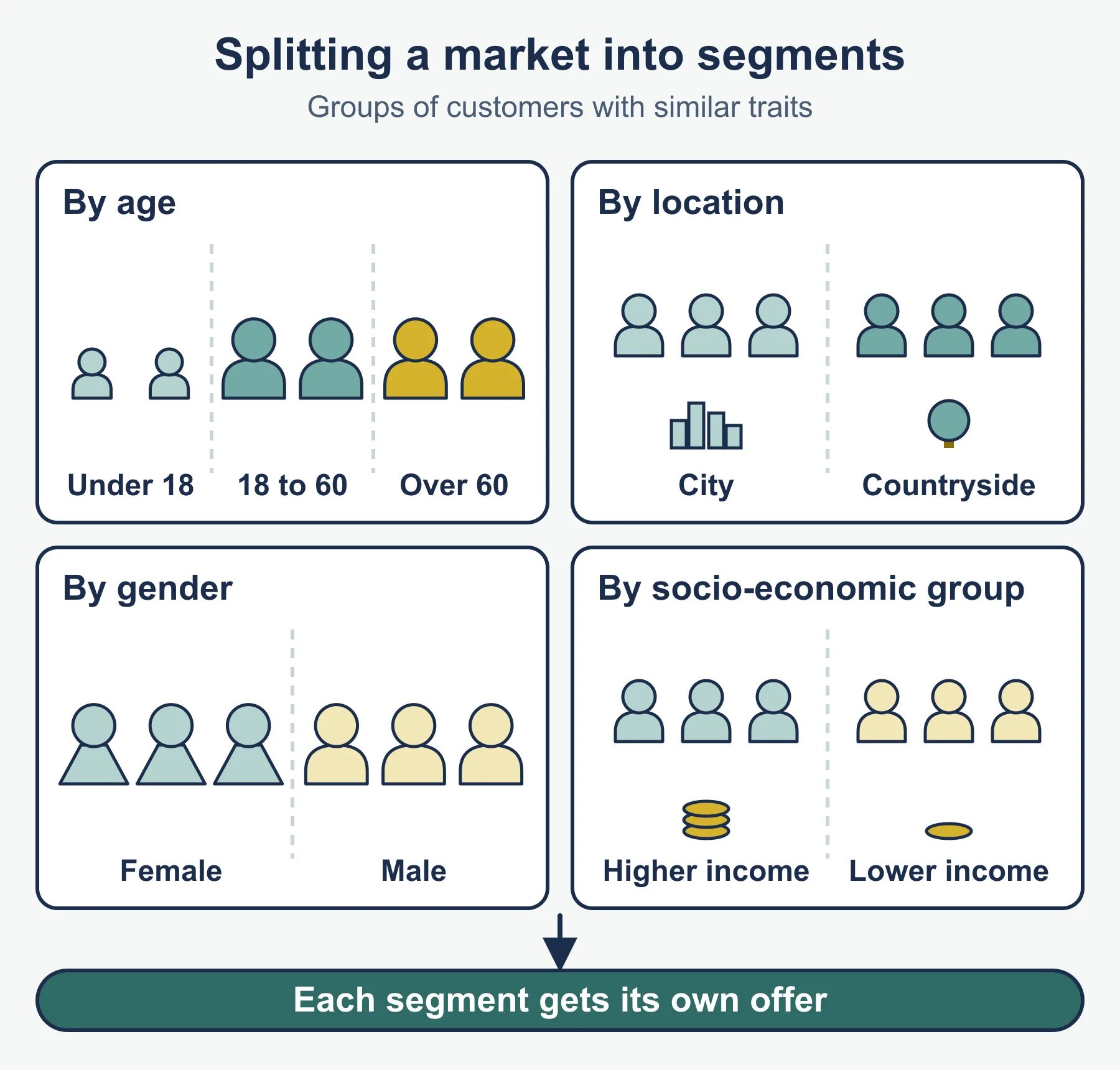
- Definition: dividing a market into groups of customers with similar characteristics or needs.
- Syllabus examples: age, socio-economic grouping, location, gender.
- Benefits: products, prices and promotion aimed at each group; less wasted spending; gaps in the market found; higher sales and loyalty possible.
Method in steps for “recommend and justify a method”
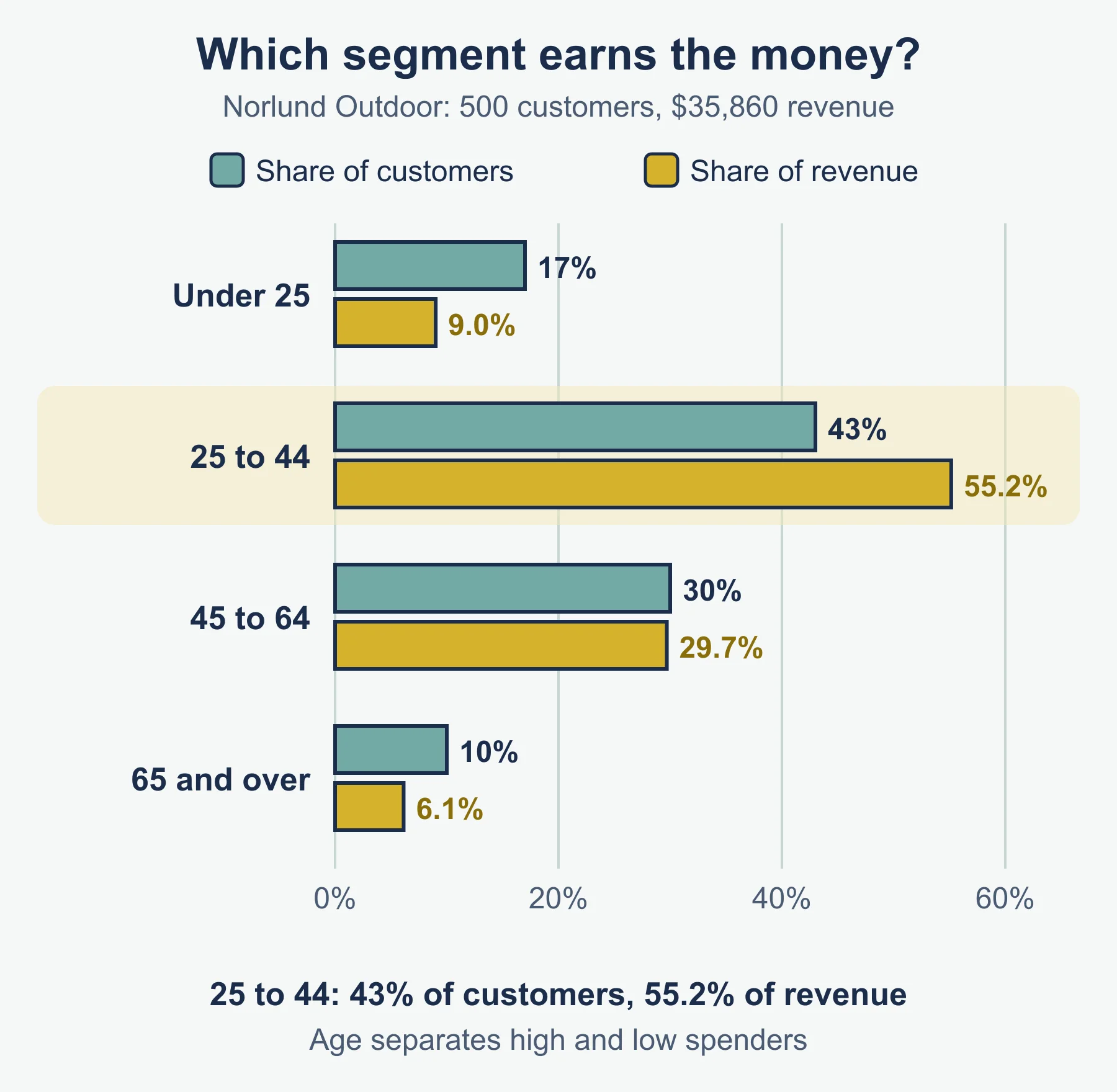
- Look for the characteristic that clearly changes what people buy in the case.
- Recommend it.
- Give the evidence (a figure or detail from the case).
- Explain how the business will use it.
- Say why another method is weaker, or what could limit the recommendation.
3.2.1 Market research
Uses to a market-orientated business: identify needs, estimate demand and market size, choose features, prices and promotion, study rivals, reduce the risk of failure.
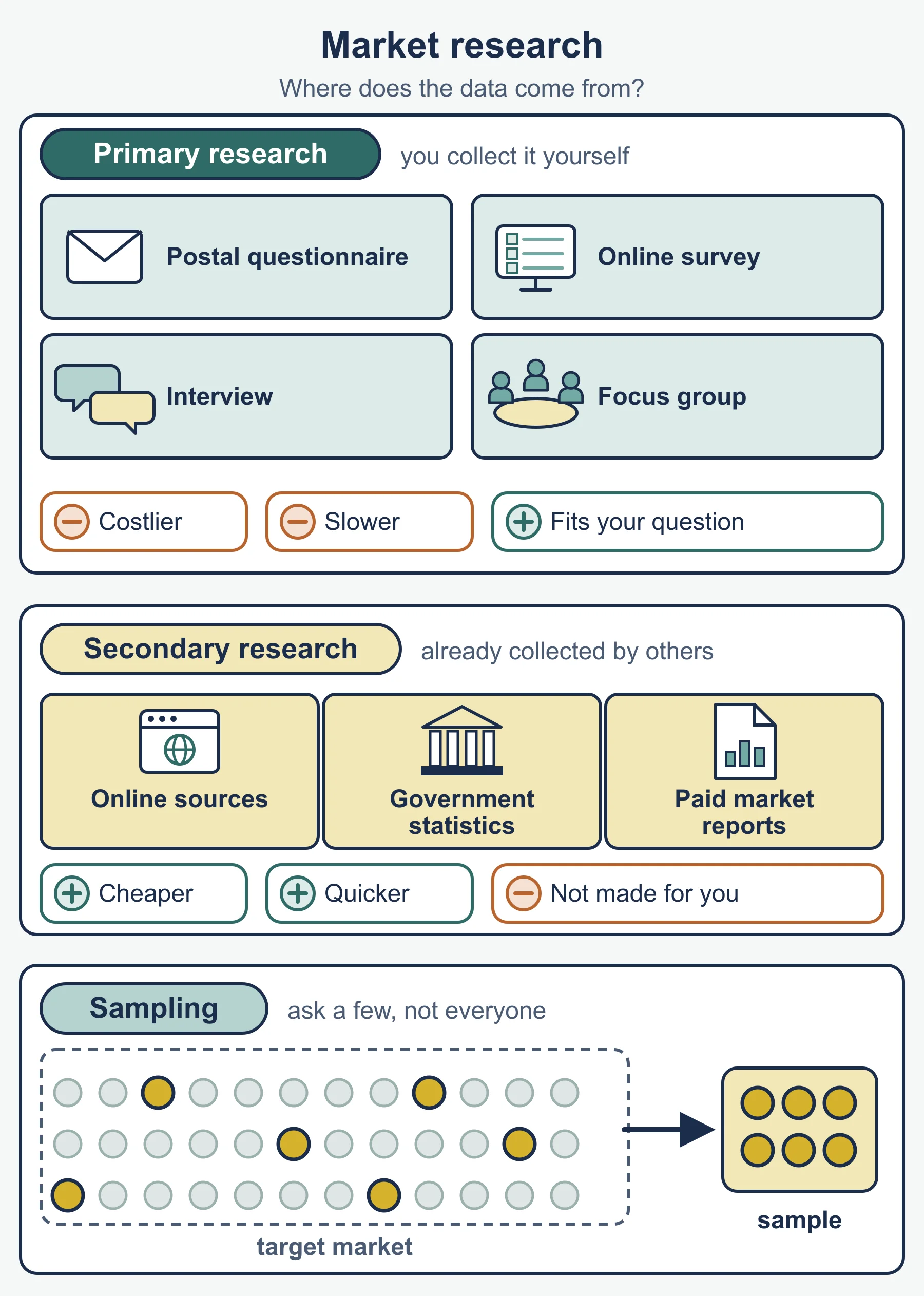
| Primary | Secondary | |
|---|---|---|
| Meaning | New data collected first-hand | Existing data collected by others |
| Benefits | Specific, up to date, private to the business | Cheaper, quicker, plenty available |
| Limitations | Slow, costly, can be biased | May be out of date or not specific; rivals can use it |
| Primary method | Strength | Weakness |
|---|---|---|
| Postal questionnaire | Wide reach | Slow, few replies |
| Online survey | Fast and cheap | Only reaches online respondents |
| Interviews | Detailed answers | Time-consuming, interviewer influence |
| Focus groups | Reveals attitudes | Small group, dominant voices |
Secondary methods: online research, government sources, paying for commercial market research reports.
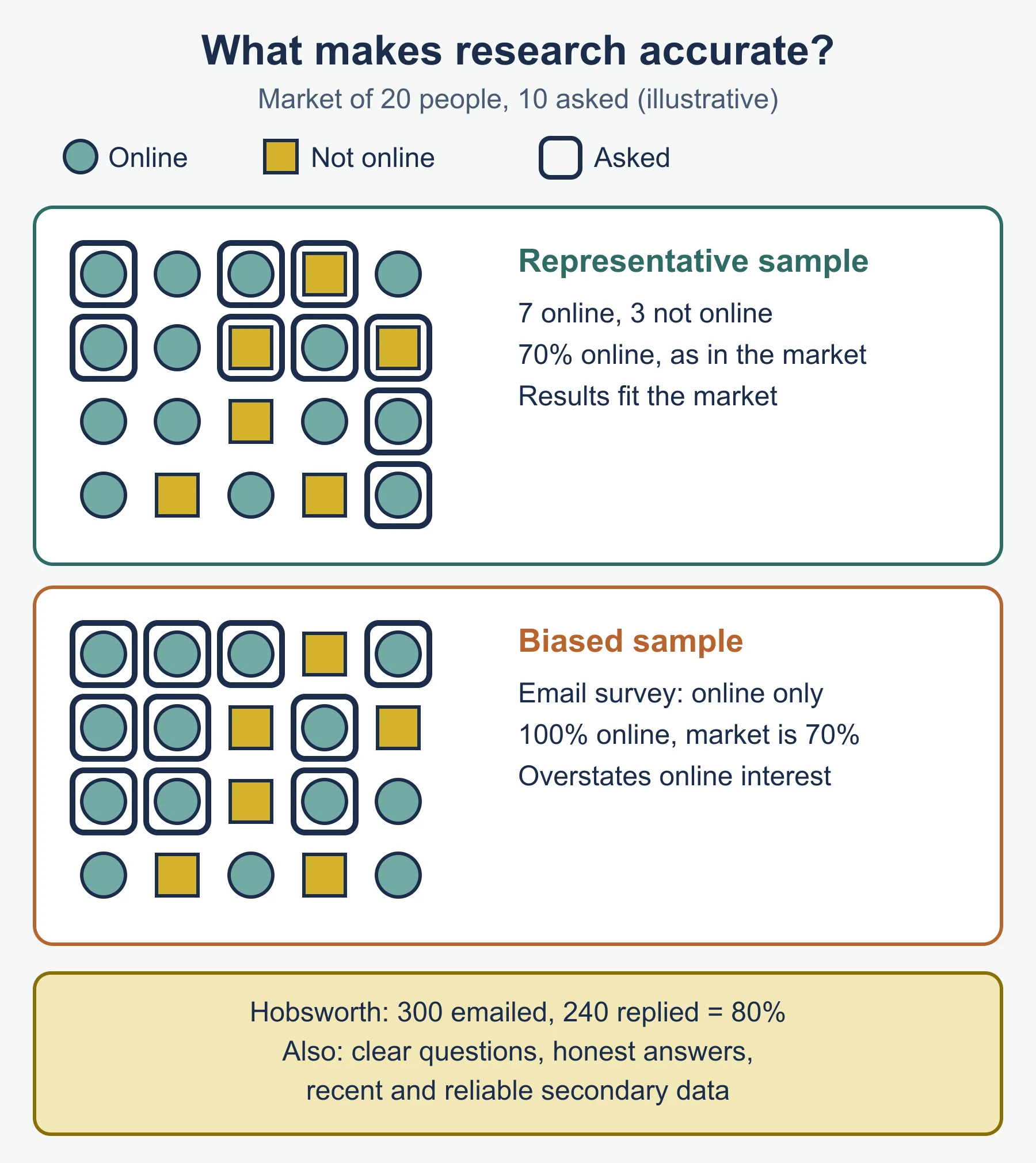
Sampling: asking everyone is too slow and expensive, so a sample represents the whole market. Bigger and more representative means more reliable.
Accuracy depends on: sample size and representativeness; clear, non-leading questions; honest, unbiased researchers and respondents; recent data from a reliable source; enough people responding.
3.2.2 Using results
- Read title, labels, units and scale first.
- Look for the largest, the smallest and the change over time.
- Percentage = part ÷ total × 100.
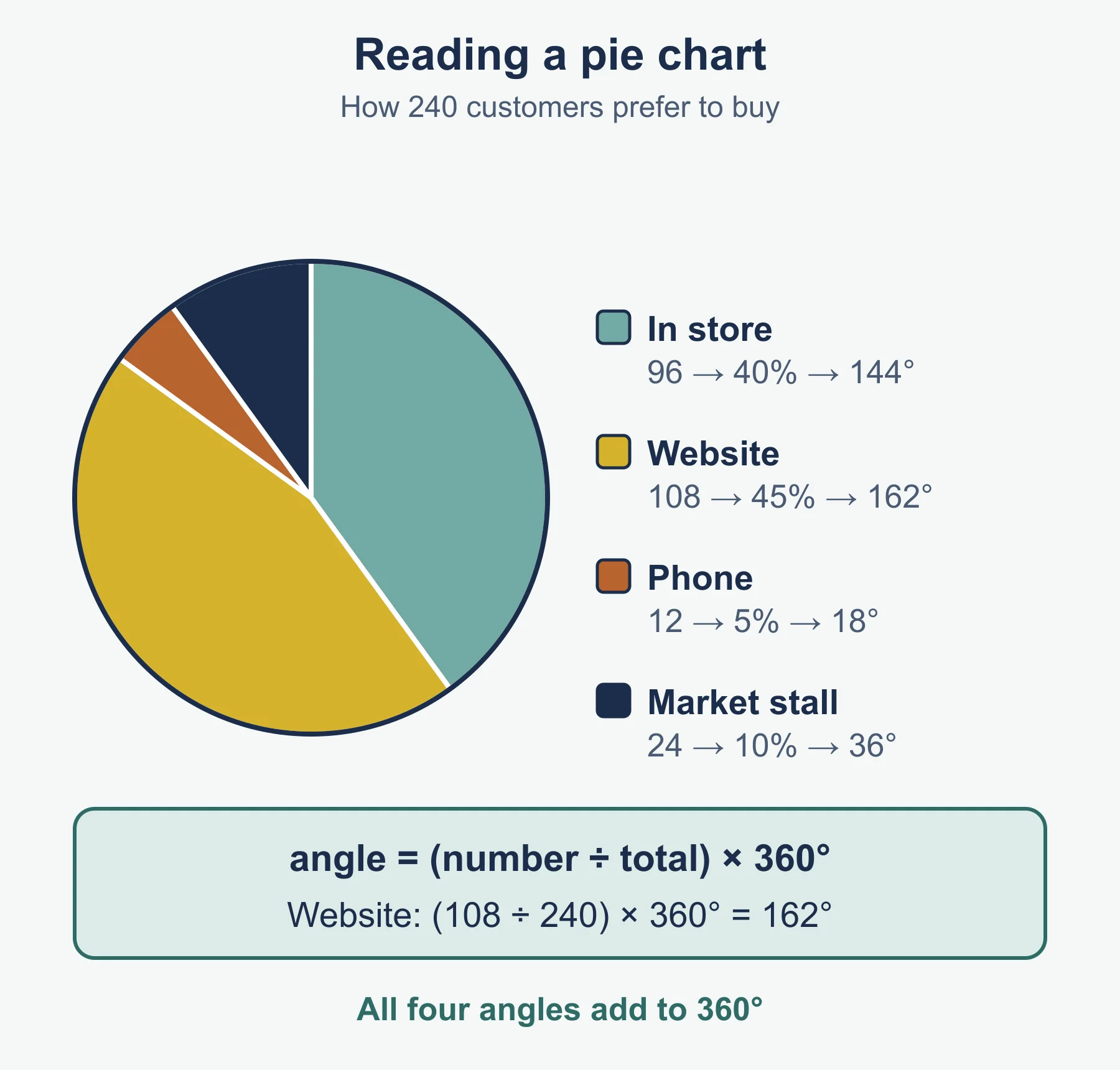
- Pie chart angle = (number ÷ total) × 360 degrees (the standard form).
- State a simple conclusion that answers the business question, and one limit on it.
Small reminder. If 45 of 150 respondents choose option B, that is 30%, and its pie angle is 108 degrees.
Applying the ideas: short reminders
Customer needs. A shop that notices parents asking for sugar-free snacks is identifying a need. Stocking them satisfies it. Remembering a regular customer’s usual order builds a relationship.
Changing market. If a rival opens an online store and your sales fall, say what changed (competition), what it does (lost customers and revenue) and what the business could do (match delivery speed, add a loyalty scheme), then judge whether that response suits a business of its size.
Niche against mass in one line each. A bakery selling only vegan celebration cakes is niche: loyal buyers, but few of them. A factory producing millions of identical plastic cups is mass: low unit cost, but buyers switch on price.
Choosing a research method. Match the method to the question and the budget:
- need deep opinions on a new design: focus group or interviews
- need views from many people across a country: online survey or postal questionnaire
- need background on the size of a market quickly: secondary sources, such as government statistics
- need very detailed industry figures and can afford them: a commercial report.
Reading a chart. For each chart, write one sentence of fact (“45% chose the website”), one of meaning (“nearly half the sample would use it”) and one of caution (“only 240 people answered”).
Exam technique for this topic
- Check the command word. State or identify needs a short answer. Explain needs a point plus a reason. Analyse needs a chain of consequences. Evaluate, justify and recommend need both sides and a reasoned judgement.
- Use the name of the business and one detail from the case in each developed answer.
- In a calculation, show the working line and finish with a unit or percentage sign.
- Keep one idea per paragraph so that each point is easy to see.
Must-know distinctions
- Needs (what customers want) against wants for a specific brand: research finds both.
- Niche (small, specialist market) against mass (large, general market).
- Primary against secondary research.
- Sample (the group asked) against population (everyone in the target market).
- Segmentation (dividing the market) against niche marketing (choosing to serve one small part).
Quick self-test
- List the four jobs of marketing set out in the syllabus.
- Explain the difference between customer loyalty and customer relationships.
- Give two reasons why customer spending patterns may change.
- State one limitation of niche marketing and one of mass marketing.
- Name the four bases of segmentation given as examples.
- Distinguish primary research from secondary research.
- A firm has 2,400 customers and surveys 150 of them. What percentage is surveyed?
- In a pie chart, 54 out of 180 respondents chose “café”. What angle shows them?
- Name two methods of primary research and one of secondary research.
- A survey finds that 36 of 120 people would buy a new flavour. What is the percentage?
- Give two factors that reduce the accuracy of research data.
- Why might a bar chart of last year’s results be unreliable for a decision today?
Answers
- Identify customer needs, satisfy customer needs, maintain customer loyalty, build customer relationships.
- Loyalty is customers choosing to buy again; relationships are the contact (feedback, personal offers) that encourages this.
- Any two: change in income, tastes, population, technology, related prices, attitudes.
- Niche: small market limits sales or growth. Mass: strong competition, often on price.
- Age, socio-economic grouping, location, gender.
- Primary is first-hand data collected for the purpose; secondary already exists, collected by someone else.
- 150 ÷ 2,400 × 100 = 6.25%.
- 54 ÷ 180 × 360 = 108 degrees.
- Primary: any two of postal questionnaire, online survey, interviews, focus groups. Secondary: online, government sources or paid commercial reports.
- 36 ÷ 120 × 100 = 30%.
- Any two: small or unrepresentative sample; leading questions; biased or dishonest answers; out-of-date secondary data; low response.
- Tastes, prices or competitors may have changed since it was collected, so the data may be out of date.
Where marks are usually lost
- Listing the four jobs of marketing without applying any to the business in the case.
- Writing that niche marketing “has no competition”, which is rarely true.
- Recommending a segmentation method with no evidence from the case.
- Describing a research method but not saying why it suits this business.
- Saying “primary research is better” without weighing cost and time against accuracy.
- Describing a large sample as accurate even though it asked the wrong people.
- Calculating a percentage or angle correctly but writing no unit or working.
- Describing a chart (“it goes up”) without a conclusion for the business.
- Giving the same point twice in different words in a “two” question.
Frequently asked questions
What is the difference between niche and mass marketing? Mass marketing sells one product to a large, wide market with little variation. Niche marketing sells a specialist product to a small, specific part of a market.
Is a large sample always accurate? No. A large sample can still be biased if the wrong people are asked, so it must also be representative of the target market and use clear, non-leading questions.
What are the ways of segmenting a market in Cambridge O Level Business 7115? The syllabus examples are age, socio-economic grouping, location and gender. Choose the basis that best explains differences in buying behaviour in the case.
What is the difference between customer loyalty and customer relationships? Loyalty is the behaviour of repeat buying. A relationship is the two-way contact, such as asking for feedback or remembering regular buyers, that encourages it.
Official syllabus
Cambridge O Level Business Studies (7115) syllabus for examination in 2026, published by Cambridge University Press & Assessment (Cambridge International Education), Subject content, sections 3.1 and 3.2.
Get free revision emails (optional)
Occasional emails with practice questions, worked explanations and links to free resources for the qualification and subjects you choose. No spam, and you can unsubscribe from any email. The free tools on this site never need an email.
Related resources
-
Study guides
O Level Business: Marketing mix (Cambridge 7115)
Study guide to the marketing mix for Cambridge O Level Business 7115: product, price, place, promotion and technology, with worked examples.
Business · Cambridge · O Level
Read guide -
Practice questions
O Level Business: Marketing mix (Cambridge 7115) – Practice Questions
Original practice questions with worked answers on the marketing mix for Cambridge O Level Business 7115: product, price, place, promotion and e-commerce.
Business · Cambridge · O Level
Try questions -
Revision notes
O Level Business: Marketing mix (Cambridge 7115) – Revision Notes
Condensed revision notes on the marketing mix for Cambridge O Level Business 7115: product, price, place, promotion and e-commerce, plus a quick self-test.
Business · Cambridge · O Level
Revise topic
Related articles
-
teaching
A Level tuition in Dubai: Cambridge or Pearson Edexcel International A Level?
Schools in Dubai and Abu Dhabi teach either Cambridge International AS & A Level or Pearson Edexcel International A Level. How the two are structured, why it matters for tuition, and how online classes from Lahore work.
9 October 2026
-
curriculum guides
Choosing subjects at IGCSE and A Level
How subject choices at 14 and 16 affect university options later, and how to keep pathways open without overloading a timetable.
28 July 2026
Studying this with a teacher
Working through Business O LEVELS?
This page is free and stays free. If you would rather be taught it, Marlbridge runs Business classes one-to-one and in small groups of up to 15, online in your own time zone. The first trial class is free. WhatsApp replies within an hour (8am–11pm Pakistan time, every day); email the same day.
Cambridge Business teachers at Marlbridge

