
Study Guides
O Level Business: Motivating employees (Cambridge 7115)
Full study guide to motivation for Cambridge O Level Business 7115: Maslow, Taylor, Herzberg, pay and non-pay methods, with worked calculations.
- Subject
- Business
- Level
- O LEVELS
- Topic
- People in business
- Author
- Marlbridge Academic Team
- Updated
- Reviewed by
- Salman Ahmad (what this means)
Aligned to Cambridge O Level Business (7115), For examination in 2026. Official specification .
Syllabus page (what it covers and how it is assessed): Cambridge O Level Business.
Syllabus points this page covers
7115
- 2.1 Motivating employees
Found an error? Report a correction.
Need help with this topic? Request a free trial class for O Level Business (7115).
This guide is for Cambridge O Level Business Studies (7115) and follows the syllabus for examination in 2026. It covers section 2.1 Motivating employees, which has two parts: 2.1.1 the importance of a well-motivated workforce and 2.1.2 methods of motivation. There are no tiers in this subject, so every point here is examinable for all candidates. It is assessed across Paper 1 (Short Answer and Data Response) and Paper 2 (Case Study).
Use it with the revision notes and the practice questions. The wider topic overview is in People in business, with its revision notes and a topic-level question set. Course links: O Level Business hub, printable checklist and the free diagnostics.
What the syllabus asks for
| Syllabus point | What you must be able to do |
|---|---|
| 2.1.1 | Explain why people work and what motivation means |
| 2.1.1 | Explain the benefits of a well-motivated workforce: labour productivity, reduced absenteeism and labour turnover |
| 2.1.1 | Use the concept of human needs, for example Maslow’s hierarchy |
| 2.1.1 | Outline the key motivational theories of Taylor and Herzberg |
| 2.1.2 | Describe financial rewards: wage, salary, bonus, commission, profit sharing |
| 2.1.2 | Describe non-financial methods: enrichment and rotation of jobs, teamworking, training, promotion opportunities |
| 2.1.2 | Recommend and justify appropriate methods in given circumstances |
The syllabus names these ideas but does not write out the theories or formulas. Where this guide gives a formula or a theory in detail, it is the standard form taught in business courses.
Why people work and what motivation means
Motivation is the desire or drive to put effort into a job. A motivated employee wants to do the work well. A person who is only present because they must be is not motivated, even if they turn up every day.
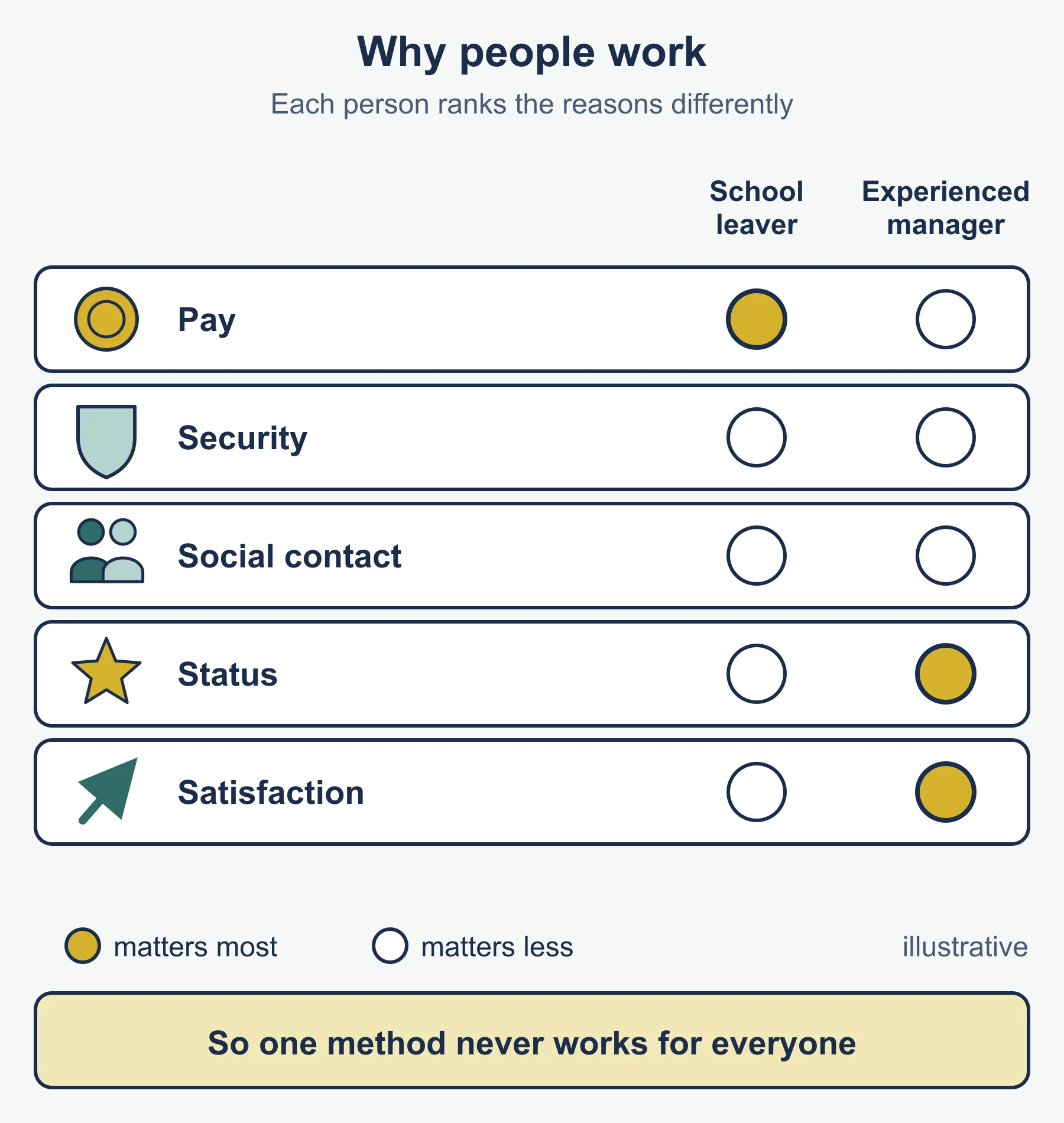
People work for several reasons:
- Pay, to afford food, housing and the things they want.
- Security, knowing the income will continue.
- Social contact, working with others and belonging to a group.
- Status and recognition, being respected for what they do.
- Satisfaction and growth, using skills and learning new ones.
Different employees put these in different orders, and the order changes over a lifetime. A school leaver with rent to pay may focus on pay. An experienced manager on a good salary may care more about influence and challenge. This is why one method of motivation never works for everyone.
Benefits of a well-motivated workforce
The syllabus names three. Each has a standard measure.
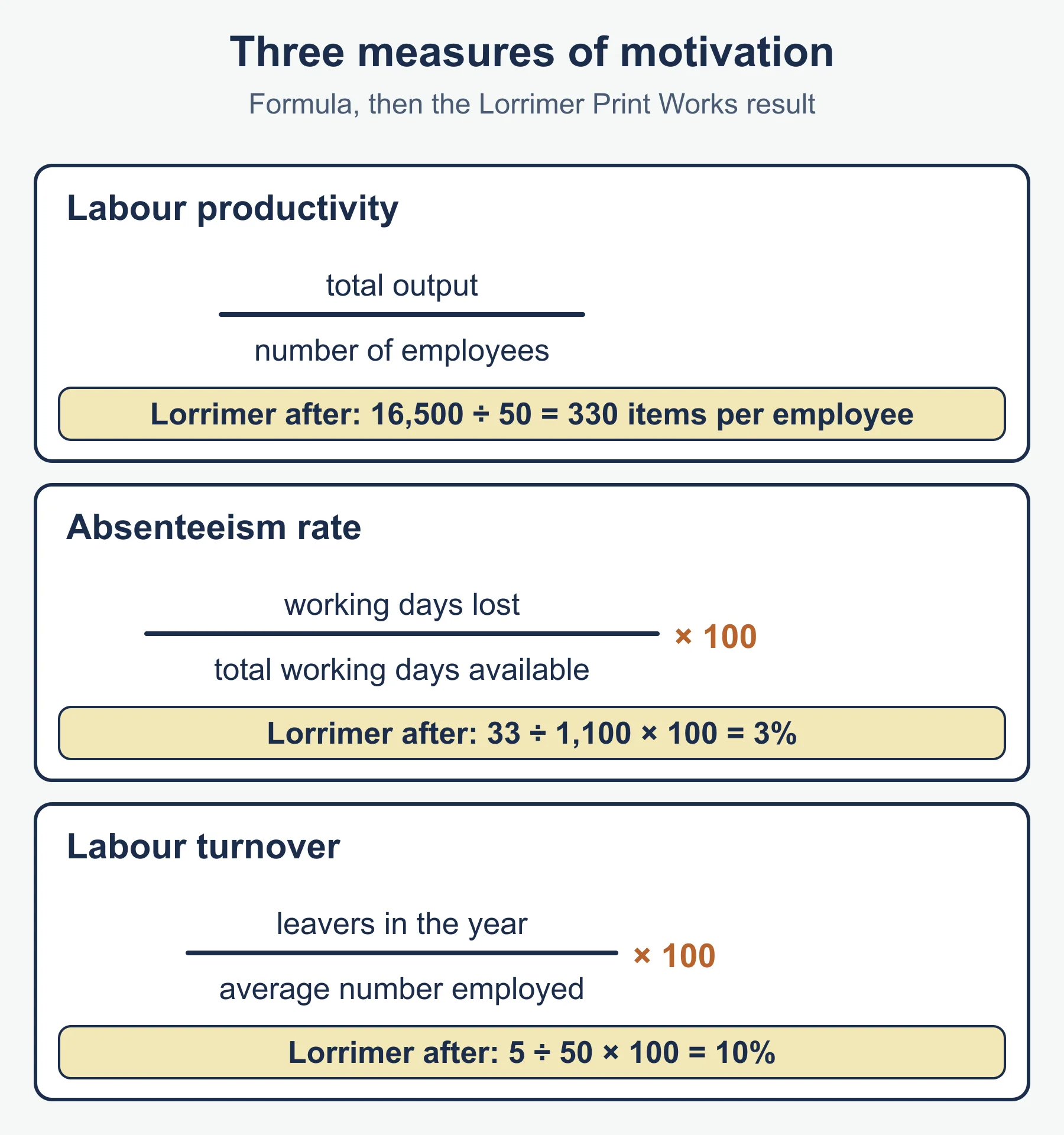
Labour productivity is output per worker over a period. Standard form: total output divided by the number of employees.
Absenteeism is employees being away from work when they are expected to be there. Standard form for the rate: working days lost divided by total working days available, multiplied by 100.
Labour turnover is the rate at which employees leave and have to be replaced. Standard form: number of leavers in the year divided by the average number employed, multiplied by 100.
Worked example: Lorrimer Print Works
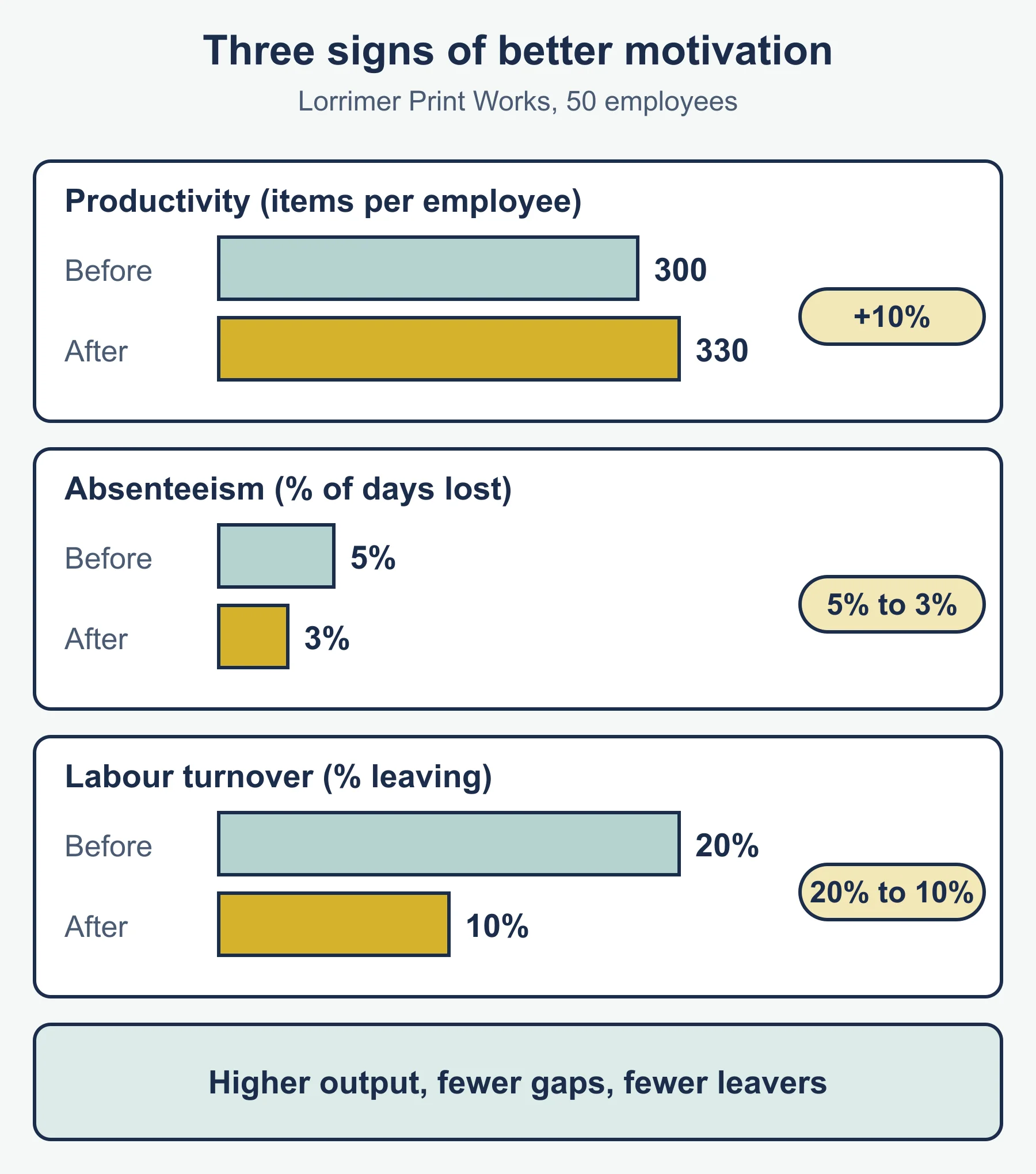
Lorrimer Print Works employs 50 people and ran for 22 days last month. Output was 15,000 printed items. Staff were absent for 55 days in total, and 10 people left during the year. After the owner introduced a package of changes, a later 22-day month gave output of 16,500 items with the same 50 staff and 33 days lost, and only 5 people left over the following year.
- Labour productivity before: 15,000 ÷ 50 = 300 items per employee.
- Labour productivity after: 16,500 ÷ 50 = 330 items per employee, a rise of (330 − 300) ÷ 300 × 100 = 10%.
- Days available: 50 × 22 = 1,100. Absenteeism before: 55 ÷ 1,100 × 100 = 5%. After: 33 ÷ 1,100 × 100 = 3%.
- Labour turnover before: 10 ÷ 50 × 100 = 20%. After: 5 ÷ 50 × 100 = 10%.
Why does each improvement help the business? Higher productivity lowers the labour cost per item, so unit costs fall. Less absence means fewer gaps in production and less spent on cover or overtime. Lower turnover cuts the cost of advertising, interviewing and training replacements, and keeps skills and customer knowledge in the business.
Do not assume motivation is the only cause. Output can also rise because of new machinery or a rise in demand. In a case study, say that motivation is a likely reason and point to evidence in the data.
Human needs and Maslow’s hierarchy
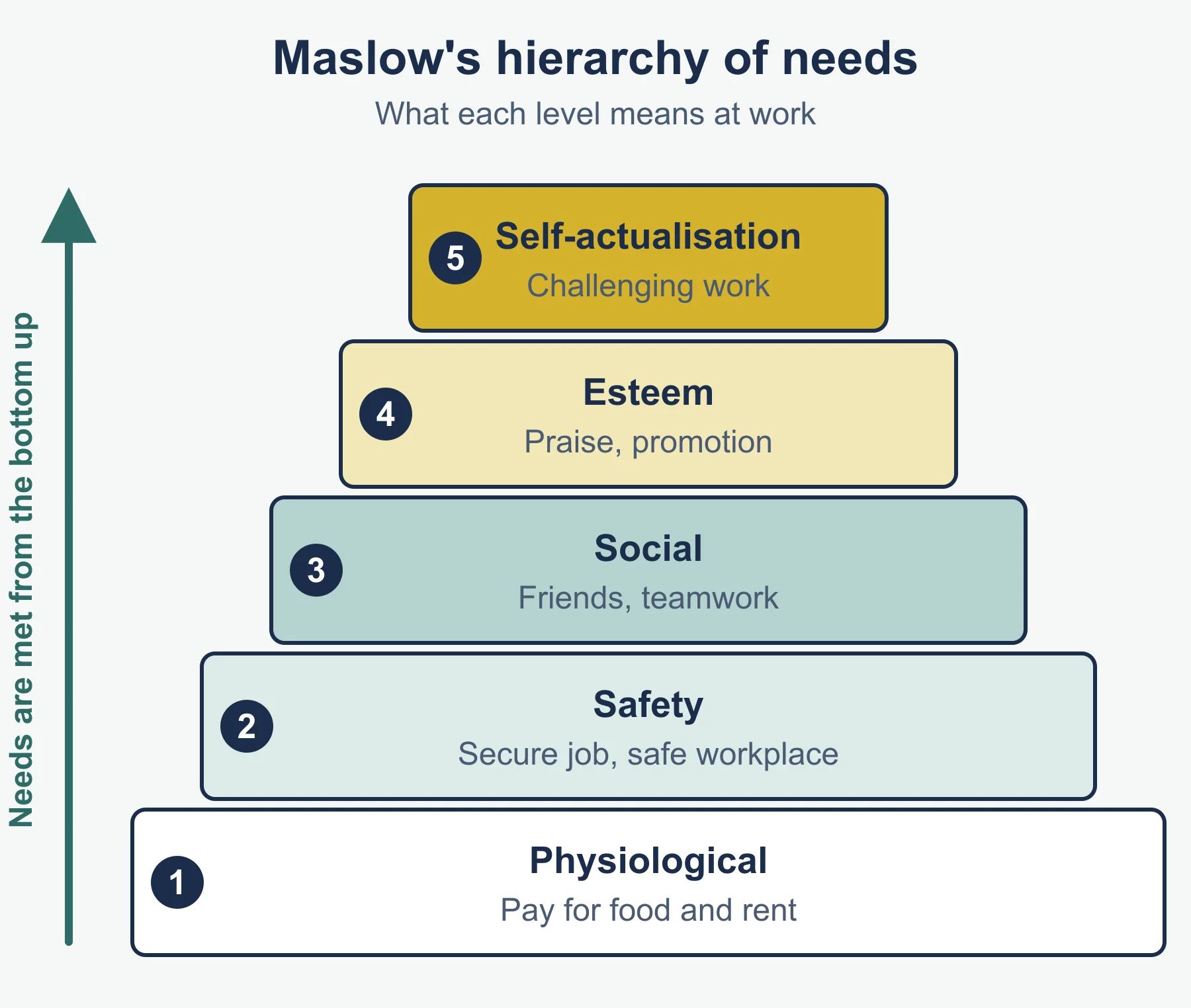
Maslow argued that people have needs arranged in five levels. A need that is already met stops motivating. The next level up then takes over.
| Level (lowest first) | Meaning at work | Example of how a business can meet it |
|---|---|---|
| Physiological | Basic needs such as food and shelter | A wage high enough to live on |
| Safety | Security of income and a safe place | A permanent contract, safe equipment |
| Social (belonging) | Friendship and being part of a group | Teamworking, social events |
| Esteem | Respect, recognition, status | Promotion, a job title, praise |
| Self-actualisation | Reaching one’s full potential | Challenging work, training for new roles |
How to use it. Decide which level the employees are at, then choose a method that meets the next unmet need. Giving a pay rise to staff who already earn enough and now want recognition may achieve little.
Limits of the theory. People do not always climb the levels in order. Someone may take a poorly paid job for the work itself. Needs also differ between people and cultures. A good answer uses Maslow as a guide, not as a rule.
Taylor
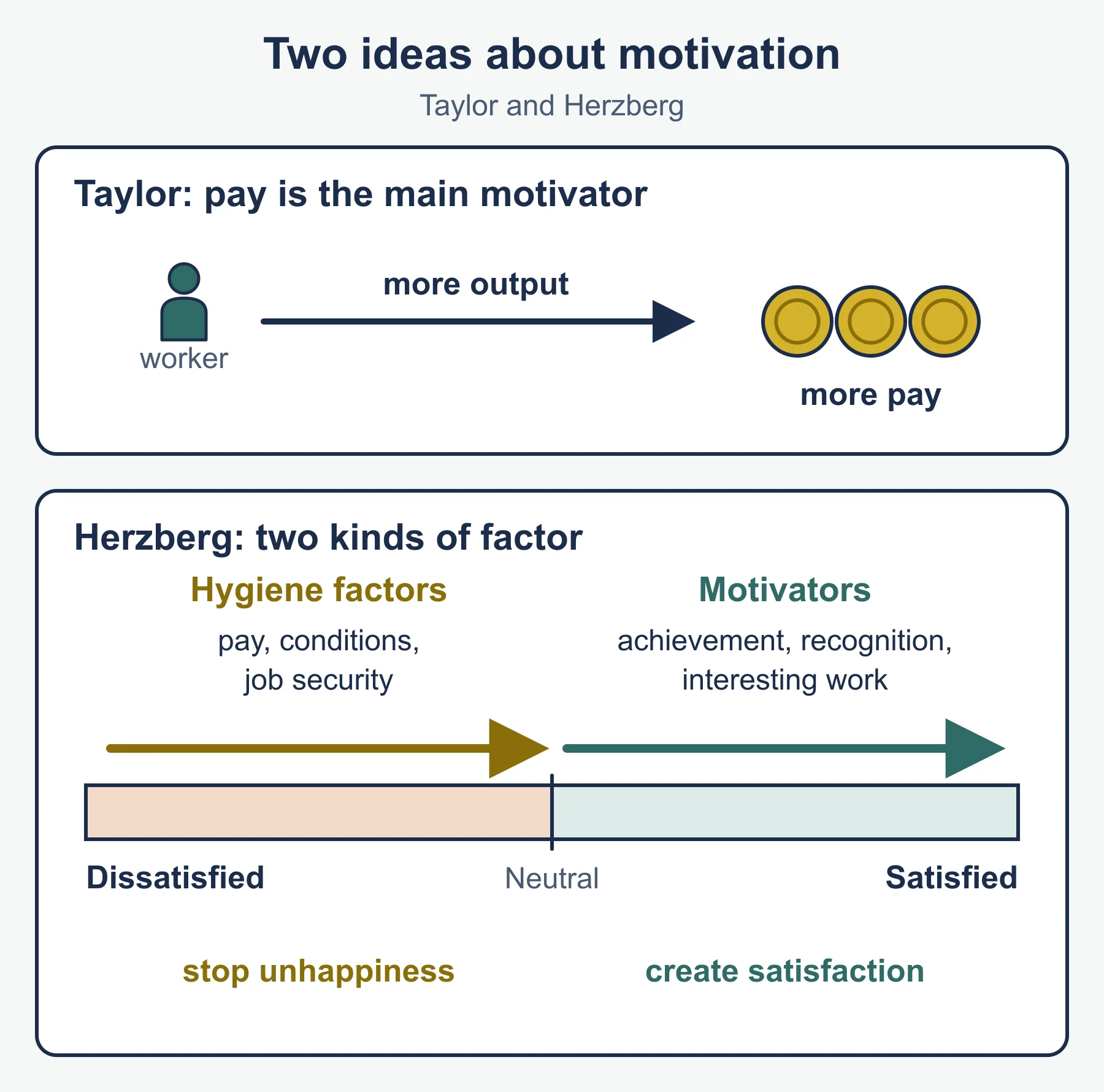
F. W. Taylor is linked with scientific management. His view was that workers are motivated mainly by money. The standard account has these features:
- Break each job into small, simple tasks.
- Time the tasks and set a standard output for each worker.
- Pay more for more output, often through piece-rate pay.
- Supervise closely, and keep thinking and planning with managers.
Strengths: it can raise output quickly, and it is simple to run in repetitive work such as assembly. Weaknesses: it ignores other needs, so work can become boring and workers may feel treated like machines. That can raise absenteeism and labour turnover. It also does little for jobs where workers are expected to use judgement.
Herzberg
Herzberg separated factors at work into two groups. The standard account is:
| Group | Examples | Effect |
|---|---|---|
| Hygiene factors | Pay, working conditions, company policy, supervision, job security, relationships with colleagues | If poor, they cause dissatisfaction. If good, they only remove dissatisfaction. They do not motivate on their own. |
| Motivators | Achievement, recognition, responsibility, interesting work, advancement | These create real motivation and satisfaction. |
The practical message: a business must first get the hygiene factors acceptable, then add motivators. Improving only pay may stop complaints but will not necessarily make people try harder.
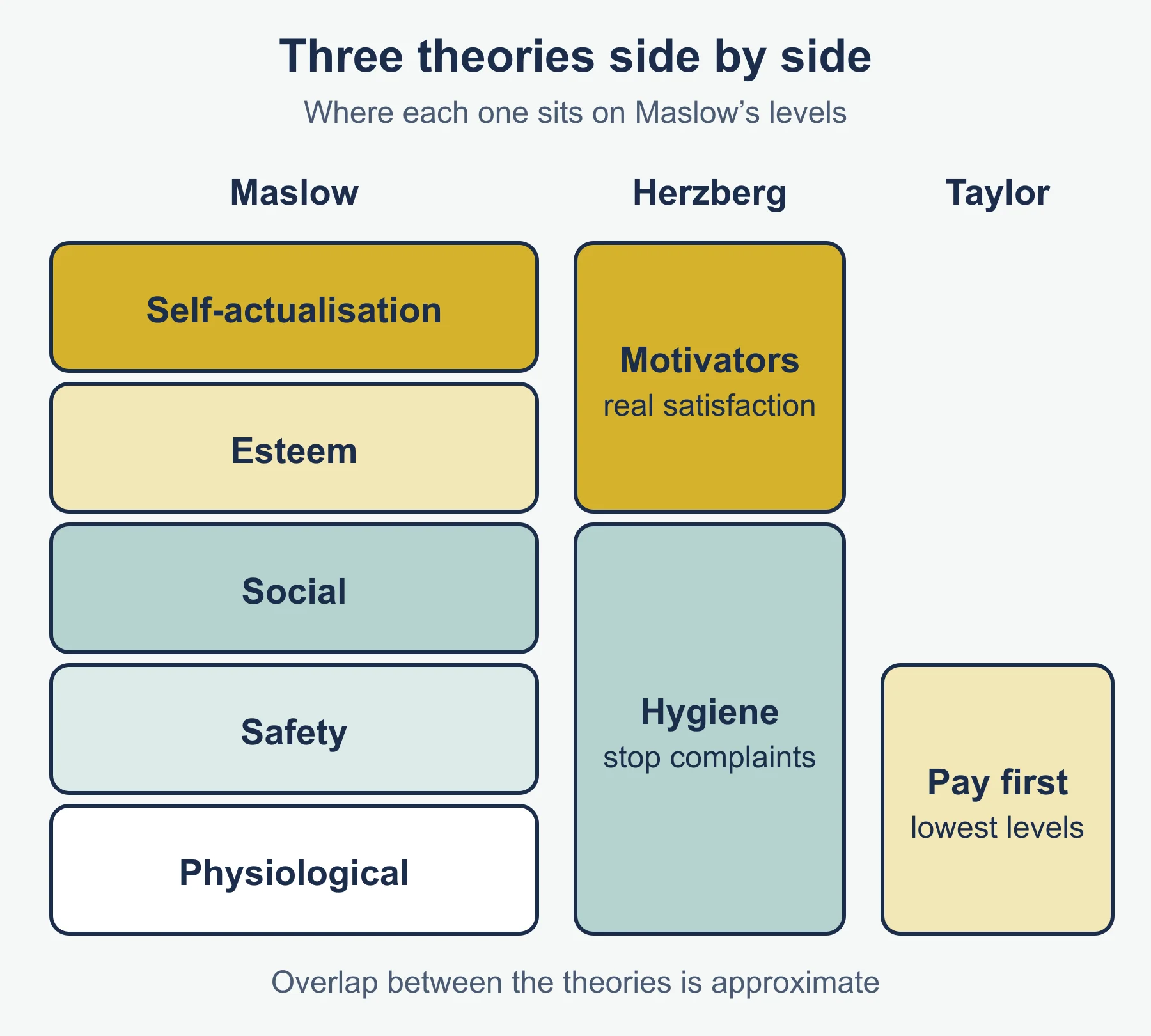
Comparing the theories. Taylor puts money first. Herzberg treats pay as mainly a hygiene factor. Maslow and Herzberg overlap: the lower Maslow levels resemble hygiene factors, and the higher levels resemble motivators. Taylor sits close to the lowest levels only.
Financial methods of motivation
| Method | What it is | Suits | Limits |
|---|---|---|---|
| Wage | Pay for hours worked, usually per hour or week | Shift work, manual and part-time jobs | Little link to effort, and costs rise with hours |
| Salary | Fixed amount per year, paid monthly | Managers and professionals | Does not reward extra effort directly |
| Bonus | Extra lump sum for meeting a target | Roles with clear measurable goals | Staff may chase the target and ignore quality |
| Commission | A percentage of sales made | Selling roles | Pressure on staff, and income can vary a lot |
| Profit sharing | A share of business profit paid to employees | Businesses wanting loyalty to the whole firm | Payout depends on many factors beyond one worker’s control |
Worked example: Sandrick Cycles
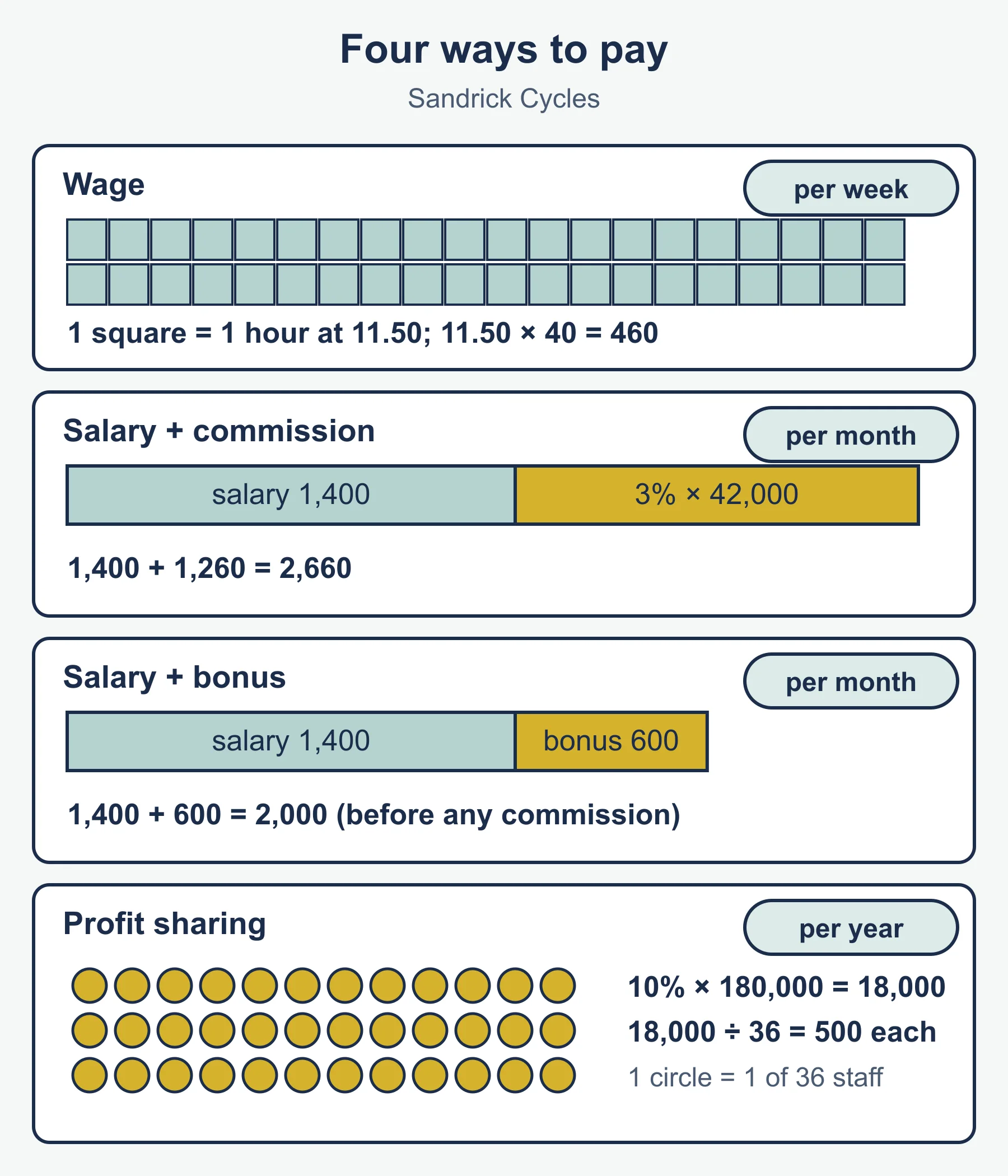
A shop assistant earns 11.50 per hour for a 40-hour week. A salesperson earns a salary of 1,400 a month plus 3% commission on sales. An employee also receives a bonus of 600 when monthly targets are met. The owner shares 10% of last year’s profit of 180,000 equally between 36 staff.
- Weekly wage: 11.50 × 40 = 460.
- Commission when monthly sales are 42,000: 3% × 42,000 = 1,260. Total pay = 1,400 + 1,260 = 2,660.
- Pay in a month the bonus is also earned: 1,400 + 600 = 2,000 (before any commission).
- Profit pool: 10% × 180,000 = 18,000. Each share: 18,000 ÷ 36 = 500.
Check the units and the period in every pay question (per hour, per week, per month, per year).
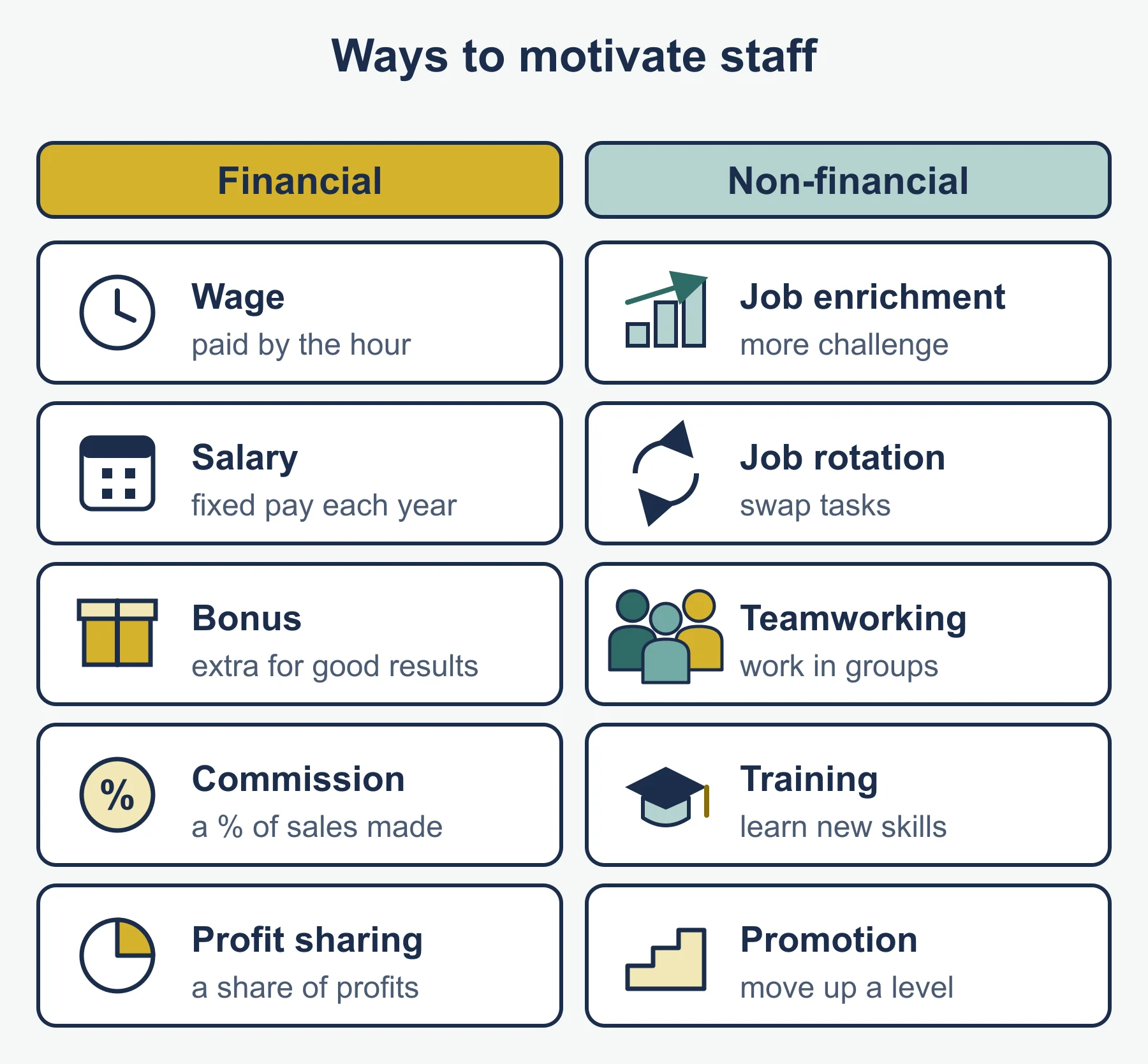
Non-financial methods of motivation
| Method | What it is | Which need it meets |
|---|---|---|
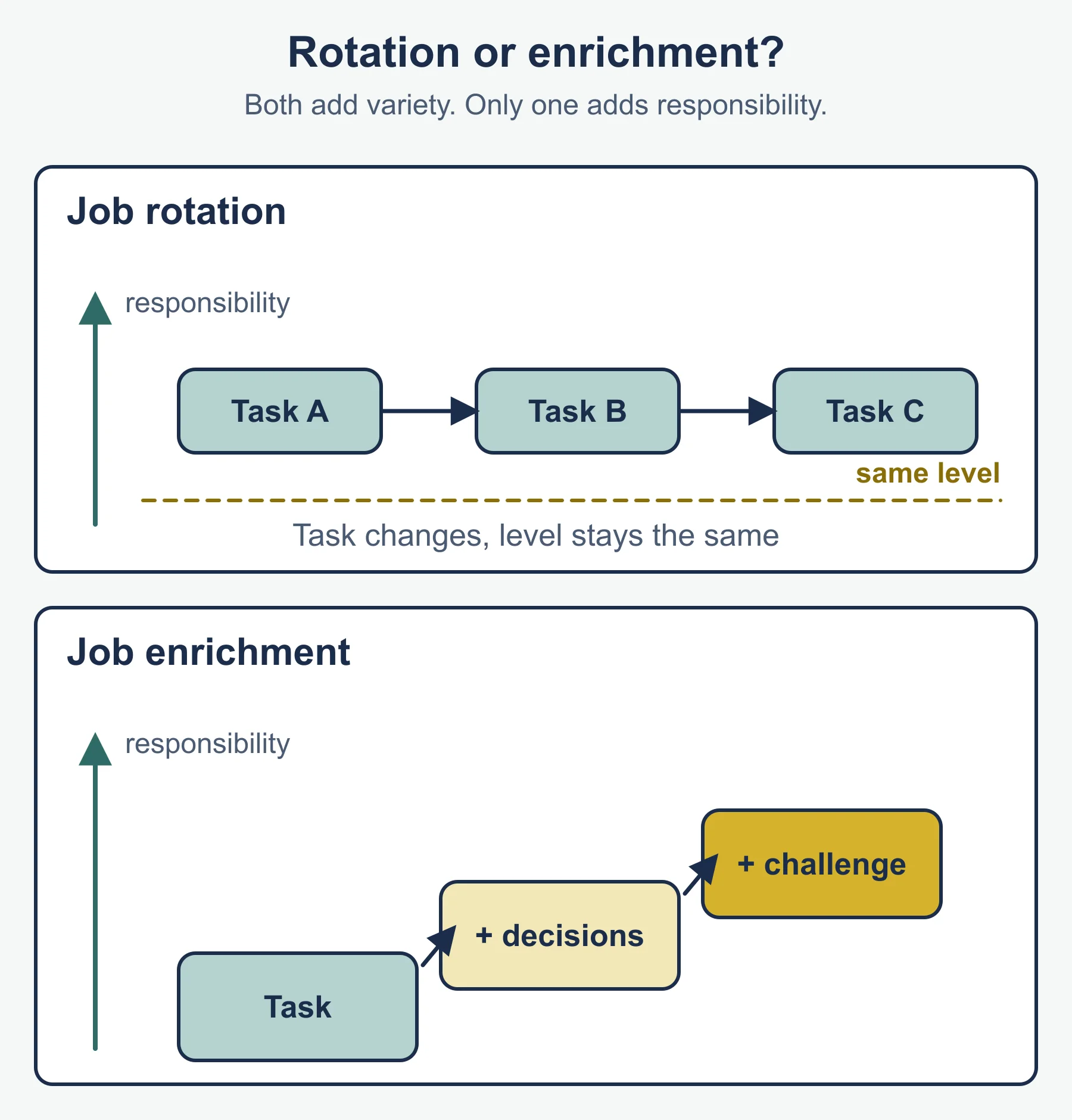
| Job enrichment | Giving employees more responsibility, decision-making and challenge | Esteem, self-actualisation. Close to Herzberg’s motivators |
| Job rotation | Moving employees between different tasks at a similar level | Variety, and a wider skill base |
| Teamworking | Employees work as a group with shared goals | Social needs |
| Training | Teaching new skills | Esteem and growth. Also shows the business values the person |
| Opportunities for promotion | A route to a higher post | Esteem, status, and often a higher income too |
Rotation versus enrichment. Rotation changes the task but not the level of responsibility. Enrichment raises the level. Mixing them up is a common error.
Costs. Non-financial methods are not free. Training takes time and fees, enrichment needs trust and may need extra pay, and promotion places are limited. A trained employee can also leave for a better job, taking the skills elsewhere.
Recommend and justify
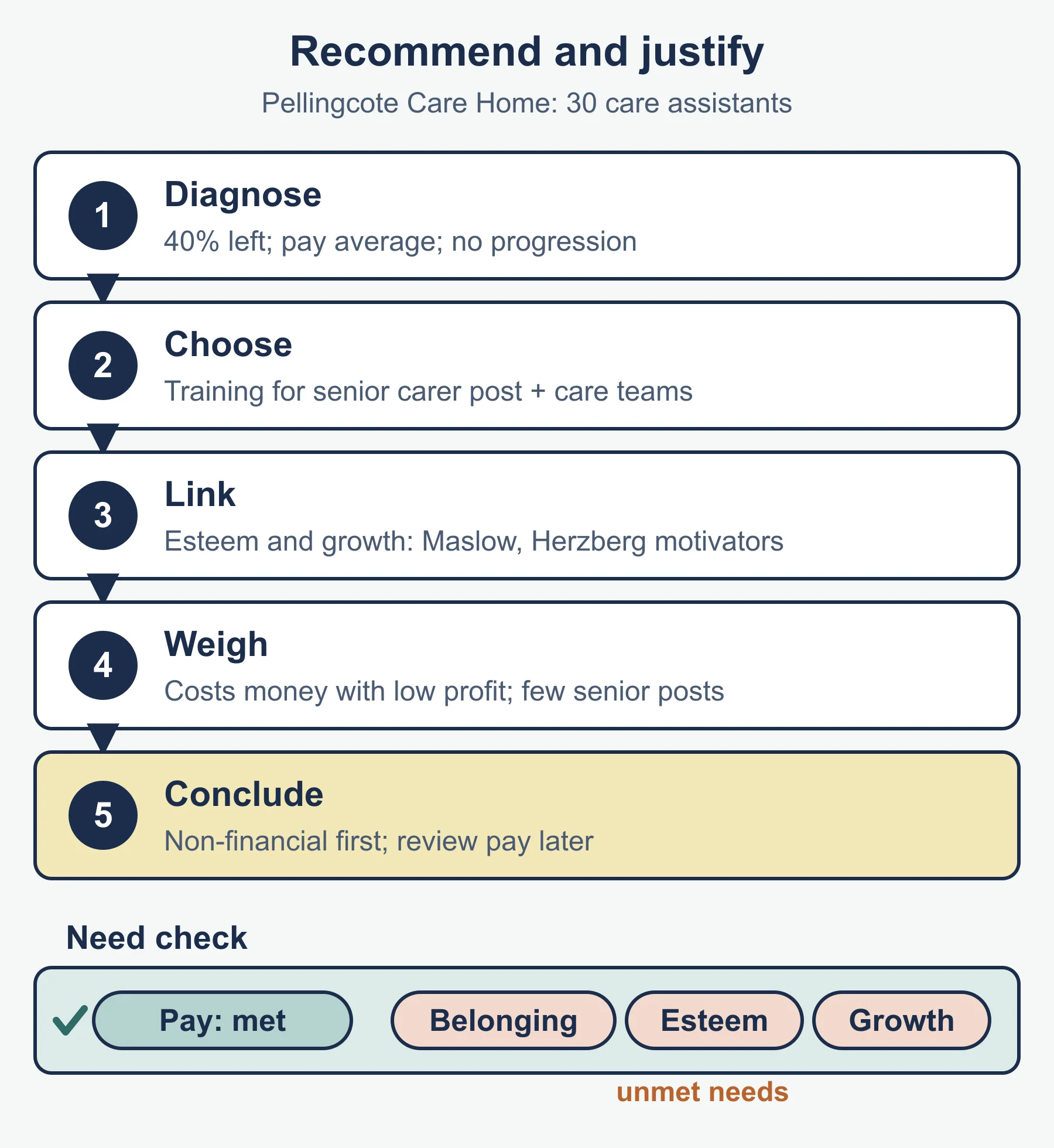
The syllabus expects you to choose methods for a given situation and defend the choice. Use this structure:
- Diagnose. What is the problem or goal, and what do the employees want?
- Choose one or two methods, named exactly.
- Link each to the evidence and to a theory.
- Weigh the cost and a risk.
- Conclude with a clear recommendation.
Worked example: Pellingcote Care Home
Pellingcote Care Home has 30 care assistants on a fixed hourly wage, close to the local average. Labour turnover last year was 40%. Exit comments say staff feel unnoticed and see no way to progress. Profits are low.
Recommendation: introduce a training programme linked to a senior carer post, and organise staff into small care teams.
Justification: pay is not the complaint, and the wage is comparable to other employers, so a bonus would address a need that is largely met. The comments point to esteem and growth, which promotion and training meet, as Maslow and Herzberg suggest. Teams offer belonging and shared responsibility. Lower turnover would also save recruitment and induction costs.
Risk: training costs money when profits are low, and only a few senior posts exist. Staff who do not get promoted may feel worse. The home should share the criteria openly and could offer small recognition awards for others.
Judgement: the non-financial package is the better choice here because it matches the stated problem. A small pay rise may still be needed later if turnover stays high, since pay is a hygiene factor.
Common errors
- Saying “motivation means paying more”. Pay is one method among many.
- Confusing job rotation with job enrichment.
- Describing Herzberg’s two groups without saying which matters for motivation.
- Listing methods with no link to the business in the question.
- Recommending commission for a job where staff do not control sales.
- Forgetting the formula and the units in productivity, absenteeism and turnover.
- Giving only advantages and no weakness when asked to justify.
Frequently asked questions
How do you calculate the absenteeism rate? Absenteeism rate = working days lost ÷ total working days available × 100. The syllabus names the idea but does not give the formula, so this is the standard form.
How do you calculate labour turnover? Labour turnover = number of leavers in the year ÷ average number employed × 100. It shows the rate at which employees leave and have to be replaced.
Is motivation always the reason output rises? No. Output can also rise because of new machinery or higher demand, so in a case study say that motivation is a likely reason and point to the evidence.
What are the limits of Maslow’s hierarchy? People do not always climb the levels in order; someone may take a poorly paid job for the work itself. Needs also differ between people and cultures.
When is commission an unsuitable payment method? Commission is unsuitable for jobs where staff do not control sales, because their pay would depend on results they cannot influence.
Official syllabus
Cambridge International, Cambridge O Level Business Studies (7115) syllabus for examination in 2026, section 2.1 Motivating employees (2.1.1 and 2.1.2).
Get free revision emails (optional)
Occasional emails with practice questions, worked explanations and links to free resources for the qualification and subjects you choose. No spam, and you can unsubscribe from any email. The free tools on this site never need an email.
Related resources
-
Practice questions
O Level Business: Motivating employees (Cambridge 7115) – Practice Questions
Ten original practice questions with worked answers on motivation for Cambridge O Level Business 7115: calculations, theories and recommend cases.
Business · Cambridge · O Level
Try questions -
Revision notes
O Level Business: Motivating employees (Cambridge 7115) – Revision Notes
Condensed revision notes on motivation for Cambridge O Level Business 7115: formulas, theories, methods, a self-test and common lost marks.
Business · Cambridge · O Level
Revise topic -
Study guides
O Level Business: Organisation and management (Cambridge 7115)
Study guide to organisational charts, management functions, delegation, leadership styles and trade unions for Cambridge O Level Business 7115.
Business · Cambridge · O Level
Read guide
Related articles
-
teaching
A Level tuition in Dubai: Cambridge or Pearson Edexcel International A Level?
Schools in Dubai and Abu Dhabi teach either Cambridge International AS & A Level or Pearson Edexcel International A Level. How the two are structured, why it matters for tuition, and how online classes from Lahore work.
9 October 2026
-
curriculum guides
Choosing subjects at IGCSE and A Level
How subject choices at 14 and 16 affect university options later, and how to keep pathways open without overloading a timetable.
28 July 2026
Studying this with a teacher
Working through Business O LEVELS?
This page is free and stays free. If you would rather be taught it, Marlbridge runs Business classes one-to-one and in small groups of up to 15, online in your own time zone. The first trial class is free. WhatsApp replies within an hour (8am–11pm Pakistan time, every day); email the same day.
Cambridge Business teachers at Marlbridge

