
Revision Notes
O Level Business: Motivating employees (Cambridge 7115) – Revision Notes
Condensed revision notes on motivation for Cambridge O Level Business 7115: formulas, theories, methods, a self-test and common lost marks.
- Subject
- Business
- Level
- O LEVELS
- Topic
- People in business
- Author
- Marlbridge Academic Team
- Updated
- Reviewed by
- Salman Ahmad (what this means)
Aligned to Cambridge O Level Business (7115), For examination in 2026. Official specification .
Syllabus page (what it covers and how it is assessed): Cambridge O Level Business.
Syllabus points this page covers
7115
- 2.1 Motivating employees
Found an error? Report a correction.
Need help with this topic? Request a free trial class for O Level Business (7115).
These notes condense section 2.1 Motivating employees (2.1.1 and 2.1.2) of the Cambridge O Level Business Studies (7115) syllabus for examination in 2026. For full explanations and worked examples, read the study guide. When you are ready to test yourself, use the practice questions.
Other links: the wider People in business overview, its topic revision notes, the O Level Business hub, the printable checklist and the free diagnostics.
Definitions to know word for word
| Term | Short definition |
|---|---|
| Motivation | The desire or drive to put effort into work |
| Labour productivity | Output per worker in a period |
| Absenteeism | Employees being away when they are expected at work |
| Labour turnover | The rate at which employees leave and need replacing |
| Hygiene factor (Herzberg) | A factor that causes dissatisfaction if poor but does not motivate if good |
| Motivator (Herzberg) | A factor that gives real satisfaction, such as achievement or responsibility |
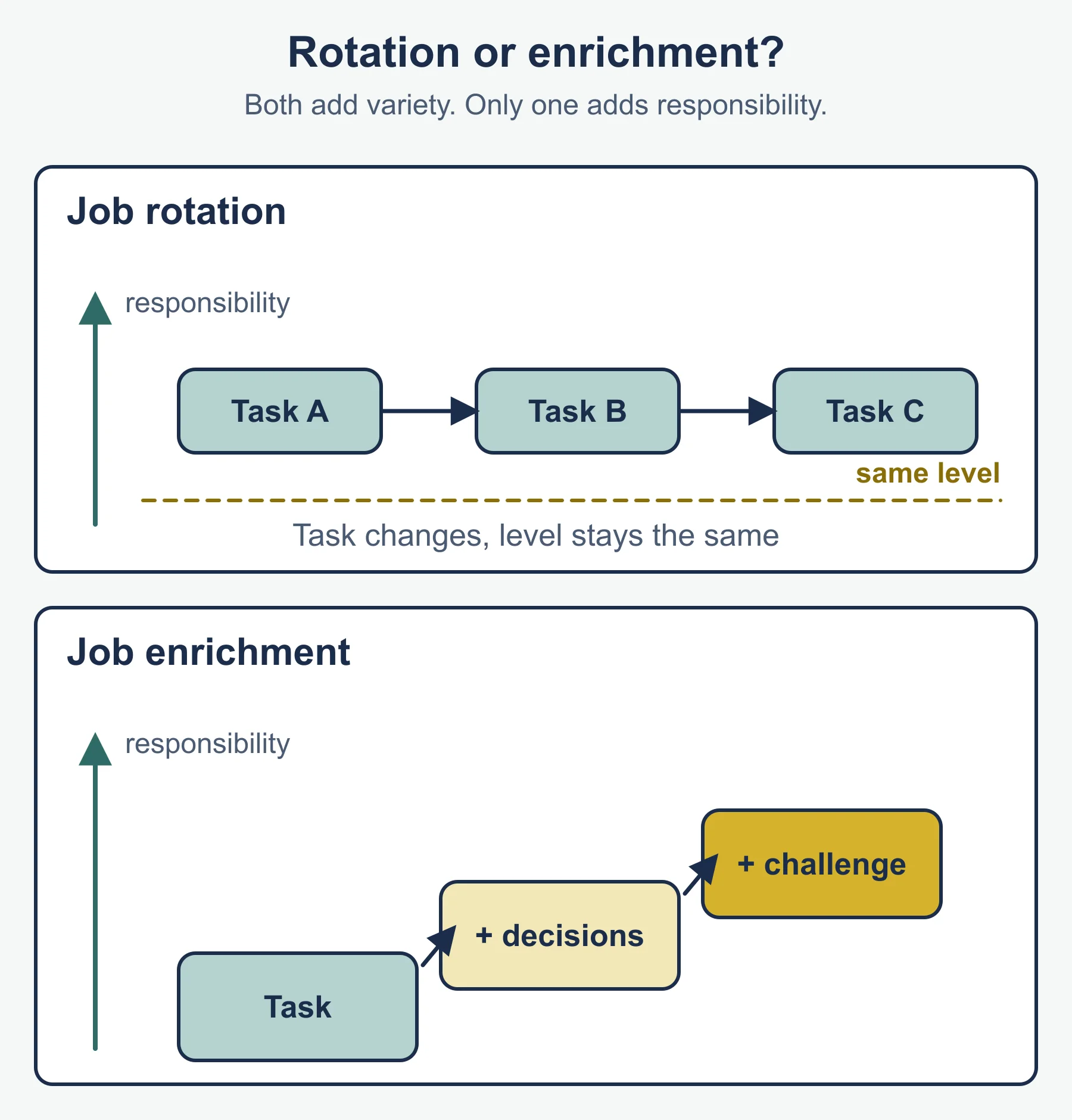
| Job enrichment | Giving employees more responsibility and challenge |
| Job rotation | Moving employees between tasks at a similar level |
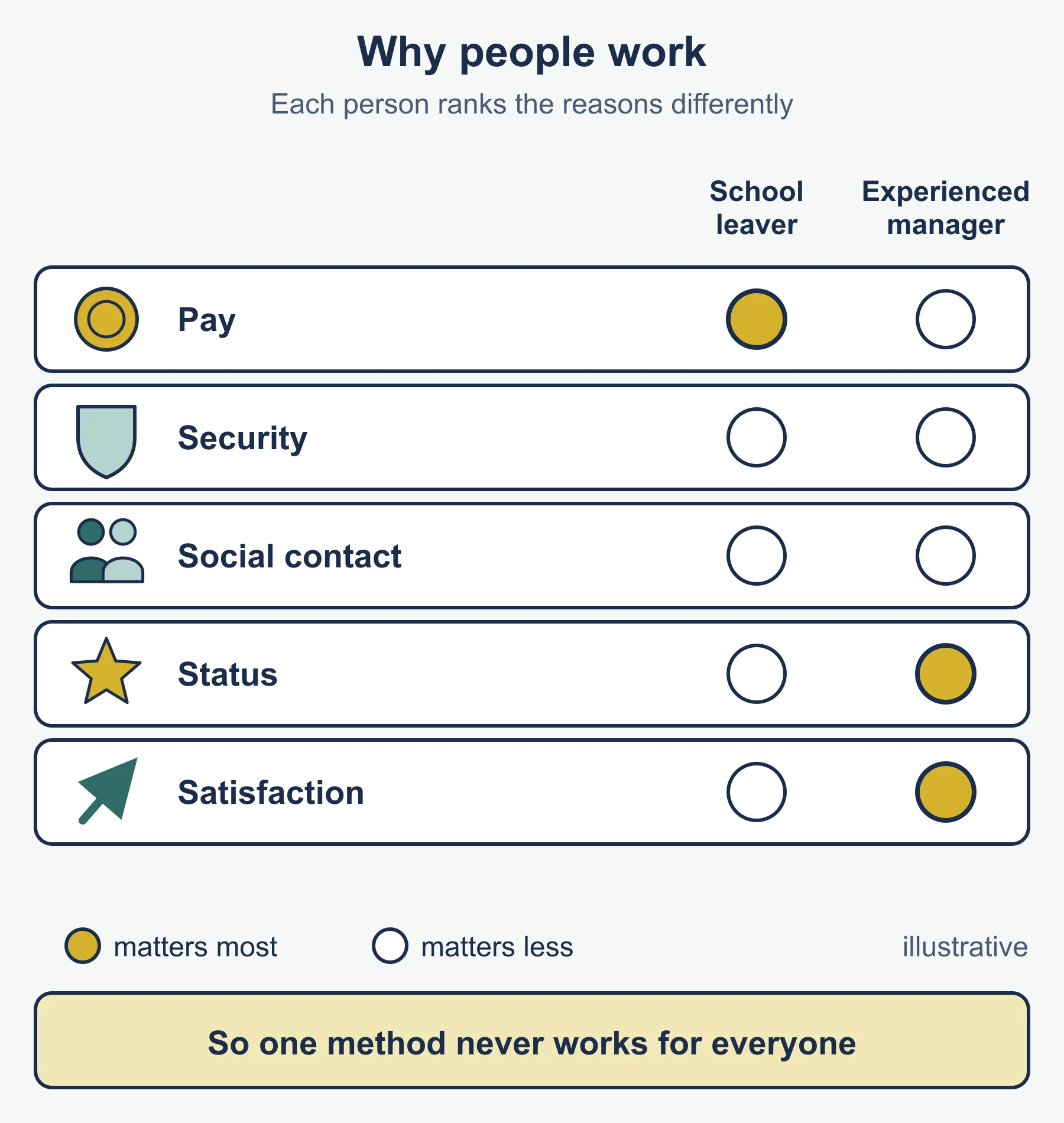
Why people work
- Pay and the things it buys
- Security of income
- Social contact and belonging
- Status and recognition
- Satisfaction and personal growth
Different people rank these differently, so a method that works for one group may fail for another.
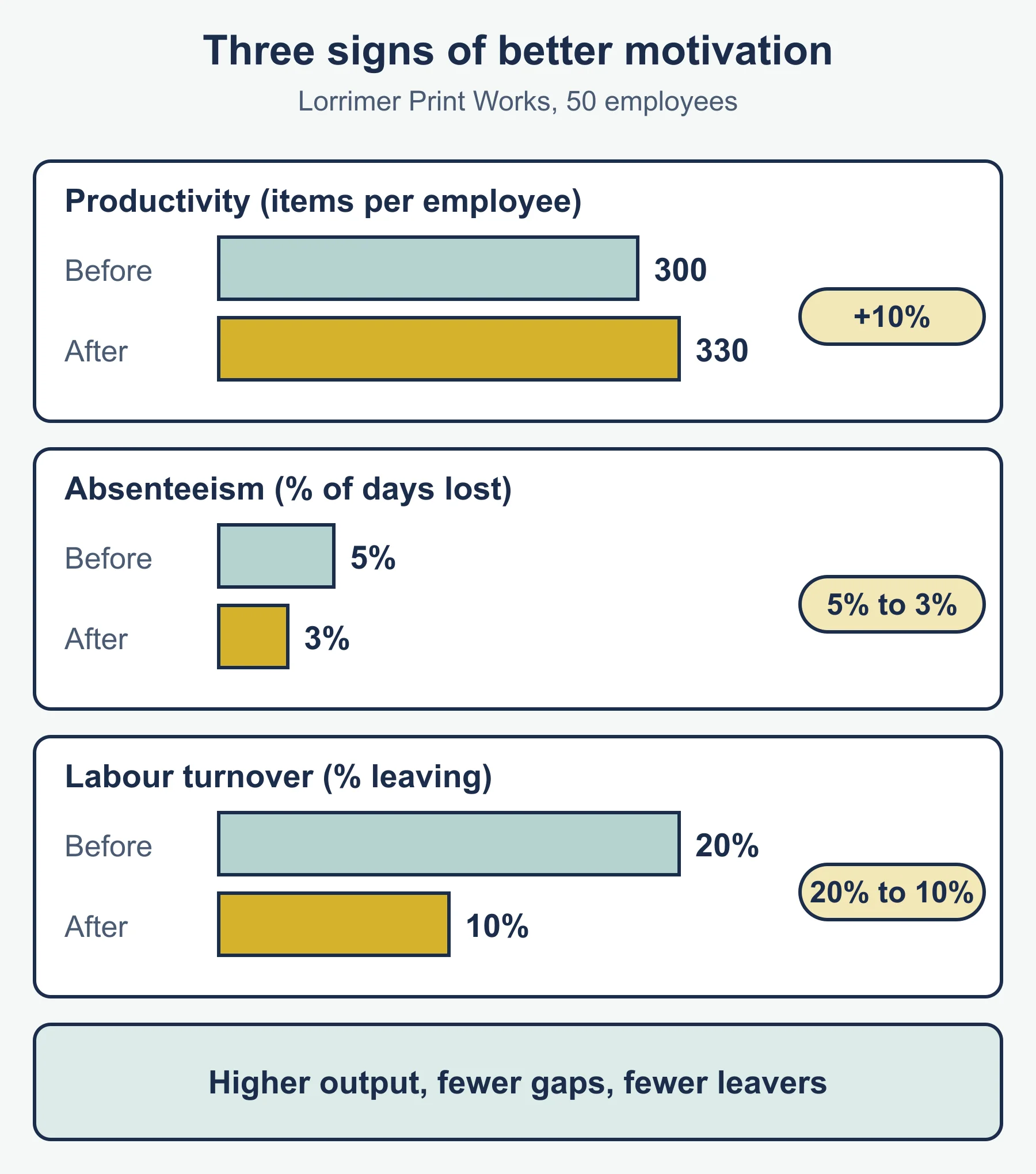
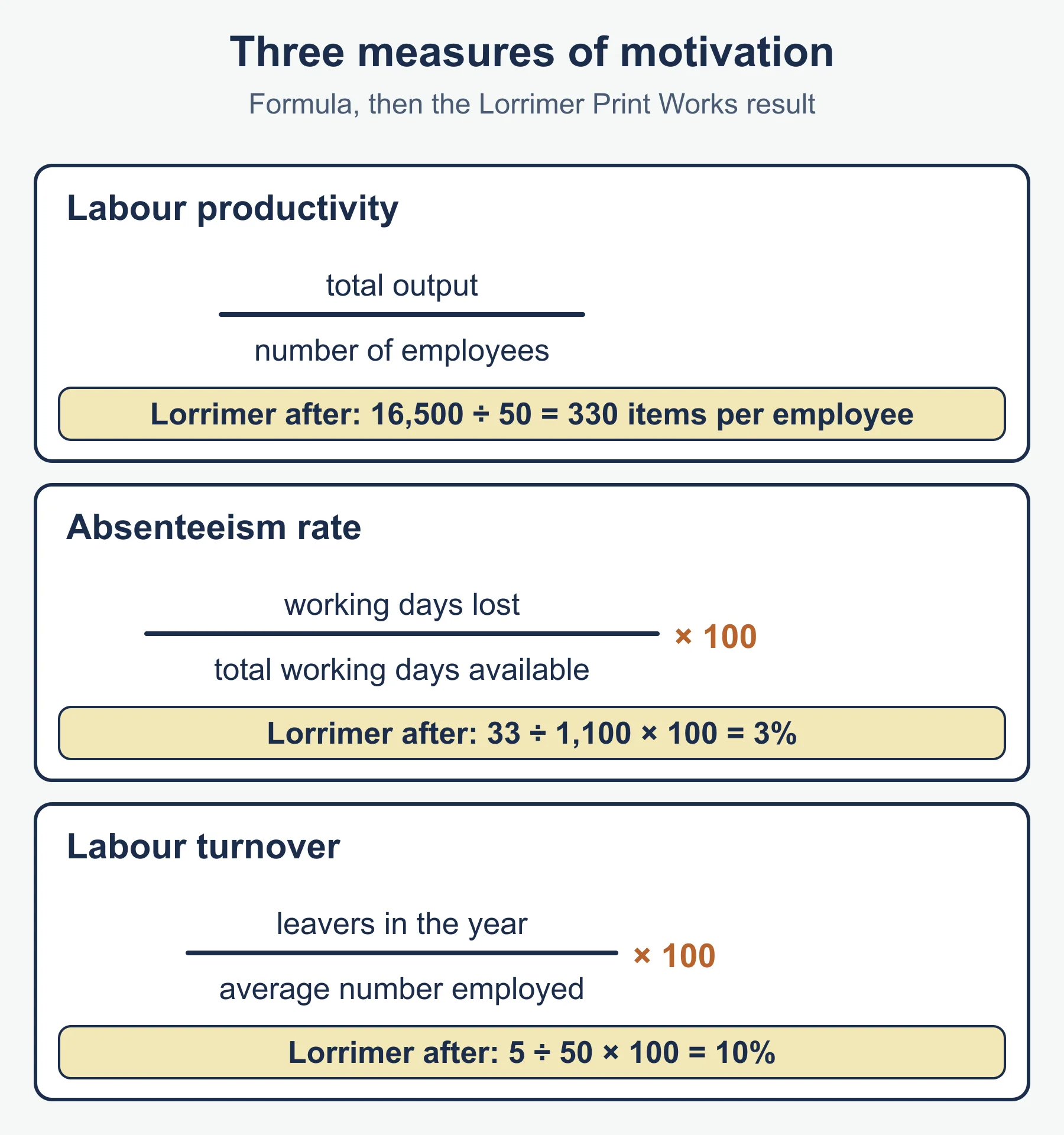
Benefits of a well-motivated workforce
| Benefit | Standard formula |
|---|---|
| Labour productivity | Total output ÷ number of employees |
| Absenteeism rate | Working days lost ÷ working days available × 100 |
| Labour turnover rate | Leavers in the year ÷ average number employed × 100 |
The syllabus names the three benefits but does not write out the formulas, so these are the standard forms.
Method in steps for a calculation
- Write the formula.
- Substitute the numbers, checking the period (month, year) matches.
- Work out the answer and add the unit (items per employee, %).
- For percentage change: (new − old) ÷ old × 100.
- Add one line on what the result means for the business.
Small reminder. 5,200 items made by 26 workers gives 200 items per worker. If this rises to 220, the change is (220 − 200) ÷ 200 × 100 = 10%.
Why each benefit matters
- Higher productivity: lower unit labour cost, more output from the same payroll.
- Less absenteeism: fewer production gaps, less cost for cover and overtime.
- Lower turnover: lower recruitment and training costs, skills stay in the firm.
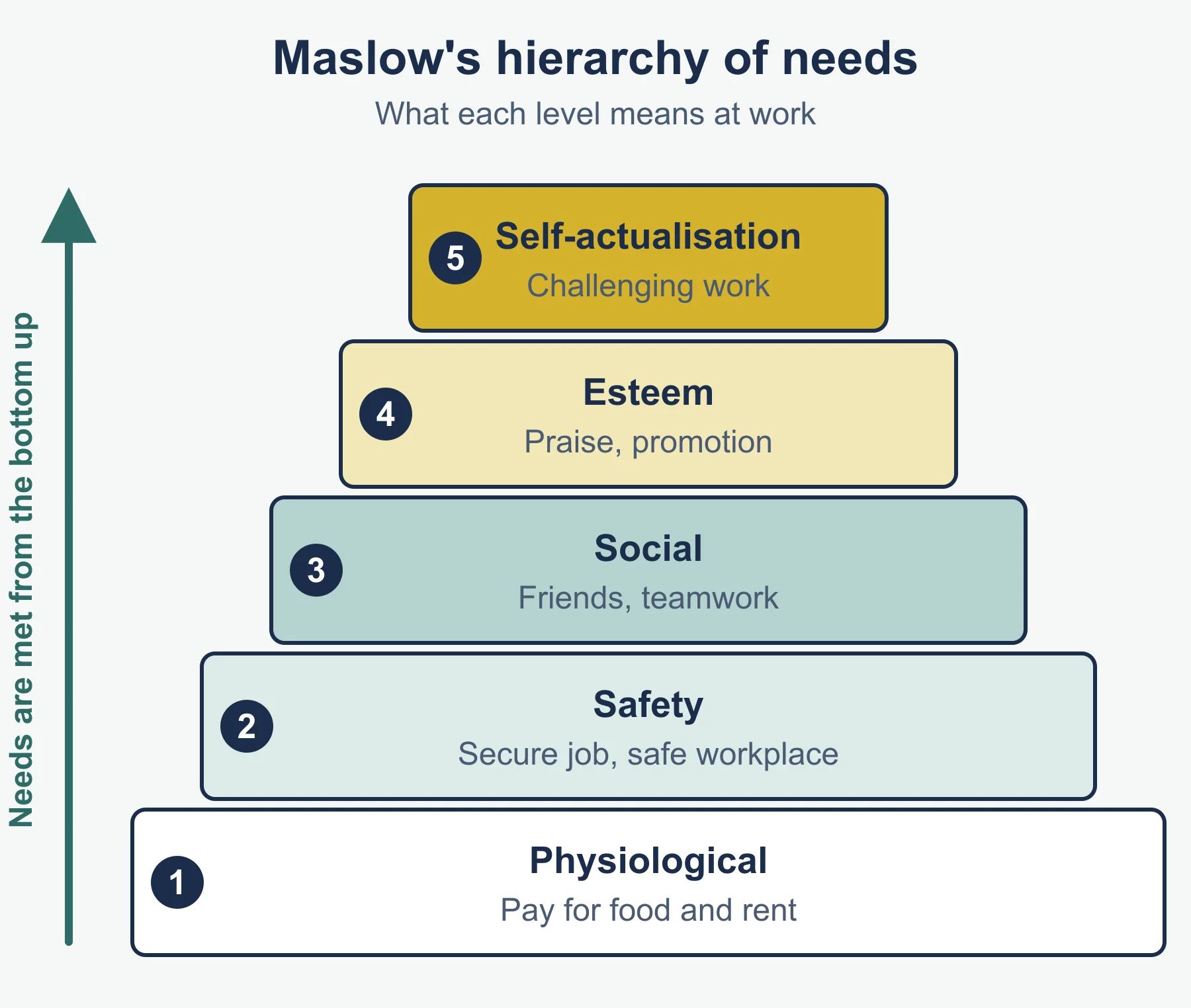
Maslow’s hierarchy (lowest to highest)
- Physiological: basic needs, met by a living wage.
- Safety: security of job and income, safe conditions.
- Social (belonging): friendship, teamworking.
- Esteem: respect, recognition, promotion.
- Self-actualisation: reaching one’s potential, challenging work.
Rule: a met need stops motivating. Find the unmet level and choose a method for it.
Weaknesses: people do not always move up in order, and needs differ between individuals and cultures.
Taylor and Herzberg side by side
| Taylor | Herzberg | |
|---|---|---|
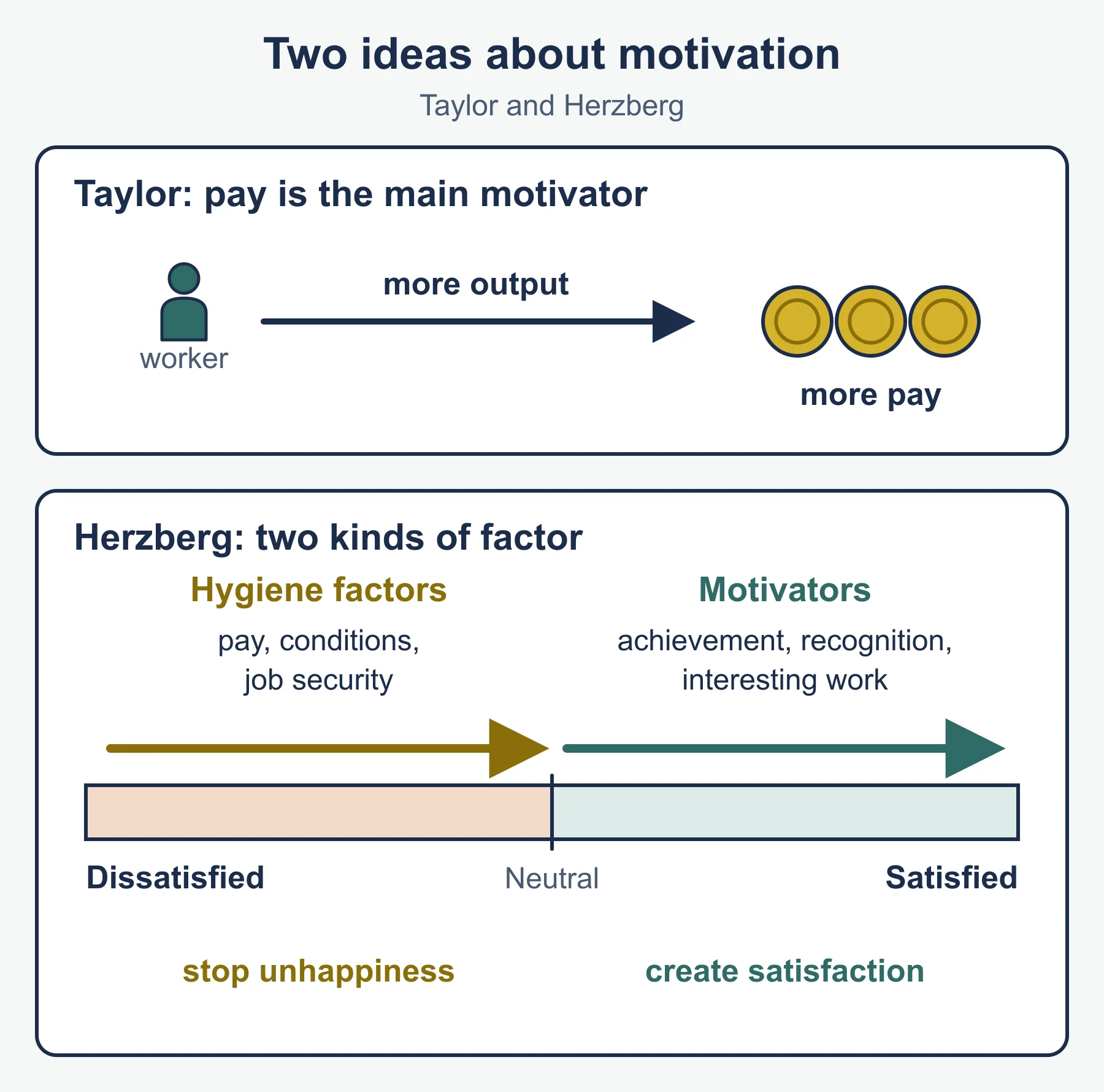
| Main idea | Workers are motivated mainly by money | Two groups of factors: hygiene and motivators |
| Role of pay | The key motivator | Mainly a hygiene factor |
| Typical approach | Small tasks, set output targets, pay linked to output, close supervision | Enrich jobs, give responsibility and recognition |
| Best fit | Repetitive, easily measured work | Skilled work where people want challenge |
| Weakness | Ignores social and esteem needs, so work can feel dull | Some staff mainly want pay, and enrichment costs time and money |
Both descriptions are the standard accounts of the theories, which the syllabus names but does not set out.
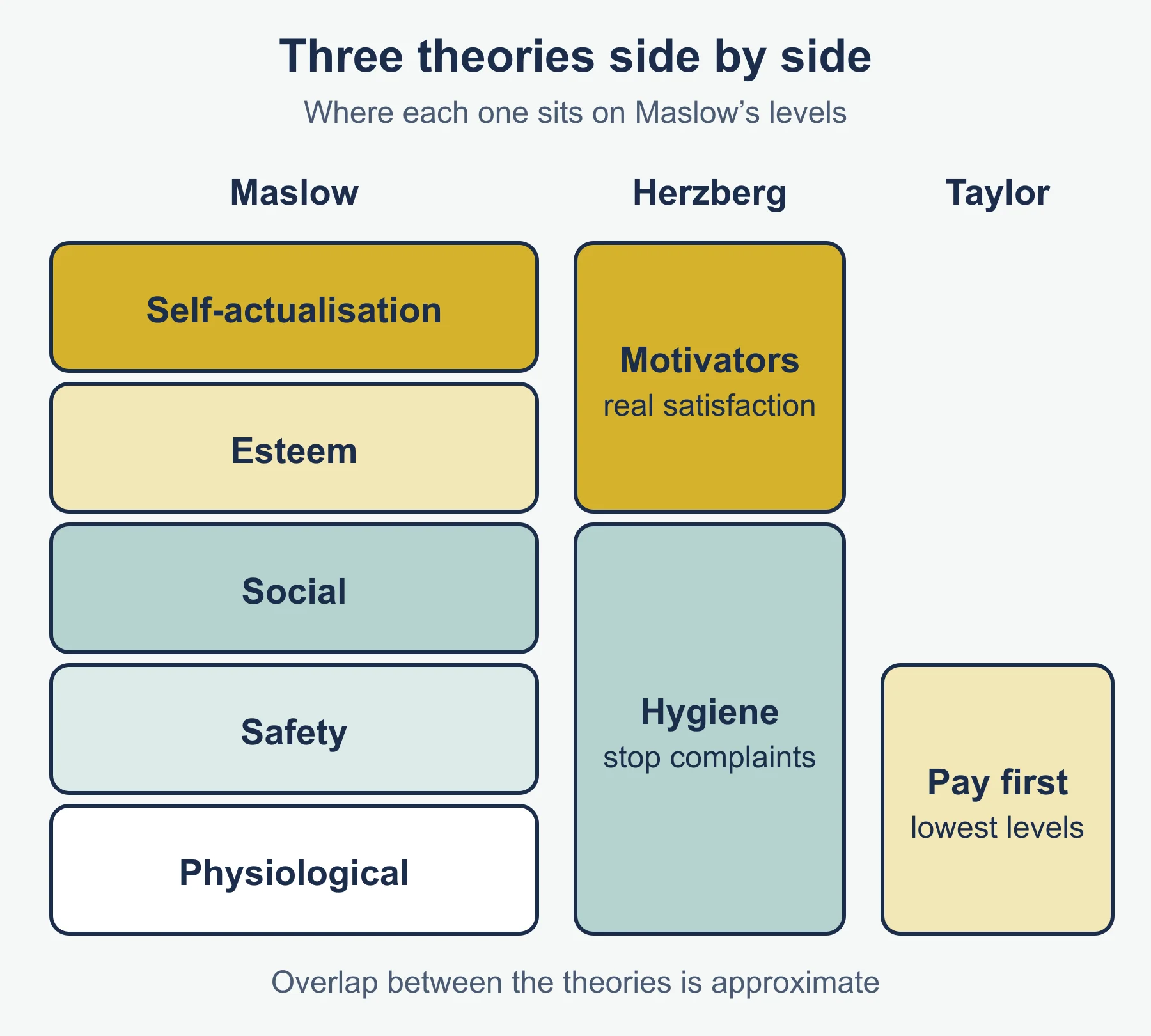
Link between the models. Lower Maslow levels resemble hygiene factors. Higher levels resemble motivators.
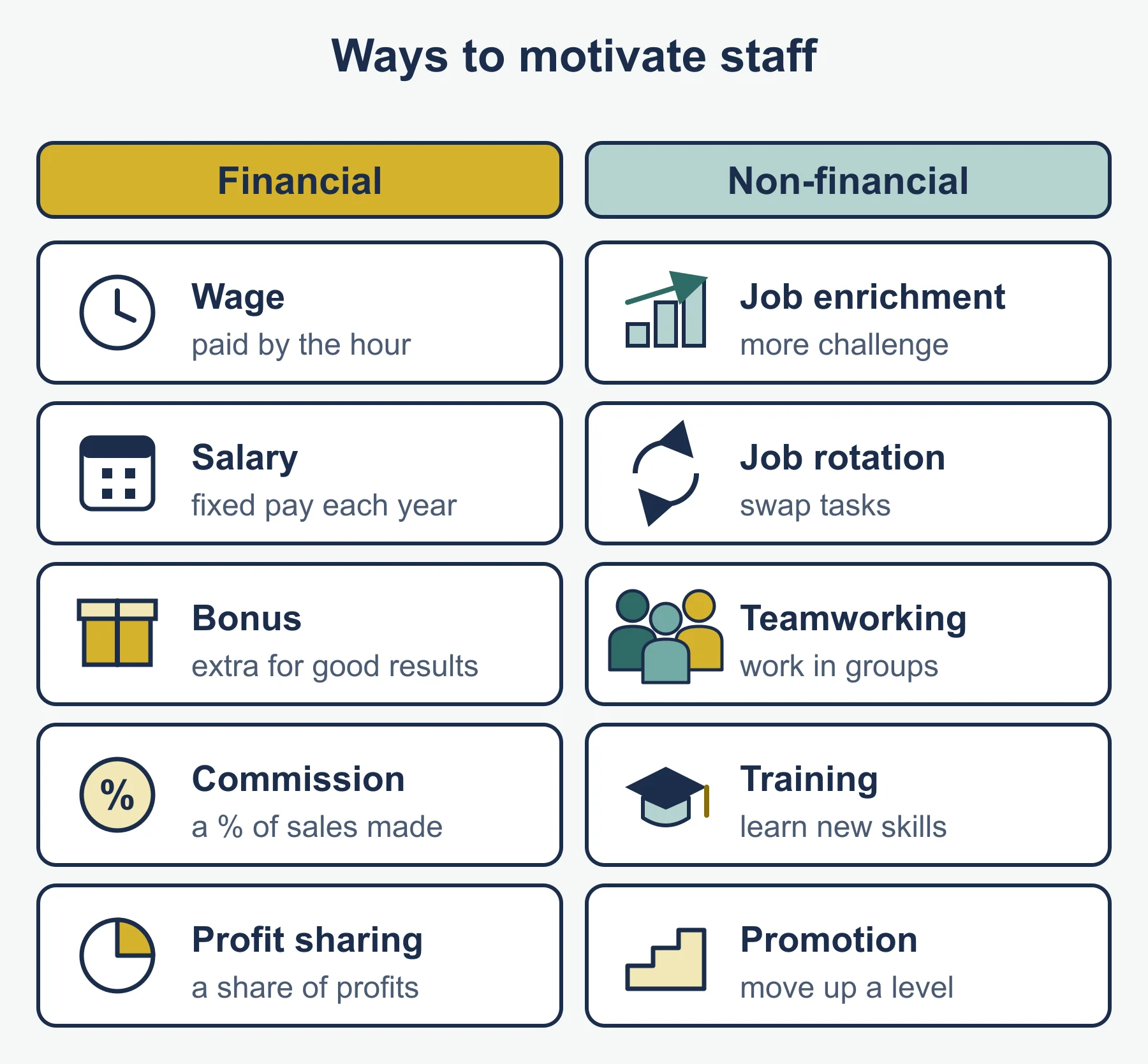
Methods of motivation at a glance
| Method | Type | Key advantage | Key disadvantage |
|---|---|---|---|
| Wage | Financial | Simple, fair for hours worked | Weak link to effort |
| Salary | Financial | Security for the employee | Does not reward extra effort |
| Bonus | Financial | Rewards a target | May hurt quality, may be short-lived |
| Commission | Financial | Strong incentive to sell | Pressure, unstable income |
| Profit sharing | Financial | Loyalty to the whole firm | Depends on many factors beyond one worker |
| Job enrichment | Non-financial | Meets esteem needs | Needs trust, may need extra pay |
| Job rotation | Non-financial | Variety, more flexible staff | Does not raise responsibility, may need training |
| Teamworking | Non-financial | Belonging, shared ideas | Some members rely on others |
| Training | Non-financial | Skills and confidence | Cost, trained staff can leave |
| Promotion | Non-financial | Status, aim to work towards | Few posts, can disappoint others |
Must-know distinctions
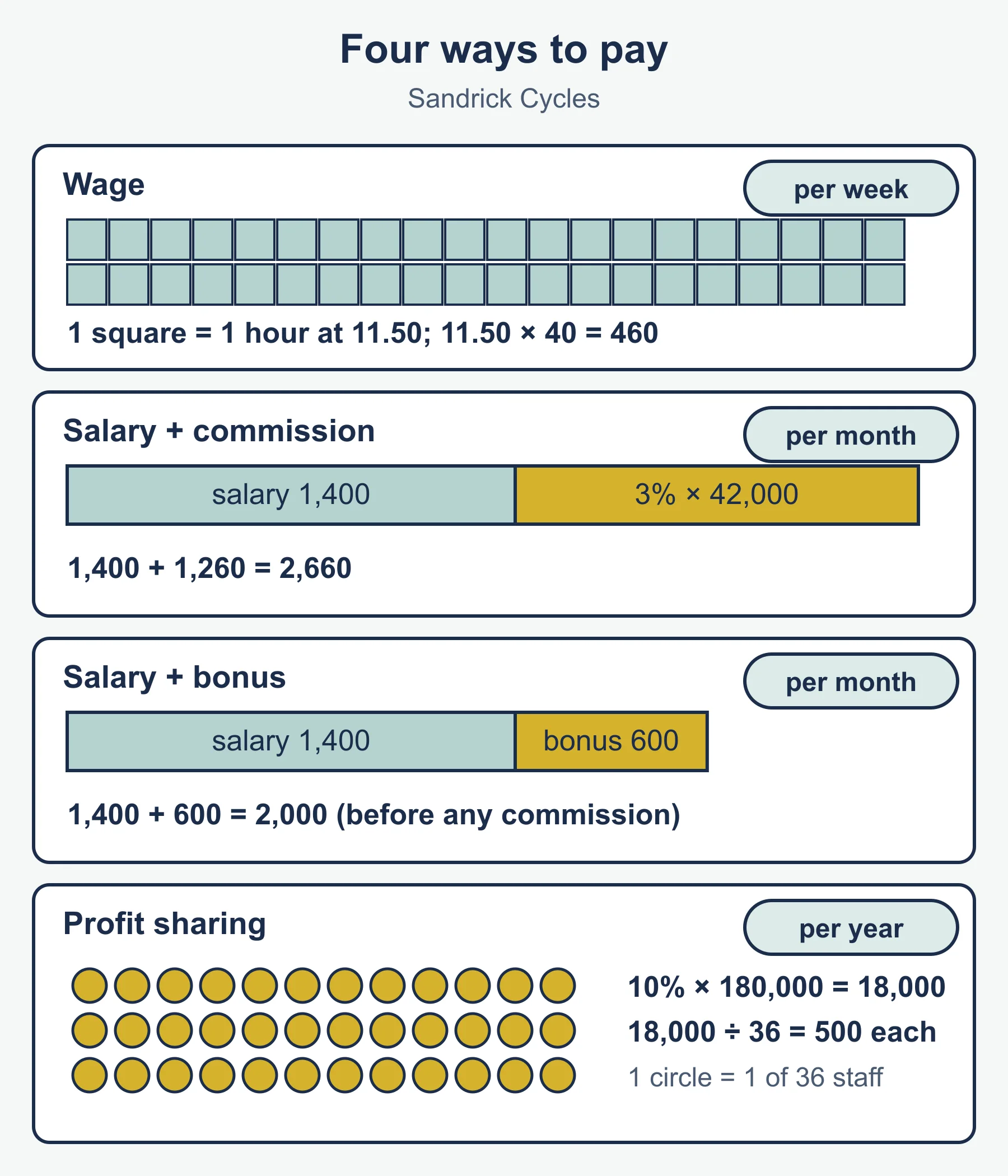
- Wage vs salary: wage is tied to hours worked; salary is a fixed yearly amount paid monthly.
- Bonus vs commission: a bonus rewards a target; commission is a percentage of each sale.
- Bonus vs profit sharing: a bonus is linked to a target; profit sharing is linked to firm profit.
- Rotation vs enrichment: rotation is sideways, enrichment is upwards.
- Hygiene vs motivator: hygiene prevents dissatisfaction; motivators create satisfaction.
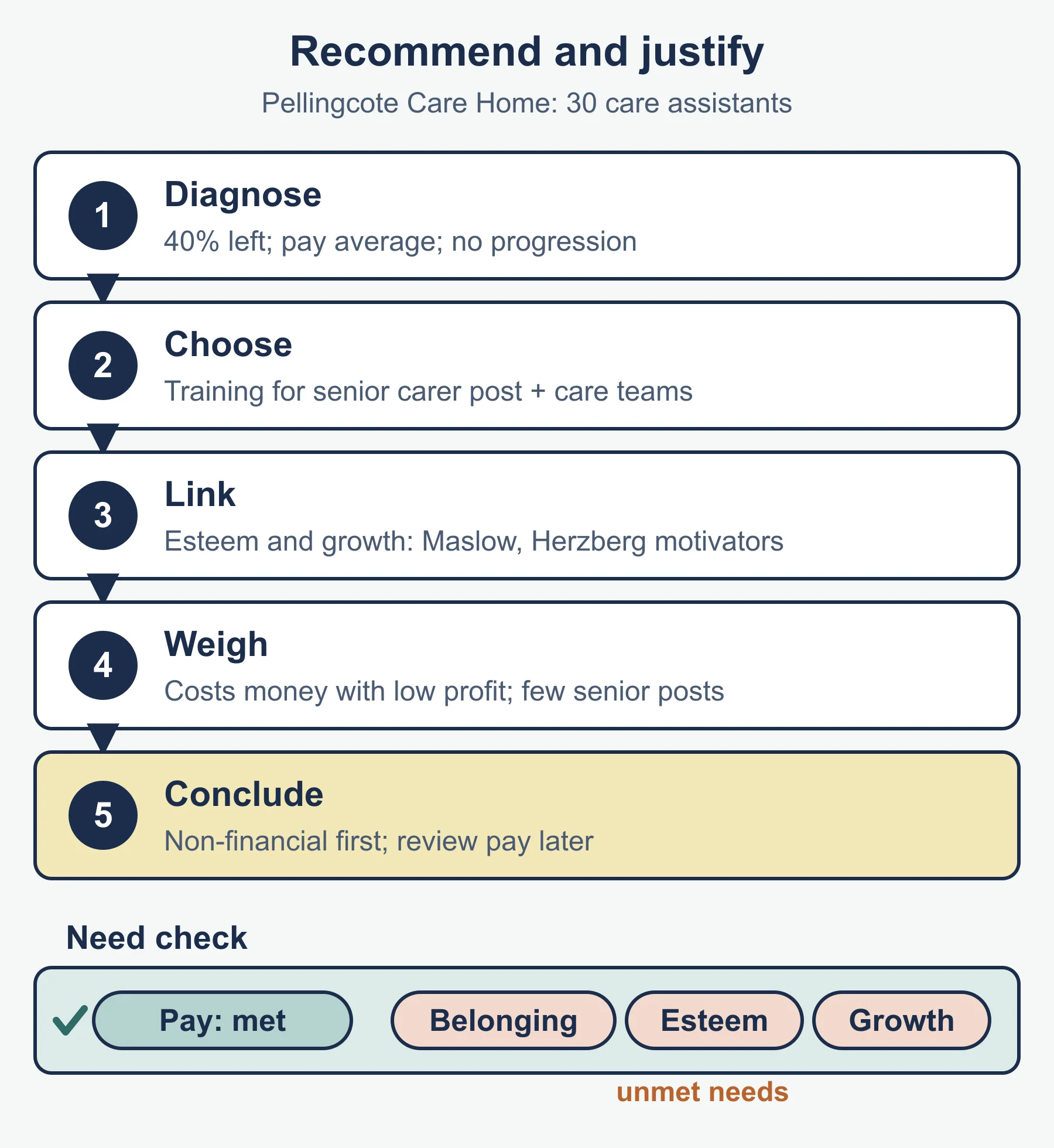
Recommend and justify in five lines
- State the problem and what the employees need.
- Name one or two methods exactly.
- Link to evidence from the question and to Maslow or Herzberg.
- Give one cost or risk.
- Reach a clear judgement and say why the other option is weaker here.
Matching methods to needs
| Unmet need | Likely sign in a case study | Methods that fit |
|---|---|---|
| Physiological or safety | Complaints about low pay, short contracts, unsafe conditions | Wage or salary review, permanent contract |
| Social | Staff work alone, low morale, little communication | Teamworking, shared targets |
| Esteem | Staff feel unnoticed, ask for titles or progression | Promotion, training, recognition |
| Self-actualisation | Skilled staff bored, talent under-used | Job enrichment, new responsibilities |
Pay is rarely the only answer, but do not dismiss it. If pay is clearly below what competitors offer, fix that first.
Command words in this topic
- State, identify, define: short and exact. No explanation needed.
- Calculate: formula, substitution, answer with unit.
- Explain: give a reason or a result, and use the word “because” or “which leads to”.
- Analyse: build a chain, for example bonus, then effort, then output, then lower unit cost.
- Recommend and justify: pick one option and support it with evidence from the case.
- Evaluate: weigh both sides, then reach a reasoned judgement on which is better in this situation and why.
Evaluation points that often apply
- Short term or long term: a bonus can lift output this month, while training builds loyalty over years.
- Cost against benefit: compare the cost of a method with the saving from lower turnover.
- Type of work: repetitive work may respond to pay incentives, creative work to responsibility.
- Size of business: a small firm may have few promotion posts but close teams.
- Staff preferences: ask what the employees actually want, since needs differ.
Quick self-test
- Calculate the labour productivity of 26 workers who make 5,200 items.
- A firm with 40 staff on average has 6 leavers in a year. Calculate labour turnover.
- 20 staff each had 15 working days available and 12 days were lost. Calculate the absenteeism rate.
- A salesperson earns 900 a month plus 4% commission on 25,000 of sales. Calculate total pay.
- A firm shares 20% of a 50,000 profit equally among 25 employees. How much does each receive?
- State the Maslow level met by teamworking.
- Give two Herzberg hygiene factors.
- State one difference between job rotation and job enrichment.
- Name two non-financial methods that suit staff who want a career path.
- Give one reason commission may be unsuitable for a nurse.
Answers
- 5,200 ÷ 26 = 200 items per worker.
- 6 ÷ 40 × 100 = 15%.
- Available days = 20 × 15 = 300. 12 ÷ 300 × 100 = 4%.
- Commission = 4% × 25,000 = 1,000. Total = 900 + 1,000 = 1,900.
- 20% × 50,000 = 10,000. 10,000 ÷ 25 = 400 each.
- Social (belonging).
- Any two from pay, working conditions, company policy, supervision, job security, relationships with colleagues.
- Rotation moves staff between tasks at a similar level, while enrichment gives more responsibility and challenge.
- Training and opportunities for promotion (job enrichment is also acceptable).
- It could push staff to rush, or pressure patients, and care quality is not a matter of sales.
Where marks are usually lost
- Writing the answer to a calculation without the working, unit or period.
- Using the wrong base in a percentage change (dividing by the new figure).
- Mixing up labour turnover with absenteeism.
- Describing Maslow’s levels but not applying them to the business in the question.
- Claiming pay is useless. Herzberg says it must be adequate first.
- Treating rotation and enrichment as the same method.
- Recommending a method without a cost, a risk or a judgement.
- Recommending a bonus where employees do not control the target.
- Giving a long list of methods instead of justifying one or two.
Frequently asked questions
What are the benefits of a well-motivated workforce in Cambridge O Level Business 7115? The syllabus names three: higher labour productivity, lower absenteeism and lower labour turnover. Each lowers costs, for example through lower labour cost per item or less spending on recruitment.
What is the difference between job rotation and job enrichment? Job rotation moves employees between different tasks at a similar level of responsibility. Job enrichment raises the level of responsibility and challenge in the job.
How do Taylor’s and Herzberg’s views on pay differ? Taylor saw money as the main motivator and linked it to piece-rate pay. Herzberg treated pay as mainly a hygiene factor that prevents dissatisfaction, with motivators such as recognition and responsibility needed to create effort.
Are non-financial methods of motivation free? No. Training takes time and fees, enrichment needs trust and may need extra pay, and promotion places are limited.
Official syllabus
Cambridge International, Cambridge O Level Business Studies (7115) syllabus for examination in 2026, section 2.1 Motivating employees (2.1.1 and 2.1.2).
Get free revision emails (optional)
Occasional emails with practice questions, worked explanations and links to free resources for the qualification and subjects you choose. No spam, and you can unsubscribe from any email. The free tools on this site never need an email.
Related resources
-
Study guides
O Level Business: Organisation and management (Cambridge 7115)
Study guide to organisational charts, management functions, delegation, leadership styles and trade unions for Cambridge O Level Business 7115.
Business · Cambridge · O Level
Read guide -
Practice questions
O Level Business: Organisation and management (Cambridge 7115) – Practice Questions
Original practice questions with worked answers on organisation charts, delegation, leadership styles and trade unions for Cambridge O Level Business 7115.
Business · Cambridge · O Level
Try questions -
Revision notes
O Level Business: Organisation and management (Cambridge 7115) – Revision Notes
Condensed revision notes on organisation charts, management functions, delegation, leadership styles and trade unions for Cambridge O Level Business 7115.
Business · Cambridge · O Level
Revise topic
Related articles
-
teaching
A Level tuition in Dubai: Cambridge or Pearson Edexcel International A Level?
Schools in Dubai and Abu Dhabi teach either Cambridge International AS & A Level or Pearson Edexcel International A Level. How the two are structured, why it matters for tuition, and how online classes from Lahore work.
9 October 2026
-
curriculum guides
Choosing subjects at IGCSE and A Level
How subject choices at 14 and 16 affect university options later, and how to keep pathways open without overloading a timetable.
28 July 2026
Studying this with a teacher
Working through Business O LEVELS?
This page is free and stays free. If you would rather be taught it, Marlbridge runs Business classes one-to-one and in small groups of up to 15, online in your own time zone. The first trial class is free. WhatsApp replies within an hour (8am–11pm Pakistan time, every day); email the same day.
Cambridge Business teachers at Marlbridge

