
Revision Notes
O Level Business: Organisation and management (Cambridge 7115) – Revision Notes
Condensed revision notes on organisation charts, management functions, delegation, leadership styles and trade unions for Cambridge O Level Business 7115.
- Subject
- Business
- Level
- O LEVELS
- Topic
- People in business
- Author
- Marlbridge Academic Team
- Updated
- Reviewed by
- Salman Ahmad (what this means)
Aligned to Cambridge O Level Business (7115), For examination in 2026. Official specification .
Syllabus page (what it covers and how it is assessed): Cambridge O Level Business.
Syllabus points this page covers
7115
- 2.2 Organisation and management
Found an error? Report a correction.
Need help with this topic? Request a free trial class for O Level Business (7115).
These notes condense section 2.2 Organisation and management of the Cambridge O Level Business Studies 7115 syllabus for examination in 2026. For full explanations and worked examples, read the study guide. Then test yourself with the practice questions. The wider topic is summarised in the People in business revision notes. Course pages: the Cambridge O Level Business hub and the printable checklist. To see where you stand first, take a free 10-minute diagnostic.
2.2.1 Organisational charts
Definitions
| Term | Meaning |
|---|---|
| Organisational chart | Diagram of posts, reporting lines and levels |
| Level of hierarchy | One layer of authority on the chart |
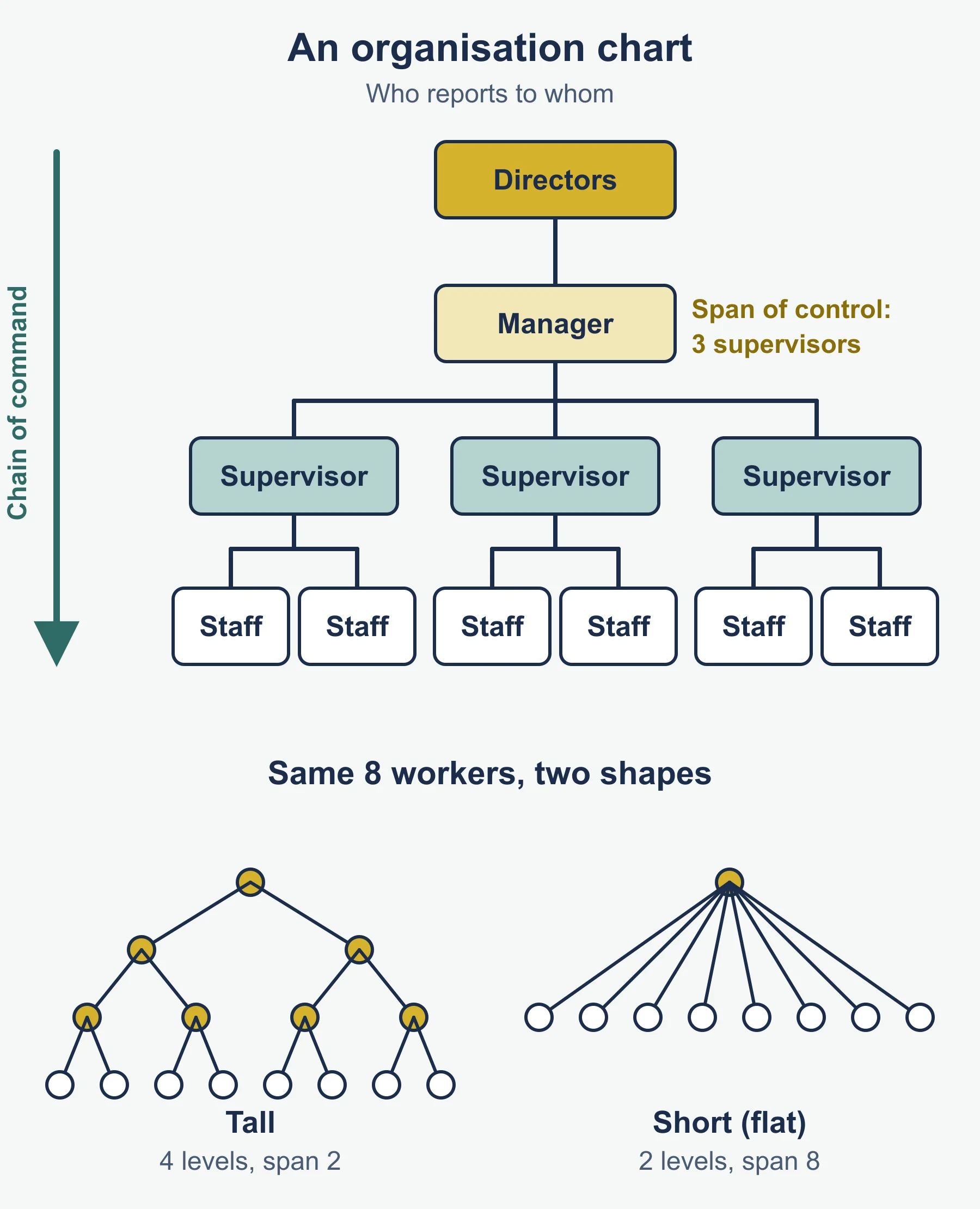
| Chain of command | Line of authority from the top to the bottom of the business |
| Span of control | Number of people reporting directly to one manager or supervisor |
| Tall structure | Many levels, usually narrow spans |
| Short structure | Few levels, usually wide spans |
Roles
| Post | Main responsibility | Reports to |
|---|---|---|
| Director | Long-term direction, objectives, major decisions | Owners or shareholders, in a company |
| Manager | Plans and runs a department to meet the objectives | Director |
| Supervisor | Oversees daily work of a small team | Manager |
| Other employees | Carry out the tasks and report problems | Supervisor or manager |
Inter-relationships: targets and instructions flow down; results, problems and ideas flow up; managers in different departments coordinate sideways.
Method: reading a chart
- Count the levels from the top post to the lowest.
- For span of control, count only the direct reports of one post.
- For the chain of command, list each post from the bottom to the top.
- To compare structures, state levels and spans for both, then link to speed, cost and supervision.
Small worked reminder: Garnetfield Pottery
Garnetfield Pottery is an invented business with 1 director, 2 managers and 8 potters (4 per manager).
- Levels: 3.
- Director’s span: 2. Each manager’s span: 4.
- Total employees: 1 + 2 + 8 = 11.
- If a third level of supervisors were added with 2 potters each under 4 supervisors (2 per manager), the structure gets taller and each manager’s span falls to 2.
Tall versus short
| Tall | Short | |
|---|---|---|
| Communication | Slower, more steps | Faster, fewer steps |
| Supervision | Close | Looser |
| Management salaries | Higher | Lower |
| Promotion steps | Many | Few |
| Suits | Work needing close checking | Skilled staff who need freedom |
2.2.2 The role of management
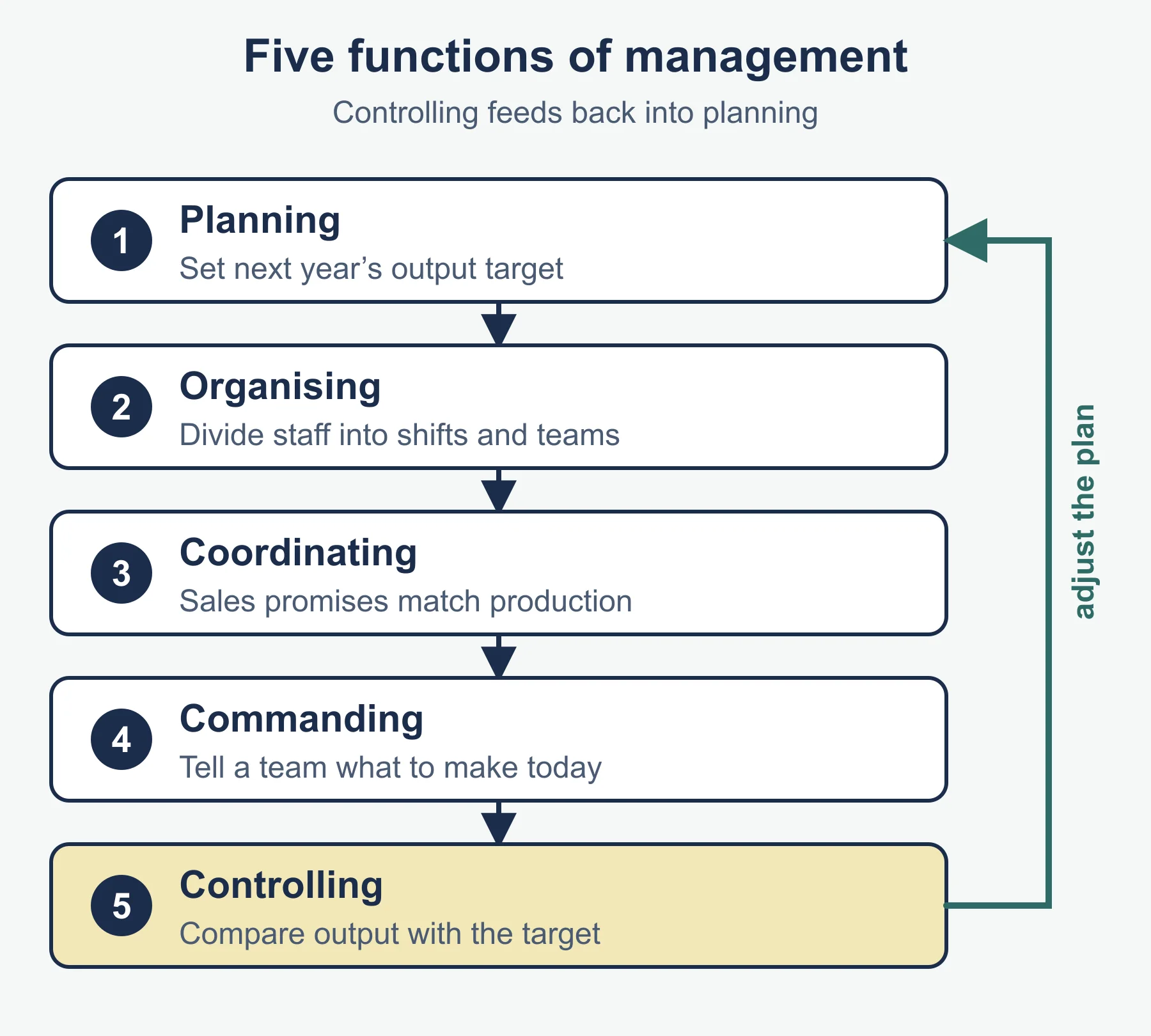
Five functions
| Function | One-line meaning |
|---|---|
| Planning | Set objectives and decide how to reach them |
| Organising | Arrange people, resources and money to carry out the plan |
| Coordinating | Make departments work towards the same aims |
| Commanding | Give instructions and direct staff |
| Controlling | Compare results with the plan and act on gaps |
Memory aid: plan, organise, coordinate, command, control. The syllabus gives these as examples (“e.g.”), so a question may describe an action without naming it. Match the action to the function.
Delegation
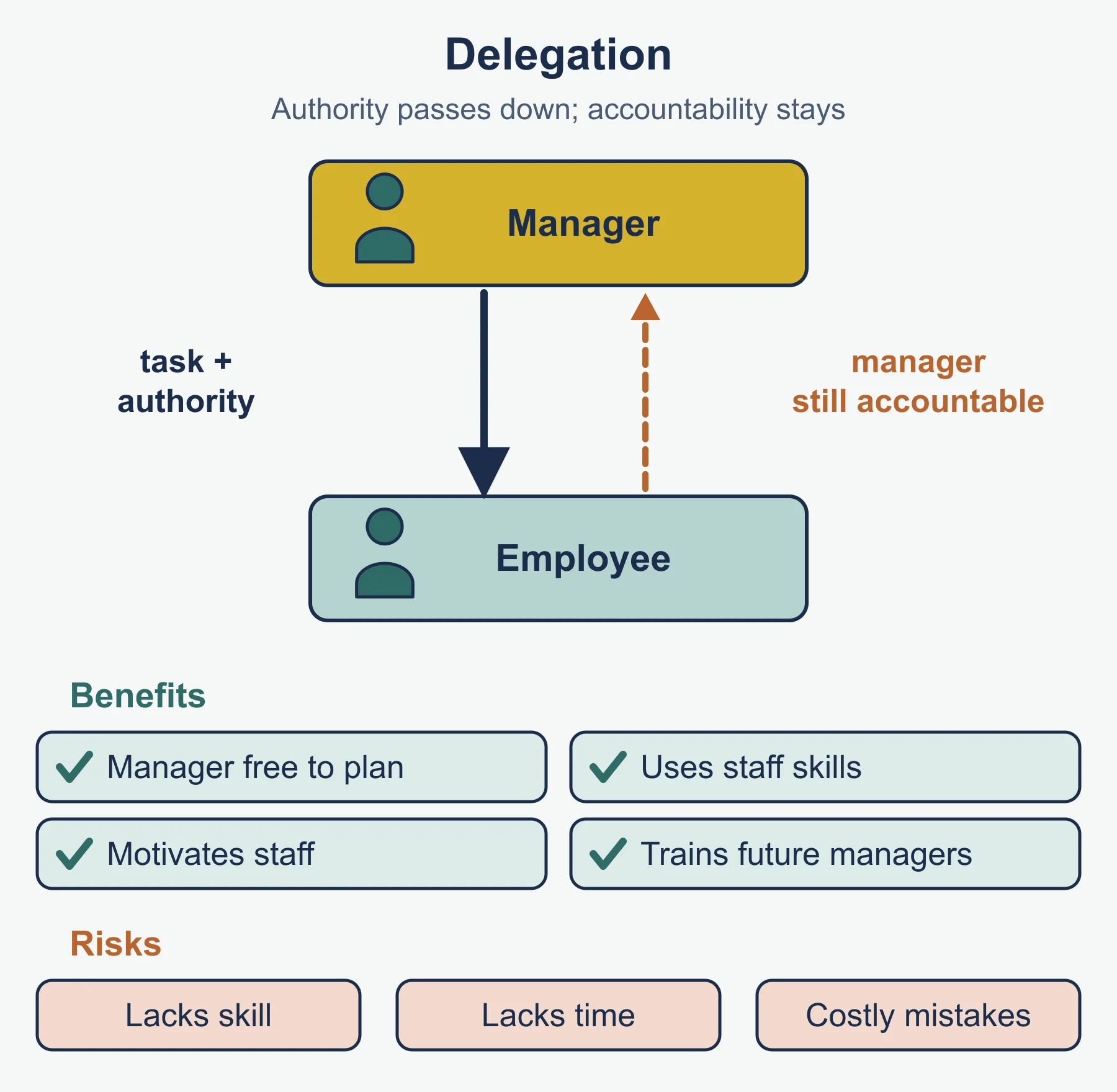
- Definition: passing authority to carry out a task, and to make decisions about it, to someone lower in the hierarchy. The manager stays accountable.
- Benefits: frees managers for planning, uses staff skills, motivates, trains future managers.
- Risks: mistakes, lack of skill or time, a task done differently from how the manager would do it.
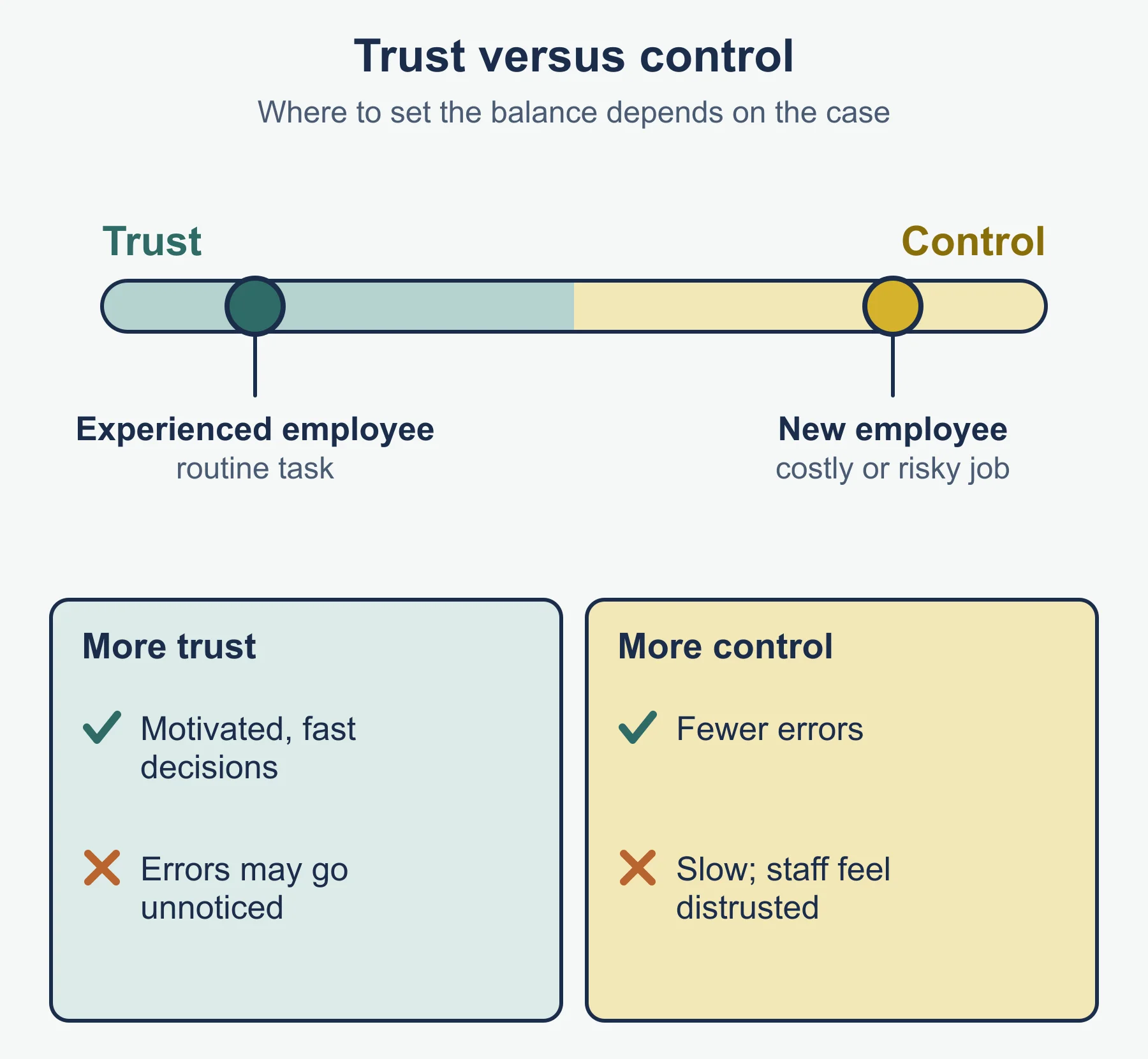
Trust versus control
| Trust | Control | |
|---|---|---|
| Gains | Motivation, speed, manager’s time freed | Fewer errors, consistent standards |
| Losses | Errors may go unseen | Slower, staff feel distrusted, manager overloaded |
| Fits | Experienced staff, routine or low-risk jobs | New staff, high-risk or costly jobs |
2.2.3 Leadership styles
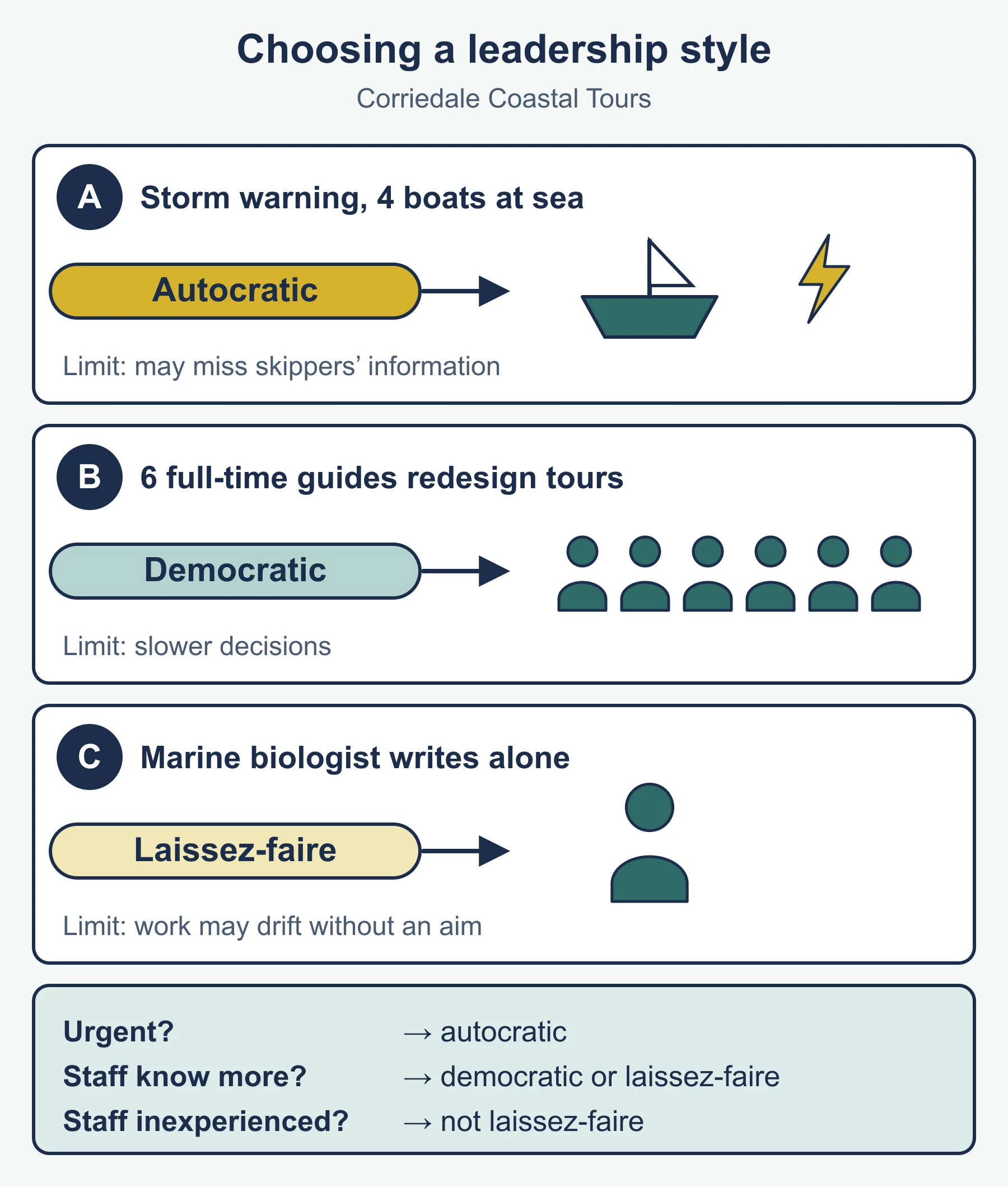
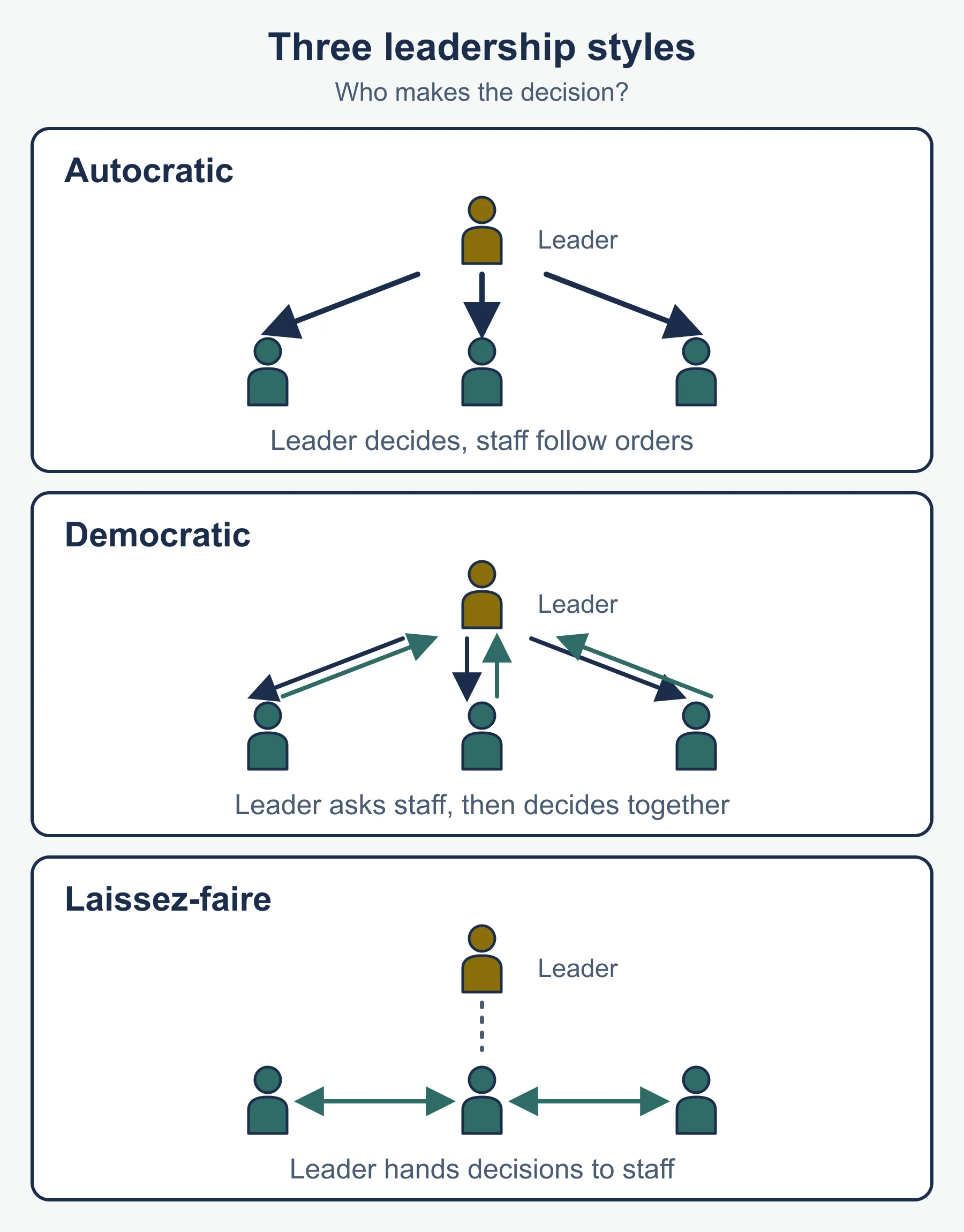
| Style | Decisions | Communication | Best when | Weakness |
|---|---|---|---|---|
| Autocratic | Leader alone | Mainly downwards | Urgent decisions, inexperienced staff, emergencies | Demotivating, ignores staff knowledge |
| Democratic | Leader consults and often shares decisions | Two-way | Skilled staff, complex decisions, commitment needed | Slower, possible disagreement |
| Laissez-faire | Staff decide how to work | Little, on request | Expert or creative staff | Lack of direction, work may drift |
Method: recommend and justify
- Name the style.
- Quote two details from the case (staff skill, urgency, size of team, type of task).
- Explain why the style fits those details.
- State one limitation.
- Compare with the main alternative and finish with a clear judgement.
2.2.4 Trade unions
- Definition: an organisation of workers formed to protect and improve its members’ pay, conditions and interests, acting together.
- Effects on employees: stronger bargaining power, support in disputes, better representation, but a subscription and possible calls to take industrial action.
- Effects on the business: higher costs from pay and conditions agreements, possible disruption, slower change; but a single channel to talk to staff, fewer unresolved disputes and often lower labour turnover.
Small worked reminder
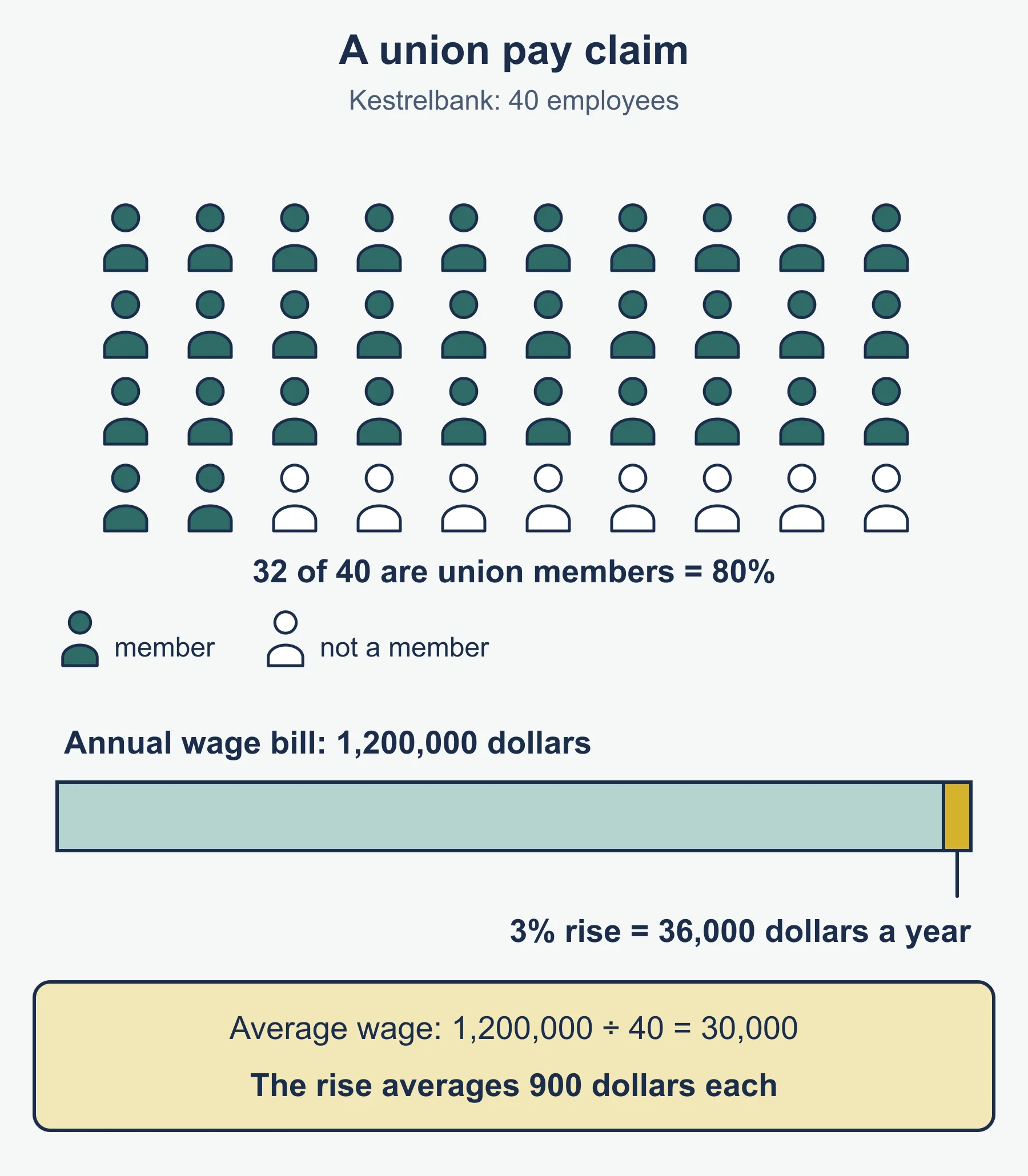
14 of 40 employees are union members: 14 ÷ 40 = 35%. A 5% rise on a wage bill of 480,000 dollars costs 480,000 × 5% = 24,000 dollars a year.
Applying the content to a case
Recommend and justify: a short model
Case: a small bakery chain has 10 bakers who are new to the job and a large rush order due tomorrow morning.
- Style: autocratic.
- Detail 1: the deadline is tomorrow, so there is no time for discussion.
- Detail 2: the bakers are new and need clear instructions.
- Limitation: the bakers may feel their ideas are ignored if this is the usual style.
- Judgement: for this order, one clear set of orders is the better choice. After the order, a more democratic approach would build skills and motivation.
Linking the four parts together
The four syllabus points connect, and the best answers use the links.
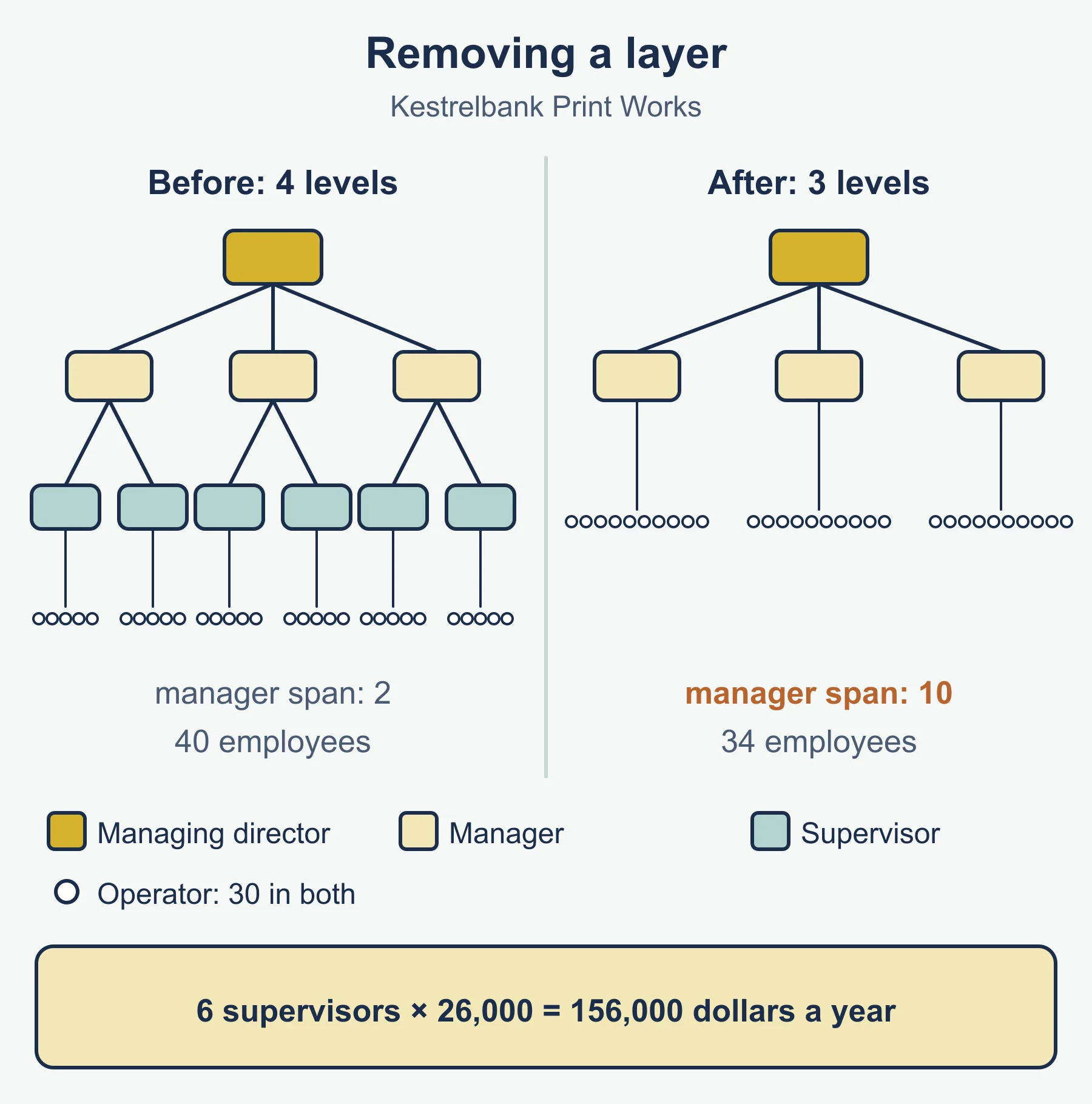
- A wide span of control forces managers to delegate, because they cannot supervise everyone closely.
- Delegation works best with trust, which suits a democratic or laissez-faire style and skilled staff.
- A tall structure with close control often goes with an autocratic style.
- A union gives staff a collective voice, which can feel like a limit on an autocratic leader and a help to a democratic one.
Command words in this section
| Command word | What to do here |
|---|---|
| State, identify | Give the term or function, no explanation needed |
| Define | Give the meaning in one precise sentence |
| Calculate | Show the working and give the answer with units or a percentage sign |
| Explain | Give a point, then a reason or consequence |
| Analyse | Break the effect into a chain of cause and result in the case |
| Recommend and justify | Choose one option, support it with case details and give a limitation |
| Evaluate | Weigh both sides, then reach a reasoned judgement |
Must-know distinctions
- Span of control versus levels: span counts people across one manager’s team; levels count layers from top to bottom.
- Delegation versus abdication: delegation passes a task but keeps accountability. Handing over a task and ignoring it is not good delegation.
- Commanding versus controlling: commanding gives instructions before the work; controlling checks results afterwards.
- Planning versus organising: planning decides what and why; organising arranges who and with what.
- Laissez-faire versus poor management: the leader still sets the broad aims.
- Democratic versus autocratic: both can lead to good decisions; the difference is who is involved.
Quick self-test
- State the five functions of management named in the syllabus.
- A supervisor has 8 staff reporting to her, and she reports to one manager. What is her span of control?
- A business removes one level of hierarchy. What usually happens to spans of control?
- Give one benefit and one risk of delegation.
- Which leadership style is most likely to suit an urgent safety decision?
- Which function of management compares actual sales with the sales target?
- Define a trade union.
- A business has 36 operatives and 3 managers and no supervisors. What is each manager’s span, if the operatives are shared equally?
- Give two ways a union can raise a business’s costs or slow decisions.
- Give one possible benefit to a business of having a recognised union.
Answers
- Planning, organising, coordinating, commanding, controlling.
-
- Spans of control usually widen.
- Benefit: frees the manager’s time, or motivates staff. Risk: the employee may make mistakes.
- Autocratic.
- Controlling.
- An organisation of workers formed to protect and improve its members’ pay, conditions and interests.
- 36 ÷ 3 = 12.
- Pay and conditions agreements raise costs; industrial action disrupts output; consultation slows change.
- A single channel for communication, fewer unresolved disputes, or lower labour turnover.
Where marks are usually lost
- Counting the wrong people when finding a span of control.
- Defining delegation as “giving a job” without the passing of authority.
- Listing the five functions but not matching a described action to the right one.
- Recommending a leadership style with no reference to the details in the case.
- Giving only the advantages of a style, structure or union, with no limitation.
- Writing only negative effects of unions.
- Saying a short structure is simply “better” or “cheaper” without a condition.
- Confusing coordinating (linking departments) with commanding (giving orders).
- Ending an evaluation without a clear judgement.
Frequently asked questions
What is the difference between a tall and a short organisational structure? A tall structure has many levels of hierarchy, usually with narrow spans of control. A short, or flat, structure has few levels, usually with wide spans of control.
What is the difference between delegation and giving someone a job? Delegation passes the authority to carry out a task and make decisions about it to someone lower in the hierarchy, while the manager remains accountable. Simply handing out work does not pass that authority.
Does laissez-faire leadership mean no management? No. Under a laissez-faire style the leader still sets the aims but leaves staff free to decide how to reach them.
What does trust versus control mean in delegation? Trust means letting staff decide for themselves, which builds motivation but may let errors go unnoticed. Control means checking and approving, which reduces errors but slows work, so the right balance depends on the employee and the task.
Official syllabus
Cambridge International, Cambridge O Level Business Studies (7115) syllabus for examination in 2026, subject content section 2.2 Organisation and management.
Get free revision emails (optional)
Occasional emails with practice questions, worked explanations and links to free resources for the qualification and subjects you choose. No spam, and you can unsubscribe from any email. The free tools on this site never need an email.
Related resources
-
Study guides
O Level Business Studies: People in Business (Cambridge 7115)
Study guide to Topic 2 People in business for Cambridge O Level Business Studies 7115: motivation, organisation, leadership, recruitment and communication.
Business · Cambridge · O Level
Read guide -
Practice questions
O Level Business Studies: People in Business — Practice Questions
Original practice questions with worked answers on motivation, structure, leadership, recruitment, training and communication for O Level Business 7115.
Business · Cambridge · O Level
Try questions -
Study guides
O Level Business: Recruitment, selection, training and communication (Cambridge 7115)
Study guide to hiring, training, redundancy, employment law, communication methods and barriers for Cambridge O Level Business Studies.
Business · Cambridge · O Level
Read guide
Related articles
-
teaching
A Level tuition in Dubai: Cambridge or Pearson Edexcel International A Level?
Schools in Dubai and Abu Dhabi teach either Cambridge International AS & A Level or Pearson Edexcel International A Level. How the two are structured, why it matters for tuition, and how online classes from Lahore work.
9 October 2026
-
curriculum guides
Choosing subjects at IGCSE and A Level
How subject choices at 14 and 16 affect university options later, and how to keep pathways open without overloading a timetable.
28 July 2026
Studying this with a teacher
Working through Business O LEVELS?
This page is free and stays free. If you would rather be taught it, Marlbridge runs Business classes one-to-one and in small groups of up to 15, online in your own time zone. The first trial class is free. WhatsApp replies within an hour (8am–11pm Pakistan time, every day); email the same day.
Cambridge Business teachers at Marlbridge

