
Study Guides
O Level Business: Recruitment, selection, training and communication (Cambridge 7115)
Study guide to hiring, training, redundancy, employment law, communication methods and barriers for Cambridge O Level Business Studies.
- Subject
- Business
- Level
- O LEVELS
- Topic
- People in business
- Author
- Marlbridge Academic Team
- Updated
- Reviewed by
- Salman Ahmad (what this means)
Aligned to Cambridge O Level Business (7115), For examination in 2026. Official specification .
Syllabus page (what it covers and how it is assessed): Cambridge O Level Business.
Syllabus points this page covers
7115
- 2.3 Recruitment, selection and training of employees
- 2.4 Internal and external communication
Found an error? Report a correction.
Need help with this topic? Request a free trial class for O Level Business (7115).
This guide follows the Cambridge O Level Business Studies 7115 syllabus for examination in 2026. It covers syllabus sections 2.3 (Recruitment, selection and training of employees) and 2.4 (Internal and external communication), both inside Topic 2, People in business. The syllabus states that all candidates take both papers. Paper 1 (Short Answer and Data Response) and Paper 2 (Case Study) each carry 50% of the qualification.
Related pages: the Cambridge O Level Business hub, the checklist, the revision notes, the practice questions, the wider People in business guide, its revision notes and its practice questions. To find weak spots first, try the free diagnostics.
What the syllabus asks for
| Section | You must be able to |
|---|---|
| 2.3.1 | Describe recruitment and selection methods; contrast internal and external recruitment; outline the main stages; recommend and justify who to employ; weigh part-time against full-time employees |
| 2.3.2 | Explain why training matters to a business and to employees; weigh induction, on-the-job and off-the-job training |
| 2.3.3 | Distinguish dismissal from redundancy with examples; understand when downsizing is needed (for example automation or reduced demand); recommend and justify which employees to make redundant |
| 2.3.4 | Describe legal controls over employment contracts, unfair dismissal, discrimination, health and safety and a legal minimum wage, and their impact on employers and employees |
| 2.4.1 | Explain why effective communication matters; weigh communication methods, including IT-based ones; recommend and justify a method |
| 2.4.2 | Explain how communication barriers arise, the problems of ineffective communication, and how barriers can be reduced or removed |
2.3.1 Recruitment and selection
Recruitment is attracting suitable people to apply for a vacancy. Selection is choosing between those who applied. Keep the two words apart in your answers.
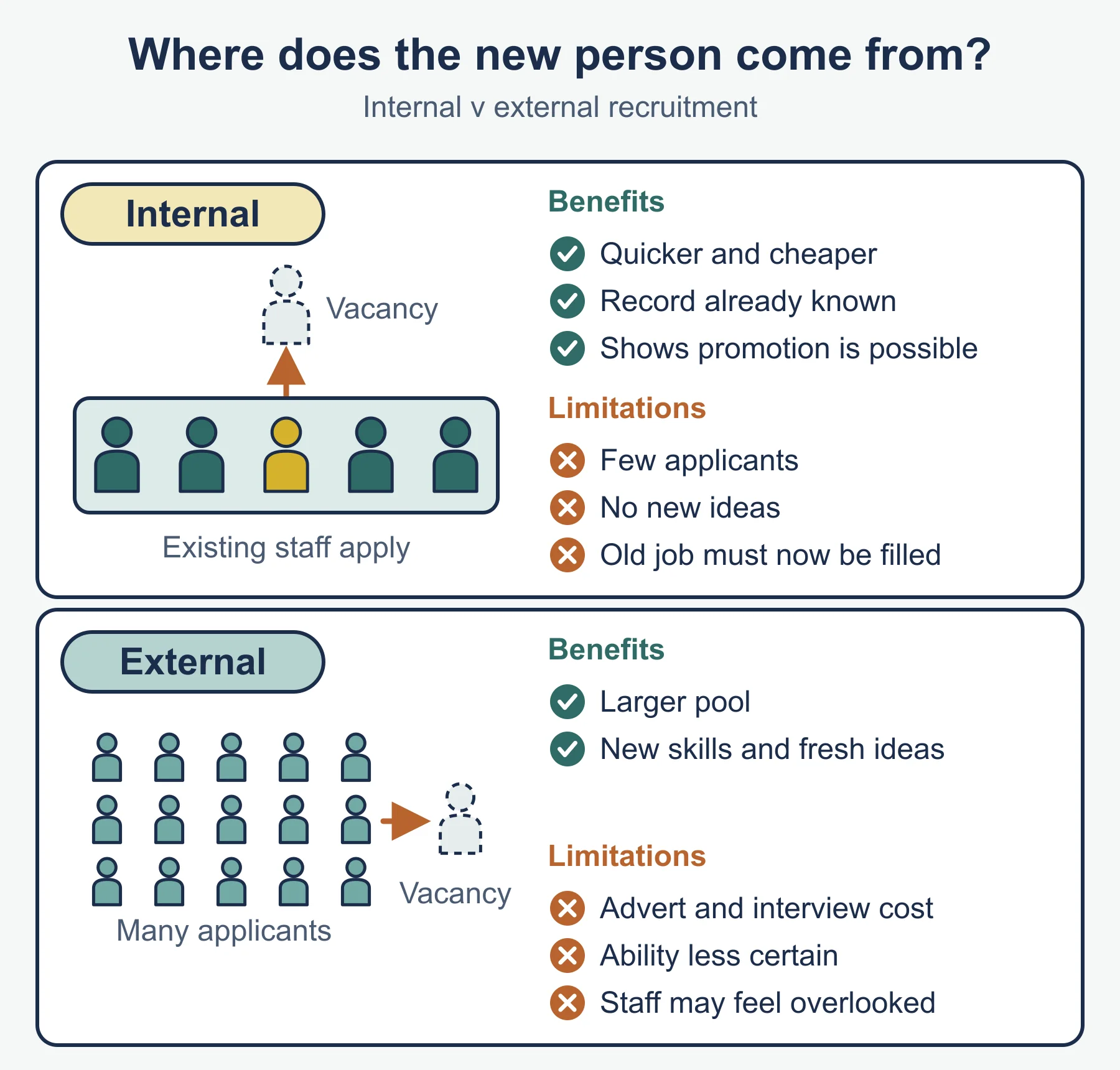
Internal recruitment fills a vacancy from the existing workforce, for example promoting a team member. External recruitment fills it from outside the business.
| Benefits | Limitations | |
|---|---|---|
| Internal | Quicker and cheaper; the person’s record is known; shows staff promotion is possible | Few applicants; no new ideas; the old job must now be filled |
| External | Larger pool; new skills and fresh ideas | Advertising and interviewing cost money and time; ability less certain; staff may feel overlooked |
Methods. Recruitment routes include internal notices, adverts, job centres, agencies and recommendation. Selection tools include application forms or CVs, interviews, tests and references. Choose methods that fit the post.
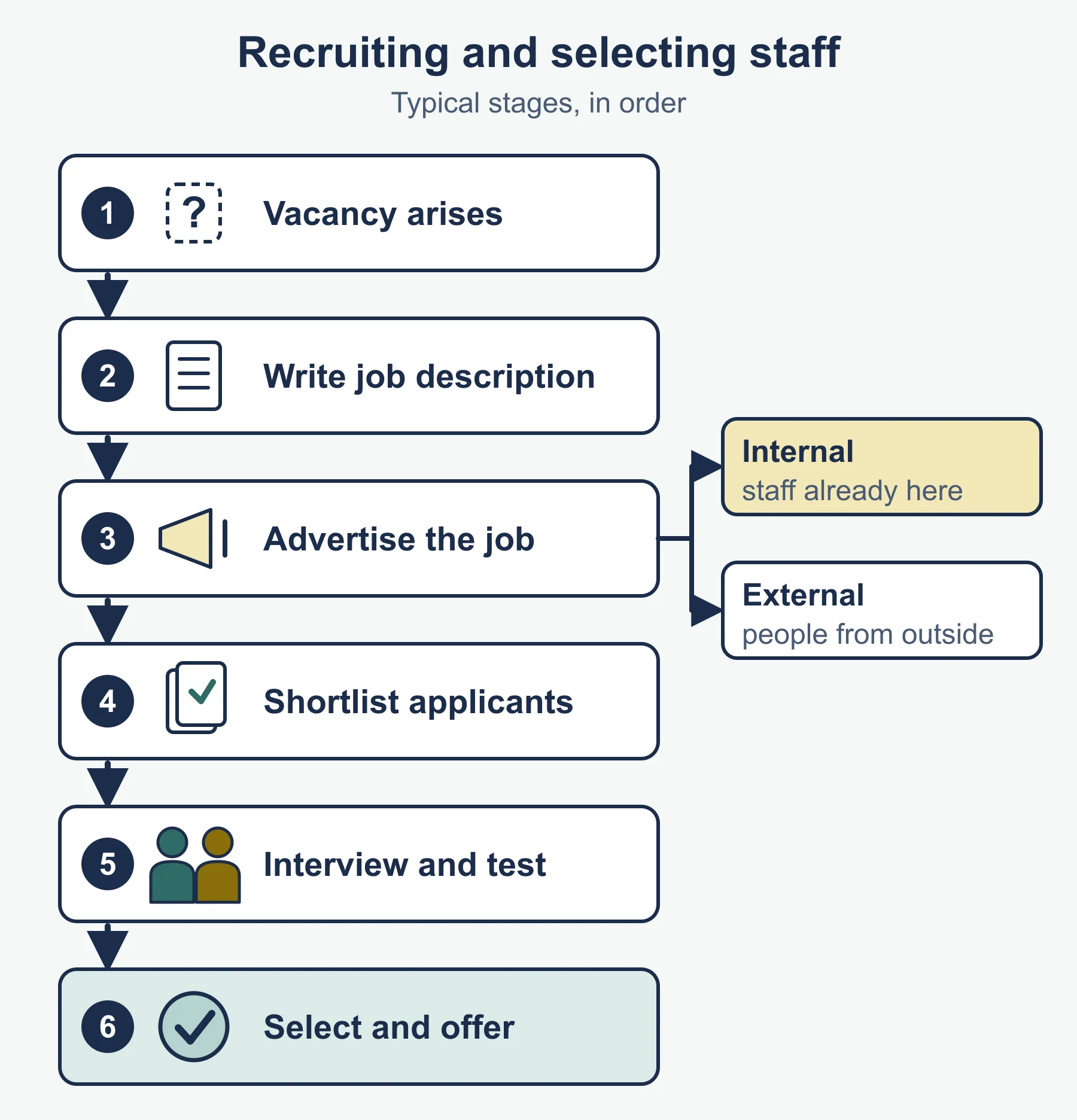
Main stages. One standard sequence is shown below.
- Identify that a vacancy exists and what the job needs.
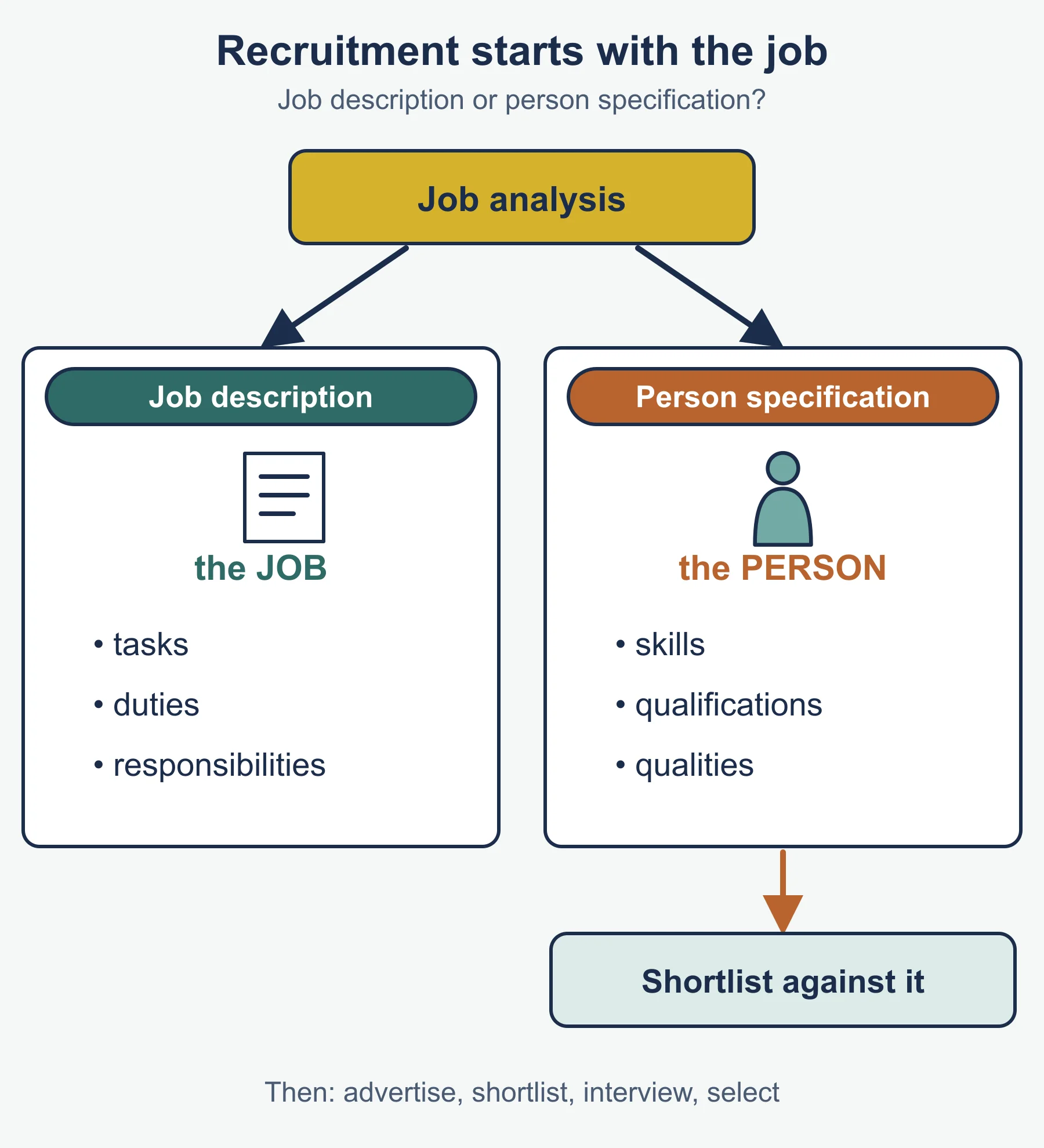
- Write a job description (what the post involves) and a person specification (the skills and qualities wanted).
- Advertise, internally, externally or both.
- Collect and shortlist applications against the person specification.
- Interview and test the shortlist, and take up references.
- Offer the post to the best candidate and agree the employment contract.
- Welcome the new starter with induction training.
Part-time and full-time employees. Part-timers work fewer hours than the business’s normal full week.
| Benefits | Limitations | |
|---|---|---|
| Part-time | Cover matches busy periods; wages paid only for hours needed; attracts people who cannot work full weeks | More people to recruit, train and manage; harder communication across short shifts |
| Full-time | Reliable cover; staff learn the job deeply; usually stronger loyalty | Paid for the whole contract even in quiet spells; less flexible |
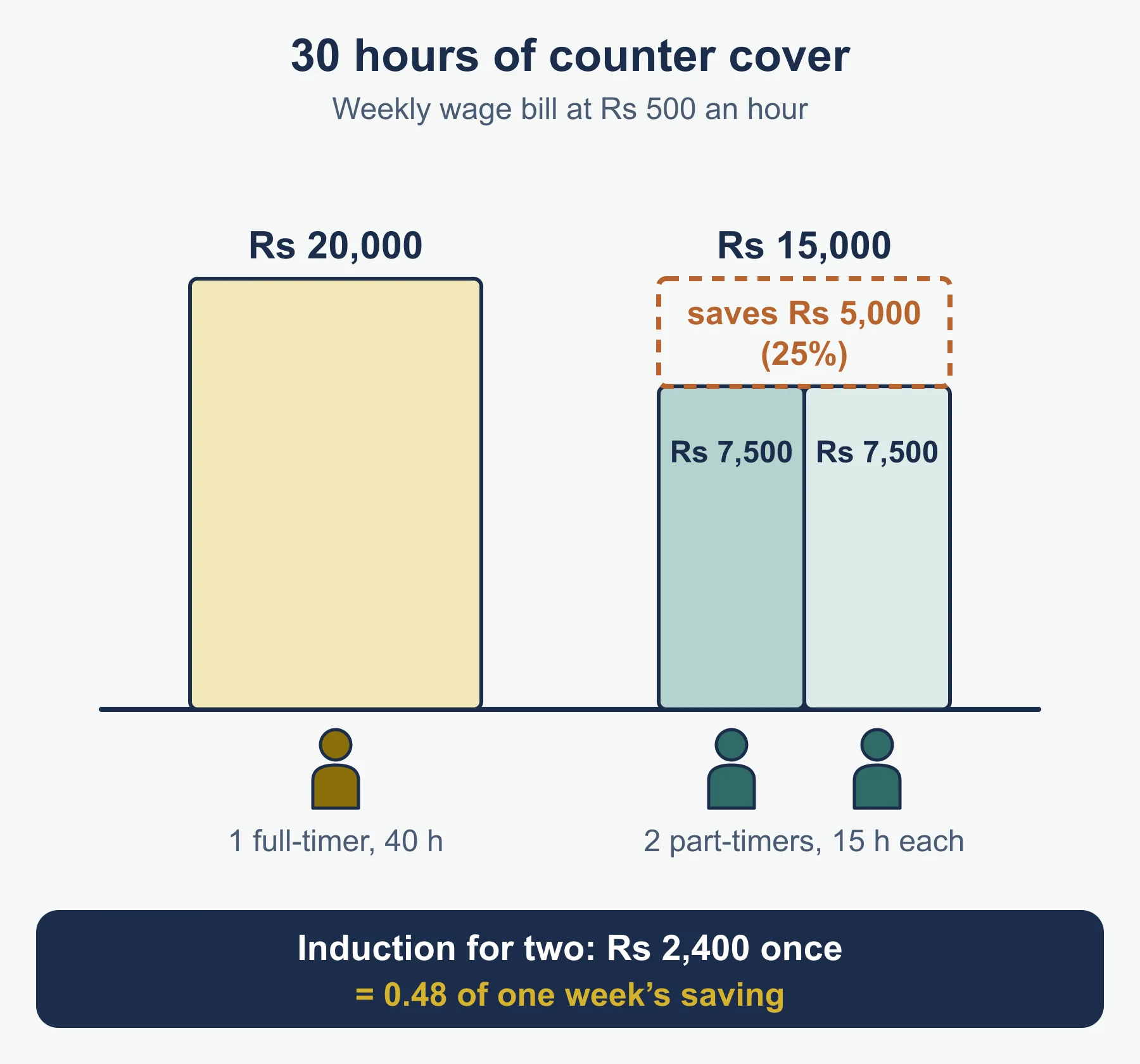
Worked example. Thistlegate Bakery needs 30 hours of counter cover a week. A full-time contract is 40 hours at Rs 500 an hour. Two part-timers would each work 15 hours at the same rate.
- Full-time cost: 40 × 500 = Rs 20,000 a week.
- Part-time cost: 2 × 15 × 500 = Rs 15,000 a week.
- Saving: 20,000 − 15,000 = Rs 5,000, which is 5,000 ÷ 20,000 = 25% of the full-time bill.
- Offsetting cost: induction for two people at Rs 1,200 each is Rs 2,400 once. That is recovered in 2,400 ÷ 5,000 = 0.48 of a week.
Judgement: part-time is cheaper, but the bakery must weigh extra management effort and cover gaps if one part-timer is absent.
Recommend and justify who to employ. You will be given two or three candidates and a business situation. Match each candidate against what this business needs now. State your choice, give two reasons tied to the facts, then say why the runner-up was less suitable or what risk your choice carries.
2.3.2 Training
Training is teaching employees the skills and knowledge to do a job well.
Why it matters to a business: higher productivity, fewer mistakes and accidents, better service, use of new equipment, and a flexible workforce. Why it matters to employees: they gain skills, feel more confident, and may earn promotion or higher pay.
| Type | What it is | Benefits | Limitations |
|---|---|---|---|
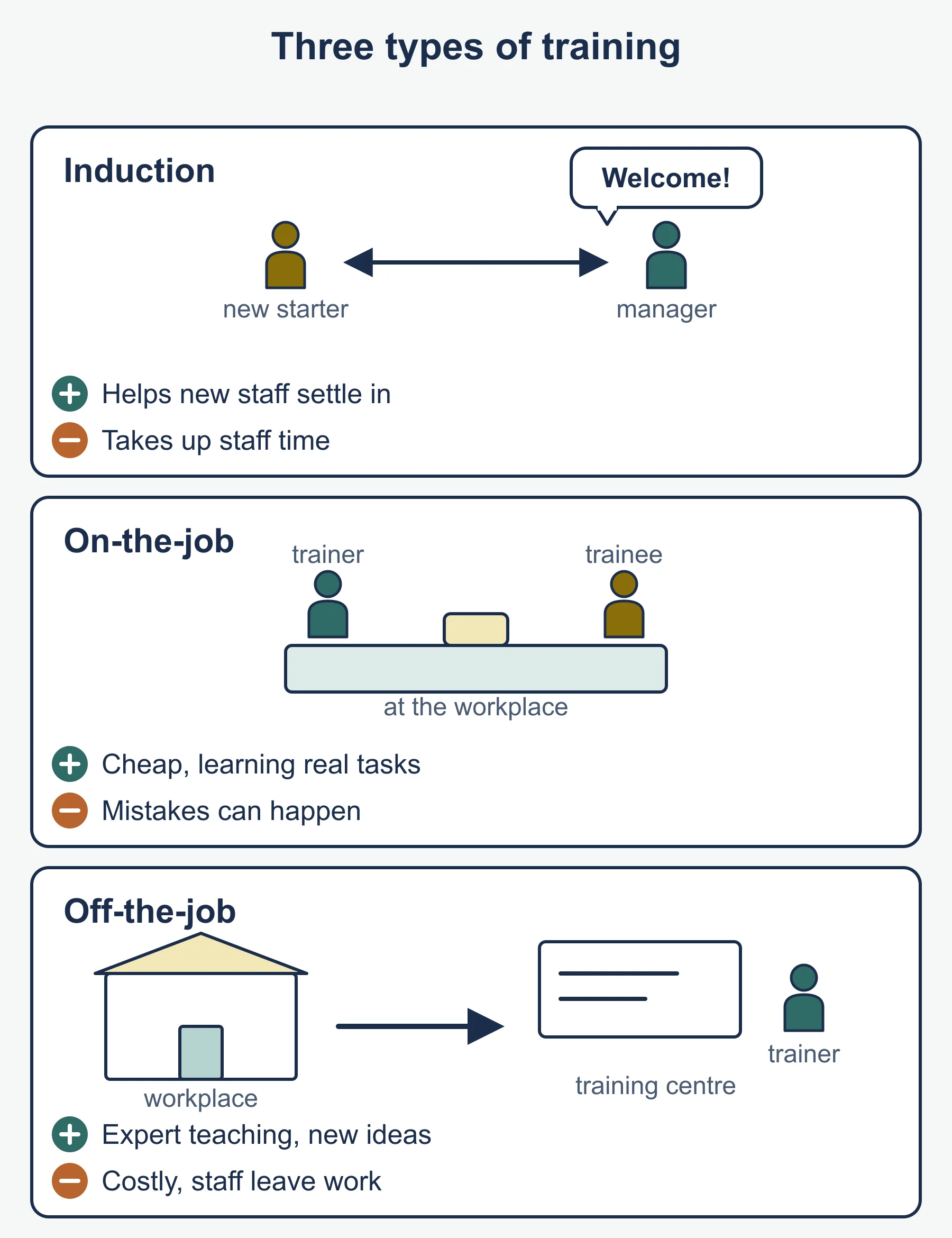
| Induction | Introduction for new starters: layout, safety rules, colleagues, duties | New staff settle quickly and know the rules; fewer early mistakes | Takes time before the person is productive; poor induction can overload a new starter with information |
| On-the-job | Learning by doing the work, beside an experienced colleague | Cheap; learning is directly relevant; output continues | Trainer’s own work suffers; bad habits can be passed on; the trainee may make costly errors |
| Off-the-job | Learning away from the workstation, such as a college or training centre | Specialist trainers; wider skills; no mistakes on live work | Expensive; the employee is absent from work; skills may not match this workplace |
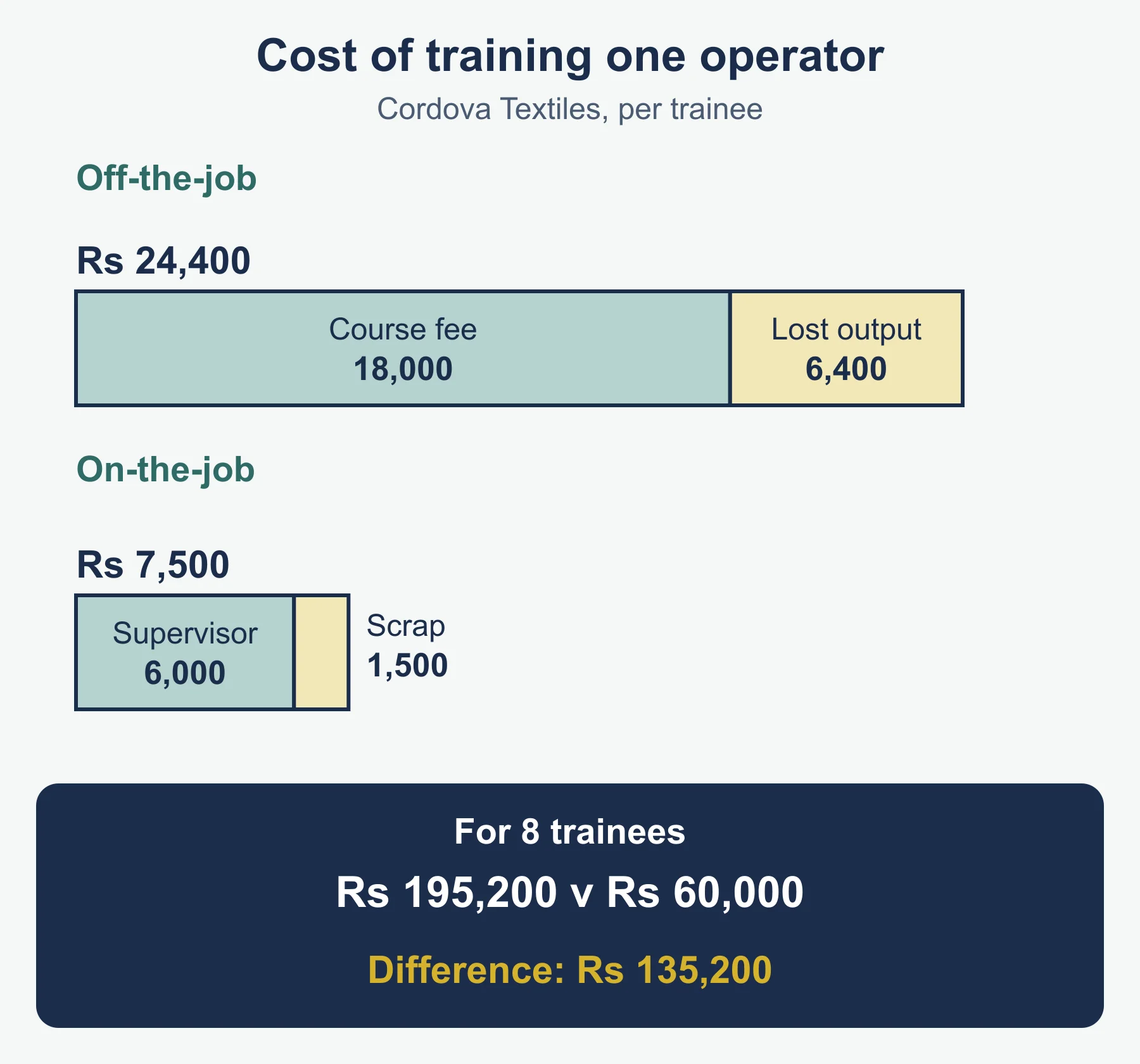
Worked example. Cordova Textiles must train 8 new machine operators.
- Off-the-job: course fee Rs 18,000 plus 2 days away at Rs 3,200 a day lost output = 18,000 + 6,400 = Rs 24,400 each; for 8 people, Rs 195,200.
- On-the-job: a supervisor spends 10 hours per trainee at Rs 600 an hour (Rs 6,000) and extra scrap costs Rs 1,500, so Rs 7,500 each; for 8 people, Rs 60,000.
- Difference: 195,200 − 60,000 = Rs 135,200.
Cost is not the only test: if mistakes on the machines are dangerous, the dearer course may still be better.
2.3.3 Reducing the size of the workforce
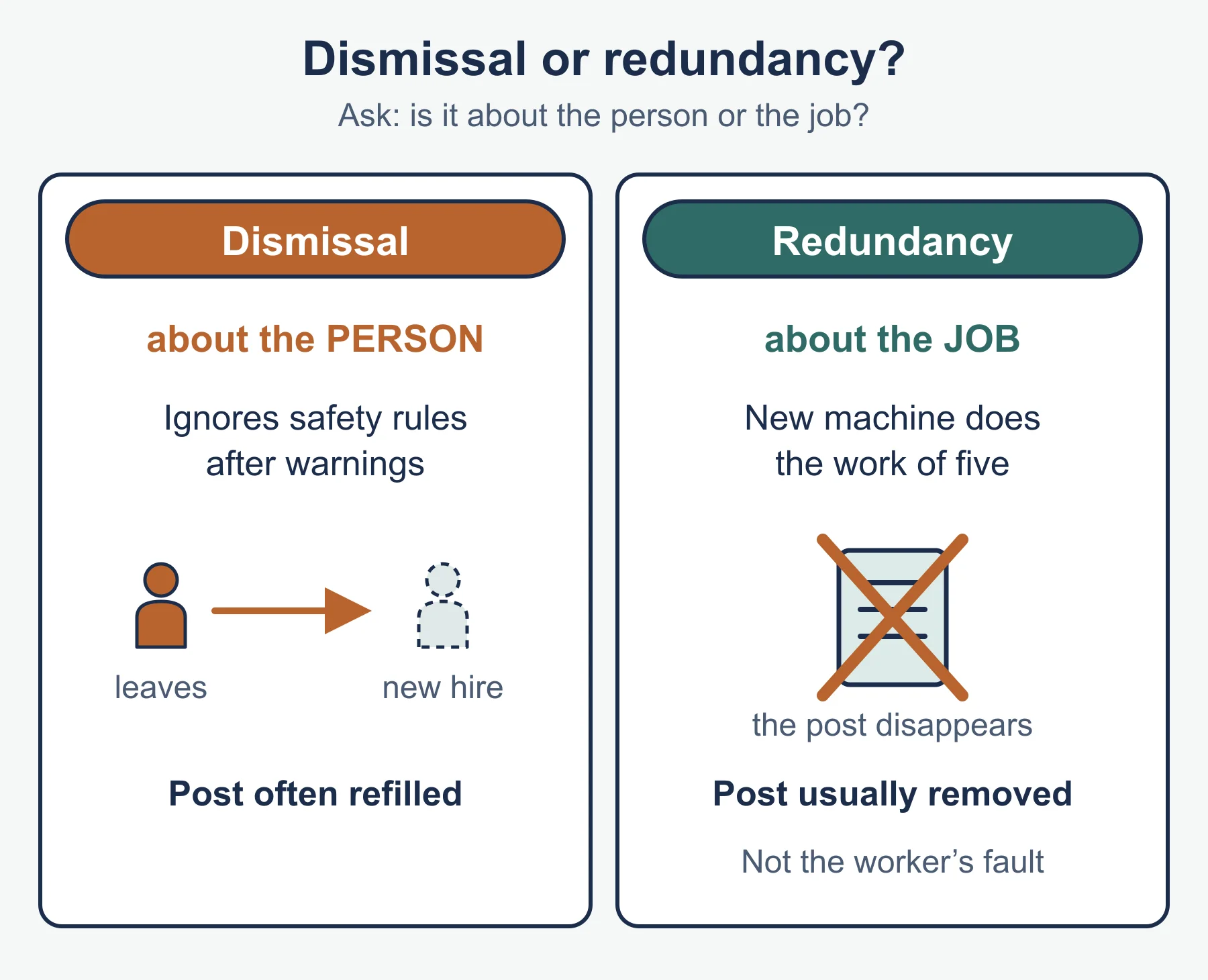
Dismissal is when an employer ends a contract because of something connected with the employee, such as repeated serious misconduct or persistent failure to reach the required standard. Redundancy is when the job itself is no longer needed, so the employee loses the post through no fault of their own.
| Dismissal | Redundancy | |
|---|---|---|
| Reason | The employee’s behaviour or performance | The business needs fewer workers |
| Example | Repeatedly ignoring safety rules after warnings | A new machine does the work of five people |
| Replacement | Often replaced by a new employee | The post is usually removed |
When downsizing may be needed: automation replaces tasks done by hand; demand for a product falls; the business closes a branch, loses a major customer, or must cut costs to survive.
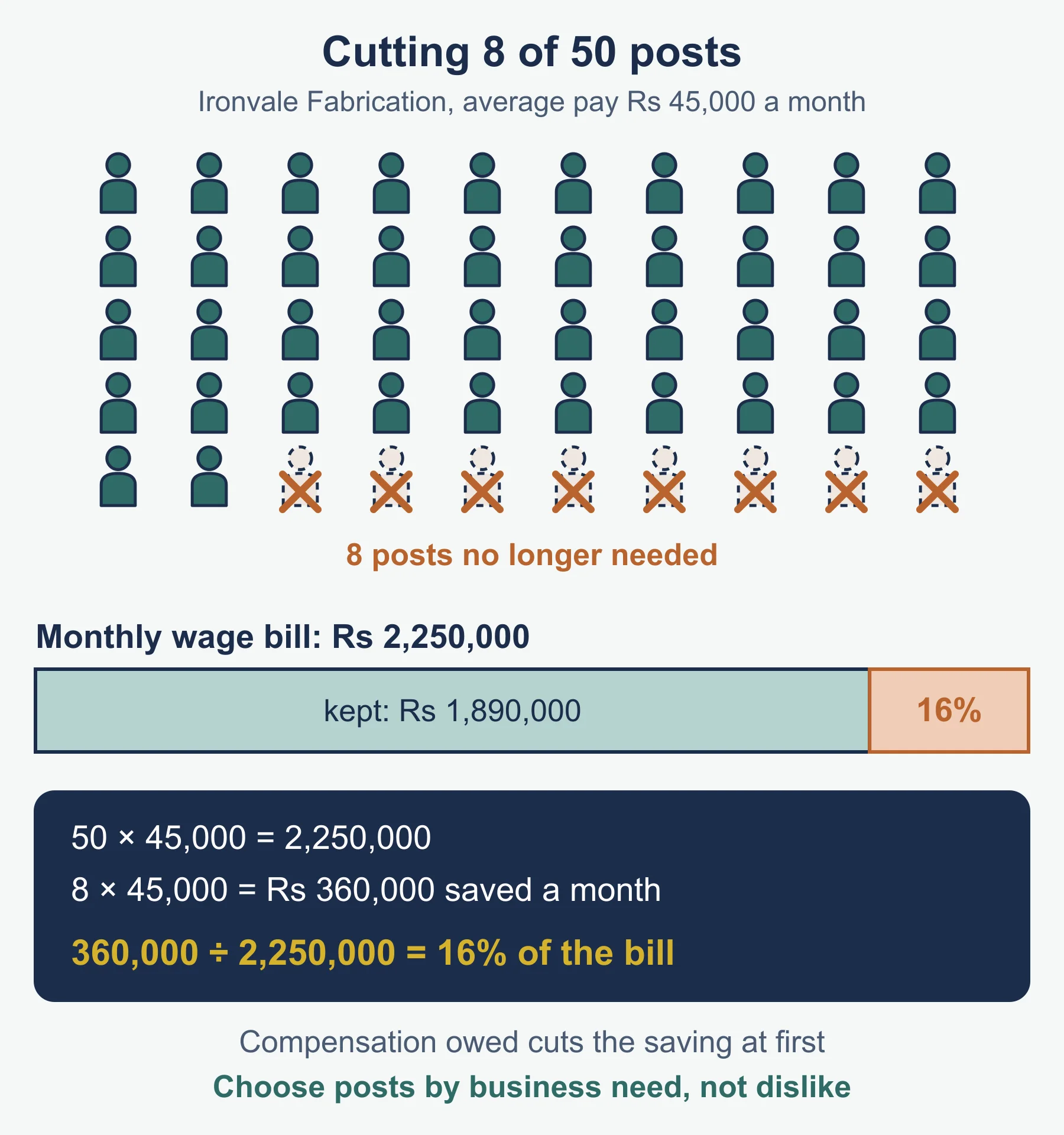
Worked example. Ironvale Fabrication has 50 employees paid an average Rs 45,000 a month, a wage bill of 50 × 45,000 = Rs 2,250,000. Demand for one product line has dropped. Removing 8 posts saves 8 × 45,000 = Rs 360,000 a month, which is 360,000 ÷ 2,250,000 = 16% of the wage bill. Any compensation owed under contracts or local law reduces the saving in the first months.
Which employees to make redundant. Base the choice on business needs, not personal dislike: which jobs are no longer needed, whose skills are still required, and who could move or retrain. Always state the downside of your recommendation, such as lost experience or lower morale among those who stay.
2.3.4 Legal controls over employment
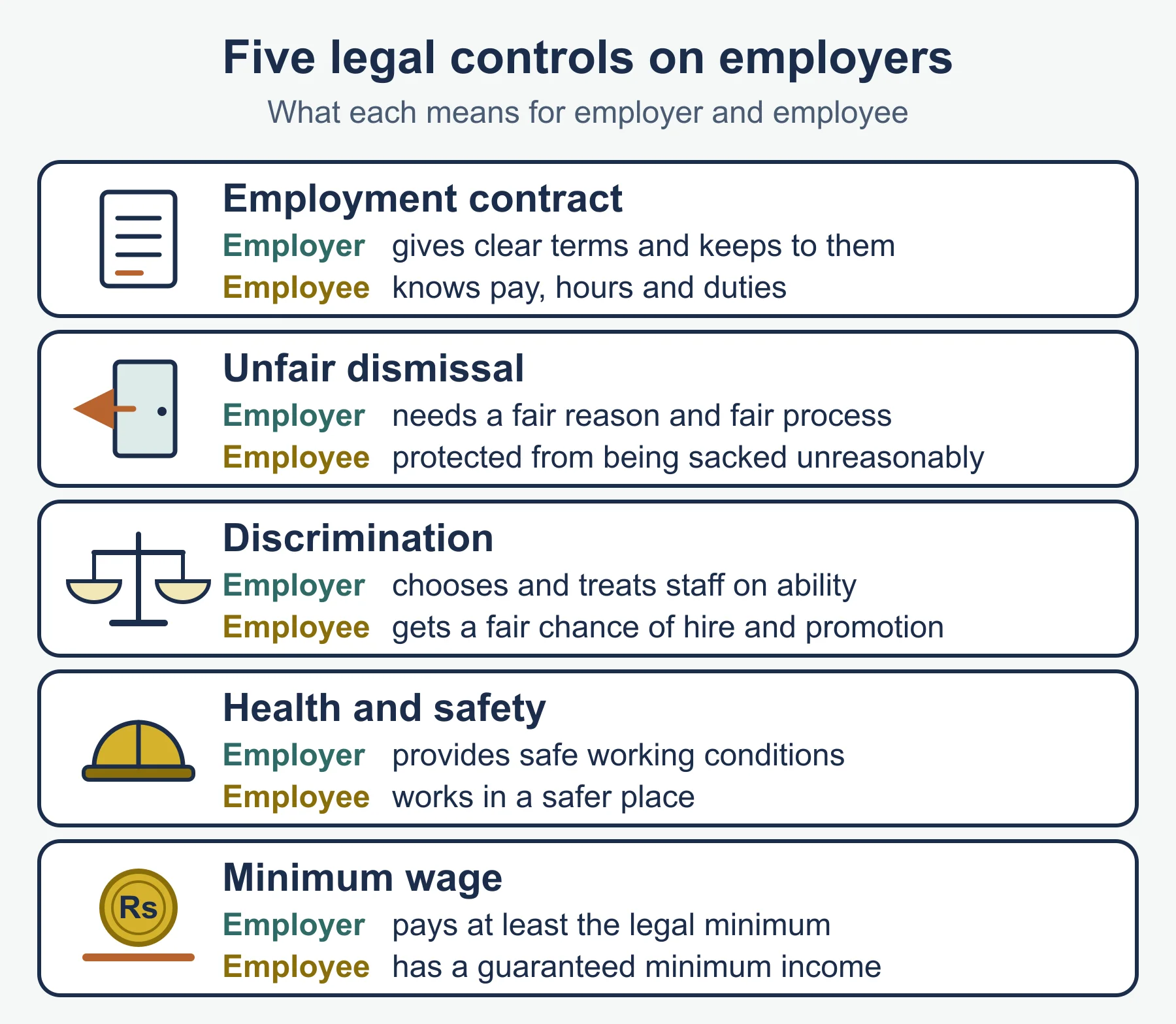
The syllabus lists five areas. Describe each in general terms.
| Area | General idea | Impact on employers | Impact on employees |
|---|---|---|---|
| Employment contracts | A written or agreed statement of pay, hours, duties and conditions | Must provide clear terms and keep to them; helps avoid disputes | Know what is expected and what they will receive |
| Unfair dismissal | Dismissal without a fair reason or fair process is not allowed | Must follow a fair procedure; may face penalties if not | Protection against being sacked unreasonably |
| Discrimination | Treating people worse because of characteristics such as gender or religion is unlawful in hiring, pay and promotion | Must choose and treat staff on ability; may widen the talent pool | Fair chance of being hired and promoted |
| Health and safety | A duty to provide safe working conditions | Costs of equipment, training and inspection; fewer accidents and absences | Safer workplace |
| Legal minimum wage | A lowest hourly or monthly pay set by law | Higher wage costs, especially for low-paid labour-intensive businesses | Guaranteed minimum income |
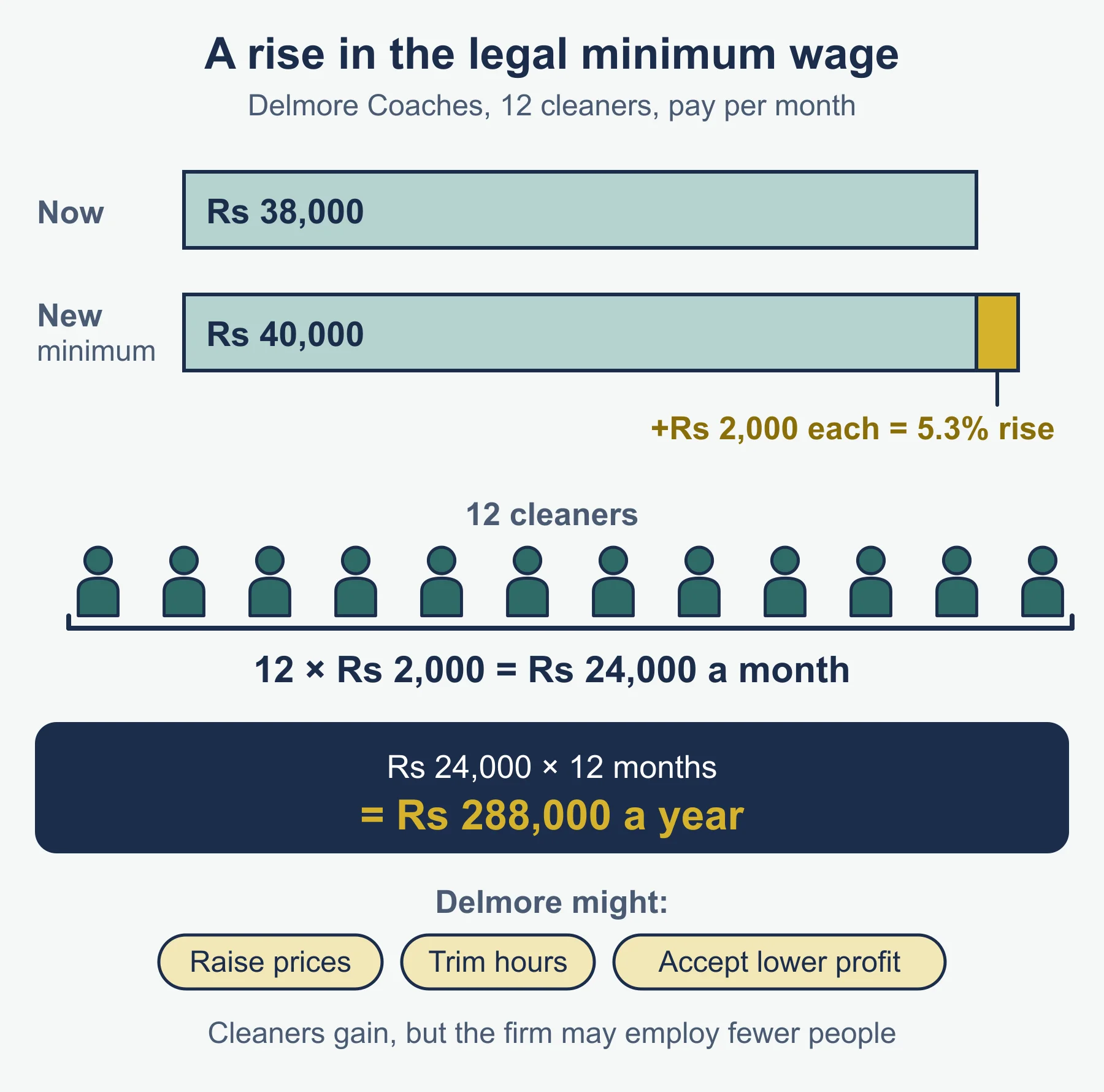
Worked example. Delmore Coaches pays 12 cleaners Rs 38,000 a month. The legal minimum rises to Rs 40,000.
- Extra per person: 40,000 − 38,000 = Rs 2,000.
- Extra a month: 12 × 2,000 = Rs 24,000; a year: Rs 288,000.
- Rise for each cleaner: 2,000 ÷ 38,000 = 5.3% (to 1 decimal place).
Delmore might raise prices, trim hours or accept lower profit. Employees gain, but the firm may employ fewer people.
2.4.1 Effective communication and methods
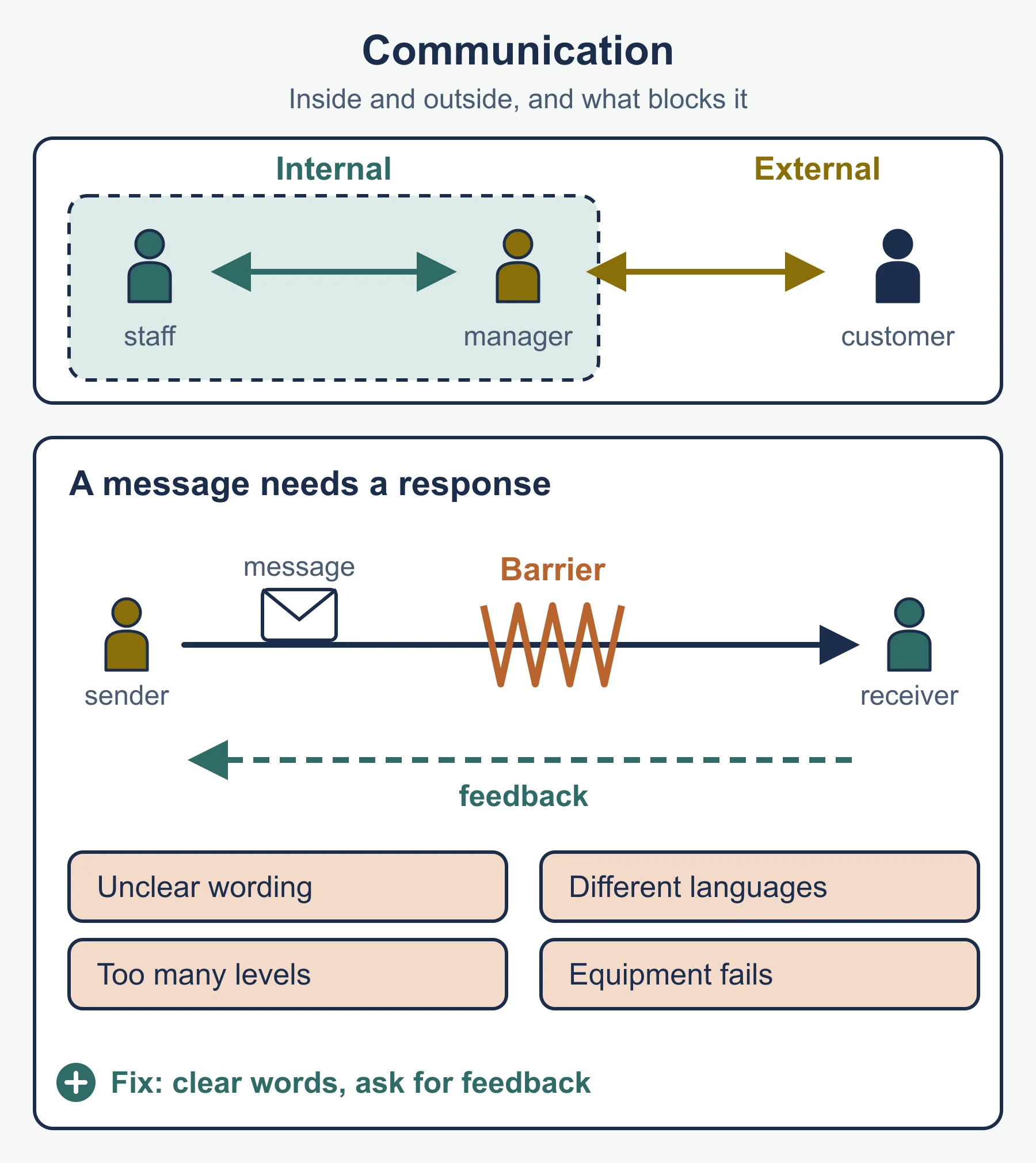
Communication is passing information from a sender to a receiver and getting a response. It is effective when the message is received, understood and acted on. Good communication helps decisions, coordination, motivation, safety and customer relations. Internal communication is within the business (managers to staff, staff to staff). External communication is with customers, suppliers, banks and the public.
| Method | Benefits | Limitations |
|---|---|---|
| Face-to-face or meeting | Instant questions and feedback; shows tone | Time-consuming; hard for scattered staff; no record unless minuted |
| Notice or memo | Cheap; reaches everyone passing | May go unread; no feedback |
| Letter or report | Formal; permanent record | Slow; costly |
| Fast, cheap, attaches files, record kept | Can be ignored, overloaded or misread; needs device access | |
| Text or messaging app | Immediate, informal, reaches mobiles | Short; not suitable for complex or formal messages |
| Video conferencing | Links distant people | Needs connection and equipment |
| Intranet or website | Information in one place, always available | Costly to keep updated; people must check it |
| Social media | Reaches many customers cheaply | Public mistakes spread fast |
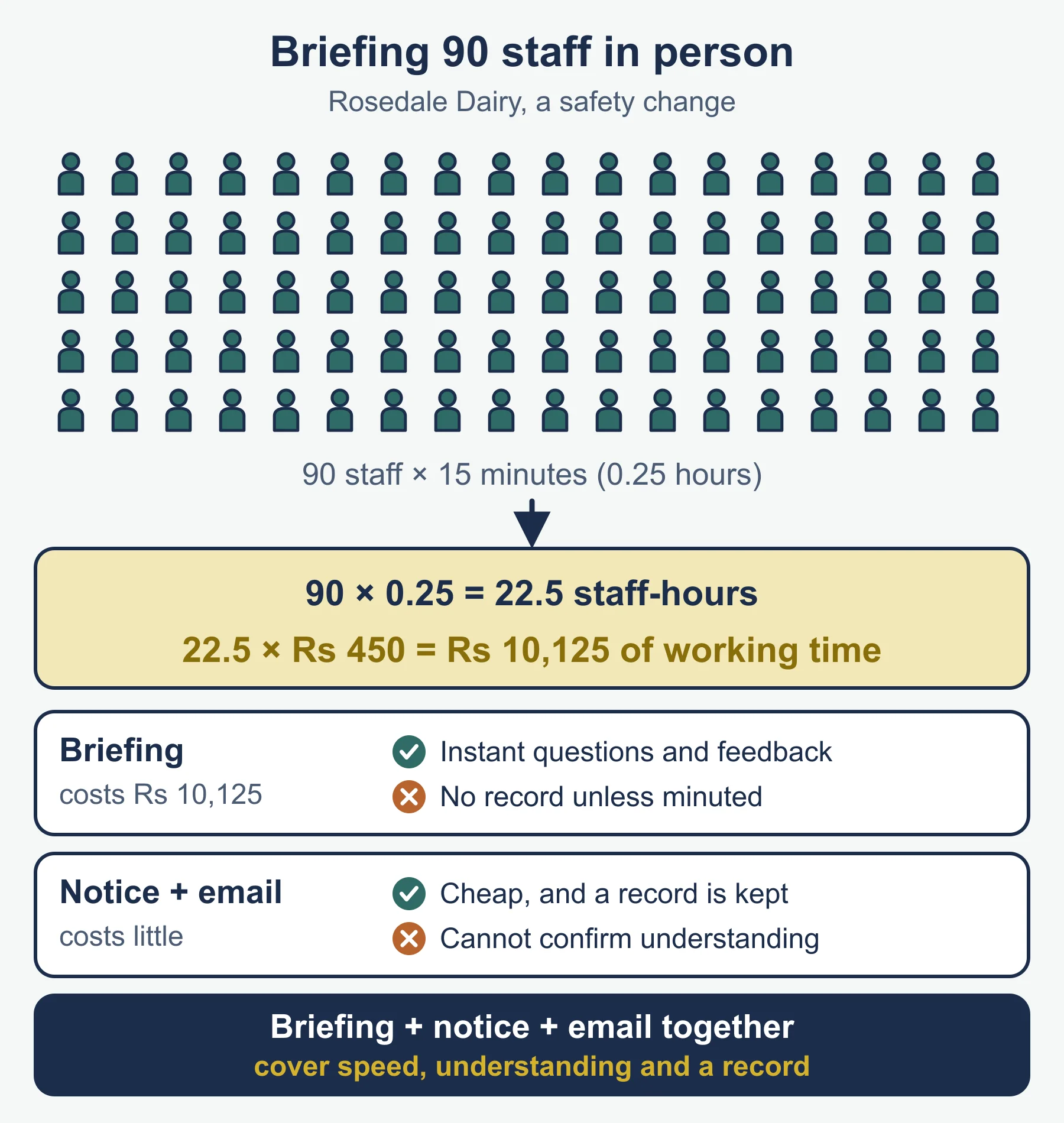
Worked example. Rosedale Dairy has 90 staff and wants to brief them on a safety change. A 15-minute briefing (0.25 hours) for everyone costs 90 × 0.25 = 22.5 staff-hours, or 22.5 × 450 = Rs 10,125 of working time at Rs 450 an hour. A notice plus email costs little but cannot confirm understanding.
Recommend and justify a method. Decide on four factors: how urgent, how complex, how many receivers, and whether a record or feedback is needed. For the dairy, a short briefing for the change itself, backed by a posted notice and a follow-up email, covers speed, understanding and record.
2.4.2 Communication barriers
A barrier is anything that stops a message being received or understood.
| How it arises | Problems it causes | How it can be reduced |
|---|---|---|
| Jargon, or a language the receiver does not share | Wrong action taken | Plain wording; translation; check understanding |
| Too many levels in the chain of communication | Delay or distortion | Fewer levels; direct channels |
| Overload of messages | Important items missed | Prioritise; summarise; use fewer channels |
| Wrong method or poor timing | Message ignored | Match method to message |
| Noise, distance or technical failure | Message not received | Better equipment; written back-up |
Problems of ineffective communication include mistakes and rework, delays, lower morale, weaker customer service, lost orders, and conflict between departments.
Common errors
- Writing “recruit” when you mean “select”, or the reverse.
- Describing dismissal as cost-cutting. It relates to the employee; redundancy relates to the job.
- Listing training types without a benefit and a limitation for each.
- Naming a communication method without saying why it suits this message and these receivers.
- Treating a calculation as the whole answer. Add a sentence of judgement.
Frequently asked questions
What are the main stages of recruitment and selection? Identify the vacancy, write a job description and person specification, advertise, shortlist applications, interview and test the shortlist and take up references, then offer the post and give induction training.
What is the difference between a job description and a person specification? A job description sets out what the post involves. A person specification sets out the skills and qualities wanted in the person who fills it.
When is communication effective? Communication is effective when the message is received, understood and acted on as intended, with a response from the receiver.
What problems does ineffective communication cause? Mistakes and rework, delays, lower morale, weaker customer service, lost orders and conflict between departments.
How should a business choose which employees to make redundant? Base the choice on business needs rather than personal dislike, such as which jobs are no longer needed and whose skills are still required.
Official syllabus
Cambridge O Level Business Studies 7115, syllabus for examination in 2026 (Version 2), published by Cambridge University Press & Assessment (Cambridge International). Sections 2.3 and 2.4 of the subject content.
Get free revision emails (optional)
Occasional emails with practice questions, worked explanations and links to free resources for the qualification and subjects you choose. No spam, and you can unsubscribe from any email. The free tools on this site never need an email.
Related resources
-
Practice questions
O Level Business: Recruitment, selection, training and communication (Cambridge 7115) – Practice Questions
Original practice questions with worked answers on recruitment, training, redundancy, employment law and communication, Cambridge O Level Business Studies.
Business · Cambridge · O Level
Try questions -
Revision notes
O Level Business: Recruitment, selection, training and communication (Cambridge 7115) – Revision Notes
Condensed revision notes on recruitment, training, redundancy, employment law and communication for Cambridge O Level Business Studies, with a self-test.
Business · Cambridge · O Level
Revise topic -
Revision notes
O Level Business Studies: People in Business — Revision Notes
Condensed notes on motivation, structure, leadership, recruitment, training and communication for Topic 2 of Cambridge O Level Business Studies (7115).
Business · Cambridge · O Level
Revise topic
Related articles
-
teaching
A Level tuition in Dubai: Cambridge or Pearson Edexcel International A Level?
Schools in Dubai and Abu Dhabi teach either Cambridge International AS & A Level or Pearson Edexcel International A Level. How the two are structured, why it matters for tuition, and how online classes from Lahore work.
9 October 2026
-
curriculum guides
Choosing subjects at IGCSE and A Level
How subject choices at 14 and 16 affect university options later, and how to keep pathways open without overloading a timetable.
28 July 2026
Studying this with a teacher
Working through Business O LEVELS?
This page is free and stays free. If you would rather be taught it, Marlbridge runs Business classes one-to-one and in small groups of up to 15, online in your own time zone. The first trial class is free. WhatsApp replies within an hour (8am–11pm Pakistan time, every day); email the same day.
Cambridge Business teachers at Marlbridge

