
Revision Notes
O Level Business: Recruitment, selection, training and communication (Cambridge 7115) – Revision Notes
Condensed revision notes on recruitment, training, redundancy, employment law and communication for Cambridge O Level Business Studies, with a self-test.
- Subject
- Business
- Level
- O LEVELS
- Topic
- People in business
- Author
- Marlbridge Academic Team
- Updated
- Reviewed by
- Salman Ahmad (what this means)
Aligned to Cambridge O Level Business (7115), For examination in 2026. Official specification .
Syllabus page (what it covers and how it is assessed): Cambridge O Level Business.
Syllabus points this page covers
7115
- 2.3 Recruitment, selection and training of employees
- 2.4 Internal and external communication
Found an error? Report a correction.
Need help with this topic? Request a free trial class for O Level Business (7115).
These notes condense sections 2.3 (Recruitment, selection and training of employees) and 2.4 (Internal and external communication) of the Cambridge O Level Business Studies 7115 syllabus for examination in 2026. For full explanations and worked examples, use the study guide. Then test yourself with the practice questions.
Other links: Cambridge O Level Business hub, checklist, the wider People in business revision notes, and the free diagnostics.
Key terms
| Term | Meaning |
|---|---|
| Recruitment | Attracting suitable applicants for a vacancy |
| Selection | Choosing the best applicant from those who applied |
| Internal recruitment | Filling the post from the existing workforce |
| External recruitment | Filling the post from outside the business |
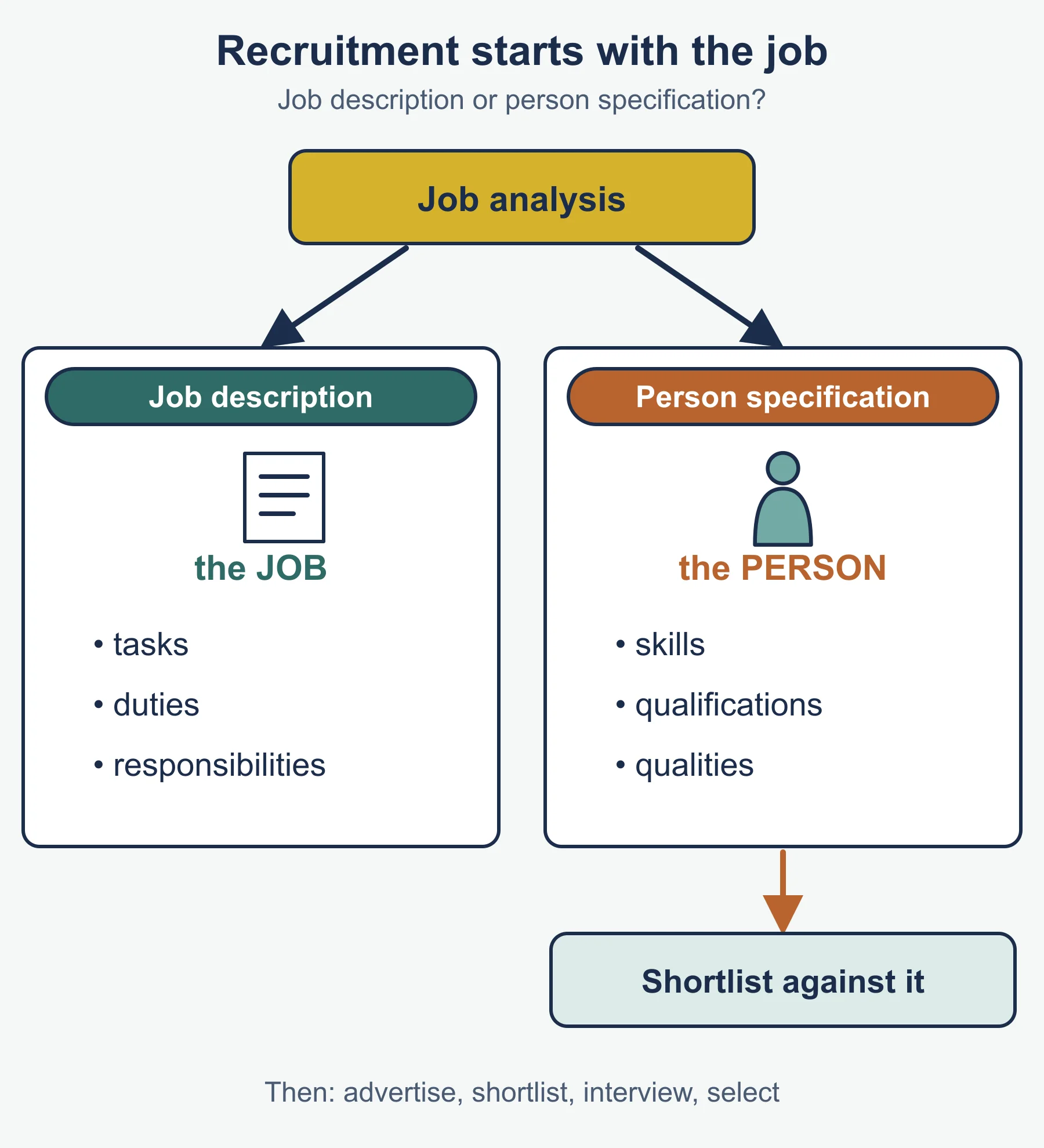
| Job description | What the post involves |
| Person specification | Skills, qualifications and qualities wanted |
| Induction training | Introduction for new starters |
| On-the-job training | Learning while doing the work |
| Off-the-job training | Learning away from the workplace |
| Dismissal | Employer ends the contract because of the employee’s conduct or performance |
| Redundancy | The job is no longer needed, so the employee loses the post |
| Communication | Sending a message that the receiver understands and, where needed, answers |
| Barrier | Anything that stops a message being received or understood |
2.3.1 Recruitment and selection
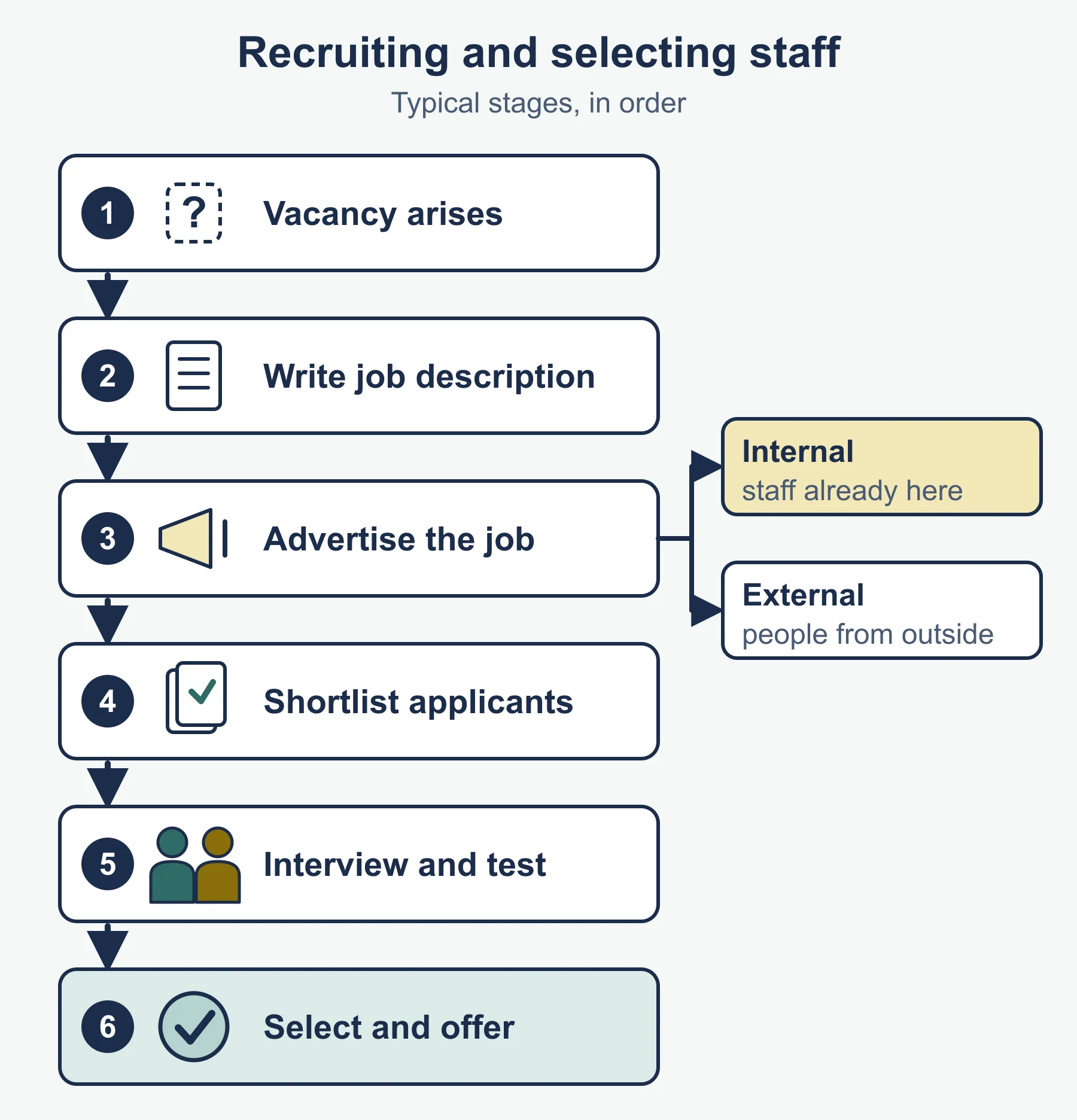
Standard sequence of stages: identify the vacancy, write the job description and person specification, advertise, shortlist, interview and test (with references), offer the post and agree the contract, then induct the starter.
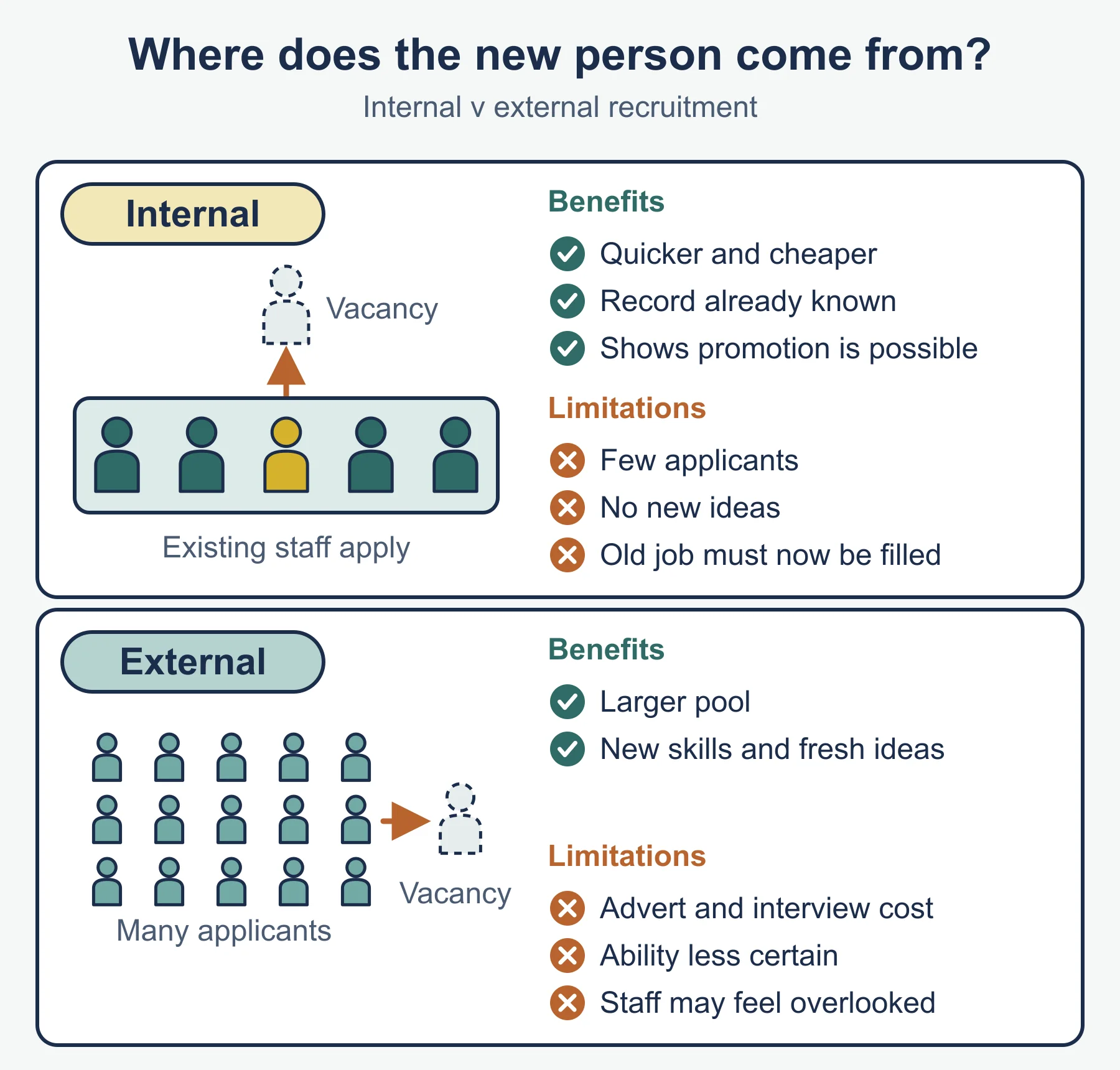
| Choose internal when | Choose external when |
|---|---|
| Speed and low cost matter | New skills or fresh ideas are needed |
| Reliability is known and valued | No suitable person is already employed |
| You want to reward loyalty | The business is expanding fast |
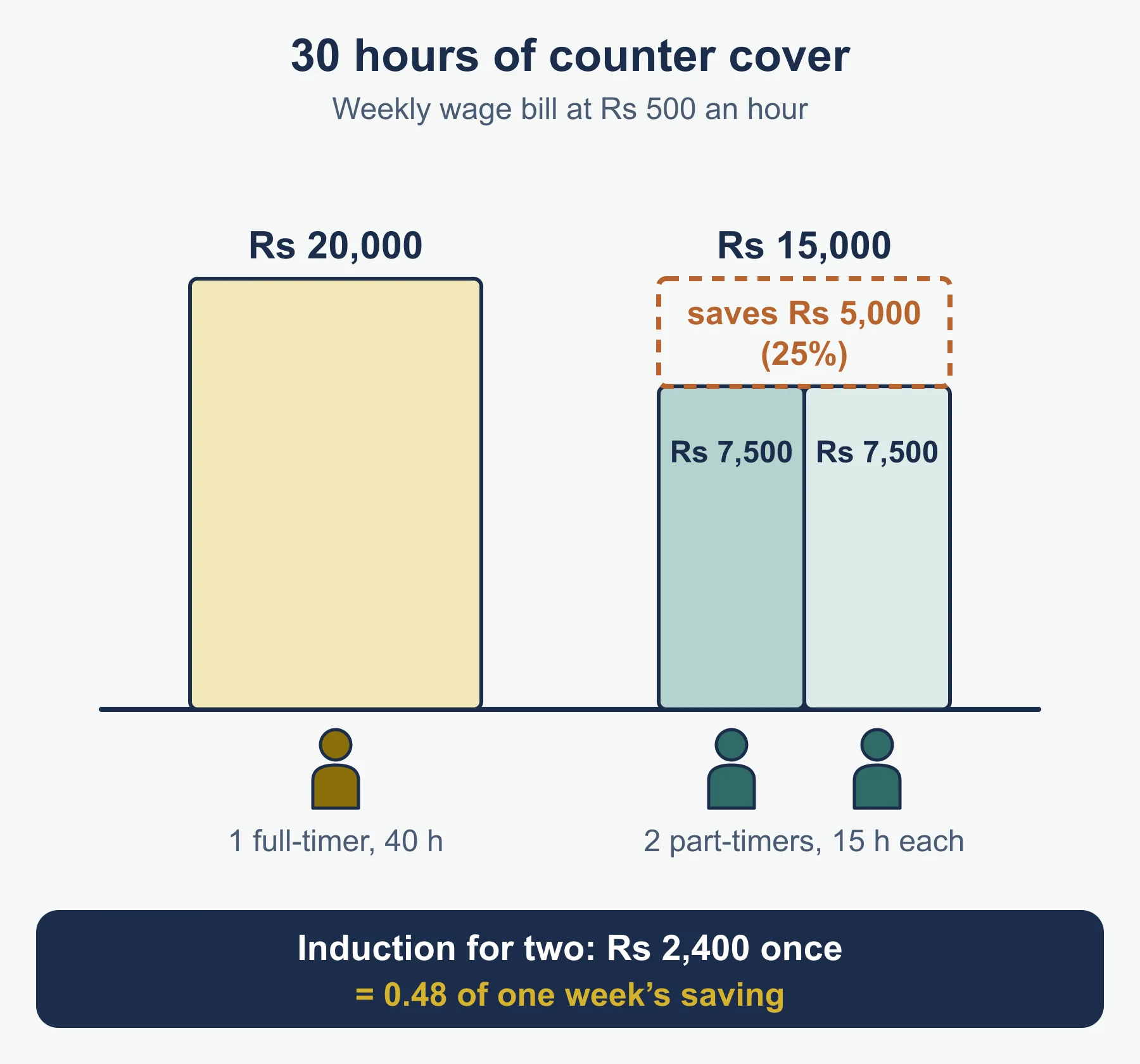
| Part-time | Full-time |
|---|---|
| Matches cover to busy periods | Reliable, committed cover |
| Pays only for hours needed | Paid even in quiet spells |
| More people to train and manage | Fewer people to manage |
Method in steps for “recommend and justify who to employ”:
- List what the business needs now (skills, speed, cost, long-term plans).
- Match each candidate to that list.
- State your choice and two reasons using the data given.
- State one risk of your choice and why the other candidate is less suitable.
2.3.2 Training
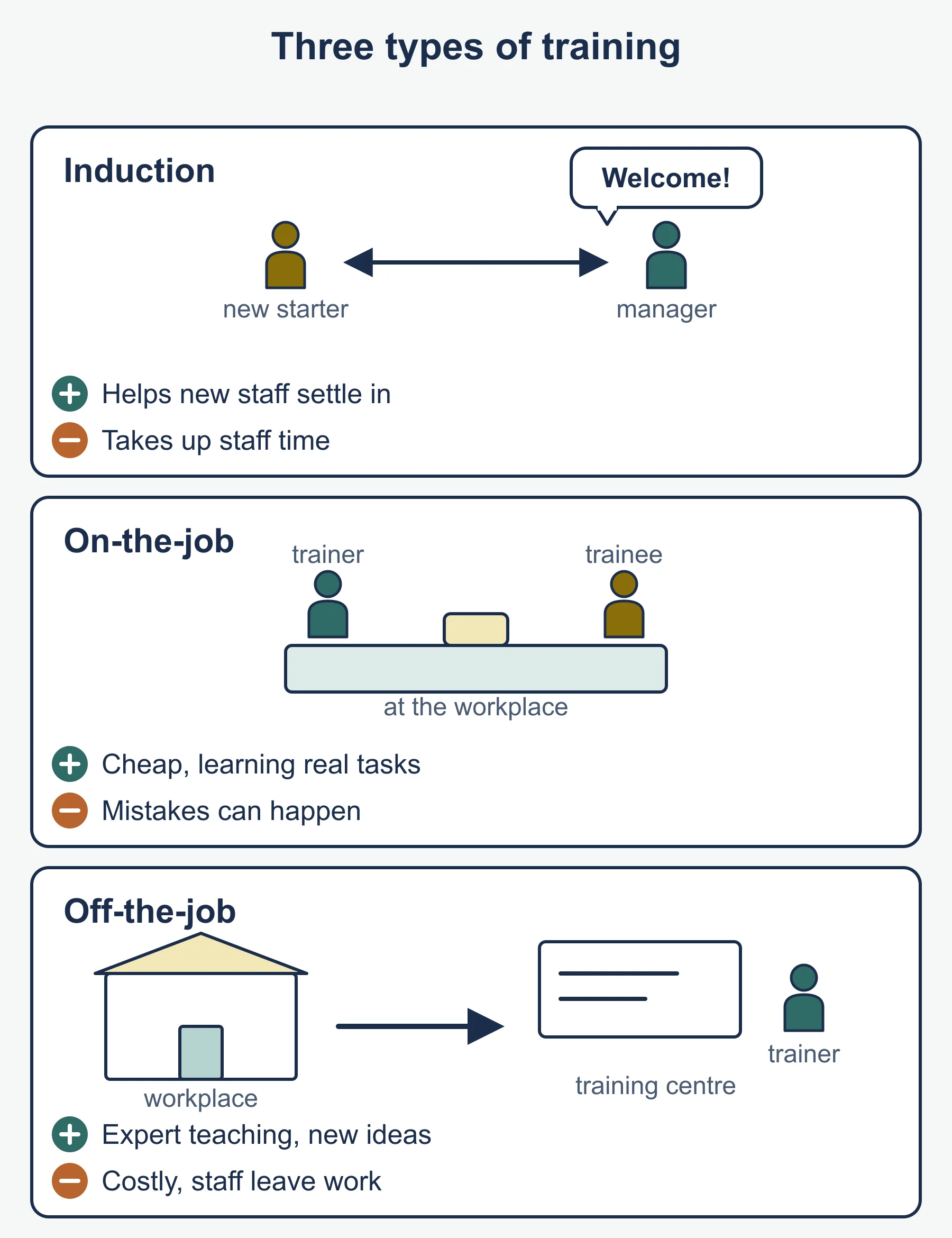
Benefits to business: higher productivity, fewer errors and accidents, better service, new equipment used properly. Benefits to employees: new skills, confidence, promotion chances.
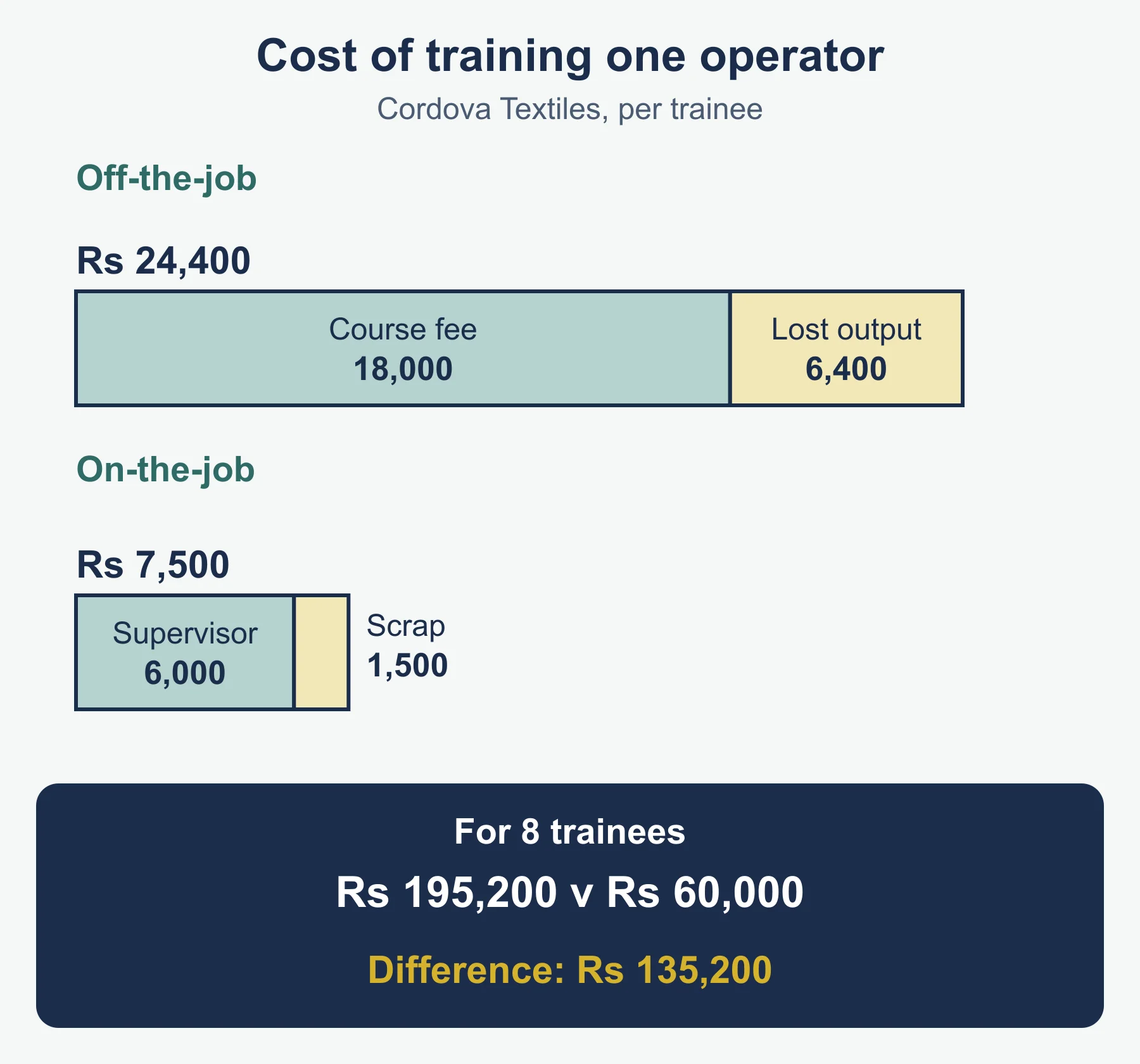
| Type | Best used for | Main limitation |
|---|---|---|
| Induction | Every new starter | Time before productive |
| On-the-job | Skills specific to this workplace | Trainer’s output falls; bad habits pass on |
| Off-the-job | Specialist or risky skills | Cost and absence from work |
2.3.3 Reducing the workforce
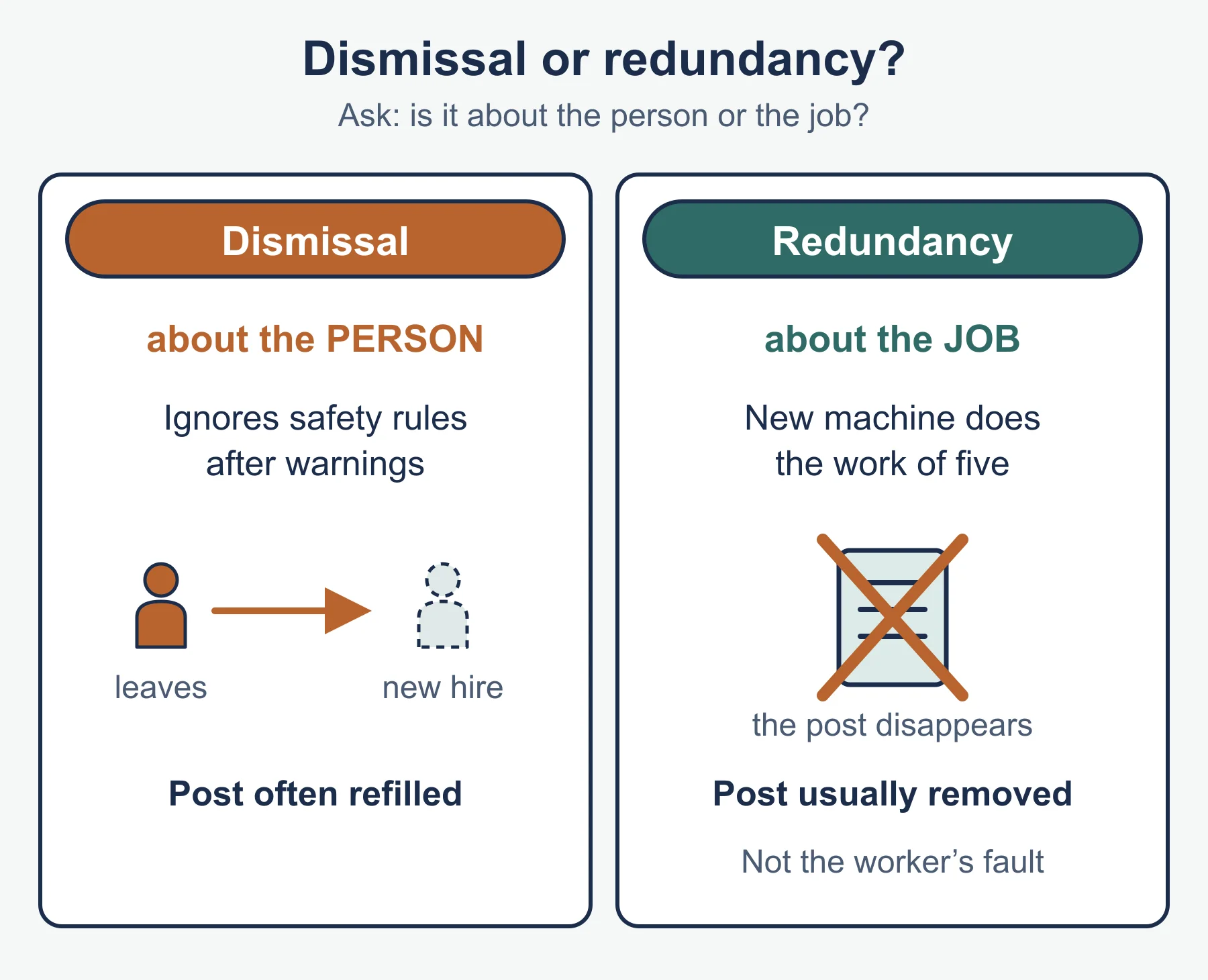
| Dismissal | Redundancy | |
|---|---|---|
| About | The person | The job |
| Example | Persistent breach of safety rules | A task is automated |
Situations for downsizing: automation, reduced demand, closing a branch, cutting costs to survive. To choose who goes, ask which jobs are no longer needed, whose skills are still required, and who can move or retrain. Give one cost of your choice, such as lost experience or lower morale.
2.3.4 Legal controls (general terms only)
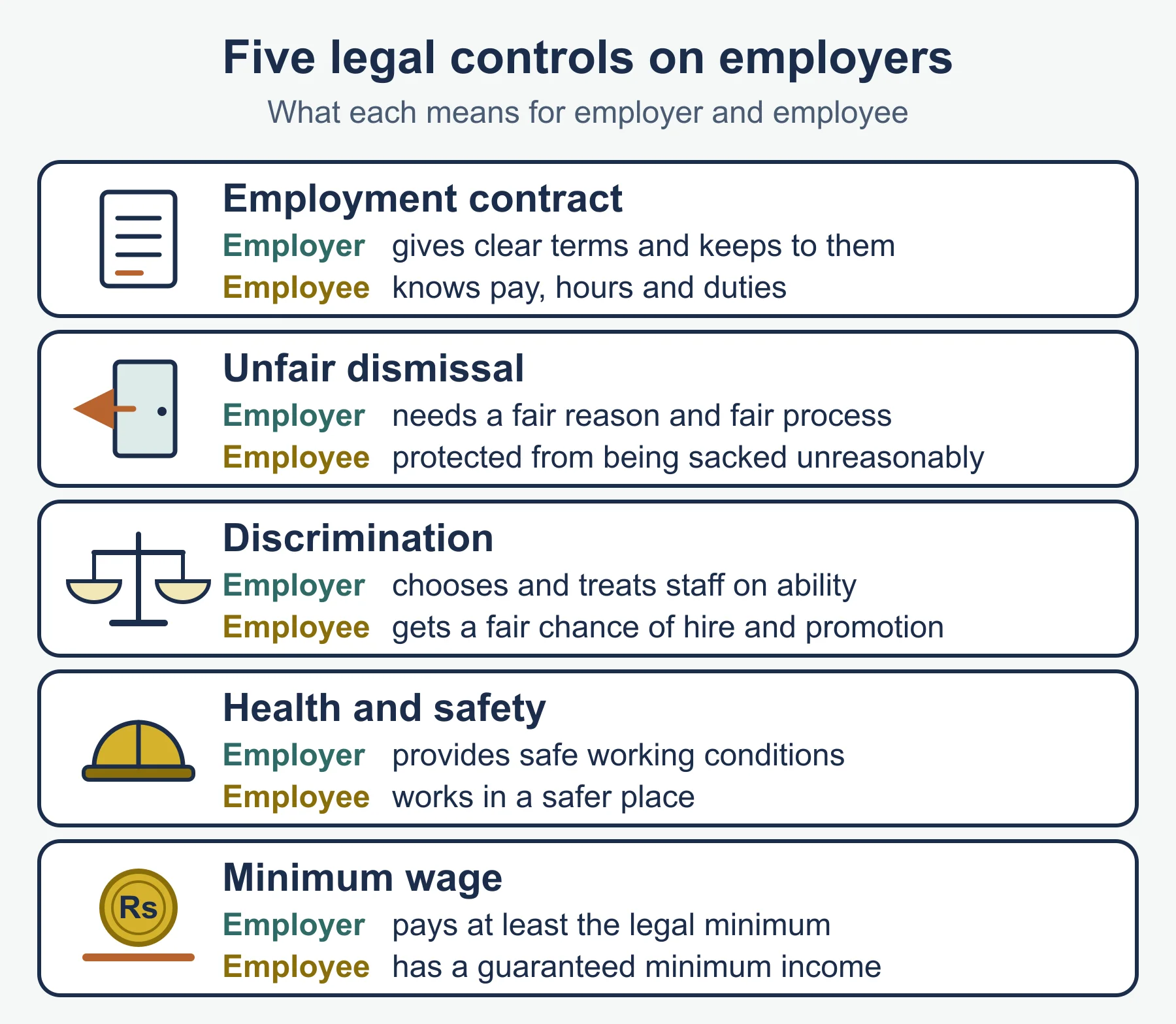
| Area | Employer impact | Employee impact |
|---|---|---|
| Employment contracts | Clear terms to provide and honour | Know pay, hours and duties |
| Unfair dismissal | Must have a fair reason and process | Protected from unreasonable dismissal |
| Discrimination | Hire and promote on ability | Fair treatment |
| Health and safety | Costs of equipment and training; fewer accidents | Safer work |
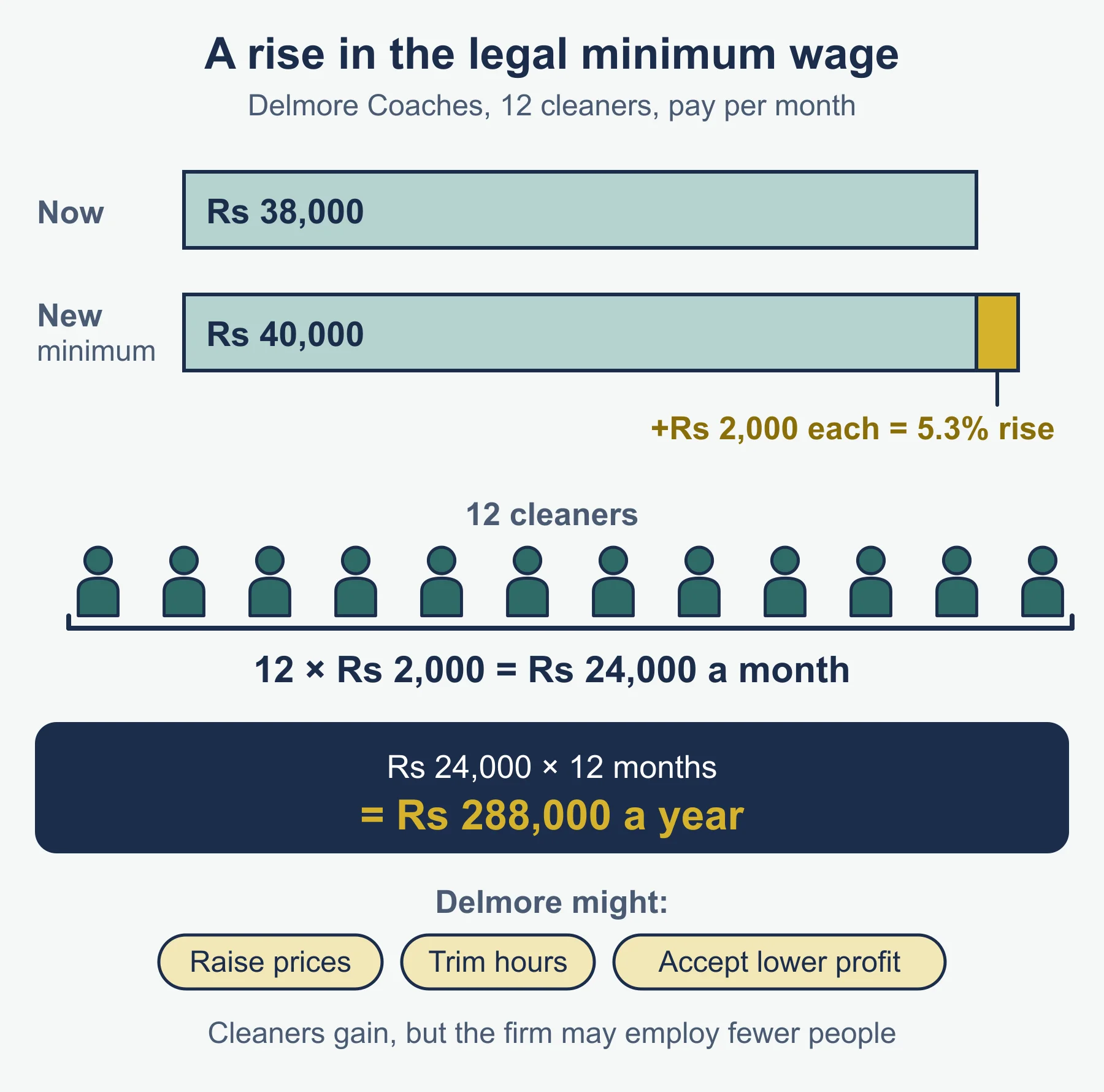
| Legal minimum wage | Higher wage costs | Guaranteed minimum pay |
2.4 Communication
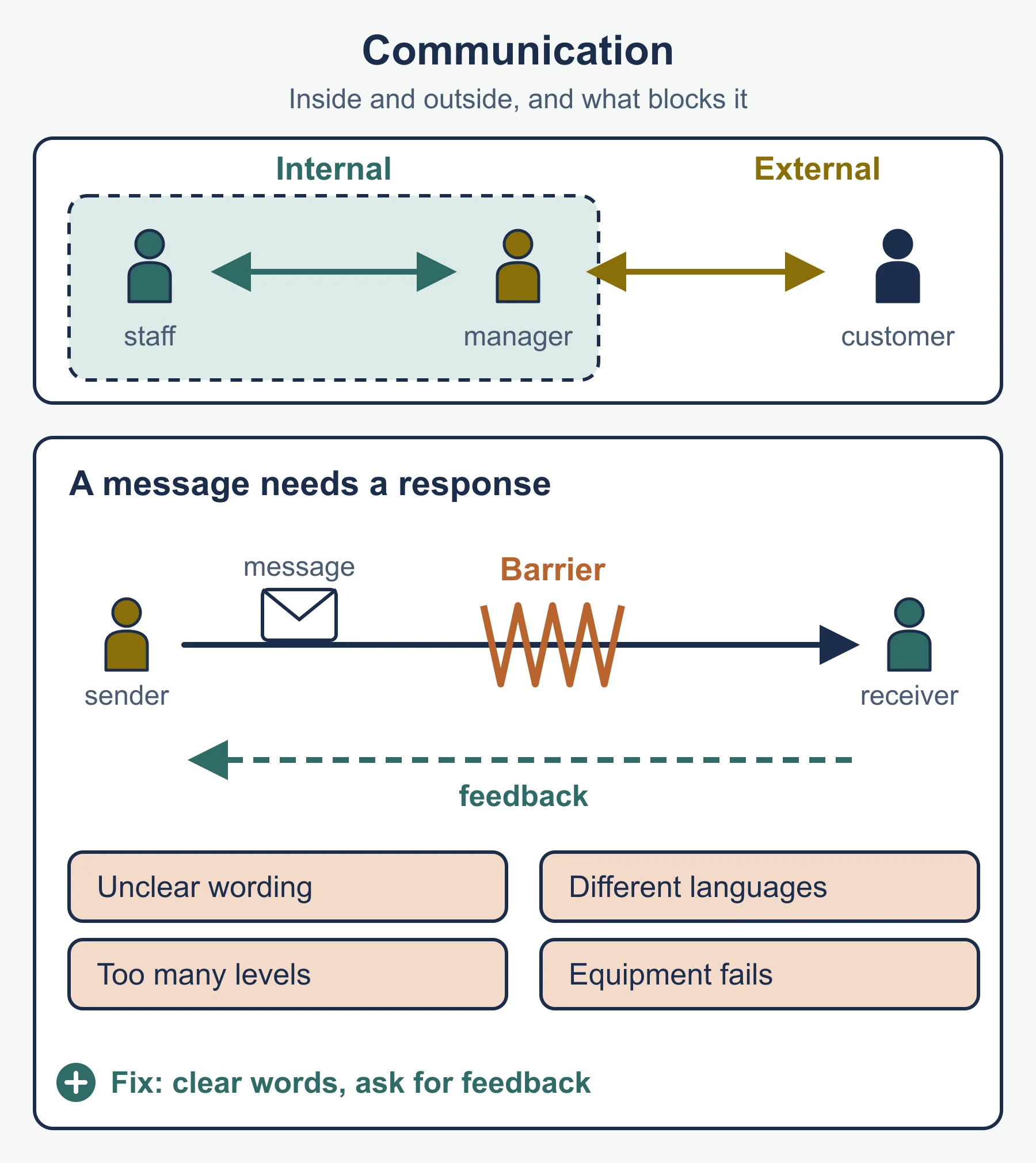
Effective means the message is received, understood and acted on. Internal is within the business; external is with customers, suppliers and others.
| Method | Use it for | Weakness |
|---|---|---|
| Meeting or face-to-face | Complex or sensitive news | Time; hard for scattered staff |
| Notice or memo | Simple news to many | May not be read |
| Letter or report | Formal, permanent record | Slow |
| Fast, detailed, recorded | Overload; can be ignored | |
| Text or messaging app | Urgent, short alerts | Too brief for complex news |
| Video conferencing | Distant participants | Equipment and connection |
| Intranet or website | Information held in one place | Needs updating |
| Social media | Reaching customers | Errors become public |
Choose a method by urgency, complexity, number of receivers, and need for a record or feedback.
| Barrier | Problem | Fix |
|---|---|---|
| Jargon or language | Misunderstanding | Plain words; translation |
| Long chain | Delay or distortion | Fewer levels |
| Overload | Key items missed | Prioritise and summarise |
| Wrong method | Message ignored | Match method to message |
| Technical failure | Not received | Back-up channel |
Problems of poor communication: mistakes, delays, low morale, lost customers and orders, conflict.
Must-know distinctions
- Recruitment finds applicants; selection chooses between them.
- Internal recruitment saves time and cost; external recruitment brings in new skills.
- Induction is for new starters; on-the-job and off-the-job are about where the learning happens.
- Dismissal is about the person; redundancy is about the job.
- Internal communication stays inside the business; external communication reaches customers, suppliers and other outsiders.
- A communication method is a channel (such as email); a barrier is what blocks the message (such as jargon).
Worked reminders
Choosing between candidates. A hotel needs a head receptionist who can start within two weeks. An internal candidate knows the booking system but has not led a team. An external candidate has led a larger team but needs six weeks’ notice. A good answer picks one, uses the start date and the experience as reasons, and names the risk (for the internal choice, lack of leadership practice, which training could address).
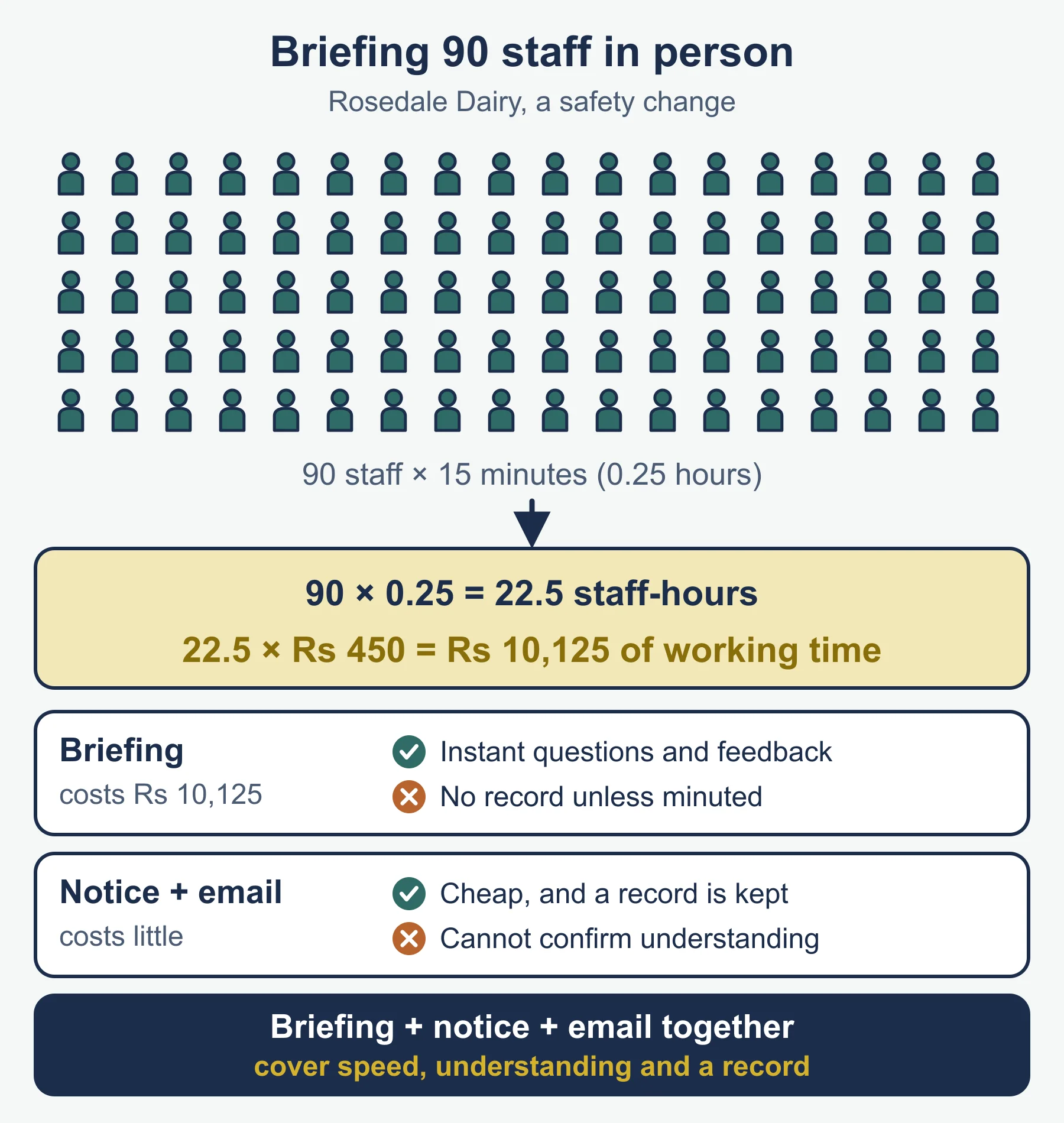
Choosing a communication method. A closure due to a power cut must reach 40 staff within the hour. Text or a messaging app suits speed and reach. Follow with a short email so there is a record. A letter would be too slow.
Choosing who goes. When a machine removes a task, say which posts disappear, then check which colleagues could move to other work. Keep the people whose skills the business still needs, and say what the business loses.
Calculation reminders
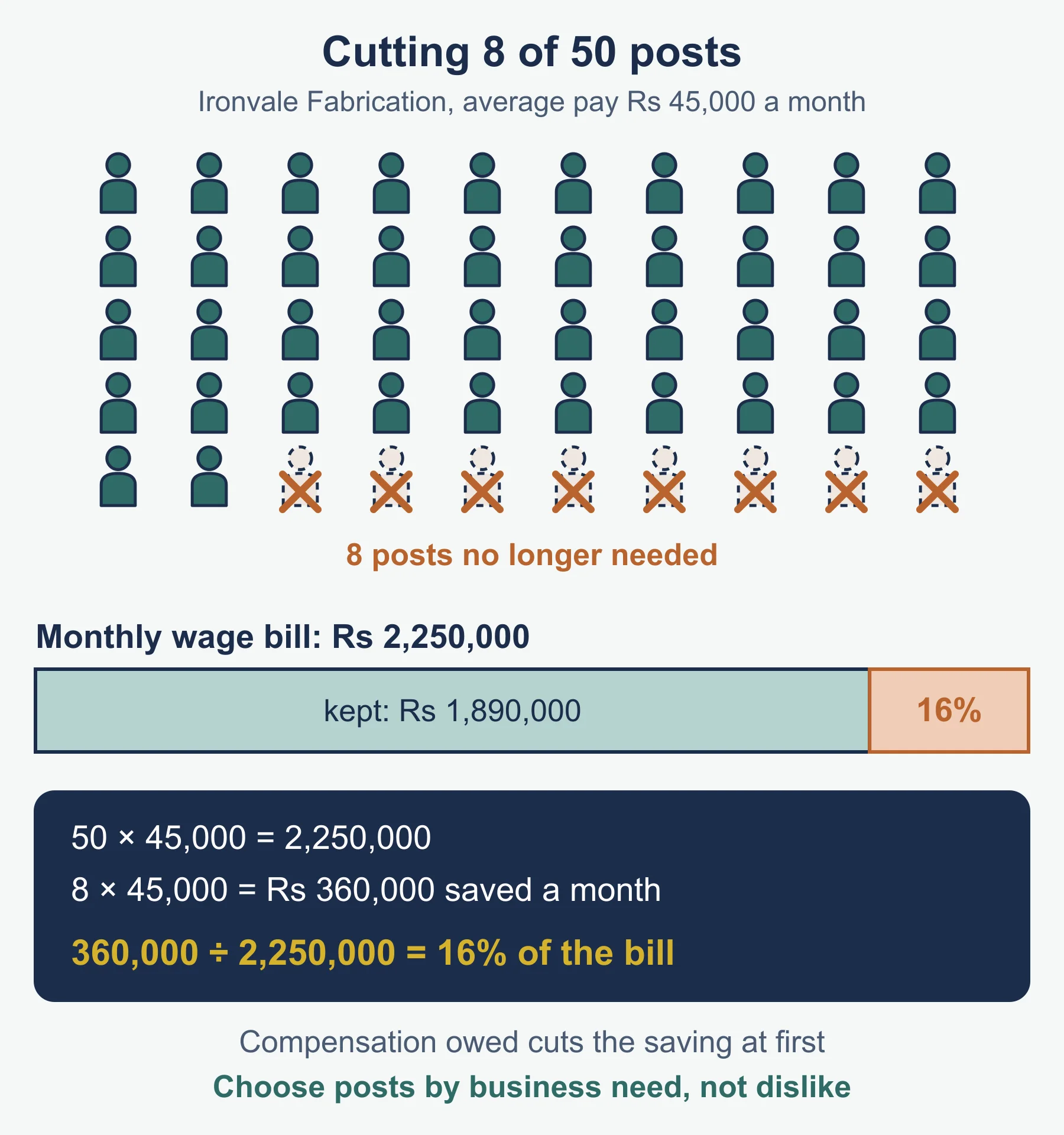
- Wage bill = number of employees × average pay. Saving from redundancies = posts removed × pay for each post.
- Percentage change = change ÷ original × 100.
- Cost of a part-time option = total hours × hourly rate. Compare with the full-time contract cost, then add one-off costs such as induction.
- Training cost per person = fees + lost output (or trainer time) + errors. Multiply by the number trained.
- Staff time cost of a meeting = people × hours × hourly pay.
Quick self-test
- State two stages that come before advertising a vacancy.
- Give one benefit and one limitation of internal recruitment.
- A shop needs 24 hours of cover a week. Calculate the weekly cost of (a) one full-time contract of 40 hours at Rs 400 an hour, and (b) two part-timers working 12 hours each at the same rate. State the saving as a percentage of (a).
- Ten trainees: off-the-job costs Rs 9,000 in fees plus 2 days at Rs 2,500 lost output each. On-the-job needs 5 supervisor hours at Rs 500 plus Rs 1,000 scrap each. Calculate the difference in total cost.
- Give one example of dismissal and one of redundancy.
- A firm has 80 employees paid Rs 36,000 a month on average. It removes 6 posts. Calculate the monthly saving and the percentage of the wage bill.
- Name two situations in which a business may need to reduce its workforce.
- A legal minimum rises from Rs 30,000 to Rs 32,400. Calculate the percentage rise.
- State one benefit and one limitation of email.
- Name two ways to reduce a language barrier.
Answers
- Any two: identify the vacancy; write the job description; write the person specification.
- Benefit: quicker and cheaper. Limitation: fewer applicants and no new ideas.
- (a) 40 × 400 = Rs 16,000. (b) 2 × 12 × 400 = Rs 9,600. Saving Rs 6,400, which is 40% of (a).
- Off-the-job: (9,000 + 2 × 2,500) × 10 = Rs 140,000. On-the-job: (5 × 500 + 1,000) × 10 = Rs 35,000. Difference Rs 105,000.
- Dismissal: repeated serious misconduct. Redundancy: a machine replaces a task.
- 6 × 36,000 = Rs 216,000 a month. Wage bill 80 × 36,000 = Rs 2,880,000, so the saving is 7.5%.
- Automation; falling demand; closing a branch.
- (2,400 ÷ 30,000) × 100 = 8%.
- Fast, cheap and keeps a record; but it can be ignored or overloaded.
- Plain wording; translation or interpreters; checking understanding.
Where marks are usually lost
- Using “recruit” and “select” as if they were the same thing.
- Listing a method without a limitation, or a limitation without saying why it matters here.
- Writing “the employee was made redundant” for a sacking.
- Recommending a candidate or an employee to dismiss without using the facts in the case.
- Giving only one side in a “recommend and justify” answer.
- Describing legal controls but not the effect on both employers and employees.
- Choosing a communication method by naming it only, with no link to urgency or complexity.
- Leaving out units, or giving a percentage with no working.
Frequently asked questions
What is the difference between recruitment and selection? Recruitment is attracting suitable people to apply for a vacancy. Selection is choosing between those who applied, using tools such as application forms, interviews, tests and references.
What is the difference between internal and external recruitment? Internal recruitment fills a vacancy from the existing workforce, for example by promoting a team member. External recruitment fills it from outside the business.
Is dismissal a way of cutting costs? No. Dismissal ends a contract because of something connected with the employee, such as serious misconduct. Redundancy relates to the job no longer being needed, for example after automation or a fall in demand.
What legal controls over employment are in Cambridge O Level Business 7115? The syllabus lists five areas: employment contracts, unfair dismissal, discrimination, health and safety, and the legal minimum wage. Describe each in general terms and its effect on employers and employees.
Official syllabus
Cambridge O Level Business Studies 7115, syllabus for examination in 2026 (Version 2), published by Cambridge University Press & Assessment (Cambridge International). Sections 2.3 and 2.4 of the subject content.
Get free revision emails (optional)
Occasional emails with practice questions, worked explanations and links to free resources for the qualification and subjects you choose. No spam, and you can unsubscribe from any email. The free tools on this site never need an email.
Related resources
-
Revision notes
O Level Business Studies: People in Business — Revision Notes
Condensed notes on motivation, structure, leadership, recruitment, training and communication for Topic 2 of Cambridge O Level Business Studies (7115).
Business · Cambridge · O Level
Revise topic -
Study guides
O Level Business: Motivating employees (Cambridge 7115)
Full study guide to motivation for Cambridge O Level Business 7115: Maslow, Taylor, Herzberg, pay and non-pay methods, with worked calculations.
Business · Cambridge · O Level
Read guide -
Practice questions
O Level Business: Motivating employees (Cambridge 7115) – Practice Questions
Ten original practice questions with worked answers on motivation for Cambridge O Level Business 7115: calculations, theories and recommend cases.
Business · Cambridge · O Level
Try questions
Related articles
-
teaching
A Level tuition in Dubai: Cambridge or Pearson Edexcel International A Level?
Schools in Dubai and Abu Dhabi teach either Cambridge International AS & A Level or Pearson Edexcel International A Level. How the two are structured, why it matters for tuition, and how online classes from Lahore work.
9 October 2026
-
curriculum guides
Choosing subjects at IGCSE and A Level
How subject choices at 14 and 16 affect university options later, and how to keep pathways open without overloading a timetable.
28 July 2026
Studying this with a teacher
Working through Business O LEVELS?
This page is free and stays free. If you would rather be taught it, Marlbridge runs Business classes one-to-one and in small groups of up to 15, online in your own time zone. The first trial class is free. WhatsApp replies within an hour (8am–11pm Pakistan time, every day); email the same day.
Cambridge Business teachers at Marlbridge

