
Study Guides
O Level Business: Organisation and management (Cambridge 7115)
Study guide to organisational charts, management functions, delegation, leadership styles and trade unions for Cambridge O Level Business 7115.
- Subject
- Business
- Level
- O LEVELS
- Topic
- People in business
- Author
- Marlbridge Academic Team
- Updated
- Reviewed by
- Salman Ahmad (what this means)
Aligned to Cambridge O Level Business (7115), For examination in 2026. Official specification .
Syllabus page (what it covers and how it is assessed): Cambridge O Level Business.
Syllabus points this page covers
7115
- 2.2 Organisation and management
Found an error? Report a correction.
Need help with this topic? Request a free trial class for O Level Business (7115).
This guide covers section 2.2 Organisation and management of the Cambridge O Level Business Studies 7115 syllabus for examination in 2026. It sits inside Topic 2, People in business. All candidates take the same two components, so there is no tier to choose and every point below is in scope for every candidate. For the wider topic, see the People in business study guide. For the course overview, use the Cambridge O Level Business hub and the printable checklist.
Other pages for this section: revision notes and the practice questions. The topic-level practice questions and revision notes cover the whole of Topic 2 more briefly.
What this section covers
| Syllabus point | What you must be able to do |
|---|---|
| 2.2.1 | Draw, interpret and understand simple organisational charts: levels of hierarchy, span of control, chain of command, tall and short structures; the roles and responsibilities of directors, managers, supervisors and other employees, and how they relate |
| 2.2.2 | Explain the functions of management (planning, organising, coordinating, commanding, controlling); explain the importance of delegation; discuss trust versus control |
| 2.2.3 | Describe the features of autocratic, democratic and laissez-faire leadership; recommend and justify a style in given circumstances |
| 2.2.4 | State what a trade union is and explain the effects of employees being union members |
The syllabus says “e.g.” against several lists, so the named items are examples. Learn them all.
2.2.1 Organisational charts
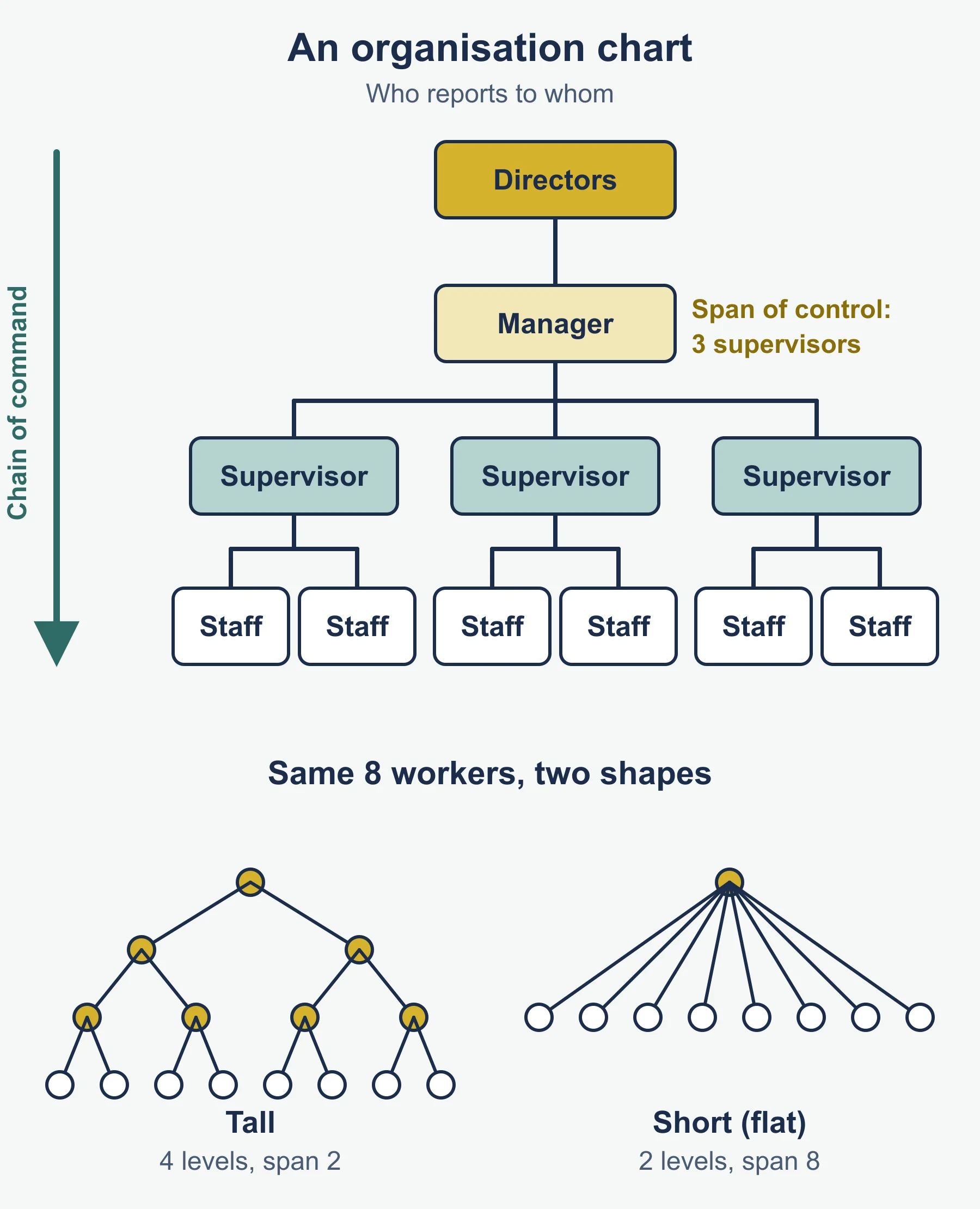
An organisational chart is a diagram that shows how a business is arranged: who holds which post, who reports to whom and how many people sit at each level. Charts are read from top to bottom.
Key terms:
- Level of hierarchy: one layer of authority on the chart. Posts at the same level have the same rank.
- Chain of command: the line of authority from the top of the business to the bottom. Instructions pass down it and information passes up it.
- Span of control: the number of people who report directly to one manager or supervisor. Counting only direct reports is the standard form of this measure.
- Tall structure: many levels of hierarchy, usually with narrow spans of control.
- Short structure (also called flat): few levels, usually with wide spans of control.
Roles and responsibilities
- Directors set the long-term direction and objectives of the business and make major decisions such as entering a new market.
- Managers turn those objectives into plans for a department or function and are answerable to the directors for results.
- Supervisors oversee the daily work of a small team, check that tasks are done and report problems upwards.
- Other employees carry out the tasks. They report to a supervisor or manager and pass on what they see at the front line.
The inter-relationships run in both directions. Directors give targets to managers, managers give instructions to supervisors, and supervisors direct employees. In the other direction, employees raise problems, supervisors report progress, and managers report results to directors. Managers in different departments also need to work with each other, which is a sideways relationship that the chart’s lines do not always show.
Worked example: Kestrelbank Print Works
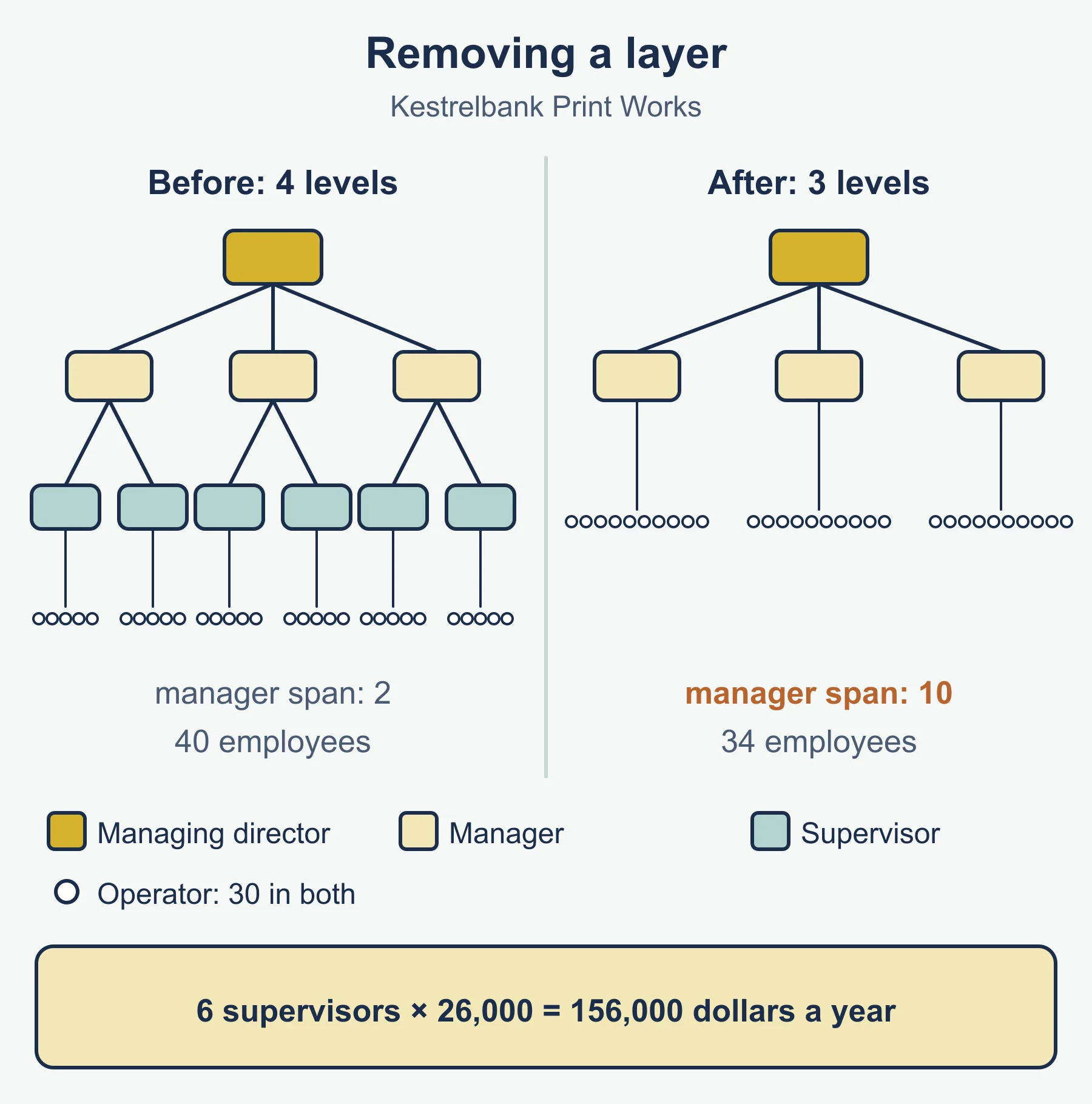
Kestrelbank Print Works is an invented business with 40 employees:
Managing director (1)
  |-- Production manager ---- 2 supervisors ---- 5 operators each
  |-- Sales manager --------- 2 supervisors ---- 5 operators each
|-- Finance manager ------- 2 supervisors ---- 5 operators each- Levels of hierarchy: managing director, managers, supervisors, operators. That is 4 levels.
- Spans of control: the managing director has 3 direct reports, each manager has 2 and each supervisor has 5.
- Chain of command for an operator: operator, supervisor, manager, managing director. A message from the top passes through 3 people before it reaches the operator.
- Total employees: 1 + 3 + 6 + 30 = 40.
The owners consider removing the six supervisor posts. The 30 operators would report straight to the three managers.
- New number of levels: 3.
- New span of control for each manager: 30 operators shared equally among 3 managers, so 30 ÷ 3 = 10.
- Employees after the change: 1 + 3 + 30 = 34.
- Salary saving if each supervisor earns 26,000 dollars a year: 6 × 26,000 = 156,000 dollars a year.
The change turns a four-level structure into a three-level one. Messages travel faster and the business saves salaries. The trade-off is that each manager now has a much wider span. They may be unable to give each operator close attention, and there is no first-line supervisor to promote operators into.
Tall versus short
| Tall structure | Short structure | |
|---|---|---|
| Levels | Many | Few |
| Span of control | Narrow | Wide |
| Chain of command | Long: messages slow and may be distorted | Short: faster, clearer communication |
| Control | Close supervision of each worker | Less supervision, so more freedom |
| Promotion | Many steps to climb | Few steps |
| Cost | More managerial salaries | Fewer managerial salaries |
Neither is always better. Tall suits work needing close checking. Short suits skilled staff.
2.2.2 The role of management
Functions of management
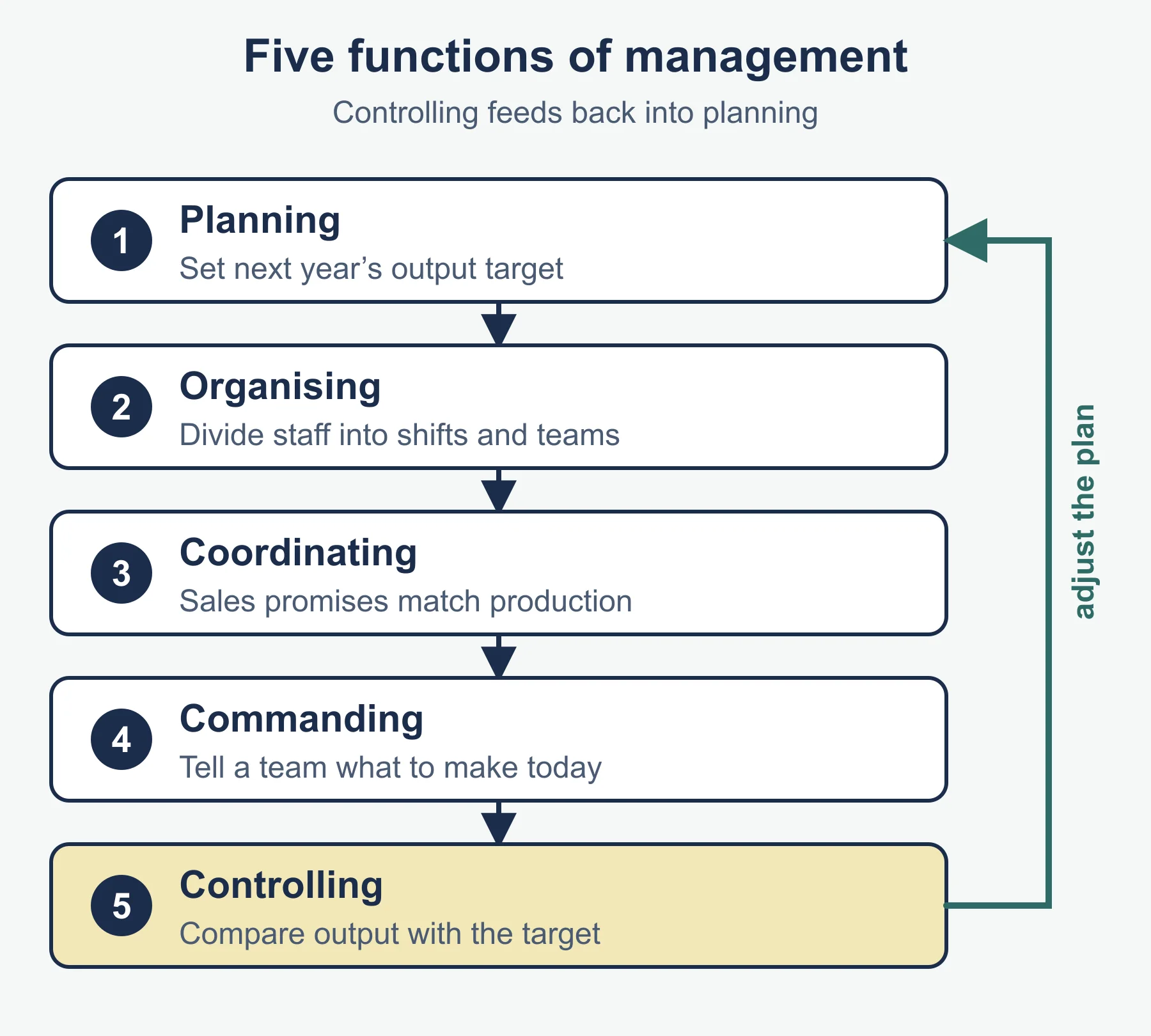
The syllabus lists five functions, using “e.g.” to show these are examples. Learn all five with a one-line meaning and a workplace example.
| Function | Meaning | Example |
|---|---|---|
| Planning | Setting objectives and deciding how to reach them | Deciding next year’s output target |
| Organising | Arranging people, equipment and money so the plan can be carried out | Dividing staff into shifts and teams |
| Coordinating | Making sure departments and teams work together towards the same aims | Ensuring that sales promises match what production can deliver |
| Commanding | Giving instructions and directing staff | Telling a team what to produce today |
| Controlling | Checking actual results against the plan and acting on differences | Comparing monthly output with the target and finding out why it fell short |
These functions link together. Planning without controlling means nobody finds out whether the plan worked. Commanding without organising leaves staff with orders but no resources.
Delegation
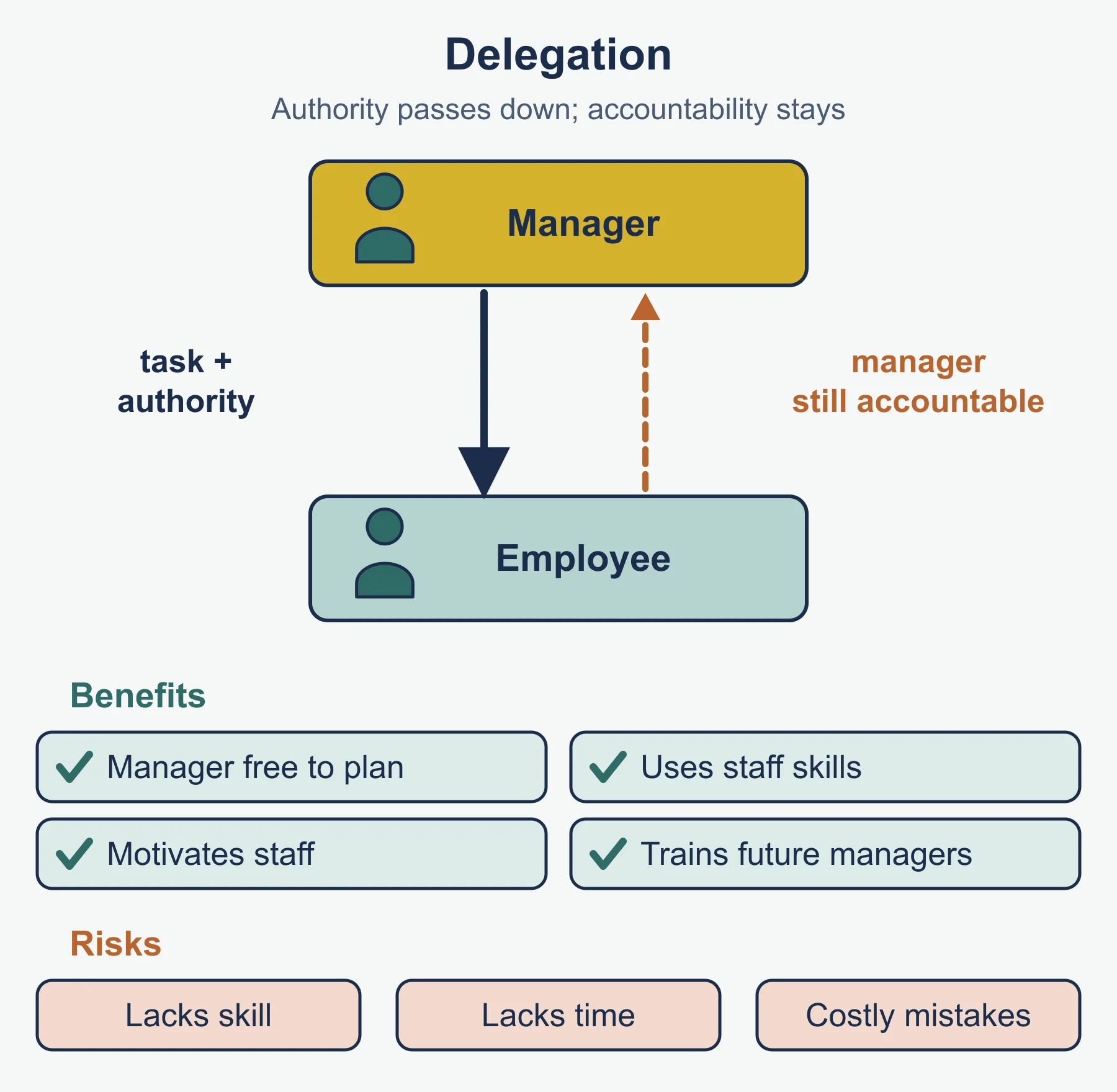
Delegation means passing authority to carry out a task, and the right to make decisions about it, to someone lower in the hierarchy. The manager remains accountable for the result.
Why it matters:
- It frees managers to concentrate on planning and other higher-level work.
- It uses the skills of staff who are closer to the work.
- It can motivate employees, because they are trusted with more responsibility. This connects to the job enrichment method in section 2.1.
- It trains future managers.
Its risks are that the employee may lack the skill or time, may make costly mistakes, or may not follow the way the manager would have done the task.
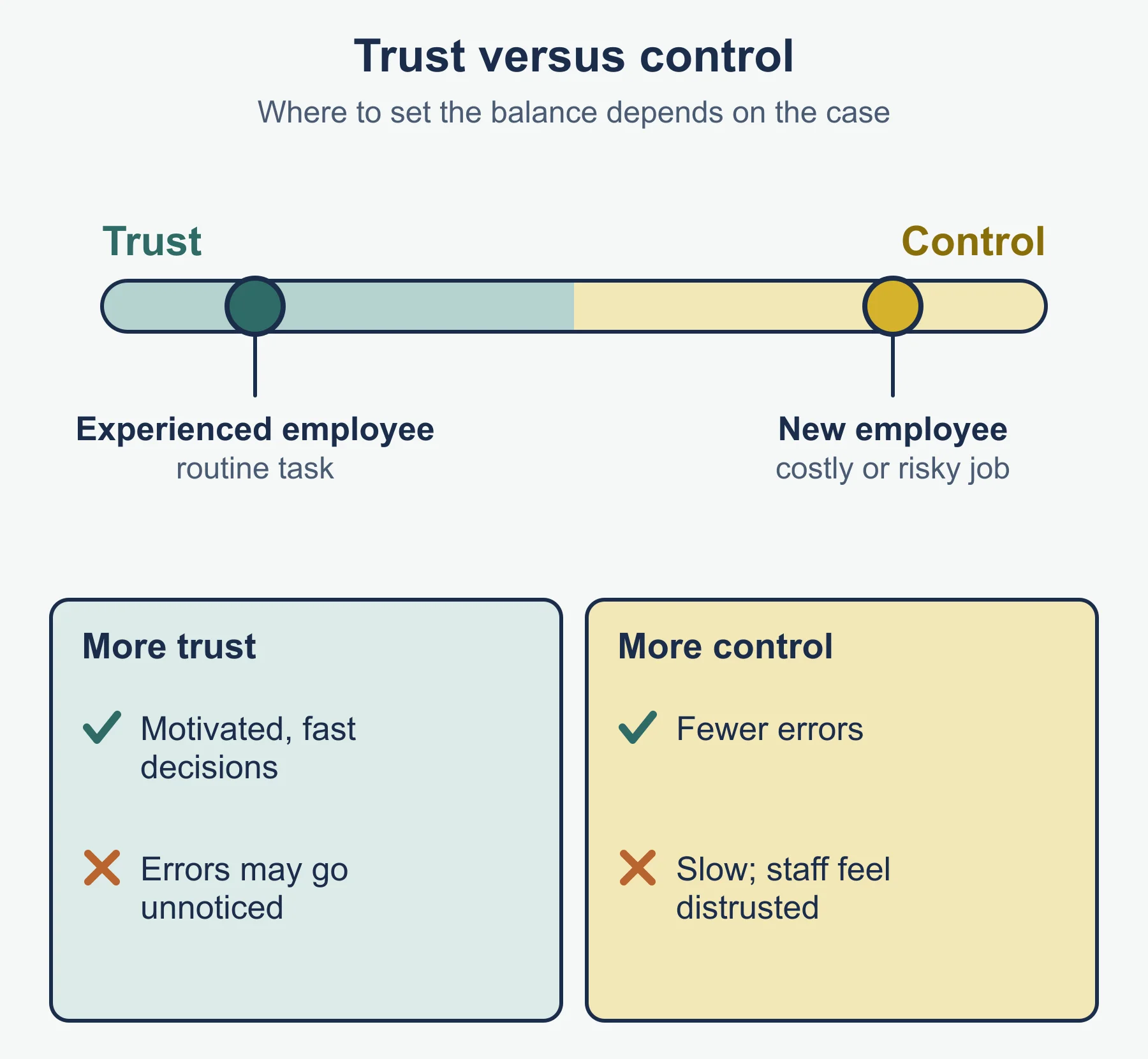
Trust versus control
Every delegating manager has to balance two things.
- Trust: letting staff decide for themselves. This builds motivation and speeds decisions, but errors may go unnoticed.
- Control: checking, approving and directing. This reduces errors but slows work down, wastes the manager’s time and can leave staff feeling that they are not trusted.
The right balance depends on the circumstances. A manager might give wide freedom to an experienced employee on a routine task but keep close control when a new employee handles an expensive or risky job. In an exam answer, link the balance to the details in the case.
2.2.3 Leadership styles
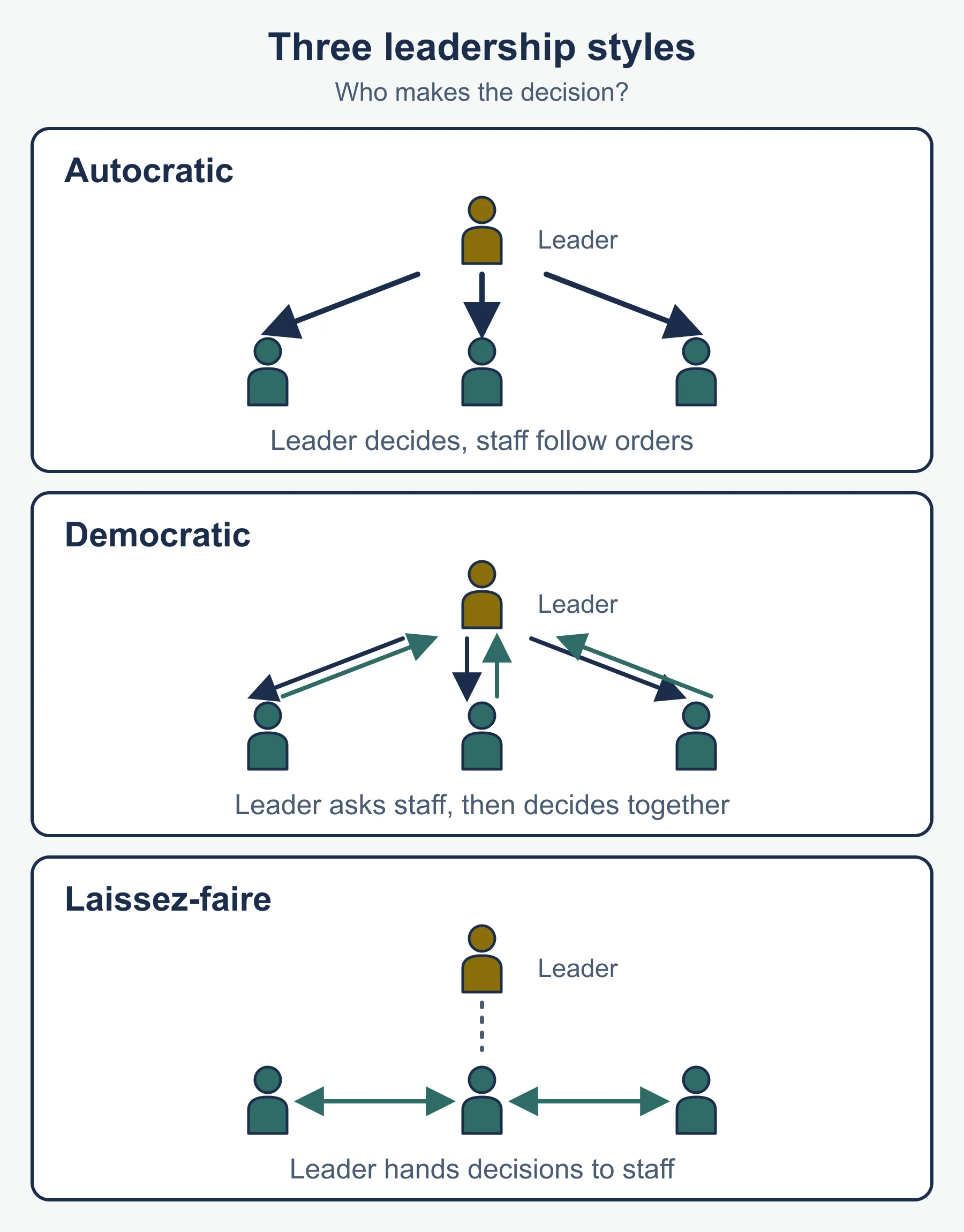
Leadership style is the way a manager guides, makes decisions and deals with staff. The syllabus names three main styles.
| Style | Features |
|---|---|
| Autocratic | The leader makes decisions alone, gives orders and expects them to be followed. Communication is mainly one way, downwards |
| Democratic | The leader consults staff, listens to their views and often lets them share in decisions. Communication flows both ways |
| Laissez-faire | The leader sets broad aims, then leaves staff to decide how to do the work. Little direction or supervision |
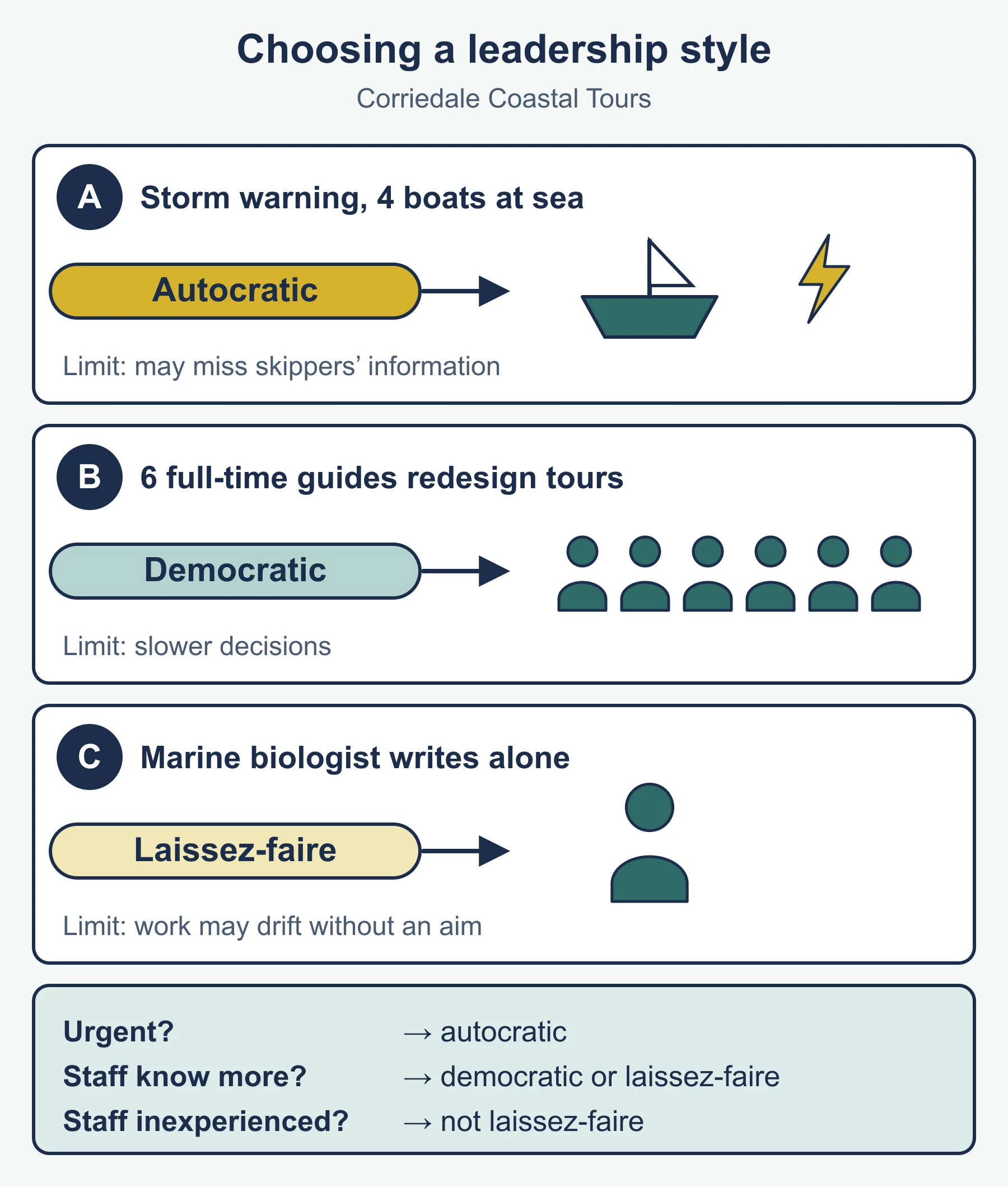
Worked example: Corriedale Coastal Tours
Corriedale Coastal Tours is an invented business that runs boat trips. It employs 6 full-time guides and, during the summer, 20 seasonal guides who have just started.
Situation A. A storm warning is issued while 4 boats are at sea. The operations manager must decide immediately which boats return and in what order. Recommended style: autocratic. There is no time to consult, the decision is urgent, and one clear instruction avoids confusion. The limitation is that the manager may overlook useful information held by the skippers, and the skippers may feel ignored if this happens often.
Situation B. In winter, the 6 full-time guides are asked to redesign the tour programme for next year. They know the coast, the customers and the competing offers well. Recommended style: democratic. The guides have knowledge the manager lacks, and involving them should raise motivation and produce better ideas. The limitation is slower decision-making, and the manager must decide what to do if the guides disagree.
Situation C. A highly experienced marine biologist works alone on writing educational material for the tours. Recommended style: laissez-faire. A specialist working on their own may produce better work with freedom than with detailed instruction. The limitation is that, without any direction, the work may drift away from what the business needs, so the manager still has to agree the broad aim and a deadline.
Notice what makes each answer strong: it names the style, links it to a detail in the situation, and gives a limitation. Use the same pattern whenever you “recommend and justify”.
To choose a style, ask whether the decision is urgent (autocratic), whether staff know more than the leader (democratic or laissez-faire), and whether staff are inexperienced and need guidance (not laissez-faire).
2.2.4 Trade unions
A trade union is an organisation of workers, formed to protect and improve its members’ pay, conditions and interests, with its strength coming from acting together. Employees who join are union members, and elected representatives speak for them in dealings with the employer.
Effects of employees being union members
Possible effects on employees:
- Pay, hours and conditions are negotiated together, which gives workers more bargaining power than they would have alone.
- Members receive advice and support, for example if they face a dispute with the employer.
- Members may feel more secure and better represented.
- Members pay a subscription and may be asked to join industrial action.
Possible effects on the business:
- Higher costs if the union secures better pay and conditions.
- Possible disruption if industrial action takes place.
- Decisions on changes, such as new working methods, may take longer because the union has to be consulted.
- A single channel for talking to the workforce, which can improve communication and settle disputes before they grow.
- Better morale, lower labour turnover and fewer unresolved grievances if the relationship is good.
A balanced answer includes both sides. The syllabus asks for the effects of union membership, not only the problems.
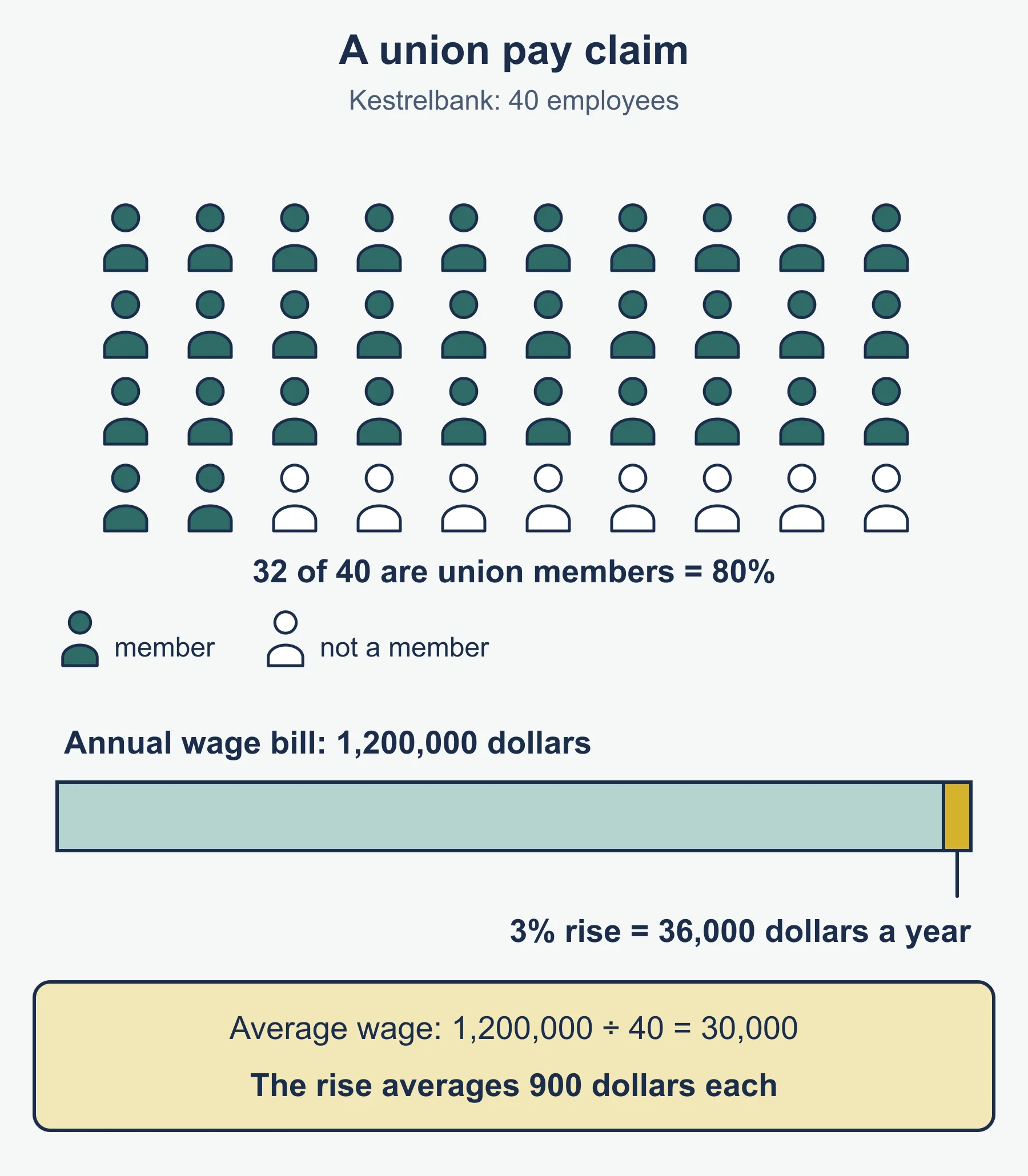
Worked example: pay claim at Kestrelbank
Of Kestrelbank’s 40 employees, 32 are union members: 32 ÷ 40 = 80%. The union negotiates a 3% rise on the annual wage bill of 1,200,000 dollars. Extra cost: 3% × 1,200,000 = 36,000 dollars a year. Average wage per employee: 1,200,000 ÷ 40 = 30,000 dollars, so the rise averages 900 dollars per employee. The business pays more, but may gain from lower turnover and fewer disputes. Whether that outweighs the cost depends on its profits and on how hard it is to recruit replacements.
Common errors
- Counting the managing director as part of a manager’s span of control. Count only the people who report directly to the manager in question.
- Saying that a short structure is “better” without a condition. It is better when staff can work with little supervision.
- Describing delegation as “giving someone a job”. The point is passing authority with the task.
- Treating laissez-faire as “no management”. The leader still sets aims.
- Naming a leadership style without tying it to the case.
- Writing only the negative effects of a union. Include effects on employees too.
Practise and check
Work through the practice questions, then test yourself on the revision notes. To find which Topic 2 areas need most work, try the free 10-minute diagnostics.
Frequently asked questions
What is span of control? Span of control is the number of people who report directly to one manager or supervisor. Count only direct reports, not everyone below the manager on the chart.
Which leadership style suits an urgent decision? An autocratic style suits urgent decisions where there is no time to consult and one clear instruction avoids confusion. Democratic or laissez-faire styles suit staff who know more than the leader or specialists working alone.
Is a short structure always better than a tall one? No. A short structure suits skilled staff who can work with little supervision, while a tall structure suits work that needs close checking.
What are the effects of trade union membership on a business? Costs may rise if the union wins better pay, industrial action can disrupt work and changes may take longer to agree. A union also gives a single channel for talking to the workforce, which can improve communication and settle disputes early.
Official syllabus
Cambridge International, Cambridge O Level Business Studies (7115) syllabus for examination in 2026, subject content section 2.2 Organisation and management.
Get free revision emails (optional)
Occasional emails with practice questions, worked explanations and links to free resources for the qualification and subjects you choose. No spam, and you can unsubscribe from any email. The free tools on this site never need an email.
Related resources
-
Practice questions
O Level Business: Organisation and management (Cambridge 7115) – Practice Questions
Original practice questions with worked answers on organisation charts, delegation, leadership styles and trade unions for Cambridge O Level Business 7115.
Business · Cambridge · O Level
Try questions -
Revision notes
O Level Business: Organisation and management (Cambridge 7115) – Revision Notes
Condensed revision notes on organisation charts, management functions, delegation, leadership styles and trade unions for Cambridge O Level Business 7115.
Business · Cambridge · O Level
Revise topic -
Study guides
O Level Business Studies: People in Business (Cambridge 7115)
Study guide to Topic 2 People in business for Cambridge O Level Business Studies 7115: motivation, organisation, leadership, recruitment and communication.
Business · Cambridge · O Level
Read guide
Related articles
-
teaching
A Level tuition in Dubai: Cambridge or Pearson Edexcel International A Level?
Schools in Dubai and Abu Dhabi teach either Cambridge International AS & A Level or Pearson Edexcel International A Level. How the two are structured, why it matters for tuition, and how online classes from Lahore work.
9 October 2026
-
curriculum guides
Choosing subjects at IGCSE and A Level
How subject choices at 14 and 16 affect university options later, and how to keep pathways open without overloading a timetable.
28 July 2026
Studying this with a teacher
Working through Business O LEVELS?
This page is free and stays free. If you would rather be taught it, Marlbridge runs Business classes one-to-one and in small groups of up to 15, online in your own time zone. The first trial class is free. WhatsApp replies within an hour (8am–11pm Pakistan time, every day); email the same day.
Cambridge Business teachers at Marlbridge

