
Study Guides
Cambridge O Level Mathematics: Coordinate Geometry (4024)
A step-by-step Cambridge O Level Mathematics study guide to coordinates, linear graphs, gradient, length, midpoint, parallel and perpendicular lines.
- Subject
- Mathematics
- Level
- O LEVELS
- Topic
- Coordinate geometry
- Author
- Marlbridge Academic Team
- Updated
- Reviewed by
- Sajawal Zahid (what this means)
Aligned to Cambridge O Level Mathematics (4024), 2025-2027. Official specification .
Syllabus page (what it covers and how it is assessed): Cambridge O Level Mathematics.
Syllabus points this page covers
4024
- 3 Coordinate geometry (whole topic)
Found an error? Report a correction.
Need help with this topic? Request a free trial class for O Level Mathematics (4024).
This guide teaches topic 3, Coordinate geometry, from the Cambridge O Level Mathematics (Syllabus D) 4024 syllabus for 2025, 2026 and 2027. It covers sections 3.1 to 3.7. There are no tiers: every candidate studies all of it. The syllabus says Paper 1 is a non-calculator paper and Paper 2 is a calculator paper, and each paper is based on the subject content, so you need to handle every skill here both with and without a calculator.
Use it with the revision notes for quick recall and the existing practice questions for testing. The course hub lists the other topics, the checklist lets you tick off each outcome, and the free diagnostics show where to focus.
What this topic covers
| Section | What you must be able to do |
|---|---|
| 3.1 Coordinates | Use and interpret Cartesian coordinates in two dimensions |
| 3.2 Drawing linear graphs | Draw straight-line graphs for linear equations |
| 3.3 Gradient | Find the gradient of a straight line, including from the coordinates of two points on it |
| 3.4 Length and midpoint | Calculate the length of a line segment; find the midpoint of a line segment |
| 3.5 Equations of linear graphs | Interpret and obtain the equation of a straight-line graph |
| 3.6 Parallel lines | Find the gradient and equation of a line parallel to a given line |
| 3.7 Perpendicular lines | Find the gradient and equation of a line perpendicular to a given line |
3.1 Coordinates
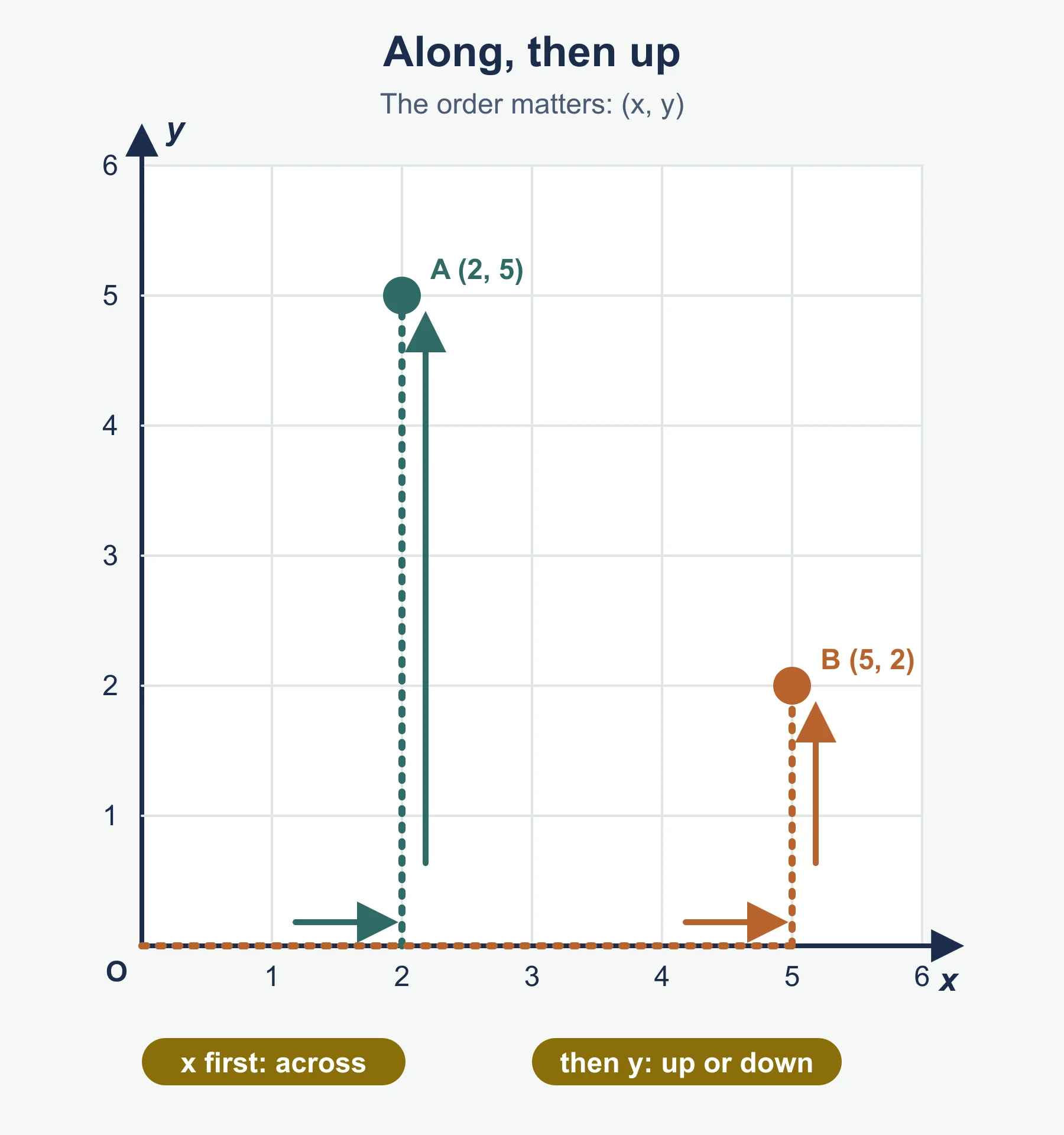
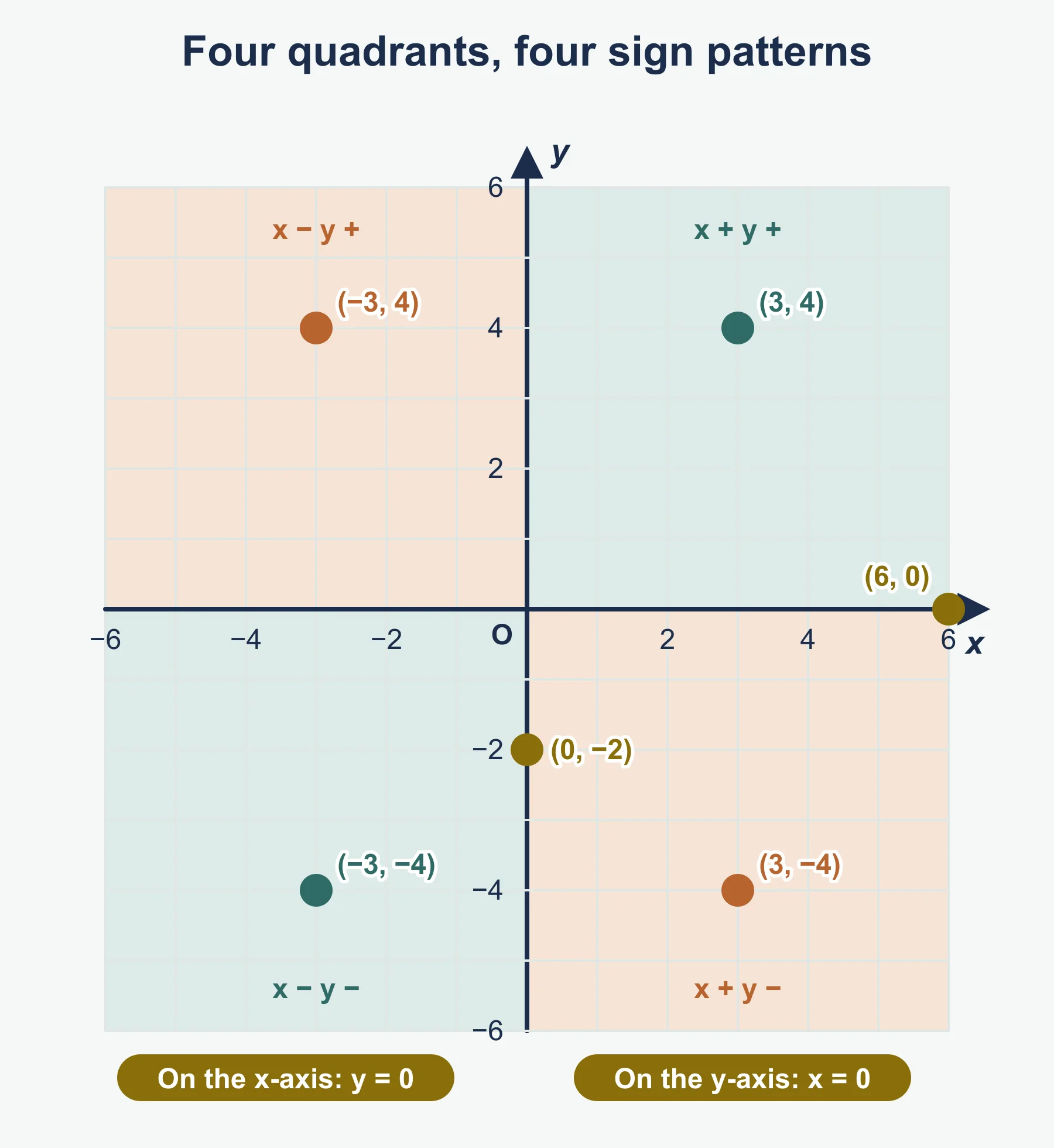
A point is written (x, y). The x-value says how far across you go from the origin O, positive to the right. The y-value says how far up, positive upwards. The axes split the plane into four quadrants. Both values are positive in the top right; x is negative and y positive in the top left; both are negative in the bottom left; x is positive and y negative in the bottom right.
Points on the x-axis have y = 0. Points on the y-axis have x = 0. A horizontal line has the same y-value at every point, and a vertical line has the same x-value at every point.
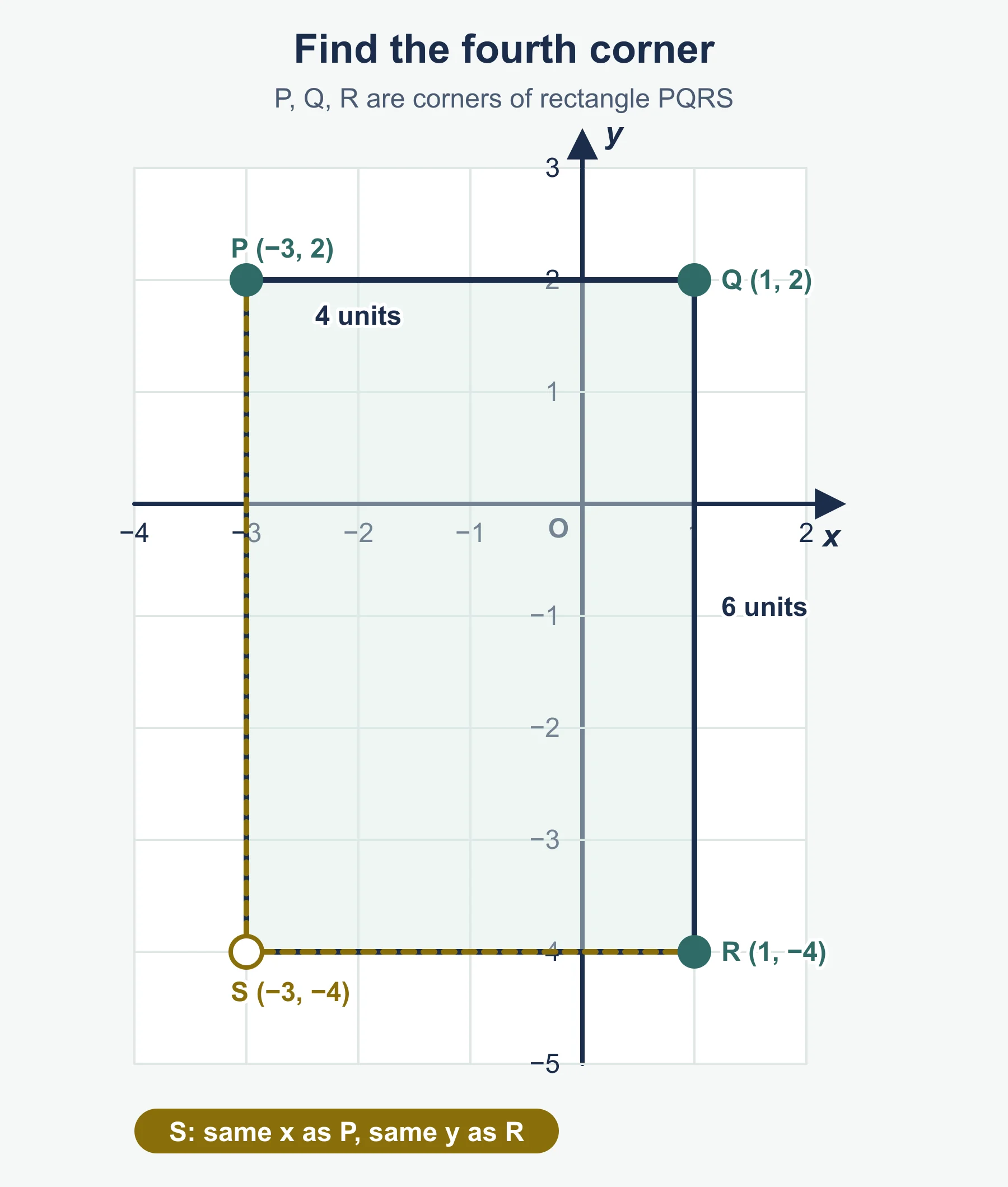
Worked example 1. Three corners of a rectangle are A(−2, 1), B(4, 1) and C(4, 5). Find D.
A and B have the same y-value, so AB is horizontal. B and C have the same x-value, so BC is vertical. In a rectangle, D lies directly above A and directly left of C.
D has the x-value of A (−2) and the y-value of C (5), so D = (−2, 5).
Sketch the points: it catches most slips.
3.2 Drawing linear graphs
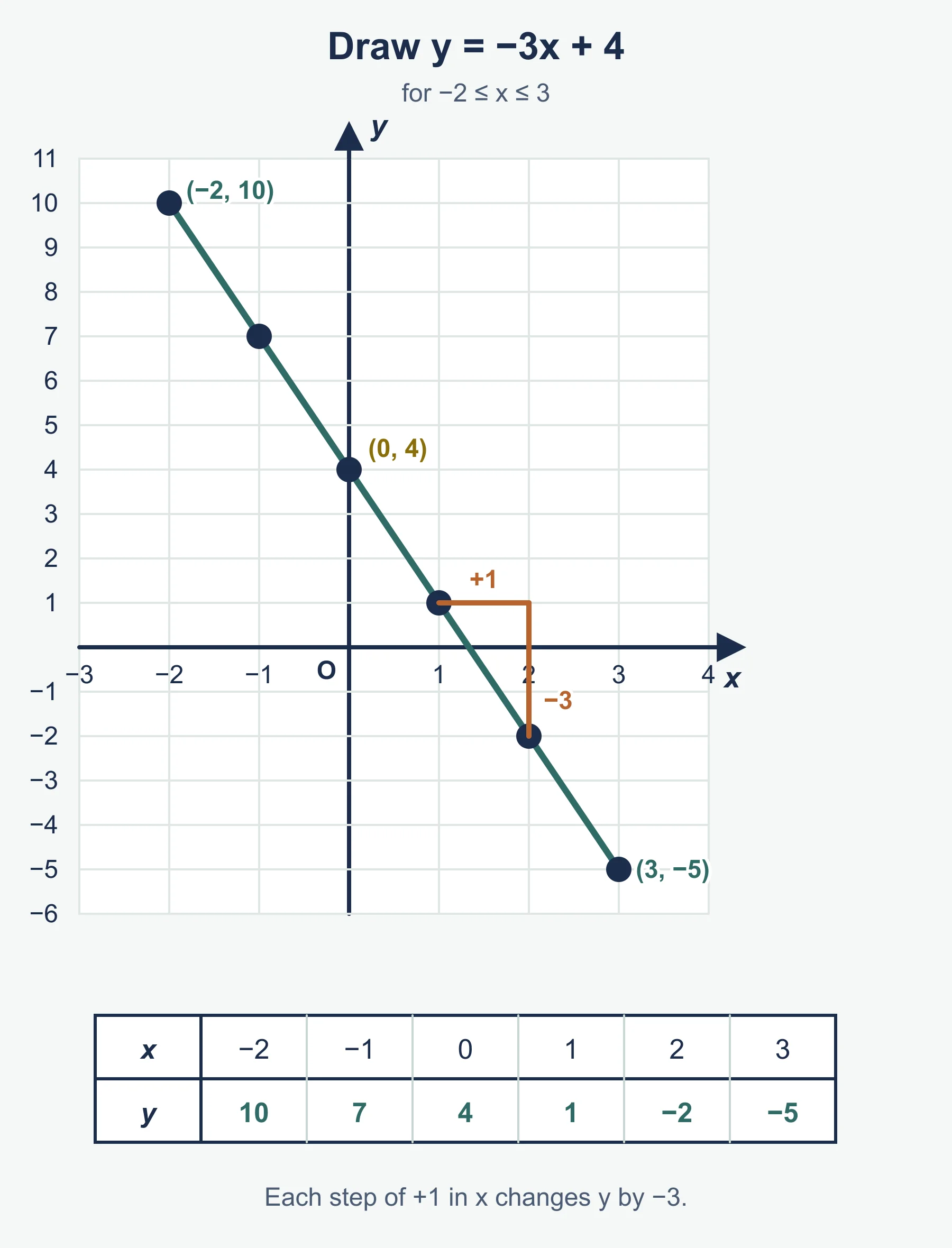
An equation in which x and y appear only to the power 1 gives a straight line. Two points define it, but plot three so that a slip shows up as an off-line point.
Method A: a table of values (for equations with y as the subject).
Worked example 2. Draw y = 4 − 2x for −1 ≤ x ≤ 3.
| x | −1 | 0 | 1 | 2 | 3 |
|---|---|---|---|---|---|
| y | 6 | 4 | 2 | 0 | −2 |
Plot (−1, 6), (0, 4), (1, 2), (2, 0) and (3, −2), then join them with a ruler. The graph slopes down from left to right, which matches the negative coefficient of x.
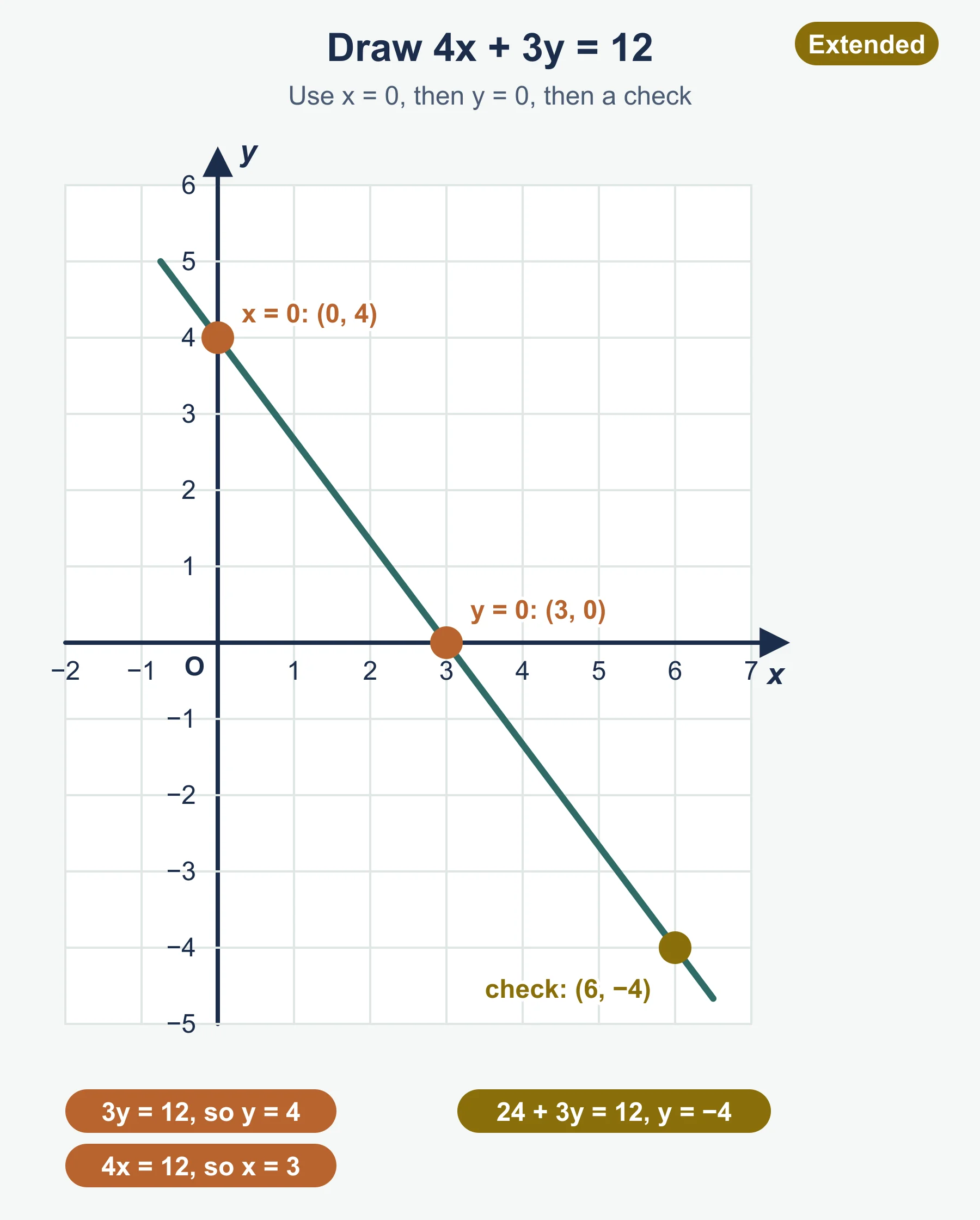
Method B: intercepts (for equations such as ax + by = c).
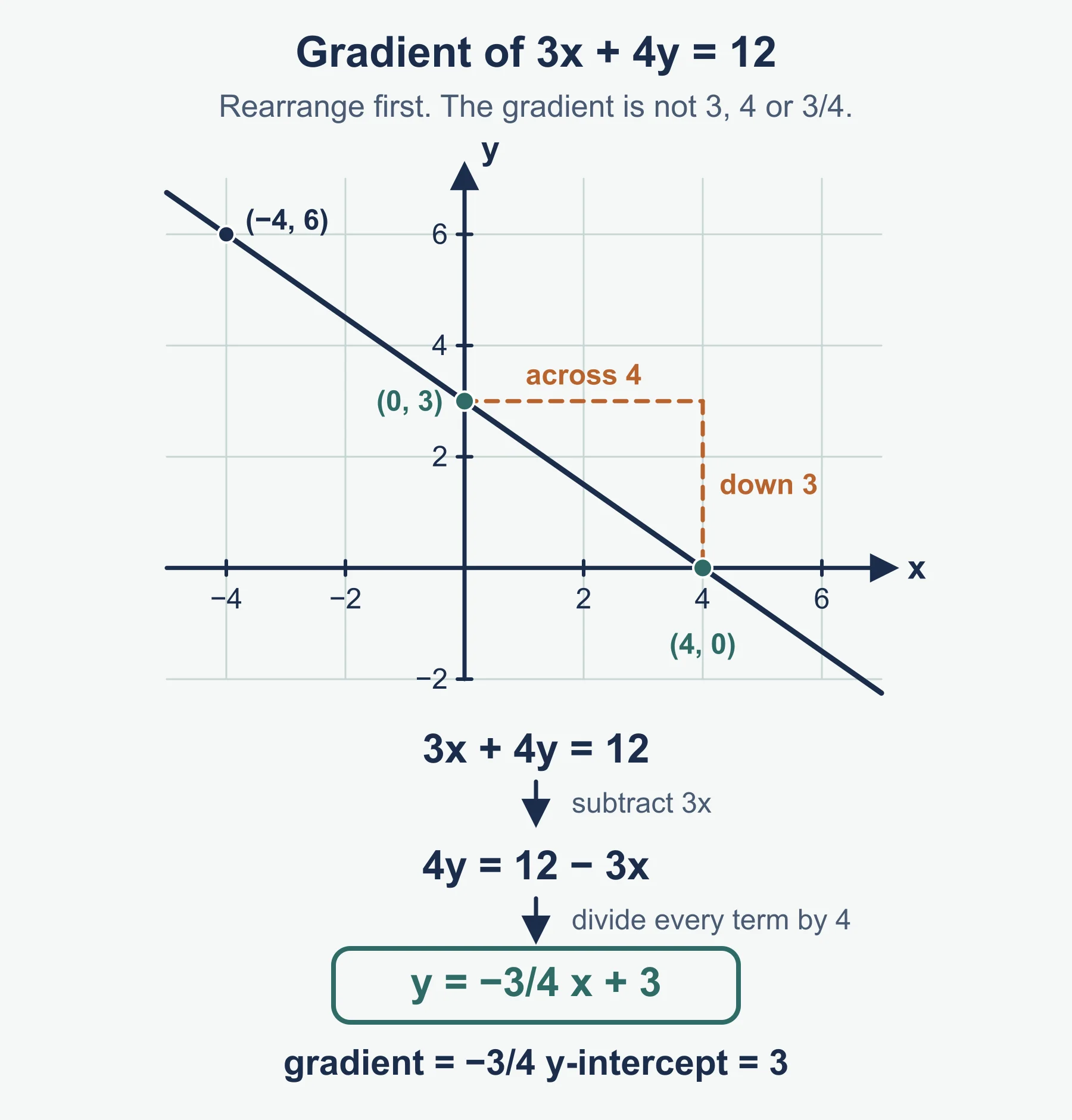
Worked example 3. Draw 3x + 4y = 12.
Put x = 0: 4y = 12, so y = 3. The line crosses the y-axis at (0, 3). Put y = 0: 3x = 12, so x = 4. The line crosses the x-axis at (4, 0).
Join (0, 3) and (4, 0) and extend the line. For a check point, try x = −4: 3(−4) + 4y = 12, so y = 6. The point (−4, 6) should lie on your line.
If the line passes through the origin both intercepts are the same point, so use a table instead.
3.3 Gradient of linear graphs
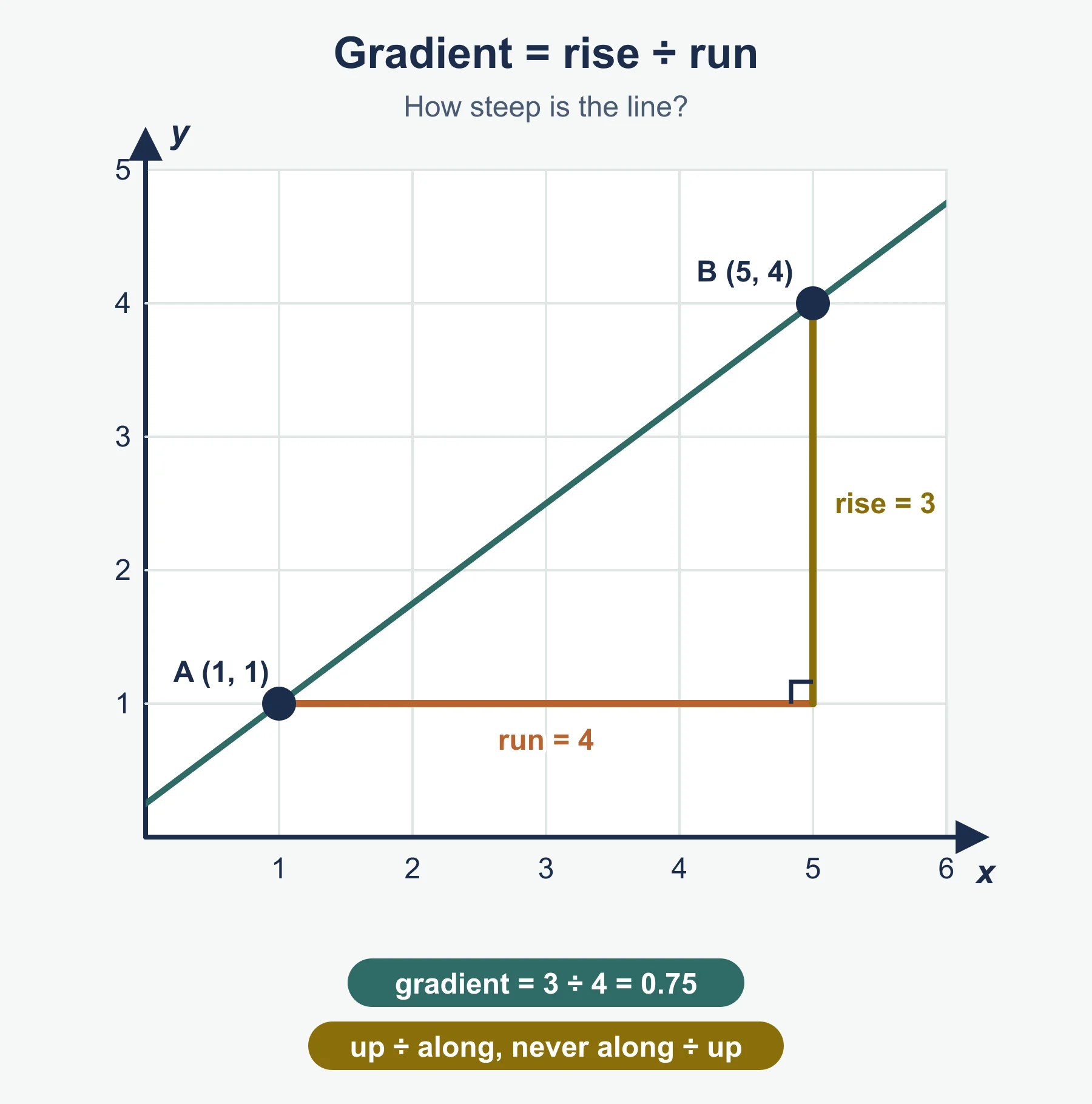
The gradient measures steepness: how far the line goes up for each unit it goes across.
gradient = change in y ÷ change in x = (y₂ − y₁) ÷ (x₂ − x₁)
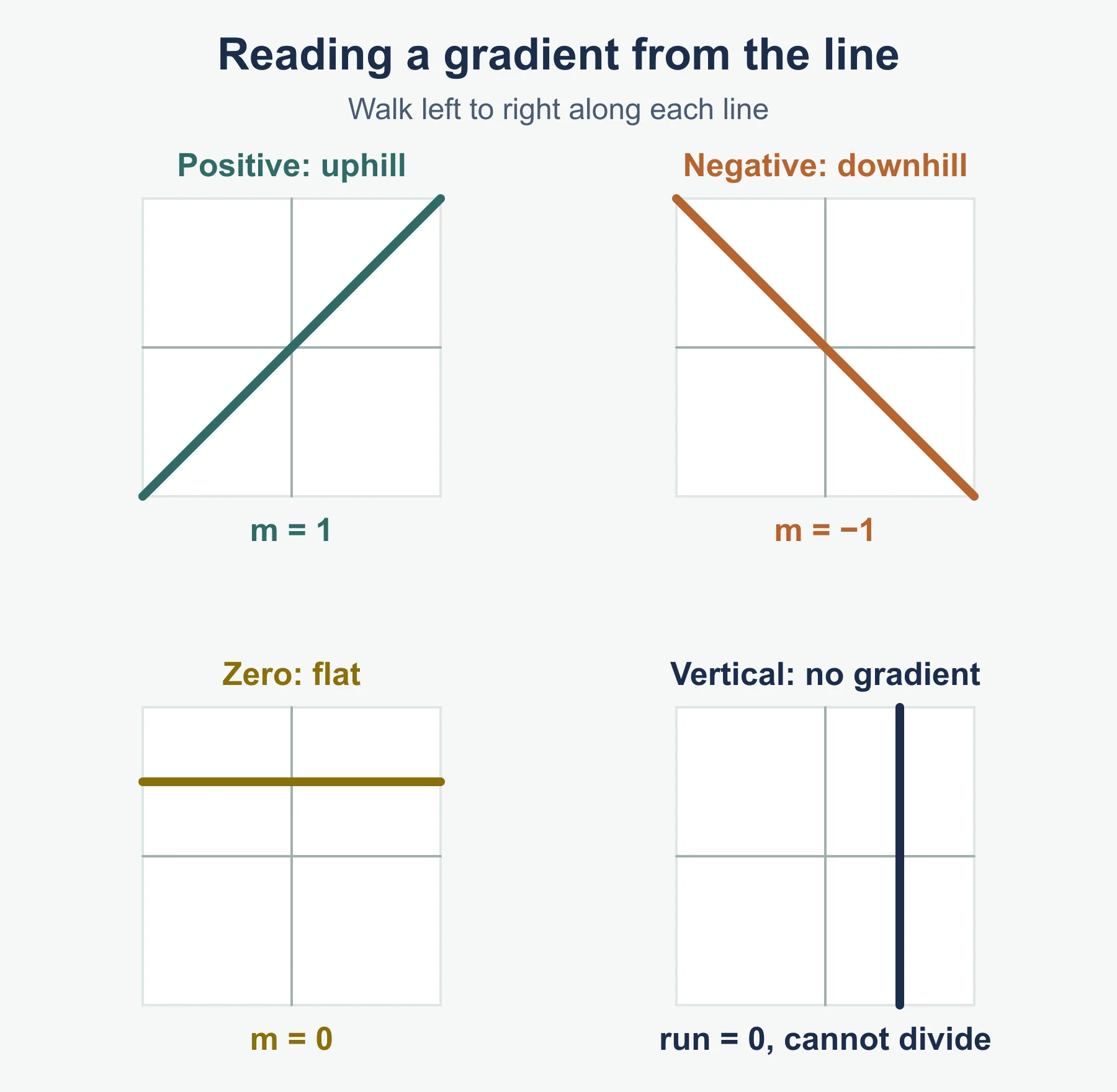
On a drawn graph, choose two points on the line where it crosses grid intersections, draw a right-angled triangle under or over the line, and divide the vertical side by the horizontal side. Read the sign from the picture: a line rising to the right has a positive gradient; one falling to the right has a negative gradient.
Special cases: a horizontal line has gradient 0. A vertical line has no gradient (the change in x is 0, so you cannot divide).
Worked example 4. Find the gradient of the line through P(−1, 7) and Q(5, −2).
Gradient = (−2 − 7) ÷ (5 − (−1)) = −9 ÷ 6 = −3/2.
Use the same point first on top and bottom. The answer is the same whichever point you call first.
3.4 Length and midpoint
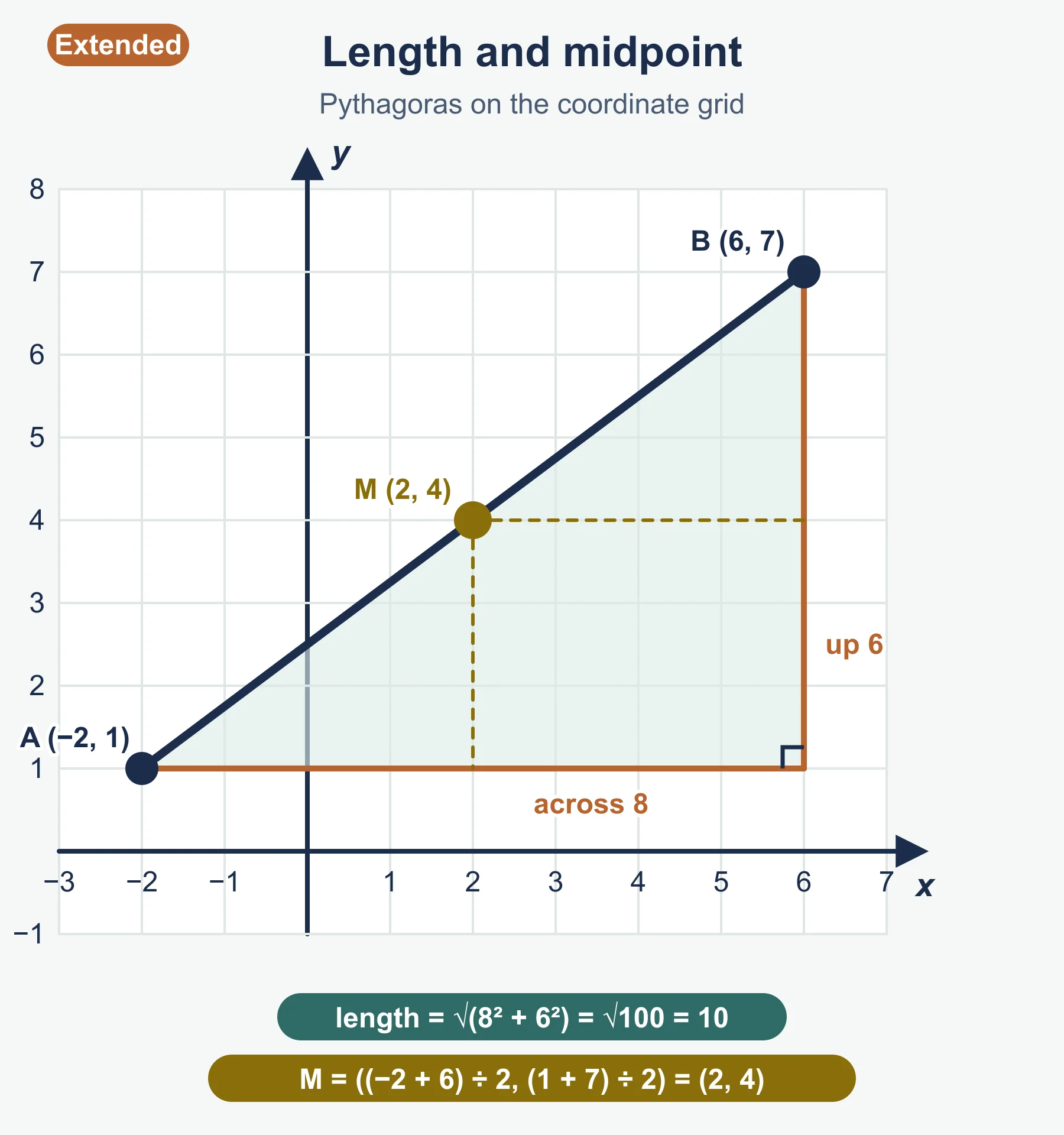
Length. The segment joining two points is the hypotenuse of a right-angled triangle whose sides are the differences in x and in y. Pythagoras’ theorem gives
length = √((x₂ − x₁)² + (y₂ − y₁)²)
Midpoint. The midpoint is the mean of the x-values and the mean of the y-values:
midpoint = ((x₁ + x₂) ÷ 2, (y₁ + y₂) ÷ 2)
Worked example 5. A(−4, −1) and B(8, 4). Find the length of AB and its midpoint.
Differences: 8 − (−4) = 12 across and 4 − (−1) = 5 up. Length = √(12² + 5²) = √(144 + 25) = √169 = 13 units. Midpoint = ((−4 + 8) ÷ 2, (−1 + 4) ÷ 2) = (2, 1.5).
Worked example 6. Find the length between (−2, 3) and (3, 5), giving the answer as a surd and then to 3 significant figures.
Differences: 5 across, 2 up. Length = √(25 + 4) = √29. With a calculator, √29 = 5.385…, which is 5.39 to 3 significant figures.
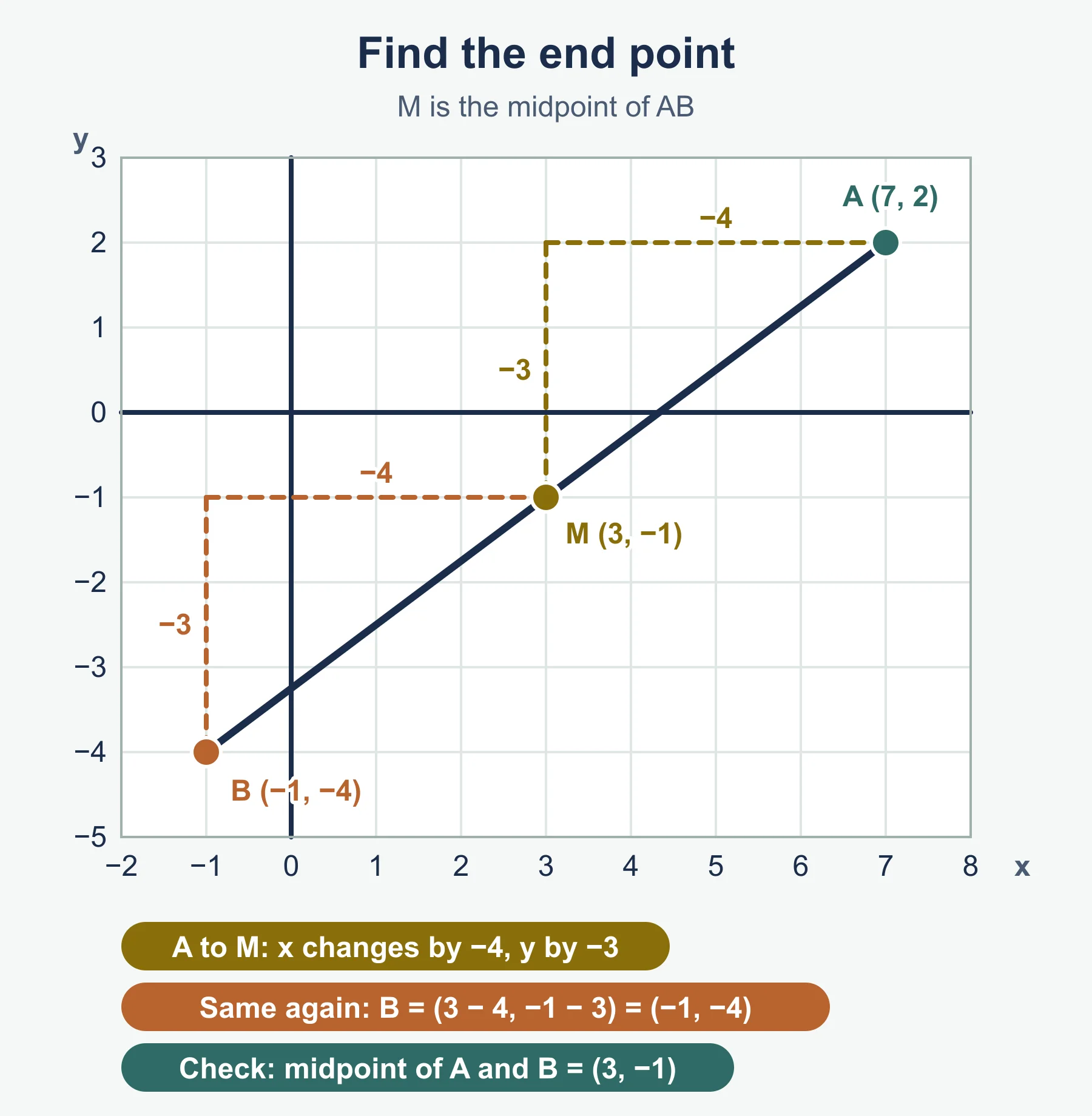
Worked example 7 (finding an end point). M(3, −1) is the midpoint of AB, and A is (7, 2). Find B.
The midpoint is halfway, so B is as far from M as A is, in the opposite direction. From A to M the x-value changes by 3 − 7 = −4 and the y-value by −1 − 2 = −3. Apply the same change again from M:
B = (3 − 4, −1 − 3) = (−1, −4).
Check: the midpoint of (7, 2) and (−1, −4) is (3, −1).
3.5 Equations of linear graphs
Forms you meet.
| Form | Example | What it shows |
|---|---|---|
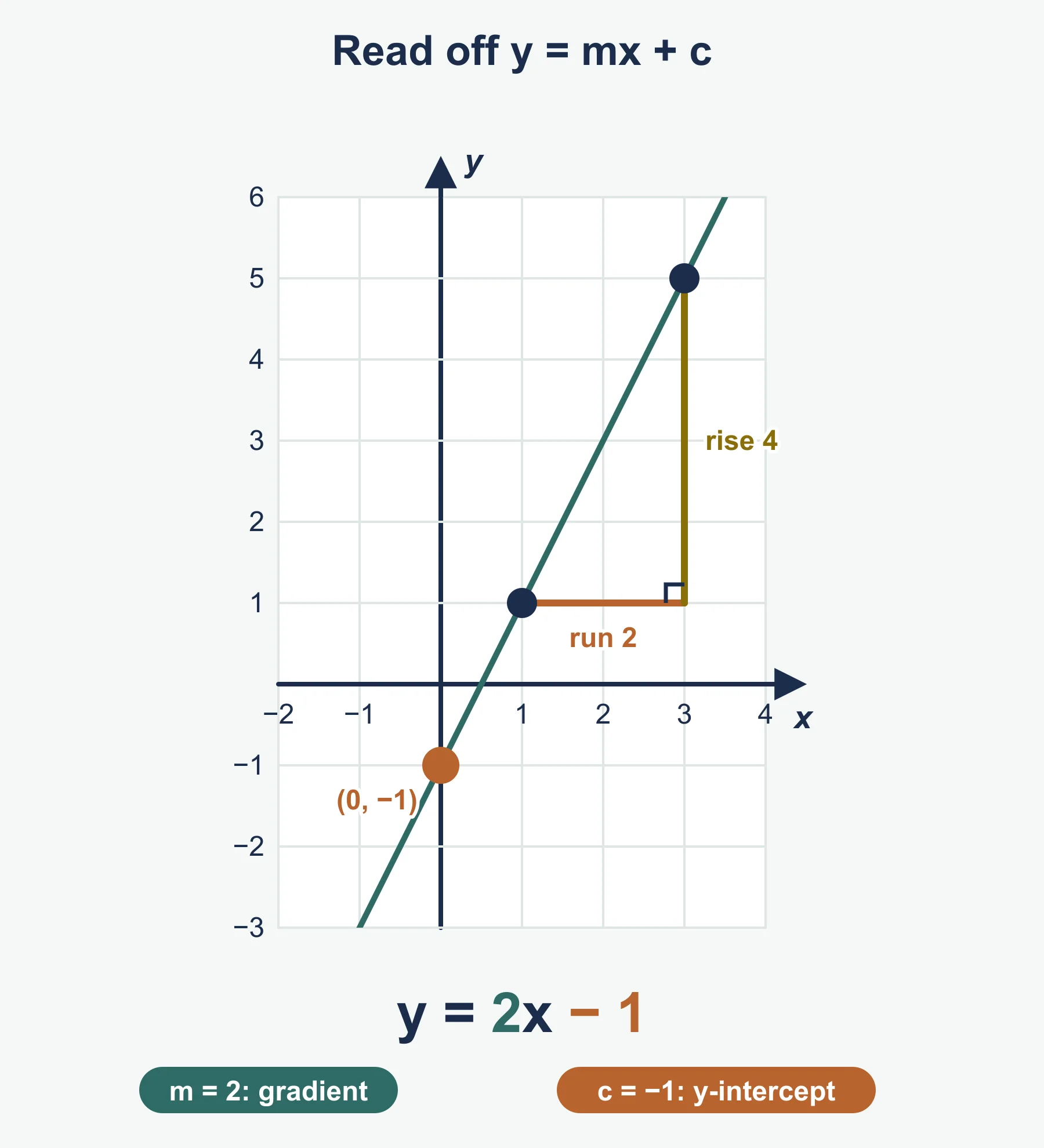
| y = mx + c | y = 2x − 3 | m is the gradient, c is the y-intercept |
| ax + by = c | 3x − 2y = 8 | Rearrange to find the gradient and intercept |
| x = k | x = 4 | Vertical line through (4, 0) |
| y = k | y = −2 | Horizontal line through (0, −2) |
The syllabus says you may be asked for a line in any of these forms and that you should give equations in a fully simplified form. Do not leave the equation half-rearranged.
Worked example 8 (reading a gradient and intercept). Find the gradient and y-intercept of 2x − 5y = 15.
Make y the subject. Subtract 2x from both sides: −5y = 15 − 2x. Divide every term by −5: y = −3 + (2/5)x.
So y = (2/5)x − 3. The gradient is 2/5 and the y-intercept is −3, which is the point (0, −3).
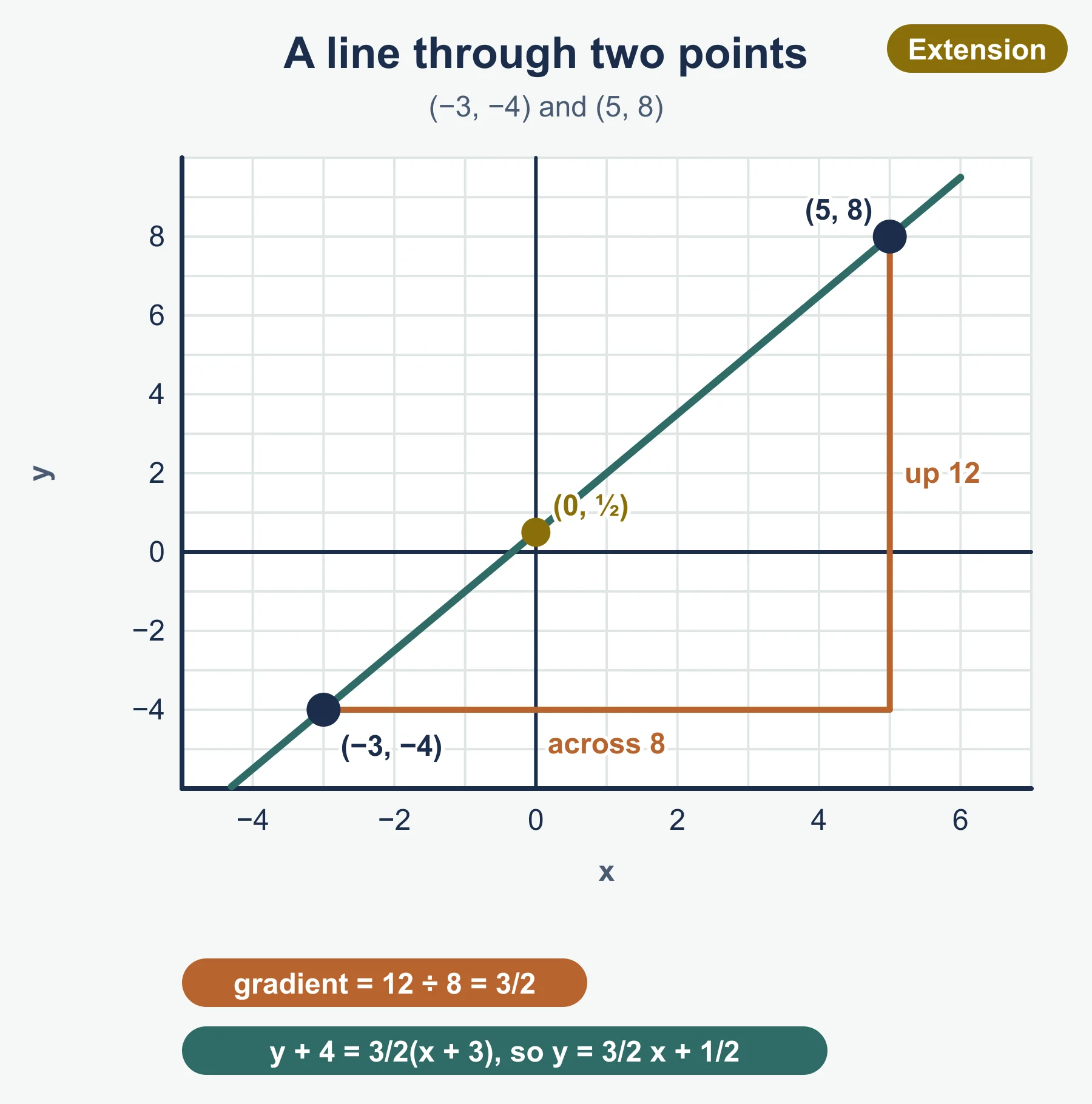
Worked example 9 (equation from two points). Find the equation of the line through (2, −1) and (6, 5).
- Gradient = (5 − (−1)) ÷ (6 − 2) = 6 ÷ 4 = 3/2.
- Use y − y₁ = m(x − x₁) with (2, −1): y + 1 = (3/2)(x − 2).
- Expand: y + 1 = (3/2)x − 3, so y = (3/2)x − 4.
- Check with (6, 5): (3/2)(6) − 4 = 9 − 4 = 5. This agrees.
To give the answer as 3x − 2y = 8, multiply by 2 to get 2y = 3x − 8 and rearrange. Either form is a correct equation, but follow any form the question asks for.
Equation from a graph. Read the y-intercept c where the line meets the y-axis. Find the gradient with a triangle. If a line crosses the y-axis at 4 and passes through (3, −2), the gradient is (−2 − 4) ÷ 3 = −2, so y = −2x + 4.
3.6 Parallel lines
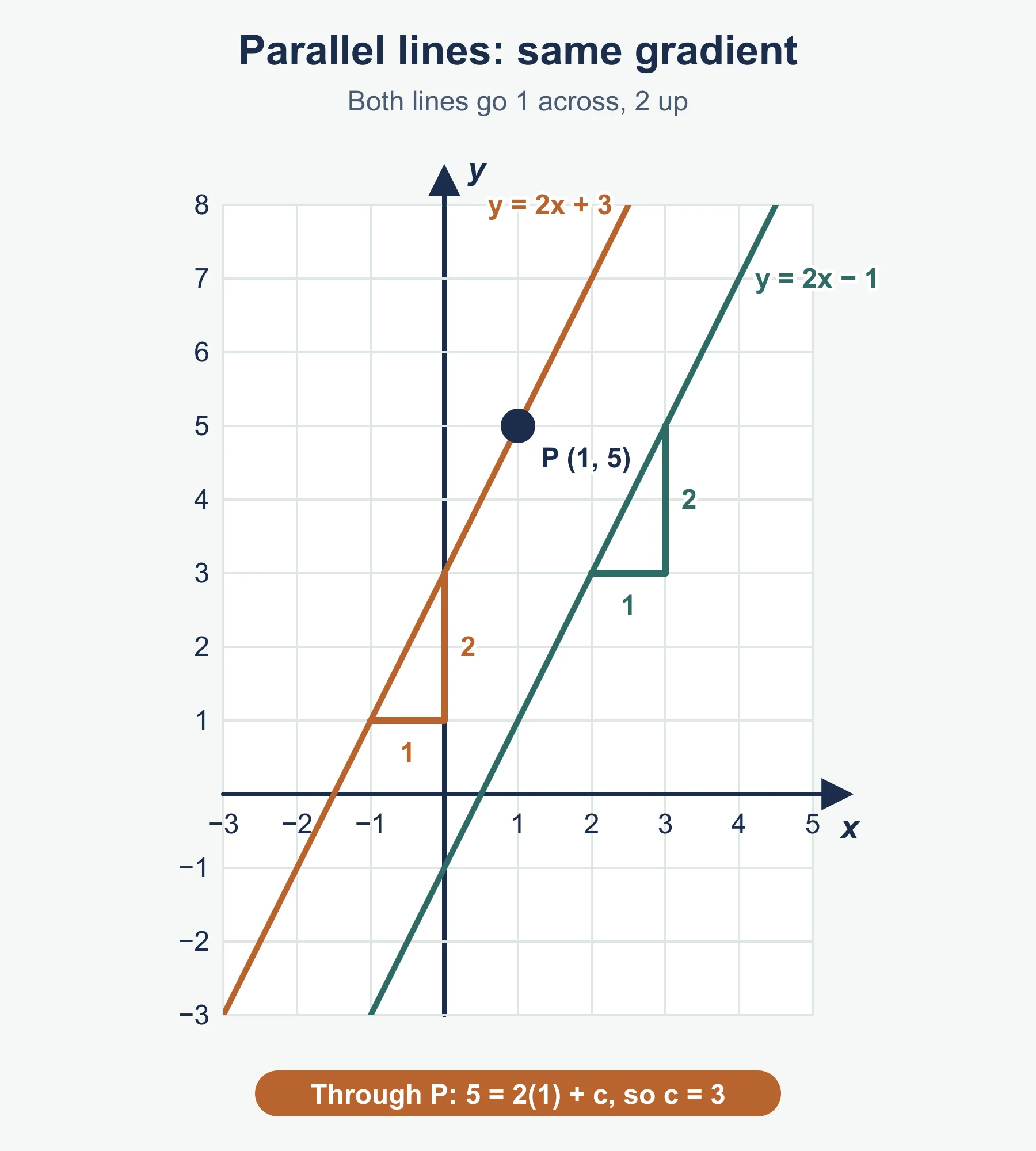
Parallel lines have the same gradient.
Worked example 10. Find the equation of the line parallel to y = −3x + 5 that passes through (2, −4).
The gradient is −3. Substitute the point into y = −3x + c: −4 = −3(2) + c, so c = 2.
The line is y = −3x + 2.
Worked example 11. Find the line parallel to 4x − 2y = 9 through (3, 1).
Rearrange: −2y = 9 − 4x, so y = 2x − 9/2. The gradient is 2. Use y − 1 = 2(x − 3), so y = 2x − 5. The line is y = 2x − 5.
To show two lines are parallel, rearrange both into y = mx + c and state that the gradients are equal. Write the conclusion; a pair of matching numbers is not enough on its own.
3.7 Perpendicular lines
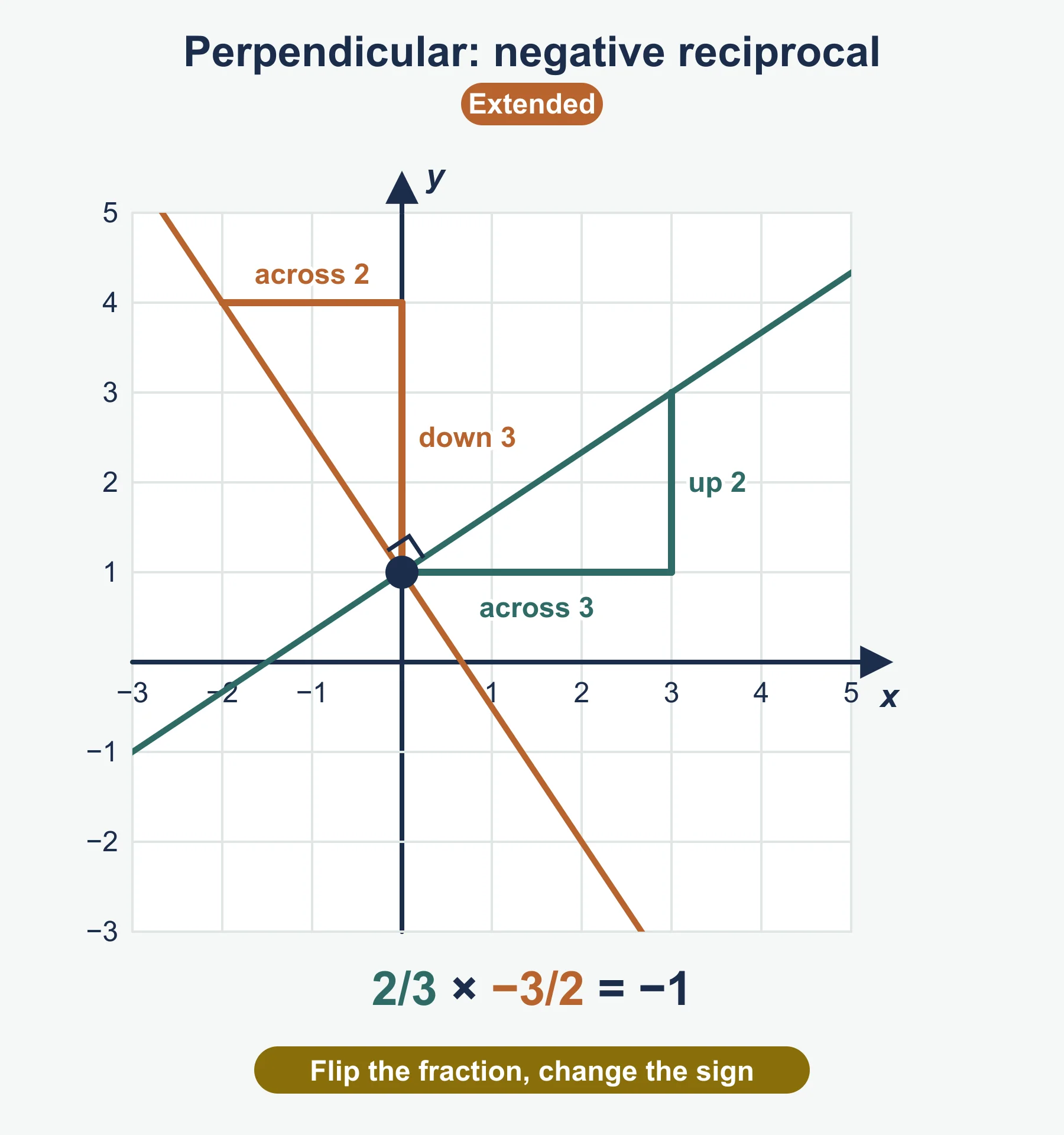
Two lines are perpendicular when the product of their gradients is −1. If one line has gradient m, a line perpendicular to it has gradient −1/m: turn the fraction upside down and change the sign.
| Given gradient | Gradient of a perpendicular line |
|---|---|
| 2 | −1/2 |
| −3/5 | 5/3 |
| 1/4 | −4 |
A horizontal line (y = k) is perpendicular to a vertical line (x = h), even though the rule with m cannot be applied to them.
Worked example 12. Find the gradient of a line perpendicular to 2y = 3x + 1.
Divide by 2: y = (3/2)x + 1/2, so the gradient is 3/2. The perpendicular gradient is −2/3.
Worked example 13. Find the line perpendicular to 3x + 5y = 10 through (6, −2).
Rearrange: 5y = 10 − 3x, so y = −(3/5)x + 2. The gradient is −3/5, so the perpendicular gradient is 5/3. Use y + 2 = (5/3)(x − 6): y = (5/3)x − 10 − 2, so y = (5/3)x − 12. As an integer form: multiply by 3 to get 3y = 5x − 36, so 5x − 3y = 36.
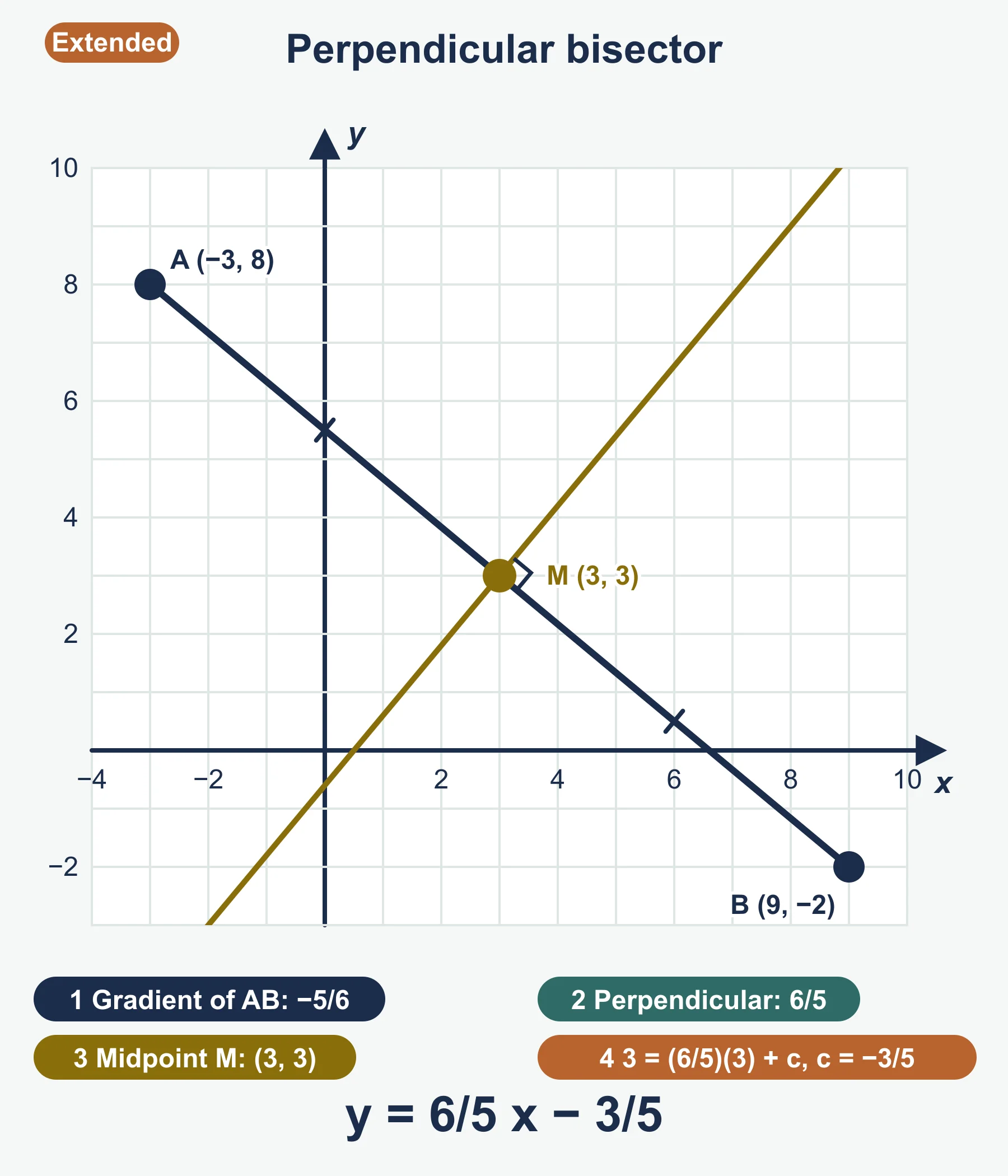
Worked example 14 (perpendicular bisector). Find the equation of the perpendicular bisector of the segment AB, where A is (−5, 2) and B is (7, −6).
A perpendicular bisector cuts the segment at its midpoint at a right angle, so you need the midpoint and the perpendicular gradient.
- Midpoint = ((−5 + 7) ÷ 2, (2 − 6) ÷ 2) = (1, −2).
- Gradient of AB = (−6 − 2) ÷ (7 − (−5)) = −8 ÷ 12 = −2/3.
- Perpendicular gradient = 3/2.
- Use y + 2 = (3/2)(x − 1), so y = (3/2)x − 7/2.
- Multiply by 2 for a neat form: 3x − 2y = 7.
Check: the midpoint (1, −2) gives 3 + 4 = 7. Correct.
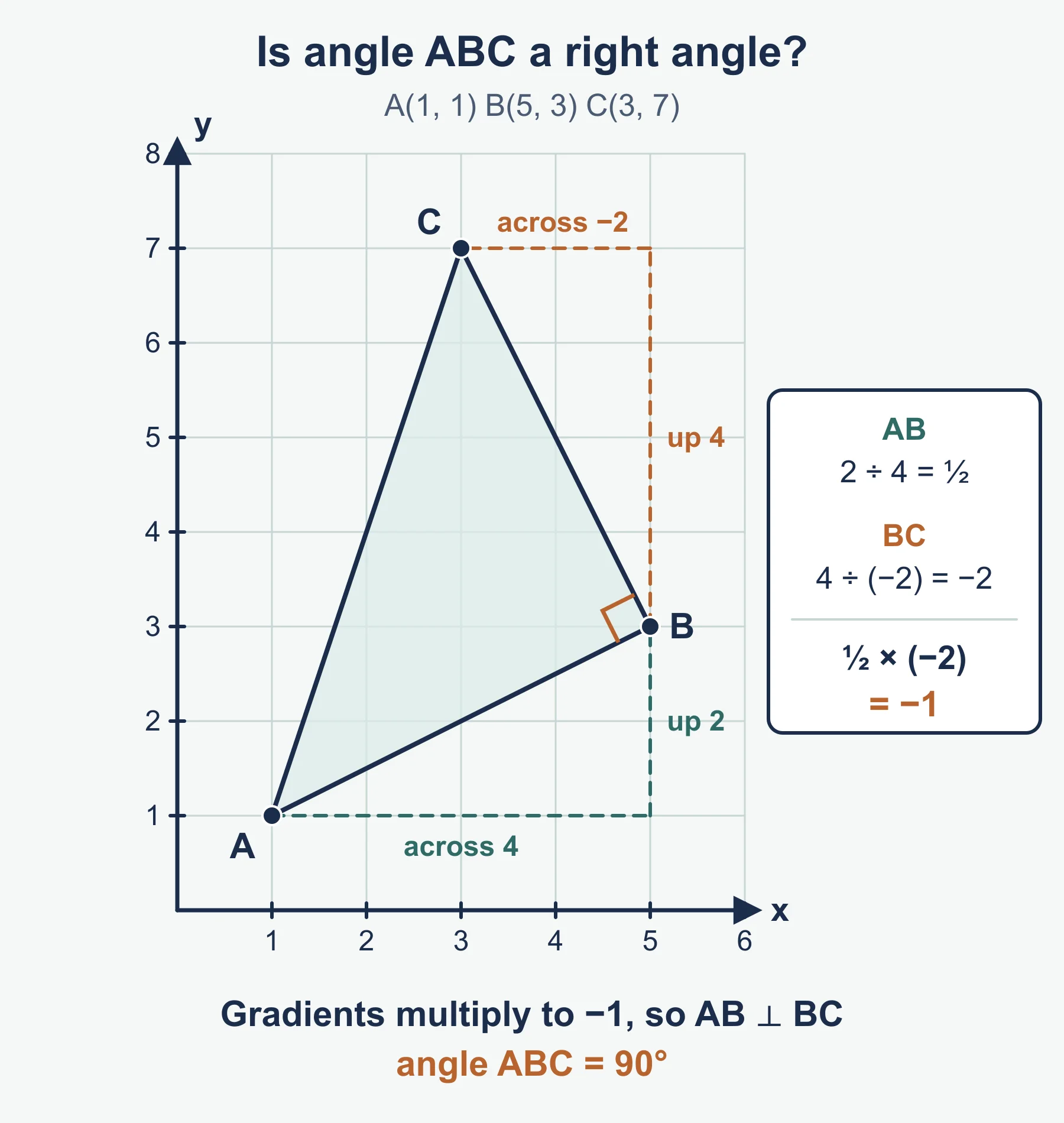
Worked example 15 (a right angle in a triangle). A(1, 1), B(5, 3) and C(3, 7). Show that angle ABC is a right angle.
Gradient of AB = (3 − 1) ÷ (5 − 1) = 1/2. Gradient of BC = (7 − 3) ÷ (3 − 5) = 4 ÷ (−2) = −2. The product is (1/2) × (−2) = −1, so AB and BC are perpendicular and angle ABC is 90°.
Common errors
- Subtracting in different orders on top and bottom of the gradient fraction, which flips the sign.
- Taking the gradient of ax + by = c to be a, or b, or a/b. Always rearrange to y = mx + c first. For 3x + 4y = 12 the gradient is −3/4, not 3/4.
- Forgetting the square root for length, or forgetting to halve for the midpoint.
- Changing the sign but not inverting the fraction (or the reverse) for a perpendicular gradient.
- Substituting the point into the wrong variable when finding c.
- Calling a vertical line y = k, or a horizontal line x = k.
- Leaving a final line equation unsimplified when the question asks for a fully simplified form.
Frequently asked questions
What does coordinate geometry cover in Cambridge O Level Mathematics 4024? Topic 3 covers coordinates, drawing linear graphs, gradient, length and midpoint of a line segment, equations of linear graphs, and parallel and perpendicular lines.
How do you draw a straight-line graph from an equation like 3x + 4y = 12? Use the intercepts: set x = 0 to find where the line crosses the y-axis, set y = 0 to find where it crosses the x-axis, then join the two points. For equations with y as the subject, a table of values also works.
How do you find the equation of a line through two points? Find the gradient from the two points, then substitute one point into y − y₁ = m(x − x₁) and rearrange. Check by substituting the second point into your final equation.
How do you find the equation of a perpendicular bisector? Find the midpoint of the segment, find the gradient of the segment and take its negative reciprocal, then write the equation of the line through the midpoint with that gradient.
How do you prove that an angle is a right angle using coordinates? Find the gradients of the two lines that meet at the angle and show that their product is −1. Then state the conclusion that the lines are perpendicular, so the angle is 90°.
Next steps
Work through the revision notes, try the practice set, and take a free diagnostic to find any gaps.
Official syllabus
Cambridge O Level Mathematics (Syllabus D) 4024 syllabus for examination in 2025, 2026 and 2027, topic 3 Coordinate geometry (Cambridge University Press & Assessment).
Get free revision emails (optional)
Occasional emails with practice questions, worked explanations and links to free resources for the qualification and subjects you choose. No spam, and you can unsubscribe from any email. The free tools on this site never need an email.
Related resources
-
Practice questions
O Level Mathematics: Coordinate Geometry Practice Questions (Cambridge 4024)
Twelve original Cambridge O Level Mathematics 4024 coordinate geometry questions on gradients, line equations, parallel and perpendicular lines, with answers.
Mathematics · Cambridge · O Level
Try questions -
Revision notes
Cambridge O Level Mathematics: Coordinate Geometry (4024) – Revision Notes
Condensed Cambridge O Level Mathematics revision notes on gradient, length, midpoint, line equations, parallel and perpendicular lines, with a self-test.
Mathematics · Cambridge · O Level
Revise topic -
Study guides
Cambridge O Level Mathematics: Geometry (4024)
A step-by-step Cambridge O Level Mathematics study guide to geometry: terms, constructions, bearings, similarity, symmetry, angles and circle theorems.
Mathematics · Cambridge · O Level
Read guide
Related articles
-
exam preparation
Where IGCSE Mathematics marks are lost early
The first weeks of an IGCSE Mathematics course rarely go wrong on difficulty. They go wrong on method, command words, rounding and units — four habits that cost marks a student had already earned.
24 August 2026
-
teaching
A Level tuition in Dubai: Cambridge or Pearson Edexcel International A Level?
Schools in Dubai and Abu Dhabi teach either Cambridge International AS & A Level or Pearson Edexcel International A Level. How the two are structured, why it matters for tuition, and how online classes from Lahore work.
9 October 2026
Studying this with a teacher
Working through Mathematics O LEVELS?
This page is free and stays free. If you would rather be taught it, Marlbridge runs Mathematics classes one-to-one and in small groups of up to 15, online in your own time zone. The first trial class is free. WhatsApp replies within an hour (8am–11pm Pakistan time, every day); email the same day.
Cambridge Mathematics teachers at Marlbridge


