
Study Guides
Cambridge O Level Mathematics: Geometry (4024)
A step-by-step Cambridge O Level Mathematics study guide to geometry: terms, constructions, bearings, similarity, symmetry, angles and circle theorems.
- Subject
- Mathematics
- Level
- O LEVELS
- Topic
- Geometry
- Author
- Marlbridge Academic Team
- Updated
- Reviewed by
- Sajawal Zahid (what this means)
Aligned to Cambridge O Level Mathematics (4024), 2025-2027. Official specification .
Syllabus page (what it covers and how it is assessed): Cambridge O Level Mathematics.
Syllabus points this page covers
4024
- 4 Geometry (whole topic)
Found an error? Report a correction.
Need help with this topic? Request a free trial class for O Level Mathematics (4024).
This guide teaches topic 4, Geometry, from the Cambridge O Level Mathematics (Syllabus D) 4024 syllabus for examination in 2025, 2026 and 2027. It covers sections 4.1 to 4.8. Every candidate sits Paper 1 (non-calculator) and Paper 2 (calculator), so practise angle and ratio work both ways.
Pair it with the revision notes and the practice questions. The course hub lists the other topics, the checklist lets you tick off each outcome, and the free diagnostics show where to focus.
What this topic covers
| Section | What you must be able to do |
|---|---|
| 4.1 Geometrical terms | Use and interpret the vocabulary of lines, angles, triangles, quadrilaterals, polygons, nets, solids and circles |
| 4.2 Constructions | Measure and draw lines and angles; construct a triangle from three sides with compasses; draw and use nets |
| 4.3 Scale drawings | Draw and interpret scale drawings; use three-figure bearings |
| 4.4 Similarity | Lengths of similar shapes; area and volume scale factors; simple explanations |
| 4.5 Symmetry | Line and rotational symmetry in 2D; planes and axes of symmetry of solids |
| 4.6 Angles | Angle facts, parallel lines, polygon angles, with reasons |
| 4.7 Circle theorems I | Semicircle, tangent and radius, centre and circumference, same segment, cyclic quadrilateral, alternate segment |
| 4.8 Circle theorems II | Chords and the centre, tangents from an external point |
4.1 Geometrical terms
Use these words precisely, because reasons depend on them. A point has position only; a line is straight; a plane is a flat surface; parallel lines never meet; perpendicular lines meet at a right angle (90°). Congruent shapes are identical in shape and size (the syllabus says you are not expected to show that two shapes are congruent). Similar shapes have the same shape and corresponding lengths in a constant ratio, the scale factor.
- An interior angle lies inside a polygon at a vertex; an exterior angle is formed by extending one side. They add to 180°.
- Acute is under 90°, obtuse is between 90° and 180°, reflex is between 180° and 360°.
- A perpendicular bisector cuts a line at 90° through its midpoint.
Triangles: equilateral (three equal sides), isosceles (two), scalene (none equal), right-angled. Quadrilaterals: square, rectangle, kite, rhombus, parallelogram, trapezium (one pair of parallel sides). Polygons are regular if all sides and angles are equal, otherwise irregular: pentagon (5 sides), hexagon (6), octagon (8), decagon (10).
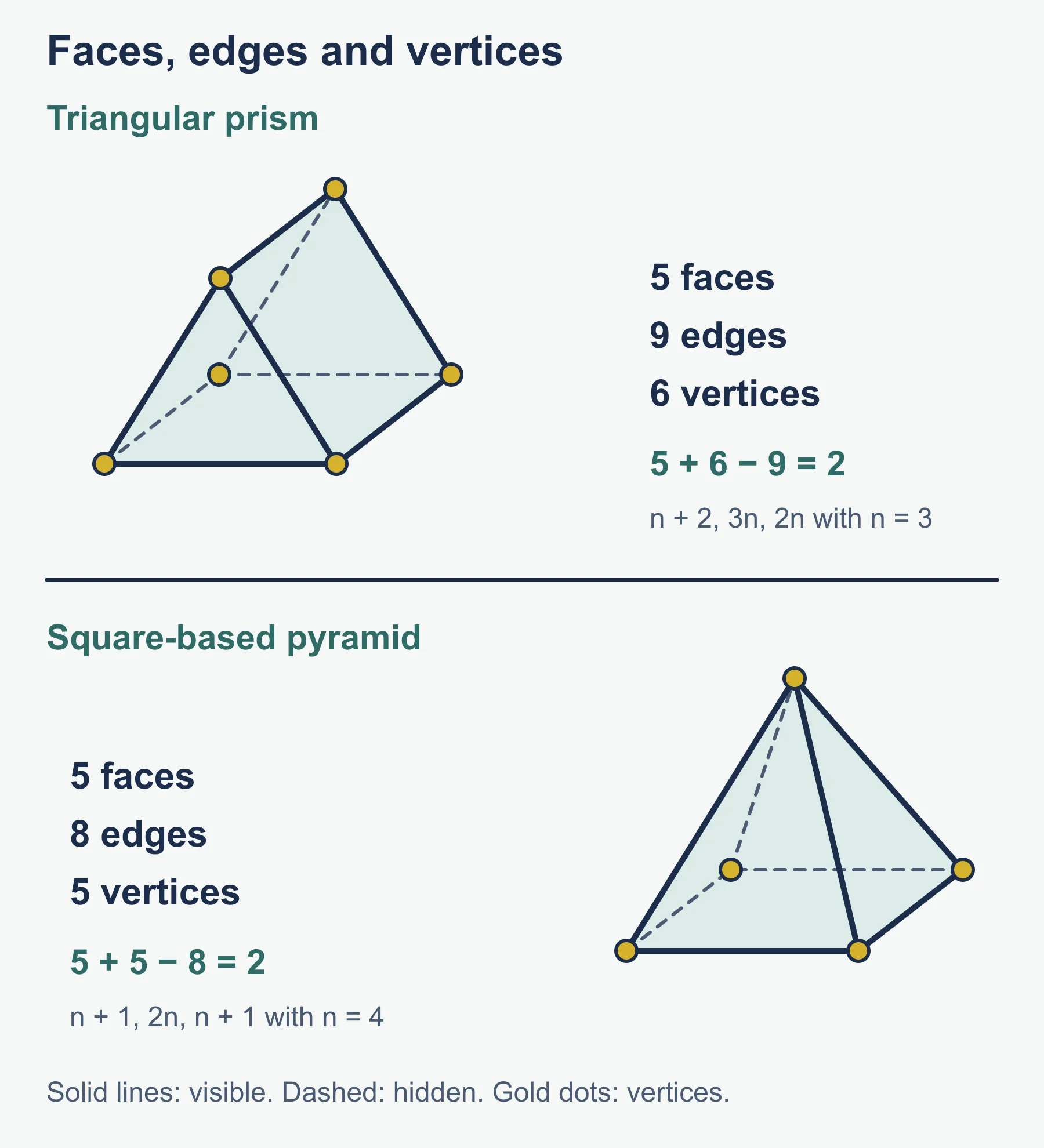
Solids: cube, cuboid, prism (uniform cross-section), cylinder, pyramid, cone, sphere, hemisphere and frustum (a cone with the top cut off by a plane parallel to its base). A face is a flat surface, an edge is where two faces meet, and a vertex is a corner.
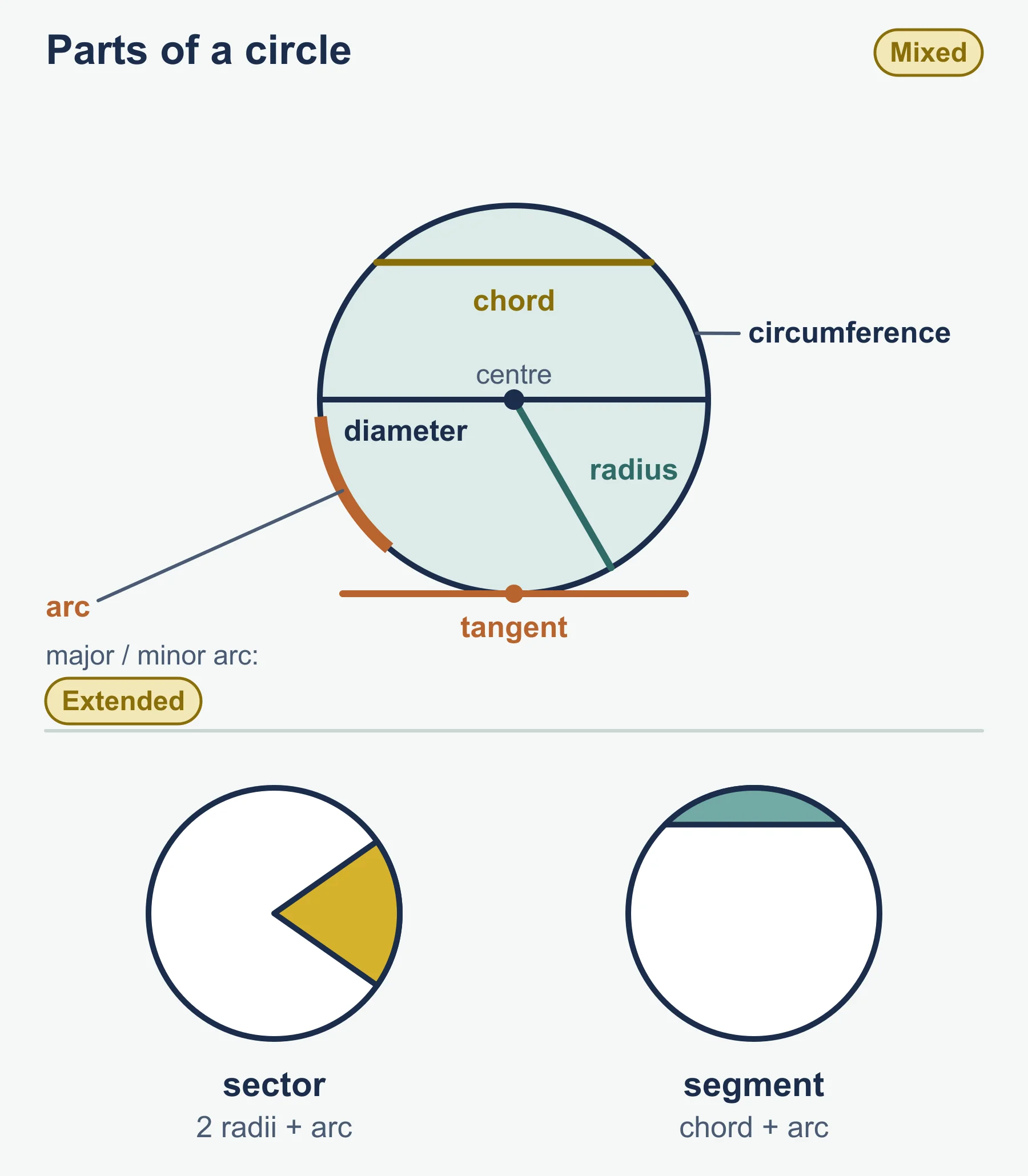
Circle vocabulary: centre, radius, diameter, circumference, semicircle, chord (a line joining two points on the circle), tangent (touches once), major and minor arc, sector (between two radii and an arc) and segment (between a chord and an arc).
4.2 Constructions and nets
Measure and draw angles with a protractor and lines with a ruler. The syllabus says a ruler must be used for all straight edges, and that constructing perpendicular bisectors and angle bisectors is not required.
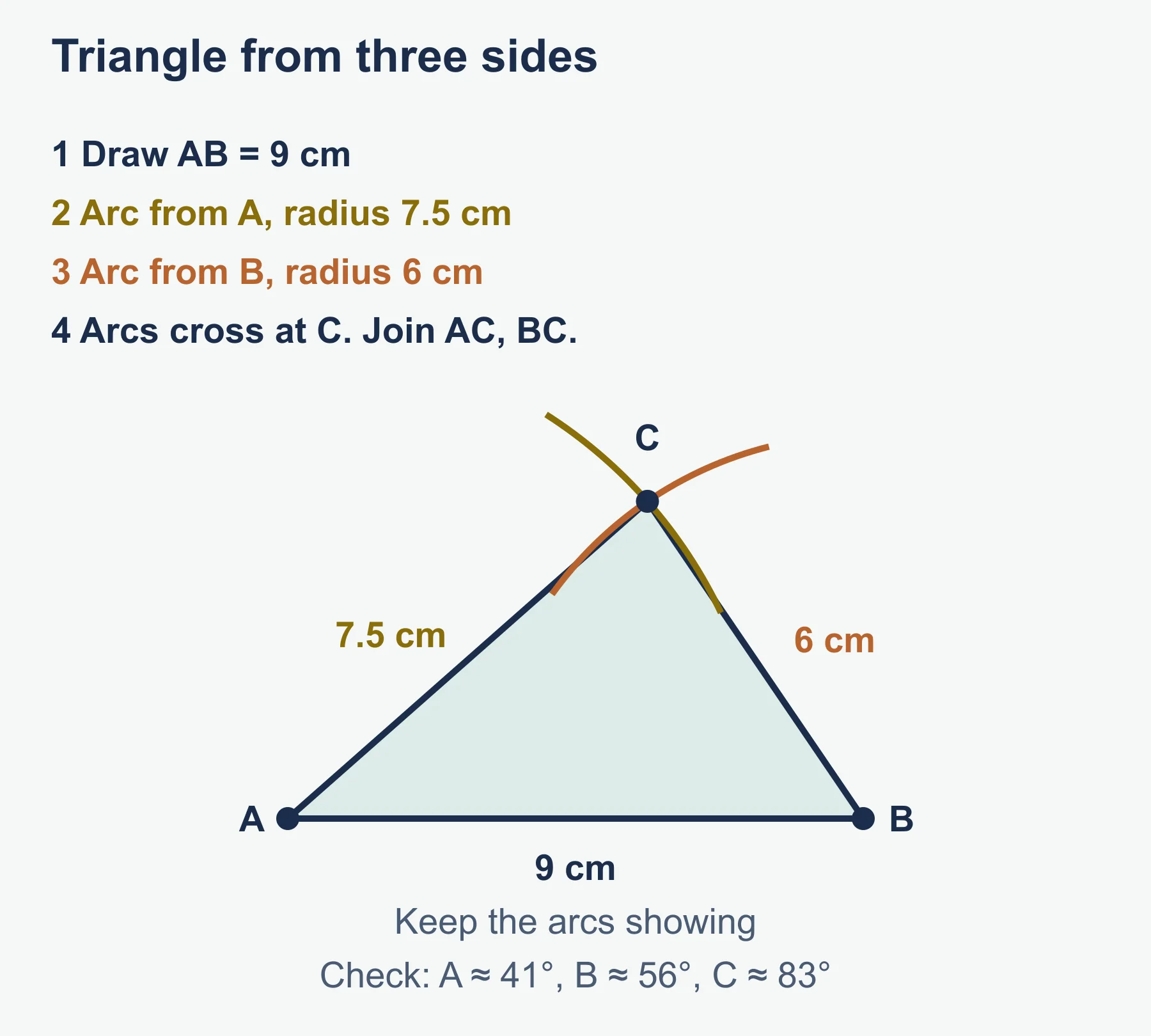
Constructing a triangle from three sides (compasses and ruler only). The syllabus requires you to show construction arcs.
- Draw one side as the base, measured exactly.
- Set the compasses to the second side, put the point on one end of the base and draw an arc.
- Set them to the third side, put the point on the other end and draw a crossing arc.
- Join the crossing point to both ends. Leave all arcs visible.
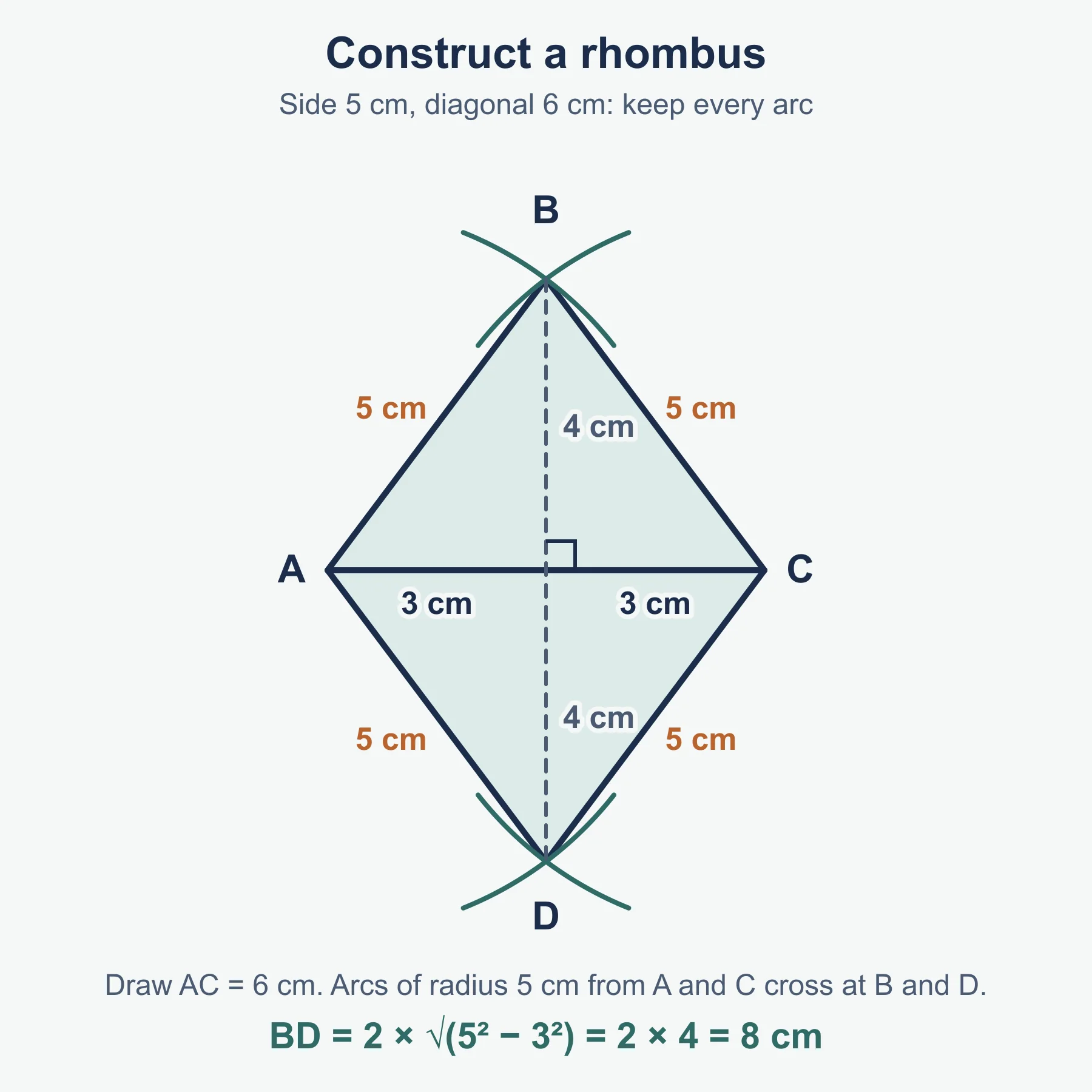
Worked example. Construct a rhombus of side 5 cm with one diagonal 6 cm.
A diagonal splits a rhombus into two triangles with sides 5, 5 and 6. Draw the 6 cm diagonal, build a triangle on it with two arcs of radius 5 cm, then repeat on the other side. The diagonals are perpendicular and bisect each other, so half the second diagonal is √(5² − 3²) = 4 cm. Your second diagonal should measure 8 cm.
Nets. A net is a flat pattern that folds into a solid. Faces that fold together must have edges of equal length.
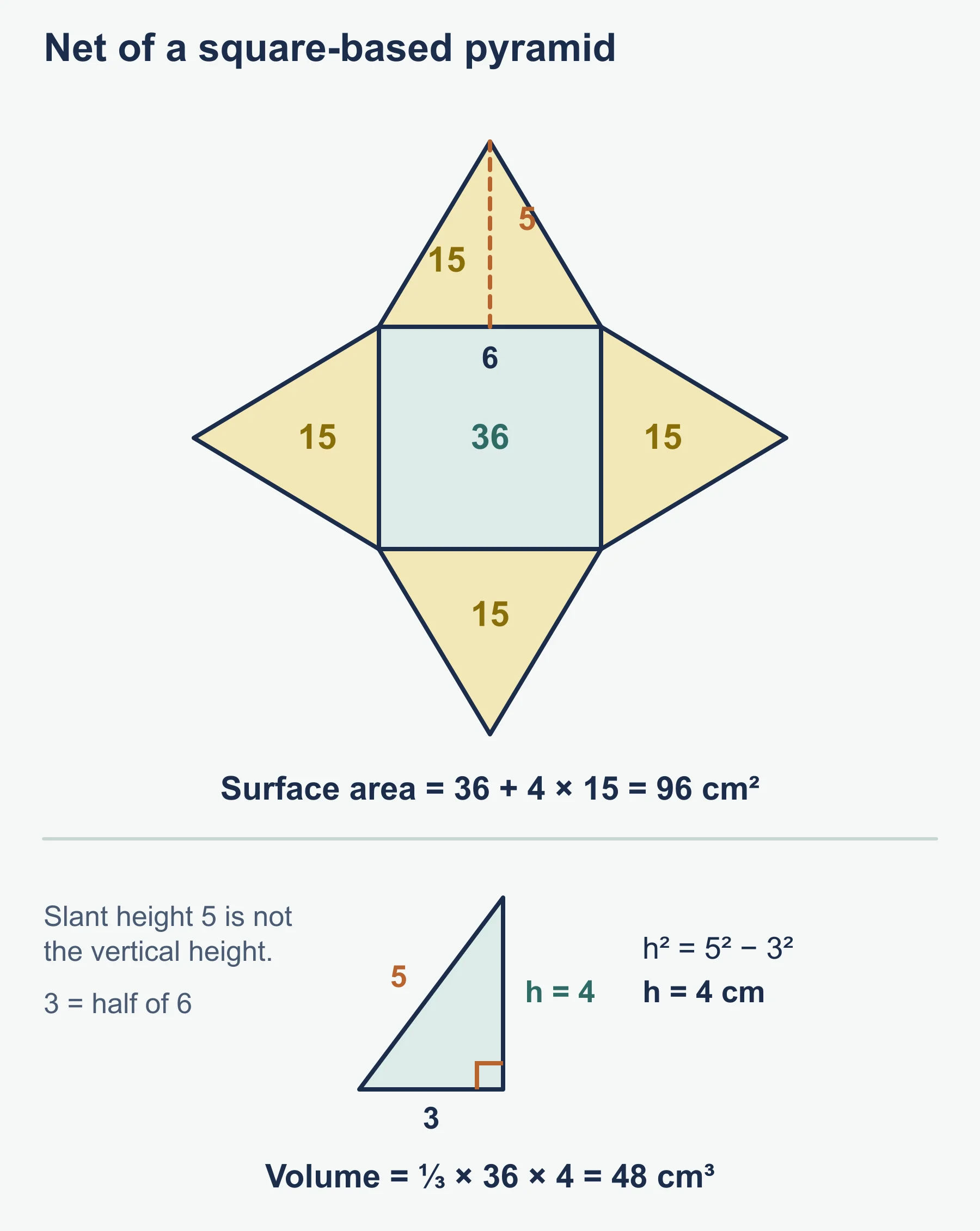
Worked example. A square-based pyramid has a square base of side 6 cm and four triangular faces, each with a slant height (measured along the face from the base edge to the apex) of 5 cm.
- Four triangles: 4 × ½ × 6 × 5 = 60 cm². With the base, surface area = 60 + 36 = 96 cm².
- Vertical height = √(5² − 3²) = 4 cm, so volume = ⅓ × 36 × 4 = 48 cm³.
4.3 Scale drawings and bearings
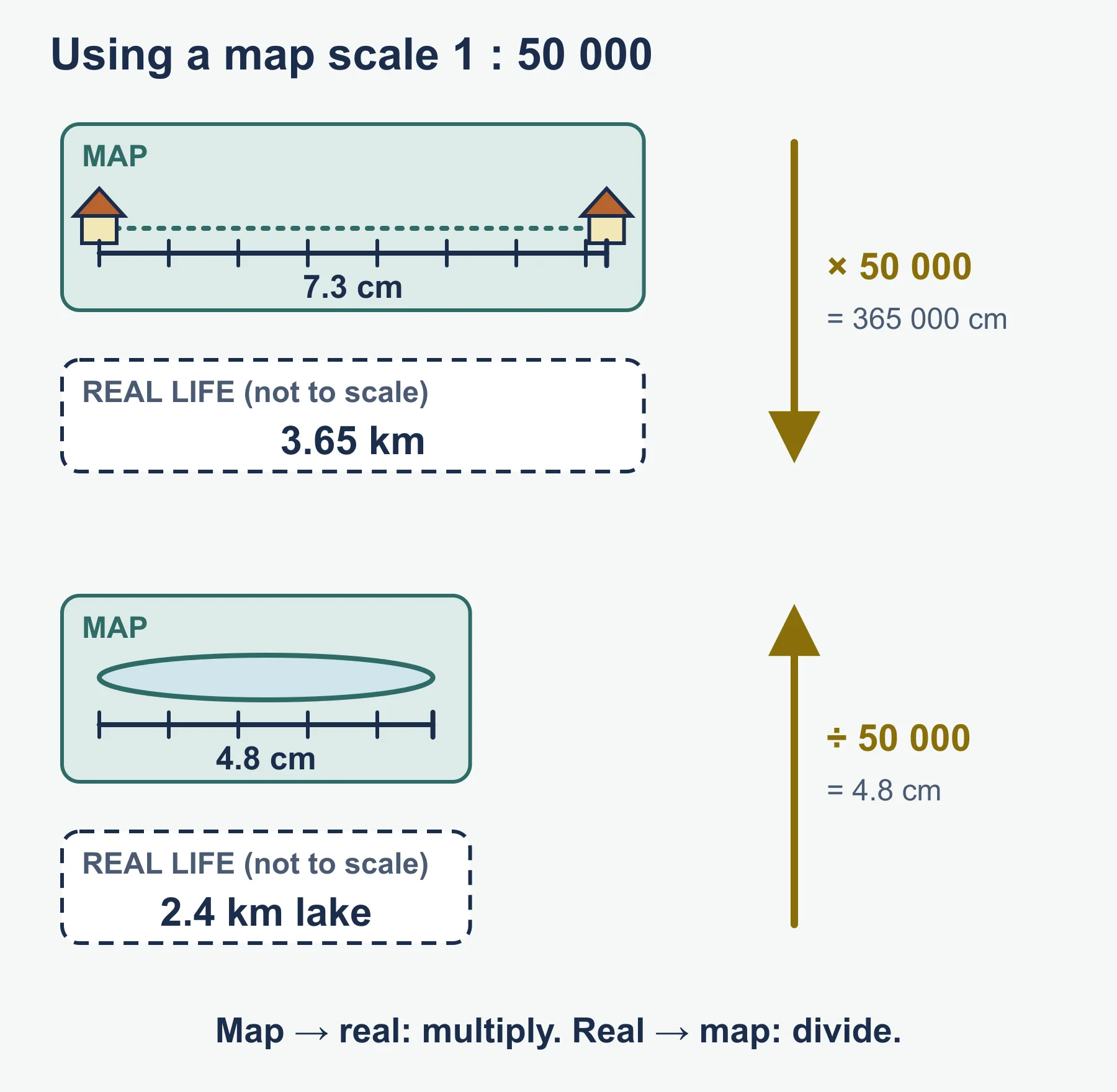
A scale of 1 cm : 10 km means 1 cm on the drawing is 10 km on the ground.
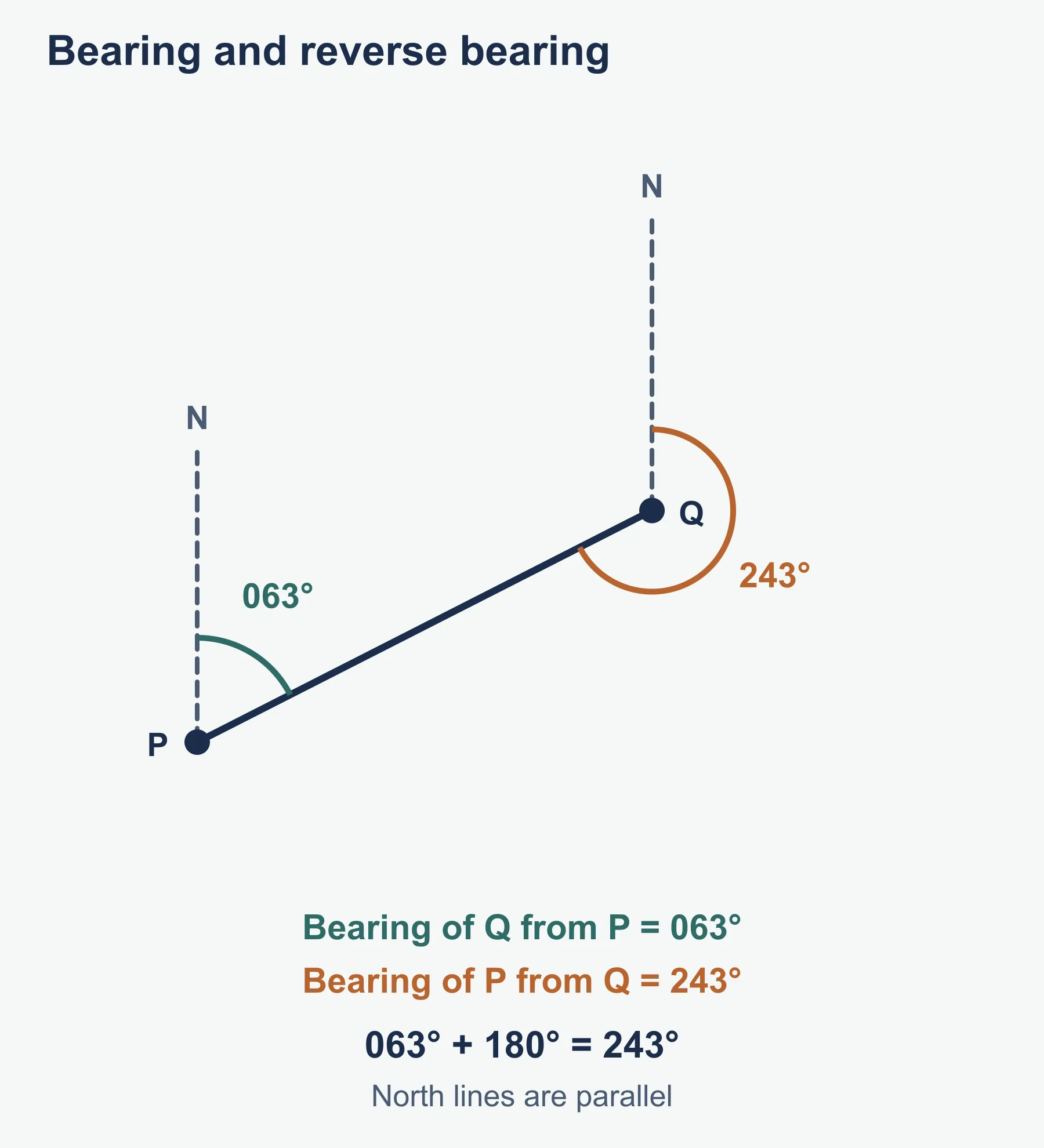
Bearings are measured clockwise from north, with three figures: east is 090°, south 180°, west 270°, and 007° is written with its zeros. To find a back bearing, add or subtract 180°. If the bearing of B from A is 108°, the bearing of A from B is 108° + 180° = 288°. Draw a north line at each point; north lines are parallel.
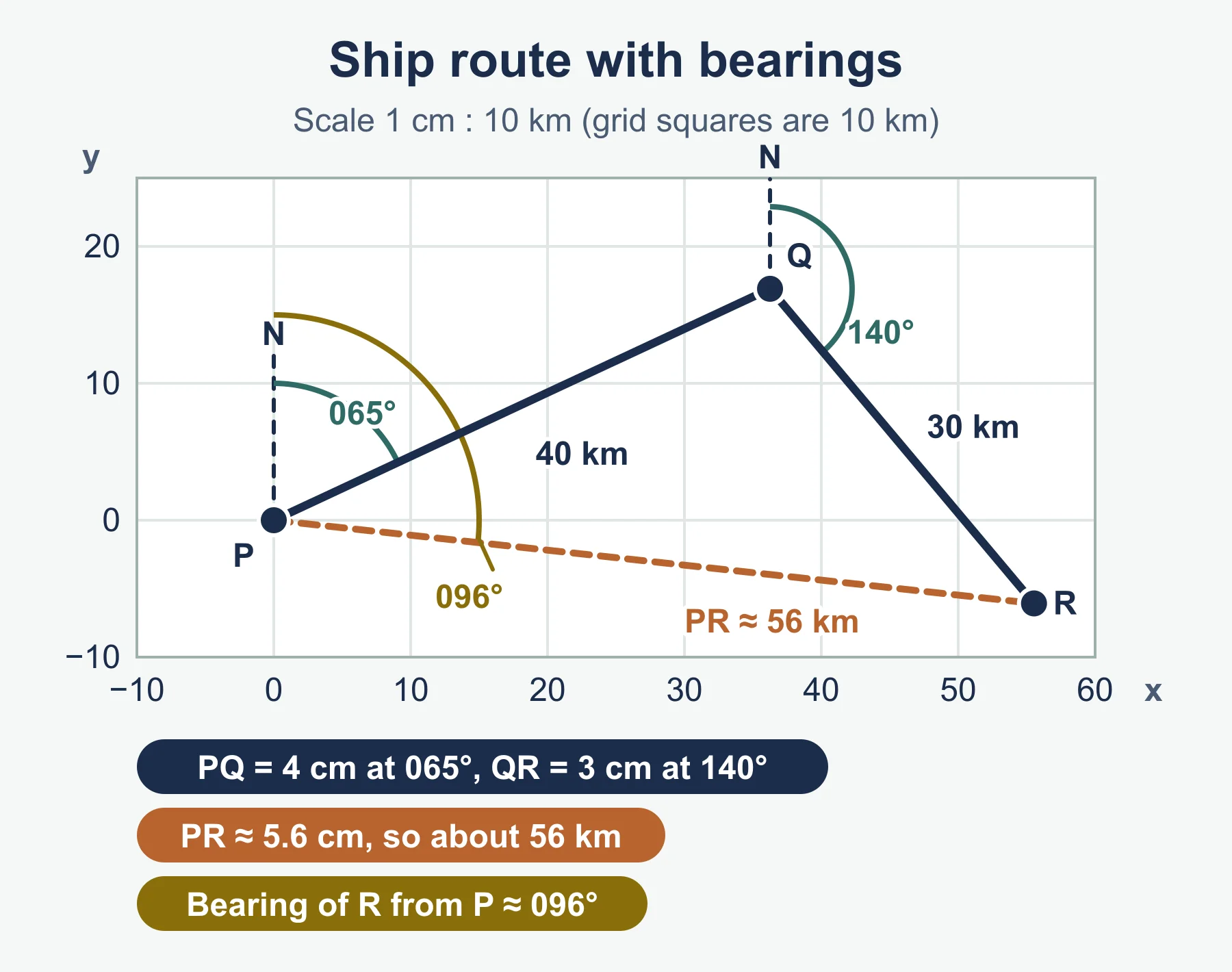
Worked example. A ship leaves port P and sails 40 km on a bearing of 065° to Q. It then sails 30 km on a bearing of 140° to R. Find the distance PR and the bearing of R from P, using a scale of 1 cm : 10 km.
- At P draw a north line, measure 065° clockwise and draw PQ = 4 cm.
- At Q draw a north line, measure 140° clockwise and draw QR = 3 cm.
- Join PR and measure it and its bearing.
A careful drawing gives PR close to 5.6 cm, which is about 56 km, and a bearing of R from P of about 096°.
4.4 Similarity
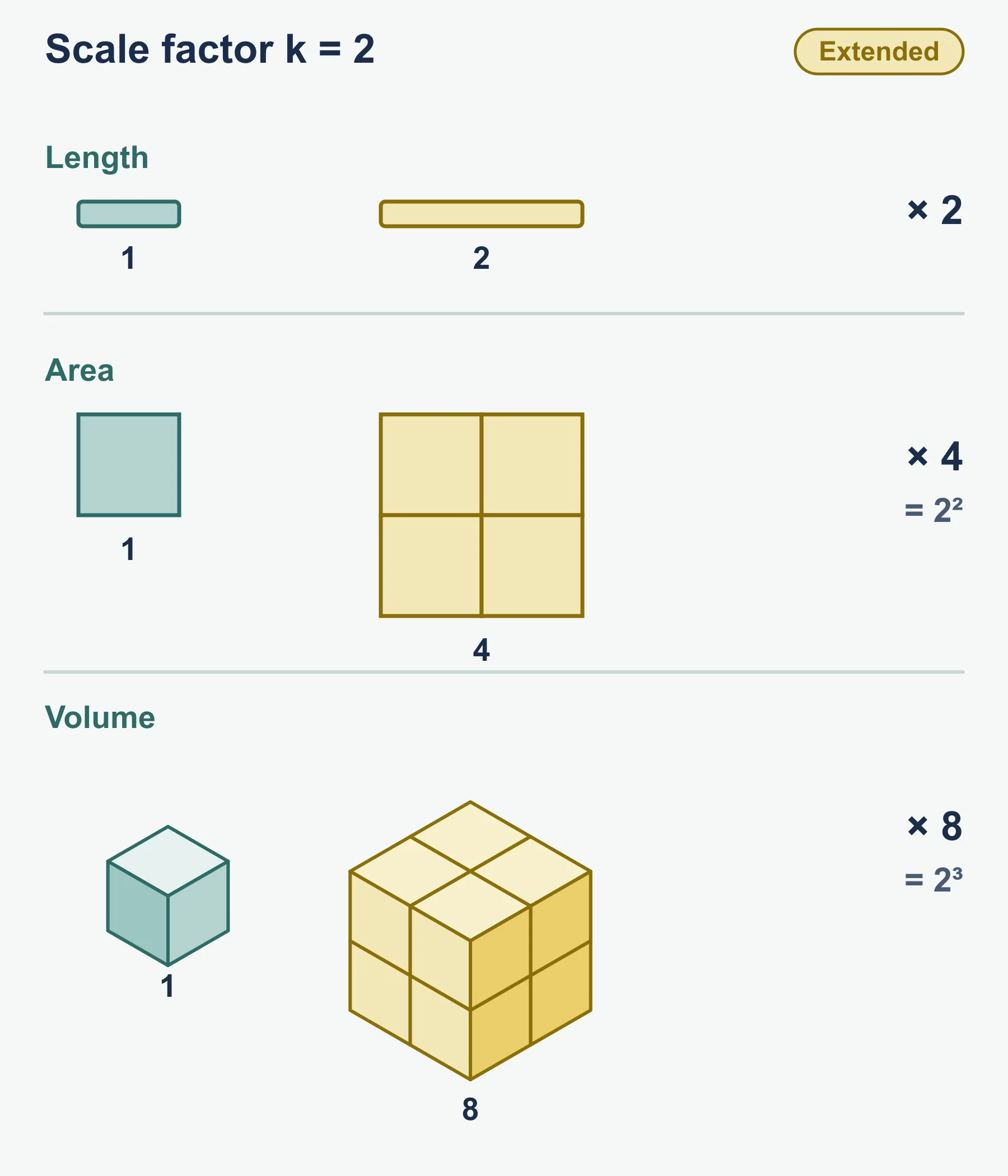
Two shapes are similar if one is an enlargement of the other. If the linear scale factor is k:
- lengths multiply by k
- areas (including surface areas) multiply by k²
- volumes multiply by k³
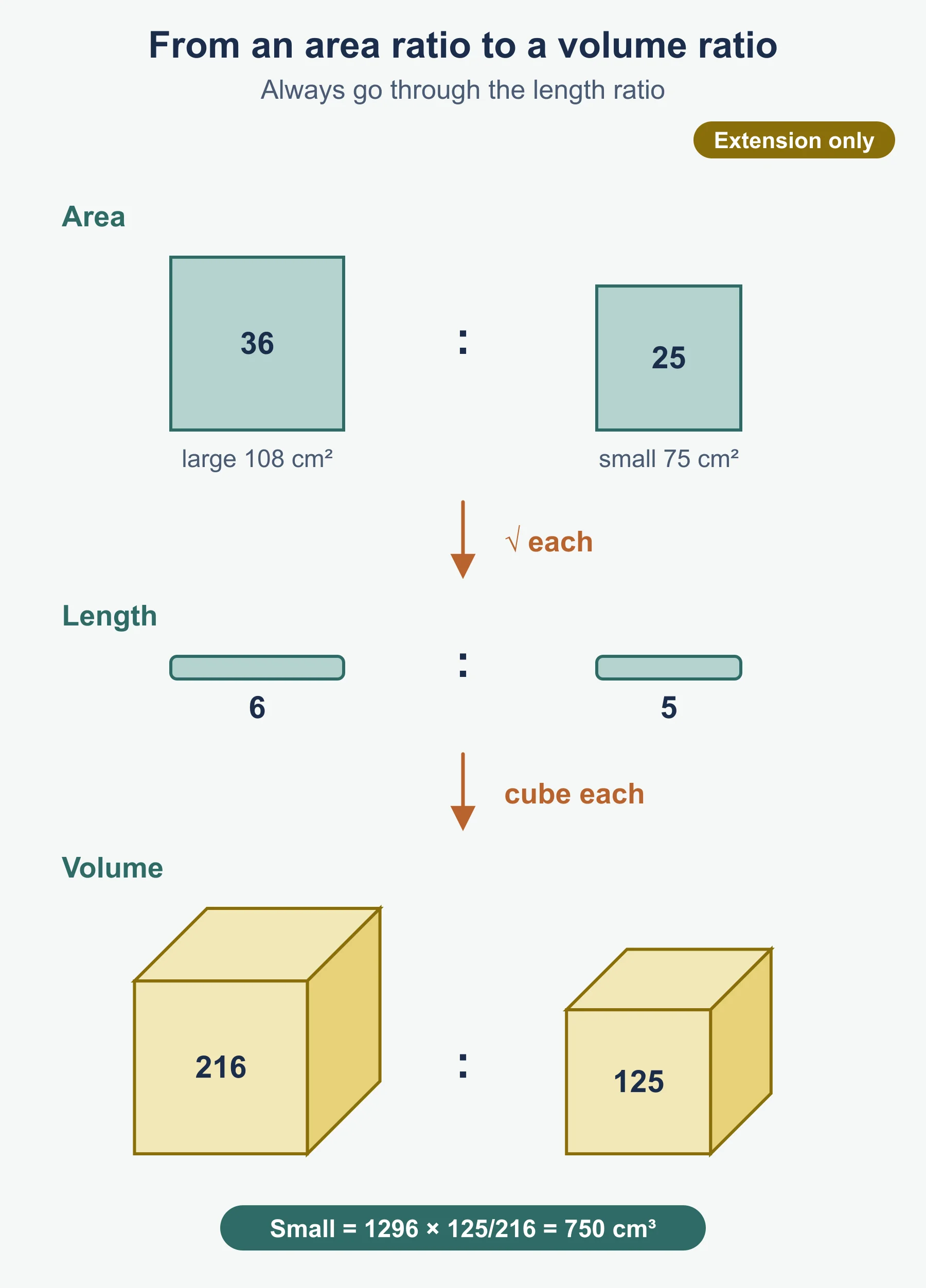
So the volume ratio equals (length ratio)³, as the syllabus notes: Volume of A over Volume of B equals (Length of A over Length of B) cubed.
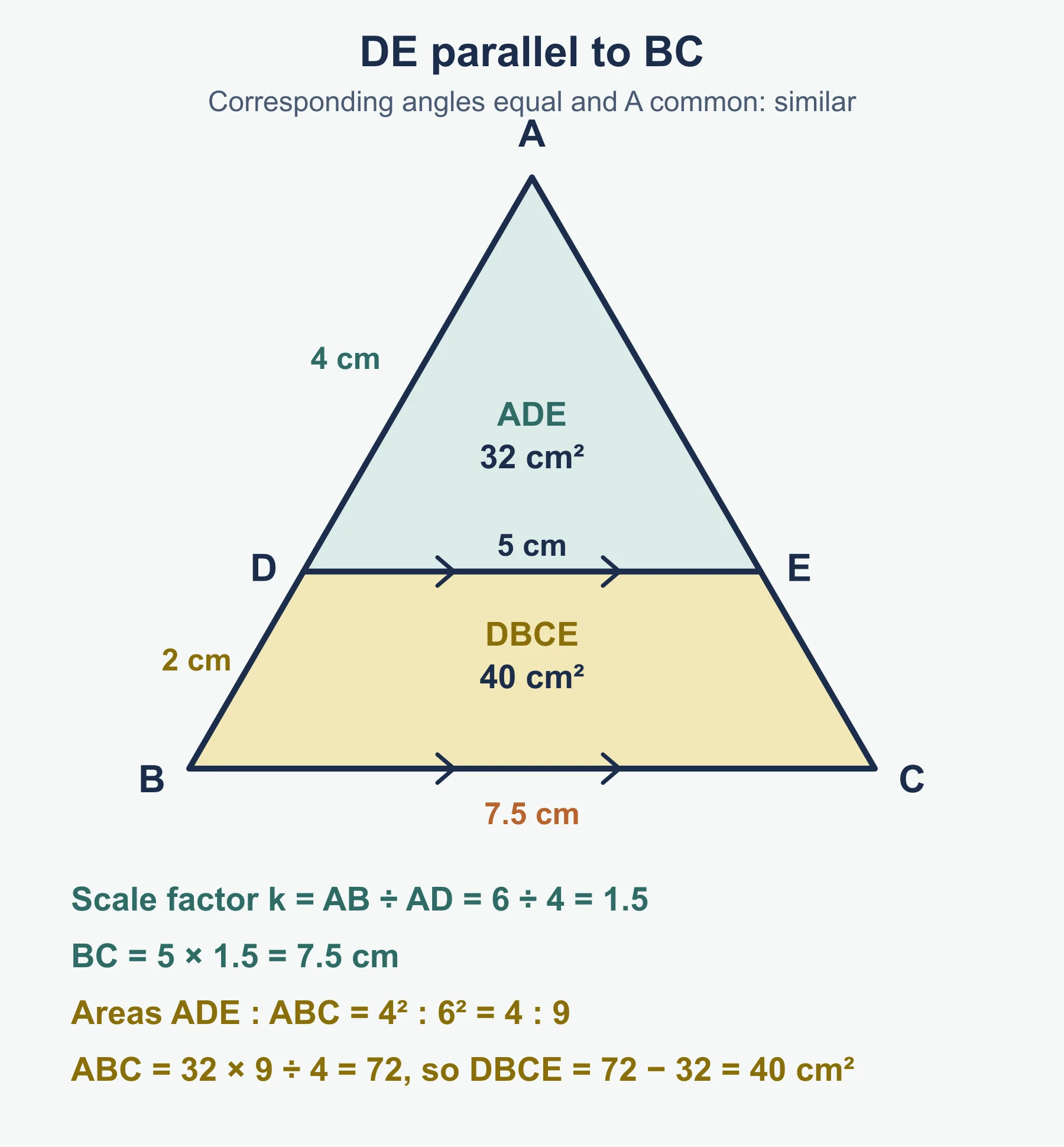
Worked example (lengths and areas). In triangle ABC, point D is on AB and point E is on AC, and DE is parallel to BC. AD = 4 cm, DB = 2 cm and DE = 5 cm.
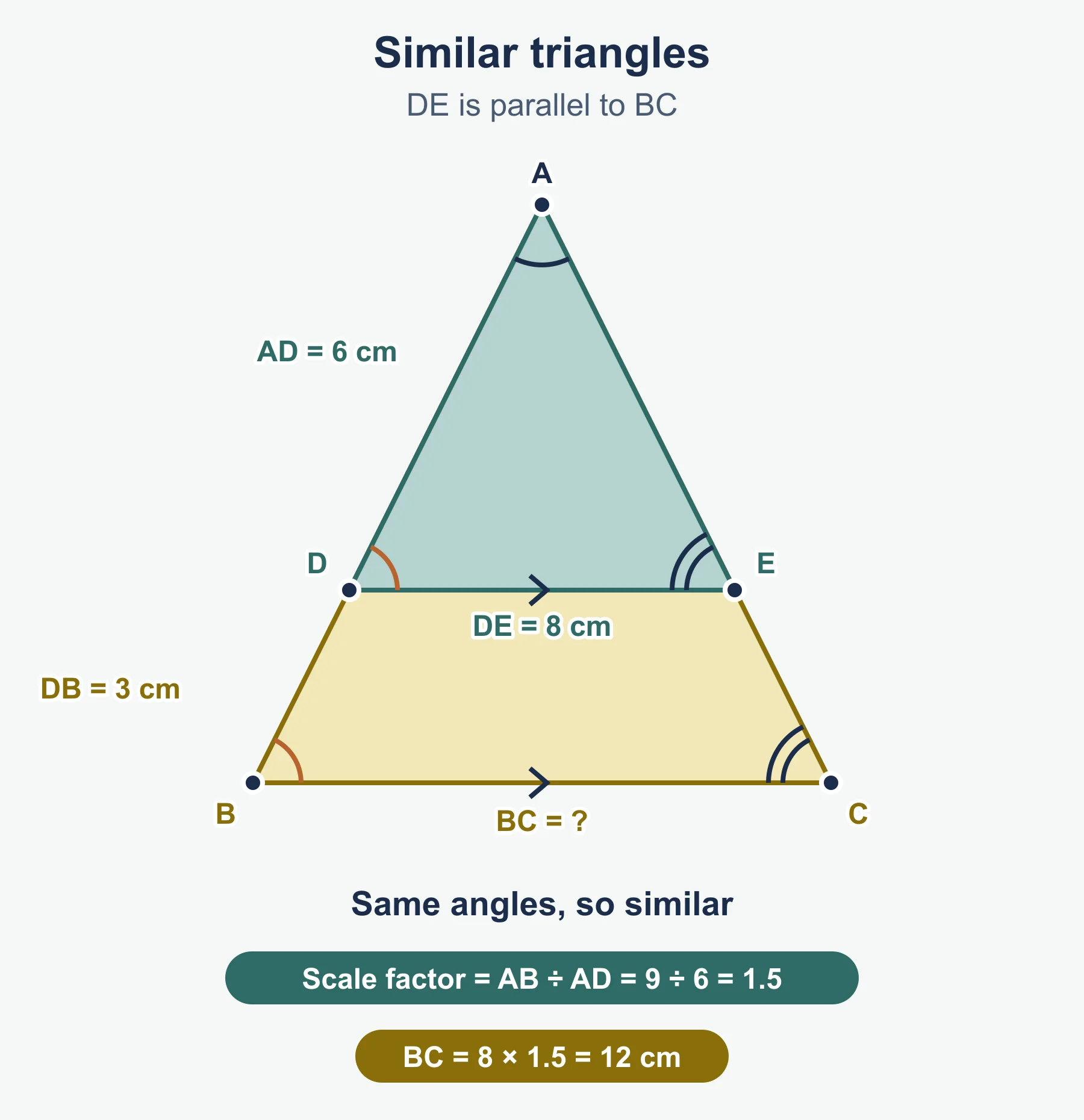
- Angle ADE = angle ABC (corresponding angles) and angle A is common, so the triangles are similar.
- Scale factor = AB ÷ AD = 6 ÷ 4 = 1.5. So BC = 5 × 1.5 = 7.5 cm.
- Area ratio ADE : ABC = 4² : 6² = 16 : 36 = 4 : 9. If triangle ADE has area 32 cm², then ABC has 72 cm², and the quadrilateral DBCE has 40 cm².
Worked example (solids). Two similar solids have surface areas 18 cm² and 50 cm². The smaller has volume 54 cm³. Area ratio 18 : 50 gives length ratio √(18/50) = 3 : 5. Volume ratio = 27 : 125, so the larger volume = 54 × 125 ÷ 27 = 250 cm³.
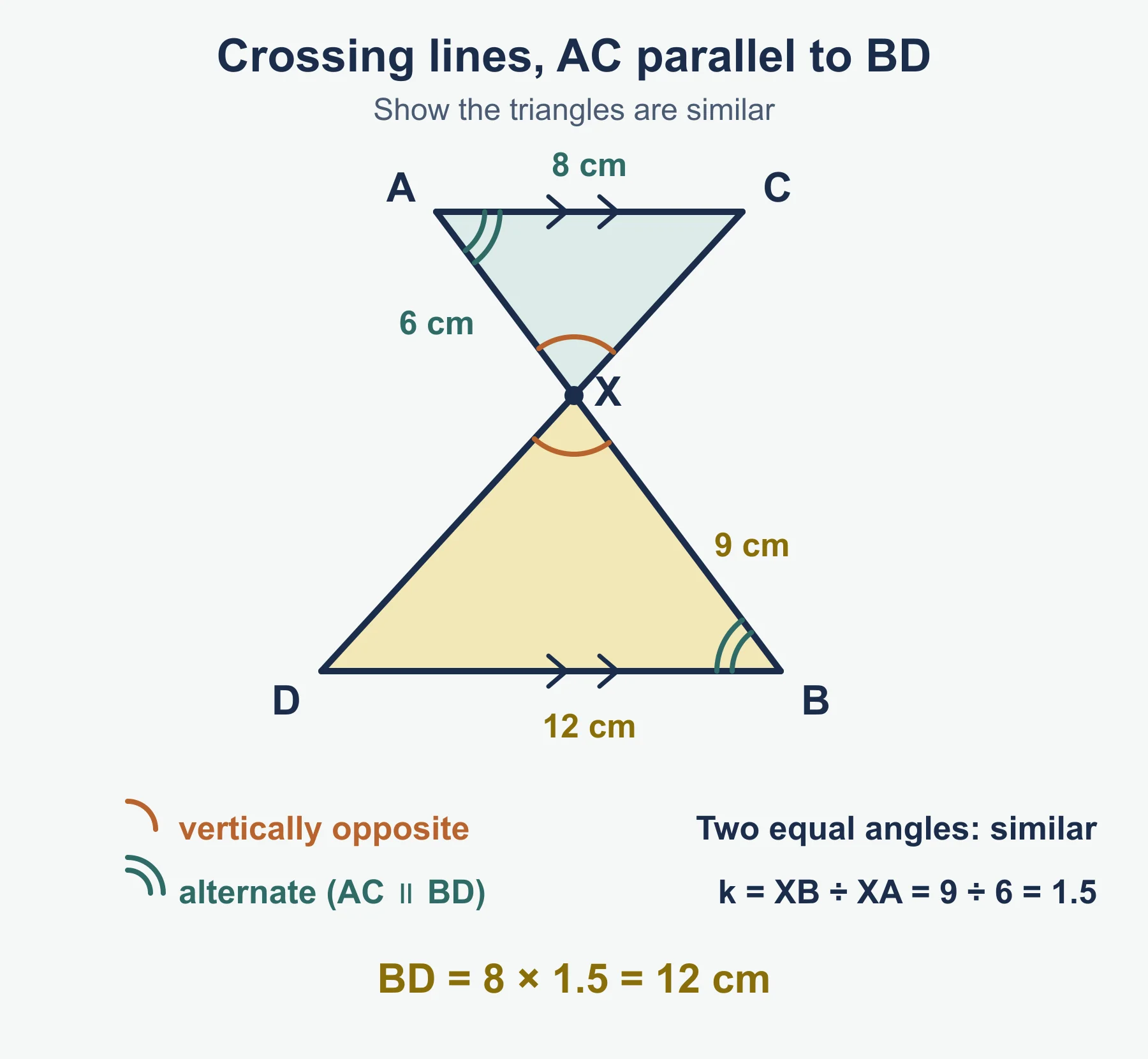
Explaining similarity. To show two triangles are similar, state the equal angles with a reason each. If AB and CD cross at X with AC parallel to BD, triangles XAC and XBD have equal vertically opposite angles and equal alternate angles, so they are similar. With XA = 6, XB = 9 and AC = 8, BD = 8 × 9/6 = 12.
4.5 Symmetry
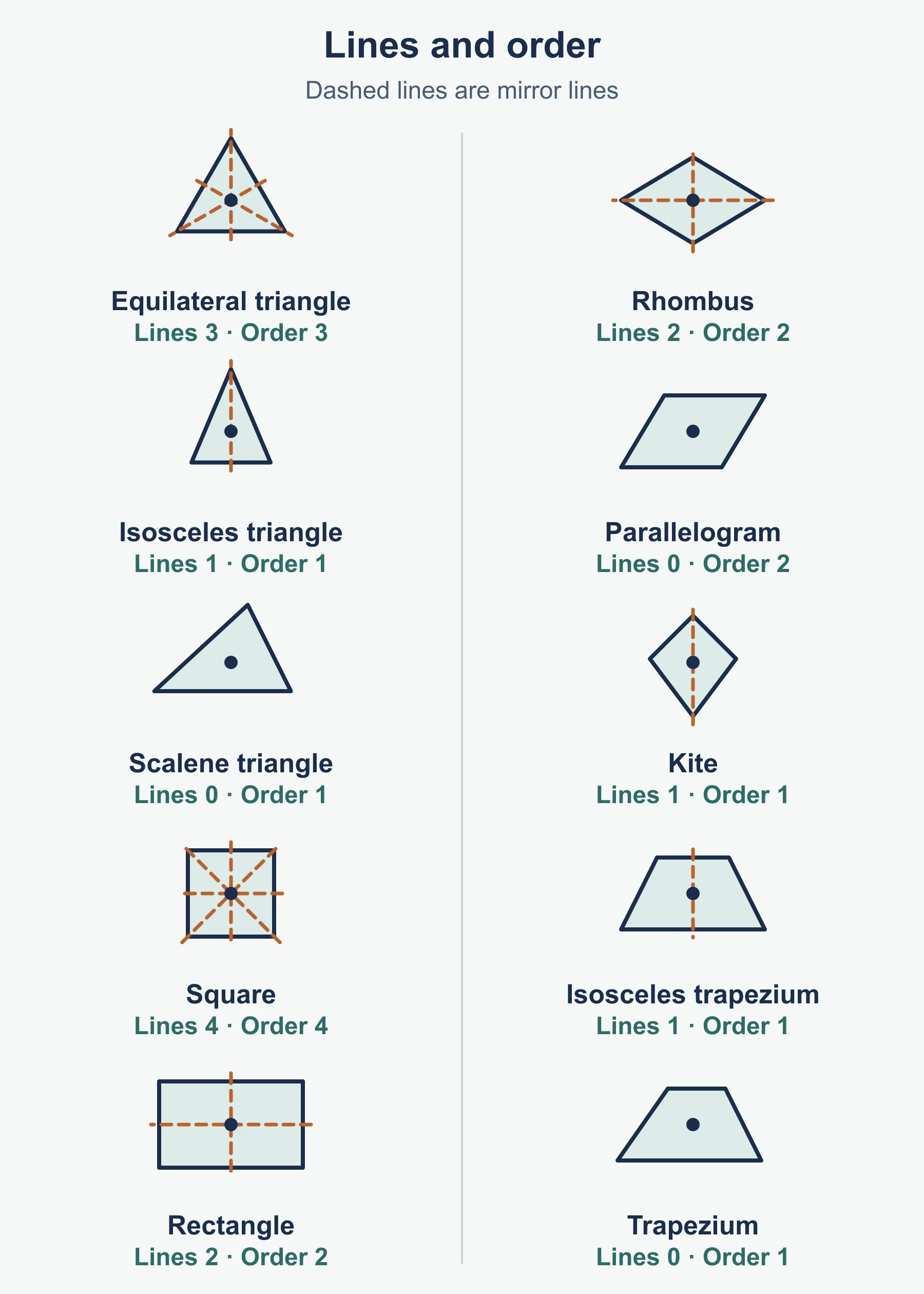
A shape has line symmetry if a mirror line maps it onto itself. Its order of rotational symmetry is the number of positions, including the start, in which it looks unchanged during a full turn.
| Shape | Lines of symmetry | Order of rotation |
|---|---|---|
| Equilateral triangle | 3 | 3 |
| Square | 4 | 4 |
| Rectangle (not a square) | 2 | 2 |
| Rhombus (not a square) | 2 | 2 |
| Parallelogram (not a rectangle or rhombus) | 0 | 2 |
| Kite | 1 | 1 |
| Isosceles trapezium | 1 | 1 |
| Regular polygon with n sides | n | n |
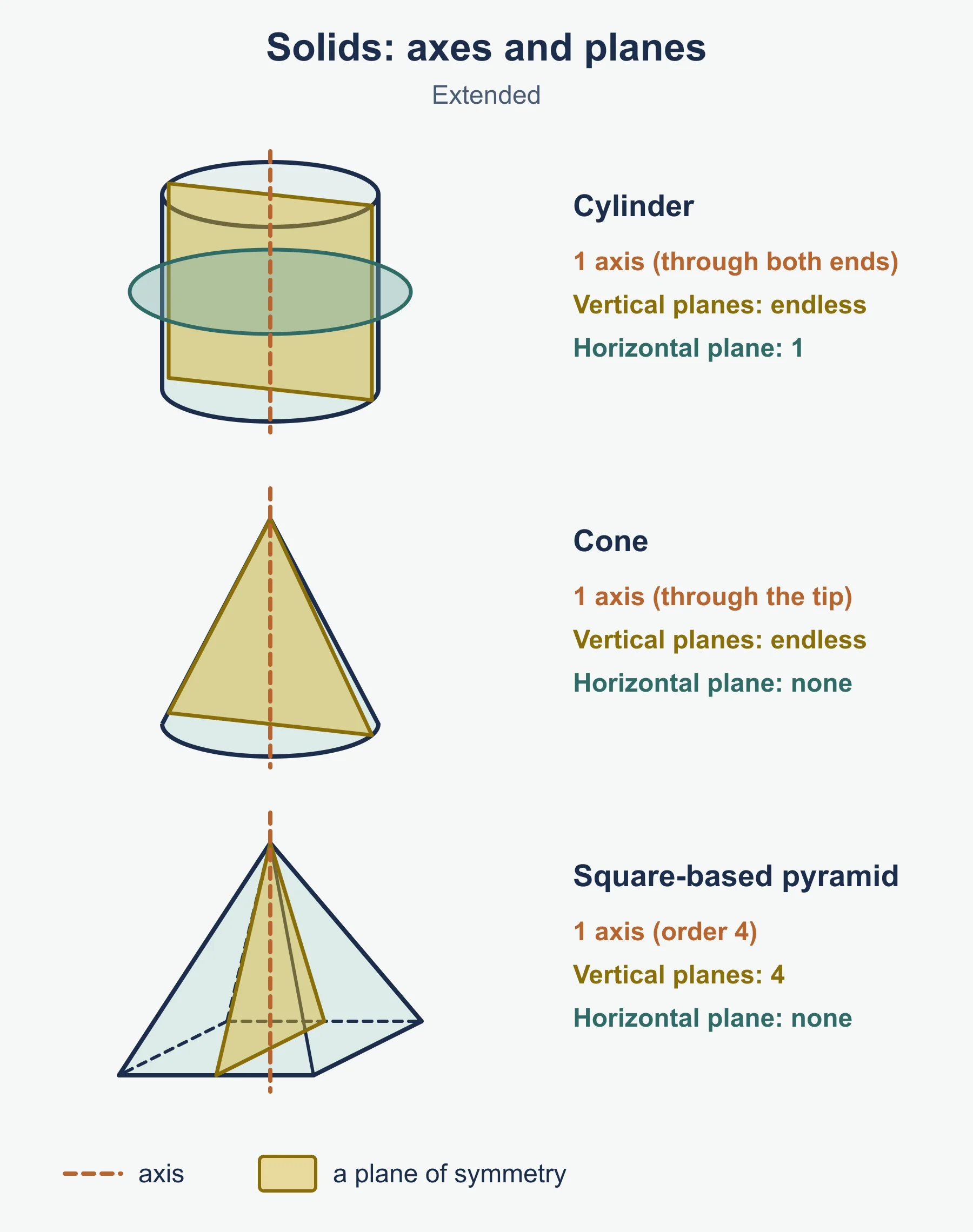
For solids, identify planes of symmetry (mirror planes that cut the solid into reflected halves) and axes of symmetry (lines about which the solid can be turned to look the same). A cuboid with three different edge lengths has 3 planes and 3 axes, each of order 2. A square-based pyramid has 4 planes and 1 axis of order 4. A regular triangular prism has 4 planes and 4 axes: one of order 3 along its length and three of order 2. A cone has one axis, with infinitely many planes containing it. A cylinder has the same planes and axis, one plane across its middle, and order-2 axes through its middle perpendicular to the main axis.
4.6 Angles
Give the reason with every angle, using the correct terms. Use three-letter notation: angle ABC is the angle at B between BA and BC.
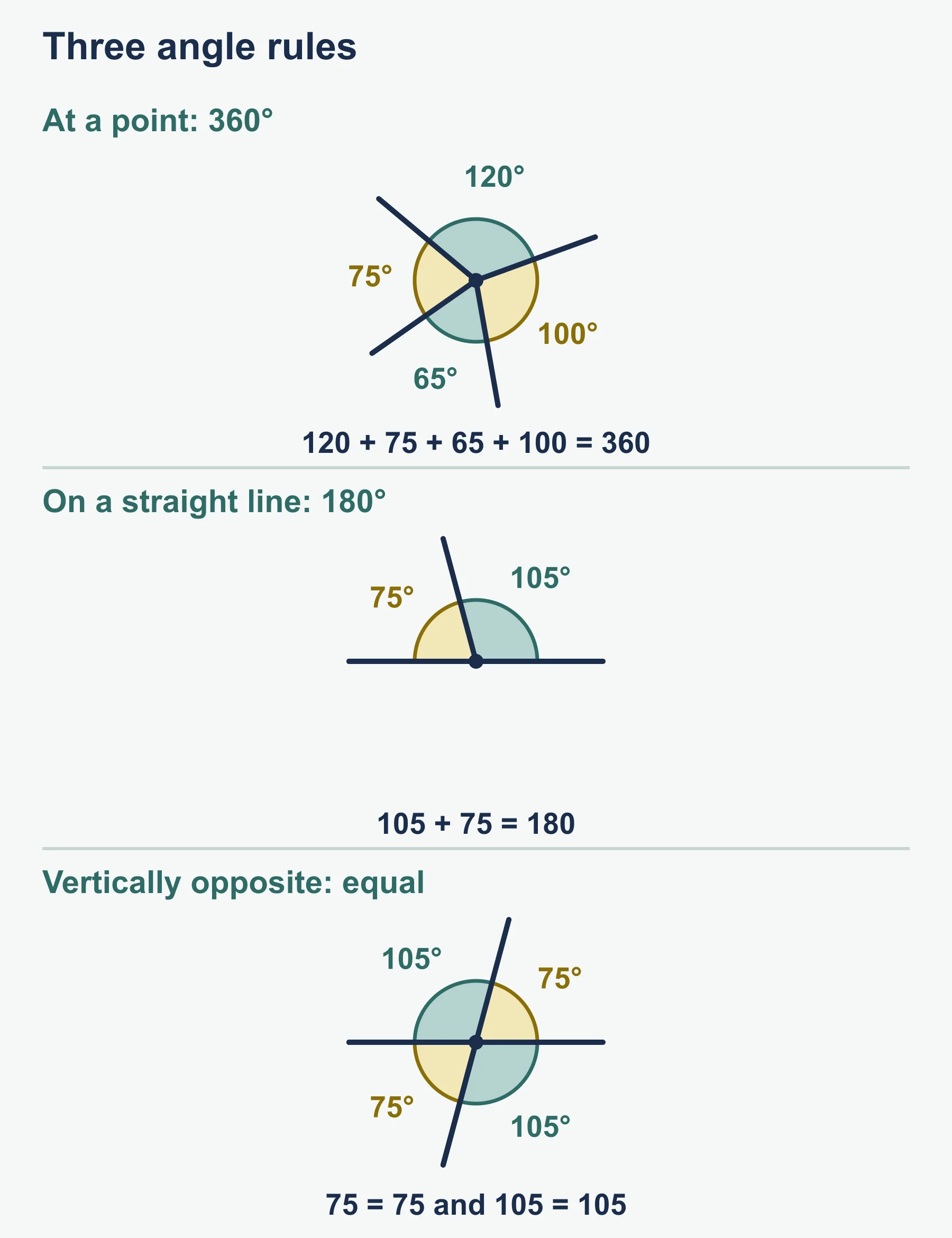
- Angles at a point sum to 360°.
- Angles on a straight line sum to 180°.
- Vertically opposite angles are equal.
- Angles in a triangle sum to 180°; in a quadrilateral, 360°.
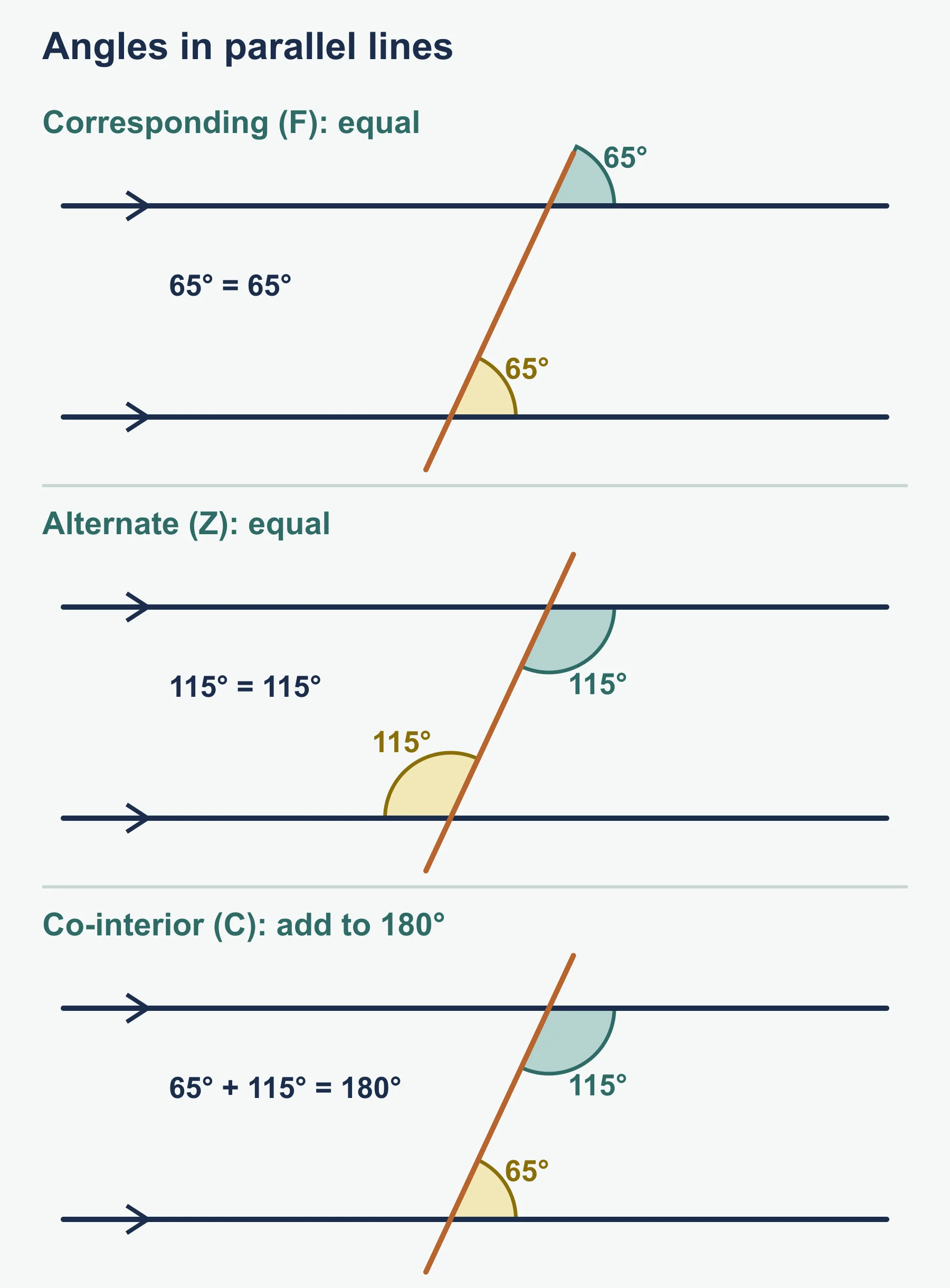
Parallel lines. Corresponding angles are equal (F shape). Alternate angles are equal (Z shape). Co-interior angles sum to 180° (C or U shape).
Worked example. Lines AB and CD are parallel. A transversal meets AB at G and CD at H, with E above G. Angle EGB = 112°. Then angle GHD = 112° (corresponding angles); angle BGH = 180° − 112° = 68° (angles on a straight line); angle GHC = 68° (alternate angles to angle BGH).
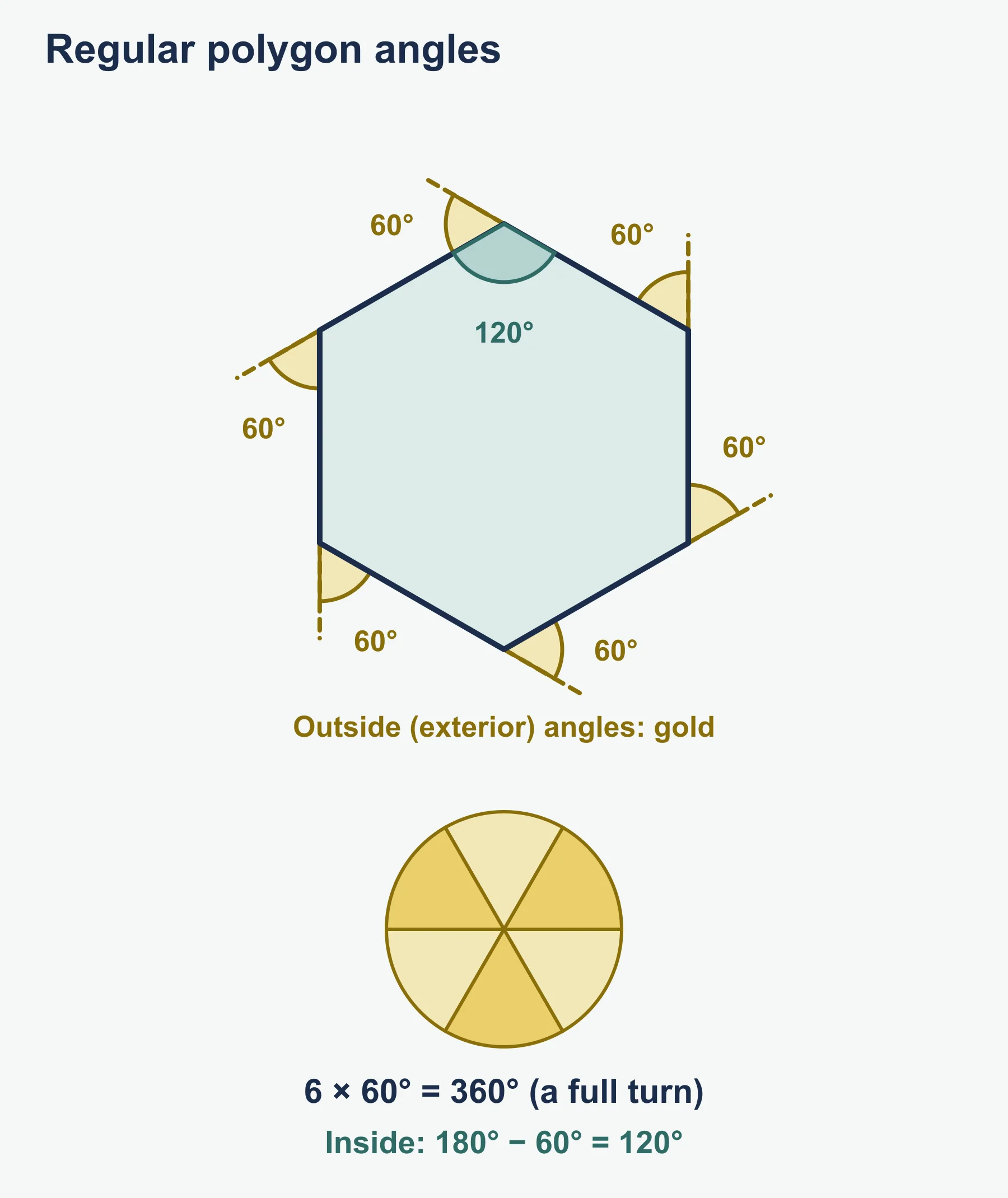
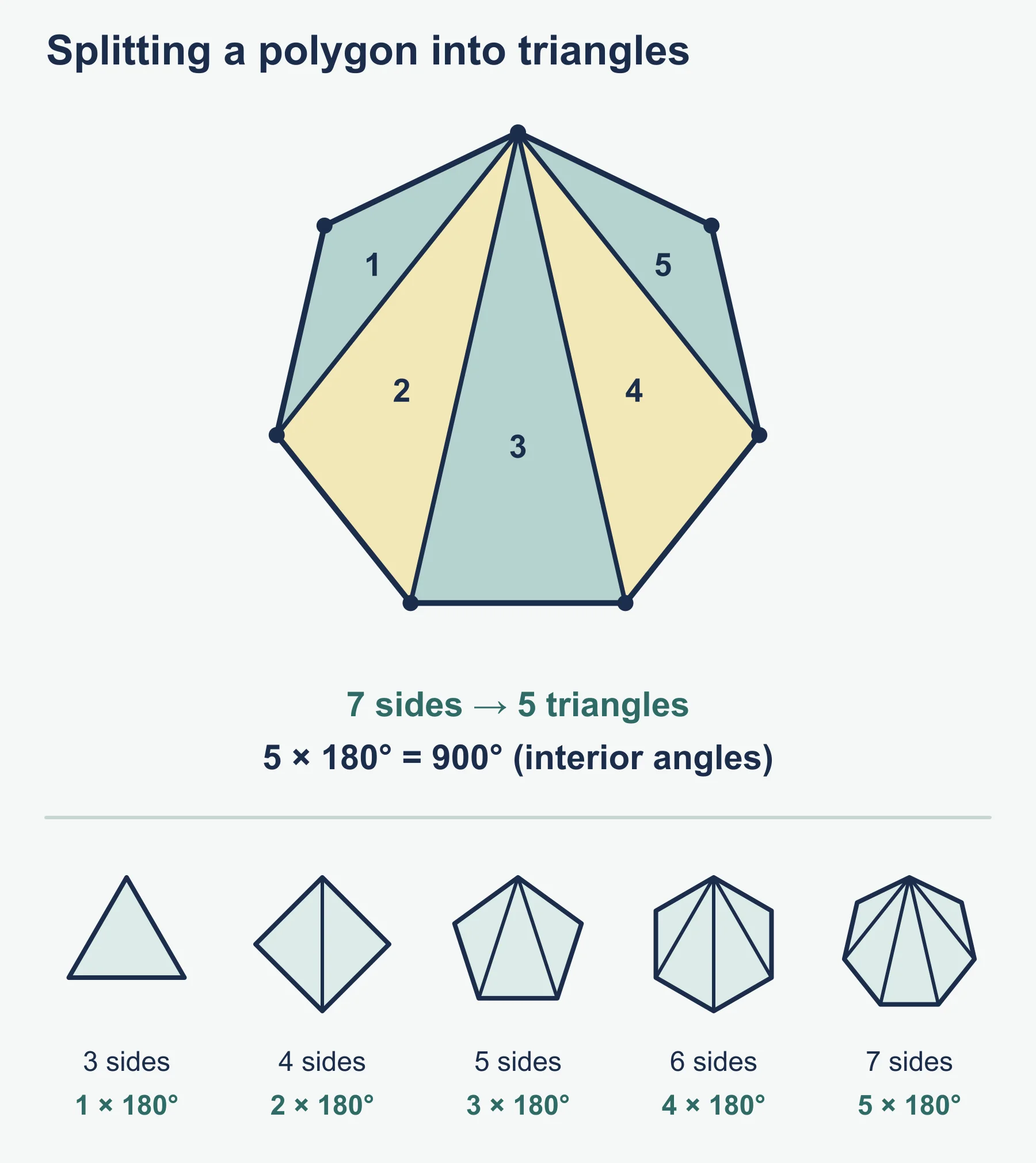
Polygons. The exterior angles of any polygon sum to 360°. Interior angles sum to (n − 2) × 180°. For a regular polygon each exterior angle is 360° ÷ n.
Worked example. A regular polygon has interior angle 162°. Exterior angle = 180° − 162° = 18°, so n = 360 ÷ 18 = 20 sides; interior angle sum = 18 × 180° = 3240°.
Worked example (irregular). Five angles of a hexagon are 130°, 95°, 140°, 118° and 126°. These total 609°. A hexagon’s angles total 4 × 180° = 720°, so the sixth angle is 720° − 609° = 111°.
4.7 Circle theorems I
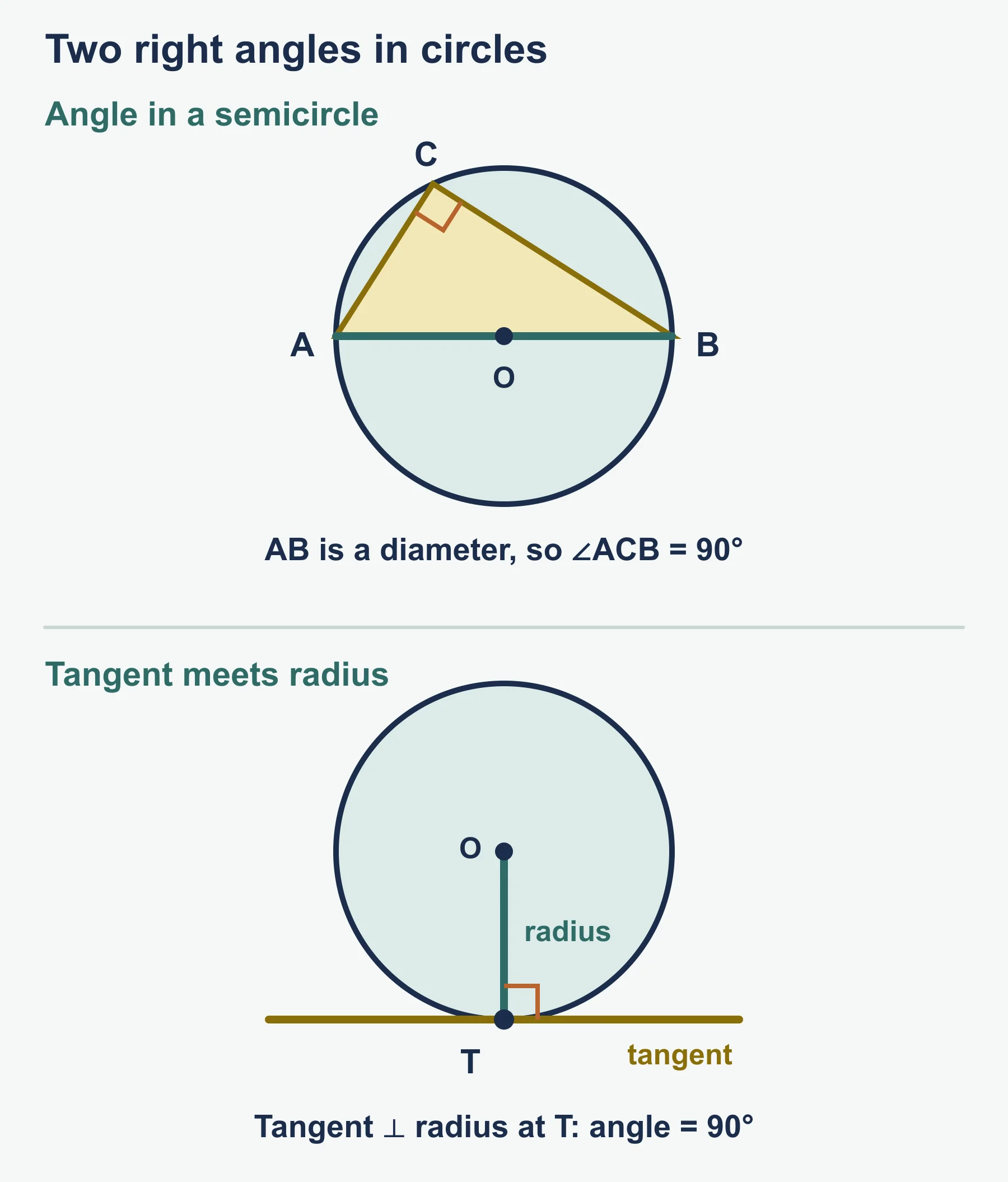
- The angle in a semicircle is 90°.
- The angle between a tangent and the radius at the point of contact is 90°.
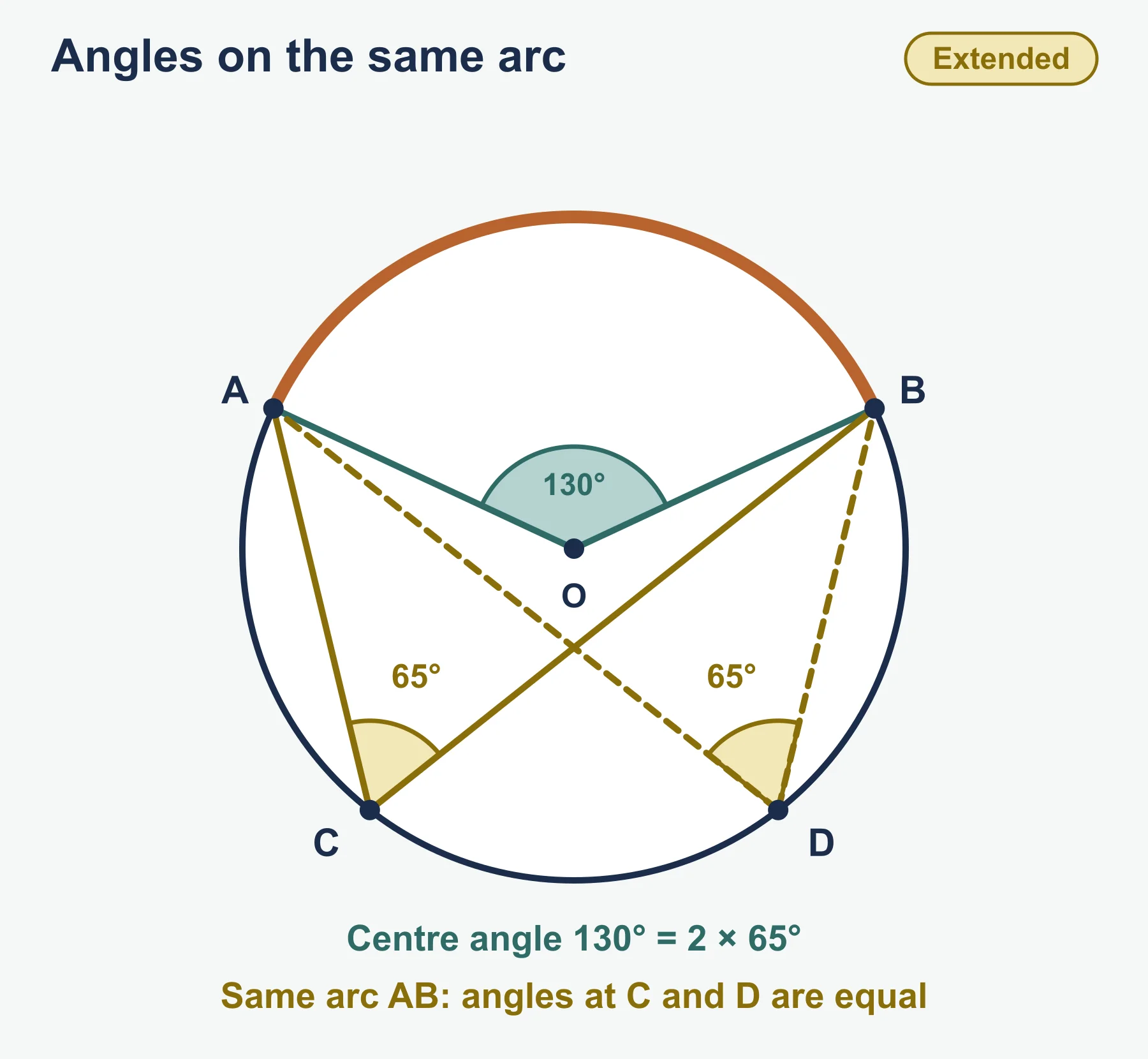
- The angle at the centre is twice the angle at the circumference, standing on the same arc.
- Angles in the same segment are equal.
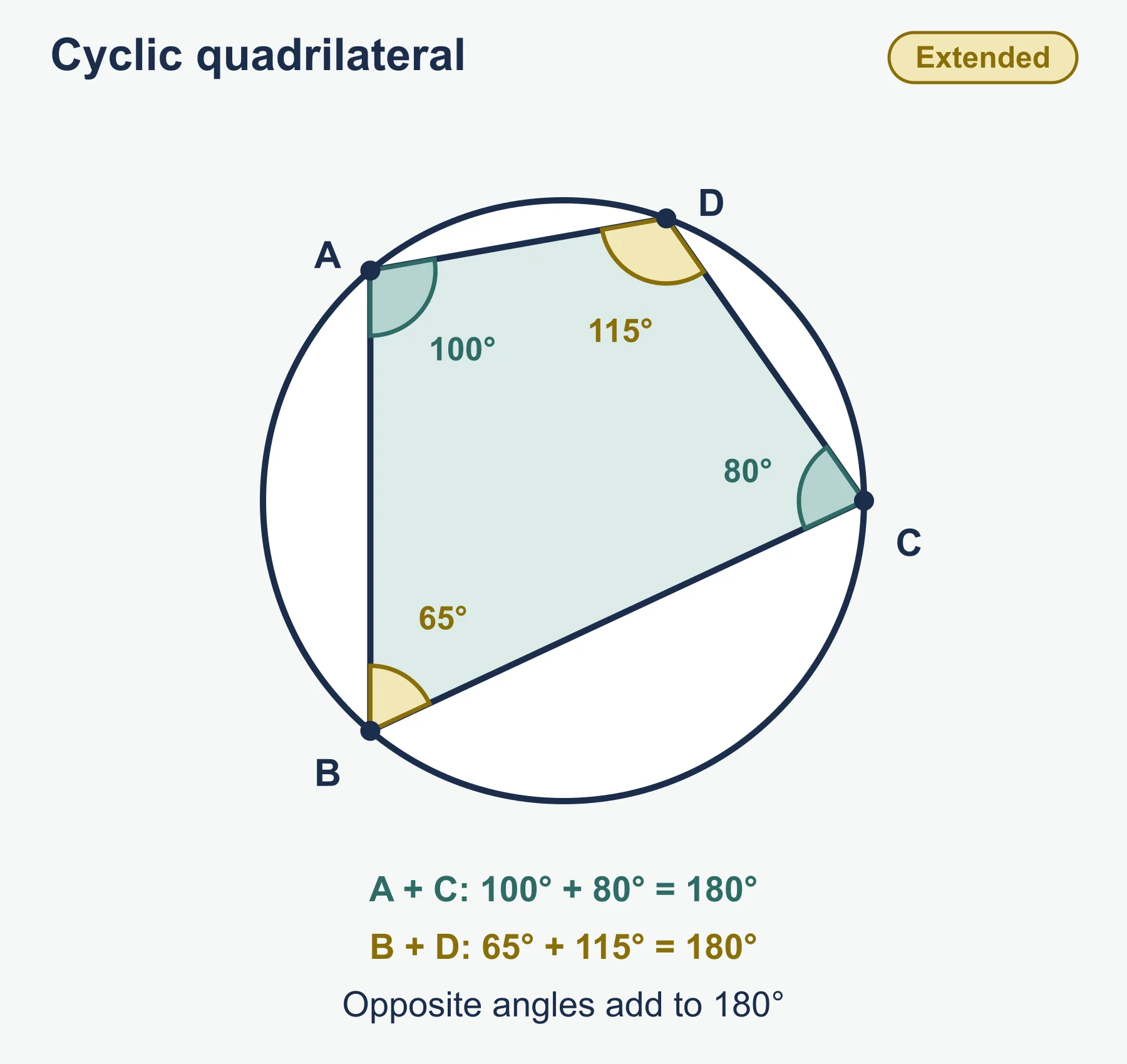
- Opposite angles of a cyclic quadrilateral sum to 180°.
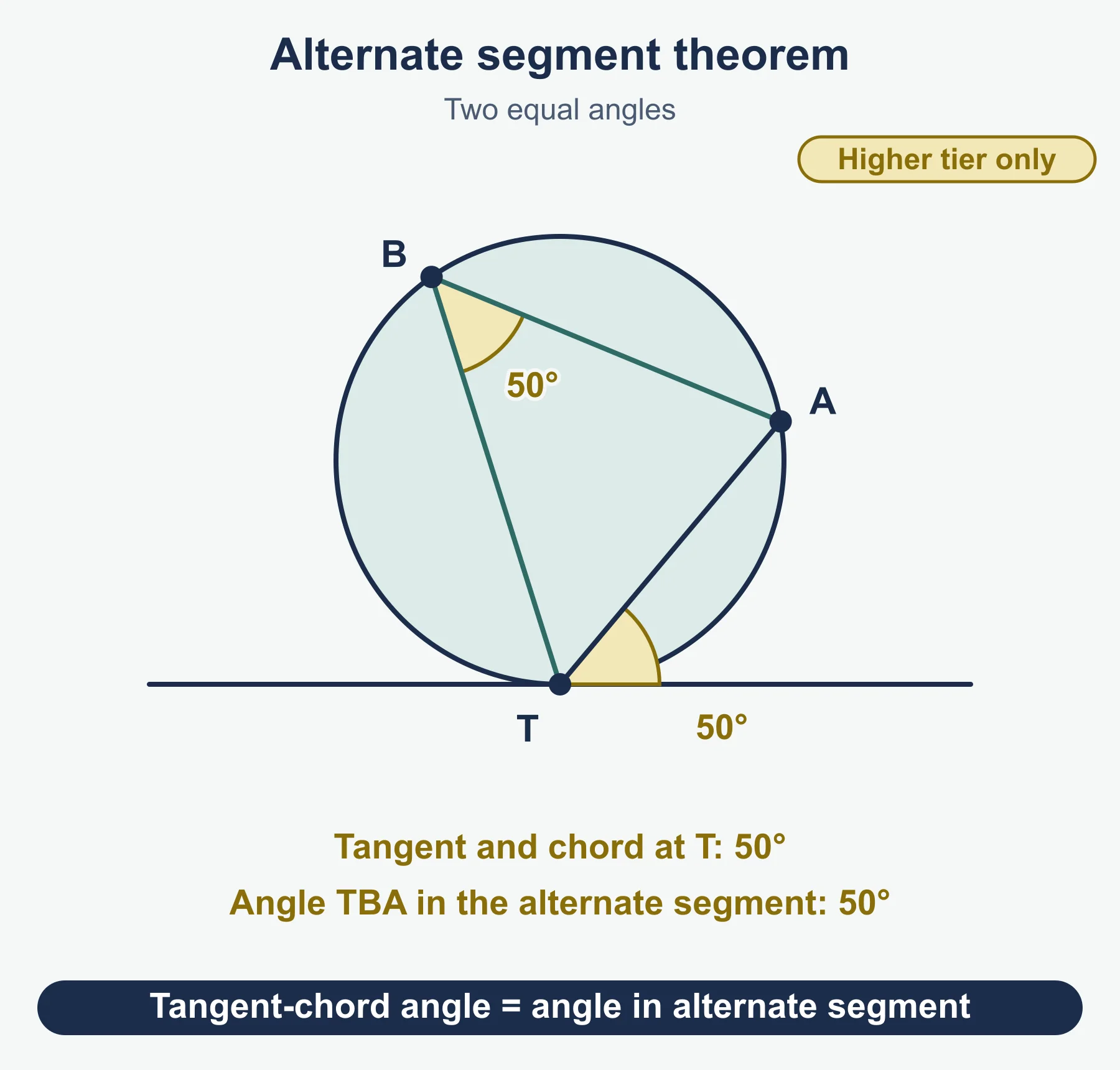
- Alternate segment theorem: the angle between a tangent and a chord equals the angle in the alternate segment.
Worked example. AB is a diameter and C is on the circle with angle CAB = 34°. Angle ACB = 90° (angle in a semicircle), so angle ABC = 180° − 90° − 34° = 56°.
Worked example. Points A, B, C lie on a circle with centre O and angle AOB = 118°. Angle ACB = 118° ÷ 2 = 59° (angle at the centre is twice the angle at the circumference), when C is on the major arc.
For a cyclic quadrilateral WXYZ with angle WXY = 87°, angle WZY = 93°. If chord PQ makes 52° with the tangent at P, any point R in the alternate segment gives angle PRQ = 52°.
4.8 Circle theorems II
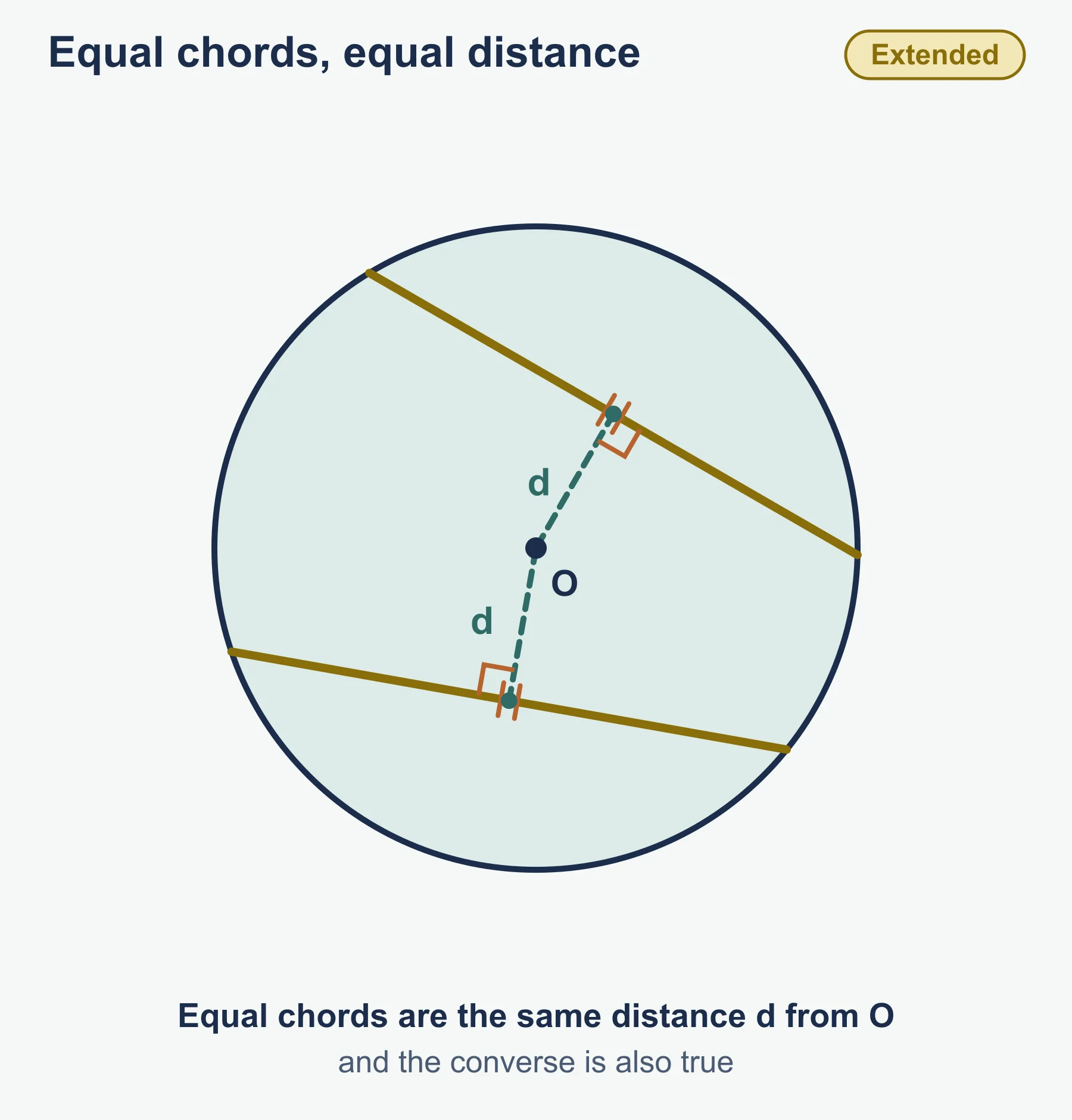
- Equal chords are equidistant from the centre, and chords equidistant from the centre are equal.
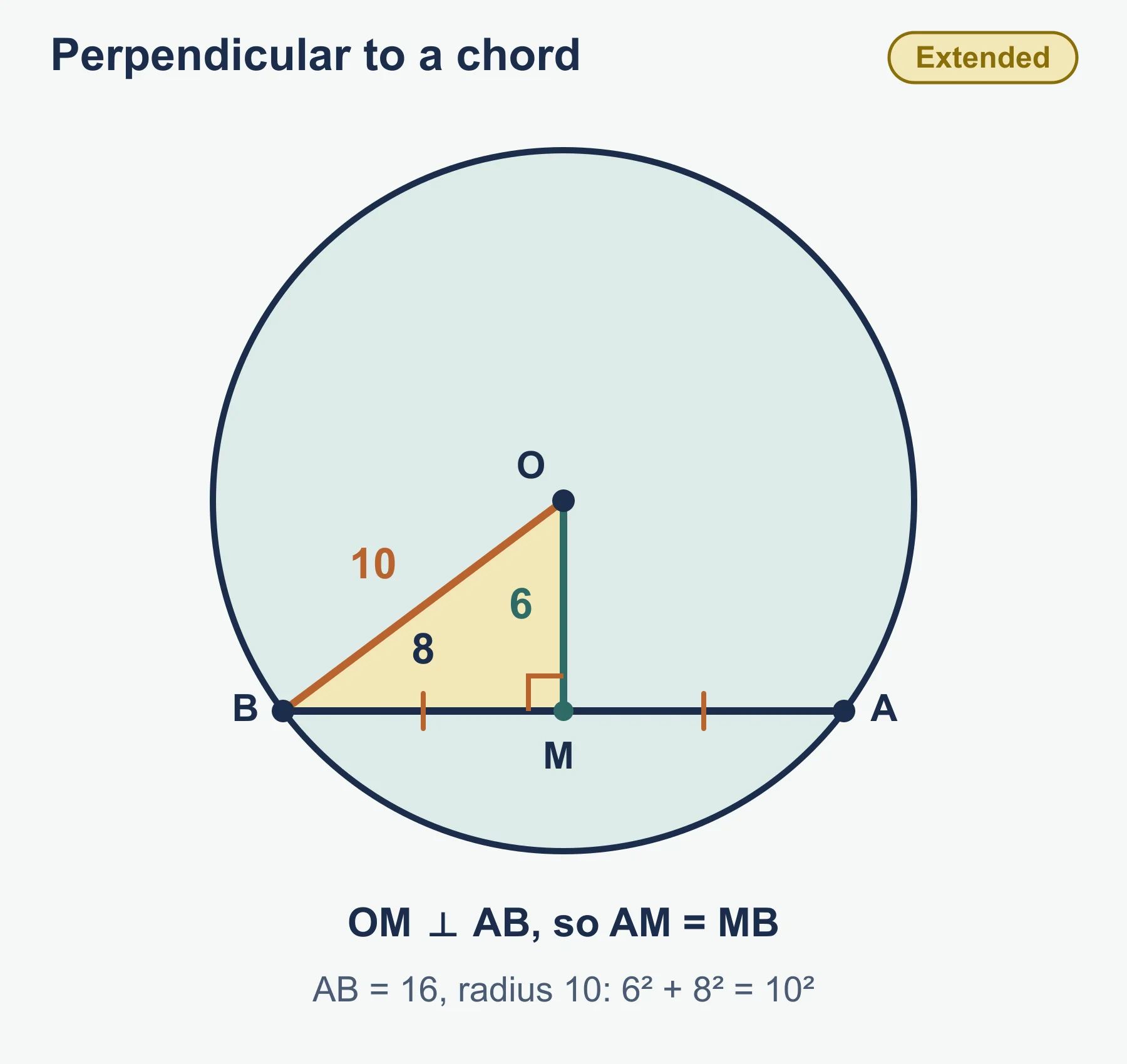
- The perpendicular bisector of a chord passes through the centre.
- Tangents from an external point are equal in length.
Worked example. A circle of radius 13 cm has a chord of length 24 cm. The perpendicular from the centre bisects the chord, forming a right-angled triangle with hypotenuse 13 and one side 12. Distance = √(13² − 12²) = 5 cm. Any other chord of length 24 cm is also 5 cm from the centre.
Worked example. T is 17 cm from the centre O of a circle of radius 8 cm. The tangent from T touches at A. Angle OAT = 90°, so TA = √(17² − 8²) = 15 cm. The second tangent TB is also 15 cm.
Common errors
- Giving no reason, or the wrong theorem name.
- Using the interior angle in n = 360 ÷ angle.
- Measuring a bearing anticlockwise, or leaving out construction arcs.
- Cubing an area ratio: area ratio 4 : 9 means volume ratio 8 : 27.
- Counting a rhombus as having four lines of symmetry.
Frequently asked questions
What does the geometry topic cover in Cambridge O Level Mathematics 4024? Topic 4 covers geometrical terms, constructions and nets, scale drawings and bearings, similarity, symmetry, angle facts and two sets of circle theorems.
How do you construct a triangle from three sides? Use a ruler and compasses only: draw one side, then draw arcs from each end with radii equal to the other two sides, and join to where the arcs cross. The syllabus requires you to show the construction arcs.
How do you show that two triangles are similar? State the pairs of equal angles, giving a reason for each, such as corresponding angles or vertically opposite angles. Two pairs of equal angles are enough, because the third pair must then be equal too.
How do you find the number of sides of a regular polygon from its interior angle? Subtract the interior angle from 180° to get the exterior angle, then divide 360° by the exterior angle. An interior angle of 162° gives an exterior angle of 18°, so the polygon has 20 sides.
How do you find the length of a tangent from a point outside a circle? The tangent meets the radius at 90°, so use Pythagoras’ theorem with the distance from the point to the centre as the hypotenuse. Tangents from the same external point are equal in length.
Official syllabus
Cambridge O Level Mathematics (Syllabus D) 4024 syllabus for examination in 2025, 2026 and 2027, Cambridge International Education, topic 4 Geometry, sections 4.1 to 4.8.
Get free revision emails (optional)
Occasional emails with practice questions, worked explanations and links to free resources for the qualification and subjects you choose. No spam, and you can unsubscribe from any email. The free tools on this site never need an email.
Related resources
-
Practice questions
O Level Mathematics: Geometry Practice Questions (Cambridge 4024)
Original Cambridge O Level Mathematics 4024 geometry questions on polygon angles, isosceles triangles, circle theorems, tangents and similarity, with answers.
Mathematics · Cambridge · O Level
Try questions -
Revision notes
Cambridge O Level Mathematics: Geometry (4024) – Revision Notes
Condensed Cambridge O Level Mathematics revision notes on geometry: angles, polygons, bearings, similarity, symmetry, circle theorems and a self-test.
Mathematics · Cambridge · O Level
Revise topic -
Study guides
Cambridge O Level Mathematics: Mensuration (4024)
Study guide to every Mensuration outcome in Cambridge O Level Mathematics 4024: units, area, circles, solids and compound shapes, with worked examples.
Mathematics · Cambridge · O Level
Read guide
Related articles
-
exam preparation
Where IGCSE Mathematics marks are lost early
The first weeks of an IGCSE Mathematics course rarely go wrong on difficulty. They go wrong on method, command words, rounding and units — four habits that cost marks a student had already earned.
24 August 2026
-
teaching
A Level tuition in Dubai: Cambridge or Pearson Edexcel International A Level?
Schools in Dubai and Abu Dhabi teach either Cambridge International AS & A Level or Pearson Edexcel International A Level. How the two are structured, why it matters for tuition, and how online classes from Lahore work.
9 October 2026
Studying this with a teacher
Working through Mathematics O LEVELS?
This page is free and stays free. If you would rather be taught it, Marlbridge runs Mathematics classes one-to-one and in small groups of up to 15, online in your own time zone. The first trial class is free. WhatsApp replies within an hour (8am–11pm Pakistan time, every day); email the same day.
Cambridge Mathematics teachers at Marlbridge


