
Revision Notes
Cambridge O Level Mathematics: Geometry (4024) – Revision Notes
Condensed Cambridge O Level Mathematics revision notes on geometry: angles, polygons, bearings, similarity, symmetry, circle theorems and a self-test.
- Subject
- Mathematics
- Level
- O LEVELS
- Topic
- Geometry
- Author
- Marlbridge Academic Team
- Updated
- Reviewed by
- Sajawal Zahid (what this means)
Aligned to Cambridge O Level Mathematics (4024), 2025-2027. Official specification .
Syllabus page (what it covers and how it is assessed): Cambridge O Level Mathematics.
Syllabus points this page covers
4024
- 4 Geometry (whole topic)
Found an error? Report a correction.
Need help with this topic? Request a free trial class for O Level Mathematics (4024).
These notes condense topic 4, Geometry, from the Cambridge O Level Mathematics (Syllabus D) 4024 syllabus for examination in 2025, 2026 and 2027 (sections 4.1 to 4.8). For full explanations and worked examples, read the study guide. Test yourself with the practice questions, tick outcomes on the checklist, see the course hub and find weak spots with the free diagnostics.
Paper 1 is non-calculator and Paper 2 is calculator, so be ready to do angle and ratio work without one.
4.1 Vocabulary checklist
| Group | Terms to define or use |
|---|---|
| Basics | point, vertex, line, plane, parallel, perpendicular, perpendicular bisector, bearing, right angle |
| Angles | acute, obtuse, reflex, interior, exterior |
| Shapes | similar, congruent, scale factor |
| Triangles | equilateral, isosceles, scalene, right-angled |
| Quadrilaterals | square, rectangle, kite, rhombus, parallelogram, trapezium |
| Polygons | regular, irregular, pentagon, hexagon, octagon, decagon |
| Solids | cube, cuboid, prism, cylinder, pyramid, cone, sphere, hemisphere, frustum, face, edge, surface, net |
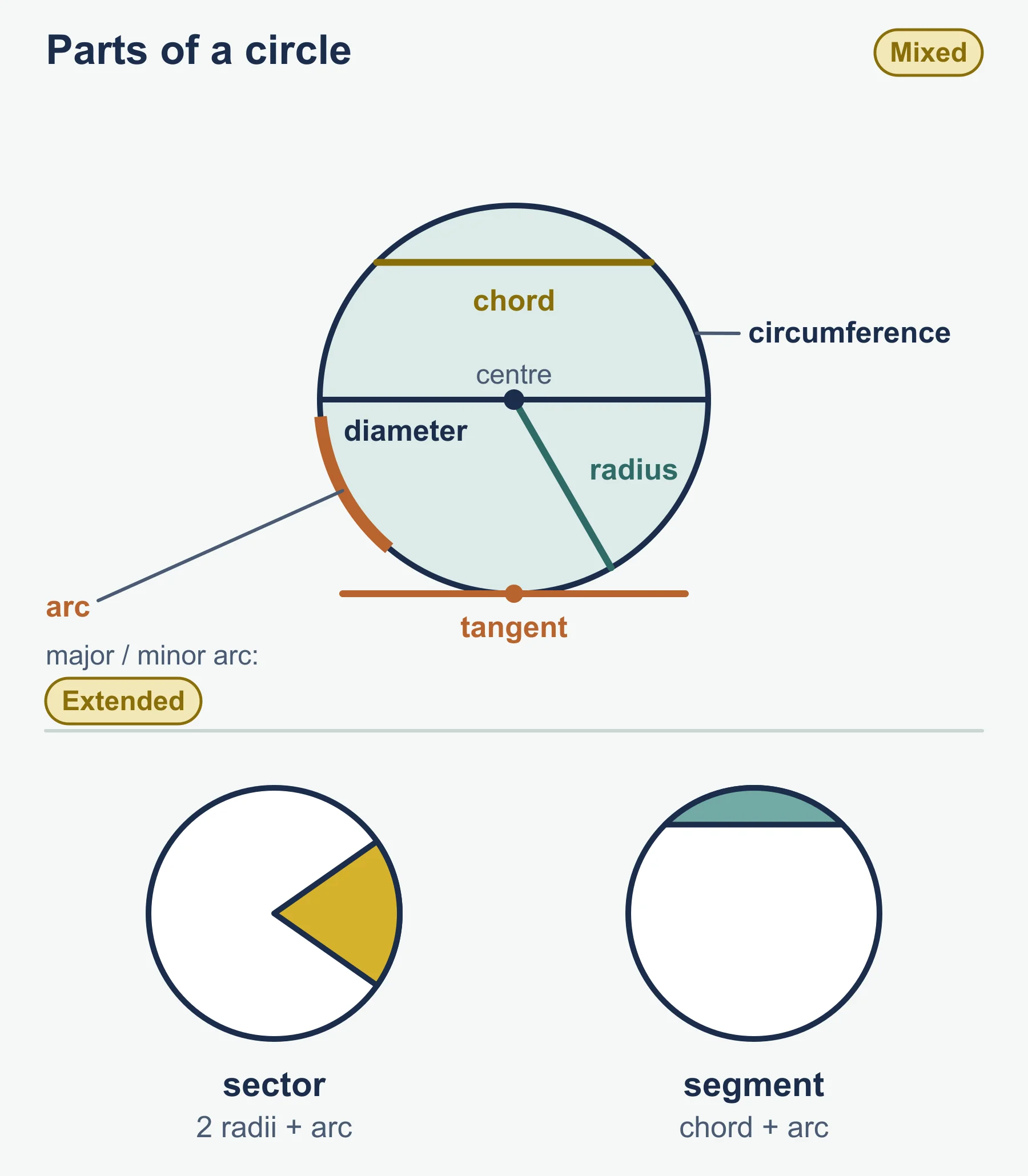
| Circle | centre, radius, diameter, circumference, semicircle, chord, tangent, major and minor arc, sector, segment |
Must-know distinctions:
- Similar: same shape, lengths in a constant ratio. Congruent: same shape and same size.
- Sector: bounded by two radii and an arc. Segment: bounded by a chord and an arc.
- Chord: any line joining two points on a circle. Diameter: a chord through the centre.
- Prism: uniform cross-section. Pyramid: base plus triangular faces meeting at an apex.
- Frustum: a cone or pyramid with the top removed by a cut parallel to the base.
Quadrilateral properties worth recalling:
| Shape | Key facts |
|---|---|
| Parallelogram | opposite sides parallel and equal; opposite angles equal |
| Rhombus | four equal sides; diagonals bisect each other at right angles |
| Kite | two pairs of adjacent equal sides; one diagonal is a line of symmetry |
| Trapezium | one pair of parallel sides |
4.2 Constructions and nets
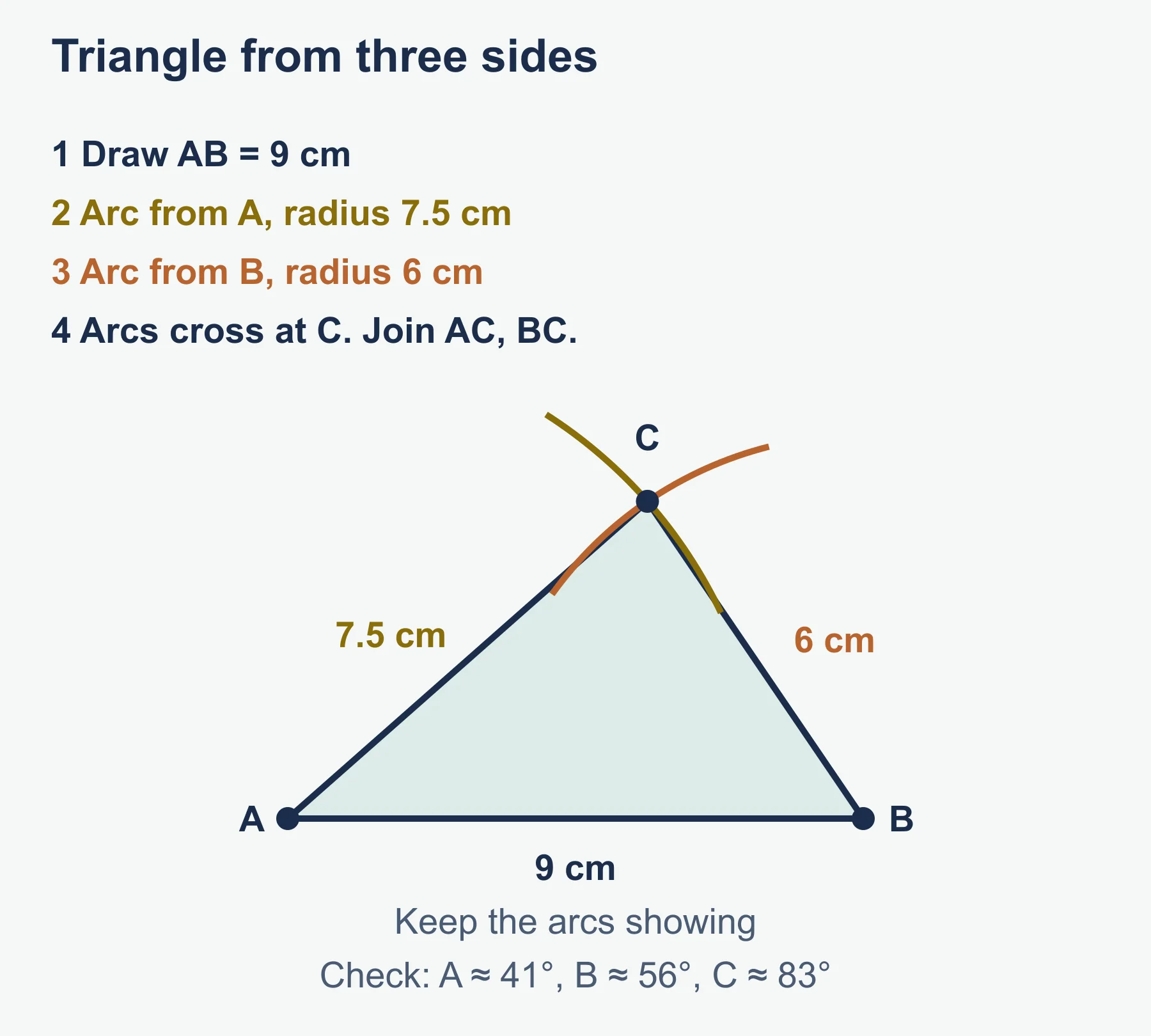
Method for a triangle with sides a, b and c:
- Draw side a with a ruler.
- Compasses set to b: arc from one end.
- Compasses set to c: arc from the other end.
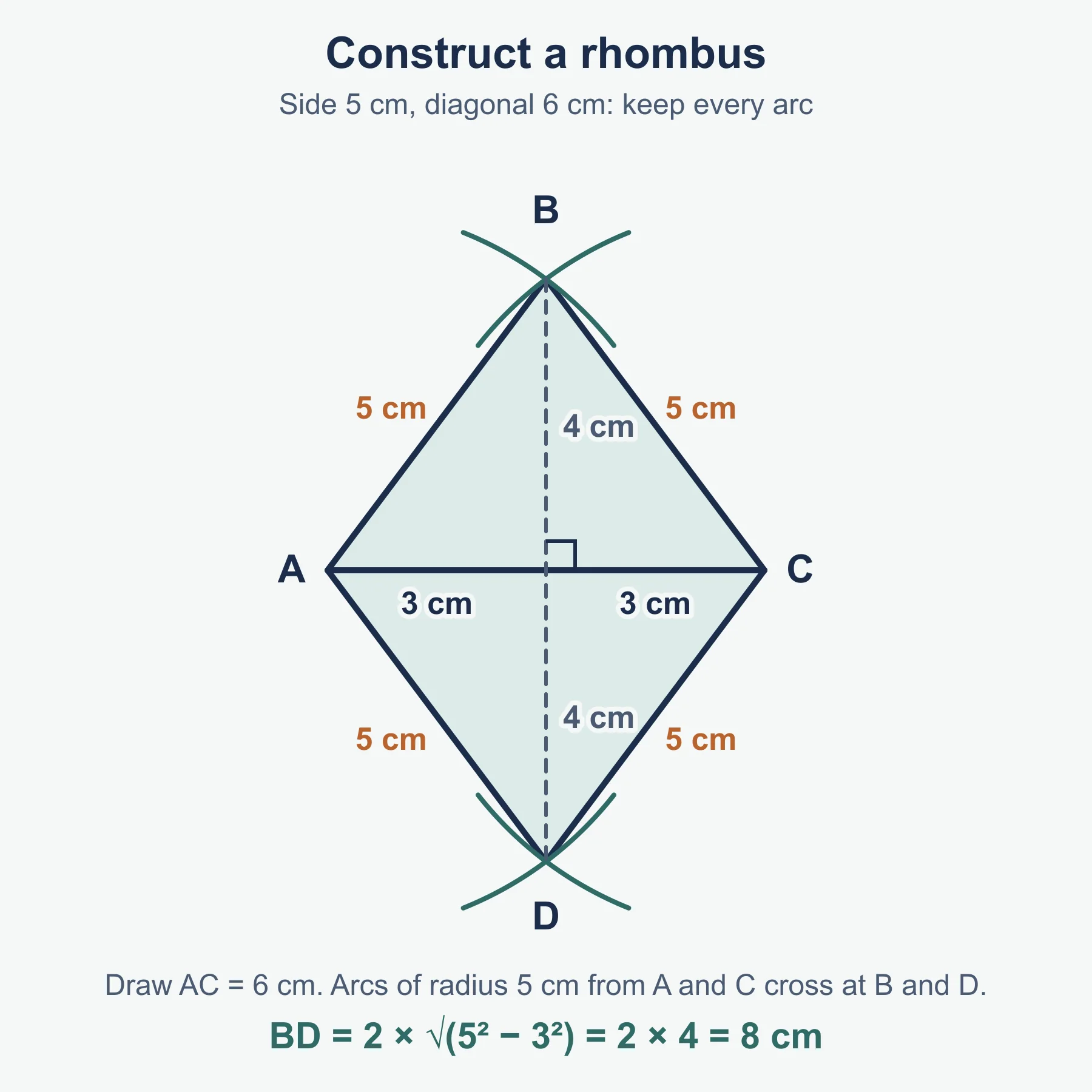
- Join the crossing point to both ends. Keep every arc.
A ruler is used for all straight edges. Perpendicular and angle bisector constructions are not required by the syllabus. A rhombus can be built from two triangles that share a diagonal.
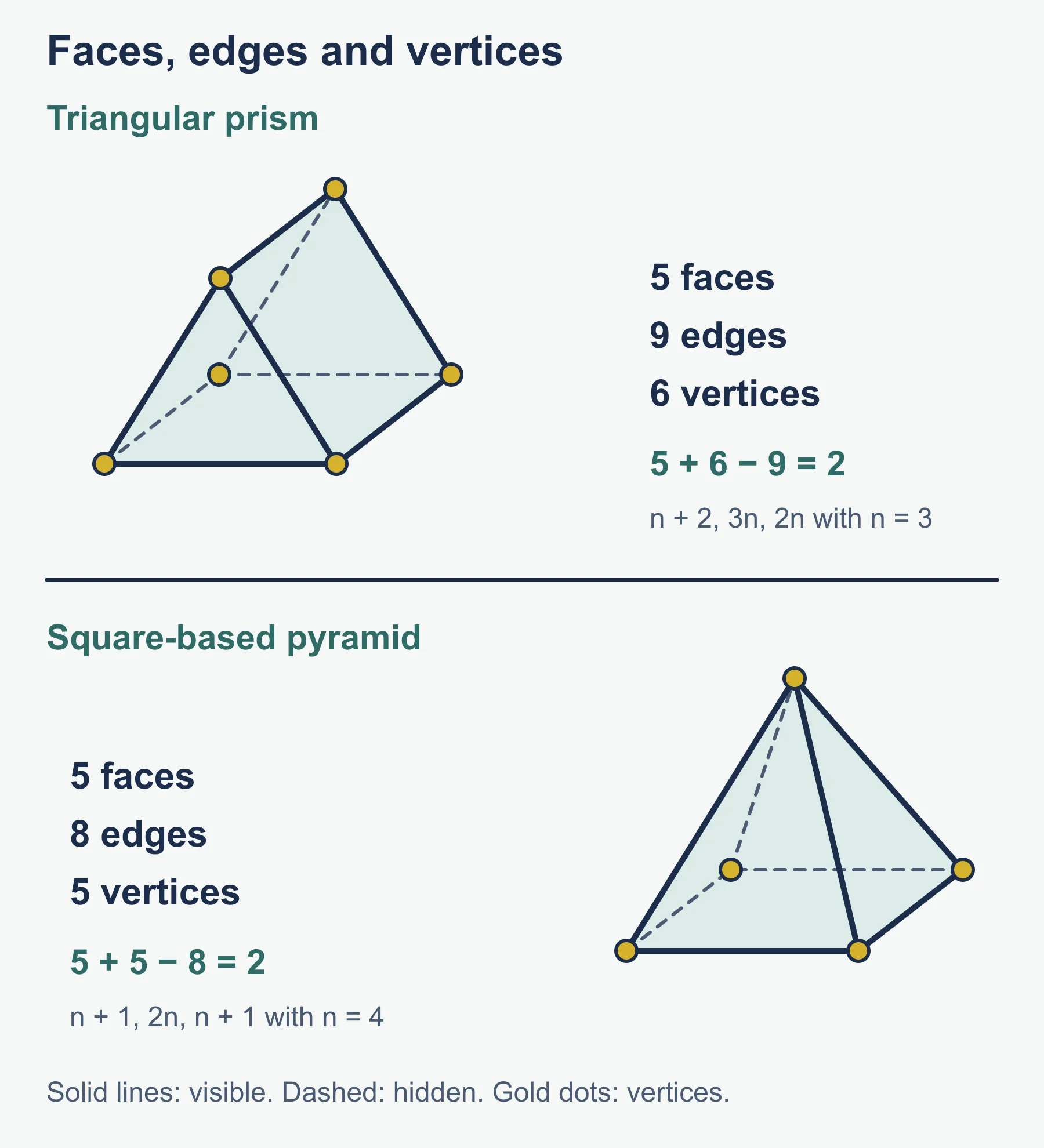
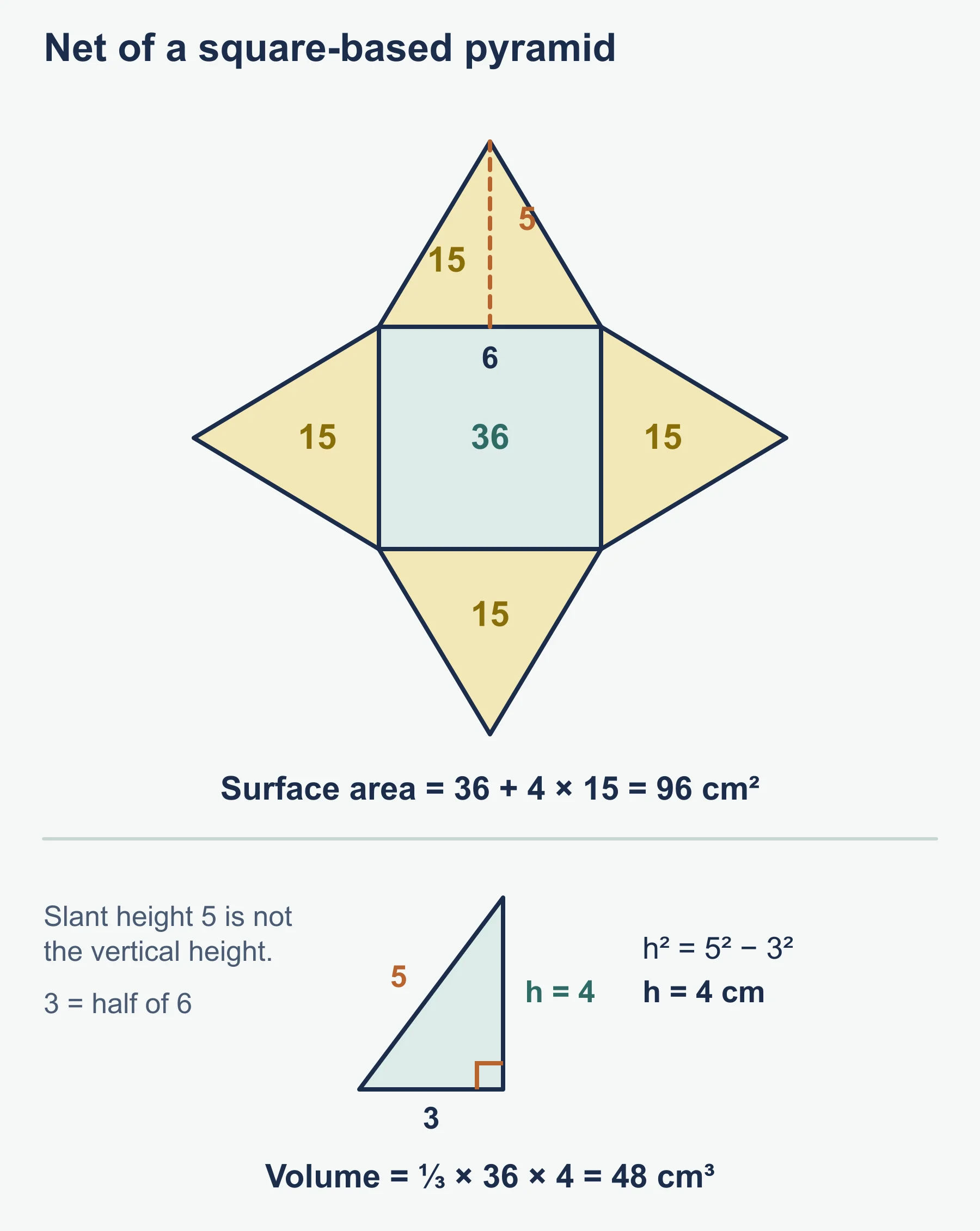
Nets: a cube has 6 square faces; a triangular prism has 2 triangles and 3 rectangles; a square-based pyramid has a square and 4 triangles. Measure lengths from the net to find surface area (add the areas of all faces) and volume.
Reminder: a triangular prism with a right-angled triangle end of sides 6, 8 and 10 cm and length 12 cm has surface area 2 × 24 + (6 + 8 + 10) × 12 = 336 cm² and volume 24 × 12 = 288 cm³.
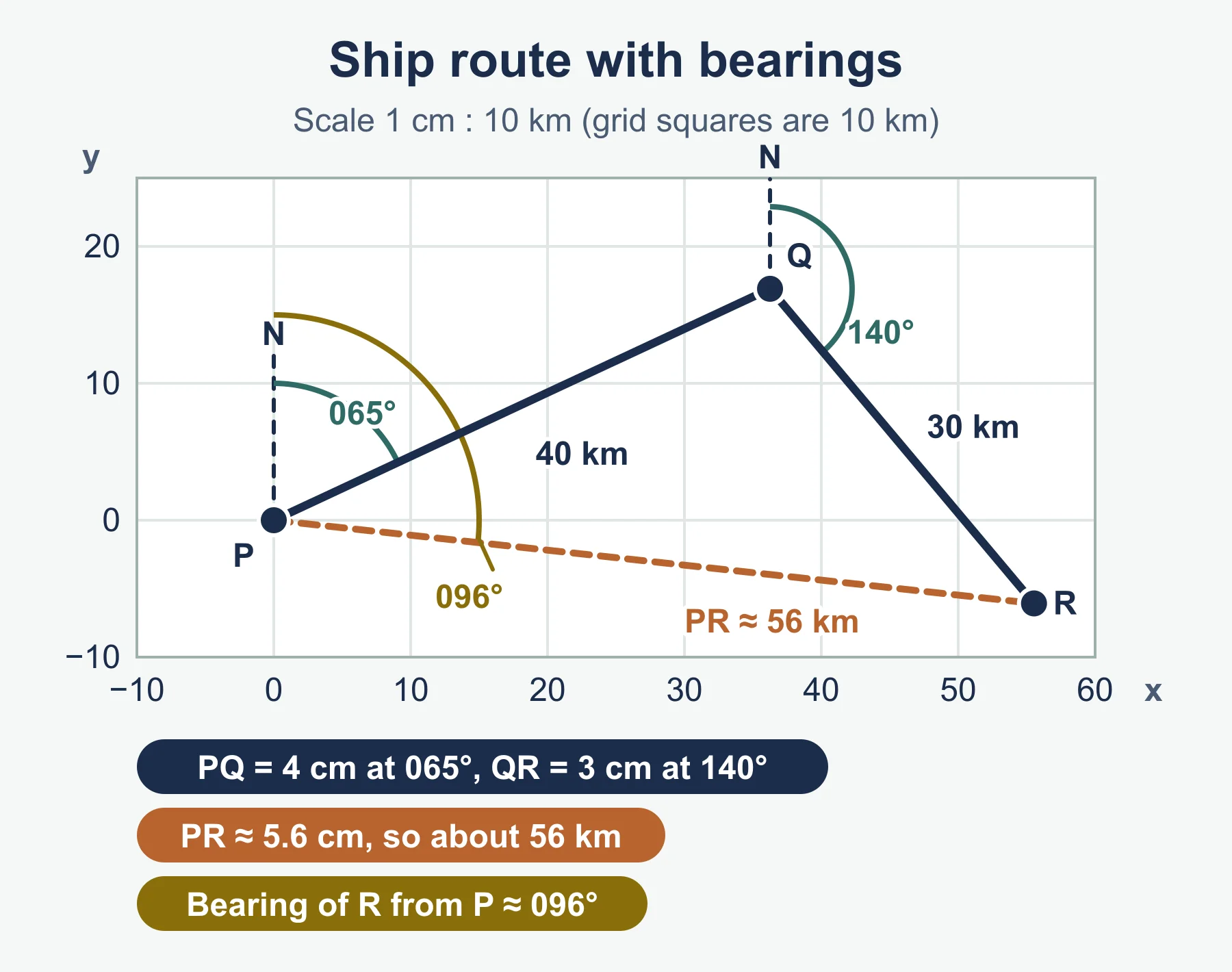
4.3 Scale drawings and bearings
| Task | Method |
|---|---|
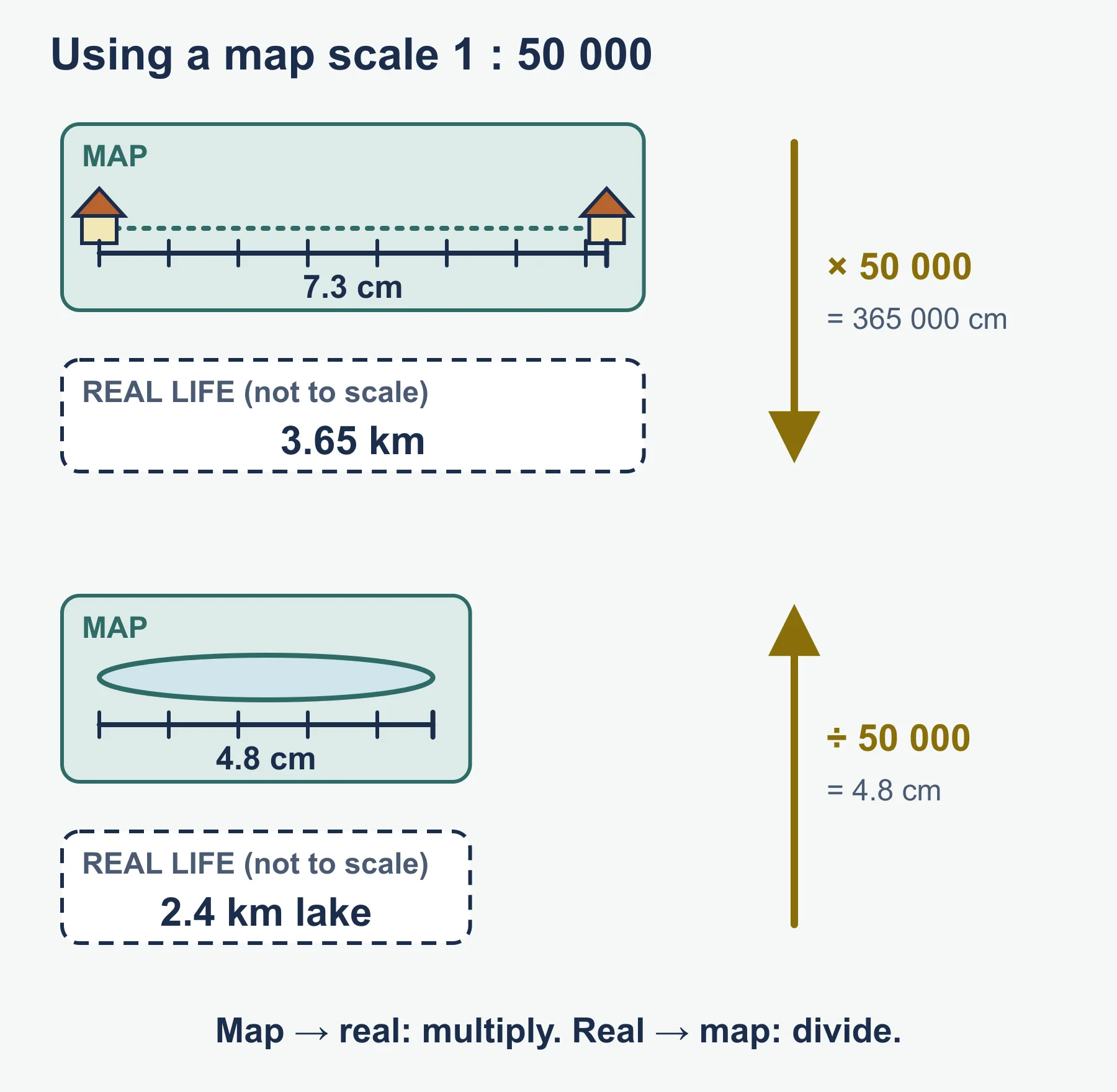
| Scale to real | multiply by the scale (1 : 25 000 means 1 cm is 25 000 cm, or 250 m) |
| Real to scale | divide by the scale |
| Bearing | clockwise from north, three figures |
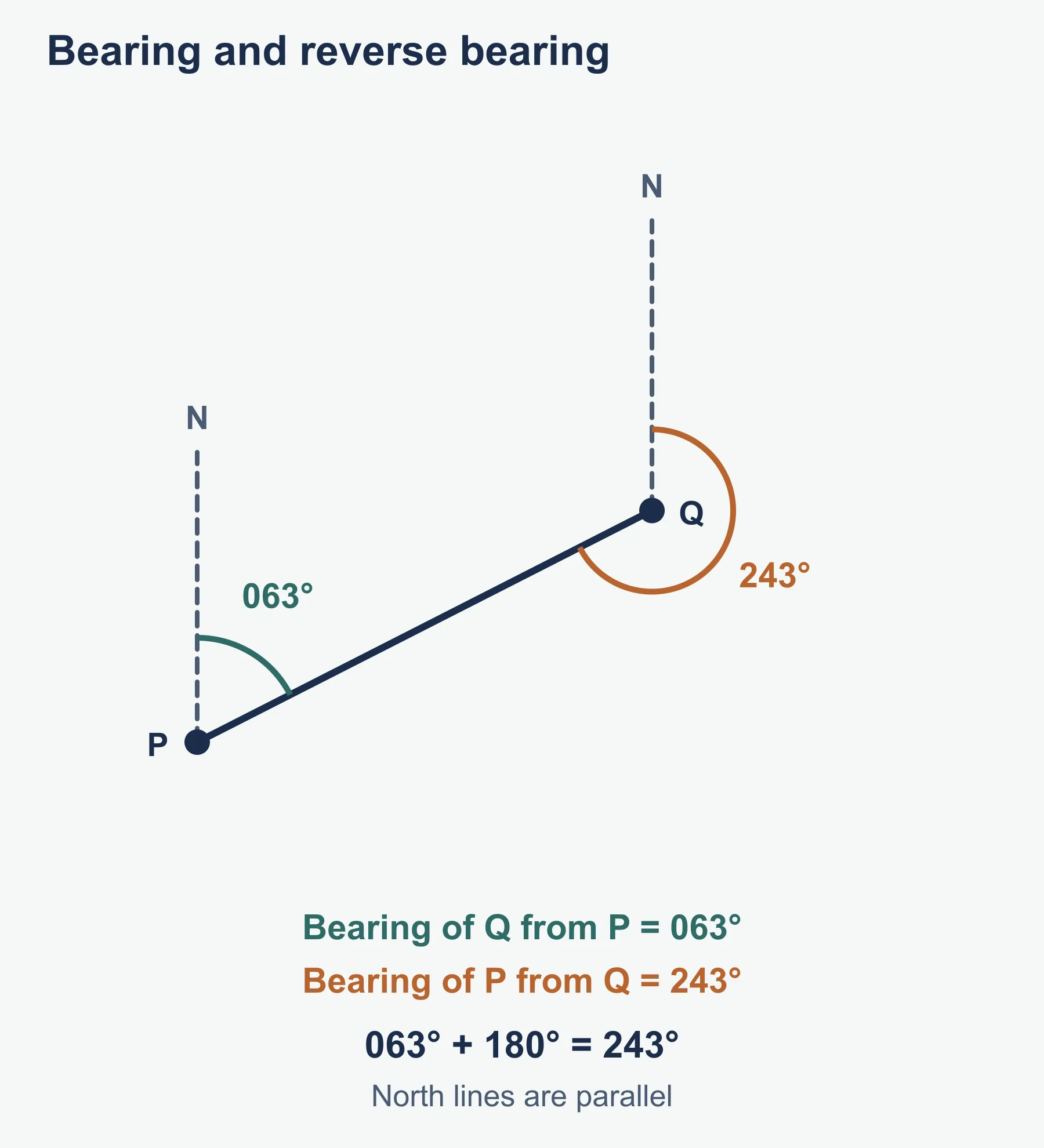
| Back bearing | add or subtract 180° |
Steps for a bearing problem:
- Draw a north line at every point involved.
- Measure the angle clockwise from the north line.
- If the bearing of B from A is below 180°, the bearing of A from B is that plus 180°; if it is 180° or more, subtract 180°.
Compass points: due east is 090°, due south is 180°, due west is 270°. If point D is due east of point C, the bearing of D from C is 090° and of C from D is 270°.
4.4 Similarity
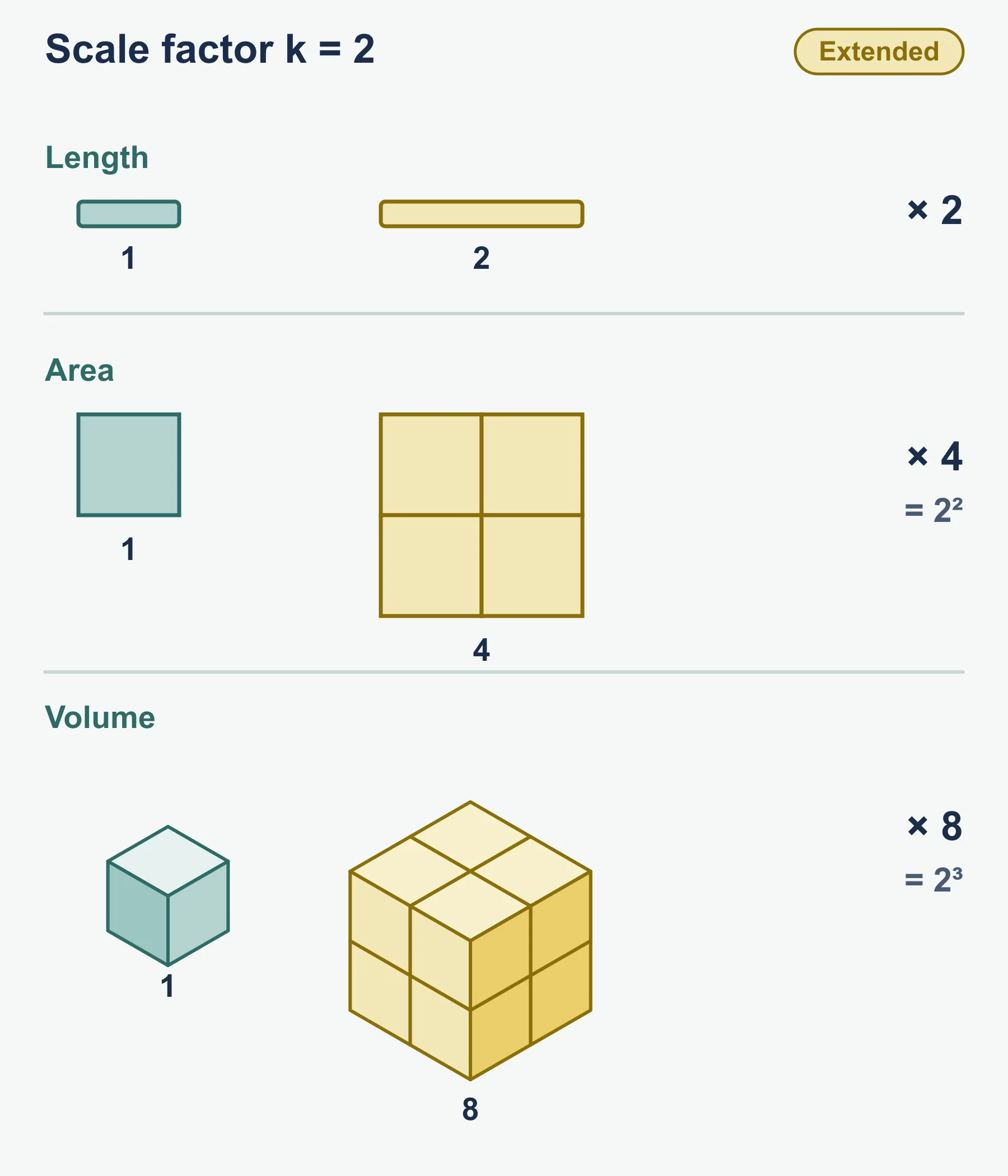
| Linear scale factor | Area scale factor | Volume scale factor |
|---|---|---|
| k | k² | k³ |
| 2 | 4 | 8 |
| 3 | 9 | 27 |
| 5 | 25 | 125 |
| 3/2 | 9/4 | 27/8 |
Method in steps:
- Identify which shape is the starting shape and which is the image.
- Write the length ratio.
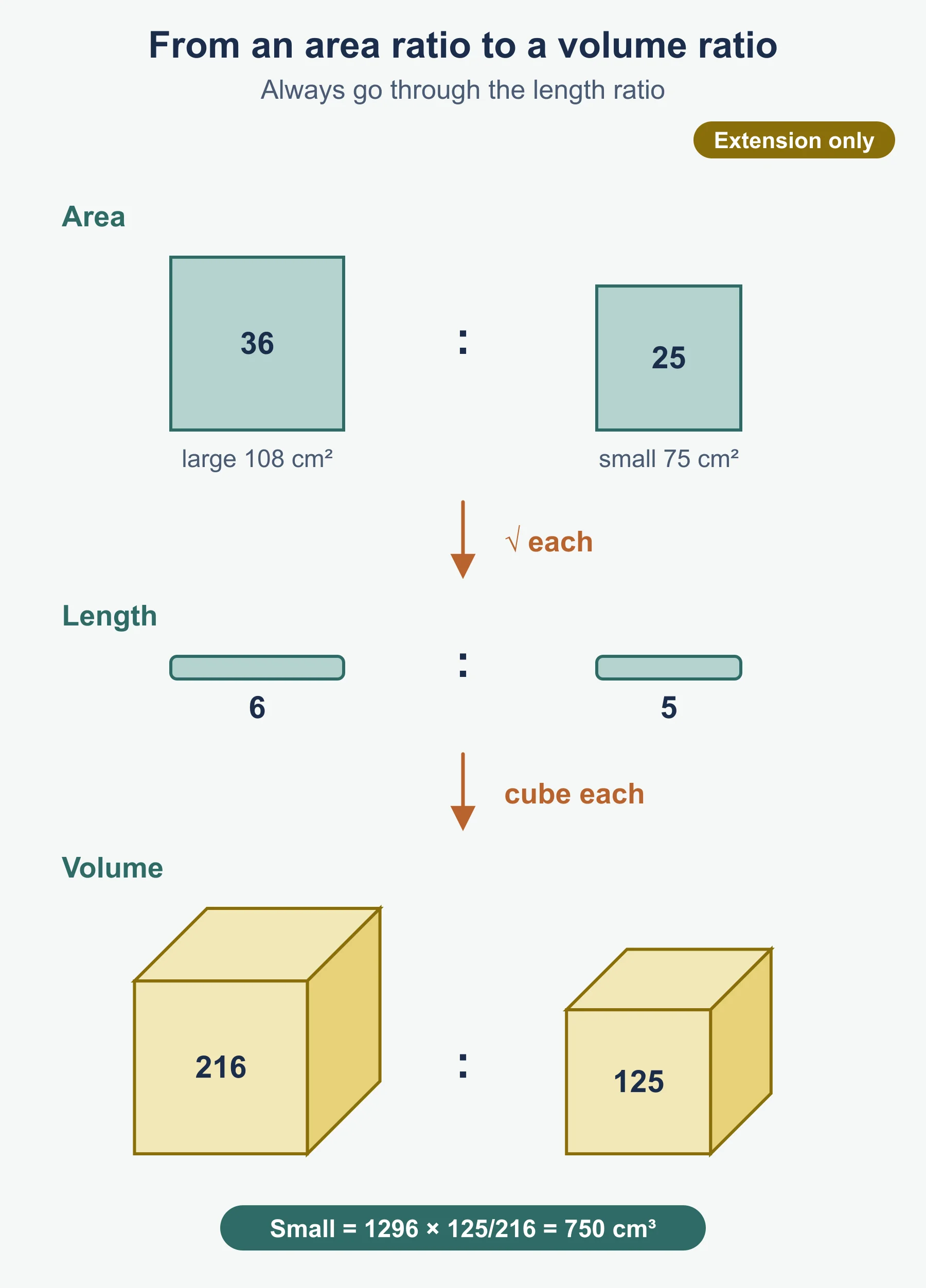
- Square it for areas (surface areas) or cube it for volumes.
- If given areas or volumes, take the square root or cube root first to get the length ratio.
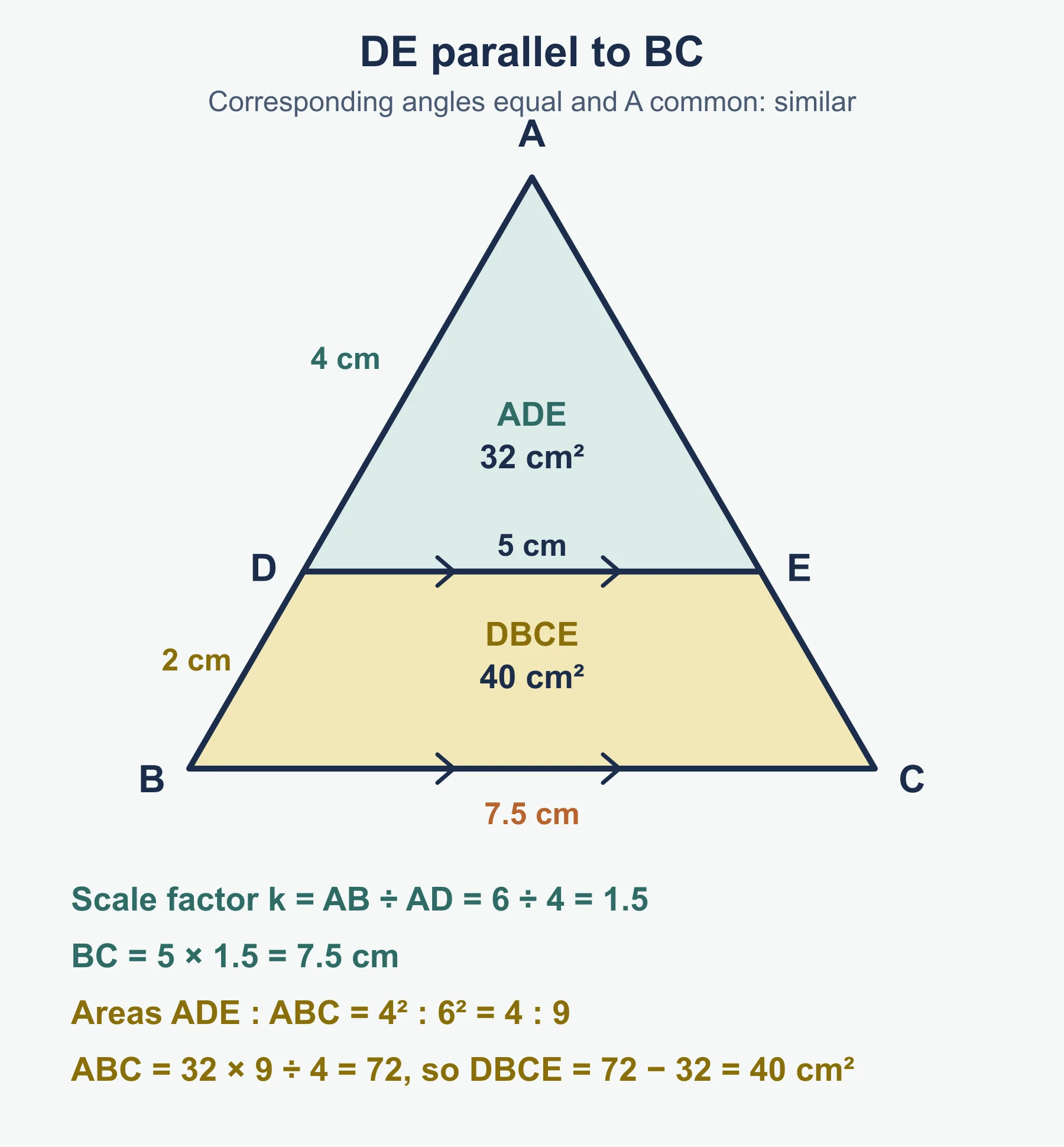
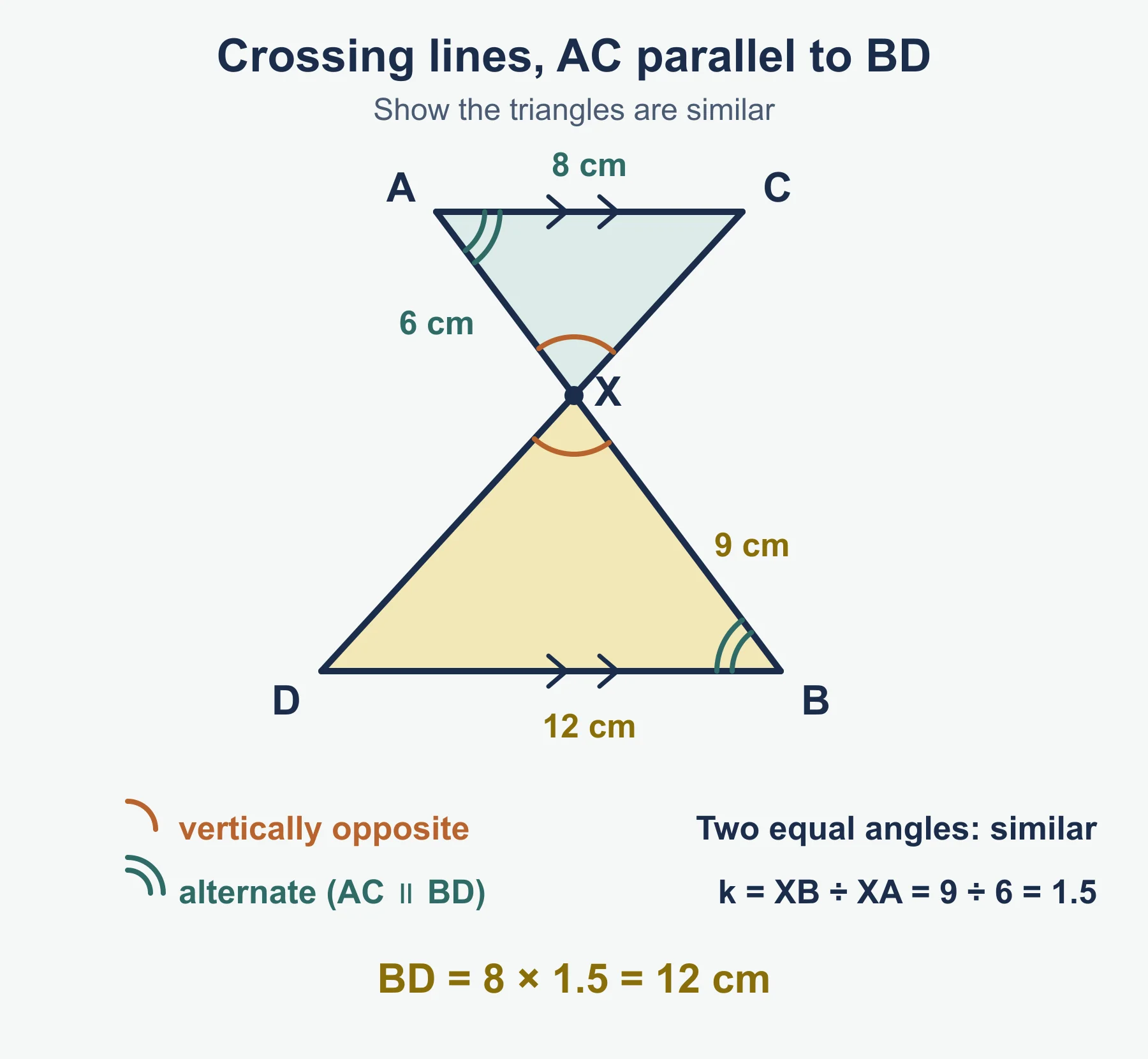
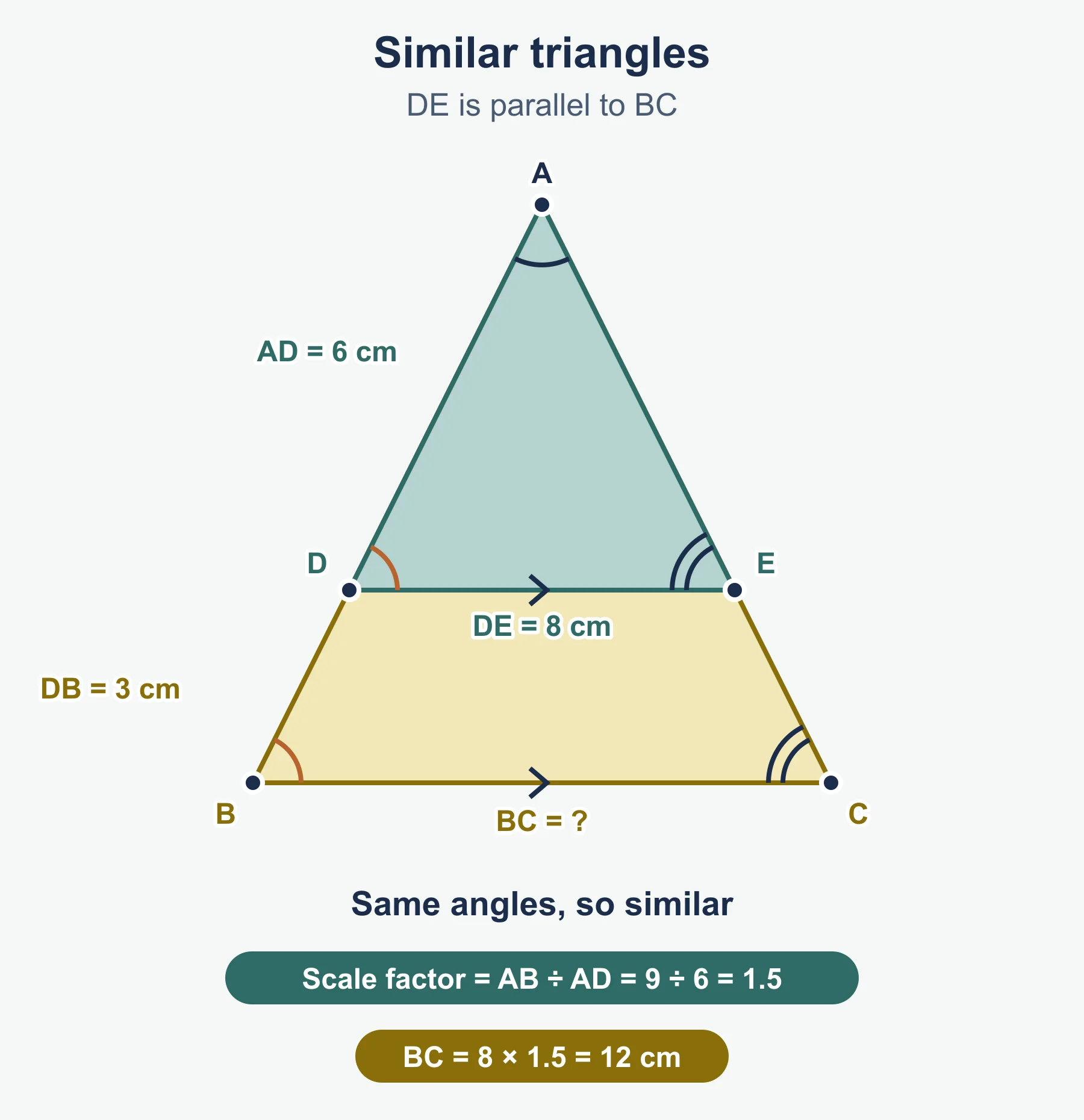
Showing two triangles are similar: list equal angle pairs, each with a reason (common angle, corresponding angles, alternate angles, vertically opposite angles). Two equal pairs are enough. Then write the matching sides as equal ratios.
Worked reminder: triangles PQR and PST are similar, with ST parallel to QR, S on PQ and T on PR. PS = 3 cm, PQ = 7.5 cm and ST = 4 cm. Scale factor = 7.5 ÷ 3 = 2.5, so QR = 4 × 2.5 = 10 cm. The areas are in the ratio 1 : 6.25.
4.5 Symmetry
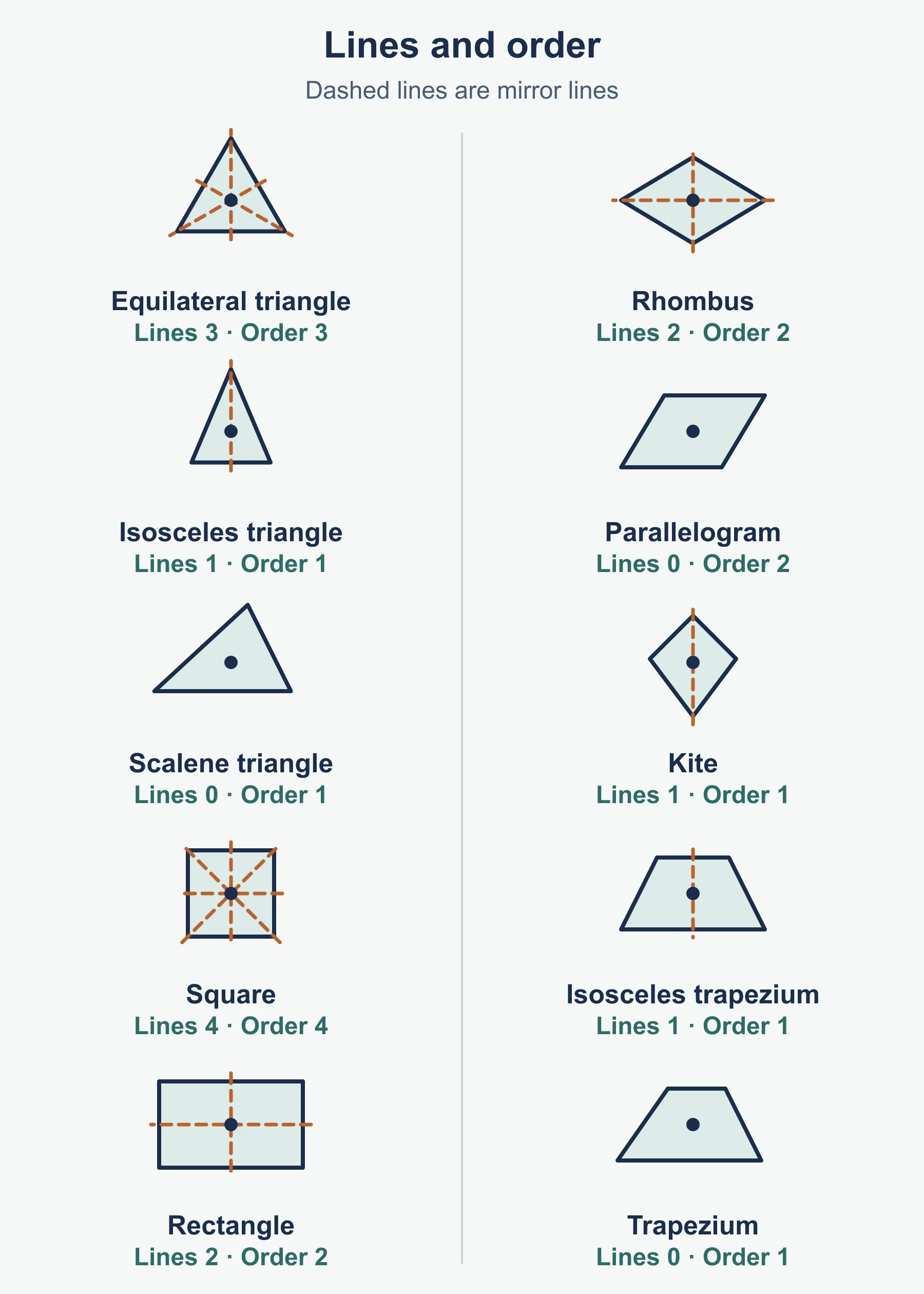
| 2D shape | Lines | Rotational order |
|---|---|---|
| Rectangle | 2 | 2 |
| Rhombus | 2 | 2 |
| Parallelogram | 0 | 2 |
| Kite | 1 | 1 |
| Isosceles triangle | 1 | 1 |
| Regular hexagon | 6 | 6 |
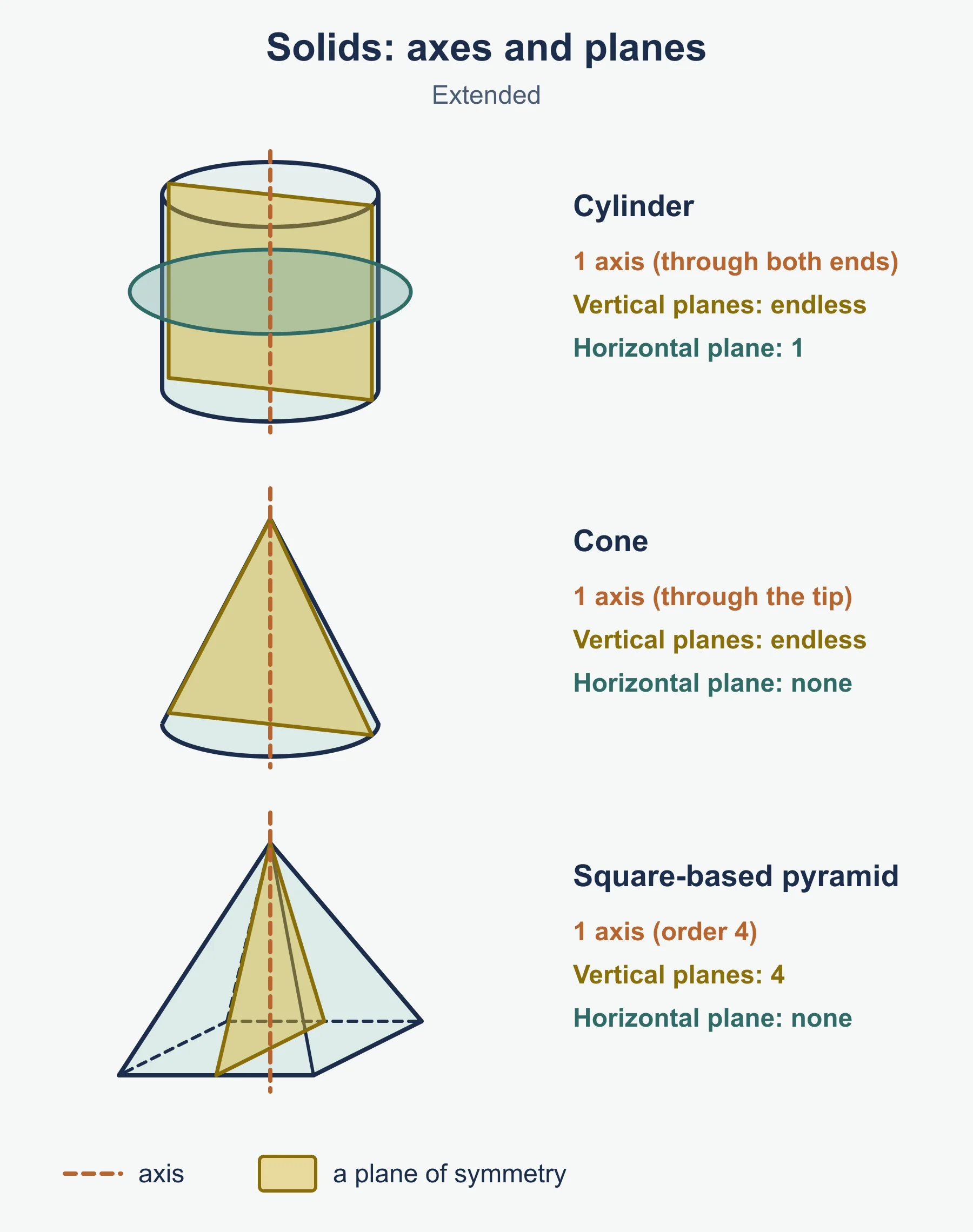
Solids: identify planes (mirror cuts) and axes (turning lines).
| Solid | Planes | Axes |
|---|---|---|
| Cuboid with three different edges | 3 | 3, each of order 2 |
| Square-based pyramid | 4 | 1, order 4 |
| Regular triangular prism | 4 | 4: one of order 3, three of order 2 |
| Cylinder | infinitely many through the axis, plus 1 across the middle | 1 main axis, plus order-2 axes through the middle |
| Cone | infinitely many through the axis | 1 |
4.6 Angles
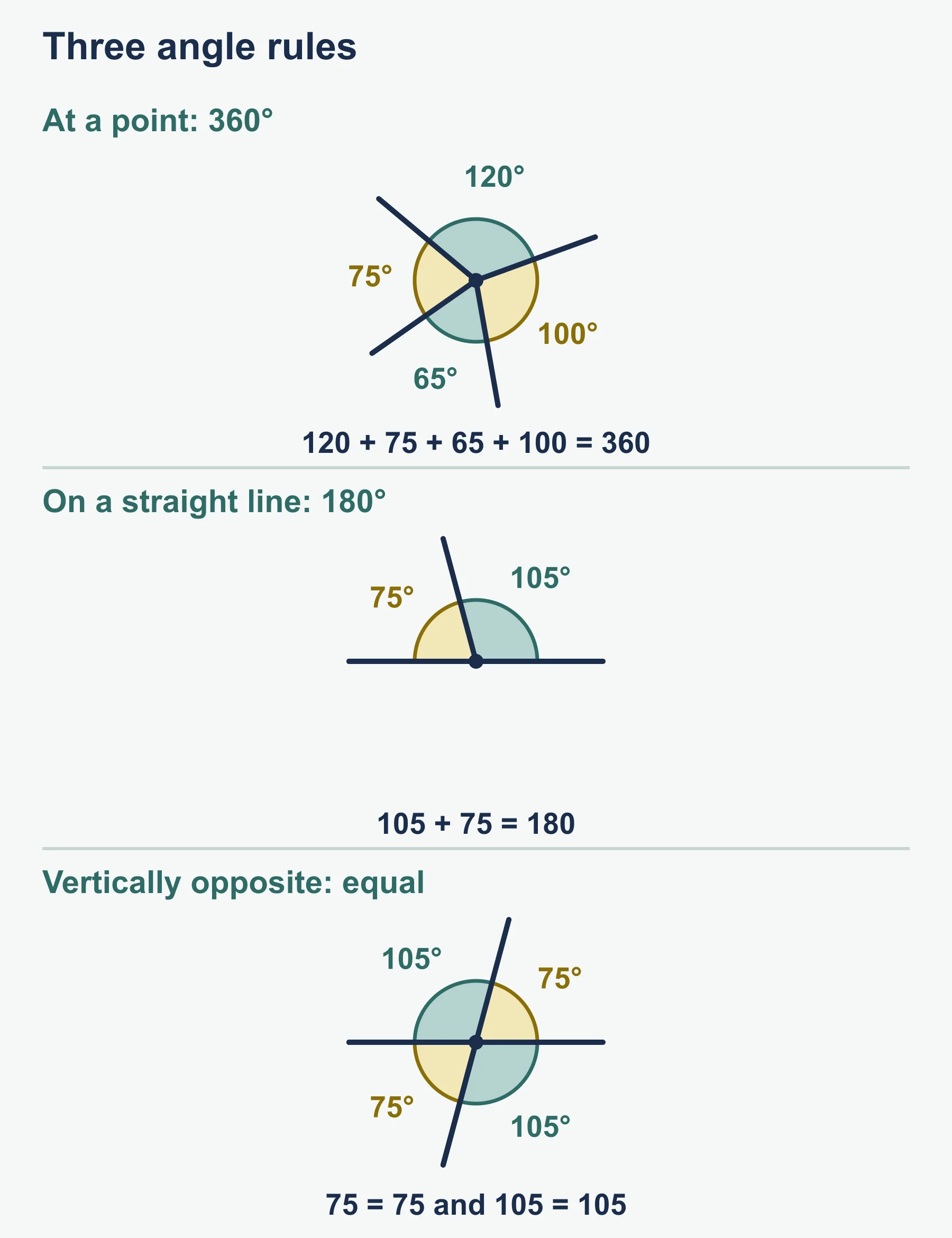
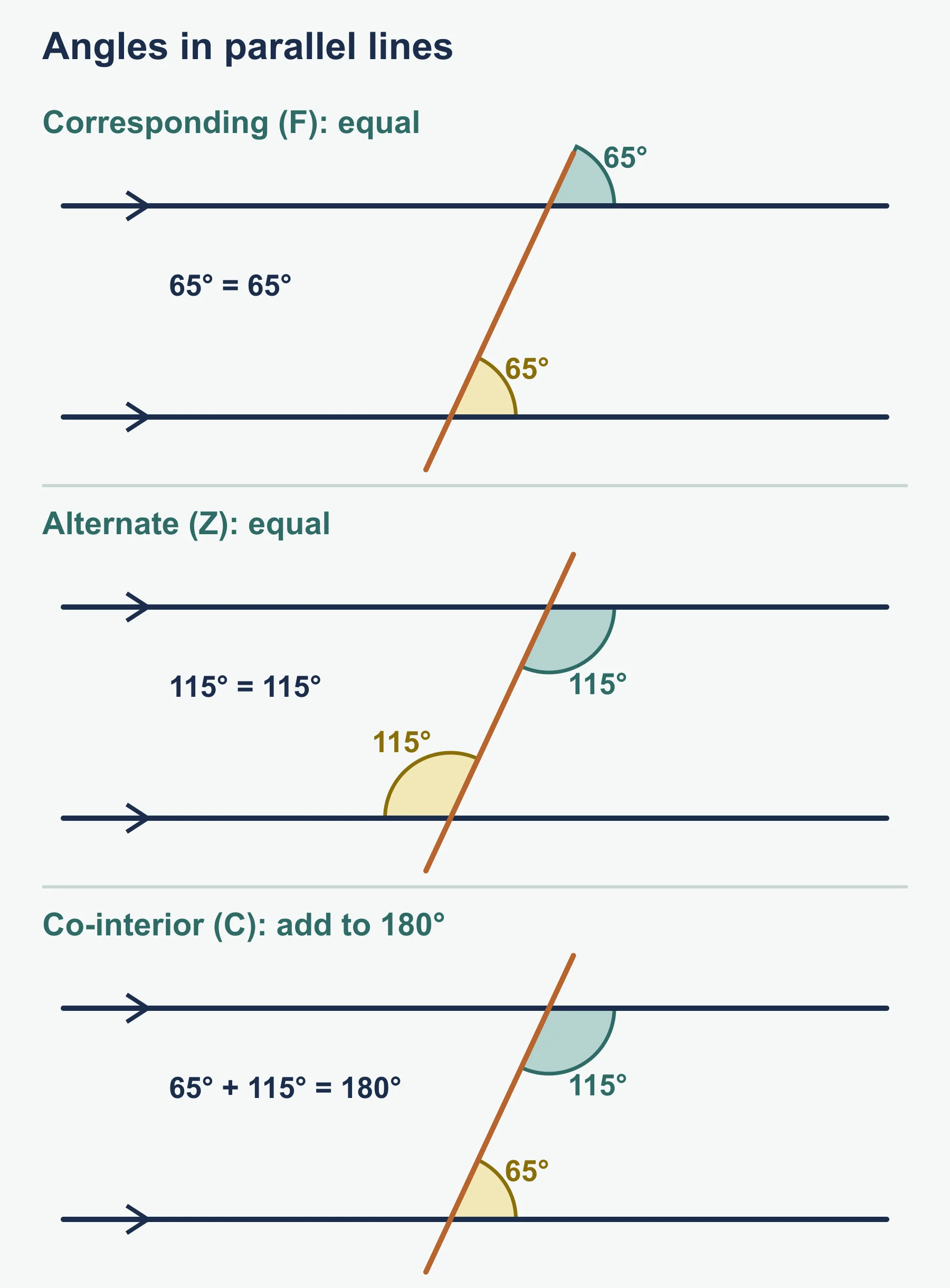
| Fact | Reason to write |
|---|---|
| Angles at a point sum to 360° | angles at a point |
| Angles on a line sum to 180° | angles on a straight line |
| Equal opposite angles at a crossing | vertically opposite angles |
| Triangle 180°, quadrilateral 360° | angle sum of a triangle or quadrilateral |
| Equal angles in the F shape | corresponding angles |
| Equal angles in the Z shape | alternate angles |
| Sum 180° in the C shape | co-interior angles |
Notation: angle ABC has its vertex at B.
Polygon formulae for n sides:
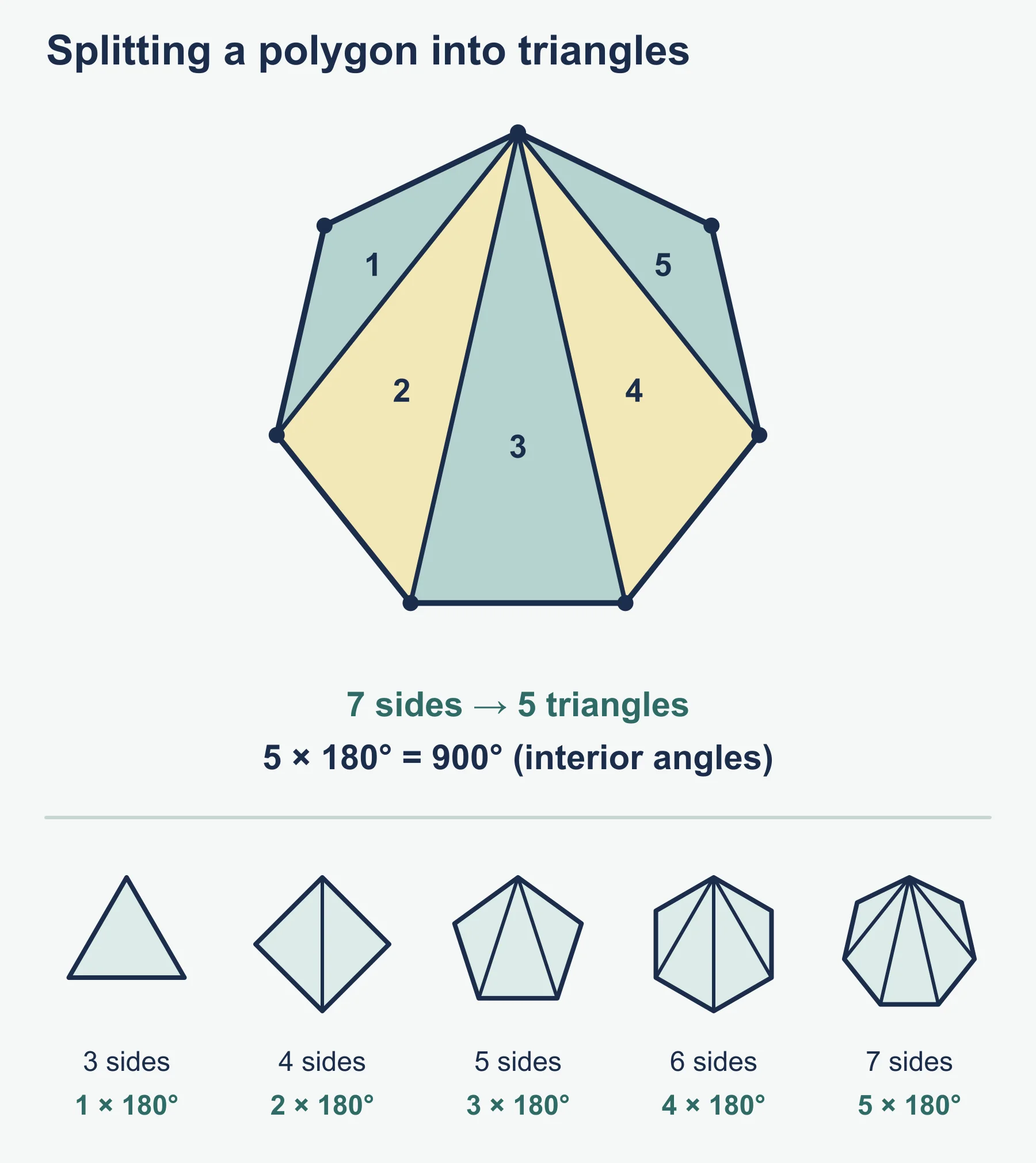
- Sum of interior angles = (n − 2) × 180°.
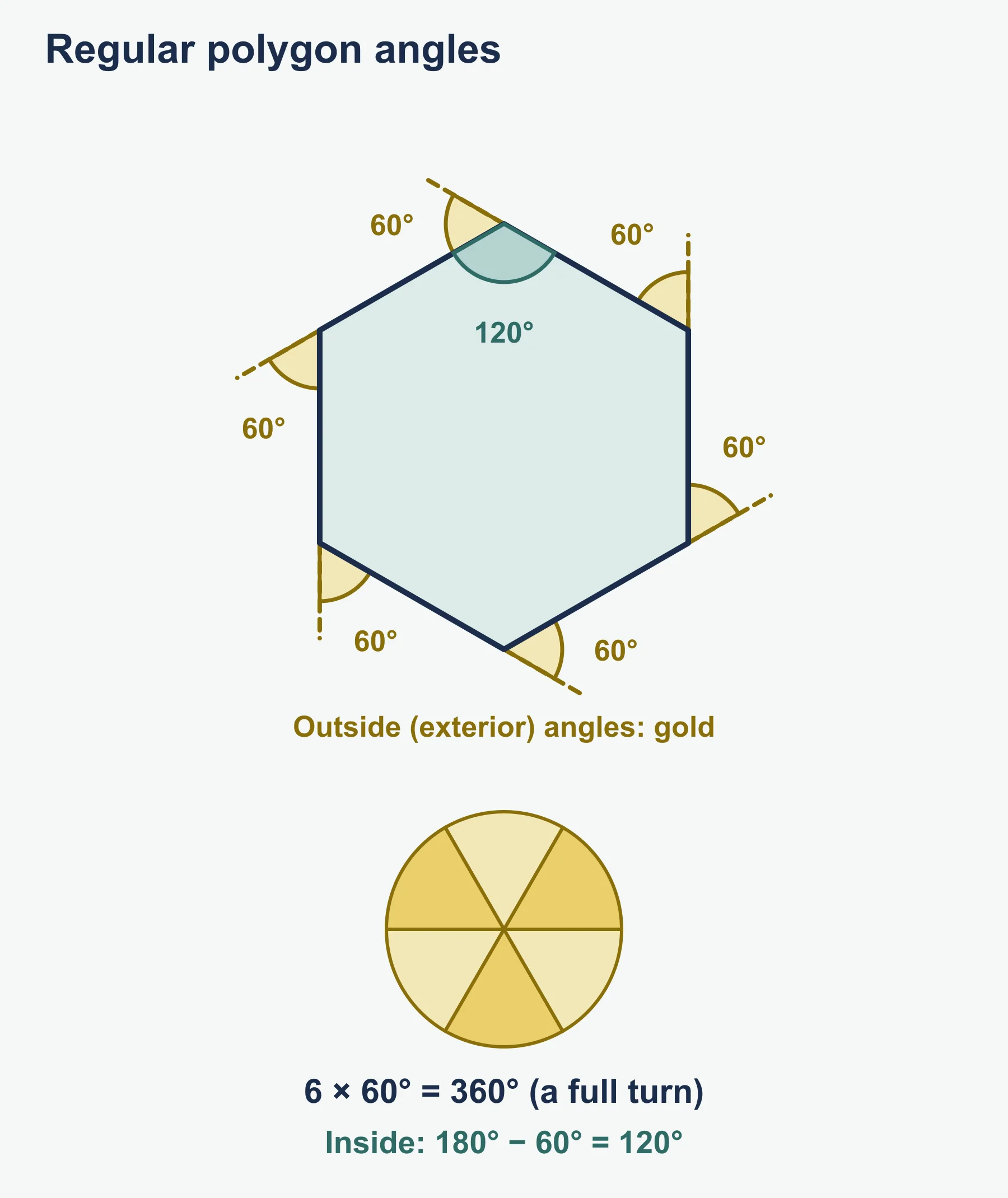
- Sum of exterior angles = 360°.
- Regular: exterior angle = 360° ÷ n; interior angle = 180° − exterior angle.
Examples: a regular octagon has interior angle 135°; a regular dodecagon has interior angle 150°. If an interior angle of a regular polygon is 140°, the exterior angle is 40° and n = 9.
4.7 Circle theorems I
| Theorem | Reason wording |
|---|---|
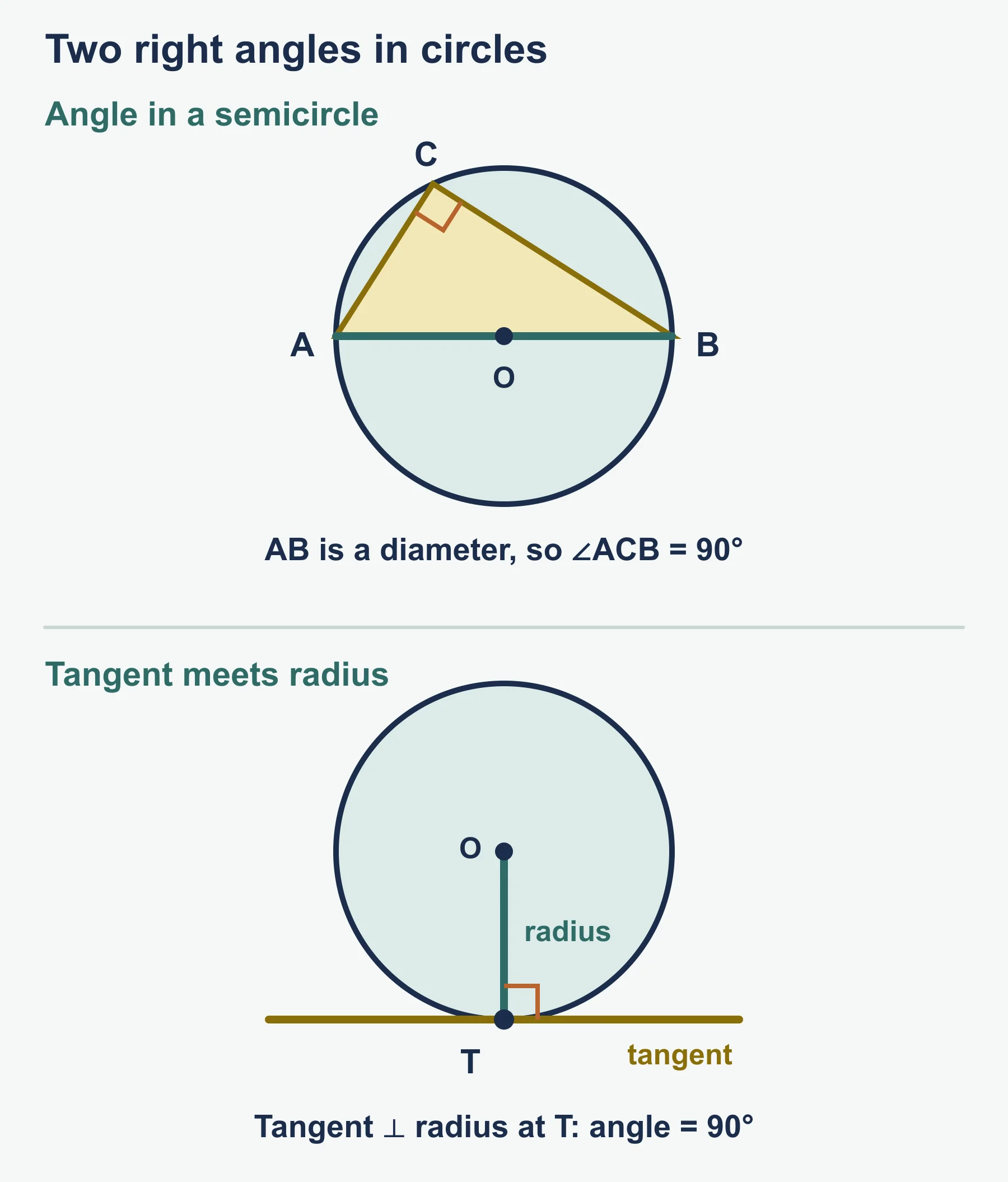
| Angle in a semicircle is 90° | angle in a semicircle |
| Tangent and radius meet at 90° | tangent is perpendicular to the radius |
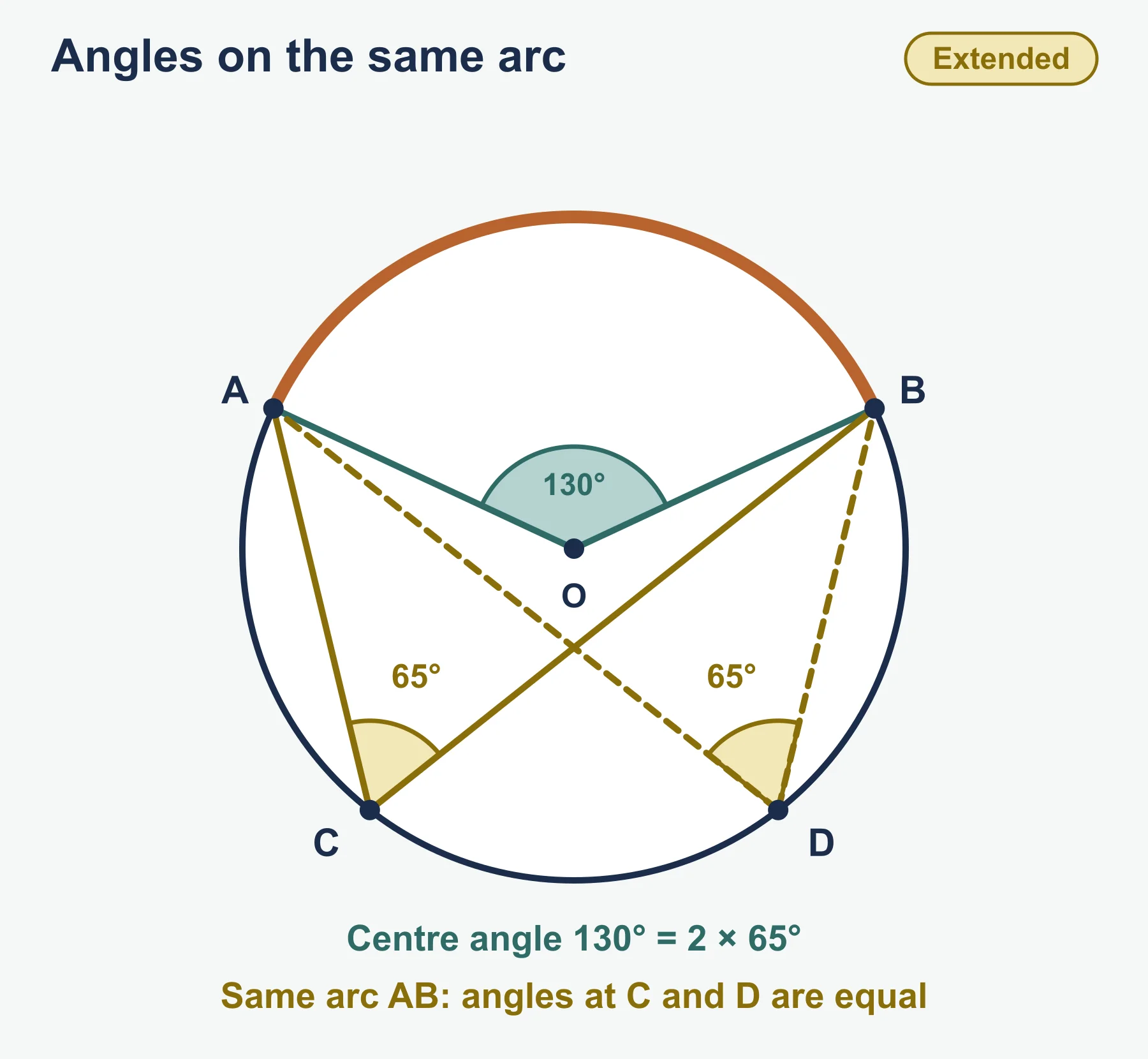
| Angle at the centre is twice the angle at the circumference | angle at centre is twice angle at circumference |
| Same segment gives equal angles | angles in the same segment |
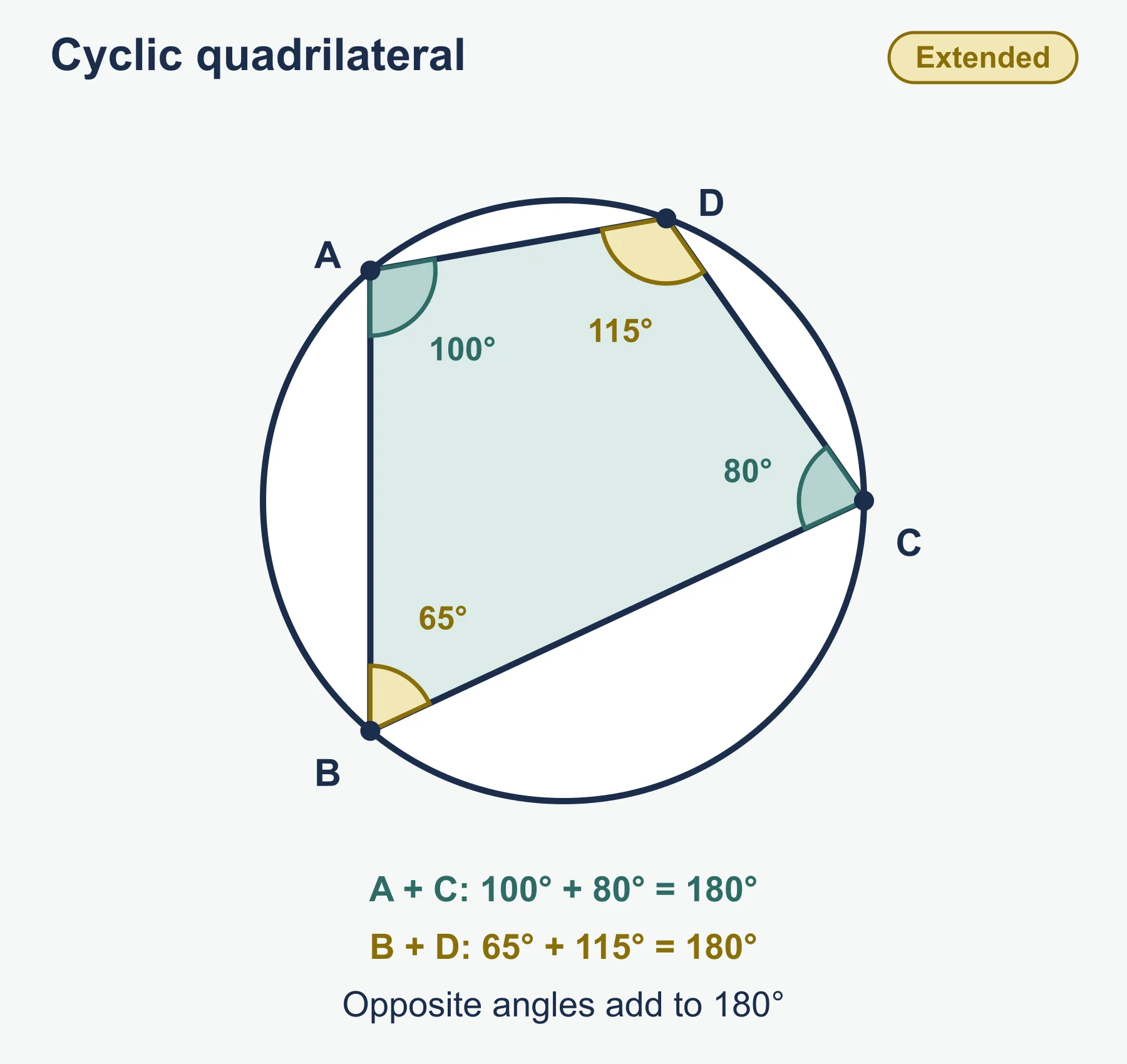
| Cyclic quadrilateral: opposite angles sum to 180° | opposite angles of a cyclic quadrilateral |
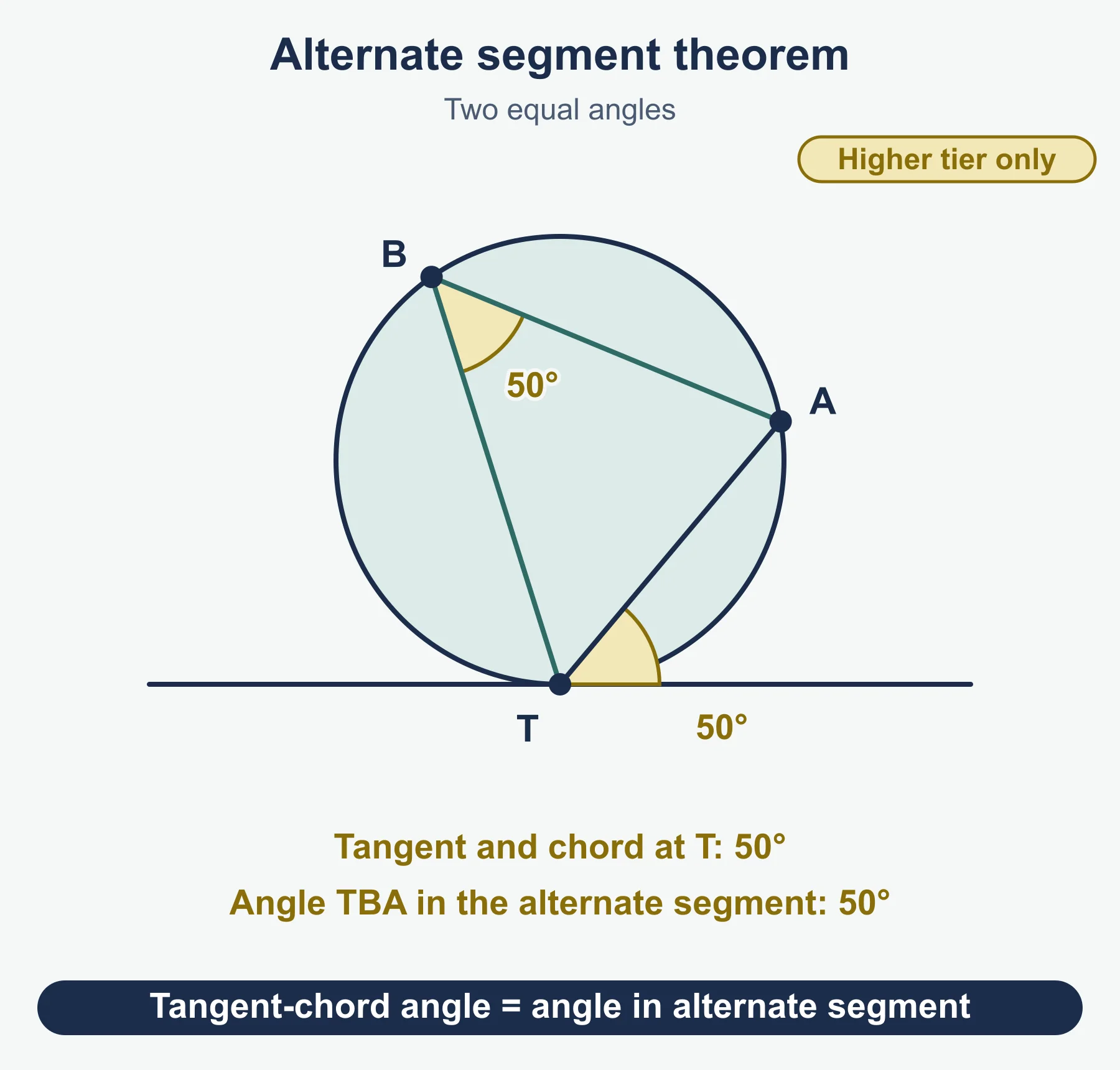
| Tangent-chord angle equals the angle in the alternate segment | alternate segment theorem |
Method in steps:
- Mark any radii, diameters or tangents on the diagram.
- Look for isosceles triangles (two radii) and right angles.
- Pick the theorem that links a known angle to the one you want.
- State the angle and the reason together.
Check the arc: the angle at the centre and the angle at the circumference must stand on the same arc.
4.8 Circle theorems II
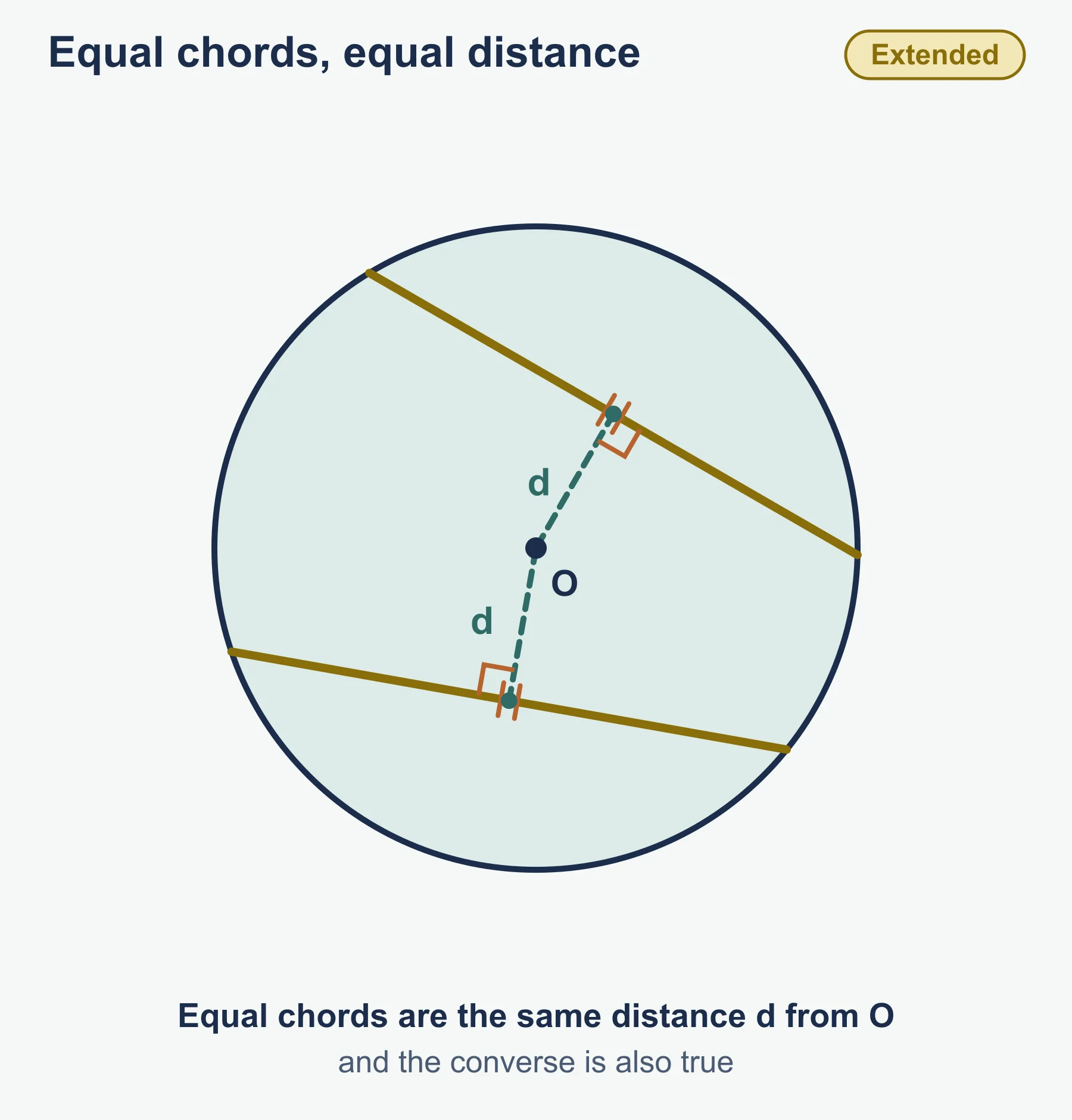
- Equal chords are the same distance from the centre.
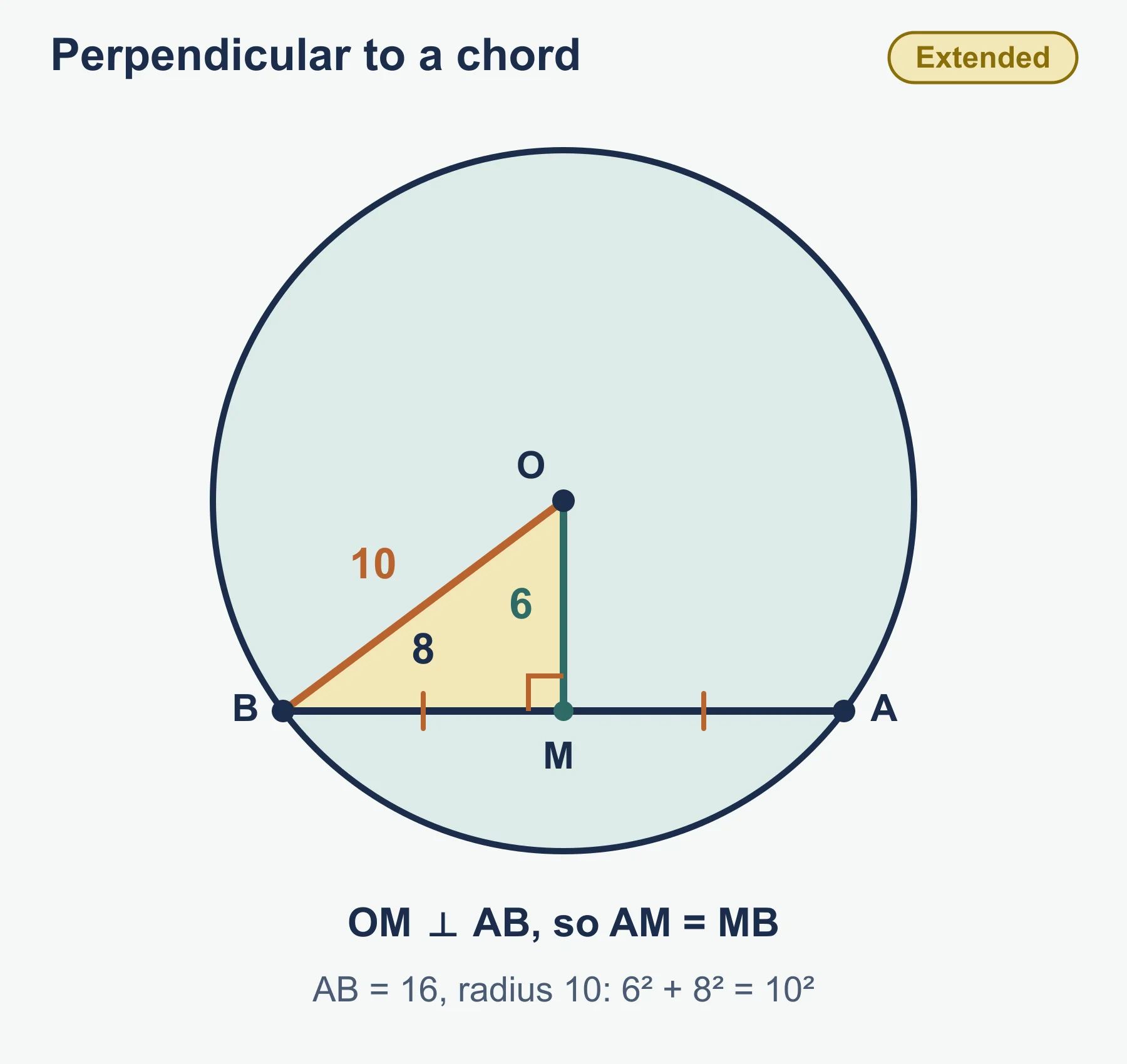
- The perpendicular bisector of a chord passes through the centre.
- Tangents from an external point are equal in length.
Chord reminder: for a chord of length 2c at distance d from the centre of a circle of radius r, c² + d² = r². Example: a diameter of 26 cm and a chord of 10 cm gives d = √(13² − 5²) = 12 cm.
Where marks are usually lost
- Writing an angle without the reason when the question says to give reasons, or using vague wording such as “angles in a circle”.
- Mixing up the interior and exterior angle of a polygon.
- Measuring a bearing from the wrong north line or anticlockwise.
- Using the length ratio for areas or volumes without squaring or cubing.
- Cubing the area ratio instead of finding the length ratio first.
- Overstating symmetry, for example four lines for a rhombus.
- Forgetting construction arcs, or drawing a straight edge freehand.
- Applying the centre theorem to angles on different arcs.
- Not showing the angle pairs when asked to show triangles are similar.
Quick self-test
- Find the interior angle of a regular 12-sided polygon.
- Each interior angle of a regular polygon is 140°. How many sides?
- The bearing of B from A is 296°. Find the bearing of A from B.
- A map has scale 1 : 25 000. A path measures 4.8 cm on the map. How long is it in kilometres?
- A model has surface area 3 cm² and is built at scale 1 : 50. Find the real surface area in m².
- Two similar cylinders have heights in the ratio 2 : 3. The smaller holds 40 cm³. Find the volume of the larger.
- A circle has diameter 26 cm. A chord is 10 cm long. How far is it from the centre?
- State the order of rotational symmetry and the number of lines of symmetry of a rhombus that is not a square.
- The angle at the centre of a circle is 76°. Find the angle at the circumference on the same arc.
- A tangent touches a circle at P. Chord PQ makes an angle of 64° with the tangent. Find the angle in the alternate segment and name the theorem.
- How many faces, edges and vertices does a triangular prism have?
- In a circle with centre O, T is 25 cm from O and the radius is 7 cm. Find the length of a tangent from T.
Answers
- Exterior = 360 ÷ 12 = 30°, so interior = 150°.
- Exterior = 40°, so n = 360 ÷ 40 = 9.
- 296° − 180° = 116°.
- 4.8 × 25 000 = 120 000 cm = 1.2 km.
- Area factor 50² = 2500, so 3 × 2500 = 7500 cm² = 0.75 m².
- Volume factor (3/2)³ = 27/8, so 40 × 27 ÷ 8 = 135 cm³.
- Radius 13, half-chord 5, so distance = √(169 − 25) = 12 cm.
- Order 2, with 2 lines of symmetry.
- 76° ÷ 2 = 38° (angle at the centre is twice the angle at the circumference).
- 64°, by the alternate segment theorem.
- 5 faces, 9 edges, 6 vertices.
- Tangent is perpendicular to the radius, so length = √(25² − 7²) = √576 = 24 cm.
Frequently asked questions
What is the difference between a sector and a segment of a circle? A sector is bounded by two radii and an arc. A segment is bounded by a chord and an arc.
How do you find the interior angle of a regular polygon? Divide 360° by the number of sides to get the exterior angle, then subtract that from 180°. For a regular 12-sided polygon the exterior angle is 30°, so the interior angle is 150°.
How do you find a back bearing? Add or subtract 180° from the original bearing. Bearings are measured clockwise from north and written with three figures.
How many lines of symmetry does a rhombus have? A rhombus that is not a square has 2 lines of symmetry and rotational symmetry of order 2. Claiming four lines is a common way to overstate its symmetry.
Which circle theorems are in Cambridge O Level Mathematics 4024? Topic 4.7 covers the angle in a semicircle, tangent and radius, the angle at the centre, angles in the same segment, cyclic quadrilaterals and the alternate segment theorem. Topic 4.8 adds equal chords, the perpendicular bisector of a chord and equal tangents from an external point.
Official syllabus
Cambridge O Level Mathematics (Syllabus D) 4024 syllabus for examination in 2025, 2026 and 2027, Cambridge International Education, topic 4 Geometry, sections 4.1 to 4.8.
Get free revision emails (optional)
Occasional emails with practice questions, worked explanations and links to free resources for the qualification and subjects you choose. No spam, and you can unsubscribe from any email. The free tools on this site never need an email.
Related resources
-
Study guides
Cambridge O Level Mathematics: Geometry (4024)
A step-by-step Cambridge O Level Mathematics study guide to geometry: terms, constructions, bearings, similarity, symmetry, angles and circle theorems.
Mathematics · Cambridge · O Level
Read guide -
Practice questions
O Level Mathematics: Geometry Practice Questions (Cambridge 4024)
Original Cambridge O Level Mathematics 4024 geometry questions on polygon angles, isosceles triangles, circle theorems, tangents and similarity, with answers.
Mathematics · Cambridge · O Level
Try questions -
Study guides
Cambridge O Level Mathematics: Mensuration (4024)
Study guide to every Mensuration outcome in Cambridge O Level Mathematics 4024: units, area, circles, solids and compound shapes, with worked examples.
Mathematics · Cambridge · O Level
Read guide
Related articles
-
exam preparation
Where IGCSE Mathematics marks are lost early
The first weeks of an IGCSE Mathematics course rarely go wrong on difficulty. They go wrong on method, command words, rounding and units — four habits that cost marks a student had already earned.
24 August 2026
-
teaching
A Level tuition in Dubai: Cambridge or Pearson Edexcel International A Level?
Schools in Dubai and Abu Dhabi teach either Cambridge International AS & A Level or Pearson Edexcel International A Level. How the two are structured, why it matters for tuition, and how online classes from Lahore work.
9 October 2026
Studying this with a teacher
Working through Mathematics O LEVELS?
This page is free and stays free. If you would rather be taught it, Marlbridge runs Mathematics classes one-to-one and in small groups of up to 15, online in your own time zone. The first trial class is free. WhatsApp replies within an hour (8am–11pm Pakistan time, every day); email the same day.
Cambridge Mathematics teachers at Marlbridge


