
Study Guides
Cambridge O Level Mathematics: Mensuration (4024)
Study guide to every Mensuration outcome in Cambridge O Level Mathematics 4024: units, area, circles, solids and compound shapes, with worked examples.
- Subject
- Mathematics
- Level
- O LEVELS
- Topic
- Mensuration
- Author
- Marlbridge Academic Team
- Updated
- Reviewed by
- Sajawal Zahid (what this means)
Aligned to Cambridge O Level Mathematics (4024), 2025-2027. Official specification .
Syllabus page (what it covers and how it is assessed): Cambridge O Level Mathematics.
Syllabus points this page covers
4024
- 5 Mensuration (whole topic)
Found an error? Report a correction.
Need help with this topic? Request a free trial class for O Level Mathematics (4024).
This study guide is aligned to the Cambridge O Level Mathematics (Syllabus D) 4024 syllabus for examination in 2025, 2026 and 2027. It covers all of syllabus topic 5, Mensuration, sections 5.1 to 5.5. The syllabus is not tiered. Paper 1 does not allow a calculator and Paper 2 requires a scientific calculator, so practise leaving answers in terms of π as well as working to 3 significant figures.
Condensed recall is in the revision notes. Exam-style questions are in the mensuration practice set. Use the course hub and the printable checklist to track progress, and take a free 10-minute diagnostic if you are unsure where to start.
| Section | What you must be able to do |
|---|---|
| 5.1 | Use metric units of mass, length, area, volume and capacity, and convert between them |
| 5.2 | Find perimeter and area of a rectangle, triangle, parallelogram and trapezium |
| 5.3 | Find circumference, area, arc length and sector area (minor and major sectors) |
| 5.4 | Find surface area and volume of a cuboid, prism, cylinder, sphere, pyramid and cone |
| 5.5 | Solve problems on compound shapes and solids, and on parts of shapes and solids |
Which formulas are given
The syllabus says a list of formulas is included on page 2 of the examination papers. For this topic it covers the area of a triangle, the area and circumference of a circle, the curved surface area of a cylinder and of a cone, the surface area of a sphere, and the volume of a prism, pyramid, cylinder, cone and sphere. Except for the triangle, area formulas are not given, so you must know the rectangle, parallelogram and trapezium formulas. The syllabus does not list arc length or sector area as given, so learn them as fractions of the circle (section 5.3). Cuboid formulas, total surface areas and the hemisphere are not in the list either, so you build them from the pieces.
5.1 Units of measure
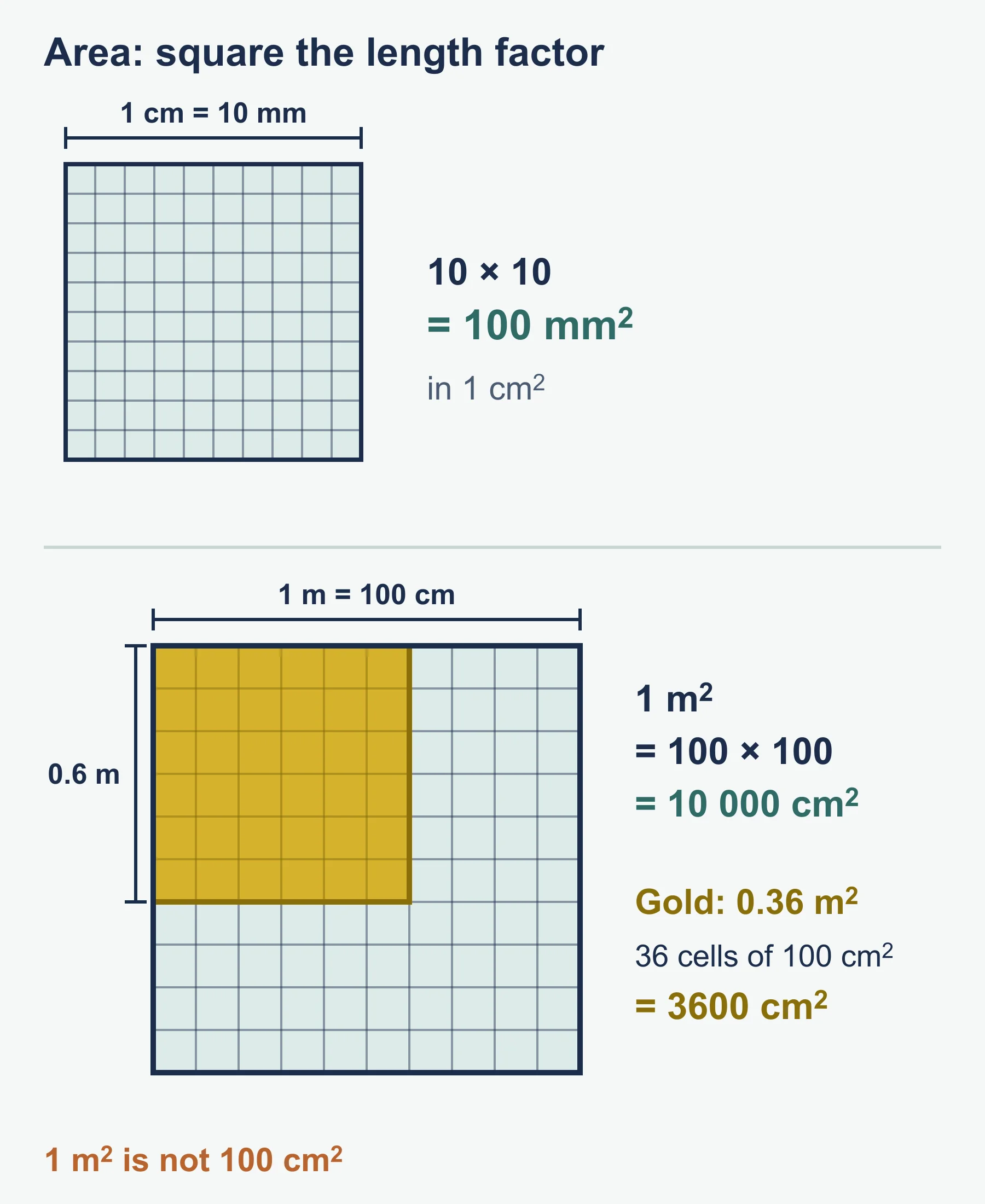
The syllabus names mm, cm, m, km; mm², cm², m², km²; mm³, cm³, m³; ml and l; g and kg. Area and volume factors are the length factor squared and cubed.
| From | To | Multiply by |
|---|---|---|
| 1 cm | mm | 10 |
| 1 cm² | mm² | 10² = 100 |
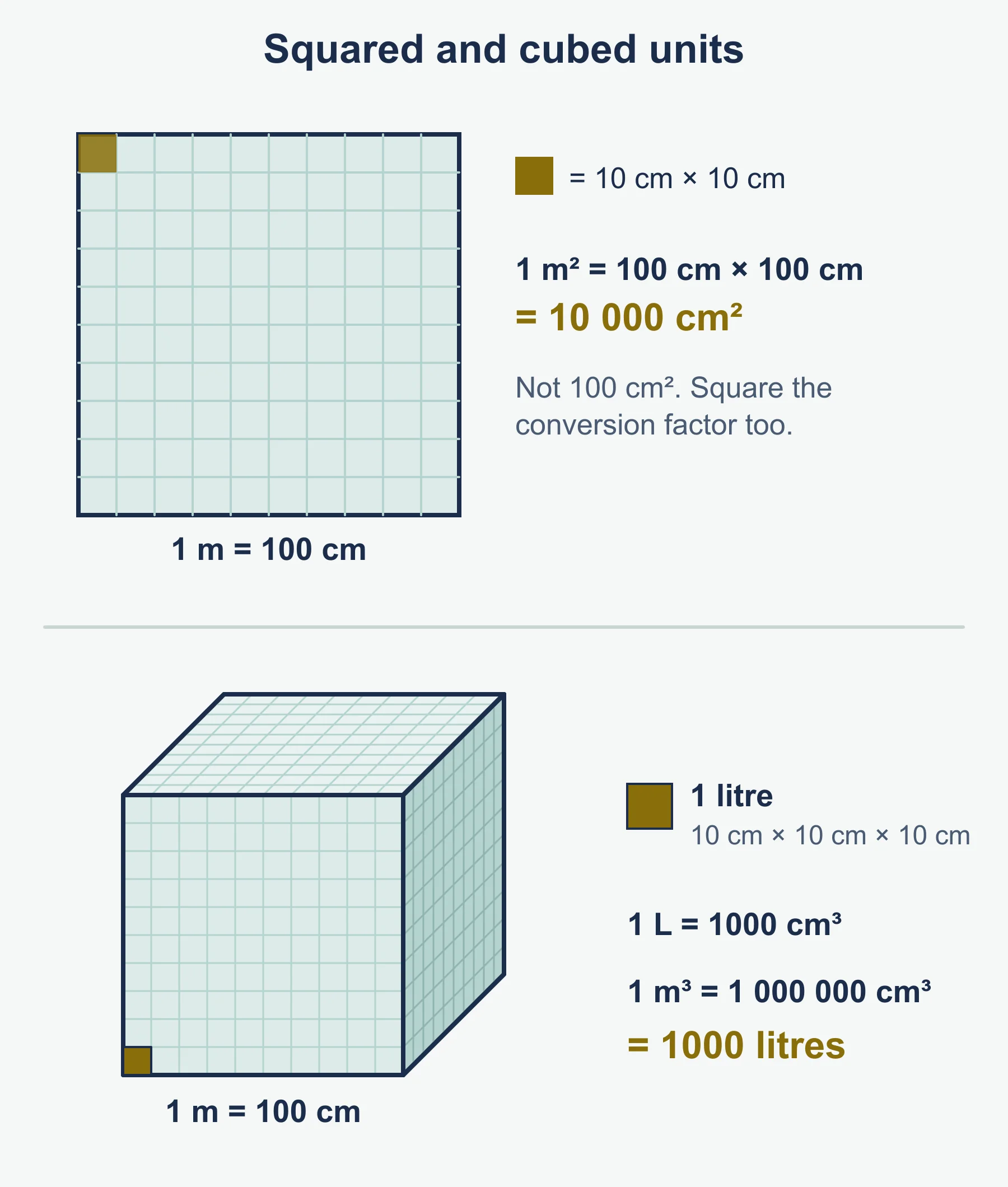
| 1 m² | cm² | 100² = 10 000 |
| 1 km² | m² | 1000² = 1 000 000 |
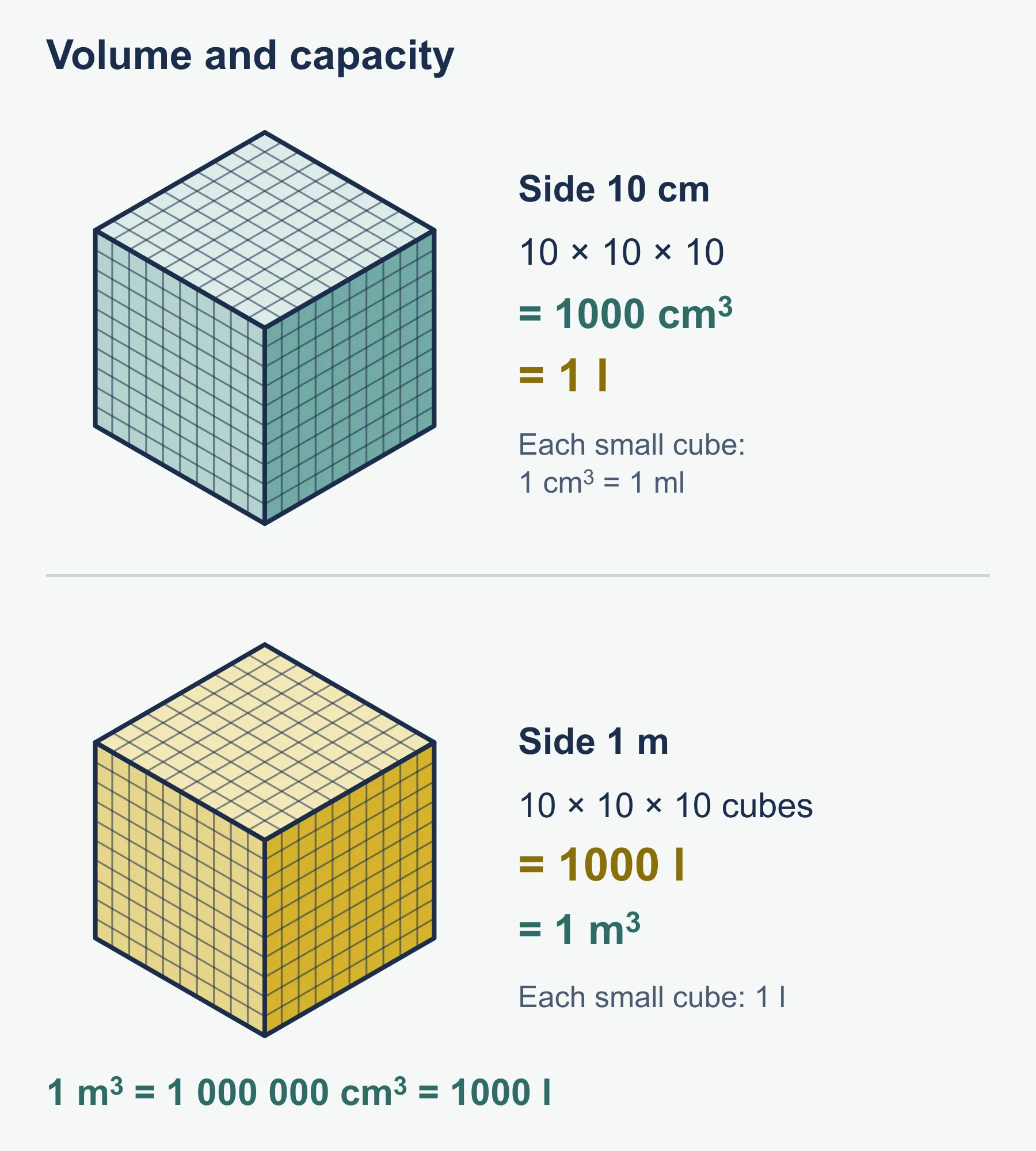
| 1 m³ | cm³ | 100³ = 1 000 000 |
| 1 cm³ | ml | 1 |
| 1 l | cm³ | 1000 |
| 1 m³ | l | 1000 |
| 1 kg | g | 1000 |
Worked example 1. A tank measures 150 cm by 80 cm by 60 cm. Find its capacity in litres.
Volume = 150 × 80 × 60 = 720 000 cm³. 1 litre = 1000 cm³, so capacity = 720 000 ÷ 1000 = 720 litres.
Worked example 2. A field has area 0.35 km². Give this in m². An engraved plate has area 4500 mm². Give this in cm².
0.35 × 1 000 000 = 350 000 m². 4500 ÷ 100 = 45 cm².
Going to a smaller unit multiplies. Going to a larger unit divides.
5.2 Area and perimeter
Perimeter is the distance round the outside. Area is the surface enclosed.
| Shape | Area | Given in exam? |
|---|---|---|
| Rectangle, length l, width w | l × w | No |
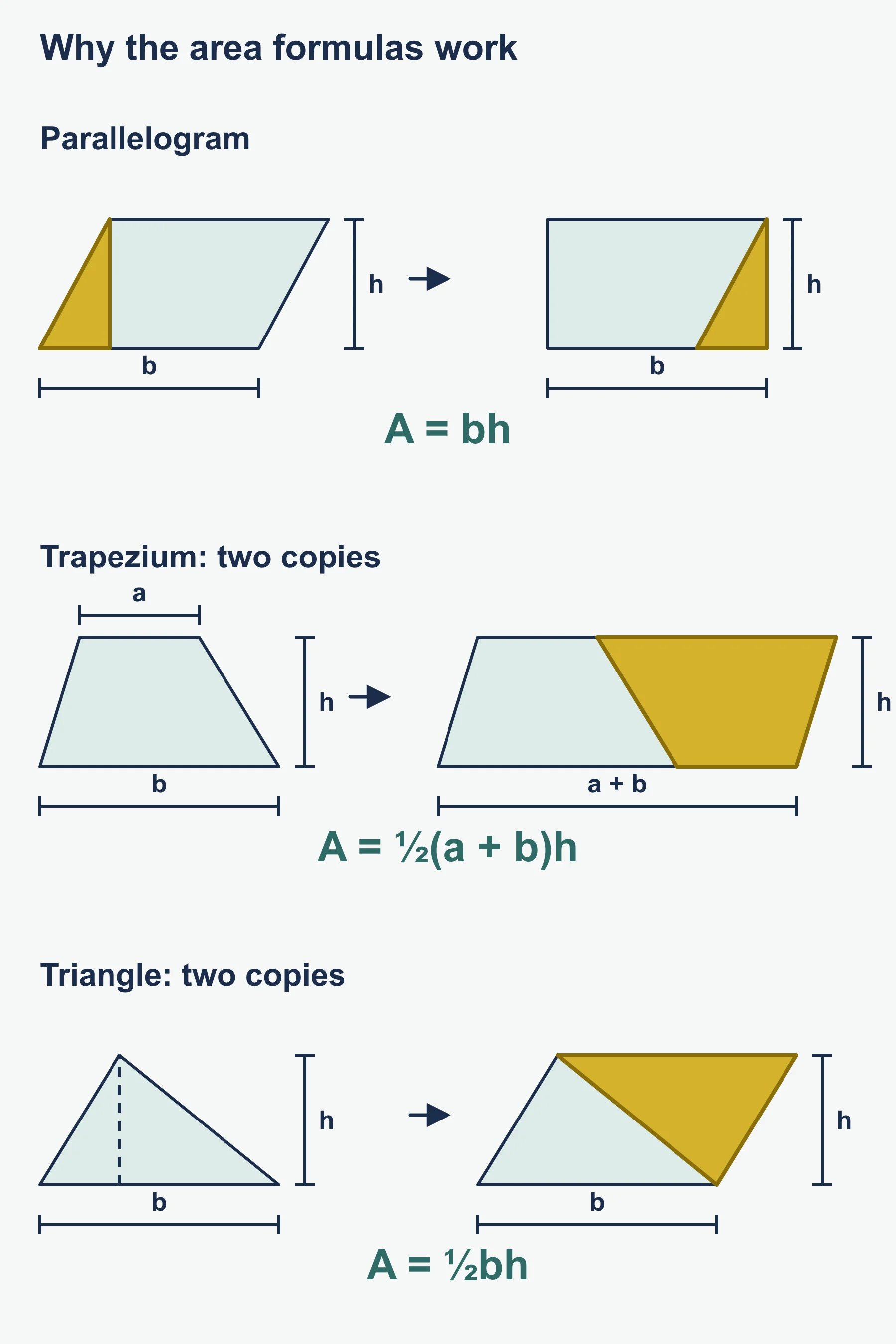
| Triangle, base b, perpendicular height h | ½bh | Yes |
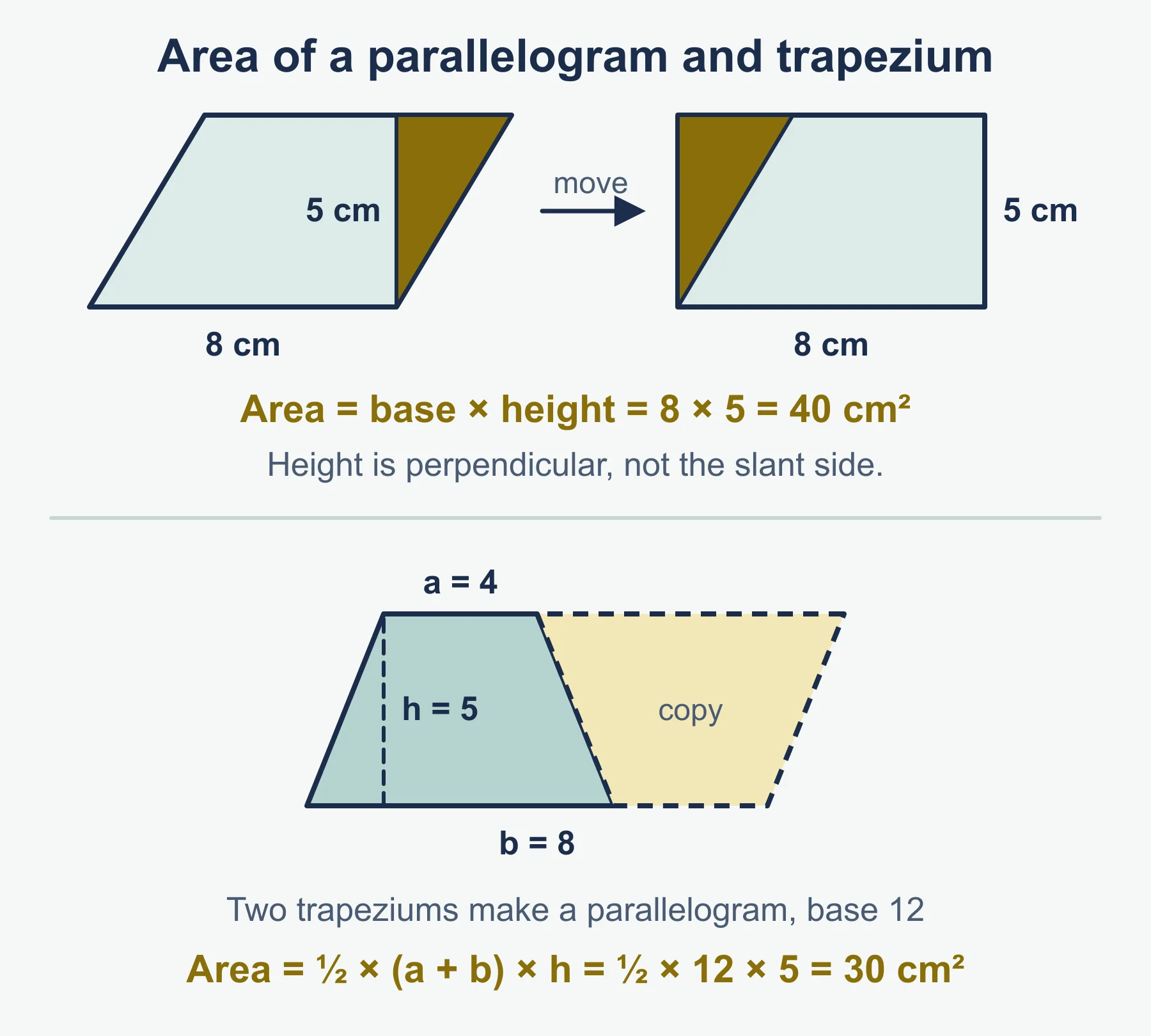
| Parallelogram, base b, perpendicular height h | bh | No |
| Trapezium, parallel sides a and b, height h | ½(a + b)h | No |
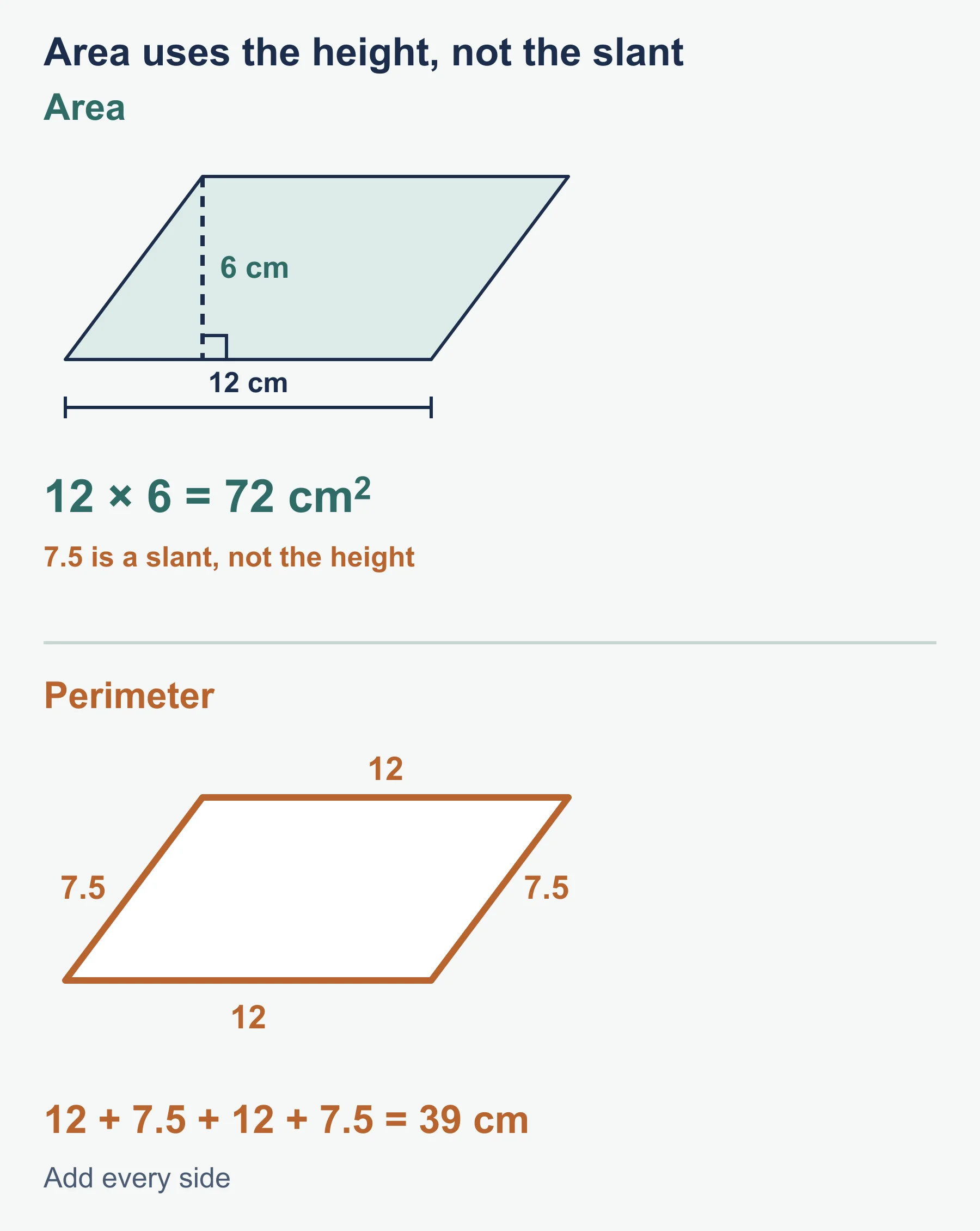
The height is always measured at right angles to the base. The sloping side of a parallelogram or trapezium is used for the perimeter, never for the area.
Worked example 3. A parallelogram has base 14 cm, a sloping side of 8 cm and a perpendicular height of 6.5 cm. Find its area and perimeter.
Area = 14 × 6.5 = 91 cm². Opposite sides are equal, so perimeter = 2 × (14 + 8) = 44 cm.
Worked example 4. A trapezium has parallel sides 5 cm and 13 cm and area 54 cm². Find the distance between the parallel sides.
54 = ½ × (5 + 13) × h 54 = 9h h = 6 cm.
5.3 Circles, arcs and sectors
For a circle of radius r, the area is πr² and the circumference is 2πr. Both are in the list of formulas. Answers may be asked for in terms of π, which means leave π as a symbol, for example 20π cm.
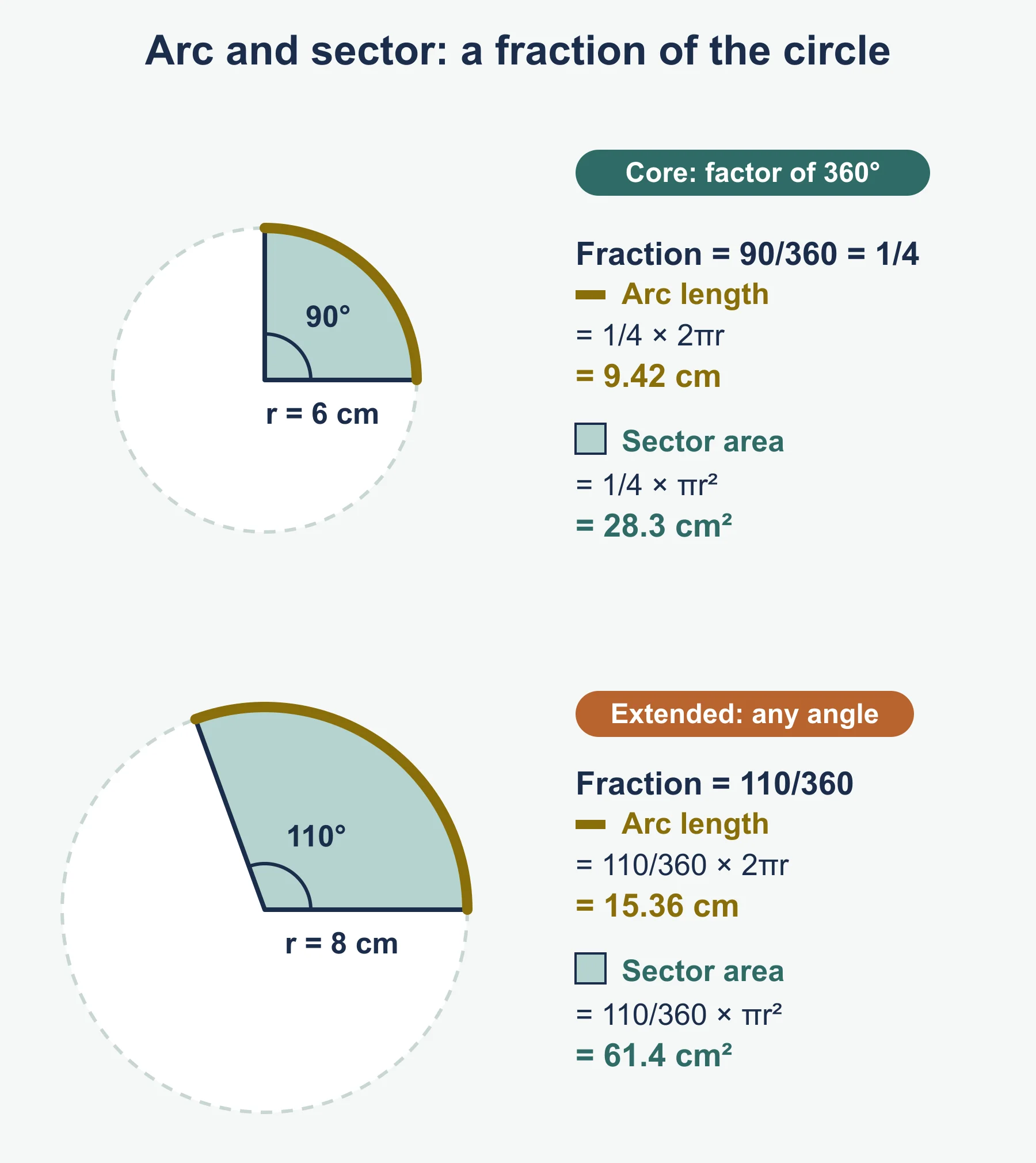
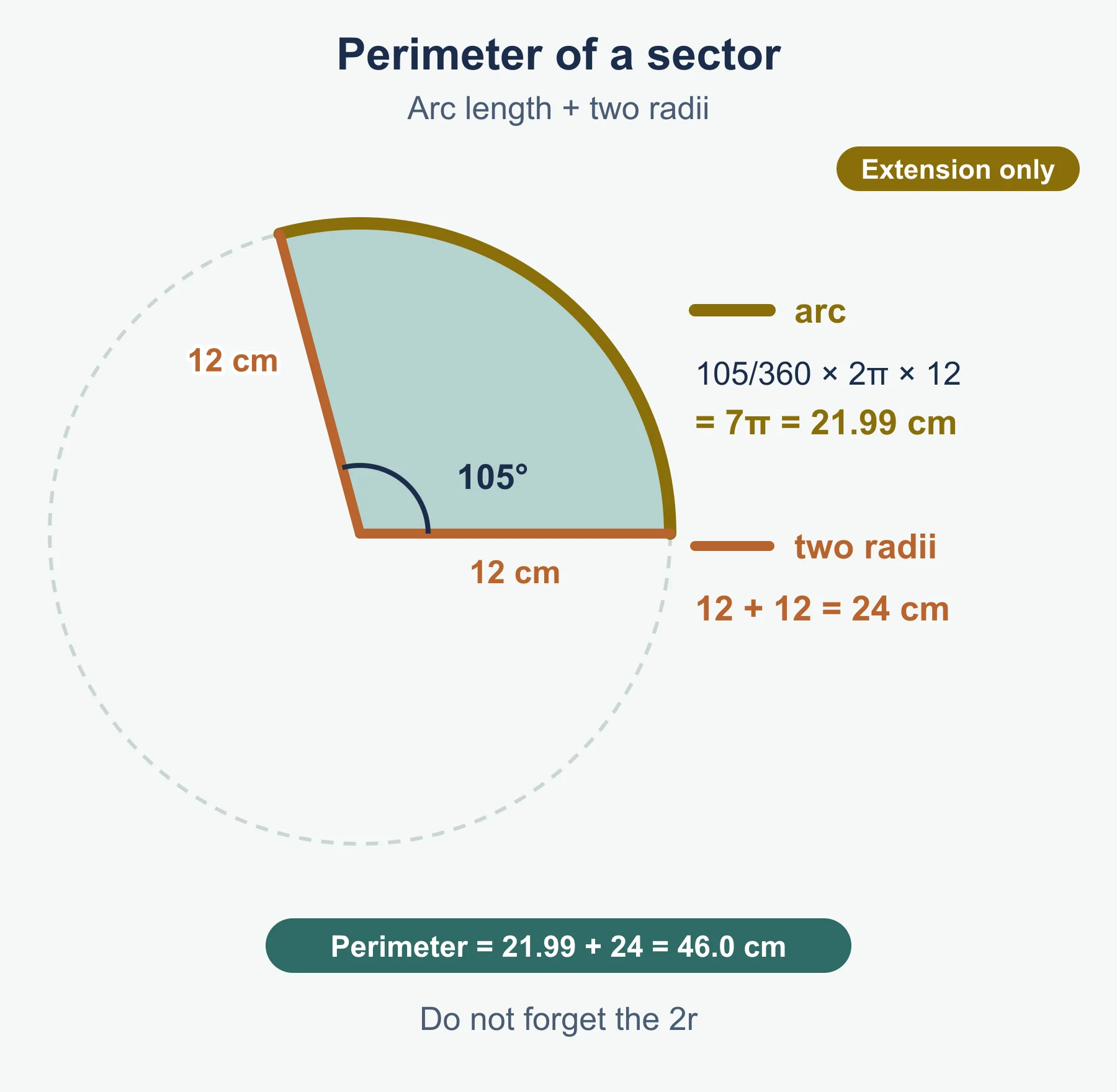
An arc is part of the circumference. A sector is the region between two radii and an arc. If the angle at the centre is θ degrees, the sector is a fraction θ/360 of the whole circle:
- arc length = (θ/360) × 2πr
- sector area = (θ/360) × πr²
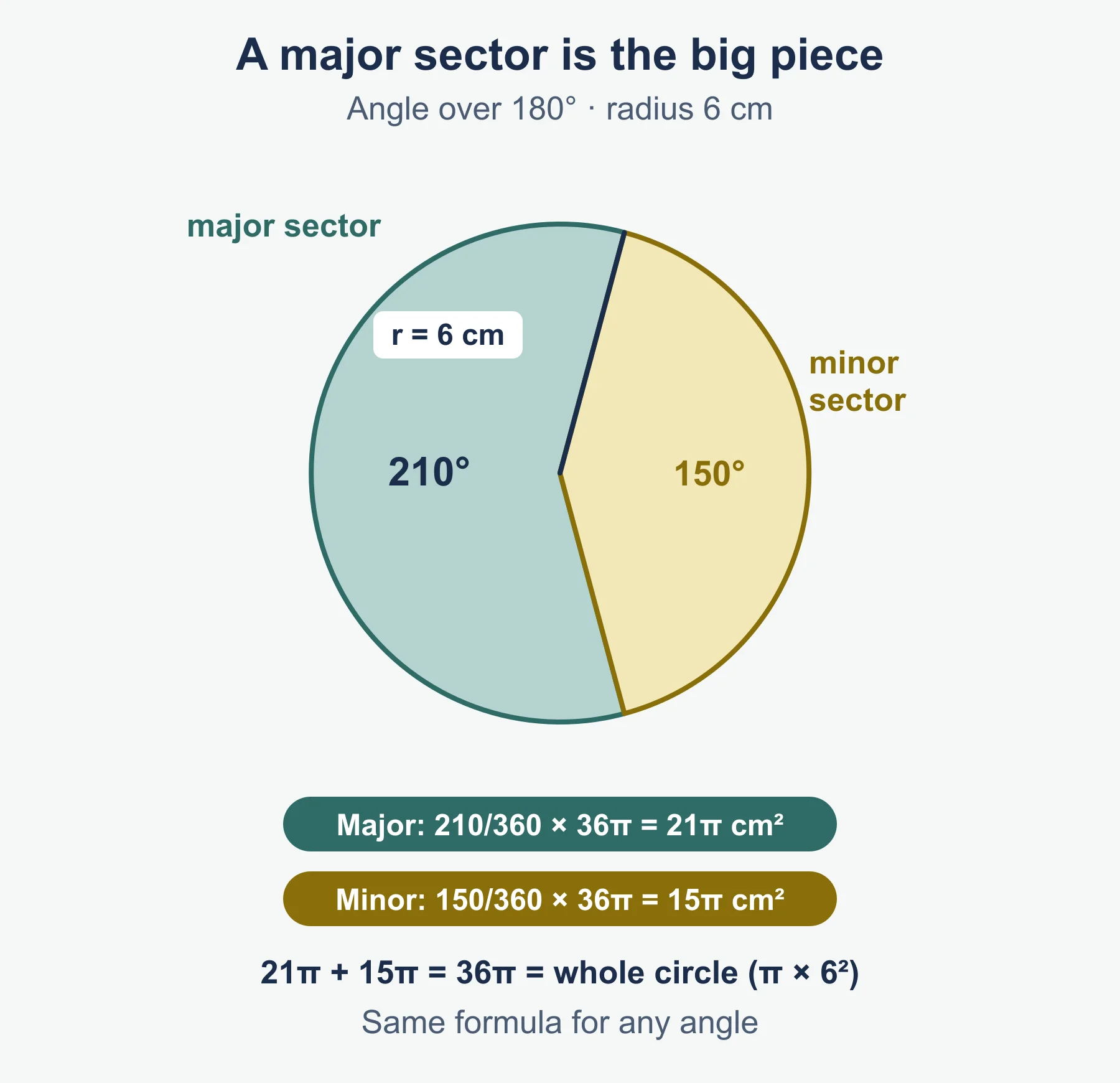
A sector with θ less than 180° is a minor sector. A sector with θ greater than 180° is a major sector. The same two formulas work for both. For a major sector, either use the large angle directly or subtract the minor sector from the whole circle.
Worked example 5. A sector has radius 12 cm and angle 75°. Find the arc length, the area and the perimeter, leaving each answer in terms of π first, then rounding to 3 significant figures.
Fraction = 75/360 = 5/24. Arc length = (5/24) × 2π × 12 = 5π cm = 15.7 cm. Area = (5/24) × π × 12² = (5/24) × 144π = 30π cm² = 94.2 cm². The perimeter of the sector includes both radii: 12 + 12 + 5π = 24 + 5π cm = 39.7 cm.
Worked example 6. A major sector has radius 6 cm and angle 210°. Find its area in terms of π.
Area = (210/360) × π × 6² = (7/12) × 36π = 21π cm².
Worked example 7. The arc of a sector of radius 14 cm has length 7π cm. Find the angle.
7π = (θ/360) × 2π × 14 7π = (θ/360) × 28π θ/360 = 1/4 θ = 90°.
5.4 Surface area and volume
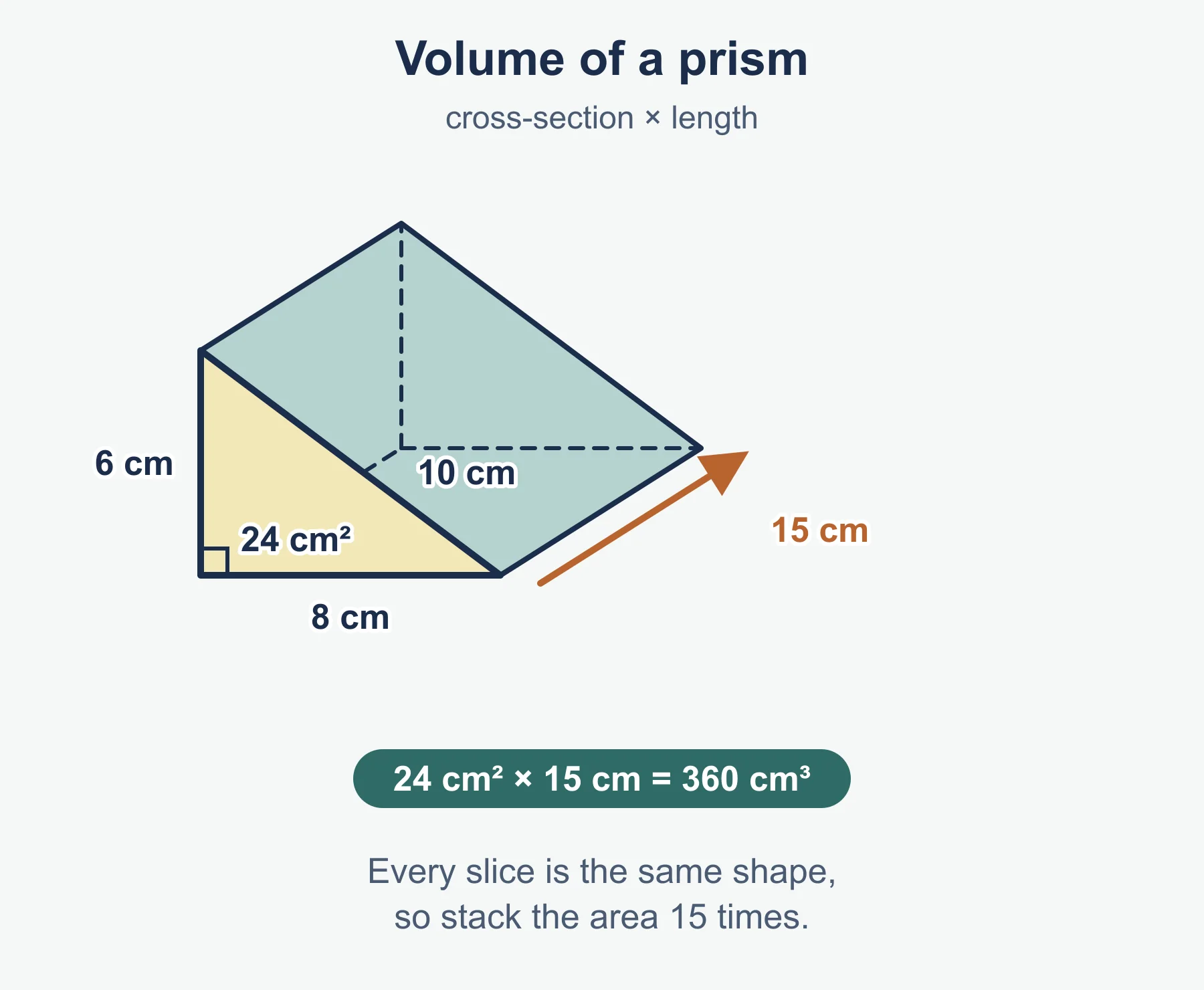
A prism is any solid with a uniform cross-section. The syllabus gives a cylindrical sector as an example, so a cylinder, a triangular prism and a half-cylinder are all prisms.
| Solid | Volume | Surface area |
|---|---|---|
| Cuboid l by w by h | lwh | 2(lw + lh + wh) |
| Prism, cross-section area A, length l | Al | 2A + (perimeter of cross-section) × l |
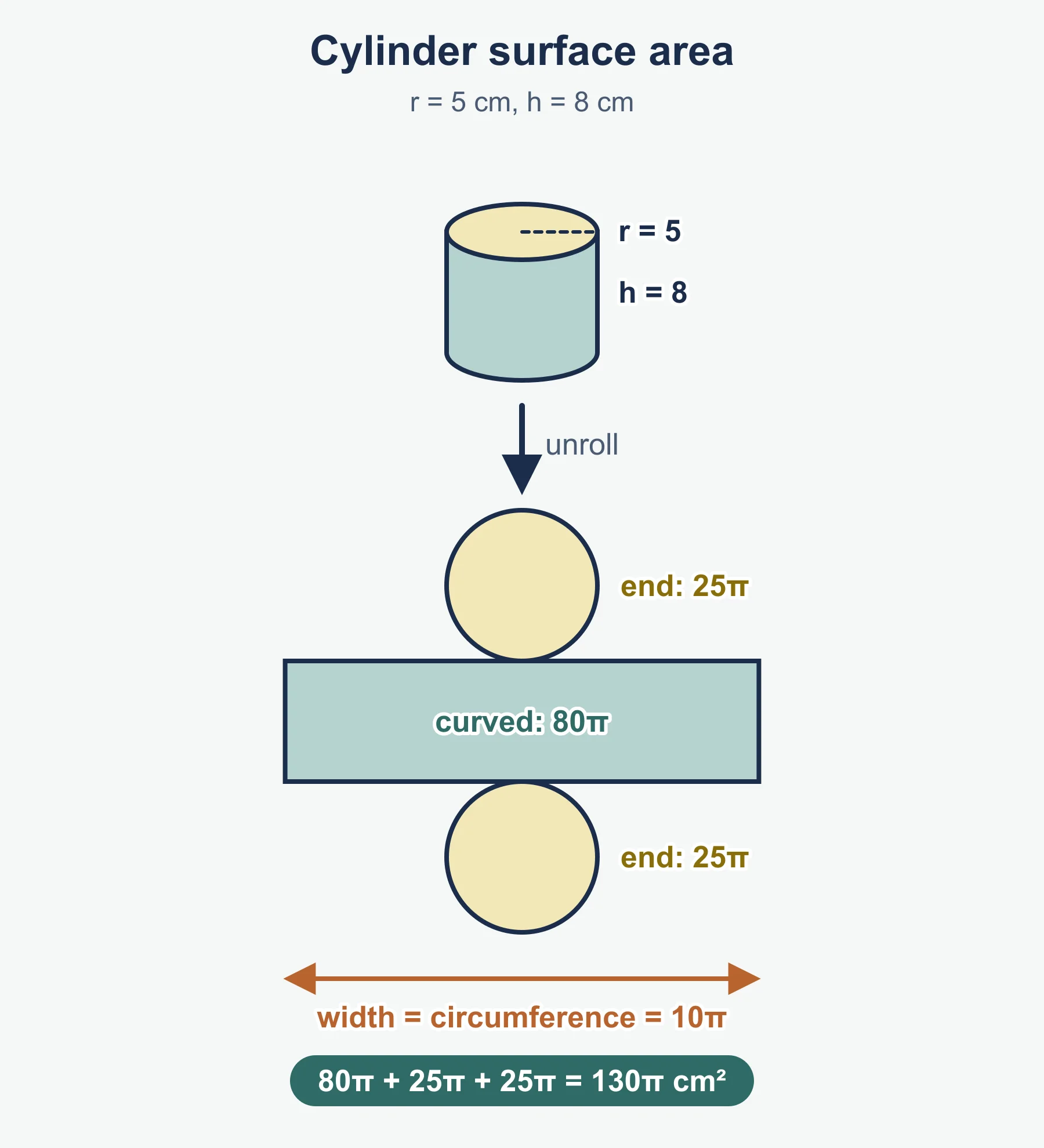
| Cylinder | πr²h | curved 2πrh, plus 2πr² for both ends |
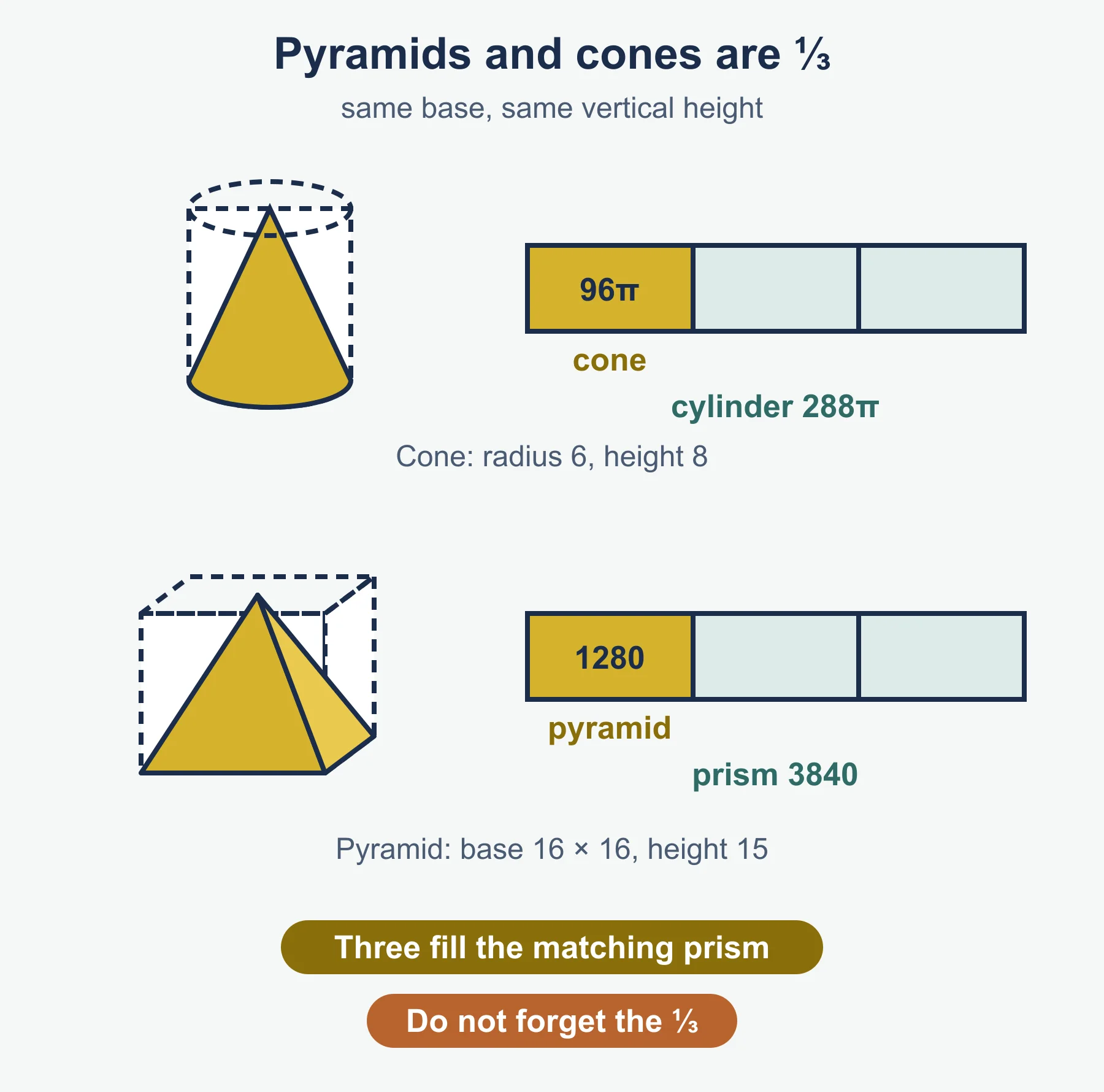
| Cone | ⅓πr²h | curved πrl, plus πr² for the base |
| Sphere | (4/3)πr³ | 4πr² |
| Pyramid, base area A, height h | ⅓Ah | base plus the triangular faces |
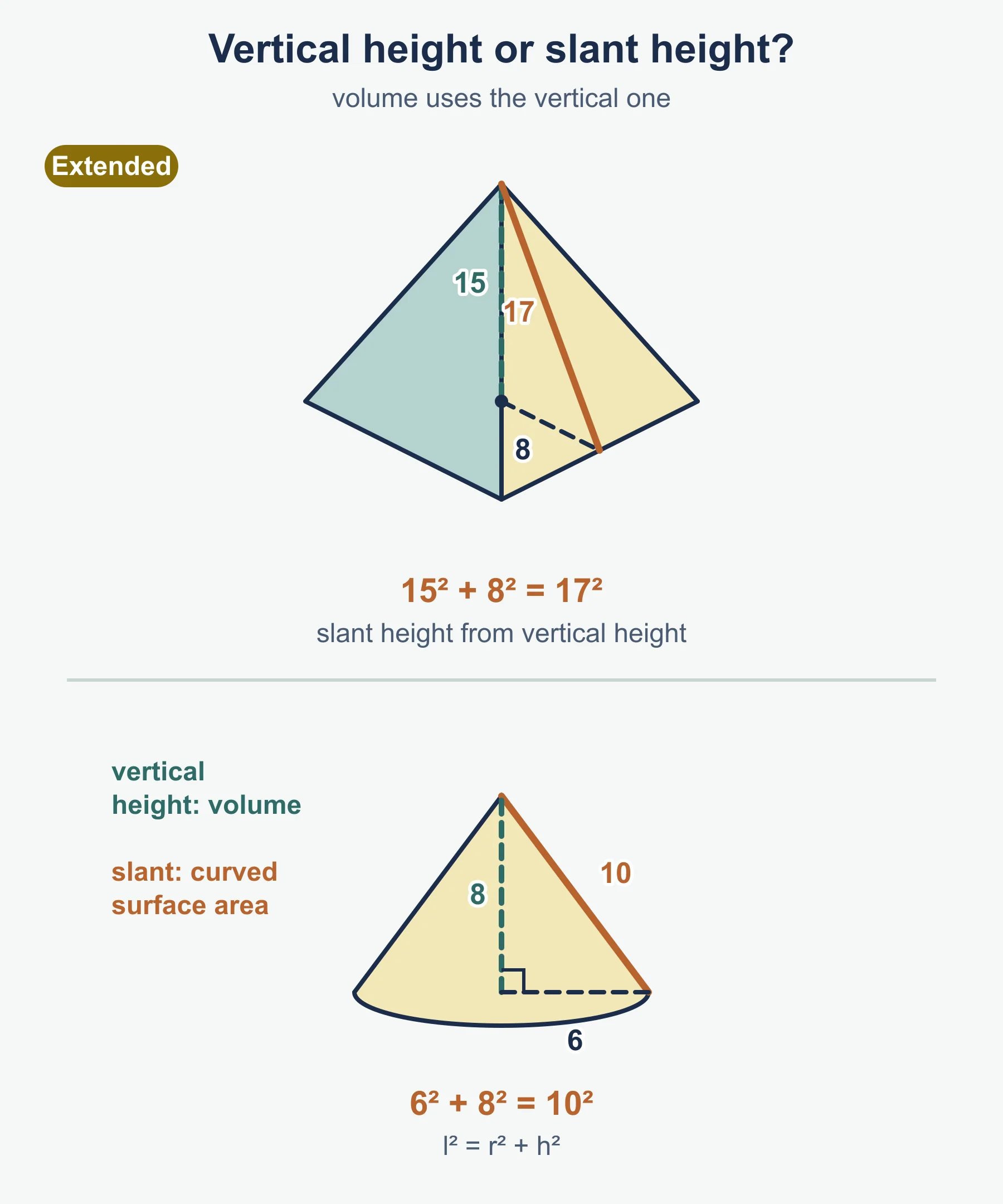
In the cone, h is the perpendicular height and l is the sloping edge. They are linked by l² = r² + h². In a pyramid, the slant height of a triangular face is different from the vertical height, and you may need Pythagoras to get it.
Worked example 8. A cone has base radius 7 cm and perpendicular height 24 cm. Find the sloping edge, the total surface area and the volume, in terms of π.
l² = 7² + 24² = 49 + 576 = 625, so l = 25 cm. Curved surface area = π × 7 × 25 = 175π. Base = π × 7² = 49π. Total surface area = 175π + 49π = 224π cm². Volume = ⅓ × π × 49 × 24 = 392π cm³.
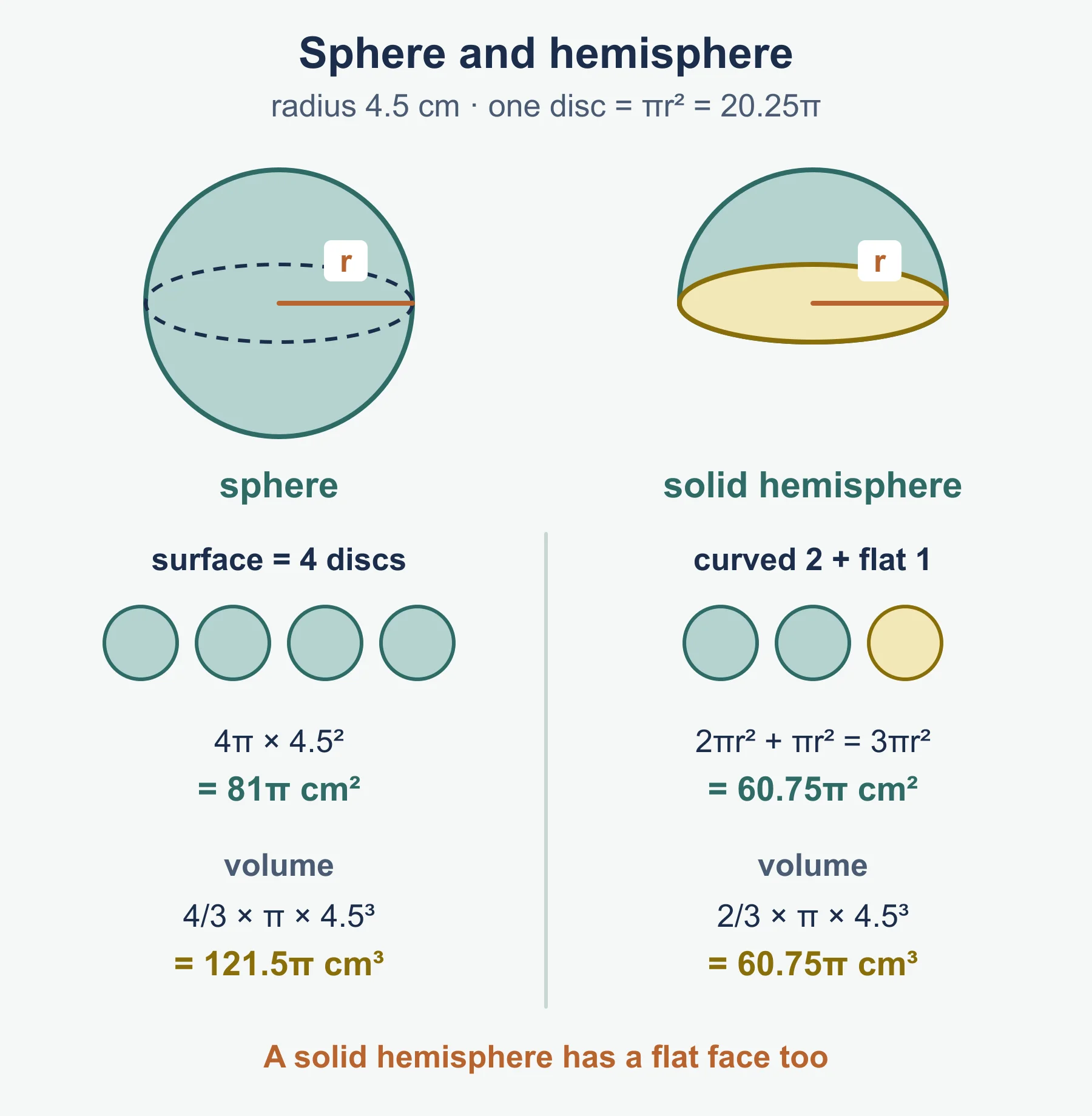
Worked example 9. A sphere has radius 4.5 cm. Find its volume and surface area in terms of π.
Volume = (4/3) × π × 4.5³ = (4/3) × 91.125π = 121.5π cm³. Surface area = 4 × π × 4.5² = 4 × 20.25π = 81π cm².
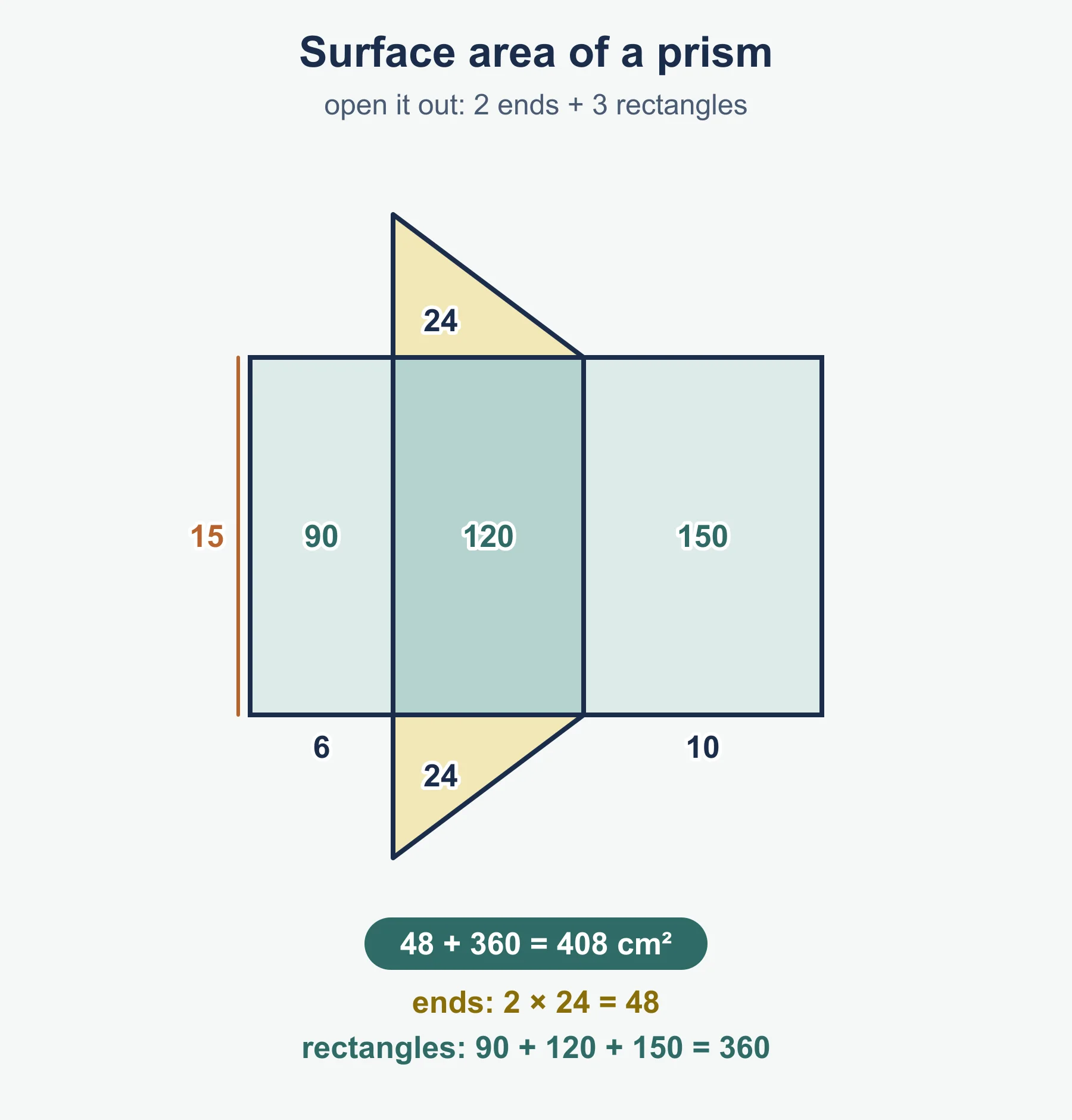
Worked example 10. A triangular prism has a right-angled triangle cross-section with sides 6 cm, 8 cm and 10 cm. The prism is 15 cm long. Find its volume and total surface area.
Cross-section area = ½ × 6 × 8 = 24 cm². Volume = 24 × 15 = 360 cm³. Perimeter of cross-section = 6 + 8 + 10 = 24 cm. Total surface area = 2 × 24 + 24 × 15 = 48 + 360 = 408 cm².
Worked example 11. A square-based pyramid has base edge 10 cm and vertical height 12 cm. Find its volume and total surface area.
Volume = ⅓ × 10² × 12 = 400 cm³. Each triangular face has base 10 cm. Its height is the slant height, found from a right-angled triangle with sides 12 and half the base, 5: slant² = 12² + 5² = 169, so slant = 13 cm. Four faces = 4 × ½ × 10 × 13 = 260. Total surface area = 100 + 260 = 360 cm².
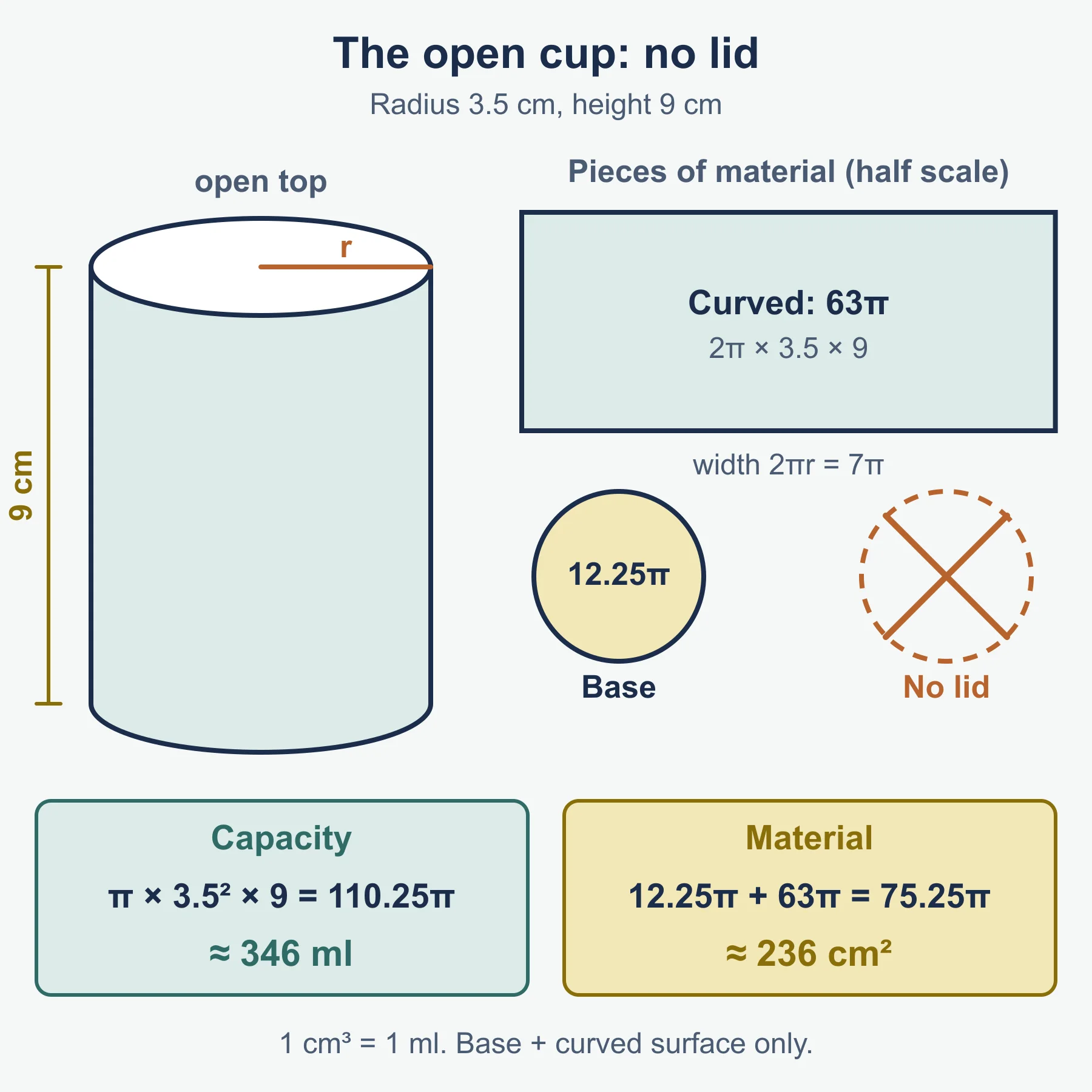
Worked example 12. An open cylindrical cup has radius 3.5 cm and height 9 cm. Find its capacity in ml and the area of material needed.
Volume = π × 3.5² × 9 = 110.25π = 346.36 cm³, so capacity = 346 ml (3 significant figures). Open means no top: area = base + curved surface = π × 3.5² + 2π × 3.5 × 9 = 12.25π + 63π = 75.25π = 236 cm² (3 significant figures).
5.5 Compound shapes and parts of shapes
A compound shape or solid is built from simpler pieces. Break it up, find each piece, then add. For a shape with a hole or a shaded region, subtract.
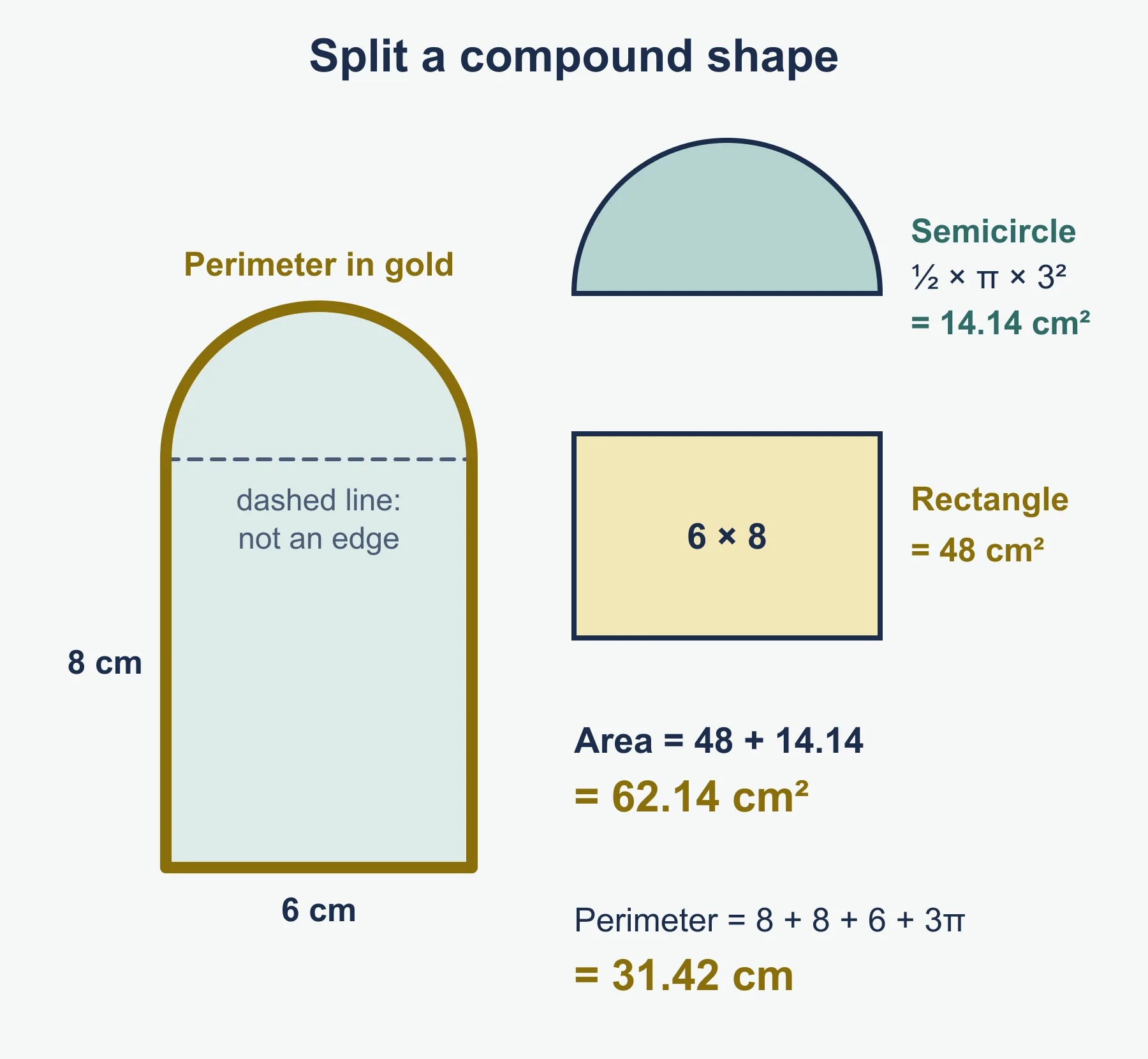
For perimeter and surface area only the outside counts. A join between two pieces is inside the shape.
Worked example 13. A shape is a rectangle 20 cm by 12 cm with a semicircle of diameter 12 cm attached to one 12 cm side. Find its area and perimeter.
Semicircle radius = 6 cm. Area = 20 × 12 + ½ × π × 6² = 240 + 18π = 297 cm² (3 significant figures). Perimeter = 20 + 20 + 12 + half the circumference of the circle = 52 + π × 6 = 52 + 6π = 70.8 cm (3 significant figures). The 12 cm side where the semicircle is attached is not part of the perimeter.
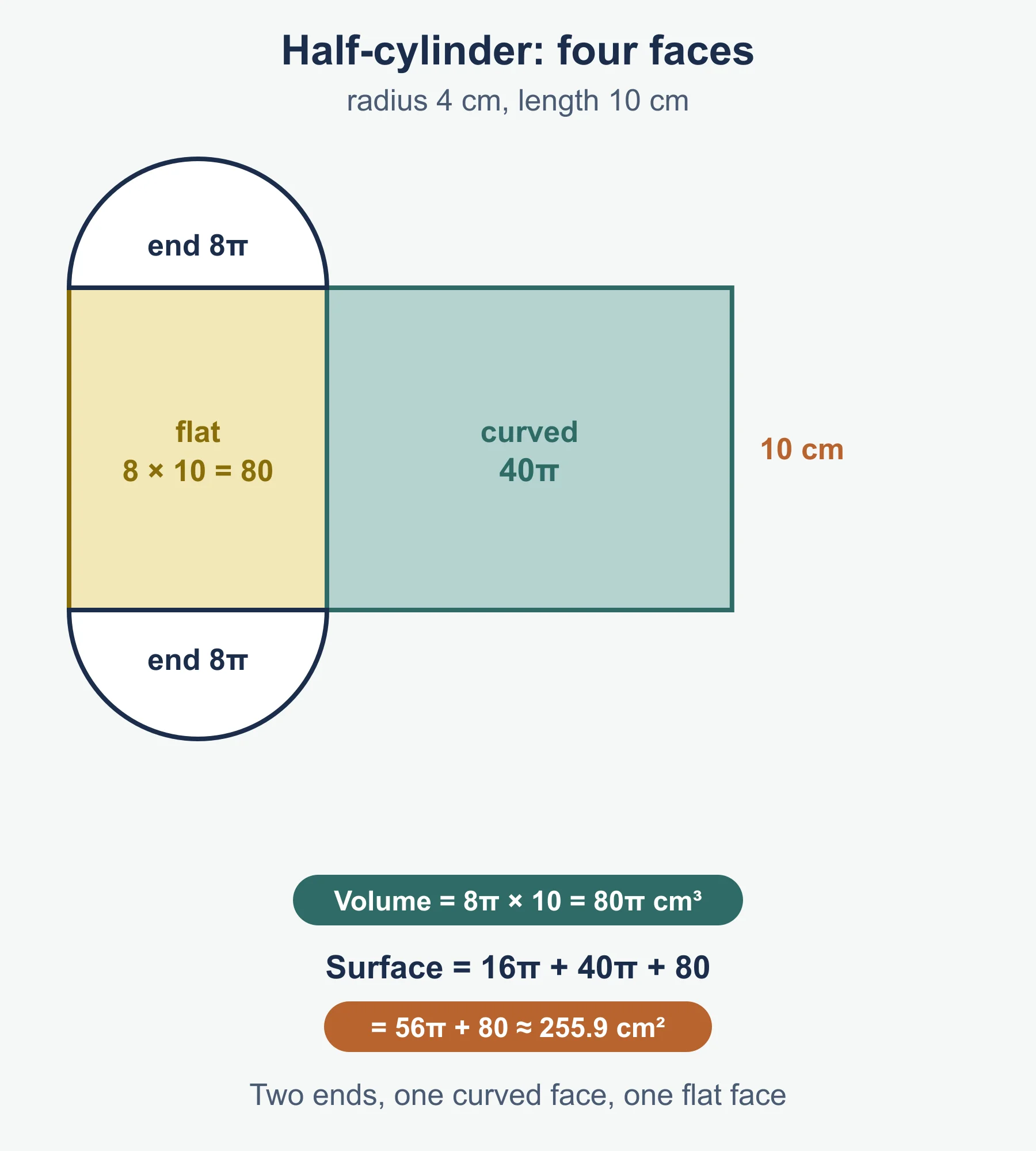
Worked example 14. A solid half-cylinder has radius 4 cm and length 10 cm. Find its volume and total surface area, in terms of π.
Cross-section is a semicircle of area ½π × 4² = 8π cm². Volume = 8π × 10 = 80π cm³. Surface area has four parts: two semicircular ends, the curved face and the flat rectangle. Ends = 2 × 8π = 16π. Curved face = ½ × 2π × 4 × 10 = 40π. Flat face = 8 × 10 = 80. Total = 56π + 80 cm².
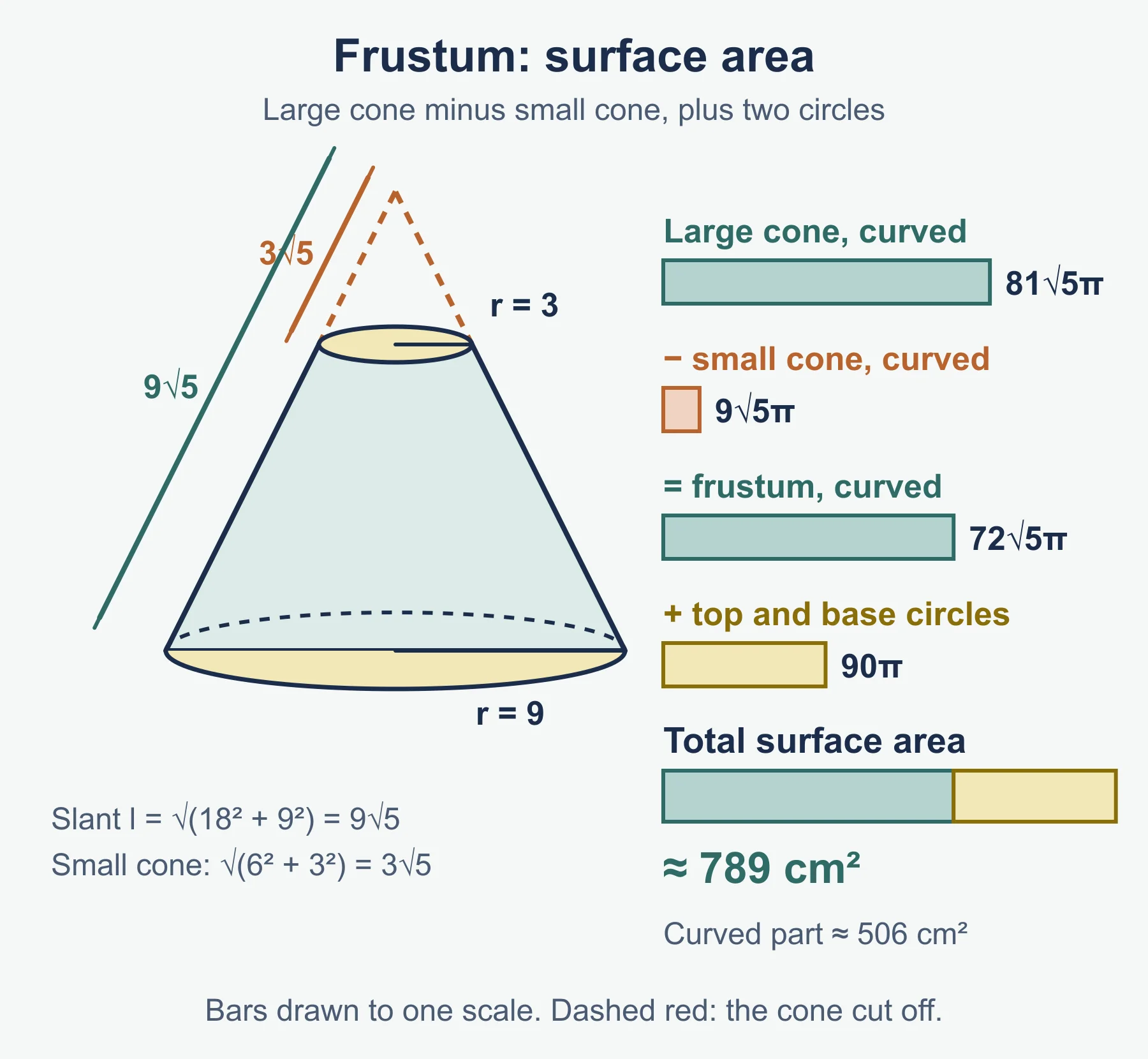
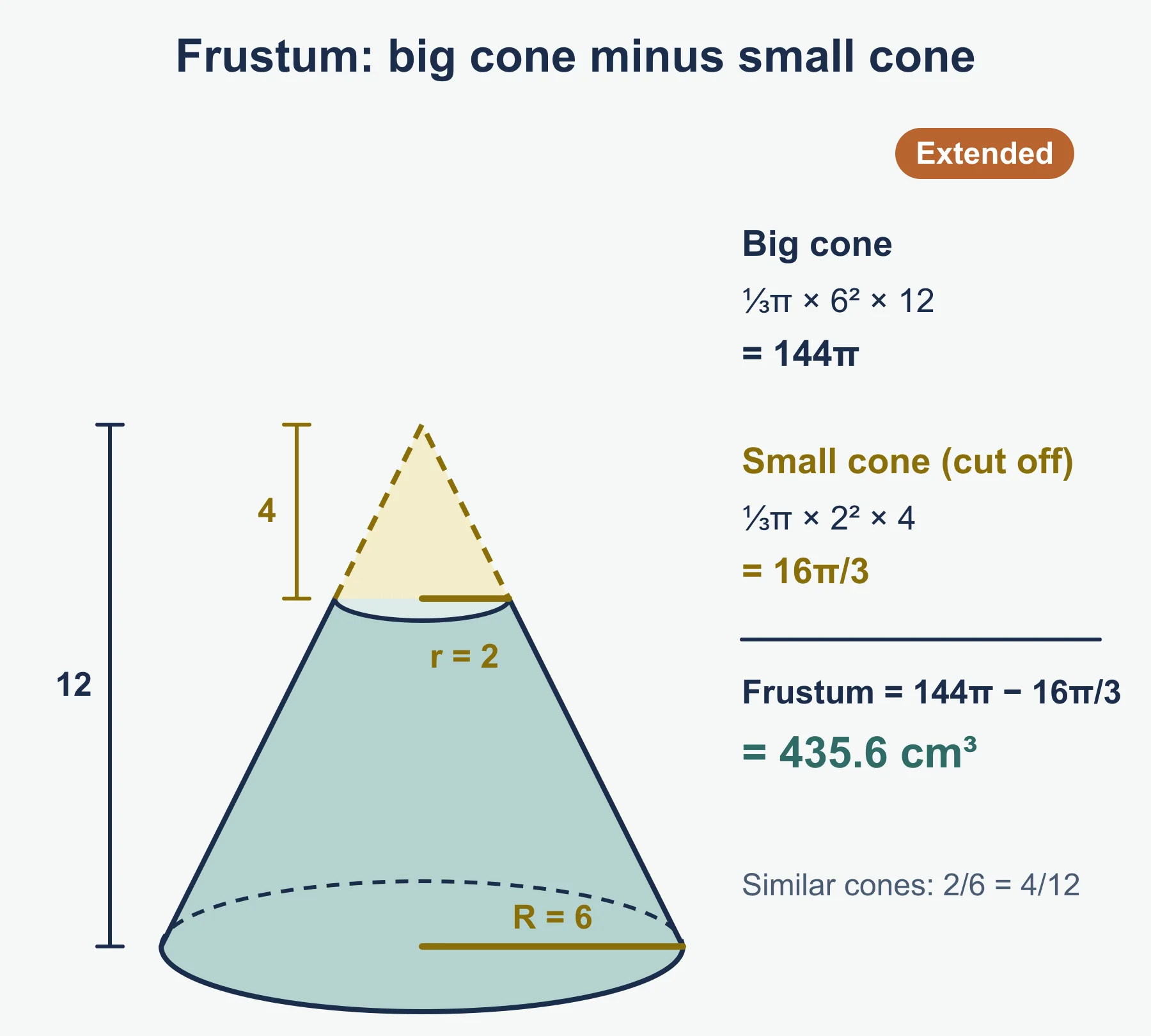
Worked example 15. A cone of height 18 cm and base radius 9 cm has a smaller cone of height 6 cm and radius 3 cm cut off the top. Find the volume and total surface area of the frustum that remains.
Frustum volume = large cone − small cone. Large cone = ⅓ × π × 9² × 18 = 486π. Small cone = ⅓ × π × 3² × 6 = 18π. Volume = 468π cm³ = 1470 cm³ (3 significant figures).
For the curved surface, the sloping edges are l = √(18² + 9²) = √405 = 9√5 and, for the small cone, √(6² + 3²) = √45 = 3√5. Large curved surface = π × 9 × 9√5 = 81√5 π. Small curved surface = π × 3 × 3√5 = 9√5 π. Curved surface of frustum = 72√5 π = 506 cm². The frustum also has a circular base of radius 9 and a circular top of radius 3: 81π + 9π = 90π. Total surface area = 72√5 π + 90π = 789 cm² (3 significant figures).
The small cone is an enlargement of the large one with scale factor 1/3.
Parts of shapes and solids
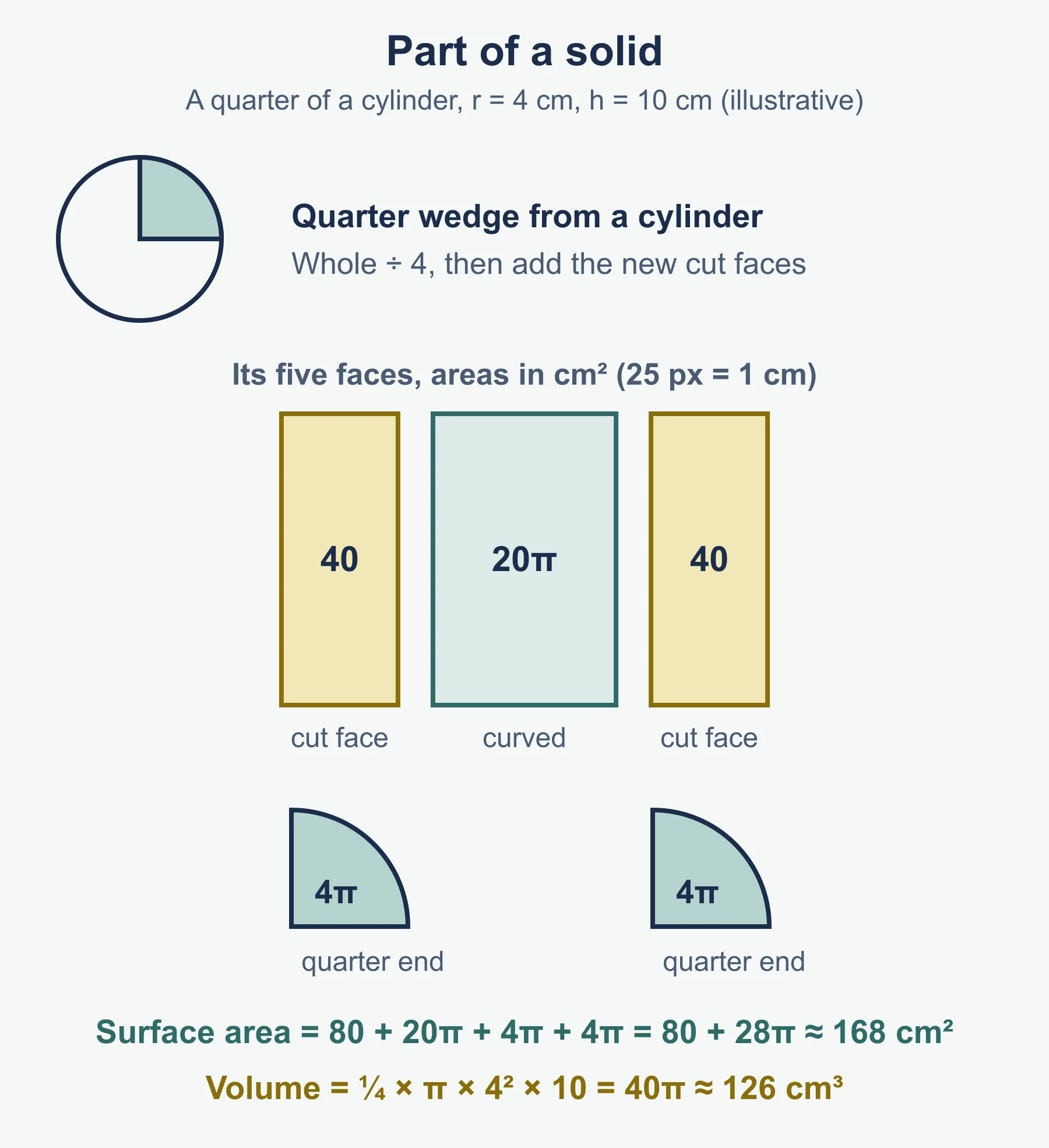
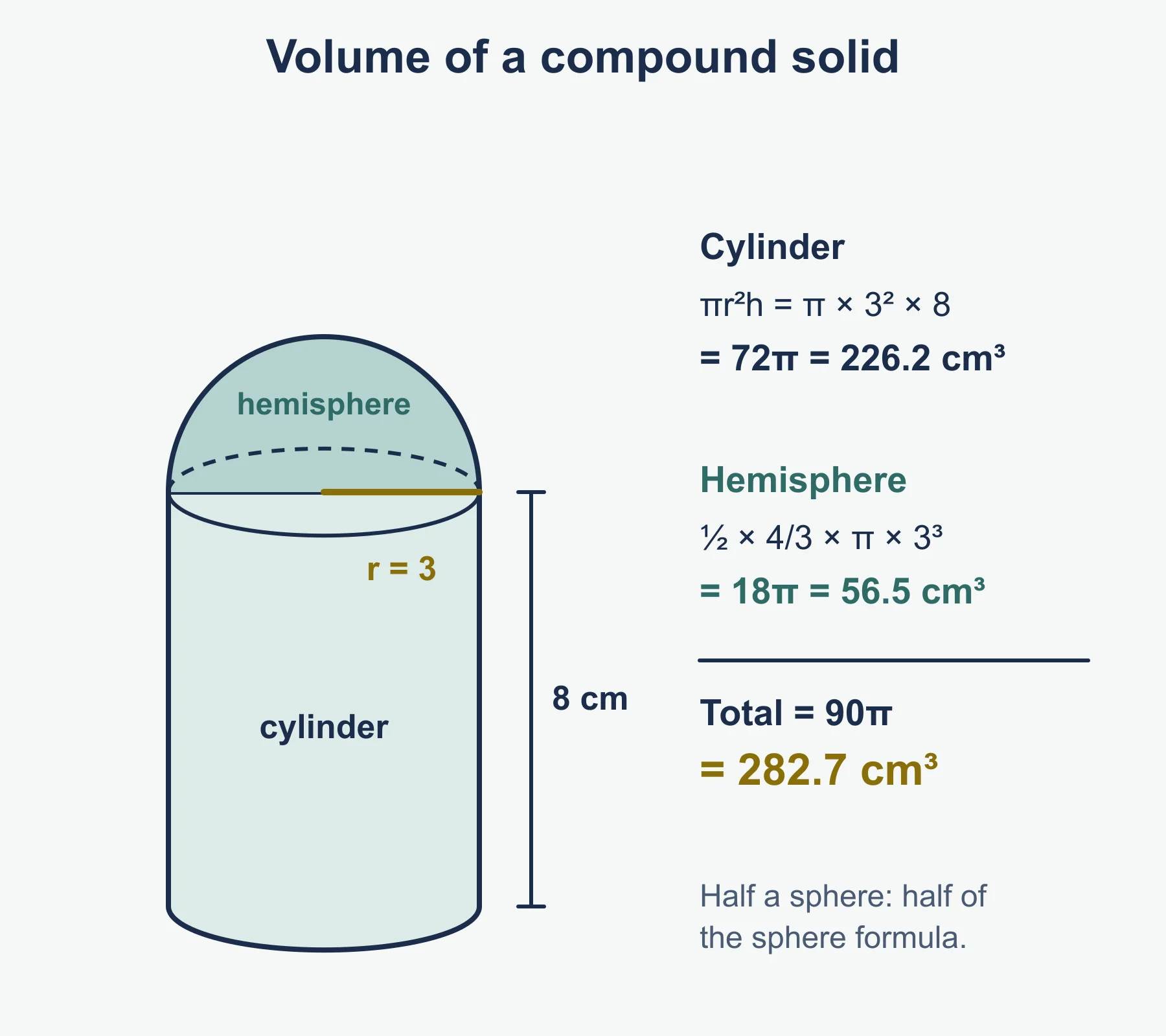
“Part of” questions use a fraction. A quarter circle, a hemisphere and a wedge cut from a cylinder are fractions of a whole. Find the whole, take the fraction, then add any new flat faces made by the cut. A hemisphere of radius r has curved surface 2πr² and volume (2/3)πr³, and a solid hemisphere also has a flat circular face of area πr².
Rounding and accuracy
Give non-exact answers to 3 significant figures unless told otherwise, avoid rounding before the final answer, and use π from your calculator or 3.142.
Common errors
- Converting m² to cm² with a factor of 100 instead of 10 000.
- Using the sloping side of a parallelogram or trapezium as the height.
- Using the diameter in place of the radius.
- Using the perpendicular height of a cone in the curved surface formula, where the sloping edge is needed.
- Forgetting the two radii when asked for the perimeter of a sector.
- Counting a join between two parts of a compound shape in the perimeter or surface area.
- Including a lid on an open container, or leaving out the base of a pyramid.
Frequently asked questions
What does mensuration cover in Cambridge O Level Mathematics 4024? Sections 5.1 to 5.5 cover metric units and conversions, perimeter and area of 2D shapes, circles, arcs and sectors, surface area and volume of solids, and compound shapes and parts of shapes.
How do you find the area of a trapezium? Use area = ½(a + b)h, where a and b are the parallel sides and h is the perpendicular distance between them. Do not use the sloping side as the height.
How do you find the surface area of an open container? Leave out the lid. For an open cylindrical cup, the area is the base plus the curved surface, πr² + 2πrh.
How do you find the perimeter of a compound shape? Add only the outside edges. A join between two parts of the shape, such as the side where a semicircle meets a rectangle, is not part of the perimeter.
How do you convert cm³ to litres? Divide by 1000, because 1 litre = 1000 cm³. A tank of 720 000 cm³ holds 720 litres.
Official syllabus
Cambridge O Level Mathematics (Syllabus D) 4024 syllabus for examination in 2025, 2026 and 2027, Cambridge International Education, topic 5 Mensuration.
Get free revision emails (optional)
Occasional emails with practice questions, worked explanations and links to free resources for the qualification and subjects you choose. No spam, and you can unsubscribe from any email. The free tools on this site never need an email.
Related resources
-
Practice questions
O Level Mathematics: Mensuration Practice Questions (Cambridge 4024)
Original Cambridge O Level Mathematics 4024 mensuration questions on area units, arcs and sectors, circles, cylinders, cones and hemispheres, with answers.
Mathematics · Cambridge · O Level
Try questions -
Revision notes
Cambridge O Level Mathematics: Mensuration (4024) – Revision Notes
Condensed formulas, methods, a quick self-test and common slips for Mensuration in Cambridge O Level Mathematics 4024, syllabus sections 5.1 to 5.5.
Mathematics · Cambridge · O Level
Revise topic -
Study guides
Cambridge O Level Mathematics: Number (4024)
Study guide to every Number outcome in Cambridge O Level Mathematics 4024, from types of number and sets to surds, with worked examples throughout.
Mathematics · Cambridge · O Level
Read guide
Related articles
-
exam preparation
Where IGCSE Mathematics marks are lost early
The first weeks of an IGCSE Mathematics course rarely go wrong on difficulty. They go wrong on method, command words, rounding and units — four habits that cost marks a student had already earned.
24 August 2026
-
teaching
A Level tuition in Dubai: Cambridge or Pearson Edexcel International A Level?
Schools in Dubai and Abu Dhabi teach either Cambridge International AS & A Level or Pearson Edexcel International A Level. How the two are structured, why it matters for tuition, and how online classes from Lahore work.
9 October 2026
Studying this with a teacher
Working through Mathematics O LEVELS?
This page is free and stays free. If you would rather be taught it, Marlbridge runs Mathematics classes one-to-one and in small groups of up to 15, online in your own time zone. The first trial class is free. WhatsApp replies within an hour (8am–11pm Pakistan time, every day); email the same day.
Cambridge Mathematics teachers at Marlbridge


