
Revision Notes
Cambridge O Level Mathematics: Mensuration (4024) – Revision Notes
Condensed formulas, methods, a quick self-test and common slips for Mensuration in Cambridge O Level Mathematics 4024, syllabus sections 5.1 to 5.5.
- Subject
- Mathematics
- Level
- O LEVELS
- Topic
- Mensuration
- Author
- Marlbridge Academic Team
- Updated
- Reviewed by
- Sajawal Zahid (what this means)
Aligned to Cambridge O Level Mathematics (4024), 2025-2027. Official specification .
Syllabus page (what it covers and how it is assessed): Cambridge O Level Mathematics.
Syllabus points this page covers
4024
- 5 Mensuration (whole topic)
Found an error? Report a correction.
Need help with this topic? Request a free trial class for O Level Mathematics (4024).
These revision notes are aligned to the Cambridge O Level Mathematics (Syllabus D) 4024 syllabus for examination in 2025, 2026 and 2027, topic 5 Mensuration, sections 5.1 to 5.5. The syllabus is not tiered. For full explanations and longer worked examples, read the study guide. For timed practice, use the mensuration practice set.
Track progress with the course hub and the printable checklist. Not sure what to revise first? Take a free 10-minute diagnostic.
5.1 Units: convert fast
| Quantity | Facts to know |
|---|---|
| Length | 1 cm = 10 mm, 1 m = 100 cm, 1 km = 1000 m |
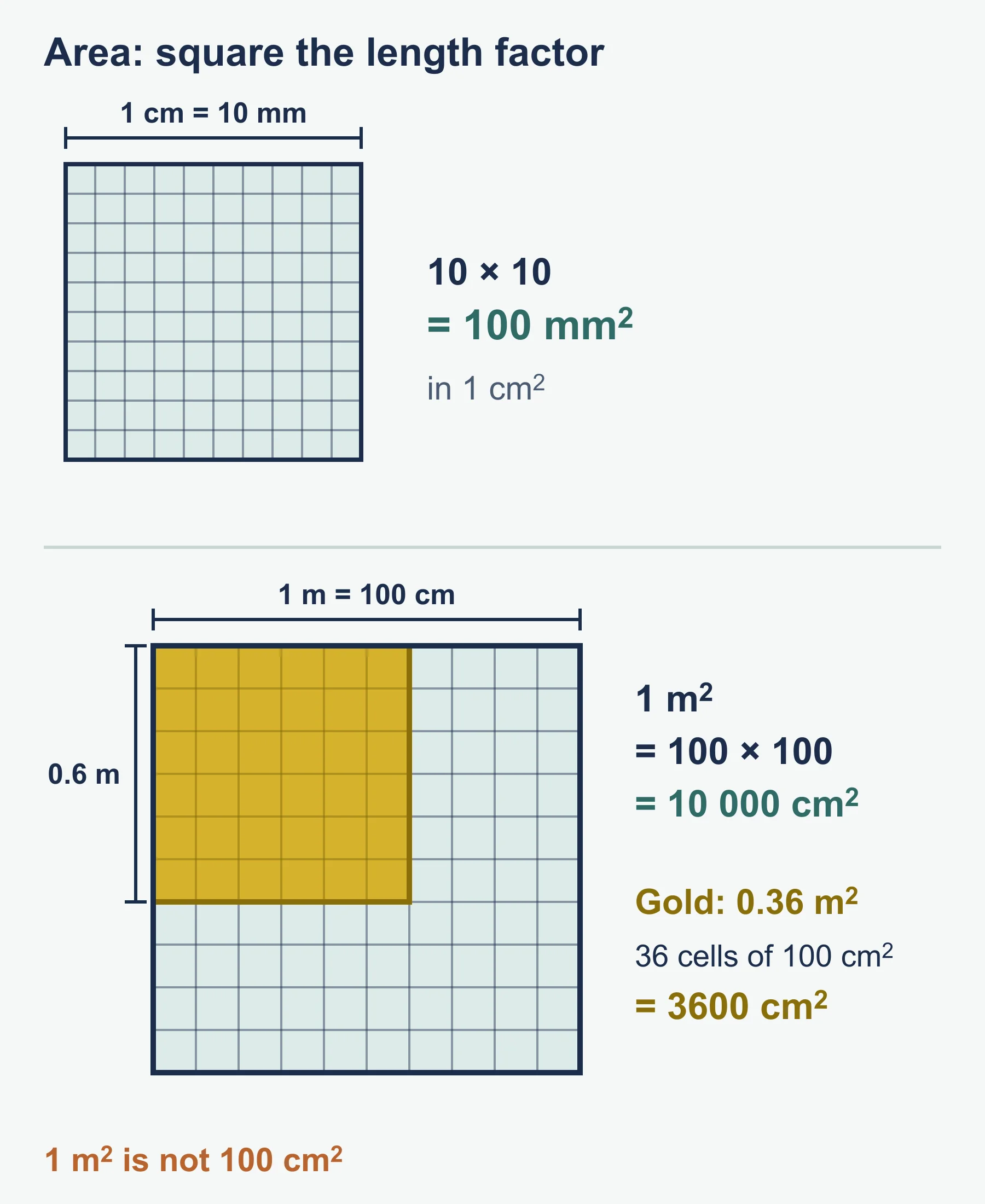
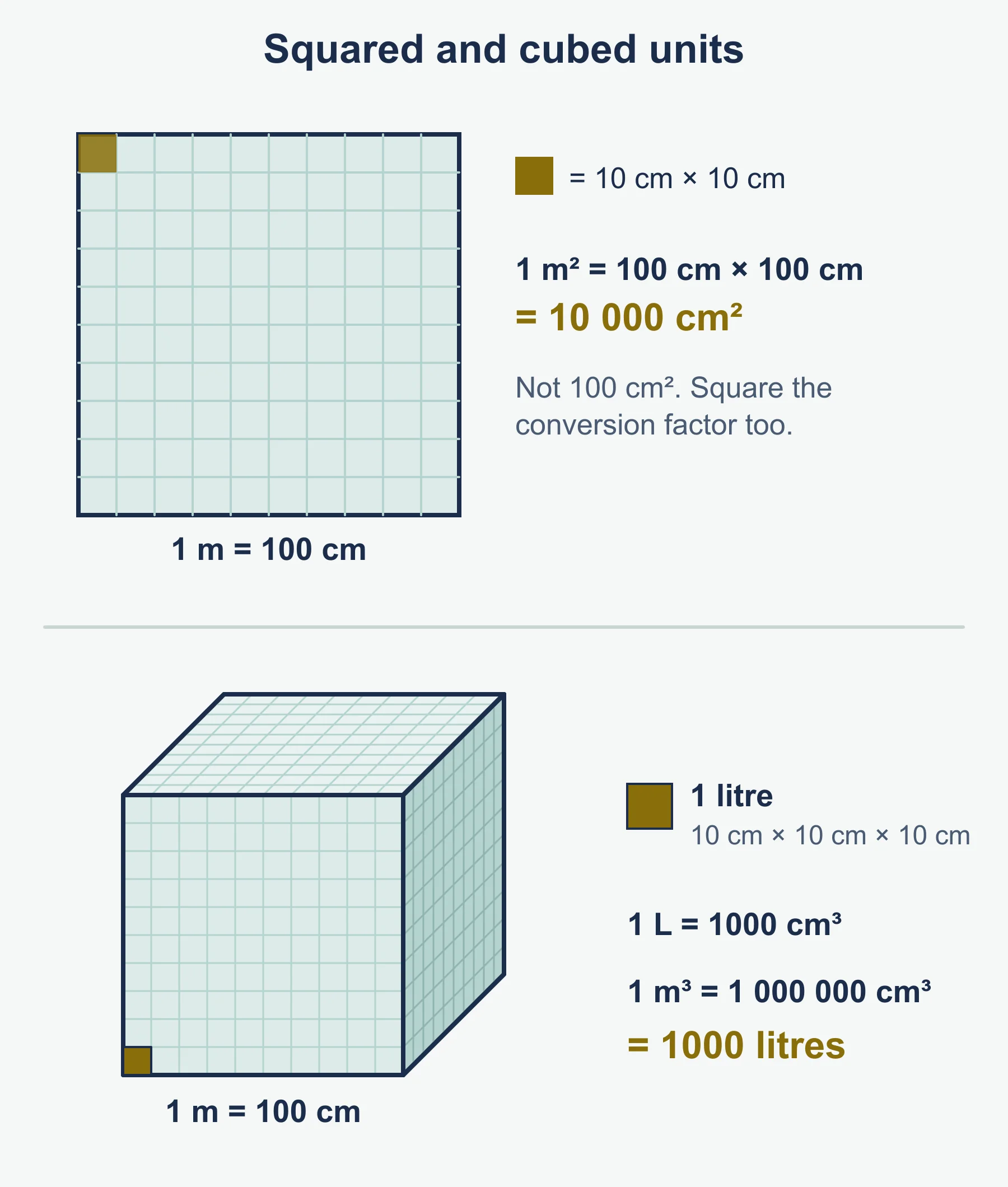
| Area | multiply the length factor by itself: 1 m² = 10 000 cm², 1 cm² = 100 mm², 1 km² = 1 000 000 m² |
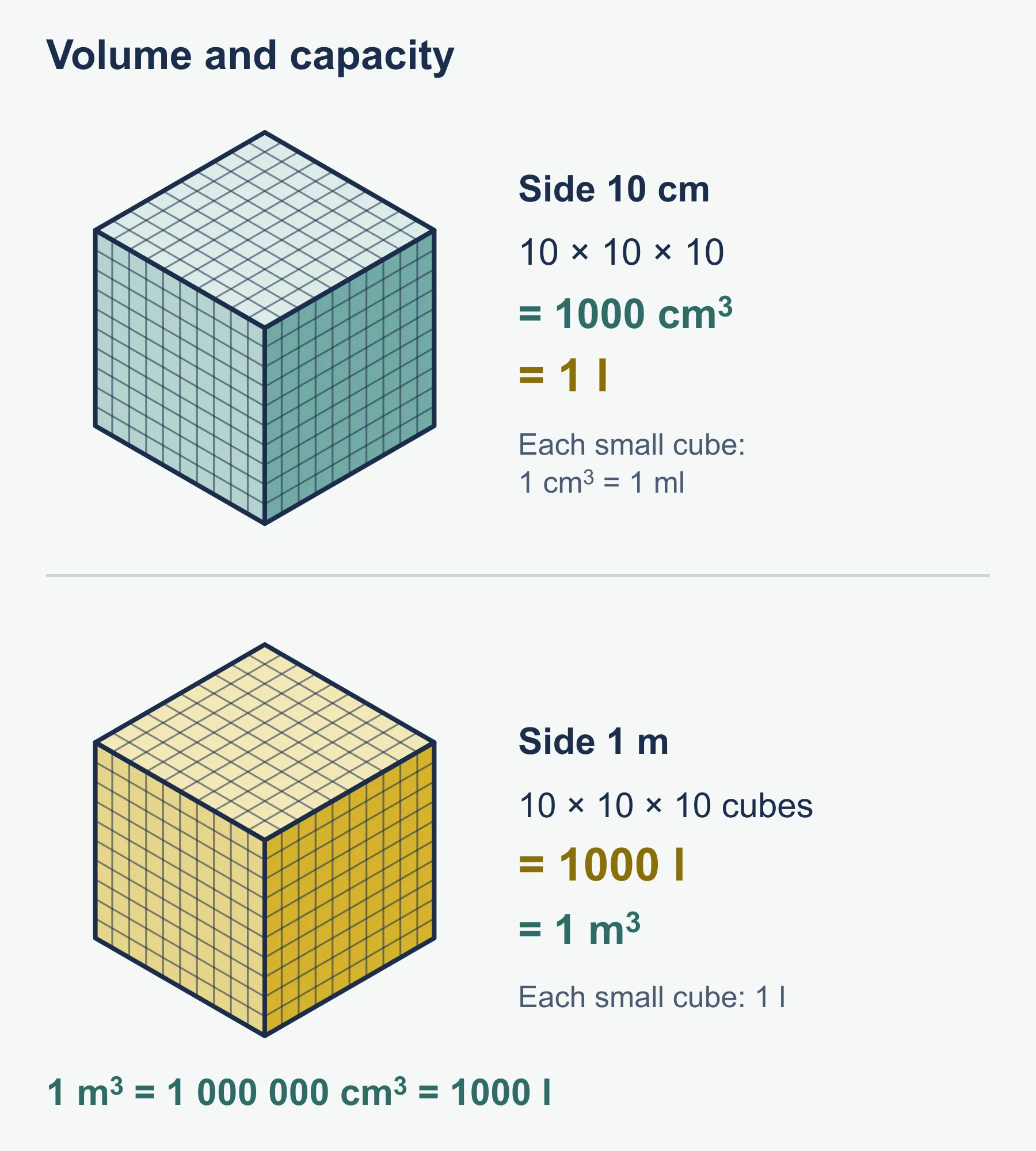
| Volume | cube the length factor: 1 m³ = 1 000 000 cm³ |
| Capacity | 1 cm³ = 1 ml, 1 l = 1000 cm³, 1 m³ = 1000 l |
| Mass | 1 kg = 1000 g |
Smaller unit means a bigger number. Larger unit means a smaller number.
Reminder: 0.06 m² = 0.06 × 10 000 = 600 cm². And 2.5 m³ = 2500 litres.
5.2 to 5.4 Formulas
The syllabus says a list of formulas is included on page 2 of the examination papers. The items it names for this topic are marked “given”. Everything else you must know.
| Result | Formula | Status |
|---|---|---|
| Rectangle area | lw | learn |
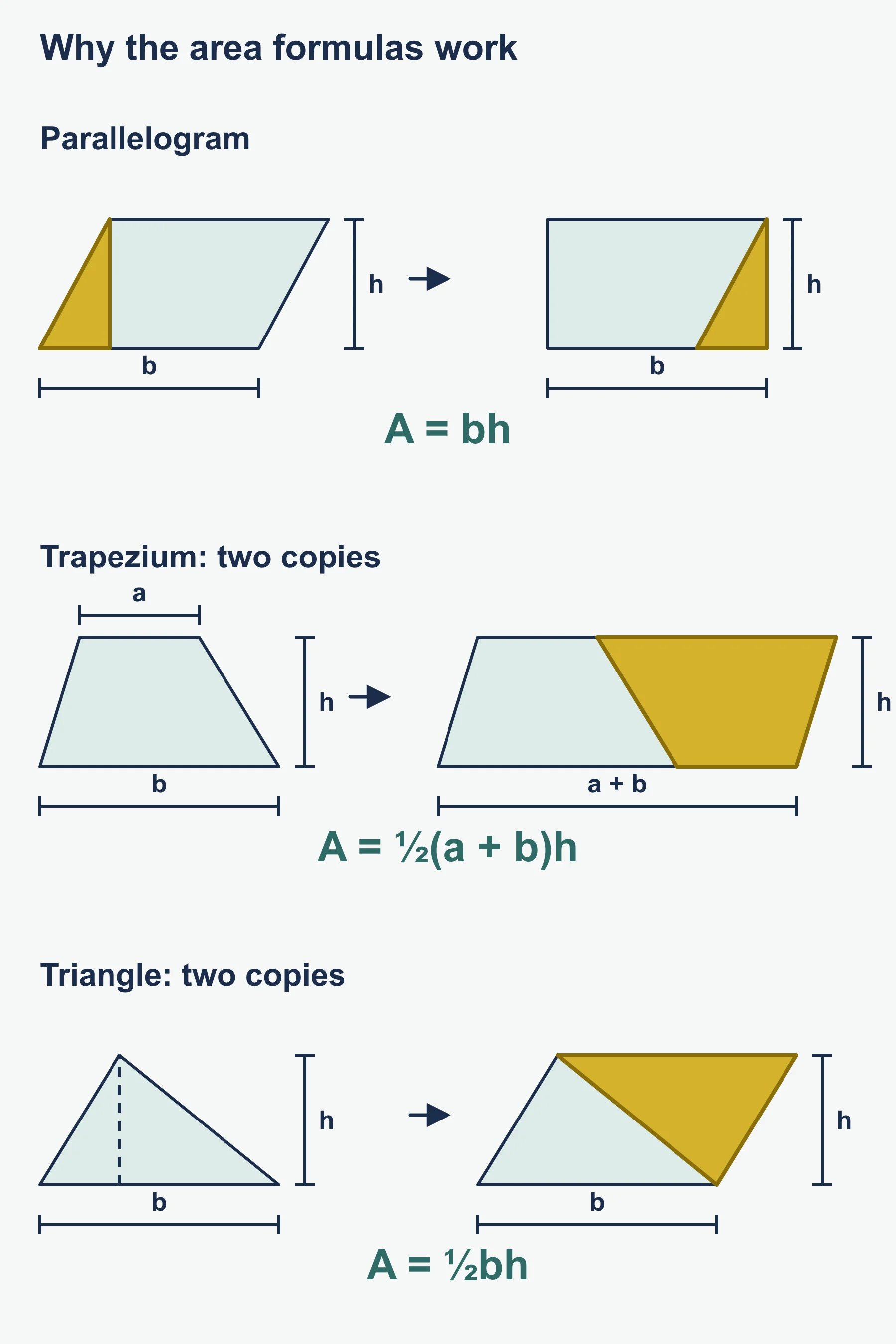
| Triangle area | ½bh | given |
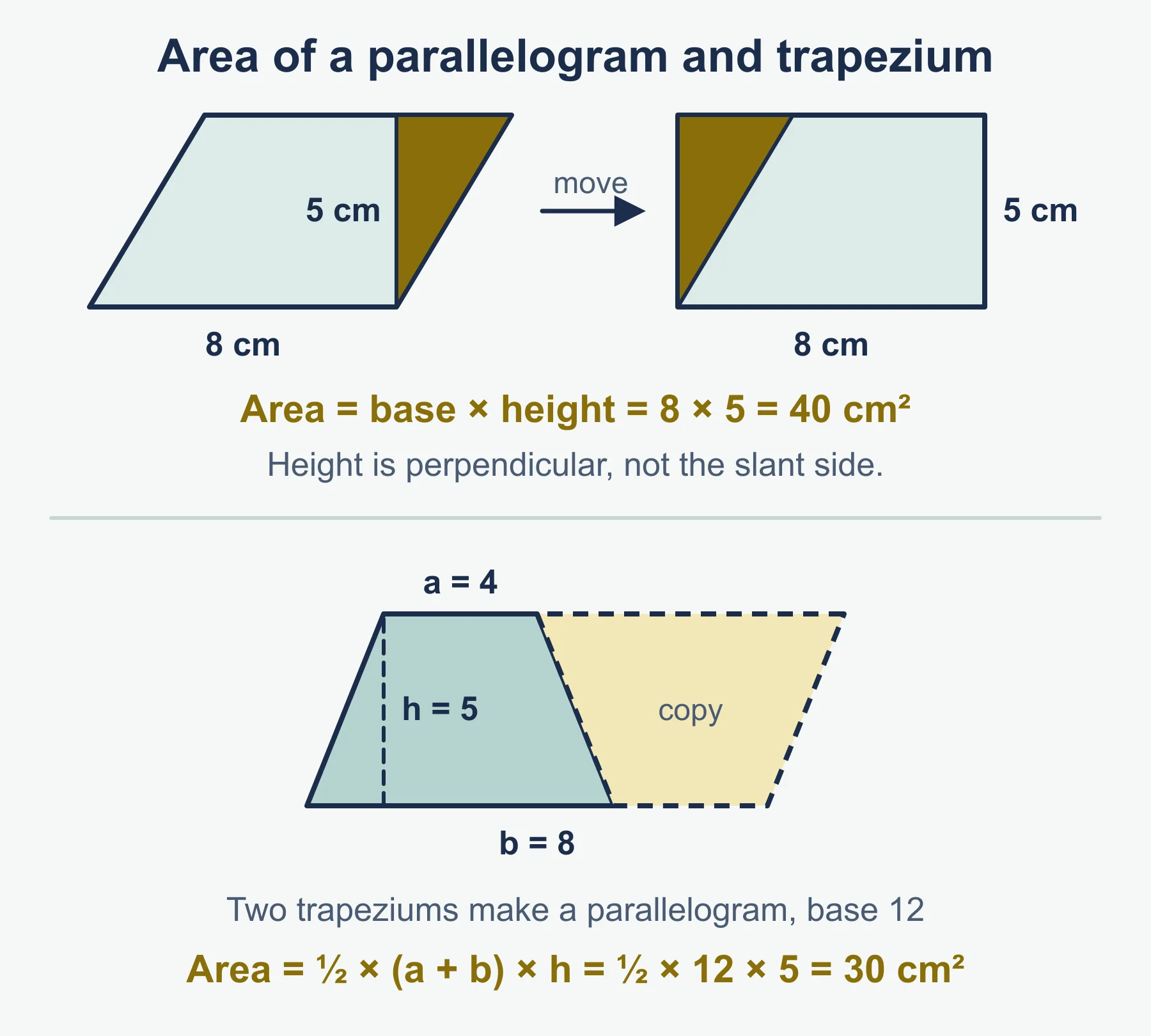
| Parallelogram area | bh | learn |
| Trapezium area | ½(a + b)h | learn |
| Circle area | πr² | given |
| Circumference | 2πr | given |
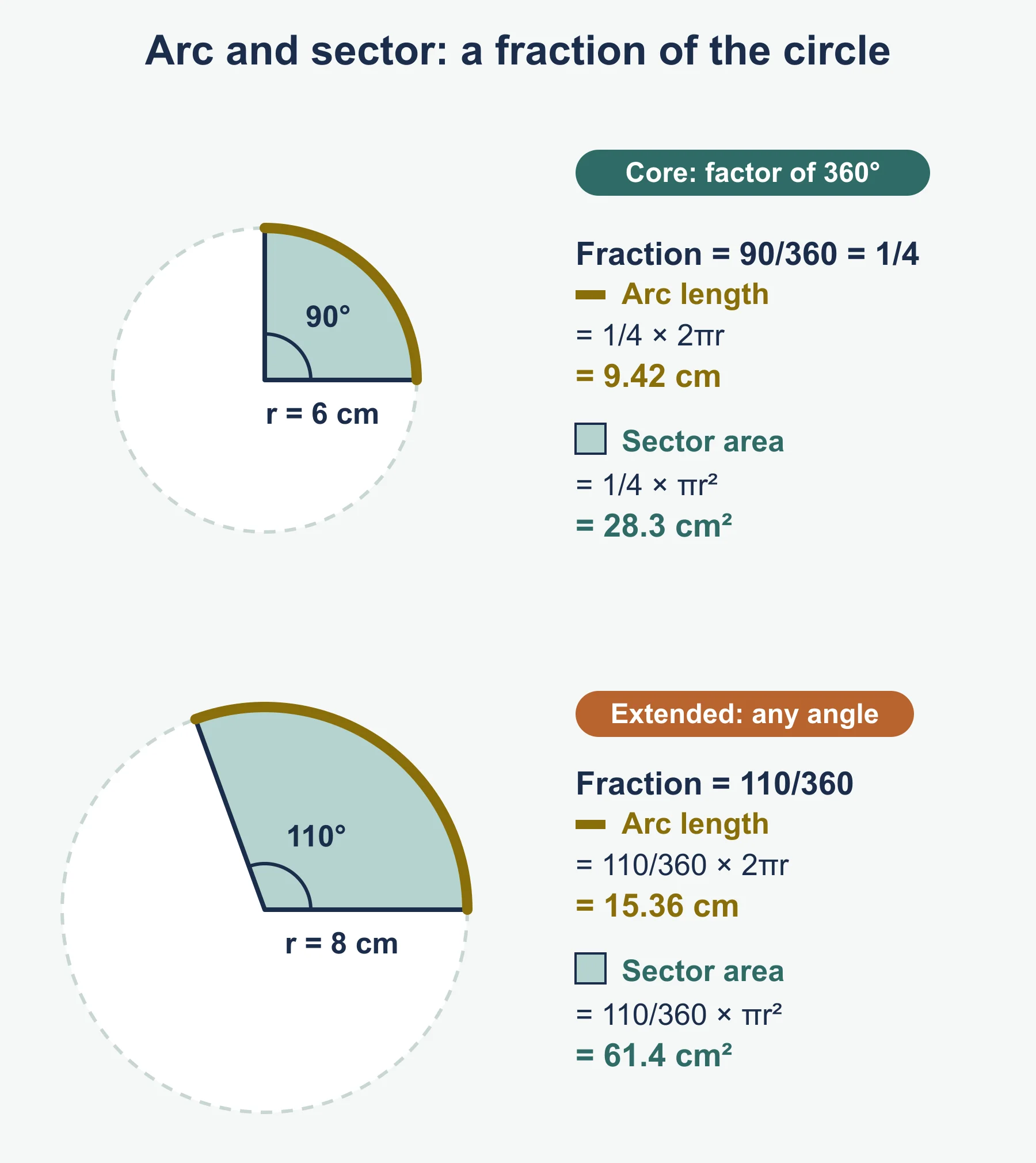
| Arc length | (θ/360) × 2πr | learn (fraction of circumference) |
| Sector area | (θ/360) × πr² | learn (fraction of area) |
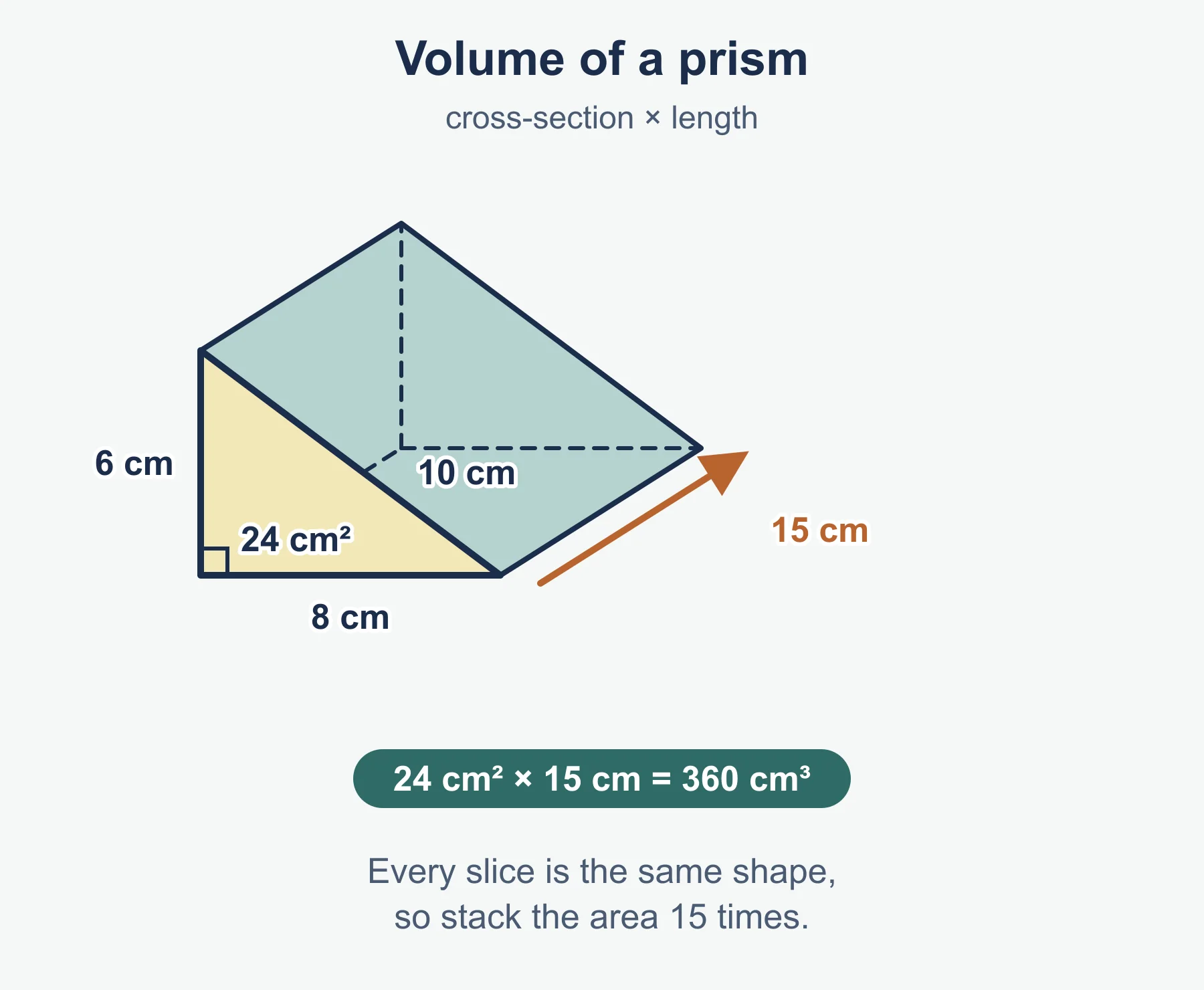
| Prism volume | Al (cross-section area times length) | given |
| Cylinder volume | πr²h | given |
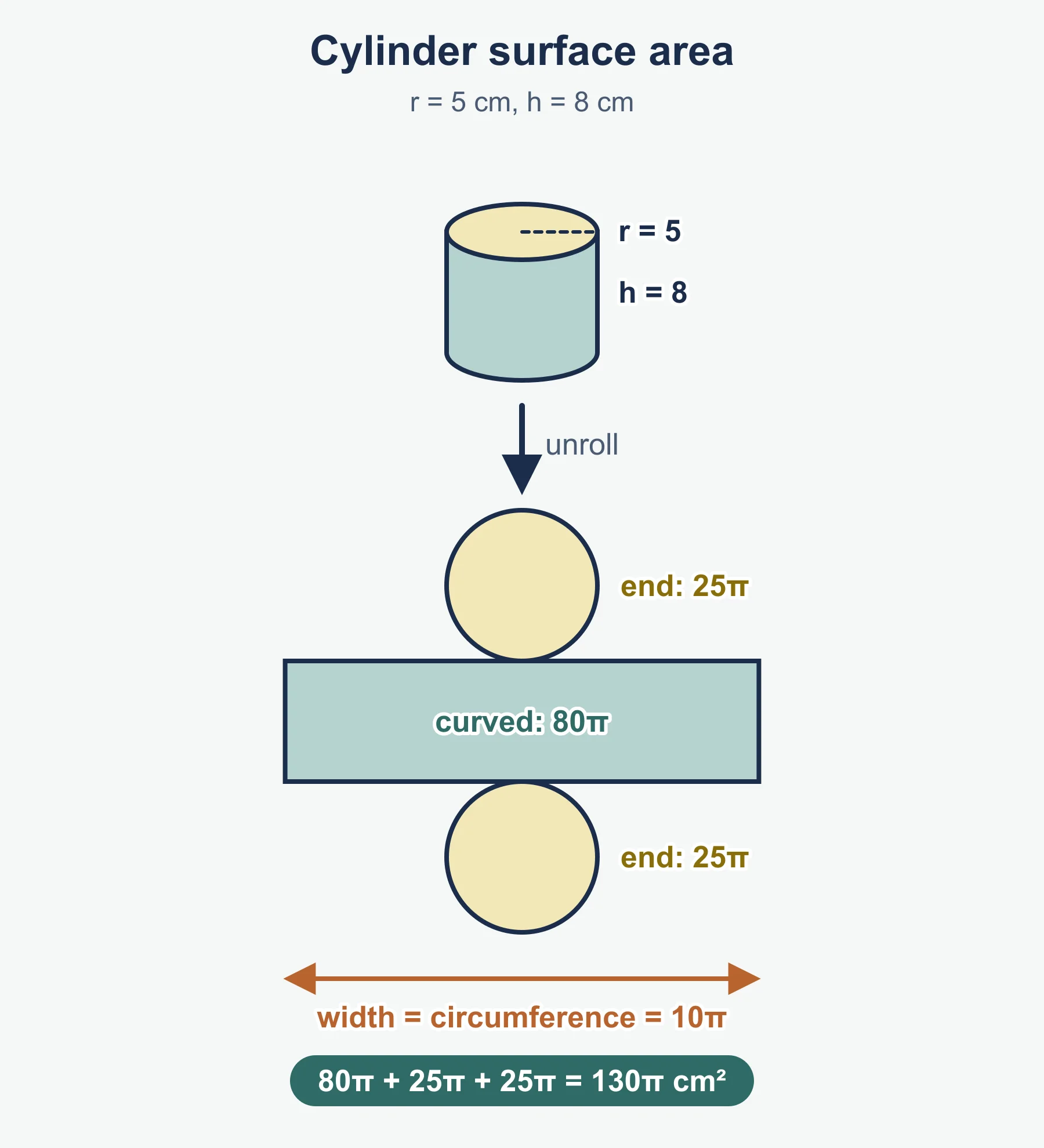
| Cylinder curved surface | 2πrh | given |
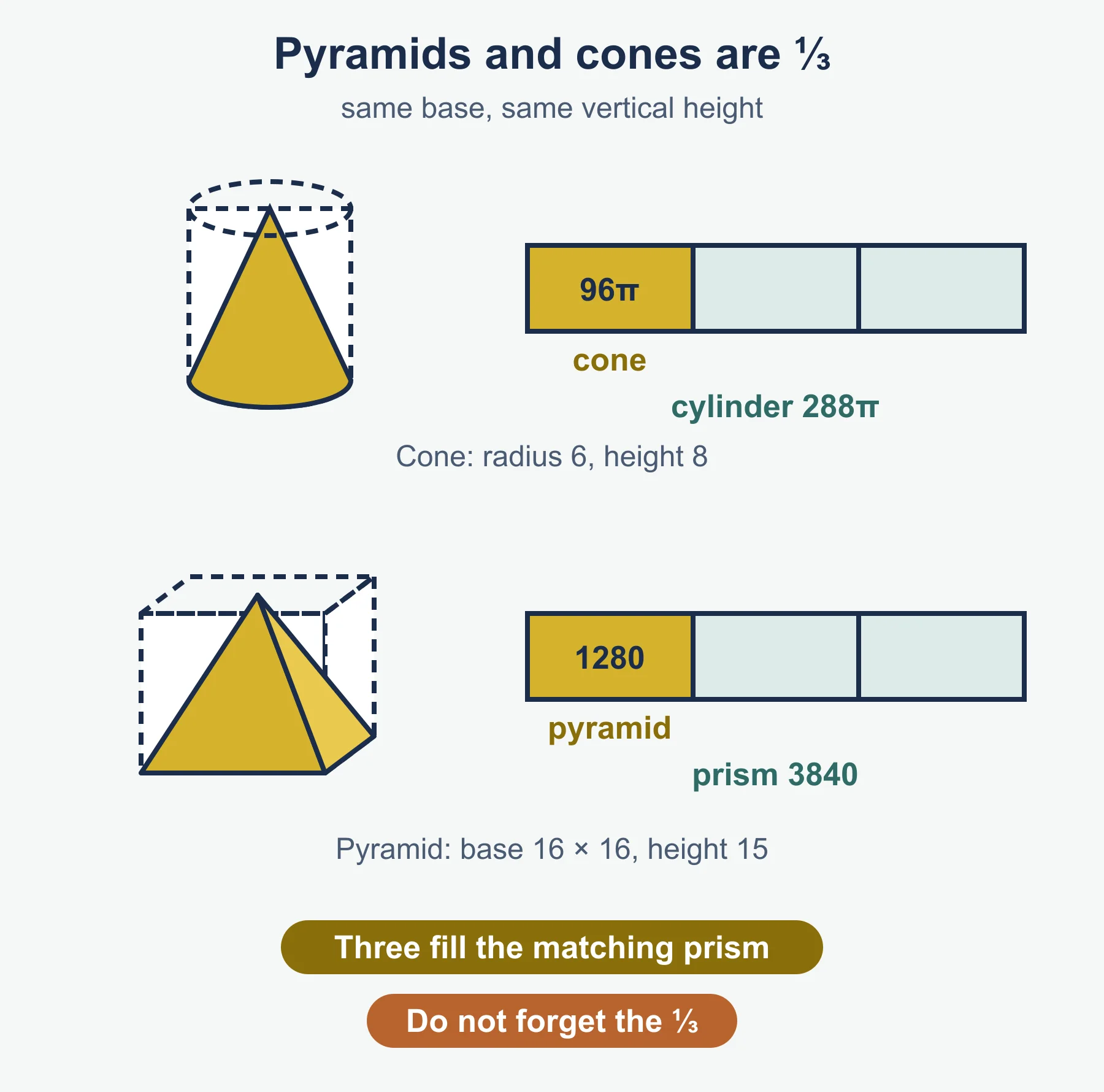
| Cone volume | ⅓πr²h | given |
| Cone curved surface | πrl | given |
| Sphere volume | (4/3)πr³ | given |
| Sphere surface area | 4πr² | given |
| Pyramid volume | ⅓ × base area × h | given |
| Cuboid surface area | 2(lw + lh + wh) | learn |
Cuboid volume is lwh, which you build from the prism rule.
Method boxes
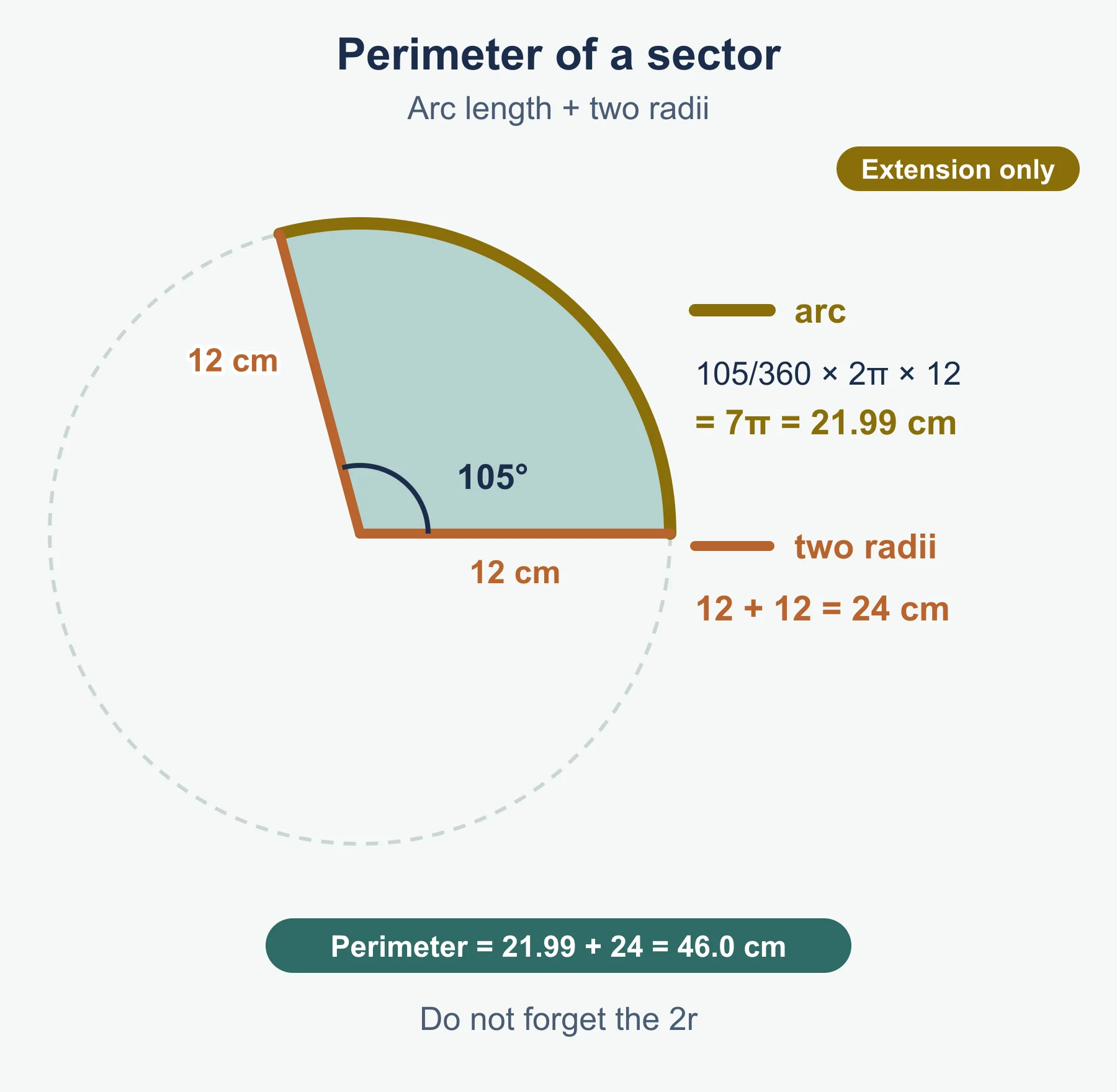
Perimeter and area of a sector
- Write the fraction θ/360 and simplify it.
- Arc = fraction × 2πr. Area = fraction × πr².
- Perimeter of the sector = arc + 2r (two straight radii).
- If the question says “in terms of π”, keep π in the answer.
Surface area of a solid
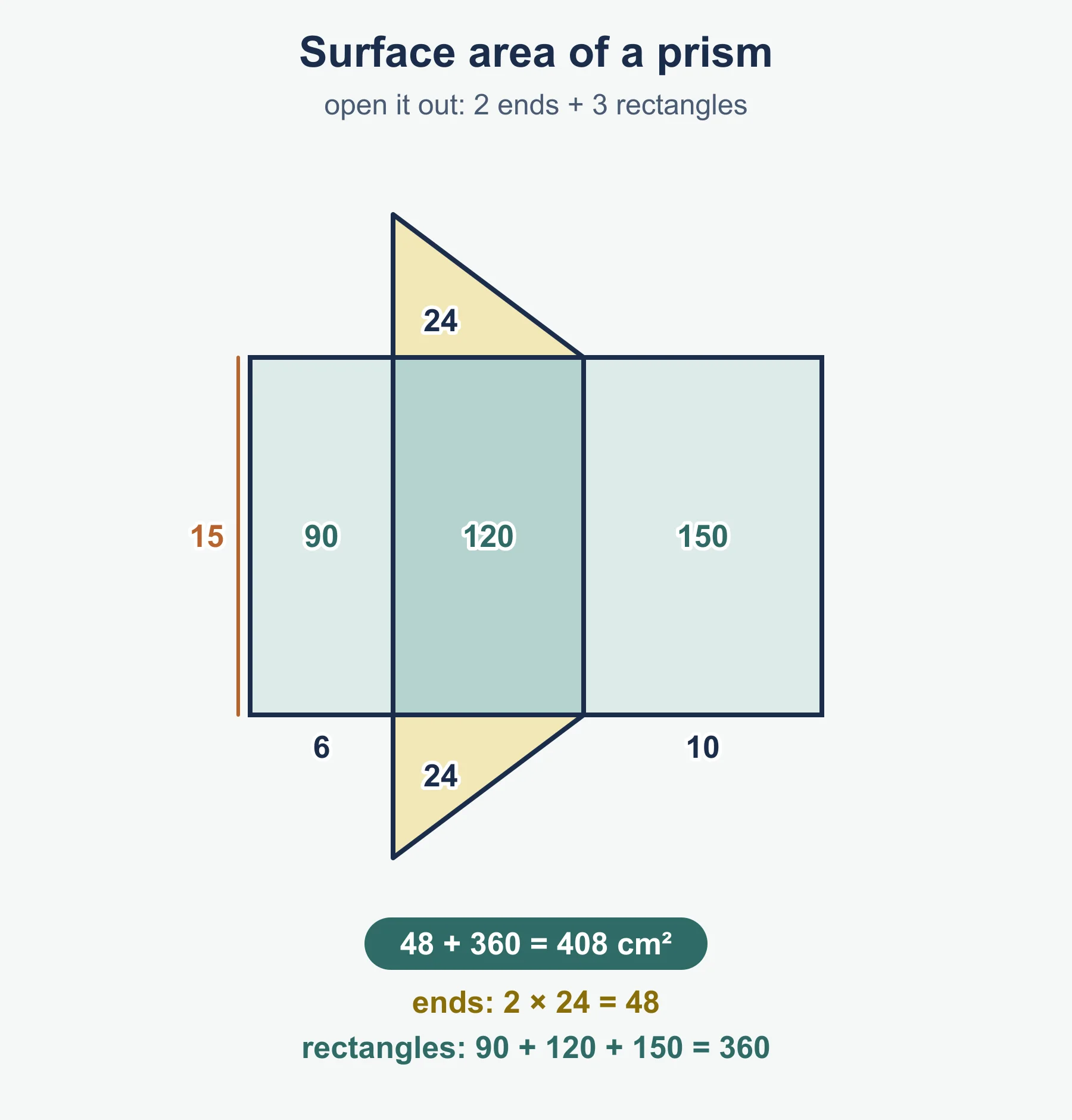
- List every face: flat faces, curved faces, ends.
- Decide if any face is missing (open top) or hidden (a join).
- Find each area and add.
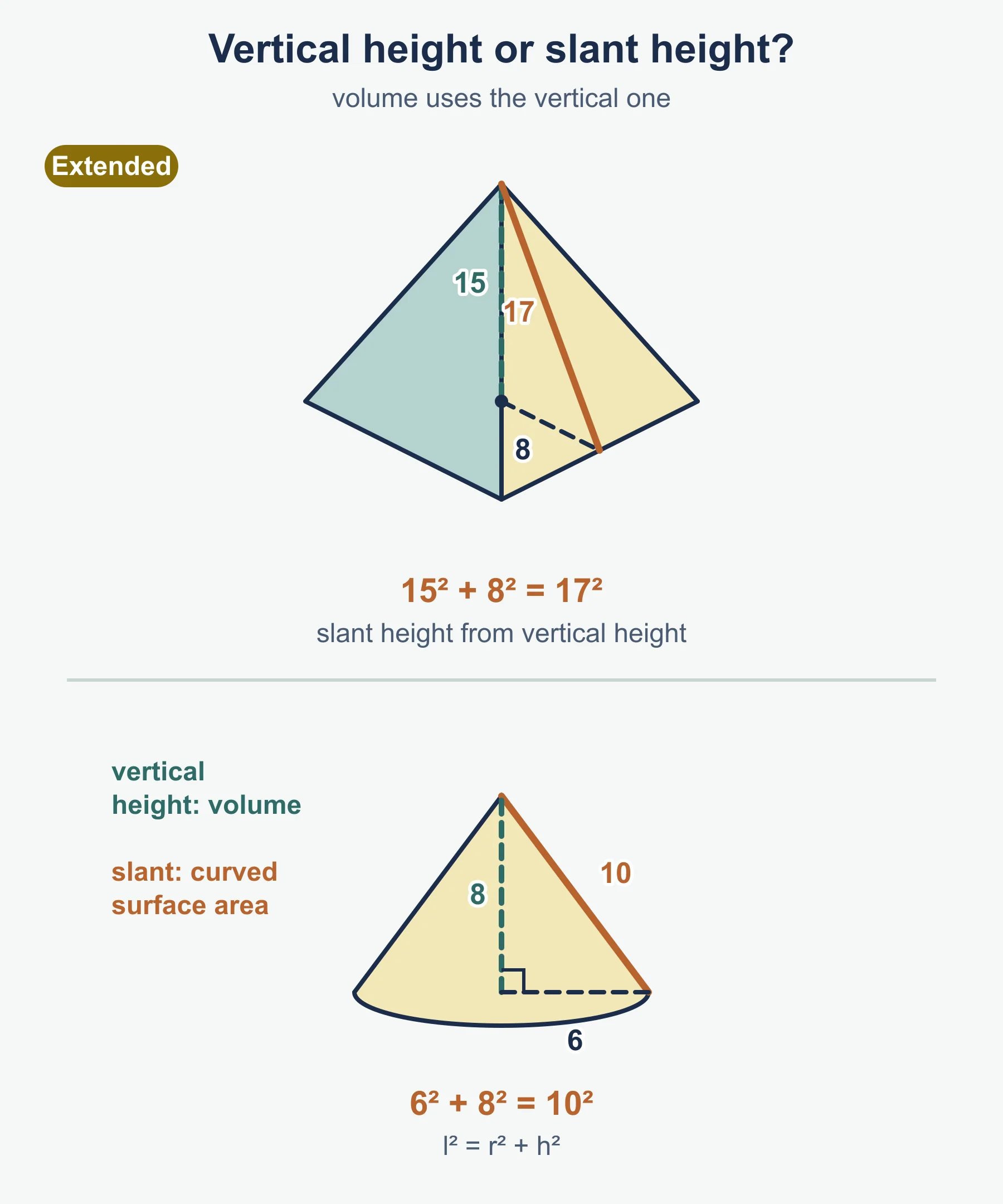
- For a cone or pyramid, get l or the slant height from Pythagoras first.
Volume of a compound solid
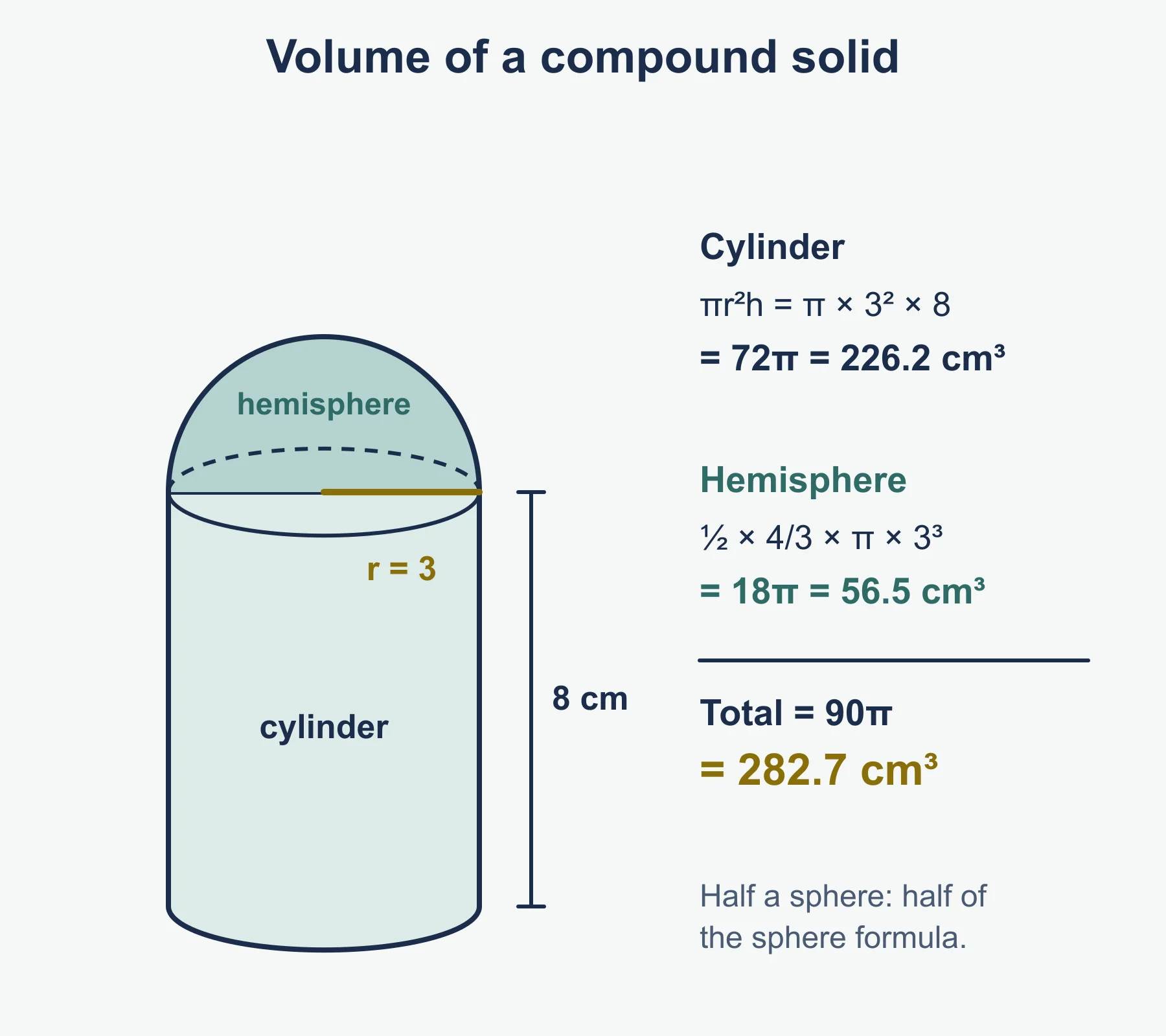
- Split into cones, cylinders, hemispheres, prisms or pyramids.
- Work out any missing height by subtraction.
- Add volumes. If a piece is removed, subtract.
Shaded regions
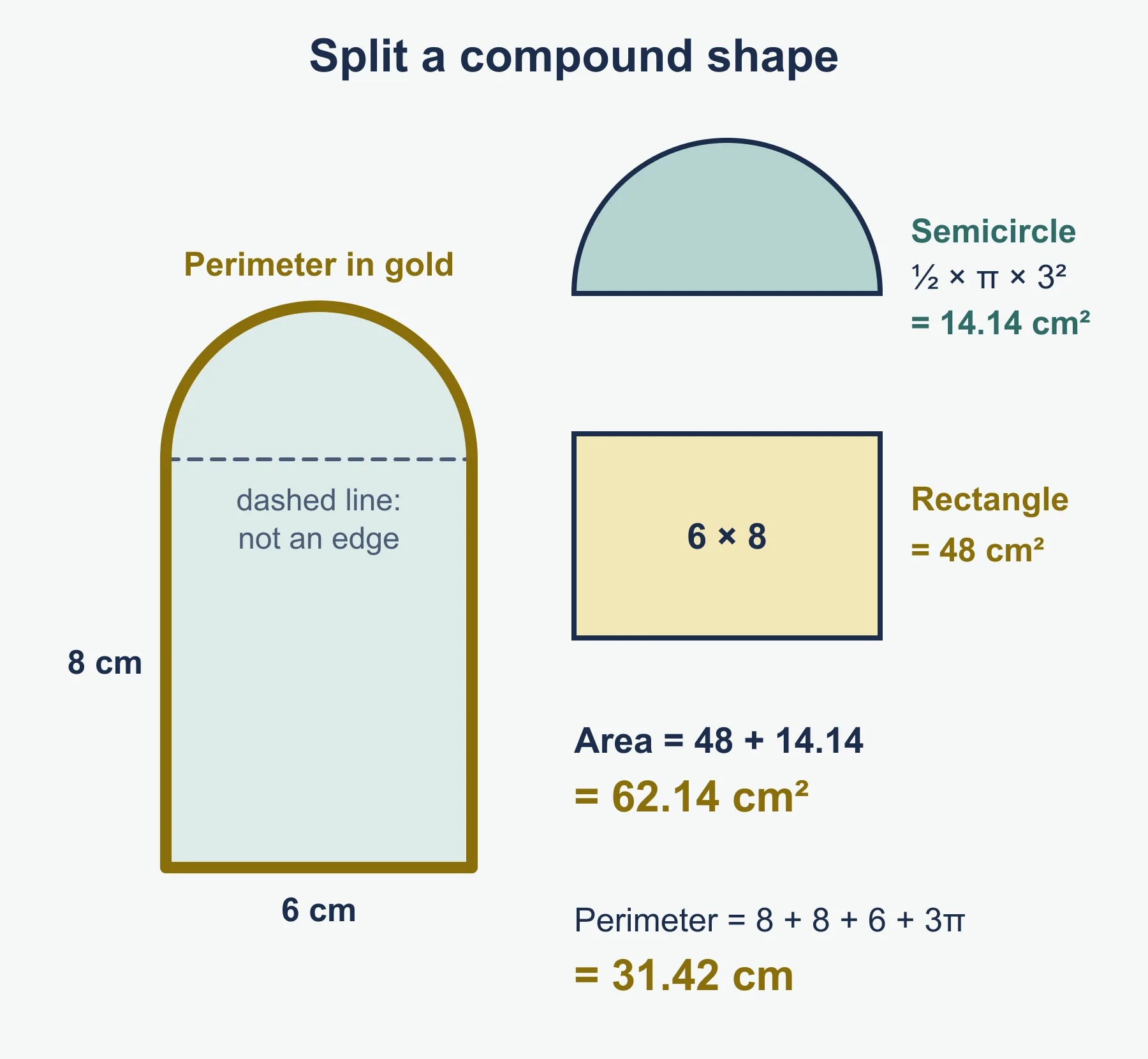
- Area of the large shape minus area of the small shape.
- Keep π in until the last line.
Worked reminders
Ring (annulus). Outer radius 10 cm, inner radius 6 cm. Area = π(10² − 6²) = π × 64 = 64π cm².
Quarter circle. Radius 10 cm. Area = ¼ × π × 100 = 25π cm². Perimeter = 10 + 10 + ¼ × 2π × 10 = 20 + 5π cm.
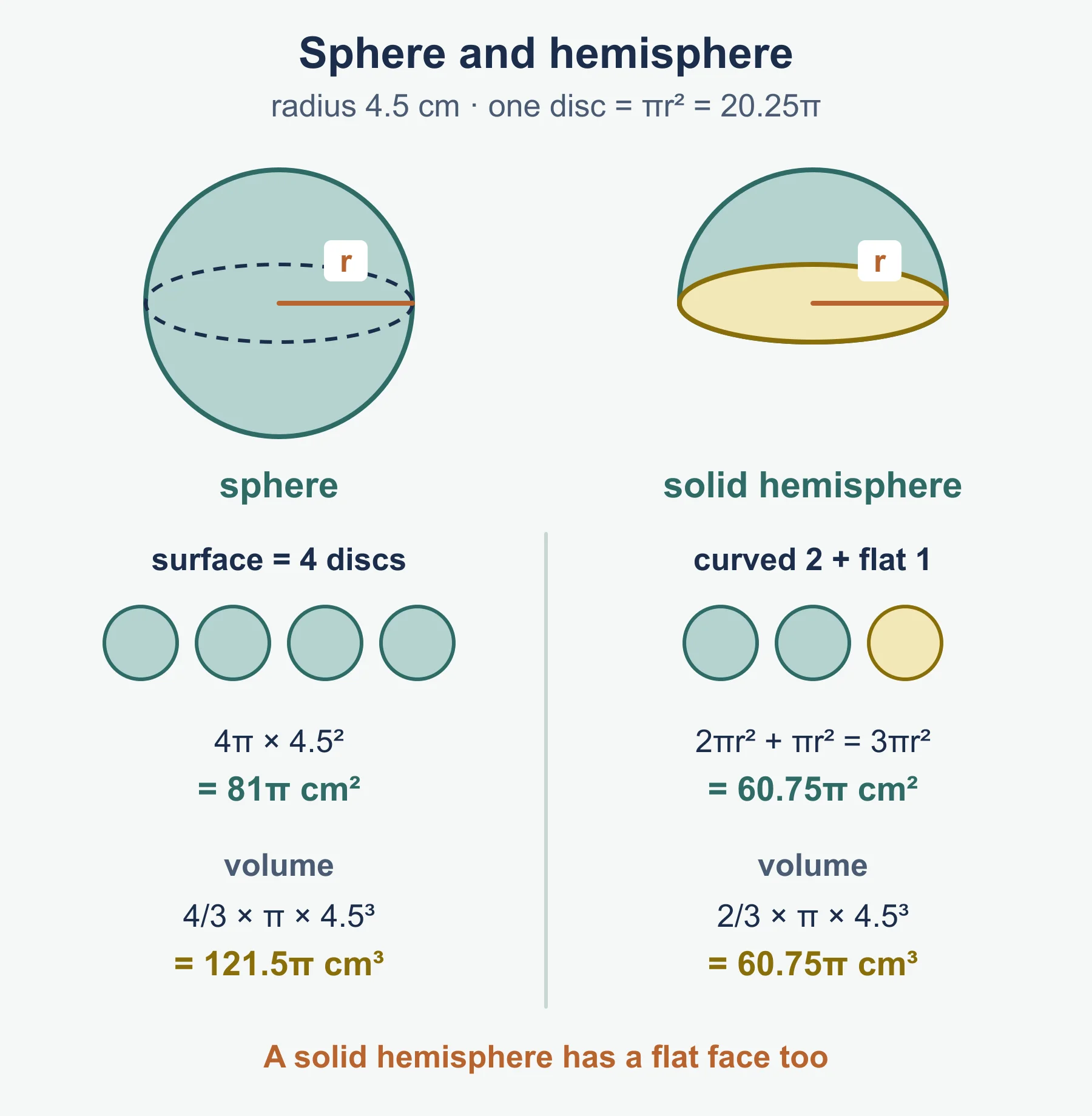
Solid hemisphere, radius 3 cm. Volume = ⅔ × π × 27 = 18π cm³. Curved surface = 2π × 9 = 18π. Total surface area = 18π + π × 9 = 27π cm² because the flat face counts when the solid is closed.
Compound solid. A cylinder of radius 4 cm and height 9 cm has a hemisphere of the same radius fixed on top. Volume = π × 16 × 9 + ⅔ × π × 64 = 144π + (128/3)π = (560/3)π cm³. The curved surface is 2π × 4 × 9 + 2π × 16 = 72π + 32π, plus the base 16π, giving 120π cm² in total. The circle where the two parts meet is a join, so it is left out.
Mixed units. A tank 1.2 m long, 50 cm wide and 40 cm deep: change to one unit first. 120 × 50 × 40 = 240 000 cm³ = 240 litres.
Recasting. When one solid is melted and made into another, the volume stays the same. Equate the two volumes and solve for the missing length.
Must-know distinctions
| Idea | Careful about |
|---|---|
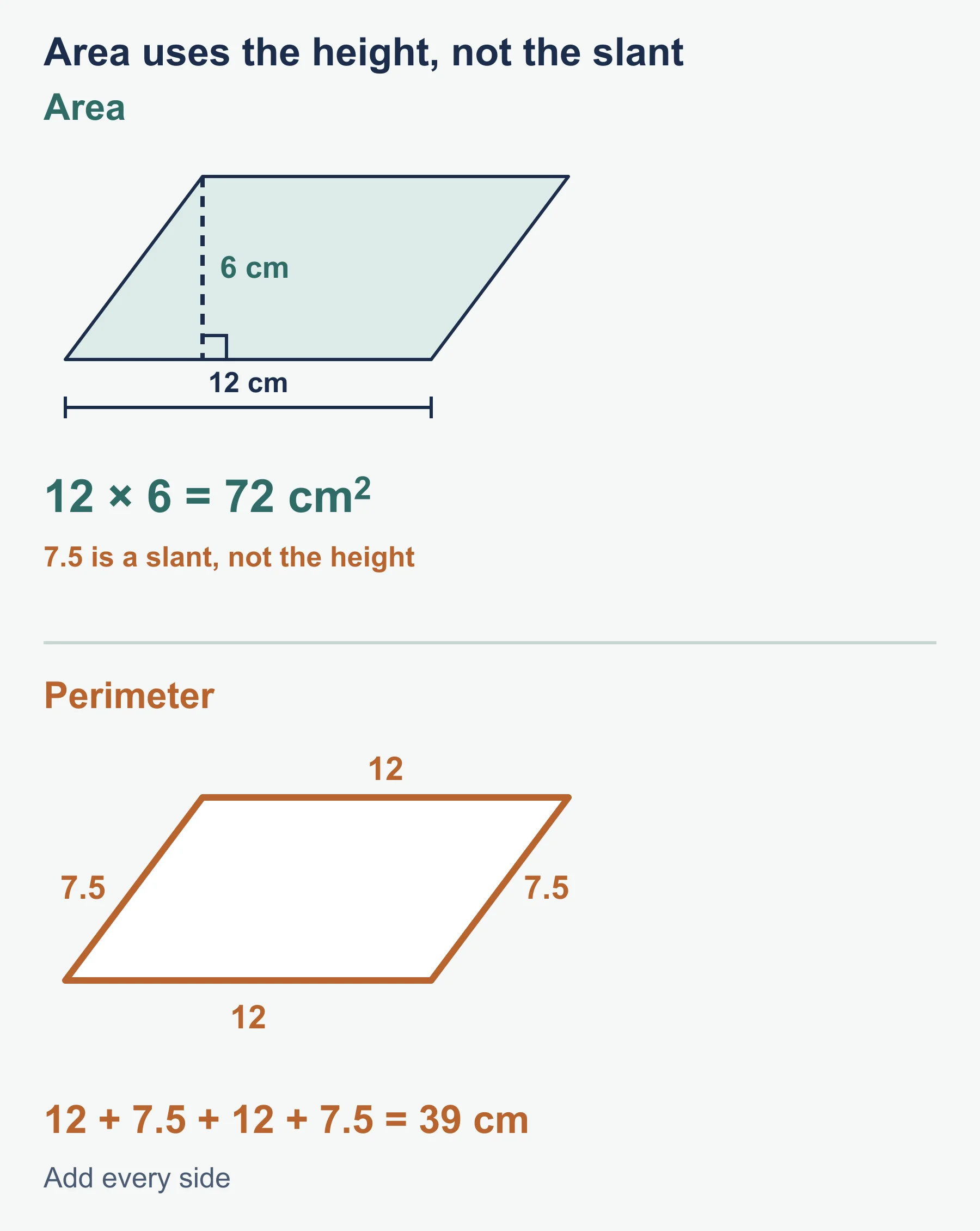
| Height v slant height | Area and volume use the perpendicular height. Curved surface of a cone uses the sloping edge l. |
| Radius v diameter | Halve the diameter before using any circle formula. |
| Perimeter v area | Perimeter is a length (cm). Area is cm². Volume is cm³. |
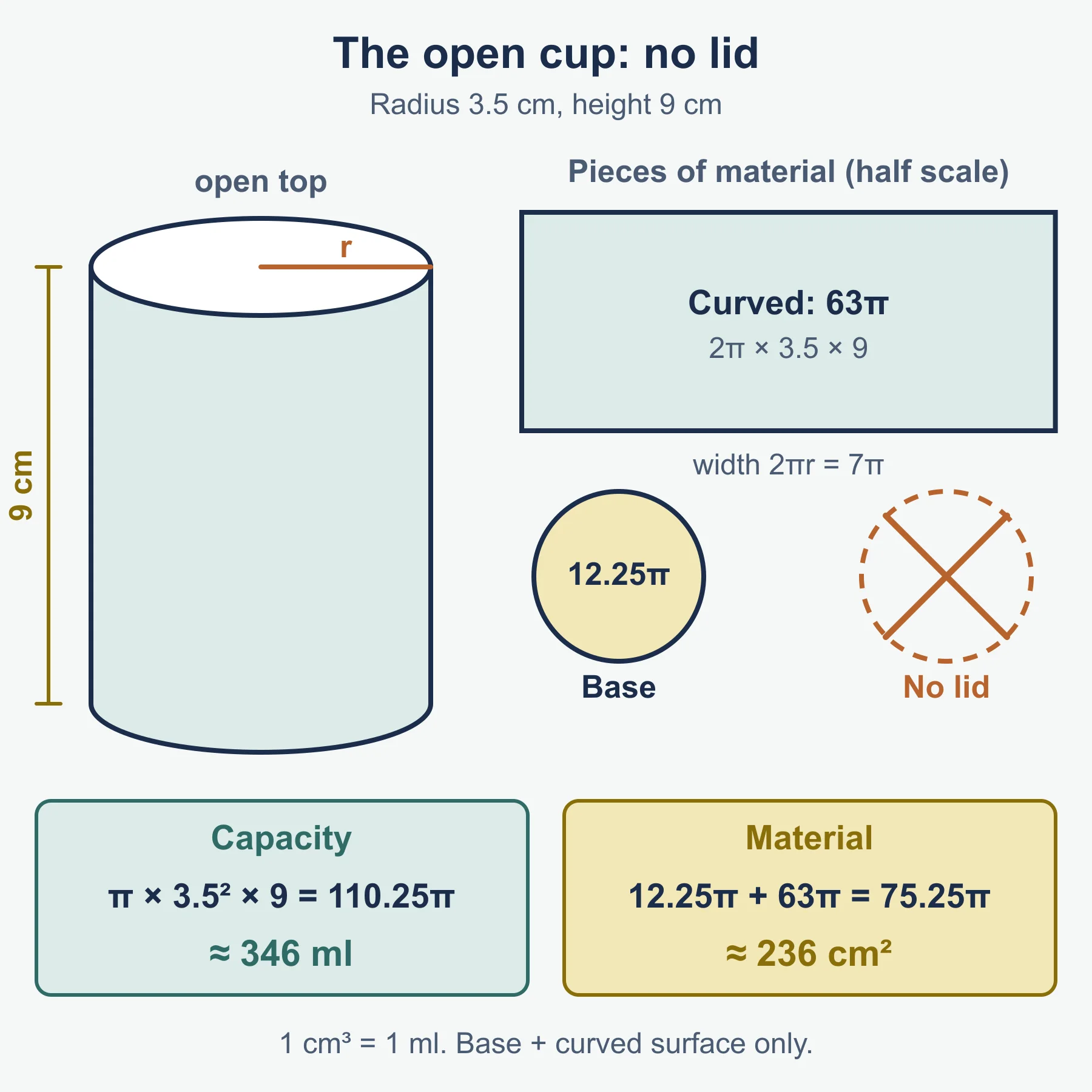
| Curved v total surface | Total includes flat ends. Open containers leave off a lid. |
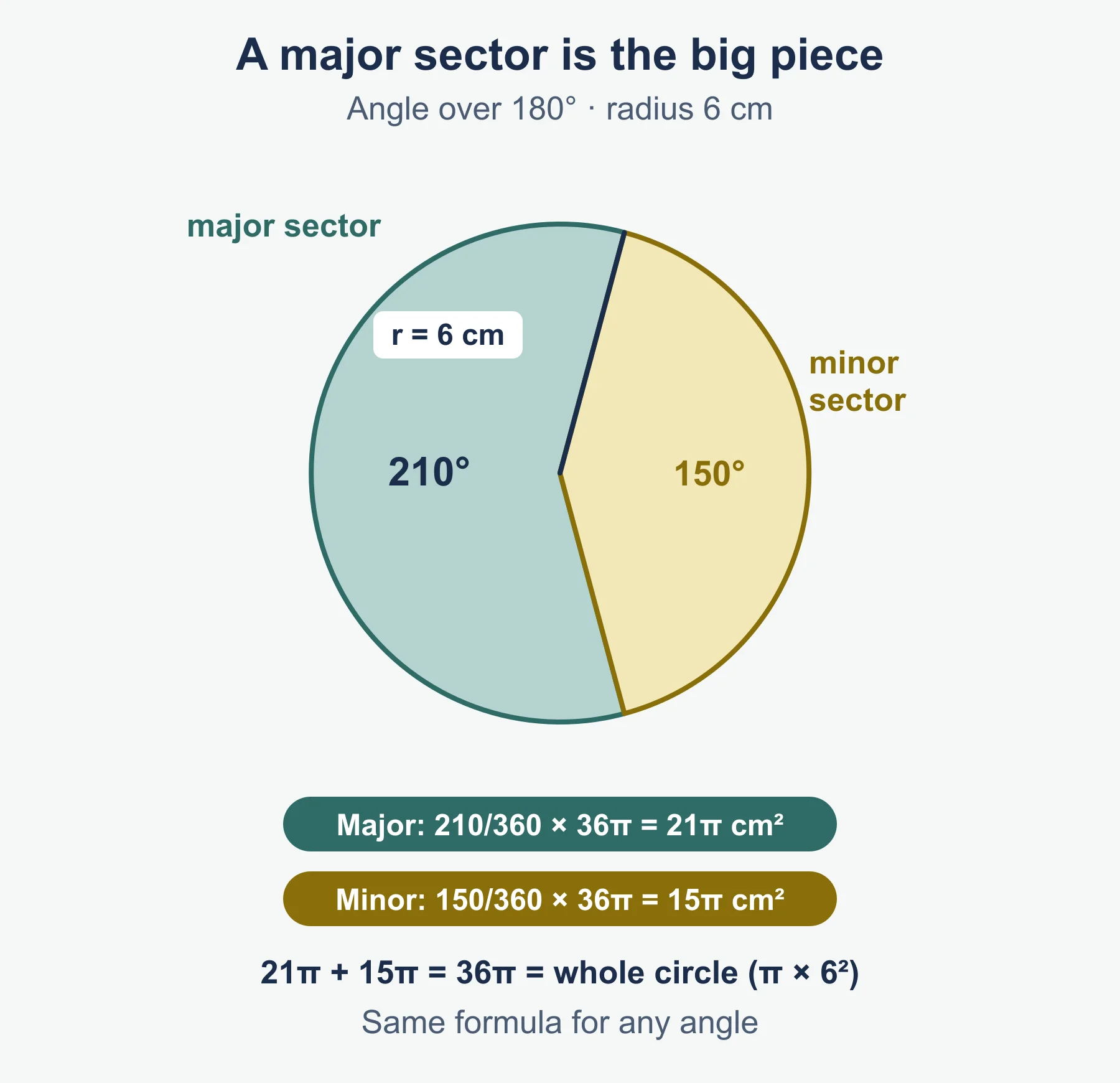
| Minor v major sector | Minor sector has angle below 180°, major above 180°. The same formulas work. |
| In terms of π v decimal | Leave π in if asked. Otherwise give 3 significant figures. |
| Capacity v volume | Capacity is measured in ml or litres, volume in cm³ or m³. |
The syllabus says to give non-exact answers to 3 significant figures unless a different accuracy is specified, and to avoid rounding before the final answer. For a calculator paper, use π from your calculator or 3.142.
Parts of shapes and solids
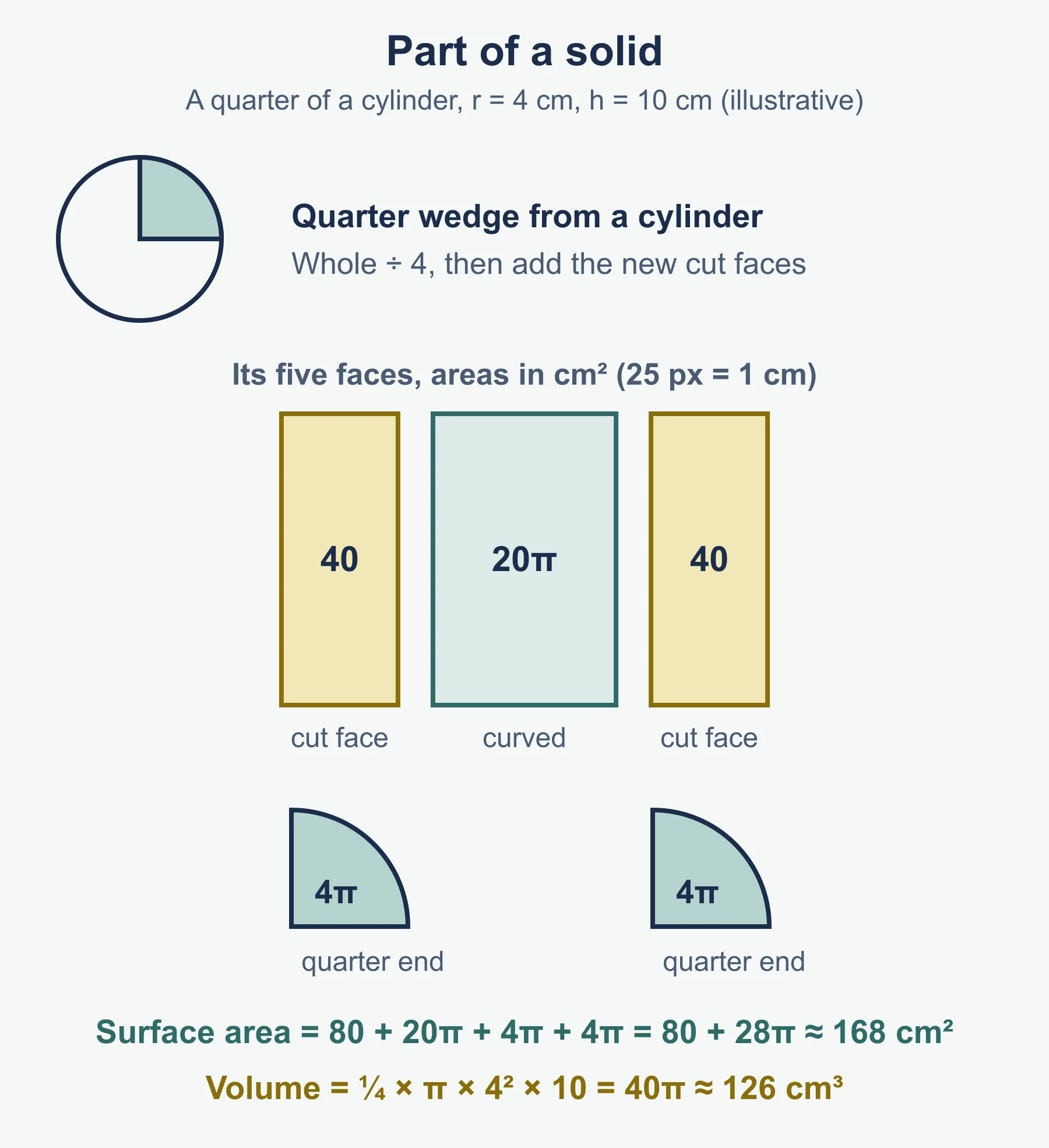
- A half or quarter of a circle, cylinder or sphere is half or a quarter of the whole.
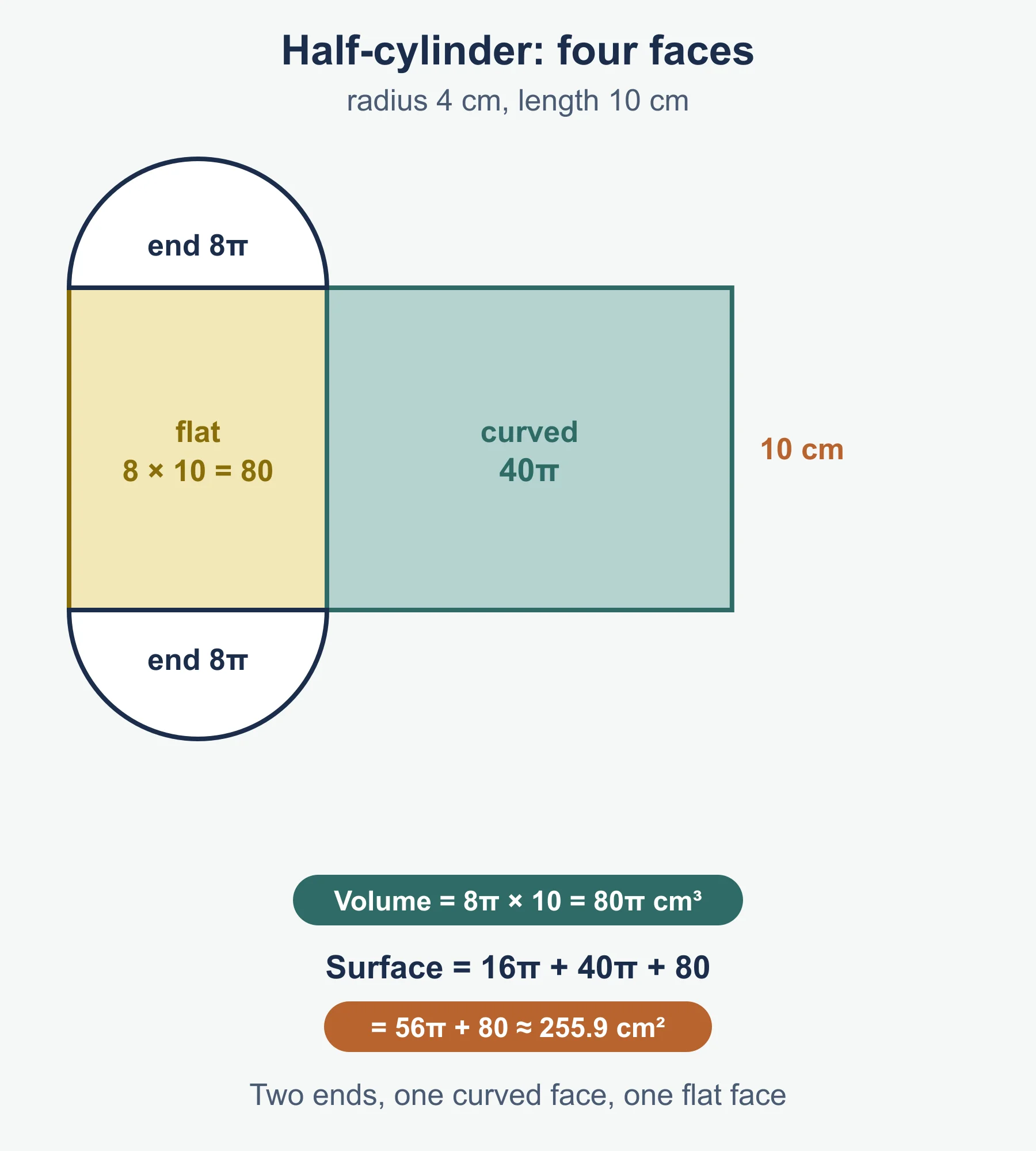
- A cut adds new flat faces. A half-cylinder has a flat rectangle as well as its two semicircular ends.
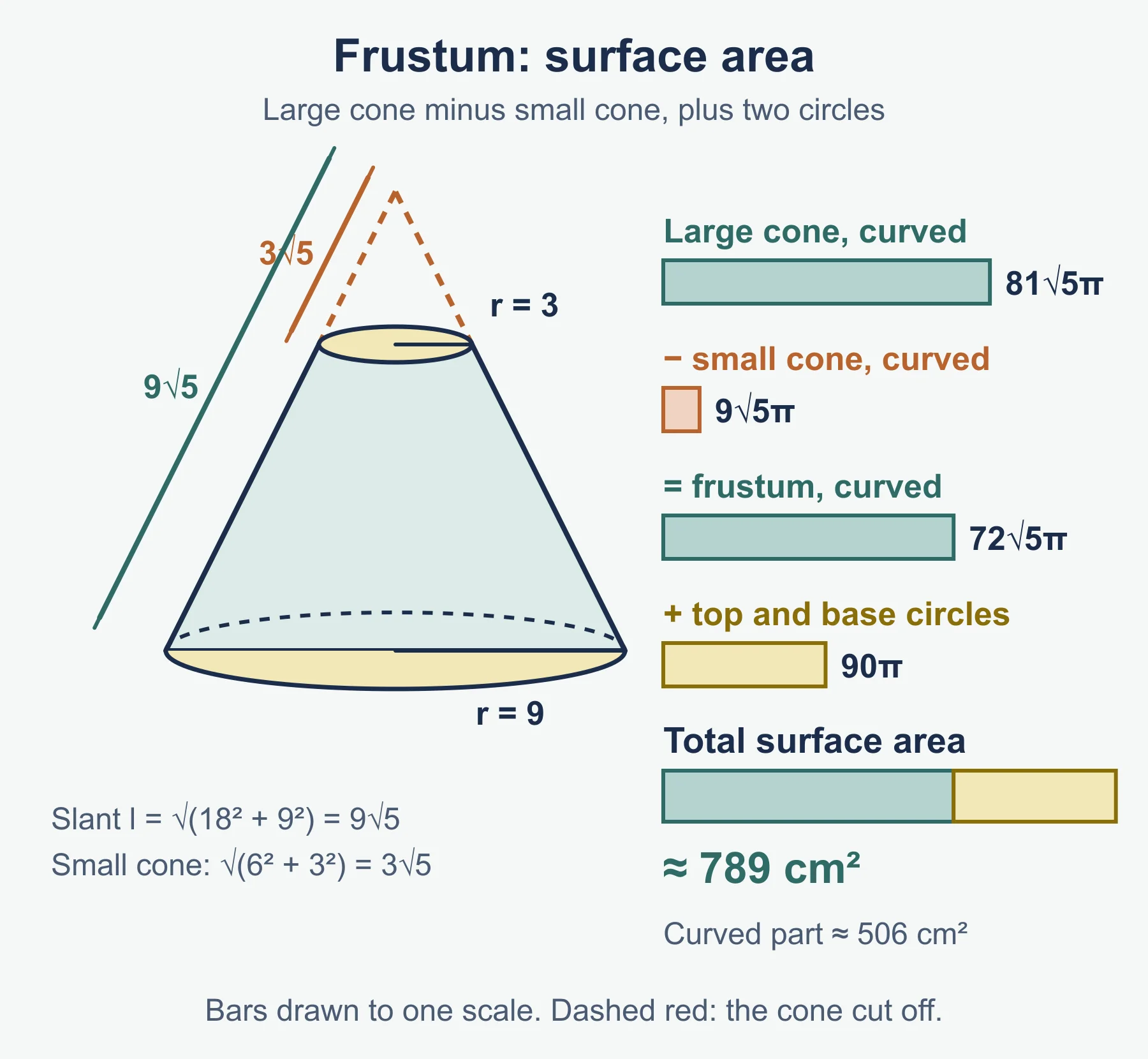
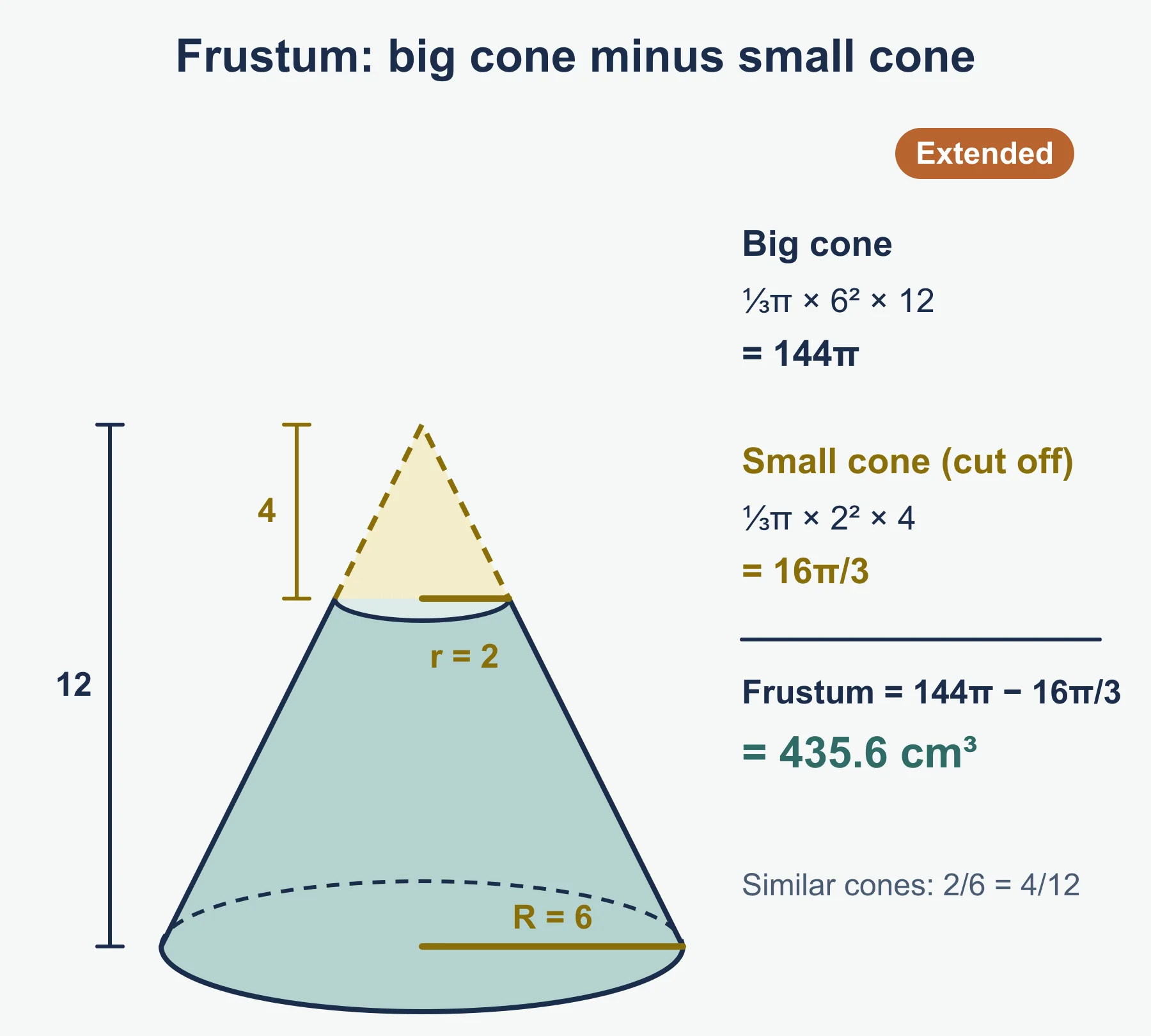
- A frustum is a cone with a smaller, similar cone removed from the top. Find both cones, then subtract volumes. Add the base, the top circle and the difference of the two curved surfaces.
- A prism can have any uniform cross-section, so find the cross-section area first.
Quick self-test
Try these without notes. Questions 3 and 10 are best done without a calculator.
- Convert 0.06 m² to cm².
- Convert 4800 cm³ to litres.
- A trapezium has parallel sides 9 cm and 15 cm and height 8 cm. Find its area.
- A parallelogram has area 72 cm² and base 9 cm. Find its perpendicular height.
- A sector has radius 8 cm and angle 135°. Find its arc length and area in terms of π.
- A sector of radius 8 cm has area 40π cm². Find its angle.
- A sphere has radius 6 cm. Find its volume and surface area in terms of π.
- A cone has base radius 5 cm and sloping edge 13 cm. Find its perpendicular height, volume and curved surface area, in terms of π.
- A cylinder with base radius 6 cm has volume 360π cm³. Find its height.
- A square-based pyramid has base edge 6 cm and vertical height 4 cm. Find its volume and total surface area.
- A cuboid measures 8 cm by 5 cm by 3 cm. Find its total surface area.
- A sphere of radius 3 cm is melted and recast as a cone with base radius 3 cm. Find the cone’s height.
Answers
- 0.06 × 10 000 = 600 cm².
- 4800 ÷ 1000 = 4.8 litres.
- ½ × (9 + 15) × 8 = 96 cm².
- 72 ÷ 9 = 8 cm.
- Fraction = 135/360 = 3/8. Arc = 3/8 × 16π = 6π cm. Area = 3/8 × 64π = 24π cm².
- 40π = (θ/360) × 64π, so θ/360 = 5/8, and θ = 225°.
- Volume = (4/3) × π × 216 = 288π cm³. Surface area = 4 × π × 36 = 144π cm².
- h² = 13² − 5² = 144, so h = 12 cm. Volume = ⅓ × π × 25 × 12 = 100π cm³. Curved surface = π × 5 × 13 = 65π cm².
- π × 36 × h = 360π, so h = 10 cm.
- Volume = ⅓ × 36 × 4 = 48 cm³. Slant height = √(4² + 3²) = 5 cm. Four faces = 4 × ½ × 6 × 5 = 60. Total = 36 + 60 = 96 cm².
- 2 × (40 + 24 + 15) = 158 cm².
- Sphere volume = (4/3) × π × 27 = 36π. Cone: ⅓ × π × 9 × h = 36π, so 3πh = 36π and h = 12 cm.
Where marks are usually lost
- Converting between area units with the length factor instead of its square.
- Using the slant side of a trapezium or parallelogram as the height.
- Using the diameter as the radius, especially when a question gives the width of a circular shape.
- Forgetting the radii in the perimeter of a sector.
- Taking a major sector as the same angle as the minor one, instead of 360° minus it.
- Using the vertical height of a cone where the curved surface needs l, or the reverse.
- Including a lid on an open cup, or missing the flat face on a solid hemisphere.
- Counting a join between two pieces of a compound solid in the surface area.
- Rounding early, then giving a final answer that is not accurate to 3 significant figures.
- Writing cm² where cm³ is needed, or leaving units off.
Before moving on, work through the mensuration practice set and revisit the study guide for any weak section.
Frequently asked questions
Which mensuration formulas are given in the Cambridge O Level Mathematics 4024 exam? According to these notes, formulas such as the area of a circle, circumference, cylinder, cone, sphere, prism and pyramid volumes are given. You must learn the rectangle, parallelogram and trapezium areas, arc length, sector area and cuboid surface area.
How do you find arc length and sector area? Use the fraction of the circle: arc length = (θ/360) × 2πr and sector area = (θ/360) × πr². The same formulas work for major sectors, where the angle is above 180°.
How do you find the volume of a frustum? A frustum is a cone with a smaller, similar cone removed from the top. Find the volumes of both cones and subtract.
What happens to the volume when a solid is melted and recast? The volume stays the same. Equate the volumes of the two solids and solve for the missing length.
What is the difference between capacity and volume? Capacity is measured in ml or litres, while volume is measured in cm³ or m³. 1 cm³ = 1 ml and 1 litre = 1000 cm³.
Official syllabus
Cambridge O Level Mathematics (Syllabus D) 4024 syllabus for examination in 2025, 2026 and 2027, Cambridge International Education, topic 5 Mensuration.
Get free revision emails (optional)
Occasional emails with practice questions, worked explanations and links to free resources for the qualification and subjects you choose. No spam, and you can unsubscribe from any email. The free tools on this site never need an email.
Related resources
-
Study guides
Cambridge O Level Mathematics: Mensuration (4024)
Study guide to every Mensuration outcome in Cambridge O Level Mathematics 4024: units, area, circles, solids and compound shapes, with worked examples.
Mathematics · Cambridge · O Level
Read guide -
Practice questions
O Level Mathematics: Mensuration Practice Questions (Cambridge 4024)
Original Cambridge O Level Mathematics 4024 mensuration questions on area units, arcs and sectors, circles, cylinders, cones and hemispheres, with answers.
Mathematics · Cambridge · O Level
Try questions -
Study guides
Cambridge O Level Mathematics: Number (4024)
Study guide to every Number outcome in Cambridge O Level Mathematics 4024, from types of number and sets to surds, with worked examples throughout.
Mathematics · Cambridge · O Level
Read guide
Related articles
-
exam preparation
Where IGCSE Mathematics marks are lost early
The first weeks of an IGCSE Mathematics course rarely go wrong on difficulty. They go wrong on method, command words, rounding and units — four habits that cost marks a student had already earned.
24 August 2026
-
teaching
A Level tuition in Dubai: Cambridge or Pearson Edexcel International A Level?
Schools in Dubai and Abu Dhabi teach either Cambridge International AS & A Level or Pearson Edexcel International A Level. How the two are structured, why it matters for tuition, and how online classes from Lahore work.
9 October 2026
Studying this with a teacher
Working through Mathematics O LEVELS?
This page is free and stays free. If you would rather be taught it, Marlbridge runs Mathematics classes one-to-one and in small groups of up to 15, online in your own time zone. The first trial class is free. WhatsApp replies within an hour (8am–11pm Pakistan time, every day); email the same day.
Cambridge Mathematics teachers at Marlbridge


