Revision Notes
O Level Physics: Nuclear physics – Revision Notes (Cambridge 5054)
Condensed revision notes for Cambridge O Level Physics 5054 nuclear physics: nuclides, radiation, half-life, fission and safety, plus a self-test.
- Subject
- Physics
- Level
- O LEVELS
- Topic
- Nuclear physics
- Author
- Marlbridge Academic Team
- Updated
- Reviewed by
- Hassan (what this means)
Aligned to Cambridge O Level Physics (5054), 2026-2028. Official specification .
Syllabus page (what it covers and how it is assessed): Cambridge O Level Physics.
Syllabus points this page covers
5054
- 5.1 The nuclear model of the atom
- 5.2 Radioactivity
Found an error? Report a correction.
Need help with this topic? Request a free trial class for O Level Physics (5054).
These notes condense topic 5, Nuclear physics, from the Cambridge O Level Physics 5054 syllabus for examination in 2026, 2027 and 2028 (sections 5.1.1 to 5.2.6). For full explanations and worked examples, read the study guide first.
After the notes, test yourself with the practice questions. The Cambridge O Level Physics hub and the printable checklist show where this topic sits in the course, and the free 10-minute diagnostics help you pick what to revise next.
Key definitions
| Term | Meaning |
|---|---|
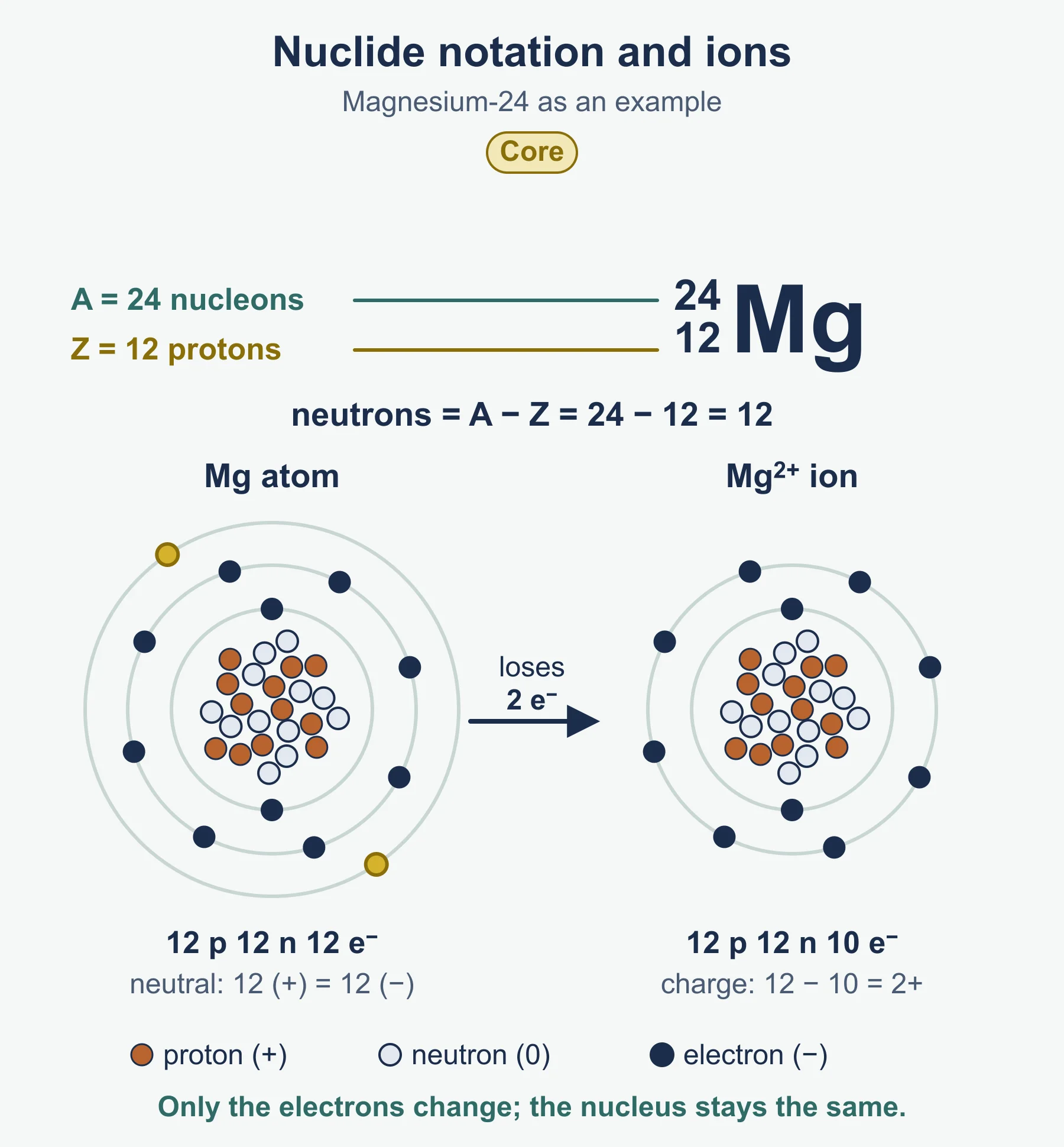
| Proton number Z | Number of protons in the nucleus (atomic number) |
| Nucleon number A | Number of protons plus neutrons (mass number) |
| Neutrons | A − Z |
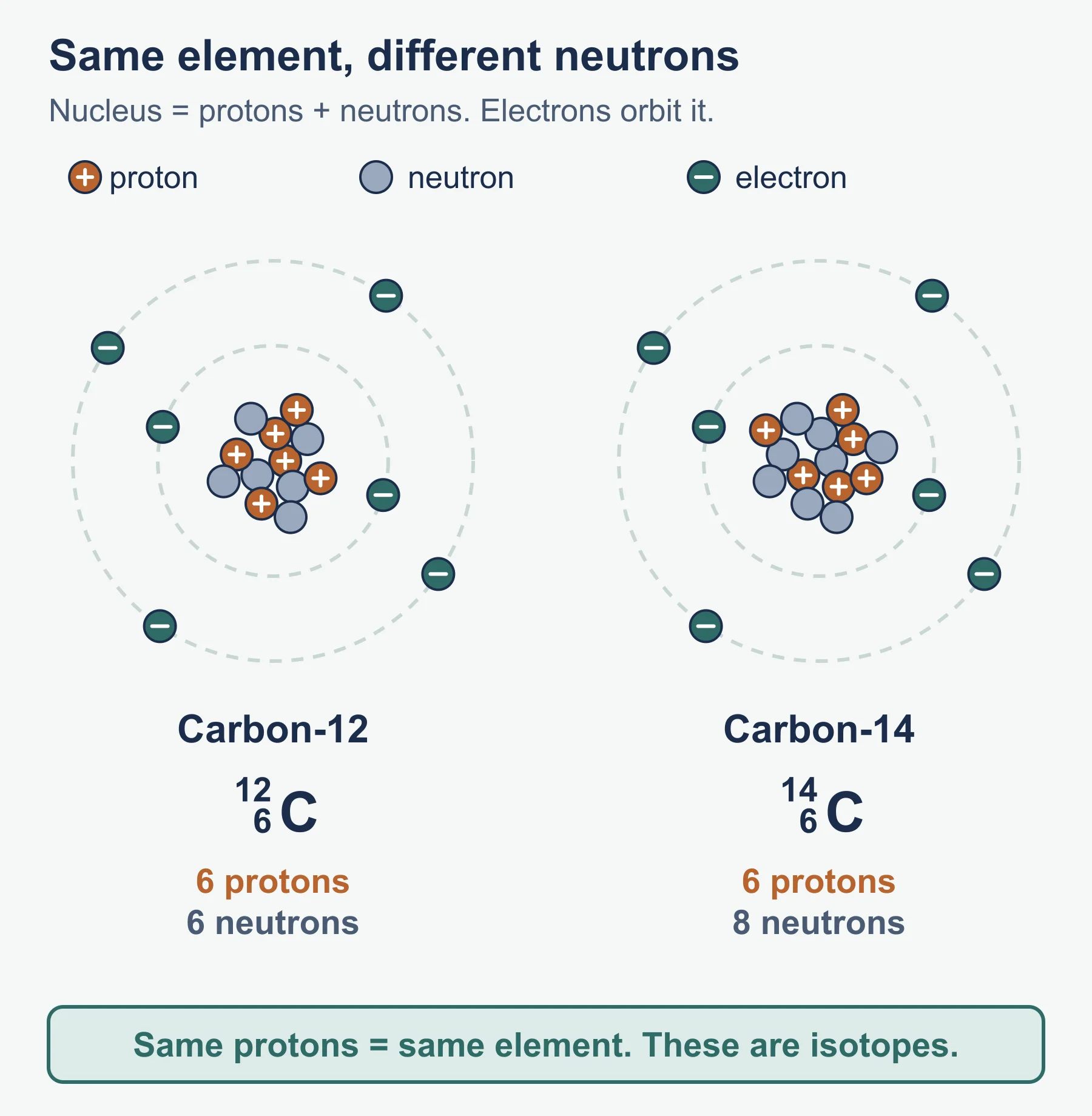
| Nuclide | A particular nucleus with given Z and A, written ᴬ_ZX |
| Isotopes | Nuclei of the same element (same Z) with different A, so different neutron numbers |
| Positive ion | Atom that has lost electrons; negative ion has gained electrons |
| Count rate | Counts detected per second or per minute |
| Background radiation | Radiation always present from the surroundings |
| Corrected count rate | Count rate with the source, less the count rate from background alone |
| Half-life | Time for half of the nuclei of an isotope, in any sample, to decay |
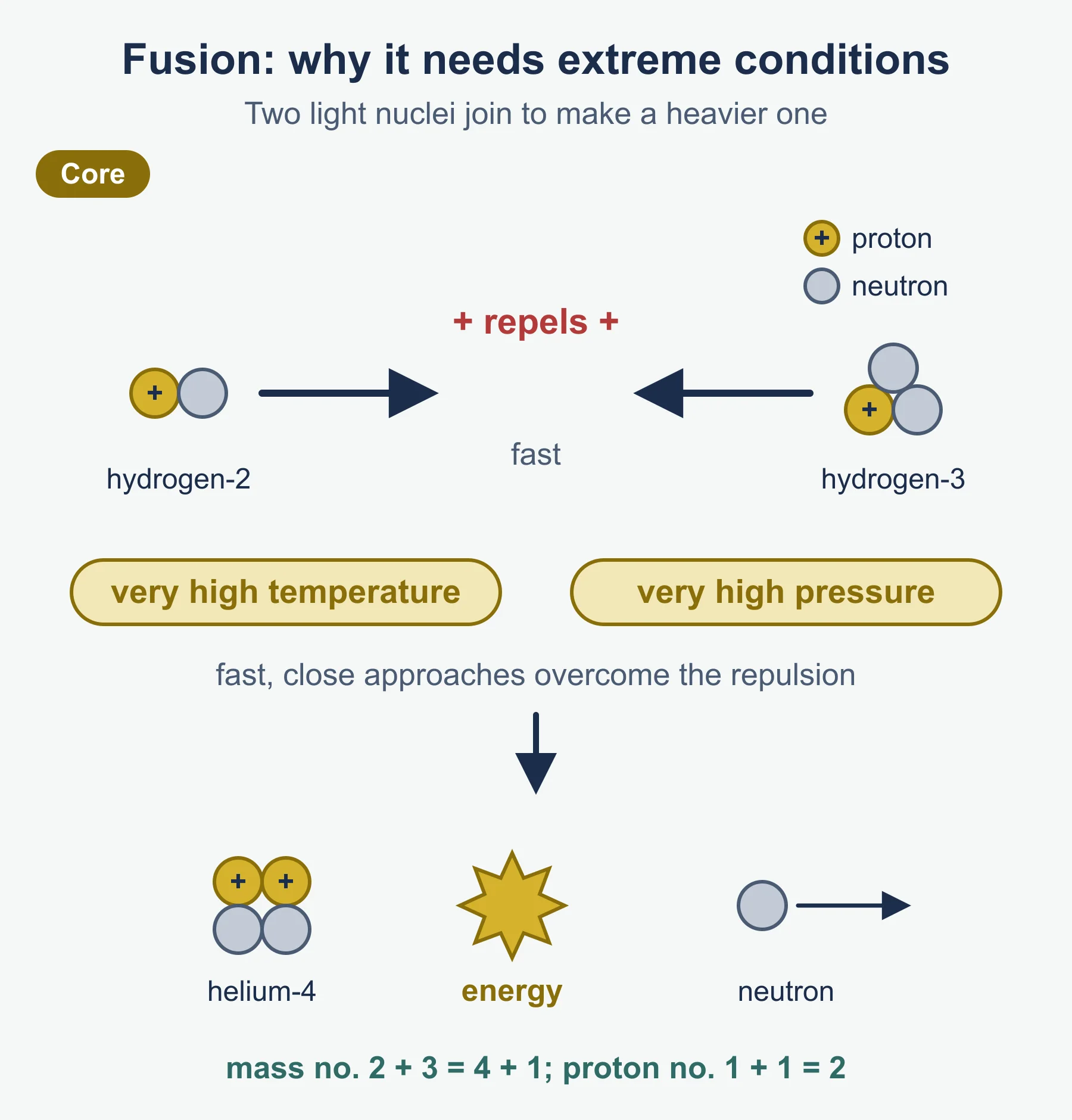
| Fusion | Two smaller nuclei combine into a larger nucleus, releasing energy |
| Fission | A heavy nucleus (for example uranium-235) takes in a neutron, breaks into daughter nuclei and gives out energy plus two or more neutrons |
The nuclear atom
- Positive nucleus, negative electrons in orbit around it.
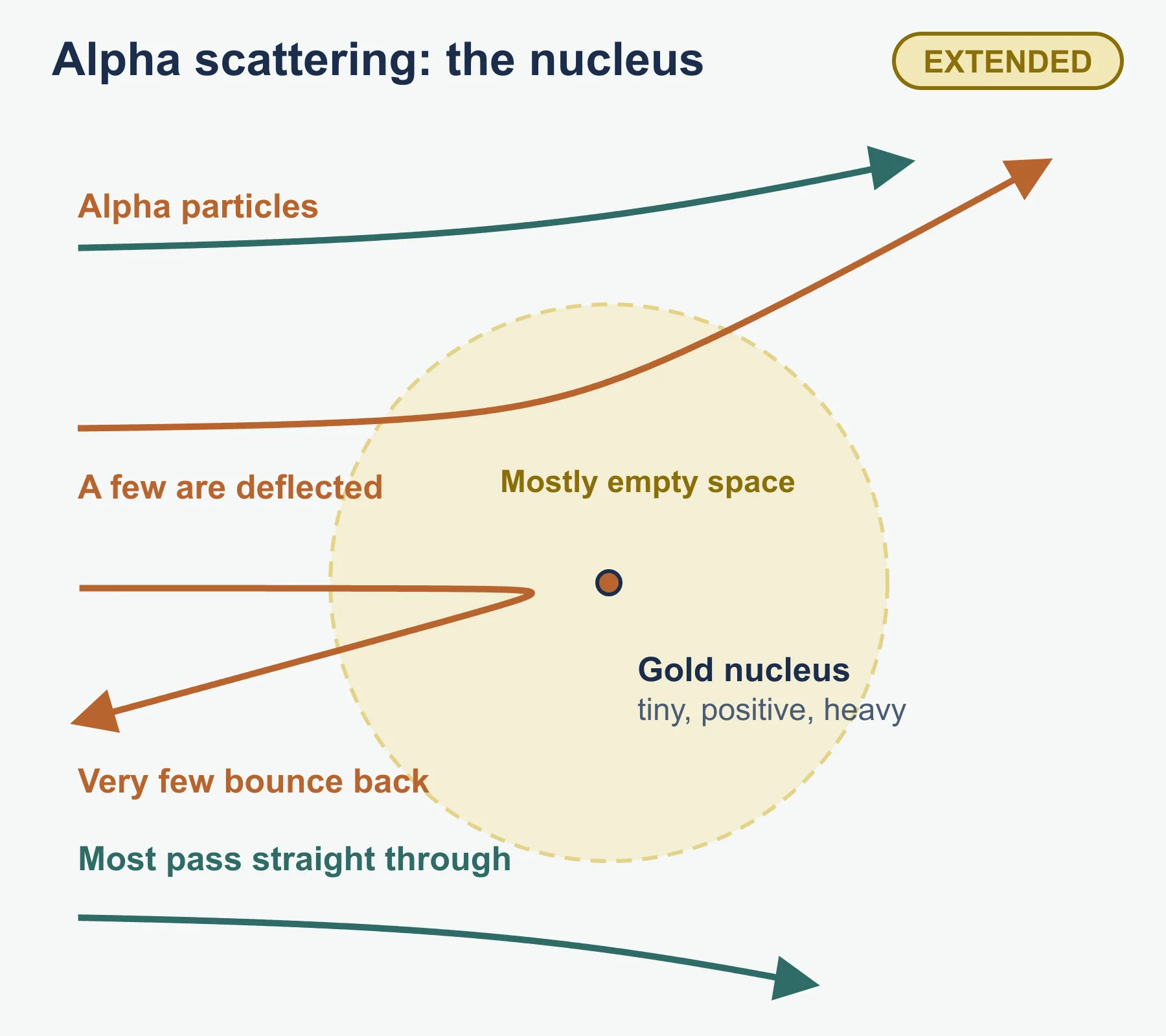
- Alpha scattering from a thin foil: most pass straight through (mostly empty space); a few deflect a lot (small nucleus, positive, most of the mass); a very few return almost the way they came (a heavy nucleus repelling them).
Detection and background
| Detector | Detects | What you see or hear |
|---|---|---|
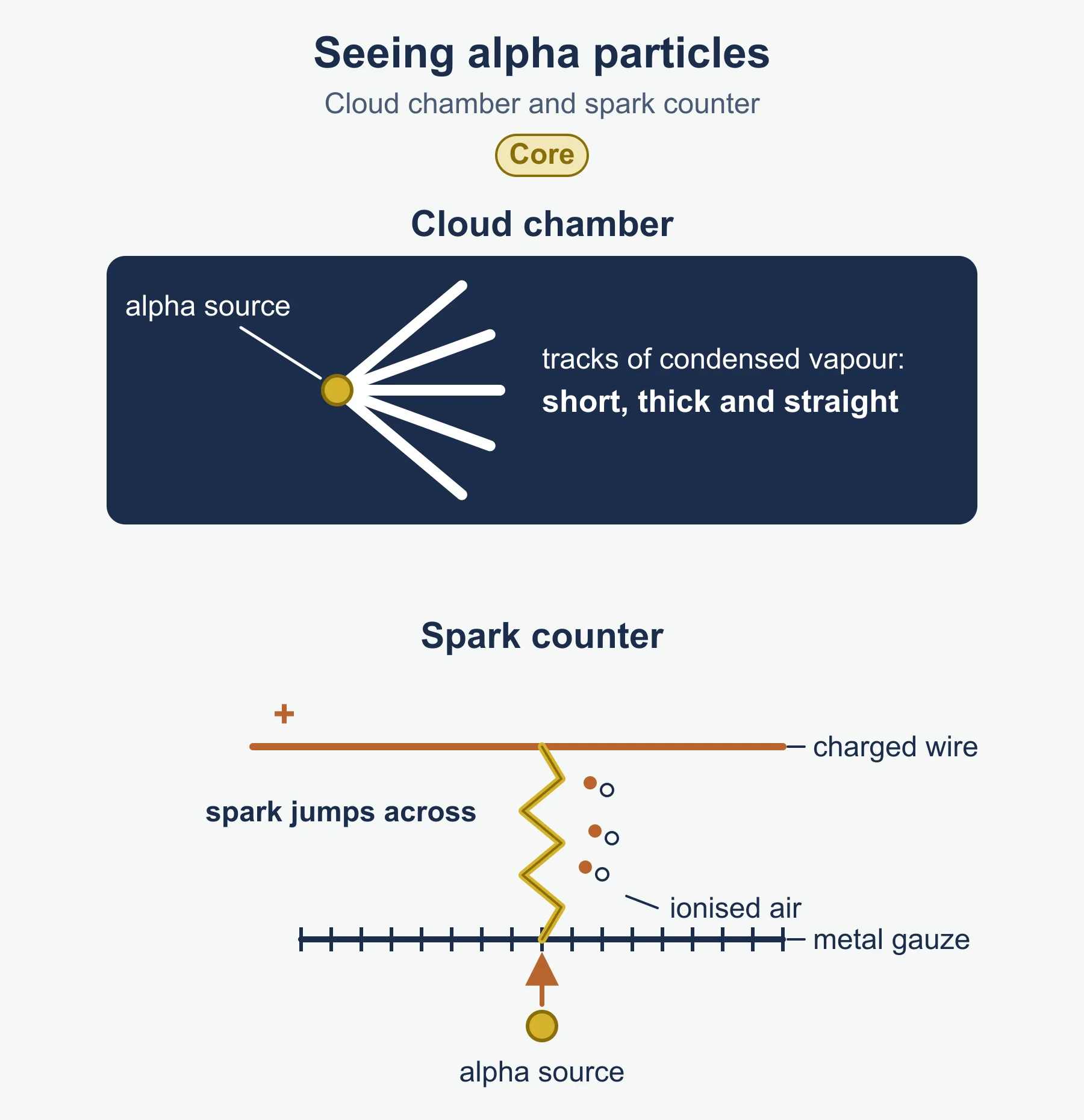
| Cloud chamber | Alpha | Short, thick, straight tracks |
| Spark counter | Alpha | Sparks between charged wire and gauze |
| GM tube and counter | Beta and gamma | Clicks or counts |
Sources of background radiation: cosmic rays, radon (a gas in the air), rocks and buildings, and what we eat and drink.
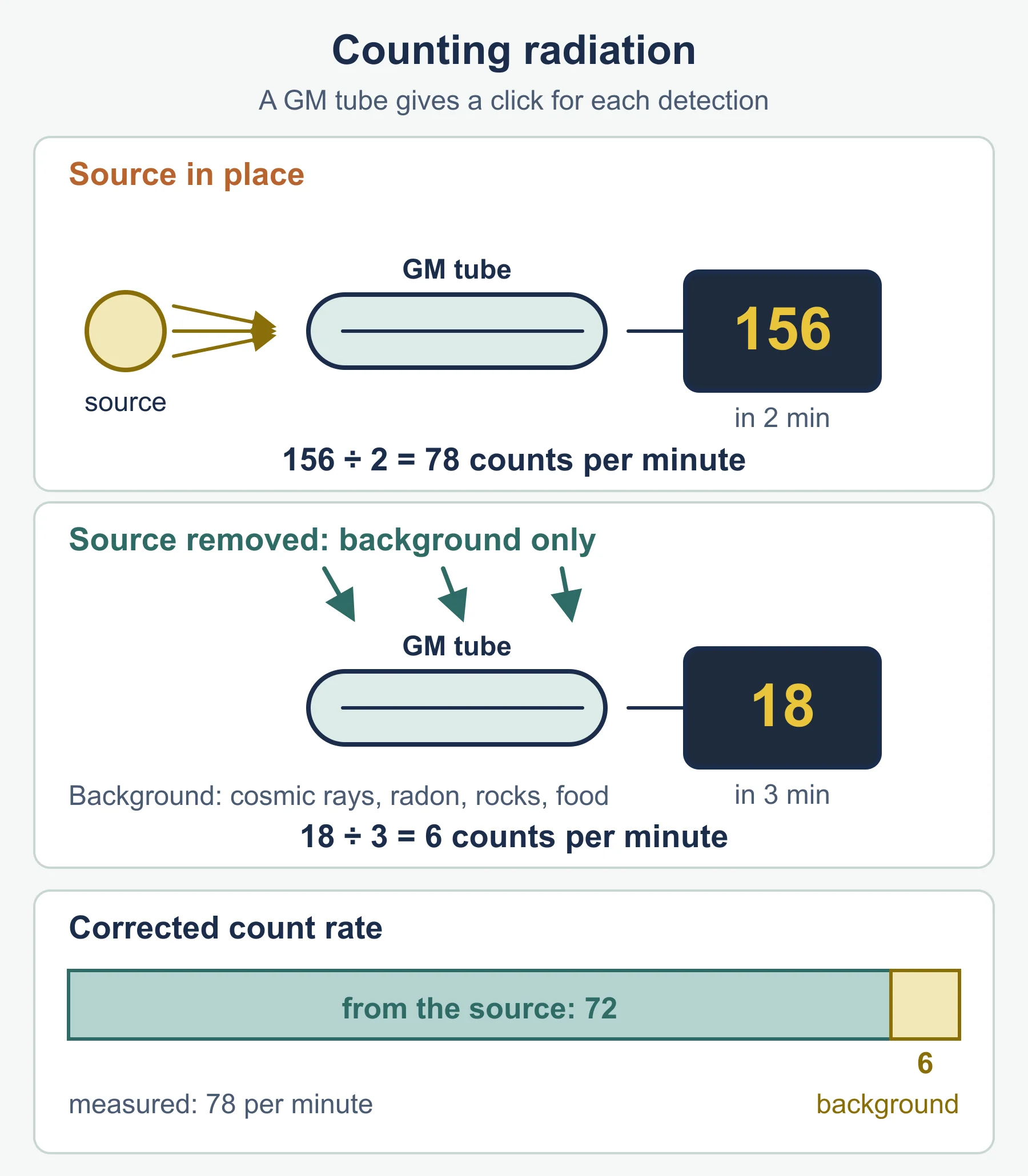
Method for corrected count rate:
- Convert the measured counts into counts per minute (or per second).
- Convert the background counts into the same unit.
- Subtract background from measured.
The three emissions
| Alpha | Beta (β⁻) | Gamma | |
|---|---|---|---|
| Nature | Helium nucleus: 2 protons and 2 neutrons | Electron ejected by the nucleus | Electromagnetic wave of very high frequency |
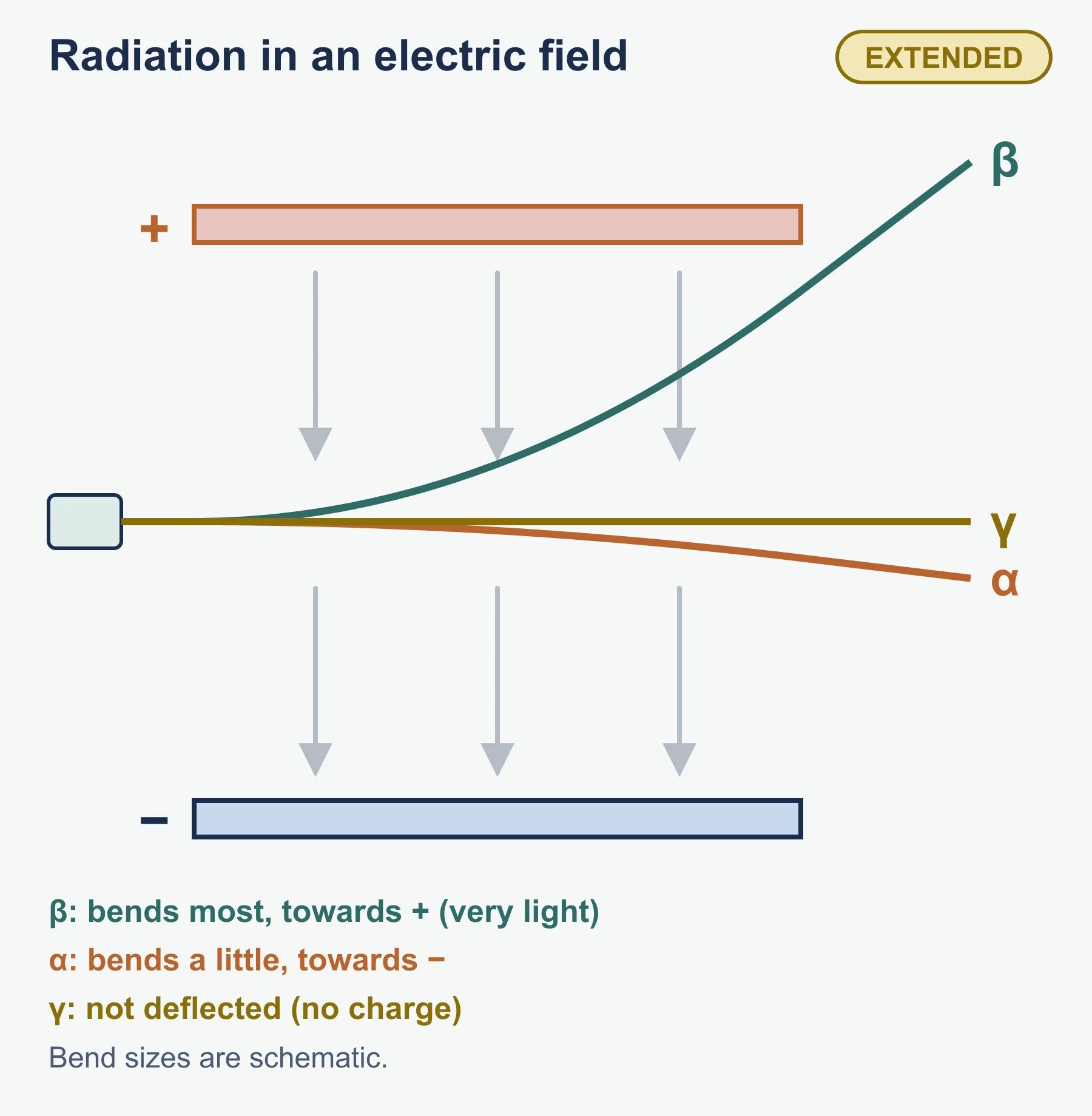
| Charge | Positive | Negative | None |
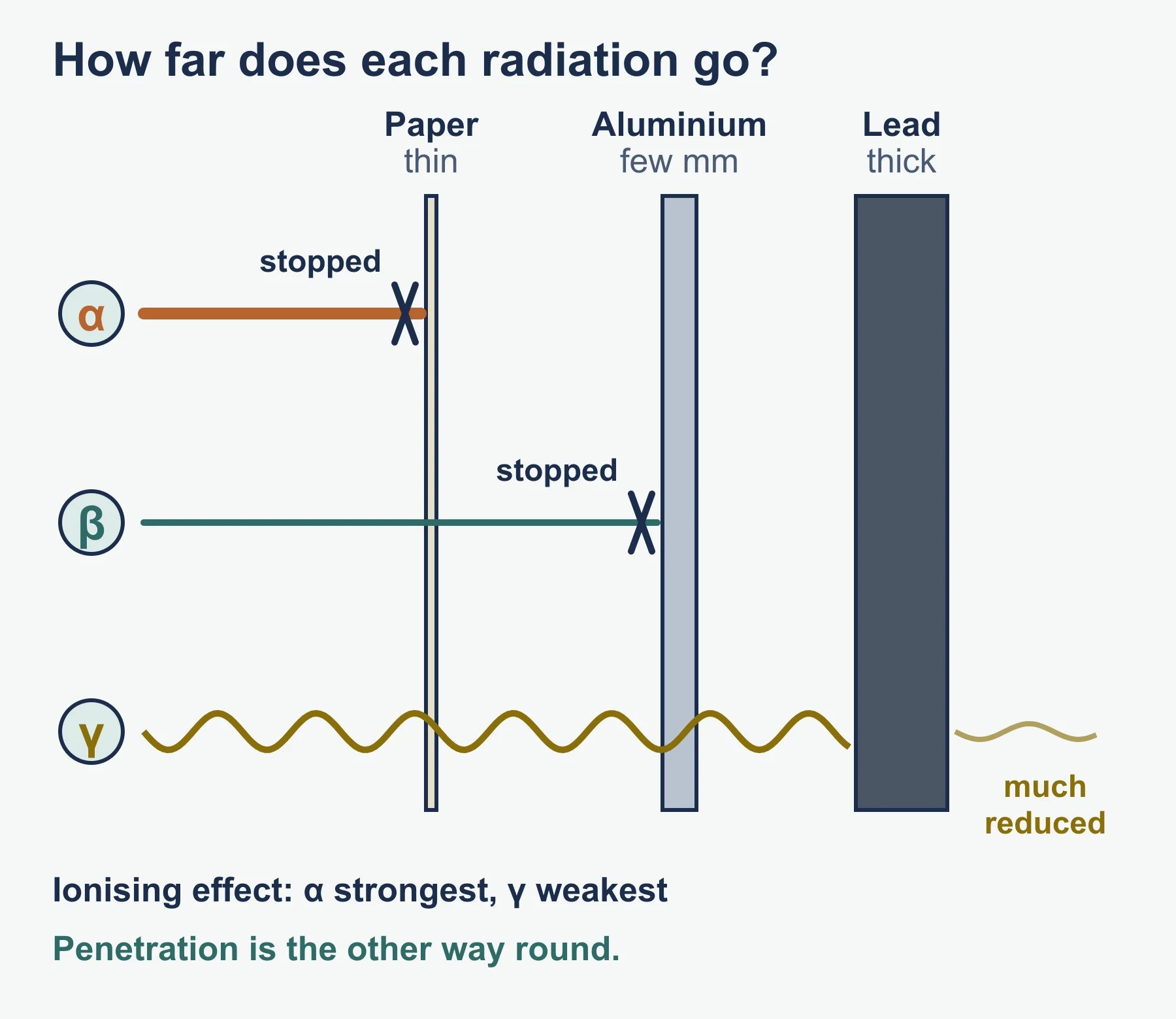
| Ionising | Strongest | Medium | Weakest |
| Penetrating | Least (paper, few cm of air) | Medium (few mm of aluminium) | Greatest (thick lead or concrete reduces it) |
| Electric field | Small bend to negative plate | Large bend to positive plate | None |
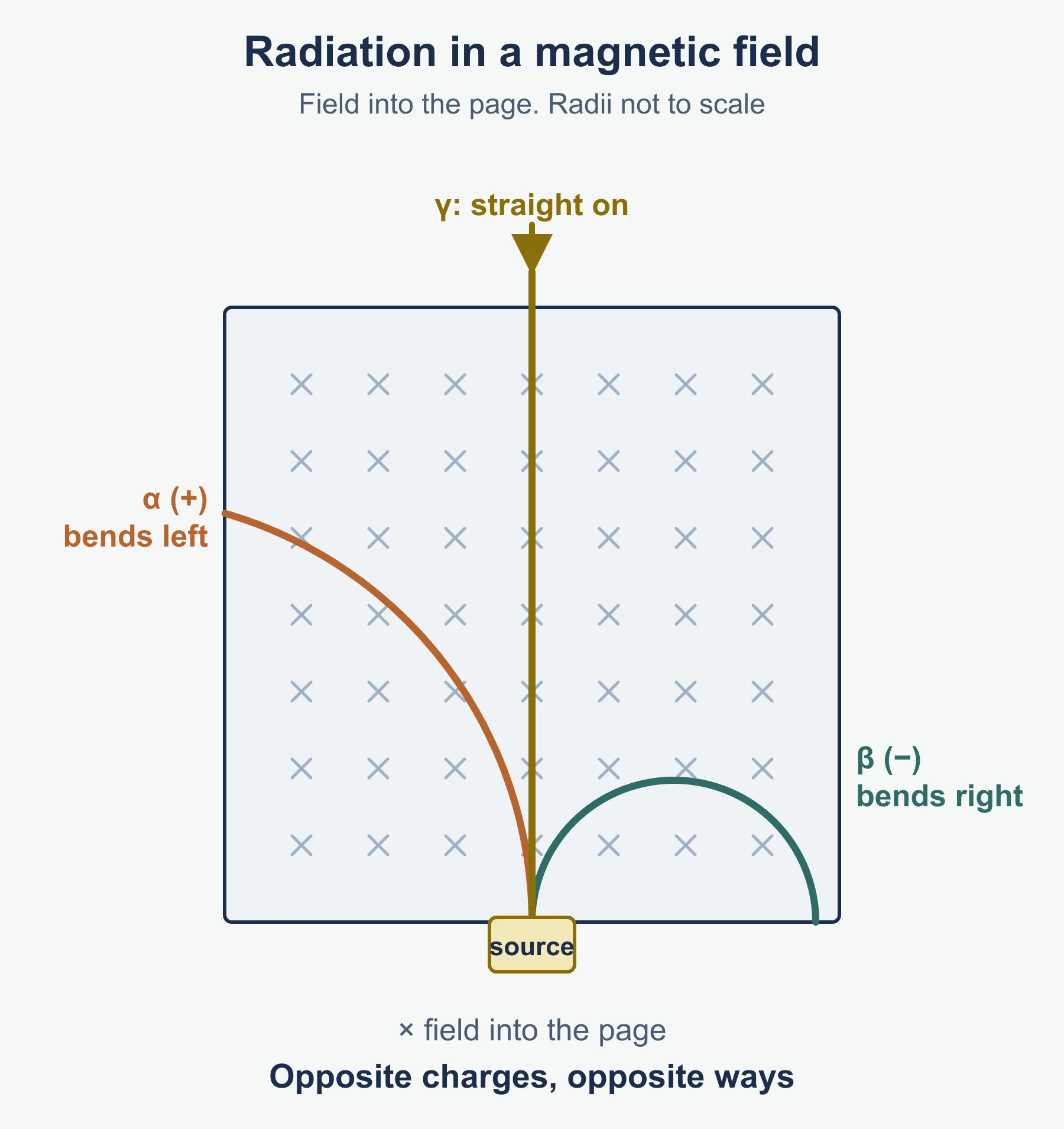
| Magnetic field | Bends one way | Bends the opposite way | None |
Must-know distinctions:
- Ionising power and penetrating power run in opposite order.
- Emission is spontaneous (no trigger) and random (you cannot say which nucleus goes next, or in which direction the radiation leaves).
- Gamma often accompanies alpha or beta decay, takes away surplus energy and changes neither A nor Z.
Decay equations
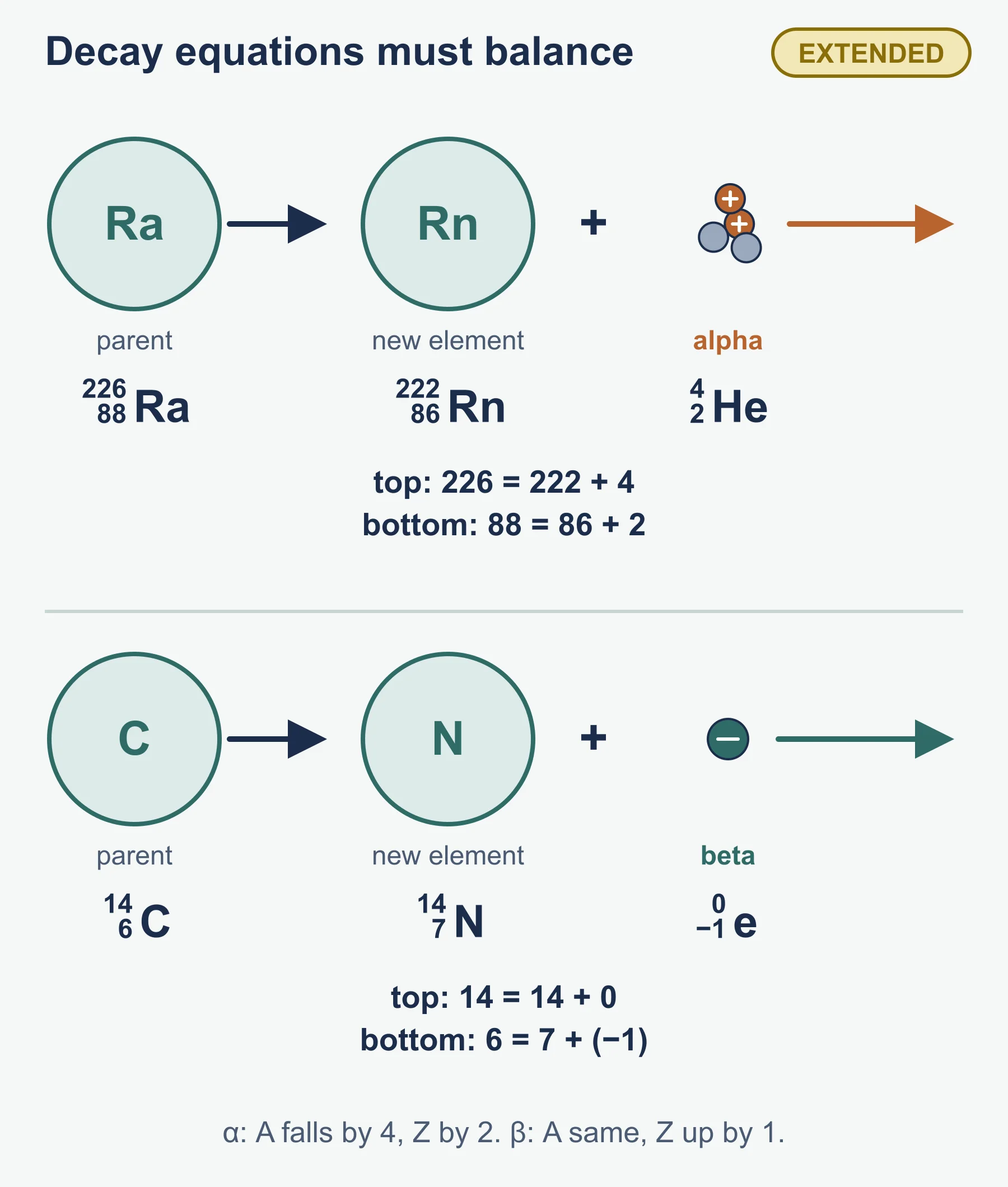
| Emission | Change in A | Change in Z |
|---|---|---|
| Alpha ⁴₂He | −4 | −2 |
| Beta ⁰₋₁e | 0 | +1 |
| Gamma | 0 | 0 |
Method in steps:
- Write the parent nuclide on the left.
- Write the emitted particle in nuclide notation on the right.
- Work out the daughter’s A and Z by subtracting from the parent (top from top, bottom from bottom).
- Look up the symbol from Z and check both totals balance.
Reminder: ²¹⁰₈₄Po → ²⁰⁶₈₂Pb + ⁴₂He. Check: 210 = 206 + 4 and 84 = 82 + 2.
Fission, fusion and the reactor
- Fusion powers stars: hydrogen nuclei fuse to make helium.
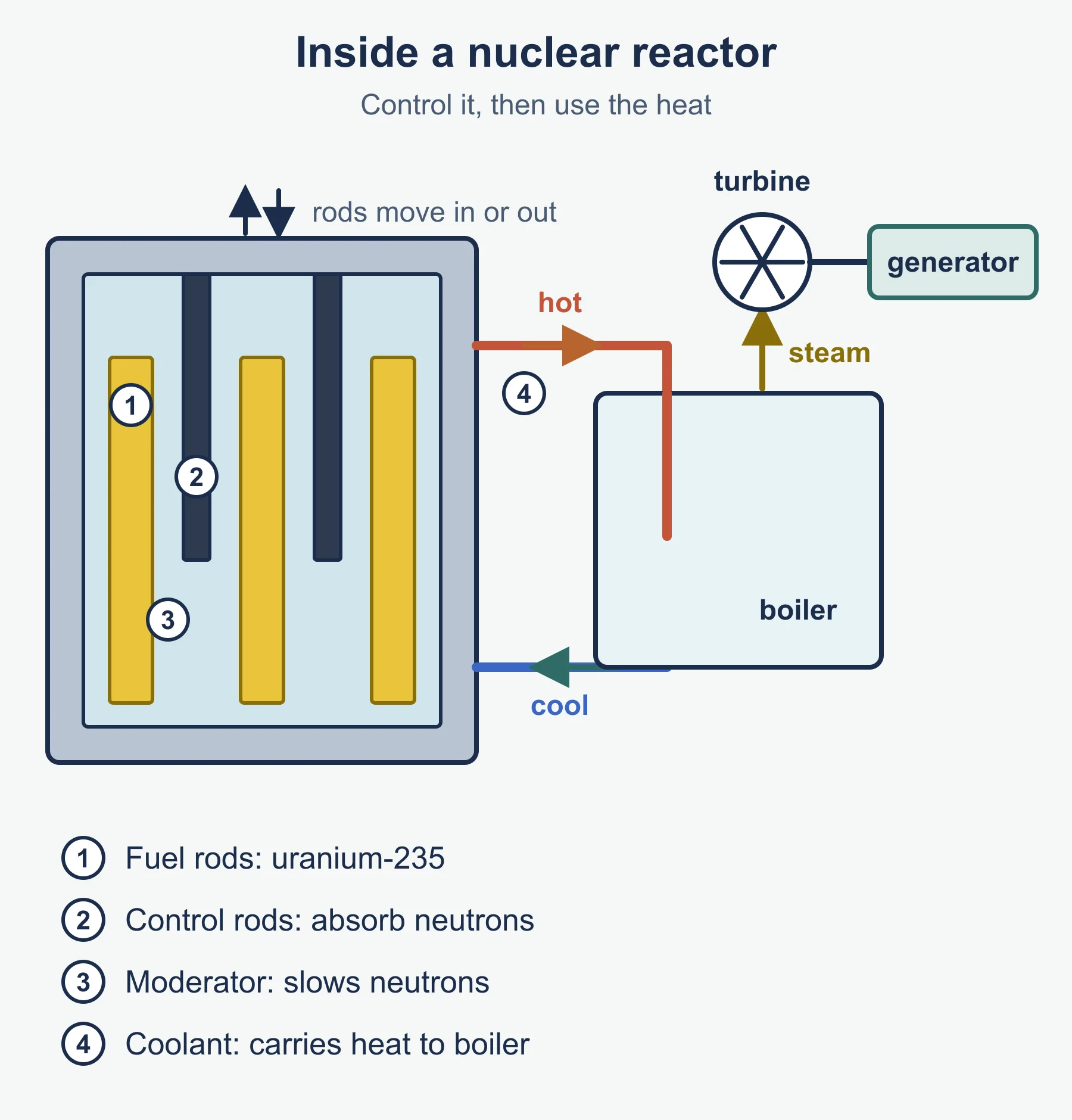
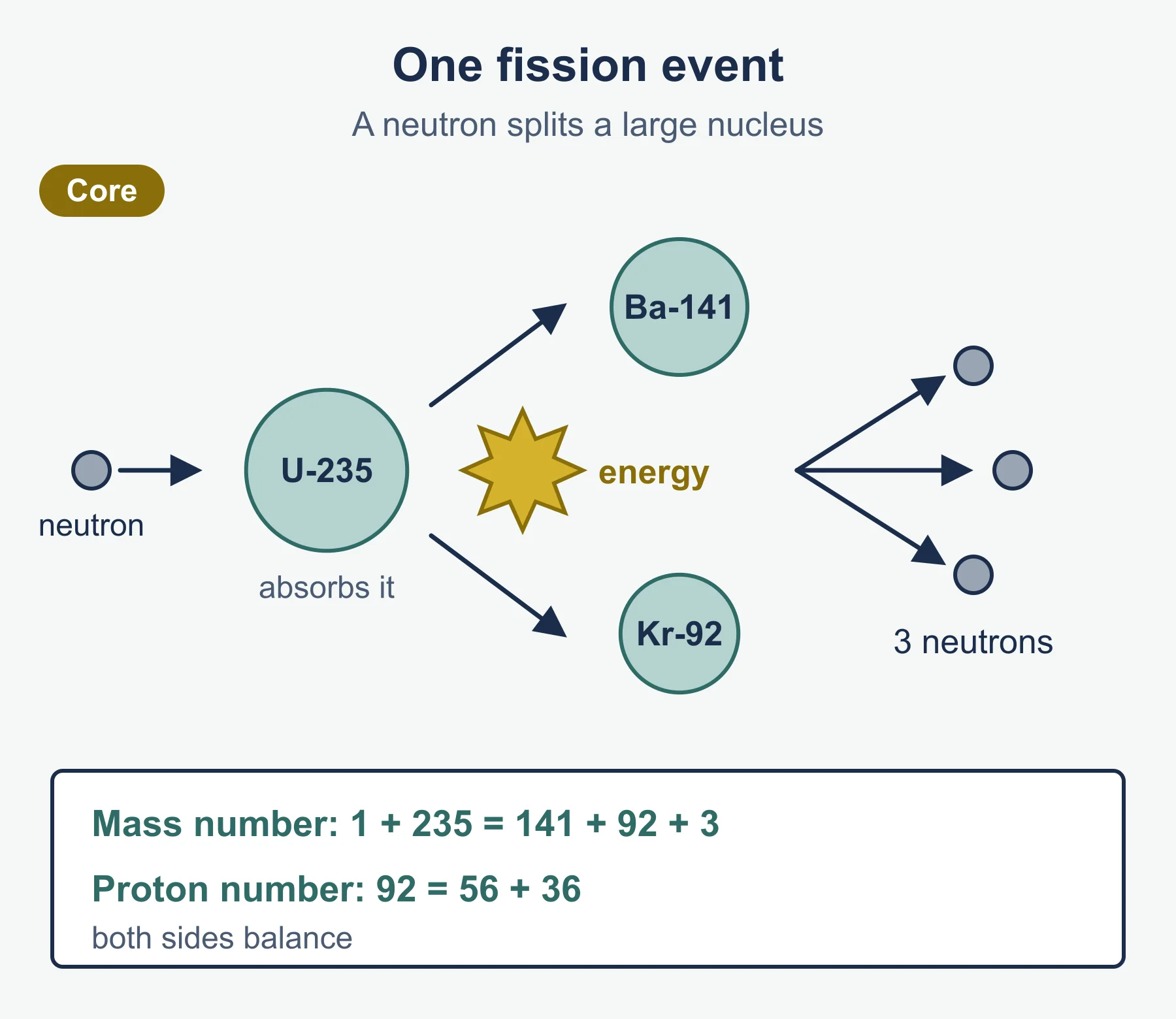
- Fission of U-235: neutron absorbed, nucleus splits into two daughter nuclei, two or more neutrons released, energy released.
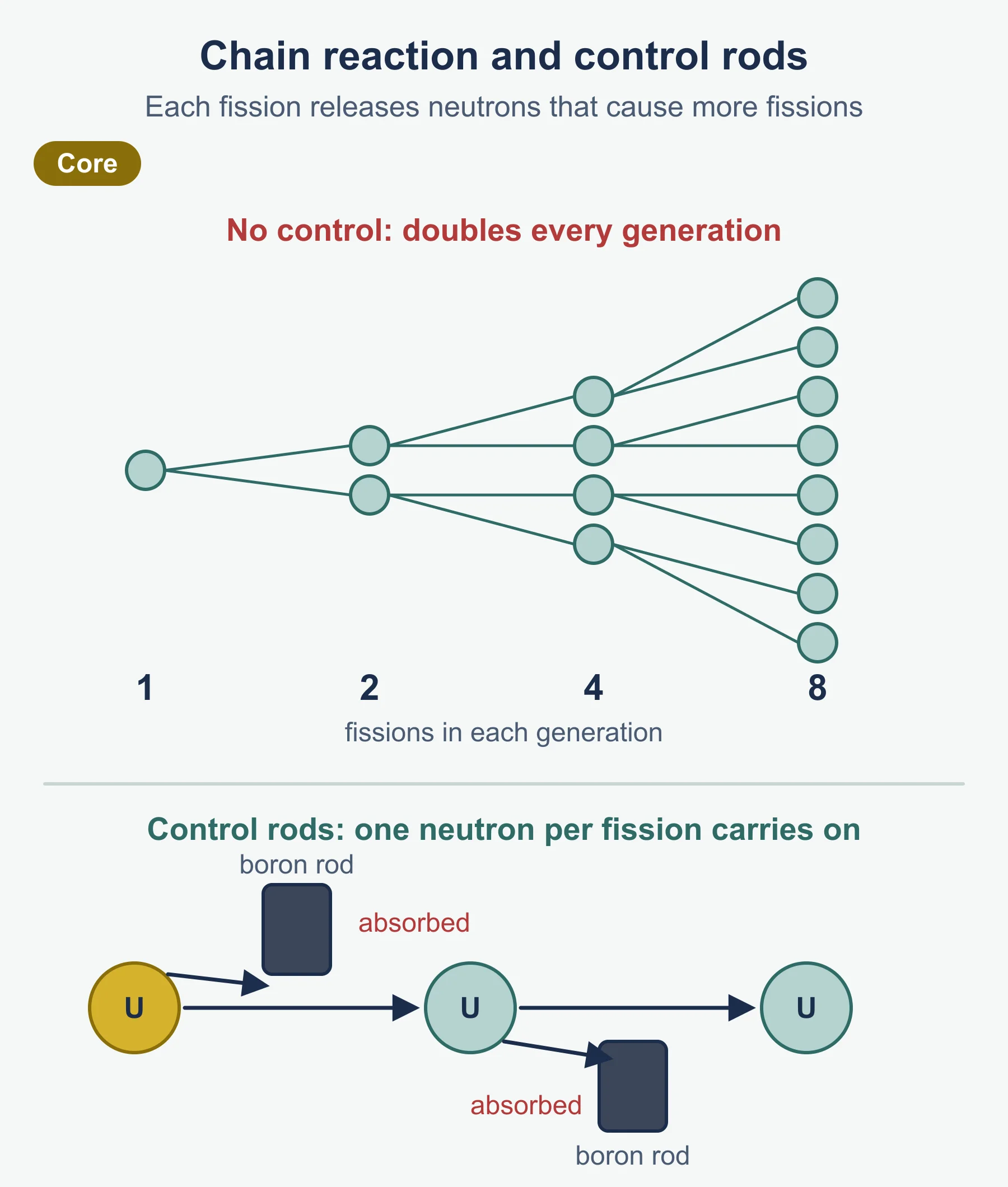
- Chain reaction: the released neutrons cause further fissions.
| Reactor part | Job |
|---|---|
| Moderator | Slows neutrons so they can be absorbed |
| Control rods | Absorb neutrons; in to reduce power, out to raise it |
| Coolant | Carries thermal energy out of the core to make steam |
Steady power means one neutron from each fission causes exactly one further fission on average.
Half-life
Method in steps:
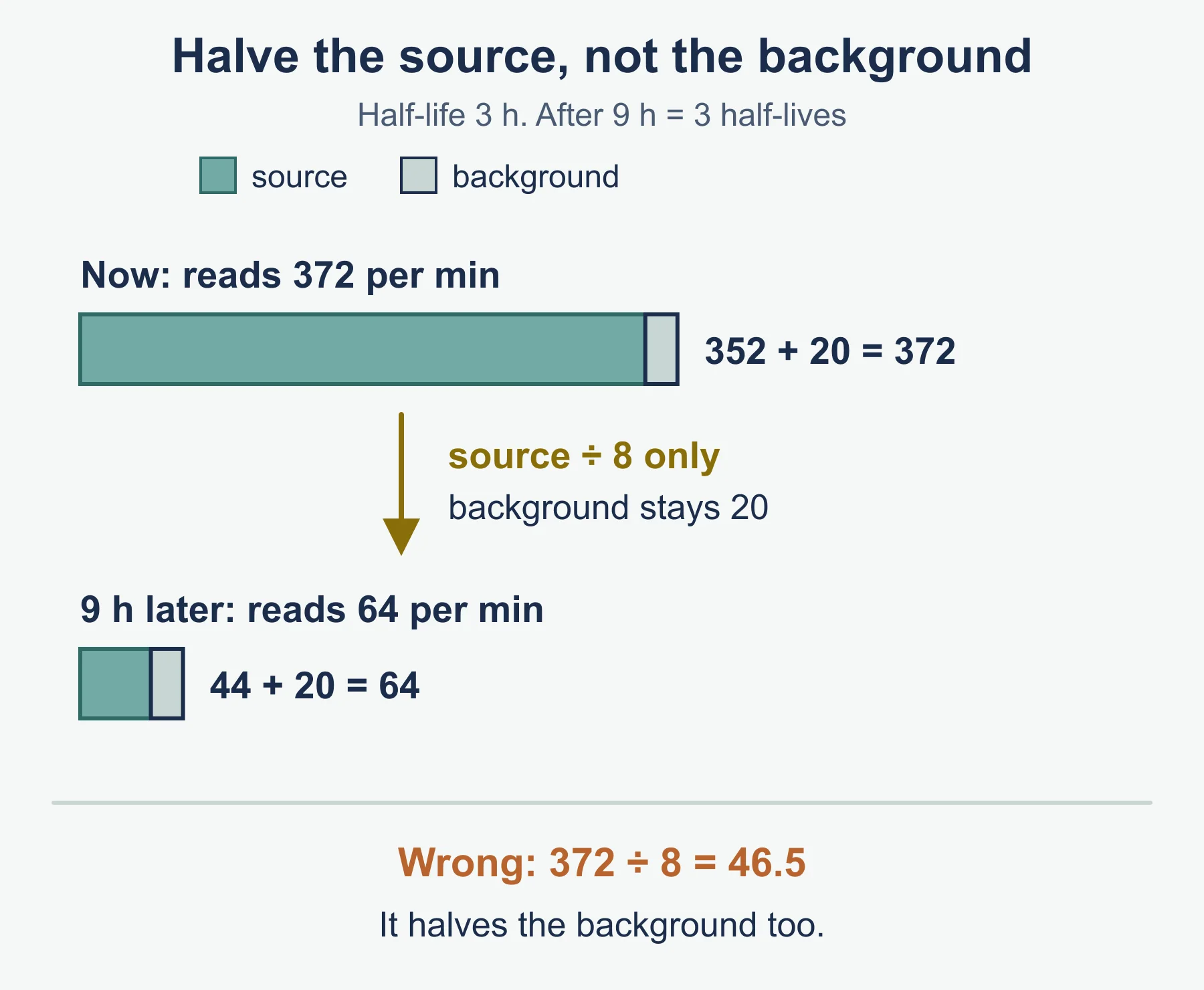
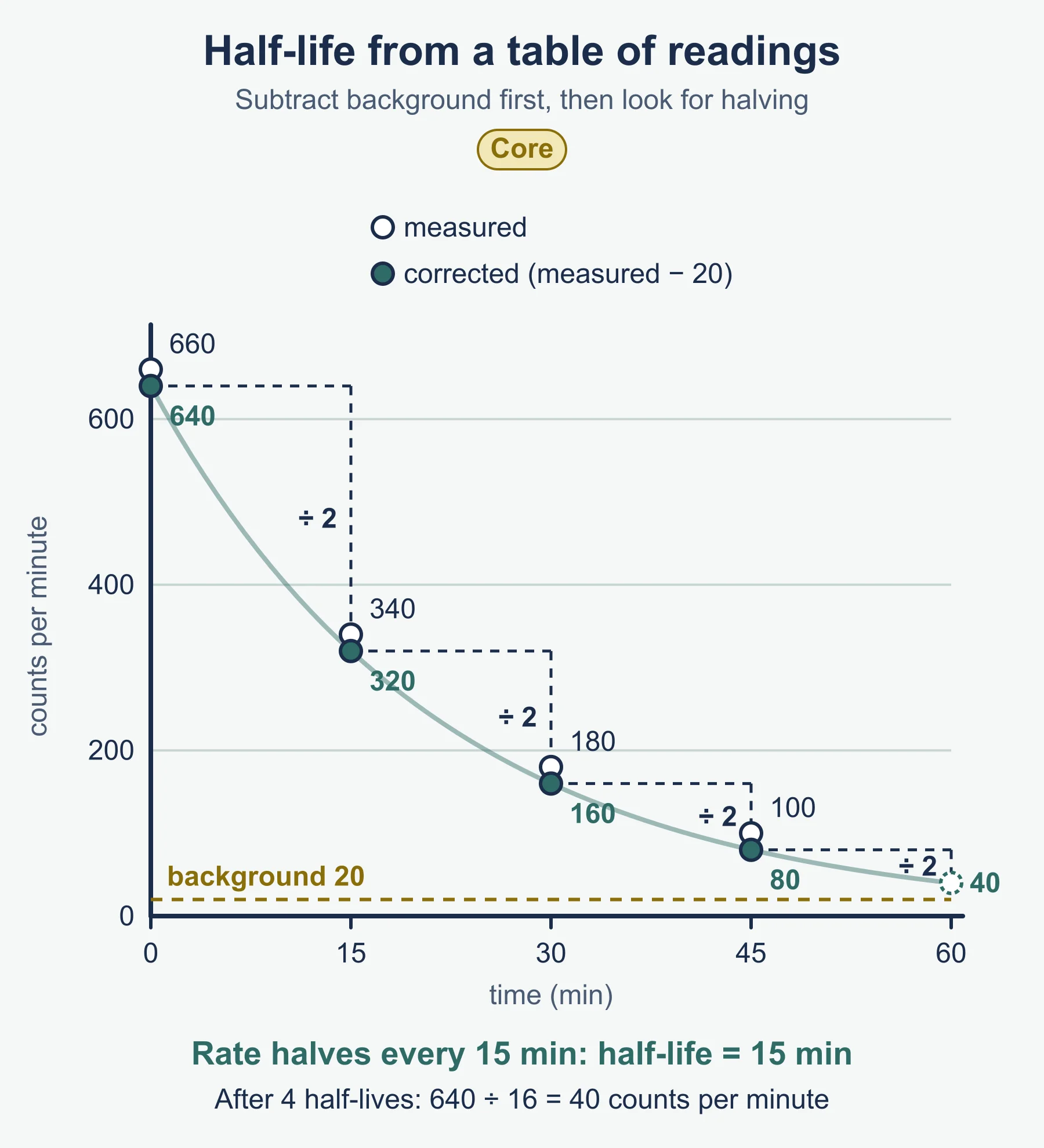
- Correct for background if readings are measured values.
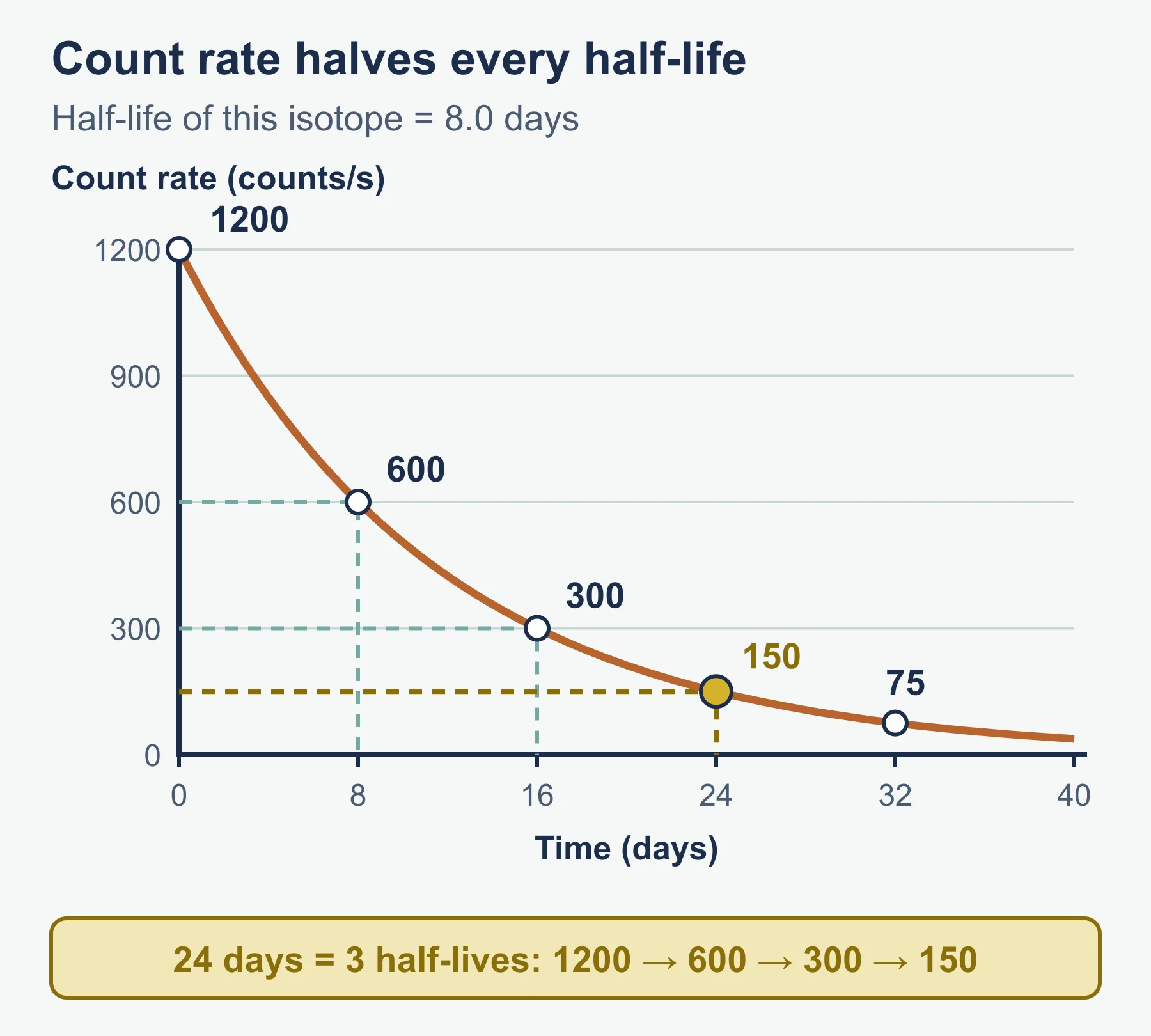
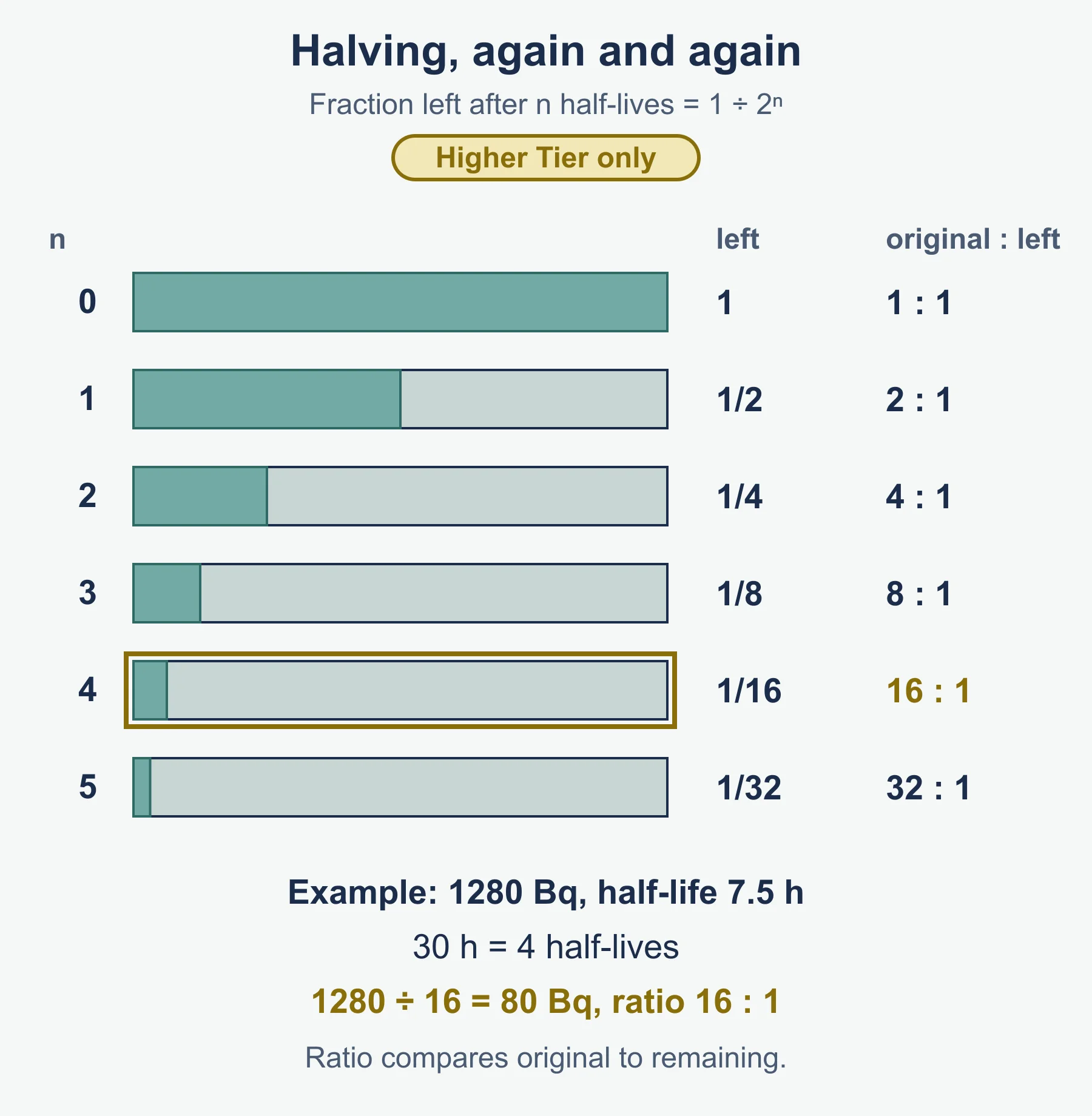
- Find how many times the rate has halved: number of half-lives n = total time ÷ half-life.
- Final value = starting value ÷ 2ⁿ.
- From a table or curve, choose a value, find half of it, read the time gap, and check with a second pair.
Small reminder: 720 counts per minute with half-life 5 minutes becomes 360 after 5 minutes, 180 after 10, 90 after 15 and 45 after 20.
Carbon-14 dating
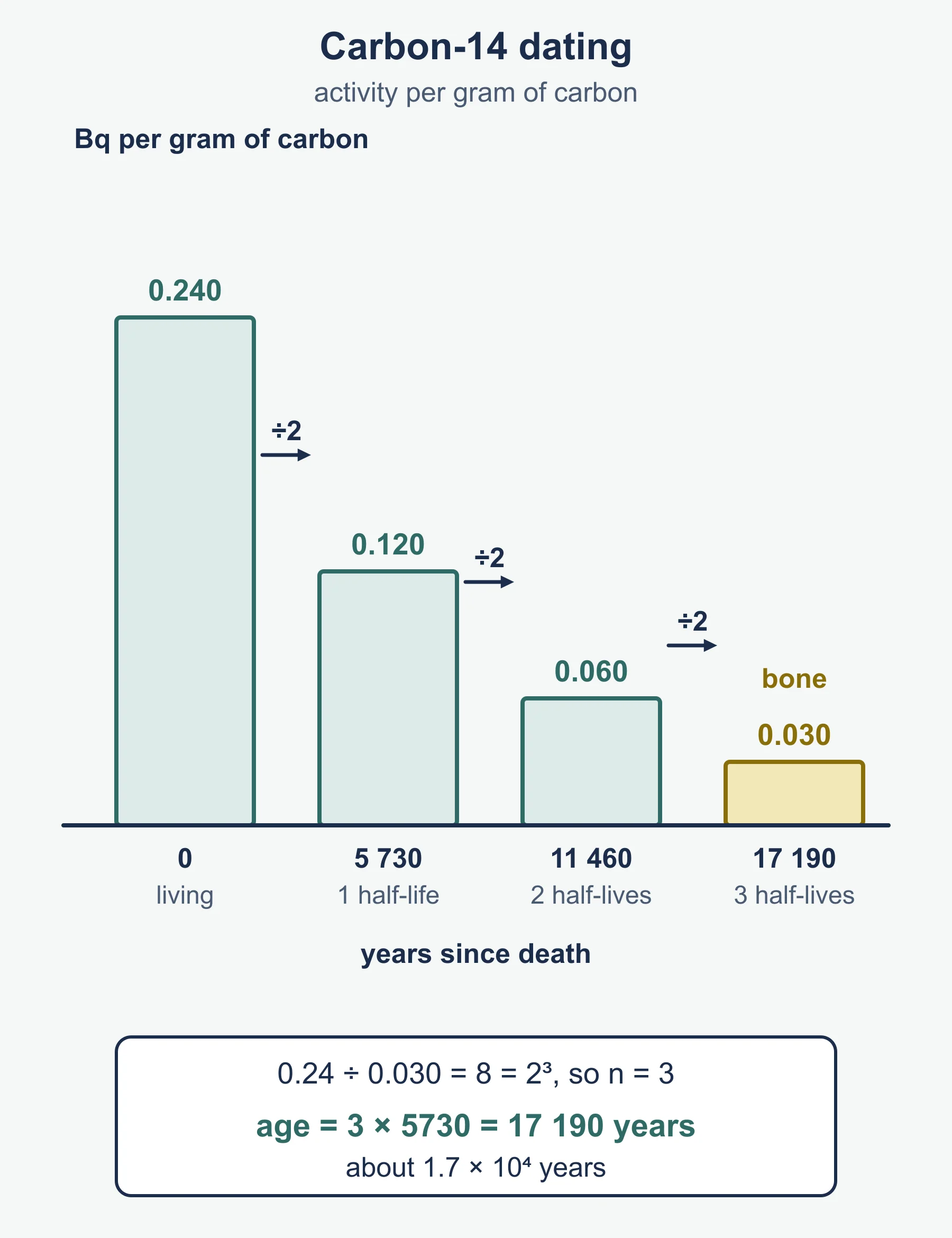
- Living things take in carbon-14, so the proportion stays constant while alive.
- Once dead, intake stops and the carbon-14 left decays (half-life 5730 years).
- Compare the activity of the object with that of living material: half the activity means one half-life of 5730 years.
Choosing an isotope for a use
| Use | Radiation | Reasoning |
|---|---|---|
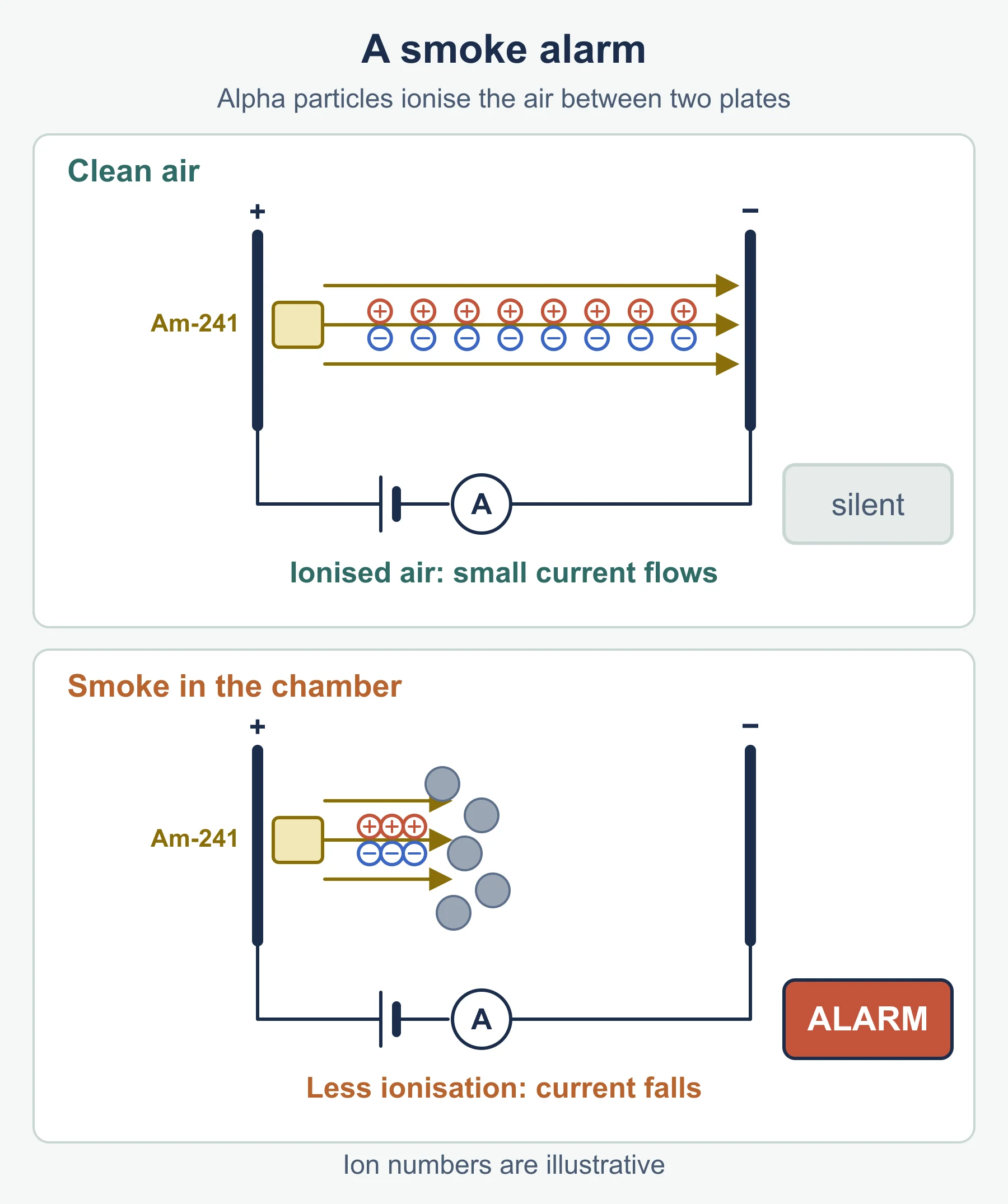
| Smoke alarm | Alpha | Ionises air; smoke blocks it, current falls; safe because alpha is easily stopped; long half-life |
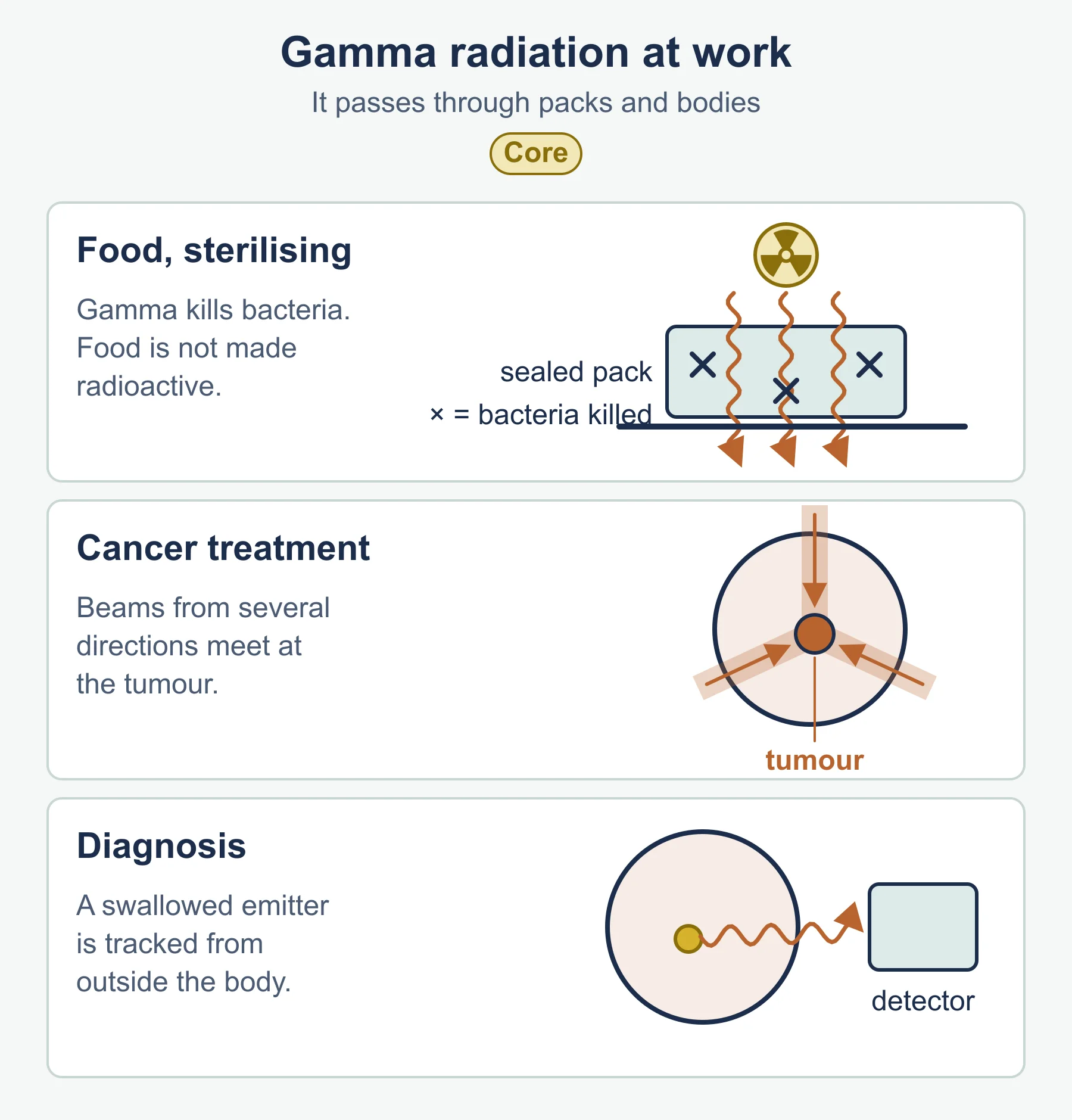
| Food irradiation | Gamma | Penetrates food and packaging to kill bacteria |
| Sterilising equipment | Gamma | Passes through sealed packs |
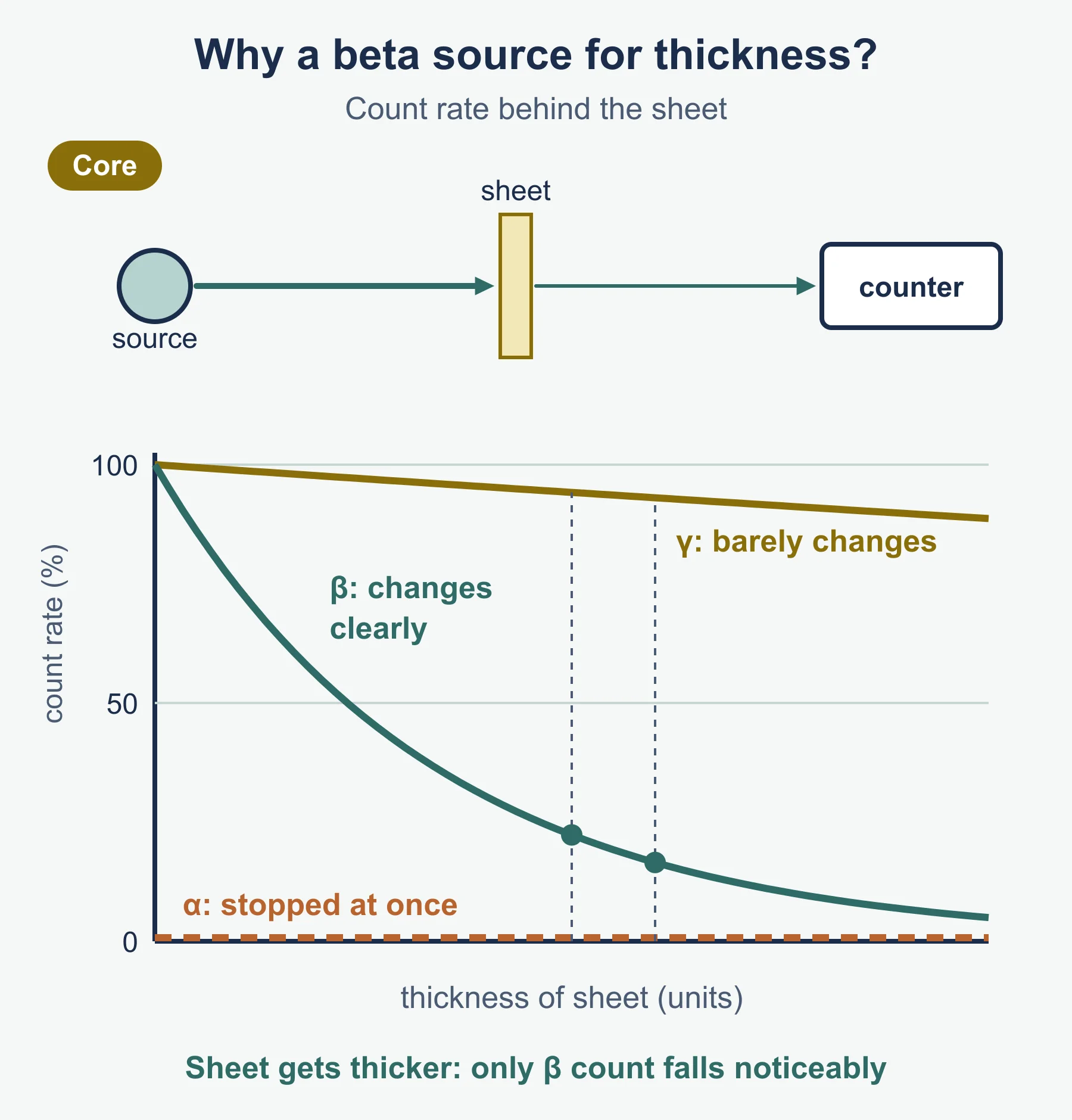
| Thickness control | Beta for thin sheet, gamma for thick metal | Must be partly absorbed; long half-life for steady readings |
| Cancer diagnosis | Gamma tracer | Detected outside the body; short half-life so it soon disappears |
| Cancer treatment | Gamma beam | High dose to tumour, aimed from several directions |
Safety
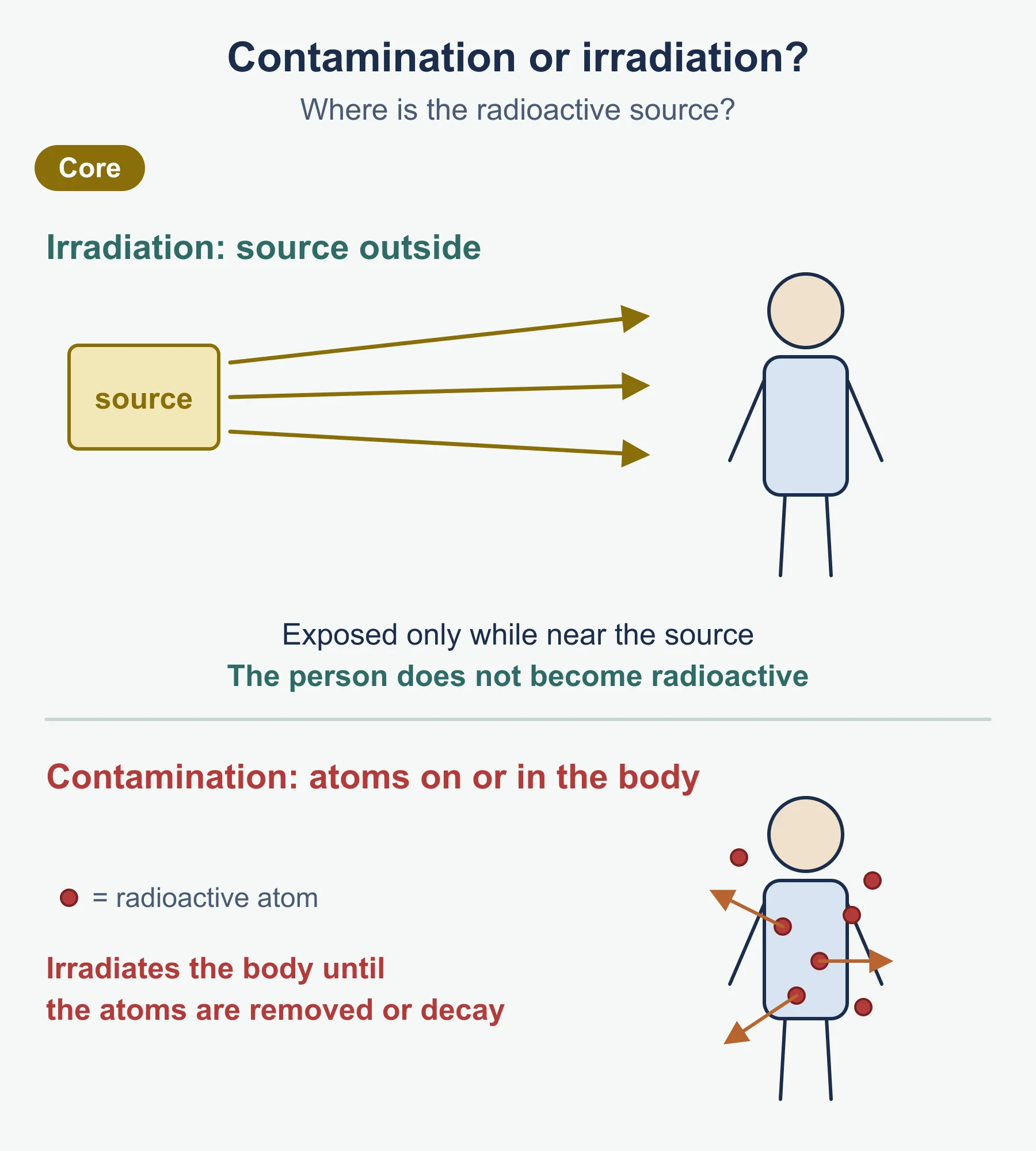
- Effects of ionising radiation: cell death, mutations, cancer.
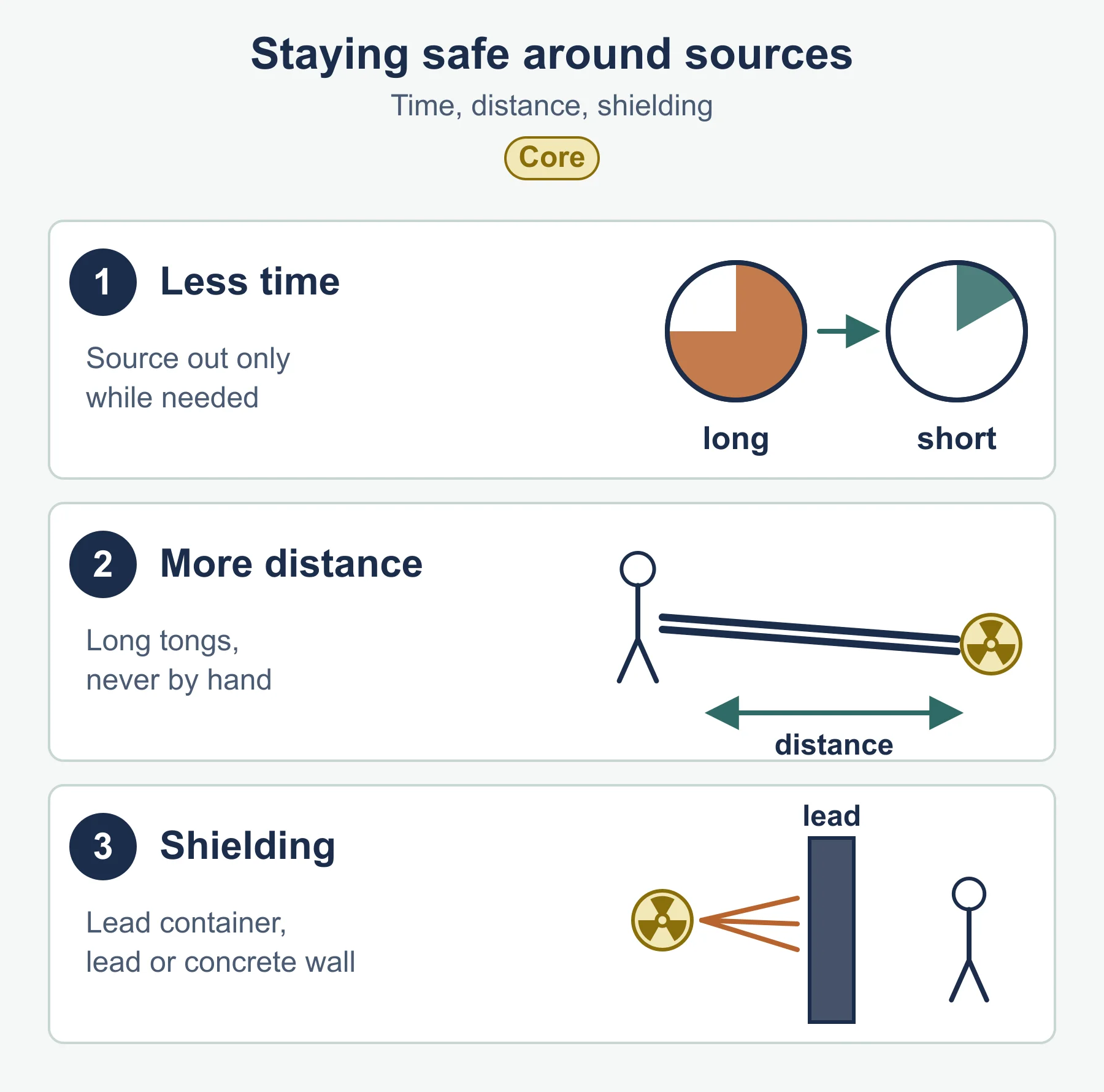
- Reduce exposure time, increase distance (use tongs), use shielding (lead-lined containers, thick walls).
Worked reminders
- Neutron count: ⁶⁵₂₉Cu has 65 − 29 = 36 neutrons. Its isotope ⁶³₂₉Cu has 34.
- Two-step decay: ²³⁸₉₂U emits alpha to give ²³⁴₉₀Th, which emits beta to give ²³⁴₉₁Pa.
- Fission balance: ²³⁵₉₂U + ¹₀n → ¹⁴¹₅₆Ba + ⁹²₃₆Kr + 3 ¹₀n. Top: 236 on each side. Bottom: 92 on each side.
- Carbon-14 age: one quarter of the original activity is two half-lives, so 2 × 5730 = 11 460 years.
- Corrected rate: 156 counts in 2 minutes is 78 per minute; background of 18 counts in 3 minutes is 6 per minute; corrected rate 72 per minute.
Self-test
- Find the number of neutrons in a nucleus of ⁵⁶₂₆Fe.
- A sulfur atom has 16 protons. How many electrons does an S²⁻ ion have?
- Lithium has isotopes with nucleon numbers 6 and 7 and proton number 3. State the neutron number of each.
- Complete: ²¹⁰₈₄Po decays by alpha emission to a nuclide with what A and Z?
- A GM tube measures 95 counts per minute with a source and 11 counts per minute without it. What is the corrected count rate?
- An isotope has a half-life of 5 minutes. A sample gives a corrected 720 counts per minute. What is the rate after 20 minutes?
- ⁶⁰₂₇Co emits a beta particle. What is the proton number of the daughter?
- Which of the three radiations is not deflected by an electric field?
- A corrected count rate falls from 960 to 120 counts per minute in 18 hours. What is the half-life?
- Give two reasons a short half-life suits a gamma tracer used to diagnose illness.
- State three precautions when handling a radioactive source.
- In the alpha-scattering experiment, what does the very small number of particles bouncing almost straight back suggest?
Answers
- 56 − 26 = 30 neutrons.
- 16 electrons in the atom plus 2 gained = 18 electrons.
- 6 − 3 = 3 neutrons and 7 − 3 = 4 neutrons.
- A = 210 − 4 = 206 and Z = 84 − 2 = 82 (lead).
- 95 − 11 = 84 counts per minute.
- Four half-lives (20 ÷ 5), so 720 ÷ 16 = 45 counts per minute.
- 27 + 1 = 28 (nickel).
- Gamma radiation.
- 960 to 480 to 240 to 120 is three half-lives, so 18 ÷ 3 = 6 hours.
- The patient receives a smaller total dose, and the tracer is gone from the body soon after the scan. Gamma also passes out of the body so it can be detected.
- Any three of: keep exposure time short, keep as far away as possible (use tongs), keep it in a lead-lined container, do not point it at people.
- A very small, dense, positively charged nucleus that holds most of the atom’s mass repelled them.
Where marks are usually lost
- Calling alpha the most penetrating, or beta the most ionising.
- Swapping the roles of control rods and moderator.
- Using measured counts, not corrected counts, when finding a half-life.
- Putting A and Z the wrong way round in a nuclide symbol.
- Writing “the nucleus is dense” without evidence from particles bouncing back.
- Not saying that the neutron must first be absorbed in fission.
- Forgetting that beta emission raises Z by one.
- Choosing alpha for a thickness gauge or gamma for a smoke alarm without justifying it with penetration and ionisation.
- Saying radiation “leaks” in the safety answer instead of naming time, distance or shielding.
Frequently asked questions
How do you find a half-life from count rate readings? Subtract the background count rate from each reading first, then find the time for the corrected count rate to halve. Using measured counts instead of corrected counts is a common error.
What happens to the proton number in beta decay? In beta emission the nucleus gives out an electron (⁰₋₁e), so the proton number Z rises by one while the nucleon number A stays the same. Check that both totals balance in the decay equation.
How is a nuclide written in nuclide notation? The nucleon (mass) number A goes on top and the proton number Z goes underneath, both to the left of the element symbol. Writing them the wrong way round loses the mark.
What must happen before a uranium nucleus undergoes fission? The nucleus must first absorb a neutron. It then splits into two smaller nuclei and releases further neutrons, which can cause a chain reaction.
Official syllabus
Cambridge O Level Physics 5054 syllabus for examination in 2026, 2027 and 2028, Cambridge University Press & Assessment. Section 5, Nuclear physics.
Get free revision emails (optional)
Occasional emails with practice questions, worked explanations and links to free resources for the qualification and subjects you choose. No spam, and you can unsubscribe from any email. The free tools on this site never need an email.
Related resources
-
Study guides
O Level Physics: Nuclear physics (Cambridge 5054)
A full study guide to nuclear physics for Cambridge O Level Physics 5054: the nuclear atom, radioactivity, half-life, fission, fusion and safety.
Physics · Cambridge · O Level
Read guide -
Practice questions
O Level Physics: Nuclear physics — Practice Questions (Cambridge 5054)
Original Cambridge O Level Physics 5054 nuclear questions with worked answers: alpha scattering, decay equations, half-life, reactors, fusion and safety.
Physics · Cambridge · O Level
Try questions -
Study guides
O Level Physics: Space physics (Cambridge 5054)
Study guide to space physics for Cambridge O Level Physics (5054): orbital speed, the Solar System, the Sun, the life cycle of stars and redshift.
Physics · Cambridge · O Level
Read guide
Related articles
-
study skills
How to revise for a science examination
Most science revision fails because it rereads notes instead of retrieving them. A practical method for revising physics, chemistry and biology in the weeks before a paper.
14 July 2026
-
teaching
A Level tuition in Dubai: Cambridge or Pearson Edexcel International A Level?
Schools in Dubai and Abu Dhabi teach either Cambridge International AS & A Level or Pearson Edexcel International A Level. How the two are structured, why it matters for tuition, and how online classes from Lahore work.
9 October 2026
Studying this with a teacher
Working through Physics O LEVELS?
This page is free and stays free. If you would rather be taught it, Marlbridge runs Physics classes one-to-one and in small groups of up to 15, online in your own time zone. The first trial class is free. WhatsApp replies within an hour (8am–11pm Pakistan time, every day); email the same day.
Cambridge Physics teachers at Marlbridge