Study Guides
O Level Physics: Nuclear physics (Cambridge 5054)
A full study guide to nuclear physics for Cambridge O Level Physics 5054: the nuclear atom, radioactivity, half-life, fission, fusion and safety.
- Subject
- Physics
- Level
- O LEVELS
- Topic
- Nuclear physics
- Author
- Marlbridge Academic Team
- Updated
- Reviewed by
- Hassan (what this means)
Aligned to Cambridge O Level Physics (5054), 2026-2028. Official specification .
Syllabus page (what it covers and how it is assessed): Cambridge O Level Physics.
Syllabus points this page covers
5054
- 5.1 The nuclear model of the atom
- 5.2 Radioactivity
Found an error? Report a correction.
Need help with this topic? Request a free trial class for O Level Physics (5054).
This guide is aligned to the Cambridge O Level Physics 5054 syllabus for examination in 2026, 2027 and 2028. The whole of topic 5 is here, Nuclear physics: 5.1 The nuclear model of the atom and 5.2 Radioactivity (detection, the three types of emission, decay, fission and fusion, half-life and safety). The syllabus does not split this topic into tiers, so all of it applies to every candidate.
Use it with the revision notes, the practice questions, the Cambridge O Level Physics hub and the printable checklist. When you finish, try a free 10-minute diagnostic to find what still needs work.
What this topic covers
| Syllabus section | You must be able to |
|---|---|
| 5.1.1 The atom | Describe the nuclear atom; explain what alpha-particle scattering shows |
| 5.1.2 The nucleus | Protons and neutrons, ions, Z and A, nuclide notation, isotopes |
| 5.2.1 Detection | Cloud chamber, spark counter, Geiger-Müller tube; count rate; background |
| 5.2.2 Three emissions | Nature, ionising effect, penetration and deflection of alpha, beta, gamma |
| 5.2.3 Radioactive decay | Spontaneous and random; decay equations |
| 5.2.4 Fission and fusion | Both processes; chain reaction; coolant, moderator, control rods |
| 5.2.5 Half-life | Definition, calculations, carbon-14 dating, choosing isotopes for uses |
| 5.2.6 Safety | Effects on living things; exposure time, distance, shielding |
5.1 The nuclear model of the atom
The atom (5.1.1)
In the nuclear model, an atom is a tiny central nucleus carrying positive charge, with negatively charged electrons orbiting it. Almost all of the atom’s volume is empty space.
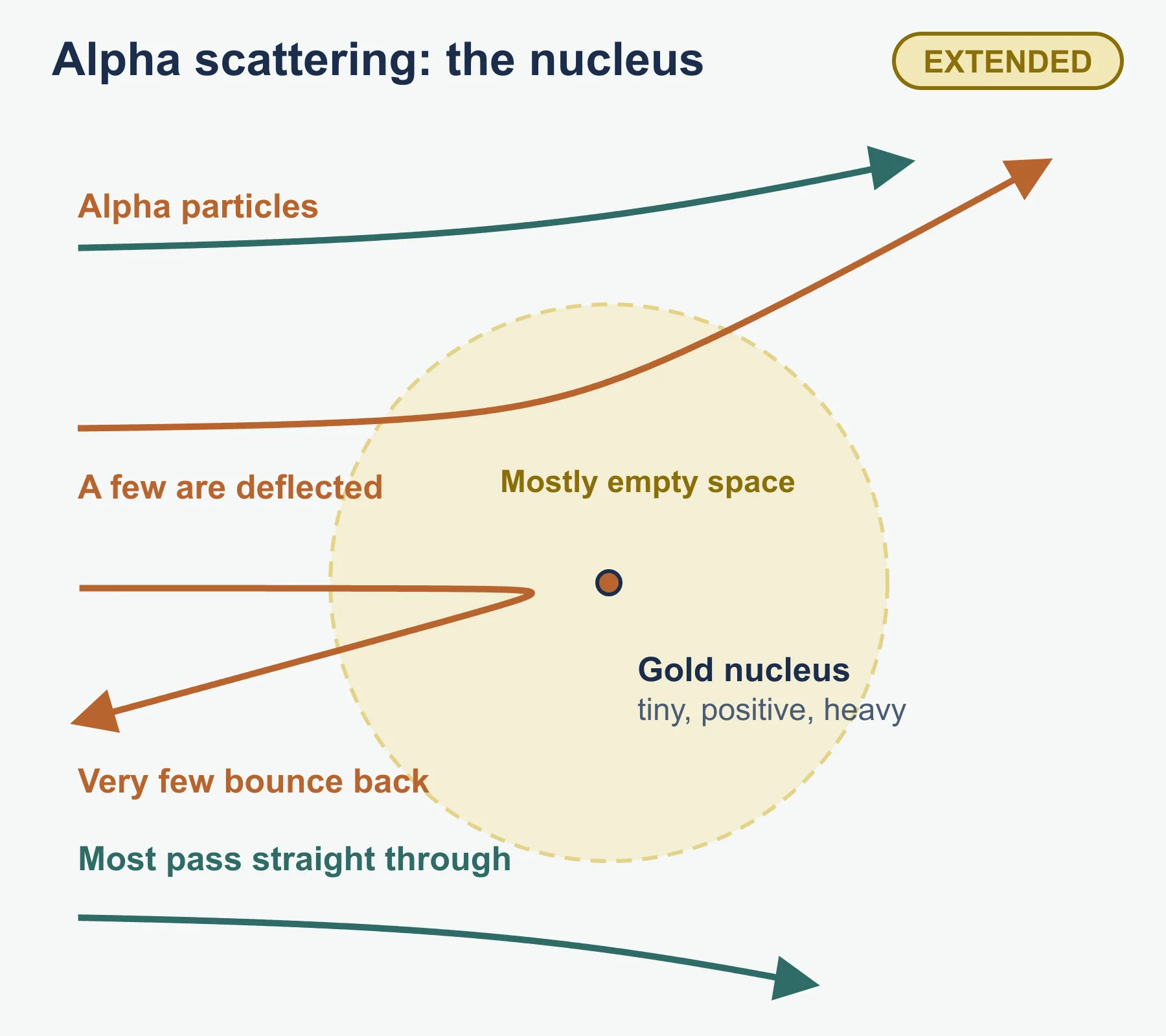
Alpha-particle scattering. In this experiment a narrow beam of alpha particles is directed onto an extremely thin metal foil and detectors record where the particles come out. The results and what they show:
| Observation | Conclusion |
|---|---|
| Most particles go straight through, almost undeviated | Most of the atom is empty space and the nucleus is tiny |
| A few particles are deflected through large angles, some almost straight back | A small nucleus holds most of the mass: only something heavy could turn an alpha particle round |
| Deflected particles are repelled | The nucleus is positively charged, like the alpha particles |
Give all three conclusions when asked for evidence, and link “dense” to particles bouncing back.
The nucleus (5.1.2)
The nucleus contains protons (positive) and neutrons (no charge). Together they are called nucleons.
- Proton number Z (atomic number): the number of protons.
- Nucleon number A (mass number): protons and neutrons added together.
- Neutrons = A − Z.
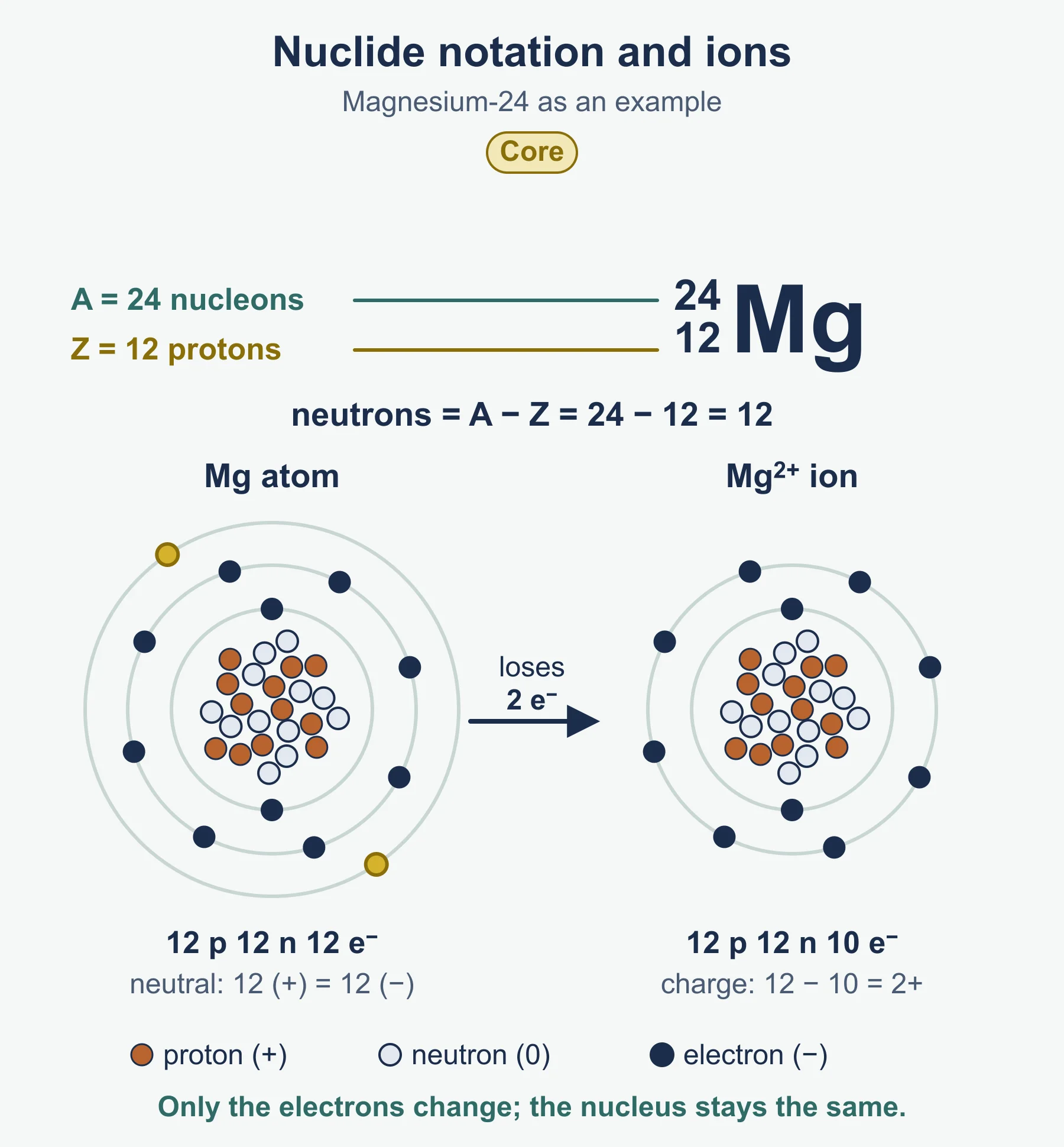
A nuclide is a particular kind of nucleus with a given Z and A. It is written ᴬ_ZX, for example ⁶³₂₉Cu, where the top number is A and the bottom number is Z.
An atom is neutral because protons and electrons are equal in number. An atom becomes a positive ion by losing electrons and a negative ion by gaining electrons. The nucleus does not change. A magnesium ion Mg²⁺ made from ²⁴₁₂Mg has 12 protons, 12 neutrons and 10 electrons.
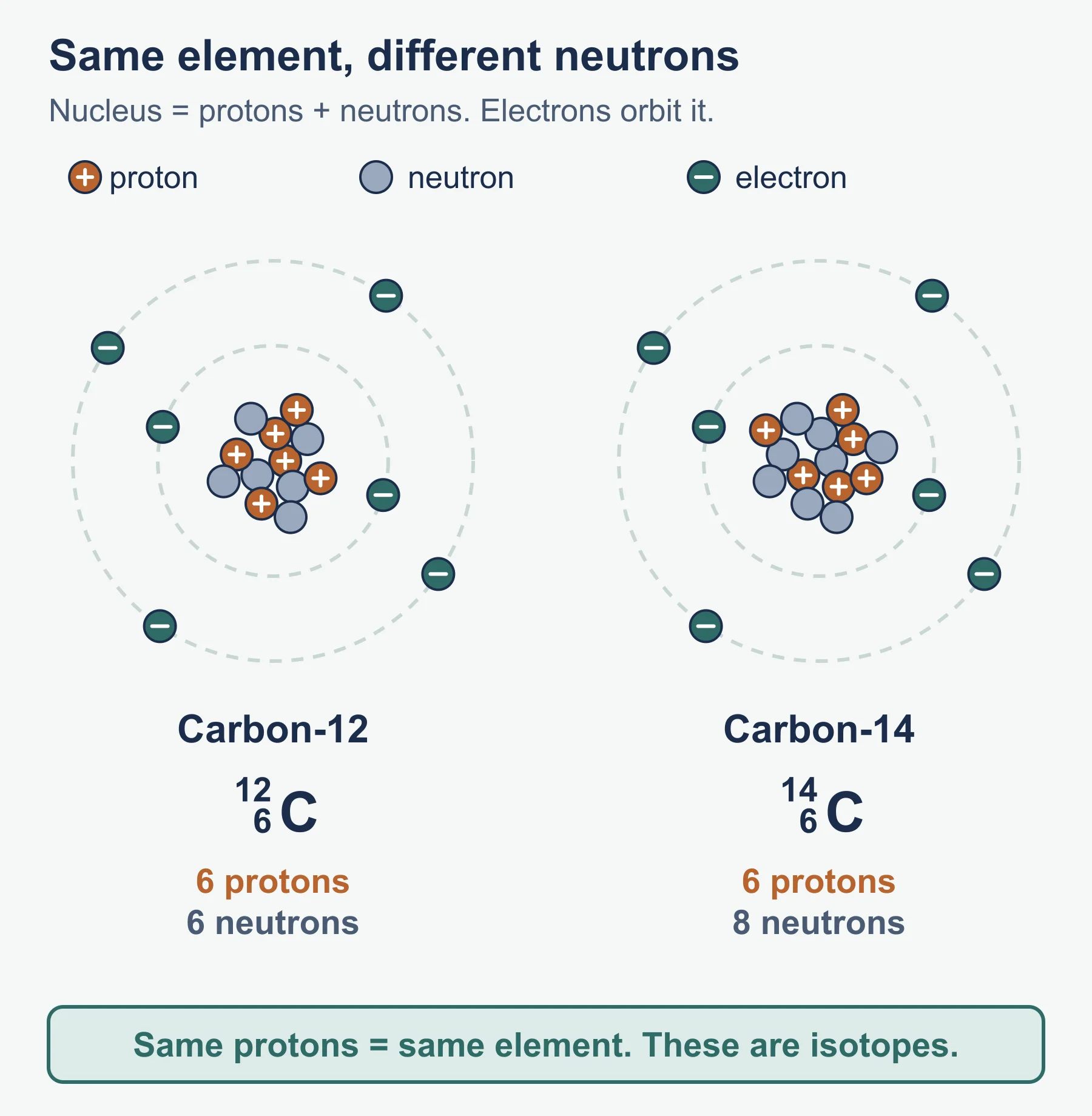
Isotopes are nuclei of the same element (same Z) with different numbers of neutrons (different A). An element can have more than one isotope. Chlorine-35 and chlorine-37 both have 17 protons, but 18 and 20 neutrons.
Worked example 1. Copper has two common isotopes, ⁶³₂₉Cu and ⁶⁵₂₉Cu. State how they are alike and different.
- Same Z = 29, so both have 29 protons and (when neutral) 29 electrons.
- Neutrons: 63 − 29 = 34 and 65 − 29 = 36.
- They differ only in neutron number, so they are isotopes of copper.
5.2.1 Detecting radioactivity
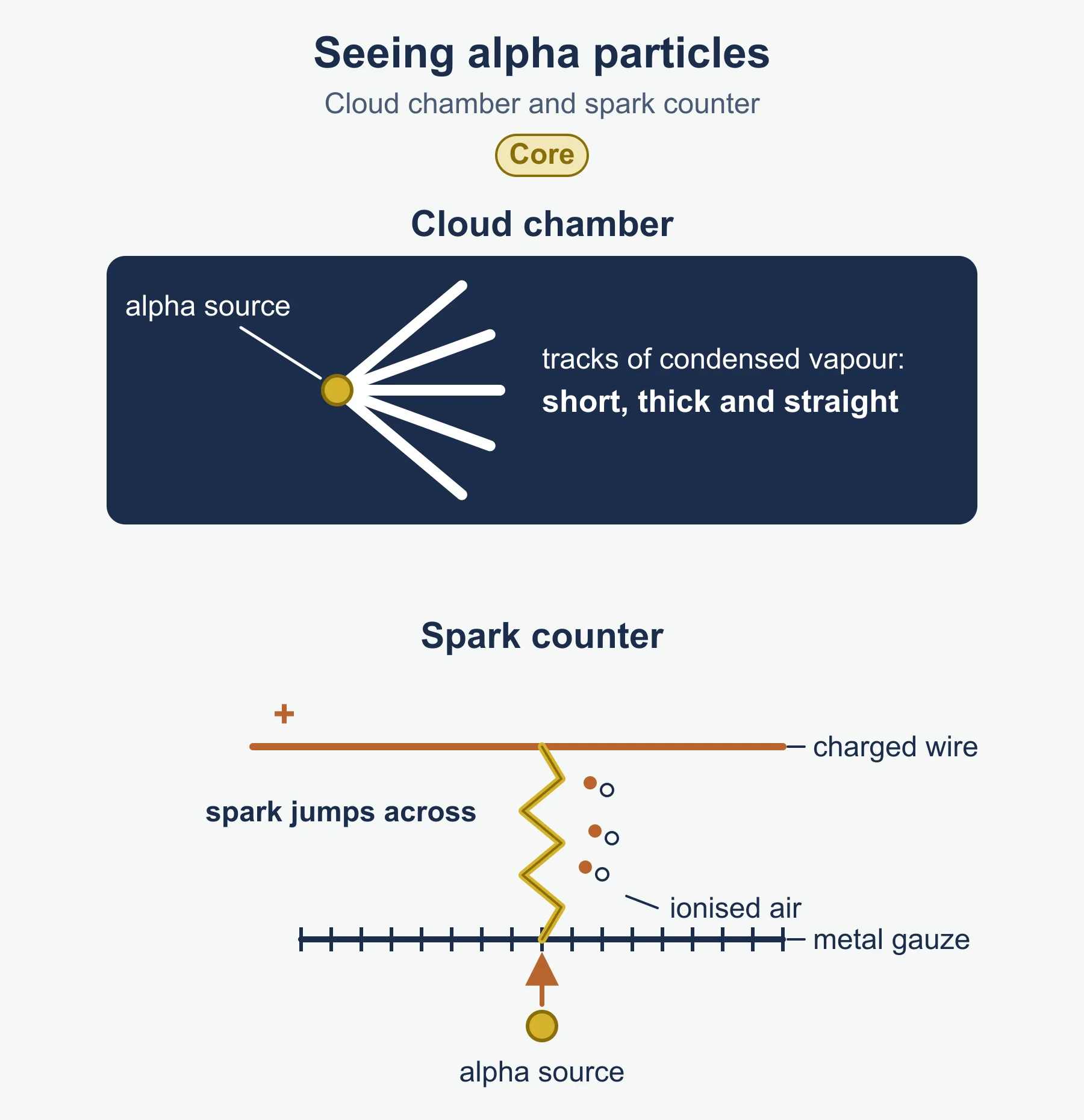
- Alpha particles: a cloud chamber shows alpha particles as short, thick, straight tracks of condensed vapour along the path of ionisation. A spark counter has a charged wire above a metal gauze; an alpha particle ionises the air and a spark jumps across.
- Beta particles and gamma radiation: a Geiger-Müller (GM) tube connected to a counter. Radiation entering the tube ionises the gas and each event gives an electrical pulse that is counted.
The count rate is the number of counts detected per unit time, in counts per second or counts per minute.
Background radiation
A GM tube with no source nearby still counts. This is background radiation. Significant sources:
- cosmic rays arriving from space
- radon, a gas found in the air
- rocks and buildings
- the food and drink we consume
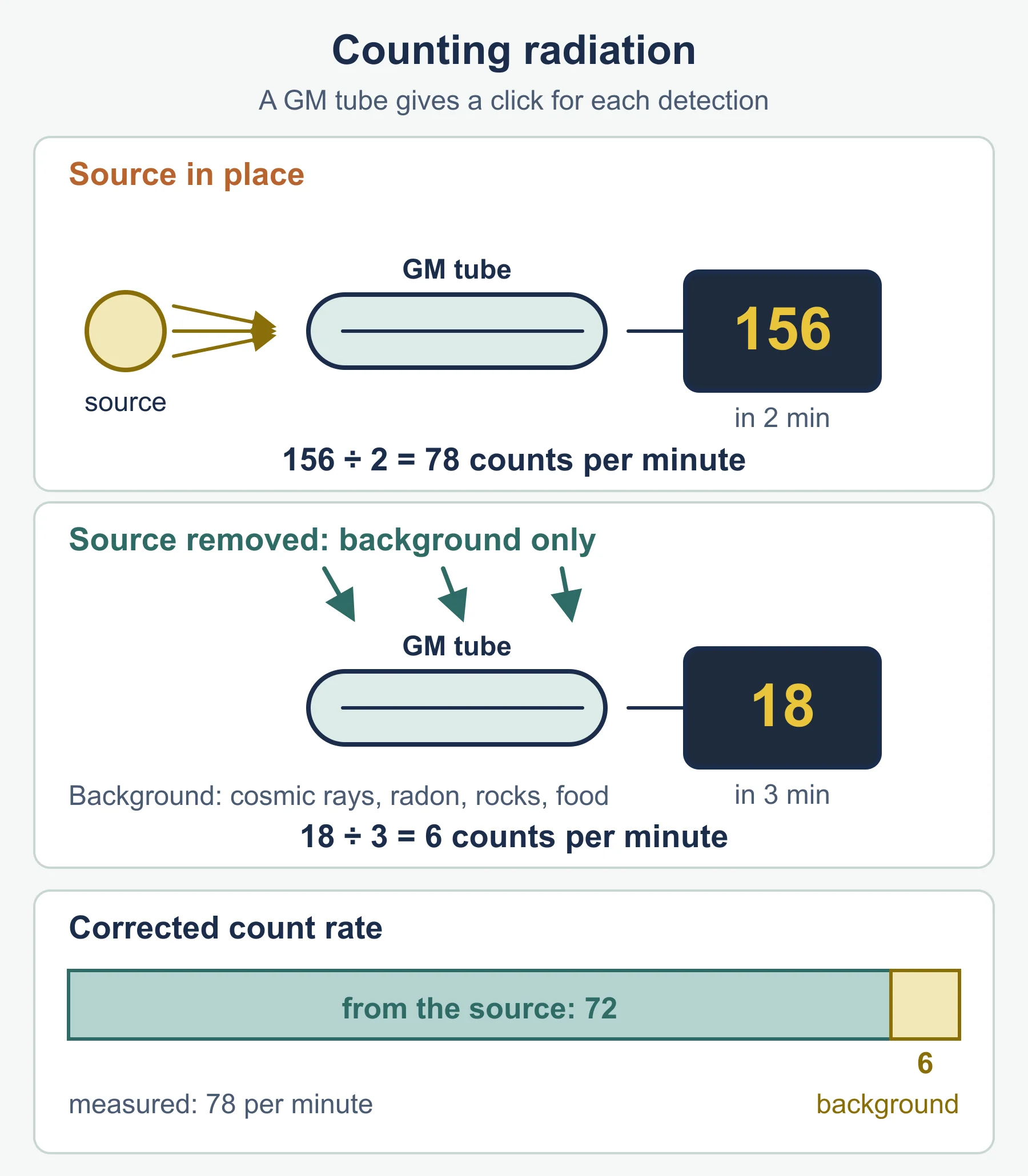
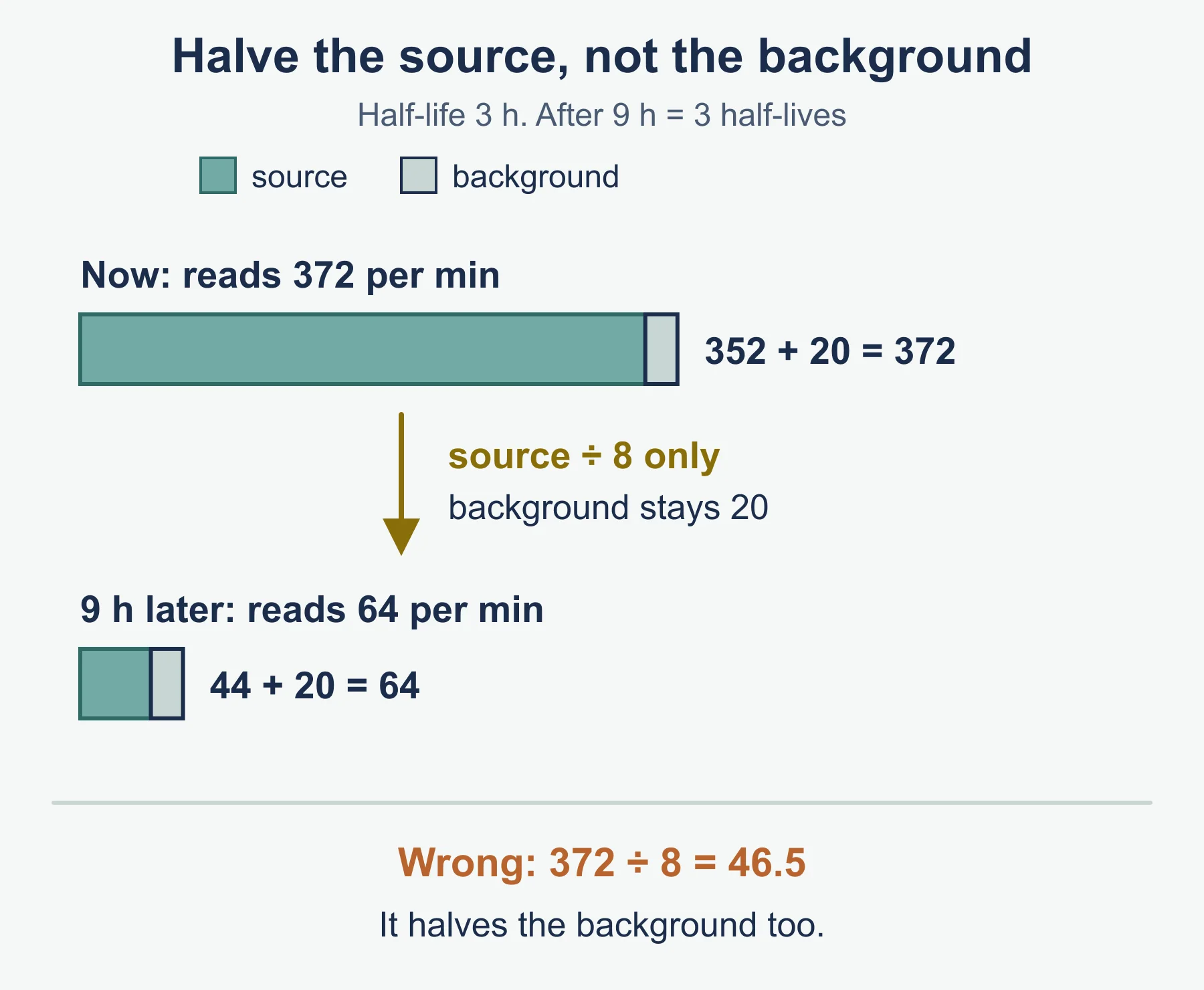
To find the corrected count rate from a source, subtract the background count rate from the measured count rate. Make sure both are per the same time unit first.
Worked example 2. A GM tube records 156 counts in 2 minutes with a source in place. With the source removed it records 18 counts in 3 minutes. Find the corrected count rate.
- Measured rate: 156 ÷ 2 = 78 counts per minute.
- Background rate: 18 ÷ 3 = 6 counts per minute.
- Corrected rate: 78 − 6 = 72 counts per minute.
5.2.2 The three types of emission
Unstable nuclei give out radiation. The emission is spontaneous (it needs no outside trigger) and random in direction.
| Alpha (α) | Beta (β) | Gamma (γ) | |
|---|---|---|---|
| What it is | 2 protons and 2 neutrons (a helium nucleus) | Fast electron from the nucleus | Very high-frequency electromagnetic wave |
| Relative ionising effect | Strongest | Weaker | Weakest |
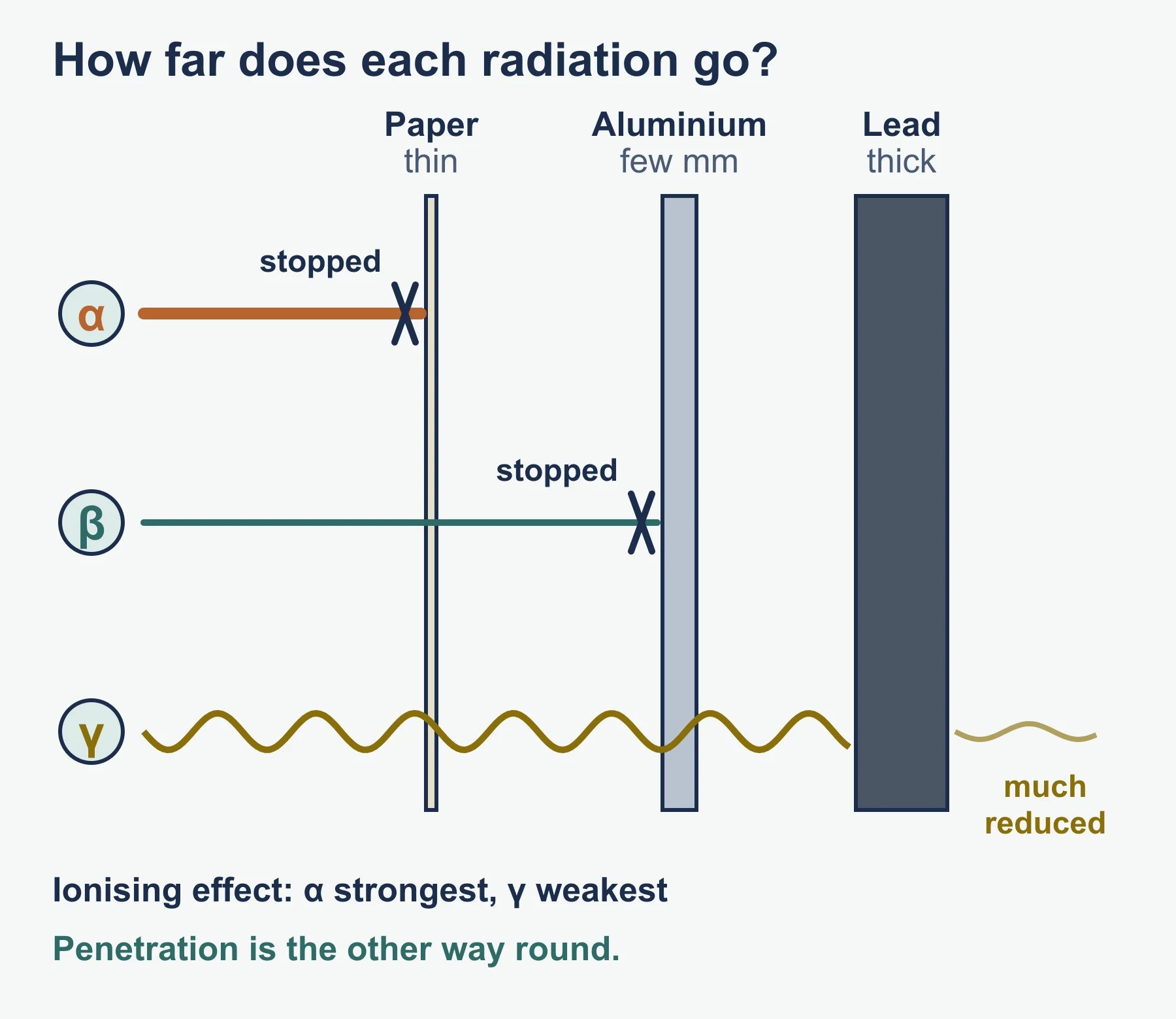
| Relative penetrating power | Least: stopped by paper or a few centimetres of air | Moderate: stopped by a few millimetres of aluminium | Greatest: only reduced by thick lead or concrete |
Beta here means β⁻, the electron. Strong ionisation and weak penetration go together: an alpha particle loses its energy quickly because it ionises so many atoms along a short path.
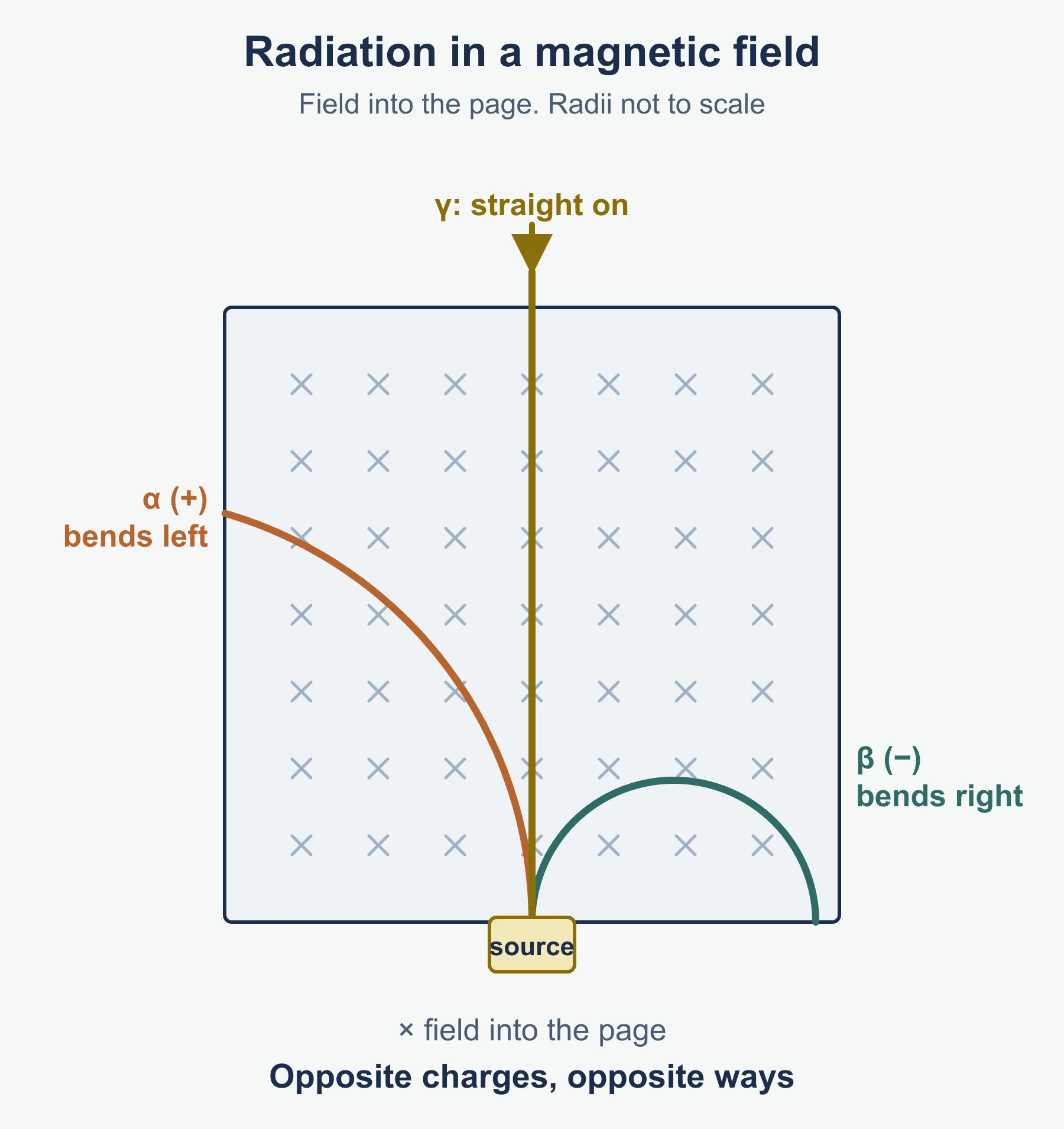
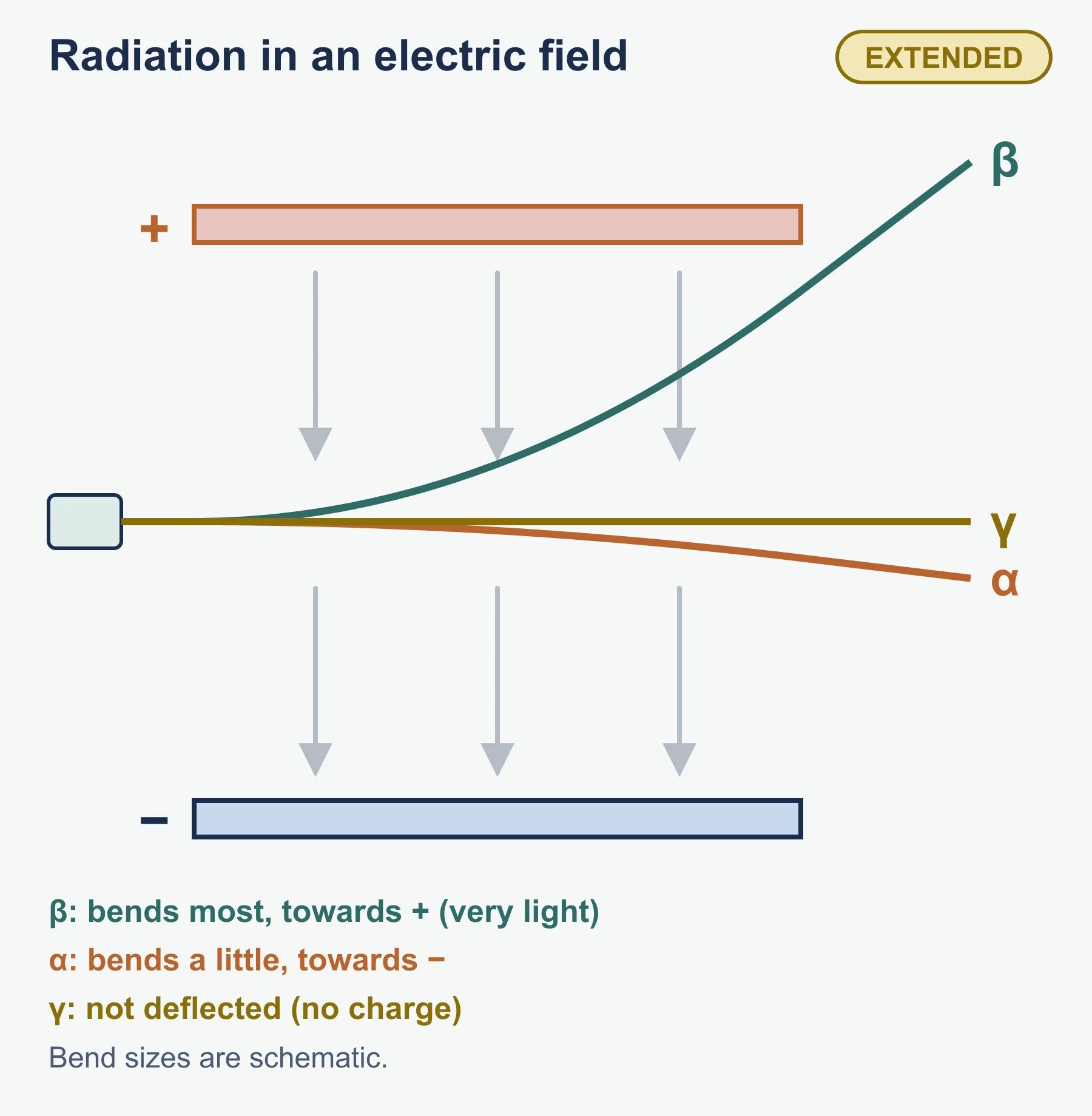
Deflection. Alpha particles are positive, beta particles are negative and gamma rays are uncharged.
- In an electric field, alpha bends towards the negative plate, beta towards the positive plate, and gamma does not bend. Beta bends much more than alpha because its mass is far smaller.
- In a magnetic field, alpha and beta curve in opposite directions (they are opposite charges moving the same way) and gamma goes straight.
5.2.3 Radioactive decay
Decay happens when an unstable nucleus changes and gives out alpha particles, beta particles and/or gamma radiation. Decay is spontaneous and random: you cannot predict when a given nucleus will decay, only the chance that it will in a given time. This is why we describe large samples by half-life.
Decay equations
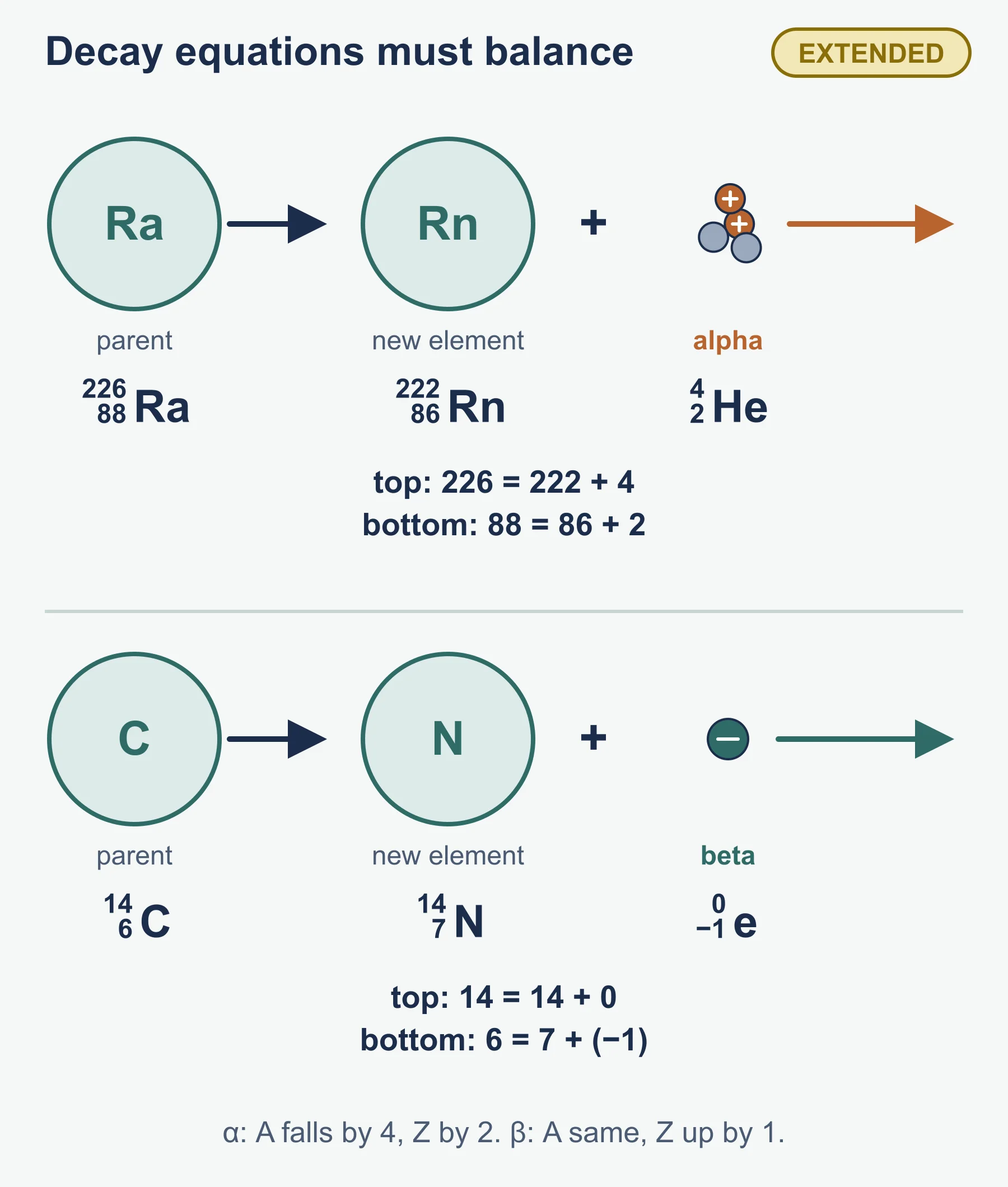
Write each particle in nuclide notation and make the top numbers balance and the bottom numbers balance.
- Alpha: ⁴₂He. A falls by 4, Z falls by 2.
- Beta: ⁰₋₁e. A is unchanged, Z rises by 1 (a neutron changes into a proton).
- Gamma: no change to A or Z. It often accompanies alpha or beta decay, carrying away surplus energy.
Worked example 3. Write equations for (a) alpha decay of americium-241, ²⁴¹₉₅Am, and (b) beta decay of carbon-14, ¹⁴₆C.
- (a) Daughter A = 241 − 4 = 237, Z = 95 − 2 = 93: ²⁴¹₉₅Am → ²³⁷₉₃Np + ⁴₂He.
- (b) A stays 14, Z = 6 + 1 = 7: ¹⁴₆C → ¹⁴₇N + ⁰₋₁e.
- Check (b): top 14 = 14 + 0; bottom 6 = 7 + (−1).
Worked example 4. Uranium-238, ²³⁸₉₂U, emits an alpha particle, and the product then emits a beta particle. Find the nuclide after both decays.
- After alpha: ²³⁴₉₀Th.
- After beta: Z = 90 + 1 = 91, A = 234, giving ²³⁴₉₁Pa.
5.2.4 Fission and fusion
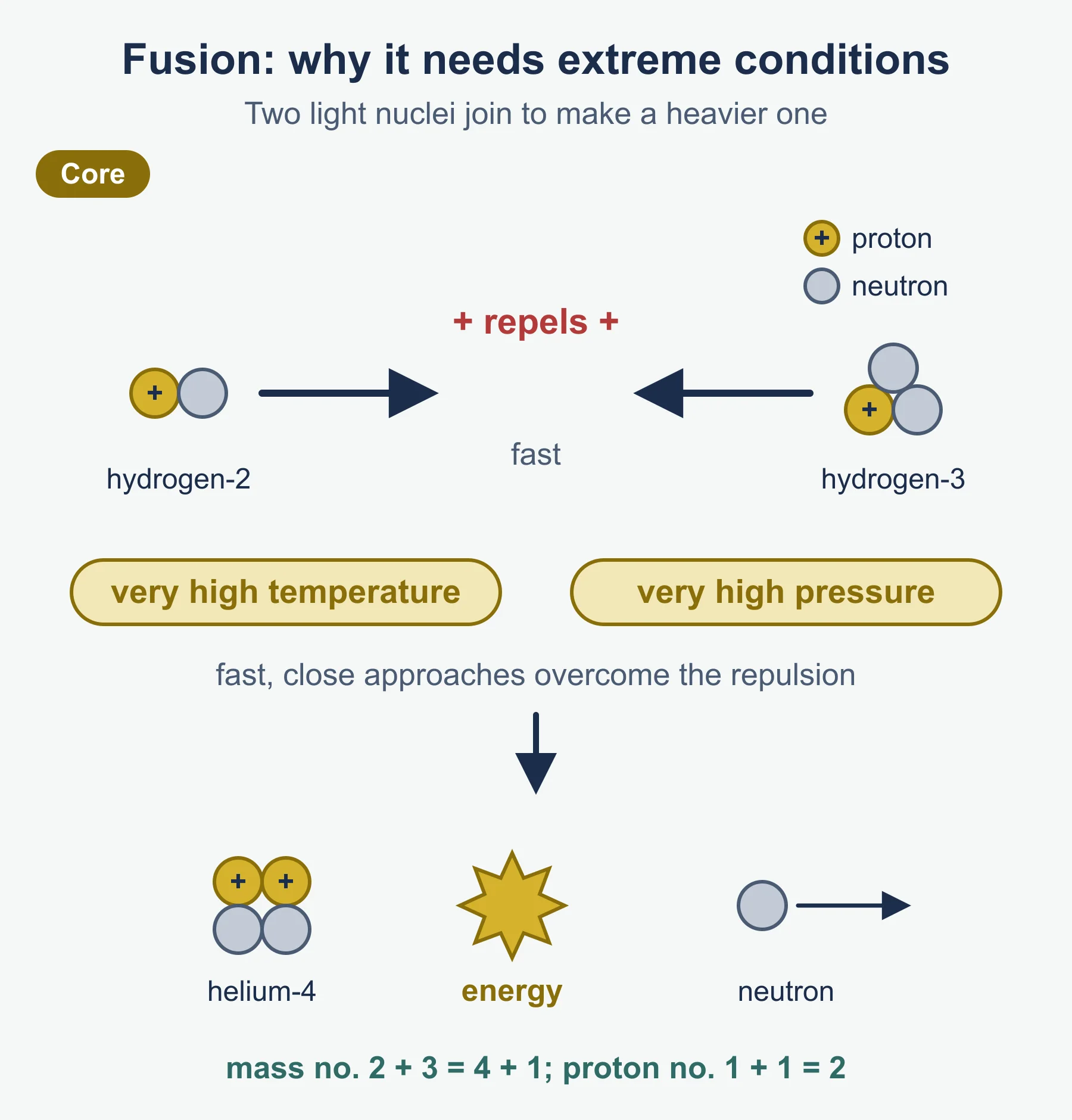
Fusion is the joining of two smaller nuclei to form a larger nucleus, releasing energy. Fusion of hydrogen into helium is the energy source of stars.
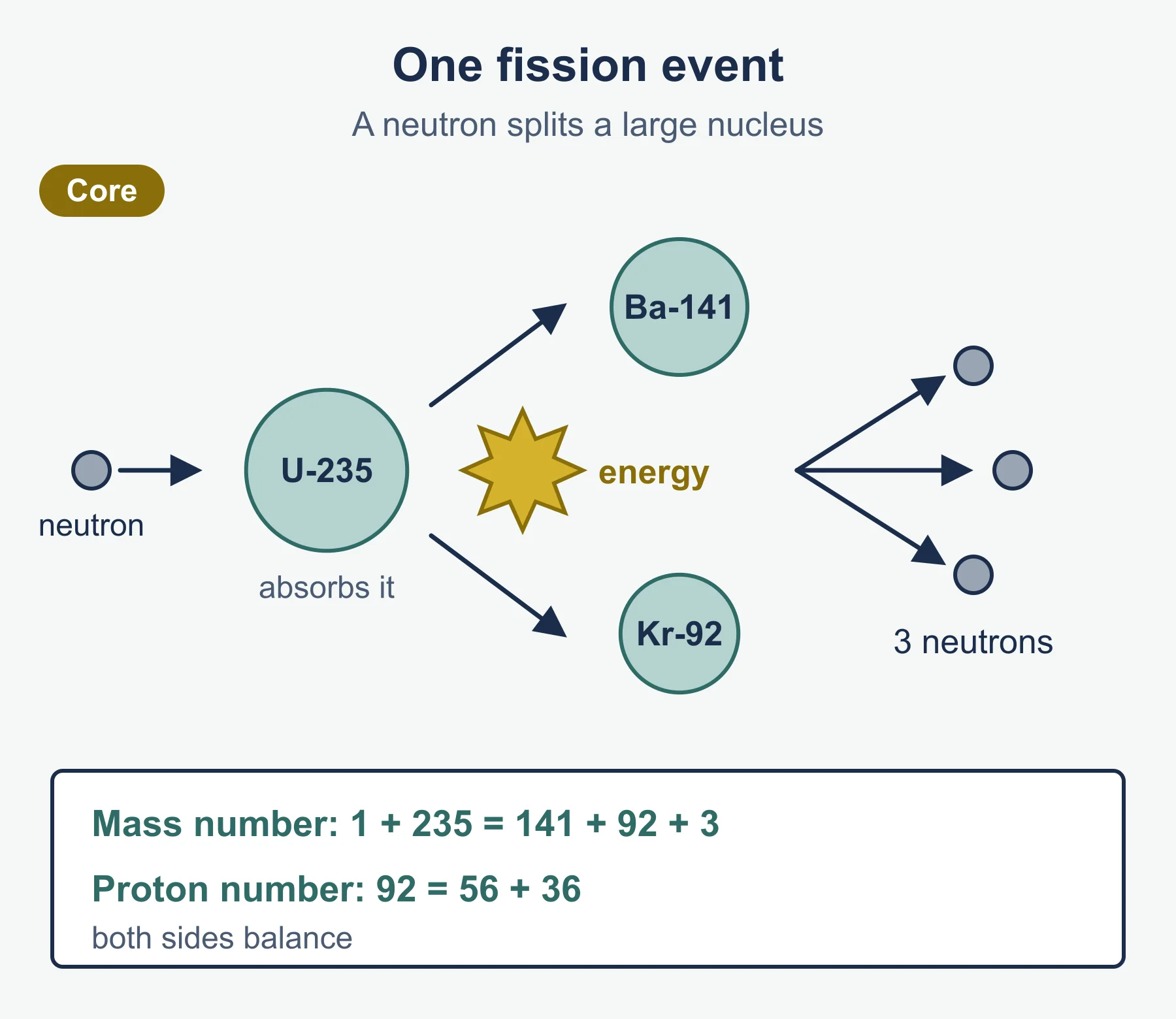
Fission happens when a nucleus such as uranium-235 absorbs a neutron, becomes unstable and splits into daughter nuclei, releasing two or more neutrons and energy. One possible reaction is
²³⁵₉₂U + ¹₀n → ¹⁴¹₅₆Ba + ⁹²₃₆Kr + 3 ¹₀n + energy
Balance: the mass numbers give 236 on the left and 141 + 92 + 3 = 236 on the right; the proton numbers give 92 on the left and 56 + 36 = 92 on the right.
Chain reaction and the reactor
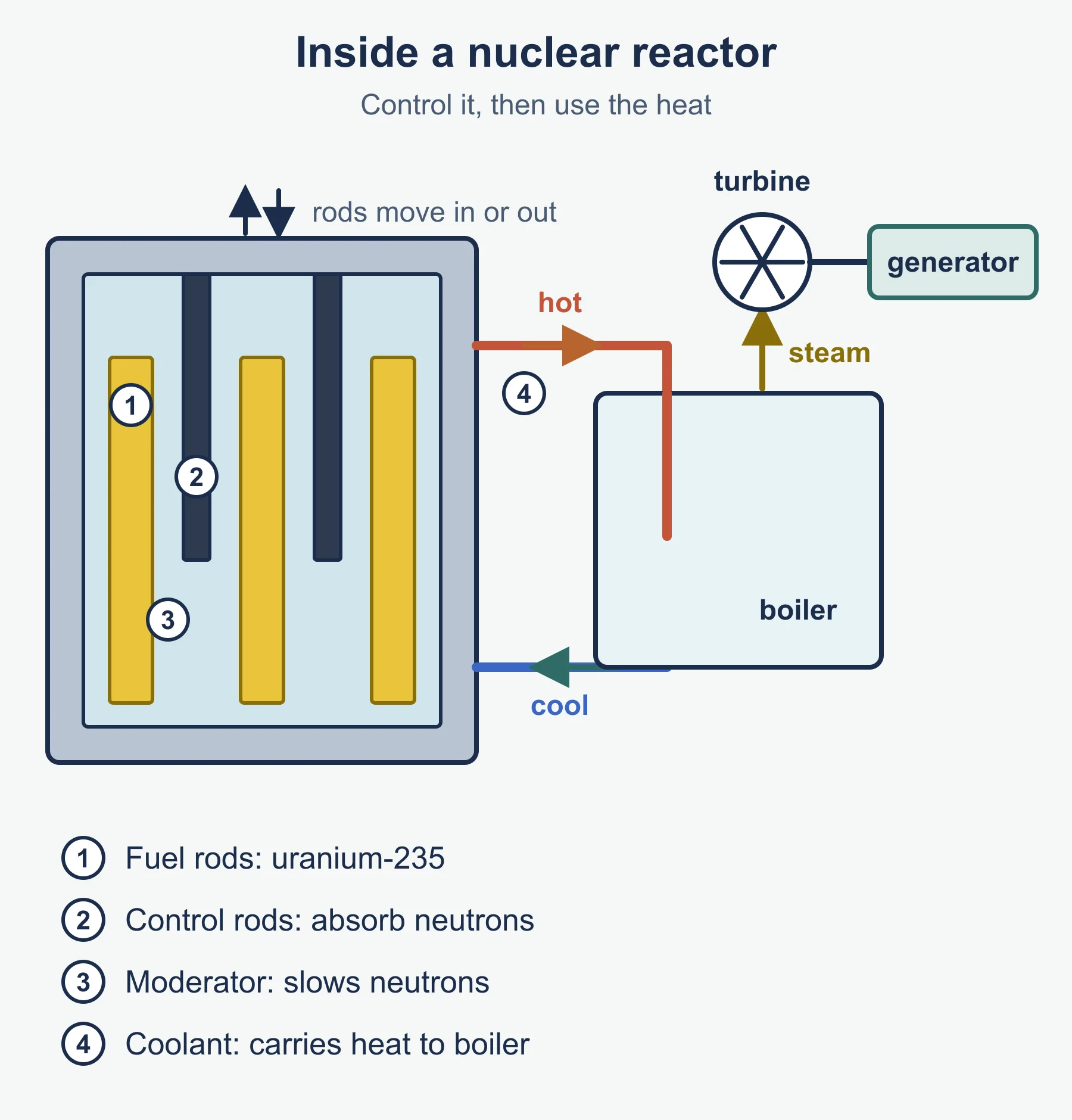
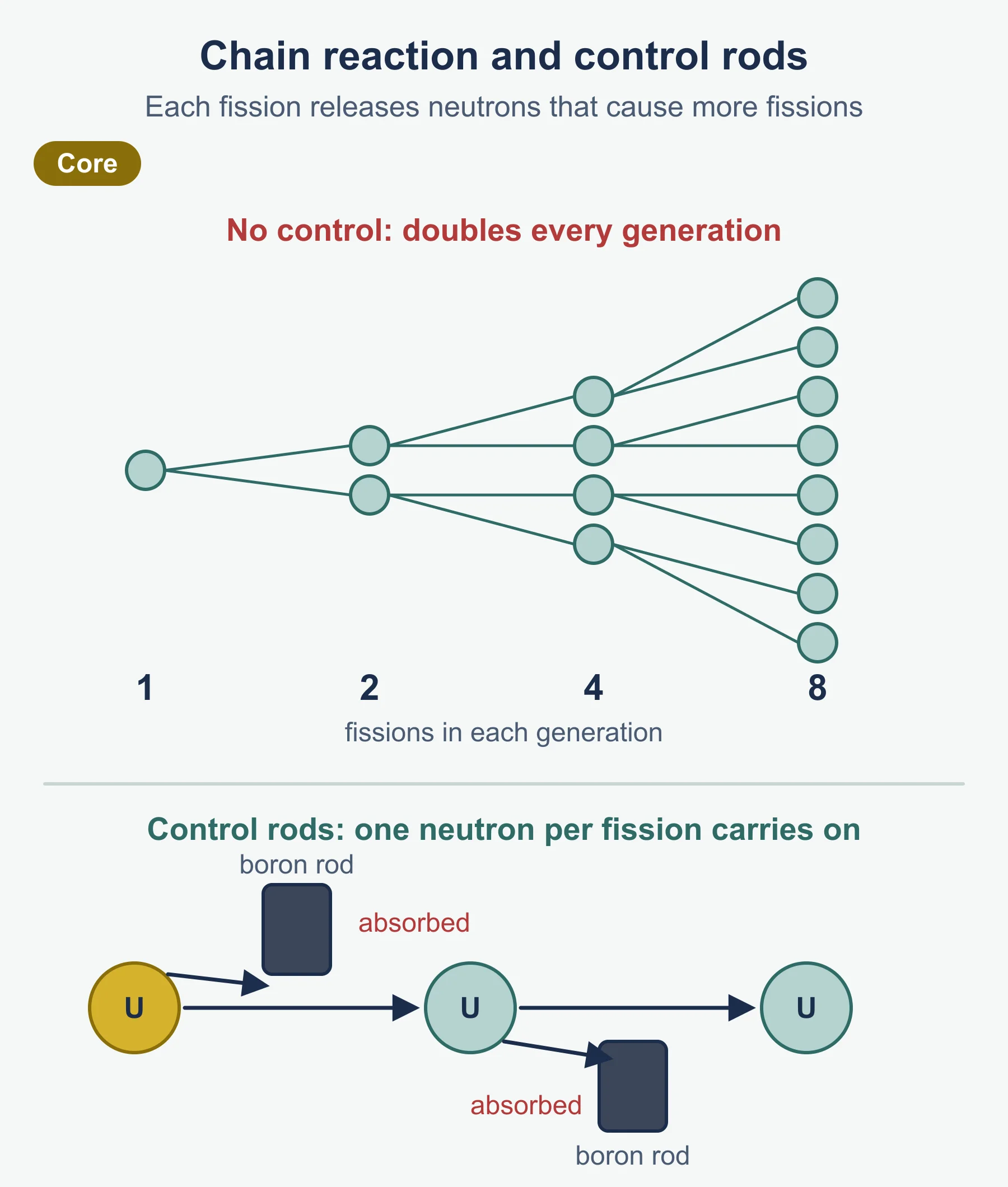
Each fission releases neutrons, and these can be absorbed by other uranium-235 nuclei, each causing a further fission. This is a chain reaction. If it were uncontrolled, the rate of fission would grow rapidly. In a reactor it is controlled:
| Part | Action |
|---|---|
| Moderator (for example graphite or water) | Slows fast neutrons so they are far more likely to be absorbed and cause fission |
| Control rods (for example boron or cadmium) | Absorb neutrons; moved in to slow the reaction and out to speed it up |
| Coolant | Flows through the core, takes thermal energy away and carries it to where steam is made to drive turbines |
To keep the power steady, on average one neutron from each fission must go on to cause one more fission.
5.2.5 Half-life
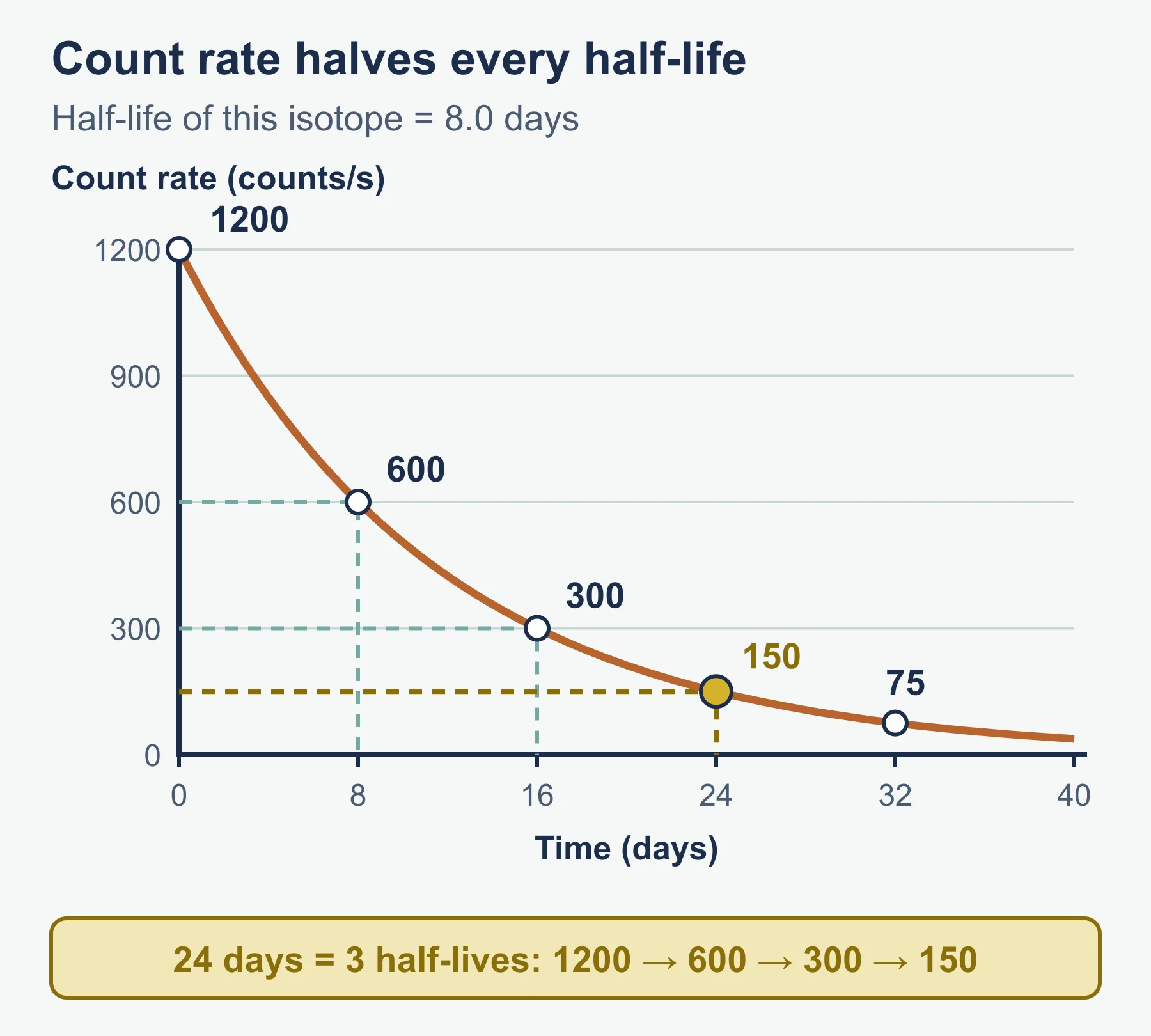
The half-life of an isotope is how long it takes for half of the nuclei of that isotope present, whatever the sample size, to decay. The background-corrected count rate also halves in this time.
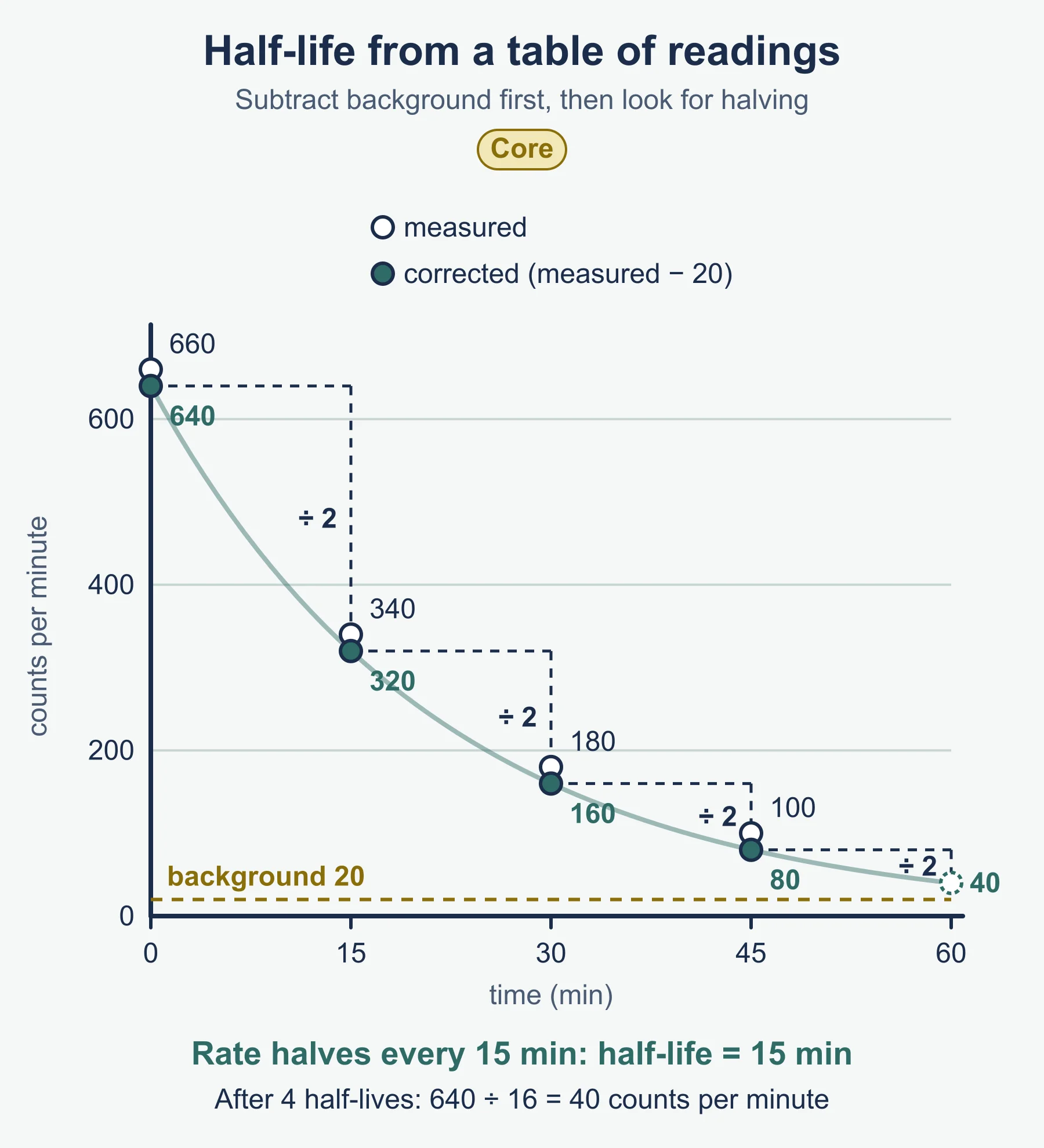
Worked example 5. A sample gives these readings. Background is 20 counts per minute throughout.
| Time (min) | 0 | 15 | 30 | 45 |
|---|---|---|---|---|
| Measured (counts per minute) | 660 | 340 | 180 | 100 |
- Correct each reading: 640, 320, 160, 80.
- Each 15 minutes the rate halves, so the half-life is 15 minutes.
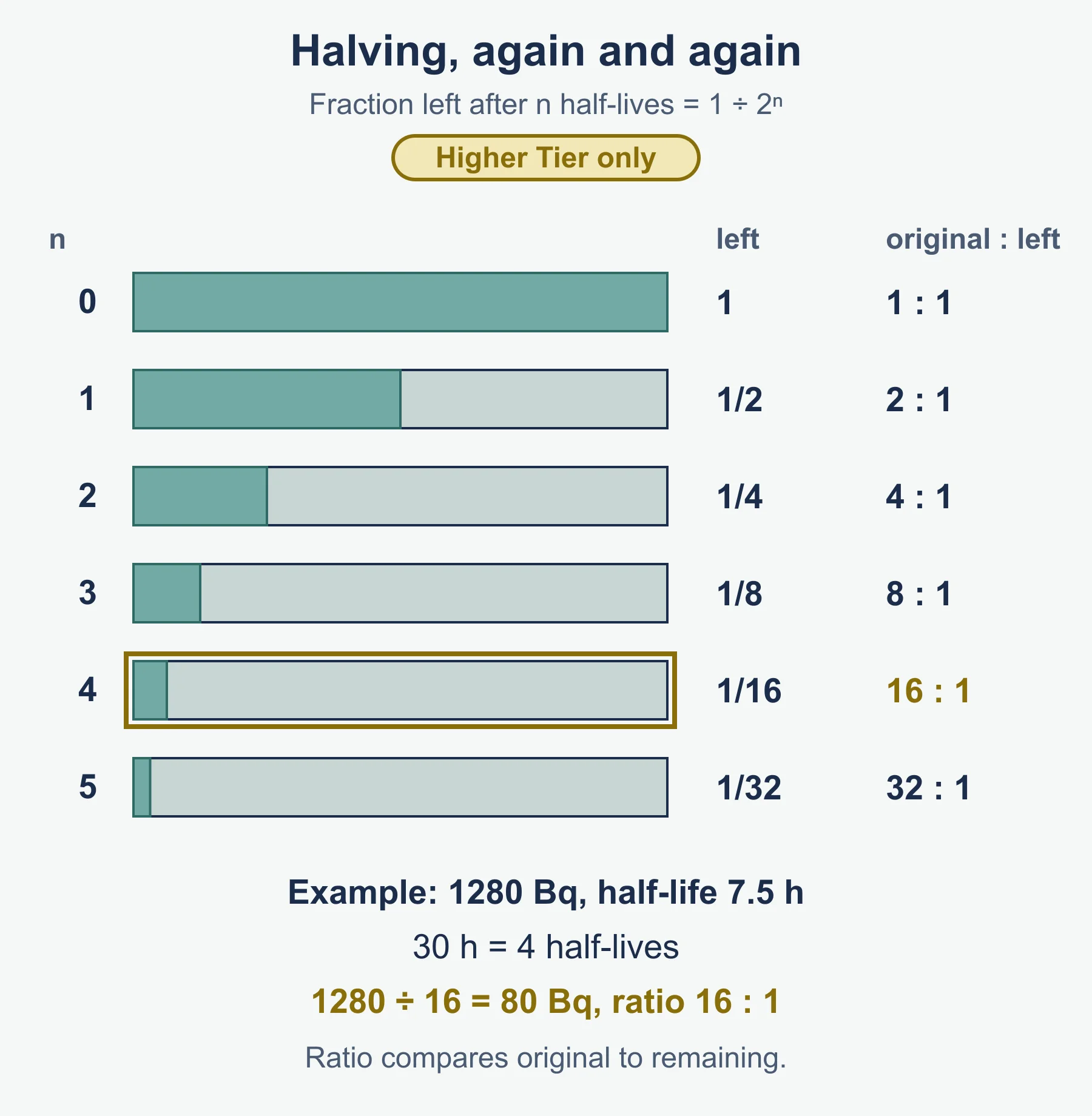
- After 60 minutes (four half-lives) the corrected rate is 640 ÷ 16 = 40 counts per minute.
- A sample of mass 2.4 g of the isotope would have 2.4 ÷ 16 = 0.15 g left after the same time.
Reading a decay curve: pick a starting value, find half of it, read the time between the two. Repeat from a second starting point to check the half-life is the same.
Carbon-14 dating
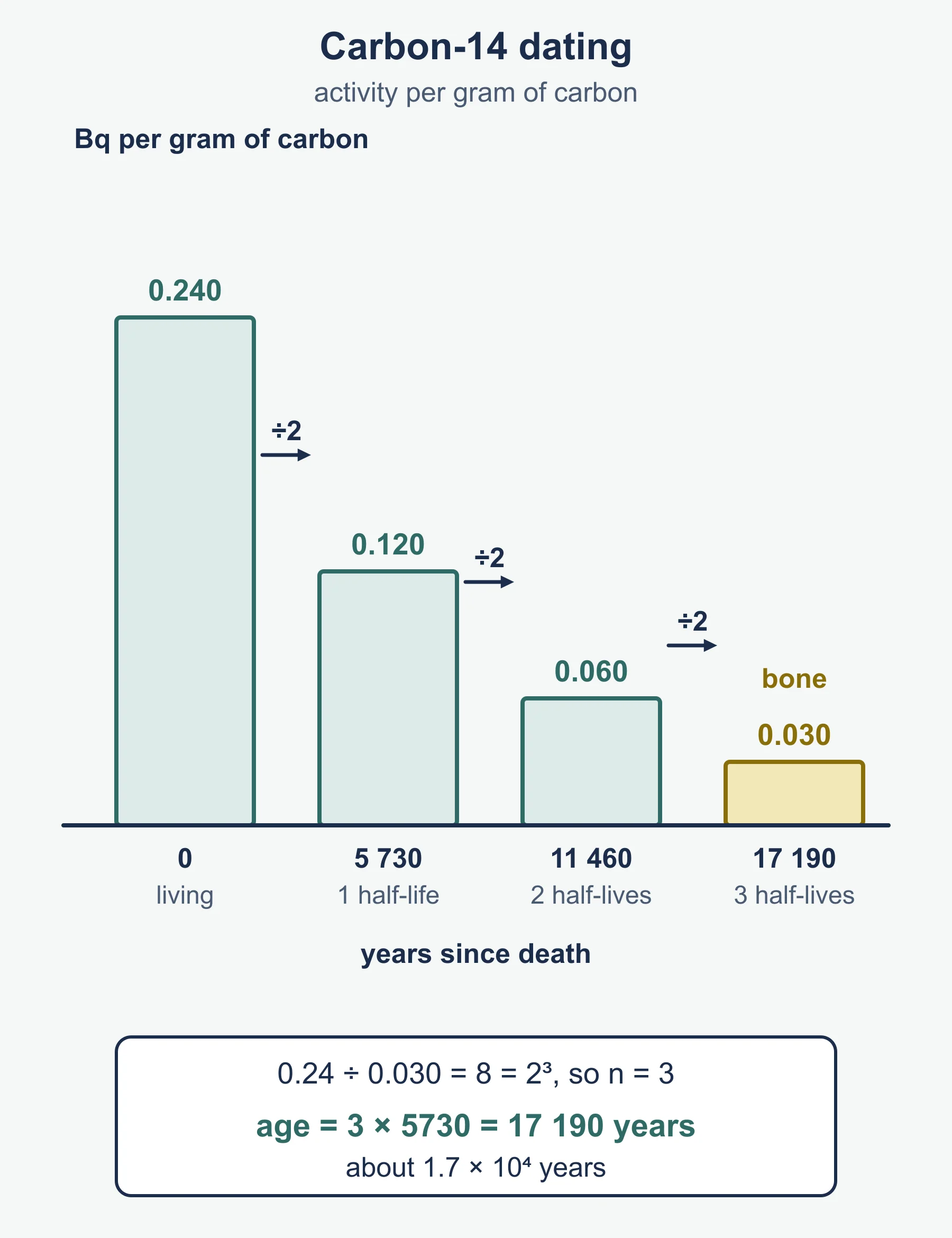
Living things take in carbon, including a small constant fraction of radioactive carbon-14, so the proportion in a living organism stays steady. Once the organism dies, its intake stops and the carbon-14 left in it decays, with a half-life of 5730 years. By comparing the carbon-14 activity of an old wooden object with that of living wood, you can estimate its age.
Worked example 6. A wooden tool has one quarter of the carbon-14 activity of living wood. Estimate its age.
- One quarter means two halvings.
- Age = 2 × 5730 = 11 460 years.
Choosing an isotope for a use
Match the type of radiation (penetration and ionisation) and the half-life (long enough to last, or short enough to be safe) to the job.
| Application | Radiation and half-life reasoning |
|---|---|
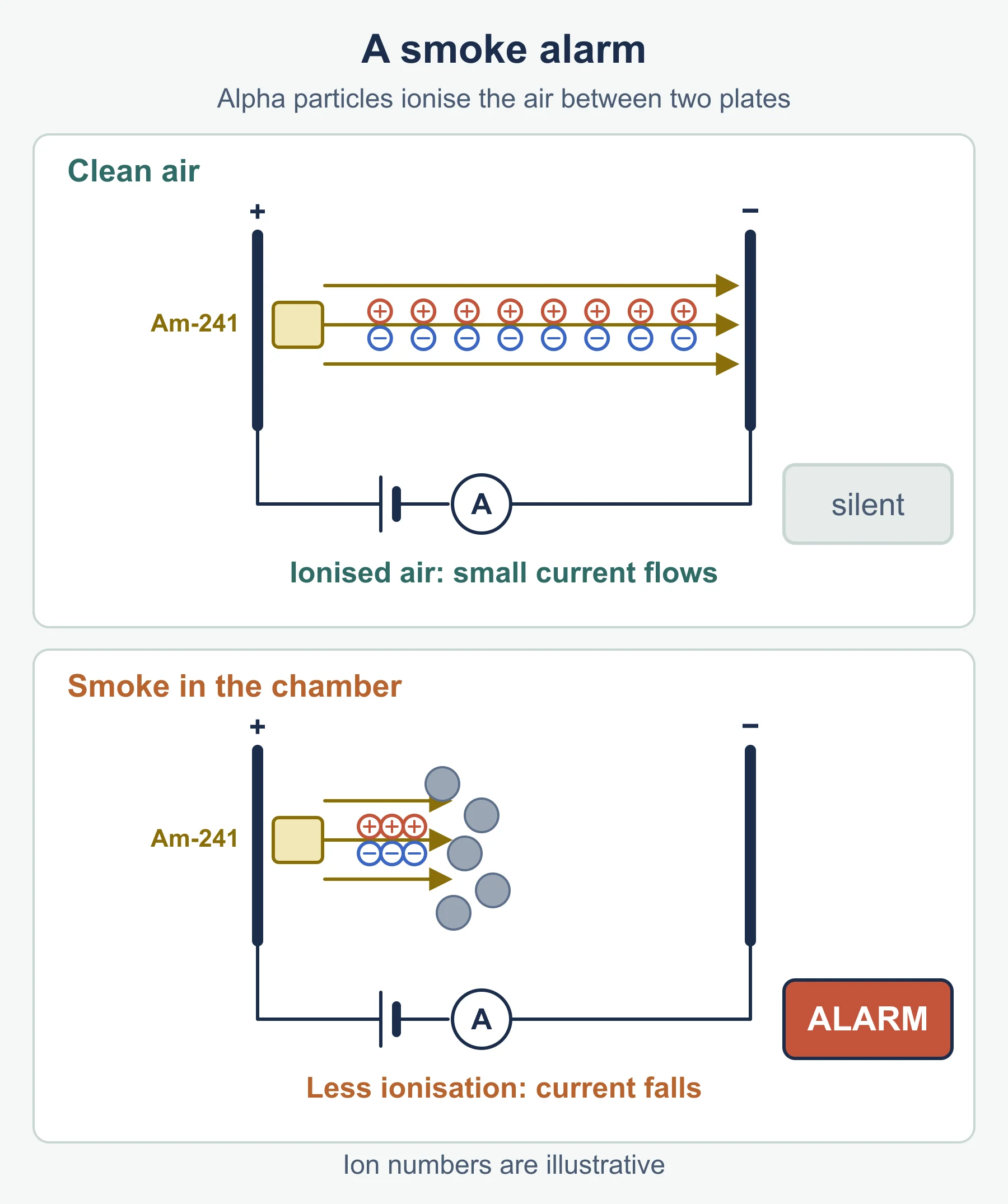
| Household fire (smoke) alarm | Alpha: ionises the air in a small chamber so a small current flows; smoke soaks up alpha particles, so the current drops and the alarm goes off. Weak penetration is safe indoors; long half-life means no frequent replacement |
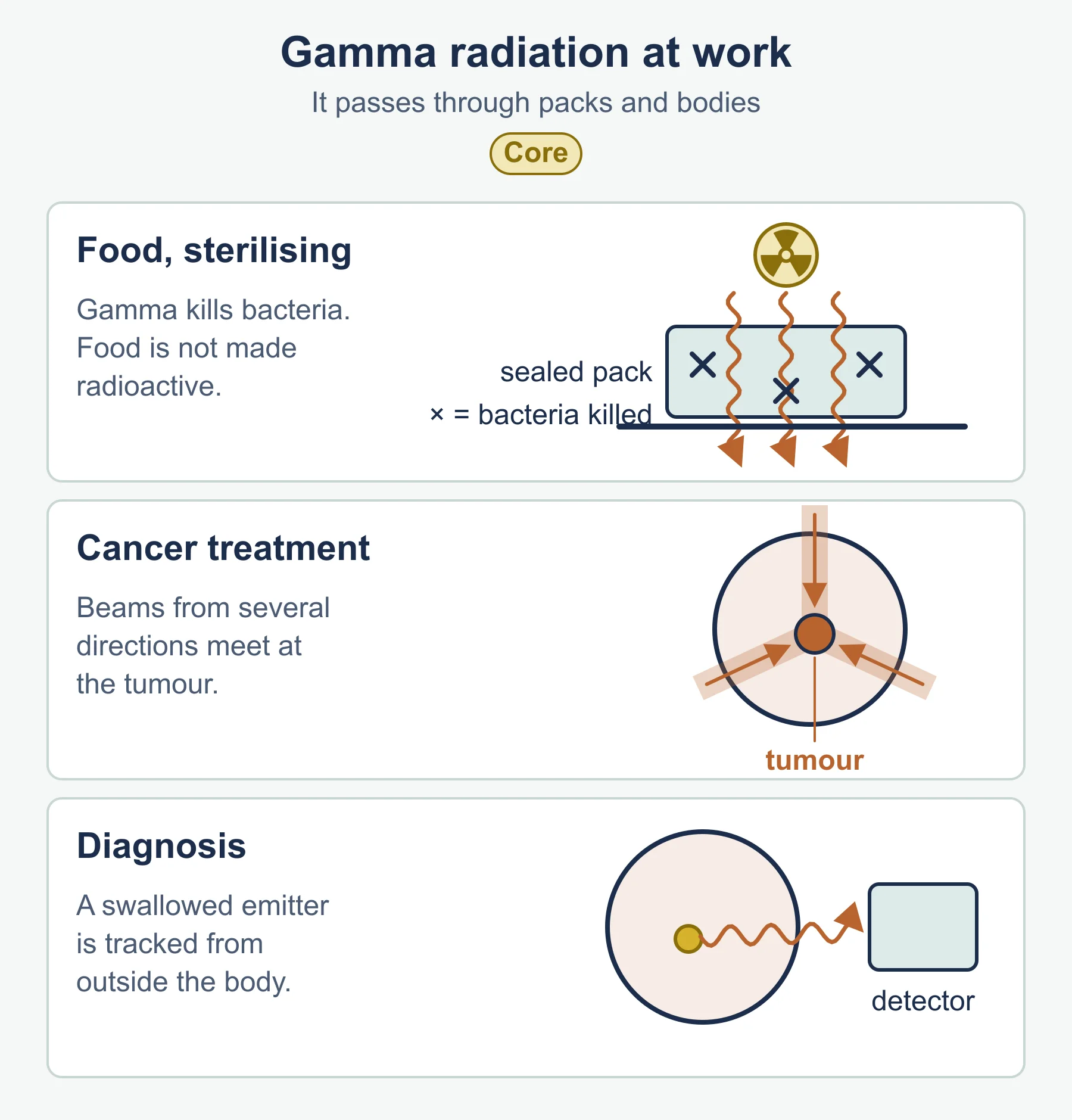
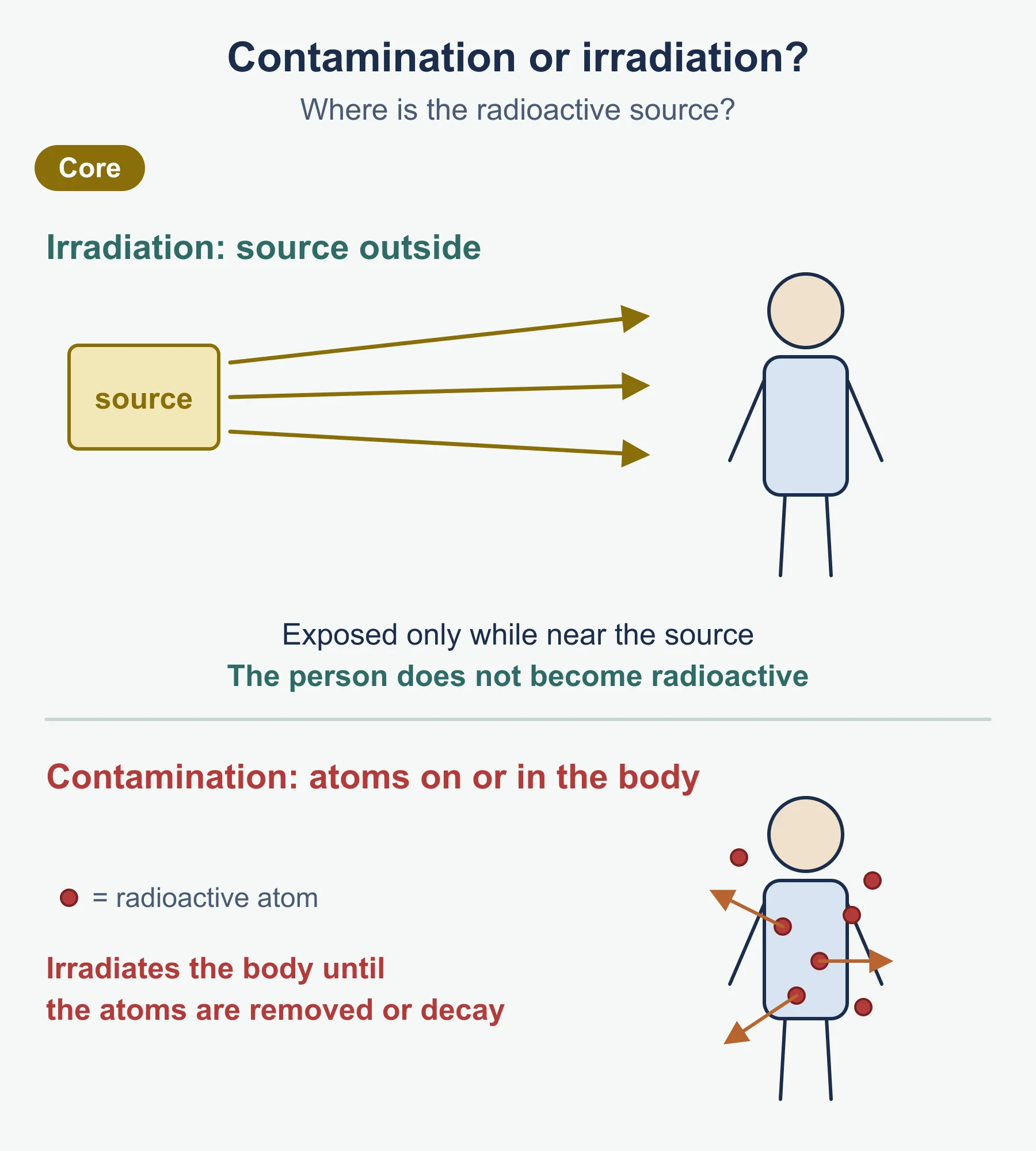
| Irradiating food to kill bacteria | Gamma: penetrates packaging and food; food is not made radioactive and bacteria are killed |
| Sterilising equipment | Gamma: passes through sealed packs and kills microorganisms on surgical tools |
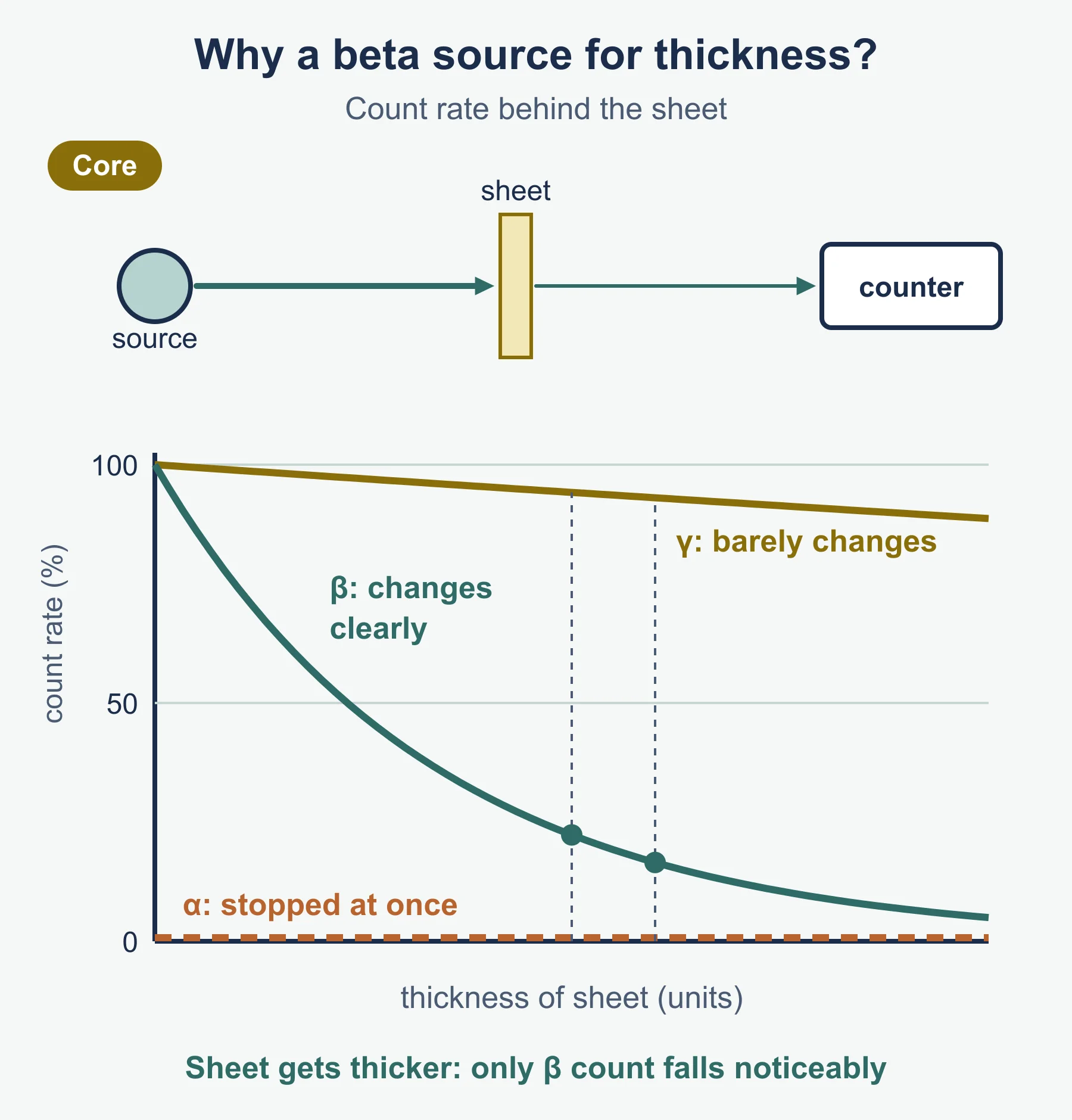
| Measuring and controlling thickness | Sheet material: the radiation must be partly absorbed. Thin aluminium foil suits beta; a thick steel plate needs gamma. Long half-life keeps readings steady |
| Diagnosing and treating cancer | Gamma: a gamma emitter swallowed or injected can be tracked outside the body, and a short half-life means it soon disappears; a focused beam of gamma from several directions delivers a high dose to a tumour and a lower dose to tissue around it |
5.2.6 Safety precautions
Ionising radiation damages living cells. Effects include cell death, mutations (changes to DNA, which may be passed on) and cancer.
To use, move and store radioactive materials safely:
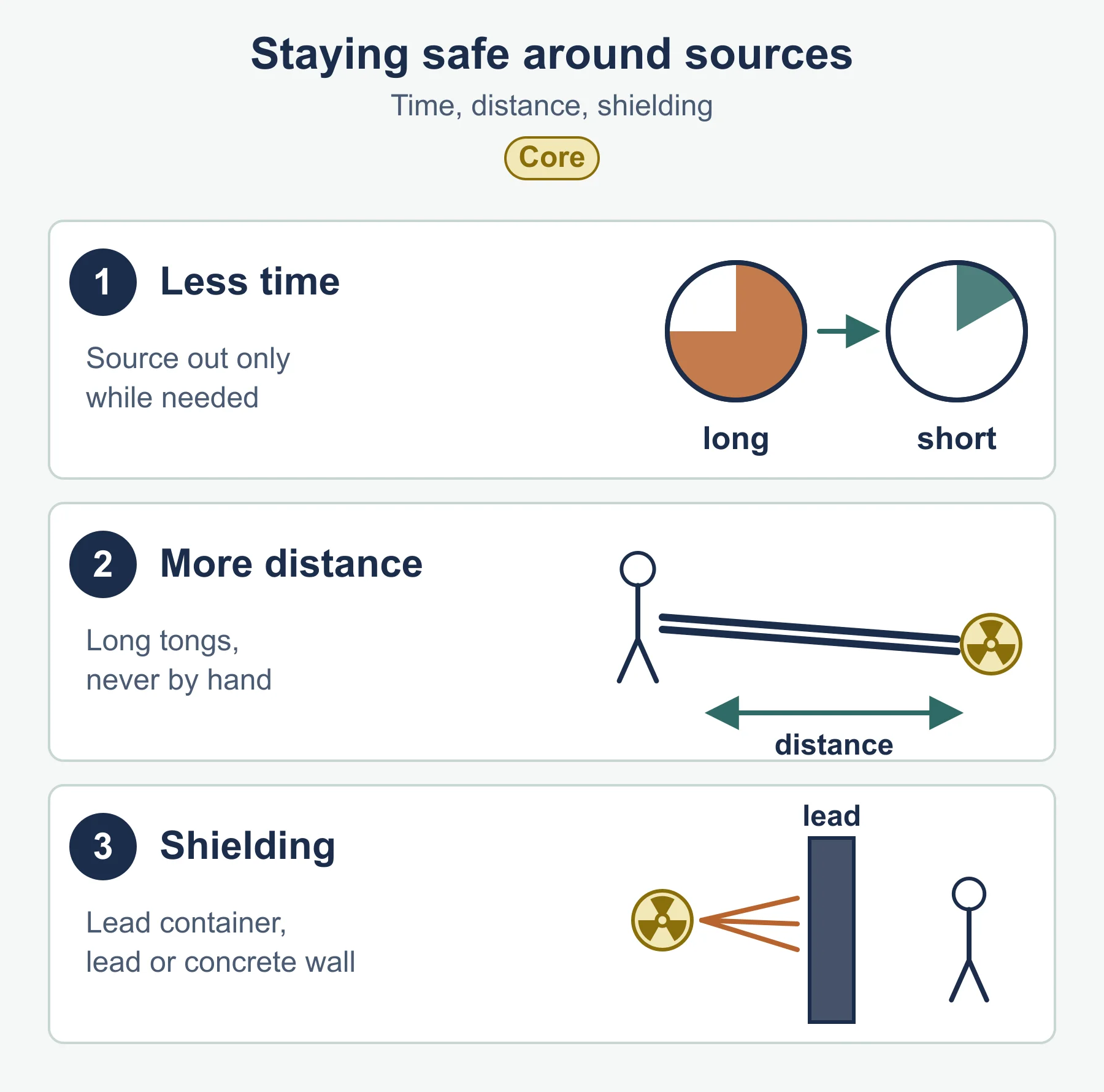
- Reduce exposure time: keep the source out only while needed.
- Increase distance: handle with long tongs, never by hand, and stay well back.
- Use shielding: keep sources in lead-lined containers; use lead or concrete walls to absorb radiation.
Common errors
- Writing that alpha is “the most penetrating” because it is the biggest. It is the most ionising and the least penetrating.
- Forgetting to subtract background before halving counts.
- Writing the proton number on top in nuclide notation.
- Saying fission “uses up atoms” without a neutron being absorbed and further neutrons released.
- Saying a short half-life means the sample decays “faster in one go”. It means the activity falls by half in less time.
Frequently asked questions
Which type of radiation is the most penetrating? Gamma is the most penetrating and alpha is the least penetrating, although alpha is the most ionising. Calling alpha the most penetrating because it is the biggest is a common error.
What do control rods and the moderator do in a nuclear reactor? The moderator slows neutrons down, control rods (for example boron or cadmium) absorb neutrons and are moved in to slow the reaction or out to speed it up, and the coolant carries the heat away.
What does a short half-life mean? A short half-life means the activity of a sample falls by half in less time. It does not mean the sample decays all at once.
How do you reduce exposure to radiation? Reduce the exposure time, increase the distance (for example by using tongs) and use shielding such as lead-lined containers or thick walls.
Official syllabus
Cambridge O Level Physics 5054 syllabus for examination in 2026, 2027 and 2028, Cambridge University Press & Assessment. Section 5, Nuclear physics, 5.1 to 5.2.6.
Get free revision emails (optional)
Occasional emails with practice questions, worked explanations and links to free resources for the qualification and subjects you choose. No spam, and you can unsubscribe from any email. The free tools on this site never need an email.
Related resources
-
Practice questions
O Level Physics: Nuclear physics — Practice Questions (Cambridge 5054)
Original Cambridge O Level Physics 5054 nuclear questions with worked answers: alpha scattering, decay equations, half-life, reactors, fusion and safety.
Physics · Cambridge · O Level
Try questions -
Revision notes
O Level Physics: Nuclear physics – Revision Notes (Cambridge 5054)
Condensed revision notes for Cambridge O Level Physics 5054 nuclear physics: nuclides, radiation, half-life, fission and safety, plus a self-test.
Physics · Cambridge · O Level
Revise topic -
Study guides
O Level Physics: Space physics (Cambridge 5054)
Study guide to space physics for Cambridge O Level Physics (5054): orbital speed, the Solar System, the Sun, the life cycle of stars and redshift.
Physics · Cambridge · O Level
Read guide
Related articles
-
study skills
How to revise for a science examination
Most science revision fails because it rereads notes instead of retrieving them. A practical method for revising physics, chemistry and biology in the weeks before a paper.
14 July 2026
-
teaching
A Level tuition in Dubai: Cambridge or Pearson Edexcel International A Level?
Schools in Dubai and Abu Dhabi teach either Cambridge International AS & A Level or Pearson Edexcel International A Level. How the two are structured, why it matters for tuition, and how online classes from Lahore work.
9 October 2026
Studying this with a teacher
Working through Physics O LEVELS?
This page is free and stays free. If you would rather be taught it, Marlbridge runs Physics classes one-to-one and in small groups of up to 15, online in your own time zone. The first trial class is free. WhatsApp replies within an hour (8am–11pm Pakistan time, every day); email the same day.
Cambridge Physics teachers at Marlbridge