
Study Guides
OCR A Level Business: Different stakeholder and business objectives and Stakeholders (H431)
Study guide to aims, the hierarchy of objectives, SMART objectives and stakeholder conflict for OCR A Level Business H431, sections 1.1 and 1.2.
- Subject
- Business
- Level
- A LEVELS
- Topic
- Business objectives and strategic decisions
- Author
- Marlbridge Academic Team
- Updated
- Reviewed by
- Salman Ahmad (what this means)
Aligned to OCR A Level Business (H431), Version 2.1 (January 2026), for first assessment in 2017; final assessment summer 2027. Official specification .
Syllabus page (what it covers and how it is assessed): OCR A Level Business.
Syllabus points this page covers
H431
- 1.1 Different stakeholder and business objectives
- 1.2 Stakeholders
Found an error? Report a correction.
Need help with this topic? Request a free trial class for A Level Business (H431).
This guide teaches the OCR A Level Business (H431) content headed “Different stakeholder and business objectives” and “Stakeholders”, from the specification at Version 2.1 (January 2026). H431 is in its final teaching and assessment cycle, with the last assessment in summer 2027. OCR says the whole specification can be assessed in each component, so treat this as content for every paper. It is mostly written-answer content: the skill is applying terms to the business in front of you and weighing both sides. Pair it with the revision notes and the practice questions. For the wider area, see the Objectives and Strategic Decisions study guide, the topic revision notes and the topic practice set. The course hub is OCR A Level Business, the printable list is the checklist, and the free 10-minute diagnostics show where to start.
What the two sections ask you to do
| Content point | Verbs OCR uses |
|---|---|
| Aims, corporate/business, strategic, tactical and operational objectives | distinguish |
| SMART objectives | explain importance to business and stakeholders |
| Hierarchy of objectives | explain |
| Setting aims and objectives | evaluate impact and importance |
| Effect of sector on aims and objectives | explain |
| Communicating objectives; mis-communication; better communication | explain, evaluate, evaluate |
| Why objectives change | explain |
| Aims and objectives for a business, and how changes are implemented | recommend and justify |
| Meaning of stakeholder; internal and external | explain, identify |
| Stakeholder objectives; reasons for conflict | analyse, explain |
| Why conflict must be managed; its impact | explain, evaluate |
| How to deal with conflict | recommend and justify |
| Stakeholder influence; impact of decisions on stakeholders | evaluate |
1.1 Aims and the hierarchy of objectives
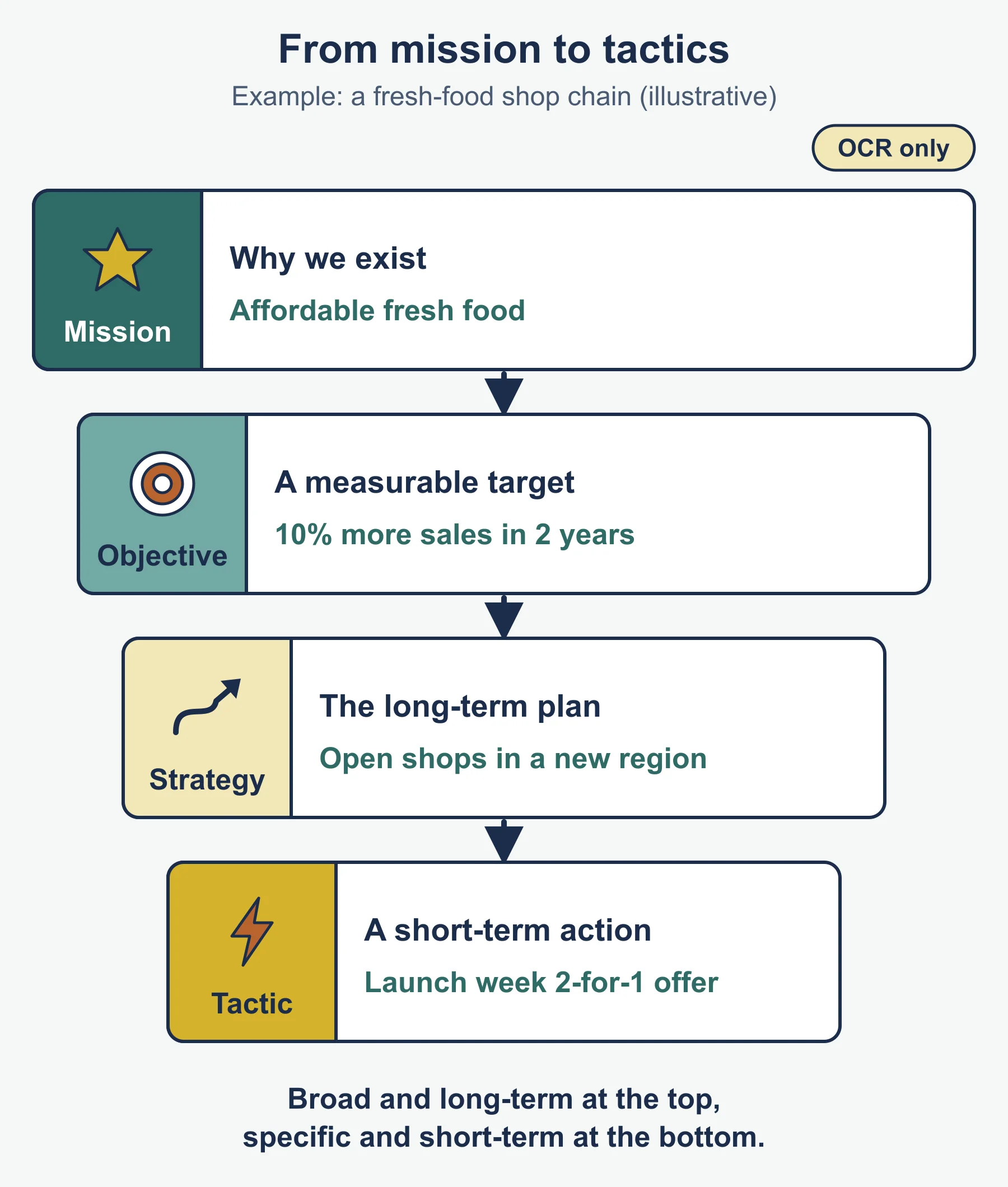
Objectives only work when each level supports the one above it. This chain is the hierarchy of objectives. These are the standard definitions, which OCR’s text does not spell out, so use them consistently.
- Organisational aim: the broad, long-term purpose or ambition. It is rarely a number.
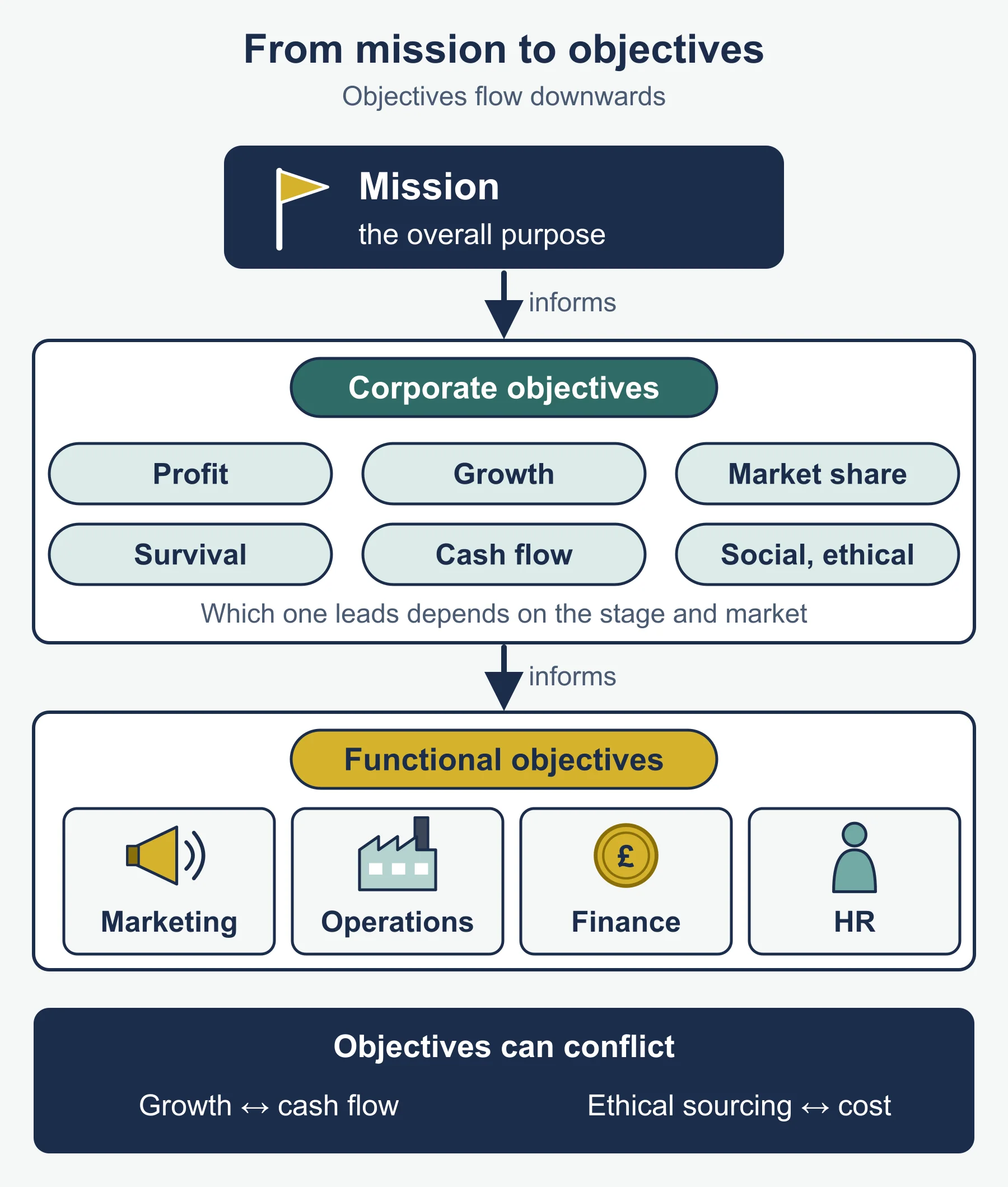
- Corporate (business) objective: a measurable target for the whole business, such as sales revenue, profit or market share.
- Strategic objective: a medium to long-term target set by senior managers that shows how the corporate objective will be reached, such as entering a new market.
- Tactical objective: a shorter-term target for a department or team that carries out the strategy.
- Operational objective: a day-to-day target for a person, shift or process.
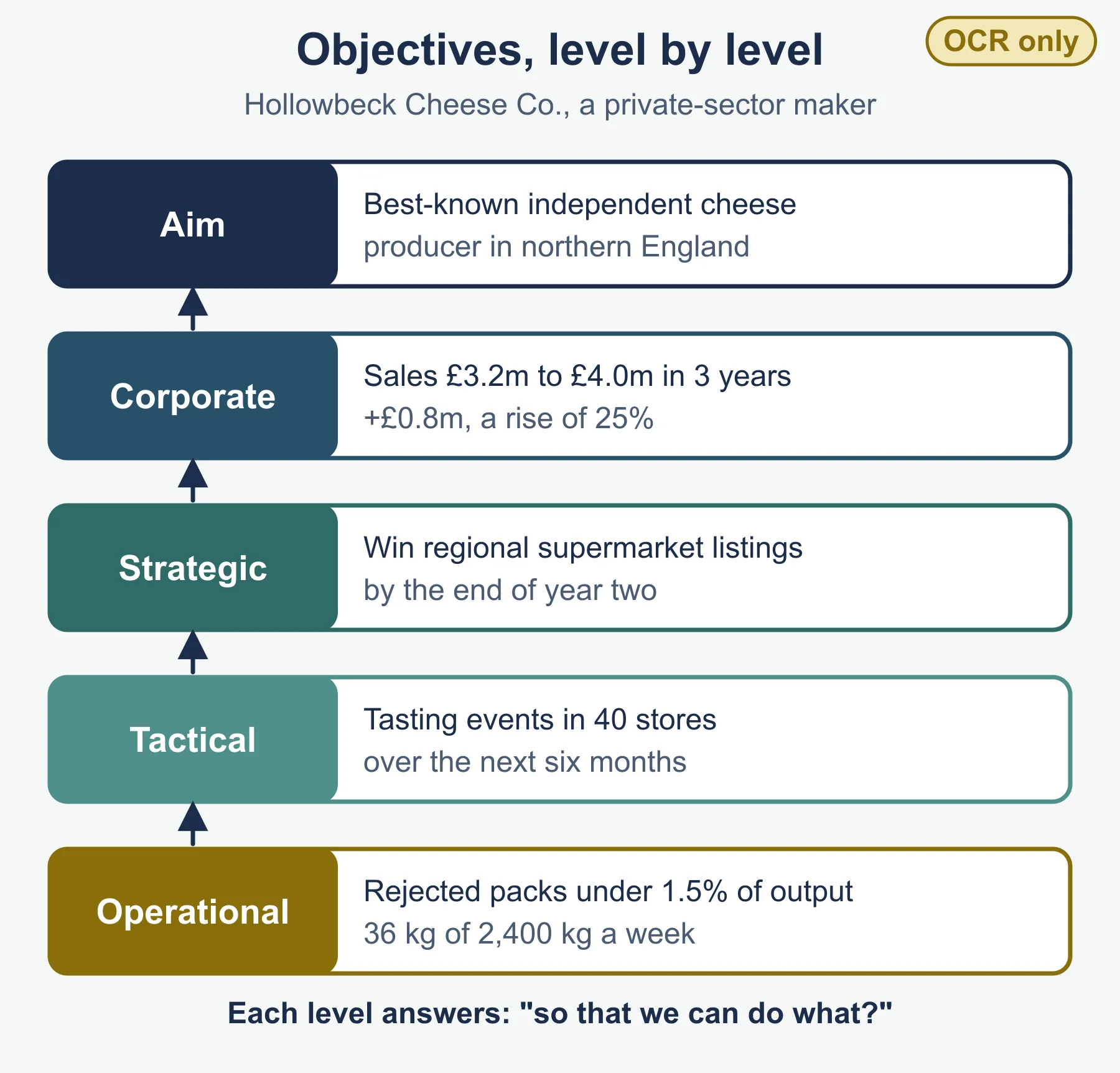
Hollowbeck Cheese Co. is a private-sector maker of farmhouse cheese. Its aim is to be the best-known independent cheese producer in northern England. Its corporate objective is to raise sales revenue from £3.2 million to £4.0 million within three years, a rise of £0.8 million or 25%. A strategic objective is to win regional listings with supermarket chains by the end of year two. A tactical objective is to run tasting events in 40 stores over the next six months. An operational objective is to keep rejected packs below 1.5% of weekly output, which is 36 kg on 2,400 kg.
Each level answers the question “so that we can do what?” from the one below. If an operational target does not connect to any higher level, question why it exists.
SMART objectives
SMART (the standard form, not spelt out in the specification) stands for specific, measurable, achievable, realistic and time-bound (some courses use “agreed” or “attainable”; follow your teacher’s wording, and name each letter). A vague objective such as “be more popular” cannot be checked. A SMART version is “raise the online customer rating from 3.9 to 4.3 out of 5 by 30 June next year”.
For the business, SMART objectives give a clear target, allow progress to be monitored and make the success of a decision measurable. For stakeholders, they show what to expect: staff know what is asked of them, lenders and shareholders can judge progress, and customers can see what is being promised. The weakness is that a narrow numerical target can encourage short-term behaviour, such as cutting quality to hit a cost target, and a figure set too early can be overtaken by events.
Impact and importance of setting aims and objectives
For evaluate questions, weigh these.
- For: direction and focus; a basis for decisions and for measuring performance; motivation when staff share goals; confidence for lenders and investors.
- Against: time and cost to set and review; rigid targets in fast-changing markets; poor objectives can push managers towards the wrong behaviour; conflicting objectives (growth against profit) can confuse.
- Judgement: objectives help most when they are few, linked to each other and reviewed regularly.
Sector and objectives
The specification separates private, public and third sector organisations. Sector shapes objectives because the owner and the funding differ.
- A private sector firm, owned by individuals or shareholders, usually emphasises profit, return to owners, growth and survival, though it may also pursue ethical or environmental goals.
- A public sector organisation, funded by government, tends to have objectives about service quality, access, value for money and meeting budgets rather than profit.
- A third sector organisation, such as a charity or social enterprise, normally pursues a social purpose, with surpluses reinvested.
Contrast Hollowbeck, which stresses revenue and profit, with a public leisure centre run for a council, which would stress affordable access and participation. Remember that sector sets a tendency, not a rule: a private firm may have a strong social aim, and a public body may still need a surplus.
Communicating objectives
Objectives only work when the people who must deliver them understand them. Methods include team briefings, meetings, emails and intranet pages, noticeboards, appraisals and one-to-one reviews, written plans and reports to shareholders, and public statements or websites for external stakeholders. Face-to-face methods allow questions and feedback but take time. Written methods reach many people cheaply but may be skimmed or misread.
Mis-communication can mean staff working towards different ends, wasted resources, duplicated effort, low morale and a loss of trust. Investors or lenders may lose confidence, and customers may receive a message that the business cannot deliver.
To improve communication, a business can use more than one channel, use plain language, link each objective to the person’s own role, check understanding through feedback, repeat the message at set times and make sure managers explain the reasons as well as the figures. Evaluate by cost, size of the workforce, how complex the message is and whether staff are in one location.
Why objectives change
Objectives change because the business or its environment has moved on. Typical triggers are a recession or a change in demand, new competitors or technology, growth or a change in ownership, a failure to meet earlier targets, a shift in law or public attitudes, or a crisis that makes survival the first priority. A start-up may begin with survival, then move to growth, and later to profit or a wider social role.
Recommend and justify
When asked to recommend and justify aims and objectives, follow four steps. State the objective in SMART form. Link it to the stage the business has reached and its sector. Say what evidence supports it from the case. Then say how change would be carried out: explain the reason, communicate in several ways, involve staff, phase the change, and review progress. Weigh one risk, such as resistance, and give a reason for your choice.
1.2 Stakeholders
A stakeholder is any person or group that has a stake in what a business does or is touched by its actions. Ownership is not required.
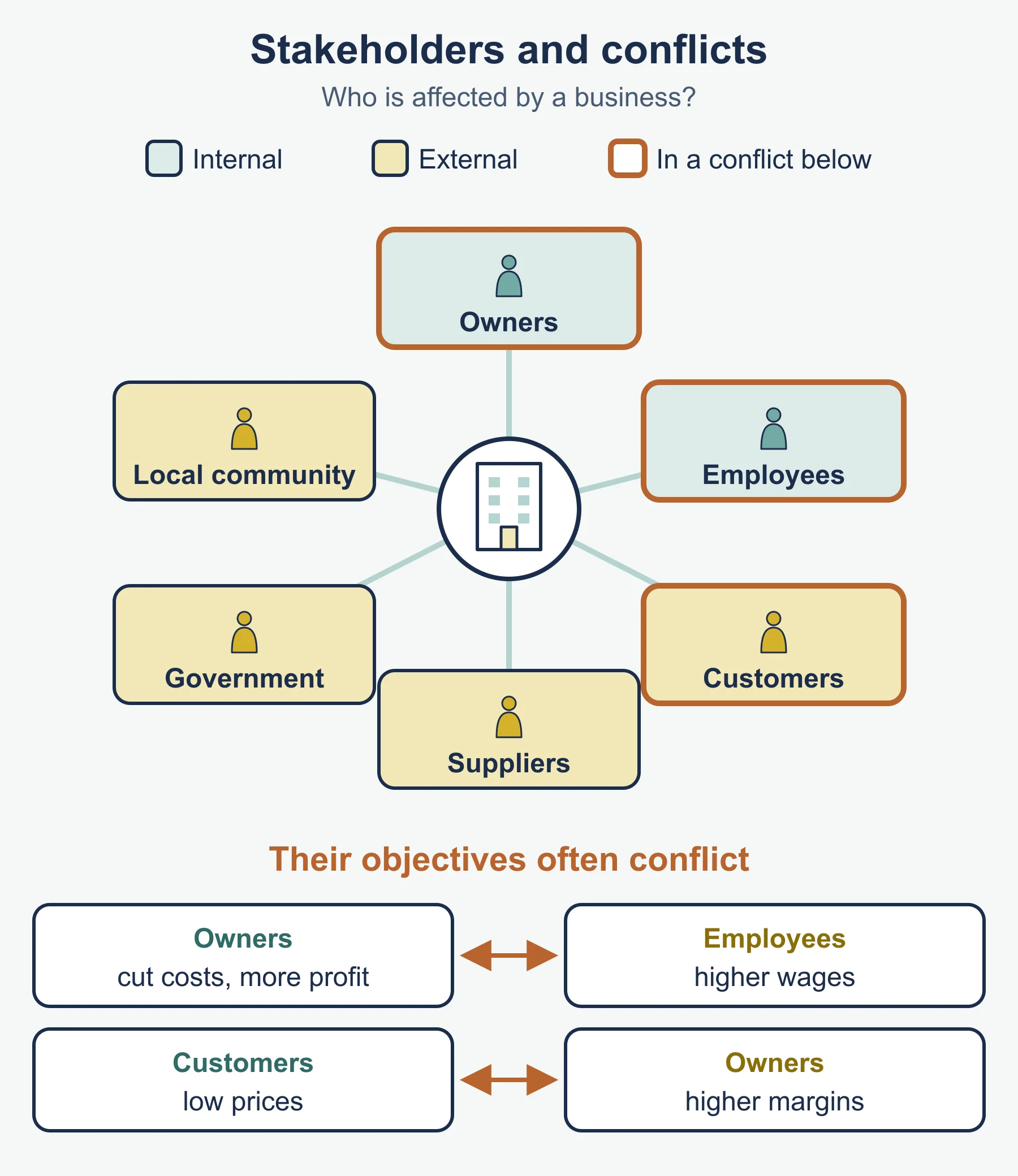
- Internal stakeholders work in or own the business: owners and shareholders, directors and managers, employees.
- External stakeholders sit outside it: customers, suppliers, lenders, competitors, the local community, government and local authorities, pressure groups, and the media.
Some people belong in two groups. A shareholder who is also a customer has two interests.
Stakeholder objectives (analyse)
| Stakeholder | Likely objective |
|---|---|
| Shareholders and owners | return on investment: dividends and a rising share value |
| Directors and managers | business success, pay, status, achievement of targets |
| Employees | fair pay, secure employment, safe conditions, training |
| Customers | quality, value, reliability, service |
| Suppliers | prompt payment, regular orders |
| Lenders | repayment with interest, low risk |
| Local community | jobs, limited noise and traffic, a clean environment |
| Government | tax revenue, compliance, employment |
| Pressure groups | change in business behaviour on a specific issue |
To analyse, add “because” to each point and link it to the case: a lender wants low risk because it needs repayment, so it will resist an expensive expansion.
Conflict between stakeholders
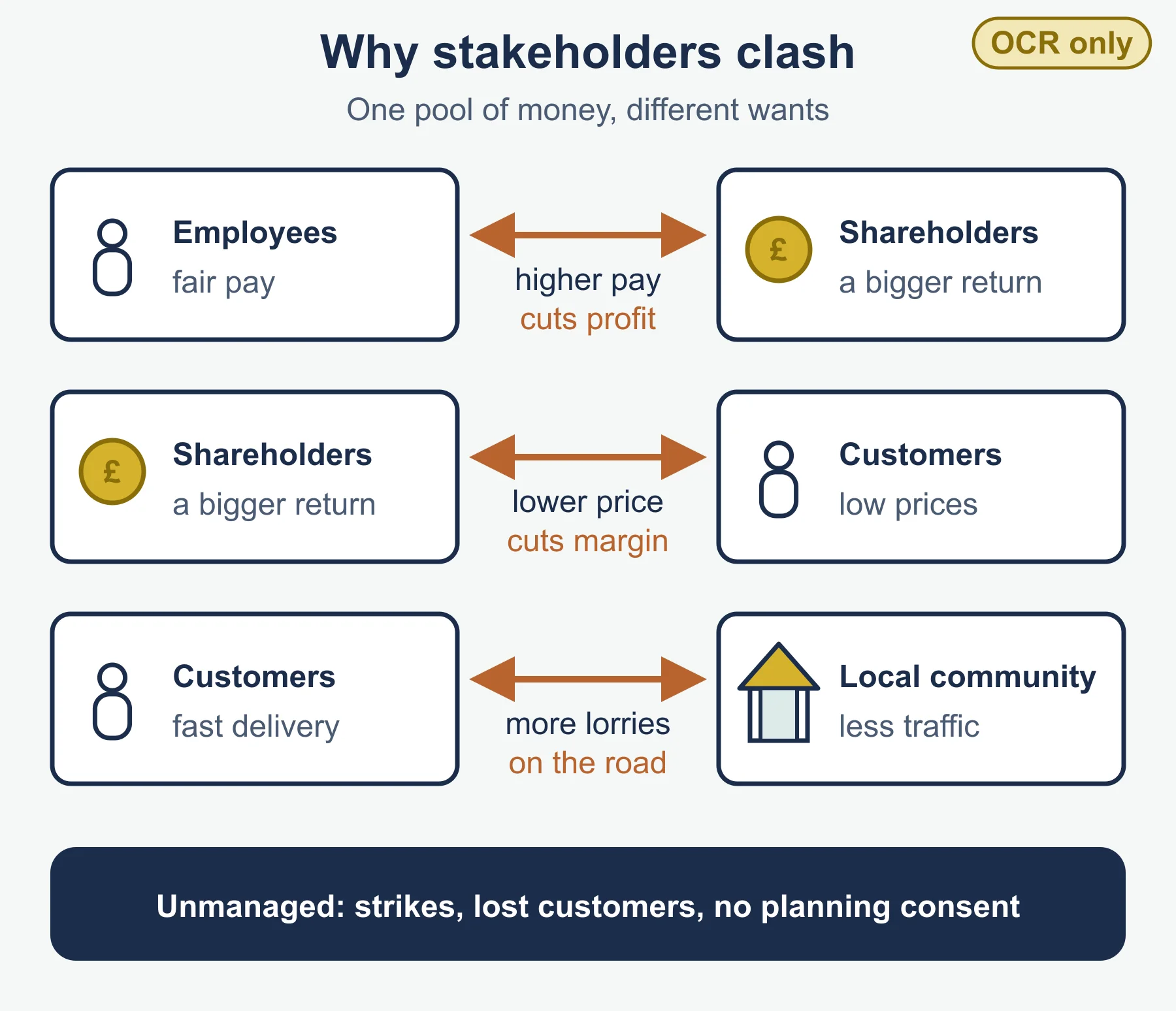
Conflict arises mainly because stakeholders have different goals and one pool of resources. A higher wage bill cuts profit. A lower price benefits customers but cuts the margin. Faster delivery can mean more lorries on local roads. Short-term and long-term interests also clash, and stakeholders differ in power and information.
A business needs to manage conflict because unresolved disputes can lead to strikes, lost customers, withdrawn finance, bad publicity, legal action or planning refusal. Poor management also wastes managers’ time and can damage the reputation that supports every other objective.
Impact of conflict (evaluate): short-term, delays, cost and tension; long-term, a stronger decision if the debate surfaces risks, or damaged relationships if one group is always overruled. The impact depends on how much power the unhappy group holds.
Dealing with conflict (recommend and justify)
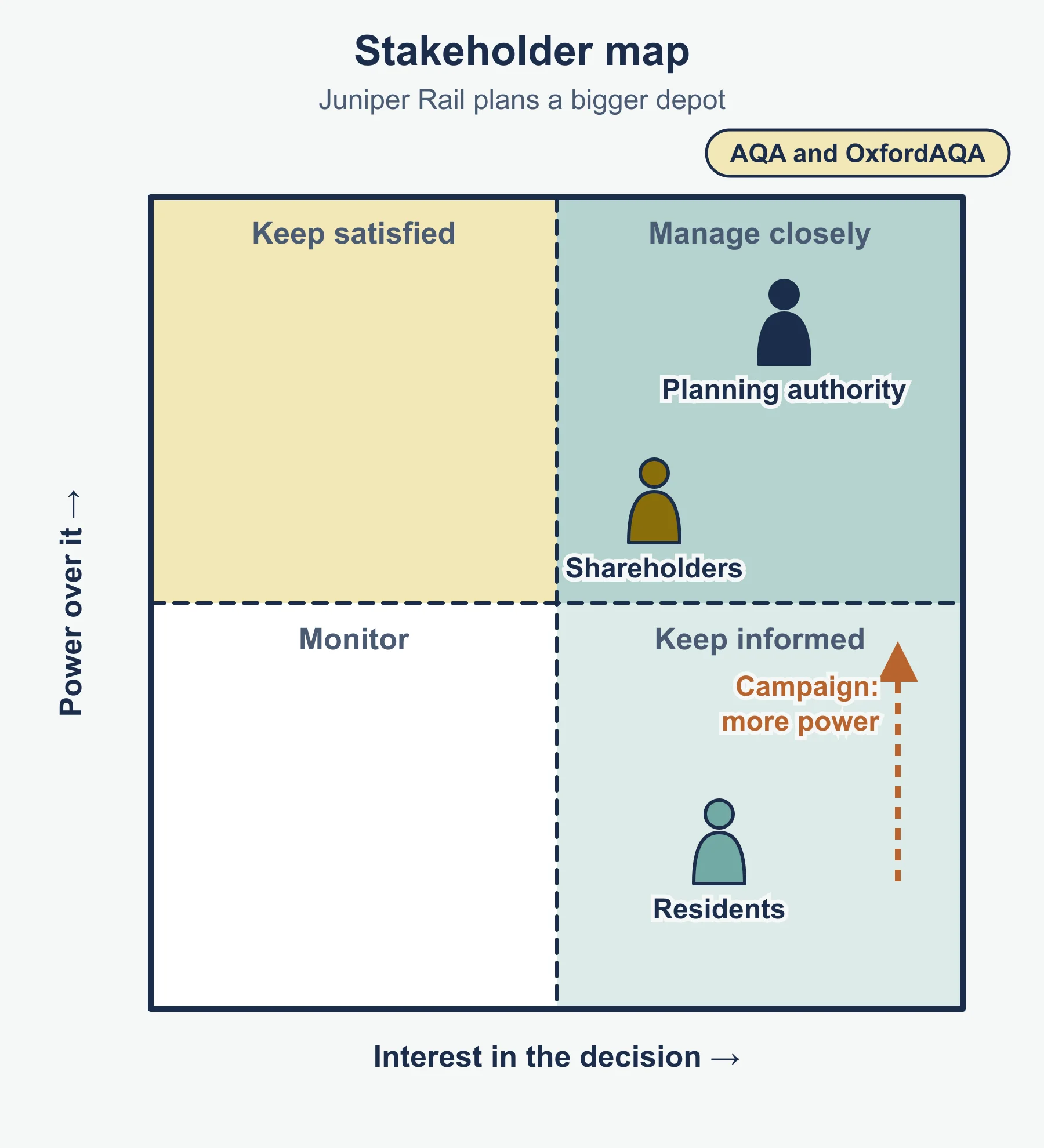
Options are to prioritise the stakeholders with the most power or interest, compromise, communicate and consult early, offer compensation or phased change, or change the decision. A power and interest grid is a standard way to sort stakeholders, though the specification does not name it. Justify by saying which stakeholders matter most to the objectives in the case and why, and accept the cost to the others.
Influence of stakeholders (evaluate)
Stakeholders affect a business’s aims and objectives, decision making, behaviour and performance. Shareholders may set profit targets. Lenders can add conditions to loans. Employees influence performance through effort and turnover. Customers influence behaviour through what they buy. Government sets rules. Pressure groups shape behaviour through publicity. Influence rests on power: control of resources, ability to withdraw, legal rights, numbers and public attention.
Impact of business decisions on stakeholders (evaluate)
Take one decision and trace winners and losers.
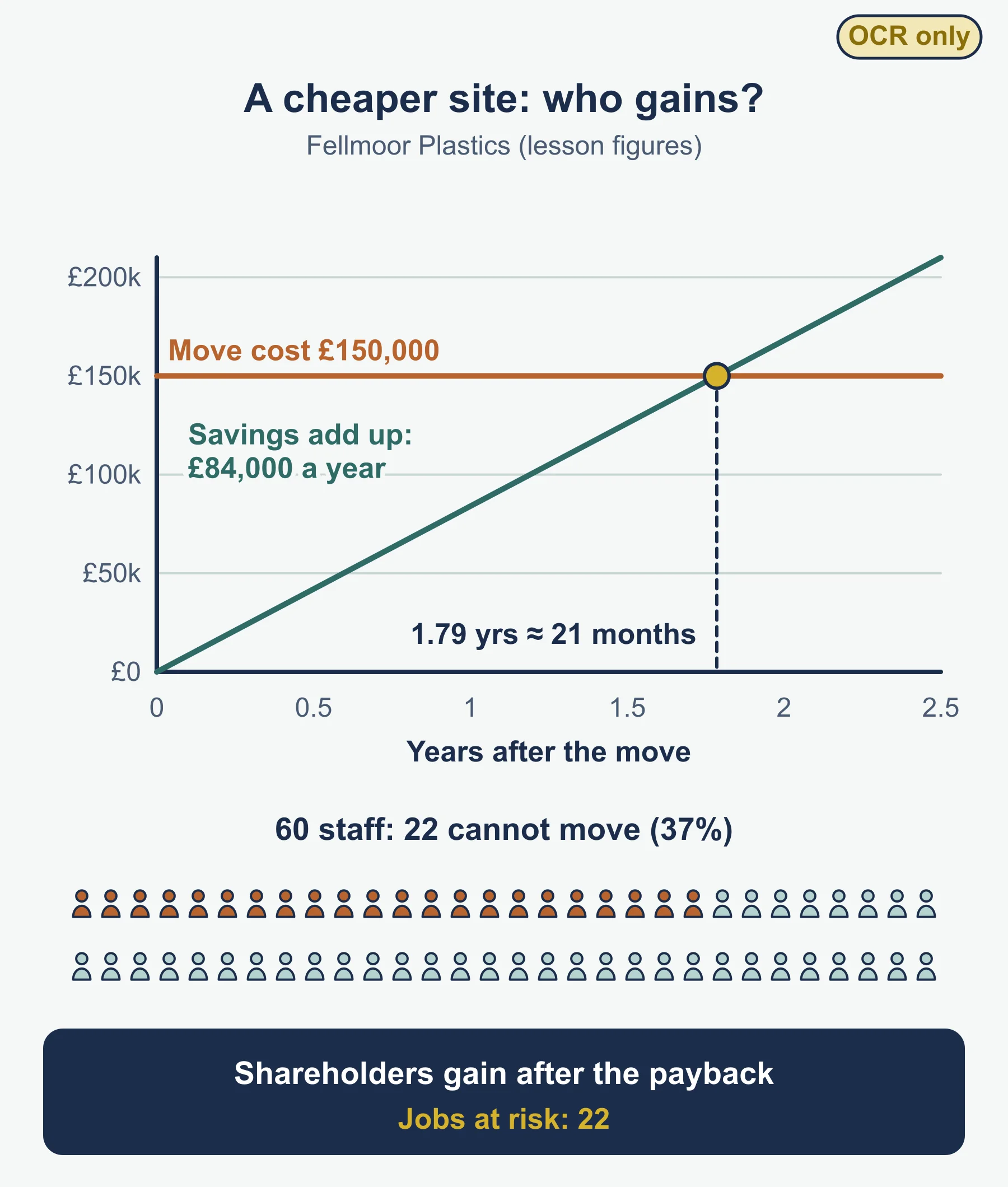
Worked example: Fellmoor Plastics Ltd. The directors plan to move production to a cheaper site 40 km away. Unit cost falls from £6.50 to £5.80 on 120,000 units a year, a saving of 0.70 × 120,000 = £84,000 a year. The move costs £150,000, so the cost is recovered in 150,000 ÷ 84,000 = 1.79 years, about 21 months. Of the 60 employees, 22 say they cannot move, which is 37% of the workforce.
- Shareholders gain: higher profit after the payback period.
- Employees lose: 22 jobs are at risk, and staff who stay face a longer journey.
- Local community: loses an employer, but may gain less traffic.
- Customers: may gain if savings are passed on, but may suffer disruption during the move.
- Suppliers: orders may shift to different firms.
A good judgement says that the saving is real but the benefit goes to a few while the cost falls on many. The move is sensible only if the business keeps skilled staff, perhaps through transport help or a phased transfer, and communicates early.
Common errors
- Writing “make money” as an aim, then confusing it with a corporate objective.
- Treating a tactical action as a strategic objective.
- Naming stakeholders without saying what each wants.
- Listing conflicts without explaining why they arise.
- Stating that stakeholders are “all equally important”.
- Giving a recommendation that ignores the sector or the size of the business.
Frequently asked questions
What is the hierarchy of objectives? It is the chain from the organisational aim to corporate, strategic, tactical and operational objectives, where each level supports the one above it. OCR’s text does not set out these definitions, so they are the standard ones.
What does SMART stand for? Specific, measurable, achievable, realistic and time-bound; some courses use “agreed” or “attainable” for the A. SMART is the standard form and is not spelt out in the specification.
Why do business objectives change? They change when the business or its environment moves on, for example after a recession or change in demand, new competitors or technology, or growth of the business.
Why does a business need to manage stakeholder conflict? Unresolved disputes can lead to strikes, lost customers, withdrawn finance, bad publicity, legal action or planning refusal. Options include prioritising powerful groups, compromise, early consultation and compensation or phased change.
Do you have to own part of a business to be a stakeholder? No. A stakeholder is any person or group that has a stake in what a business does or is touched by its actions, so ownership is not required.
Official syllabus
OCR Level 3 Advanced GCE in Business (H431), specification Version 2.1 (January 2026), for first assessment in 2017, published by OCR. This guide covers the area “Business objectives and strategy” content headed “Different stakeholder and business objectives” and “Stakeholders”.
Get free revision emails (optional)
Occasional emails with practice questions, worked explanations and links to free resources for the qualification and subjects you choose. No spam, and you can unsubscribe from any email. The free tools on this site never need an email.
Related resources
-
Practice questions
OCR A Level Business: Different stakeholder and business objectives and Stakeholders (H431) – Practice Questions
Original practice questions with worked answers on objectives, SMART targets and stakeholder conflict for OCR A Level Business H431, sections 1.1 and 1.2.
Business · OCR · A Level
Try questions -
Revision notes
OCR A Level Business: Different stakeholder and business objectives and Stakeholders (H431) – Revision Notes
Condensed recall notes on the hierarchy of objectives, SMART targets and stakeholder conflict for OCR A Level Business H431, sections 1.1 and 1.2.
Business · OCR · A Level
Revise topic -
Study guides
OCR A Level Business: Forecasting (H431)
Study guide to forecasting for OCR A Level Business (H431): qualitative methods, moving averages, correlation and seasonal and cyclical variation.
Business · OCR · A Level
Read guide
Related articles
-
teaching
A Level tuition in Dubai: Cambridge or Pearson Edexcel International A Level?
Schools in Dubai and Abu Dhabi teach either Cambridge International AS & A Level or Pearson Edexcel International A Level. How the two are structured, why it matters for tuition, and how online classes from Lahore work.
9 October 2026
-
curriculum guides
Choosing subjects at IGCSE and A Level
How subject choices at 14 and 16 affect university options later, and how to keep pathways open without overloading a timetable.
28 July 2026
Studying this with a teacher
Working through Business A LEVELS?
This page is free and stays free. If you would rather be taught it, Marlbridge runs Business classes one-to-one, online in your own time zone. One-to-one only for this course: Rs 6,000 per class in Pakistan, with other currencies on the fees page. The first trial class is free. WhatsApp replies within an hour (8am–11pm Pakistan time, every day); email the same day.
OCR Business teachers at Marlbridge
