
Revision Notes
OCR A Level Business: Different stakeholder and business objectives and Stakeholders (H431) – Revision Notes
Condensed recall notes on the hierarchy of objectives, SMART targets and stakeholder conflict for OCR A Level Business H431, sections 1.1 and 1.2.
- Subject
- Business
- Level
- A LEVELS
- Topic
- Business objectives and strategic decisions
- Author
- Marlbridge Academic Team
- Updated
- Reviewed by
- Salman Ahmad (what this means)
Aligned to OCR A Level Business (H431), Version 2.1 (January 2026), for first assessment in 2017; final assessment summer 2027. Official specification .
Syllabus page (what it covers and how it is assessed): OCR A Level Business.
Syllabus points this page covers
H431
- 1.1 Different stakeholder and business objectives
- 1.2 Stakeholders
Found an error? Report a correction.
Need help with this topic? Request a free trial class for A Level Business (H431).
These are condensed notes for the OCR A Level Business (H431) content “Different stakeholder and business objectives” and “Stakeholders”, from the specification at Version 2.1 (January 2026), whose final assessment is summer 2027. For full explanations and a worked case, use the study guide. Test yourself with the practice questions. Related pages are the Objectives and Strategic Decisions study guide, the topic revision notes and the topic practice set. Links for the course are the OCR A Level Business hub, the checklist and the free 10-minute diagnostics.
The hierarchy of objectives
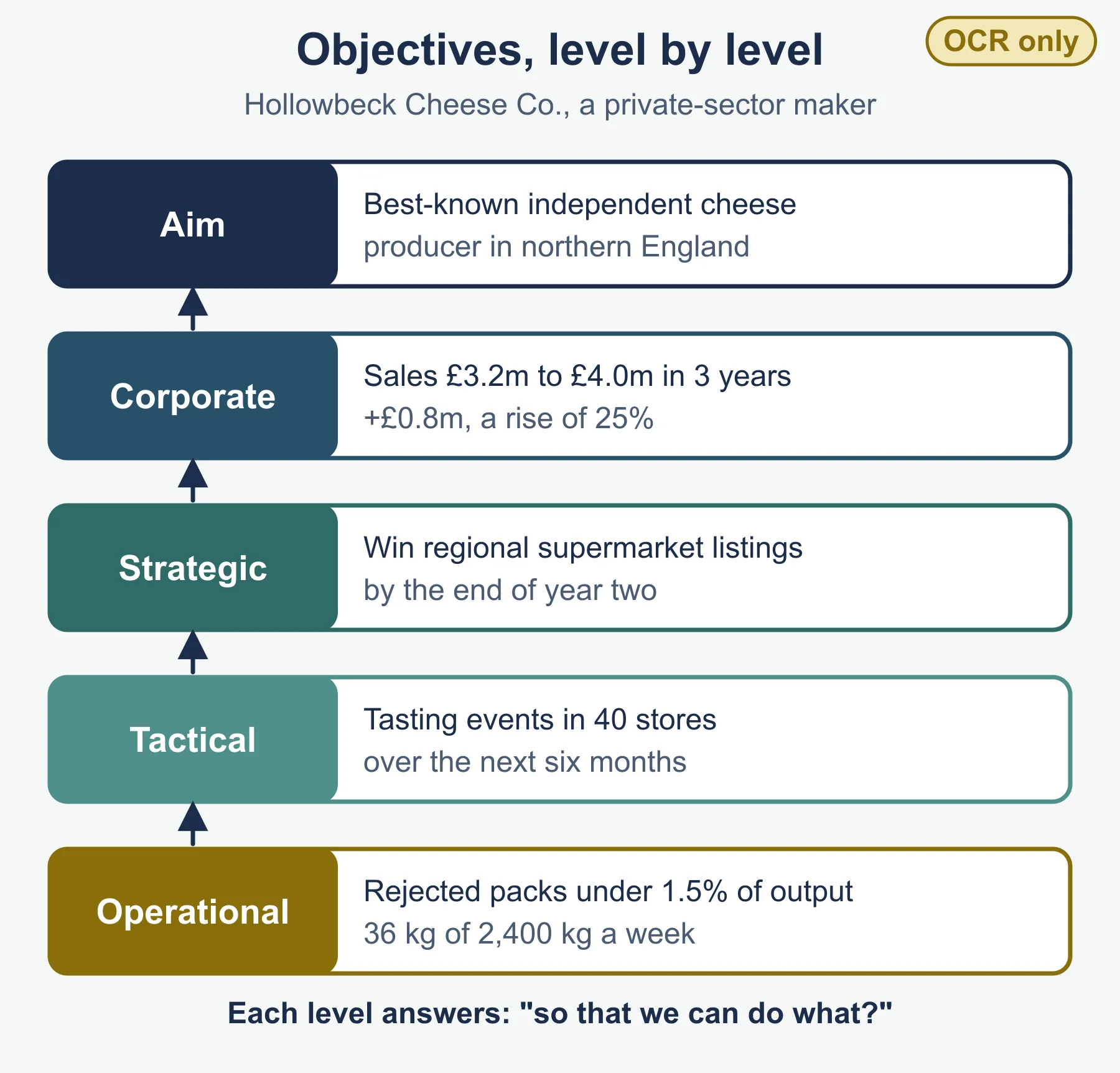
The five terms below are the ones OCR asks you to distinguish. The definitions are the standard forms.
| Level | What it is | Who sets it | Typical time span | Example (Sedgecombe Cycles) |
|---|---|---|---|---|
| Organisational aim | Broad purpose or ambition | Owners, board | Long term, no end date | Be the first choice for everyday cyclists in the county |
| Corporate (business) objective | Measurable target for the whole business | Board, directors | Several years | Raise sales revenue from £1.5m to £1.8m in three years |
| Strategic objective | Target showing how the corporate objective will be met | Senior managers | Medium to long term | Open an online shop by the end of year one |
| Tactical objective | Target for a department or team that delivers the strategy | Middle managers | Months | Launch a delivery service in the town by June |
| Operational objective | Day-to-day target for a person, shift or process | Supervisors | Days or weeks | Answer every web enquiry within four hours |
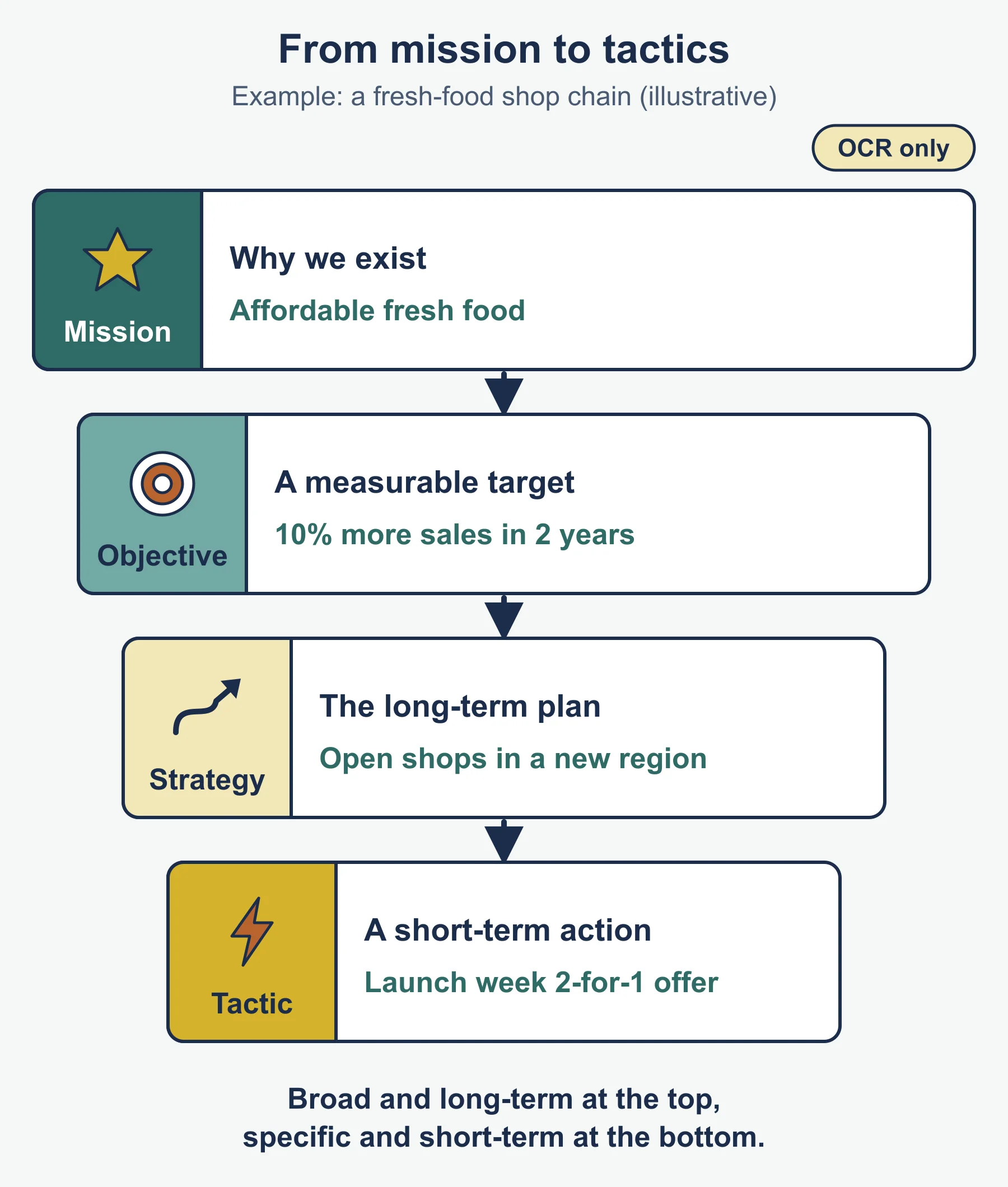
Memory line: each level answers “so that we can do what?” for the level below it.
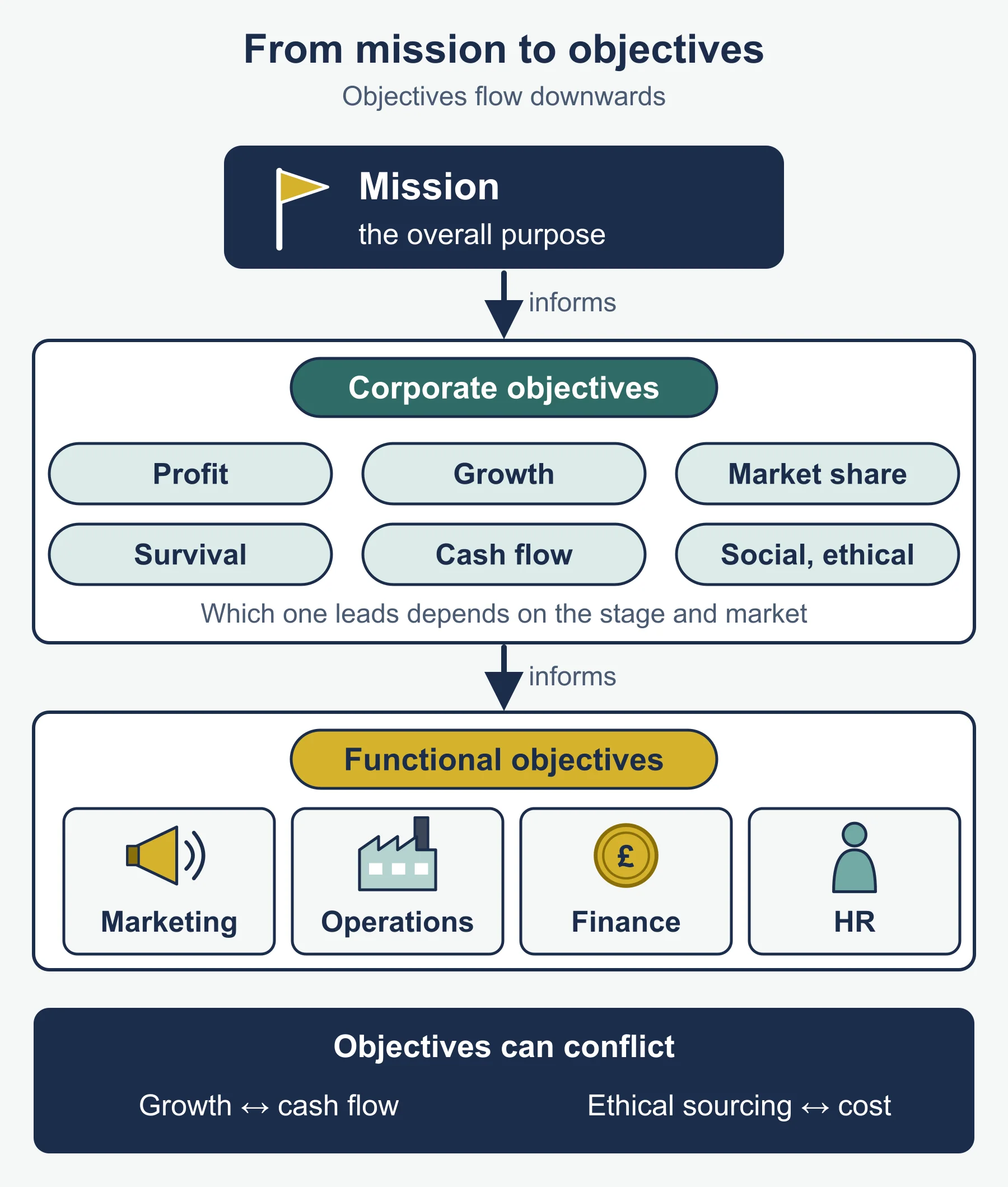
Hierarchy of objectives means the cascade from aim to operational target, each level supporting the one above. Its value is that effort in different departments points the same way. The risk is that top-level targets are passed down without explanation.
SMART objectives
| Letter | Standard meaning | Test |
|---|---|---|
| S | Specific | Is it clear what is to be done? |
| M | Measurable | Is there a number to track? |
| A | Achievable | Can the people involved do it? |
| R | Realistic | Do resources and the market allow it? |
| T | Time-bound | Is there a deadline? |
Some courses read A and R differently (“agreed”, “relevant”). Use one wording consistently.
- Importance to the business: direction, monitoring, a basis for judging decisions.
- Importance to stakeholders: staff know what is expected, investors can judge progress, lenders can assess risk.
- Weakness: can focus attention on what is easy to measure; may become out of date.
Setting aims and objectives: evaluate
| Case for | Case against |
|---|---|
| Focus and direction | Time and cost to set and review |
| Measures success | Targets can distort behaviour |
| Motivates if shared | Can be rigid when markets change |
| Reassures investors and lenders | Objectives can conflict with each other |
Judgement line: they help most when few, linked, reviewed and explained.
Sector and objectives
| Sector | Usual emphasis |
|---|---|
| Private | Profit, return to owners, growth, survival |
| Public | Service quality, access, value for money, budget control |
| Third | Social purpose, surplus reinvested |
Sector sets a tendency, not a rule. A private firm can have a social aim; a public body may still need to balance its books.
Communicating objectives
- Methods: briefings, meetings, email and intranet, noticeboards, appraisals, written plans, reports and websites for outsiders.
- Consequences of mis-communication: conflicting effort, duplicated work, low morale, lost trust, wasted resources, investor and customer doubt.
- Better communication: use several channels, plain language, link targets to each person’s role, seek feedback, repeat on a schedule, explain reasons.
- Evaluate by: cost, size of workforce, complexity of message, location of staff.
Why objectives change
Recession or demand shift; new competitor or technology; growth or ownership change; missed targets; changes in law or public attitudes; crisis or survival threat; the stage the business has reached.
Recommend and justify objectives: method in steps
- Choose the objective and write it in SMART form.
- Link it to the business’s stage, sector and the evidence in the case.
- Say who must deliver it and how it will be communicated.
- Say how change will be implemented: explain the reason, involve staff, phase it, review.
- Weigh one risk or alternative and give a reasoned choice.
Stakeholders
Stakeholder: any person or group that has a stake in what a business does or is touched by its actions.
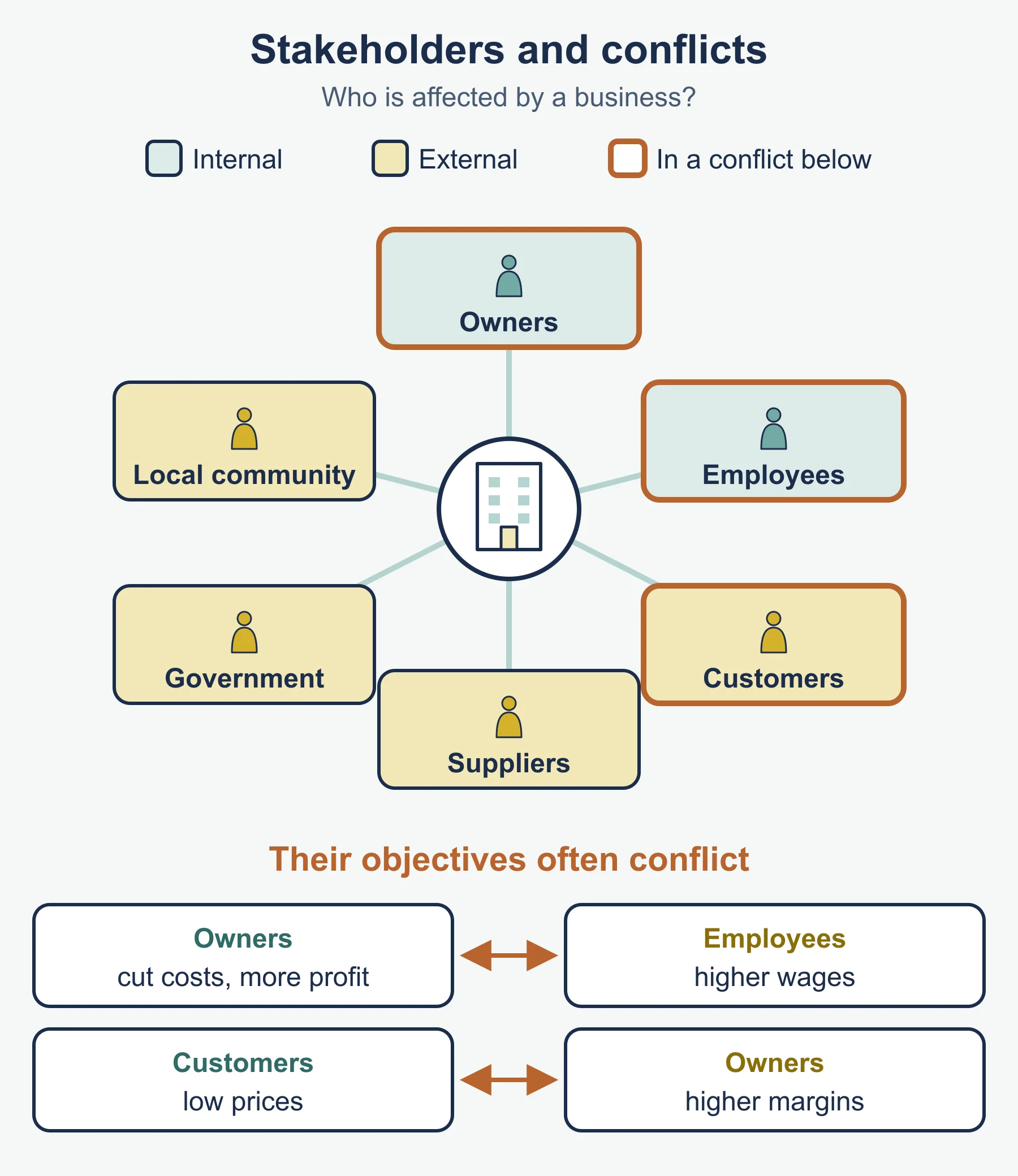
| Internal | External |
|---|---|
| Owners and shareholders, directors, managers, employees | Customers, suppliers, lenders, competitors, local community, government, pressure groups, media |
Stakeholder objectives
| Group | Objective |
|---|---|
| Shareholders | Dividends, rising share value |
| Managers | Targets met, pay, status |
| Employees | Pay, security, conditions, training |
| Customers | Quality, price, service |
| Suppliers | Regular orders, prompt payment |
| Lenders | Repayment, low risk |
| Community | Jobs, low disruption, clean environment |
| Government | Tax, compliance, employment |
| Pressure groups | Change on a single issue |
Conflict
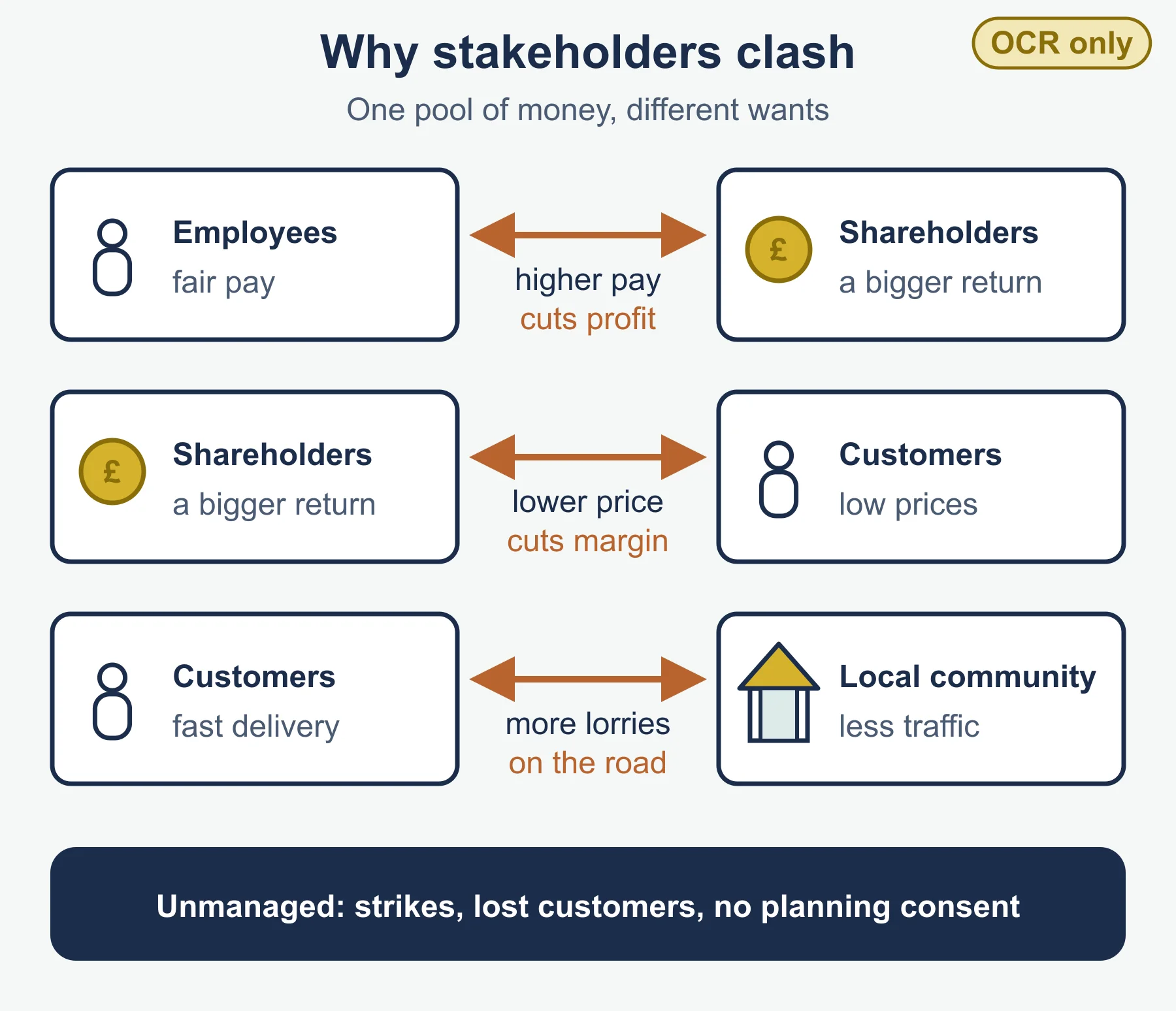
- Reasons: different goals; limited resources; short term against long term; different power and information.
- Why manage it: avoid strikes, lost customers, withdrawn finance, bad publicity, planning or legal trouble and wasted management time.
- Impact: delay and cost; possibly a better-tested decision; damaged trust if one group is always overruled.
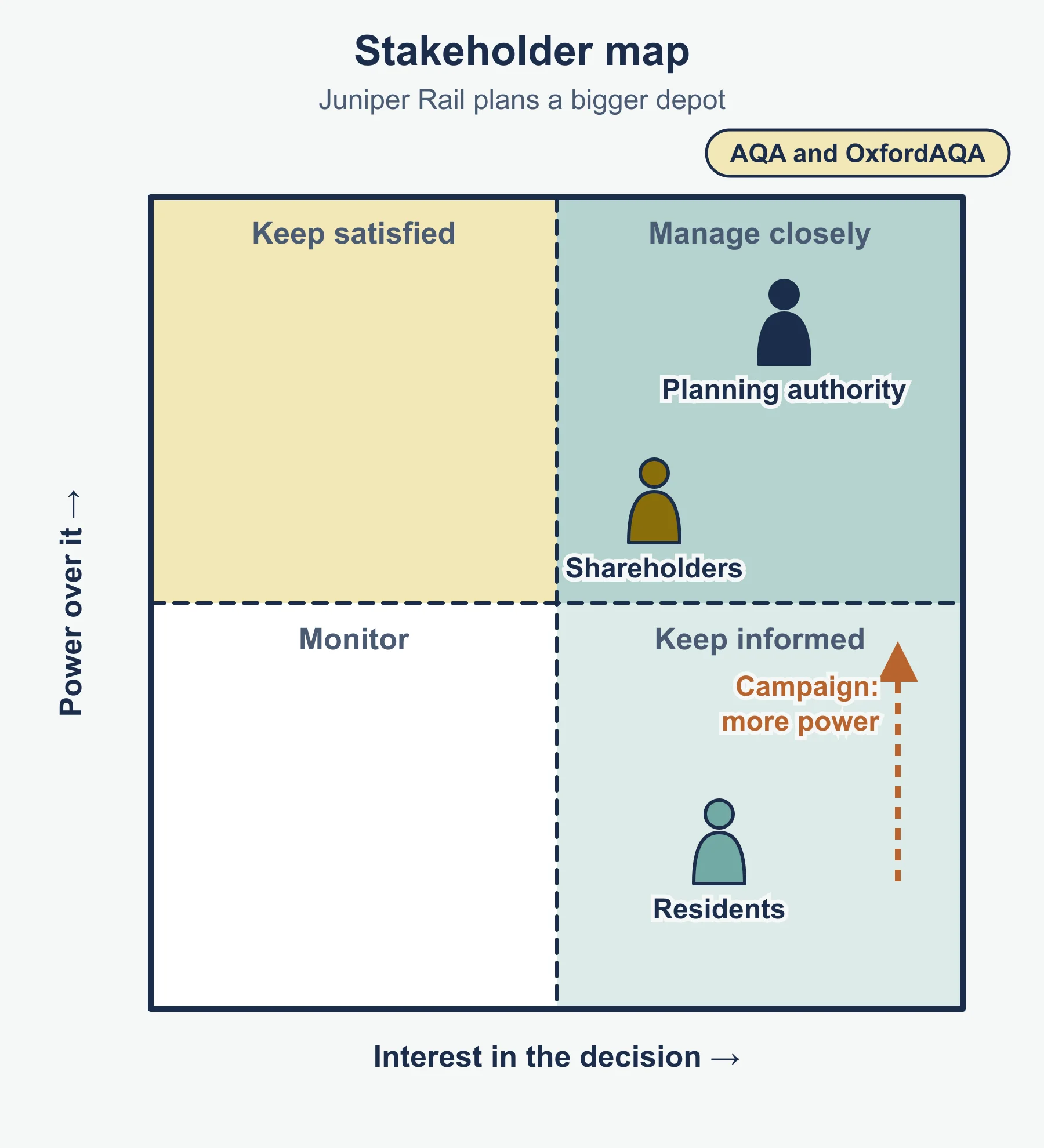
- Ways to deal with it: prioritise by power and interest, compromise, consult early, compensate or phase, or change the decision.
Influence and impact
| Aspect influenced | Example |
|---|---|
| Aims and objectives | Owners demand profit targets |
| Decision making | Lenders attach conditions |
| Behaviour | Customers favour ethical products |
| Performance | Staff effort and turnover |
Impact of a decision: list each group, state gain or loss, then judge who benefits most and what the business could do to soften the loss.
Worked reminders
Objective cascade. A business aims to be the leading local supplier of school uniforms. Corporate objective: raise sales revenue by 10% in two years. Strategic objective: add an online ordering service. Tactical objective: test the website with three schools this term. Operational objective: pack every order within 48 hours. Check each level links upwards.
Percentage target. Target revenue = current revenue × (1 + growth rate). A firm earning £2.0m that seeks 15% growth needs £2.0m × 1.15 = £2.3m, an increase of £0.3m.
Conflict analysis in four moves.
- Name the two groups and what each wants.
- Say why the wants cannot both be met (shared money, time, space).
- Judge which group has more power or interest in this case.
- Recommend a compromise or priority, and state who loses.
Evaluation phrases that carry weight. “This depends on…”, “In the short run… but in the long run…”, “The group with most power here is… because…”, “The business could soften this by…”. Always end with a judgement tied to the case.
Must-know distinctions
- Aim against objective: an aim is broad and may have no number; an objective is a target and should be measurable.
- Strategic against tactical: strategic means senior managers, longer term and bigger resources; tactical means middle managers and shorter term.
- Tactical against operational: tactical belongs to a team or department; operational is the daily task.
- Internal against external: inside the organisation or outside it. Check owners, lenders and managers carefully.
- Influence against interest: a group can care greatly (interest) yet hold little power (influence).
Quick self-test
- Which level of the hierarchy is a day-to-day target for a team member?
- Give two reasons why SMART objectives matter to stakeholders.
- Name the three sectors the specification asks you to distinguish.
- A firm with sales revenue of £2.0m sets a corporate objective of 15% growth. State the target revenue.
- State one internal and one external stakeholder of a firm.
- Give two reasons why stakeholder objectives conflict.
- Why might a lender resist a risky expansion?
- Give one way a business can improve the communication of its objectives.
- Name two reasons why objectives may need to change.
- Why might a business prioritise one stakeholder group in a conflict?
Answers
- Operational.
- Staff know what is expected of them; investors or lenders can judge progress; customers can see what is promised.
- Private, public and third sector.
- £2.0m × 1.15 = £2.3m (an increase of £0.3m).
- Internal: employees (or owners, managers). External: customers (or suppliers, lenders, community).
- Any two of: different goals; limited resources; short-term against long-term views; different power.
- Its priority is repayment with low risk, and expansion raises the chance of a shortfall.
- For example: use several channels, link targets to each person’s role, or ask for feedback.
- Any two of: recession, new competitor, ownership change, missed targets, crisis.
- Because of its power or interest, or because the objectives of the business depend on that group’s support.
Where marks are usually lost
- Writing a long-term ambition and calling it an operational objective.
- Listing SMART letters without applying them to an objective in the case.
- Treating the sectors as fixed rules, rather than as tendencies.
- Naming stakeholders without saying what each wants.
- Explaining that conflict exists without saying why it arises.
- Evaluating conflict with no reference to which group has power.
- Recommending an objective with no reason linked to the case.
- Stating that every stakeholder must be satisfied, when the question asks for a choice.
- Forgetting that stakeholders can also help a business, as well as constrain it.
Frequently asked questions
What is the difference between an aim and an objective? An aim is a broad, long-term purpose that may have no number. An objective is a target and should be measurable.
What is the difference between stakeholder influence and interest? Interest is how much a group cares about the business’s actions; influence is how much power it has to affect them. A group can have great interest yet little influence.
What is the difference between strategic, tactical and operational objectives? Strategic objectives are set by senior managers for the longer term with bigger resources; tactical objectives belong to a team or department over a shorter term; operational objectives are daily tasks.
Are all stakeholders equally important? No. Stating that stakeholders are all equally important is a common error, since their power, interest and the decision in question differ.
Official syllabus
OCR Level 3 Advanced GCE in Business (H431), specification Version 2.1 (January 2026), for first assessment in 2017, published by OCR. The notes cover the content “Different stakeholder and business objectives” and “Stakeholders”.
Get free revision emails (optional)
Occasional emails with practice questions, worked explanations and links to free resources for the qualification and subjects you choose. No spam, and you can unsubscribe from any email. The free tools on this site never need an email.
Related resources
-
Study guides
OCR A Level Business: Forecasting (H431)
Study guide to forecasting for OCR A Level Business (H431): qualitative methods, moving averages, correlation and seasonal and cyclical variation.
Business · OCR · A Level
Read guide -
Practice questions
OCR A Level Business: Forecasting (H431) – Practice Questions
Original practice questions with worked answers on forecasting for OCR A Level Business (H431): qualitative methods, moving averages and cash flow.
Business · OCR · A Level
Try questions -
Revision notes
OCR A Level Business: Forecasting (H431) – Revision Notes
Condensed revision notes on forecasting for OCR A Level Business (H431): methods, formulas, moving averages, correlation, a self-test and lost marks.
Business · OCR · A Level
Revise topic
Related articles
-
teaching
A Level tuition in Dubai: Cambridge or Pearson Edexcel International A Level?
Schools in Dubai and Abu Dhabi teach either Cambridge International AS & A Level or Pearson Edexcel International A Level. How the two are structured, why it matters for tuition, and how online classes from Lahore work.
9 October 2026
-
curriculum guides
Choosing subjects at IGCSE and A Level
How subject choices at 14 and 16 affect university options later, and how to keep pathways open without overloading a timetable.
28 July 2026
Studying this with a teacher
Working through Business A LEVELS?
This page is free and stays free. If you would rather be taught it, Marlbridge runs Business classes one-to-one, online in your own time zone. One-to-one only for this course: Rs 6,000 per class in Pakistan, with other currencies on the fees page. The first trial class is free. WhatsApp replies within an hour (8am–11pm Pakistan time, every day); email the same day.
OCR Business teachers at Marlbridge
