
Study Guides
OCR A Level Business: Mission statement and Corporate social responsibility (CSR) (H431)
Study guide to mission statements and corporate social responsibility for OCR A Level Business, with worked examples and evaluation skills.
- Subject
- Business
- Level
- A LEVELS
- Topic
- Business objectives and strategic decisions
- Author
- Marlbridge Academic Team
- Updated
- Reviewed by
- Salman Ahmad (what this means)
Aligned to OCR A Level Business (H431), Version 2.1 (January 2026), for first assessment in 2017; final assessment summer 2027. Official specification .
Syllabus page (what it covers and how it is assessed): OCR A Level Business.
Syllabus points this page covers
H431
- 1.3 Mission statement
- 1.4 Corporate social responsibility (CSR)
Found an error? Report a correction.
Need help with this topic? Request a free trial class for A Level Business (H431).
This study guide covers sections 1.3 (Mission statement) and 1.4 (Corporate social responsibility (CSR)) of the OCR A Level Business specification (H431, Version 2.1, January 2026), within Business objectives and strategy. Both sections sit alongside the wider topic notes in Business objectives and strategic decisions, the topic revision notes and the topic practice questions. Pair this guide with the revision notes and the practice set. Course hub: OCR A Level Business. Printable list: checklist. To find weak spots first, try the free diagnostics.
What the specification asks you to do
The specification lists what you must be able to do but does not set out definitions or formulae. The definitions here, and the profit, percentage and payback calculations, are standard forms.
| Section | Learners should be able to |
|---|---|
| 1.3 Mission statement | explain the nature and purpose of a mission statement; recommend and justify a suitable mission statement for a business; evaluate the advantages and disadvantages of having one; evaluate the impact of changing a mission statement on a business and its stakeholders |
| 1.4 CSR | explain what CSR means; explain the potential conflict between CSR and profit and other objectives; evaluate the impact and importance of a CSR policy; evaluate the advantages and disadvantages of a CSR profile; recommend and justify how to improve a CSR profile; evaluate the impact and importance of CSR to a business and its stakeholders |
The command words matter. “Explain” needs a point and a reason. “Evaluate” needs both sides and a judgement. “Recommend and justify” needs a clear choice, supported by reasons that fit the business in front of you.
1.3 Mission statement
Nature and purpose
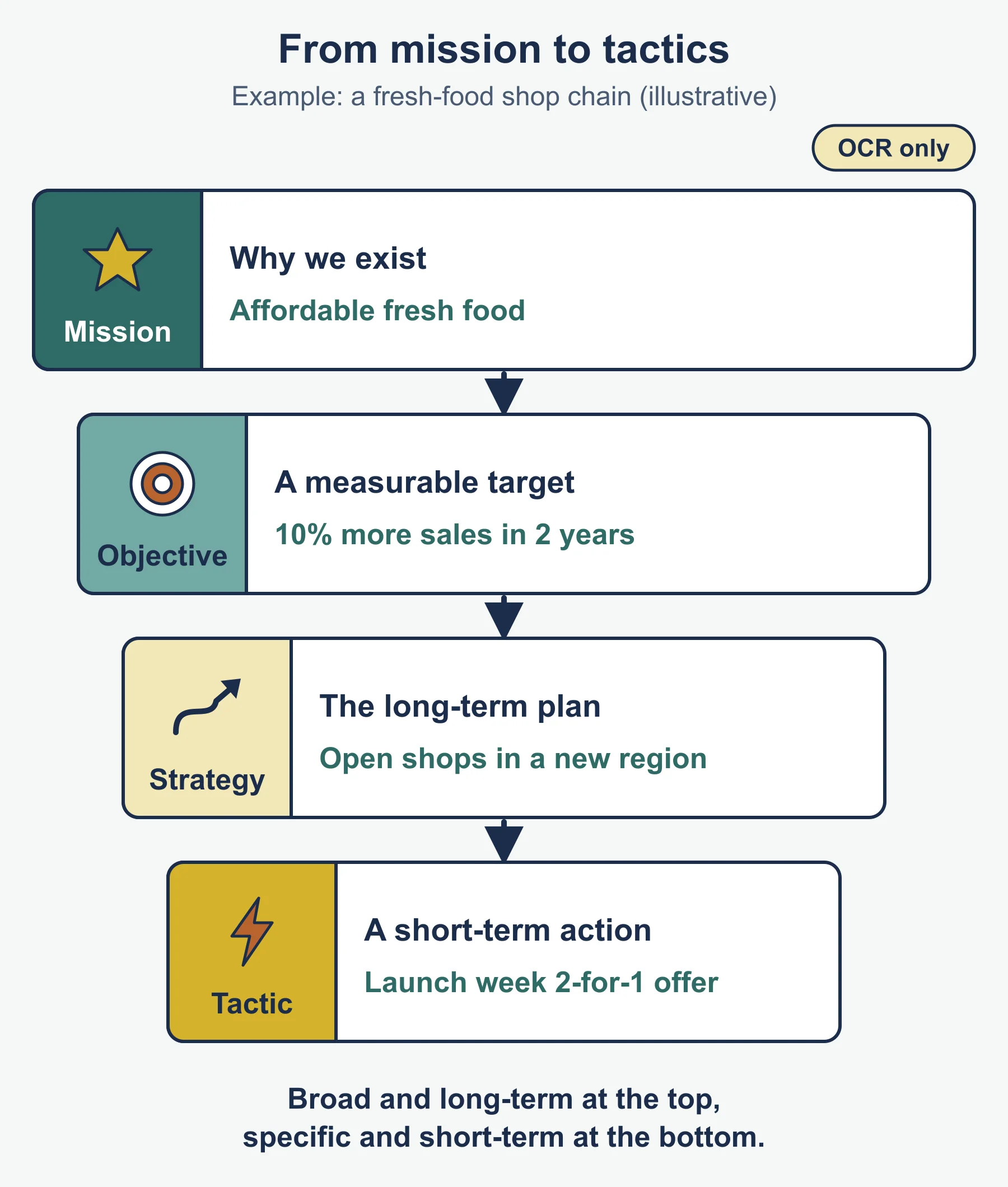
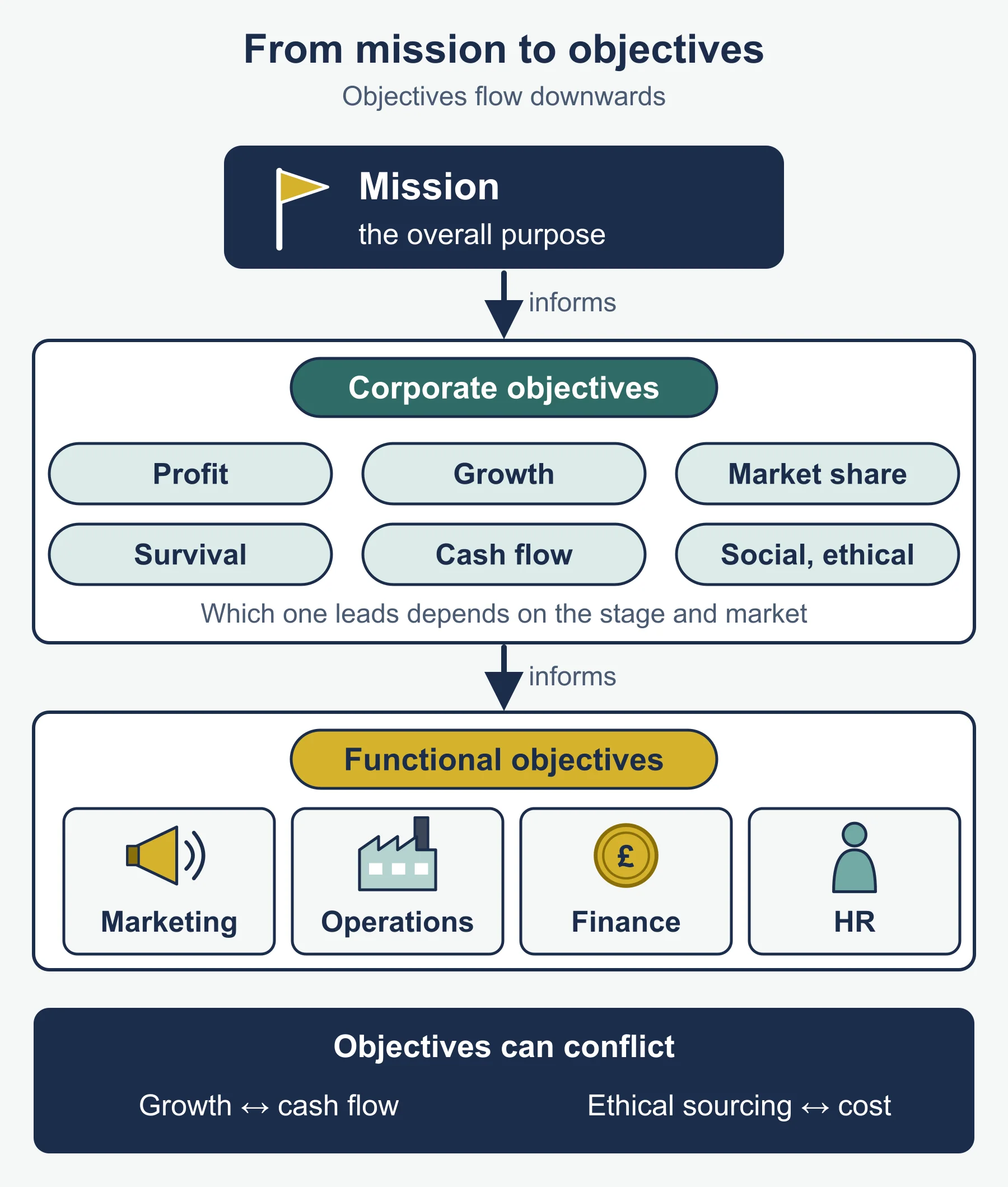
A mission statement is a short, public statement of what a business is for: what it does, for whom, and often how or why. It sits at the top of the planning chain. Aims and objectives, strategy and tactics should all be consistent with it.
The nature of a good statement:
- It is brief enough to remember.
- It describes the present purpose and the direction of travel, not a single year’s target.
- It is broad enough to last several years but specific enough to rule some things out.
- It is usually general rather than numerical. A figure such as a profit target is an objective, not a mission.
Its purposes include:
- giving managers and staff a common sense of direction;
- guiding decisions, because a proposal can be tested against it;
- telling customers, investors, suppliers and the community what the business stands for;
- supporting the culture and the employer brand.
Worked example: writing and justifying a statement
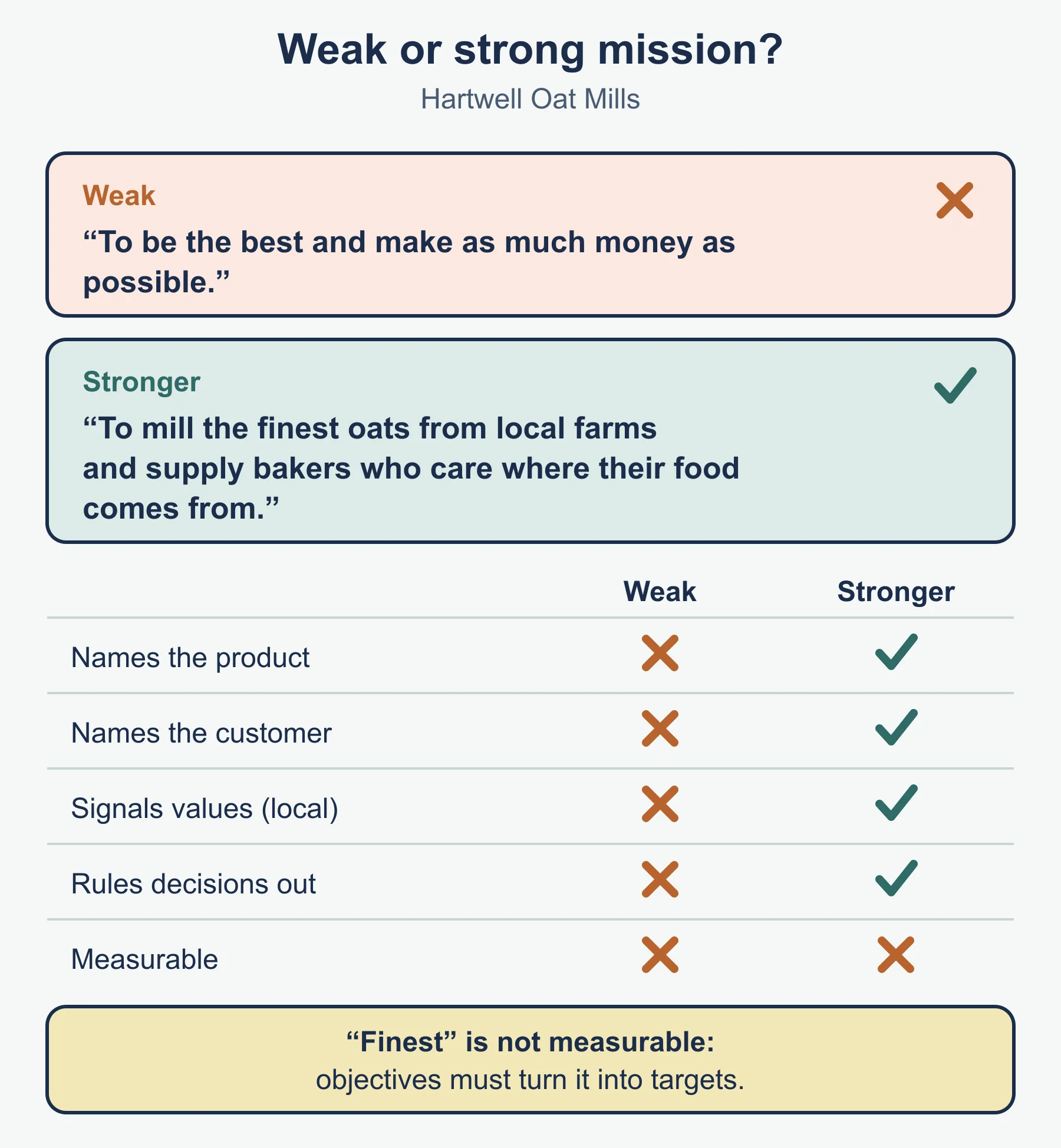
Hartwell Oat Mills is a family-owned business milling oats from farms within 60 miles. It sells to bakeries and cafés, is proud of local sourcing, and wants to grow slowly without losing quality.
A weak statement: “To be the best and make as much money as possible.” It is vague, not distinctive, and says nothing to staff or farmers.
A stronger statement: “To mill the finest oats from local farms and supply bakers who care where their food comes from.”
Justification (this is what earns the marks on a “recommend and justify” question):
- It names the product and the customer, so it fits the actual business.
- “Local farms” signals values to farmers and to environmentally minded customers, two stakeholder groups.
- It would help screen decisions. Buying cheap imported oats to cut cost would contradict it.
- It is flexible enough to allow new products such as oat flour, so it will not date quickly.
A fuller answer would add one limitation: “finest” is not measurable, so objectives must turn it into targets.
Advantages of having a mission statement
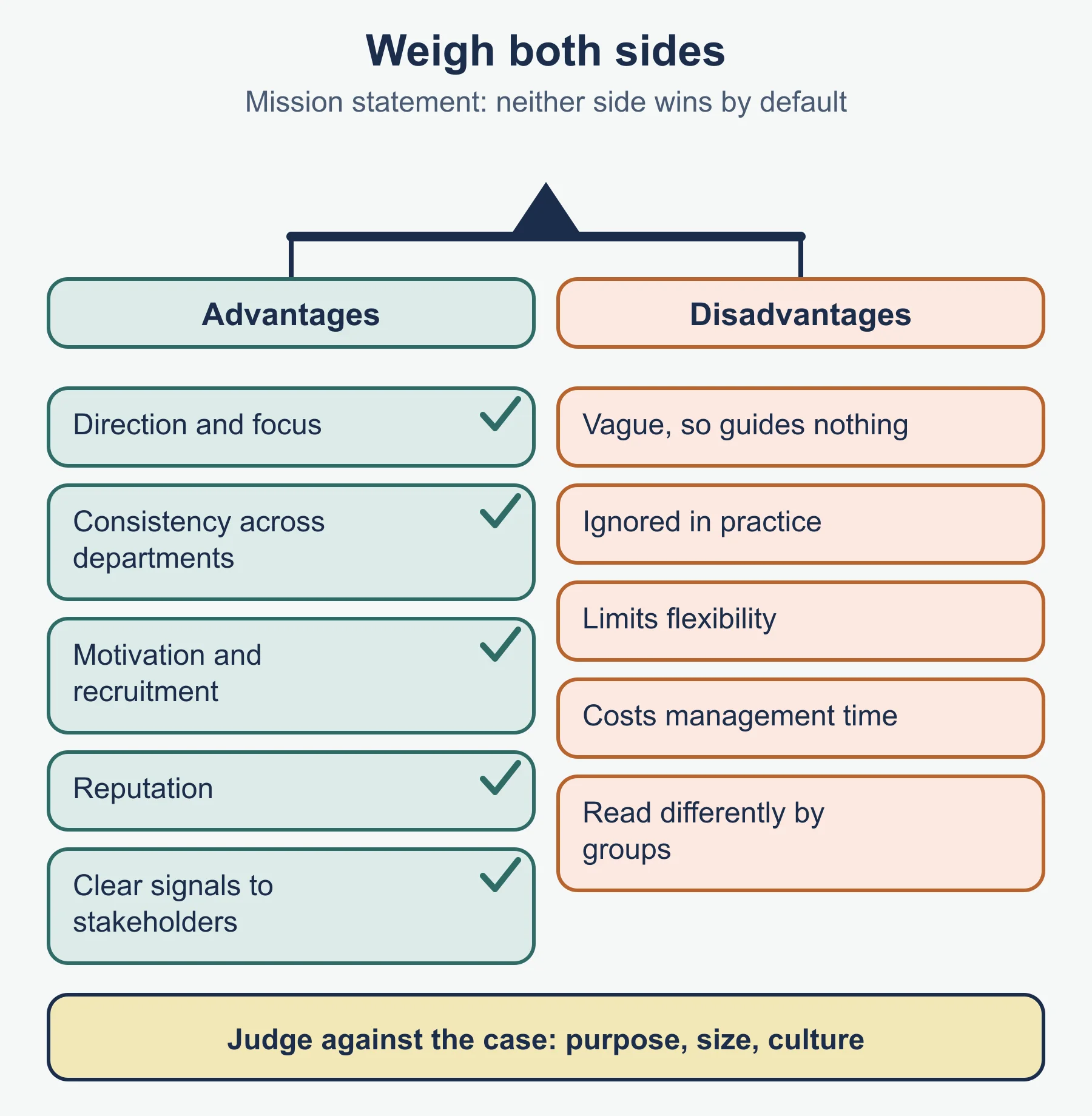
- Direction and focus: managers can reject projects that do not fit.
- Consistency: different departments pull the same way.
- Motivation and recruitment: staff who share the purpose may be more committed.
- Marketing and reputation: it gives customers and investors a reason to prefer the business.
- Stakeholder communication: it signals priorities, such as quality, community or sustainability.
Disadvantages
- It can be vague or full of generic words, so it guides nothing.
- It may be ignored. If actions contradict it, staff and customers become cynical and reputation can suffer.
- It can restrict flexibility. A tightly worded statement may discourage a worthwhile move into a new market.
- It costs management time to write and communicate, with little direct financial return.
- Stakeholders may read different things into it.
Impact of changing a mission statement
A business may change its mission after a takeover, a change of ownership, entry to new markets, a scandal, or a shift in customer values. The impact depends on how far the new wording differs from the old and how well the change is explained.
On the business: the strategy, objectives and branding may need to change, which has costs (new materials, training, signage) and takes time. If the change is credible, it can renew focus and attract new customers. If it looks like a slogan, it can damage trust.
On stakeholders:
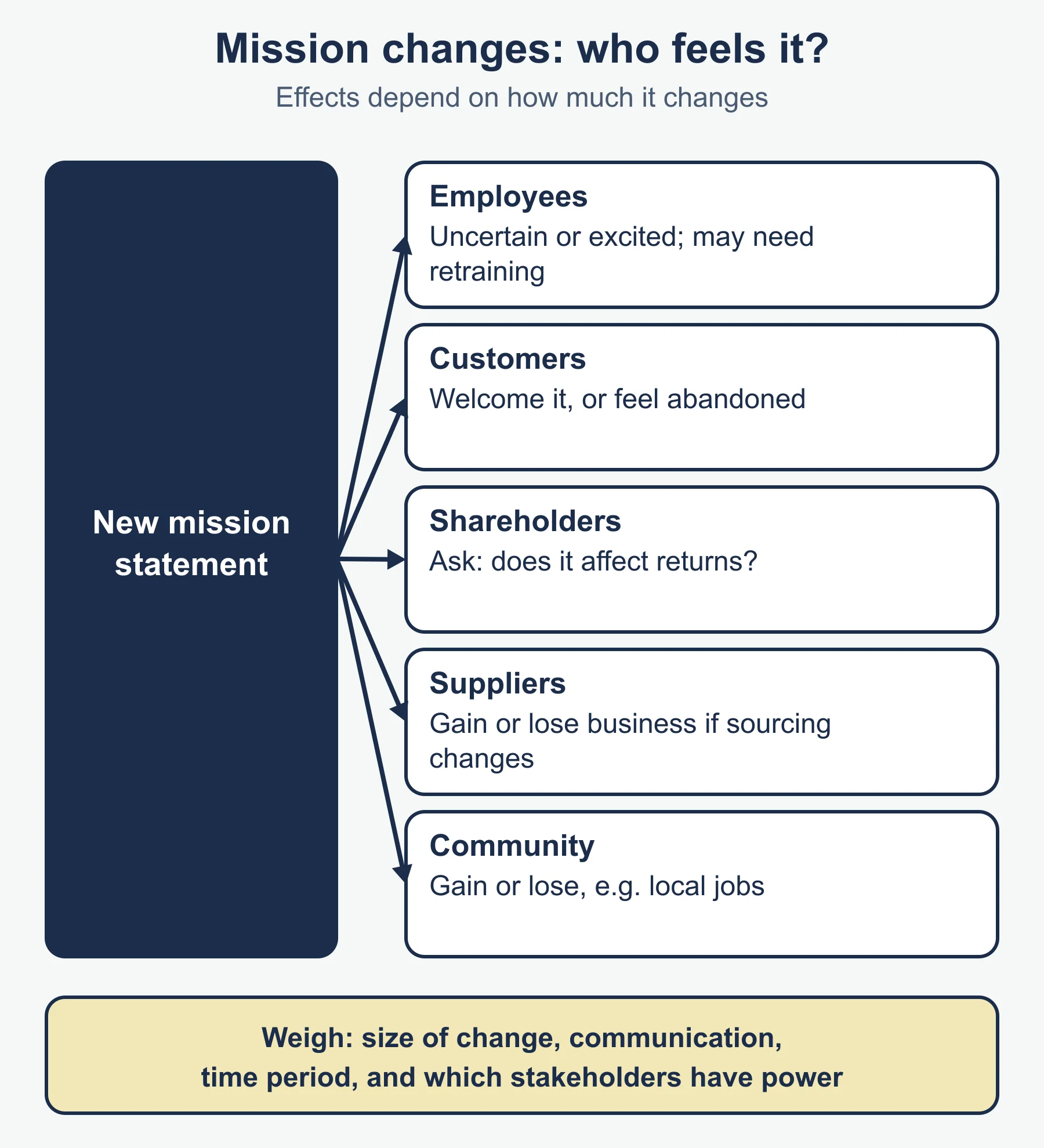
- Employees may feel uncertain, or excited if the change opens opportunities. They may need retraining.
- Customers may welcome it or feel the brand has abandoned them.
- Shareholders and investors will ask whether it affects returns.
- Suppliers may gain or lose business if sourcing priorities change.
- The local community may gain or lose, for example if a commitment to local employment is dropped.
A good evaluation weighs the size of the change, the quality of communication, the time period (short-run disruption against long-run benefit) and the stakeholders with most power.
1.4 Corporate social responsibility (CSR)
What CSR means
Corporate social responsibility is the idea that a business has duties beyond making profit for its owners. It should take account of the effects of its decisions on society, the community and the environment, and act ethically towards all stakeholders, including employees, suppliers, customers and local people. It goes further than obeying the law. CSR is typically voluntary: the business chooses to do more than it must.
Typical CSR actions include fair pay and working conditions, ethical sourcing, reducing waste and emissions, supporting local charities, and honest marketing. A CSR policy sets these commitments out and says how they will be carried out and reported.
The potential conflict with profit and other objectives
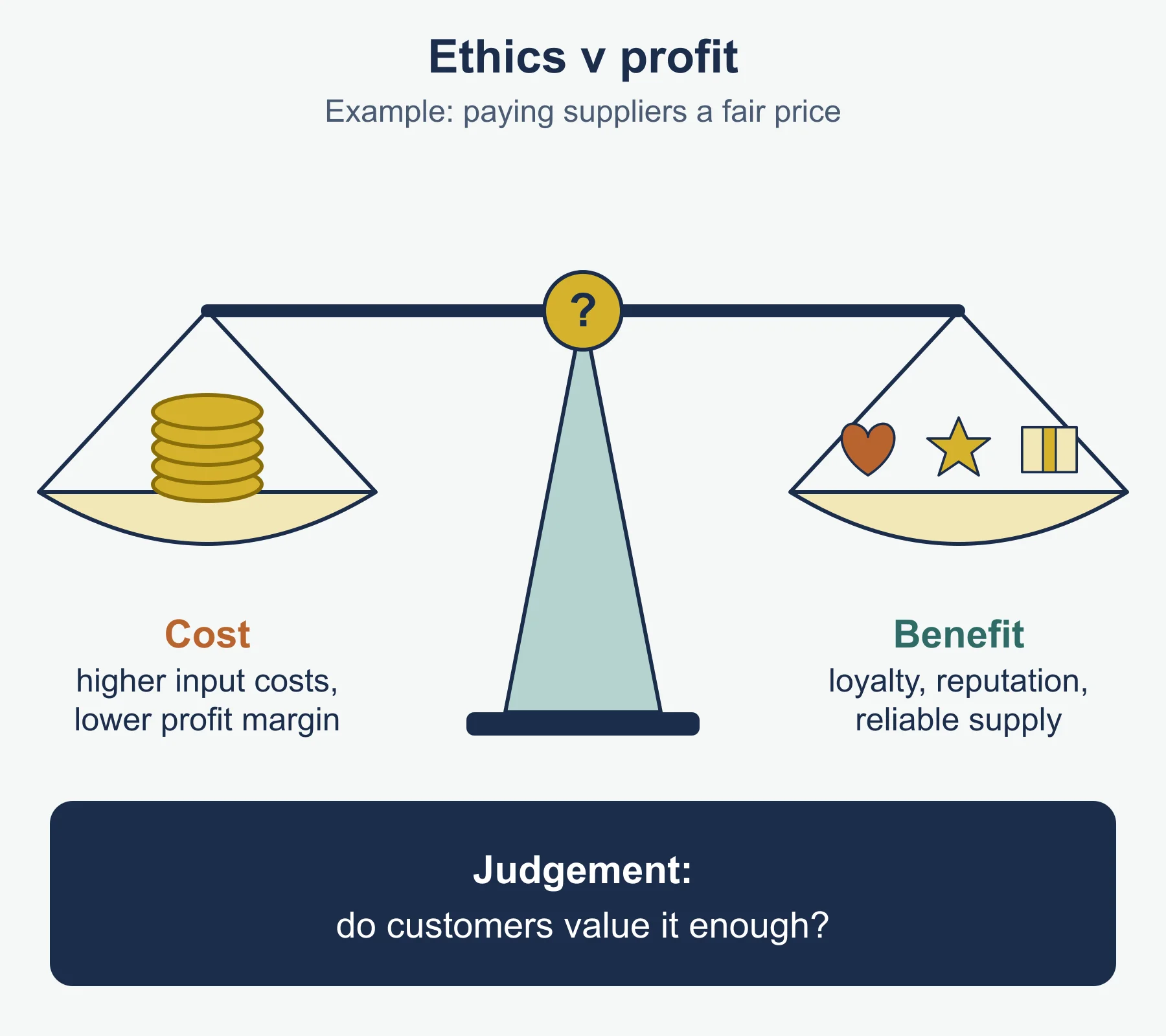
CSR can conflict with profit because it can raise costs or reduce revenue. A business that pays above the market wage, buys more expensive materials or invests in cleaner equipment may see its profit margin fall. Shareholders, especially those who expect high returns, may object.
It can also conflict with other objectives:
- Growth: refusing a profitable contract with a poor supplier can slow expansion.
- Cost leadership: a low-price strategy leaves little room for extra costs.
- Market share: higher prices after ethical changes may lose price-sensitive customers.
- Short-term targets: investments pay back over years.
The conflict is not inevitable. Good CSR can raise sales, help recruitment and retention, reduce risk of fines and bad publicity, and cut costs (for example lower energy use). The usual evaluation point is that the conflict is stronger in the short run and weaker in the long run.
Worked example: the cost of a CSR decision
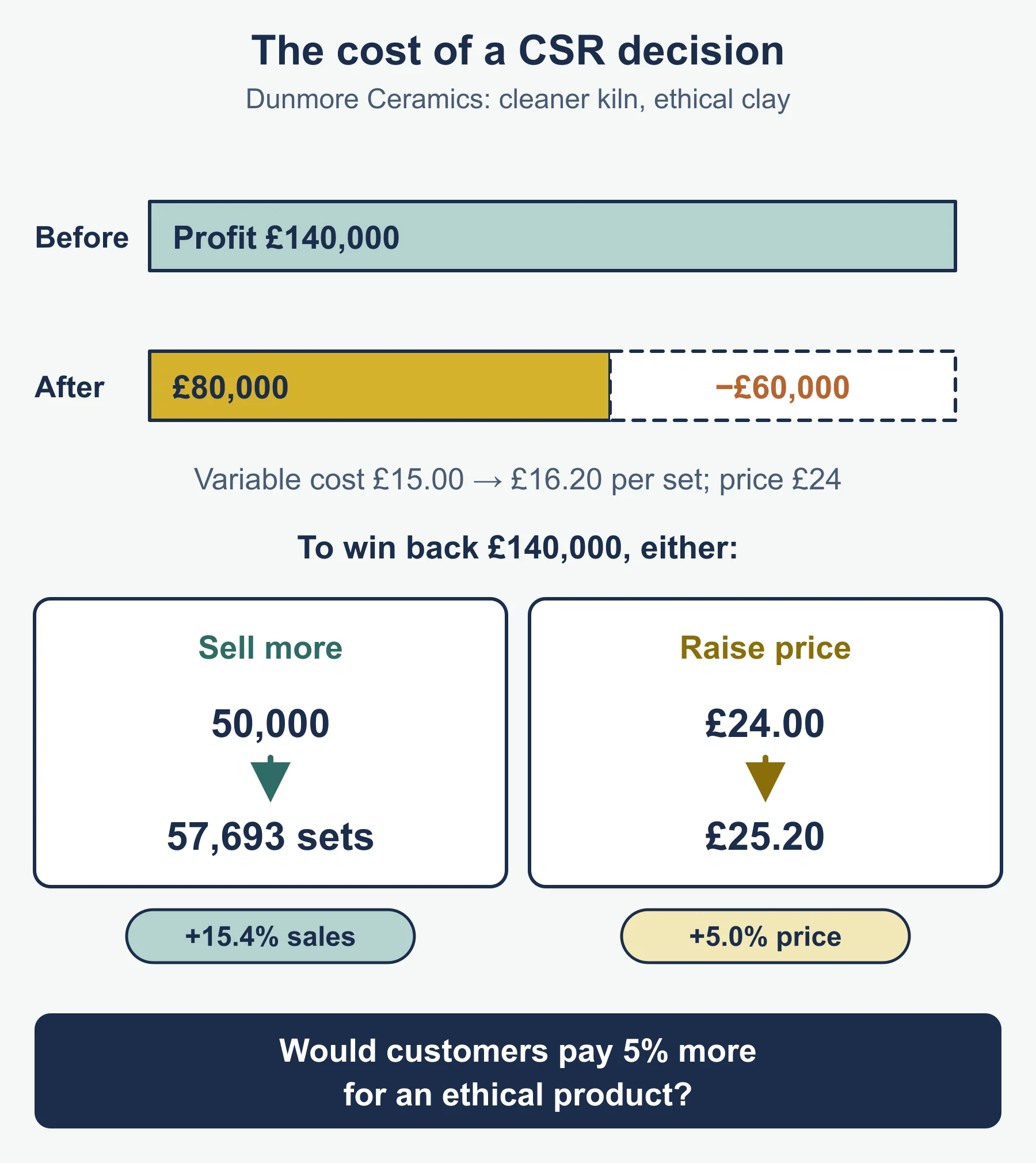
Dunmore Ceramics sells 50,000 mug sets a year at £24. Variable cost is £15 per set and fixed costs are £310,000.
Current profit = (24 − 15) × 50,000 − 310,000 = £140,000.
The directors propose a cleaner kiln and ethically sourced clay. This raises variable cost by £1.20 to £16.20 per set. If price and sales do not change:
New profit = (24 − 16.20) × 50,000 − 310,000 = £80,000, a fall of £60,000 (about 43%).
To restore £140,000 at £24, sales must reach (310,000 + 140,000) ÷ 7.80 = 57,692.3, so 57,693 sets, which is 15.4% more than now. Alternatively, a price rise of £1.20 (5.0%) would restore the profit if sales held at 50,000.
Evaluation points that go beyond the figures: would customers pay 5% more for an ethical product? Is the kiln saving energy? Could the claim be used in marketing? How much does the profit target matter to the owners?
Impact and importance of a CSR policy, and of CSR itself
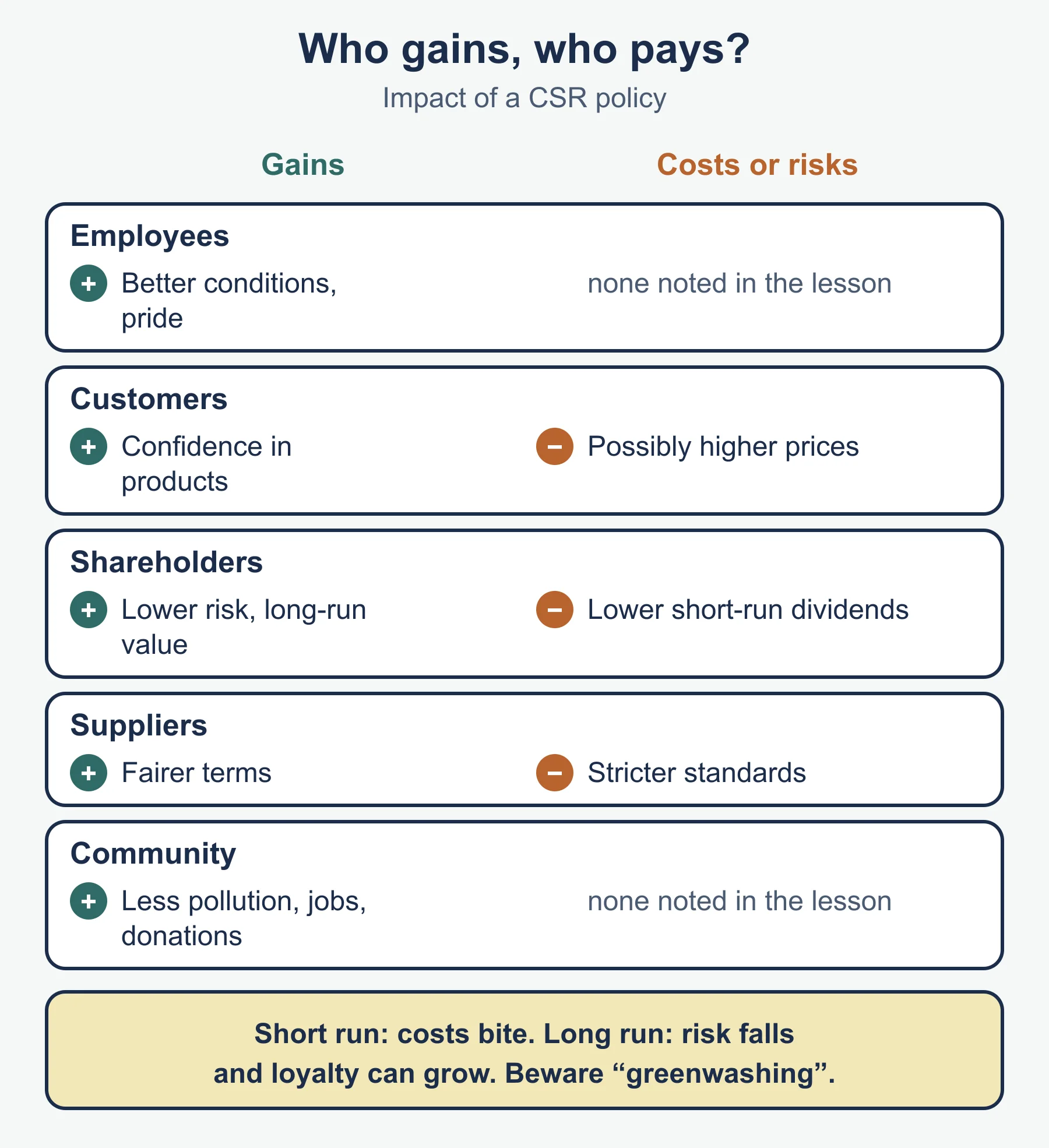
A CSR policy matters because it turns good intentions into specific, checkable commitments. Impact on the business: a better reputation, possible price premium, easier recruitment, lower risk of boycotts and regulatory action, but also extra cost and the risk of being accused of “greenwashing” if claims are not true. Impact on stakeholders:
- Employees: better conditions and pride in the employer.
- Customers: confidence in the products, though possibly higher prices.
- Shareholders: possible lower short-run dividends, possibly lower risk and stronger long-run value.
- Suppliers: fairer terms, but stricter standards to meet.
- Community and environment: lower pollution, jobs and donations.
The same weighing applies to the importance of CSR in general. Importance varies by business. It is likely to be greater for a food brand selling on trust than for a firm supplying anonymous components, and greater where the business is visible and competes on image.
Advantages and disadvantages of a CSR profile
A CSR profile is how far a business is seen to behave responsibly.
Advantages: stronger brand and customer loyalty; ability to charge more; staff motivation; investor appeal; good relations with local authorities and communities; fewer scandals.
Disadvantages: higher costs; lower short-run profit; slower decision making; high expectations that are hard to meet; any failure is amplified (a business that markets itself as ethical suffers more when a supplier is found at fault); benefits that are hard to measure.
Recommending how to improve a CSR profile
Choose actions that fit the business and its main stakeholders, and say how you would judge success. Options include:
- Ethical audits of suppliers, with a plan to drop those that fail.
- Cutting packaging, waste and energy, and publishing the results.
- Paying a living wage, training and fair contracts.
- Community partnerships, such as apprenticeships for local young people.
- Independent reporting, so claims can be checked.
Justify by linking to cost, timing and credibility. A low-cost, visible action may suit a business with tight finances. A measurable programme (for example a target to cut waste by a stated percentage) is more credible than a general promise.
Common errors
- Writing a mission as a numerical target. That is an objective.
- Describing CSR as only charity donations. It covers how the whole business operates.
- Saying CSR always reduces profit. Evaluate the time frame.
- Listing stakeholders without saying how each is affected.
- Judging without evidence from the case, such as the business’s size, sector or customers.
Frequently asked questions
What is the difference between a mission statement and an objective? A mission statement is broad, usually non-numerical and meant to last several years. An objective is a specific, measurable target, so writing a mission as a numerical target is a common error.
How do you answer a “recommend and justify” question on a mission statement? Make a clear choice of statement that fits the business in the case, then give reasons linked to its product, customers and values. A fuller answer adds a limitation, such as a word like “finest” not being measurable, so objectives must turn it into targets.
Why might a business change its mission statement? A business may change its mission after a takeover, a change of ownership, entry to new markets, a scandal or a shift in customer values. The impact depends on how far the new wording differs from the old and how well the change is explained.
Which OCR A Level Business sections cover mission statements and CSR? Section 1.3 (Mission statement) and section 1.4 (Corporate social responsibility) of the OCR A Level Business specification (H431) cover them, within the Business objectives and strategy area of study.
Next steps
Test yourself with the practice questions and use the revision notes for recall.
Official syllabus
OCR, Advanced GCE in Business (H431), specification Version 2.1, January 2026, for first assessment in 2017; sections 1.3 and 1.4 under Business objectives and strategy.
Get free revision emails (optional)
Occasional emails with practice questions, worked explanations and links to free resources for the qualification and subjects you choose. No spam, and you can unsubscribe from any email. The free tools on this site never need an email.
Related resources
-
Practice questions
OCR A Level Business: Mission statement and Corporate social responsibility (CSR) (H431) – Practice Questions
Original practice questions with worked answers on mission statements and CSR for OCR A Level Business, mixing short answers, calculations and cases.
Business · OCR · A Level
Try questions -
Revision notes
OCR A Level Business: Mission statement and Corporate social responsibility (CSR) (H431) – Revision Notes
Condensed revision notes on mission statements and CSR for OCR A Level Business, with evaluation checklists and a short self-test.
Business · OCR · A Level
Revise topic -
Study guides
OCR A Level Business: Models of strategic choice (H431)
Study guide to Porter's Five Forces, Porter's generic strategies and competitive advantage for OCR A Level Business (H431), with worked examples.
Business · OCR · A Level
Read guide
Related articles
-
teaching
A Level tuition in Dubai: Cambridge or Pearson Edexcel International A Level?
Schools in Dubai and Abu Dhabi teach either Cambridge International AS & A Level or Pearson Edexcel International A Level. How the two are structured, why it matters for tuition, and how online classes from Lahore work.
9 October 2026
-
curriculum guides
Choosing subjects at IGCSE and A Level
How subject choices at 14 and 16 affect university options later, and how to keep pathways open without overloading a timetable.
28 July 2026
Studying this with a teacher
Working through Business A LEVELS?
This page is free and stays free. If you would rather be taught it, Marlbridge runs Business classes one-to-one, online in your own time zone. One-to-one only for this course: Rs 6,000 per class in Pakistan, with other currencies on the fees page. The first trial class is free. WhatsApp replies within an hour (8am–11pm Pakistan time, every day); email the same day.
OCR Business teachers at Marlbridge
