
Revision Notes
OCR A Level Business: Mission statement and Corporate social responsibility (CSR) (H431) – Revision Notes
Condensed revision notes on mission statements and CSR for OCR A Level Business, with evaluation checklists and a short self-test.
- Subject
- Business
- Level
- A LEVELS
- Topic
- Business objectives and strategic decisions
- Author
- Marlbridge Academic Team
- Updated
- Reviewed by
- Salman Ahmad (what this means)
Aligned to OCR A Level Business (H431), Version 2.1 (January 2026), for first assessment in 2017; final assessment summer 2027. Official specification .
Syllabus page (what it covers and how it is assessed): OCR A Level Business.
Syllabus points this page covers
H431
- 1.3 Mission statement
- 1.4 Corporate social responsibility (CSR)
Found an error? Report a correction.
Need help with this topic? Request a free trial class for A Level Business (H431).
Quick recall for sections 1.3 (Mission statement) and 1.4 (Corporate social responsibility (CSR)) of OCR A Level Business (H431, Version 2.1, January 2026). For full explanations and a worked example, read the study guide. Then test yourself with the practice questions. Related topic pages: Objectives and Strategic Decisions notes and topic study guide. Course hub: OCR A Level Business. Printable list: checklist. Not sure where you stand? Use the free diagnostics.
Definitions
The specification does not give wording for these terms; the definitions below are standard forms.
| Term | Meaning |
|---|---|
| Mission statement | A short public statement of what the business is for: what it does, for whom, and often how or why |
| Corporate social responsibility (CSR) | The idea that a business should consider the effects of its decisions on society, the community and the environment, and act ethically towards all stakeholders, beyond what the law requires |
| CSR policy | The written commitments a business makes on CSR and how it will deliver and report them |
| CSR profile | How responsible the business is seen to be by its stakeholders |
| Stakeholder | Any individual or group that has a stake in, or is affected by, what the business does |
1.3 Mission statement
Nature and purpose (explain)
- Nature: brief, memorable, general, forward-looking, not a numerical target.
- Purpose: gives direction, guides decisions, unites staff, signals values to customers, investors, suppliers and the community.
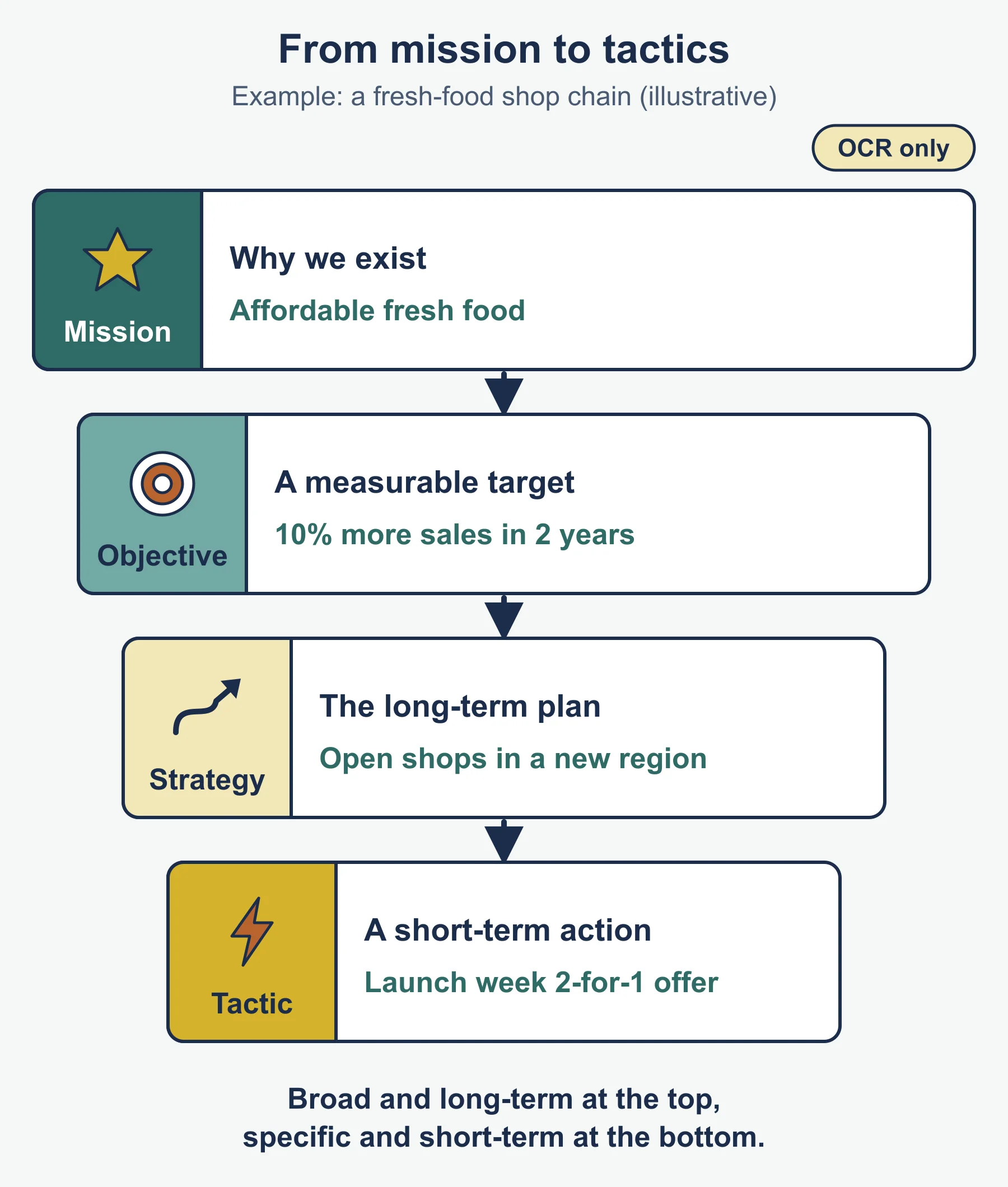
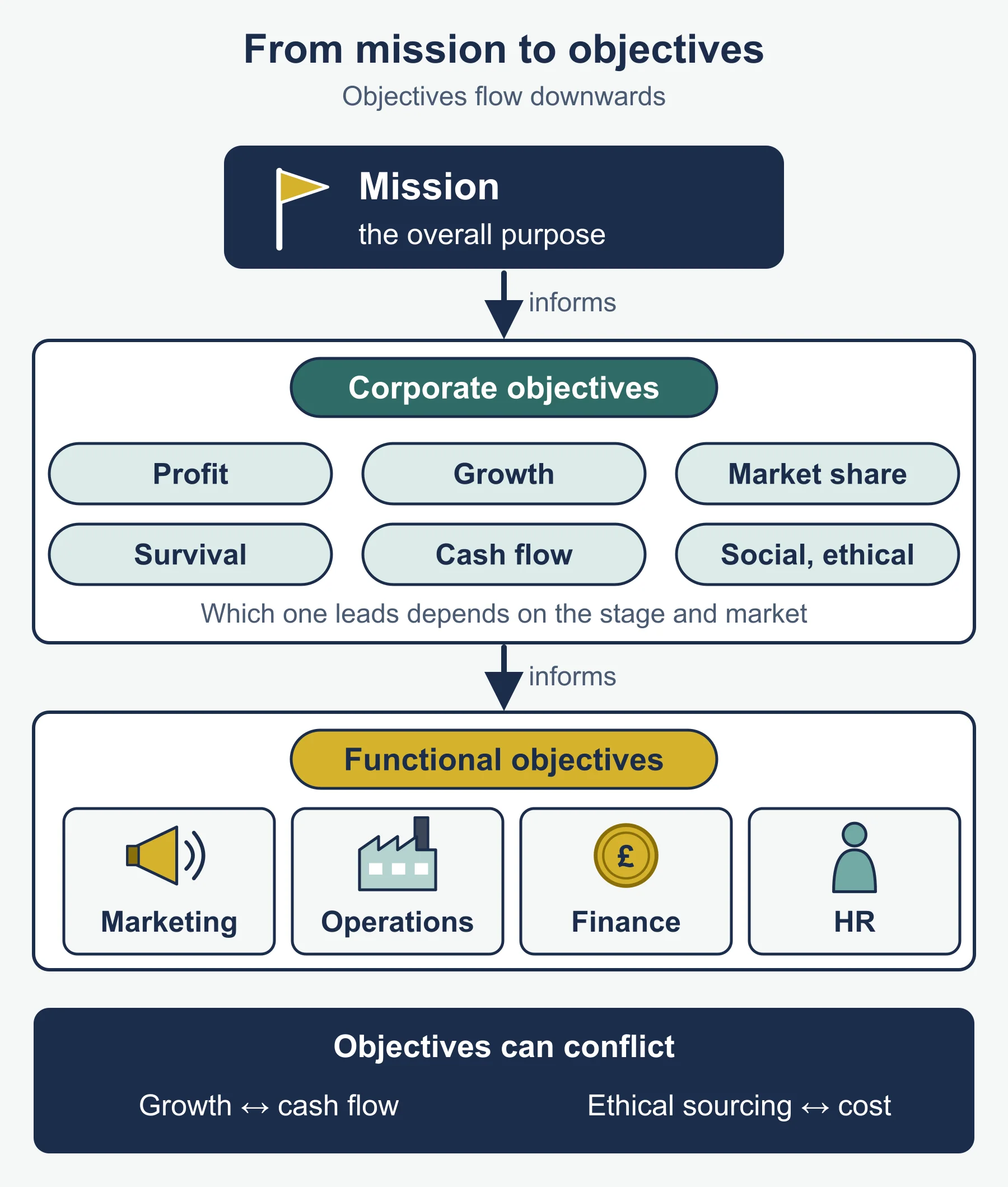
- Place in the planning chain: mission, then aims and objectives, then strategy, then tactics.
Recommend and justify a mission statement: method in steps
- Identify what the business does, who it serves and what makes it distinctive.
- Identify the stakeholders who matter most (for example customers, staff, owners).
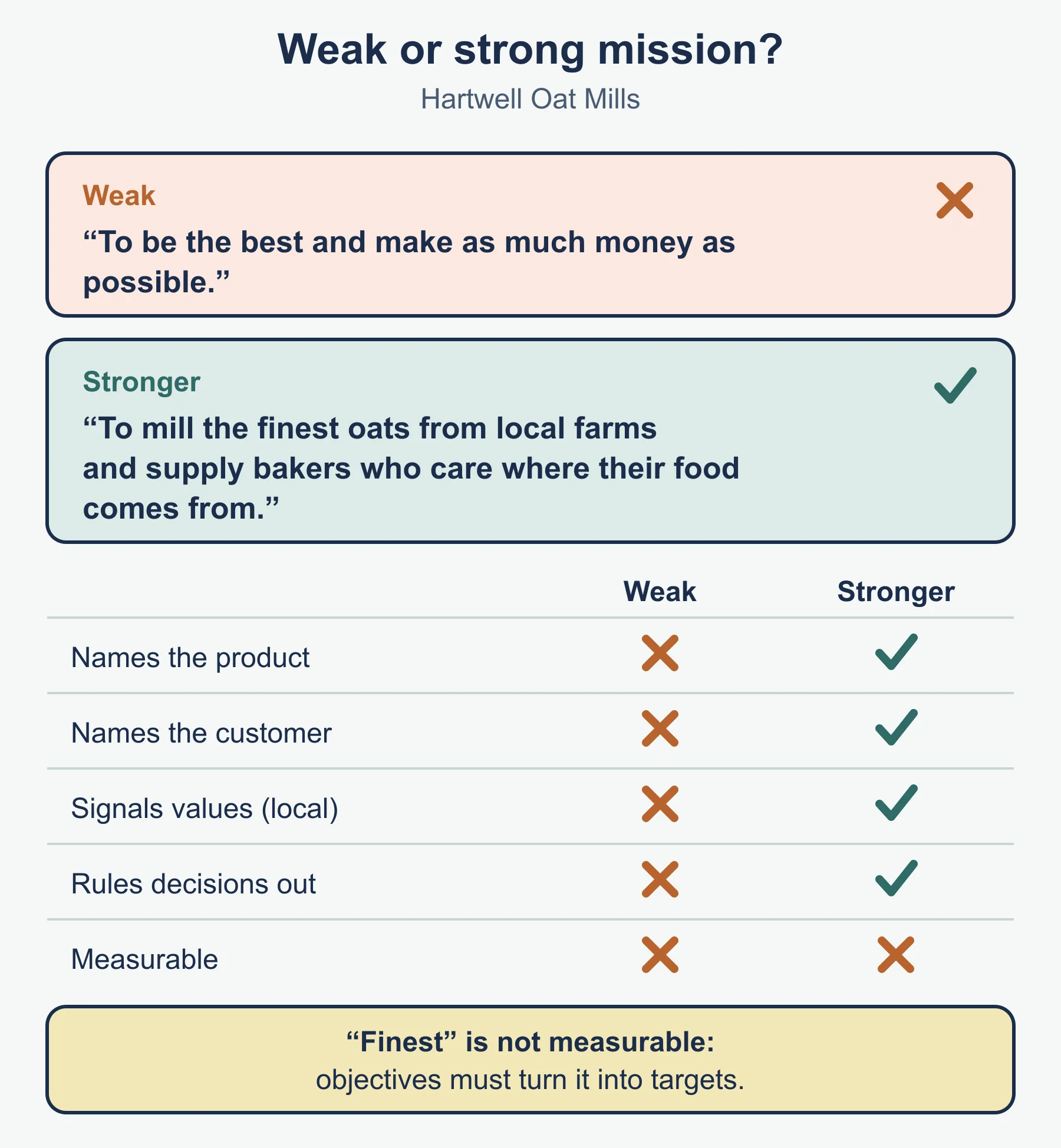
- Draft one or two sentences naming product, customer and a value.
- Justify by linking each element to the case: fit with the business, appeal to stakeholders, decision guidance and flexibility.
- Note one limitation, such as the need for measurable objectives.
Advantages and disadvantages: at a glance
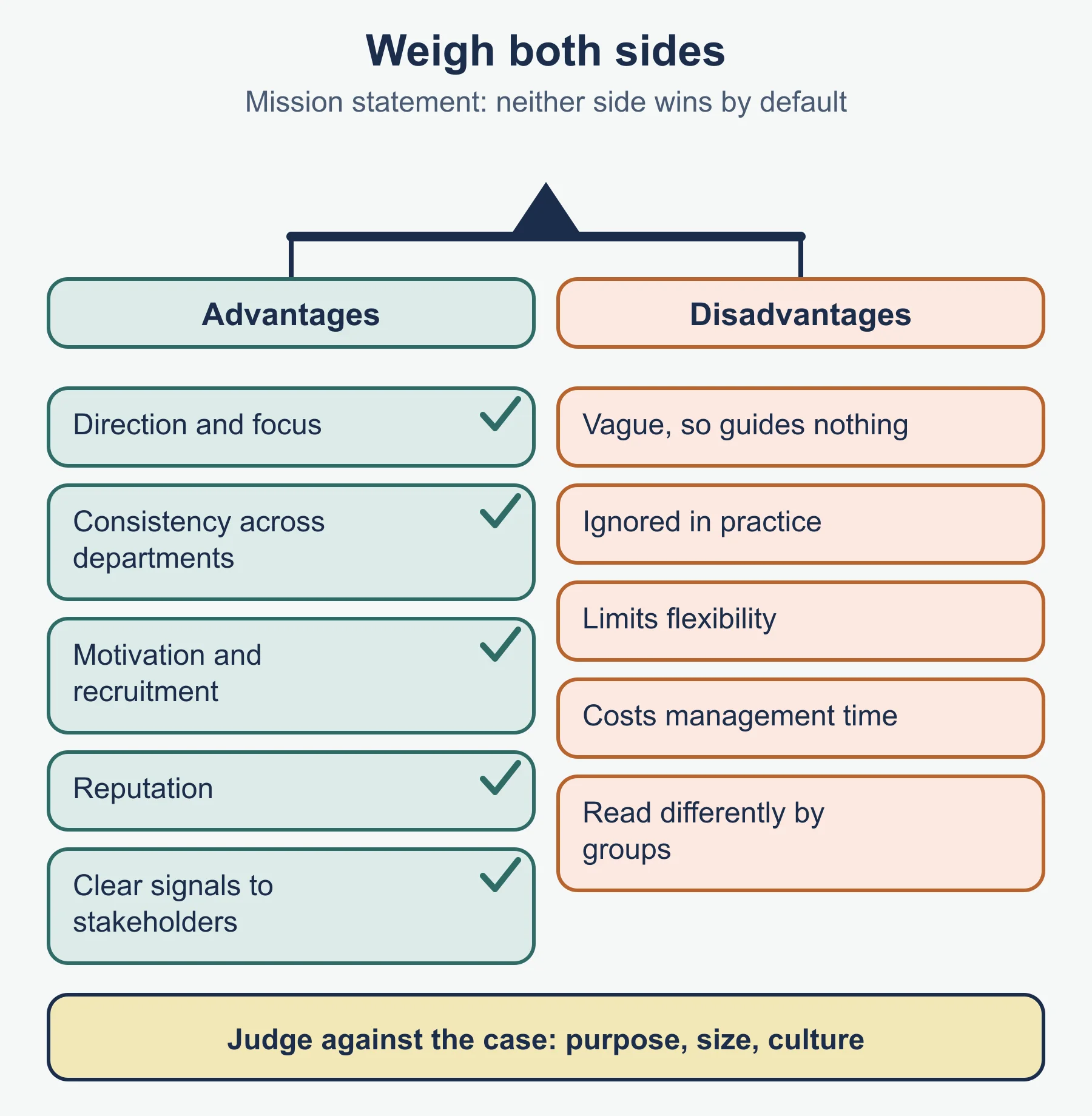
| Advantages | Disadvantages |
|---|---|
| Direction and focus | Can be vague or generic |
| Consistent decisions | May be ignored, causing cynicism |
| Motivation and recruitment | Can limit flexibility |
| Reputation and marketing | Costs time to write and communicate |
| Clear signal to stakeholders | Different stakeholders read it differently |
Evaluation hinge: a statement is only worth having if behaviour matches the words.
Impact of changing a mission statement
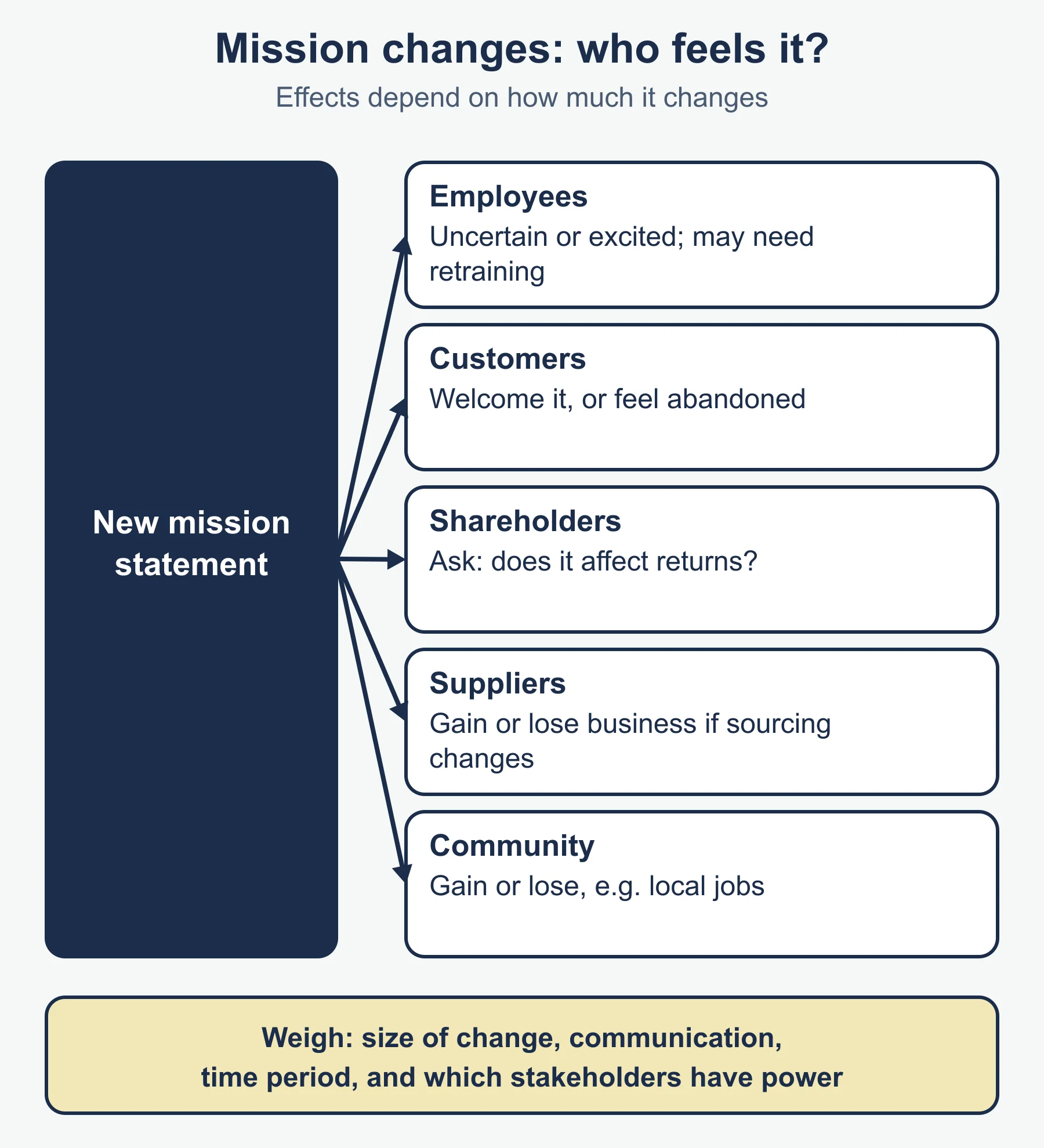
| Stakeholder | Possible impact |
|---|---|
| Owners and shareholders | Worry about returns; may welcome renewed focus |
| Employees | Uncertainty, retraining, or new opportunities |
| Customers | Welcome the change, or feel the brand has drifted |
| Suppliers | Different sourcing needs; contracts gained or lost |
| Community | Gain or loss, such as local jobs or support |
Judge the size of the change, how well it is communicated, the time period and which stakeholders have most power. Costs are likely in the short run (rebranding, training); benefits take longer.
Worked reminder: is a rebrand worth it?
Brightwater Bakehouse has an annual operating profit of £150,000. A change of mission means a one-off cost of £25,000 for packaging, signs and staff briefing. That cost equals 25,000 ÷ 150,000 = 16.7% of one year’s operating profit. The decision therefore depends on whether the new focus raises contribution by enough over several years to repay the cost. Say that, and name the stakeholders who will notice the change first.
1.4 Corporate social responsibility (CSR)
Meaning (explain)
- Duties beyond profit: society, community, environment.
- Usually voluntary and above the legal minimum.
- Examples: ethical sourcing, fair pay, cutting waste, community projects, honest marketing.
Potential conflict with profit and other objectives
| Objective | How CSR may conflict |
|---|---|
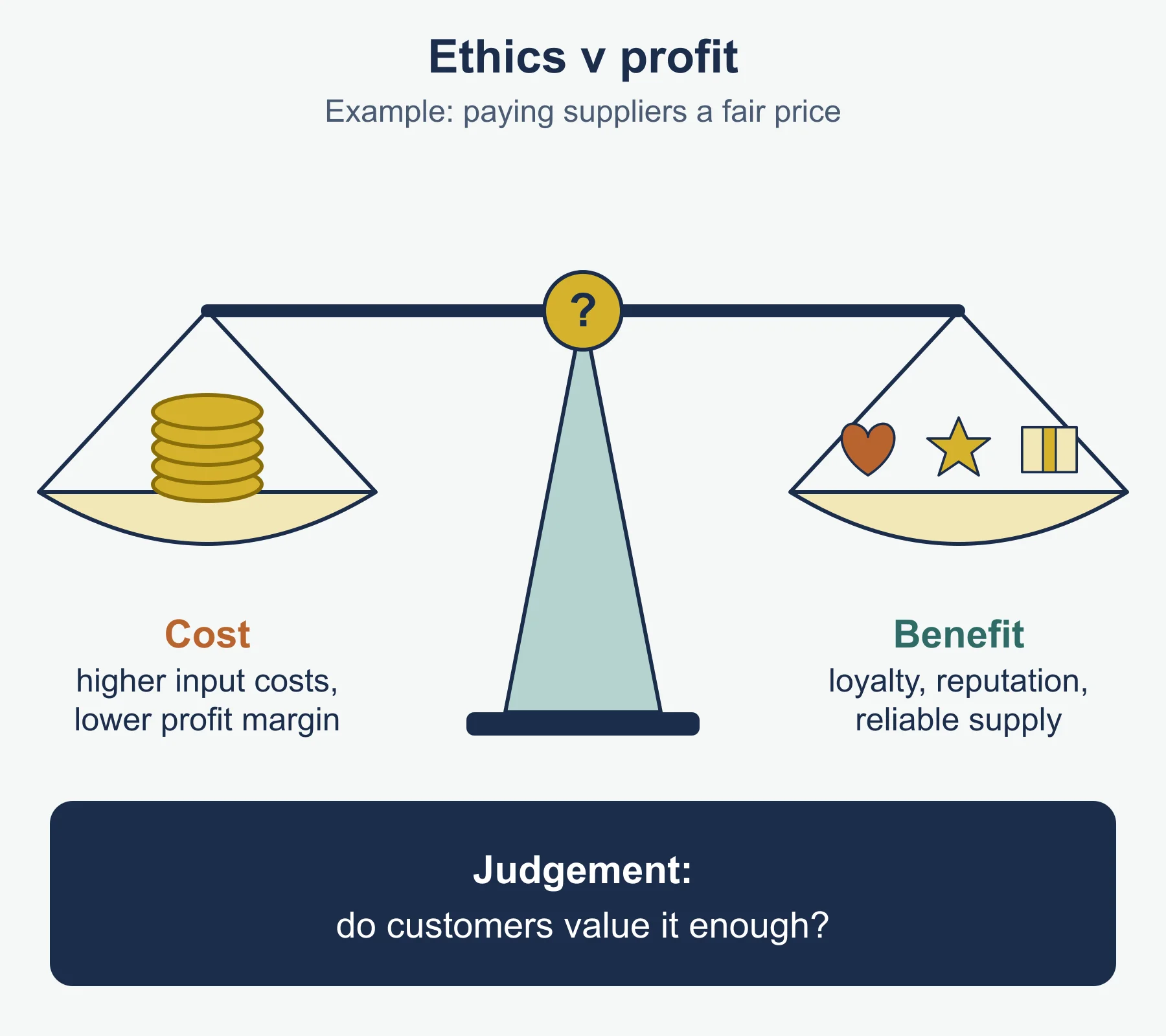
| Profit | Higher costs, lower margin, lower dividends |
| Growth | Turning down contracts or suppliers that fail standards |
| Cost leadership | Little room for extra cost |
| Market share | Higher prices may lose price-sensitive customers |
| Short-term targets | Payback is slow |
Counterpoint: CSR may raise sales, loyalty and recruitment, reduce risk and cut costs. The conflict is usually sharper in the short run.
Worked reminder: measuring the cost
Brightwater Bakehouse bakes 600,000 loaves a year. Switching to reusable crates and recycled wrapping adds £0.03 per loaf.
- Extra annual cost = 0.03 × 600,000 = £18,000.
- As a share of £150,000 operating profit = 12%.
- Profit after the change, if nothing else moves = £132,000 (88% of the original).
Evaluation: can the bakery charge a little more, win a supply contract that values the policy, or save on waste disposal? Is a 12% fall acceptable to the owners?
Impact and importance of a CSR policy
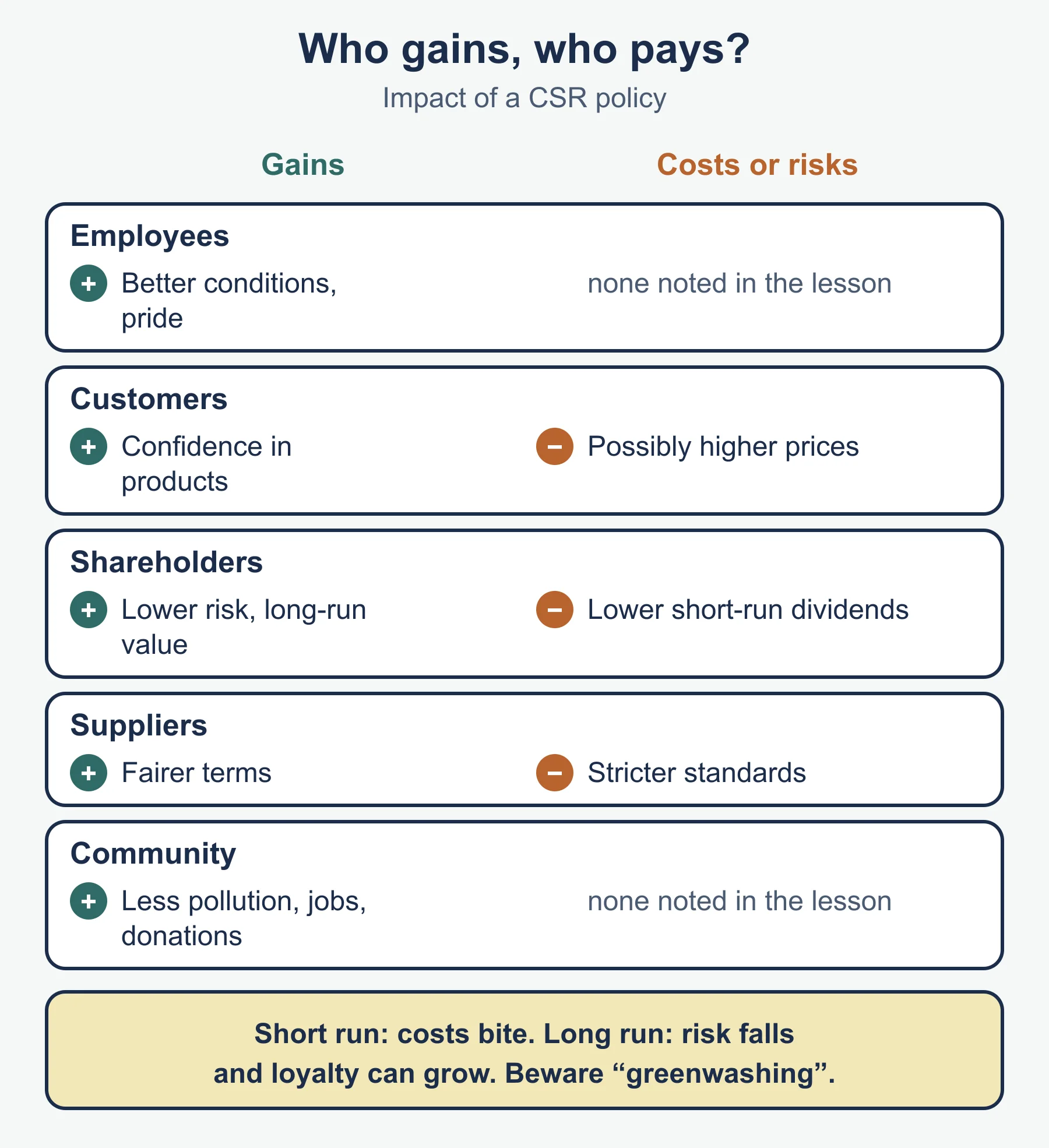
| Stakeholder | Possible impact |
|---|---|
| Owners and shareholders | Lower short-run return, possibly lower risk and stronger long-run value |
| Employees | Better conditions, pride; or pressure from higher standards |
| Customers | Trust and loyalty; possibly higher prices |
| Suppliers | Fairer terms but stricter checks |
| Community and environment | Jobs, donations, less pollution |
Importance is greater where the business sells on trust or image, is highly visible, or is under media or regulatory scrutiny.
CSR profile: advantages and disadvantages
| Advantages | Disadvantages |
|---|---|
| Stronger brand and loyalty | Higher costs |
| Price premium possible | Lower short-run profit |
| Motivated, loyal staff | High expectations; failures magnified |
| Investor and community goodwill | Benefits hard to measure |
| Lower risk of scandal | Possible accusations of exaggerating claims |
Recommend and justify how to improve a CSR profile
- Pick actions that suit the business and its main stakeholders.
- Choose measurable targets, such as a stated cut in waste.
- Consider cost, speed and visibility.
- Make claims verifiable (independent reporting).
- Justify by linking to the case: finances, customers, competitors, and the time period.
Evaluation checklist for extended answers
- Point, explanation, and a link to the case.
- Both sides, with the stakeholder affected named each time.
- Short run against long run.
- Size and sector of the business.
- A judgement with a reason (“it depends” is not enough; say on what).
Must-know distinctions
- Mission statement and objective: the mission says why the business exists; an objective is a measurable target that helps deliver it.
- Mission statement and slogan: a slogan is marketing wording; a mission should guide decisions inside the business.
- CSR and the law: CSR means doing more than legal compliance, usually by choice.
- CSR and charity: donations are one possible part of a CSR policy, not the whole of it.
- CSR policy and CSR profile: the policy is what the business commits to; the profile is how stakeholders judge its behaviour.
- Cost of CSR and value of CSR: the cost is often immediate and easy to measure; the value (loyalty, reputation, lower risk) is slower and harder to measure.
Quick self-test
- Define a mission statement.
- Give two purposes of a mission statement.
- Explain why a mission statement is not the same as an objective.
- Give one disadvantage of a vague mission statement.
- Explain one reason a business might change its mission statement.
- State what CSR means.
- Explain one way in which CSR might conflict with growth.
- A firm sells 80,000 units at £6 and a CSR change adds £0.15 per unit to variable cost. Calculate the extra annual cost.
- Give two benefits of a strong CSR profile.
- Give one reason a CSR claim might harm a business.
Answers
- A short public statement of what a business is for: what it does, for whom, and why.
- Any two: gives direction, guides decisions, motivates staff, communicates values to stakeholders.
- A mission is general and long-term; an objective is a specific target, usually measurable and with a time limit.
- It gives no guidance for decisions, so it is ignored and may create cynicism.
- For example a takeover or change of ownership, entry to a new market, or a change in customer values means the old purpose no longer fits.
- A business taking account of the effects of its decisions on society, the community and the environment, and acting ethically towards its stakeholders.
- Rejecting a profitable order from a supplier or customer that fails its standards slows expansion.
- 80,000 × 0.15 = £12,000 a year (as a share of £480,000 revenue, 2.5%).
- Any two: stronger brand, customer loyalty, ability to charge more, easier recruitment, lower risk of scandal.
- If the claim is exaggerated or a supplier is found to breach it, the business is accused of misleading customers and reputation falls.
Where marks are usually lost
- Defining CSR only as donations to charity.
- Describing a mission as a target with a number and a date.
- Listing pros and cons that are not tied to the business in the case.
- Stating “CSR costs money” without saying how much or who bears it.
- Naming stakeholders without explaining the effect on each.
- Ignoring the time period, so short-run costs and long-run gains are mixed up.
- Recommending an action with no justification linked to the business’s situation.
- Concluding without a judgement.
Frequently asked questions
What is the difference between a CSR policy and a CSR profile? A CSR policy is what the business commits to and how it will deliver and report it. A CSR profile is how stakeholders judge the business’s behaviour.
Is a mission statement the same as a slogan? No. A slogan is marketing wording, while a mission statement should guide decisions inside the business by saying what it is for.
Is CSR just giving money to charity? No. Donations are one possible part of a CSR policy, but CSR covers the effects of all a business’s decisions on society, the community and the environment, usually going beyond what the law requires.
Why is the value of CSR hard to measure? The cost of CSR is often immediate and easy to measure, but its value, such as loyalty, reputation and lower risk, arrives more slowly and is harder to put a figure on.
How can a business improve its CSR profile credibly? Choose actions that suit the business and its main stakeholders, set measurable targets such as a stated cut in waste, and make claims verifiable through independent reporting, as exaggerated claims can harm its reputation.
Official syllabus
OCR, Advanced GCE in Business (H431), specification Version 2.1, January 2026, for first assessment in 2017; sections 1.3 and 1.4 under Business objectives and strategy.
Get free revision emails (optional)
Occasional emails with practice questions, worked explanations and links to free resources for the qualification and subjects you choose. No spam, and you can unsubscribe from any email. The free tools on this site never need an email.
Related resources
-
Study guides
OCR A Level Business: Models of strategic choice (H431)
Study guide to Porter's Five Forces, Porter's generic strategies and competitive advantage for OCR A Level Business (H431), with worked examples.
Business · OCR · A Level
Read guide -
Practice questions
OCR A Level Business: Models of strategic choice (H431) – Practice Questions
Original practice questions with worked answers on Porter's Five Forces, generic strategies and competitive advantage for OCR A Level Business (H431).
Business · OCR · A Level
Try questions -
Revision notes
OCR A Level Business: Models of strategic choice (H431) – Revision Notes
Condensed revision notes on Porter's Five Forces, generic strategies and competitive advantage for OCR A Level Business (H431), with a self-test.
Business · OCR · A Level
Revise topic
Related articles
-
teaching
A Level tuition in Dubai: Cambridge or Pearson Edexcel International A Level?
Schools in Dubai and Abu Dhabi teach either Cambridge International AS & A Level or Pearson Edexcel International A Level. How the two are structured, why it matters for tuition, and how online classes from Lahore work.
9 October 2026
-
curriculum guides
Choosing subjects at IGCSE and A Level
How subject choices at 14 and 16 affect university options later, and how to keep pathways open without overloading a timetable.
28 July 2026
Studying this with a teacher
Working through Business A LEVELS?
This page is free and stays free. If you would rather be taught it, Marlbridge runs Business classes one-to-one, online in your own time zone. One-to-one only for this course: Rs 6,000 per class in Pakistan, with other currencies on the fees page. The first trial class is free. WhatsApp replies within an hour (8am–11pm Pakistan time, every day); email the same day.
OCR Business teachers at Marlbridge
