
Revision Notes
OCR A Level Business: Models of strategic choice (H431) – Revision Notes
Condensed revision notes on Porter's Five Forces, generic strategies and competitive advantage for OCR A Level Business (H431), with a self-test.
- Subject
- Business
- Level
- A LEVELS
- Topic
- Business objectives and strategic decisions
- Author
- Marlbridge Academic Team
- Updated
- Reviewed by
- Salman Ahmad (what this means)
Aligned to OCR A Level Business (H431), Version 2.1 (January 2026), for first assessment in 2017; final assessment summer 2027. Official specification .
Syllabus page (what it covers and how it is assessed): OCR A Level Business.
Syllabus points this page covers
H431
- 1.10 Models of strategic choice
Found an error? Report a correction.
Need help with this topic? Request a free trial class for A Level Business (H431).
These notes condense section 1.10 “Models of strategic choice” of the OCR A Level Business (H431) specification, Version 2.1 (January 2026), for first assessment in 2017 and final assessment in summer 2027. For full explanations and worked examples, read the study guide first. Then test yourself on the practice questions.
Other links: course hub, printable checklist, objectives and strategic decisions guide, strategy revision notes, strategy practice and the free diagnostics.
The seven points to be able to do
| Point | One-line summary |
|---|---|
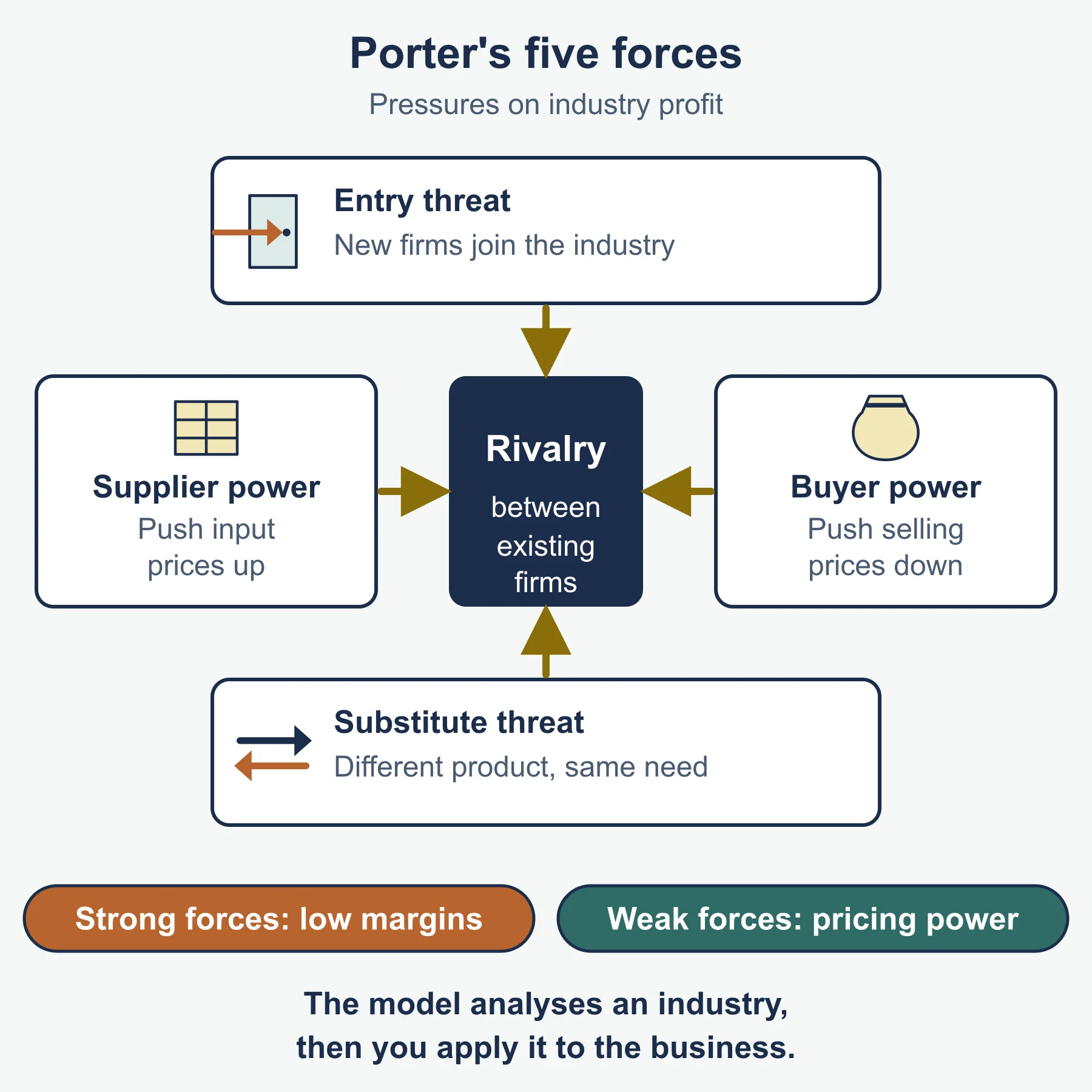
| Explain Five Forces (nature, purpose) | Industry framework of five competitive pressures; judges how attractive and profitable an industry is |
| Evaluate position or proposed position with Five Forces | Rank the forces using case evidence, judge the industry, state the response |
| Evaluate usefulness of Five Forces | Structured, but a snapshot, industry-level and judgement-based |
| Explain generic strategies (nature, purpose) | Broad routes to competitive advantage: cost leadership, differentiation, focus |
| Evaluate position or proposed position with generic strategies | Match evidence to a strategy, test fit and risk |
| Evaluate usefulness of generic strategies | Clear and simple, but real firms blend strategies |
| Explain competitive advantage | A feature that lets a business outperform rivals |
Competitive advantage
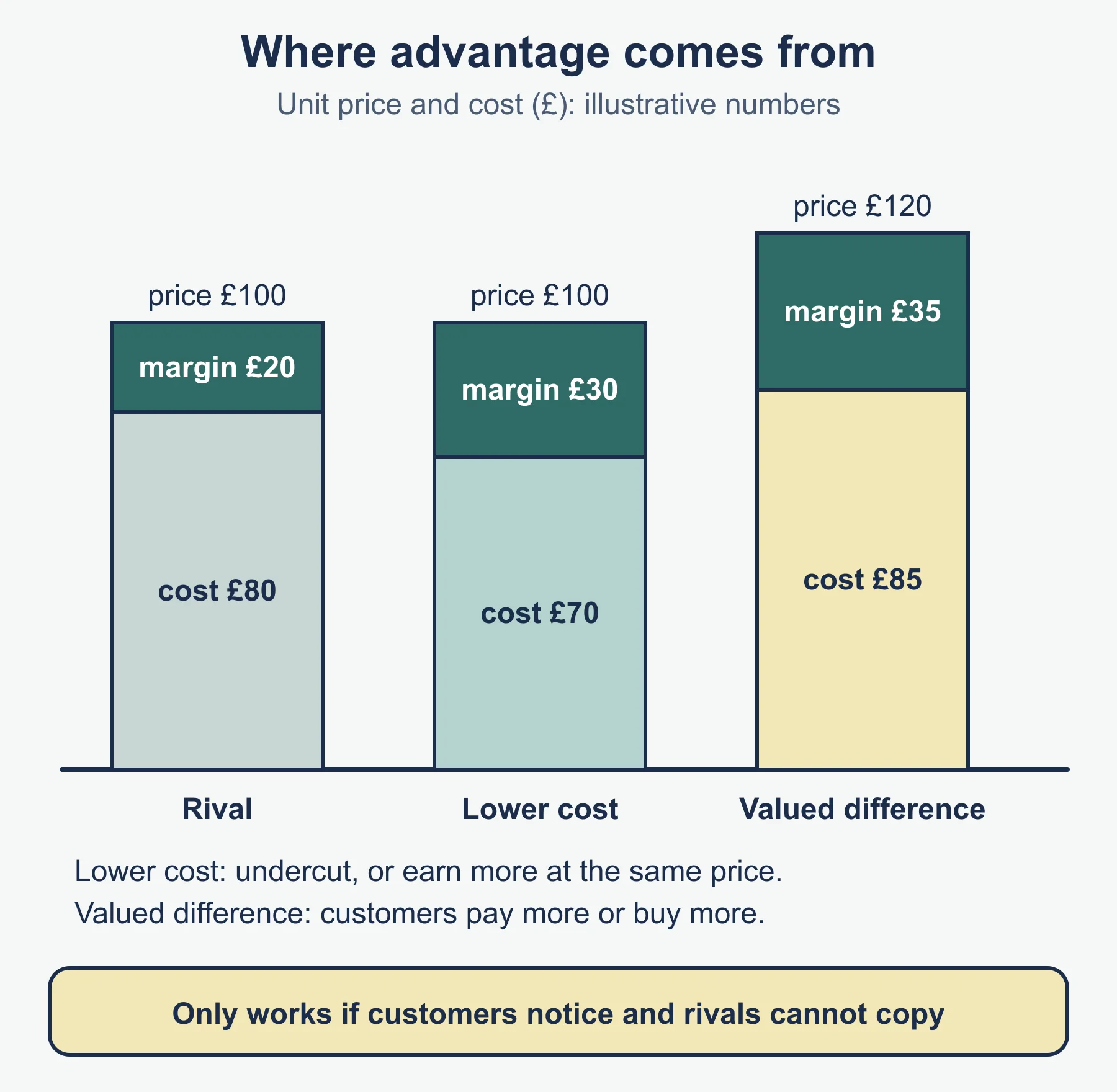
- Definition (standard sense): something a business does better than rivals that earns it more customers, higher margins or both.
- Sources: lower costs, or something customers value that rivals lack.
- Lasts when: customers notice it and rivals cannot copy it quickly (a brand, patent, location, skills).
- Does not last when: it is a price cut that rivals can match.
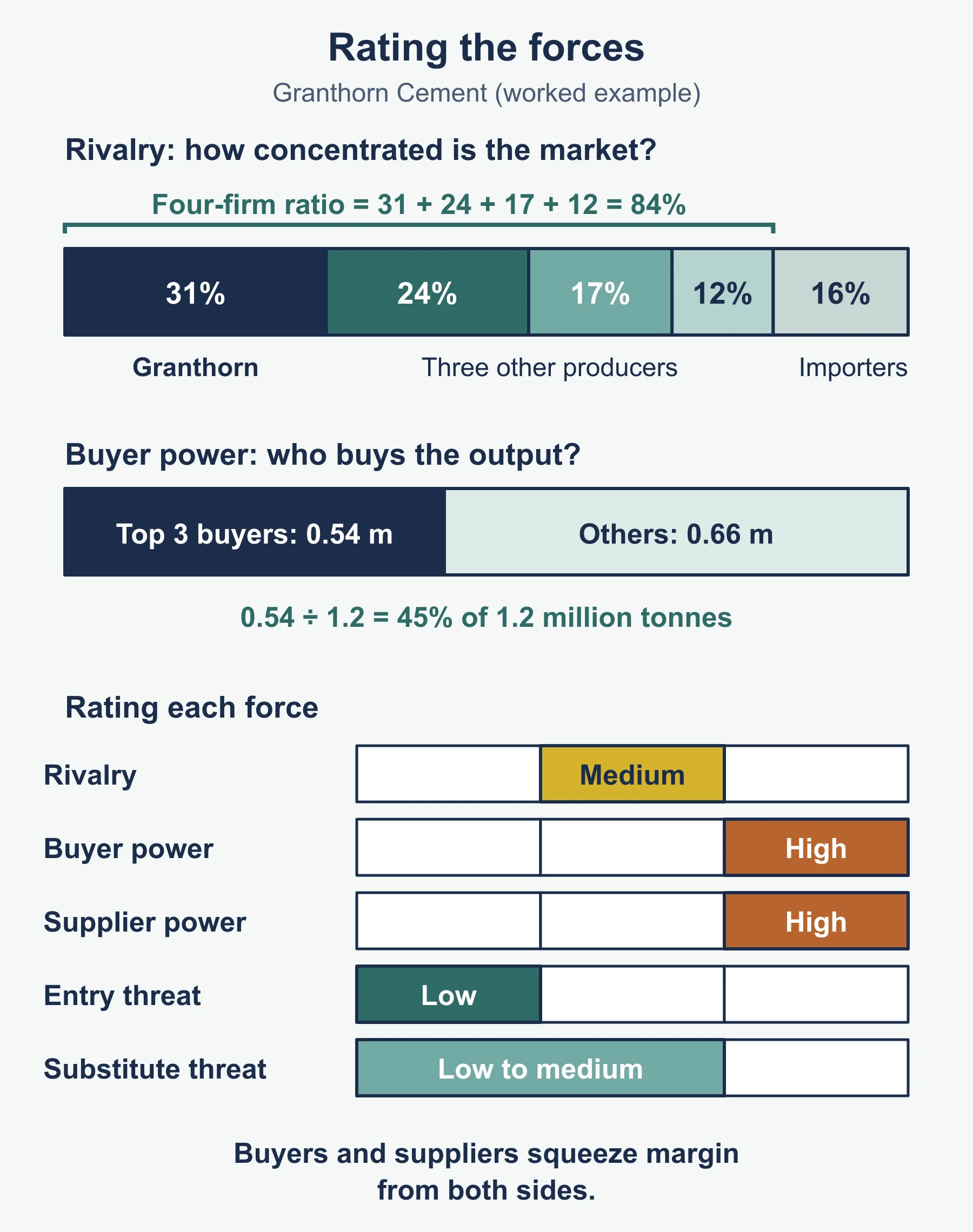
Five Forces at a glance
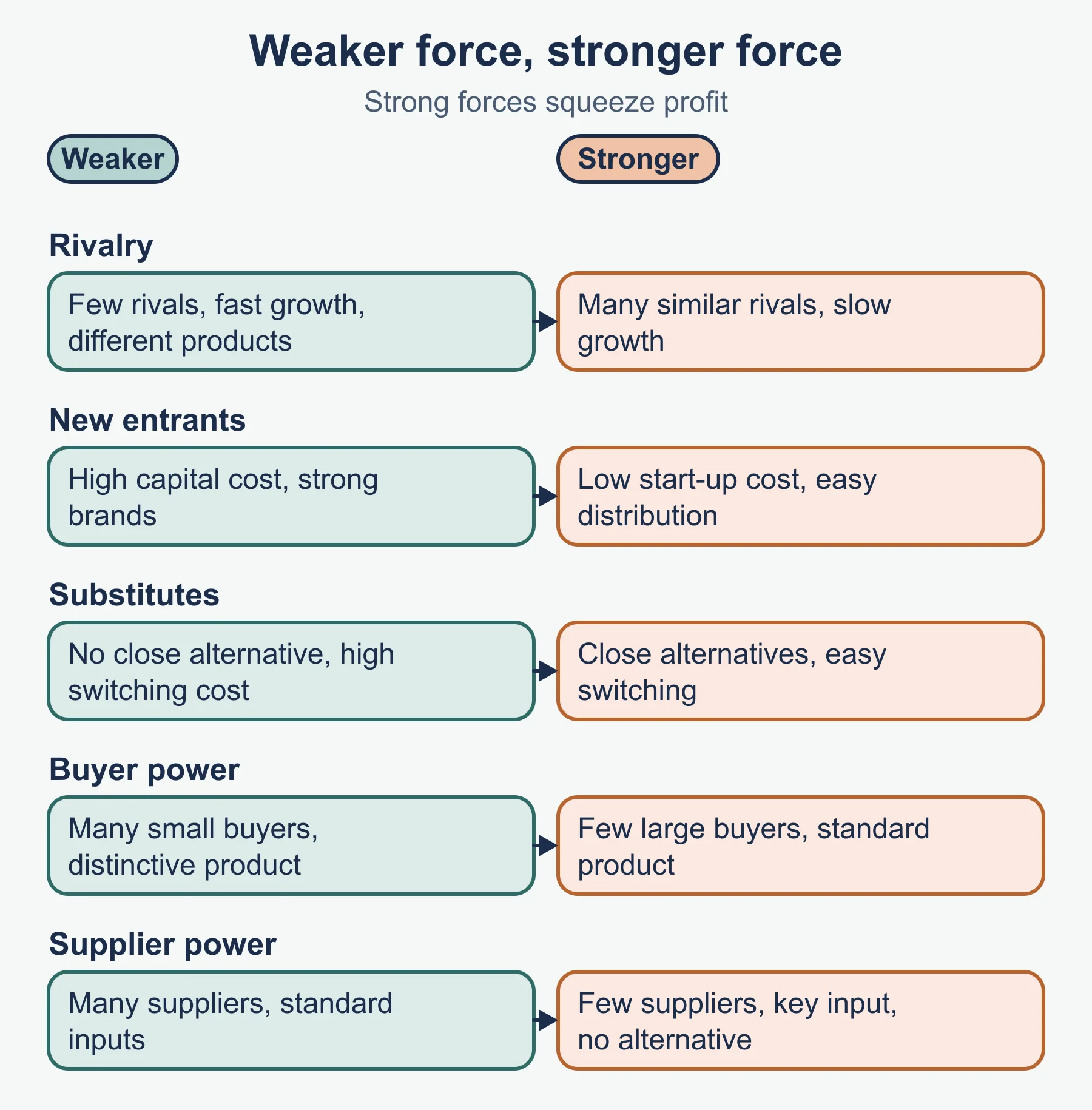
| Force | Stronger when | Typical response |
|---|---|---|
| Rivalry | Many similar rivals, slow growth, little differentiation | Differentiate, avoid price wars, find a niche |
| New entrants | Low start-up cost, no loyalty, easy distribution | Build barriers: scale, brand, patents, loyalty schemes |
| Substitutes | Close alternatives, low switching cost | Improve value, stress benefits, add features |
| Buyer power | Few large buyers, easy switching, standard product | Widen the customer base, lock in with contracts, differentiate |
| Supplier power | Few suppliers, essential input, high switching cost | Use several suppliers, build relationships, hold stock, integrate |
Key idea: a strong force reduces profit by pushing prices down or costs up.
Method: evaluate a position with Five Forces
- Pick out case evidence for each force. Say “not enough information” where the case is silent.
- Rank the forces. Which one limits profit most?
- Judge the industry: attractive, moderate or unattractive.
- Recommend a response, and say what could change it (for example, a new technology that creates substitutes).
For a proposed position, compare the forces in the new market with those in the current one.
Usefulness of Five Forces
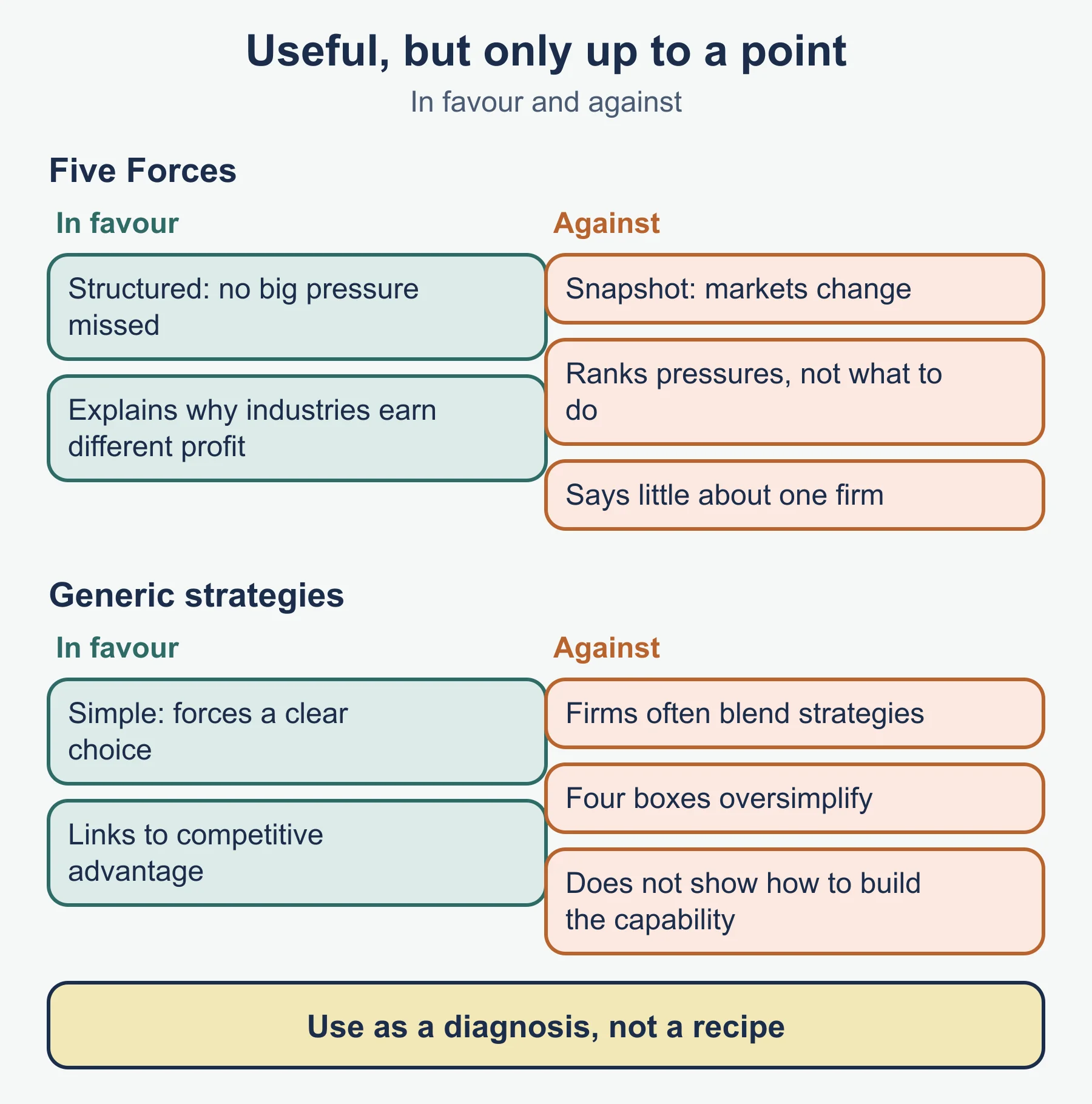
| For | Against |
|---|---|
| Structured, covers the main pressures | Snapshot; markets change |
| Explains why industries differ in profit | Industry-level, not firm-level |
| Guides entry and exit decisions | Strength of each force is a judgement |
| Shows where to build barriers | Does not say what to do |
Verdict pattern: most useful as a first filter and when combined with SWOT or forecasts.
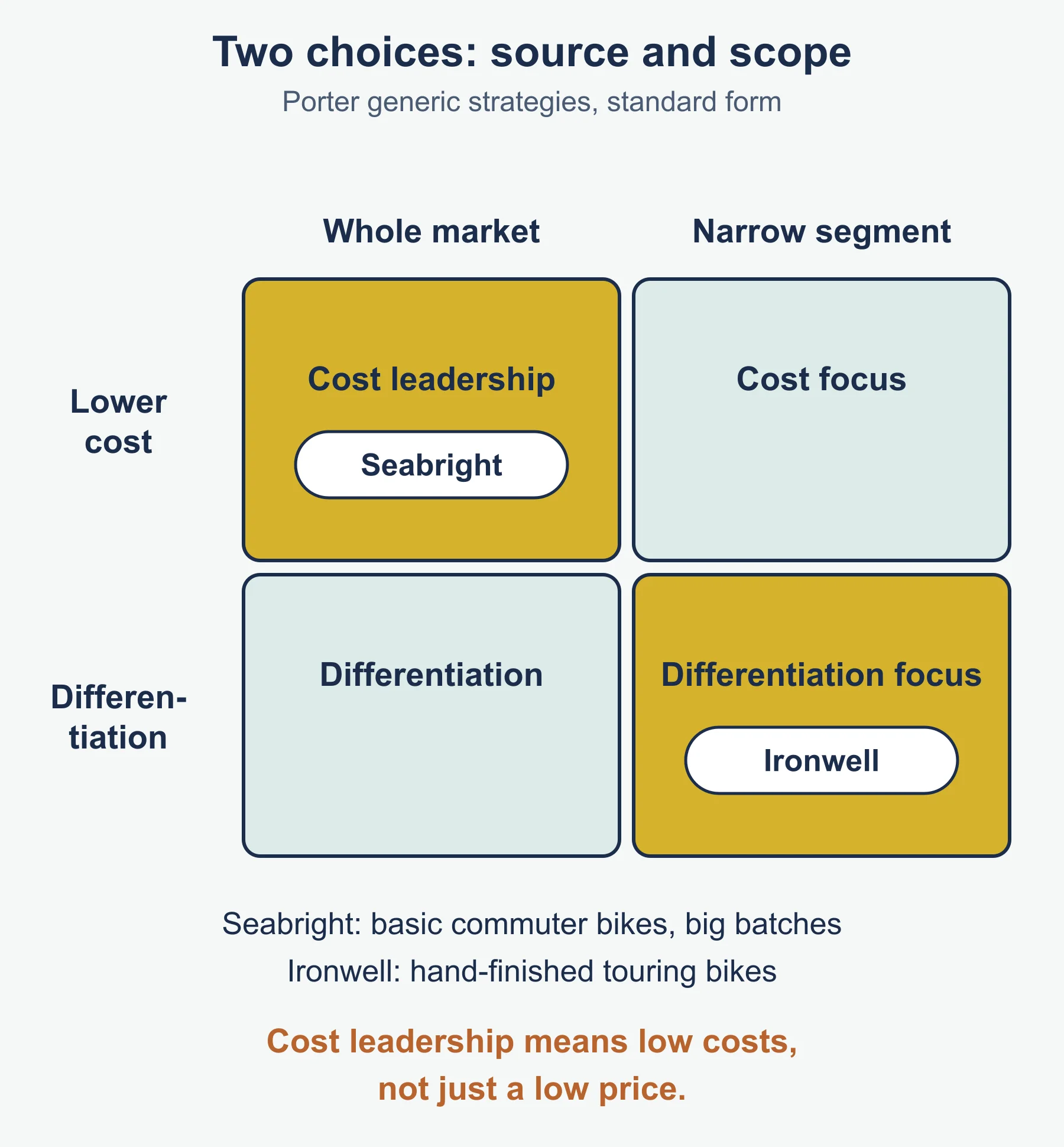
Generic strategies at a glance
| Whole market | Narrow segment | |
|---|---|---|
| Lower cost | Cost leadership | Cost focus |
| Differentiation | Differentiation | Differentiation focus |
(Standard form of the model.)
| Strategy | What it needs | Main risk |
|---|---|---|
| Cost leadership | Scale, efficient processes, tight overhead control | Price war; a rival with lower cost; falling quality |
| Differentiation | Features customers value; spending on quality, design or brand | Imitation; customers stop valuing the difference |
| Focus | Deep knowledge of one segment | Segment shrinks; a larger rival enters it |
Method: evaluate a position with the generic strategies
- Match evidence (relative price, unit costs, target market, advertising claims) to a strategy.
- Check the business has the capability that strategy needs.
- Look for conflict between strategies.
- Weigh the risks.
- Link to the market (use Five Forces) and recommend.
Usefulness of the generic strategies
| For | Against |
|---|---|
| Simple, forces a clear choice | Real firms often combine strategies |
| Links to competitive advantage | Four boxes oversimplify |
| Helps align functions | Does not say how to build capability |
| Good for comparing rivals | Does not show whether the market is profitable |
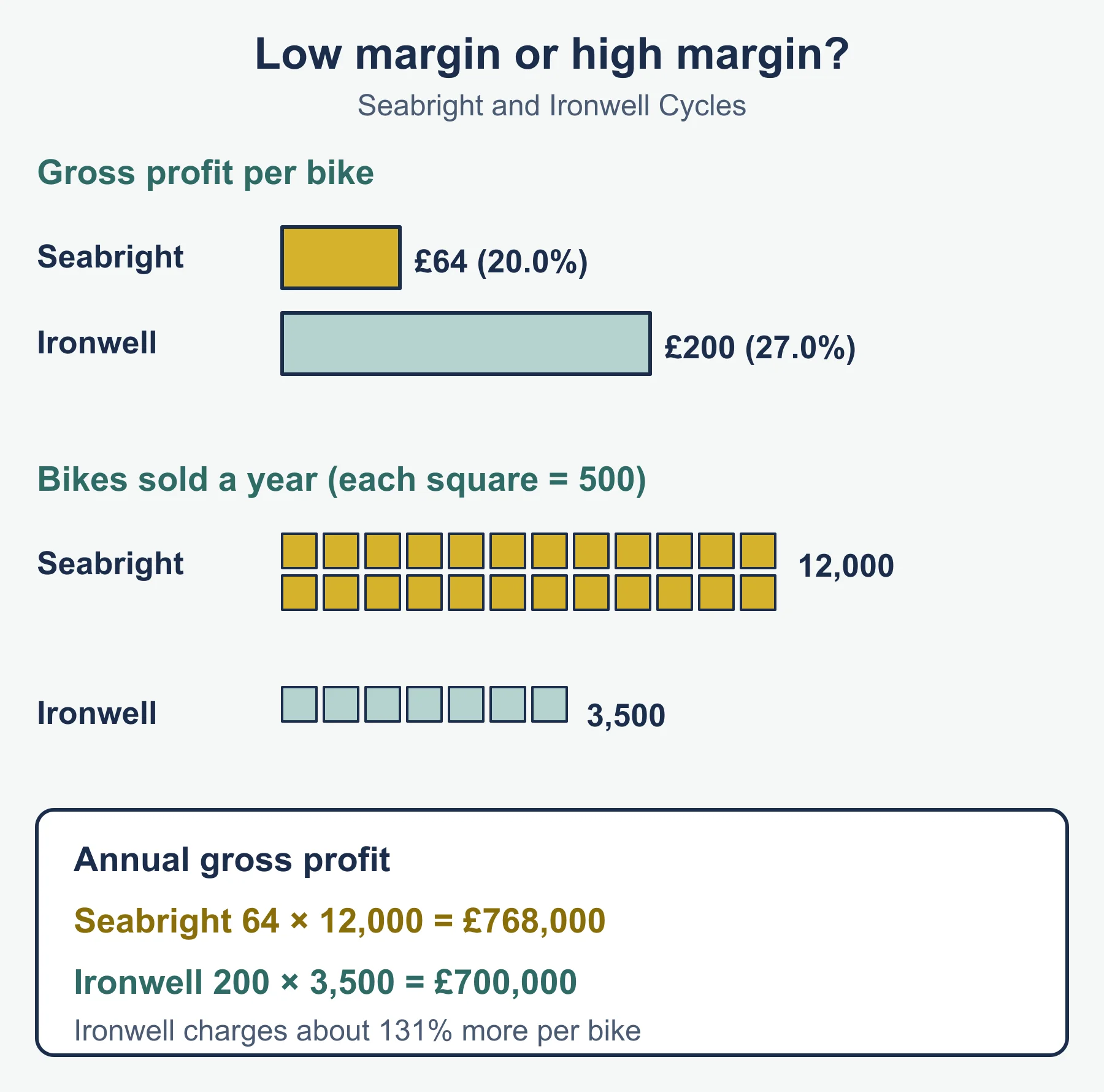
Worked reminder: price versus margin
A cost leader and a differentiator can earn very different margins and still make similar total profit.
gross profit per unit = selling price - unit cost
gross margin (%)      = gross profit per unit / selling price x 100
total gross profit    = gross profit per unit x units sold
Example: a firm sells 5,000 units at £40 with unit cost £34, giving £6 per unit, a 15% margin and £30,000 in total. A rival sells 1,000 units at £90 with unit cost £60, giving £30 per unit, a 33.3% margin and £30,000 in total. The same total comes from very different strategies.
Linking the models and writing the answer
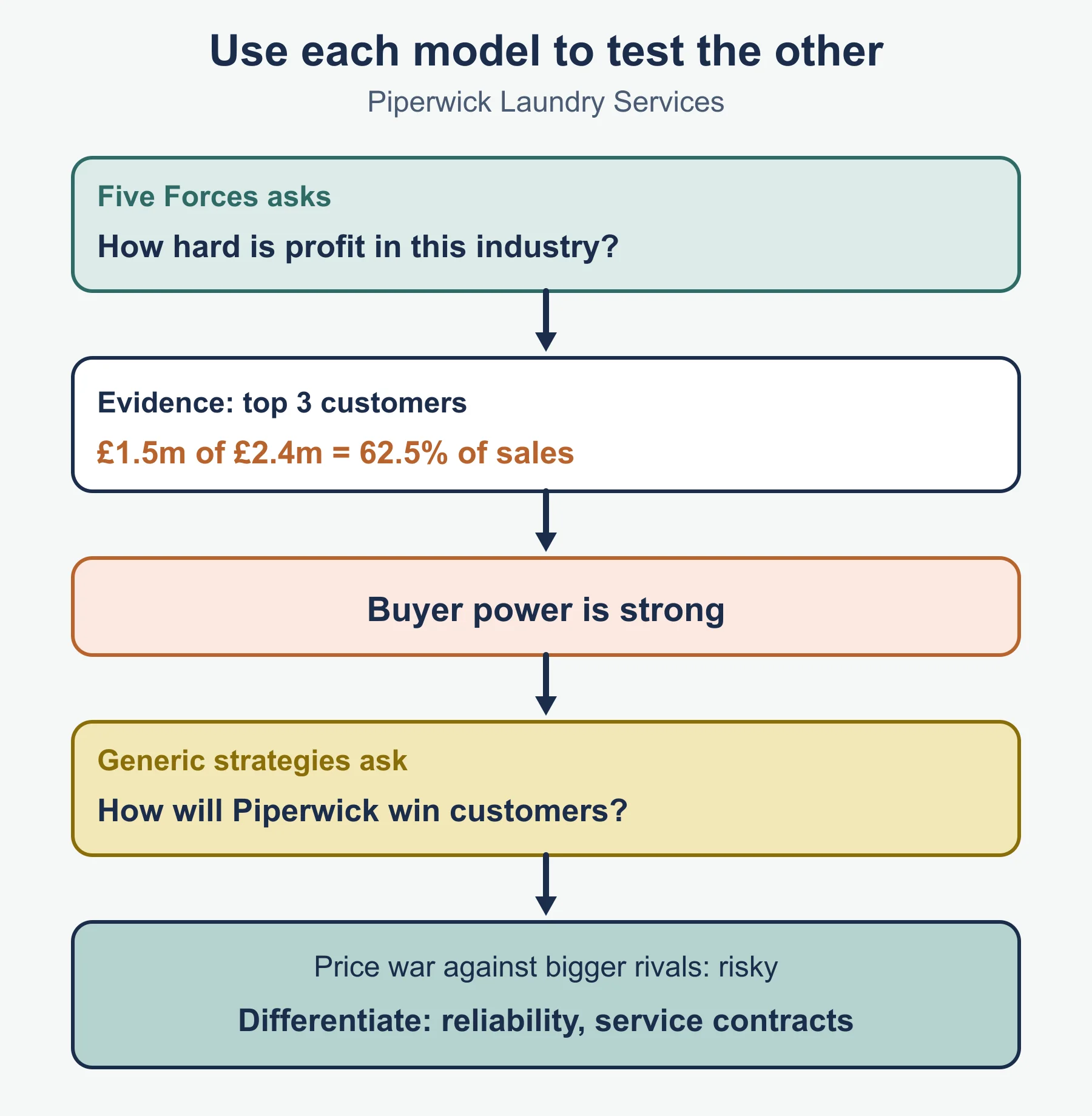
- Five Forces asks how hard it is to earn profit in the industry. Generic strategies ask how this business will win customers. Use one to test the other.
- Example link: strong buyer power makes a pure price strategy risky for a small supplier, so differentiating through service or reliability may be safer.
- For “evaluate” questions, use this order: point from the case, effect on the business or its stakeholders, counter-point, judgement that depends on a condition.
- For “explain” questions, define the model, then say what it is used for.
- Link back to the wider strategy notes when a question mixes Ansoff, SWOT or decision trees with these models.
Evaluation prompts to keep to hand
- Which force or strategy matters most here, and why?
- Is the evidence current, or could the market change quickly?
- Does the business have the capability to carry out the strategy?
- Which stakeholders gain or lose: owners, employees, customers, suppliers?
- What would change your conclusion?
Must-know distinctions
- Five Forces describes an industry; generic strategies describe a business’s choice.
- Low price is not the same as cost leadership. Cost leadership is about low cost.
- Focus is about scope (a narrow segment), not about size of firm.
- A strong force is a problem to manage, not a reason to give up.
Quick self-test
- Name the five forces in Porter’s model.
- What is the purpose of Five Forces?
- State two conditions that make buyer power strong.
- State two conditions that make the threat of new entrants weak.
- Name Porter’s generic strategies.
- What is the difference between differentiation and differentiation focus?
- Give one risk of a cost leadership strategy.
- A firm sells 8,000 units at £25 with unit cost £21. Calculate its total gross profit and gross margin.
- Give one reason why Five Forces may be of limited use to a business.
- Explain what is meant by competitive advantage.
Answers
- Rivalry among existing competitors, threat of new entrants, threat of substitutes, bargaining power of buyers, bargaining power of suppliers.
- To assess how attractive and profitable an industry is, and so guide decisions about entry and strategy.
- Any two: few large buyers; easy switching; standard product; buyers can make the product themselves.
- Any two: high start-up cost; economies of scale for existing firms; strong brand loyalty; difficult access to distribution; patents or other legal barriers.
- Cost leadership, differentiation and focus (cost focus or differentiation focus).
- Differentiation aims at the whole market; differentiation focus targets one narrow segment.
- Any one: a price war; a rival with lower costs; quality falling as costs are cut; loss of sales if a single cost cut is copied.
- Gross profit per unit is £4, so total gross profit is £32,000. Gross margin is 4/25 = 16%.
- Any one: it is a snapshot while markets change; it is about the industry, not the business; judging each force is subjective; it does not recommend action.
- A feature (such as lower costs or a valued difference) that lets a business do better than rivals, giving more customers, higher margins or both.
Where marks are usually lost
- Writing about one business’s strengths when the question asks about the industry.
- Naming the forces without linking each to evidence in the case.
- Treating all five forces equally instead of ranking them.
- Saying a force is “high” without explaining the effect on profit.
- Mistaking low prices for cost leadership.
- Describing a strategy without checking whether the business has the capability to deliver it.
- Evaluating the usefulness of a model with generic points that would fit any model.
- Giving a one-sided answer to “evaluate” or ending without a judgement.
- Forgetting to say what the business should do, or what could change the conclusion.
- Using the wrong term, such as “Boston matrix”, for a Porter model.
Frequently asked questions
What are Porter’s five forces? The five forces are rivalry among existing competitors, the threat of new entrants, the threat of substitutes, the bargaining power of buyers and the bargaining power of suppliers. A strong force reduces profit by pushing prices down or costs up.
What are Porter’s generic strategies? They are cost leadership and differentiation across the whole market, and cost focus and differentiation focus within a narrow segment. Each is a broad route to competitive advantage, and each needs different capabilities.
What is the difference between Five Forces and the generic strategies? Five Forces describes an industry and asks how hard it is to earn profit there. The generic strategies describe a business’s own choice of how it will win customers, so the two are often used together in OCR A Level Business (H431) answers.
Can a cost leader make as much profit as a differentiator? Yes. A cost leader usually earns a lower margin per unit but can make a similar or higher total profit by selling a much larger volume, so compare total gross profit as well as margin.
Official syllabus
OCR, A Level Business (H431), Version 2.1 (January 2026), for first assessment in 2017 with final assessment in summer 2027: area of study “Business objectives and strategic decisions”, section “Models of strategic choice”.
Get free revision emails (optional)
Occasional emails with practice questions, worked explanations and links to free resources for the qualification and subjects you choose. No spam, and you can unsubscribe from any email. The free tools on this site never need an email.
Related resources
-
Study guides
OCR A-Level Business: Objectives and Strategic Decisions (H431)
Mission, objectives, stakeholders, SWOT, Five Forces, Ansoff, decision trees and change for OCR A Level Business H431's Business objectives and strategy area.
Business · OCR · A Level
Read guide -
Study guides
OCR A Level Business: Risk and uncertainty and Opportunity cost (H431)
Study guide to risk and reward, quantifiable and unquantifiable risk, uncertainty and opportunity cost for OCR A Level Business, with worked examples.
Business · OCR · A Level
Read guide -
Practice questions
OCR A Level Business: Risk and uncertainty and Opportunity cost (H431) – Practice Questions
Ten original questions with worked answers on risk and reward, uncertainty and opportunity cost for OCR A Level Business, using invented businesses.
Business · OCR · A Level
Try questions
Related articles
-
teaching
A Level tuition in Dubai: Cambridge or Pearson Edexcel International A Level?
Schools in Dubai and Abu Dhabi teach either Cambridge International AS & A Level or Pearson Edexcel International A Level. How the two are structured, why it matters for tuition, and how online classes from Lahore work.
9 October 2026
-
curriculum guides
Choosing subjects at IGCSE and A Level
How subject choices at 14 and 16 affect university options later, and how to keep pathways open without overloading a timetable.
28 July 2026
Studying this with a teacher
Working through Business A LEVELS?
This page is free and stays free. If you would rather be taught it, Marlbridge runs Business classes one-to-one, online in your own time zone. One-to-one only for this course: Rs 6,000 per class in Pakistan, with other currencies on the fees page. The first trial class is free. WhatsApp replies within an hour (8am–11pm Pakistan time, every day); email the same day.
OCR Business teachers at Marlbridge
