
Study Guides
OCR A Level Business: Models of strategic choice (H431)
Study guide to Porter's Five Forces, Porter's generic strategies and competitive advantage for OCR A Level Business (H431), with worked examples.
- Subject
- Business
- Level
- A LEVELS
- Topic
- Business objectives and strategic decisions
- Author
- Marlbridge Academic Team
- Updated
- Reviewed by
- Salman Ahmad (what this means)
Aligned to OCR A Level Business (H431), Version 2.1 (January 2026), for first assessment in 2017; final assessment summer 2027. Official specification .
Syllabus page (what it covers and how it is assessed): OCR A Level Business.
Syllabus points this page covers
H431
- 1.10 Models of strategic choice
Found an error? Report a correction.
Need help with this topic? Request a free trial class for A Level Business (H431).
This guide is aligned to the OCR A Level Business (H431) specification, Version 2.1 (January 2026), section 1.10 “Models of strategic choice” in the area of study “Business objectives and strategic decisions”. The specification is for first assessment in 2017, with final assessment in summer 2027. It covers Porter’s Five Forces, Porter’s generic strategies and competitive advantage. The specification says techniques and models can be assessed in any appropriate context, so practise applying them to unfamiliar businesses.
Related pages: course hub, printable checklist, revision notes for this topic, practice questions for this topic, the wider objectives and strategic decisions guide, the strategy revision notes and the strategy practice set. To find your weak spots first, try the free diagnostics.
What the specification asks you to do
| Specification point (1.10) | Where it is taught below |
|---|---|
| Explain the nature and purpose of Porter’s Five Forces model | Five Forces: nature and purpose |
| Evaluate a business’s position or proposed position using Five Forces | Applying Five Forces |
| Evaluate the usefulness of Five Forces to a business | Usefulness of Five Forces |
| Explain the nature and purpose of Porter’s generic strategies | Generic strategies: nature and purpose |
| Evaluate a business’s position or proposed position using the generic strategies | Applying the generic strategies |
| Evaluate the usefulness of the generic strategies to a business | Usefulness of the generic strategies |
| Explain what is meant by competitive advantage | Competitive advantage |
Every point is an “explain” or an “evaluate”. Numbers in a case study are evidence, so the worked examples below use them.
Competitive advantage
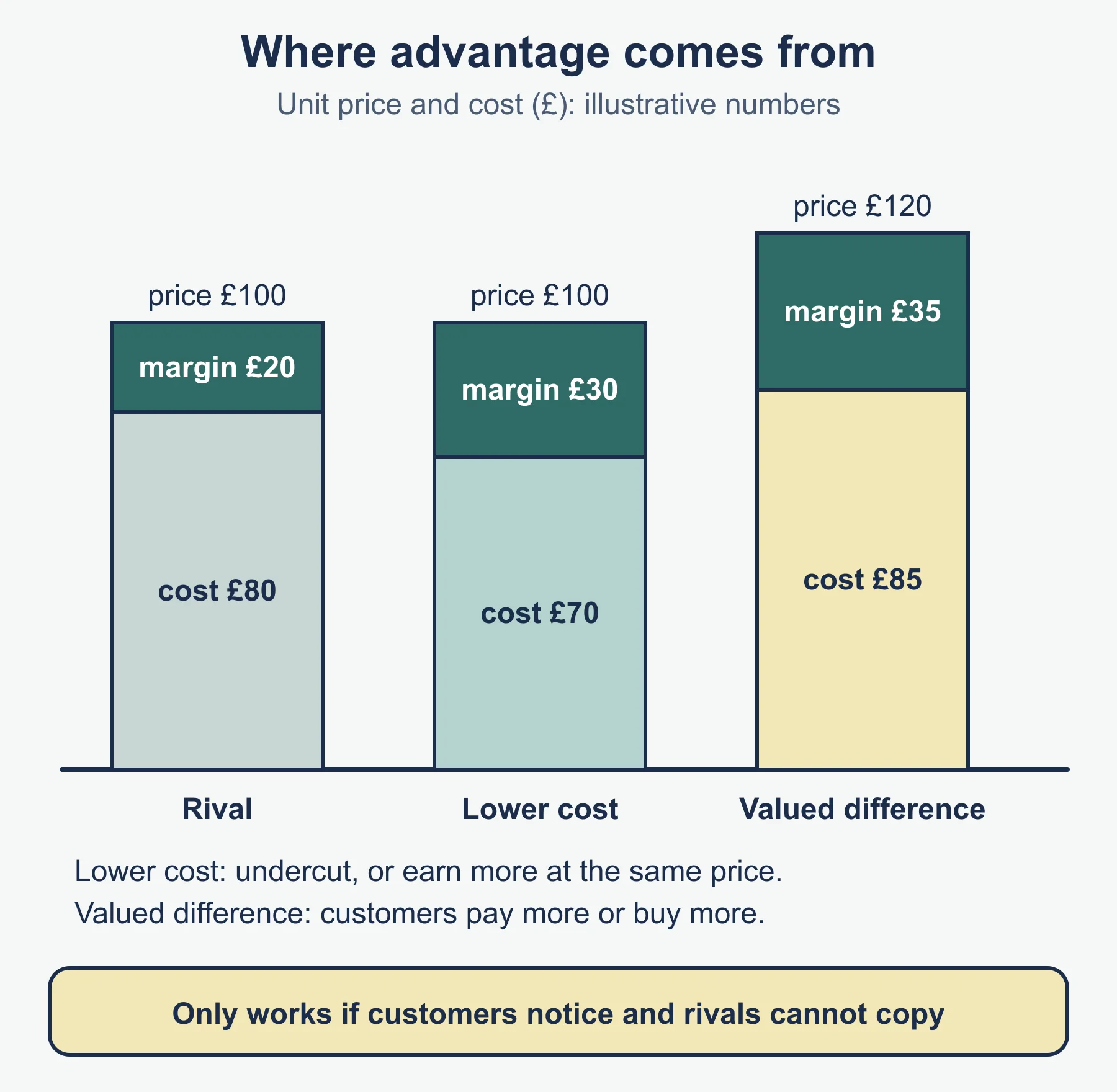
A business has a competitive advantage when it has a feature that lets it outperform its rivals in the same market. The result is usually more customers, higher margins or both. This is the standard sense of the term, not a quoted definition.
Two broad sources matter for the rest of this guide:
- Lower costs than rivals. The business can charge less and still earn a margin, or charge the same and earn more.
- Something customers value and rivals do not offer. Customers accept a higher price, or buy more, because of it.
An advantage only helps if customers notice it and rivals cannot copy it quickly. A patent, a strong brand or a skilled workforce can last. A price cut is easy to match. Porter’s two models give you a structured way to say where advantage can come from (the generic strategies) and how hard it is to earn profit in the market at all (Five Forces).
Porter’s Five Forces: nature and purpose
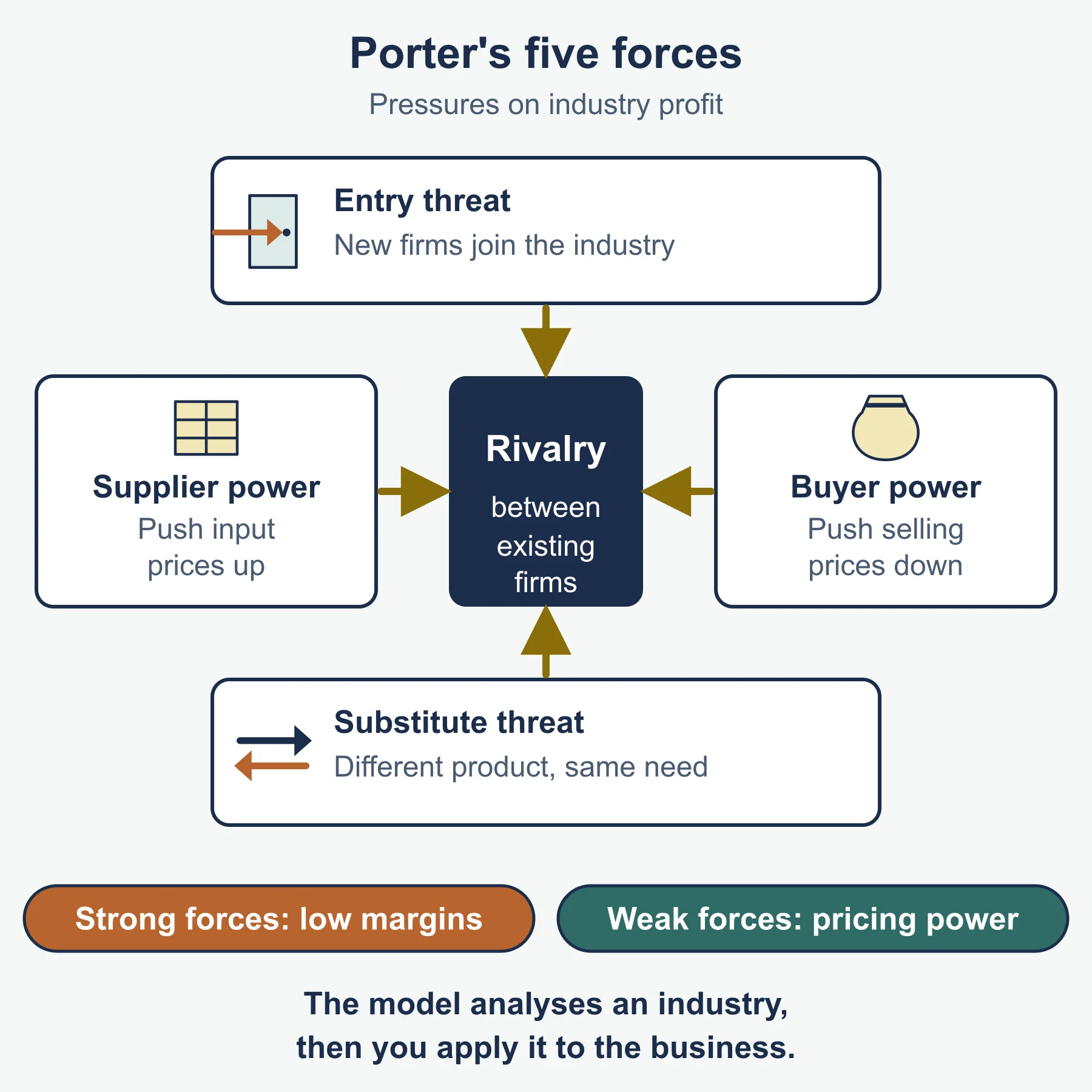
Nature. Porter’s Five Forces is an analytical framework that looks at the competitive pressures inside an industry. It names five forces:
- Rivalry among existing competitors.
- Threat of new entrants.
- Threat of substitutes.
- Bargaining power of buyers.
- Bargaining power of suppliers.
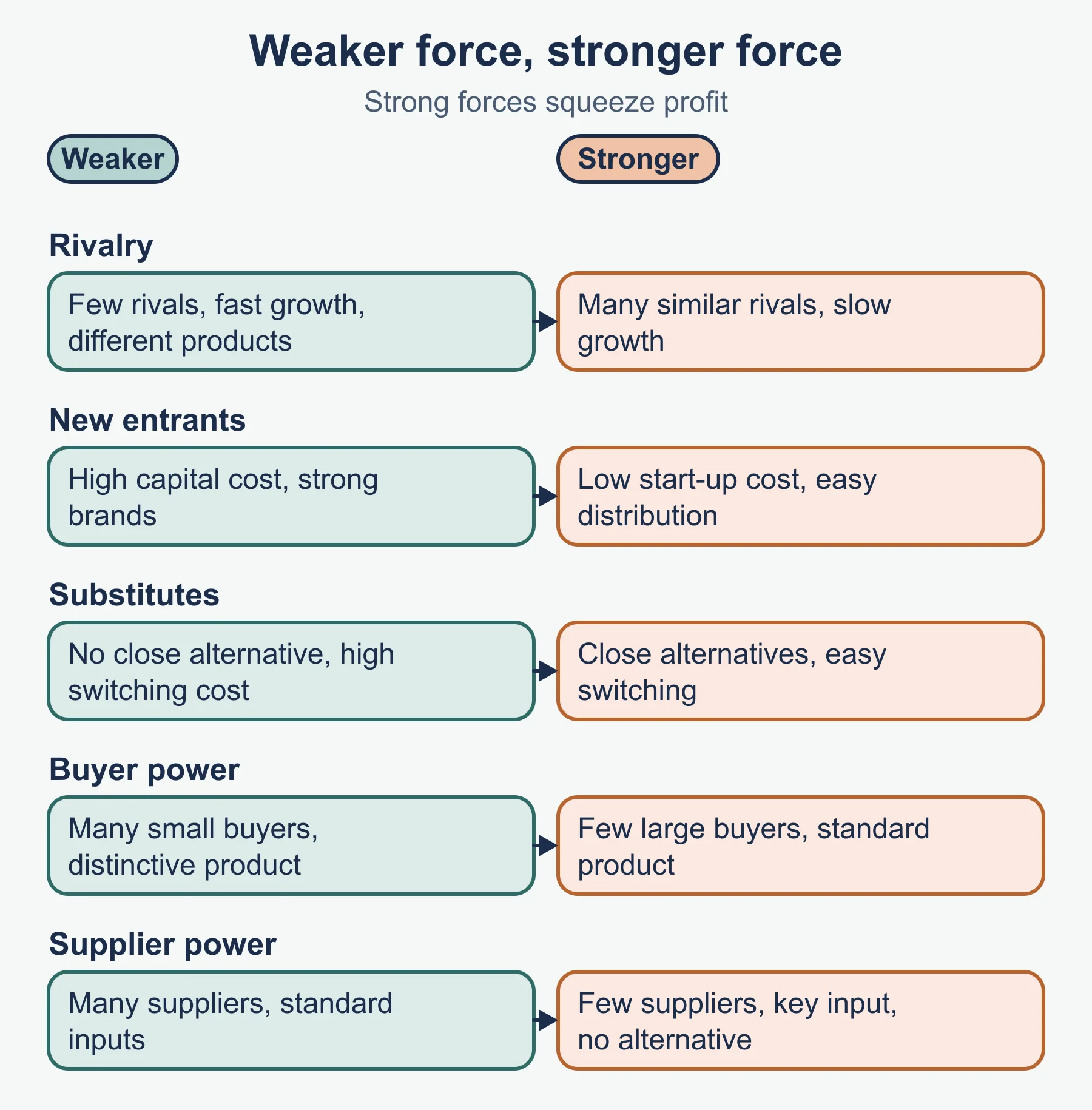
Purpose. The model helps a business judge how attractive an industry is and how much profit it can expect from it. Strong forces squeeze profit, because they push prices down or costs up. Weak forces leave room for margin. A business uses the result to decide whether to enter or stay in a market, and which strategy is likely to work.
Five Forces describes the industry. A business’s own strengths are a separate question, which is why it is often used alongside SWOT or the generic strategies.
What makes each force stronger
| Force | Stronger when | Weaker when |
|---|---|---|
| Rivalry | Many rivals of similar size; slow market growth; little to tell products apart; high exit costs | Few rivals; fast growth; differentiated products |
| New entrants | Low start-up cost; no brand loyalty; easy access to distribution | High capital cost; economies of scale; strong brands; legal or technical barriers |
| Substitutes | Close alternatives at similar or lower price; low cost of switching | No close alternative; high switching cost or strong loyalty |
| Buyer power | Few large buyers; buyers can switch easily; product is standard | Many small buyers; high switching costs; product is distinctive |
| Supplier power | Few suppliers; key input with no alternative; high cost to switch | Many suppliers; inputs are standard; business can switch or integrate |
These drivers are standard textbook factors, not listed in the specification.
Worked example: Piperwick Laundry Services
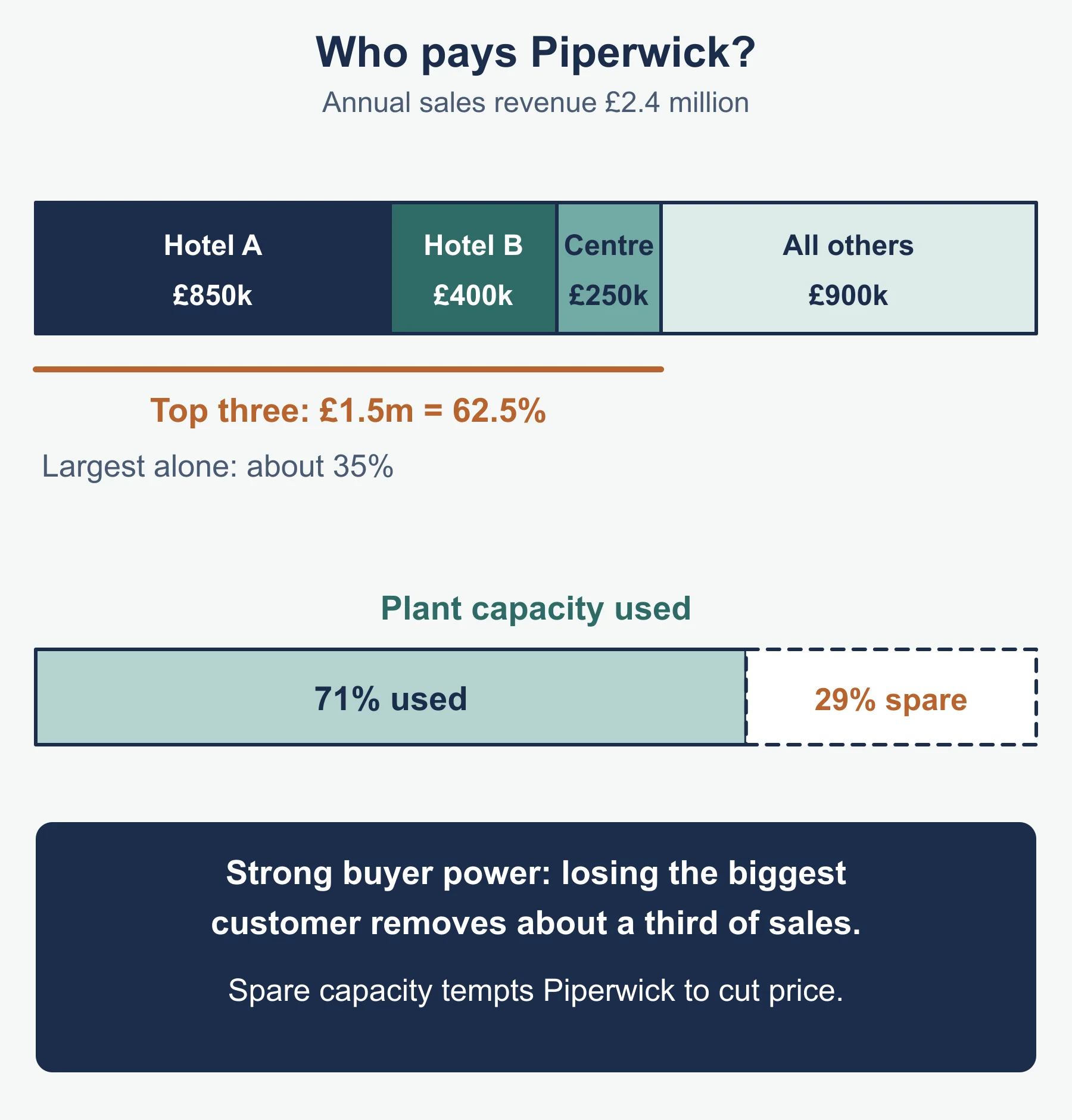
Piperwick Laundry Services cleans linen for hotels and guesthouses in a medium-sized coastal town. Annual sales revenue is £2.4 million. Its three largest customers (two hotel groups and a conference centre) pay £850,000, £400,000 and £250,000 a year. Its plant runs at 71% of capacity. A national laundry chain has just opened a depot 40 miles away. Piperwick buys detergent and machine servicing from a handful of specialist firms.
Step 1: work out the shares. The three customers pay £1,500,000 in total, which is 62.5% of revenue. The largest alone is about 35%.
Step 2: assess each force using evidence from the case.
- Buyer power: strong. Losing the biggest customer would remove about a third of sales revenue, so that customer can demand lower prices or faster service.
- Rivalry: moderate to strong. Spare capacity of 29% gives Piperwick a reason to cut prices to fill machines, and rivals with similar spare capacity may do the same.
- New entrants: moderate. Industrial machines need heavy investment, which protects Piperwick, but the chain’s depot shows that well-funded entrants can arrive.
- Substitutes: weak to moderate. Hotels could buy their own machines, though few have the space or staff.
- Supplier power: not enough information. A good answer says so and states what it would need, such as the number of alternative suppliers.
Step 3: reach a judgement. The industry is not highly attractive for a business this size. The strongest pressure comes from buyers, so the most useful response is to reduce dependence on three customers, for example by winning many smaller guesthouse contracts and offering longer contracts to the large ones.
Applying Five Forces: position and proposed position
The specification asks you to evaluate a business’s position (where it stands now) or proposed position (a market it plans to enter). The method is the same:
- Identify which forces the case gives evidence on.
- Rank them: which one limits profit most?
- Judge the overall attractiveness of the industry.
- Say what the business should do, and what could change the picture.
For a proposed move, ask whether the forces in the new market are weaker than in the current one. A market with strong rivalry and low entry costs may look big but offer little profit.
Usefulness of Five Forces
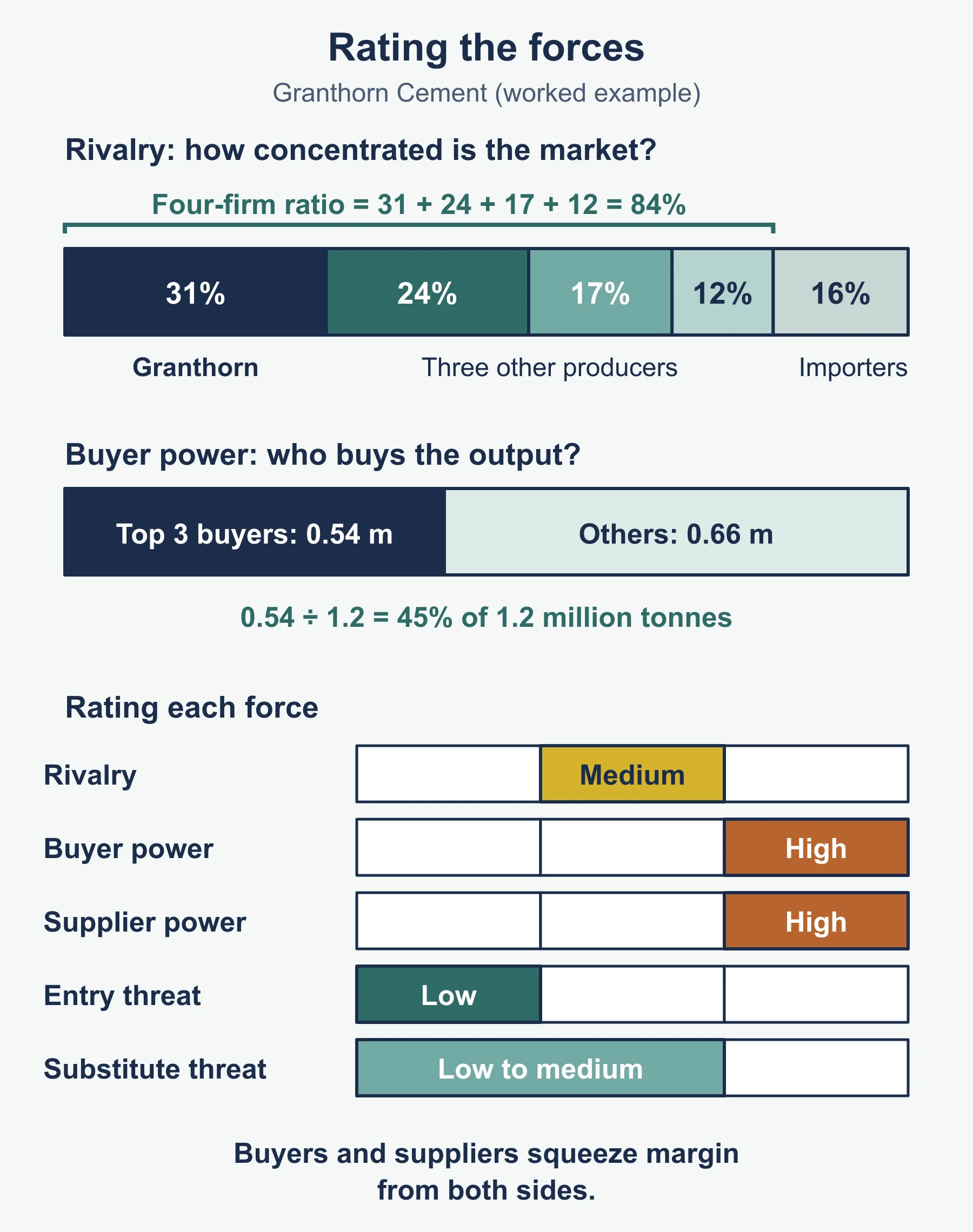
Evaluate usefulness by weighing both sides.
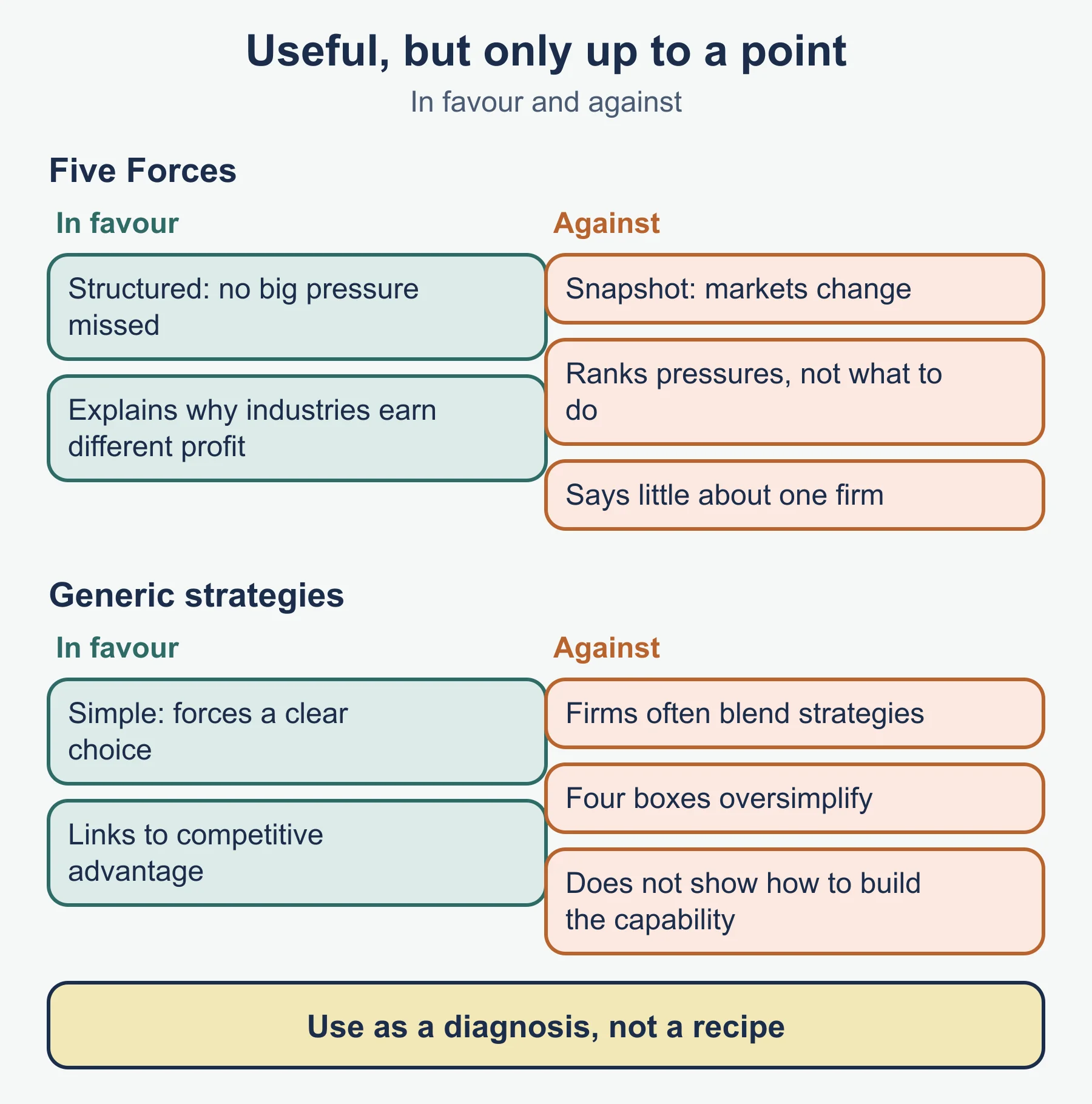
In favour: it is structured, so no major pressure is overlooked; it explains why some industries earn higher profit than others.
Against: it gives a snapshot, while markets change (new technology can reshape the forces quickly); it ranks pressures but does not say what to do; it treats the industry as the unit, so it says little about the strengths of an individual business; the strength of each force is a judgement, and managers can disagree.
Judgement. It is most useful as a first filter for entry decisions and for explaining low margins. It is less useful alone, so a convincing answer says what it should be combined with, for example SWOT and a forecast of how the forces will change.
Porter’s generic strategies: nature and purpose
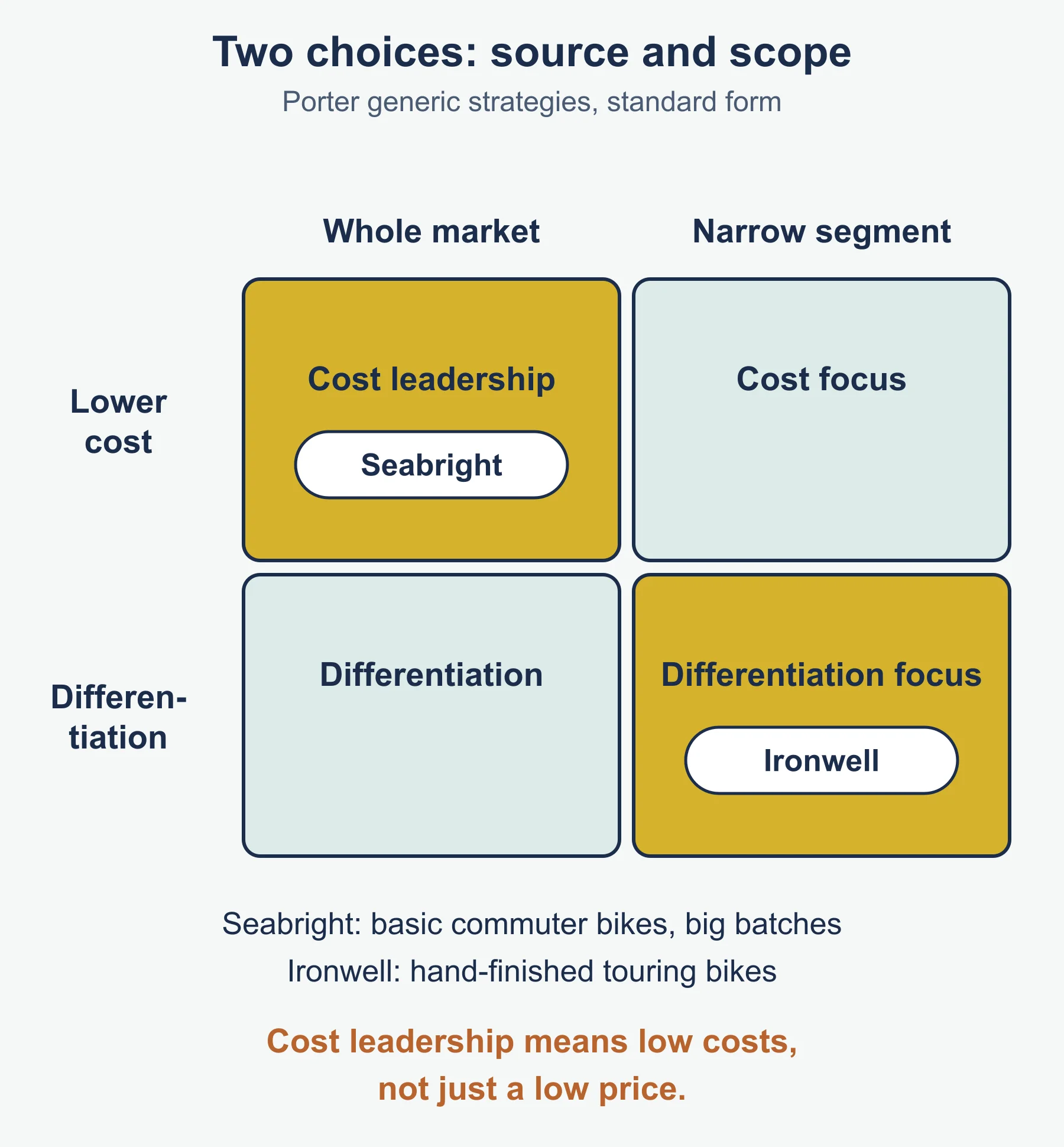
Nature. Porter’s generic strategies describe the broad ways a business can try to gain competitive advantage. This guide gives the standard form, which has two dimensions: the source of advantage (lower cost or differentiation) and the scope (the whole market or a narrow segment).
| Whole market | Narrow segment | |
|---|---|---|
| Lower cost | Cost leadership | Cost focus |
| Differentiation | Differentiation | Differentiation focus |
- Cost leadership: be the lowest-cost producer in the whole market. Methods include large-scale buying, high output, tight control of overheads and efficient processes. The business can then undercut rivals or earn a higher margin at market prices.
- Differentiation: offer something customers see as different and are willing to pay more for, such as design, quality, service or brand image. This needs spending on marketing or product development.
- Focus: concentrate on one segment, such as one age group, region or type of customer, and win it through either lower cost or differentiation.
Purpose. The strategies help a business choose a clear route to competitive advantage and align its operations, marketing and finance behind it. For the risk of mixing strategies, see “stuck in the middle” in the objectives and strategic decisions guide.
Worked example: Seabright Cycles and Ironwell Cycles
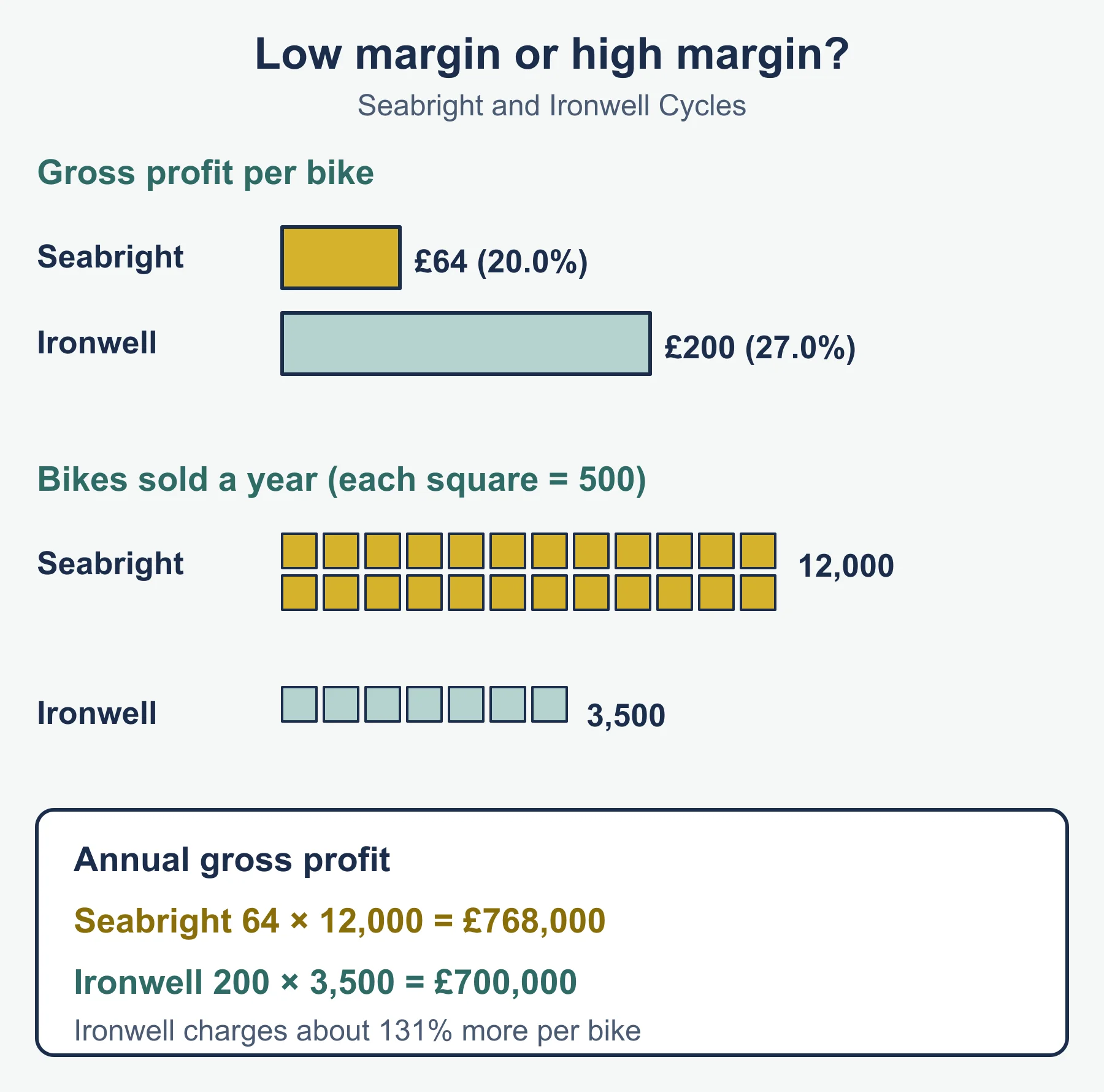
Seabright Cycles makes basic commuter bicycles in large batches. It sells 12,000 a year at £320 against a unit cost of £256. Ironwell Cycles makes hand-finished touring bikes. It sells 3,500 a year at £740 against a unit cost of £540.
| Seabright | Ironwell | |
|---|---|---|
| Gross profit per bike | £64 | £200 |
| Gross margin | 20.0% | 27.0% |
| Annual gross profit | £768,000 | £700,000 |
Ironwell charges about 131% more per bike. Seabright earns the lower margin but the higher total gross profit because it sells over three times as many. Seabright is following cost leadership; Ironwell is following differentiation focus (a narrow group of touring cyclists, won by quality).
Neither strategy is automatically better; each works only if the business delivers what it needs. Seabright needs volume and low cost, so a fall in sales hurts it more. Ironwell needs customers who keep valuing the finish, so a cheaper imitation could threaten it.
Applying the generic strategies: position and proposed position
To evaluate a position, follow these steps:
- Match the evidence to a strategy. Look at prices relative to rivals, unit costs, target market and what the business advertises.
- Check whether the business has what that strategy needs. A cost leader needs scale and efficiency; a differentiator needs something customers genuinely value.
- Look for conflicts. A business that claims both low price and premium quality may find costs rising while the price stays low.
- Weigh the risks: price wars for cost leaders, imitation and changing tastes for differentiators, a small or shrinking segment for focus businesses.
- Judge whether the strategy suits the market (use Five Forces for this) and recommend a change if not.
For a proposed position, test whether the business has the resources for the new strategy.
Usefulness of the generic strategies
In favour: it is simple and forces a clear choice; it links directly to competitive advantage; it helps align functions behind one aim; it gives a vocabulary for comparing rivals.
Against: real businesses often blend strategies, for instance by cutting costs and improving quality together; four boxes oversimplify, and “differentiation” covers many different things; it says little about how to build the capability to reach the strategy; it does not tell you whether the chosen market is profitable; markets and technology change faster than a chosen strategy.
Judgement. The strategies are useful as a way to diagnose what a business is trying to do, less useful as a recipe. A strong answer links the verdict to the case: a small firm with limited funds may benefit from the clarity of a focus strategy, while a large firm in a changing market needs more flexibility.
Linking the models
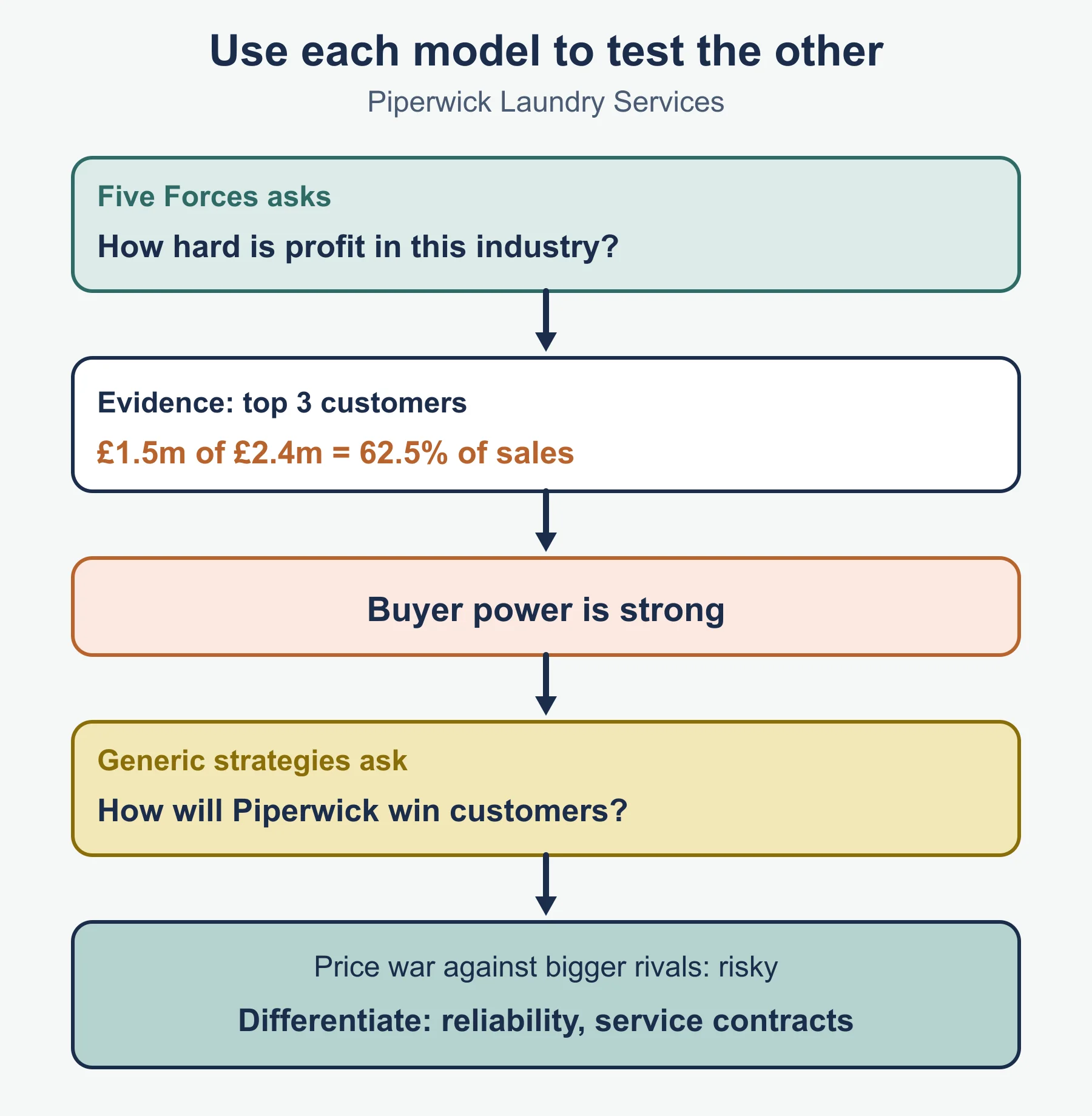
The two models answer different questions. Five Forces asks how hard it is to earn profit in this industry. The generic strategies ask how this business will win customers. In the Piperwick case, strong buyer power suggests differentiating through reliability and service contracts, because competing only on price against bigger rivals would be risky. Use each to test the other.
Common errors
- Using Five Forces to describe one business’s strengths. It describes the industry.
- Listing the five forces without evidence from the case.
- Calling any low-priced firm a cost leader. Cost leadership means low costs, not just low prices.
- Ending an evaluation without a judgement tied to the case.
Frequently asked questions
What is the difference between cost focus and differentiation focus? Both concentrate on a narrow segment, such as one age group, region or type of customer. Cost focus wins that segment through lower costs, while differentiation focus wins it through something customers value and will pay more for, such as quality or design.
Why is Five Forces often used alongside SWOT? Five Forces describes the industry, not the business itself. A business’s own strengths are a separate question, so the model is often combined with SWOT or the generic strategies in OCR A Level Business (H431) answers.
Can a business with a lower margin make more total profit? Yes. A cost leader may earn a lower margin per unit than a differentiator but make a higher total gross profit by selling a much larger volume, so neither strategy is automatically better.
Next steps
Use the revision notes, the practice questions and the checklist.
Official syllabus
OCR, A Level Business (H431), Version 2.1 (January 2026), for first assessment in 2017 with final assessment in summer 2027: area of study “Business objectives and strategic decisions”, section “Models of strategic choice”.
Get free revision emails (optional)
Occasional emails with practice questions, worked explanations and links to free resources for the qualification and subjects you choose. No spam, and you can unsubscribe from any email. The free tools on this site never need an email.
Related resources
-
Practice questions
OCR A Level Business: Models of strategic choice (H431) – Practice Questions
Original practice questions with worked answers on Porter's Five Forces, generic strategies and competitive advantage for OCR A Level Business (H431).
Business · OCR · A Level
Try questions -
Revision notes
OCR A Level Business: Models of strategic choice (H431) – Revision Notes
Condensed revision notes on Porter's Five Forces, generic strategies and competitive advantage for OCR A Level Business (H431), with a self-test.
Business · OCR · A Level
Revise topic -
Study guides
OCR A-Level Business: Objectives and Strategic Decisions (H431)
Mission, objectives, stakeholders, SWOT, Five Forces, Ansoff, decision trees and change for OCR A Level Business H431's Business objectives and strategy area.
Business · OCR · A Level
Read guide
Related articles
-
teaching
A Level tuition in Dubai: Cambridge or Pearson Edexcel International A Level?
Schools in Dubai and Abu Dhabi teach either Cambridge International AS & A Level or Pearson Edexcel International A Level. How the two are structured, why it matters for tuition, and how online classes from Lahore work.
9 October 2026
-
curriculum guides
Choosing subjects at IGCSE and A Level
How subject choices at 14 and 16 affect university options later, and how to keep pathways open without overloading a timetable.
28 July 2026
Studying this with a teacher
Working through Business A LEVELS?
This page is free and stays free. If you would rather be taught it, Marlbridge runs Business classes one-to-one, online in your own time zone. One-to-one only for this course: Rs 6,000 per class in Pakistan, with other currencies on the fees page. The first trial class is free. WhatsApp replies within an hour (8am–11pm Pakistan time, every day); email the same day.
OCR Business teachers at Marlbridge
