
Revision Notes
OCR A Level Business: Contingency planning and crisis management (H431) – Revision Notes
Condensed revision notes on contingency planning and crisis management for OCR A Level Business H431, with a quick self-test and common mark losses.
- Subject
- Business
- Level
- A LEVELS
- Topic
- Business objectives and strategic decisions
- Author
- Marlbridge Academic Team
- Updated
- Reviewed by
- Salman Ahmad (what this means)
Aligned to OCR A Level Business (H431), Version 2.1 (January 2026), for first assessment in 2017; final assessment summer 2027. Official specification .
Syllabus page (what it covers and how it is assessed): OCR A Level Business.
Syllabus points this page covers
H431
- 1.9 Contingency planning and crisis management
Found an error? Report a correction.
Need help with this topic? Request a free trial class for A Level Business (H431).
These notes condense the content heading Contingency planning and crisis management from the OCR A Level Business (H431) specification, Version 2.1 (January 2026), in the area of study Business objectives and strategy. Full explanations and worked examples are in the study guide. Test yourself with the practice questions.
Related pages: the Objectives and Strategic Decisions guide, the strategy revision notes and the strategy practice set. Course pages: OCR A Level Business hub and checklist. Not sure where you stand? Take a free diagnostic.
The six things to be able to do
| Point | One-line reminder |
|---|---|
| Nature and purpose of contingency planning | Prepared in advance for unlikely, damaging events; cuts harm and speeds recovery |
| Advantages and disadvantages, business and stakeholders | Faster response and protection against cost, time and effort; cannot cover everything |
| Impact and importance, business and stakeholders | Depends on likelihood, severity, dependence, size, sector, quality of plan |
| Recommend and justify a plan | Specific actions, tied to the case, with a reasoned judgement |
| Nature and purpose of crisis management | Handling the event during and after it; limit harm, keep trust, recover |
| Evaluate a business’ crisis management | Judge speed, honesty, priorities, control, cost, recovery, learning |
Definitions
- Contingency plan: a set of actions prepared in advance for an unexpected event that could disrupt the business. Standard definition.
- Contingency planning: the process of identifying such events, assessing them and preparing responses.
- Crisis: a serious, usually sudden event that threatens survival, reputation or normal running and needs urgent decisions. Standard definition.
- Crisis management: how a business responds during and after a crisis.
- Stakeholders: individuals or groups with an interest in the business, such as owners, employees, customers, suppliers, lenders and the local community.
Must-know distinctions
| Contingency planning | Crisis management | |
|---|---|---|
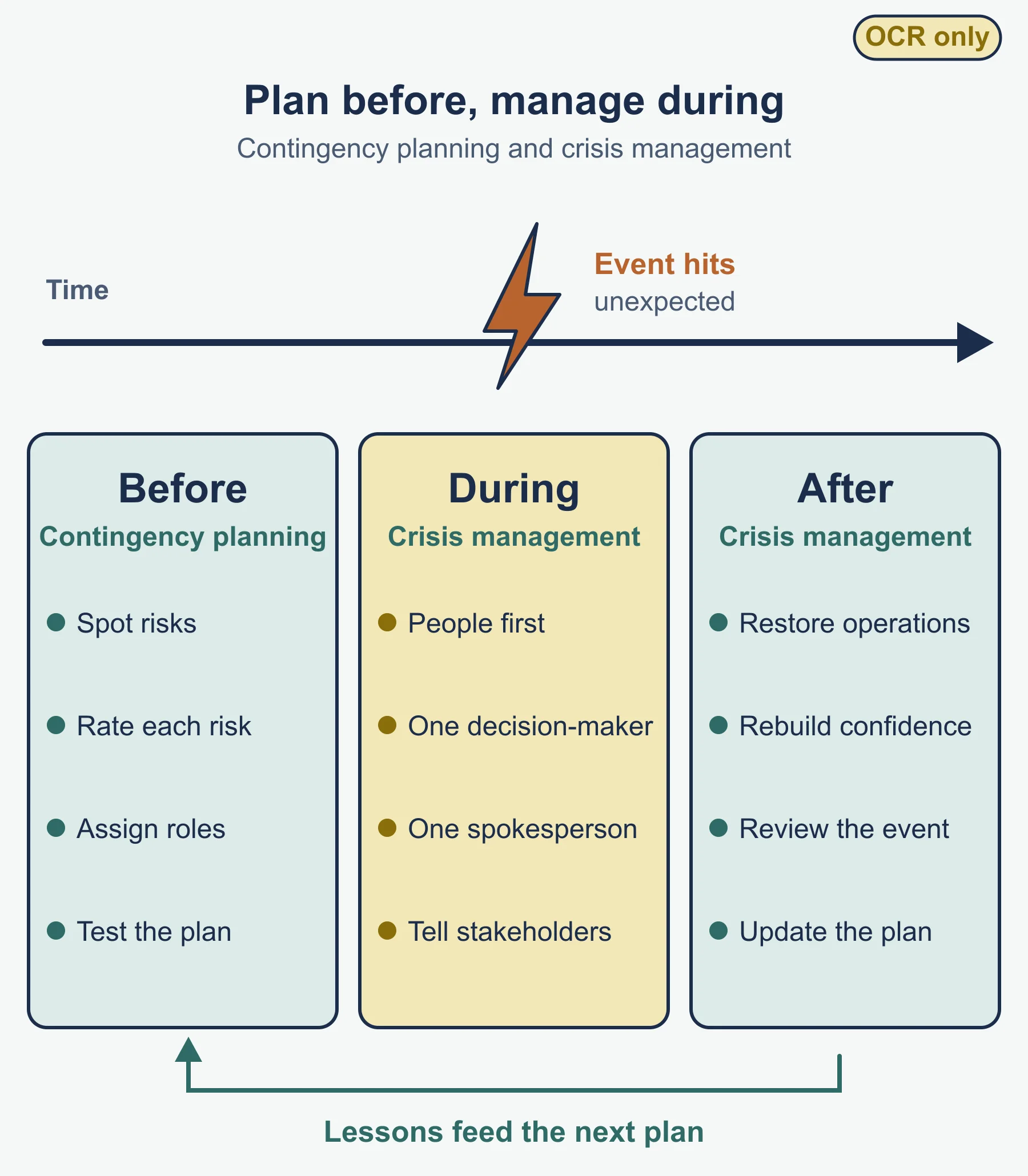
| When | Before the event | During and after the event |
| Main activity | Predicting, preparing, rehearsing | Deciding, communicating, containing, recovering |
| Needs | Time, money, imagination | Speed, clear leadership, honest messages |
| Weakness | Event may not match the plan | Poor decisions under pressure if unprepared |
| Link | A good plan makes the response faster | Lessons feed back into the plan |
Also keep these apart:
- Risk that can be measured and uncertainty that cannot. Contingency plans are partly a response to the second.
- Prevention (stop the event) and mitigation (reduce its effect). Insurance transfers cost but does not repair reputation or keep customers.
- Impact (what difference the plan makes) and importance (how much it matters).
Method: preparing a contingency plan (standard approach)
- Identify possible disruptive events.
- Rate each for likelihood and severity.
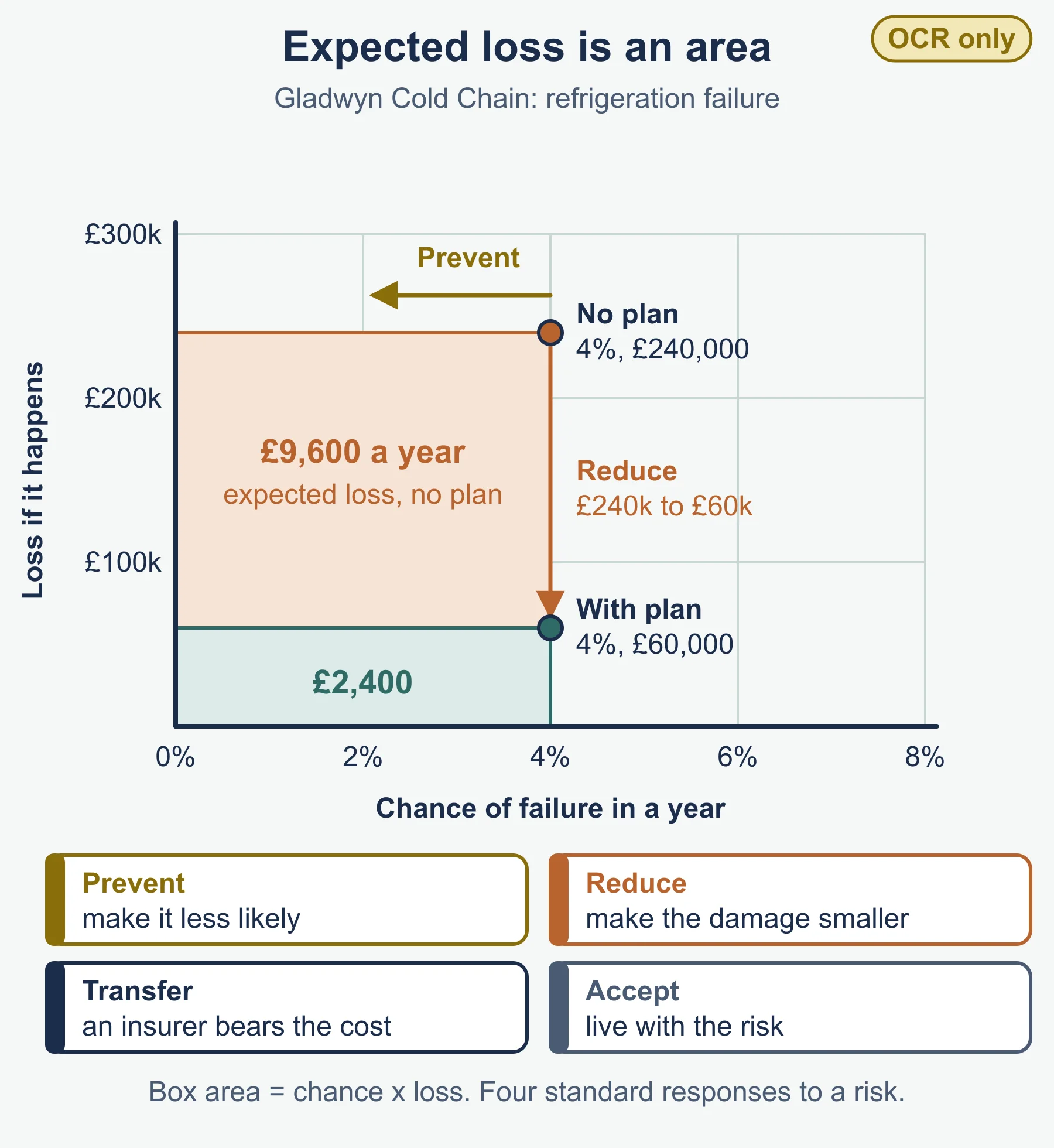
- Choose a response: prevent, reduce, transfer or accept.
- Assign roles, resources and a trigger for action.
- Plan communication with each stakeholder group.
- Test, review and update.
Advantages and disadvantages: recall list
Advantages: quicker, calmer response; less lost sales revenue; protects customers and contracts; protects jobs; may help with insurance or customer requirements; reveals weak points.
Disadvantages: cost and management time every year; cannot cover every event; may go out of date; may not be tested; false confidence; opportunity cost.
Stakeholder angle: link each group to a specific effect. Owners (value protected, profit reduced by cost), employees (security, extra training), customers (continuity, possible higher prices), suppliers (stable orders, new demands), lenders (lower default risk).
Impact and importance: the checklist
Ask these five questions of any case:
- How likely and how severe is the event?
- How dependent is the business on one site, supplier, system or person?
- How large and well resourced is the business?
- Are people’s safety or perishable goods involved?
- Is the plan realistic, tested and understood by those who must use it?
Small worked reminder: expected loss
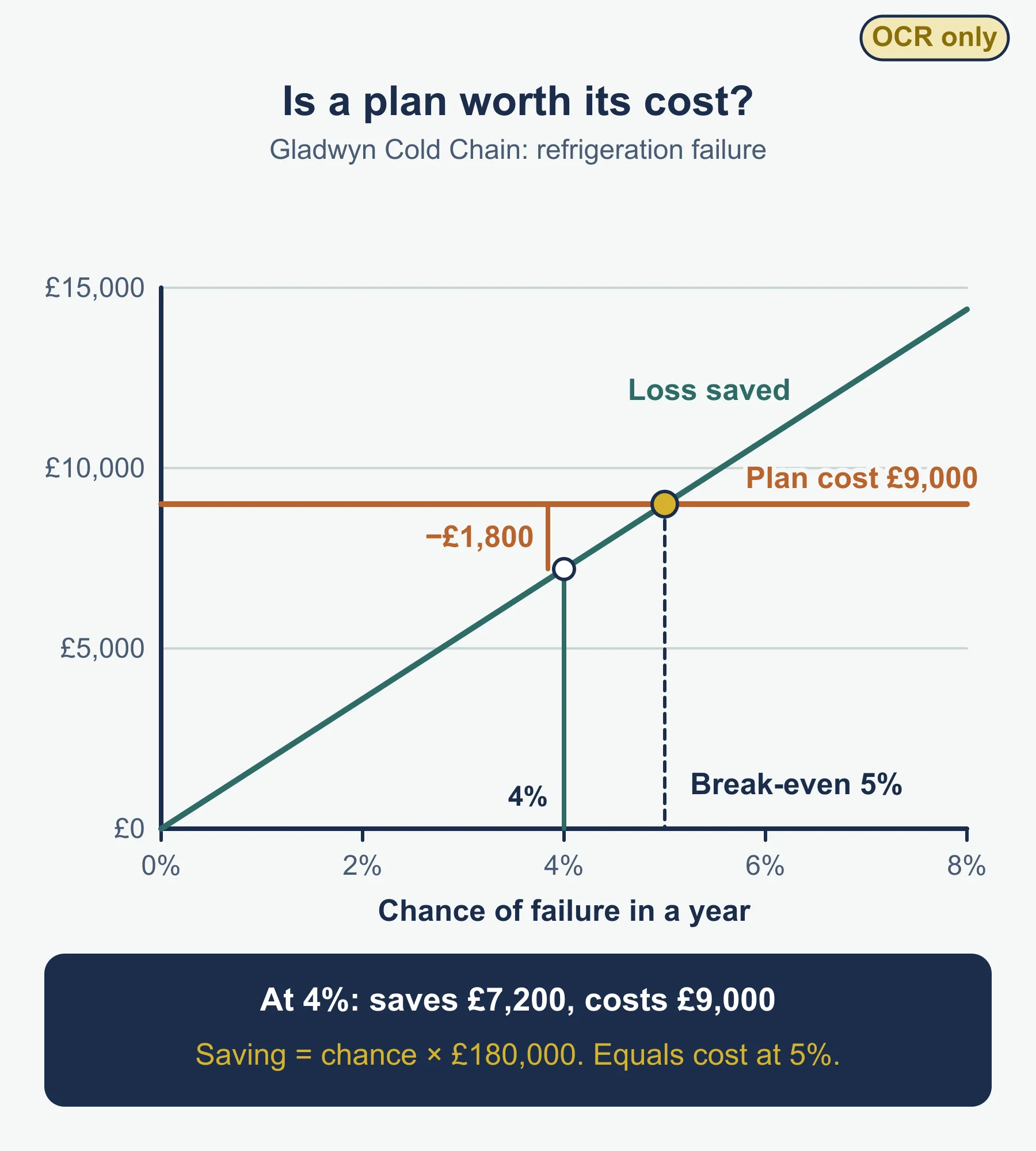
A standard comparison is expected loss = probability x loss. It is not an OCR formula, so state it as a standard approach.
| Event | Probability per year | Loss if it happens | Expected loss |
|---|---|---|---|
| A: supplier failure | 10% | £30,000 | £3,000 |
| B: warehouse fire | 2% | £400,000 | £8,000 |
| C: payment-system outage | 25% | £8,000 | £2,000 |
Event B has the highest expected loss, although it is the least likely. Suppose a £5,500-a-year plan cuts B’s loss to £150,000. The new expected loss is 0.02 x £150,000 = £3,000. The saving is £8,000 - £3,000 = £5,000, which is £500 less than the plan’s cost. Numbers alone would not support the plan, but a fire could end the business, so a judgement might still favour a cheaper version.
Always follow the sum with a comment on what it leaves out: reputation, safety, the accuracy of the probability, and whether the loss could be larger than estimated.
Events and typical responses
Use this table to generate specific ideas for a “recommend” answer. Adapt each to the case; do not copy it.
| Event | Prevent or reduce | Prepare to respond |
|---|---|---|
| Fire at the only site | Fire detection, safe storage | Alternative premises, copies of records off site, insurance |
| Supplier fails or is delayed | A second approved supplier, buffer stock | Pre-agreed emergency orders, customer messages |
| Cyber-attack | Staff training, access controls | Tested backups, a named recovery contact |
| Key person leaves suddenly | Shared knowledge, documented procedures | Named deputy, interim cover |
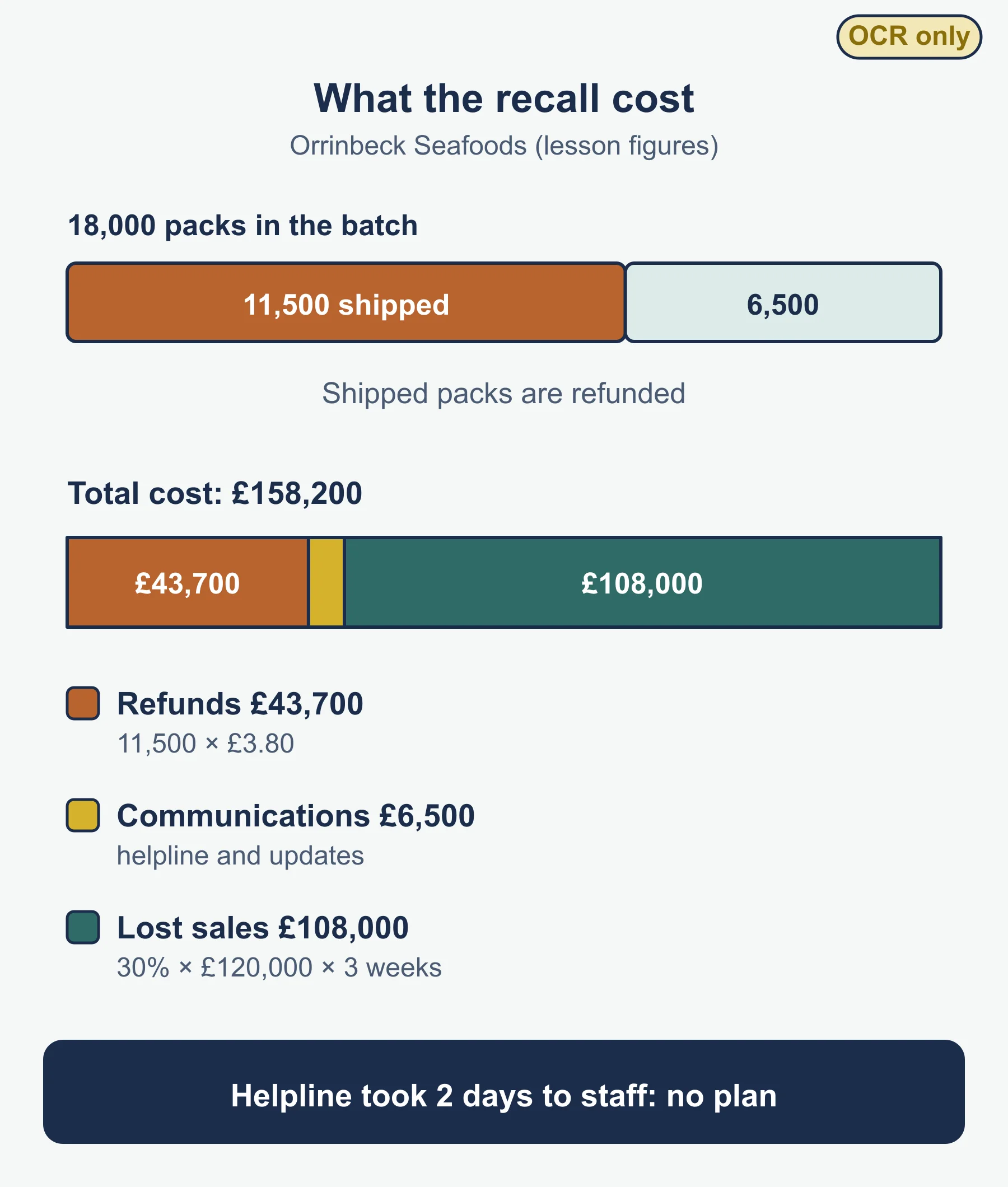
| Faulty product | Quality checks, traceability | Recall procedure, helpline, refund policy |
Communication in a crisis
Each stakeholder group needs a different message, so a plan should say who tells whom.
- Employees: what has happened, what to do, who to ask. Hearing it from the business first limits rumour.
- Customers: what is affected, what the business is doing, what they should do.
- Suppliers and lenders: how payments and orders will be handled, so they stay supportive.
- Media and the public: one spokesperson, factual statements, no guessing about causes.
Method: recommend and justify a plan
- Choose the most serious realistic risk in the case.
- Name specific actions (what, who, how quickly, at what cost).
- Use case evidence to justify: figures, dependence, customer expectations.
- Compare with an alternative and say why you reject it.
- Note a limit or risk.
- Give a one-sentence judgement.
Method: evaluate crisis management
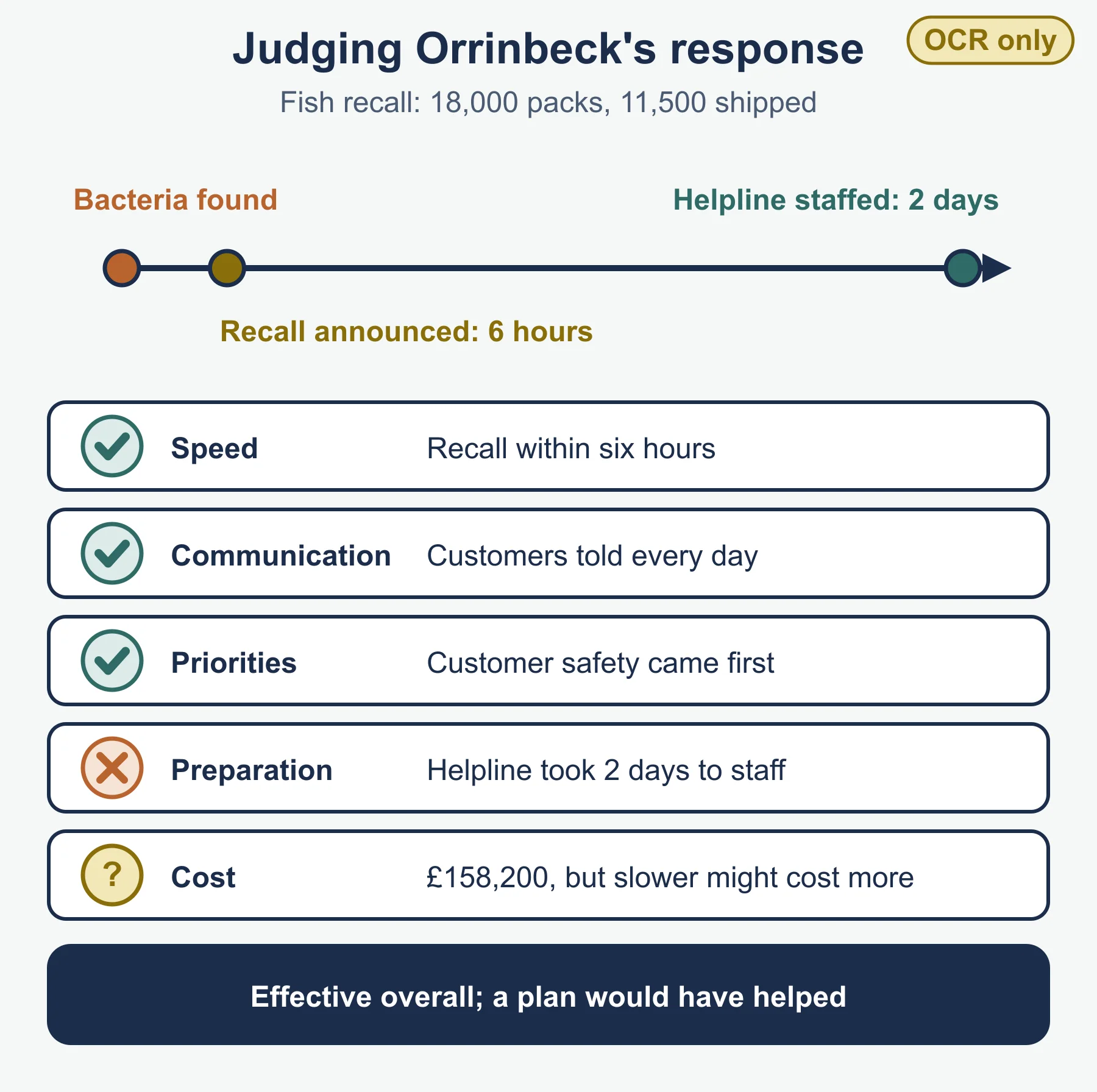
Score the response against these seven criteria, using evidence from the case:
- Speed
- Honesty and clarity of communication
- Safety and people first
- Clear control and roles
- Cost against harm avoided
- Speed and extent of recovery
- Learning afterwards
Then decide how effective it was overall, and say what depends on the time frame. A response can look expensive now yet protect the business over several years. Avoid judging only by outcome.
Quick self-test
- Define a contingency plan.
- State whether contingency planning takes place before or after an event.
- Give two examples of events a business might plan for.
- Give one advantage and one disadvantage of contingency planning to a business.
- Name two stakeholder groups and one way a plan affects each.
- A business estimates a 5% chance of a £120,000 loss each year. Calculate the expected annual loss.
- A plan would cut that loss to £30,000 and costs £2,500 a year. Calculate the net annual benefit using expected loss.
- Give one reason why a plan might be less valuable to a business than the figures suggest.
- State two things that good crisis management usually involves.
- Give two criteria for judging how well a business handled a crisis.
Answers
- A set of actions prepared in advance for an unexpected event that could disrupt the business.
- Before.
- For example fire, cyber-attack, supplier failure, loss of a key person, product fault.
- For example: faster recovery (advantage); cost and time to prepare and keep up to date (disadvantage).
- For example: employees, who gain security or clearer instructions; customers, who keep receiving orders.
- 0.05 x £120,000 = £6,000.
- Expected loss after: 0.05 x £30,000 = £1,500. Saving £4,500. Less cost £2,500 gives £2,000 net benefit per year.
- For example: the probability is only an estimate; the plan may be untested or out of date; the event may not match the plan.
- For example: quick, honest communication; clear leadership; putting people’s safety first; containing the problem.
- For example: speed of response; honesty of communication; recovery time; cost against harm avoided.
Where marks are usually lost
- Writing that a contingency plan is used after the event.
- Describing contingency planning in general without using the business in the case.
- Listing advantages and disadvantages with no weighing or judgement.
- Naming stakeholders but not saying how they are affected.
- Calculating expected loss and stopping, with no comment on what the figure leaves out.
- Recommending “insurance and a backup” for every business without saying which, how and why.
- Judging crisis management only by whether things turned out well.
- Praising a response without stating a criterion, such as speed or honesty.
- Ignoring the size of the business when judging how affordable a plan is.
- Giving a conclusion that repeats the question instead of answering it.
Frequently asked questions
When is a contingency plan used? A contingency plan is prepared in advance and written down, then activated when an unexpected event happens. Describing it as something done after the event is a common error.
How do you calculate expected loss? Expected loss = probability × loss, which is a standard way to organise the thinking rather than a formula named in the specification. Then comment on what the figure leaves out, such as lost customer trust.
Is “insurance and a backup” a good contingency plan answer? Only if you say which backup, how it would work, who would trigger it and why it suits this business. The same generic answer for every business scores poorly.
Does a business’s size matter when judging a contingency plan? Yes. A large firm can afford specialist planning, while for a small firm even a simple plan is a real cost, though it may have less cushion if it is hit.
Official syllabus
These notes follow the OCR A Level in Business (H431) specification, Version 2.1 (January 2026), published by OCR, content heading Contingency planning and crisis management within Business objectives and strategy.
Get free revision emails (optional)
Occasional emails with practice questions, worked explanations and links to free resources for the qualification and subjects you choose. No spam, and you can unsubscribe from any email. The free tools on this site never need an email.
Related resources
-
Study guides
OCR A Level Business: Decision making and Decision trees (H431)
Study guide to OCR A Level Business decision making and decision trees: decision types, tools, expected values, worked trees and evaluation.
Business · OCR · A Level
Read guide -
Practice questions
OCR A Level Business: Decision making and Decision trees (H431) – Practice Questions
Original OCR A Level Business practice questions with worked answers on decision types, tools, expected values and evaluating decision trees.
Business · OCR · A Level
Try questions -
Revision notes
OCR A Level Business: Decision making and Decision trees (H431) – Revision Notes
Condensed OCR A Level Business revision notes on decision types, decision-making tools, expected values and evaluating decision trees.
Business · OCR · A Level
Revise topic
Related articles
-
teaching
A Level tuition in Dubai: Cambridge or Pearson Edexcel International A Level?
Schools in Dubai and Abu Dhabi teach either Cambridge International AS & A Level or Pearson Edexcel International A Level. How the two are structured, why it matters for tuition, and how online classes from Lahore work.
9 October 2026
-
curriculum guides
Choosing subjects at IGCSE and A Level
How subject choices at 14 and 16 affect university options later, and how to keep pathways open without overloading a timetable.
28 July 2026
Studying this with a teacher
Working through Business A LEVELS?
This page is free and stays free. If you would rather be taught it, Marlbridge runs Business classes one-to-one, online in your own time zone. One-to-one only for this course: Rs 6,000 per class in Pakistan, with other currencies on the fees page. The first trial class is free. WhatsApp replies within an hour (8am–11pm Pakistan time, every day); email the same day.
OCR Business teachers at Marlbridge
